Solving linear equation systems using direct
methods:
Gauss Jordan and Aitken methods
Presented by: Sulaiman M. KARIM
Student No: 4013031617
E-mail: Sulaiman_musaria@yahoo.Com
Outlines
 INTRODUCTION
 METHODS OF SOLUTION
 GAUSS - JORDAN METHOD
LINEAR SYSTEM OF EQUATIONS
 GAUSS - JORDAN METHOD THEORY
EXAMPLES
AITKEN METHOD
EXAMPLES
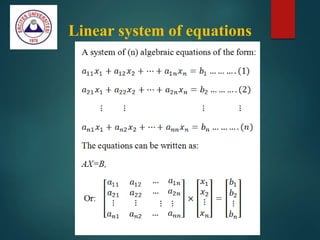
A system of equations is a collection of two or more
equations with a same set of unknowns (x1,x2,… xn).
In solving a system of equations, we try to find
values for each of the unknowns ,that will satisfy
every equation in the system. The equations in the
system can be linear or non-linear. Here we are
interested in solving linear equations systems using
two direct methods:
1- Gauss Jordan method
2- Aitkem method
Introduction
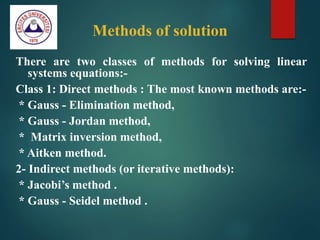
There are two classes of methods for solving linear
systems equations:-
Class 1: Direct methods : The most known methods are:-
* Gauss - Elimination method,
* Gauss - Jordan method,
* Matrix inversion method,
* Aitken method.
2- Indirect methods (or iterative methods):
* Jacobi’s method .
* Gauss - Seidel method .
Methods of solution
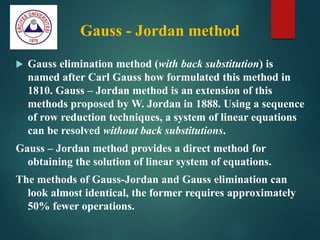
 Gauss elimination method (with back substitution) is
named after Carl Gauss how formulated this method in
1810. Gauss – Jordan method is an extension of this
methods proposed by W. Jordan in 1888. Using a sequence
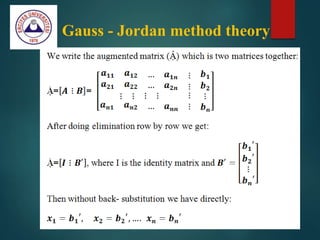
of row reduction techniques, a system of linear equations
can be resolved without back substitutions.
Gauss – Jordan method provides a direct method for
obtaining the solution of linear system of equations.
The methods of Gauss-Jordan and Gauss elimination can
look almost identical, the former requires approximately
50% fewer operations.
Gauss - Jordan method
Linear system of equations
Gauss - Jordan method theory
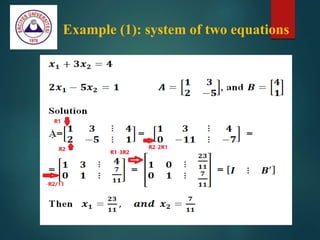
Example (1): system of two equations
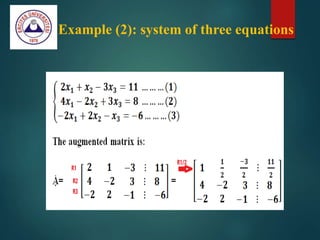
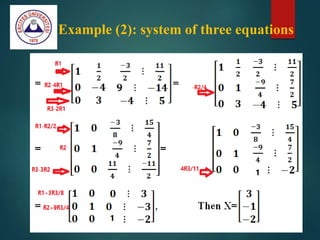
Example (2): system of three equations
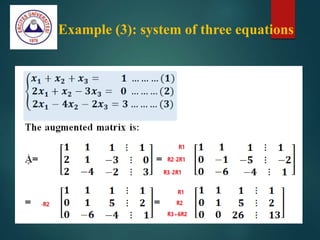
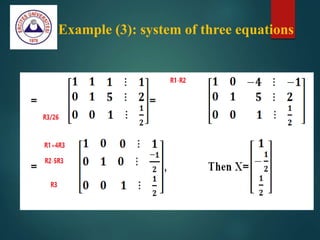
Example (3): system of three equations
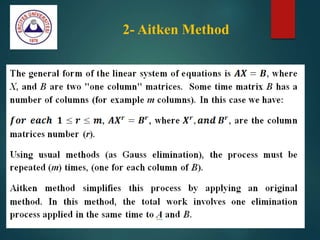
2- Aitken Method
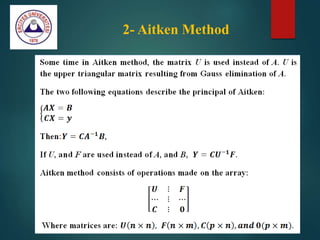
2- Aitken Method
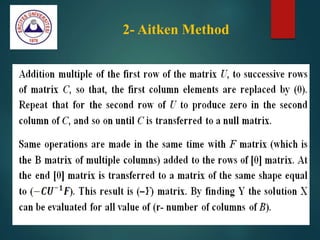
2- Aitken Method
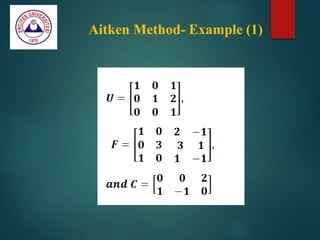
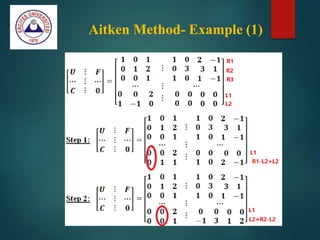
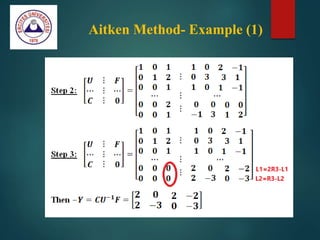
Aitken Method- Example (1)
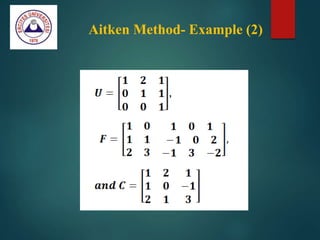
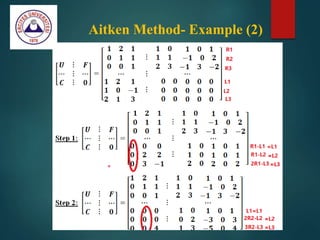
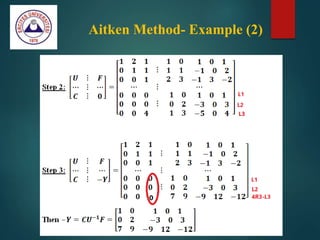
Aitken Method- Example (2)
Solving linear equation systems using direct  methods:Gauss Jordan and Aitken methods

Solving linear equation systems using direct methods: Gauss Jordan and Aitken methods

  • 1.
    Solving linear equationsystems using direct methods: Gauss Jordan and Aitken methods Presented by: Sulaiman M. KARIM Student No: 4013031617 E-mail: Sulaiman_musaria@yahoo.Com
  • 2.
    Outlines  INTRODUCTION  METHODSOF SOLUTION  GAUSS - JORDAN METHOD LINEAR SYSTEM OF EQUATIONS  GAUSS - JORDAN METHOD THEORY EXAMPLES AITKEN METHOD EXAMPLES
  • 3.
    A system ofequations is a collection of two or more equations with a same set of unknowns (x1,x2,… xn). In solving a system of equations, we try to find values for each of the unknowns ,that will satisfy every equation in the system. The equations in the system can be linear or non-linear. Here we are interested in solving linear equations systems using two direct methods: 1- Gauss Jordan method 2- Aitkem method Introduction
  • 4.
    There are twoclasses of methods for solving linear systems equations:- Class 1: Direct methods : The most known methods are:- * Gauss - Elimination method, * Gauss - Jordan method, * Matrix inversion method, * Aitken method. 2- Indirect methods (or iterative methods): * Jacobi’s method . * Gauss - Seidel method . Methods of solution
  • 5.
     Gauss eliminationmethod (with back substitution) is named after Carl Gauss how formulated this method in 1810. Gauss – Jordan method is an extension of this methods proposed by W. Jordan in 1888. Using a sequence of row reduction techniques, a system of linear equations can be resolved without back substitutions. Gauss – Jordan method provides a direct method for obtaining the solution of linear system of equations. The methods of Gauss-Jordan and Gauss elimination can look almost identical, the former requires approximately 50% fewer operations. Gauss - Jordan method
  • 6.
  • 7.
    Gauss - Jordanmethod theory
  • 8.
    Example (1): systemof two equations
  • 9.
    Example (2): systemof three equations
  • 10.
    Example (2): systemof three equations
  • 11.
    Example (3): systemof three equations
  • 12.
    Example (3): systemof three equations
  • 13.
  • 14.
  • 15.
  • 16.
  • 17.
  • 18.
  • 19.
  • 20.
  • 21.