Differential Equations
Dr.G.V.RAMANA REDDY
M.Sc, Ph.D
KL University,
Guntur
A.P
Differential Equations
( ) ( )
4 2 2 3
sin , ' 2 0, 0y x y y xy x y y x′ ′′= − + − = + + =
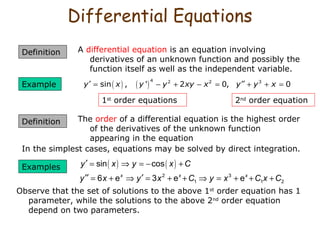
Definition A differential equation is an equation involving
derivatives of an unknown function and possibly the
function itself as well as the independent variable.
Example
Definition The order of a differential equation is the highest order
of the derivatives of the unknown function
appearing in the equation
1st
order equations 2nd
order equation
( ) ( )′ = ⇒ = − +sin cosy x y x CExamples
′′ ′= + ⇒ = + + ⇒ = + + +2 3
1 1 26 e 3 e ex x x
y x y x C y x C x C
In the simplest cases, equations may be solved by direct integration.
Observe that the set of solutions to the above 1st
order equation has 1
parameter, while the solutions to the above 2nd
order equation
depend on two parameters.
Separable Differential Equations
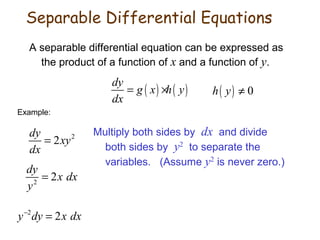
A separable differential equation can be expressed as
the product of a function of x and a function of y.
( ) ( )
dy
g x h y
dx
= ×
Example:
2
2
dy
xy
dx
=
Multiply both sides by dx and divide
both sides by y2
to separate the
variables. (Assume y2
is never zero.)
2
2
dy
x dx
y
=
2
2y dy x dx−
=
( ) 0h y ≠
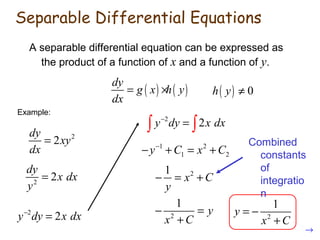
A separable differential equation can be expressed as
the product of a function of x and a function of y.
( ) ( )
dy
g x h y
dx
= ×
Example:
2
2
dy
xy
dx
=
2
2
dy
x dx
y
=
2
2y dy x dx−
=
2
2y dy x dx−
=∫ ∫
1 2
1 2y C x C−
− + = +
21
x C
y
− = +
2
1
y
x C
− =
+ 2
1
y
x C
= −
+
( ) 0h y ≠
→
Combined
constants
of
integratio
n
Separable Differential Equations
Family of solutions (general solution)
of a differential equation
Example
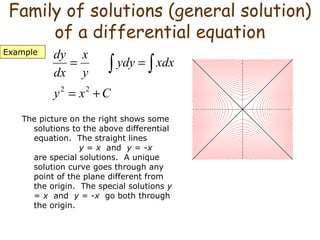
The picture on the right shows some
solutions to the above differential
equation. The straight lines
y = x and y = -x
are special solutions. A unique
solution curve goes through any
point of the plane different from
the origin. The special solutions y
= x and y = -x go both through
the origin.
Cxy
xdxydy
y
x
dx
dy
+=
== ∫ ∫
22
Initial conditions
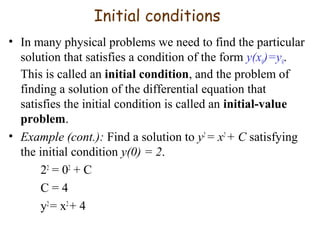
• In many physical problems we need to find the particular
solution that satisfies a condition of the form y(x0)=y0.
This is called an initial condition, and the problem of
finding a solution of the differential equation that
satisfies the initial condition is called an initial-value
problem.
• Example (cont.): Find a solution to y2
= x2
+ C satisfying
the initial condition y(0) = 2.
22
= 02
+ C
C = 4
y2
= x2
+ 4
Example:
( )
2
2
2 1 xdy
x y e
dx
= +
2
2
1
2
1
x
dy x e dx
y
=
+
Separable differential equation
2
2
1
2
1
x
dy x e dx
y
=
+∫ ∫
2
u x=
2du x dx=
2
1
1
u
dy e du
y
=
+∫ ∫
1
1 2tan u
y C e C−
+ = +
2
1
1 2tan x
y C e C−
+ = +
2
1
tan x
y e C−
= + Combined constants of integration →
Example (cont.):
( )
2
2
2 1 xdy
x y e
dx
= +
2
1
tan x
y e C−
= + We now have y as an implicit
function of x.
We can find y as an explicit function
of x by taking the tangent of both
sides.
( ) ( )2
1
tan tan tan x
y e C−
= +
( )2
tan x
y e C= +
→
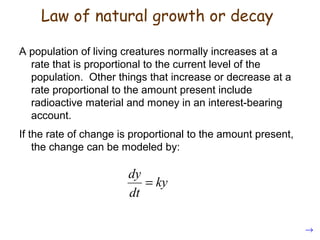
A population of living creatures normally increases at a
rate that is proportional to the current level of the
population. Other things that increase or decrease at a
rate proportional to the amount present include
radioactive material and money in an interest-bearing
account.
If the rate of change is proportional to the amount present,
the change can be modeled by:
dy
ky
dt
=
→
Law of natural growth or decay
dy
ky
dt
=
1
dy k dt
y
=
1
dy k dt
y
=∫ ∫
ln y kt C= +
Rate of change is proportional
to the amount present.
Divide both sides by y.
Integrate both sides.
→
ln y kt C
e e +
= Exponentiate both sides.
C kt
y e e= ⋅
C kt
y e e= ±
kt
y Ae=
Real-life populations do not increase forever. There is
some limiting factor such as food or living space.
There is a maximum population, or carrying capacity, M.
A more realistic model is the logistic growth model where
growth rate is proportional to both the size of the
population (y) and the amount by which y falls short of
the maximal size (M-y). Then we have the equation:
)( yMky
dt
dy
−=
Logistic Growth Model
The solution to this differential equation (derived in the textbook):
)0(where,
)(
0
00
0
yy
eyMy
My
y kMt
=
−+
= −
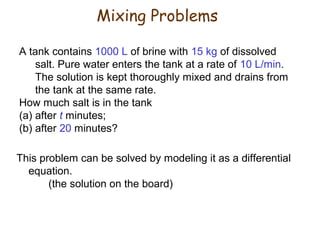
A tank contains 1000 L of brine with 15 kg of dissolved
salt. Pure water enters the tank at a rate of 10 L/min.
The solution is kept thoroughly mixed and drains from
the tank at the same rate.
How much salt is in the tank
(a) after t minutes;
(b) after 20 minutes?
This problem can be solved by modeling it as a differential
equation.
(the solution on the board)
Mixing Problems
Problem 45.
A vat with 500 gallons of beer contains 4%
alcohol (by volume). Beer with 6%
alcohol is pumped into the vat at a rate of
5 gal/min and the mixture is pumped out
at the same rate. What is the percentage
of alcohol after an hour?
Mixing Problems

Differential equations

  • 1.
  • 2.
    Differential Equations ( )( ) 4 2 2 3 sin , ' 2 0, 0y x y y xy x y y x′ ′′= − + − = + + = Definition A differential equation is an equation involving derivatives of an unknown function and possibly the function itself as well as the independent variable. Example Definition The order of a differential equation is the highest order of the derivatives of the unknown function appearing in the equation 1st order equations 2nd order equation ( ) ( )′ = ⇒ = − +sin cosy x y x CExamples ′′ ′= + ⇒ = + + ⇒ = + + +2 3 1 1 26 e 3 e ex x x y x y x C y x C x C In the simplest cases, equations may be solved by direct integration. Observe that the set of solutions to the above 1st order equation has 1 parameter, while the solutions to the above 2nd order equation depend on two parameters.
  • 3.
    Separable Differential Equations Aseparable differential equation can be expressed as the product of a function of x and a function of y. ( ) ( ) dy g x h y dx = × Example: 2 2 dy xy dx = Multiply both sides by dx and divide both sides by y2 to separate the variables. (Assume y2 is never zero.) 2 2 dy x dx y = 2 2y dy x dx− = ( ) 0h y ≠
  • 4.
    A separable differentialequation can be expressed as the product of a function of x and a function of y. ( ) ( ) dy g x h y dx = × Example: 2 2 dy xy dx = 2 2 dy x dx y = 2 2y dy x dx− = 2 2y dy x dx− =∫ ∫ 1 2 1 2y C x C− − + = + 21 x C y − = + 2 1 y x C − = + 2 1 y x C = − + ( ) 0h y ≠ → Combined constants of integratio n Separable Differential Equations
  • 5.
    Family of solutions(general solution) of a differential equation Example The picture on the right shows some solutions to the above differential equation. The straight lines y = x and y = -x are special solutions. A unique solution curve goes through any point of the plane different from the origin. The special solutions y = x and y = -x go both through the origin. Cxy xdxydy y x dx dy += == ∫ ∫ 22
  • 6.
    Initial conditions • Inmany physical problems we need to find the particular solution that satisfies a condition of the form y(x0)=y0. This is called an initial condition, and the problem of finding a solution of the differential equation that satisfies the initial condition is called an initial-value problem. • Example (cont.): Find a solution to y2 = x2 + C satisfying the initial condition y(0) = 2. 22 = 02 + C C = 4 y2 = x2 + 4
  • 7.
    Example: ( ) 2 2 2 1xdy x y e dx = + 2 2 1 2 1 x dy x e dx y = + Separable differential equation 2 2 1 2 1 x dy x e dx y = +∫ ∫ 2 u x= 2du x dx= 2 1 1 u dy e du y = +∫ ∫ 1 1 2tan u y C e C− + = + 2 1 1 2tan x y C e C− + = + 2 1 tan x y e C− = + Combined constants of integration →
  • 8.
    Example (cont.): ( ) 2 2 21 xdy x y e dx = + 2 1 tan x y e C− = + We now have y as an implicit function of x. We can find y as an explicit function of x by taking the tangent of both sides. ( ) ( )2 1 tan tan tan x y e C− = + ( )2 tan x y e C= + →
  • 9.
    A population ofliving creatures normally increases at a rate that is proportional to the current level of the population. Other things that increase or decrease at a rate proportional to the amount present include radioactive material and money in an interest-bearing account. If the rate of change is proportional to the amount present, the change can be modeled by: dy ky dt = → Law of natural growth or decay
  • 10.
    dy ky dt = 1 dy k dt y = 1 dyk dt y =∫ ∫ ln y kt C= + Rate of change is proportional to the amount present. Divide both sides by y. Integrate both sides. → ln y kt C e e + = Exponentiate both sides. C kt y e e= ⋅ C kt y e e= ± kt y Ae=
  • 11.
    Real-life populations donot increase forever. There is some limiting factor such as food or living space. There is a maximum population, or carrying capacity, M. A more realistic model is the logistic growth model where growth rate is proportional to both the size of the population (y) and the amount by which y falls short of the maximal size (M-y). Then we have the equation: )( yMky dt dy −= Logistic Growth Model The solution to this differential equation (derived in the textbook): )0(where, )( 0 00 0 yy eyMy My y kMt = −+ = −
  • 12.
    A tank contains1000 L of brine with 15 kg of dissolved salt. Pure water enters the tank at a rate of 10 L/min. The solution is kept thoroughly mixed and drains from the tank at the same rate. How much salt is in the tank (a) after t minutes; (b) after 20 minutes? This problem can be solved by modeling it as a differential equation. (the solution on the board) Mixing Problems
  • 13.
    Problem 45. A vatwith 500 gallons of beer contains 4% alcohol (by volume). Beer with 6% alcohol is pumped into the vat at a rate of 5 gal/min and the mixture is pumped out at the same rate. What is the percentage of alcohol after an hour? Mixing Problems