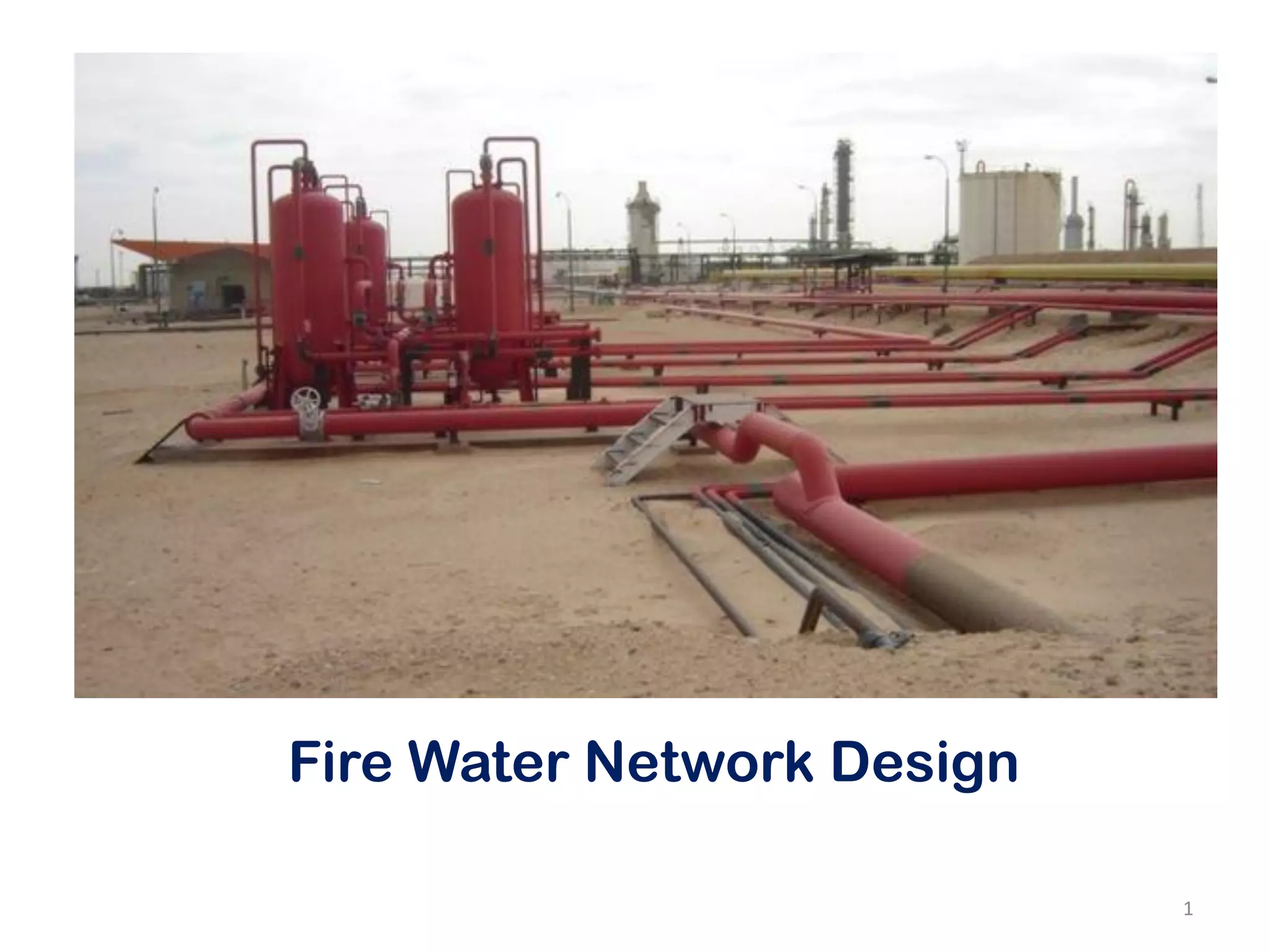
Fire Water Network Design
1
Contents
Fire and Fire Classes
Few Short Definitions of Fire Terms
Combustible and Flammable Materials, Flash Point,
LFL & UFL
Extinguishing Methods & Agents
Installed Fire Protection.
Firefighting System Design Consideration
References
Passive and Active Fire Protection
Scenarios, fire protection philosophy,
Water Capacity and Rates;
The rate and duration of water flow
Typical Application Rates
Sources of Water
Fire Water Pumps
Fire Water Piping Design
Distribution System
Typical Looped Fire Water Distribution System
Example Calculation Sheet
Considerations regarding the use of cooling
water for tanks on fire;
Appendix A
2
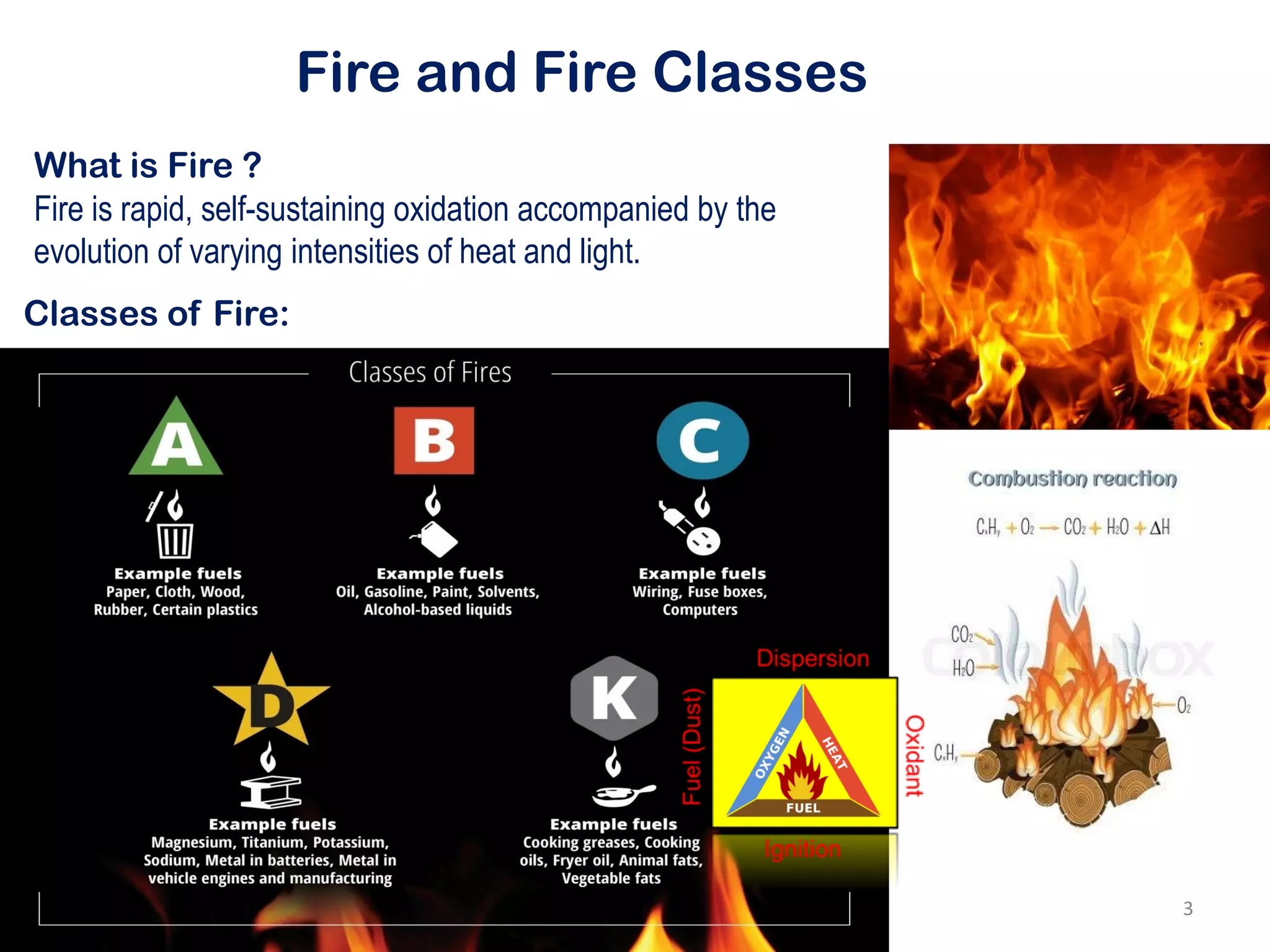
Fire and Fire Classes
Prepared by: Syed Akbar Ali Shah (18 – MS – CH - 26)
What is Fire ?
Fire is rapid, self-sustaining oxidation accompanied by the
evolution of varying intensities of heat and light.
Classes of Fire:
3
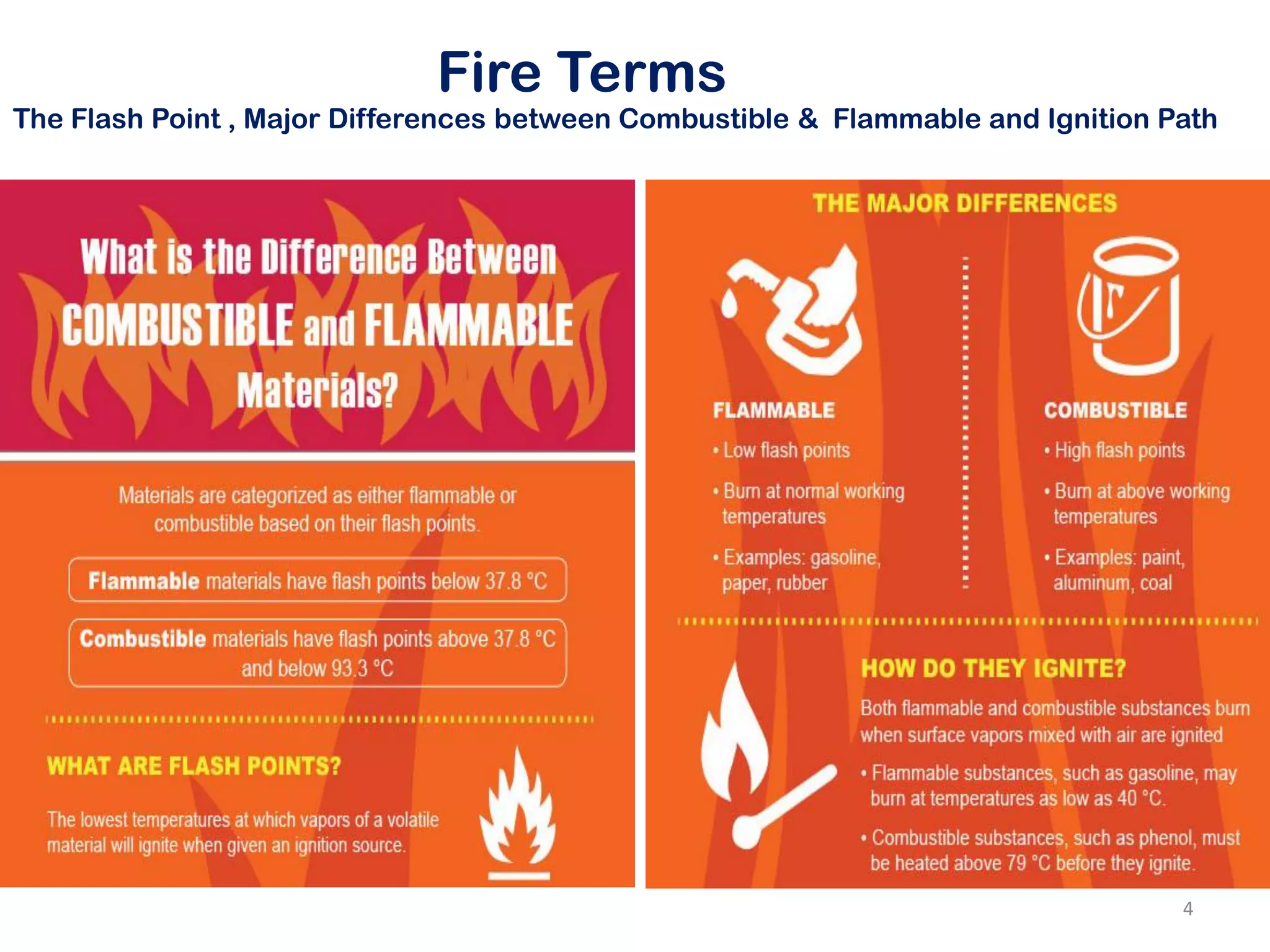
Fire Terms
The Flash Point , Major Differences between Combustible & Flammable and Ignition Path
4
Fire Terms
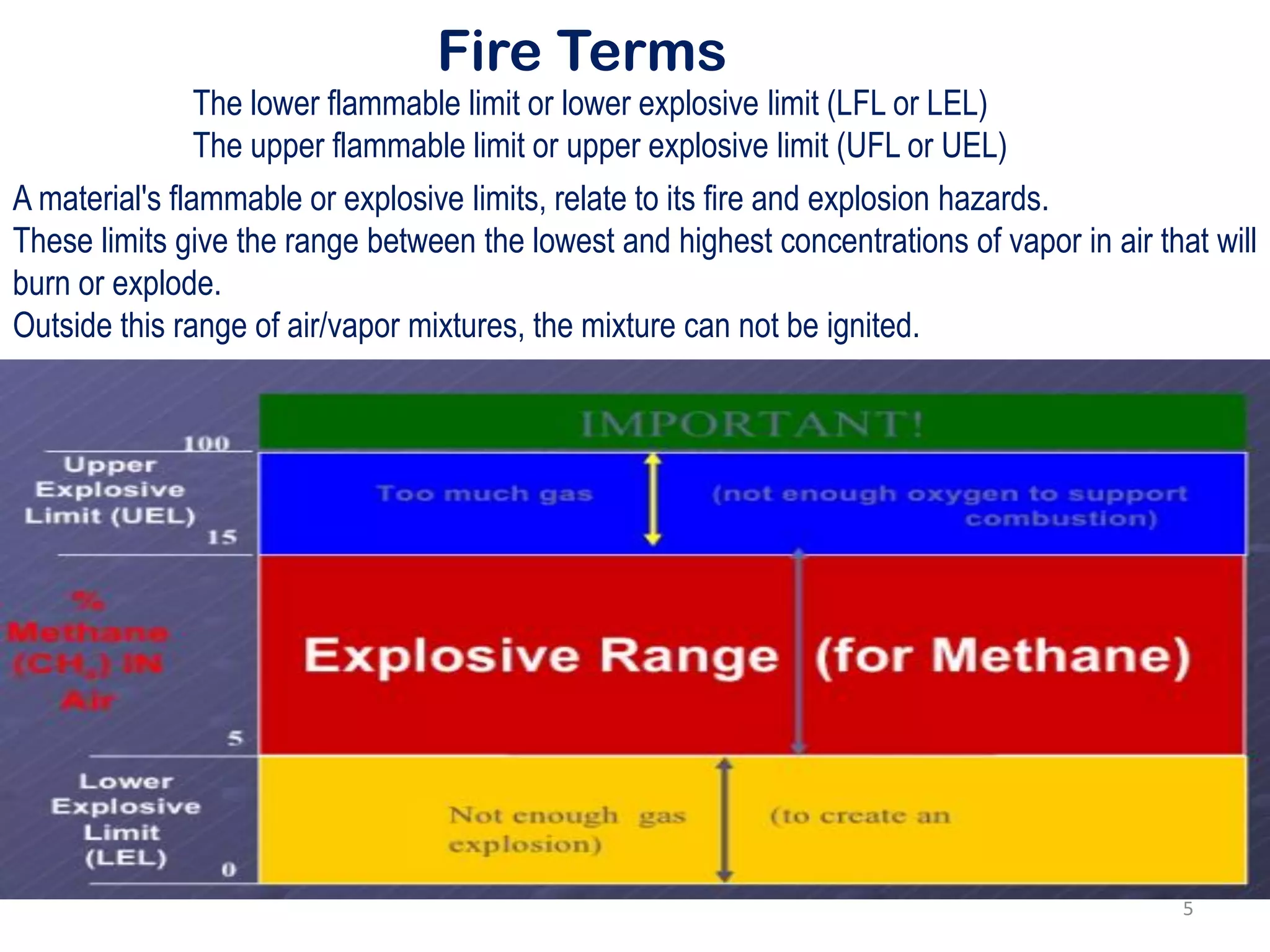
The lower flammable limit or lower explosive limit (LFL or LEL)
The upper flammable limit or upper explosive limit (UFL or UEL)
A material's flammable or explosive limits, relate to its fire and explosion hazards.
These limits give the range between the lowest and highest concentrations of vapor in air that will
burn or explode.
Outside this range of air/vapor mixtures, the mixture can not be ignited.
5
Fire Terms
Fire-Point and Auto-ignition Temperature
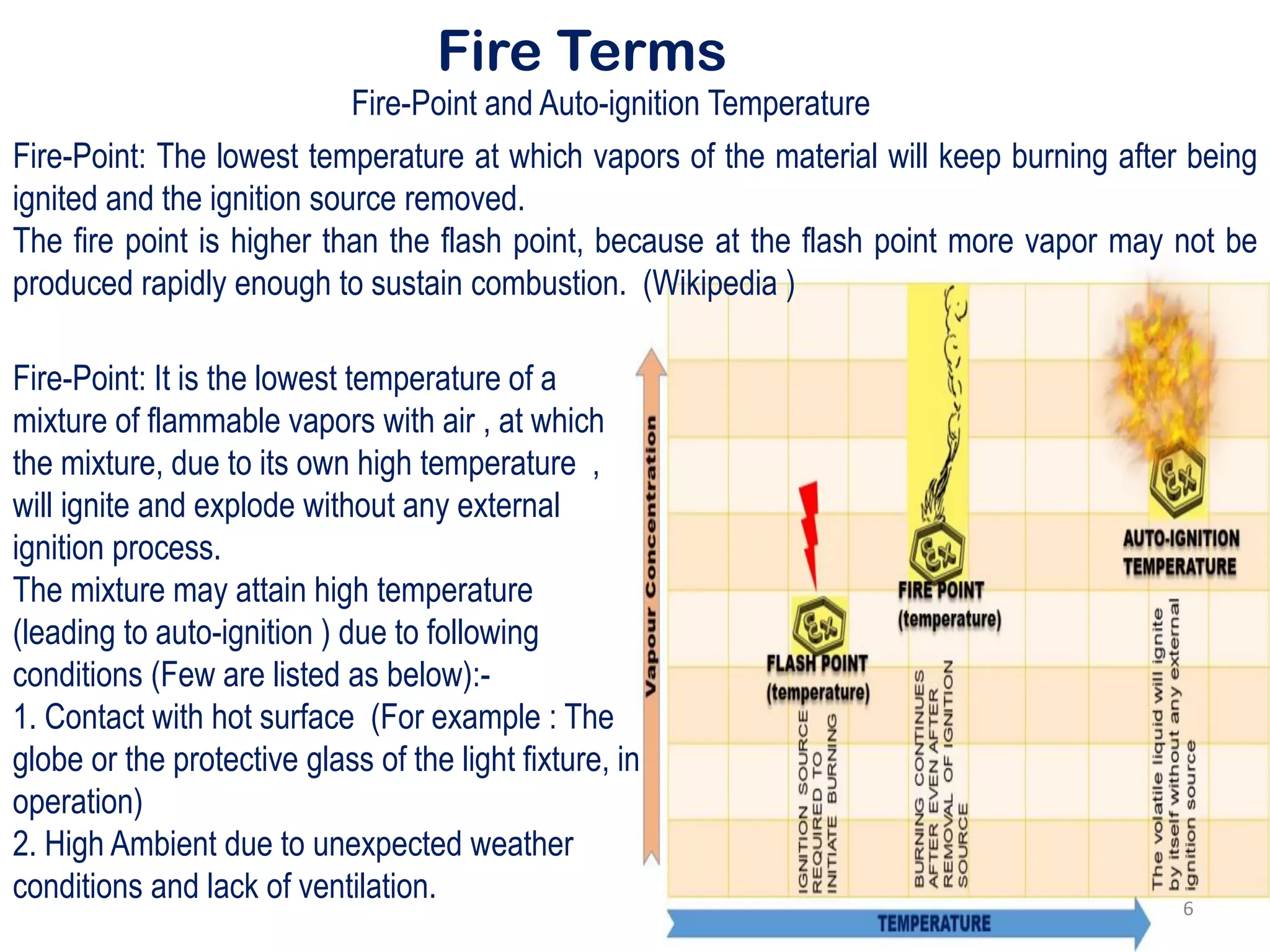
Fire-Point: The lowest temperature at which vapors of the material will keep burning after being
ignited and the ignition source removed.
The fire point is higher than the flash point, because at the flash point more vapor may not be
produced rapidly enough to sustain combustion. (Wikipedia )
Fire-Point: It is the lowest temperature of a
mixture of flammable vapors with air , at which
the mixture, due to its own high temperature ,
will ignite and explode without any external
ignition process.
The mixture may attain high temperature
(leading to auto-ignition ) due to following
conditions (Few are listed as below):-
1. Contact with hot surface (For example : The
globe or the protective glass of the light fixture, in
operation)
2. High Ambient due to unexpected weather
conditions and lack of ventilation. 6
Extinguishing Methods & Agents
Extinguishing Methods:
All of the methods used to control and extinguish fires are based on the fire square.
Efforts are focused on removing one or more of the elements that allow the fire to continue
Fire extinguishing consists of one or more of the following methods:
• Quenching (cooling)
• Smothering (blanketing)
• Flame suppression (heat absorption)
• Flame propagation interruption (free radical-chain breaking)
7
Extinguishing Agents
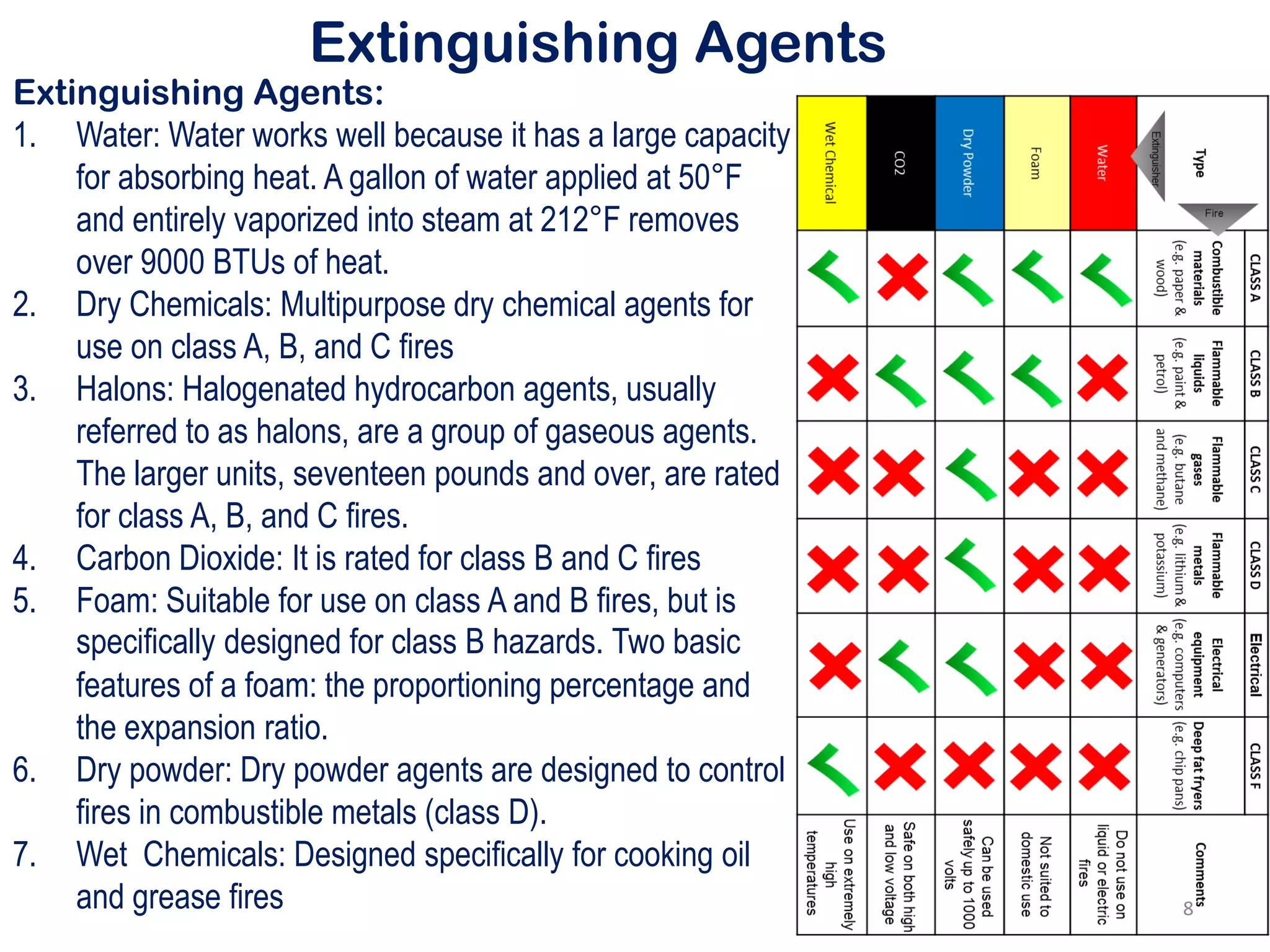
Extinguishing Agents:
1. Water: Water works well because it has a large capacity
for absorbing heat. A gallon of water applied at 50°F
and entirely vaporized into steam at 212°F removes
over 9000 BTUs of heat.
2. Dry Chemicals: Multipurpose dry chemical agents for
use on class A, B, and C fires
3. Halons: Halogenated hydrocarbon agents, usually
referred to as halons, are a group of gaseous agents.
The larger units, seventeen pounds and over, are rated
for class A, B, and C fires.
4. Carbon Dioxide: It is rated for class B and C fires
5. Foam: Suitable for use on class A and B fires, but is
specifically designed for class B hazards. Two basic
features of a foam: the proportioning percentage and
the expansion ratio.
6. Dry powder: Dry powder agents are designed to control
fires in combustible metals (class D).
7. Wet Chemicals: Designed specifically for cooking oil
and grease fires 8
Installed Fire Protection.
Traditionally, installed fire protection systems have been considered systems designed for the detection,
control, and extinguishment of fires.
Two major groupings of installed fire protection :
Passive systems and Active systems.
PASSIVE SYSTEMS
Passive systems are those devices, features, and characteristics that are installed as part of a process or
structure designed to avoid fire ignition, limit fire development and growth, prevent the spread of fire, and
otherwise contribute to loss prevention and control efforts without any actively functioning components. An
example of a passive system is a fire wall.
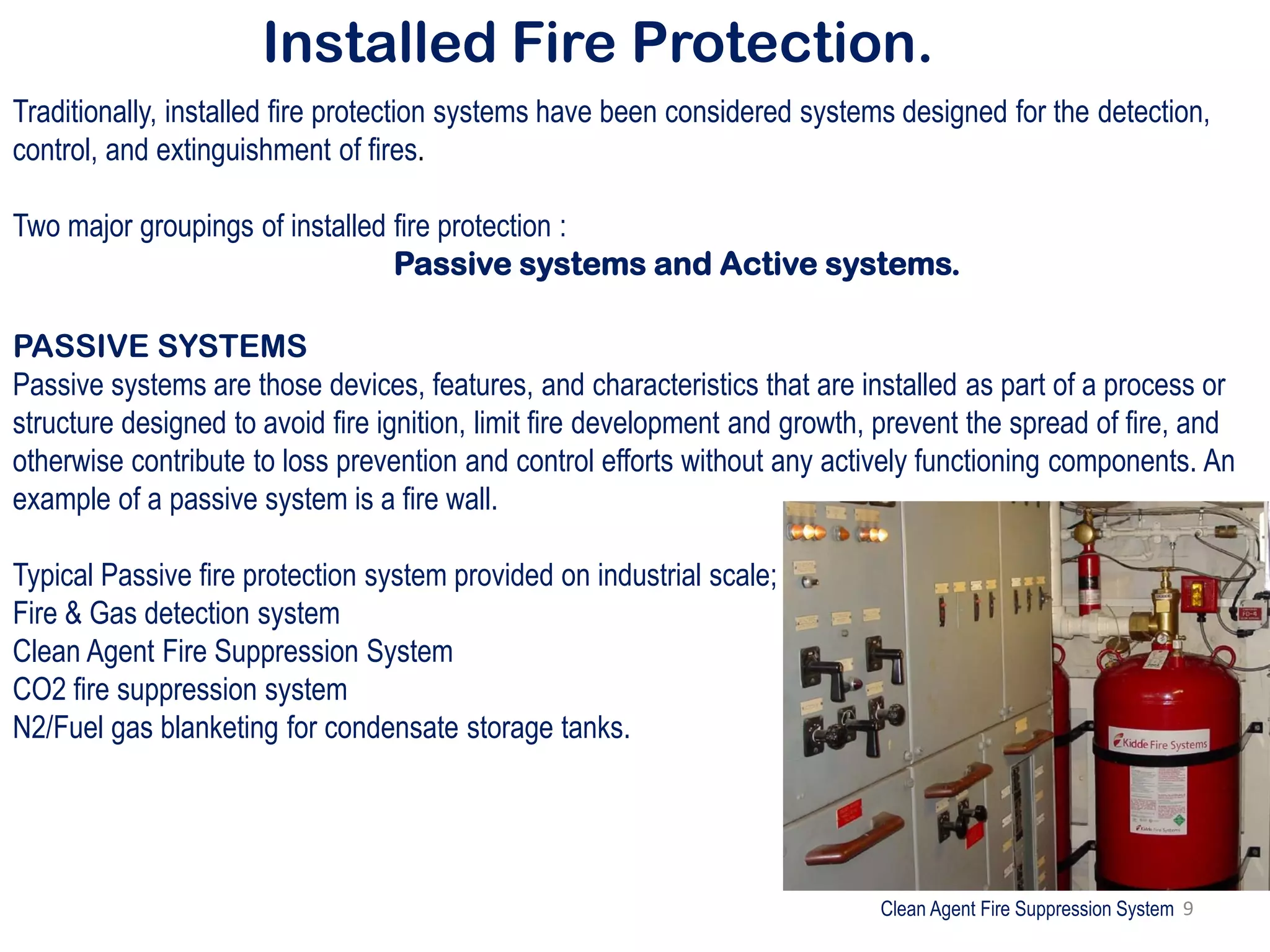
Typical Passive fire protection system provided on industrial scale;
Fire & Gas detection system
Clean Agent Fire Suppression System
CO2 fire suppression system
N2/Fuel gas blanketing for condensate storage tanks.
Clean Agent Fire Suppression System 9
Installed Fire Protection.
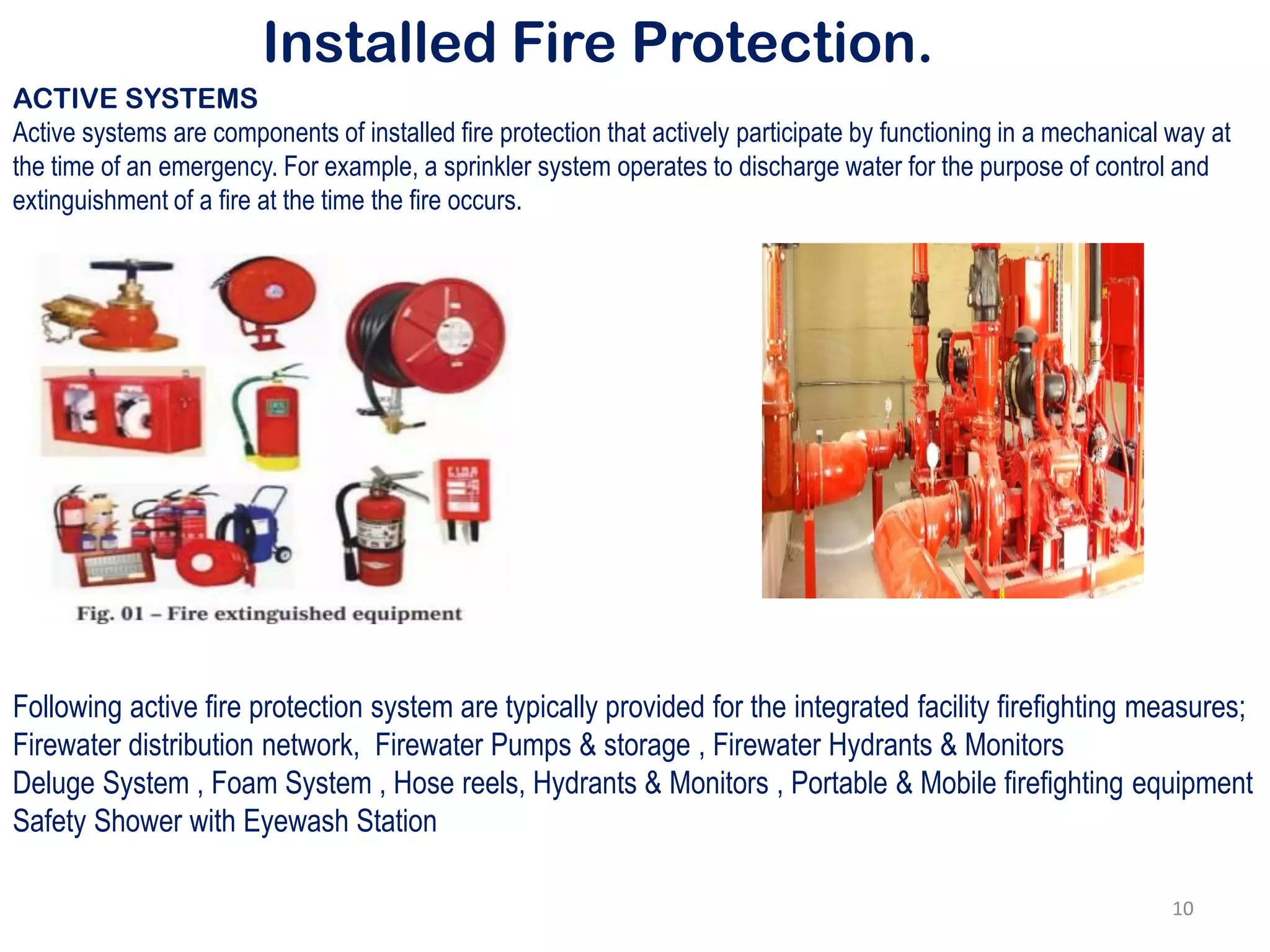
ACTIVE SYSTEMS
Active systems are components of installed fire protection that actively participate by functioning in a mechanical way at
the time of an emergency. For example, a sprinkler system operates to discharge water for the purpose of control and
extinguishment of a fire at the time the fire occurs.
Following active fire protection system are typically provided for the integrated facility firefighting measures;
Firewater distribution network, Firewater Pumps & storage , Firewater Hydrants & Monitors
Deluge System , Foam System , Hose reels, Hydrants & Monitors , Portable & Mobile firefighting equipment
Safety Shower with Eyewash Station
10
Firefighting System Design Consideration
“Scenarios:
A range of fire and explosion scenarios should be considered. In most cases it will be impractical to
consider every possible scenario and a balance should be struck between addressing larger, less frequent
scenarios that would cause more damaging consequences to personnel, business and the environment,
and smaller, potentially more frequent events that could lead to escalation or significant localized damage.
Scenarios should include:
— unignited product releases;
— pool fires;
— atmospheric storage tank fires:
- vent fires;
- full surface fires;
- rim seal fires;
- spill-on-roof fires;
- bund fires;
- boilover;
— jet fires:
- gas jet fires;
- liquid spray fires;
— BLEVEs;
— vapour cloud explosions
(VCEs);
— flash fires.”
11
Firefighting System Design Consideration
FIRE PROTECTION PHILOSOPHY:
Fire protection philosophy for the facility are based on a single fire scenario.
“In other words, the design capacity of major firefighting facilities is determined by the largest single fire
contingency”
“However, some system components are sized to handle less significant contingencies.
For instance, foam concentrate requirements are usually determined by a tank fire rather than by the worst
contingency, which may be a fire in the process area.”
12
Firefighting System Design Consideration
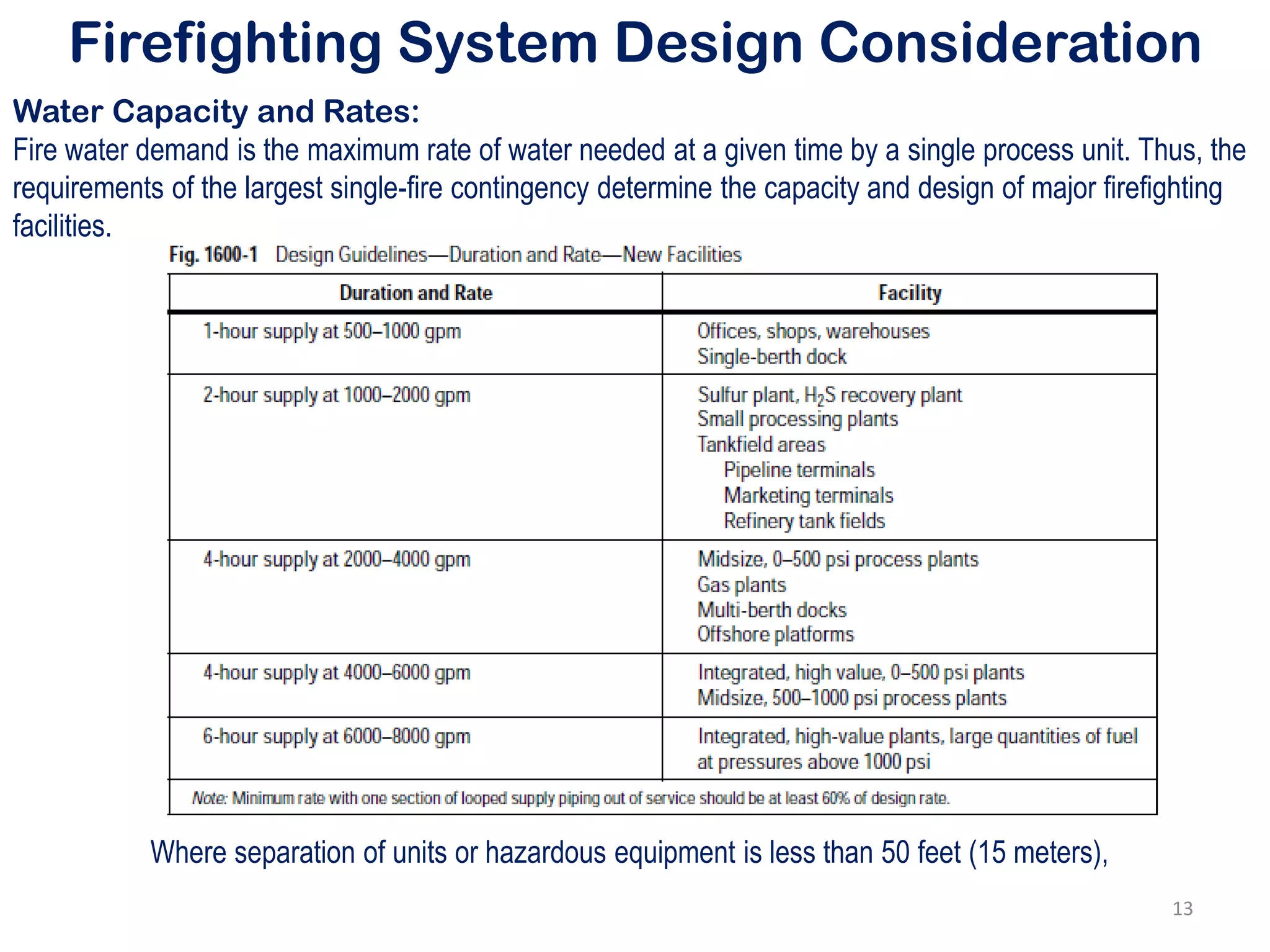
Water Capacity and Rates:
Fire water demand is the maximum rate of water needed at a given time by a single process unit. Thus, the
requirements of the largest single-fire contingency determine the capacity and design of major firefighting
facilities.
Where separation of units or hazardous equipment is less than 50 feet (15 meters),
13
Firefighting System Design Consideration
Water Capacity and Rates:
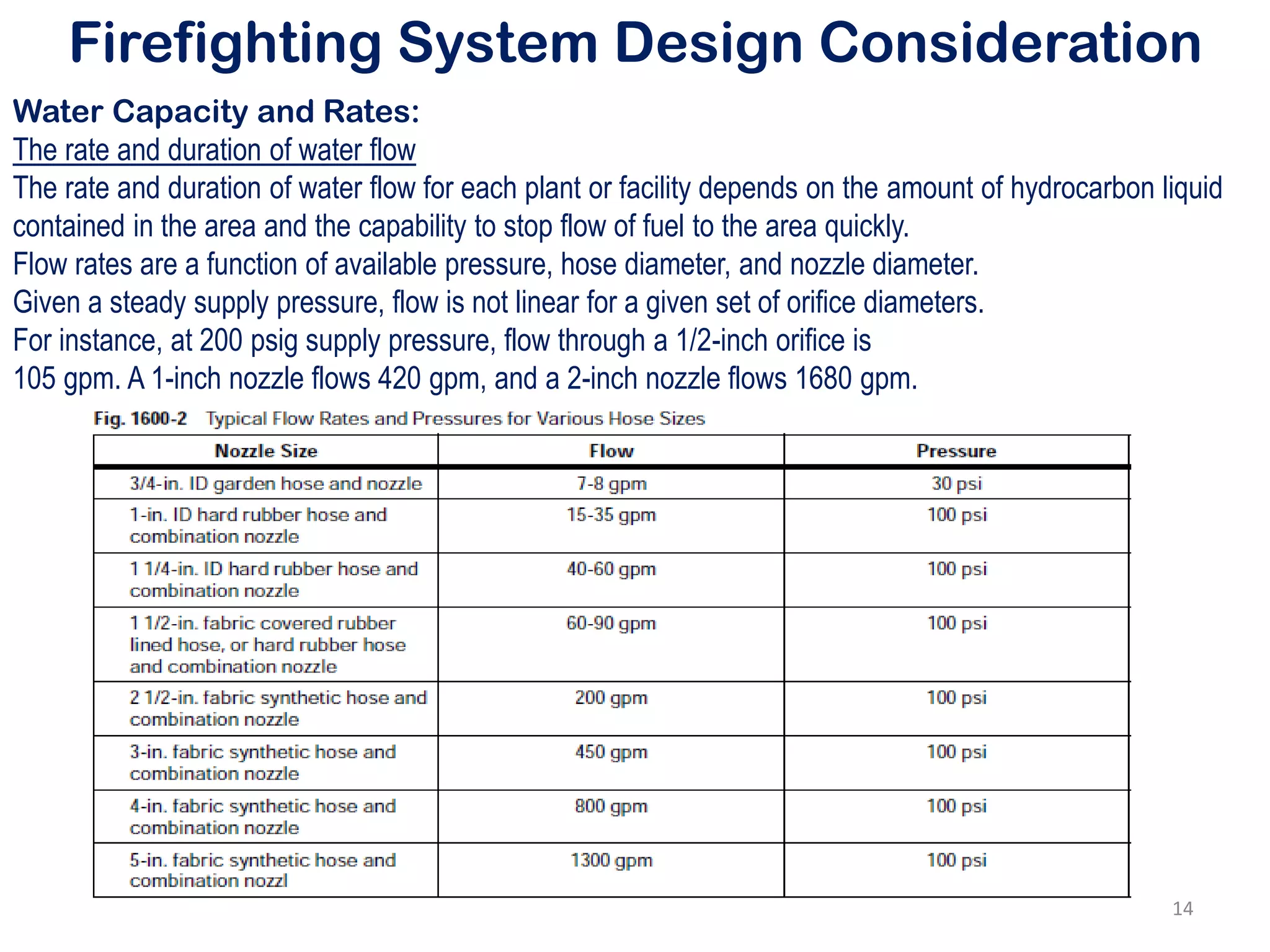
The rate and duration of water flow
The rate and duration of water flow for each plant or facility depends on the amount of hydrocarbon liquid
contained in the area and the capability to stop flow of fuel to the area quickly.
Flow rates are a function of available pressure, hose diameter, and nozzle diameter.
Given a steady supply pressure, flow is not linear for a given set of orifice diameters.
For instance, at 200 psig supply pressure, flow through a 1/2-inch orifice is
105 gpm. A 1-inch nozzle flows 420 gpm, and a 2-inch nozzle flows 1680 gpm.
14
Firefighting System Design Consideration
Water Capacity and Rates:
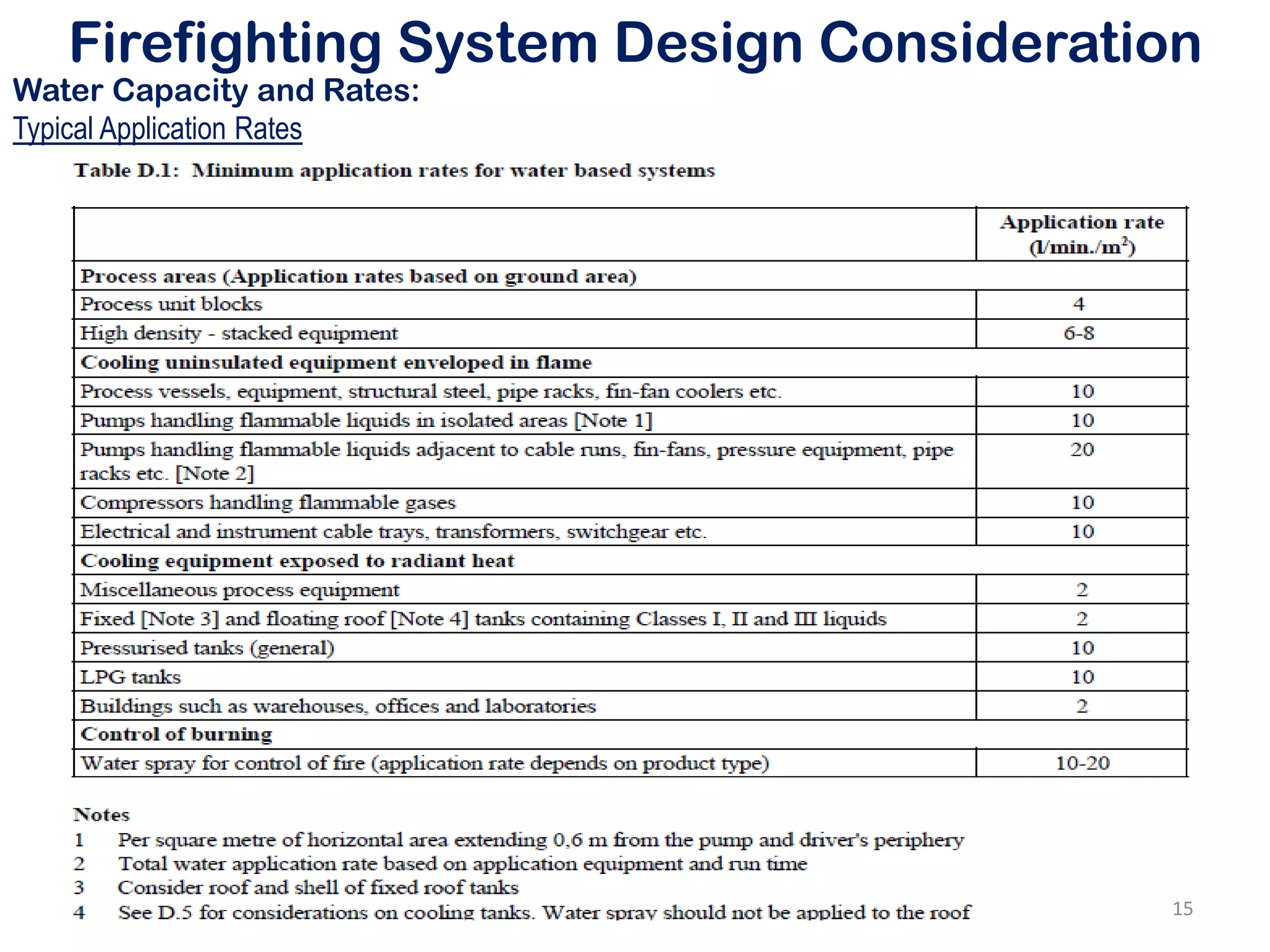
Typical Application Rates
15
Firefighting System Design Consideration
Sources of Water:
Public systems with inadequate water flow may be used to supply storage facilities, which then supply the
fire water systems through pumps or by gravity flow.
Fire Water Pumps
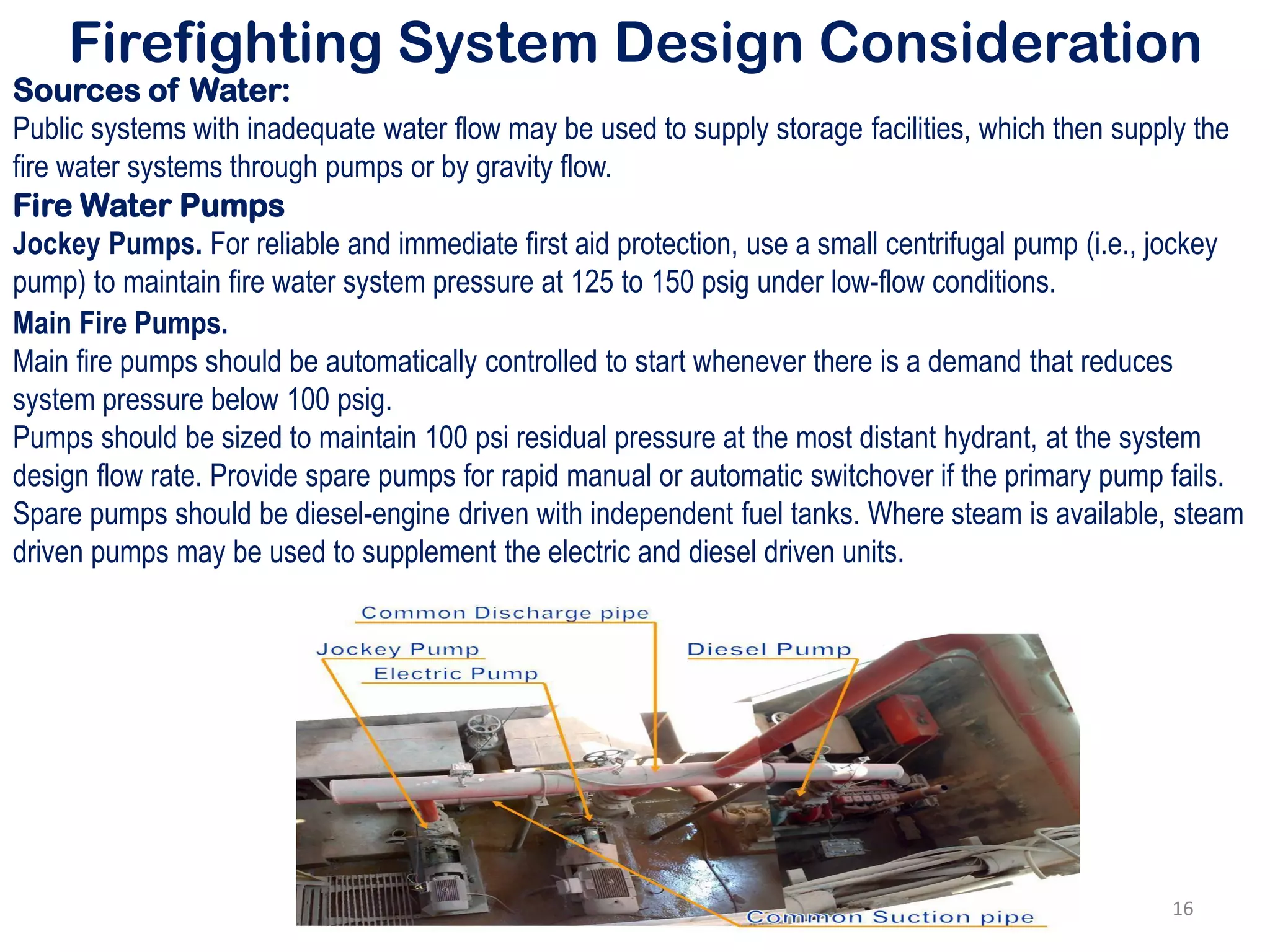
Jockey Pumps. For reliable and immediate first aid protection, use a small centrifugal pump (i.e., jockey
pump) to maintain fire water system pressure at 125 to 150 psig under low-flow conditions.
Main Fire Pumps.
Main fire pumps should be automatically controlled to start whenever there is a demand that reduces
system pressure below 100 psig.
Pumps should be sized to maintain 100 psi residual pressure at the most distant hydrant, at the system
design flow rate. Provide spare pumps for rapid manual or automatic switchover if the primary pump fails.
Spare pumps should be diesel-engine driven with independent fuel tanks. Where steam is available, steam
driven pumps may be used to supplement the electric and diesel driven units.
16
Firefighting System Design Consideration
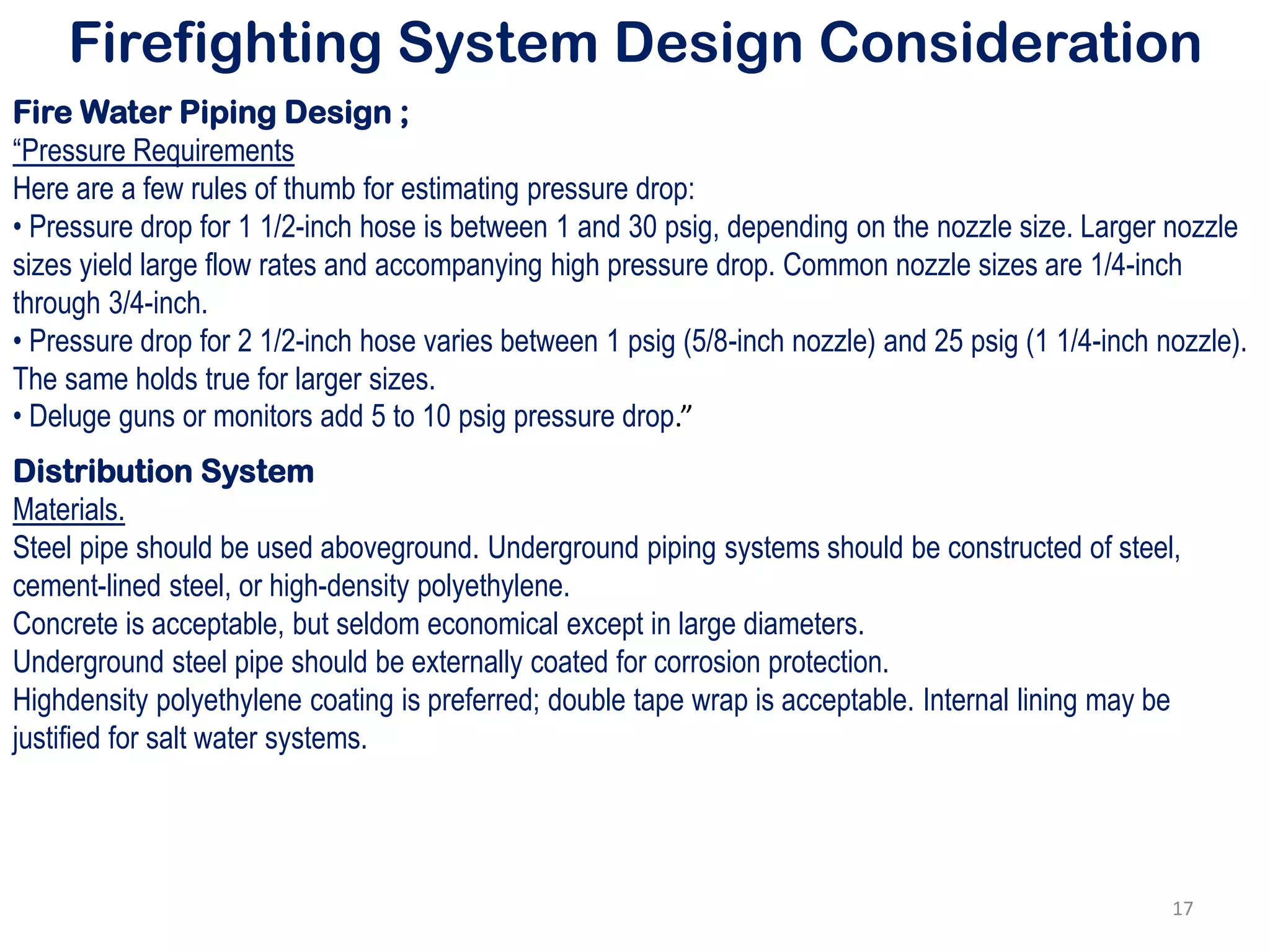
Fire Water Piping Design ;
“Pressure Requirements
Here are a few rules of thumb for estimating pressure drop:
• Pressure drop for 1 1/2-inch hose is between 1 and 30 psig, depending on the nozzle size. Larger nozzle
sizes yield large flow rates and accompanying high pressure drop. Common nozzle sizes are 1/4-inch
through 3/4-inch.
• Pressure drop for 2 1/2-inch hose varies between 1 psig (5/8-inch nozzle) and 25 psig (1 1/4-inch nozzle).
The same holds true for larger sizes.
• Deluge guns or monitors add 5 to 10 psig pressure drop.”
Distribution System
Materials.
Steel pipe should be used aboveground. Underground piping systems should be constructed of steel,
cement-lined steel, or high-density polyethylene.
Concrete is acceptable, but seldom economical except in large diameters.
Underground steel pipe should be externally coated for corrosion protection.
Highdensity polyethylene coating is preferred; double tape wrap is acceptable. Internal lining may be
justified for salt water systems.
17
Firefighting System Design Consideration
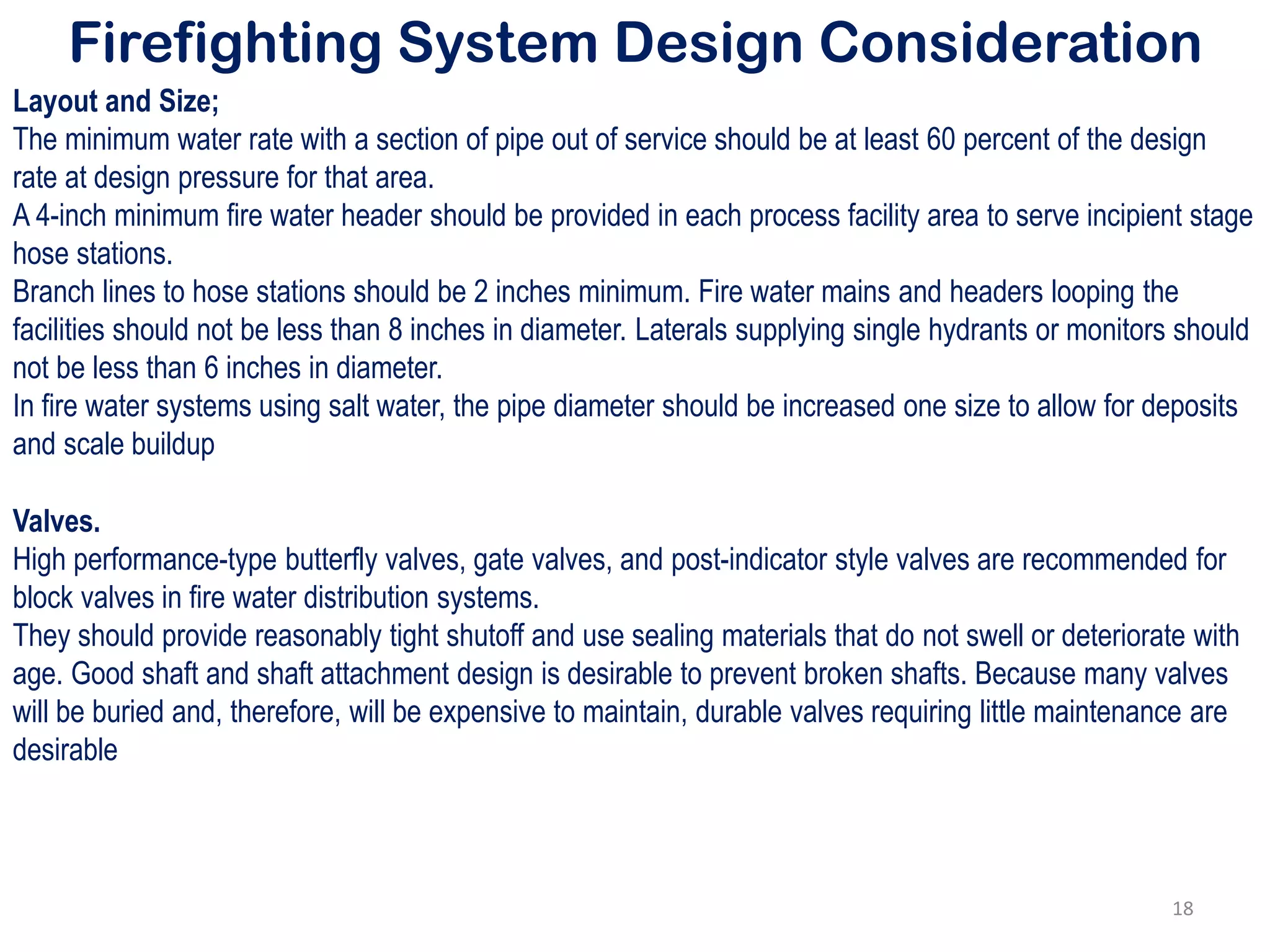
Layout and Size;
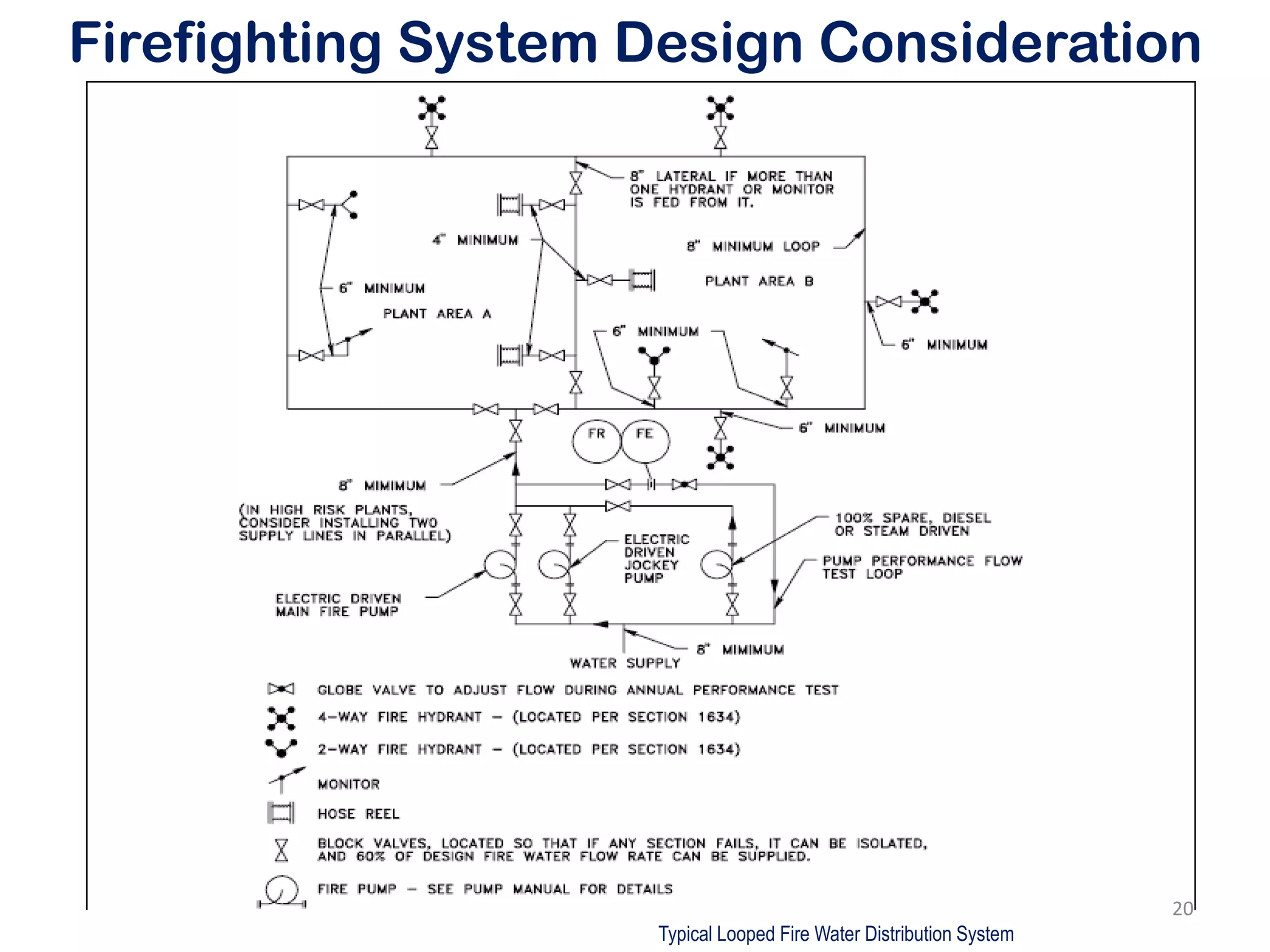
The minimum water rate with a section of pipe out of service should be at least 60 percent of the design
rate at design pressure for that area.
A 4-inch minimum fire water header should be provided in each process facility area to serve incipient stage
hose stations.
Branch lines to hose stations should be 2 inches minimum. Fire water mains and headers looping the
facilities should not be less than 8 inches in diameter. Laterals supplying single hydrants or monitors should
not be less than 6 inches in diameter.
In fire water systems using salt water, the pipe diameter should be increased one size to allow for deposits
and scale buildup
Valves.
High performance-type butterfly valves, gate valves, and post-indicator style valves are recommended for
block valves in fire water distribution systems.
They should provide reasonably tight shutoff and use sealing materials that do not swell or deteriorate with
age. Good shaft and shaft attachment design is desirable to prevent broken shafts. Because many valves
will be buried and, therefore, will be expensive to maintain, durable valves requiring little maintenance are
desirable
18
Firefighting System Design Consideration
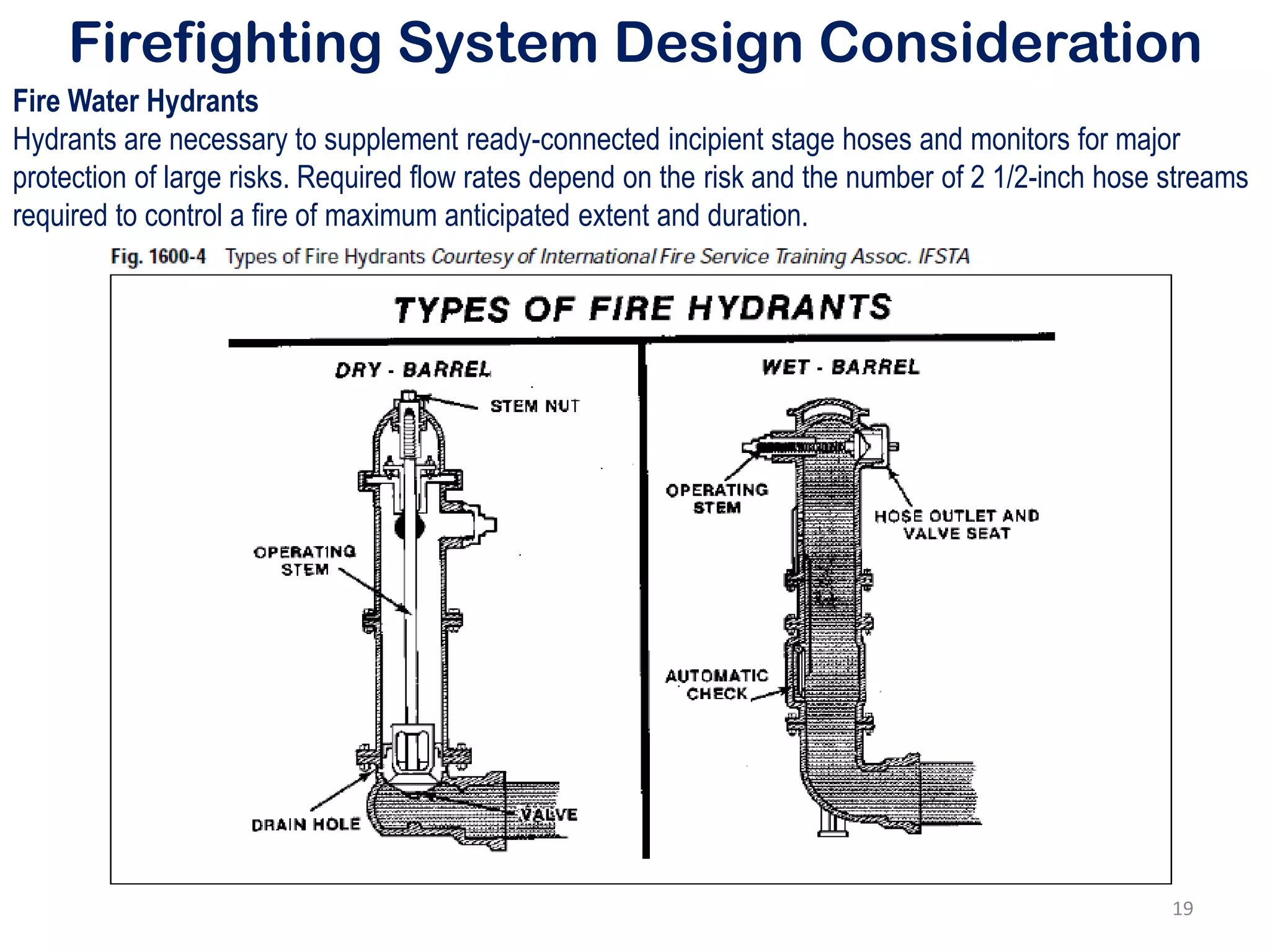
Fire Water Hydrants
Hydrants are necessary to supplement ready-connected incipient stage hoses and monitors for major
protection of large risks. Required flow rates depend on the risk and the number of 2 1/2-inch hose streams
required to control a fire of maximum anticipated extent and duration.
19
Firefighting System Design Consideration
Typical Looped Fire Water Distribution System
20
Firefighting System Design Consideration
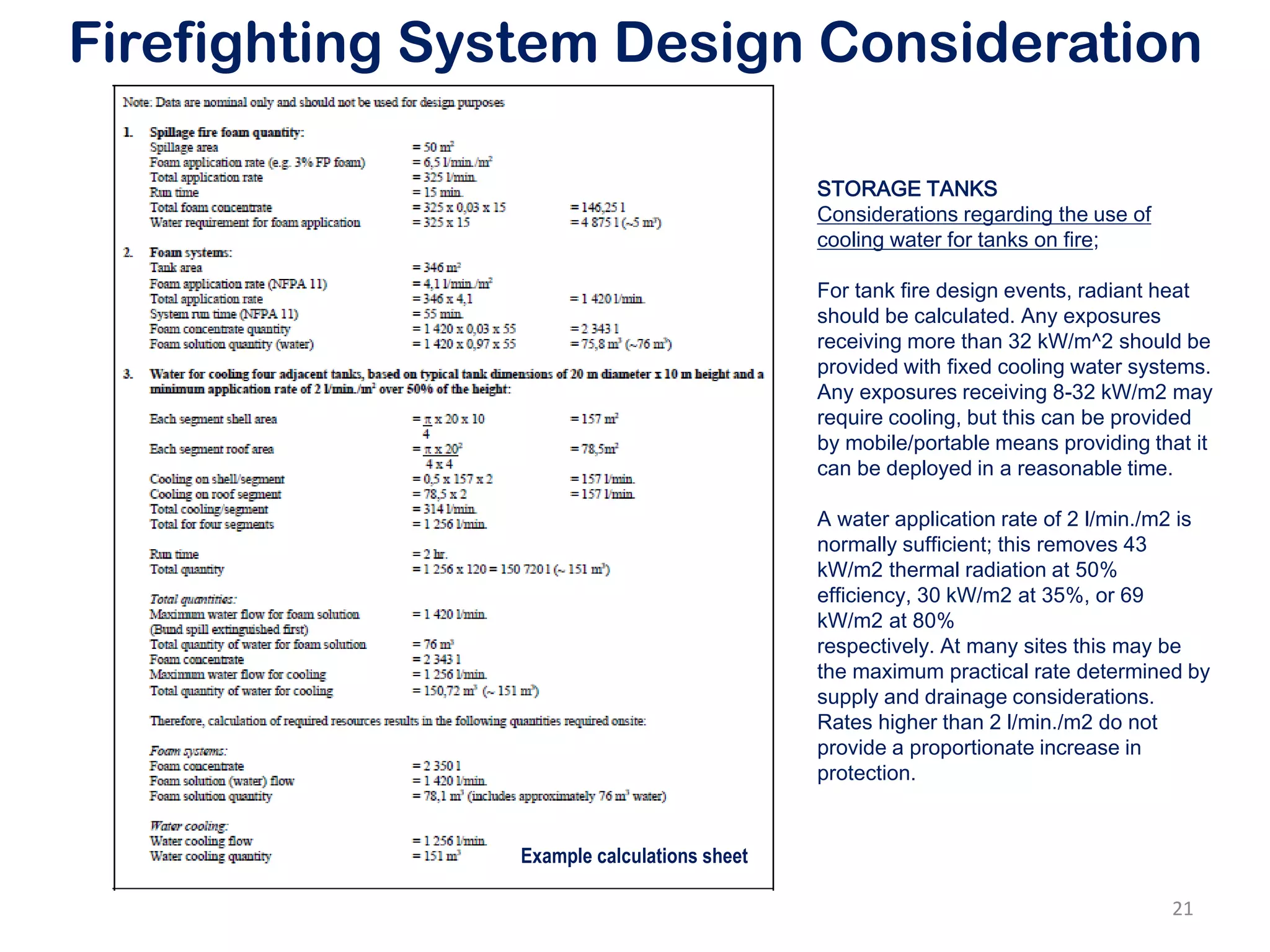
Example calculations sheet
STORAGE TANKS
Considerations regarding the use of
cooling water for tanks on fire;
For tank fire design events, radiant heat
should be calculated. Any exposures
receiving more than 32 kW/m^2 should be
provided with fixed cooling water systems.
Any exposures receiving 8-32 kW/m2 may
require cooling, but this can be provided
by mobile/portable means providing that it
can be deployed in a reasonable time.
A water application rate of 2 l/min./m2 is
normally sufficient; this removes 43
kW/m2 thermal radiation at 50%
efficiency, 30 kW/m2 at 35%, or 69
kW/m2 at 80%
respectively. At many sites this may be
the maximum practical rate determined by
supply and drainage considerations.
Rates higher than 2 l/min./m2 do not
provide a proportionate increase in
protection.
21
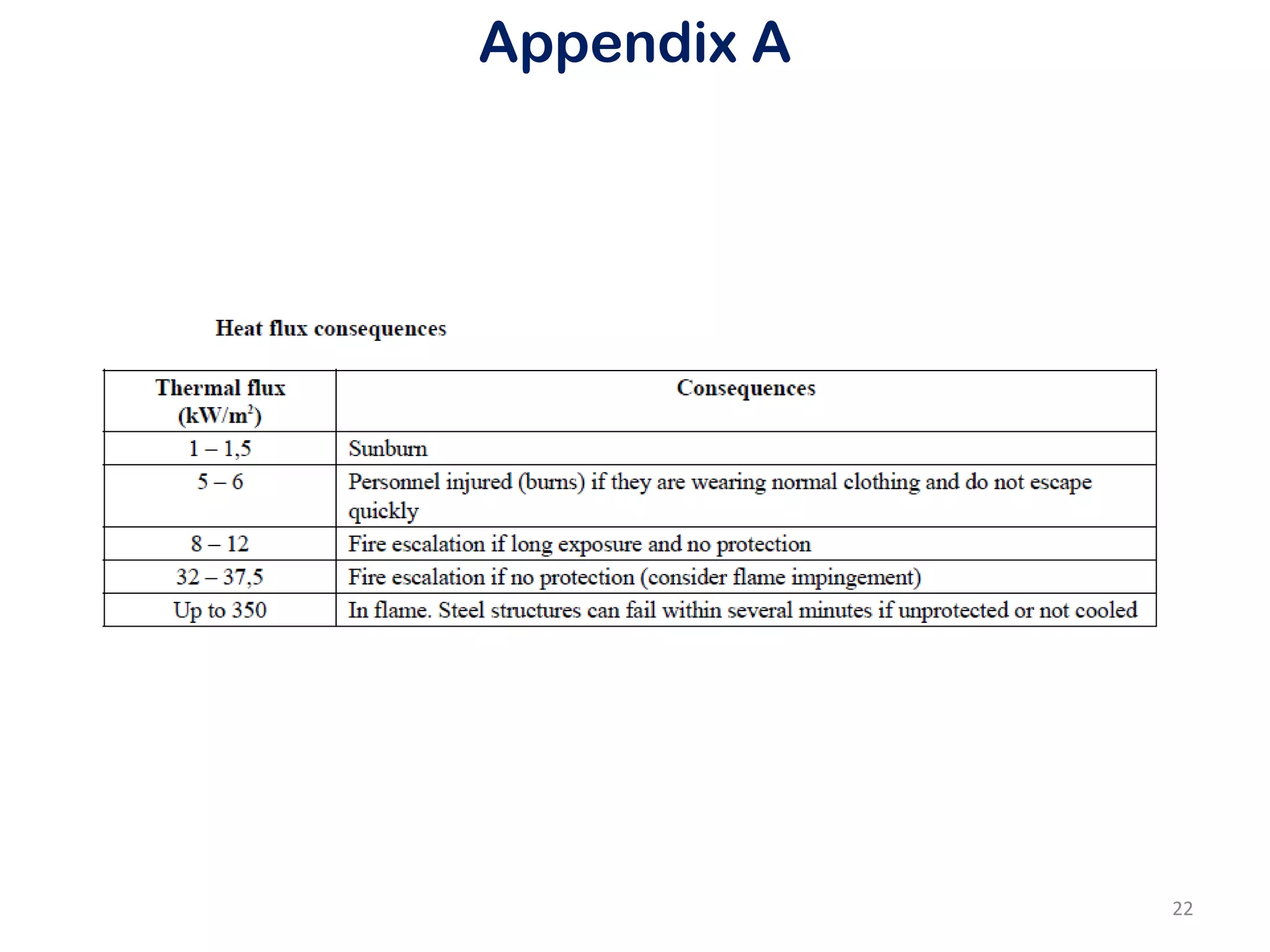
Appendix A
22
References
Fire Water Network Design References
Industrial Fire Protection Handbook
Fire Water System and Fire Fighting Equipment (Chevron Design Practice)-1600
Fire precautions at petroleum refi neries and bulk storage installations – IP 19
https://www.wellsins.com/fire-extinguisher-classes-11x17_01/
https://www.kisspng.com/png-fire-triangle-combustion-fuel-triangle-853484/preview.html
https://www.quora.com/What-is-the-chemical-reaction-of-burning-wood
https://www.oshacampus.com/blog/files/What-is-the-Difference-Between-Combustible-and-
Flammable-Materials.jpg
https://www.ccohs.ca/oshanswers/chemicals/flammable/flam.html
https://www.dalkita.com/what-is-the-lfl-what-does-it-mean-to-you/
https://www.slideshare.net/lifecombo/ngisimops
https://expeltec.com/5-terminology/flash-point-auto-ignition-temperature/
https://dustsafetyscience.com/combustible-dust-hazard/
https://surreyfire.co.uk/wp-content/uploads/2015/11/which-type-of-fire-extinguisher-2.png
https://normacomm.com/fire-extinguishers/
http://www.intellifirewall.com/
http://firesafetysecurityindia.com/passive-fire-protection-important-factor/
https://kidde-fenwal.com/Public/System_Details/Kidde-Fire-Systems/ECS-Clean-Agent-Fire-
Suppression-Systems
https://i0.wp.com/missrifka.com/wp-
content/uploads/2012/08/Main_fire_pumps_with_Jockey.jpg
23
24

Fire water netowrk presentation

  • 1.
  • 2.
    Contents Fire and FireClasses Few Short Definitions of Fire Terms Combustible and Flammable Materials, Flash Point, LFL & UFL Extinguishing Methods & Agents Installed Fire Protection. Firefighting System Design Consideration References Passive and Active Fire Protection Scenarios, fire protection philosophy, Water Capacity and Rates; The rate and duration of water flow Typical Application Rates Sources of Water Fire Water Pumps Fire Water Piping Design Distribution System Typical Looped Fire Water Distribution System Example Calculation Sheet Considerations regarding the use of cooling water for tanks on fire; Appendix A 2
  • 3.
    Fire and FireClasses Prepared by: Syed Akbar Ali Shah (18 – MS – CH - 26) What is Fire ? Fire is rapid, self-sustaining oxidation accompanied by the evolution of varying intensities of heat and light. Classes of Fire: 3
  • 4.
    Fire Terms The FlashPoint , Major Differences between Combustible & Flammable and Ignition Path 4
  • 5.
    Fire Terms The lowerflammable limit or lower explosive limit (LFL or LEL) The upper flammable limit or upper explosive limit (UFL or UEL) A material's flammable or explosive limits, relate to its fire and explosion hazards. These limits give the range between the lowest and highest concentrations of vapor in air that will burn or explode. Outside this range of air/vapor mixtures, the mixture can not be ignited. 5
  • 6.
    Fire Terms Fire-Point andAuto-ignition Temperature Fire-Point: The lowest temperature at which vapors of the material will keep burning after being ignited and the ignition source removed. The fire point is higher than the flash point, because at the flash point more vapor may not be produced rapidly enough to sustain combustion. (Wikipedia ) Fire-Point: It is the lowest temperature of a mixture of flammable vapors with air , at which the mixture, due to its own high temperature , will ignite and explode without any external ignition process. The mixture may attain high temperature (leading to auto-ignition ) due to following conditions (Few are listed as below):- 1. Contact with hot surface (For example : The globe or the protective glass of the light fixture, in operation) 2. High Ambient due to unexpected weather conditions and lack of ventilation. 6
  • 7.
    Extinguishing Methods &Agents Extinguishing Methods: All of the methods used to control and extinguish fires are based on the fire square. Efforts are focused on removing one or more of the elements that allow the fire to continue Fire extinguishing consists of one or more of the following methods: • Quenching (cooling) • Smothering (blanketing) • Flame suppression (heat absorption) • Flame propagation interruption (free radical-chain breaking) 7
  • 8.
    Extinguishing Agents Extinguishing Agents: 1.Water: Water works well because it has a large capacity for absorbing heat. A gallon of water applied at 50°F and entirely vaporized into steam at 212°F removes over 9000 BTUs of heat. 2. Dry Chemicals: Multipurpose dry chemical agents for use on class A, B, and C fires 3. Halons: Halogenated hydrocarbon agents, usually referred to as halons, are a group of gaseous agents. The larger units, seventeen pounds and over, are rated for class A, B, and C fires. 4. Carbon Dioxide: It is rated for class B and C fires 5. Foam: Suitable for use on class A and B fires, but is specifically designed for class B hazards. Two basic features of a foam: the proportioning percentage and the expansion ratio. 6. Dry powder: Dry powder agents are designed to control fires in combustible metals (class D). 7. Wet Chemicals: Designed specifically for cooking oil and grease fires 8
  • 9.
    Installed Fire Protection. Traditionally,installed fire protection systems have been considered systems designed for the detection, control, and extinguishment of fires. Two major groupings of installed fire protection : Passive systems and Active systems. PASSIVE SYSTEMS Passive systems are those devices, features, and characteristics that are installed as part of a process or structure designed to avoid fire ignition, limit fire development and growth, prevent the spread of fire, and otherwise contribute to loss prevention and control efforts without any actively functioning components. An example of a passive system is a fire wall. Typical Passive fire protection system provided on industrial scale; Fire & Gas detection system Clean Agent Fire Suppression System CO2 fire suppression system N2/Fuel gas blanketing for condensate storage tanks. Clean Agent Fire Suppression System 9
  • 10.
    Installed Fire Protection. ACTIVESYSTEMS Active systems are components of installed fire protection that actively participate by functioning in a mechanical way at the time of an emergency. For example, a sprinkler system operates to discharge water for the purpose of control and extinguishment of a fire at the time the fire occurs. Following active fire protection system are typically provided for the integrated facility firefighting measures; Firewater distribution network, Firewater Pumps & storage , Firewater Hydrants & Monitors Deluge System , Foam System , Hose reels, Hydrants & Monitors , Portable & Mobile firefighting equipment Safety Shower with Eyewash Station 10
  • 11.
    Firefighting System DesignConsideration “Scenarios: A range of fire and explosion scenarios should be considered. In most cases it will be impractical to consider every possible scenario and a balance should be struck between addressing larger, less frequent scenarios that would cause more damaging consequences to personnel, business and the environment, and smaller, potentially more frequent events that could lead to escalation or significant localized damage. Scenarios should include: — unignited product releases; — pool fires; — atmospheric storage tank fires: - vent fires; - full surface fires; - rim seal fires; - spill-on-roof fires; - bund fires; - boilover; — jet fires: - gas jet fires; - liquid spray fires; — BLEVEs; — vapour cloud explosions (VCEs); — flash fires.” 11
  • 12.
    Firefighting System DesignConsideration FIRE PROTECTION PHILOSOPHY: Fire protection philosophy for the facility are based on a single fire scenario. “In other words, the design capacity of major firefighting facilities is determined by the largest single fire contingency” “However, some system components are sized to handle less significant contingencies. For instance, foam concentrate requirements are usually determined by a tank fire rather than by the worst contingency, which may be a fire in the process area.” 12
  • 13.
    Firefighting System DesignConsideration Water Capacity and Rates: Fire water demand is the maximum rate of water needed at a given time by a single process unit. Thus, the requirements of the largest single-fire contingency determine the capacity and design of major firefighting facilities. Where separation of units or hazardous equipment is less than 50 feet (15 meters), 13
  • 14.
    Firefighting System DesignConsideration Water Capacity and Rates: The rate and duration of water flow The rate and duration of water flow for each plant or facility depends on the amount of hydrocarbon liquid contained in the area and the capability to stop flow of fuel to the area quickly. Flow rates are a function of available pressure, hose diameter, and nozzle diameter. Given a steady supply pressure, flow is not linear for a given set of orifice diameters. For instance, at 200 psig supply pressure, flow through a 1/2-inch orifice is 105 gpm. A 1-inch nozzle flows 420 gpm, and a 2-inch nozzle flows 1680 gpm. 14
  • 15.
    Firefighting System DesignConsideration Water Capacity and Rates: Typical Application Rates 15
  • 16.
    Firefighting System DesignConsideration Sources of Water: Public systems with inadequate water flow may be used to supply storage facilities, which then supply the fire water systems through pumps or by gravity flow. Fire Water Pumps Jockey Pumps. For reliable and immediate first aid protection, use a small centrifugal pump (i.e., jockey pump) to maintain fire water system pressure at 125 to 150 psig under low-flow conditions. Main Fire Pumps. Main fire pumps should be automatically controlled to start whenever there is a demand that reduces system pressure below 100 psig. Pumps should be sized to maintain 100 psi residual pressure at the most distant hydrant, at the system design flow rate. Provide spare pumps for rapid manual or automatic switchover if the primary pump fails. Spare pumps should be diesel-engine driven with independent fuel tanks. Where steam is available, steam driven pumps may be used to supplement the electric and diesel driven units. 16
  • 17.
    Firefighting System DesignConsideration Fire Water Piping Design ; “Pressure Requirements Here are a few rules of thumb for estimating pressure drop: • Pressure drop for 1 1/2-inch hose is between 1 and 30 psig, depending on the nozzle size. Larger nozzle sizes yield large flow rates and accompanying high pressure drop. Common nozzle sizes are 1/4-inch through 3/4-inch. • Pressure drop for 2 1/2-inch hose varies between 1 psig (5/8-inch nozzle) and 25 psig (1 1/4-inch nozzle). The same holds true for larger sizes. • Deluge guns or monitors add 5 to 10 psig pressure drop.” Distribution System Materials. Steel pipe should be used aboveground. Underground piping systems should be constructed of steel, cement-lined steel, or high-density polyethylene. Concrete is acceptable, but seldom economical except in large diameters. Underground steel pipe should be externally coated for corrosion protection. Highdensity polyethylene coating is preferred; double tape wrap is acceptable. Internal lining may be justified for salt water systems. 17
  • 18.
    Firefighting System DesignConsideration Layout and Size; The minimum water rate with a section of pipe out of service should be at least 60 percent of the design rate at design pressure for that area. A 4-inch minimum fire water header should be provided in each process facility area to serve incipient stage hose stations. Branch lines to hose stations should be 2 inches minimum. Fire water mains and headers looping the facilities should not be less than 8 inches in diameter. Laterals supplying single hydrants or monitors should not be less than 6 inches in diameter. In fire water systems using salt water, the pipe diameter should be increased one size to allow for deposits and scale buildup Valves. High performance-type butterfly valves, gate valves, and post-indicator style valves are recommended for block valves in fire water distribution systems. They should provide reasonably tight shutoff and use sealing materials that do not swell or deteriorate with age. Good shaft and shaft attachment design is desirable to prevent broken shafts. Because many valves will be buried and, therefore, will be expensive to maintain, durable valves requiring little maintenance are desirable 18
  • 19.
    Firefighting System DesignConsideration Fire Water Hydrants Hydrants are necessary to supplement ready-connected incipient stage hoses and monitors for major protection of large risks. Required flow rates depend on the risk and the number of 2 1/2-inch hose streams required to control a fire of maximum anticipated extent and duration. 19
  • 20.
    Firefighting System DesignConsideration Typical Looped Fire Water Distribution System 20
  • 21.
    Firefighting System DesignConsideration Example calculations sheet STORAGE TANKS Considerations regarding the use of cooling water for tanks on fire; For tank fire design events, radiant heat should be calculated. Any exposures receiving more than 32 kW/m^2 should be provided with fixed cooling water systems. Any exposures receiving 8-32 kW/m2 may require cooling, but this can be provided by mobile/portable means providing that it can be deployed in a reasonable time. A water application rate of 2 l/min./m2 is normally sufficient; this removes 43 kW/m2 thermal radiation at 50% efficiency, 30 kW/m2 at 35%, or 69 kW/m2 at 80% respectively. At many sites this may be the maximum practical rate determined by supply and drainage considerations. Rates higher than 2 l/min./m2 do not provide a proportionate increase in protection. 21
  • 22.
  • 23.
    References Fire Water NetworkDesign References Industrial Fire Protection Handbook Fire Water System and Fire Fighting Equipment (Chevron Design Practice)-1600 Fire precautions at petroleum refi neries and bulk storage installations – IP 19 https://www.wellsins.com/fire-extinguisher-classes-11x17_01/ https://www.kisspng.com/png-fire-triangle-combustion-fuel-triangle-853484/preview.html https://www.quora.com/What-is-the-chemical-reaction-of-burning-wood https://www.oshacampus.com/blog/files/What-is-the-Difference-Between-Combustible-and- Flammable-Materials.jpg https://www.ccohs.ca/oshanswers/chemicals/flammable/flam.html https://www.dalkita.com/what-is-the-lfl-what-does-it-mean-to-you/ https://www.slideshare.net/lifecombo/ngisimops https://expeltec.com/5-terminology/flash-point-auto-ignition-temperature/ https://dustsafetyscience.com/combustible-dust-hazard/ https://surreyfire.co.uk/wp-content/uploads/2015/11/which-type-of-fire-extinguisher-2.png https://normacomm.com/fire-extinguishers/ http://www.intellifirewall.com/ http://firesafetysecurityindia.com/passive-fire-protection-important-factor/ https://kidde-fenwal.com/Public/System_Details/Kidde-Fire-Systems/ECS-Clean-Agent-Fire- Suppression-Systems https://i0.wp.com/missrifka.com/wp- content/uploads/2012/08/Main_fire_pumps_with_Jockey.jpg 23
  • 24.