Chapter Six Installation of Fire Protection Systems
Learning Objectives List four classes of fire Identify fire suppression system agents compatible with each class Describe method of extinguishment List and describe the four basic types of sprinkler systems
Learning Objectives Describe differences between NFPA 13, 13D, and 13R standards and applications Describe function of standpipe pressure reducing valves and potential hazards
Learning Objectives Describe the purpose for UL-300 standard
Fire Protection Systems Extinguishing systems for structural protection and life safety Detection and alarm devices Smoke control and removal systems Extinguishing systems for industrial process Portable first aid extinguishing devices
Fire Protection Systems Engineered systems Designed for a specific hazard Any change in hazard requires reevaluation of the system to determine its effectiveness
Fire Protection Systems A primary responsibility of the inspector is to verify system maintenance  No change to hazard classification
Fire Extinguishing Systems Agents used in extinguishing systems must be appropriate for the hazard  Compatible with one another Water extinguishers are not appropriate for fires in energized electrical equipment ABC and BC types of dry chemical are not compatible
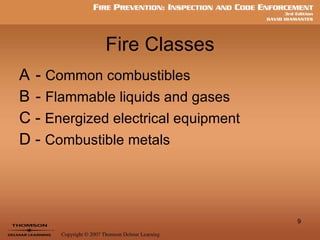
Fire Classes A  -  Common combustibles B  -  Flammable liquids and gases C -  Energized electrical equipment D -  Combustible metals
Extinguishing Agent Classes A  -  Water, dry chemical, foam, some halon  B  -  CO ² , dry chemical, halon, foam C  -  CO ² , dry chemical, halon D  -  Dry powder
Fire Triangle
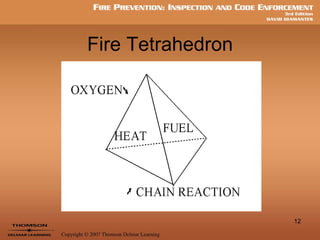
Fire Tetrahedron
NFPA 13  Property protection system Provides a high level of safety All areas of building are protected Including combustible void spaces
Occupancy Classifications  Light Hazard Ordinary Hazard Group 1 Ordinary Hazard Group 2 Extra Hazard Group 1 Extra Hazard Group 2
Light Hazard Occupancies  Occupancies where quantity and combustibility is low Fires develop a low rate of heat release Stock piles do not exceed 8 feet
Light Hazard Occupancies  Churches Schools Libraries Offices Theaters
Light Hazard Occupancies  Clubs Hospitals Museums Residential Restaurants
Ordinary Hazard Group 1  Occupancies where quantity and combustibility is low Fires develop a moderate rate of heat release Stock piles do not exceed 8 feet
Ordinary Hazard Group 1 Automobile parking Bakeries Canneries Dairies Restaurant service areas
Ordinary Hazard Group 2  Occupancies where quantity and combustibility is moderate Fires develop a moderate rate of heat release Stock piles do not exceed 12 feet
Ordinary Hazard Group 2 Cereal mills Chemical plants Distilleries Dry cleaners Machine shops Repair garages
Extra Hazard Group 1 Occupancies where quantity and combustibility is very high Fires develop a high rate of heat release May contain a small amount of flammable liquids
Extra Hazard Group 1 Aircraft hangars Plywood manufacturing Saw mills Textile picking Upholstering with plastic foam
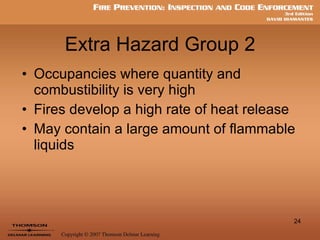
Extra Hazard Group 2 Occupancies where quantity and combustibility is very high Fires develop a high rate of heat release May contain a large amount of flammable liquids
Extra Hazard Group  2 Flammable liquid spraying Manufactured home assembly Plastics processing
Sprinkler Standards  NFPA 13R Standard  Installation of sprinkler systems in residential occupancies up to four stories
NFPA 13R  Residential occupancies    4 stories Sprinklers may be omitted from: Bathrooms    55 ft² Closets    24 ft² Garages, carports, porches, attics, crawl spaces, and combustible voids
NFPA 13R  Provide a high level of life safety  Designed to prevent or delay flashover and permit escape Does not provide property protection Building may sustain fire damage
NFPA 13D  One- and two-family dwellings Sprinklers may be omitted from: Bathrooms    55 ft² Closets    24 ft² Garages, carports, porches, attics, crawl spaces, and combustible voids
NFPA 13D  One- and two-family dwellings Designed to prevent or delay flashover and permit escape Does not provide property protection Building may sustain considerable damage
Sprinkler System Types Wet Pipe Systems Dry Pipe Systems Preaction Systems Deluge Systems
Wet Pipe Systems Most common Most reliable Water > 7 psi Most economical For areas not subject to freezing
Dry Pipe Systems  750 gallons per dry pipe valve Quick opening device > 500 gallons Dry pipe valve in room that is heated, lighted room
Differential Ratio of air pressure to water pressure necessary to balance the dry pipe valve Maintaining it in the closed position
Dry Pipe Systems   750 gallons per dry pipe valve Quick opening device > 500 gallons Dry pipe valve in room that is heated and lighted
Preaction Systems Closed heads Detection devices control valve Activation charges system Wet > 20 heads require 7 psi air for supervision
Deluge Systems Used where fire may outrun sprinkler system High hazard areas Hangars Loading racks Explosives
ESFR Sprinklers Early Suppression Fast Response Flow rates up to 125 pm Designed to extinguish not control Protect rack storage up to 35 feet with sprinklers at ceiling only
Standpipe Classes  Class I Fire department 500 gpm for 30 minutes 250 gpm for additional standpipes Class II For use by building occupants 100 gpm for 30 minutes
Standpipe Classes  Class III FD and building occupants
Types of Standpipe Systems Wet with constant water supply Dry with automatic actuation Dry with manual actuation Dry without fixed water supply
Standpipe Pressure Reducing Devices  Prevent overpressure on lower floors Fire pumps must overcome head pressure of .434 psi per foot or 5 lbs per floor Achieves correct pressure at topmost outlet
Standpipe Pressure Reducing Devices  Pressure on lower floors is higher by about 5 lbs per floor
Dry Chemical Extinguishing Systems  Designed and installed per NFPA 17 Automatic and manual actuation Warning signs and alarms Acceptance tests Discharge tests
Wet Chemical Fire Extinguishing Systems  Designed and installed per NFPA 17A Automatic and manual actuation Warning signs and alarms Acceptance tests Discharge tests
Halogenated Extinguishing Systems  Designed and installed per NFPA 12A Automatic and manual actuation Warning signs and alarms Acceptance tests
Halogenated Extinguishing Systems  Agent names based on chemical formula Chlorine 1 1 Flourine 3 2 Bromine 0 1 Iodine 1 1
Clean Agent Fire Extinguishing Systems  Designed and installed per code and manufacturers instructions Automatic and manual actuation Warning signs and alarms Acceptance tests
Carbon Dioxide Extinguishing Systems  Designed and installed per NFPA 12 Automatic and manual actuation Warning signs and alarms Acceptance tests
Foam Extinguishing Systems  Designed and installed per NFPA 11, 11A, 16 Automatic and manual actuation Warning signs and alarms Acceptance tests
Water Spray Fixed Systems Designed and installed per NFPA 15 Automatic actuation Acceptance tests
Fire Department Connections Required by  NFPA 13 – Standard for the Installation of Sprinklers NFPA 13R – Residential Occupancies up to 4 Stories
Fire Department Connections Required for all sprinklers systems except: Limited area systems off domestic water supply Systems < 20 heads
Fire Department Connection Requirements Connection will supply all sprinklers or all standpipes Street front or location approved by the FD 18-42” above ground, w/sign No obstructions
Fire Alarm and Detection Systems Notification of occupants Activation of fire protection systems NFPA 72  National Fire Alarm Code
Fire Alarm System Components Detection devices Smoke, heat, water flow, UV flame Signaling or notification  devices Bells, horns, AV devices Control panel System “brain”
Summary Fire protection systems are hazard-specific Sprinkler system standards 13, 13D, and  13R provide different levels of protection
Summary Passive fire protection features, rated and (or) noncombustible construction  Active features, sprinklers, alarms, etc, are complimentary

Chapter 06

  • 1.
    Chapter Six Installationof Fire Protection Systems
  • 2.
    Learning Objectives Listfour classes of fire Identify fire suppression system agents compatible with each class Describe method of extinguishment List and describe the four basic types of sprinkler systems
  • 3.
    Learning Objectives Describedifferences between NFPA 13, 13D, and 13R standards and applications Describe function of standpipe pressure reducing valves and potential hazards
  • 4.
    Learning Objectives Describethe purpose for UL-300 standard
  • 5.
    Fire Protection SystemsExtinguishing systems for structural protection and life safety Detection and alarm devices Smoke control and removal systems Extinguishing systems for industrial process Portable first aid extinguishing devices
  • 6.
    Fire Protection SystemsEngineered systems Designed for a specific hazard Any change in hazard requires reevaluation of the system to determine its effectiveness
  • 7.
    Fire Protection SystemsA primary responsibility of the inspector is to verify system maintenance No change to hazard classification
  • 8.
    Fire Extinguishing SystemsAgents used in extinguishing systems must be appropriate for the hazard Compatible with one another Water extinguishers are not appropriate for fires in energized electrical equipment ABC and BC types of dry chemical are not compatible
  • 9.
    Fire Classes A - Common combustibles B - Flammable liquids and gases C - Energized electrical equipment D - Combustible metals
  • 10.
    Extinguishing Agent ClassesA - Water, dry chemical, foam, some halon B - CO ² , dry chemical, halon, foam C - CO ² , dry chemical, halon D - Dry powder
  • 11.
  • 12.
  • 13.
    NFPA 13 Property protection system Provides a high level of safety All areas of building are protected Including combustible void spaces
  • 14.
    Occupancy Classifications Light Hazard Ordinary Hazard Group 1 Ordinary Hazard Group 2 Extra Hazard Group 1 Extra Hazard Group 2
  • 15.
    Light Hazard Occupancies Occupancies where quantity and combustibility is low Fires develop a low rate of heat release Stock piles do not exceed 8 feet
  • 16.
    Light Hazard Occupancies Churches Schools Libraries Offices Theaters
  • 17.
    Light Hazard Occupancies Clubs Hospitals Museums Residential Restaurants
  • 18.
    Ordinary Hazard Group1 Occupancies where quantity and combustibility is low Fires develop a moderate rate of heat release Stock piles do not exceed 8 feet
  • 19.
    Ordinary Hazard Group1 Automobile parking Bakeries Canneries Dairies Restaurant service areas
  • 20.
    Ordinary Hazard Group2 Occupancies where quantity and combustibility is moderate Fires develop a moderate rate of heat release Stock piles do not exceed 12 feet
  • 21.
    Ordinary Hazard Group2 Cereal mills Chemical plants Distilleries Dry cleaners Machine shops Repair garages
  • 22.
    Extra Hazard Group1 Occupancies where quantity and combustibility is very high Fires develop a high rate of heat release May contain a small amount of flammable liquids
  • 23.
    Extra Hazard Group1 Aircraft hangars Plywood manufacturing Saw mills Textile picking Upholstering with plastic foam
  • 24.
    Extra Hazard Group2 Occupancies where quantity and combustibility is very high Fires develop a high rate of heat release May contain a large amount of flammable liquids
  • 25.
    Extra Hazard Group 2 Flammable liquid spraying Manufactured home assembly Plastics processing
  • 26.
    Sprinkler Standards NFPA 13R Standard Installation of sprinkler systems in residential occupancies up to four stories
  • 27.
    NFPA 13R Residential occupancies  4 stories Sprinklers may be omitted from: Bathrooms  55 ft² Closets  24 ft² Garages, carports, porches, attics, crawl spaces, and combustible voids
  • 28.
    NFPA 13R Provide a high level of life safety Designed to prevent or delay flashover and permit escape Does not provide property protection Building may sustain fire damage
  • 29.
    NFPA 13D One- and two-family dwellings Sprinklers may be omitted from: Bathrooms  55 ft² Closets  24 ft² Garages, carports, porches, attics, crawl spaces, and combustible voids
  • 30.
    NFPA 13D One- and two-family dwellings Designed to prevent or delay flashover and permit escape Does not provide property protection Building may sustain considerable damage
  • 31.
    Sprinkler System TypesWet Pipe Systems Dry Pipe Systems Preaction Systems Deluge Systems
  • 32.
    Wet Pipe SystemsMost common Most reliable Water > 7 psi Most economical For areas not subject to freezing
  • 33.
    Dry Pipe Systems 750 gallons per dry pipe valve Quick opening device > 500 gallons Dry pipe valve in room that is heated, lighted room
  • 34.
    Differential Ratio ofair pressure to water pressure necessary to balance the dry pipe valve Maintaining it in the closed position
  • 35.
    Dry Pipe Systems 750 gallons per dry pipe valve Quick opening device > 500 gallons Dry pipe valve in room that is heated and lighted
  • 36.
    Preaction Systems Closedheads Detection devices control valve Activation charges system Wet > 20 heads require 7 psi air for supervision
  • 37.
    Deluge Systems Usedwhere fire may outrun sprinkler system High hazard areas Hangars Loading racks Explosives
  • 38.
    ESFR Sprinklers EarlySuppression Fast Response Flow rates up to 125 pm Designed to extinguish not control Protect rack storage up to 35 feet with sprinklers at ceiling only
  • 39.
    Standpipe Classes Class I Fire department 500 gpm for 30 minutes 250 gpm for additional standpipes Class II For use by building occupants 100 gpm for 30 minutes
  • 40.
    Standpipe Classes Class III FD and building occupants
  • 41.
    Types of StandpipeSystems Wet with constant water supply Dry with automatic actuation Dry with manual actuation Dry without fixed water supply
  • 42.
    Standpipe Pressure ReducingDevices Prevent overpressure on lower floors Fire pumps must overcome head pressure of .434 psi per foot or 5 lbs per floor Achieves correct pressure at topmost outlet
  • 43.
    Standpipe Pressure ReducingDevices Pressure on lower floors is higher by about 5 lbs per floor
  • 44.
    Dry Chemical ExtinguishingSystems Designed and installed per NFPA 17 Automatic and manual actuation Warning signs and alarms Acceptance tests Discharge tests
  • 45.
    Wet Chemical FireExtinguishing Systems Designed and installed per NFPA 17A Automatic and manual actuation Warning signs and alarms Acceptance tests Discharge tests
  • 46.
    Halogenated Extinguishing Systems Designed and installed per NFPA 12A Automatic and manual actuation Warning signs and alarms Acceptance tests
  • 47.
    Halogenated Extinguishing Systems Agent names based on chemical formula Chlorine 1 1 Flourine 3 2 Bromine 0 1 Iodine 1 1
  • 48.
    Clean Agent FireExtinguishing Systems Designed and installed per code and manufacturers instructions Automatic and manual actuation Warning signs and alarms Acceptance tests
  • 49.
    Carbon Dioxide ExtinguishingSystems Designed and installed per NFPA 12 Automatic and manual actuation Warning signs and alarms Acceptance tests
  • 50.
    Foam Extinguishing Systems Designed and installed per NFPA 11, 11A, 16 Automatic and manual actuation Warning signs and alarms Acceptance tests
  • 51.
    Water Spray FixedSystems Designed and installed per NFPA 15 Automatic actuation Acceptance tests
  • 52.
    Fire Department ConnectionsRequired by NFPA 13 – Standard for the Installation of Sprinklers NFPA 13R – Residential Occupancies up to 4 Stories
  • 53.
    Fire Department ConnectionsRequired for all sprinklers systems except: Limited area systems off domestic water supply Systems < 20 heads
  • 54.
    Fire Department ConnectionRequirements Connection will supply all sprinklers or all standpipes Street front or location approved by the FD 18-42” above ground, w/sign No obstructions
  • 55.
    Fire Alarm andDetection Systems Notification of occupants Activation of fire protection systems NFPA 72 National Fire Alarm Code
  • 56.
    Fire Alarm SystemComponents Detection devices Smoke, heat, water flow, UV flame Signaling or notification devices Bells, horns, AV devices Control panel System “brain”
  • 57.
    Summary Fire protectionsystems are hazard-specific Sprinkler system standards 13, 13D, and 13R provide different levels of protection
  • 58.
    Summary Passive fireprotection features, rated and (or) noncombustible construction Active features, sprinklers, alarms, etc, are complimentary