FIRE PUMPS
FIRE PUMPS
General
 A centrifugal pump for fire protection shall be
selected to operate at less than or equal to 150% of
the rated capacity. The pump should be selected at
capacities between 90% to 140% of the rated
capacity( clause 5.8.1 ).
 It is a poor design practice to overdesign the fire
pump and the driver and depend on the pressure
relief valve to open and relieve the excess pressure
Requirements of Pump room
 Indoor fire pump units should be physically
separated or protected by fire rated construction.
For a fully sprinklered pump room one hour fire
rating is required.
 Emergency lighting and ventilation are required in
pump room.
 Drainage-Flow should be pitched to adequate
drainage of escaping water from pump and other
accessories.
Piping
 Steel pipe should be used for above ground
applications. For underground applications
NFPA 24 should be followed.
 Steel pipes should be joined by means of
threaded, flanged (flanges welded to pipes
are preferred), grooved joints.
Suction piping
 The size of the suction pipe for a single pump or of
the suction header pipe for multiple pumps
( operating together) should be such that with all
pumps operating at 150% of the rated capacity, the
gauge pressure at the pump suction flanges should
be 0 bar or higher.
 Where the supply is the suction tank with its base at
or above the same elevation as the pump gauge,
pressure at the pump suction flange shall be
permitted to drop to -0.2 bar.
Suction piping………cont’d
 Suction pipe should be sized such that with the
pumps operating at 150% of the rated capacity, the
velocity in that portion of the suction pipe located
within 10 pipe diameters upstream of the suction
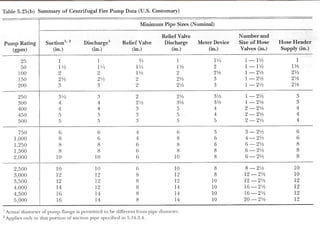
flange does not exceed 4.57m/s and the size should
not be less than that specified in section 5.25
 A listed OS&Y gate valve should be installed in the
suction pipe.
Suction piping………cont’d
 No valve other than a listed OS&Y valve should be
installed in the suction pipe within 15.3m.
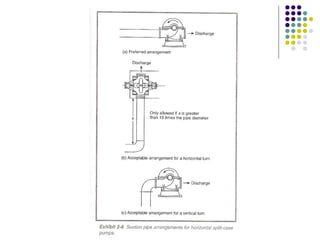
 Elbows and Tees with a centre line plane parallel to
HSC pump are not permitted within 10 times the
suction pipe diameter.
 Elbows with centre line plane perpendicular to HSC
pump shaft is permitted.
 Where the pump and water tank are on separate
foundations provision shall be made for strain relief.
Suction piping………cont’d
 For pumps taking suction from a water tank a vortex
plate shall be provided at the entrance to the suction
pipe.
Discharge piping
 The size of the pump discharge pipe should not be
less than that given in section 5.25
 Flanges welded to pipes are preferred.
 Butterfly valves are permitted.
 No pressure regulating devices should be installed
in the discharge pipe except as permitted in NFPA
20.
 Pressure relief valves are required for diesel engine
pumps only if the 121% of the shut off head + static
suction pressure exceeds the system components
rating.
Discharge piping………..cont’d
 Size of the relief valve should be as per section 5.25
 Relief valve should be located between check valve
and the pump.
 Relief valve discharge piping returning water back to
the storage tank should be piped independently and
not be combined with the discharge from other relief
valves.
 Flow meter-size of the test line and flow meter
should be as per section 5.25
Jockey pump
 Flow rate of a jockey pump should not be less than
the normal leakage rate.
 Jockey pump should be sized to make up the
allowable leakage rate within 10 minutes or 3.8
litres/min which ever is larger.
 For sprinkler systems jockey pumps are generally
sized to flow an amount of water less than or equal
to that required by a single sprinkler.
Centrifugal Pumps
 Centrifugal pumps shall not be used where a static
suction lift is required.
 Fittings (accessories) to be provided by the
manufacturer or an authorised representative.
1.Automatic air release valve
2.Circulation relief valve
3.Pressure gauges
 Strainer:-Pumps that require removal of the driver to
remove rocks or debris from the pump impeller
should have a pipe lined strainer installed in the
suction line a minimum of 10 pipe diameters from
the suction flange.
Centrifugal Pumps………
cont’d
 Foundation:-The base plate of the pump should be
securely attached to the solid foundation.
 The foundation should be sufficiently substantial to
form a permanent and rigid support for the base
plate.
Vertical shaft turbine pumps
 Wet Pit Installation
 The required submergence should be obtained from
the pump manufacturer.
Electric drive for pumps
 For pumps driven by electric motors where a reliable
power cannot be obtained from reliable power
sources , one of the following arrangements should
be provided.
 Combination of two or more power sources
 One of the approved power sources and an onsite
standby generator.
 An approved combination of feeders constituting two
or more power sources.
Electric drive for pumps…
cont’d
 Combination of one or feeders in combination with
an onsite standby generator
 One of the power source and a redundant fire pump
driven by diesel engine.
 Transfer of power to the fire pump controller
between normal power supply and one alternate
power supply should take place within the pump
room.
Fire pump’s controller
(Electric)
Primary Design
 System operation is Primary
 Protection of connected motor is secondary
Fire pump’s controller
(Electric)………….cont’d
 Controllers should be located as close as is
practical to the motors they control and
should be within the site of the motors.
 Interfacing with fire alarm system.
Pump running
Loss of Phase
Phase reversal
Controller connected to alternate power
supply.
Emergency Starting Circuits
 If the contactor coil does not function for any
reason an emergency mechanical means is
available for closing the contactor
Service Entrance Rating
 Utility can DIRECTLY connect to controller
 Equipped with grounding lug bonded to the
enclosure
 For added safety controller equipped with
isolating switch interlocked with enclosure
door.
Motor Contactor
 No control circuit fuse
 No voltage, frequency or other sensor to
prevent operation of contactor
 No thermal overload relay
 Contactor coil at LINE voltage
Circuit Breaker
 Maintains locked rotor current for:
 8 Seconds Minimum
 20 Seconds Maximum
 LRC=600% of Motor FLA
 Minimum setting is 300% of the motor’s full
load Amps for 30 minutes minimum
Circuit Breaker Type
 Magnetic device only
 No thermal elements are permitted
 Instantaneous Reset
Circuit Breaker Basic Design
 Set to allow operation, not to protect the
connected electric motor
 All motors shall be specifically listed for fire
pump service
 Horsepower and locked rotor current motor
designation shall be as per NEC & NFPA 70
National Electric Code
 All motors shall comply with NEMA standard
MG-1 and be marked as complying with
NEMA Design B standards
 All motors shall be rated for continuous duty
and shall be applied only at voltages of +10
percent of the motor nameplate voltage.
 Electric-motor-induced transients shall be
coordinated with 7-4.3.3 to prevent nuisance
tripping of motor controller protective devices.
Diesel Engine
 Fuel Supply and arrangement
Fuel tank should have a capacity at least 1 gal/hp,
plus 5% volume for expansion and 5% volume for
sump
 For multiple diesel engine pumps, separate fuel line
and separate fuel tank are required.
 Inlet to the fuel supply line should be located so that
its opening is no lower than the level of the engine
fuel pump.
Diesel Engine…..cont’d
 The engine manufacturer’s fuel pump static head
pressure limit should not be exceeded.
 Galvanised steel or copper should not be used for
fuel piping
 No shutoff valve should be installed in the fuel return
line to the tank.
 Air supply and discharge ventilators should be
provided.
Controller for Diesel Engine
 System operation is primary
 Protection of the connected engine is
secondary
Engine Protection Circuits
Allows engine to continue operation:
 When a low oil pressure condition exists
 When a high cooling water temperature
condition exists.

Fire pumps

  • 1.
  • 2.
    FIRE PUMPS General  Acentrifugal pump for fire protection shall be selected to operate at less than or equal to 150% of the rated capacity. The pump should be selected at capacities between 90% to 140% of the rated capacity( clause 5.8.1 ).  It is a poor design practice to overdesign the fire pump and the driver and depend on the pressure relief valve to open and relieve the excess pressure
  • 3.
    Requirements of Pumproom  Indoor fire pump units should be physically separated or protected by fire rated construction. For a fully sprinklered pump room one hour fire rating is required.  Emergency lighting and ventilation are required in pump room.  Drainage-Flow should be pitched to adequate drainage of escaping water from pump and other accessories.
  • 4.
    Piping  Steel pipeshould be used for above ground applications. For underground applications NFPA 24 should be followed.  Steel pipes should be joined by means of threaded, flanged (flanges welded to pipes are preferred), grooved joints.
  • 7.
    Suction piping  Thesize of the suction pipe for a single pump or of the suction header pipe for multiple pumps ( operating together) should be such that with all pumps operating at 150% of the rated capacity, the gauge pressure at the pump suction flanges should be 0 bar or higher.  Where the supply is the suction tank with its base at or above the same elevation as the pump gauge, pressure at the pump suction flange shall be permitted to drop to -0.2 bar.
  • 8.
    Suction piping………cont’d  Suctionpipe should be sized such that with the pumps operating at 150% of the rated capacity, the velocity in that portion of the suction pipe located within 10 pipe diameters upstream of the suction flange does not exceed 4.57m/s and the size should not be less than that specified in section 5.25  A listed OS&Y gate valve should be installed in the suction pipe.
  • 10.
    Suction piping………cont’d  Novalve other than a listed OS&Y valve should be installed in the suction pipe within 15.3m.  Elbows and Tees with a centre line plane parallel to HSC pump are not permitted within 10 times the suction pipe diameter.  Elbows with centre line plane perpendicular to HSC pump shaft is permitted.  Where the pump and water tank are on separate foundations provision shall be made for strain relief.
  • 12.
    Suction piping………cont’d  Forpumps taking suction from a water tank a vortex plate shall be provided at the entrance to the suction pipe.
  • 14.
    Discharge piping  Thesize of the pump discharge pipe should not be less than that given in section 5.25  Flanges welded to pipes are preferred.  Butterfly valves are permitted.  No pressure regulating devices should be installed in the discharge pipe except as permitted in NFPA 20.  Pressure relief valves are required for diesel engine pumps only if the 121% of the shut off head + static suction pressure exceeds the system components rating.
  • 16.
    Discharge piping………..cont’d  Sizeof the relief valve should be as per section 5.25  Relief valve should be located between check valve and the pump.  Relief valve discharge piping returning water back to the storage tank should be piped independently and not be combined with the discharge from other relief valves.  Flow meter-size of the test line and flow meter should be as per section 5.25
  • 19.
    Jockey pump  Flowrate of a jockey pump should not be less than the normal leakage rate.  Jockey pump should be sized to make up the allowable leakage rate within 10 minutes or 3.8 litres/min which ever is larger.  For sprinkler systems jockey pumps are generally sized to flow an amount of water less than or equal to that required by a single sprinkler.
  • 20.
    Centrifugal Pumps  Centrifugalpumps shall not be used where a static suction lift is required.  Fittings (accessories) to be provided by the manufacturer or an authorised representative. 1.Automatic air release valve 2.Circulation relief valve 3.Pressure gauges  Strainer:-Pumps that require removal of the driver to remove rocks or debris from the pump impeller should have a pipe lined strainer installed in the suction line a minimum of 10 pipe diameters from the suction flange.
  • 21.
    Centrifugal Pumps……… cont’d  Foundation:-Thebase plate of the pump should be securely attached to the solid foundation.  The foundation should be sufficiently substantial to form a permanent and rigid support for the base plate.
  • 26.
    Vertical shaft turbinepumps  Wet Pit Installation  The required submergence should be obtained from the pump manufacturer.
  • 29.
    Electric drive forpumps  For pumps driven by electric motors where a reliable power cannot be obtained from reliable power sources , one of the following arrangements should be provided.  Combination of two or more power sources  One of the approved power sources and an onsite standby generator.  An approved combination of feeders constituting two or more power sources.
  • 30.
    Electric drive forpumps… cont’d  Combination of one or feeders in combination with an onsite standby generator  One of the power source and a redundant fire pump driven by diesel engine.  Transfer of power to the fire pump controller between normal power supply and one alternate power supply should take place within the pump room.
  • 31.
    Fire pump’s controller (Electric) PrimaryDesign  System operation is Primary  Protection of connected motor is secondary
  • 32.
    Fire pump’s controller (Electric)………….cont’d Controllers should be located as close as is practical to the motors they control and should be within the site of the motors.  Interfacing with fire alarm system. Pump running Loss of Phase Phase reversal Controller connected to alternate power supply.
  • 33.
    Emergency Starting Circuits If the contactor coil does not function for any reason an emergency mechanical means is available for closing the contactor
  • 34.
    Service Entrance Rating Utility can DIRECTLY connect to controller  Equipped with grounding lug bonded to the enclosure  For added safety controller equipped with isolating switch interlocked with enclosure door.
  • 35.
    Motor Contactor  Nocontrol circuit fuse  No voltage, frequency or other sensor to prevent operation of contactor  No thermal overload relay  Contactor coil at LINE voltage
  • 36.
    Circuit Breaker  Maintainslocked rotor current for:  8 Seconds Minimum  20 Seconds Maximum  LRC=600% of Motor FLA  Minimum setting is 300% of the motor’s full load Amps for 30 minutes minimum
  • 37.
    Circuit Breaker Type Magnetic device only  No thermal elements are permitted  Instantaneous Reset
  • 38.
    Circuit Breaker BasicDesign  Set to allow operation, not to protect the connected electric motor
  • 39.
     All motorsshall be specifically listed for fire pump service  Horsepower and locked rotor current motor designation shall be as per NEC & NFPA 70 National Electric Code  All motors shall comply with NEMA standard MG-1 and be marked as complying with NEMA Design B standards
  • 40.
     All motorsshall be rated for continuous duty and shall be applied only at voltages of +10 percent of the motor nameplate voltage.  Electric-motor-induced transients shall be coordinated with 7-4.3.3 to prevent nuisance tripping of motor controller protective devices.
  • 42.
    Diesel Engine  FuelSupply and arrangement Fuel tank should have a capacity at least 1 gal/hp, plus 5% volume for expansion and 5% volume for sump  For multiple diesel engine pumps, separate fuel line and separate fuel tank are required.  Inlet to the fuel supply line should be located so that its opening is no lower than the level of the engine fuel pump.
  • 44.
    Diesel Engine…..cont’d  Theengine manufacturer’s fuel pump static head pressure limit should not be exceeded.  Galvanised steel or copper should not be used for fuel piping  No shutoff valve should be installed in the fuel return line to the tank.  Air supply and discharge ventilators should be provided.
  • 45.
    Controller for DieselEngine  System operation is primary  Protection of the connected engine is secondary
  • 46.
    Engine Protection Circuits Allowsengine to continue operation:  When a low oil pressure condition exists  When a high cooling water temperature condition exists.