Fire Prevention Through the Codes Process   Chapter 4
Objectives Upon completion of this chapter, you will be able to: Describe the origin of the model code system in the United States List the major model code organizations and describe the evolution of model code organizations in the United States
Objectives (cont’d.) Describe the code change process used by the model code organizations Describe the methods of code adoption by states and local governments Discuss the impact of the agendas of groups participating in the model code process
Model Codes Codes: systematically arranged bodies of laws or rules Codes tell us what to do or what not to do Examples:  United States Code ,  Code of Virginia ,  Code of the County of Fairfax Model codes: technical rules made available for governments to accept Adoption of the code
The Development of Model Codes Fire insurance industry failed to self-regulate insurance rates/commissions Started prevention through codes/standards The  NEC ®   may be the most universal model code The NBFU published the  National Building Code  and  National Fire Prevention Code  through 1976
Model Code Organizations of the Twentieth Century M any jurisdictions adopted NBFU codes The NBFU was absorbed as part of Insurance Services Organization (ISO) The NFPA grew into a 75,000-member international organization Largest model code organizations consolidated into the International Code Council (ICC)
The Regional Model Code Organizations System of regional codes, began in 1920s Building code by the Pacific Building Officials Conference Three regional code groups, 1950 Three major regional codes evolved in the 20th century National map of adopted codes resembled a puzzle: late 80s
Building Officials and Code Administrators, International Established in 1915 First  Basic Building Code  by BOCA,   1950 BOCA maintained building, mechanical, fire prevention, plumbing, and property maintenance codes through 1999 BOCA served the northeast, mid-Atlantic, and midwestern states before ICC
Southern Building Code Congress International Established in 1940 Published first edition of the  Standard Building Code  in 1945 Published several codes through 1999 Standard Fire Code:  developed with the Southeastern/Southwestern Fire Chief’s Associations
International Conference of Building Officials ICBO was established in 1921 as the Pacific Building Officials Conference Uniform Building Code , first edition published in 1927 Incorporated into the Department of Defense Military Handbook 1008 Replaced by  Unified Facilities Criteria,  2002 Incorporated the  International Building Code
International Code Council (ICC) Established in 1994 to develop a single set of model codes for the U.S. Consolidation of BOCA, ICBO, and SBCCI Pub lishes 14 model codes International Fire Code Council (IFCC) Established to represent common interests of the fire service and the ICC
The National Fire Protection Association Fe w comprehensive building regulations in effect in the 1800s Fire underwriters formed NFPA in 1896 Publishes almost 300 codes, standards, and recommended practices NFPA’s  NEC ®  may be the most widely used code in the U.S. Triangle Shirtwaist fire:  Life Safety Code ®
Code Changes Tw o major groups involved in the process ICC C3 group NFPA, ASHRAE, IAPMO, and WFCA Both groups  use a consensus process to develop and maintain their documents Disagree on what  consensus  really means
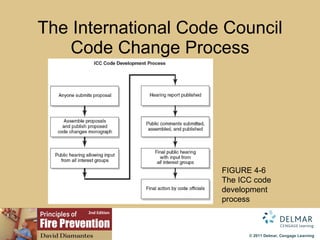
The International Code Council Code Change Process FIGURE 4-6 The ICC code development process
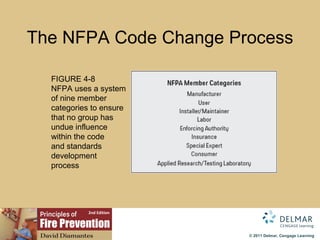
The NFPA Code Change Process FIGURE 4-8 NFPA uses a system of nine member categories to ensure that no group has undue influence within the code and standards development process
Fire Service Commitment ICC v o ting procedures Opportunity for full fire service participation Obligation to present and future firefighters M ust exercise influence through groups International Association of Fire Chiefs, the International Association of Fire Fighters (IAFF), and regional organizations
Code Adoption Two basic methods used Adoption by reference The jurisdiction passes an ordinance that lists or references a specific edition of a model code Adoption by transcription T he model code is republished as an ordinance by a jurisdiction
State and Local Adoption Le gal requirements to ensure adequate public notice S tate minimum code that can be locally amended State mini-maxi code with no option of local amendment Fa vored by business interests/developers Locally adopted code
What Codes Cannot Do Cycle of catastrophe/public outcries of “there ought to be a law” will continue to exist The largest fire prevention bureau cannot inspect every building every day
Summary Organizations originally formed to reduce property loss and protect lives Evolved to promote public safety Major reorganization in community, 2003 Three regional model code organizations voted to consolidate/form the ICC Effective codes: adequate education, enforcement, and public cooperation

Chapter 4

  • 1.
    Fire Prevention Throughthe Codes Process Chapter 4
  • 2.
    Objectives Upon completionof this chapter, you will be able to: Describe the origin of the model code system in the United States List the major model code organizations and describe the evolution of model code organizations in the United States
  • 3.
    Objectives (cont’d.) Describethe code change process used by the model code organizations Describe the methods of code adoption by states and local governments Discuss the impact of the agendas of groups participating in the model code process
  • 4.
    Model Codes Codes:systematically arranged bodies of laws or rules Codes tell us what to do or what not to do Examples: United States Code , Code of Virginia , Code of the County of Fairfax Model codes: technical rules made available for governments to accept Adoption of the code
  • 5.
    The Development ofModel Codes Fire insurance industry failed to self-regulate insurance rates/commissions Started prevention through codes/standards The NEC ® may be the most universal model code The NBFU published the National Building Code and National Fire Prevention Code through 1976
  • 6.
    Model Code Organizationsof the Twentieth Century M any jurisdictions adopted NBFU codes The NBFU was absorbed as part of Insurance Services Organization (ISO) The NFPA grew into a 75,000-member international organization Largest model code organizations consolidated into the International Code Council (ICC)
  • 7.
    The Regional ModelCode Organizations System of regional codes, began in 1920s Building code by the Pacific Building Officials Conference Three regional code groups, 1950 Three major regional codes evolved in the 20th century National map of adopted codes resembled a puzzle: late 80s
  • 8.
    Building Officials andCode Administrators, International Established in 1915 First Basic Building Code by BOCA, 1950 BOCA maintained building, mechanical, fire prevention, plumbing, and property maintenance codes through 1999 BOCA served the northeast, mid-Atlantic, and midwestern states before ICC
  • 9.
    Southern Building CodeCongress International Established in 1940 Published first edition of the Standard Building Code in 1945 Published several codes through 1999 Standard Fire Code: developed with the Southeastern/Southwestern Fire Chief’s Associations
  • 10.
    International Conference ofBuilding Officials ICBO was established in 1921 as the Pacific Building Officials Conference Uniform Building Code , first edition published in 1927 Incorporated into the Department of Defense Military Handbook 1008 Replaced by Unified Facilities Criteria, 2002 Incorporated the International Building Code
  • 11.
    International Code Council(ICC) Established in 1994 to develop a single set of model codes for the U.S. Consolidation of BOCA, ICBO, and SBCCI Pub lishes 14 model codes International Fire Code Council (IFCC) Established to represent common interests of the fire service and the ICC
  • 12.
    The National FireProtection Association Fe w comprehensive building regulations in effect in the 1800s Fire underwriters formed NFPA in 1896 Publishes almost 300 codes, standards, and recommended practices NFPA’s NEC ® may be the most widely used code in the U.S. Triangle Shirtwaist fire: Life Safety Code ®
  • 13.
    Code Changes Two major groups involved in the process ICC C3 group NFPA, ASHRAE, IAPMO, and WFCA Both groups use a consensus process to develop and maintain their documents Disagree on what consensus really means
  • 14.
    The International CodeCouncil Code Change Process FIGURE 4-6 The ICC code development process
  • 15.
    The NFPA CodeChange Process FIGURE 4-8 NFPA uses a system of nine member categories to ensure that no group has undue influence within the code and standards development process
  • 16.
    Fire Service CommitmentICC v o ting procedures Opportunity for full fire service participation Obligation to present and future firefighters M ust exercise influence through groups International Association of Fire Chiefs, the International Association of Fire Fighters (IAFF), and regional organizations
  • 17.
    Code Adoption Twobasic methods used Adoption by reference The jurisdiction passes an ordinance that lists or references a specific edition of a model code Adoption by transcription T he model code is republished as an ordinance by a jurisdiction
  • 18.
    State and LocalAdoption Le gal requirements to ensure adequate public notice S tate minimum code that can be locally amended State mini-maxi code with no option of local amendment Fa vored by business interests/developers Locally adopted code
  • 19.
    What Codes CannotDo Cycle of catastrophe/public outcries of “there ought to be a law” will continue to exist The largest fire prevention bureau cannot inspect every building every day
  • 20.
    Summary Organizations originallyformed to reduce property loss and protect lives Evolved to promote public safety Major reorganization in community, 2003 Three regional model code organizations voted to consolidate/form the ICC Effective codes: adequate education, enforcement, and public cooperation