THE INTEGUMENTARY SYSTEM Skin and its Derivatives
DERMATOLOGY STUDY  OF  THE  STRUCTURE, COMPOSITION,  AND FUNCTIONS OF THE SKIN DERMA- SKIN SKIN/INTEGUMENT  – the largest organ of the body, approximately 5 kg of  the body weight thick in palms and soles, thin in eyelids and scrotum
Functions of Skin Protects from injuries Acts as barrier and regulates what enters/leaves body. Regulates body temperature. Synthesizes, stores vitamins. Sensory functions Excretion Absorption
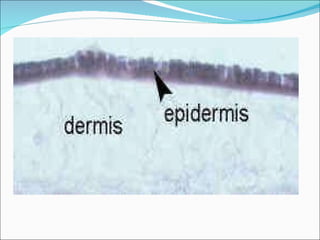
Main layers of the Skin Epidermis – outermost skin layer 2.Dermis – true skin layer 3. Hypodermis – the subcutaneous layer
DIFFERENCES OF THE SKIN LAYERS BASIS EPIDERMIS DERMIS HYPODERMIS 1. LOCATION OUTERMOST SUB EPIDERMAL SUBCUTANEOUS 2.THICKNESS THIN THICK RELATIVE 3. HISTOLOGICAL COMPONENT HIGHLY EPITHELIAL CONNECTIVE, MUSCULAR,NERVOUS, VASCULAR CONNECTIVE 4. VASCULARI- ZATION AVASCULAR VASCULAR VASCULAR
5. LAYERS 5 SUB LAYERS 1.S. CORNEUM 2.S. LUCIDUM 3.S. GRAULOSUM 4. S. SPINOSUM 5. S. GERMINATIVUM 2 SUB LAYERS 1.S. PAPILLAROSUM 2.S.  RETICULAROSUM RELATIVE 6. NERVE ENDINGS ABSENT PRESENT PRESENT 7. GLANDS AGLANDULAR GLANDULAR –SWEAT,SEBACEOUS, MAMMARY GLANDULAR – SECRETES LEPTIN 8. DERIVATIVES HAIRS AND NAILS GLANDS GLAND
 
EPIDERMAL  DIFFERENCES I.Epidermis of fishes and Aquatic amphibians GLANDS 1.MUCOUS GLANDS secretes gelatinous substance mucin in frogs; for water absorption and respiration in fish; defense  mechanism for predations
2.SEROUS GLANDS -secretes poisonous alkaloids  for protection against  predators. 3.PHOTOPHORES GLANDS -contains  light-emittingn
II.EPIDERMIS OF TERRESRIAL  OR LAND VERTERATES GLANDS 1.MAMMARY GLANDS secretes milk-feed the young both sexes;male-non functional;female-location 2.SWEAT GLANDS AND  SUDORIFEROUS GLANDS produce sweat/perspiration cooling  mechanism to regulate body temp
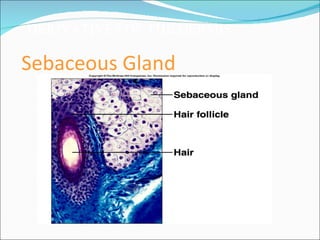
3.OIL/ SEBACEOUS GLANDS secretes oilo/sebum;for lubrication/mare skin moist/shiny 4.UROPYGIAL GLAND [BIRDS] tail of uroryogium secretes oil,oiling the beark;shiny  feathers/preening by beaks
5.SEROUS GLANDS [SNAKE] secretes poison/toxic alkaloids 6.CERUMINOUS GLANDS [MAN] -secretes cerumen 7.GLANDS OF ZELS -moits the eyelashes 8.MELBOMIAN GLANDS -moists the eyelids
TYPES OF GLANDS ACCDG. TO MANNER OF SECRETION 1.MEROCRINE GLANDS [TRUE GLAND] release secretion thought  memrbrane/cells remain intact. ex.unicellular integumentary glands sweat glands 2.HOLOCRINE GLANDS cells themselves constitute the secretion cells goes with secretion ex.sebaceous gland
APOCRINE SWEAT GLAND
3.APOCRINE GLANDS intermediate in position secretions  gathers at the tip or apical portion of the cell part of the cyptoplasm  are pinched off with the secretion & then repair itself. ex.mammary glands
 
EPIDERMAL DERIVATIVES 1.MAMMALS HAIR- shaft,bulb,root NAILS-lunula,nail bed,root CLAWS-cats,monkeys,bird,etc, HOOVES-ungulates TUSKS-elephants,source of plastics
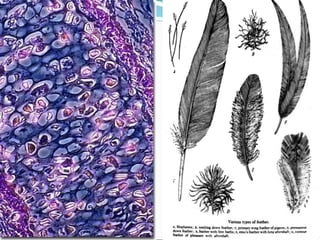
2.BIRDS-BEAKS,PREENING,NESTING,F00D-FEATHERS-FOR INSULTION, FLIGHTS,BODY CONTOURS parts;shaft,barbs,barbules,,calamus Types; 1.flight feathers 2.covert feathers 3.pin feathers 4.filoplumers 5.hair feathers
 
3.REPTILES epidermal scales-molting Exoskeleton turtles-scutes -corapace - plastron  4.AMPHIBIAN-rough/coarse skin 5.FISHES –with dermal scales Types of scales 1.CYCLOID SCALES-concentric ridges-milkfish 2.CTENOID SCALES-w/spines or ctenii 3.GANIOD SCALES-rhomboid shape, 4.COMOID SCALES-extinct fishes dermal armor 5.PLACOID SCALES-spines directed  caudally-sharks,skates
COMPARATIVE ANATOMY OF THE  SKIN CHORDATE EPIDERMIS DERMIS 1. AGNATHANS ‘ multi-layered  and is  rich w/mucous glands  ‘ slime  eels lack scales  ‘ Layers are mitotic including surface  cells horny denticles in the buccal funnel is  the only cormfied structure,shed replaced ‘ thinner than epidermis but tough due to interwoven collagenous fibers. ‘ rich in the melanophores w/c ad  heres tightly  to the  underlying  musculator myosepta
CHORDATE EPIDERMIS DERMIS 2.CHONDRICH-THYES ‘ more  layered and cells are compactly arranged ‘ unicellular glands excepting chaemiras ‘ stingrays-goblet toxins. ‘ multicellular cells at the  base secretes toxins  Multicelullar cells are  conc. at the base of  the claspers of males ‘ thicker than epidermis and w/2 more  or  less defined layers ‘ placoid scales fr.the paleozioc shakers ‘ sheet of melanophores derse  dorsally than virtrally  less illumnuscence ‘ with ceratotrichia  or fin rays
 
CHORDATE EPIDERMIS DERMIS 3. OSTEICH-THYES  -more mucous glands -presence of cycloid scales -with uicellular goblet cells w/c maintain mucous coat of the skin to prevent dessication -with poisonous granular gland -photophores serve as lures /warning -presence of ancient ganoid or modern cycloid scale -flexible dermal fin rays which stregthens the fins of bony fishes -with osteoderms
Bony fish
 
CHORDATE EPIDERMIS DERMIS 4.AMPHIBIA ‘ skin-w/o scales ‘ with incipient stratum corneum ‘ uncellular goblet cells secretes  mucigens for semi-aquatic amphibians ‘ mucons glands-mucin ‘ poison glands-alkaloidal secreation ‘ cornified skin prevents dessication. ‘ with dermal chomatophores ‘ firmly attached to the underlying musuculature ‘ voluminous bread subcutaneous lymph sinuses  separates skin from muscles  ‘ bony dermal scales in caecilians
 
CHORDATE EPIDERMIS DERMIS 5.REPTILES ‘ thick stratum corneum ‘ with epidermal scales molts at regular internal ‘ presence of unique horny surface features  ‘ integumentary glands are not abundant  ‘ scales,scutes,rattles,clansz,plaque,spiny crests ‘ bony dermal,bones are  more abundant ‘ osteoderms 1.lizards-underlying the  epidermal scales 2.snakes-absent
Reptilian
CHORDATE EPIDERMIS DERMIS 6.AVES ‘ thin-skinned ‘ epidermal scales umited to feet and base of breaks ‘ presence of sharp clans  ‘ integumentary glands are absent  ‘ uropygial  gland caudal,  oil the feathers ‘ with feathers .down .filoplumes .rectrices .remiges ‘ dermis supports the feathers and arrectures pilorum/ plumarun ‘ exceptionally thin ‘ motility of skin is correlated to thermoregulatory function of feathers ‘ no osteoderms ‘ with spurs both sexes .tarsometatasus .carpometasus in some
 
CHORDATE EPIDERMIS DERMIS 7.MAMMALS ‘ hairs are present arising  from hair follicles ‘ epidermal glands .sebaceous-sebum .sudoriferous-sweat .mammary-milk ‘ stratum germinativum is germinating ‘ dense stratum corneum ‘ derivatives .claws .horns  .hairs  .nails .baleen whale bone hangs or oral cavity ‘ presence of hair  follicle,arrector muscles,sweat, sebaceous glands,conn. tissues ‘ highly vascularized ‘ with nerve endings ‘ has thermoregulatory function-homiothermic ‘ hypodermis or subcutaneous layer separates skin from  muscles ‘ with pigment cells
THE MAMMALIAN SKIN
 
Stratum corneum Stratum granulosum Stratum spinosum Stratum basale (germinativum) Stratum lucidum** **Thick skin only
Stratum Basale Lowest epidermal layer, near dermis Good nutrient supply Reproduces by mitosis Cuboidal, columnar in shape Moves to upper epidermis in 27 days.
 
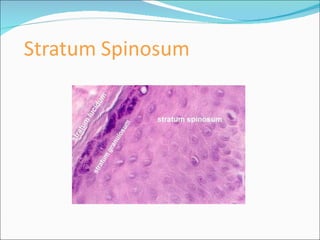
Stratum Spinosum Living cells Dividing 8-10 cells thick Polygonal in appearance
 
Stratus Granulosum,  Lucidum   Poor nutrient supply. Flatten layer of cells. 3-5 cells thick. No cell division. Keratin accumulates. Found only in very thick skin. Translucent. Highly keratinized. Dead cells
Stratum Corneum 25-30 cells thick. Cells are filled with keratin and hardened. Sloughed off. Outer most layer of epidermis. Keratinocytes
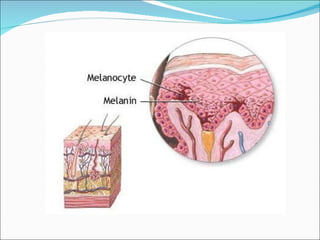
Melanocyte Produces melanin for protection from UV radiation. Responsible for skin color. Melanoma.
Melanocyte
 
Irregular Dense Connective Tissue Collagenous fibers                                                                  
Layers of the dermis Stratum papillarosum - superficial region(1/5) of the dermis,consists of areolar connective tissues with elastic fibers - contains dermal papillae that house capillaries,touch corpuscles,& free nerve endings 2. Stratum reticularosum - the deeper portion (4/5 of the dermis) - with dense regular conn. Tissue with bundles of collagen and elastic fibers - spaces between fibers contain adipocytes,hair follicles,nerves,sebaceous glands, sudoriferous glands
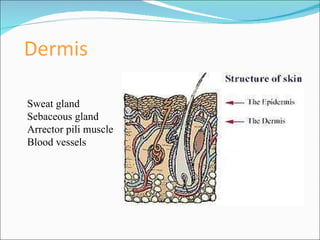
Sweat gland Sebaceous gland Arrector pili muscle Blood vessels
 
FEATURE THIN SKIN THICK SKIN 1. Distribution All parts of the body except palms,palmar digits,soles Palms,palmar surface of digits and soles 2. Epidermal thickness 0.10-0.15mm 0.6 – 4.5 mm 3. Epidermal Strata Lack stratum lucidum,thinner s. spinosum and s. corneum Thick s. lucidum,spinosum,corneum 4. epidermal Ridges Lacking due to poorly developed or fewer dermal papillae Present due to well- developed or numerous dermal papillae 5. Hair follicles and Arrector pili Muscle Present Absent   6. Sebaceous Glands Present Absent   7. Sudoriferpous Gland Fewer More numerous 8. Sensory Receptors Sparser denser
DERIVATIVES OF THE EPIDERMIS HAIR PARTS OF HAIR A. HAIR ROOT  D. HAIR FOLLICLE B. HAIR SHAFT E. HAIR CORTEX C. HAIR BULB F. HAIR MEDULLA
 
Hair Follicle
 
TYPES OF HAIR A. ANGORA B. DEFINITIVE HAIR C. LANUGO 2. NAIL A. NAIL ROOT B. NAIL BED C. LUNULA
Angora Hair
Definitive Hair
Lanugo Hair
 
Sebaceous Gland DERIVATIVES OF THE DERMIS
Sweat Gland SKIN GLANDS
Types of Sweat Glands (Sudoriferous Glands) Merocrine glands:  release fluid by exocytosis Eccrine Most common Secretion is mostly water with solutes Cools body down Apocrine Develops scent as bacteria metabolize secretion Stimulated when frightened, during pain, during emotional upset
APOCRINE SWEAT GLAND
ECCRINE SWEAT GLAND
 
Sensory Structures of Dermis Deep touch/pressure:  Pacinian corpuscles Light touch/pressure:  Meisner’s corpuscles Warm temperature:  Free nerve endings Cold temperature:  Free nerve endings Pain:  Free nerve endings
 
                                                                               Atlas of Human Anatomy in Cross Section: Section 2. Neck, Shoulders, Upper Arm, and Upper Thorax (Lungs)   Key Figure 4 a Ronald A. Bergman, Ph.D., Adel K. Afifi, M.D., Jean J. Jew, M.D., and Paul C. Reimann, B.S. Peer Review Status: Externally Peer Reviewed                                                                     Recognized by adipose tissue.
FACTORS INFLUENCING SKIN COLOR GENETIC INFORMATION AMOUNT OF MELANIN PIGMENTS DEGREE OF OXYGENATION HORMONES * MSH 5. EXPOSURE TO SUNLIGHT
WHITE SKIN
BROWN SKIN

The integumentary system

  • 1.
    THE INTEGUMENTARY SYSTEMSkin and its Derivatives
  • 2.
    DERMATOLOGY STUDY OF THE STRUCTURE, COMPOSITION, AND FUNCTIONS OF THE SKIN DERMA- SKIN SKIN/INTEGUMENT – the largest organ of the body, approximately 5 kg of the body weight thick in palms and soles, thin in eyelids and scrotum
  • 3.
    Functions of SkinProtects from injuries Acts as barrier and regulates what enters/leaves body. Regulates body temperature. Synthesizes, stores vitamins. Sensory functions Excretion Absorption
  • 4.
    Main layers ofthe Skin Epidermis – outermost skin layer 2.Dermis – true skin layer 3. Hypodermis – the subcutaneous layer
  • 5.
    DIFFERENCES OF THESKIN LAYERS BASIS EPIDERMIS DERMIS HYPODERMIS 1. LOCATION OUTERMOST SUB EPIDERMAL SUBCUTANEOUS 2.THICKNESS THIN THICK RELATIVE 3. HISTOLOGICAL COMPONENT HIGHLY EPITHELIAL CONNECTIVE, MUSCULAR,NERVOUS, VASCULAR CONNECTIVE 4. VASCULARI- ZATION AVASCULAR VASCULAR VASCULAR
  • 6.
    5. LAYERS 5SUB LAYERS 1.S. CORNEUM 2.S. LUCIDUM 3.S. GRAULOSUM 4. S. SPINOSUM 5. S. GERMINATIVUM 2 SUB LAYERS 1.S. PAPILLAROSUM 2.S. RETICULAROSUM RELATIVE 6. NERVE ENDINGS ABSENT PRESENT PRESENT 7. GLANDS AGLANDULAR GLANDULAR –SWEAT,SEBACEOUS, MAMMARY GLANDULAR – SECRETES LEPTIN 8. DERIVATIVES HAIRS AND NAILS GLANDS GLAND
  • 7.
  • 8.
    EPIDERMAL DIFFERENCESI.Epidermis of fishes and Aquatic amphibians GLANDS 1.MUCOUS GLANDS secretes gelatinous substance mucin in frogs; for water absorption and respiration in fish; defense mechanism for predations
  • 9.
    2.SEROUS GLANDS -secretespoisonous alkaloids for protection against predators. 3.PHOTOPHORES GLANDS -contains light-emittingn
  • 10.
    II.EPIDERMIS OF TERRESRIAL OR LAND VERTERATES GLANDS 1.MAMMARY GLANDS secretes milk-feed the young both sexes;male-non functional;female-location 2.SWEAT GLANDS AND SUDORIFEROUS GLANDS produce sweat/perspiration cooling mechanism to regulate body temp
  • 11.
    3.OIL/ SEBACEOUS GLANDSsecretes oilo/sebum;for lubrication/mare skin moist/shiny 4.UROPYGIAL GLAND [BIRDS] tail of uroryogium secretes oil,oiling the beark;shiny feathers/preening by beaks
  • 12.
    5.SEROUS GLANDS [SNAKE]secretes poison/toxic alkaloids 6.CERUMINOUS GLANDS [MAN] -secretes cerumen 7.GLANDS OF ZELS -moits the eyelashes 8.MELBOMIAN GLANDS -moists the eyelids
  • 13.
    TYPES OF GLANDSACCDG. TO MANNER OF SECRETION 1.MEROCRINE GLANDS [TRUE GLAND] release secretion thought memrbrane/cells remain intact. ex.unicellular integumentary glands sweat glands 2.HOLOCRINE GLANDS cells themselves constitute the secretion cells goes with secretion ex.sebaceous gland
  • 14.
  • 15.
    3.APOCRINE GLANDS intermediatein position secretions gathers at the tip or apical portion of the cell part of the cyptoplasm are pinched off with the secretion & then repair itself. ex.mammary glands
  • 16.
  • 17.
    EPIDERMAL DERIVATIVES 1.MAMMALSHAIR- shaft,bulb,root NAILS-lunula,nail bed,root CLAWS-cats,monkeys,bird,etc, HOOVES-ungulates TUSKS-elephants,source of plastics
  • 18.
    2.BIRDS-BEAKS,PREENING,NESTING,F00D-FEATHERS-FOR INSULTION, FLIGHTS,BODYCONTOURS parts;shaft,barbs,barbules,,calamus Types; 1.flight feathers 2.covert feathers 3.pin feathers 4.filoplumers 5.hair feathers
  • 19.
  • 20.
    3.REPTILES epidermal scales-moltingExoskeleton turtles-scutes -corapace - plastron 4.AMPHIBIAN-rough/coarse skin 5.FISHES –with dermal scales Types of scales 1.CYCLOID SCALES-concentric ridges-milkfish 2.CTENOID SCALES-w/spines or ctenii 3.GANIOD SCALES-rhomboid shape, 4.COMOID SCALES-extinct fishes dermal armor 5.PLACOID SCALES-spines directed caudally-sharks,skates
  • 21.
    COMPARATIVE ANATOMY OFTHE SKIN CHORDATE EPIDERMIS DERMIS 1. AGNATHANS ‘ multi-layered and is rich w/mucous glands ‘ slime eels lack scales ‘ Layers are mitotic including surface cells horny denticles in the buccal funnel is the only cormfied structure,shed replaced ‘ thinner than epidermis but tough due to interwoven collagenous fibers. ‘ rich in the melanophores w/c ad heres tightly to the underlying musculator myosepta
  • 22.
    CHORDATE EPIDERMIS DERMIS2.CHONDRICH-THYES ‘ more layered and cells are compactly arranged ‘ unicellular glands excepting chaemiras ‘ stingrays-goblet toxins. ‘ multicellular cells at the base secretes toxins Multicelullar cells are conc. at the base of the claspers of males ‘ thicker than epidermis and w/2 more or less defined layers ‘ placoid scales fr.the paleozioc shakers ‘ sheet of melanophores derse dorsally than virtrally less illumnuscence ‘ with ceratotrichia or fin rays
  • 23.
  • 24.
    CHORDATE EPIDERMIS DERMIS3. OSTEICH-THYES -more mucous glands -presence of cycloid scales -with uicellular goblet cells w/c maintain mucous coat of the skin to prevent dessication -with poisonous granular gland -photophores serve as lures /warning -presence of ancient ganoid or modern cycloid scale -flexible dermal fin rays which stregthens the fins of bony fishes -with osteoderms
  • 25.
  • 26.
  • 27.
    CHORDATE EPIDERMIS DERMIS4.AMPHIBIA ‘ skin-w/o scales ‘ with incipient stratum corneum ‘ uncellular goblet cells secretes mucigens for semi-aquatic amphibians ‘ mucons glands-mucin ‘ poison glands-alkaloidal secreation ‘ cornified skin prevents dessication. ‘ with dermal chomatophores ‘ firmly attached to the underlying musuculature ‘ voluminous bread subcutaneous lymph sinuses separates skin from muscles ‘ bony dermal scales in caecilians
  • 28.
  • 29.
    CHORDATE EPIDERMIS DERMIS5.REPTILES ‘ thick stratum corneum ‘ with epidermal scales molts at regular internal ‘ presence of unique horny surface features ‘ integumentary glands are not abundant ‘ scales,scutes,rattles,clansz,plaque,spiny crests ‘ bony dermal,bones are more abundant ‘ osteoderms 1.lizards-underlying the epidermal scales 2.snakes-absent
  • 30.
  • 31.
    CHORDATE EPIDERMIS DERMIS6.AVES ‘ thin-skinned ‘ epidermal scales umited to feet and base of breaks ‘ presence of sharp clans ‘ integumentary glands are absent ‘ uropygial gland caudal, oil the feathers ‘ with feathers .down .filoplumes .rectrices .remiges ‘ dermis supports the feathers and arrectures pilorum/ plumarun ‘ exceptionally thin ‘ motility of skin is correlated to thermoregulatory function of feathers ‘ no osteoderms ‘ with spurs both sexes .tarsometatasus .carpometasus in some
  • 32.
  • 33.
    CHORDATE EPIDERMIS DERMIS7.MAMMALS ‘ hairs are present arising from hair follicles ‘ epidermal glands .sebaceous-sebum .sudoriferous-sweat .mammary-milk ‘ stratum germinativum is germinating ‘ dense stratum corneum ‘ derivatives .claws .horns .hairs .nails .baleen whale bone hangs or oral cavity ‘ presence of hair follicle,arrector muscles,sweat, sebaceous glands,conn. tissues ‘ highly vascularized ‘ with nerve endings ‘ has thermoregulatory function-homiothermic ‘ hypodermis or subcutaneous layer separates skin from muscles ‘ with pigment cells
  • 34.
  • 35.
  • 36.
    Stratum corneum Stratumgranulosum Stratum spinosum Stratum basale (germinativum) Stratum lucidum** **Thick skin only
  • 37.
    Stratum Basale Lowestepidermal layer, near dermis Good nutrient supply Reproduces by mitosis Cuboidal, columnar in shape Moves to upper epidermis in 27 days.
  • 38.
  • 39.
    Stratum Spinosum Livingcells Dividing 8-10 cells thick Polygonal in appearance
  • 40.
  • 41.
    Stratus Granulosum, Lucidum Poor nutrient supply. Flatten layer of cells. 3-5 cells thick. No cell division. Keratin accumulates. Found only in very thick skin. Translucent. Highly keratinized. Dead cells
  • 42.
    Stratum Corneum 25-30cells thick. Cells are filled with keratin and hardened. Sloughed off. Outer most layer of epidermis. Keratinocytes
  • 43.
    Melanocyte Produces melaninfor protection from UV radiation. Responsible for skin color. Melanoma.
  • 44.
  • 45.
  • 46.
    Irregular Dense ConnectiveTissue Collagenous fibers                                                                  
  • 47.
    Layers of thedermis Stratum papillarosum - superficial region(1/5) of the dermis,consists of areolar connective tissues with elastic fibers - contains dermal papillae that house capillaries,touch corpuscles,& free nerve endings 2. Stratum reticularosum - the deeper portion (4/5 of the dermis) - with dense regular conn. Tissue with bundles of collagen and elastic fibers - spaces between fibers contain adipocytes,hair follicles,nerves,sebaceous glands, sudoriferous glands
  • 48.
    Sweat gland Sebaceousgland Arrector pili muscle Blood vessels
  • 49.
  • 50.
    FEATURE THIN SKINTHICK SKIN 1. Distribution All parts of the body except palms,palmar digits,soles Palms,palmar surface of digits and soles 2. Epidermal thickness 0.10-0.15mm 0.6 – 4.5 mm 3. Epidermal Strata Lack stratum lucidum,thinner s. spinosum and s. corneum Thick s. lucidum,spinosum,corneum 4. epidermal Ridges Lacking due to poorly developed or fewer dermal papillae Present due to well- developed or numerous dermal papillae 5. Hair follicles and Arrector pili Muscle Present Absent   6. Sebaceous Glands Present Absent   7. Sudoriferpous Gland Fewer More numerous 8. Sensory Receptors Sparser denser
  • 51.
    DERIVATIVES OF THEEPIDERMIS HAIR PARTS OF HAIR A. HAIR ROOT D. HAIR FOLLICLE B. HAIR SHAFT E. HAIR CORTEX C. HAIR BULB F. HAIR MEDULLA
  • 52.
  • 53.
  • 54.
  • 55.
    TYPES OF HAIRA. ANGORA B. DEFINITIVE HAIR C. LANUGO 2. NAIL A. NAIL ROOT B. NAIL BED C. LUNULA
  • 56.
  • 57.
  • 58.
  • 59.
  • 60.
  • 61.
  • 62.
    Types of SweatGlands (Sudoriferous Glands) Merocrine glands: release fluid by exocytosis Eccrine Most common Secretion is mostly water with solutes Cools body down Apocrine Develops scent as bacteria metabolize secretion Stimulated when frightened, during pain, during emotional upset
  • 63.
  • 64.
  • 65.
  • 66.
    Sensory Structures ofDermis Deep touch/pressure: Pacinian corpuscles Light touch/pressure: Meisner’s corpuscles Warm temperature: Free nerve endings Cold temperature: Free nerve endings Pain: Free nerve endings
  • 67.
  • 68.
                                                                              Atlas of Human Anatomy in Cross Section: Section 2. Neck, Shoulders, Upper Arm, and Upper Thorax (Lungs) Key Figure 4 a Ronald A. Bergman, Ph.D., Adel K. Afifi, M.D., Jean J. Jew, M.D., and Paul C. Reimann, B.S. Peer Review Status: Externally Peer Reviewed                                                                 Recognized by adipose tissue.
  • 69.
    FACTORS INFLUENCING SKINCOLOR GENETIC INFORMATION AMOUNT OF MELANIN PIGMENTS DEGREE OF OXYGENATION HORMONES * MSH 5. EXPOSURE TO SUNLIGHT
  • 70.
  • 71.