1
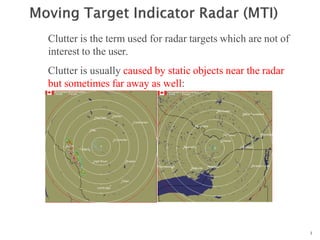
Clutter is usually caused by static objects near the radar
but sometimes far away as well:
n
n
n
n
Clutter is the term used for radar targets which are not of
interest to the user.
n
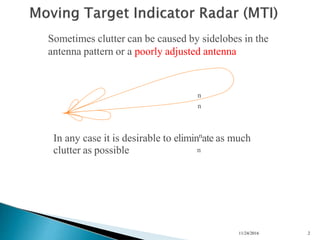
Sometimes clutter can be caused by sidelobes in the
antenna pattern or a poorly adjusted antenna
n
n
In any case it is desirable to eliminnate as much
11/24/2016 2
clutter as possible
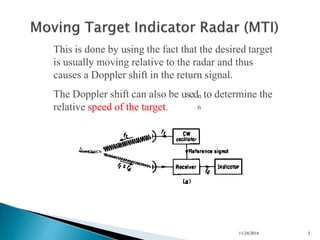
The Doppler shift can also be usedn to determine the
n
n
n
This is done by using the fact that the desired target
is usually moving relative to the radar and thus
causes a Doppler shift in the return signal.
relative speed of the target.
11/24/2016 3
n
n
n
n
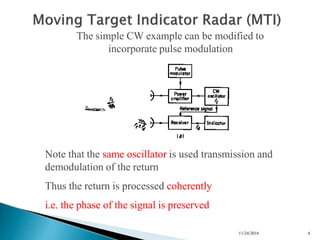
The simple CW example can be modified to
incorporate pulse modulation
Note that the same oscillator is used transmission and
demodulation of the return
Thus the return is processed coherently
i.e. the phase of the signal is preserved
11/24/2016 4
n
n
n
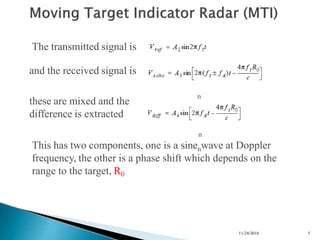
This has two components, one is a sinenwave at Doppler
frequency, the other is a phase shift which depends on the
range to the target, R0
The transmitted signal is
and the received signal is
these are mixed and the
difference is extracted
11/24/2016 5
n
n
n
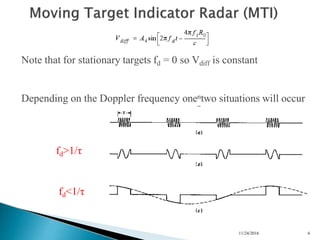
Depending on the Doppler frequency onentwo situations will occur
Note that for stationary targets fd = 0 so Vdiff is constant
fd>1/τ
fd<1/τ
11/24/2016 6
n
11/24/2016 7
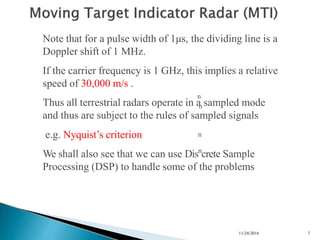
If the carrier frequency is 1 GHz, this implies a relative
speed of 30,000 m/s .
Thus all terrestrial radars operate in a
n sampled mode
and thus are subject to the rules of sampled signals
We shall also see that we can use Disn
crete Sample
Processing (DSP) to handle some of the problems
n
Note that for a pulse width of 1μs, the dividing line is a
Doppler shift of 1 MHz.
e.g. Nyquist’s criterion
n
n
n
n
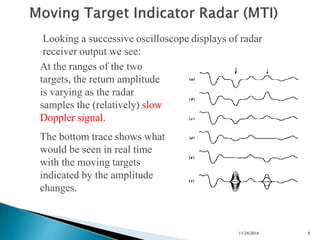
Looking a successive oscilloscope displays of radar
receiver output we see:
At the ranges of the two
targets, the return amplitude
is varying as the radar
samples the (relatively) slow
Doppler signal.
The bottom trace shows what
would be seen in real time
with the moving targets
indicated by the amplitude
changes.
11/24/2016 8
n
n
n
n
We usually want to process the information
automatically. To do this we take advantage of the fact
that the amplitudes of successive pulse returns are
different:
OR
z-1
-
11/24/2016 9
n
n
n
n
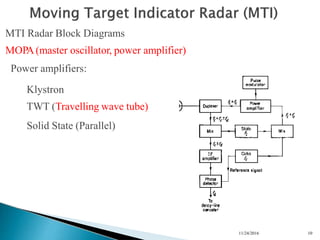
MTI Radar Block Diagrams
MOPA(master oscillator, power amplifier)
Power amplifiers:
Klystron
TWT (Travelling wave tube)
Solid State (Parallel)
11/24/2016 10
n
11/24/2016 11
n
n
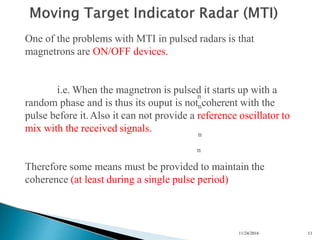
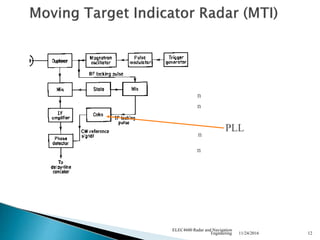
One of the problems with MTI in pulsed radars is that
magnetrons are ON/OFF devices.
i.e. When the magnetron is pulsed it starts up with a
random phase and is thus its ouput is notncoherent with the
pulse before it.Also it can not provide a reference oscillator to
mix with the received signals.
Therefore some means must be provided to maintain the
coherence (at least during a single pulse period)
11/24/2016
ELEC4600 Radar and Navigation
Engineering 12
n
n
n
n
PLL
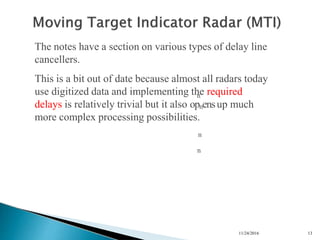
This is a bit out of date because almost all radars today
use digitized data and implementing th
ne required
delays is relatively trivial but it also opnensup much
more complex processing possibilities.
n
n
11/24/2016 13
The notes have a section on various types of delay line
cancellers.
n
n
n
n
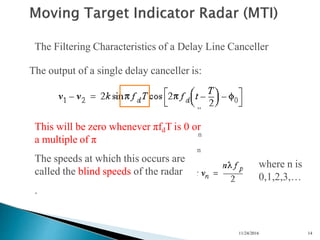
The Filtering Characteristics of a Delay Line Canceller
The output of a single delay canceller is:
This will be zero whenever πfdT is 0 or
a multiple of π
The speeds at which this occurs are
called the blind speeds of the radar
.
where n is
0,1,2,3,…
11/24/2016 14
n
11/24/2016 15
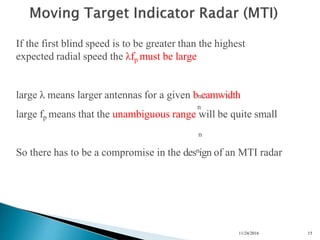
large λ means larger antennas for a given bneamwidth
large fp means that the unambiguous range will be quite small
n
So there has to be a compromise in the desnign of an MTI radar
If the first blind speed is to be greater than the highest
expected radial speed the λfp must be large
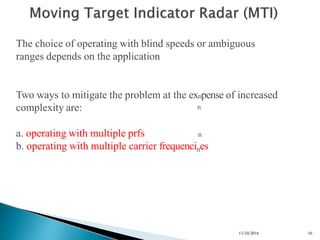
Two ways to mitigate the problem at the exnpense of increased
11/24/2016 16
n
n
The choice of operating with blind speeds or ambiguous
ranges depends on the application
complexity are:
a. operating with multiple prfs
b. operating with multiple carrier frequencines
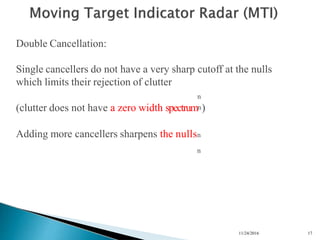
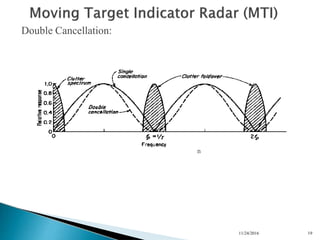
Single cancellers do not have a very sharp cutoff at the nulls
which limits their rejection of clutter
n
(clutter does not have a zero width spectrumn)
Adding more cancellers sharpens the nullsn
n
11/24/2016 17
Double Cancellation:
n
n
n
n
Double Cancellation:
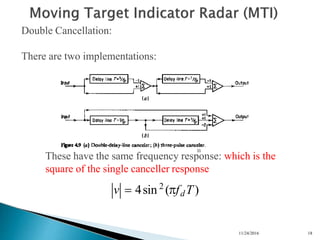
There are two implementations:
These have the same frequency response: which is the
square of the single canceller response
v  4sin 2
(fdT)
11/24/2016 18
n
n
n
n
Double Cancellation:
11/24/2016 19
n
n
n
n
Transversal Filters
These are basically a tapped delay line with the taps
11/24/2016 20
summed at the output
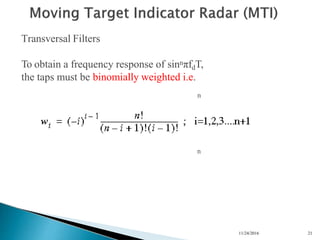
To obtain a frequency response of sinnπfdT,
the taps must be binomially weighted i.e.
n
n
n
n
Transversal Filters
11/24/2016 21
n
n
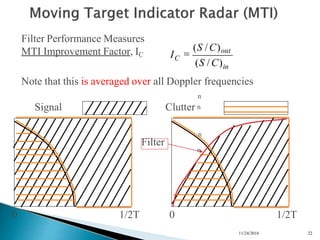
Filter Performance Measures
MTI Improvement Factor, IC
in

(S /C)out
C
(S /C)
I
1/2T
0
Note that this is averaged over all Doppler frequencies
n
Signal Clutter n
1/2T
0
Filter
11/24/2016 22
23
n
n
Filter Performance Measures
ClutterAttenuation ,C/A
The ratio of the clutter power at the input of the canceler
n
n
to the clutter power at the output of the canceler
It is normalized, (or adjusted) to the signal attenuation of
the canceler.
i.e. the inherent signal attenuation of the canceler is
ignored
n
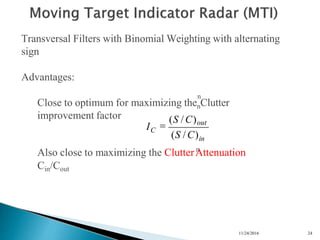
Close to optimum for maximizing thenClutter
Also close to maximizing the ClutterA
n
ttenuation
Cin/Cout
n
Transversal Filters with Binomial Weighting with alternating
sign
Advantages:
improvement factor
in
11/24/2016 24
C
I
(S /C)

(S /C)out
n
n
n
Transversal Filters with Binomial Weighting with alternating
sign
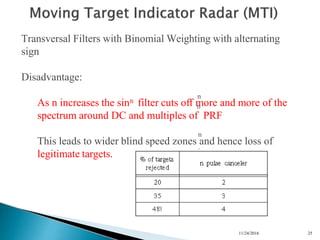
Disadvantage:
n
As n increases the sin filter cuts off m
n ore and more of the
spectrum around DC and multiples of PRF
This leads to wider blind speed zones and hence loss of
legitimate targets.
11/24/2016 25

movingtargetindicatorradarmtilecture-161124175117.pptx

  • 1.
    1 Clutter is usuallycaused by static objects near the radar but sometimes far away as well: n n n n Clutter is the term used for radar targets which are not of interest to the user.
  • 2.
    n Sometimes clutter canbe caused by sidelobes in the antenna pattern or a poorly adjusted antenna n n In any case it is desirable to eliminnate as much 11/24/2016 2 clutter as possible
  • 3.
    The Doppler shiftcan also be usedn to determine the n n n This is done by using the fact that the desired target is usually moving relative to the radar and thus causes a Doppler shift in the return signal. relative speed of the target. 11/24/2016 3
  • 4.
    n n n n The simple CWexample can be modified to incorporate pulse modulation Note that the same oscillator is used transmission and demodulation of the return Thus the return is processed coherently i.e. the phase of the signal is preserved 11/24/2016 4
  • 5.
    n n n This has twocomponents, one is a sinenwave at Doppler frequency, the other is a phase shift which depends on the range to the target, R0 The transmitted signal is and the received signal is these are mixed and the difference is extracted 11/24/2016 5
  • 6.
    n n n Depending on theDoppler frequency onentwo situations will occur Note that for stationary targets fd = 0 so Vdiff is constant fd>1/τ fd<1/τ 11/24/2016 6
  • 7.
    n 11/24/2016 7 If thecarrier frequency is 1 GHz, this implies a relative speed of 30,000 m/s . Thus all terrestrial radars operate in a n sampled mode and thus are subject to the rules of sampled signals We shall also see that we can use Disn crete Sample Processing (DSP) to handle some of the problems n Note that for a pulse width of 1μs, the dividing line is a Doppler shift of 1 MHz. e.g. Nyquist’s criterion
  • 8.
    n n n n Looking a successiveoscilloscope displays of radar receiver output we see: At the ranges of the two targets, the return amplitude is varying as the radar samples the (relatively) slow Doppler signal. The bottom trace shows what would be seen in real time with the moving targets indicated by the amplitude changes. 11/24/2016 8
  • 9.
    n n n n We usually wantto process the information automatically. To do this we take advantage of the fact that the amplitudes of successive pulse returns are different: OR z-1 - 11/24/2016 9
  • 10.
    n n n n MTI Radar BlockDiagrams MOPA(master oscillator, power amplifier) Power amplifiers: Klystron TWT (Travelling wave tube) Solid State (Parallel) 11/24/2016 10
  • 11.
    n 11/24/2016 11 n n One ofthe problems with MTI in pulsed radars is that magnetrons are ON/OFF devices. i.e. When the magnetron is pulsed it starts up with a random phase and is thus its ouput is notncoherent with the pulse before it.Also it can not provide a reference oscillator to mix with the received signals. Therefore some means must be provided to maintain the coherence (at least during a single pulse period)
  • 12.
    11/24/2016 ELEC4600 Radar andNavigation Engineering 12 n n n n PLL
  • 13.
    This is abit out of date because almost all radars today use digitized data and implementing th ne required delays is relatively trivial but it also opnensup much more complex processing possibilities. n n 11/24/2016 13 The notes have a section on various types of delay line cancellers.
  • 14.
    n n n n The Filtering Characteristicsof a Delay Line Canceller The output of a single delay canceller is: This will be zero whenever πfdT is 0 or a multiple of π The speeds at which this occurs are called the blind speeds of the radar . where n is 0,1,2,3,… 11/24/2016 14
  • 15.
    n 11/24/2016 15 large λmeans larger antennas for a given bneamwidth large fp means that the unambiguous range will be quite small n So there has to be a compromise in the desnign of an MTI radar If the first blind speed is to be greater than the highest expected radial speed the λfp must be large
  • 16.
    Two ways tomitigate the problem at the exnpense of increased 11/24/2016 16 n n The choice of operating with blind speeds or ambiguous ranges depends on the application complexity are: a. operating with multiple prfs b. operating with multiple carrier frequencines
  • 17.
    Single cancellers donot have a very sharp cutoff at the nulls which limits their rejection of clutter n (clutter does not have a zero width spectrumn) Adding more cancellers sharpens the nullsn n 11/24/2016 17 Double Cancellation:
  • 18.
    n n n n Double Cancellation: There aretwo implementations: These have the same frequency response: which is the square of the single canceller response v  4sin 2 (fdT) 11/24/2016 18
  • 19.
  • 20.
    n n n n Transversal Filters These arebasically a tapped delay line with the taps 11/24/2016 20 summed at the output
  • 21.
    To obtain afrequency response of sinnπfdT, the taps must be binomially weighted i.e. n n n n Transversal Filters 11/24/2016 21
  • 22.
    n n Filter Performance Measures MTIImprovement Factor, IC in  (S /C)out C (S /C) I 1/2T 0 Note that this is averaged over all Doppler frequencies n Signal Clutter n 1/2T 0 Filter 11/24/2016 22
  • 23.
    23 n n Filter Performance Measures ClutterAttenuation,C/A The ratio of the clutter power at the input of the canceler n n to the clutter power at the output of the canceler It is normalized, (or adjusted) to the signal attenuation of the canceler. i.e. the inherent signal attenuation of the canceler is ignored
  • 24.
    n Close to optimumfor maximizing thenClutter Also close to maximizing the ClutterA n ttenuation Cin/Cout n Transversal Filters with Binomial Weighting with alternating sign Advantages: improvement factor in 11/24/2016 24 C I (S /C)  (S /C)out
  • 25.
    n n n Transversal Filters withBinomial Weighting with alternating sign Disadvantage: n As n increases the sin filter cuts off m n ore and more of the spectrum around DC and multiples of PRF This leads to wider blind speed zones and hence loss of legitimate targets. 11/24/2016 25