Predicates and Quantifiers
Discrete Mathematics
Page 1 1
Slide Owner
• Istiak Ahmed
• Email- istiakahmed271@gmail.com
Page 2
2
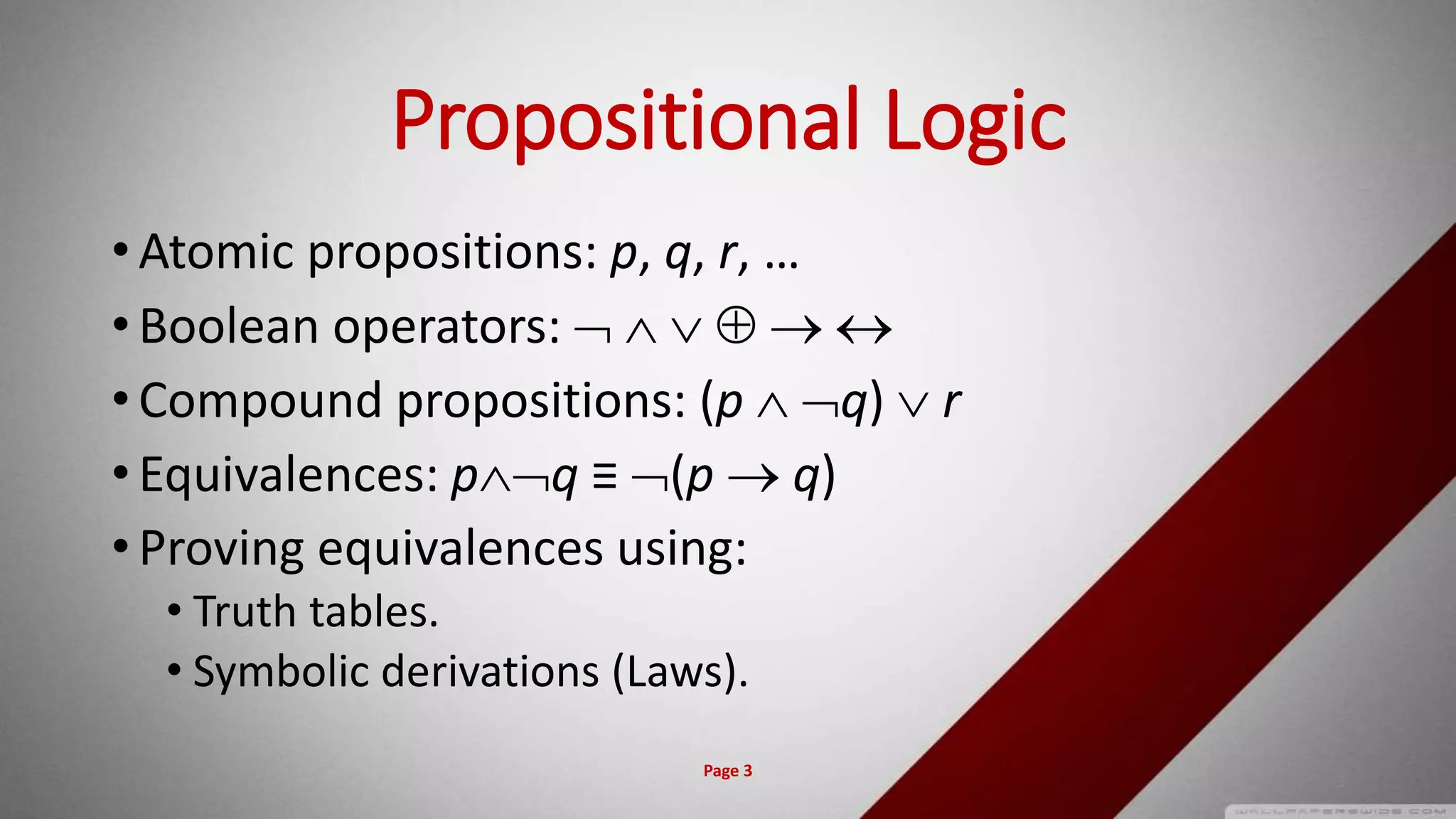
Propositional Logic
• Atomic propositions: p, q, r, …
• Boolean operators:      
• Compound propositions: (p  q)  r
• Equivalences: pq ≡ (p  q)
• Proving equivalences using:
• Truth tables.
• Symbolic derivations (Laws).
Page 3
3
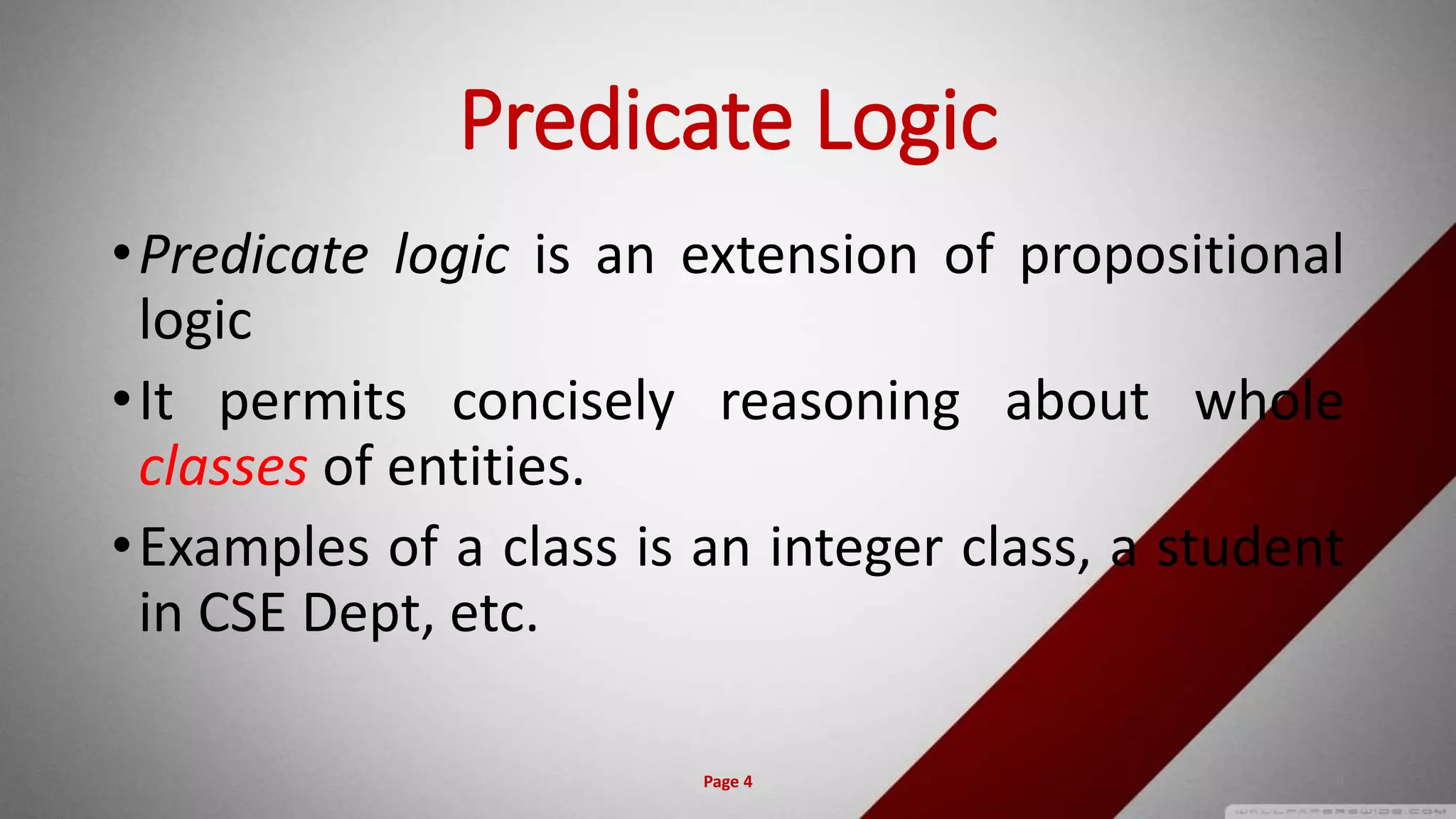
Predicate Logic
•Predicate logic is an extension of propositional
logic
•It permits concisely reasoning about whole
classes of entities.
•Examples of a class is an integer class, a student
in CSE Dept, etc.
Page 4 4
Applications of Predicate Logic
• It is the formal notation for writing perfectly clear,
concise, and unambiguous mathematical definitions,
axioms, and theorems for any branch of mathematics.
• Statements like x > 5 are neither true nor false when
the value of x is not specified.
• Predicate logic can be used to make propositions from
such statements.
Page 5 5
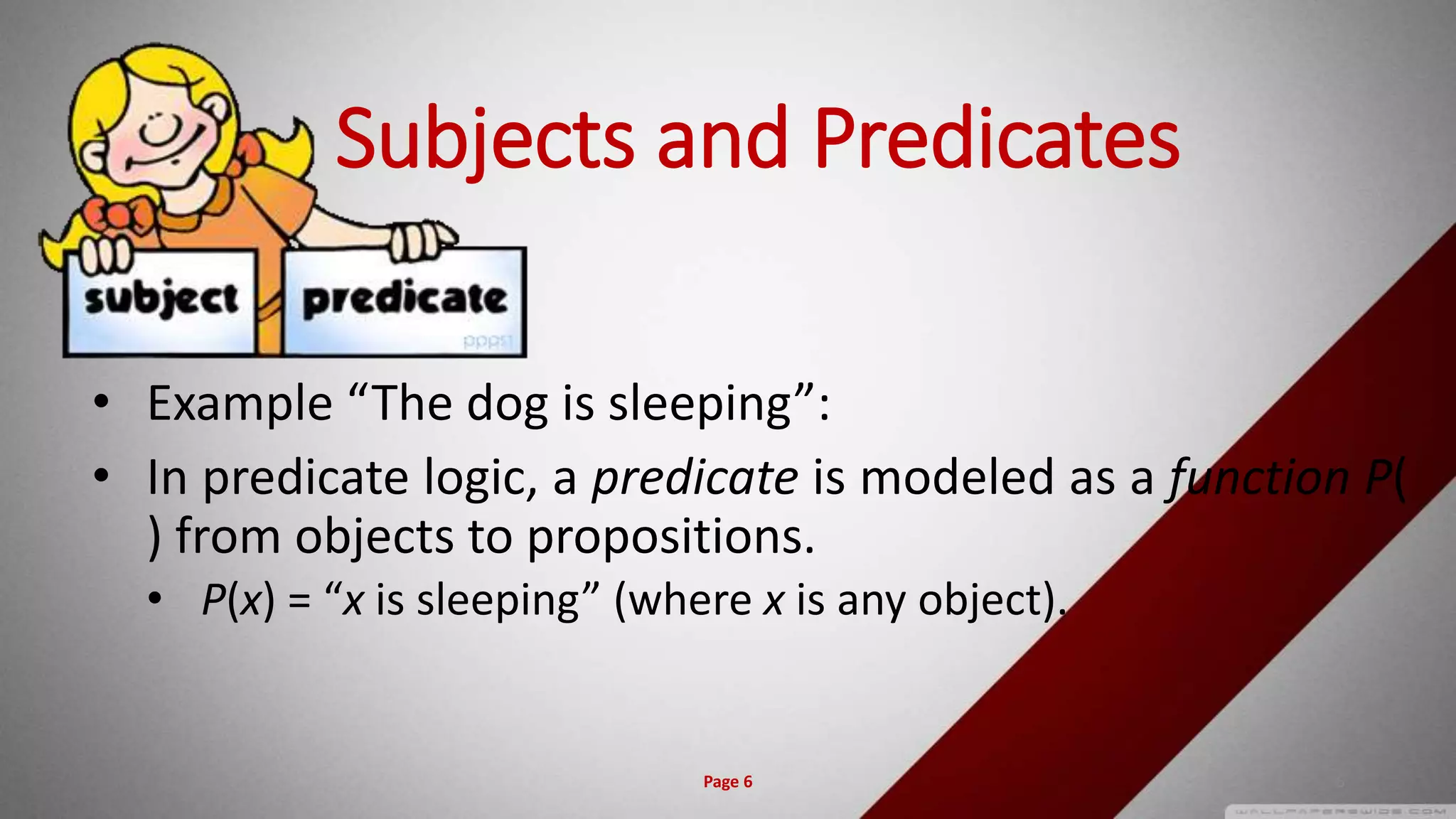
Subjects and Predicates
• Example “The dog is sleeping”:
• In predicate logic, a predicate is modeled as a function P(
) from objects to propositions.
• P(x) = “x is sleeping” (where x is any object).
Page 6 6
More About Predicates
• Convention: Lowercase variables x, y, z... denote
objects/entities; uppercase variables P, Q, R… denote
propositional functions (predicates).
• The result of applying a predicate P to an object x is the
proposition P(x).
• The predicate P itself (e.g. P =“is sleeping”) is not a
proposition (not a complete sentence).
Page 7 7
Propositional Functions
• Predicate logic can also involve statements with more
than one variable or argument.
• E.g. let P(x,y,z) = “x gave y the grade z”, then if
x=“Mike”, y=“Mary”, z=“A”, then P(x,y,z) = “Mike gave
Mary the grade A.”
• E.g. let Q(x,y,z) = “x + y > z”, then what is the truth value of
Q(1,2,3)? – False
• Q(3,2,1)? -True
Page 8 8
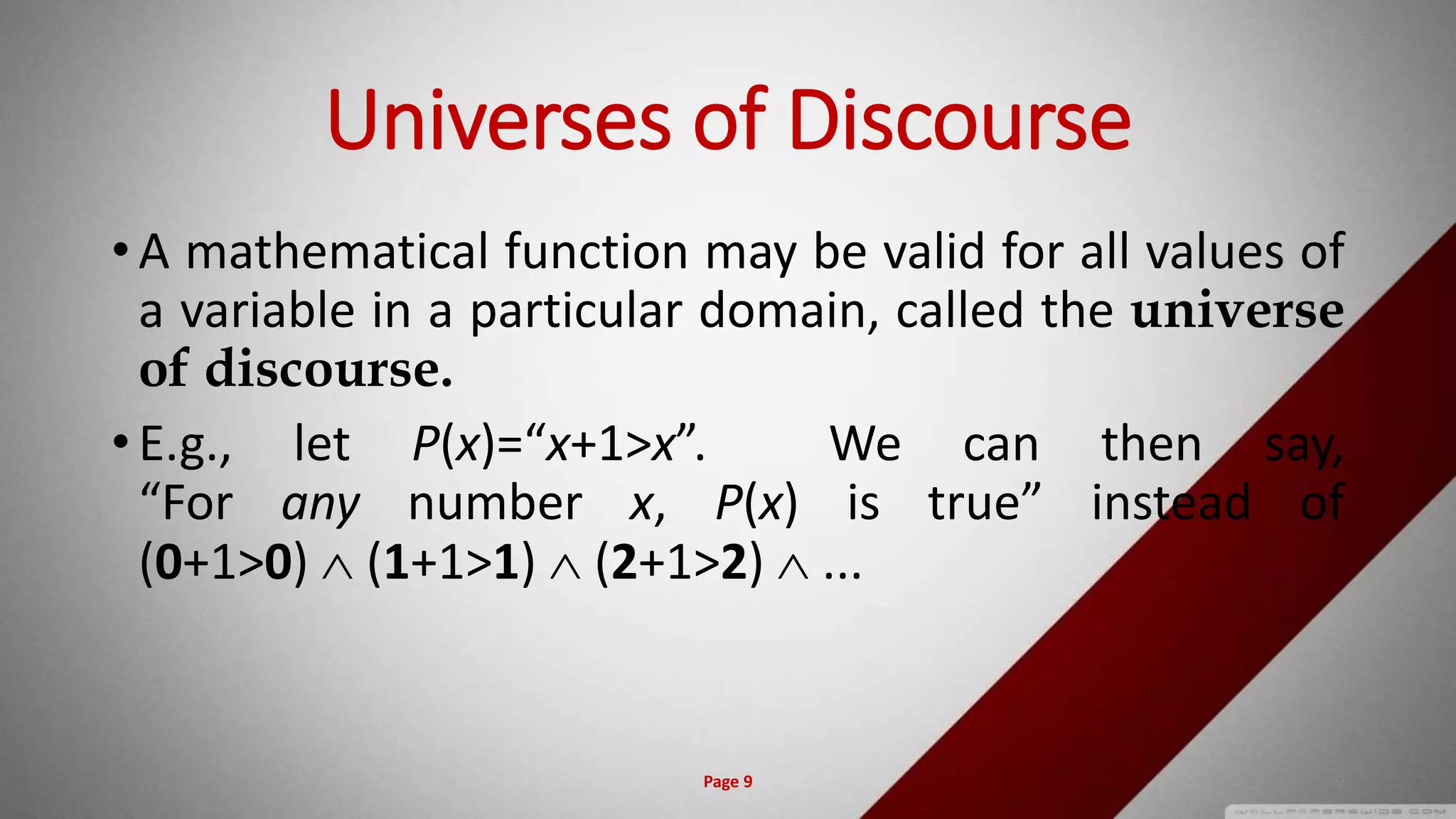
Universes of Discourse
• A mathematical function may be valid for all values of
a variable in a particular domain, called the universe
of discourse.
• E.g., let P(x)=“x+1>x”. We can then say,
“For any number x, P(x) is true” instead of
(0+1>0)  (1+1>1)  (2+1>2)  ...
Page 9 9
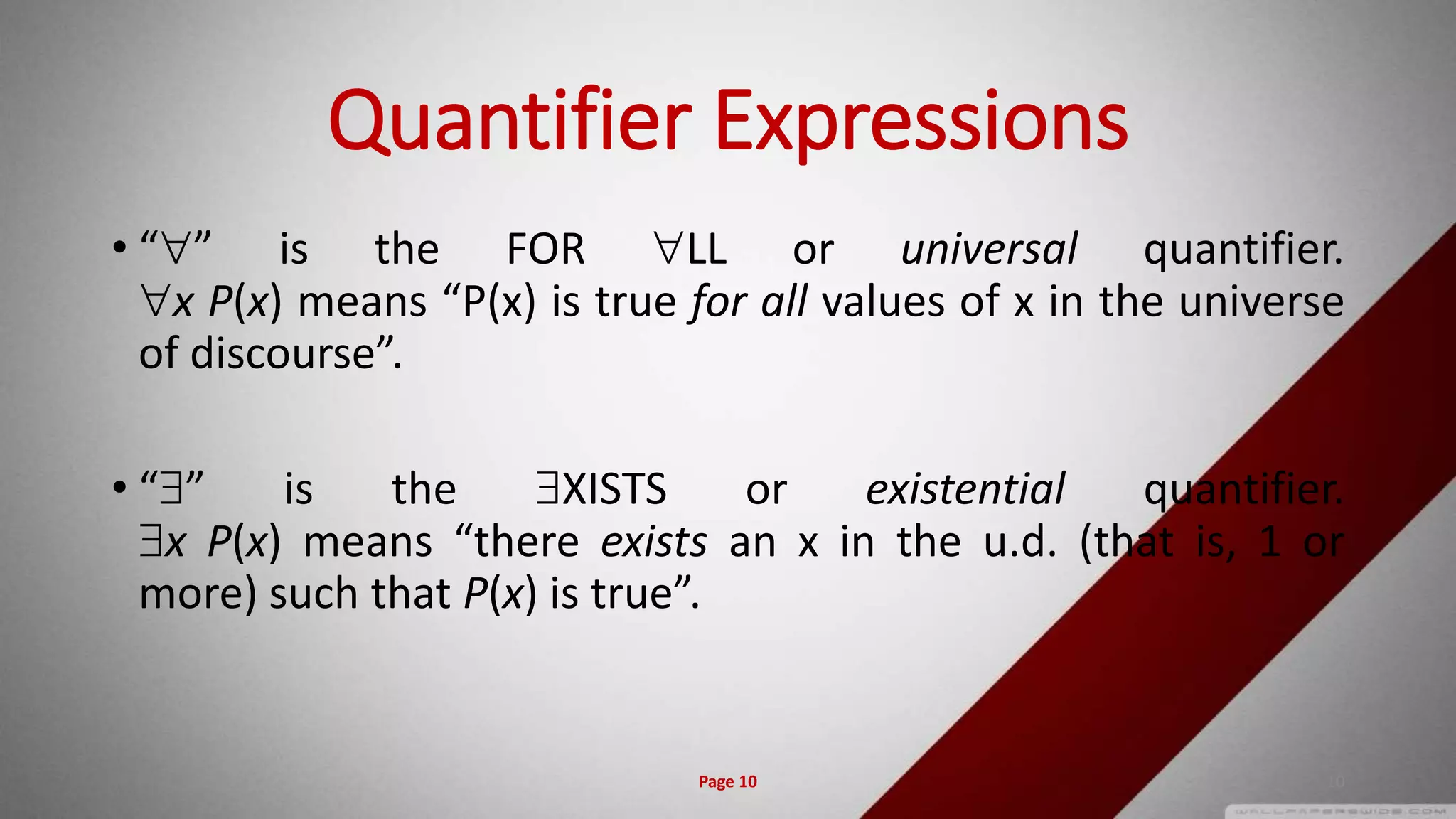
Quantifier Expressions
• “” is the FOR LL or universal quantifier.
x P(x) means “P(x) is true for all values of x in the universe
of discourse”.
• “” is the XISTS or existential quantifier.
x P(x) means “there exists an x in the u.d. (that is, 1 or
more) such that P(x) is true”.
Page 10 10
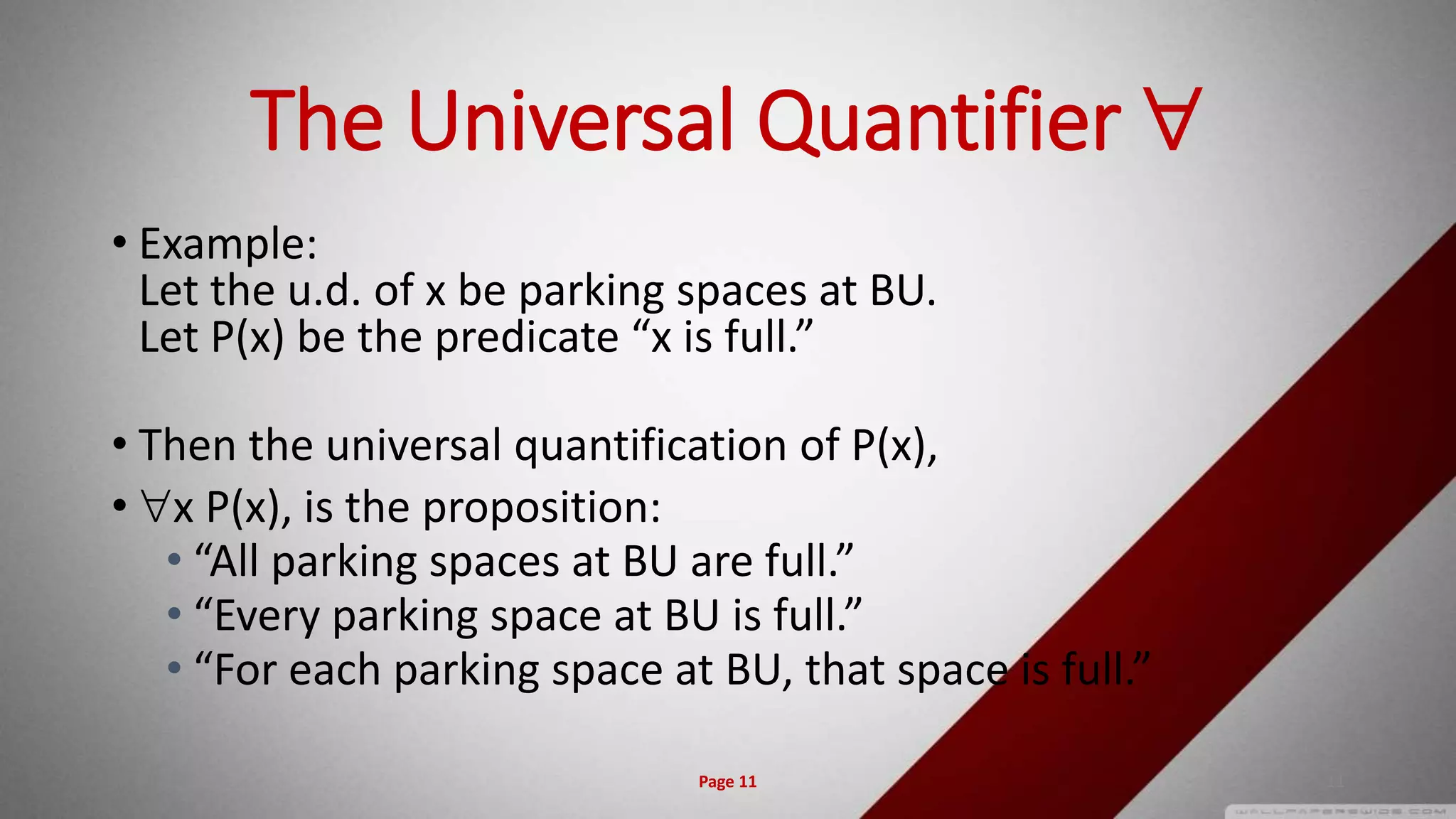
The Universal Quantifier 
• Example:
Let the u.d. of x be parking spaces at BU.
Let P(x) be the predicate “x is full.”
• Then the universal quantification of P(x),
• x P(x), is the proposition:
• “All parking spaces at BU are full.”
• “Every parking space at BU is full.”
• “For each parking space at BU, that space is full.”
Page 11 11
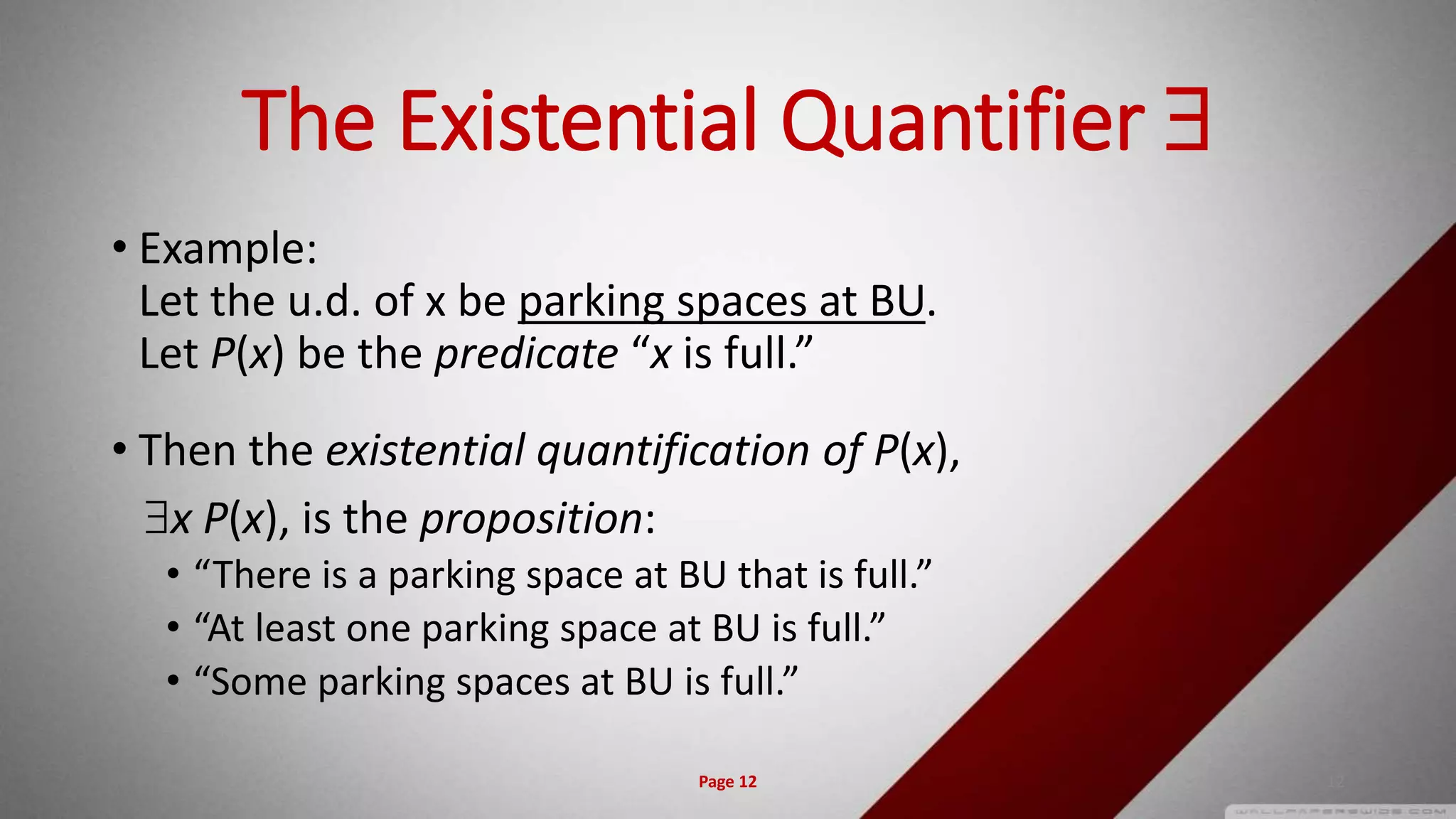
The Existential Quantifier 
• Example:
Let the u.d. of x be parking spaces at BU.
Let P(x) be the predicate “x is full.”
• Then the existential quantification of P(x),
x P(x), is the proposition:
• “There is a parking space at BU that is full.”
• “At least one parking space at BU is full.”
• “Some parking spaces at BU is full.”
Page 12 12
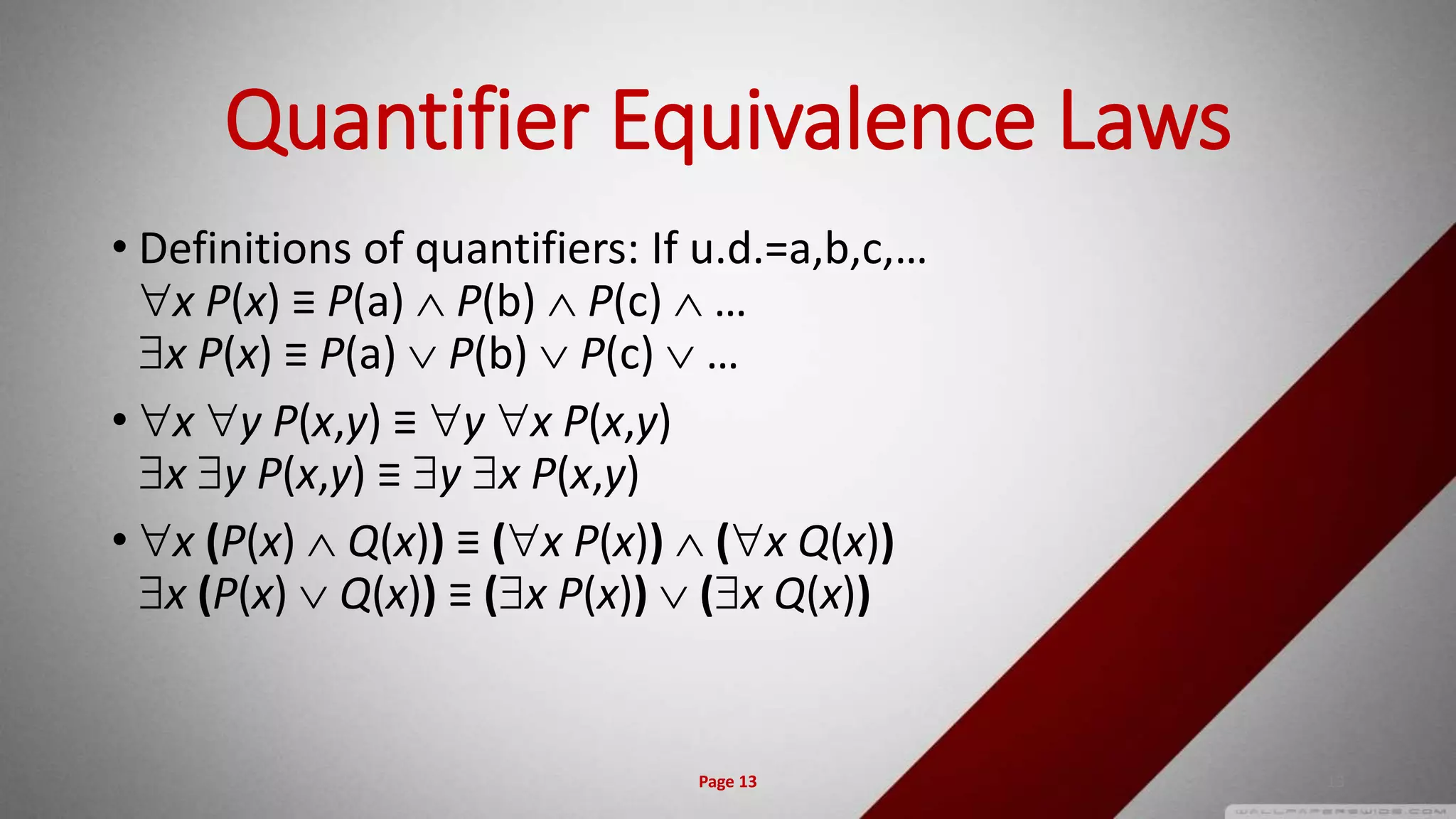
Quantifier Equivalence Laws
• Definitions of quantifiers: If u.d.=a,b,c,…
x P(x) ≡ P(a)  P(b)  P(c)  …
x P(x) ≡ P(a)  P(b)  P(c)  …
• x y P(x,y) ≡ y x P(x,y)
x y P(x,y) ≡ y x P(x,y)
• x (P(x)  Q(x)) ≡ (x P(x))  (x Q(x))
x (P(x)  Q(x)) ≡ (x P(x))  (x Q(x))
Page 13 13
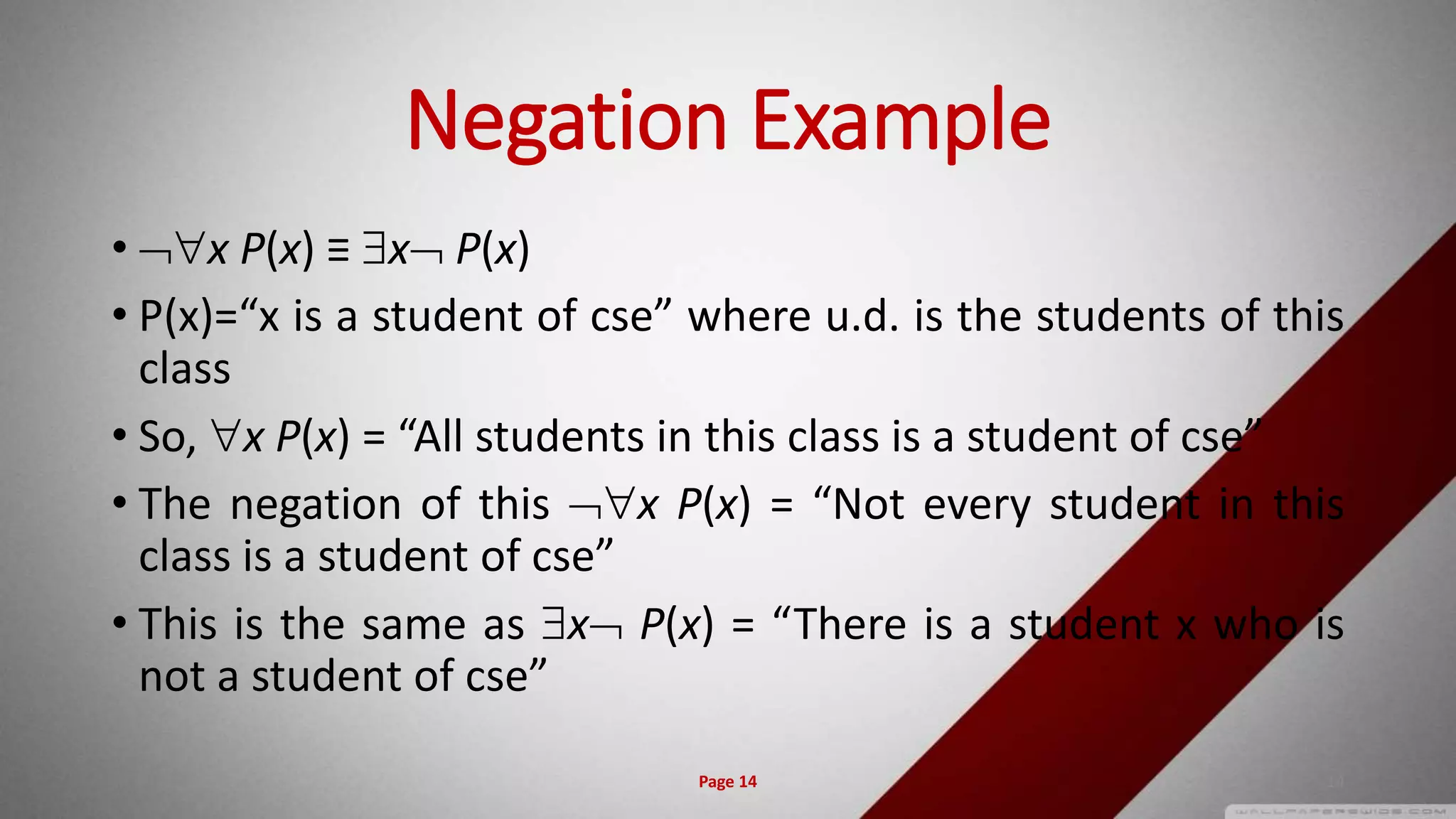
Negation Example
• x P(x) ≡ x P(x)
• P(x)=“x is a student of cse” where u.d. is the students of this
class
• So, x P(x) = “All students in this class is a student of cse”
• The negation of this x P(x) = “Not every student in this
class is a student of cse”
• This is the same as x P(x) = “There is a student x who is
not a student of cse”
Page 14 14
Thanks To All
Page 15 15

Predicates and quantifiers

  • 1.
  • 2.
    Slide Owner • IstiakAhmed • Email- istiakahmed271@gmail.com Page 2 2
  • 3.
    Propositional Logic • Atomicpropositions: p, q, r, … • Boolean operators:       • Compound propositions: (p  q)  r • Equivalences: pq ≡ (p  q) • Proving equivalences using: • Truth tables. • Symbolic derivations (Laws). Page 3 3
  • 4.
    Predicate Logic •Predicate logicis an extension of propositional logic •It permits concisely reasoning about whole classes of entities. •Examples of a class is an integer class, a student in CSE Dept, etc. Page 4 4
  • 5.
    Applications of PredicateLogic • It is the formal notation for writing perfectly clear, concise, and unambiguous mathematical definitions, axioms, and theorems for any branch of mathematics. • Statements like x > 5 are neither true nor false when the value of x is not specified. • Predicate logic can be used to make propositions from such statements. Page 5 5
  • 6.
    Subjects and Predicates •Example “The dog is sleeping”: • In predicate logic, a predicate is modeled as a function P( ) from objects to propositions. • P(x) = “x is sleeping” (where x is any object). Page 6 6
  • 7.
    More About Predicates •Convention: Lowercase variables x, y, z... denote objects/entities; uppercase variables P, Q, R… denote propositional functions (predicates). • The result of applying a predicate P to an object x is the proposition P(x). • The predicate P itself (e.g. P =“is sleeping”) is not a proposition (not a complete sentence). Page 7 7
  • 8.
    Propositional Functions • Predicatelogic can also involve statements with more than one variable or argument. • E.g. let P(x,y,z) = “x gave y the grade z”, then if x=“Mike”, y=“Mary”, z=“A”, then P(x,y,z) = “Mike gave Mary the grade A.” • E.g. let Q(x,y,z) = “x + y > z”, then what is the truth value of Q(1,2,3)? – False • Q(3,2,1)? -True Page 8 8
  • 9.
    Universes of Discourse •A mathematical function may be valid for all values of a variable in a particular domain, called the universe of discourse. • E.g., let P(x)=“x+1>x”. We can then say, “For any number x, P(x) is true” instead of (0+1>0)  (1+1>1)  (2+1>2)  ... Page 9 9
  • 10.
    Quantifier Expressions • “”is the FOR LL or universal quantifier. x P(x) means “P(x) is true for all values of x in the universe of discourse”. • “” is the XISTS or existential quantifier. x P(x) means “there exists an x in the u.d. (that is, 1 or more) such that P(x) is true”. Page 10 10
  • 11.
    The Universal Quantifier • Example: Let the u.d. of x be parking spaces at BU. Let P(x) be the predicate “x is full.” • Then the universal quantification of P(x), • x P(x), is the proposition: • “All parking spaces at BU are full.” • “Every parking space at BU is full.” • “For each parking space at BU, that space is full.” Page 11 11
  • 12.
    The Existential Quantifier • Example: Let the u.d. of x be parking spaces at BU. Let P(x) be the predicate “x is full.” • Then the existential quantification of P(x), x P(x), is the proposition: • “There is a parking space at BU that is full.” • “At least one parking space at BU is full.” • “Some parking spaces at BU is full.” Page 12 12
  • 13.
    Quantifier Equivalence Laws •Definitions of quantifiers: If u.d.=a,b,c,… x P(x) ≡ P(a)  P(b)  P(c)  … x P(x) ≡ P(a)  P(b)  P(c)  … • x y P(x,y) ≡ y x P(x,y) x y P(x,y) ≡ y x P(x,y) • x (P(x)  Q(x)) ≡ (x P(x))  (x Q(x)) x (P(x)  Q(x)) ≡ (x P(x))  (x Q(x)) Page 13 13
  • 14.
    Negation Example • xP(x) ≡ x P(x) • P(x)=“x is a student of cse” where u.d. is the students of this class • So, x P(x) = “All students in this class is a student of cse” • The negation of this x P(x) = “Not every student in this class is a student of cse” • This is the same as x P(x) = “There is a student x who is not a student of cse” Page 14 14
  • 15.