

Introduction to Mathematics for AI
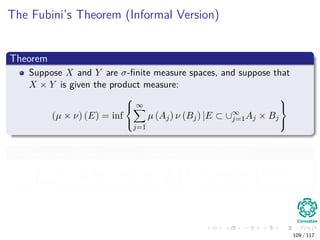
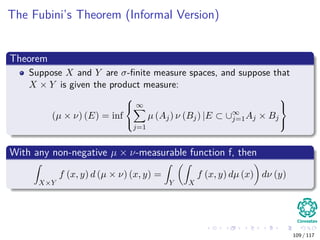
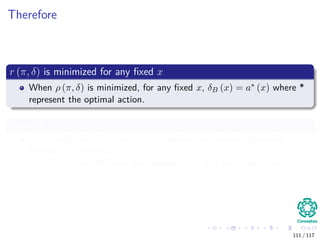
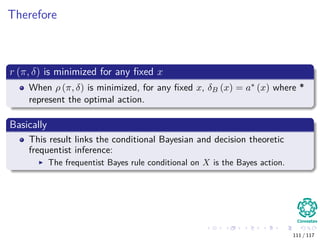
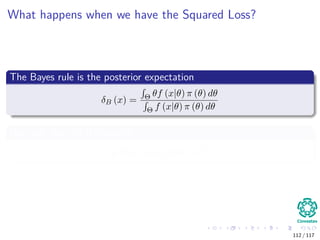
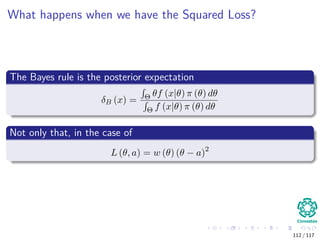
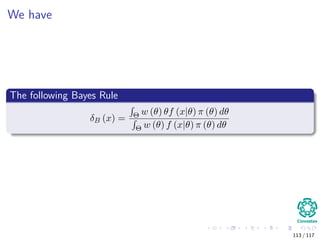
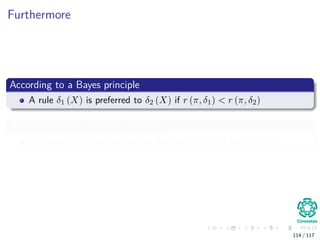
Bayesian Estimation
Andres Mendez-Vazquez
May 22, 2020
1 / 117
Outline
1 Introduction
Likelihood Principle
Example, Testing Fairness
Independence Influence
Sufficiency
Fisher-Neyman Characterization
Example
Sufficiency Principle
Conditionality Perspective
Example
Sins of Being non-Bayesian
2 Bayesian Inference
Introduction
Connection with Sufficient Statistics
Generalized Maximum Likelihood Estimator
The Maximum A Posteriori (MAP)

Maximum Likelihood Vs Maximum A Posteriori
Properties of the MAP
3 Loss, Posterior Risk, Bayes Action
Bayes Principle in the Frequentist Decision Theoretic Setup
Examples of Loss Functions
Bayesian Expected Loss Principle
Example
The Empirical Risk
The Fubini’s Theorem
2 / 117
Outline
1 Introduction
Likelihood Principle
Example, Testing Fairness
Independence Influence
Sufficiency
Fisher-Neyman Characterization
Example
Sufficiency Principle
Conditionality Perspective
Example
Sins of Being non-Bayesian
2 Bayesian Inference
Introduction
Connection with Sufficient Statistics
Generalized Maximum Likelihood Estimator
The Maximum A Posteriori (MAP)
Maximum Likelihood Vs Maximum A Posteriori
Properties of the MAP
3 Loss, Posterior Risk, Bayes Action
Bayes Principle in the Frequentist Decision Theoretic Setup
Examples of Loss Functions
Bayesian Expected Loss Principle
Example
The Empirical Risk
The Fubini’s Theorem
3 / 117
The Basis of Bayesian Inference
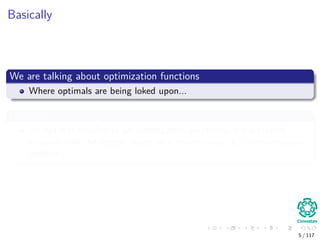
A Basic setup
Let f(x|θ) be a conditional distribution for X given the unknown
parameter θ.
For the observed data, X = x, the function (θ) = f(x|θ)
It is called the likelihood function!!!
The name likelihood implies that, given x, the value of θ
It is more likely to be the true parameter than θ , if
f (x|θ) > f x|θ
4 / 117
The Basis of Bayesian Inference
A Basic setup
Let f(x|θ) be a conditional distribution for X given the unknown
parameter θ.
For the observed data, X = x, the function (θ) = f(x|θ)
It is called the likelihood function!!!
The name likelihood implies that, given x, the value of θ
It is more likely to be the true parameter than θ , if
f (x|θ) > f x|θ
4 / 117
The Basis of Bayesian Inference
A Basic setup
Let f(x|θ) be a conditional distribution for X given the unknown
parameter θ.
For the observed data, X = x, the function (θ) = f(x|θ)
It is called the likelihood function!!!
The name likelihood implies that, given x, the value of θ
It is more likely to be the true parameter than θ , if
f (x|θ) > f x|θ
4 / 117
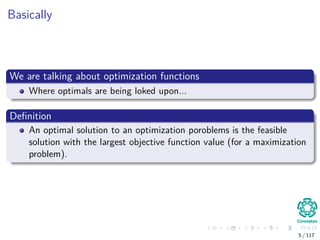
Basically
We are talking about optimization functions
Where optimals are being loked upon...
Definition
An optimal solution to an optimization poroblems is the feasible
solution with the largest objective function value (for a maximization
problem).
5 / 117
Basically
We are talking about optimization functions
Where optimals are being loked upon...
Definition
An optimal solution to an optimization poroblems is the feasible
solution with the largest objective function value (for a maximization
problem).
5 / 117
Likelihood Principle
Remarks
In the inference about θ, after x is observed, all relevant
experimental information is contained in the likelihood function
for the observed x.
There is an interesting example quoted by Lindley and Phillips in
1976 [1]
Originally by Leonard Savage
Leonard Savage
Leonard Jimmie Savage (born Leonard Ogashevitz; 20 November
1917 – 1 November 1971) was an American mathematician and
statistician.
Economist Milton Friedman said Savage was "one of the few people I
have met whom I would unhesitatingly call a genius.
6 / 117
Likelihood Principle
Remarks
In the inference about θ, after x is observed, all relevant
experimental information is contained in the likelihood function
for the observed x.
There is an interesting example quoted by Lindley and Phillips in
1976 [1]
Originally by Leonard Savage
Leonard Savage
Leonard Jimmie Savage (born Leonard Ogashevitz; 20 November
1917 – 1 November 1971) was an American mathematician and
statistician.
Economist Milton Friedman said Savage was "one of the few people I
have met whom I would unhesitatingly call a genius.
6 / 117
Likelihood Principle
Remarks
In the inference about θ, after x is observed, all relevant
experimental information is contained in the likelihood function
for the observed x.
There is an interesting example quoted by Lindley and Phillips in
1976 [1]
Originally by Leonard Savage
Leonard Savage
Leonard Jimmie Savage (born Leonard Ogashevitz; 20 November
1917 – 1 November 1971) was an American mathematician and
statistician.
Economist Milton Friedman said Savage was "one of the few people I
have met whom I would unhesitatingly call a genius.
6 / 117
History
Something Notable
The likelihood principle was first identified by that name in print in
1962 (Barnard et al., Birnbaum, and Savage et al.),
However Fisher
It was already using a version of it in 1920’s.
However, versions of it can be tracked to
To the mid-1700s
It seems to have become a commonplace among natural philosophers
that problems of observational error were susceptible to mathematical
description.
7 / 117
History
Something Notable
The likelihood principle was first identified by that name in print in
1962 (Barnard et al., Birnbaum, and Savage et al.),
However Fisher
It was already using a version of it in 1920’s.
However, versions of it can be tracked to
To the mid-1700s
It seems to have become a commonplace among natural philosophers
that problems of observational error were susceptible to mathematical
description.
7 / 117
History
Something Notable
The likelihood principle was first identified by that name in print in
1962 (Barnard et al., Birnbaum, and Savage et al.),
However Fisher
It was already using a version of it in 1920’s.
However, versions of it can be tracked to
To the mid-1700s
It seems to have become a commonplace among natural philosophers
that problems of observational error were susceptible to mathematical
description.
7 / 117
Outline
1 Introduction
Likelihood Principle
Example, Testing Fairness
Independence Influence
Sufficiency
Fisher-Neyman Characterization
Example
Sufficiency Principle
Conditionality Perspective
Example
Sins of Being non-Bayesian
2 Bayesian Inference
Introduction
Connection with Sufficient Statistics
Generalized Maximum Likelihood Estimator
The Maximum A Posteriori (MAP)
Maximum Likelihood Vs Maximum A Posteriori
Properties of the MAP
3 Loss, Posterior Risk, Bayes Action
Bayes Principle in the Frequentist Decision Theoretic Setup
Examples of Loss Functions
Bayesian Expected Loss Principle
Example
The Empirical Risk
The Fubini’s Theorem
8 / 117
Testing Fairness
Basic Setup
Suppose we are interested in testing θ, the unknown probability of
heads for possibly biased coin.
Suppose the following Hypothesis
H0 : θ = 1/2 v.s. H1 : θ > 1/2
Then
An experiment is conducted and 9 heads and 3 tails are observed.
Not enough information to fully specify f (x|θ)
9 / 117
Testing Fairness
Basic Setup
Suppose we are interested in testing θ, the unknown probability of
heads for possibly biased coin.
Suppose the following Hypothesis
H0 : θ = 1/2 v.s. H1 : θ > 1/2
Then
An experiment is conducted and 9 heads and 3 tails are observed.
Not enough information to fully specify f (x|θ)
9 / 117
Testing Fairness
Basic Setup
Suppose we are interested in testing θ, the unknown probability of
heads for possibly biased coin.
Suppose the following Hypothesis
H0 : θ = 1/2 v.s. H1 : θ > 1/2
Then
An experiment is conducted and 9 heads and 3 tails are observed.
Not enough information to fully specify f (x|θ)
9 / 117
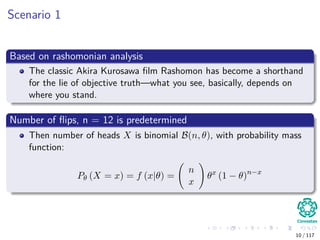
Scenario 1
Based on rashomonian analysis
The classic Akira Kurosawa film Rashomon has become a shorthand
for the lie of objective truth—what you see, basically, depends on
where you stand.
Number of flips, n = 12 is predetermined
Then number of heads X is binomial B(n, θ), with probability mass
function:
Pθ (X = x) = f (x|θ) =
n
x
θx
(1 − θ)n−x
10 / 117
Scenario 1
Based on rashomonian analysis
The classic Akira Kurosawa film Rashomon has become a shorthand
for the lie of objective truth—what you see, basically, depends on
where you stand.
Number of flips, n = 12 is predetermined
Then number of heads X is binomial B(n, θ), with probability mass
function:
Pθ (X = x) = f (x|θ) =
n
x
θx
(1 − θ)n−x
10 / 117
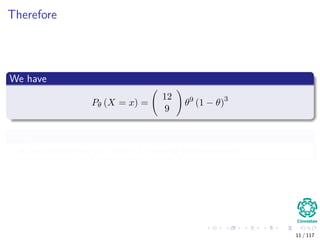
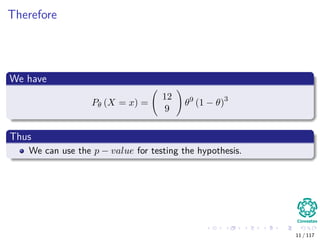
Therefore
We have
Pθ (X = x) =
12
9
θ9
(1 − θ)3
Thus
We can use the p − value for testing the hypothesis.
11 / 117
Therefore
We have
Pθ (X = x) =
12
9
θ9
(1 − θ)3
Thus
We can use the p − value for testing the hypothesis.
11 / 117
Then if we use the following p − value analysis
Definition [2, 3]
The p-value is defined as the probability, under the null hypothesis H0
about the unknown distribution F of the random variable X.
Very Unlike
Observation
Very Unlike
Observation
P-Value
More Likely Observation
Set of Possible Results
ProbabilityDensity
Observed
Data Point
12 / 117
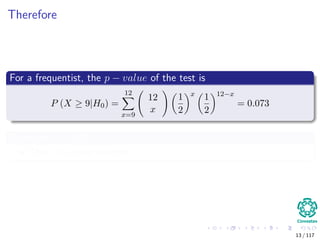
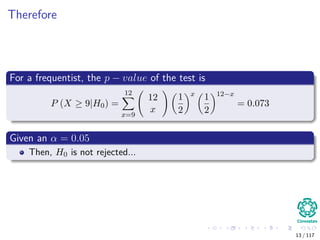
Therefore
For a frequentist, the p − value of the test is
P (X ≥ 9|H0) =
12
x=9
12
x
1
2
x
1
2
12−x
= 0.073
Given an α = 0.05
Then, H0 is not rejected...
13 / 117
Therefore
For a frequentist, the p − value of the test is
P (X ≥ 9|H0) =
12
x=9
12
x
1
2
x
1
2
12−x
= 0.073
Given an α = 0.05
Then, H0 is not rejected...
13 / 117
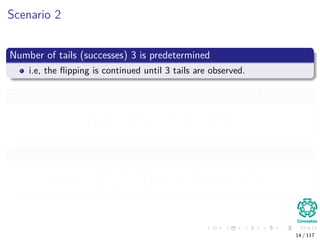
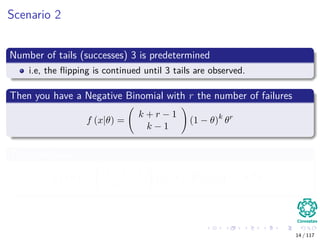
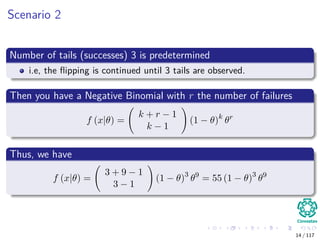
Scenario 2
Number of tails (successes) 3 is predetermined
i.e, the flipping is continued until 3 tails are observed.
Then you have a Negative Binomial with r the number of failures
f (x|θ) =
k + r − 1
k − 1
(1 − θ)k
θr
Thus, we have
f (x|θ) =
3 + 9 − 1
3 − 1
(1 − θ)3
θ9
= 55 (1 − θ)3
θ9
14 / 117
Scenario 2
Number of tails (successes) 3 is predetermined
i.e, the flipping is continued until 3 tails are observed.
Then you have a Negative Binomial with r the number of failures
f (x|θ) =
k + r − 1
k − 1
(1 − θ)k
θr
Thus, we have
f (x|θ) =
3 + 9 − 1
3 − 1
(1 − θ)3
θ9
= 55 (1 − θ)3
θ9
14 / 117
Scenario 2
Number of tails (successes) 3 is predetermined
i.e, the flipping is continued until 3 tails are observed.
Then you have a Negative Binomial with r the number of failures
f (x|θ) =
k + r − 1
k − 1
(1 − θ)k
θr
Thus, we have
f (x|θ) =
3 + 9 − 1
3 − 1
(1 − θ)3
θ9
= 55 (1 − θ)3
θ9
14 / 117
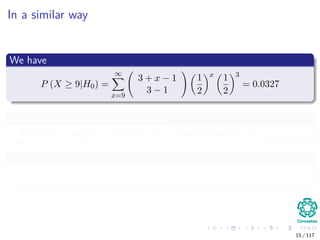
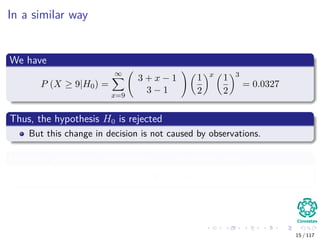
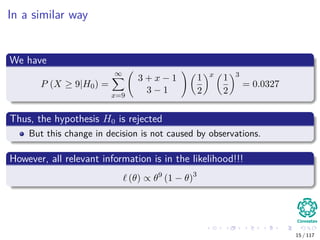
In a similar way
We have
P (X ≥ 9|H0) =
∞
x=9
3 + x − 1
3 − 1
1
2
x
1
2
3
= 0.0327
Thus, the hypothesis H0 is rejected
But this change in decision is not caused by observations.
However, all relevant information is in the likelihood!!!
(θ) ∝ θ9
(1 − θ)3
15 / 117
In a similar way
We have
P (X ≥ 9|H0) =
∞
x=9
3 + x − 1
3 − 1
1
2
x
1
2
3
= 0.0327
Thus, the hypothesis H0 is rejected
But this change in decision is not caused by observations.
However, all relevant information is in the likelihood!!!
(θ) ∝ θ9
(1 − θ)3
15 / 117
In a similar way
We have
P (X ≥ 9|H0) =
∞
x=9
3 + x − 1
3 − 1
1
2
x
1
2
3
= 0.0327
Thus, the hypothesis H0 is rejected
But this change in decision is not caused by observations.
However, all relevant information is in the likelihood!!!
(θ) ∝ θ9
(1 − θ)3
15 / 117
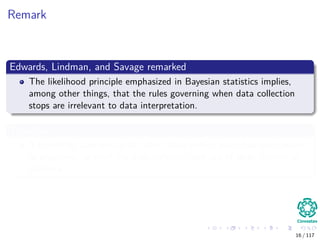
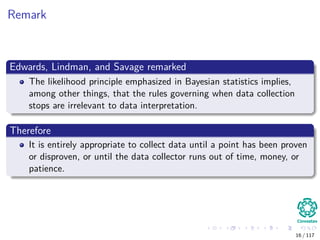
Remark
Edwards, Lindman, and Savage remarked
The likelihood principle emphasized in Bayesian statistics implies,
among other things, that the rules governing when data collection
stops are irrelevant to data interpretation.
Therefore
It is entirely appropriate to collect data until a point has been proven
or disproven, or until the data collector runs out of time, money, or
patience.
16 / 117
Remark
Edwards, Lindman, and Savage remarked
The likelihood principle emphasized in Bayesian statistics implies,
among other things, that the rules governing when data collection
stops are irrelevant to data interpretation.
Therefore
It is entirely appropriate to collect data until a point has been proven
or disproven, or until the data collector runs out of time, money, or
patience.
16 / 117
Thus
Likelihood Principle [4]
The Likelihood principle (LP) asserts that for inference on an
unknown quantity θ, all of the evidence from any observation X = x
with distribution X ∼ f (x|θ) lies in the likelihood function
L (θ|x) ∝ f (x|θ) , θ ∈ Θ
17 / 117
Thus
Something Notable
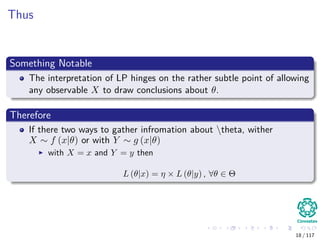
The interpretation of LP hinges on the rather subtle point of allowing
any observable X to draw conclusions about θ.
Therefore
If there two ways to gather infromation about theta, wither
X ∼ f (x|θ) or with Y ∼ g (x|θ)
with X = x and Y = y then
L (θ|x) = η × L (θ|y) , ∀θ ∈ Θ
18 / 117
Thus
Something Notable
The interpretation of LP hinges on the rather subtle point of allowing
any observable X to draw conclusions about θ.
Therefore
If there two ways to gather infromation about theta, wither
X ∼ f (x|θ) or with Y ∼ g (x|θ)
with X = x and Y = y then
L (θ|x) = η × L (θ|y) , ∀θ ∈ Θ
18 / 117
Outline
1 Introduction
Likelihood Principle
Example, Testing Fairness
Independence Influence
Sufficiency
Fisher-Neyman Characterization
Example
Sufficiency Principle
Conditionality Perspective
Example
Sins of Being non-Bayesian
2 Bayesian Inference
Introduction
Connection with Sufficient Statistics
Generalized Maximum Likelihood Estimator
The Maximum A Posteriori (MAP)
Maximum Likelihood Vs Maximum A Posteriori
Properties of the MAP
3 Loss, Posterior Risk, Bayes Action
Bayes Principle in the Frequentist Decision Theoretic Setup
Examples of Loss Functions
Bayesian Expected Loss Principle
Example
The Empirical Risk
The Fubini’s Theorem
19 / 117
In the case of Learning
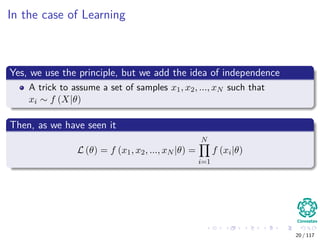
Yes, we use the principle, but we add the idea of independence
A trick to assume a set of samples x1, x2, ..., xN such that
xi ∼ f (X|θ)
Then, as we have seen it
L (θ) = f (x1, x2, ..., xN |θ) =
N
i=1
f (xi|θ)
20 / 117
In the case of Learning
Yes, we use the principle, but we add the idea of independence
A trick to assume a set of samples x1, x2, ..., xN such that
xi ∼ f (X|θ)
Then, as we have seen it
L (θ) = f (x1, x2, ..., xN |θ) =
N
i=1
f (xi|θ)
20 / 117
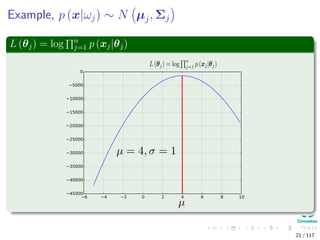
Example, p (x|ωj) ∼ N µj, Σj
L (θj) = log n
j=1 p (xj|θj)
21 / 117
Outline
1 Introduction
Likelihood Principle
Example, Testing Fairness
Independence Influence
Sufficiency
Fisher-Neyman Characterization
Example
Sufficiency Principle
Conditionality Perspective
Example
Sins of Being non-Bayesian
2 Bayesian Inference
Introduction
Connection with Sufficient Statistics
Generalized Maximum Likelihood Estimator
The Maximum A Posteriori (MAP)
Maximum Likelihood Vs Maximum A Posteriori
Properties of the MAP
3 Loss, Posterior Risk, Bayes Action
Bayes Principle in the Frequentist Decision Theoretic Setup
Examples of Loss Functions
Bayesian Expected Loss Principle
Example
The Empirical Risk
The Fubini’s Theorem
22 / 117
The Basics
Sufficiency Principle
An statistic is sufficient with respect to a statistical model and its
associated unknown parameter if
"no other statistic that can be calculated from the same sample
provides any additional information as to the value of the parameter"[5]
However, as always
We want a definition to build upon it... as always
23 / 117
The Basics
Sufficiency Principle
An statistic is sufficient with respect to a statistical model and its
associated unknown parameter if
"no other statistic that can be calculated from the same sample
provides any additional information as to the value of the parameter"[5]
However, as always
We want a definition to build upon it... as always
23 / 117
A Basic Definition
Definition
A statistic t = T(X) is sufficient for underlying parameter θ precisely
if the conditional probability distribution of the data X, given the
statistic t = T(X), does not depend on the parameter θ [6].
Something Notable
This agreement is non-philosophical, it is rather a consequence of
mathematics (measure theoretic considerations).
24 / 117
A Basic Definition
Definition
A statistic t = T(X) is sufficient for underlying parameter θ precisely
if the conditional probability distribution of the data X, given the
statistic t = T(X), does not depend on the parameter θ [6].
Something Notable
This agreement is non-philosophical, it is rather a consequence of
mathematics (measure theoretic considerations).
24 / 117
Outline
1 Introduction
Likelihood Principle
Example, Testing Fairness
Independence Influence
Sufficiency
Fisher-Neyman Characterization
Example
Sufficiency Principle
Conditionality Perspective
Example
Sins of Being non-Bayesian
2 Bayesian Inference
Introduction
Connection with Sufficient Statistics
Generalized Maximum Likelihood Estimator
The Maximum A Posteriori (MAP)
Maximum Likelihood Vs Maximum A Posteriori
Properties of the MAP
3 Loss, Posterior Risk, Bayes Action
Bayes Principle in the Frequentist Decision Theoretic Setup
Examples of Loss Functions
Bayesian Expected Loss Principle
Example
The Empirical Risk
The Fubini’s Theorem
25 / 117
Fisher’s Factorization Theorem
Theorem
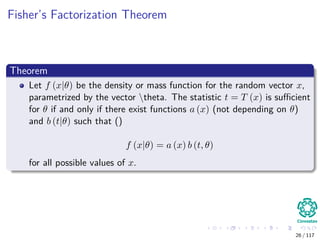
Let f (x|θ) be the density or mass function for the random vector x,
parametrized by the vector theta. The statistic t = T (x) is sufficient
for θ if and only if there exist functions a (x) (not depending on θ)
and b (t|θ) such that ()
f (x|θ) = a (x) b (t, θ)
for all possible values of x.
26 / 117
Proof
First ⇒ (We will look only to the discrete case [7])
Suppose t = T (x) is sufficient for θ. Then, by definition
f (x|θ, T (x) = t) is independient of θ
Let f (x, t|θ) denote the joint density function or mass function for
(X, T (X))
Observe f (x|θ) = f (x, t|θ) then we have
f (x|θ) = f (x, t|θ)
= f (x|θ, t) f (t|θ) Bayesian
= a (x)
f (x|t)
b (t, θ)
f (t|θ)
Independence
27 / 117
Proof
First ⇒ (We will look only to the discrete case [7])
Suppose t = T (x) is sufficient for θ. Then, by definition
f (x|θ, T (x) = t) is independient of θ
Let f (x, t|θ) denote the joint density function or mass function for
(X, T (X))
Observe f (x|θ) = f (x, t|θ) then we have
f (x|θ) = f (x, t|θ)
= f (x|θ, t) f (t|θ) Bayesian
= a (x)
f (x|t)
b (t, θ)
f (t|θ)
Independence
27 / 117
Proof
First ⇒ (We will look only to the discrete case [7])
Suppose t = T (x) is sufficient for θ. Then, by definition
f (x|θ, T (x) = t) is independient of θ
Let f (x, t|θ) denote the joint density function or mass function for
(X, T (X))
Observe f (x|θ) = f (x, t|θ) then we have
f (x|θ) = f (x, t|θ)
= f (x|θ, t) f (t|θ) Bayesian
= a (x)
f (x|t)
b (t, θ)
f (t|θ)
Independence
27 / 117
Proof
First ⇒ (We will look only to the discrete case [7])
Suppose t = T (x) is sufficient for θ. Then, by definition
f (x|θ, T (x) = t) is independient of θ
Let f (x, t|θ) denote the joint density function or mass function for
(X, T (X))
Observe f (x|θ) = f (x, t|θ) then we have
f (x|θ) = f (x, t|θ)
= f (x|θ, t) f (t|θ) Bayesian
= a (x)
f (x|t)
b (t, θ)
f (t|θ)
Independence
27 / 117
Proof
First ⇒ (We will look only to the discrete case [7])
Suppose t = T (x) is sufficient for θ. Then, by definition
f (x|θ, T (x) = t) is independient of θ
Let f (x, t|θ) denote the joint density function or mass function for
(X, T (X))
Observe f (x|θ) = f (x, t|θ) then we have
f (x|θ) = f (x, t|θ)
= f (x|θ, t) f (t|θ) Bayesian
= a (x)
f (x|t)
b (t, θ)
f (t|θ)
Independence
27 / 117
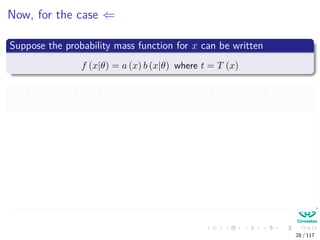
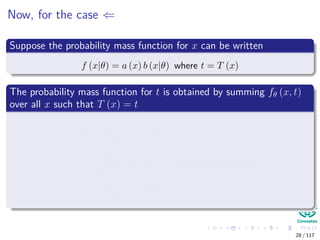
Now, for the case ⇐
Suppose the probability mass function for x can be written
f (x|θ) = a (x) b (x|θ) where t = T (x)
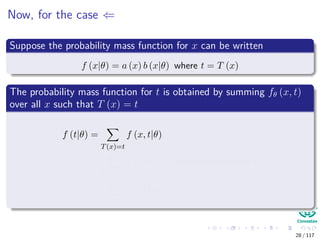
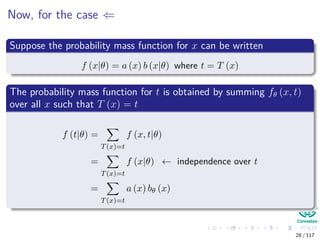
The probability mass function for t is obtained by summing fθ (x, t)
over all x such that T (x) = t
f (t|θ) =
T(x)=t
f (x, t|θ)
=
T(x)=t
f (x|θ) ← independence over t
=
T(x)=t
a (x) bθ (x)
28 / 117
Now, for the case ⇐
Suppose the probability mass function for x can be written
f (x|θ) = a (x) b (x|θ) where t = T (x)
The probability mass function for t is obtained by summing fθ (x, t)
over all x such that T (x) = t
f (t|θ) =
T(x)=t
f (x, t|θ)
=
T(x)=t
f (x|θ) ← independence over t
=
T(x)=t
a (x) bθ (x)
28 / 117
Now, for the case ⇐
Suppose the probability mass function for x can be written
f (x|θ) = a (x) b (x|θ) where t = T (x)
The probability mass function for t is obtained by summing fθ (x, t)
over all x such that T (x) = t
f (t|θ) =
T(x)=t
f (x, t|θ)
=
T(x)=t
f (x|θ) ← independence over t
=
T(x)=t
a (x) bθ (x)
28 / 117
Now, for the case ⇐
Suppose the probability mass function for x can be written
f (x|θ) = a (x) b (x|θ) where t = T (x)
The probability mass function for t is obtained by summing fθ (x, t)
over all x such that T (x) = t
f (t|θ) =
T(x)=t
f (x, t|θ)
=
T(x)=t
f (x|θ) ← independence over t
=
T(x)=t
a (x) bθ (x)
28 / 117
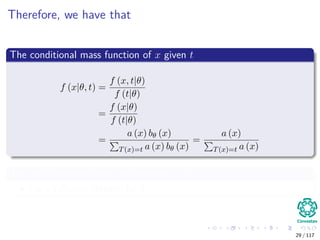
Therefore, we have that
The conditional mass function of x given t
f (x|θ, t) =
f (x, t|θ)
f (t|θ)
=
f (x|θ)
f (t|θ)
=
a (x) bθ (x)
T(x)=t a (x) bθ (x)
=
a (x)
T(x)=t a (x)
This last expression does not depend on θ
t is a sufficient statistic for θ.
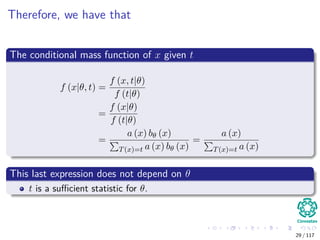
29 / 117
Therefore, we have that
The conditional mass function of x given t
f (x|θ, t) =
f (x, t|θ)
f (t|θ)
=
f (x|θ)
f (t|θ)
=
a (x) bθ (x)
T(x)=t a (x) bθ (x)
=
a (x)
T(x)=t a (x)
This last expression does not depend on θ
t is a sufficient statistic for θ.
29 / 117
Outline
1 Introduction
Likelihood Principle
Example, Testing Fairness
Independence Influence
Sufficiency
Fisher-Neyman Characterization
Example
Sufficiency Principle
Conditionality Perspective
Example
Sins of Being non-Bayesian
2 Bayesian Inference
Introduction
Connection with Sufficient Statistics
Generalized Maximum Likelihood Estimator
The Maximum A Posteriori (MAP)
Maximum Likelihood Vs Maximum A Posteriori
Properties of the MAP
3 Loss, Posterior Risk, Bayes Action
Bayes Principle in the Frequentist Decision Theoretic Setup
Examples of Loss Functions
Bayesian Expected Loss Principle
Example
The Empirical Risk
The Fubini’s Theorem
30 / 117
Using the Bernoulli Distribution
xn ∼Bernoulli(θ) are i.d.d. ∀n = 1, ..., N
f (x1, .., xN |θ) =
N
n=1
θxn
(1 − θ)1−xn
= θk
(1 − θ)N−k
k = N
n=1 xn
Now, if we have the following choices
a (x) = 1 and bθ (k) = θk
(1 − θ)N−k
31 / 117
Using the Bernoulli Distribution
xn ∼Bernoulli(θ) are i.d.d. ∀n = 1, ..., N
f (x1, .., xN |θ) =
N
n=1
θxn
(1 − θ)1−xn
= θk
(1 − θ)N−k
k = N
n=1 xn
Now, if we have the following choices
a (x) = 1 and bθ (k) = θk
(1 − θ)N−k
31 / 117
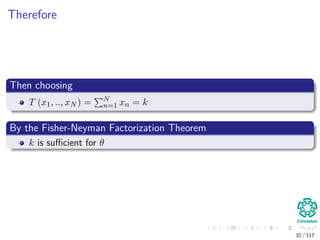
Therefore
Then choosing
T (x1, .., xN ) = N
n=1 xn = k
By the Fisher-Neyman Factorization Theorem
k is sufficient for θ
32 / 117
Outline
1 Introduction
Likelihood Principle
Example, Testing Fairness
Independence Influence
Sufficiency
Fisher-Neyman Characterization
Example
Sufficiency Principle
Conditionality Perspective
Example
Sins of Being non-Bayesian
2 Bayesian Inference
Introduction
Connection with Sufficient Statistics
Generalized Maximum Likelihood Estimator
The Maximum A Posteriori (MAP)
Maximum Likelihood Vs Maximum A Posteriori
Properties of the MAP
3 Loss, Posterior Risk, Bayes Action
Bayes Principle in the Frequentist Decision Theoretic Setup
Examples of Loss Functions
Bayesian Expected Loss Principle
Example
The Empirical Risk
The Fubini’s Theorem
33 / 117
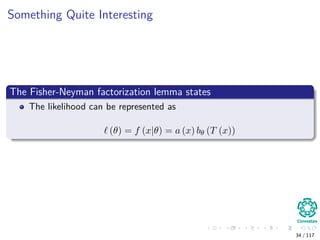
Something Quite Interesting
The Fisher-Neyman factorization lemma states
The likelihood can be represented as
(θ) = f (x|θ) = a (x) bθ (T (x))
34 / 117
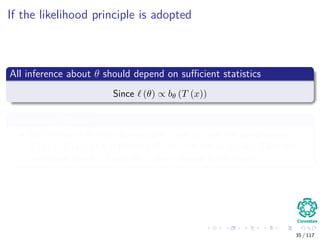
If the likelihood principle is adopted
All inference about θ should depend on sufficient statistics
Since (θ) ∝ bθ (T (x))
Sufficiency Principle
Let the two different observations x and y have the same values
T (x) = T (y), of a statistics sufficient for family f (·|θ). Then the
inferences about θ based on x and y should be the same.
35 / 117
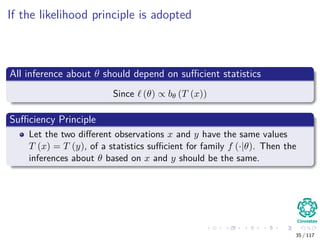
If the likelihood principle is adopted
All inference about θ should depend on sufficient statistics
Since (θ) ∝ bθ (T (x))
Sufficiency Principle
Let the two different observations x and y have the same values
T (x) = T (y), of a statistics sufficient for family f (·|θ). Then the
inferences about θ based on x and y should be the same.
35 / 117
Outline
1 Introduction
Likelihood Principle
Example, Testing Fairness
Independence Influence
Sufficiency
Fisher-Neyman Characterization
Example
Sufficiency Principle
Conditionality Perspective
Example
Sins of Being non-Bayesian
2 Bayesian Inference
Introduction
Connection with Sufficient Statistics
Generalized Maximum Likelihood Estimator
The Maximum A Posteriori (MAP)
Maximum Likelihood Vs Maximum A Posteriori
Properties of the MAP
3 Loss, Posterior Risk, Bayes Action
Bayes Principle in the Frequentist Decision Theoretic Setup
Examples of Loss Functions
Bayesian Expected Loss Principle
Example
The Empirical Risk
The Fubini’s Theorem
36 / 117
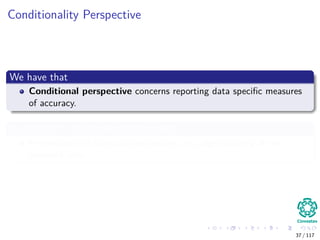
Conditionality Perspective
We have that
Conditional perspective concerns reporting data specific measures
of accuracy.
In contrast to the frequentist approach
Performance of statistical procedures are judged looking at the
observed data.
37 / 117
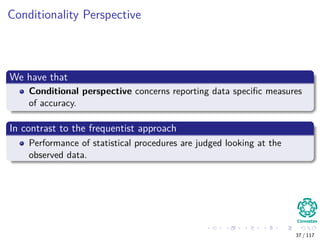
Conditionality Perspective
We have that
Conditional perspective concerns reporting data specific measures
of accuracy.
In contrast to the frequentist approach
Performance of statistical procedures are judged looking at the
observed data.
37 / 117
Outline
1 Introduction
Likelihood Principle
Example, Testing Fairness
Independence Influence
Sufficiency
Fisher-Neyman Characterization
Example
Sufficiency Principle
Conditionality Perspective
Example
Sins of Being non-Bayesian
2 Bayesian Inference
Introduction
Connection with Sufficient Statistics
Generalized Maximum Likelihood Estimator
The Maximum A Posteriori (MAP)
Maximum Likelihood Vs Maximum A Posteriori
Properties of the MAP
3 Loss, Posterior Risk, Bayes Action
Bayes Principle in the Frequentist Decision Theoretic Setup
Examples of Loss Functions
Bayesian Expected Loss Principle
Example
The Empirical Risk
The Fubini’s Theorem
38 / 117
Example
Consider estimating θ in the model
P (X = θ − 1|θ) = P (X = θ + 1|θ) with θ ∈ R
on basis of two observations, X1 and X2 .
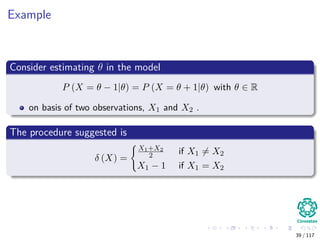
The procedure suggested is
δ (X) =
X1+X2
2 if X1 = X2
X1 − 1 if X1 = X2
39 / 117
Example
Consider estimating θ in the model
P (X = θ − 1|θ) = P (X = θ + 1|θ) with θ ∈ R
on basis of two observations, X1 and X2 .
The procedure suggested is
δ (X) =
X1+X2
2 if X1 = X2
X1 − 1 if X1 = X2
39 / 117
Therefore
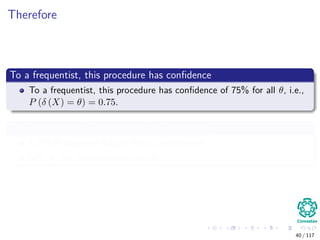
To a frequentist, this procedure has confidence
To a frequentist, this procedure has confidence of 75% for all θ, i.e.,
P (δ (X) = θ) = 0.75.
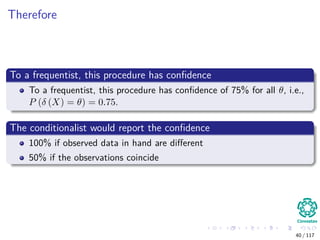
The conditionalist would report the confidence
100% if observed data in hand are different
50% if the observations coincide
40 / 117
Therefore
To a frequentist, this procedure has confidence
To a frequentist, this procedure has confidence of 75% for all θ, i.e.,
P (δ (X) = θ) = 0.75.
The conditionalist would report the confidence
100% if observed data in hand are different
50% if the observations coincide
40 / 117
Then
Conditionality Principle
If an experiment concerning the inference about θ is chosen from a
collection of possible experiments, independently of θ, then any
experiment not chosen is irrelevant to the inference.
41 / 117
Outline
1 Introduction
Likelihood Principle
Example, Testing Fairness
Independence Influence
Sufficiency
Fisher-Neyman Characterization
Example
Sufficiency Principle
Conditionality Perspective
Example
Sins of Being non-Bayesian
2 Bayesian Inference
Introduction
Connection with Sufficient Statistics
Generalized Maximum Likelihood Estimator
The Maximum A Posteriori (MAP)
Maximum Likelihood Vs Maximum A Posteriori
Properties of the MAP
3 Loss, Posterior Risk, Bayes Action
Bayes Principle in the Frequentist Decision Theoretic Setup
Examples of Loss Functions
Bayesian Expected Loss Principle
Example
The Empirical Risk
The Fubini’s Theorem
42 / 117
Not a good idea to integrate with respect to sample space
What?
A perfectly valid hypothesis can be rejected because the
test failed to account for unlikely data that had not been
observed...
43 / 117
The Lindley Paradox
Suppose y|θ ∼ N θ, 1
n
We wish to test H0 : θ = 0 vs the two sided alternative.
Suppose a Bayesian puts the prior P (θ = 0) = P (θ = 0) = 1
2
The 1
2 is uniformly spread over the interval [−M/2, M/2].
Suppose n = 40, 000 and y = 0.01 are observed
So,
√
ny = 2
44 / 117
The Lindley Paradox
Suppose y|θ ∼ N θ, 1
n
We wish to test H0 : θ = 0 vs the two sided alternative.
Suppose a Bayesian puts the prior P (θ = 0) = P (θ = 0) = 1
2
The 1
2 is uniformly spread over the interval [−M/2, M/2].
Suppose n = 40, 000 and y = 0.01 are observed
So,
√
ny = 2
44 / 117
The Lindley Paradox
Suppose y|θ ∼ N θ, 1
n
We wish to test H0 : θ = 0 vs the two sided alternative.
Suppose a Bayesian puts the prior P (θ = 0) = P (θ = 0) = 1
2
The 1
2 is uniformly spread over the interval [−M/2, M/2].
Suppose n = 40, 000 and y = 0.01 are observed
So,
√
ny = 2
44 / 117
Therefore
Classical statistician
She/he rejects H0 at level α = 0.05
Posterior odds in favor of H0 are 11 if M = 1
We will look at this... no worries, but Bayesian Statistician will
choose H0
45 / 117
Therefore
Classical statistician
She/he rejects H0 at level α = 0.05
Posterior odds in favor of H0 are 11 if M = 1
We will look at this... no worries, but Bayesian Statistician will
choose H0
45 / 117
Outline
1 Introduction
Likelihood Principle
Example, Testing Fairness
Independence Influence
Sufficiency
Fisher-Neyman Characterization
Example
Sufficiency Principle
Conditionality Perspective
Example
Sins of Being non-Bayesian
2 Bayesian Inference
Introduction
Connection with Sufficient Statistics
Generalized Maximum Likelihood Estimator
The Maximum A Posteriori (MAP)
Maximum Likelihood Vs Maximum A Posteriori
Properties of the MAP
3 Loss, Posterior Risk, Bayes Action
Bayes Principle in the Frequentist Decision Theoretic Setup
Examples of Loss Functions
Bayesian Expected Loss Principle
Example
The Empirical Risk
The Fubini’s Theorem
46 / 117
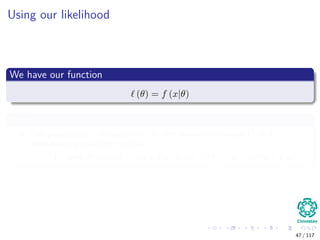
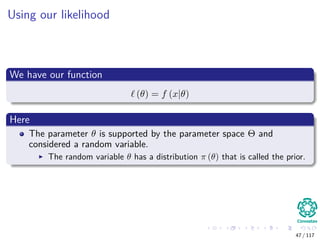
Using our likelihood
We have our function
(θ) = f (x|θ)
Here
The parameter θ is supported by the parameter space Θ and
considered a random variable.
The random variable θ has a distribution π (θ) that is called the prior.
47 / 117
Using our likelihood
We have our function
(θ) = f (x|θ)
Here
The parameter θ is supported by the parameter space Θ and
considered a random variable.
The random variable θ has a distribution π (θ) that is called the prior.
47 / 117
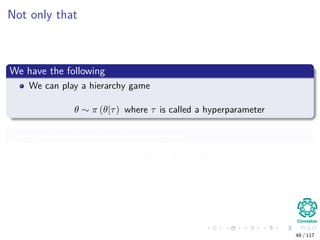
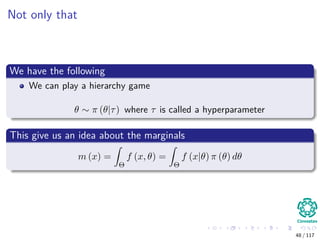
Not only that
We have the following
We can play a hierarchy game
θ ∼ π (θ|τ) where τ is called a hyperparameter
This give us an idea about the marginals
m (x) =
Θ
f (x, θ) =
Θ
f (x|θ) π (θ) dθ
48 / 117
Not only that
We have the following
We can play a hierarchy game
θ ∼ π (θ|τ) where τ is called a hyperparameter
This give us an idea about the marginals
m (x) =
Θ
f (x, θ) =
Θ
f (x|θ) π (θ) dθ
48 / 117
What about the posterior?
We have the following
f (θ|x) =
f (x, θ)
m (x)
=
f (x|θ) π (θ)
m (x)
=
f (x|θ) π (θ)
Θ f (x|θ) π (θ) dθ
49 / 117
What about the posterior?
We have the following
f (θ|x) =
f (x, θ)
m (x)
=
f (x|θ) π (θ)
m (x)
=
f (x|θ) π (θ)
Θ f (x|θ) π (θ) dθ
49 / 117
What about the posterior?
We have the following
f (θ|x) =
f (x, θ)
m (x)
=
f (x|θ) π (θ)
m (x)
=
f (x|θ) π (θ)
Θ f (x|θ) π (θ) dθ
49 / 117
Outline
1 Introduction
Likelihood Principle
Example, Testing Fairness
Independence Influence
Sufficiency
Fisher-Neyman Characterization
Example
Sufficiency Principle
Conditionality Perspective
Example
Sins of Being non-Bayesian
2 Bayesian Inference
Introduction
Connection with Sufficient Statistics
Generalized Maximum Likelihood Estimator
The Maximum A Posteriori (MAP)
Maximum Likelihood Vs Maximum A Posteriori
Properties of the MAP
3 Loss, Posterior Risk, Bayes Action
Bayes Principle in the Frequentist Decision Theoretic Setup
Examples of Loss Functions
Bayesian Expected Loss Principle
Example
The Empirical Risk
The Fubini’s Theorem
50 / 117
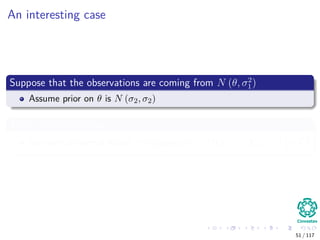
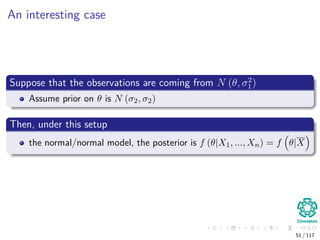
An interesting case
Suppose that the observations are coming from N (θ, σ2
1)
Assume prior on θ is N (σ2, σ2)
Then, under this setup
the normal/normal model, the posterior is f (θ|X1, ..., Xn) = f θ|X
51 / 117
An interesting case
Suppose that the observations are coming from N (θ, σ2
1)
Assume prior on θ is N (σ2, σ2)
Then, under this setup
the normal/normal model, the posterior is f (θ|X1, ..., Xn) = f θ|X
51 / 117
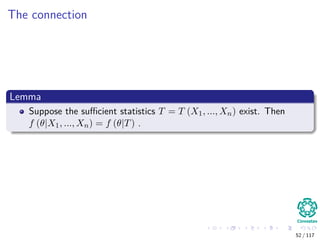
The connection
Lemma
Suppose the sufficient statistics T = T (X1, ..., Xn) exist. Then
f (θ|X1, ..., Xn) = f (θ|T) .
52 / 117
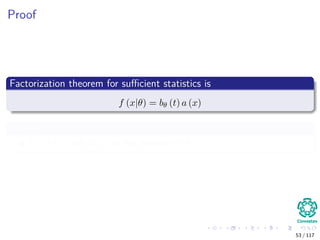
Proof
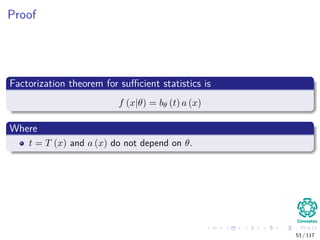
Factorization theorem for sufficient statistics is
f (x|θ) = bθ (t) a (x)
Where
t = T (x) and a (x) do not depend on θ.
53 / 117
Proof
Factorization theorem for sufficient statistics is
f (x|θ) = bθ (t) a (x)
Where
t = T (x) and a (x) do not depend on θ.
53 / 117
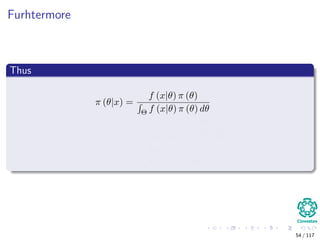
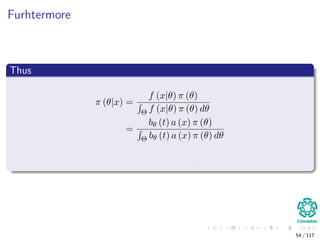
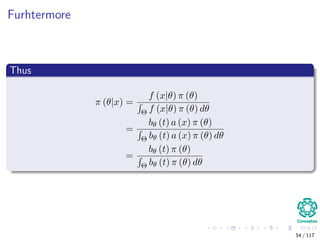
Furhtermore
Thus
π (θ|x) =
f (x|θ) π (θ)
Θ f (x|θ) π (θ) dθ
=
bθ (t) a (x) π (θ)
Θ bθ (t) a (x) π (θ) dθ
=
bθ (t) π (θ)
Θ bθ (t) π (θ) dθ
54 / 117
Furhtermore
Thus
π (θ|x) =
f (x|θ) π (θ)
Θ f (x|θ) π (θ) dθ
=
bθ (t) a (x) π (θ)
Θ bθ (t) a (x) π (θ) dθ
=
bθ (t) π (θ)
Θ bθ (t) π (θ) dθ
54 / 117
Furhtermore
Thus
π (θ|x) =
f (x|θ) π (θ)
Θ f (x|θ) π (θ) dθ
=
bθ (t) a (x) π (θ)
Θ bθ (t) a (x) π (θ) dθ
=
bθ (t) π (θ)
Θ bθ (t) π (θ) dθ
54 / 117
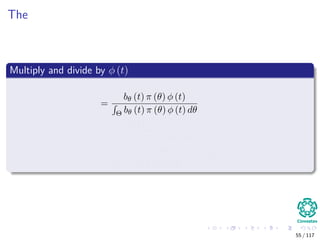
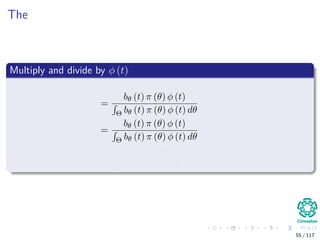
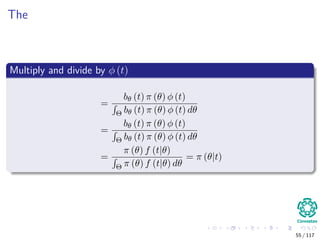
The
Multiply and divide by φ (t)
=
bθ (t) π (θ) φ (t)
Θ bθ (t) π (θ) φ (t) dθ
=
bθ (t) π (θ) φ (t)
Θ bθ (t) π (θ) φ (t) dθ
=
π (θ) f (t|θ)
Θ π (θ) f (t|θ) dθ
= π (θ|t)
55 / 117
The
Multiply and divide by φ (t)
=
bθ (t) π (θ) φ (t)
Θ bθ (t) π (θ) φ (t) dθ
=
bθ (t) π (θ) φ (t)
Θ bθ (t) π (θ) φ (t) dθ
=
π (θ) f (t|θ)
Θ π (θ) f (t|θ) dθ
= π (θ|t)
55 / 117
The
Multiply and divide by φ (t)
=
bθ (t) π (θ) φ (t)
Θ bθ (t) π (θ) φ (t) dθ
=
bθ (t) π (θ) φ (t)
Θ bθ (t) π (θ) φ (t) dθ
=
π (θ) f (t|θ)
Θ π (θ) f (t|θ) dθ
= π (θ|t)
55 / 117
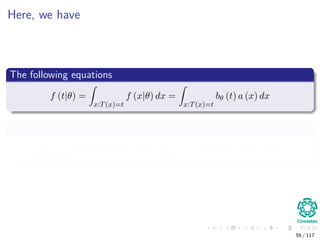
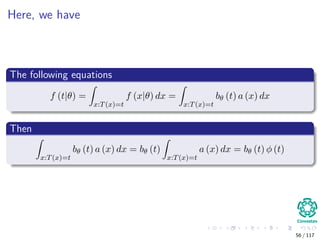
Here, we have
The following equations
f (t|θ) =
x:T(x)=t
f (x|θ) dx =
x:T(x)=t
bθ (t) a (x) dx
Then
x:T(x)=t
bθ (t) a (x) dx = bθ (t)
x:T(x)=t
a (x) dx = bθ (t) φ (t)
56 / 117
Here, we have
The following equations
f (t|θ) =
x:T(x)=t
f (x|θ) dx =
x:T(x)=t
bθ (t) a (x) dx
Then
x:T(x)=t
bθ (t) a (x) dx = bθ (t)
x:T(x)=t
a (x) dx = bθ (t) φ (t)
56 / 117
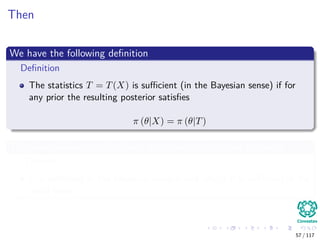
Then
We have the following definition
Definition
The statistics T = T(X) is sufficient (in the Bayesian sense) if for
any prior the resulting posterior satisfies
π (θ|X) = π (θ|T)
This is equivalent to the classic definition on sufficient statistics
Theorem
T is sufficient in the Bayesian sense if and only if it is sufficient in the
usual sense.
57 / 117
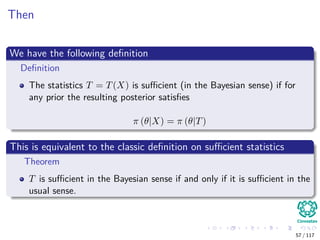
Then
We have the following definition
Definition
The statistics T = T(X) is sufficient (in the Bayesian sense) if for
any prior the resulting posterior satisfies
π (θ|X) = π (θ|T)
This is equivalent to the classic definition on sufficient statistics
Theorem
T is sufficient in the Bayesian sense if and only if it is sufficient in the
usual sense.
57 / 117
Outline
1 Introduction
Likelihood Principle
Example, Testing Fairness
Independence Influence
Sufficiency
Fisher-Neyman Characterization
Example
Sufficiency Principle
Conditionality Perspective
Example
Sins of Being non-Bayesian
2 Bayesian Inference
Introduction
Connection with Sufficient Statistics
Generalized Maximum Likelihood Estimator
The Maximum A Posteriori (MAP)
Maximum Likelihood Vs Maximum A Posteriori
Properties of the MAP
3 Loss, Posterior Risk, Bayes Action
Bayes Principle in the Frequentist Decision Theoretic Setup
Examples of Loss Functions
Bayesian Expected Loss Principle
Example
The Empirical Risk
The Fubini’s Theorem
58 / 117
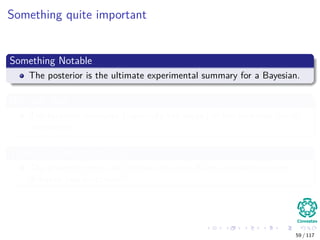
Something quite important
Something Notable
The posterior is the ultimate experimental summary for a Bayesian.
Not only that
The location measures (especially the mean) of the posterior are of
importance.
There is an important idea
The posterior mode and median are also Bayes estimators under
different loss functions!!!
59 / 117
Something quite important
Something Notable
The posterior is the ultimate experimental summary for a Bayesian.
Not only that
The location measures (especially the mean) of the posterior are of
importance.
There is an important idea
The posterior mode and median are also Bayes estimators under
different loss functions!!!
59 / 117
Something quite important
Something Notable
The posterior is the ultimate experimental summary for a Bayesian.
Not only that
The location measures (especially the mean) of the posterior are of
importance.
There is an important idea
The posterior mode and median are also Bayes estimators under
different loss functions!!!
59 / 117
Furthermore
Generalized Maximum Likelihood Estimator AKA MAP (Maximum
Aposteriori)
The generalized MLE is the largest mode of the π (θ|x).
60 / 117
Outline
1 Introduction
Likelihood Principle
Example, Testing Fairness
Independence Influence
Sufficiency
Fisher-Neyman Characterization
Example
Sufficiency Principle
Conditionality Perspective
Example
Sins of Being non-Bayesian
2 Bayesian Inference
Introduction
Connection with Sufficient Statistics
Generalized Maximum Likelihood Estimator
The Maximum A Posteriori (MAP)
Maximum Likelihood Vs Maximum A Posteriori
Properties of the MAP
3 Loss, Posterior Risk, Bayes Action
Bayes Principle in the Frequentist Decision Theoretic Setup
Examples of Loss Functions
Bayesian Expected Loss Principle
Example
The Empirical Risk
The Fubini’s Theorem
61 / 117
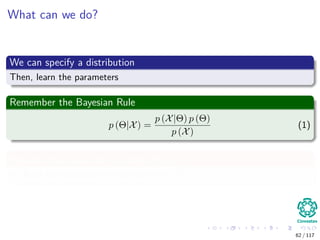
What can we do?
We can specify a distribution
Then, learn the parameters
Remember the Bayesian Rule
p (Θ|X) =
p (X|Θ) p (Θ)
p (X)
(1)
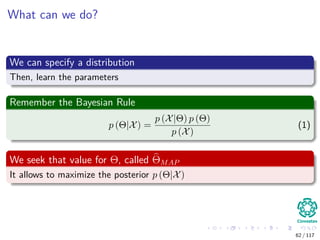
We seek that value for Θ, called ΘMAP
It allows to maximize the posterior p (Θ|X)
62 / 117
What can we do?
We can specify a distribution
Then, learn the parameters
Remember the Bayesian Rule
p (Θ|X) =
p (X|Θ) p (Θ)
p (X)
(1)
We seek that value for Θ, called ΘMAP
It allows to maximize the posterior p (Θ|X)
62 / 117
What can we do?
We can specify a distribution
Then, learn the parameters
Remember the Bayesian Rule
p (Θ|X) =
p (X|Θ) p (Θ)
p (X)
(1)
We seek that value for Θ, called ΘMAP
It allows to maximize the posterior p (Θ|X)
62 / 117
Therefore
We can use this idea of maximizing the posterior
To obtain the distribution through the Maximum a Posteriori
63 / 117
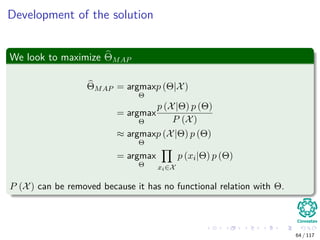
Development of the solution
We look to maximize ΘMAP
ΘMAP = argmax
Θ
p (Θ|X)
= argmax
Θ
p (X|Θ) p (Θ)
P (X)
≈ argmax
Θ
p (X|Θ) p (Θ)
= argmax
Θ xi∈X
p (xi|Θ) p (Θ)
P (X) can be removed because it has no functional relation with Θ.
64 / 117
Development of the solution
We look to maximize ΘMAP
ΘMAP = argmax
Θ
p (Θ|X)
= argmax
Θ
p (X|Θ) p (Θ)
P (X)
≈ argmax
Θ
p (X|Θ) p (Θ)
= argmax
Θ xi∈X
p (xi|Θ) p (Θ)
P (X) can be removed because it has no functional relation with Θ.
64 / 117
Development of the solution
We look to maximize ΘMAP
ΘMAP = argmax
Θ
p (Θ|X)
= argmax
Θ
p (X|Θ) p (Θ)
P (X)
≈ argmax
Θ
p (X|Θ) p (Θ)
= argmax
Θ xi∈X
p (xi|Θ) p (Θ)
P (X) can be removed because it has no functional relation with Θ.
64 / 117
Development of the solution
We look to maximize ΘMAP
ΘMAP = argmax
Θ
p (Θ|X)
= argmax
Θ
p (X|Θ) p (Θ)
P (X)
≈ argmax
Θ
p (X|Θ) p (Θ)
= argmax
Θ xi∈X
p (xi|Θ) p (Θ)
P (X) can be removed because it has no functional relation with Θ.
64 / 117
Development of the solution
We look to maximize ΘMAP
ΘMAP = argmax
Θ
p (Θ|X)
= argmax
Θ
p (X|Θ) p (Θ)
P (X)
≈ argmax
Θ
p (X|Θ) p (Θ)
= argmax
Θ xi∈X
p (xi|Θ) p (Θ)
P (X) can be removed because it has no functional relation with Θ.
64 / 117
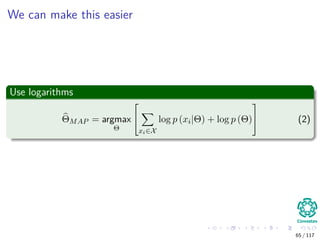
We can make this easier
Use logarithms
ΘMAP = argmax
Θ


xi∈X
log p (xi|Θ) + log p (Θ)

 (2)
65 / 117
What Does the MAP Estimate Get?
Something Notable
The MAP estimate allows us to inject into the estimation calculation our
prior beliefs regarding the parameters values in Θ.
For example
Let’s conduct N independent trials of the following Bernoulli experiment
with q parameter:
We will ask each individual we run into in the hallway whether they
will vote PRI or PAN in the next presidential election.
With probability q to vote PRI
Where the values of xi is either PRI or PAN.
66 / 117
What Does the MAP Estimate Get?
Something Notable
The MAP estimate allows us to inject into the estimation calculation our
prior beliefs regarding the parameters values in Θ.
For example
Let’s conduct N independent trials of the following Bernoulli experiment
with q parameter:
We will ask each individual we run into in the hallway whether they
will vote PRI or PAN in the next presidential election.
With probability q to vote PRI
Where the values of xi is either PRI or PAN.
66 / 117
What Does the MAP Estimate Get?
Something Notable
The MAP estimate allows us to inject into the estimation calculation our
prior beliefs regarding the parameters values in Θ.
For example
Let’s conduct N independent trials of the following Bernoulli experiment
with q parameter:
We will ask each individual we run into in the hallway whether they
will vote PRI or PAN in the next presidential election.
With probability q to vote PRI
Where the values of xi is either PRI or PAN.
66 / 117
What Does the MAP Estimate Get?
Something Notable
The MAP estimate allows us to inject into the estimation calculation our
prior beliefs regarding the parameters values in Θ.
For example
Let’s conduct N independent trials of the following Bernoulli experiment
with q parameter:
We will ask each individual we run into in the hallway whether they
will vote PRI or PAN in the next presidential election.
With probability q to vote PRI
Where the values of xi is either PRI or PAN.
66 / 117
Outline
1 Introduction
Likelihood Principle
Example, Testing Fairness
Independence Influence
Sufficiency
Fisher-Neyman Characterization
Example
Sufficiency Principle
Conditionality Perspective
Example
Sins of Being non-Bayesian
2 Bayesian Inference
Introduction
Connection with Sufficient Statistics
Generalized Maximum Likelihood Estimator
The Maximum A Posteriori (MAP)
Maximum Likelihood Vs Maximum A Posteriori
Properties of the MAP
3 Loss, Posterior Risk, Bayes Action
Bayes Principle in the Frequentist Decision Theoretic Setup
Examples of Loss Functions
Bayesian Expected Loss Principle
Example
The Empirical Risk
The Fubini’s Theorem
67 / 117
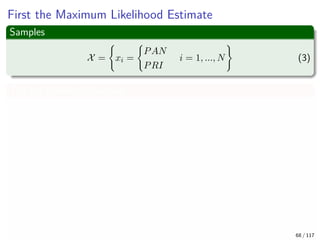
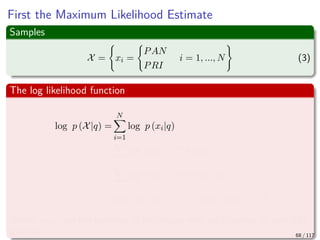
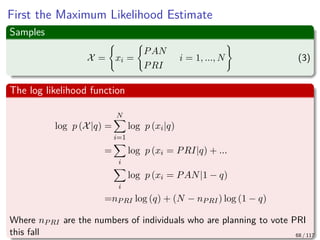
First the Maximum Likelihood Estimate
Samples
X = xi =
PAN
PRI
i = 1, ..., N (3)
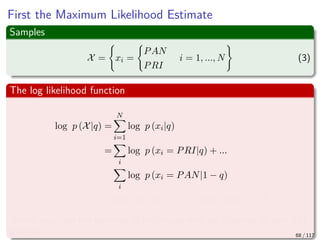
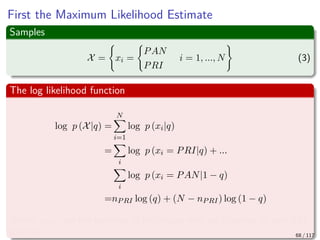
The log likelihood function
log p (X|q) =
N
i=1
log p (xi|q)
=
i
log p (xi = PRI|q) + ...
i
log p (xi = PAN|1 − q)
=nPRI log (q) + (N − nPRI) log (1 − q)
Where nPRI are the numbers of individuals who are planning to vote PRI
this fall 68 / 117
First the Maximum Likelihood Estimate
Samples
X = xi =
PAN
PRI
i = 1, ..., N (3)
The log likelihood function
log p (X|q) =
N
i=1
log p (xi|q)
=
i
log p (xi = PRI|q) + ...
i
log p (xi = PAN|1 − q)
=nPRI log (q) + (N − nPRI) log (1 − q)
Where nPRI are the numbers of individuals who are planning to vote PRI
this fall 68 / 117
First the Maximum Likelihood Estimate
Samples
X = xi =
PAN
PRI
i = 1, ..., N (3)
The log likelihood function
log p (X|q) =
N
i=1
log p (xi|q)
=
i
log p (xi = PRI|q) + ...
i
log p (xi = PAN|1 − q)
=nPRI log (q) + (N − nPRI) log (1 − q)
Where nPRI are the numbers of individuals who are planning to vote PRI
this fall 68 / 117
First the Maximum Likelihood Estimate
Samples
X = xi =
PAN
PRI
i = 1, ..., N (3)
The log likelihood function
log p (X|q) =
N
i=1
log p (xi|q)
=
i
log p (xi = PRI|q) + ...
i
log p (xi = PAN|1 − q)
=nPRI log (q) + (N − nPRI) log (1 − q)
Where nPRI are the numbers of individuals who are planning to vote PRI
this fall 68 / 117
First the Maximum Likelihood Estimate
Samples
X = xi =
PAN
PRI
i = 1, ..., N (3)
The log likelihood function
log p (X|q) =
N
i=1
log p (xi|q)
=
i
log p (xi = PRI|q) + ...
i
log p (xi = PAN|1 − q)
=nPRI log (q) + (N − nPRI) log (1 − q)
Where nPRI are the numbers of individuals who are planning to vote PRI
this fall 68 / 117
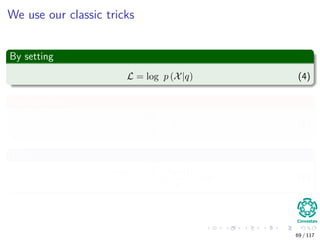
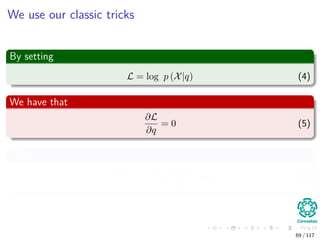
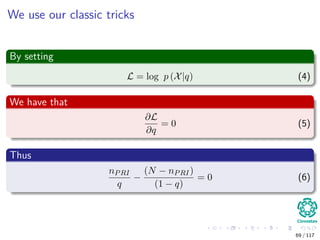
We use our classic tricks
By setting
L = log p (X|q) (4)
We have that
∂L
∂q
= 0 (5)
Thus
nPRI
q
−
(N − nPRI)
(1 − q)
= 0 (6)
69 / 117
We use our classic tricks
By setting
L = log p (X|q) (4)
We have that
∂L
∂q
= 0 (5)
Thus
nPRI
q
−
(N − nPRI)
(1 − q)
= 0 (6)
69 / 117
We use our classic tricks
By setting
L = log p (X|q) (4)
We have that
∂L
∂q
= 0 (5)
Thus
nPRI
q
−
(N − nPRI)
(1 − q)
= 0 (6)
69 / 117
Final Solution of ML
We get
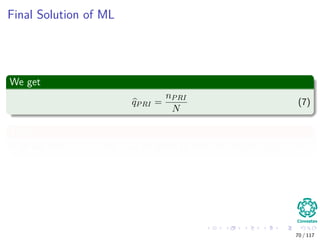
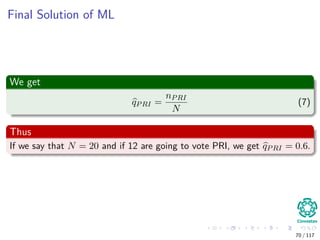
qPRI =
nPRI
N
(7)
Thus
If we say that N = 20 and if 12 are going to vote PRI, we get qPRI = 0.6.
70 / 117
Final Solution of ML
We get
qPRI =
nPRI
N
(7)
Thus
If we say that N = 20 and if 12 are going to vote PRI, we get qPRI = 0.6.
70 / 117
Building the MAP estimate
Obviously we need a prior belief distribution
We have the following constraints:
The prior for q must be zero outside the [0, 1] interval.
Within the [0, 1] interval, we are free to specify our beliefs in any way
we wish.
In most cases, we would want to choose a distribution for the prior
beliefs that peaks somewhere in the [0, 1] interval.
We assume the following
The state of Colima has traditionally voted PRI in presidential
elections.
However, on account of the prevailing economic conditions, the voters
are more likely to vote PAN in the election in question.
71 / 117
Building the MAP estimate
Obviously we need a prior belief distribution
We have the following constraints:
The prior for q must be zero outside the [0, 1] interval.
Within the [0, 1] interval, we are free to specify our beliefs in any way
we wish.
In most cases, we would want to choose a distribution for the prior
beliefs that peaks somewhere in the [0, 1] interval.
We assume the following
The state of Colima has traditionally voted PRI in presidential
elections.
However, on account of the prevailing economic conditions, the voters
are more likely to vote PAN in the election in question.
71 / 117
Building the MAP estimate
Obviously we need a prior belief distribution
We have the following constraints:
The prior for q must be zero outside the [0, 1] interval.
Within the [0, 1] interval, we are free to specify our beliefs in any way
we wish.
In most cases, we would want to choose a distribution for the prior
beliefs that peaks somewhere in the [0, 1] interval.
We assume the following
The state of Colima has traditionally voted PRI in presidential
elections.
However, on account of the prevailing economic conditions, the voters
are more likely to vote PAN in the election in question.
71 / 117
Building the MAP estimate
Obviously we need a prior belief distribution
We have the following constraints:
The prior for q must be zero outside the [0, 1] interval.
Within the [0, 1] interval, we are free to specify our beliefs in any way
we wish.
In most cases, we would want to choose a distribution for the prior
beliefs that peaks somewhere in the [0, 1] interval.
We assume the following
The state of Colima has traditionally voted PRI in presidential
elections.
However, on account of the prevailing economic conditions, the voters
are more likely to vote PAN in the election in question.
71 / 117
Building the MAP estimate
Obviously we need a prior belief distribution
We have the following constraints:
The prior for q must be zero outside the [0, 1] interval.
Within the [0, 1] interval, we are free to specify our beliefs in any way
we wish.
In most cases, we would want to choose a distribution for the prior
beliefs that peaks somewhere in the [0, 1] interval.
We assume the following
The state of Colima has traditionally voted PRI in presidential
elections.
However, on account of the prevailing economic conditions, the voters
are more likely to vote PAN in the election in question.
71 / 117
Building the MAP estimate
Obviously we need a prior belief distribution
We have the following constraints:
The prior for q must be zero outside the [0, 1] interval.
Within the [0, 1] interval, we are free to specify our beliefs in any way
we wish.
In most cases, we would want to choose a distribution for the prior
beliefs that peaks somewhere in the [0, 1] interval.
We assume the following
The state of Colima has traditionally voted PRI in presidential
elections.
However, on account of the prevailing economic conditions, the voters
are more likely to vote PAN in the election in question.
71 / 117
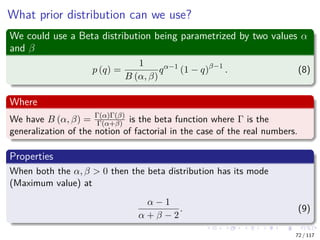
What prior distribution can we use?
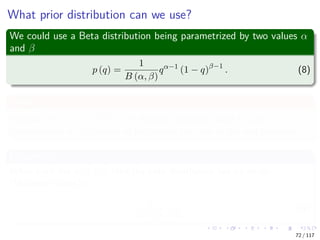
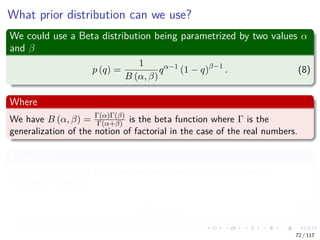
We could use a Beta distribution being parametrized by two values α
and β
p (q) =
1
B (α, β)
qα−1
(1 − q)β−1
. (8)
Where
We have B (α, β) = Γ(α)Γ(β)
Γ(α+β) is the beta function where Γ is the
generalization of the notion of factorial in the case of the real numbers.
Properties
When both the α, β > 0 then the beta distribution has its mode
(Maximum value) at
α − 1
α + β − 2
. (9)
72 / 117
What prior distribution can we use?
We could use a Beta distribution being parametrized by two values α
and β
p (q) =
1
B (α, β)
qα−1
(1 − q)β−1
. (8)
Where
We have B (α, β) = Γ(α)Γ(β)
Γ(α+β) is the beta function where Γ is the
generalization of the notion of factorial in the case of the real numbers.
Properties
When both the α, β > 0 then the beta distribution has its mode
(Maximum value) at
α − 1
α + β − 2
. (9)
72 / 117
What prior distribution can we use?
We could use a Beta distribution being parametrized by two values α
and β
p (q) =
1
B (α, β)
qα−1
(1 − q)β−1
. (8)
Where
We have B (α, β) = Γ(α)Γ(β)
Γ(α+β) is the beta function where Γ is the
generalization of the notion of factorial in the case of the real numbers.
Properties
When both the α, β > 0 then the beta distribution has its mode
(Maximum value) at
α − 1
α + β − 2
. (9)
72 / 117
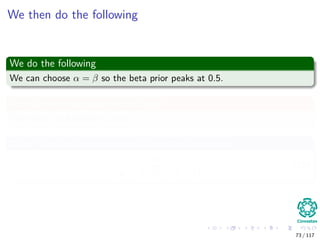
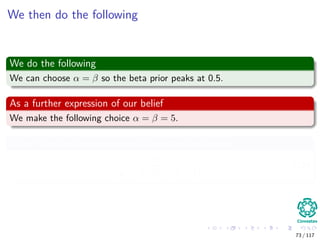
We then do the following
We do the following
We can choose α = β so the beta prior peaks at 0.5.
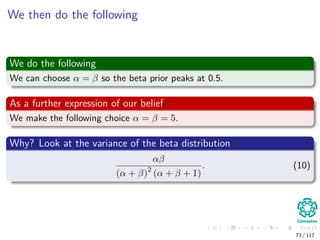
As a further expression of our belief
We make the following choice α = β = 5.
Why? Look at the variance of the beta distribution
αβ
(α + β)2
(α + β + 1)
. (10)
73 / 117
We then do the following
We do the following
We can choose α = β so the beta prior peaks at 0.5.
As a further expression of our belief
We make the following choice α = β = 5.
Why? Look at the variance of the beta distribution
αβ
(α + β)2
(α + β + 1)
. (10)
73 / 117
We then do the following
We do the following
We can choose α = β so the beta prior peaks at 0.5.
As a further expression of our belief
We make the following choice α = β = 5.
Why? Look at the variance of the beta distribution
αβ
(α + β)2
(α + β + 1)
. (10)
73 / 117
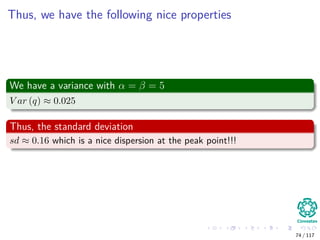
Thus, we have the following nice properties
We have a variance with α = β = 5
V ar (q) ≈ 0.025
Thus, the standard deviation
sd ≈ 0.16 which is a nice dispersion at the peak point!!!
74 / 117
Thus, we have the following nice properties
We have a variance with α = β = 5
V ar (q) ≈ 0.025
Thus, the standard deviation
sd ≈ 0.16 which is a nice dispersion at the peak point!!!
74 / 117
Now, our MAP estimate for pMAP ...
We have then
pMAP = argmax
Θ


xi∈X
log p (xi|q) + log p (q)

 (11)
Plugging back the ML
pMAP = argmax
Θ
[nPRI log q + (N − nPRI) log (1 − q) + log p (q)] (12)
Where
log p (q) = log
1
B (α, β)
qα−1
(1 − q)β−1
(13)
75 / 117
Now, our MAP estimate for pMAP ...
We have then
pMAP = argmax
Θ


xi∈X
log p (xi|q) + log p (q)

 (11)
Plugging back the ML
pMAP = argmax
Θ
[nPRI log q + (N − nPRI) log (1 − q) + log p (q)] (12)
Where
log p (q) = log
1
B (α, β)
qα−1
(1 − q)β−1
(13)
75 / 117
Now, our MAP estimate for pMAP ...
We have then
pMAP = argmax
Θ


xi∈X
log p (xi|q) + log p (q)

 (11)
Plugging back the ML
pMAP = argmax
Θ
[nPRI log q + (N − nPRI) log (1 − q) + log p (q)] (12)
Where
log p (q) = log
1
B (α, β)
qα−1
(1 − q)β−1
(13)
75 / 117
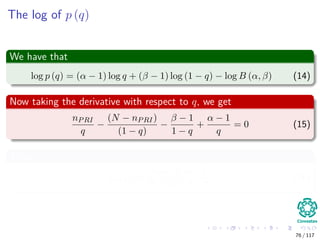
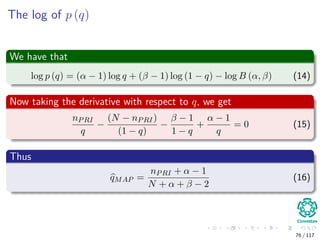
The log of p (q)
We have that
log p (q) = (α − 1) log q + (β − 1) log (1 − q) − log B (α, β) (14)
Now taking the derivative with respect to q, we get
nPRI
q
−
(N − nPRI)
(1 − q)
−
β − 1
1 − q
+
α − 1
q
= 0 (15)
Thus
qMAP =
nPRI + α − 1
N + α + β − 2
(16)
76 / 117
The log of p (q)
We have that
log p (q) = (α − 1) log q + (β − 1) log (1 − q) − log B (α, β) (14)
Now taking the derivative with respect to q, we get
nPRI
q
−
(N − nPRI)
(1 − q)
−
β − 1
1 − q
+
α − 1
q
= 0 (15)
Thus
qMAP =
nPRI + α − 1
N + α + β − 2
(16)
76 / 117
The log of p (q)
We have that
log p (q) = (α − 1) log q + (β − 1) log (1 − q) − log B (α, β) (14)
Now taking the derivative with respect to q, we get
nPRI
q
−
(N − nPRI)
(1 − q)
−
β − 1
1 − q
+
α − 1
q
= 0 (15)
Thus
qMAP =
nPRI + α − 1
N + α + β − 2
(16)
76 / 117
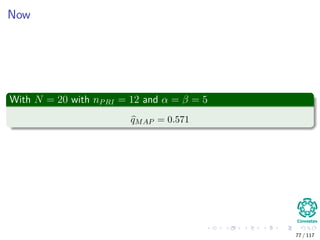
Now
With N = 20 with nPRI = 12 and α = β = 5
qMAP = 0.571
77 / 117
Another Example
Let X1, ..., Xn given θ are Poisson P (θ) with probability
f (xi|θ) = θxi
xi!
e−θ
Assume θ ∼ Γ (α, β) given by π (θ) ∝ θα−1e−βθ
The MAP is equal to
π (θ|X1, X2, ..., Xn) = π θ| Xi ∝ θ Xi+α−1
e−(n+β)θ
Basically Γ ( Xi + α − 1, n + β)
The mean is
E [θ|X] =
Xi + α
n + β
78 / 117
Another Example
Let X1, ..., Xn given θ are Poisson P (θ) with probability
f (xi|θ) = θxi
xi!
e−θ
Assume θ ∼ Γ (α, β) given by π (θ) ∝ θα−1e−βθ
The MAP is equal to
π (θ|X1, X2, ..., Xn) = π θ| Xi ∝ θ Xi+α−1
e−(n+β)θ
Basically Γ ( Xi + α − 1, n + β)
The mean is
E [θ|X] =
Xi + α
n + β
78 / 117
Another Example
Let X1, ..., Xn given θ are Poisson P (θ) with probability
f (xi|θ) = θxi
xi!
e−θ
Assume θ ∼ Γ (α, β) given by π (θ) ∝ θα−1e−βθ
The MAP is equal to
π (θ|X1, X2, ..., Xn) = π θ| Xi ∝ θ Xi+α−1
e−(n+β)θ
Basically Γ ( Xi + α − 1, n + β)
The mean is
E [θ|X] =
Xi + α
n + β
78 / 117
Now, given the mean of the Γ
We can rewrite the mean as
E [θ|X] =
n
n + β
×
Xi
n
+
β
β + n
×
α
β
Given that the means are
Mean of MLE
Xi
n
Mean of the prior α
β
79 / 117
Now, given the mean of the Γ
We can rewrite the mean as
E [θ|X] =
n
n + β
×
Xi
n
+
β
β + n
×
α
β
Given that the means are
Mean of MLE
Xi
n
Mean of the prior α
β
79 / 117
Remarks
Something Notable
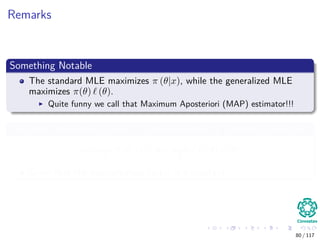
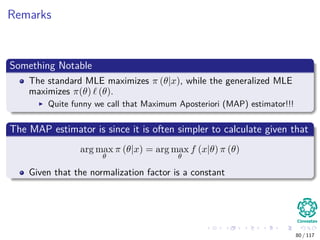
The standard MLE maximizes π (θ|x), while the generalized MLE
maximizes π(θ) (θ).
Quite funny we call that Maximum Aposteriori (MAP) estimator!!!
The MAP estimator is since it is often simpler to calculate given that
arg max
θ
π (θ|x) = arg max
θ
f (x|θ) π (θ)
Given that the normalization factor is a constant
80 / 117
Remarks
Something Notable
The standard MLE maximizes π (θ|x), while the generalized MLE
maximizes π(θ) (θ).
Quite funny we call that Maximum Aposteriori (MAP) estimator!!!
The MAP estimator is since it is often simpler to calculate given that
arg max
θ
π (θ|x) = arg max
θ
f (x|θ) π (θ)
Given that the normalization factor is a constant
80 / 117
Outline
1 Introduction
Likelihood Principle
Example, Testing Fairness
Independence Influence
Sufficiency
Fisher-Neyman Characterization
Example
Sufficiency Principle
Conditionality Perspective
Example
Sins of Being non-Bayesian
2 Bayesian Inference
Introduction
Connection with Sufficient Statistics
Generalized Maximum Likelihood Estimator
The Maximum A Posteriori (MAP)
Maximum Likelihood Vs Maximum A Posteriori
Properties of the MAP
3 Loss, Posterior Risk, Bayes Action
Bayes Principle in the Frequentist Decision Theoretic Setup
Examples of Loss Functions
Bayesian Expected Loss Principle
Example
The Empirical Risk
The Fubini’s Theorem
81 / 117
Properties
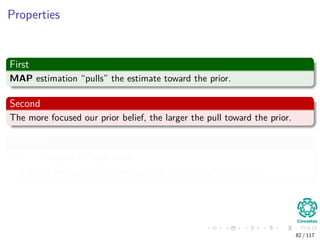
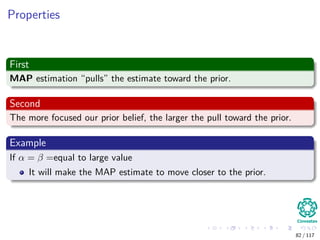
First
MAP estimation “pulls” the estimate toward the prior.
Second
The more focused our prior belief, the larger the pull toward the prior.
Example
If α = β =equal to large value
It will make the MAP estimate to move closer to the prior.
82 / 117
Properties
First
MAP estimation “pulls” the estimate toward the prior.
Second
The more focused our prior belief, the larger the pull toward the prior.
Example
If α = β =equal to large value
It will make the MAP estimate to move closer to the prior.
82 / 117
Properties
First
MAP estimation “pulls” the estimate toward the prior.
Second
The more focused our prior belief, the larger the pull toward the prior.
Example
If α = β =equal to large value
It will make the MAP estimate to move closer to the prior.
82 / 117
Properties
Third
In the expression we derived for qMAP , the parameters α and β play a
“smoothing” role vis-a-vis the measurement nPRI.
Fourth
Since we referred to q as the parameter to be estimated, we can refer to α
and β as the hyper-parameters in the estimation calculations.
83 / 117
Properties
Third
In the expression we derived for qMAP , the parameters α and β play a
“smoothing” role vis-a-vis the measurement nPRI.
Fourth
Since we referred to q as the parameter to be estimated, we can refer to α
and β as the hyper-parameters in the estimation calculations.
83 / 117
Beyond simple derivation
In the previous technique
We took an logarithm of the likelihood × the prior to obtain a function
that can be derived in order to obtain each of the parameters to be
estimated.
What if we cannot derive?
For example when we have something like |θi|.
We can try the following
EM + MAP to be able to estimate the sought parameters.
84 / 117
Beyond simple derivation
In the previous technique
We took an logarithm of the likelihood × the prior to obtain a function
that can be derived in order to obtain each of the parameters to be
estimated.
What if we cannot derive?
For example when we have something like |θi|.
We can try the following
EM + MAP to be able to estimate the sought parameters.
84 / 117
Beyond simple derivation
In the previous technique
We took an logarithm of the likelihood × the prior to obtain a function
that can be derived in order to obtain each of the parameters to be
estimated.
What if we cannot derive?
For example when we have something like |θi|.
We can try the following
EM + MAP to be able to estimate the sought parameters.
84 / 117
Outline
1 Introduction
Likelihood Principle
Example, Testing Fairness
Independence Influence
Sufficiency
Fisher-Neyman Characterization
Example
Sufficiency Principle
Conditionality Perspective
Example
Sins of Being non-Bayesian
2 Bayesian Inference
Introduction
Connection with Sufficient Statistics
Generalized Maximum Likelihood Estimator
The Maximum A Posteriori (MAP)
Maximum Likelihood Vs Maximum A Posteriori
Properties of the MAP
3 Loss, Posterior Risk, Bayes Action
Bayes Principle in the Frequentist Decision Theoretic Setup
Examples of Loss Functions
Bayesian Expected Loss Principle
Example
The Empirical Risk
The Fubini’s Theorem
85 / 117
Imagine an action space and a ∈ A
For example
In estimation problems, A is the set of real numbers and a is a
number, say a = 2 is adopted as an estimator of θ ∈ Θ.
Another One
In testing problems, the action space is A = {accept, reject}
86 / 117
Imagine an action space and a ∈ A
For example
In estimation problems, A is the set of real numbers and a is a
number, say a = 2 is adopted as an estimator of θ ∈ Θ.
Another One
In testing problems, the action space is A = {accept, reject}
86 / 117
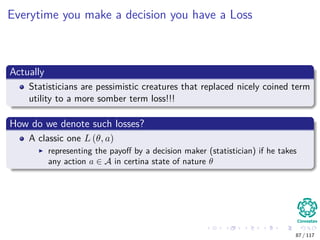
Everytime you make a decision you have a Loss
Actually
Statisticians are pessimistic creatures that replaced nicely coined term
utility to a more somber term loss!!!
How do we denote such losses?
A classic one L (θ, a)
representing the payoff by a decision maker (statistician) if he takes
any action a ∈ A in certina state of nature θ
87 / 117
Everytime you make a decision you have a Loss
Actually
Statisticians are pessimistic creatures that replaced nicely coined term
utility to a more somber term loss!!!
How do we denote such losses?
A classic one L (θ, a)
representing the payoff by a decision maker (statistician) if he takes
any action a ∈ A in certina state of nature θ
87 / 117
Outline
1 Introduction
Likelihood Principle
Example, Testing Fairness
Independence Influence
Sufficiency
Fisher-Neyman Characterization
Example
Sufficiency Principle
Conditionality Perspective
Example
Sins of Being non-Bayesian
2 Bayesian Inference
Introduction
Connection with Sufficient Statistics
Generalized Maximum Likelihood Estimator
The Maximum A Posteriori (MAP)
Maximum Likelihood Vs Maximum A Posteriori
Properties of the MAP
3 Loss, Posterior Risk, Bayes Action
Bayes Principle in the Frequentist Decision Theoretic Setup
Examples of Loss Functions
Bayesian Expected Loss Principle
Example
The Empirical Risk
The Fubini’s Theorem
88 / 117
Examples
Squared Error Loss
L (θ, a) = (θ − a)2
Absolute Loss
L (θ, a) = |θ − a|
0-1 Loss example
L (θ, a) = I [|θ − a| > m]
89 / 117
Examples
Squared Error Loss
L (θ, a) = (θ − a)2
Absolute Loss
L (θ, a) = |θ − a|
0-1 Loss example
L (θ, a) = I [|θ − a| > m]
89 / 117
Examples
Squared Error Loss
L (θ, a) = (θ − a)2
Absolute Loss
L (θ, a) = |θ − a|
0-1 Loss example
L (θ, a) = I [|θ − a| > m]
89 / 117
Clearly the easiest mathematically SEL
Additionally, it is linked with
EX|θ [θ − δ (X)]2
= V ar (δ (X)) + [bias (δ (X))]2
Where bias (δ (X)) = EX|θ [δ (X)] − θ
90 / 117
In another example
The median, m, of random variable X is defined as
P (X ≥ m) ≥
1
2
,
P (X ≤ m) ≤
1
2
Assuming the absolute loss
ϕ (a) =Eθ|X [|θ − a|]
=
θ≥a
(θ − a) π (θ|X) dθ +
θ≤a
(a − θ) π (θ|X) dθ
=
∞
a
(θ − a) π (θ|X) dθ +
a
∞
(a − θ) π (θ|X) dθ
91 / 117
In another example
The median, m, of random variable X is defined as
P (X ≥ m) ≥
1
2
,
P (X ≤ m) ≤
1
2
Assuming the absolute loss
ϕ (a) =Eθ|X [|θ − a|]
=
θ≥a
(θ − a) π (θ|X) dθ +
θ≤a
(a − θ) π (θ|X) dθ
=
∞
a
(θ − a) π (θ|X) dθ +
a
∞
(a − θ) π (θ|X) dθ
91 / 117
In another example
The median, m, of random variable X is defined as
P (X ≥ m) ≥
1
2
,
P (X ≤ m) ≤
1
2
Assuming the absolute loss
ϕ (a) =Eθ|X [|θ − a|]
=
θ≥a
(θ − a) π (θ|X) dθ +
θ≤a
(a − θ) π (θ|X) dθ
=
∞
a
(θ − a) π (θ|X) dθ +
a
∞
(a − θ) π (θ|X) dθ
91 / 117
In another example
The median, m, of random variable X is defined as
P (X ≥ m) ≥
1
2
,
P (X ≤ m) ≤
1
2
Assuming the absolute loss
ϕ (a) =Eθ|X [|θ − a|]
=
θ≥a
(θ − a) π (θ|X) dθ +
θ≤a
(a − θ) π (θ|X) dθ
=
∞
a
(θ − a) π (θ|X) dθ +
a
∞
(a − θ) π (θ|X) dθ
91 / 117
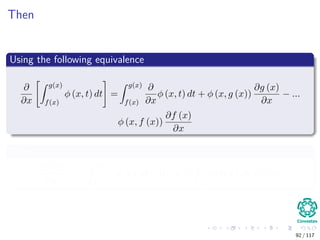
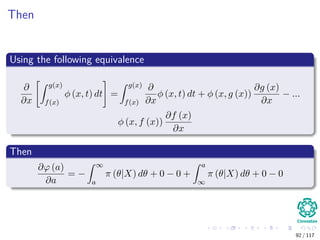
Then
Using the following equivalence
∂
∂x
g(x)
f(x)
φ (x, t) dt =
g(x)
f(x)
∂
∂x
φ (x, t) dt + φ (x, g (x))
∂g (x)
∂x
− ...
φ (x, f (x))
∂f (x)
∂x
Then
∂ϕ (a)
∂a
= −
∞
a
π (θ|X) dθ + 0 − 0 +
a
∞
π (θ|X) dθ + 0 − 0
92 / 117
Then
Using the following equivalence
∂
∂x
g(x)
f(x)
φ (x, t) dt =
g(x)
f(x)
∂
∂x
φ (x, t) dt + φ (x, g (x))
∂g (x)
∂x
− ...
φ (x, f (x))
∂f (x)
∂x
Then
∂ϕ (a)
∂a
= −
∞
a
π (θ|X) dθ + 0 − 0 +
a
∞
π (θ|X) dθ + 0 − 0
92 / 117
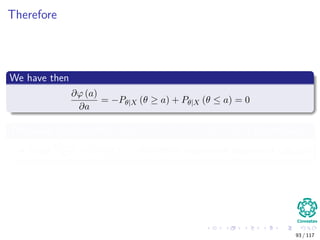
Therefore
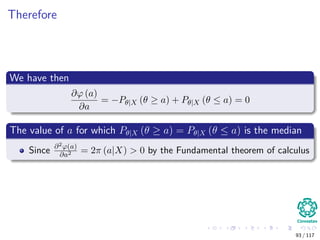
We have then
∂ϕ (a)
∂a
= −Pθ|X (θ ≥ a) + Pθ|X (θ ≤ a) = 0
The value of a for which Pθ|X (θ ≥ a) = Pθ|X (θ ≤ a) is the median
Since ∂2ϕ(a)
∂a2 = 2π (a|X) > 0 by the Fundamental theorem of calculus
93 / 117
Therefore
We have then
∂ϕ (a)
∂a
= −Pθ|X (θ ≥ a) + Pθ|X (θ ≤ a) = 0
The value of a for which Pθ|X (θ ≥ a) = Pθ|X (θ ≤ a) is the median
Since ∂2ϕ(a)
∂a2 = 2π (a|X) > 0 by the Fundamental theorem of calculus
93 / 117
Finally
The Median Minimize
ϕ (a)
94 / 117
Outline
1 Introduction
Likelihood Principle
Example, Testing Fairness
Independence Influence
Sufficiency
Fisher-Neyman Characterization
Example
Sufficiency Principle
Conditionality Perspective
Example
Sins of Being non-Bayesian
2 Bayesian Inference
Introduction
Connection with Sufficient Statistics
Generalized Maximum Likelihood Estimator
The Maximum A Posteriori (MAP)
Maximum Likelihood Vs Maximum A Posteriori
Properties of the MAP
3 Loss, Posterior Risk, Bayes Action
Bayes Principle in the Frequentist Decision Theoretic Setup
Examples of Loss Functions
Bayesian Expected Loss Principle
Example
The Empirical Risk
The Fubini’s Theorem
95 / 117
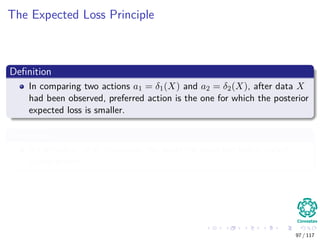
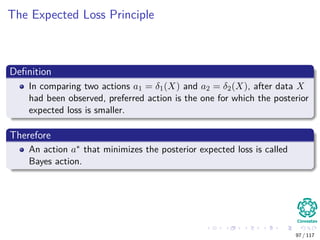
Bayesian Expected Loss
Definition
Bayesian expected loss is the expectation of the loss function with
respect to posterior measure,
ρ (a, π) = Eθ|X [L (a, θ)] =
Θ
L (θ, a) π (θ|x) dθ
Here, we have an important principle
Referring to the less possible loss!!!
96 / 117
Bayesian Expected Loss
Definition
Bayesian expected loss is the expectation of the loss function with
respect to posterior measure,
ρ (a, π) = Eθ|X [L (a, θ)] =
Θ
L (θ, a) π (θ|x) dθ
Here, we have an important principle
Referring to the less possible loss!!!
96 / 117
The Expected Loss Principle
Definition
In comparing two actions a1 = δ1(X) and a2 = δ2(X), after data X
had been observed, preferred action is the one for which the posterior
expected loss is smaller.
Therefore
An action a∗ that minimizes the posterior expected loss is called
Bayes action.
97 / 117
The Expected Loss Principle
Definition
In comparing two actions a1 = δ1(X) and a2 = δ2(X), after data X
had been observed, preferred action is the one for which the posterior
expected loss is smaller.
Therefore
An action a∗ that minimizes the posterior expected loss is called
Bayes action.
97 / 117
Outline
1 Introduction
Likelihood Principle
Example, Testing Fairness
Independence Influence
Sufficiency
Fisher-Neyman Characterization
Example
Sufficiency Principle
Conditionality Perspective
Example
Sins of Being non-Bayesian
2 Bayesian Inference
Introduction
Connection with Sufficient Statistics
Generalized Maximum Likelihood Estimator
The Maximum A Posteriori (MAP)
Maximum Likelihood Vs Maximum A Posteriori
Properties of the MAP
3 Loss, Posterior Risk, Bayes Action
Bayes Principle in the Frequentist Decision Theoretic Setup
Examples of Loss Functions
Bayesian Expected Loss Principle
Example
The Empirical Risk
The Fubini’s Theorem
98 / 117
Example
If the loss is squared error
The Bayes action a∗ is found by minimizing
ϕ (a) = Eθ|X (θ − a)2
= a2
− 2Eθ|X [θ] a + Eθ|Xθ2
Then, we want ϕ (a) = 0
Solving for it, we have a = Eθ|X [θ]
Additionally
ϕ (a) < 0 then a∗ = Eθ|X [θ] is a Bayesian Action.
99 / 117
Example
If the loss is squared error
The Bayes action a∗ is found by minimizing
ϕ (a) = Eθ|X (θ − a)2
= a2
− 2Eθ|X [θ] a + Eθ|Xθ2
Then, we want ϕ (a) = 0
Solving for it, we have a = Eθ|X [θ]
Additionally
ϕ (a) < 0 then a∗ = Eθ|X [θ] is a Bayesian Action.
99 / 117
Example
If the loss is squared error
The Bayes action a∗ is found by minimizing
ϕ (a) = Eθ|X (θ − a)2
= a2
− 2Eθ|X [θ] a + Eθ|Xθ2
Then, we want ϕ (a) = 0
Solving for it, we have a = Eθ|X [θ]
Additionally
ϕ (a) < 0 then a∗ = Eθ|X [θ] is a Bayesian Action.
99 / 117
Outline
1 Introduction
Likelihood Principle
Example, Testing Fairness
Independence Influence
Sufficiency
Fisher-Neyman Characterization
Example
Sufficiency Principle
Conditionality Perspective
Example
Sins of Being non-Bayesian
2 Bayesian Inference
Introduction
Connection with Sufficient Statistics
Generalized Maximum Likelihood Estimator
The Maximum A Posteriori (MAP)
Maximum Likelihood Vs Maximum A Posteriori
Properties of the MAP
3 Loss, Posterior Risk, Bayes Action
Bayes Principle in the Frequentist Decision Theoretic Setup
Examples of Loss Functions
Bayesian Expected Loss Principle
Example
The Empirical Risk
The Fubini’s Theorem
100 / 117
Given X ∈ {Pθ, θ ∈ Θ}
A family which is indexed by a parameter (random variable) θ
Here, we change our Bayesian hat to the frequentist one
This allows to make inferences about θ
A solution is a decision procedure (decision rule) δ (x), that identifies
particular inference for each value of x that can be observed.
101 / 117
Given X ∈ {Pθ, θ ∈ Θ}
A family which is indexed by a parameter (random variable) θ
Here, we change our Bayesian hat to the frequentist one
This allows to make inferences about θ
A solution is a decision procedure (decision rule) δ (x), that identifies
particular inference for each value of x that can be observed.
101 / 117
A be the class of all possible realizations of δ(x), i.e.
actions
The Loss function L (θ, a) maps Θ × A −→ R
Defining a cost to the statistician when he takes the action a and the
true value of the parameter is θ.
Then we can define a decision function called Risk
R (θ, δ) = EX|θ [L (θ|δ (X))] =
X
L (θ|δ (X)) f (x|θ) dx
A frequentist risk on the performance of δ.
102 / 117
A be the class of all possible realizations of δ(x), i.e.
actions
The Loss function L (θ, a) maps Θ × A −→ R
Defining a cost to the statistician when he takes the action a and the
true value of the parameter is θ.
Then we can define a decision function called Risk
R (θ, δ) = EX|θ [L (θ|δ (X))] =
X
L (θ|δ (X)) f (x|θ) dx
A frequentist risk on the performance of δ.
102 / 117
Therefore
Since the risk function is defined as an average loss with respect to a
sample space
it is called the frequentist risk.
Let D be the collection of all measurable decision rules
There are several ways for assigning the preference among the rules in
D.
103 / 117
Therefore
Since the risk function is defined as an average loss with respect to a
sample space
it is called the frequentist risk.
Let D be the collection of all measurable decision rules
There are several ways for assigning the preference among the rules in
D.
103 / 117
Furthermore
Some of them are
The Minimax Principle
Γ-minimax Principle
Minimax Principle
etc
The one we are interested is
The Bayes principle
104 / 117
Furthermore
Some of them are
The Minimax Principle
Γ-minimax Principle
Minimax Principle
etc
The one we are interested is
The Bayes principle
104 / 117
Furthermore
Some of them are
The Minimax Principle
Γ-minimax Principle
Minimax Principle
etc
The one we are interested is
The Bayes principle
104 / 117
Furthermore
Some of them are
The Minimax Principle
Γ-minimax Principle
Minimax Principle
etc
The one we are interested is
The Bayes principle
104 / 117
Furthermore
Some of them are
The Minimax Principle
Γ-minimax Principle
Minimax Principle
etc
The one we are interested is
The Bayes principle
104 / 117
Under the Bayes principle
Bayes risk
r (π, δ) = R (θ, δ) π (dθ) = EθR (θ, δ)
Where there is a δπ , called Bayes rule, minimizing the risk
δπ = arg inf
δ∈D
r (π, δ)
Bayes risk of the prior distribution π (Bayes envelope function) is
r (π) = r (π, δπ)
105 / 117
Under the Bayes principle
Bayes risk
r (π, δ) = R (θ, δ) π (dθ) = EθR (θ, δ)
Where there is a δπ , called Bayes rule, minimizing the risk
δπ = arg inf
δ∈D
r (π, δ)
Bayes risk of the prior distribution π (Bayes envelope function) is
r (π) = r (π, δπ)
105 / 117
Under the Bayes principle
Bayes risk
r (π, δ) = R (θ, δ) π (dθ) = EθR (θ, δ)
Where there is a δπ , called Bayes rule, minimizing the risk
δπ = arg inf
δ∈D
r (π, δ)
Bayes risk of the prior distribution π (Bayes envelope function) is
r (π) = r (π, δπ)
105 / 117
Bayes Envelope Function Definition
Definition
The Bayes Envelope is the maximal reward rate a player could achieve
had he known in advance the relative frequencies of the other players.
In particular, we define the following function as
r (π, δ) = Eθ EX|θ [L (θ, δ (X))]
Therefore the Bayes action as Bayes Rules looks like
δ∗
(x) = arg min
δ∈D
r (π, δ)
106 / 117
Bayes Envelope Function Definition
Definition
The Bayes Envelope is the maximal reward rate a player could achieve
had he known in advance the relative frequencies of the other players.
In particular, we define the following function as
r (π, δ) = Eθ EX|θ [L (θ, δ (X))]
Therefore the Bayes action as Bayes Rules looks like
δ∗
(x) = arg min
δ∈D
r (π, δ)
106 / 117
Bayes Envelope Function Definition
Definition
The Bayes Envelope is the maximal reward rate a player could achieve
had he known in advance the relative frequencies of the other players.
In particular, we define the following function as
r (π, δ) = Eθ EX|θ [L (θ, δ (X))]
Therefore the Bayes action as Bayes Rules looks like
δ∗
(x) = arg min
δ∈D
r (π, δ)
106 / 117
Actually
A classic Bayes Rule
The Naive Bayes Rules for classification using Gaussian’s for
classification
R1 : P (ω1|x) > P (ω2|x)
R2 : P (ω2|x) > P (ω1|x)
107 / 117
Outline
1 Introduction
Likelihood Principle
Example, Testing Fairness
Independence Influence
Sufficiency
Fisher-Neyman Characterization
Example
Sufficiency Principle
Conditionality Perspective
Example
Sins of Being non-Bayesian
2 Bayesian Inference
Introduction
Connection with Sufficient Statistics
Generalized Maximum Likelihood Estimator
The Maximum A Posteriori (MAP)
Maximum Likelihood Vs Maximum A Posteriori
Properties of the MAP
3 Loss, Posterior Risk, Bayes Action
Bayes Principle in the Frequentist Decision Theoretic Setup
Examples of Loss Functions
Bayesian Expected Loss Principle
Example
The Empirical Risk
The Fubini’s Theorem
108 / 117
The Fubini’s Theorem (Informal Version)
Theorem
Suppose X and Y are σ-finite measure spaces, and suppose that
X × Y is given the product measure:
(µ × ν) (E) = inf



∞
j=1
µ (Aj) ν (Bj) |E ⊂ ∪∞
j=1Aj × Bj



With any non-negative µ × ν-measurable function f, then
X×Y
f (x, y) d (µ × ν) (x, y) =
Y X
f (x, y) dµ (x) dν (y)
109 / 117
The Fubini’s Theorem (Informal Version)
Theorem
Suppose X and Y are σ-finite measure spaces, and suppose that
X × Y is given the product measure:
(µ × ν) (E) = inf



∞
j=1
µ (Aj) ν (Bj) |E ⊂ ∪∞
j=1Aj × Bj



With any non-negative µ × ν-measurable function f, then
X×Y
f (x, y) d (µ × ν) (x, y) =
Y X
f (x, y) dµ (x) dν (y)
109 / 117
Implications with the Expected Value
We have by the Fubini’s Theorem
r (π, δ) = Eθ EX|θ [L (θ, δ (X))]
= EX Eθ|X [L (θ, δ (X))]
Where the posterior expected loss
ρ (π, δ) = Eθ|X [L (θ, δ (X))]
110 / 117
Implications with the Expected Value
We have by the Fubini’s Theorem
r (π, δ) = Eθ EX|θ [L (θ, δ (X))]
= EX Eθ|X [L (θ, δ (X))]
Where the posterior expected loss
ρ (π, δ) = Eθ|X [L (θ, δ (X))]
110 / 117
Therefore
r (π, δ) is minimized for any fixed x
When ρ (π, δ) is minimized, for any fixed x, δB (x) = a∗ (x) where *
represent the optimal action.
Basically
This result links the conditional Bayesian and decision theoretic
frequentist inference:
The frequentist Bayes rule conditional on X is the Bayes action.
111 / 117
Therefore
r (π, δ) is minimized for any fixed x
When ρ (π, δ) is minimized, for any fixed x, δB (x) = a∗ (x) where *
represent the optimal action.
Basically
This result links the conditional Bayesian and decision theoretic
frequentist inference:
The frequentist Bayes rule conditional on X is the Bayes action.
111 / 117
What happens when we have the Squared Loss?
The Bayes rule is the posterior expectation
δB (x) = Θ θf (x|θ) π (θ) dθ
Θ f (x|θ) π (θ) dθ
Not only that, in the case of
L (θ, a) = w (θ) (θ − a)2
112 / 117
What happens when we have the Squared Loss?
The Bayes rule is the posterior expectation
δB (x) = Θ θf (x|θ) π (θ) dθ
Θ f (x|θ) π (θ) dθ
Not only that, in the case of
L (θ, a) = w (θ) (θ − a)2
112 / 117
We have
The following Bayes Rule
δB (x) = Θ w (θ) θf (x|θ) π (θ) dθ
Θ w (θ) f (x|θ) π (θ) dθ
113 / 117
Furthermore
According to a Bayes principle
A rule δ1 (X) is preferred to δ2 (X) if r (π, δ1) < r (π, δ2)
The frequentists use Bayes principle
to compare frequentist risks of the rules R (θ, δ1) and R (θ, δ2).
114 / 117
Furthermore
According to a Bayes principle
A rule δ1 (X) is preferred to δ2 (X) if r (π, δ1) < r (π, δ2)
The frequentists use Bayes principle
to compare frequentist risks of the rules R (θ, δ1) and R (θ, δ2).
114 / 117
Analysis of frequentist risk
It leads to various concepts as
1 minimaxity,
2 admissibility,
3 unbiasedness,
4 equivariance,
5 etc.
115 / 117
D. V. Lindley and L. D. Phillips, “Inference for a bernoulli process (a
bayesian view),” The American Statistician, vol. 30, no. 3,
pp. 112–119, 1976.
C. Aschwanden, “Not even scientists can easily explain p-values.”
https://fivethirtyeight.com/features/not-even-scientists-can-easily-
explain-p-values.
Online; accessed 24 Noviembre 2015.
K. P. F.R.S., “X. on the criterion that a given system of deviations
from the probable in the case of a correlated system of variables is
such that it can be reasonably supposed to have arisen from random
sampling,” The London, Edinburgh, and Dublin Philosophical
Magazine and Journal of Science, vol. 50, no. 302, pp. 157–175, 1900.
116 / 117
P. Bickel and K. Doksum, Mathematical Statistics: Basic Ideas and
Selected Topics.
No. v. 1 in Mathematical Statistics: Basic Ideas and Selected Topics,
Prentice Hall, 2001.
R. A. Fisher, “On the mathematical foundations of theoretical
statistics,” Philosophical Transactions of the Royal Society of London.
Series A, Containing Papers of a Mathematical or Physical Character,
vol. 222, no. 594-604, pp. 309–368, 1922.
G. Casella and R. L. Berger, Statistical inference, vol. 2.
Duxbury Pacific Grove, CA, 2002.
S. M. Kay, Fundamentals of statistical signal processing.
Prentice Hall PTR, 1993.
117 / 117

2.03 bayesian estimation

  • 1.
    Introduction to Mathematicsfor AI Bayesian Estimation Andres Mendez-Vazquez May 22, 2020 1 / 117
  • 2.
    Outline 1 Introduction Likelihood Principle Example,Testing Fairness Independence Influence Sufficiency Fisher-Neyman Characterization Example Sufficiency Principle Conditionality Perspective Example Sins of Being non-Bayesian 2 Bayesian Inference Introduction Connection with Sufficient Statistics Generalized Maximum Likelihood Estimator The Maximum A Posteriori (MAP) Maximum Likelihood Vs Maximum A Posteriori Properties of the MAP 3 Loss, Posterior Risk, Bayes Action Bayes Principle in the Frequentist Decision Theoretic Setup Examples of Loss Functions Bayesian Expected Loss Principle Example The Empirical Risk The Fubini’s Theorem 2 / 117
  • 3.
    Outline 1 Introduction Likelihood Principle Example,Testing Fairness Independence Influence Sufficiency Fisher-Neyman Characterization Example Sufficiency Principle Conditionality Perspective Example Sins of Being non-Bayesian 2 Bayesian Inference Introduction Connection with Sufficient Statistics Generalized Maximum Likelihood Estimator The Maximum A Posteriori (MAP) Maximum Likelihood Vs Maximum A Posteriori Properties of the MAP 3 Loss, Posterior Risk, Bayes Action Bayes Principle in the Frequentist Decision Theoretic Setup Examples of Loss Functions Bayesian Expected Loss Principle Example The Empirical Risk The Fubini’s Theorem 3 / 117
  • 4.
    The Basis ofBayesian Inference A Basic setup Let f(x|θ) be a conditional distribution for X given the unknown parameter θ. For the observed data, X = x, the function (θ) = f(x|θ) It is called the likelihood function!!! The name likelihood implies that, given x, the value of θ It is more likely to be the true parameter than θ , if f (x|θ) > f x|θ 4 / 117
  • 5.
    The Basis ofBayesian Inference A Basic setup Let f(x|θ) be a conditional distribution for X given the unknown parameter θ. For the observed data, X = x, the function (θ) = f(x|θ) It is called the likelihood function!!! The name likelihood implies that, given x, the value of θ It is more likely to be the true parameter than θ , if f (x|θ) > f x|θ 4 / 117
  • 6.
    The Basis ofBayesian Inference A Basic setup Let f(x|θ) be a conditional distribution for X given the unknown parameter θ. For the observed data, X = x, the function (θ) = f(x|θ) It is called the likelihood function!!! The name likelihood implies that, given x, the value of θ It is more likely to be the true parameter than θ , if f (x|θ) > f x|θ 4 / 117
  • 7.
    Basically We are talkingabout optimization functions Where optimals are being loked upon... Definition An optimal solution to an optimization poroblems is the feasible solution with the largest objective function value (for a maximization problem). 5 / 117
  • 8.
    Basically We are talkingabout optimization functions Where optimals are being loked upon... Definition An optimal solution to an optimization poroblems is the feasible solution with the largest objective function value (for a maximization problem). 5 / 117
  • 9.
    Likelihood Principle Remarks In theinference about θ, after x is observed, all relevant experimental information is contained in the likelihood function for the observed x. There is an interesting example quoted by Lindley and Phillips in 1976 [1] Originally by Leonard Savage Leonard Savage Leonard Jimmie Savage (born Leonard Ogashevitz; 20 November 1917 – 1 November 1971) was an American mathematician and statistician. Economist Milton Friedman said Savage was "one of the few people I have met whom I would unhesitatingly call a genius. 6 / 117
  • 10.
    Likelihood Principle Remarks In theinference about θ, after x is observed, all relevant experimental information is contained in the likelihood function for the observed x. There is an interesting example quoted by Lindley and Phillips in 1976 [1] Originally by Leonard Savage Leonard Savage Leonard Jimmie Savage (born Leonard Ogashevitz; 20 November 1917 – 1 November 1971) was an American mathematician and statistician. Economist Milton Friedman said Savage was "one of the few people I have met whom I would unhesitatingly call a genius. 6 / 117
  • 11.
    Likelihood Principle Remarks In theinference about θ, after x is observed, all relevant experimental information is contained in the likelihood function for the observed x. There is an interesting example quoted by Lindley and Phillips in 1976 [1] Originally by Leonard Savage Leonard Savage Leonard Jimmie Savage (born Leonard Ogashevitz; 20 November 1917 – 1 November 1971) was an American mathematician and statistician. Economist Milton Friedman said Savage was "one of the few people I have met whom I would unhesitatingly call a genius. 6 / 117
  • 12.
    History Something Notable The likelihoodprinciple was first identified by that name in print in 1962 (Barnard et al., Birnbaum, and Savage et al.), However Fisher It was already using a version of it in 1920’s. However, versions of it can be tracked to To the mid-1700s It seems to have become a commonplace among natural philosophers that problems of observational error were susceptible to mathematical description. 7 / 117
  • 13.
    History Something Notable The likelihoodprinciple was first identified by that name in print in 1962 (Barnard et al., Birnbaum, and Savage et al.), However Fisher It was already using a version of it in 1920’s. However, versions of it can be tracked to To the mid-1700s It seems to have become a commonplace among natural philosophers that problems of observational error were susceptible to mathematical description. 7 / 117
  • 14.
    History Something Notable The likelihoodprinciple was first identified by that name in print in 1962 (Barnard et al., Birnbaum, and Savage et al.), However Fisher It was already using a version of it in 1920’s. However, versions of it can be tracked to To the mid-1700s It seems to have become a commonplace among natural philosophers that problems of observational error were susceptible to mathematical description. 7 / 117
  • 15.
    Outline 1 Introduction Likelihood Principle Example,Testing Fairness Independence Influence Sufficiency Fisher-Neyman Characterization Example Sufficiency Principle Conditionality Perspective Example Sins of Being non-Bayesian 2 Bayesian Inference Introduction Connection with Sufficient Statistics Generalized Maximum Likelihood Estimator The Maximum A Posteriori (MAP) Maximum Likelihood Vs Maximum A Posteriori Properties of the MAP 3 Loss, Posterior Risk, Bayes Action Bayes Principle in the Frequentist Decision Theoretic Setup Examples of Loss Functions Bayesian Expected Loss Principle Example The Empirical Risk The Fubini’s Theorem 8 / 117
  • 16.
    Testing Fairness Basic Setup Supposewe are interested in testing θ, the unknown probability of heads for possibly biased coin. Suppose the following Hypothesis H0 : θ = 1/2 v.s. H1 : θ > 1/2 Then An experiment is conducted and 9 heads and 3 tails are observed. Not enough information to fully specify f (x|θ) 9 / 117
  • 17.
    Testing Fairness Basic Setup Supposewe are interested in testing θ, the unknown probability of heads for possibly biased coin. Suppose the following Hypothesis H0 : θ = 1/2 v.s. H1 : θ > 1/2 Then An experiment is conducted and 9 heads and 3 tails are observed. Not enough information to fully specify f (x|θ) 9 / 117
  • 18.
    Testing Fairness Basic Setup Supposewe are interested in testing θ, the unknown probability of heads for possibly biased coin. Suppose the following Hypothesis H0 : θ = 1/2 v.s. H1 : θ > 1/2 Then An experiment is conducted and 9 heads and 3 tails are observed. Not enough information to fully specify f (x|θ) 9 / 117
  • 19.
    Scenario 1 Based onrashomonian analysis The classic Akira Kurosawa film Rashomon has become a shorthand for the lie of objective truth—what you see, basically, depends on where you stand. Number of flips, n = 12 is predetermined Then number of heads X is binomial B(n, θ), with probability mass function: Pθ (X = x) = f (x|θ) = n x θx (1 − θ)n−x 10 / 117
  • 20.
    Scenario 1 Based onrashomonian analysis The classic Akira Kurosawa film Rashomon has become a shorthand for the lie of objective truth—what you see, basically, depends on where you stand. Number of flips, n = 12 is predetermined Then number of heads X is binomial B(n, θ), with probability mass function: Pθ (X = x) = f (x|θ) = n x θx (1 − θ)n−x 10 / 117
  • 21.
    Therefore We have Pθ (X= x) = 12 9 θ9 (1 − θ)3 Thus We can use the p − value for testing the hypothesis. 11 / 117
  • 22.
    Therefore We have Pθ (X= x) = 12 9 θ9 (1 − θ)3 Thus We can use the p − value for testing the hypothesis. 11 / 117
  • 23.
    Then if weuse the following p − value analysis Definition [2, 3] The p-value is defined as the probability, under the null hypothesis H0 about the unknown distribution F of the random variable X. Very Unlike Observation Very Unlike Observation P-Value More Likely Observation Set of Possible Results ProbabilityDensity Observed Data Point 12 / 117
  • 24.
    Therefore For a frequentist,the p − value of the test is P (X ≥ 9|H0) = 12 x=9 12 x 1 2 x 1 2 12−x = 0.073 Given an α = 0.05 Then, H0 is not rejected... 13 / 117
  • 25.
    Therefore For a frequentist,the p − value of the test is P (X ≥ 9|H0) = 12 x=9 12 x 1 2 x 1 2 12−x = 0.073 Given an α = 0.05 Then, H0 is not rejected... 13 / 117
  • 26.
    Scenario 2 Number oftails (successes) 3 is predetermined i.e, the flipping is continued until 3 tails are observed. Then you have a Negative Binomial with r the number of failures f (x|θ) = k + r − 1 k − 1 (1 − θ)k θr Thus, we have f (x|θ) = 3 + 9 − 1 3 − 1 (1 − θ)3 θ9 = 55 (1 − θ)3 θ9 14 / 117
  • 27.
    Scenario 2 Number oftails (successes) 3 is predetermined i.e, the flipping is continued until 3 tails are observed. Then you have a Negative Binomial with r the number of failures f (x|θ) = k + r − 1 k − 1 (1 − θ)k θr Thus, we have f (x|θ) = 3 + 9 − 1 3 − 1 (1 − θ)3 θ9 = 55 (1 − θ)3 θ9 14 / 117
  • 28.
    Scenario 2 Number oftails (successes) 3 is predetermined i.e, the flipping is continued until 3 tails are observed. Then you have a Negative Binomial with r the number of failures f (x|θ) = k + r − 1 k − 1 (1 − θ)k θr Thus, we have f (x|θ) = 3 + 9 − 1 3 − 1 (1 − θ)3 θ9 = 55 (1 − θ)3 θ9 14 / 117
  • 29.
    In a similarway We have P (X ≥ 9|H0) = ∞ x=9 3 + x − 1 3 − 1 1 2 x 1 2 3 = 0.0327 Thus, the hypothesis H0 is rejected But this change in decision is not caused by observations. However, all relevant information is in the likelihood!!! (θ) ∝ θ9 (1 − θ)3 15 / 117
  • 30.
    In a similarway We have P (X ≥ 9|H0) = ∞ x=9 3 + x − 1 3 − 1 1 2 x 1 2 3 = 0.0327 Thus, the hypothesis H0 is rejected But this change in decision is not caused by observations. However, all relevant information is in the likelihood!!! (θ) ∝ θ9 (1 − θ)3 15 / 117
  • 31.
    In a similarway We have P (X ≥ 9|H0) = ∞ x=9 3 + x − 1 3 − 1 1 2 x 1 2 3 = 0.0327 Thus, the hypothesis H0 is rejected But this change in decision is not caused by observations. However, all relevant information is in the likelihood!!! (θ) ∝ θ9 (1 − θ)3 15 / 117
  • 32.
    Remark Edwards, Lindman, andSavage remarked The likelihood principle emphasized in Bayesian statistics implies, among other things, that the rules governing when data collection stops are irrelevant to data interpretation. Therefore It is entirely appropriate to collect data until a point has been proven or disproven, or until the data collector runs out of time, money, or patience. 16 / 117
  • 33.
    Remark Edwards, Lindman, andSavage remarked The likelihood principle emphasized in Bayesian statistics implies, among other things, that the rules governing when data collection stops are irrelevant to data interpretation. Therefore It is entirely appropriate to collect data until a point has been proven or disproven, or until the data collector runs out of time, money, or patience. 16 / 117
  • 34.
    Thus Likelihood Principle [4] TheLikelihood principle (LP) asserts that for inference on an unknown quantity θ, all of the evidence from any observation X = x with distribution X ∼ f (x|θ) lies in the likelihood function L (θ|x) ∝ f (x|θ) , θ ∈ Θ 17 / 117
  • 35.
    Thus Something Notable The interpretationof LP hinges on the rather subtle point of allowing any observable X to draw conclusions about θ. Therefore If there two ways to gather infromation about theta, wither X ∼ f (x|θ) or with Y ∼ g (x|θ) with X = x and Y = y then L (θ|x) = η × L (θ|y) , ∀θ ∈ Θ 18 / 117
  • 36.
    Thus Something Notable The interpretationof LP hinges on the rather subtle point of allowing any observable X to draw conclusions about θ. Therefore If there two ways to gather infromation about theta, wither X ∼ f (x|θ) or with Y ∼ g (x|θ) with X = x and Y = y then L (θ|x) = η × L (θ|y) , ∀θ ∈ Θ 18 / 117
  • 37.
    Outline 1 Introduction Likelihood Principle Example,Testing Fairness Independence Influence Sufficiency Fisher-Neyman Characterization Example Sufficiency Principle Conditionality Perspective Example Sins of Being non-Bayesian 2 Bayesian Inference Introduction Connection with Sufficient Statistics Generalized Maximum Likelihood Estimator The Maximum A Posteriori (MAP) Maximum Likelihood Vs Maximum A Posteriori Properties of the MAP 3 Loss, Posterior Risk, Bayes Action Bayes Principle in the Frequentist Decision Theoretic Setup Examples of Loss Functions Bayesian Expected Loss Principle Example The Empirical Risk The Fubini’s Theorem 19 / 117
  • 38.
    In the caseof Learning Yes, we use the principle, but we add the idea of independence A trick to assume a set of samples x1, x2, ..., xN such that xi ∼ f (X|θ) Then, as we have seen it L (θ) = f (x1, x2, ..., xN |θ) = N i=1 f (xi|θ) 20 / 117
  • 39.
    In the caseof Learning Yes, we use the principle, but we add the idea of independence A trick to assume a set of samples x1, x2, ..., xN such that xi ∼ f (X|θ) Then, as we have seen it L (θ) = f (x1, x2, ..., xN |θ) = N i=1 f (xi|θ) 20 / 117
  • 40.
    Example, p (x|ωj)∼ N µj, Σj L (θj) = log n j=1 p (xj|θj) 21 / 117
  • 41.
    Outline 1 Introduction Likelihood Principle Example,Testing Fairness Independence Influence Sufficiency Fisher-Neyman Characterization Example Sufficiency Principle Conditionality Perspective Example Sins of Being non-Bayesian 2 Bayesian Inference Introduction Connection with Sufficient Statistics Generalized Maximum Likelihood Estimator The Maximum A Posteriori (MAP) Maximum Likelihood Vs Maximum A Posteriori Properties of the MAP 3 Loss, Posterior Risk, Bayes Action Bayes Principle in the Frequentist Decision Theoretic Setup Examples of Loss Functions Bayesian Expected Loss Principle Example The Empirical Risk The Fubini’s Theorem 22 / 117
  • 42.
    The Basics Sufficiency Principle Anstatistic is sufficient with respect to a statistical model and its associated unknown parameter if "no other statistic that can be calculated from the same sample provides any additional information as to the value of the parameter"[5] However, as always We want a definition to build upon it... as always 23 / 117
  • 43.
    The Basics Sufficiency Principle Anstatistic is sufficient with respect to a statistical model and its associated unknown parameter if "no other statistic that can be calculated from the same sample provides any additional information as to the value of the parameter"[5] However, as always We want a definition to build upon it... as always 23 / 117
  • 44.
    A Basic Definition Definition Astatistic t = T(X) is sufficient for underlying parameter θ precisely if the conditional probability distribution of the data X, given the statistic t = T(X), does not depend on the parameter θ [6]. Something Notable This agreement is non-philosophical, it is rather a consequence of mathematics (measure theoretic considerations). 24 / 117
  • 45.
    A Basic Definition Definition Astatistic t = T(X) is sufficient for underlying parameter θ precisely if the conditional probability distribution of the data X, given the statistic t = T(X), does not depend on the parameter θ [6]. Something Notable This agreement is non-philosophical, it is rather a consequence of mathematics (measure theoretic considerations). 24 / 117
  • 46.
    Outline 1 Introduction Likelihood Principle Example,Testing Fairness Independence Influence Sufficiency Fisher-Neyman Characterization Example Sufficiency Principle Conditionality Perspective Example Sins of Being non-Bayesian 2 Bayesian Inference Introduction Connection with Sufficient Statistics Generalized Maximum Likelihood Estimator The Maximum A Posteriori (MAP) Maximum Likelihood Vs Maximum A Posteriori Properties of the MAP 3 Loss, Posterior Risk, Bayes Action Bayes Principle in the Frequentist Decision Theoretic Setup Examples of Loss Functions Bayesian Expected Loss Principle Example The Empirical Risk The Fubini’s Theorem 25 / 117
  • 47.
    Fisher’s Factorization Theorem Theorem Letf (x|θ) be the density or mass function for the random vector x, parametrized by the vector theta. The statistic t = T (x) is sufficient for θ if and only if there exist functions a (x) (not depending on θ) and b (t|θ) such that () f (x|θ) = a (x) b (t, θ) for all possible values of x. 26 / 117
  • 48.
    Proof First ⇒ (Wewill look only to the discrete case [7]) Suppose t = T (x) is sufficient for θ. Then, by definition f (x|θ, T (x) = t) is independient of θ Let f (x, t|θ) denote the joint density function or mass function for (X, T (X)) Observe f (x|θ) = f (x, t|θ) then we have f (x|θ) = f (x, t|θ) = f (x|θ, t) f (t|θ) Bayesian = a (x) f (x|t) b (t, θ) f (t|θ) Independence 27 / 117
  • 49.
    Proof First ⇒ (Wewill look only to the discrete case [7]) Suppose t = T (x) is sufficient for θ. Then, by definition f (x|θ, T (x) = t) is independient of θ Let f (x, t|θ) denote the joint density function or mass function for (X, T (X)) Observe f (x|θ) = f (x, t|θ) then we have f (x|θ) = f (x, t|θ) = f (x|θ, t) f (t|θ) Bayesian = a (x) f (x|t) b (t, θ) f (t|θ) Independence 27 / 117
  • 50.
    Proof First ⇒ (Wewill look only to the discrete case [7]) Suppose t = T (x) is sufficient for θ. Then, by definition f (x|θ, T (x) = t) is independient of θ Let f (x, t|θ) denote the joint density function or mass function for (X, T (X)) Observe f (x|θ) = f (x, t|θ) then we have f (x|θ) = f (x, t|θ) = f (x|θ, t) f (t|θ) Bayesian = a (x) f (x|t) b (t, θ) f (t|θ) Independence 27 / 117
  • 51.
    Proof First ⇒ (Wewill look only to the discrete case [7]) Suppose t = T (x) is sufficient for θ. Then, by definition f (x|θ, T (x) = t) is independient of θ Let f (x, t|θ) denote the joint density function or mass function for (X, T (X)) Observe f (x|θ) = f (x, t|θ) then we have f (x|θ) = f (x, t|θ) = f (x|θ, t) f (t|θ) Bayesian = a (x) f (x|t) b (t, θ) f (t|θ) Independence 27 / 117
  • 52.
    Proof First ⇒ (Wewill look only to the discrete case [7]) Suppose t = T (x) is sufficient for θ. Then, by definition f (x|θ, T (x) = t) is independient of θ Let f (x, t|θ) denote the joint density function or mass function for (X, T (X)) Observe f (x|θ) = f (x, t|θ) then we have f (x|θ) = f (x, t|θ) = f (x|θ, t) f (t|θ) Bayesian = a (x) f (x|t) b (t, θ) f (t|θ) Independence 27 / 117
  • 53.
    Now, for thecase ⇐ Suppose the probability mass function for x can be written f (x|θ) = a (x) b (x|θ) where t = T (x) The probability mass function for t is obtained by summing fθ (x, t) over all x such that T (x) = t f (t|θ) = T(x)=t f (x, t|θ) = T(x)=t f (x|θ) ← independence over t = T(x)=t a (x) bθ (x) 28 / 117
  • 54.
    Now, for thecase ⇐ Suppose the probability mass function for x can be written f (x|θ) = a (x) b (x|θ) where t = T (x) The probability mass function for t is obtained by summing fθ (x, t) over all x such that T (x) = t f (t|θ) = T(x)=t f (x, t|θ) = T(x)=t f (x|θ) ← independence over t = T(x)=t a (x) bθ (x) 28 / 117
  • 55.
    Now, for thecase ⇐ Suppose the probability mass function for x can be written f (x|θ) = a (x) b (x|θ) where t = T (x) The probability mass function for t is obtained by summing fθ (x, t) over all x such that T (x) = t f (t|θ) = T(x)=t f (x, t|θ) = T(x)=t f (x|θ) ← independence over t = T(x)=t a (x) bθ (x) 28 / 117
  • 56.
    Now, for thecase ⇐ Suppose the probability mass function for x can be written f (x|θ) = a (x) b (x|θ) where t = T (x) The probability mass function for t is obtained by summing fθ (x, t) over all x such that T (x) = t f (t|θ) = T(x)=t f (x, t|θ) = T(x)=t f (x|θ) ← independence over t = T(x)=t a (x) bθ (x) 28 / 117
  • 57.
    Therefore, we havethat The conditional mass function of x given t f (x|θ, t) = f (x, t|θ) f (t|θ) = f (x|θ) f (t|θ) = a (x) bθ (x) T(x)=t a (x) bθ (x) = a (x) T(x)=t a (x) This last expression does not depend on θ t is a sufficient statistic for θ. 29 / 117
  • 58.
    Therefore, we havethat The conditional mass function of x given t f (x|θ, t) = f (x, t|θ) f (t|θ) = f (x|θ) f (t|θ) = a (x) bθ (x) T(x)=t a (x) bθ (x) = a (x) T(x)=t a (x) This last expression does not depend on θ t is a sufficient statistic for θ. 29 / 117
  • 59.
    Outline 1 Introduction Likelihood Principle Example,Testing Fairness Independence Influence Sufficiency Fisher-Neyman Characterization Example Sufficiency Principle Conditionality Perspective Example Sins of Being non-Bayesian 2 Bayesian Inference Introduction Connection with Sufficient Statistics Generalized Maximum Likelihood Estimator The Maximum A Posteriori (MAP) Maximum Likelihood Vs Maximum A Posteriori Properties of the MAP 3 Loss, Posterior Risk, Bayes Action Bayes Principle in the Frequentist Decision Theoretic Setup Examples of Loss Functions Bayesian Expected Loss Principle Example The Empirical Risk The Fubini’s Theorem 30 / 117
  • 60.
    Using the BernoulliDistribution xn ∼Bernoulli(θ) are i.d.d. ∀n = 1, ..., N f (x1, .., xN |θ) = N n=1 θxn (1 − θ)1−xn = θk (1 − θ)N−k k = N n=1 xn Now, if we have the following choices a (x) = 1 and bθ (k) = θk (1 − θ)N−k 31 / 117
  • 61.
    Using the BernoulliDistribution xn ∼Bernoulli(θ) are i.d.d. ∀n = 1, ..., N f (x1, .., xN |θ) = N n=1 θxn (1 − θ)1−xn = θk (1 − θ)N−k k = N n=1 xn Now, if we have the following choices a (x) = 1 and bθ (k) = θk (1 − θ)N−k 31 / 117
  • 62.
    Therefore Then choosing T (x1,.., xN ) = N n=1 xn = k By the Fisher-Neyman Factorization Theorem k is sufficient for θ 32 / 117
  • 63.
    Outline 1 Introduction Likelihood Principle Example,Testing Fairness Independence Influence Sufficiency Fisher-Neyman Characterization Example Sufficiency Principle Conditionality Perspective Example Sins of Being non-Bayesian 2 Bayesian Inference Introduction Connection with Sufficient Statistics Generalized Maximum Likelihood Estimator The Maximum A Posteriori (MAP) Maximum Likelihood Vs Maximum A Posteriori Properties of the MAP 3 Loss, Posterior Risk, Bayes Action Bayes Principle in the Frequentist Decision Theoretic Setup Examples of Loss Functions Bayesian Expected Loss Principle Example The Empirical Risk The Fubini’s Theorem 33 / 117
  • 64.
    Something Quite Interesting TheFisher-Neyman factorization lemma states The likelihood can be represented as (θ) = f (x|θ) = a (x) bθ (T (x)) 34 / 117
  • 65.
    If the likelihoodprinciple is adopted All inference about θ should depend on sufficient statistics Since (θ) ∝ bθ (T (x)) Sufficiency Principle Let the two different observations x and y have the same values T (x) = T (y), of a statistics sufficient for family f (·|θ). Then the inferences about θ based on x and y should be the same. 35 / 117
  • 66.
    If the likelihoodprinciple is adopted All inference about θ should depend on sufficient statistics Since (θ) ∝ bθ (T (x)) Sufficiency Principle Let the two different observations x and y have the same values T (x) = T (y), of a statistics sufficient for family f (·|θ). Then the inferences about θ based on x and y should be the same. 35 / 117
  • 67.
    Outline 1 Introduction Likelihood Principle Example,Testing Fairness Independence Influence Sufficiency Fisher-Neyman Characterization Example Sufficiency Principle Conditionality Perspective Example Sins of Being non-Bayesian 2 Bayesian Inference Introduction Connection with Sufficient Statistics Generalized Maximum Likelihood Estimator The Maximum A Posteriori (MAP) Maximum Likelihood Vs Maximum A Posteriori Properties of the MAP 3 Loss, Posterior Risk, Bayes Action Bayes Principle in the Frequentist Decision Theoretic Setup Examples of Loss Functions Bayesian Expected Loss Principle Example The Empirical Risk The Fubini’s Theorem 36 / 117
  • 68.
    Conditionality Perspective We havethat Conditional perspective concerns reporting data specific measures of accuracy. In contrast to the frequentist approach Performance of statistical procedures are judged looking at the observed data. 37 / 117
  • 69.
    Conditionality Perspective We havethat Conditional perspective concerns reporting data specific measures of accuracy. In contrast to the frequentist approach Performance of statistical procedures are judged looking at the observed data. 37 / 117
  • 70.
    Outline 1 Introduction Likelihood Principle Example,Testing Fairness Independence Influence Sufficiency Fisher-Neyman Characterization Example Sufficiency Principle Conditionality Perspective Example Sins of Being non-Bayesian 2 Bayesian Inference Introduction Connection with Sufficient Statistics Generalized Maximum Likelihood Estimator The Maximum A Posteriori (MAP) Maximum Likelihood Vs Maximum A Posteriori Properties of the MAP 3 Loss, Posterior Risk, Bayes Action Bayes Principle in the Frequentist Decision Theoretic Setup Examples of Loss Functions Bayesian Expected Loss Principle Example The Empirical Risk The Fubini’s Theorem 38 / 117
  • 71.
    Example Consider estimating θin the model P (X = θ − 1|θ) = P (X = θ + 1|θ) with θ ∈ R on basis of two observations, X1 and X2 . The procedure suggested is δ (X) = X1+X2 2 if X1 = X2 X1 − 1 if X1 = X2 39 / 117
  • 72.
    Example Consider estimating θin the model P (X = θ − 1|θ) = P (X = θ + 1|θ) with θ ∈ R on basis of two observations, X1 and X2 . The procedure suggested is δ (X) = X1+X2 2 if X1 = X2 X1 − 1 if X1 = X2 39 / 117
  • 73.
    Therefore To a frequentist,this procedure has confidence To a frequentist, this procedure has confidence of 75% for all θ, i.e., P (δ (X) = θ) = 0.75. The conditionalist would report the confidence 100% if observed data in hand are different 50% if the observations coincide 40 / 117
  • 74.
    Therefore To a frequentist,this procedure has confidence To a frequentist, this procedure has confidence of 75% for all θ, i.e., P (δ (X) = θ) = 0.75. The conditionalist would report the confidence 100% if observed data in hand are different 50% if the observations coincide 40 / 117
  • 75.
    Then Conditionality Principle If anexperiment concerning the inference about θ is chosen from a collection of possible experiments, independently of θ, then any experiment not chosen is irrelevant to the inference. 41 / 117
  • 76.
    Outline 1 Introduction Likelihood Principle Example,Testing Fairness Independence Influence Sufficiency Fisher-Neyman Characterization Example Sufficiency Principle Conditionality Perspective Example Sins of Being non-Bayesian 2 Bayesian Inference Introduction Connection with Sufficient Statistics Generalized Maximum Likelihood Estimator The Maximum A Posteriori (MAP) Maximum Likelihood Vs Maximum A Posteriori Properties of the MAP 3 Loss, Posterior Risk, Bayes Action Bayes Principle in the Frequentist Decision Theoretic Setup Examples of Loss Functions Bayesian Expected Loss Principle Example The Empirical Risk The Fubini’s Theorem 42 / 117
  • 77.
    Not a goodidea to integrate with respect to sample space What? A perfectly valid hypothesis can be rejected because the test failed to account for unlikely data that had not been observed... 43 / 117
  • 78.
    The Lindley Paradox Supposey|θ ∼ N θ, 1 n We wish to test H0 : θ = 0 vs the two sided alternative. Suppose a Bayesian puts the prior P (θ = 0) = P (θ = 0) = 1 2 The 1 2 is uniformly spread over the interval [−M/2, M/2]. Suppose n = 40, 000 and y = 0.01 are observed So, √ ny = 2 44 / 117
  • 79.
    The Lindley Paradox Supposey|θ ∼ N θ, 1 n We wish to test H0 : θ = 0 vs the two sided alternative. Suppose a Bayesian puts the prior P (θ = 0) = P (θ = 0) = 1 2 The 1 2 is uniformly spread over the interval [−M/2, M/2]. Suppose n = 40, 000 and y = 0.01 are observed So, √ ny = 2 44 / 117
  • 80.
    The Lindley Paradox Supposey|θ ∼ N θ, 1 n We wish to test H0 : θ = 0 vs the two sided alternative. Suppose a Bayesian puts the prior P (θ = 0) = P (θ = 0) = 1 2 The 1 2 is uniformly spread over the interval [−M/2, M/2]. Suppose n = 40, 000 and y = 0.01 are observed So, √ ny = 2 44 / 117
  • 81.
    Therefore Classical statistician She/he rejectsH0 at level α = 0.05 Posterior odds in favor of H0 are 11 if M = 1 We will look at this... no worries, but Bayesian Statistician will choose H0 45 / 117
  • 82.
    Therefore Classical statistician She/he rejectsH0 at level α = 0.05 Posterior odds in favor of H0 are 11 if M = 1 We will look at this... no worries, but Bayesian Statistician will choose H0 45 / 117
  • 83.
    Outline 1 Introduction Likelihood Principle Example,Testing Fairness Independence Influence Sufficiency Fisher-Neyman Characterization Example Sufficiency Principle Conditionality Perspective Example Sins of Being non-Bayesian 2 Bayesian Inference Introduction Connection with Sufficient Statistics Generalized Maximum Likelihood Estimator The Maximum A Posteriori (MAP) Maximum Likelihood Vs Maximum A Posteriori Properties of the MAP 3 Loss, Posterior Risk, Bayes Action Bayes Principle in the Frequentist Decision Theoretic Setup Examples of Loss Functions Bayesian Expected Loss Principle Example The Empirical Risk The Fubini’s Theorem 46 / 117
  • 84.
    Using our likelihood Wehave our function (θ) = f (x|θ) Here The parameter θ is supported by the parameter space Θ and considered a random variable. The random variable θ has a distribution π (θ) that is called the prior. 47 / 117
  • 85.
    Using our likelihood Wehave our function (θ) = f (x|θ) Here The parameter θ is supported by the parameter space Θ and considered a random variable. The random variable θ has a distribution π (θ) that is called the prior. 47 / 117
  • 86.
    Not only that Wehave the following We can play a hierarchy game θ ∼ π (θ|τ) where τ is called a hyperparameter This give us an idea about the marginals m (x) = Θ f (x, θ) = Θ f (x|θ) π (θ) dθ 48 / 117
  • 87.
    Not only that Wehave the following We can play a hierarchy game θ ∼ π (θ|τ) where τ is called a hyperparameter This give us an idea about the marginals m (x) = Θ f (x, θ) = Θ f (x|θ) π (θ) dθ 48 / 117
  • 88.
    What about theposterior? We have the following f (θ|x) = f (x, θ) m (x) = f (x|θ) π (θ) m (x) = f (x|θ) π (θ) Θ f (x|θ) π (θ) dθ 49 / 117
  • 89.
    What about theposterior? We have the following f (θ|x) = f (x, θ) m (x) = f (x|θ) π (θ) m (x) = f (x|θ) π (θ) Θ f (x|θ) π (θ) dθ 49 / 117
  • 90.
    What about theposterior? We have the following f (θ|x) = f (x, θ) m (x) = f (x|θ) π (θ) m (x) = f (x|θ) π (θ) Θ f (x|θ) π (θ) dθ 49 / 117
  • 91.
    Outline 1 Introduction Likelihood Principle Example,Testing Fairness Independence Influence Sufficiency Fisher-Neyman Characterization Example Sufficiency Principle Conditionality Perspective Example Sins of Being non-Bayesian 2 Bayesian Inference Introduction Connection with Sufficient Statistics Generalized Maximum Likelihood Estimator The Maximum A Posteriori (MAP) Maximum Likelihood Vs Maximum A Posteriori Properties of the MAP 3 Loss, Posterior Risk, Bayes Action Bayes Principle in the Frequentist Decision Theoretic Setup Examples of Loss Functions Bayesian Expected Loss Principle Example The Empirical Risk The Fubini’s Theorem 50 / 117
  • 92.
    An interesting case Supposethat the observations are coming from N (θ, σ2 1) Assume prior on θ is N (σ2, σ2) Then, under this setup the normal/normal model, the posterior is f (θ|X1, ..., Xn) = f θ|X 51 / 117
  • 93.
    An interesting case Supposethat the observations are coming from N (θ, σ2 1) Assume prior on θ is N (σ2, σ2) Then, under this setup the normal/normal model, the posterior is f (θ|X1, ..., Xn) = f θ|X 51 / 117
  • 94.
    The connection Lemma Suppose thesufficient statistics T = T (X1, ..., Xn) exist. Then f (θ|X1, ..., Xn) = f (θ|T) . 52 / 117
  • 95.
    Proof Factorization theorem forsufficient statistics is f (x|θ) = bθ (t) a (x) Where t = T (x) and a (x) do not depend on θ. 53 / 117
  • 96.
    Proof Factorization theorem forsufficient statistics is f (x|θ) = bθ (t) a (x) Where t = T (x) and a (x) do not depend on θ. 53 / 117
  • 97.
    Furhtermore Thus π (θ|x) = f(x|θ) π (θ) Θ f (x|θ) π (θ) dθ = bθ (t) a (x) π (θ) Θ bθ (t) a (x) π (θ) dθ = bθ (t) π (θ) Θ bθ (t) π (θ) dθ 54 / 117
  • 98.
    Furhtermore Thus π (θ|x) = f(x|θ) π (θ) Θ f (x|θ) π (θ) dθ = bθ (t) a (x) π (θ) Θ bθ (t) a (x) π (θ) dθ = bθ (t) π (θ) Θ bθ (t) π (θ) dθ 54 / 117
  • 99.
    Furhtermore Thus π (θ|x) = f(x|θ) π (θ) Θ f (x|θ) π (θ) dθ = bθ (t) a (x) π (θ) Θ bθ (t) a (x) π (θ) dθ = bθ (t) π (θ) Θ bθ (t) π (θ) dθ 54 / 117
  • 100.
    The Multiply and divideby φ (t) = bθ (t) π (θ) φ (t) Θ bθ (t) π (θ) φ (t) dθ = bθ (t) π (θ) φ (t) Θ bθ (t) π (θ) φ (t) dθ = π (θ) f (t|θ) Θ π (θ) f (t|θ) dθ = π (θ|t) 55 / 117
  • 101.
    The Multiply and divideby φ (t) = bθ (t) π (θ) φ (t) Θ bθ (t) π (θ) φ (t) dθ = bθ (t) π (θ) φ (t) Θ bθ (t) π (θ) φ (t) dθ = π (θ) f (t|θ) Θ π (θ) f (t|θ) dθ = π (θ|t) 55 / 117
  • 102.
    The Multiply and divideby φ (t) = bθ (t) π (θ) φ (t) Θ bθ (t) π (θ) φ (t) dθ = bθ (t) π (θ) φ (t) Θ bθ (t) π (θ) φ (t) dθ = π (θ) f (t|θ) Θ π (θ) f (t|θ) dθ = π (θ|t) 55 / 117
  • 103.
    Here, we have Thefollowing equations f (t|θ) = x:T(x)=t f (x|θ) dx = x:T(x)=t bθ (t) a (x) dx Then x:T(x)=t bθ (t) a (x) dx = bθ (t) x:T(x)=t a (x) dx = bθ (t) φ (t) 56 / 117
  • 104.
    Here, we have Thefollowing equations f (t|θ) = x:T(x)=t f (x|θ) dx = x:T(x)=t bθ (t) a (x) dx Then x:T(x)=t bθ (t) a (x) dx = bθ (t) x:T(x)=t a (x) dx = bθ (t) φ (t) 56 / 117
  • 105.
    Then We have thefollowing definition Definition The statistics T = T(X) is sufficient (in the Bayesian sense) if for any prior the resulting posterior satisfies π (θ|X) = π (θ|T) This is equivalent to the classic definition on sufficient statistics Theorem T is sufficient in the Bayesian sense if and only if it is sufficient in the usual sense. 57 / 117
  • 106.
    Then We have thefollowing definition Definition The statistics T = T(X) is sufficient (in the Bayesian sense) if for any prior the resulting posterior satisfies π (θ|X) = π (θ|T) This is equivalent to the classic definition on sufficient statistics Theorem T is sufficient in the Bayesian sense if and only if it is sufficient in the usual sense. 57 / 117
  • 107.
    Outline 1 Introduction Likelihood Principle Example,Testing Fairness Independence Influence Sufficiency Fisher-Neyman Characterization Example Sufficiency Principle Conditionality Perspective Example Sins of Being non-Bayesian 2 Bayesian Inference Introduction Connection with Sufficient Statistics Generalized Maximum Likelihood Estimator The Maximum A Posteriori (MAP) Maximum Likelihood Vs Maximum A Posteriori Properties of the MAP 3 Loss, Posterior Risk, Bayes Action Bayes Principle in the Frequentist Decision Theoretic Setup Examples of Loss Functions Bayesian Expected Loss Principle Example The Empirical Risk The Fubini’s Theorem 58 / 117
  • 108.
    Something quite important SomethingNotable The posterior is the ultimate experimental summary for a Bayesian. Not only that The location measures (especially the mean) of the posterior are of importance. There is an important idea The posterior mode and median are also Bayes estimators under different loss functions!!! 59 / 117
  • 109.
    Something quite important SomethingNotable The posterior is the ultimate experimental summary for a Bayesian. Not only that The location measures (especially the mean) of the posterior are of importance. There is an important idea The posterior mode and median are also Bayes estimators under different loss functions!!! 59 / 117
  • 110.
    Something quite important SomethingNotable The posterior is the ultimate experimental summary for a Bayesian. Not only that The location measures (especially the mean) of the posterior are of importance. There is an important idea The posterior mode and median are also Bayes estimators under different loss functions!!! 59 / 117
  • 111.
    Furthermore Generalized Maximum LikelihoodEstimator AKA MAP (Maximum Aposteriori) The generalized MLE is the largest mode of the π (θ|x). 60 / 117
  • 112.
    Outline 1 Introduction Likelihood Principle Example,Testing Fairness Independence Influence Sufficiency Fisher-Neyman Characterization Example Sufficiency Principle Conditionality Perspective Example Sins of Being non-Bayesian 2 Bayesian Inference Introduction Connection with Sufficient Statistics Generalized Maximum Likelihood Estimator The Maximum A Posteriori (MAP) Maximum Likelihood Vs Maximum A Posteriori Properties of the MAP 3 Loss, Posterior Risk, Bayes Action Bayes Principle in the Frequentist Decision Theoretic Setup Examples of Loss Functions Bayesian Expected Loss Principle Example The Empirical Risk The Fubini’s Theorem 61 / 117
  • 113.
    What can wedo? We can specify a distribution Then, learn the parameters Remember the Bayesian Rule p (Θ|X) = p (X|Θ) p (Θ) p (X) (1) We seek that value for Θ, called ΘMAP It allows to maximize the posterior p (Θ|X) 62 / 117
  • 114.
    What can wedo? We can specify a distribution Then, learn the parameters Remember the Bayesian Rule p (Θ|X) = p (X|Θ) p (Θ) p (X) (1) We seek that value for Θ, called ΘMAP It allows to maximize the posterior p (Θ|X) 62 / 117
  • 115.
    What can wedo? We can specify a distribution Then, learn the parameters Remember the Bayesian Rule p (Θ|X) = p (X|Θ) p (Θ) p (X) (1) We seek that value for Θ, called ΘMAP It allows to maximize the posterior p (Θ|X) 62 / 117
  • 116.
    Therefore We can usethis idea of maximizing the posterior To obtain the distribution through the Maximum a Posteriori 63 / 117
  • 117.
    Development of thesolution We look to maximize ΘMAP ΘMAP = argmax Θ p (Θ|X) = argmax Θ p (X|Θ) p (Θ) P (X) ≈ argmax Θ p (X|Θ) p (Θ) = argmax Θ xi∈X p (xi|Θ) p (Θ) P (X) can be removed because it has no functional relation with Θ. 64 / 117
  • 118.
    Development of thesolution We look to maximize ΘMAP ΘMAP = argmax Θ p (Θ|X) = argmax Θ p (X|Θ) p (Θ) P (X) ≈ argmax Θ p (X|Θ) p (Θ) = argmax Θ xi∈X p (xi|Θ) p (Θ) P (X) can be removed because it has no functional relation with Θ. 64 / 117
  • 119.
    Development of thesolution We look to maximize ΘMAP ΘMAP = argmax Θ p (Θ|X) = argmax Θ p (X|Θ) p (Θ) P (X) ≈ argmax Θ p (X|Θ) p (Θ) = argmax Θ xi∈X p (xi|Θ) p (Θ) P (X) can be removed because it has no functional relation with Θ. 64 / 117
  • 120.
    Development of thesolution We look to maximize ΘMAP ΘMAP = argmax Θ p (Θ|X) = argmax Θ p (X|Θ) p (Θ) P (X) ≈ argmax Θ p (X|Θ) p (Θ) = argmax Θ xi∈X p (xi|Θ) p (Θ) P (X) can be removed because it has no functional relation with Θ. 64 / 117
  • 121.
    Development of thesolution We look to maximize ΘMAP ΘMAP = argmax Θ p (Θ|X) = argmax Θ p (X|Θ) p (Θ) P (X) ≈ argmax Θ p (X|Θ) p (Θ) = argmax Θ xi∈X p (xi|Θ) p (Θ) P (X) can be removed because it has no functional relation with Θ. 64 / 117
  • 122.
    We can makethis easier Use logarithms ΘMAP = argmax Θ   xi∈X log p (xi|Θ) + log p (Θ)   (2) 65 / 117
  • 123.
    What Does theMAP Estimate Get? Something Notable The MAP estimate allows us to inject into the estimation calculation our prior beliefs regarding the parameters values in Θ. For example Let’s conduct N independent trials of the following Bernoulli experiment with q parameter: We will ask each individual we run into in the hallway whether they will vote PRI or PAN in the next presidential election. With probability q to vote PRI Where the values of xi is either PRI or PAN. 66 / 117
  • 124.
    What Does theMAP Estimate Get? Something Notable The MAP estimate allows us to inject into the estimation calculation our prior beliefs regarding the parameters values in Θ. For example Let’s conduct N independent trials of the following Bernoulli experiment with q parameter: We will ask each individual we run into in the hallway whether they will vote PRI or PAN in the next presidential election. With probability q to vote PRI Where the values of xi is either PRI or PAN. 66 / 117
  • 125.
    What Does theMAP Estimate Get? Something Notable The MAP estimate allows us to inject into the estimation calculation our prior beliefs regarding the parameters values in Θ. For example Let’s conduct N independent trials of the following Bernoulli experiment with q parameter: We will ask each individual we run into in the hallway whether they will vote PRI or PAN in the next presidential election. With probability q to vote PRI Where the values of xi is either PRI or PAN. 66 / 117
  • 126.
    What Does theMAP Estimate Get? Something Notable The MAP estimate allows us to inject into the estimation calculation our prior beliefs regarding the parameters values in Θ. For example Let’s conduct N independent trials of the following Bernoulli experiment with q parameter: We will ask each individual we run into in the hallway whether they will vote PRI or PAN in the next presidential election. With probability q to vote PRI Where the values of xi is either PRI or PAN. 66 / 117
  • 127.
    Outline 1 Introduction Likelihood Principle Example,Testing Fairness Independence Influence Sufficiency Fisher-Neyman Characterization Example Sufficiency Principle Conditionality Perspective Example Sins of Being non-Bayesian 2 Bayesian Inference Introduction Connection with Sufficient Statistics Generalized Maximum Likelihood Estimator The Maximum A Posteriori (MAP) Maximum Likelihood Vs Maximum A Posteriori Properties of the MAP 3 Loss, Posterior Risk, Bayes Action Bayes Principle in the Frequentist Decision Theoretic Setup Examples of Loss Functions Bayesian Expected Loss Principle Example The Empirical Risk The Fubini’s Theorem 67 / 117
  • 128.
    First the MaximumLikelihood Estimate Samples X = xi = PAN PRI i = 1, ..., N (3) The log likelihood function log p (X|q) = N i=1 log p (xi|q) = i log p (xi = PRI|q) + ... i log p (xi = PAN|1 − q) =nPRI log (q) + (N − nPRI) log (1 − q) Where nPRI are the numbers of individuals who are planning to vote PRI this fall 68 / 117
  • 129.
    First the MaximumLikelihood Estimate Samples X = xi = PAN PRI i = 1, ..., N (3) The log likelihood function log p (X|q) = N i=1 log p (xi|q) = i log p (xi = PRI|q) + ... i log p (xi = PAN|1 − q) =nPRI log (q) + (N − nPRI) log (1 − q) Where nPRI are the numbers of individuals who are planning to vote PRI this fall 68 / 117
  • 130.
    First the MaximumLikelihood Estimate Samples X = xi = PAN PRI i = 1, ..., N (3) The log likelihood function log p (X|q) = N i=1 log p (xi|q) = i log p (xi = PRI|q) + ... i log p (xi = PAN|1 − q) =nPRI log (q) + (N − nPRI) log (1 − q) Where nPRI are the numbers of individuals who are planning to vote PRI this fall 68 / 117
  • 131.
    First the MaximumLikelihood Estimate Samples X = xi = PAN PRI i = 1, ..., N (3) The log likelihood function log p (X|q) = N i=1 log p (xi|q) = i log p (xi = PRI|q) + ... i log p (xi = PAN|1 − q) =nPRI log (q) + (N − nPRI) log (1 − q) Where nPRI are the numbers of individuals who are planning to vote PRI this fall 68 / 117
  • 132.
    First the MaximumLikelihood Estimate Samples X = xi = PAN PRI i = 1, ..., N (3) The log likelihood function log p (X|q) = N i=1 log p (xi|q) = i log p (xi = PRI|q) + ... i log p (xi = PAN|1 − q) =nPRI log (q) + (N − nPRI) log (1 − q) Where nPRI are the numbers of individuals who are planning to vote PRI this fall 68 / 117
  • 133.
    We use ourclassic tricks By setting L = log p (X|q) (4) We have that ∂L ∂q = 0 (5) Thus nPRI q − (N − nPRI) (1 − q) = 0 (6) 69 / 117
  • 134.
    We use ourclassic tricks By setting L = log p (X|q) (4) We have that ∂L ∂q = 0 (5) Thus nPRI q − (N − nPRI) (1 − q) = 0 (6) 69 / 117
  • 135.
    We use ourclassic tricks By setting L = log p (X|q) (4) We have that ∂L ∂q = 0 (5) Thus nPRI q − (N − nPRI) (1 − q) = 0 (6) 69 / 117
  • 136.
    Final Solution ofML We get qPRI = nPRI N (7) Thus If we say that N = 20 and if 12 are going to vote PRI, we get qPRI = 0.6. 70 / 117
  • 137.
    Final Solution ofML We get qPRI = nPRI N (7) Thus If we say that N = 20 and if 12 are going to vote PRI, we get qPRI = 0.6. 70 / 117
  • 138.
    Building the MAPestimate Obviously we need a prior belief distribution We have the following constraints: The prior for q must be zero outside the [0, 1] interval. Within the [0, 1] interval, we are free to specify our beliefs in any way we wish. In most cases, we would want to choose a distribution for the prior beliefs that peaks somewhere in the [0, 1] interval. We assume the following The state of Colima has traditionally voted PRI in presidential elections. However, on account of the prevailing economic conditions, the voters are more likely to vote PAN in the election in question. 71 / 117
  • 139.
    Building the MAPestimate Obviously we need a prior belief distribution We have the following constraints: The prior for q must be zero outside the [0, 1] interval. Within the [0, 1] interval, we are free to specify our beliefs in any way we wish. In most cases, we would want to choose a distribution for the prior beliefs that peaks somewhere in the [0, 1] interval. We assume the following The state of Colima has traditionally voted PRI in presidential elections. However, on account of the prevailing economic conditions, the voters are more likely to vote PAN in the election in question. 71 / 117
  • 140.
    Building the MAPestimate Obviously we need a prior belief distribution We have the following constraints: The prior for q must be zero outside the [0, 1] interval. Within the [0, 1] interval, we are free to specify our beliefs in any way we wish. In most cases, we would want to choose a distribution for the prior beliefs that peaks somewhere in the [0, 1] interval. We assume the following The state of Colima has traditionally voted PRI in presidential elections. However, on account of the prevailing economic conditions, the voters are more likely to vote PAN in the election in question. 71 / 117
  • 141.
    Building the MAPestimate Obviously we need a prior belief distribution We have the following constraints: The prior for q must be zero outside the [0, 1] interval. Within the [0, 1] interval, we are free to specify our beliefs in any way we wish. In most cases, we would want to choose a distribution for the prior beliefs that peaks somewhere in the [0, 1] interval. We assume the following The state of Colima has traditionally voted PRI in presidential elections. However, on account of the prevailing economic conditions, the voters are more likely to vote PAN in the election in question. 71 / 117
  • 142.
    Building the MAPestimate Obviously we need a prior belief distribution We have the following constraints: The prior for q must be zero outside the [0, 1] interval. Within the [0, 1] interval, we are free to specify our beliefs in any way we wish. In most cases, we would want to choose a distribution for the prior beliefs that peaks somewhere in the [0, 1] interval. We assume the following The state of Colima has traditionally voted PRI in presidential elections. However, on account of the prevailing economic conditions, the voters are more likely to vote PAN in the election in question. 71 / 117
  • 143.
    Building the MAPestimate Obviously we need a prior belief distribution We have the following constraints: The prior for q must be zero outside the [0, 1] interval. Within the [0, 1] interval, we are free to specify our beliefs in any way we wish. In most cases, we would want to choose a distribution for the prior beliefs that peaks somewhere in the [0, 1] interval. We assume the following The state of Colima has traditionally voted PRI in presidential elections. However, on account of the prevailing economic conditions, the voters are more likely to vote PAN in the election in question. 71 / 117
  • 144.
    What prior distributioncan we use? We could use a Beta distribution being parametrized by two values α and β p (q) = 1 B (α, β) qα−1 (1 − q)β−1 . (8) Where We have B (α, β) = Γ(α)Γ(β) Γ(α+β) is the beta function where Γ is the generalization of the notion of factorial in the case of the real numbers. Properties When both the α, β > 0 then the beta distribution has its mode (Maximum value) at α − 1 α + β − 2 . (9) 72 / 117
  • 145.
    What prior distributioncan we use? We could use a Beta distribution being parametrized by two values α and β p (q) = 1 B (α, β) qα−1 (1 − q)β−1 . (8) Where We have B (α, β) = Γ(α)Γ(β) Γ(α+β) is the beta function where Γ is the generalization of the notion of factorial in the case of the real numbers. Properties When both the α, β > 0 then the beta distribution has its mode (Maximum value) at α − 1 α + β − 2 . (9) 72 / 117
  • 146.
    What prior distributioncan we use? We could use a Beta distribution being parametrized by two values α and β p (q) = 1 B (α, β) qα−1 (1 − q)β−1 . (8) Where We have B (α, β) = Γ(α)Γ(β) Γ(α+β) is the beta function where Γ is the generalization of the notion of factorial in the case of the real numbers. Properties When both the α, β > 0 then the beta distribution has its mode (Maximum value) at α − 1 α + β − 2 . (9) 72 / 117
  • 147.
    We then dothe following We do the following We can choose α = β so the beta prior peaks at 0.5. As a further expression of our belief We make the following choice α = β = 5. Why? Look at the variance of the beta distribution αβ (α + β)2 (α + β + 1) . (10) 73 / 117
  • 148.
    We then dothe following We do the following We can choose α = β so the beta prior peaks at 0.5. As a further expression of our belief We make the following choice α = β = 5. Why? Look at the variance of the beta distribution αβ (α + β)2 (α + β + 1) . (10) 73 / 117
  • 149.
    We then dothe following We do the following We can choose α = β so the beta prior peaks at 0.5. As a further expression of our belief We make the following choice α = β = 5. Why? Look at the variance of the beta distribution αβ (α + β)2 (α + β + 1) . (10) 73 / 117
  • 150.
    Thus, we havethe following nice properties We have a variance with α = β = 5 V ar (q) ≈ 0.025 Thus, the standard deviation sd ≈ 0.16 which is a nice dispersion at the peak point!!! 74 / 117
  • 151.
    Thus, we havethe following nice properties We have a variance with α = β = 5 V ar (q) ≈ 0.025 Thus, the standard deviation sd ≈ 0.16 which is a nice dispersion at the peak point!!! 74 / 117
  • 152.
    Now, our MAPestimate for pMAP ... We have then pMAP = argmax Θ   xi∈X log p (xi|q) + log p (q)   (11) Plugging back the ML pMAP = argmax Θ [nPRI log q + (N − nPRI) log (1 − q) + log p (q)] (12) Where log p (q) = log 1 B (α, β) qα−1 (1 − q)β−1 (13) 75 / 117
  • 153.
    Now, our MAPestimate for pMAP ... We have then pMAP = argmax Θ   xi∈X log p (xi|q) + log p (q)   (11) Plugging back the ML pMAP = argmax Θ [nPRI log q + (N − nPRI) log (1 − q) + log p (q)] (12) Where log p (q) = log 1 B (α, β) qα−1 (1 − q)β−1 (13) 75 / 117
  • 154.
    Now, our MAPestimate for pMAP ... We have then pMAP = argmax Θ   xi∈X log p (xi|q) + log p (q)   (11) Plugging back the ML pMAP = argmax Θ [nPRI log q + (N − nPRI) log (1 − q) + log p (q)] (12) Where log p (q) = log 1 B (α, β) qα−1 (1 − q)β−1 (13) 75 / 117
  • 155.
    The log ofp (q) We have that log p (q) = (α − 1) log q + (β − 1) log (1 − q) − log B (α, β) (14) Now taking the derivative with respect to q, we get nPRI q − (N − nPRI) (1 − q) − β − 1 1 − q + α − 1 q = 0 (15) Thus qMAP = nPRI + α − 1 N + α + β − 2 (16) 76 / 117
  • 156.
    The log ofp (q) We have that log p (q) = (α − 1) log q + (β − 1) log (1 − q) − log B (α, β) (14) Now taking the derivative with respect to q, we get nPRI q − (N − nPRI) (1 − q) − β − 1 1 − q + α − 1 q = 0 (15) Thus qMAP = nPRI + α − 1 N + α + β − 2 (16) 76 / 117
  • 157.
    The log ofp (q) We have that log p (q) = (α − 1) log q + (β − 1) log (1 − q) − log B (α, β) (14) Now taking the derivative with respect to q, we get nPRI q − (N − nPRI) (1 − q) − β − 1 1 − q + α − 1 q = 0 (15) Thus qMAP = nPRI + α − 1 N + α + β − 2 (16) 76 / 117
  • 158.
    Now With N =20 with nPRI = 12 and α = β = 5 qMAP = 0.571 77 / 117
  • 159.
    Another Example Let X1,..., Xn given θ are Poisson P (θ) with probability f (xi|θ) = θxi xi! e−θ Assume θ ∼ Γ (α, β) given by π (θ) ∝ θα−1e−βθ The MAP is equal to π (θ|X1, X2, ..., Xn) = π θ| Xi ∝ θ Xi+α−1 e−(n+β)θ Basically Γ ( Xi + α − 1, n + β) The mean is E [θ|X] = Xi + α n + β 78 / 117
  • 160.
    Another Example Let X1,..., Xn given θ are Poisson P (θ) with probability f (xi|θ) = θxi xi! e−θ Assume θ ∼ Γ (α, β) given by π (θ) ∝ θα−1e−βθ The MAP is equal to π (θ|X1, X2, ..., Xn) = π θ| Xi ∝ θ Xi+α−1 e−(n+β)θ Basically Γ ( Xi + α − 1, n + β) The mean is E [θ|X] = Xi + α n + β 78 / 117
  • 161.
    Another Example Let X1,..., Xn given θ are Poisson P (θ) with probability f (xi|θ) = θxi xi! e−θ Assume θ ∼ Γ (α, β) given by π (θ) ∝ θα−1e−βθ The MAP is equal to π (θ|X1, X2, ..., Xn) = π θ| Xi ∝ θ Xi+α−1 e−(n+β)θ Basically Γ ( Xi + α − 1, n + β) The mean is E [θ|X] = Xi + α n + β 78 / 117
  • 162.
    Now, given themean of the Γ We can rewrite the mean as E [θ|X] = n n + β × Xi n + β β + n × α β Given that the means are Mean of MLE Xi n Mean of the prior α β 79 / 117
  • 163.
    Now, given themean of the Γ We can rewrite the mean as E [θ|X] = n n + β × Xi n + β β + n × α β Given that the means are Mean of MLE Xi n Mean of the prior α β 79 / 117
  • 164.
    Remarks Something Notable The standardMLE maximizes π (θ|x), while the generalized MLE maximizes π(θ) (θ). Quite funny we call that Maximum Aposteriori (MAP) estimator!!! The MAP estimator is since it is often simpler to calculate given that arg max θ π (θ|x) = arg max θ f (x|θ) π (θ) Given that the normalization factor is a constant 80 / 117
  • 165.
    Remarks Something Notable The standardMLE maximizes π (θ|x), while the generalized MLE maximizes π(θ) (θ). Quite funny we call that Maximum Aposteriori (MAP) estimator!!! The MAP estimator is since it is often simpler to calculate given that arg max θ π (θ|x) = arg max θ f (x|θ) π (θ) Given that the normalization factor is a constant 80 / 117
  • 166.
    Outline 1 Introduction Likelihood Principle Example,Testing Fairness Independence Influence Sufficiency Fisher-Neyman Characterization Example Sufficiency Principle Conditionality Perspective Example Sins of Being non-Bayesian 2 Bayesian Inference Introduction Connection with Sufficient Statistics Generalized Maximum Likelihood Estimator The Maximum A Posteriori (MAP) Maximum Likelihood Vs Maximum A Posteriori Properties of the MAP 3 Loss, Posterior Risk, Bayes Action Bayes Principle in the Frequentist Decision Theoretic Setup Examples of Loss Functions Bayesian Expected Loss Principle Example The Empirical Risk The Fubini’s Theorem 81 / 117
  • 167.
    Properties First MAP estimation “pulls”the estimate toward the prior. Second The more focused our prior belief, the larger the pull toward the prior. Example If α = β =equal to large value It will make the MAP estimate to move closer to the prior. 82 / 117
  • 168.
    Properties First MAP estimation “pulls”the estimate toward the prior. Second The more focused our prior belief, the larger the pull toward the prior. Example If α = β =equal to large value It will make the MAP estimate to move closer to the prior. 82 / 117
  • 169.
    Properties First MAP estimation “pulls”the estimate toward the prior. Second The more focused our prior belief, the larger the pull toward the prior. Example If α = β =equal to large value It will make the MAP estimate to move closer to the prior. 82 / 117
  • 170.
    Properties Third In the expressionwe derived for qMAP , the parameters α and β play a “smoothing” role vis-a-vis the measurement nPRI. Fourth Since we referred to q as the parameter to be estimated, we can refer to α and β as the hyper-parameters in the estimation calculations. 83 / 117
  • 171.
    Properties Third In the expressionwe derived for qMAP , the parameters α and β play a “smoothing” role vis-a-vis the measurement nPRI. Fourth Since we referred to q as the parameter to be estimated, we can refer to α and β as the hyper-parameters in the estimation calculations. 83 / 117
  • 172.
    Beyond simple derivation Inthe previous technique We took an logarithm of the likelihood × the prior to obtain a function that can be derived in order to obtain each of the parameters to be estimated. What if we cannot derive? For example when we have something like |θi|. We can try the following EM + MAP to be able to estimate the sought parameters. 84 / 117
  • 173.
    Beyond simple derivation Inthe previous technique We took an logarithm of the likelihood × the prior to obtain a function that can be derived in order to obtain each of the parameters to be estimated. What if we cannot derive? For example when we have something like |θi|. We can try the following EM + MAP to be able to estimate the sought parameters. 84 / 117
  • 174.
    Beyond simple derivation Inthe previous technique We took an logarithm of the likelihood × the prior to obtain a function that can be derived in order to obtain each of the parameters to be estimated. What if we cannot derive? For example when we have something like |θi|. We can try the following EM + MAP to be able to estimate the sought parameters. 84 / 117
  • 175.
    Outline 1 Introduction Likelihood Principle Example,Testing Fairness Independence Influence Sufficiency Fisher-Neyman Characterization Example Sufficiency Principle Conditionality Perspective Example Sins of Being non-Bayesian 2 Bayesian Inference Introduction Connection with Sufficient Statistics Generalized Maximum Likelihood Estimator The Maximum A Posteriori (MAP) Maximum Likelihood Vs Maximum A Posteriori Properties of the MAP 3 Loss, Posterior Risk, Bayes Action Bayes Principle in the Frequentist Decision Theoretic Setup Examples of Loss Functions Bayesian Expected Loss Principle Example The Empirical Risk The Fubini’s Theorem 85 / 117
  • 176.
    Imagine an actionspace and a ∈ A For example In estimation problems, A is the set of real numbers and a is a number, say a = 2 is adopted as an estimator of θ ∈ Θ. Another One In testing problems, the action space is A = {accept, reject} 86 / 117
  • 177.
    Imagine an actionspace and a ∈ A For example In estimation problems, A is the set of real numbers and a is a number, say a = 2 is adopted as an estimator of θ ∈ Θ. Another One In testing problems, the action space is A = {accept, reject} 86 / 117
  • 178.
    Everytime you makea decision you have a Loss Actually Statisticians are pessimistic creatures that replaced nicely coined term utility to a more somber term loss!!! How do we denote such losses? A classic one L (θ, a) representing the payoff by a decision maker (statistician) if he takes any action a ∈ A in certina state of nature θ 87 / 117
  • 179.
    Everytime you makea decision you have a Loss Actually Statisticians are pessimistic creatures that replaced nicely coined term utility to a more somber term loss!!! How do we denote such losses? A classic one L (θ, a) representing the payoff by a decision maker (statistician) if he takes any action a ∈ A in certina state of nature θ 87 / 117
  • 180.
    Outline 1 Introduction Likelihood Principle Example,Testing Fairness Independence Influence Sufficiency Fisher-Neyman Characterization Example Sufficiency Principle Conditionality Perspective Example Sins of Being non-Bayesian 2 Bayesian Inference Introduction Connection with Sufficient Statistics Generalized Maximum Likelihood Estimator The Maximum A Posteriori (MAP) Maximum Likelihood Vs Maximum A Posteriori Properties of the MAP 3 Loss, Posterior Risk, Bayes Action Bayes Principle in the Frequentist Decision Theoretic Setup Examples of Loss Functions Bayesian Expected Loss Principle Example The Empirical Risk The Fubini’s Theorem 88 / 117
  • 181.
    Examples Squared Error Loss L(θ, a) = (θ − a)2 Absolute Loss L (θ, a) = |θ − a| 0-1 Loss example L (θ, a) = I [|θ − a| > m] 89 / 117
  • 182.
    Examples Squared Error Loss L(θ, a) = (θ − a)2 Absolute Loss L (θ, a) = |θ − a| 0-1 Loss example L (θ, a) = I [|θ − a| > m] 89 / 117
  • 183.
    Examples Squared Error Loss L(θ, a) = (θ − a)2 Absolute Loss L (θ, a) = |θ − a| 0-1 Loss example L (θ, a) = I [|θ − a| > m] 89 / 117
  • 184.
    Clearly the easiestmathematically SEL Additionally, it is linked with EX|θ [θ − δ (X)]2 = V ar (δ (X)) + [bias (δ (X))]2 Where bias (δ (X)) = EX|θ [δ (X)] − θ 90 / 117
  • 185.
    In another example Themedian, m, of random variable X is defined as P (X ≥ m) ≥ 1 2 , P (X ≤ m) ≤ 1 2 Assuming the absolute loss ϕ (a) =Eθ|X [|θ − a|] = θ≥a (θ − a) π (θ|X) dθ + θ≤a (a − θ) π (θ|X) dθ = ∞ a (θ − a) π (θ|X) dθ + a ∞ (a − θ) π (θ|X) dθ 91 / 117
  • 186.
    In another example Themedian, m, of random variable X is defined as P (X ≥ m) ≥ 1 2 , P (X ≤ m) ≤ 1 2 Assuming the absolute loss ϕ (a) =Eθ|X [|θ − a|] = θ≥a (θ − a) π (θ|X) dθ + θ≤a (a − θ) π (θ|X) dθ = ∞ a (θ − a) π (θ|X) dθ + a ∞ (a − θ) π (θ|X) dθ 91 / 117
  • 187.
    In another example Themedian, m, of random variable X is defined as P (X ≥ m) ≥ 1 2 , P (X ≤ m) ≤ 1 2 Assuming the absolute loss ϕ (a) =Eθ|X [|θ − a|] = θ≥a (θ − a) π (θ|X) dθ + θ≤a (a − θ) π (θ|X) dθ = ∞ a (θ − a) π (θ|X) dθ + a ∞ (a − θ) π (θ|X) dθ 91 / 117
  • 188.
    In another example Themedian, m, of random variable X is defined as P (X ≥ m) ≥ 1 2 , P (X ≤ m) ≤ 1 2 Assuming the absolute loss ϕ (a) =Eθ|X [|θ − a|] = θ≥a (θ − a) π (θ|X) dθ + θ≤a (a − θ) π (θ|X) dθ = ∞ a (θ − a) π (θ|X) dθ + a ∞ (a − θ) π (θ|X) dθ 91 / 117
  • 189.
    Then Using the followingequivalence ∂ ∂x g(x) f(x) φ (x, t) dt = g(x) f(x) ∂ ∂x φ (x, t) dt + φ (x, g (x)) ∂g (x) ∂x − ... φ (x, f (x)) ∂f (x) ∂x Then ∂ϕ (a) ∂a = − ∞ a π (θ|X) dθ + 0 − 0 + a ∞ π (θ|X) dθ + 0 − 0 92 / 117
  • 190.
    Then Using the followingequivalence ∂ ∂x g(x) f(x) φ (x, t) dt = g(x) f(x) ∂ ∂x φ (x, t) dt + φ (x, g (x)) ∂g (x) ∂x − ... φ (x, f (x)) ∂f (x) ∂x Then ∂ϕ (a) ∂a = − ∞ a π (θ|X) dθ + 0 − 0 + a ∞ π (θ|X) dθ + 0 − 0 92 / 117
  • 191.
    Therefore We have then ∂ϕ(a) ∂a = −Pθ|X (θ ≥ a) + Pθ|X (θ ≤ a) = 0 The value of a for which Pθ|X (θ ≥ a) = Pθ|X (θ ≤ a) is the median Since ∂2ϕ(a) ∂a2 = 2π (a|X) > 0 by the Fundamental theorem of calculus 93 / 117
  • 192.
    Therefore We have then ∂ϕ(a) ∂a = −Pθ|X (θ ≥ a) + Pθ|X (θ ≤ a) = 0 The value of a for which Pθ|X (θ ≥ a) = Pθ|X (θ ≤ a) is the median Since ∂2ϕ(a) ∂a2 = 2π (a|X) > 0 by the Fundamental theorem of calculus 93 / 117
  • 193.
  • 194.
    Outline 1 Introduction Likelihood Principle Example,Testing Fairness Independence Influence Sufficiency Fisher-Neyman Characterization Example Sufficiency Principle Conditionality Perspective Example Sins of Being non-Bayesian 2 Bayesian Inference Introduction Connection with Sufficient Statistics Generalized Maximum Likelihood Estimator The Maximum A Posteriori (MAP) Maximum Likelihood Vs Maximum A Posteriori Properties of the MAP 3 Loss, Posterior Risk, Bayes Action Bayes Principle in the Frequentist Decision Theoretic Setup Examples of Loss Functions Bayesian Expected Loss Principle Example The Empirical Risk The Fubini’s Theorem 95 / 117
  • 195.
    Bayesian Expected Loss Definition Bayesianexpected loss is the expectation of the loss function with respect to posterior measure, ρ (a, π) = Eθ|X [L (a, θ)] = Θ L (θ, a) π (θ|x) dθ Here, we have an important principle Referring to the less possible loss!!! 96 / 117
  • 196.
    Bayesian Expected Loss Definition Bayesianexpected loss is the expectation of the loss function with respect to posterior measure, ρ (a, π) = Eθ|X [L (a, θ)] = Θ L (θ, a) π (θ|x) dθ Here, we have an important principle Referring to the less possible loss!!! 96 / 117
  • 197.
    The Expected LossPrinciple Definition In comparing two actions a1 = δ1(X) and a2 = δ2(X), after data X had been observed, preferred action is the one for which the posterior expected loss is smaller. Therefore An action a∗ that minimizes the posterior expected loss is called Bayes action. 97 / 117
  • 198.
    The Expected LossPrinciple Definition In comparing two actions a1 = δ1(X) and a2 = δ2(X), after data X had been observed, preferred action is the one for which the posterior expected loss is smaller. Therefore An action a∗ that minimizes the posterior expected loss is called Bayes action. 97 / 117
  • 199.
    Outline 1 Introduction Likelihood Principle Example,Testing Fairness Independence Influence Sufficiency Fisher-Neyman Characterization Example Sufficiency Principle Conditionality Perspective Example Sins of Being non-Bayesian 2 Bayesian Inference Introduction Connection with Sufficient Statistics Generalized Maximum Likelihood Estimator The Maximum A Posteriori (MAP) Maximum Likelihood Vs Maximum A Posteriori Properties of the MAP 3 Loss, Posterior Risk, Bayes Action Bayes Principle in the Frequentist Decision Theoretic Setup Examples of Loss Functions Bayesian Expected Loss Principle Example The Empirical Risk The Fubini’s Theorem 98 / 117
  • 200.
    Example If the lossis squared error The Bayes action a∗ is found by minimizing ϕ (a) = Eθ|X (θ − a)2 = a2 − 2Eθ|X [θ] a + Eθ|Xθ2 Then, we want ϕ (a) = 0 Solving for it, we have a = Eθ|X [θ] Additionally ϕ (a) < 0 then a∗ = Eθ|X [θ] is a Bayesian Action. 99 / 117
  • 201.
    Example If the lossis squared error The Bayes action a∗ is found by minimizing ϕ (a) = Eθ|X (θ − a)2 = a2 − 2Eθ|X [θ] a + Eθ|Xθ2 Then, we want ϕ (a) = 0 Solving for it, we have a = Eθ|X [θ] Additionally ϕ (a) < 0 then a∗ = Eθ|X [θ] is a Bayesian Action. 99 / 117
  • 202.
    Example If the lossis squared error The Bayes action a∗ is found by minimizing ϕ (a) = Eθ|X (θ − a)2 = a2 − 2Eθ|X [θ] a + Eθ|Xθ2 Then, we want ϕ (a) = 0 Solving for it, we have a = Eθ|X [θ] Additionally ϕ (a) < 0 then a∗ = Eθ|X [θ] is a Bayesian Action. 99 / 117
  • 203.
    Outline 1 Introduction Likelihood Principle Example,Testing Fairness Independence Influence Sufficiency Fisher-Neyman Characterization Example Sufficiency Principle Conditionality Perspective Example Sins of Being non-Bayesian 2 Bayesian Inference Introduction Connection with Sufficient Statistics Generalized Maximum Likelihood Estimator The Maximum A Posteriori (MAP) Maximum Likelihood Vs Maximum A Posteriori Properties of the MAP 3 Loss, Posterior Risk, Bayes Action Bayes Principle in the Frequentist Decision Theoretic Setup Examples of Loss Functions Bayesian Expected Loss Principle Example The Empirical Risk The Fubini’s Theorem 100 / 117
  • 204.
    Given X ∈{Pθ, θ ∈ Θ} A family which is indexed by a parameter (random variable) θ Here, we change our Bayesian hat to the frequentist one This allows to make inferences about θ A solution is a decision procedure (decision rule) δ (x), that identifies particular inference for each value of x that can be observed. 101 / 117
  • 205.
    Given X ∈{Pθ, θ ∈ Θ} A family which is indexed by a parameter (random variable) θ Here, we change our Bayesian hat to the frequentist one This allows to make inferences about θ A solution is a decision procedure (decision rule) δ (x), that identifies particular inference for each value of x that can be observed. 101 / 117
  • 206.
    A be theclass of all possible realizations of δ(x), i.e. actions The Loss function L (θ, a) maps Θ × A −→ R Defining a cost to the statistician when he takes the action a and the true value of the parameter is θ. Then we can define a decision function called Risk R (θ, δ) = EX|θ [L (θ|δ (X))] = X L (θ|δ (X)) f (x|θ) dx A frequentist risk on the performance of δ. 102 / 117
  • 207.
    A be theclass of all possible realizations of δ(x), i.e. actions The Loss function L (θ, a) maps Θ × A −→ R Defining a cost to the statistician when he takes the action a and the true value of the parameter is θ. Then we can define a decision function called Risk R (θ, δ) = EX|θ [L (θ|δ (X))] = X L (θ|δ (X)) f (x|θ) dx A frequentist risk on the performance of δ. 102 / 117
  • 208.
    Therefore Since the riskfunction is defined as an average loss with respect to a sample space it is called the frequentist risk. Let D be the collection of all measurable decision rules There are several ways for assigning the preference among the rules in D. 103 / 117
  • 209.
    Therefore Since the riskfunction is defined as an average loss with respect to a sample space it is called the frequentist risk. Let D be the collection of all measurable decision rules There are several ways for assigning the preference among the rules in D. 103 / 117
  • 210.
    Furthermore Some of themare The Minimax Principle Γ-minimax Principle Minimax Principle etc The one we are interested is The Bayes principle 104 / 117
  • 211.
    Furthermore Some of themare The Minimax Principle Γ-minimax Principle Minimax Principle etc The one we are interested is The Bayes principle 104 / 117
  • 212.
    Furthermore Some of themare The Minimax Principle Γ-minimax Principle Minimax Principle etc The one we are interested is The Bayes principle 104 / 117
  • 213.
    Furthermore Some of themare The Minimax Principle Γ-minimax Principle Minimax Principle etc The one we are interested is The Bayes principle 104 / 117
  • 214.
    Furthermore Some of themare The Minimax Principle Γ-minimax Principle Minimax Principle etc The one we are interested is The Bayes principle 104 / 117
  • 215.
    Under the Bayesprinciple Bayes risk r (π, δ) = R (θ, δ) π (dθ) = EθR (θ, δ) Where there is a δπ , called Bayes rule, minimizing the risk δπ = arg inf δ∈D r (π, δ) Bayes risk of the prior distribution π (Bayes envelope function) is r (π) = r (π, δπ) 105 / 117
  • 216.
    Under the Bayesprinciple Bayes risk r (π, δ) = R (θ, δ) π (dθ) = EθR (θ, δ) Where there is a δπ , called Bayes rule, minimizing the risk δπ = arg inf δ∈D r (π, δ) Bayes risk of the prior distribution π (Bayes envelope function) is r (π) = r (π, δπ) 105 / 117
  • 217.
    Under the Bayesprinciple Bayes risk r (π, δ) = R (θ, δ) π (dθ) = EθR (θ, δ) Where there is a δπ , called Bayes rule, minimizing the risk δπ = arg inf δ∈D r (π, δ) Bayes risk of the prior distribution π (Bayes envelope function) is r (π) = r (π, δπ) 105 / 117
  • 218.
    Bayes Envelope FunctionDefinition Definition The Bayes Envelope is the maximal reward rate a player could achieve had he known in advance the relative frequencies of the other players. In particular, we define the following function as r (π, δ) = Eθ EX|θ [L (θ, δ (X))] Therefore the Bayes action as Bayes Rules looks like δ∗ (x) = arg min δ∈D r (π, δ) 106 / 117
  • 219.
    Bayes Envelope FunctionDefinition Definition The Bayes Envelope is the maximal reward rate a player could achieve had he known in advance the relative frequencies of the other players. In particular, we define the following function as r (π, δ) = Eθ EX|θ [L (θ, δ (X))] Therefore the Bayes action as Bayes Rules looks like δ∗ (x) = arg min δ∈D r (π, δ) 106 / 117
  • 220.
    Bayes Envelope FunctionDefinition Definition The Bayes Envelope is the maximal reward rate a player could achieve had he known in advance the relative frequencies of the other players. In particular, we define the following function as r (π, δ) = Eθ EX|θ [L (θ, δ (X))] Therefore the Bayes action as Bayes Rules looks like δ∗ (x) = arg min δ∈D r (π, δ) 106 / 117
  • 221.
    Actually A classic BayesRule The Naive Bayes Rules for classification using Gaussian’s for classification R1 : P (ω1|x) > P (ω2|x) R2 : P (ω2|x) > P (ω1|x) 107 / 117
  • 222.
    Outline 1 Introduction Likelihood Principle Example,Testing Fairness Independence Influence Sufficiency Fisher-Neyman Characterization Example Sufficiency Principle Conditionality Perspective Example Sins of Being non-Bayesian 2 Bayesian Inference Introduction Connection with Sufficient Statistics Generalized Maximum Likelihood Estimator The Maximum A Posteriori (MAP) Maximum Likelihood Vs Maximum A Posteriori Properties of the MAP 3 Loss, Posterior Risk, Bayes Action Bayes Principle in the Frequentist Decision Theoretic Setup Examples of Loss Functions Bayesian Expected Loss Principle Example The Empirical Risk The Fubini’s Theorem 108 / 117
  • 223.
    The Fubini’s Theorem(Informal Version) Theorem Suppose X and Y are σ-finite measure spaces, and suppose that X × Y is given the product measure: (µ × ν) (E) = inf    ∞ j=1 µ (Aj) ν (Bj) |E ⊂ ∪∞ j=1Aj × Bj    With any non-negative µ × ν-measurable function f, then X×Y f (x, y) d (µ × ν) (x, y) = Y X f (x, y) dµ (x) dν (y) 109 / 117
  • 224.
    The Fubini’s Theorem(Informal Version) Theorem Suppose X and Y are σ-finite measure spaces, and suppose that X × Y is given the product measure: (µ × ν) (E) = inf    ∞ j=1 µ (Aj) ν (Bj) |E ⊂ ∪∞ j=1Aj × Bj    With any non-negative µ × ν-measurable function f, then X×Y f (x, y) d (µ × ν) (x, y) = Y X f (x, y) dµ (x) dν (y) 109 / 117
  • 225.
    Implications with theExpected Value We have by the Fubini’s Theorem r (π, δ) = Eθ EX|θ [L (θ, δ (X))] = EX Eθ|X [L (θ, δ (X))] Where the posterior expected loss ρ (π, δ) = Eθ|X [L (θ, δ (X))] 110 / 117
  • 226.
    Implications with theExpected Value We have by the Fubini’s Theorem r (π, δ) = Eθ EX|θ [L (θ, δ (X))] = EX Eθ|X [L (θ, δ (X))] Where the posterior expected loss ρ (π, δ) = Eθ|X [L (θ, δ (X))] 110 / 117
  • 227.
    Therefore r (π, δ)is minimized for any fixed x When ρ (π, δ) is minimized, for any fixed x, δB (x) = a∗ (x) where * represent the optimal action. Basically This result links the conditional Bayesian and decision theoretic frequentist inference: The frequentist Bayes rule conditional on X is the Bayes action. 111 / 117
  • 228.
    Therefore r (π, δ)is minimized for any fixed x When ρ (π, δ) is minimized, for any fixed x, δB (x) = a∗ (x) where * represent the optimal action. Basically This result links the conditional Bayesian and decision theoretic frequentist inference: The frequentist Bayes rule conditional on X is the Bayes action. 111 / 117
  • 229.
    What happens whenwe have the Squared Loss? The Bayes rule is the posterior expectation δB (x) = Θ θf (x|θ) π (θ) dθ Θ f (x|θ) π (θ) dθ Not only that, in the case of L (θ, a) = w (θ) (θ − a)2 112 / 117
  • 230.
    What happens whenwe have the Squared Loss? The Bayes rule is the posterior expectation δB (x) = Θ θf (x|θ) π (θ) dθ Θ f (x|θ) π (θ) dθ Not only that, in the case of L (θ, a) = w (θ) (θ − a)2 112 / 117
  • 231.
    We have The followingBayes Rule δB (x) = Θ w (θ) θf (x|θ) π (θ) dθ Θ w (θ) f (x|θ) π (θ) dθ 113 / 117
  • 232.
    Furthermore According to aBayes principle A rule δ1 (X) is preferred to δ2 (X) if r (π, δ1) < r (π, δ2) The frequentists use Bayes principle to compare frequentist risks of the rules R (θ, δ1) and R (θ, δ2). 114 / 117
  • 233.
    Furthermore According to aBayes principle A rule δ1 (X) is preferred to δ2 (X) if r (π, δ1) < r (π, δ2) The frequentists use Bayes principle to compare frequentist risks of the rules R (θ, δ1) and R (θ, δ2). 114 / 117
  • 234.
    Analysis of frequentistrisk It leads to various concepts as 1 minimaxity, 2 admissibility, 3 unbiasedness, 4 equivariance, 5 etc. 115 / 117
  • 235.
    D. V. Lindleyand L. D. Phillips, “Inference for a bernoulli process (a bayesian view),” The American Statistician, vol. 30, no. 3, pp. 112–119, 1976. C. Aschwanden, “Not even scientists can easily explain p-values.” https://fivethirtyeight.com/features/not-even-scientists-can-easily- explain-p-values. Online; accessed 24 Noviembre 2015. K. P. F.R.S., “X. on the criterion that a given system of deviations from the probable in the case of a correlated system of variables is such that it can be reasonably supposed to have arisen from random sampling,” The London, Edinburgh, and Dublin Philosophical Magazine and Journal of Science, vol. 50, no. 302, pp. 157–175, 1900. 116 / 117
  • 236.
    P. Bickel andK. Doksum, Mathematical Statistics: Basic Ideas and Selected Topics. No. v. 1 in Mathematical Statistics: Basic Ideas and Selected Topics, Prentice Hall, 2001. R. A. Fisher, “On the mathematical foundations of theoretical statistics,” Philosophical Transactions of the Royal Society of London. Series A, Containing Papers of a Mathematical or Physical Character, vol. 222, no. 594-604, pp. 309–368, 1922. G. Casella and R. L. Berger, Statistical inference, vol. 2. Duxbury Pacific Grove, CA, 2002. S. M. Kay, Fundamentals of statistical signal processing. Prentice Hall PTR, 1993. 117 / 117