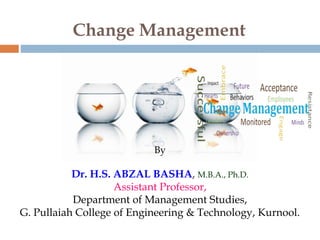

Change Management
By
Dr. H.S. ABZAL BASHA, M.B.A., Ph.D.
Assistant Professor,
Department of Management Studies,
G. Pullaiah College of Engineering & Technology, Kurnool.
What is Change Management ?
Change management is a collective term
for all approaches to prepare, support, and
help individuals, teams,
and organizations in making organizational
change.
Change management is the
creation and implementation
of the roles, processes and
tools that each of these groups use
to effectively manage the
people side of change.
Organizations do not
change!
People Change………
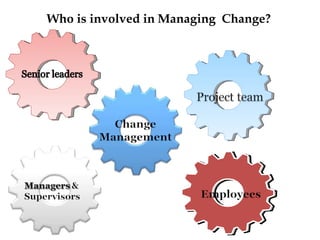
Who is involved in Managing Change?
Reasons for change
 Globalization has created advances in information and
communication technology.
 With the increased global interactions comes the growth
of international trade, ideas, and culture.
 Economic process of interaction and integration has
shown impact on social and cultural aspects.
 Economically, influences goods, services, the economic
resources of capital and data.
 Expansions of global markets and economic activities of
the exchange urge demand for goods and funds.
 Removal of cross-border trade barriers has made
formation of global markets more feasible.
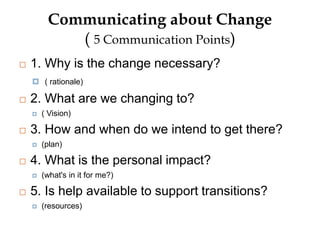
Communicating about Change
( 5 Communication Points)
 1. Why is the change necessary?
 ( rationale)
 2. What are we changing to?
 ( Vision)
 3. How and when do we intend to get there?
 (plan)
 4. What is the personal impact?
 (what's in it for me?)
 5. Is help available to support transitions?
 (resources)
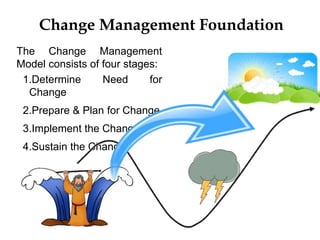
Change Management Foundation
The Change Management
Model consists of four stages:
1.Determine Need for
Change
2.Prepare & Plan for Change
3.Implement the Change
4.Sustain the Change
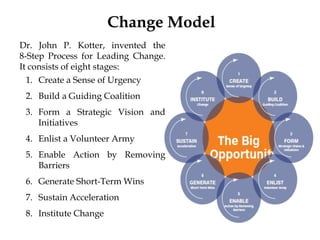
Change Model
Dr. John P. Kotter, invented the
8-Step Process for Leading Change.
It consists of eight stages:
1. Create a Sense of Urgency
2. Build a Guiding Coalition
3. Form a Strategic Vision and
Initiatives
4. Enlist a Volunteer Army
5. Enable Action by Removing
Barriers
6. Generate Short-Term Wins
7. Sustain Acceleration
8. Institute Change
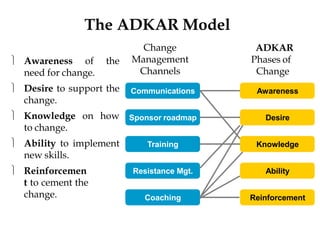
The ADKAR Model
 Awareness of the
need for change.
 Desire to support the
change.
 Knowledge on how
to change.
 Ability to implement
new skills.
 Reinforcemen
t to cement the
change.
Communications
Sponsor roadmap
Training
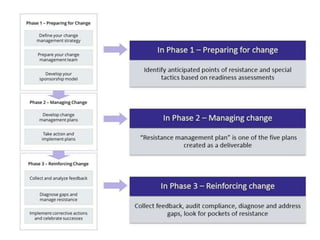
Resistance Mgt.
Coaching
Awareness
Desire
Knowledge
Ability
Reinforcement
Change
Management
Channels
ADKAR
Phases of
Change
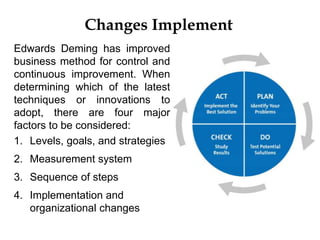
Changes Implement
Edwards Deming has improved
business method for control and
continuous improvement. When
determining which of the latest
techniques or innovations to
adopt, there are four major
factors to be considered:
1. Levels, goals, and strategies
2. Measurement system
3. Sequence of steps
4. Implementation and
organizational changes
Why Change Fails
 Top barriers in major change programs
 Competing resources
48%
 Functional boundaries
44
 Lack of change skills
42
 Middle management 38
 Long IT lead times 35
 Communication
34
 Employee opposition ( resistance)
33
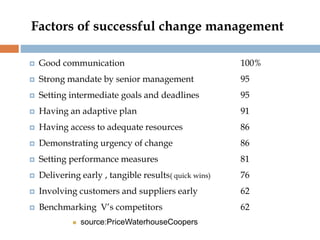
Factors of successful change management
 Good communication 100%
 Strong mandate by senior management 95
 Setting intermediate goals and deadlines 95
 Having an adaptive plan 91
 Having access to adequate resources 86
 Demonstrating urgency of change 86
 Setting performance measures 81
 Delivering early , tangible results( quick wins) 76
 Involving customers and suppliers early 62
 Benchmarking V’s competitors 62
 source:PriceWaterhouseCoopers
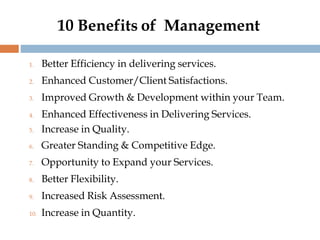
10 Benefits of Management
1. Better Efficiency in delivering services.
2. Enhanced Customer/Client Satisfactions.
3. Improved Growth & Development within your Team.
4. Enhanced Effectiveness in Delivering Services.
5. Increase in Quality.
6. Greater Standing & Competitive Edge.
7. Opportunity to Expand your Services.
8. Better Flexibility.
9. Increased Risk Assessment.
10. Increase in Quantity.
Change Management

Change Management

  • 1.
    Change Management By Dr. H.S.ABZAL BASHA, M.B.A., Ph.D. Assistant Professor, Department of Management Studies, G. Pullaiah College of Engineering & Technology, Kurnool.
  • 2.
    What is ChangeManagement ? Change management is a collective term for all approaches to prepare, support, and help individuals, teams, and organizations in making organizational change. Change management is the creation and implementation of the roles, processes and tools that each of these groups use to effectively manage the people side of change. Organizations do not change! People Change………
  • 3.
    Who is involvedin Managing Change?
  • 4.
    Reasons for change Globalization has created advances in information and communication technology.  With the increased global interactions comes the growth of international trade, ideas, and culture.  Economic process of interaction and integration has shown impact on social and cultural aspects.  Economically, influences goods, services, the economic resources of capital and data.  Expansions of global markets and economic activities of the exchange urge demand for goods and funds.  Removal of cross-border trade barriers has made formation of global markets more feasible.
  • 5.
    Communicating about Change (5 Communication Points)  1. Why is the change necessary?  ( rationale)  2. What are we changing to?  ( Vision)  3. How and when do we intend to get there?  (plan)  4. What is the personal impact?  (what's in it for me?)  5. Is help available to support transitions?  (resources)
  • 6.
    Change Management Foundation TheChange Management Model consists of four stages: 1.Determine Need for Change 2.Prepare & Plan for Change 3.Implement the Change 4.Sustain the Change
  • 9.
    Change Model Dr. JohnP. Kotter, invented the 8-Step Process for Leading Change. It consists of eight stages: 1. Create a Sense of Urgency 2. Build a Guiding Coalition 3. Form a Strategic Vision and Initiatives 4. Enlist a Volunteer Army 5. Enable Action by Removing Barriers 6. Generate Short-Term Wins 7. Sustain Acceleration 8. Institute Change
  • 10.
    The ADKAR Model Awareness of the need for change.  Desire to support the change.  Knowledge on how to change.  Ability to implement new skills.  Reinforcemen t to cement the change. Communications Sponsor roadmap Training Resistance Mgt. Coaching Awareness Desire Knowledge Ability Reinforcement Change Management Channels ADKAR Phases of Change
  • 11.
    Changes Implement Edwards Deminghas improved business method for control and continuous improvement. When determining which of the latest techniques or innovations to adopt, there are four major factors to be considered: 1. Levels, goals, and strategies 2. Measurement system 3. Sequence of steps 4. Implementation and organizational changes
  • 12.
    Why Change Fails Top barriers in major change programs  Competing resources 48%  Functional boundaries 44  Lack of change skills 42  Middle management 38  Long IT lead times 35  Communication 34  Employee opposition ( resistance) 33
  • 13.
    Factors of successfulchange management  Good communication 100%  Strong mandate by senior management 95  Setting intermediate goals and deadlines 95  Having an adaptive plan 91  Having access to adequate resources 86  Demonstrating urgency of change 86  Setting performance measures 81  Delivering early , tangible results( quick wins) 76  Involving customers and suppliers early 62  Benchmarking V’s competitors 62  source:PriceWaterhouseCoopers
  • 14.
    10 Benefits ofManagement 1. Better Efficiency in delivering services. 2. Enhanced Customer/Client Satisfactions. 3. Improved Growth & Development within your Team. 4. Enhanced Effectiveness in Delivering Services. 5. Increase in Quality. 6. Greater Standing & Competitive Edge. 7. Opportunity to Expand your Services. 8. Better Flexibility. 9. Increased Risk Assessment. 10. Increase in Quantity.