CHANGE
MANAGEMENT
Contents
• Meaning of Change Management
• Change Management
• Change starts with a vision
• Characteristics of an effective vision
• Principles of change
• Forces for change
• 3 states of change management
• Change management models
• Process of planned change
• Responses to change
• Types of planned change
• Constituents of change management
• Resistance to change
• Common obstacles to change
• Conclusion
What is change management?
Change management is a systematic approach to dealing with
the transition or transformation of an organization’s goals, processes
and technologies.
Change Management
 As a systematic process
Change management is the formal process for organizational change,
including a systematic approach and application of knowledge.
 As a means of transitioning people
Change management is a critical part of any project that leads,
manages, and enables people to accept new processes, technologies,
systems, structures, and values.
 As a competitive tactic
Change management is the continuous process of aligning an
organization with its marketplace—and doing so more responsively and
effectively than competitors.
Changes starts with a vision
A change effort or initiative must start with a vision. Whether
change is prompted by external or internal factors creating a vision will
clarify the direction for the change.
Characteristics of an effective vision
 Imaginable
-conveys a picture of what the future will look like
 Desirable
-appeals to the long-term interests of employees, customers,
stakeholders etc.
 Feasible
-comprises realistic, obtainable goals
 Focused
-clear enough to provide guidance in decision making
 Flexible
-General enough to allow initiative and alternative responses
 Communicable
-can be fully explained in 5 minutes
Principles of change
 Change is process that can be enabled ,not managed.
 The change process must be linked to business and performance
goals.
 Building capacity to change is a strategic imperative.
 Building capacity for change is an evolutionary process.
Forces for change
Internal ExternalForces
for
change
 3 states of change management
3
states
• Current state
• Future state
• Transition state
Change management model
• Unfreezing
• Changing
• Refreezing
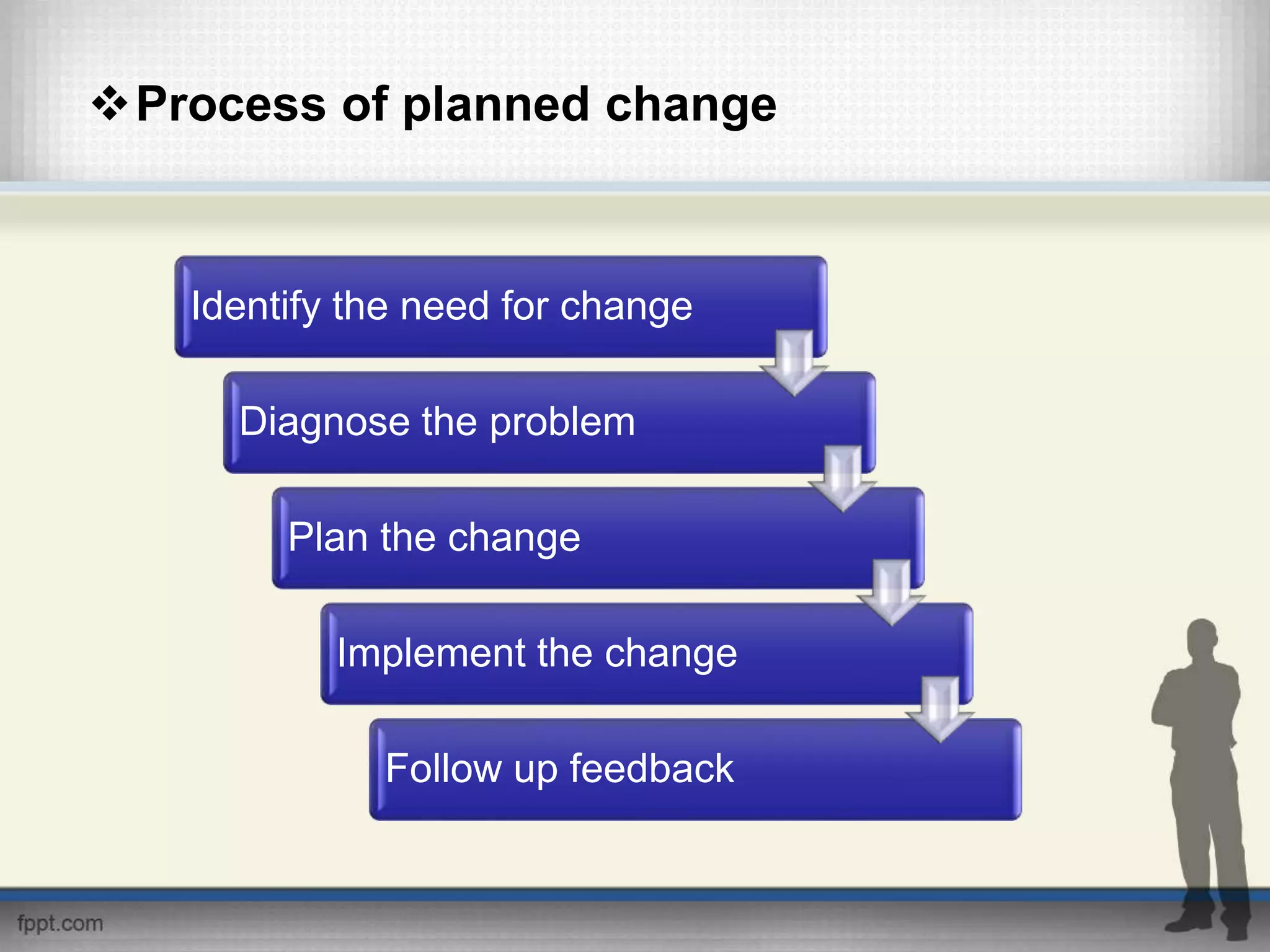
Process of planned change
Identify the need for change
Diagnose the problem
Plan the change
Implement the change
Follow up feedback
Responses change management
 Doubt
 Resistance
 Anger
 Uncertainty
Types of planned changes
 Structural change
structural change is a changed aimed at increasing organizational
effectiveness through modification in the existing organizational structure.
 Redesigning task
Here change efforts focus on increasing the scope or diversity and
depth of the job.
 Changing technology
A technology change is concerned with organisation’s
production process, how the organisation does its work.
 Culture /people change
People change emphasises increasing organisational
effectiveness by changing attitudes, skills, perceptions, expectations
and values of organisation members.
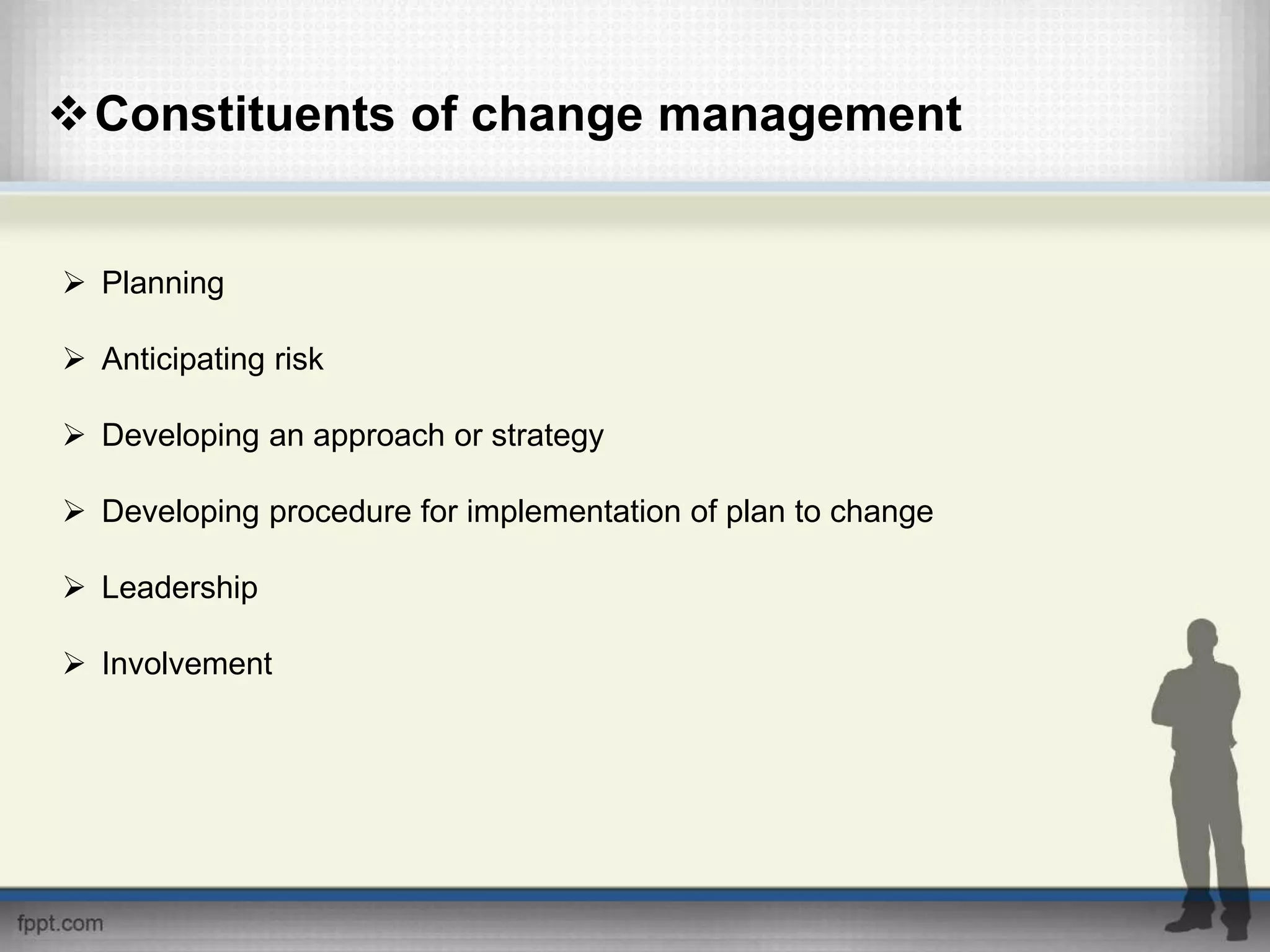
Constituents of change management
 Planning
 Anticipating risk
 Developing an approach or strategy
 Developing procedure for implementation of plan to change
 Leadership
 Involvement
Resistance to change
 Awareness & communication
 Training & development
 Participation
 Facilitation & support
 Negotiation
Common obstacle to change
 Obstacles experienced during major organizational changes
Conclusion
The nature of change has changed significantly ;it is no longer
linear and incremental as it is used to be in the past .in the present
context ,it has become fierce and abrupt ,with much deeper and
broader implications .
Change management

Change management

  • 1.
  • 2.
    Contents • Meaning ofChange Management • Change Management • Change starts with a vision • Characteristics of an effective vision • Principles of change • Forces for change • 3 states of change management • Change management models • Process of planned change • Responses to change • Types of planned change • Constituents of change management • Resistance to change • Common obstacles to change • Conclusion
  • 3.
    What is changemanagement? Change management is a systematic approach to dealing with the transition or transformation of an organization’s goals, processes and technologies.
  • 4.
    Change Management  Asa systematic process Change management is the formal process for organizational change, including a systematic approach and application of knowledge.  As a means of transitioning people Change management is a critical part of any project that leads, manages, and enables people to accept new processes, technologies, systems, structures, and values.  As a competitive tactic Change management is the continuous process of aligning an organization with its marketplace—and doing so more responsively and effectively than competitors.
  • 5.
    Changes starts witha vision A change effort or initiative must start with a vision. Whether change is prompted by external or internal factors creating a vision will clarify the direction for the change.
  • 6.
    Characteristics of aneffective vision  Imaginable -conveys a picture of what the future will look like  Desirable -appeals to the long-term interests of employees, customers, stakeholders etc.  Feasible -comprises realistic, obtainable goals  Focused -clear enough to provide guidance in decision making
  • 7.
     Flexible -General enoughto allow initiative and alternative responses  Communicable -can be fully explained in 5 minutes
  • 8.
    Principles of change Change is process that can be enabled ,not managed.  The change process must be linked to business and performance goals.  Building capacity to change is a strategic imperative.  Building capacity for change is an evolutionary process.
  • 9.
    Forces for change InternalExternalForces for change
  • 10.
     3 statesof change management 3 states • Current state • Future state • Transition state
  • 11.
    Change management model •Unfreezing • Changing • Refreezing
  • 12.
    Process of plannedchange Identify the need for change Diagnose the problem Plan the change Implement the change Follow up feedback
  • 13.
    Responses change management Doubt  Resistance  Anger  Uncertainty
  • 14.
    Types of plannedchanges  Structural change structural change is a changed aimed at increasing organizational effectiveness through modification in the existing organizational structure.  Redesigning task Here change efforts focus on increasing the scope or diversity and depth of the job.
  • 15.
     Changing technology Atechnology change is concerned with organisation’s production process, how the organisation does its work.  Culture /people change People change emphasises increasing organisational effectiveness by changing attitudes, skills, perceptions, expectations and values of organisation members.
  • 16.
    Constituents of changemanagement  Planning  Anticipating risk  Developing an approach or strategy  Developing procedure for implementation of plan to change  Leadership  Involvement
  • 17.
    Resistance to change Awareness & communication  Training & development  Participation  Facilitation & support  Negotiation
  • 18.
    Common obstacle tochange  Obstacles experienced during major organizational changes
  • 19.
    Conclusion The nature ofchange has changed significantly ;it is no longer linear and incremental as it is used to be in the past .in the present context ,it has become fierce and abrupt ,with much deeper and broader implications .