Managing Change
Kulkesh Kumar
21-Feb, 2014
Objective
2
 Identify the change that needs to be managed
 Develop an outline plan for implementing change
Change management is the process, tools and techniques to
manage the people-side of change to achieve the required
business outcome.
What is Change
Management?
Change as a survival tactic -- if the organization does not keep
pace with the changing technology, consumer demands, and
effective business processes, they will lose their competitive
edge.
Why Change is Important in
Organization ?
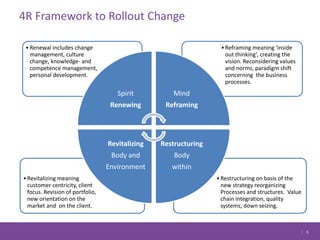
4R Framework to Rollout Change
5
•Restructuring on basis of the
new strategy reorganizing
Processes and structures. Value
chain integration, quality
systems, down seizing.
•Revitalizing meaning
customer centricity, client
focus. Revision of portfolio,
new orientation on the
market and on the client.
•Reframing meaning ‘inside
out thinking’, creating the
vision. Reconsidering values
and norms, paradigm shift
concerning the business
processes.
•Renewal includes change
management, culture
change, knowledge- and
competence management,
personal development.
Spirit
Renewing
Mind
Reframing
Restructuring
Body
within
Revitalizing
Body and
Environment
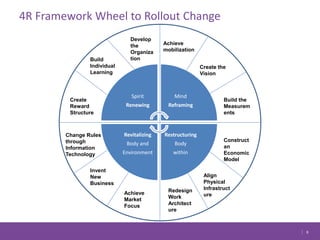
4R Framework Wheel to Rollout Change
6
Spirit
Renewing
Mind
Reframing
Restructuring
Body
within
Revitalizing
Body and
Environment
Achieve
mobilization
Create the
Vision
Build the
Measurem
ents
Construct
an
Economic
Model
Align
Physical
Infrastruct
ure
Redesign
Work
Architect
ure
Achieve
Market
Focus
Invent
New
Business
Change Rules
through
Information
Technology
Create
Reward
Structure
Build
Individual
Learning
Develop
the
Organiza
tion
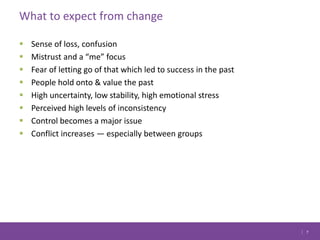
What to expect from change
7
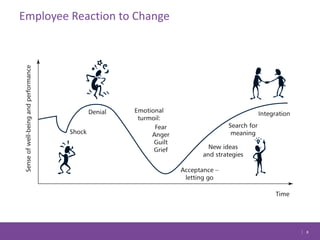
 Sense of loss, confusion
 Mistrust and a “me” focus
 Fear of letting go of that which led to success in the past
 People hold onto & value the past
 High uncertainty, low stability, high emotional stress
 Perceived high levels of inconsistency
 Control becomes a major issue
 Conflict increases — especially between groups
Employee Reaction to Change
8
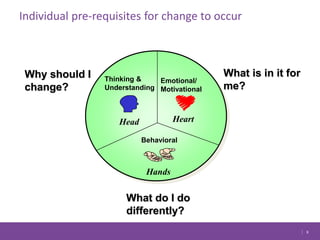
Individual pre-requisites for change to occur
9
Thinking &
Understanding
Emotional/
Motivational
Behavioral
Head Heart
Hands
Why should I
change?
What is in it for
me?
What do I do
differently?
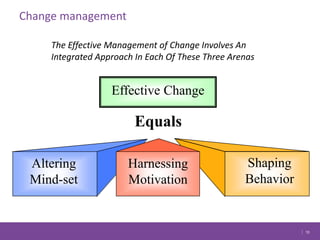
Change management
10
Effective Change
Equals
Altering
Mind-set
Harnessing
Motivation
Shaping
Behavior
The Effective Management of Change Involves An
Integrated Approach In Each Of These Three Arenas
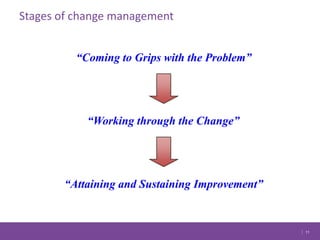
Stages of change management
11
“Coming to Grips with the Problem”
“Working through the Change”
“Attaining and Sustaining Improvement”
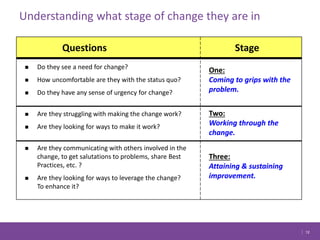
Understanding what stage of change they are in
12
Questions Stage
 Do they see a need for change?
 How uncomfortable are they with the status quo?
 Do they have any sense of urgency for change?
 Are they struggling with making the change work?
 Are they looking for ways to make it work?
 Are they communicating with others involved in the
change, to get salutations to problems, share Best
Practices, etc. ?
 Are they looking for ways to leverage the change?
To enhance it?
One:
Coming to grips with the
problem.
Two:
Working through the
change.
Three:
Attaining & sustaining
improvement.
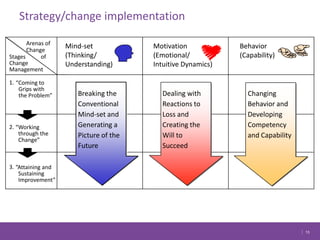
Strategy/change implementation
13
“Coming to
Grips with
the Problem”
1.
Arenas of
Change
Stages of
Change
Management
2. “Working
through the
Change”
3. “Attaining and
Sustaining
Improvement”
Changing
Behavior and
Developing
Competency
and Capability
Behavior
(Capability)
Mind-set
(Thinking/
Understanding)
Breaking the
Conventional
Mind-set and
Generating a
Picture of the
Future
Dealing with
Reactions to
Loss and
Creating the
Will to
Succeed
Motivation
(Emotional/
Intuitive Dynamics)
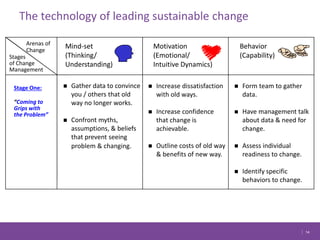
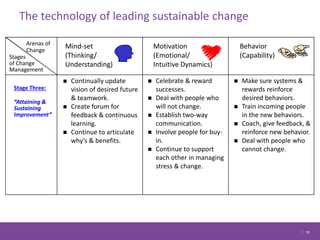
The technology of leading sustainable change
14
Mind-set
(Thinking/
Understanding)
Stage One:
Arenas of
Change
Stages
of Change
Management
Motivation
(Emotional/
Intuitive Dynamics)
Behavior
(Capability)
 Gather data to convince
you / others that old
way no longer works.
 Confront myths,
assumptions, & beliefs
that prevent seeing
problem & changing.
 Increase dissatisfaction
with old ways.
 Increase confidence
that change is
achievable.
 Outline costs of old way
& benefits of new way.
 Form team to gather
data.
 Have management talk
about data & need for
change.
 Assess individual
readiness to change.
 Identify specific
behaviors to change.
“Coming to
Grips with
the Problem”
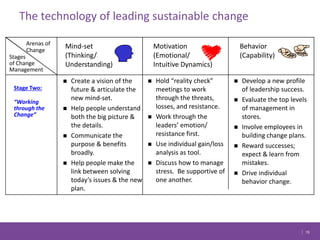
The technology of leading sustainable change
15
Mind-set
(Thinking/
Understanding)
Stage Two:
Arenas of
Change
Stages
of Change
Management
Motivation
(Emotional/
Intuitive Dynamics)
“Working
through the
Change”
 Create a vision of the
future & articulate the
new mind-set.
 Help people understand
both the big picture &
the details.
 Communicate the
purpose & benefits
broadly.
 Help people make the
link between solving
today’s issues & the new
plan.
 Hold “reality check”
meetings to work
through the threats,
losses, and resistance.
 Work through the
leaders’ emotion/
resistance first.
 Use individual gain/loss
analysis as tool.
 Discuss how to manage
stress. Be supportive of
one another.
 Develop a new profile
of leadership success.
 Evaluate the top levels
of management in
stores.
 Involve employees in
building change plans.
 Reward successes;
expect & learn from
mistakes.
 Drive individual
behavior change.
Behavior
(Capability)
The technology of leading sustainable change
16
Mind-set
(Thinking/
Understanding)
Arenas of
Change
Stages
of Change
Management
Motivation
(Emotional/
Intuitive Dynamics)
Behavior
(Capability)
“Attaining &
Sustaining
Improvement”
 Continually update
vision of desired future
& teamwork.
 Create forum for
feedback & continuous
learning.
 Continue to articulate
why’s & benefits.
 Celebrate & reward
successes.
 Deal with people who
will not change.
 Establish two-way
communication.
 Involve people for buy-
in.
 Continue to support
each other in managing
stress & change.
 Make sure systems &
rewards reinforce
desired behaviors.
 Train incoming people
in the new behaviors.
 Coach, give feedback, &
reinforce new behavior.
 Deal with people who
cannot change.
Stage Three:
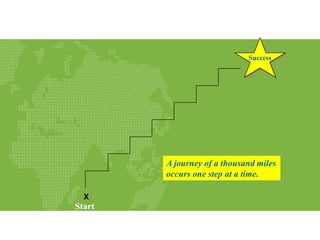
Start
X
A journey of a thousand miles
occurs one step at a time.
Success

Managing change slide

  • 1.
  • 2.
    Objective 2  Identify thechange that needs to be managed  Develop an outline plan for implementing change
  • 3.
    Change management isthe process, tools and techniques to manage the people-side of change to achieve the required business outcome. What is Change Management?
  • 4.
    Change as asurvival tactic -- if the organization does not keep pace with the changing technology, consumer demands, and effective business processes, they will lose their competitive edge. Why Change is Important in Organization ?
  • 5.
    4R Framework toRollout Change 5 •Restructuring on basis of the new strategy reorganizing Processes and structures. Value chain integration, quality systems, down seizing. •Revitalizing meaning customer centricity, client focus. Revision of portfolio, new orientation on the market and on the client. •Reframing meaning ‘inside out thinking’, creating the vision. Reconsidering values and norms, paradigm shift concerning the business processes. •Renewal includes change management, culture change, knowledge- and competence management, personal development. Spirit Renewing Mind Reframing Restructuring Body within Revitalizing Body and Environment
  • 6.
    4R Framework Wheelto Rollout Change 6 Spirit Renewing Mind Reframing Restructuring Body within Revitalizing Body and Environment Achieve mobilization Create the Vision Build the Measurem ents Construct an Economic Model Align Physical Infrastruct ure Redesign Work Architect ure Achieve Market Focus Invent New Business Change Rules through Information Technology Create Reward Structure Build Individual Learning Develop the Organiza tion
  • 7.
    What to expectfrom change 7  Sense of loss, confusion  Mistrust and a “me” focus  Fear of letting go of that which led to success in the past  People hold onto & value the past  High uncertainty, low stability, high emotional stress  Perceived high levels of inconsistency  Control becomes a major issue  Conflict increases — especially between groups
  • 8.
  • 9.
    Individual pre-requisites forchange to occur 9 Thinking & Understanding Emotional/ Motivational Behavioral Head Heart Hands Why should I change? What is in it for me? What do I do differently?
  • 10.
    Change management 10 Effective Change Equals Altering Mind-set Harnessing Motivation Shaping Behavior TheEffective Management of Change Involves An Integrated Approach In Each Of These Three Arenas
  • 11.
    Stages of changemanagement 11 “Coming to Grips with the Problem” “Working through the Change” “Attaining and Sustaining Improvement”
  • 12.
    Understanding what stageof change they are in 12 Questions Stage  Do they see a need for change?  How uncomfortable are they with the status quo?  Do they have any sense of urgency for change?  Are they struggling with making the change work?  Are they looking for ways to make it work?  Are they communicating with others involved in the change, to get salutations to problems, share Best Practices, etc. ?  Are they looking for ways to leverage the change? To enhance it? One: Coming to grips with the problem. Two: Working through the change. Three: Attaining & sustaining improvement.
  • 13.
    Strategy/change implementation 13 “Coming to Gripswith the Problem” 1. Arenas of Change Stages of Change Management 2. “Working through the Change” 3. “Attaining and Sustaining Improvement” Changing Behavior and Developing Competency and Capability Behavior (Capability) Mind-set (Thinking/ Understanding) Breaking the Conventional Mind-set and Generating a Picture of the Future Dealing with Reactions to Loss and Creating the Will to Succeed Motivation (Emotional/ Intuitive Dynamics)
  • 14.
    The technology ofleading sustainable change 14 Mind-set (Thinking/ Understanding) Stage One: Arenas of Change Stages of Change Management Motivation (Emotional/ Intuitive Dynamics) Behavior (Capability)  Gather data to convince you / others that old way no longer works.  Confront myths, assumptions, & beliefs that prevent seeing problem & changing.  Increase dissatisfaction with old ways.  Increase confidence that change is achievable.  Outline costs of old way & benefits of new way.  Form team to gather data.  Have management talk about data & need for change.  Assess individual readiness to change.  Identify specific behaviors to change. “Coming to Grips with the Problem”
  • 15.
    The technology ofleading sustainable change 15 Mind-set (Thinking/ Understanding) Stage Two: Arenas of Change Stages of Change Management Motivation (Emotional/ Intuitive Dynamics) “Working through the Change”  Create a vision of the future & articulate the new mind-set.  Help people understand both the big picture & the details.  Communicate the purpose & benefits broadly.  Help people make the link between solving today’s issues & the new plan.  Hold “reality check” meetings to work through the threats, losses, and resistance.  Work through the leaders’ emotion/ resistance first.  Use individual gain/loss analysis as tool.  Discuss how to manage stress. Be supportive of one another.  Develop a new profile of leadership success.  Evaluate the top levels of management in stores.  Involve employees in building change plans.  Reward successes; expect & learn from mistakes.  Drive individual behavior change. Behavior (Capability)
  • 16.
    The technology ofleading sustainable change 16 Mind-set (Thinking/ Understanding) Arenas of Change Stages of Change Management Motivation (Emotional/ Intuitive Dynamics) Behavior (Capability) “Attaining & Sustaining Improvement”  Continually update vision of desired future & teamwork.  Create forum for feedback & continuous learning.  Continue to articulate why’s & benefits.  Celebrate & reward successes.  Deal with people who will not change.  Establish two-way communication.  Involve people for buy- in.  Continue to support each other in managing stress & change.  Make sure systems & rewards reinforce desired behaviors.  Train incoming people in the new behaviors.  Coach, give feedback, & reinforce new behavior.  Deal with people who cannot change. Stage Three:
  • 17.
    Start X A journey ofa thousand miles occurs one step at a time. Success