
Strategic Management & Project
Management
Presentation
By
Dr. H.S. ABZAL BASHA, M.B.A., Ph.D.
RUHI AFREEN, M.B.A.
Assistant Professor,
Department of Management Studies,
G. Pullaiah College of Engineering & Technology,
Kurnool.
Unit-IV
• What is Strategy?
• Features of Strategy
• Levelsof Strategy- corporate-level,business-
level and functional-level.
• What is Strategic Management?
• Processof StrategicManagement
What isstrategy?
• Strategy is a tactical course of action which is designed to
achieve long term objectives. It is an art and science of
planning and marshalling resources for their most efficient
and effective usein achangingenvironment.
• Strategy of a business enterprise consists of what management
decides about the future direction and scope of the business.
It entails managerial choice among alternative action
programmes, competitive moves and different business
approachesto achieveenterprise objectives.
• Strategy once formulated has long term implications. It is
framed by top management in an organization. In short, it
maybecalled asthe ‘gameplanof management’.
Definition of Strategy
• AsperGlueck,
Strategy is unified, comprehensive and integrated plan relating
the strategic advantages of the firm to the challenges of the
environment. It is designed to ensure that the basic objectives of
the enterpriseare achieved.
• AsperAlfredD.Chandler,
Strategy is “The determination of basic long-term goals and
objectives of an enterprise and the adoption of the courses of
action and the allocation of resources necessary for carrying out
thesegoals.”
Featuresof Strategy
• Topmanagement responsibility
• Allocation of large amount ofresources
• Impact on long term prosperity of the firm
• Future oriented
• Multi-functional or multi-business
consequences
• Consideration of factors in the external
environment
Levelsof Strategy
Corporate-level Strategy
• At this level, strategic decisions relate to organization-wide
policies and are taken care by top-level management (BOD) with a
visionof determining ‘Where the company wants to
be?’
• It has two main aspects- Formulation of Strategy (strategic
planning)andStrategyImplementation
• The nature of strategy at this level tend to be value-oriented,
conceptual andthan otherlevels.
• There is also greater risk, cost and profit potential as well as
greater need of flexibility associatedwiththis level.
• Major financial policy decisions involving acquisition, diversification
andstructuralredesigningbelongto this level.
Business-LevelStrategy
• Business-level strategy is more likely related to a unit
within the whole. It is concerned with competition in a
market.
• The concerns are about what products or services should be
developed and offered to which markets in order to meet
customer needsand organizationalobjectives.
• At this level, multifunctional strategies developed at
corporate level are formulated and implemented for specific
product market in which the business operates. Thus,
managers at this level translate general directions and intent
into concrete functionalobjectives.
• Decisionsat thislevelincludepoliciesinvolvingnew product
development, marketing mix, research & development,
personnel, etc.
Functional/Operational-Level Strategy
• Functional strategy involves decision-making with respect to
specific functional areas- production, marketing, personnel,
finance etc.
• While corporate and business level strategies are
concerned with “Doing the right things”, functional
strategies stress on “Doingthingsright”.
• Operating level strategy is concerned with strategic approaches
for managing frontline operating units(like plants, sales, etc)
and for handling day to day tasks of strategic significance(like
advertising campaign, purchasing materials, inventory control,
maintenance, etc.). Thus, it focuses on how the different
functions of the enterprise contribute to the other levels of
strategy.
• Thus, functional level strategic management is the management
of relatively narrow areas of activity, which are of vital,
pervasive or continuing importance to the total organization.
StrategicManagement
• Strategic management is a set of management decisions and actions
that determines the long-run performance of a corporation. It
includes environmental scanning, strategy formulation, strategy
implementation and evaluation and control to achieve the
objectives ofanorganization.
• The study of strategic management emphasizes the monitoring
and evaluating of external opportunities and threats in light of a
corporation’s strengths and weaknesses.
• Asper Fred R. David, strategic management is an art and science of
formulating, implementing and evaluating cross functional
decisionsthat enableanorganization toachieve its objectives.
• As per Channon, strategic management is defined as that set of
decisions and actions that result in formulating of strategy an its
implementation to achievethe objectivesof the corporation.
Step1: Strategic Intent
• Vision- Vision is the statement that expresses organization’s ultimate
long-run objectives. It is what the firm ultimately like to become.
Vision once formulated is for forever and long lasting for years to
come. Vision is closely related with strategic intent and is a forward
thinking process.
Eg- Microsoft- ’A computer software on every desk and in every
home’.
• Mission- It tells who we are and what we doaswell aswhat we’d like
to become. Mission of a business is the fundamental, unique purpose
that sets it apart from other firms of its kind and identifies the scope
of its operations in product and market terms.
Eg- Microsoft- ‘Empower every person and every organization on the
planet to achievemore’.
• Objectives- These are the end results of planned activity that state
what is to be accomplished by when and should be quantified if
possible and their achievement should result in the fulfillment of a
corporation’s mission. Objectives state specifically how the goals
shall be achieved. Following are the areas for setting objectives-
profit objective, marketing objective, production objective,etc.
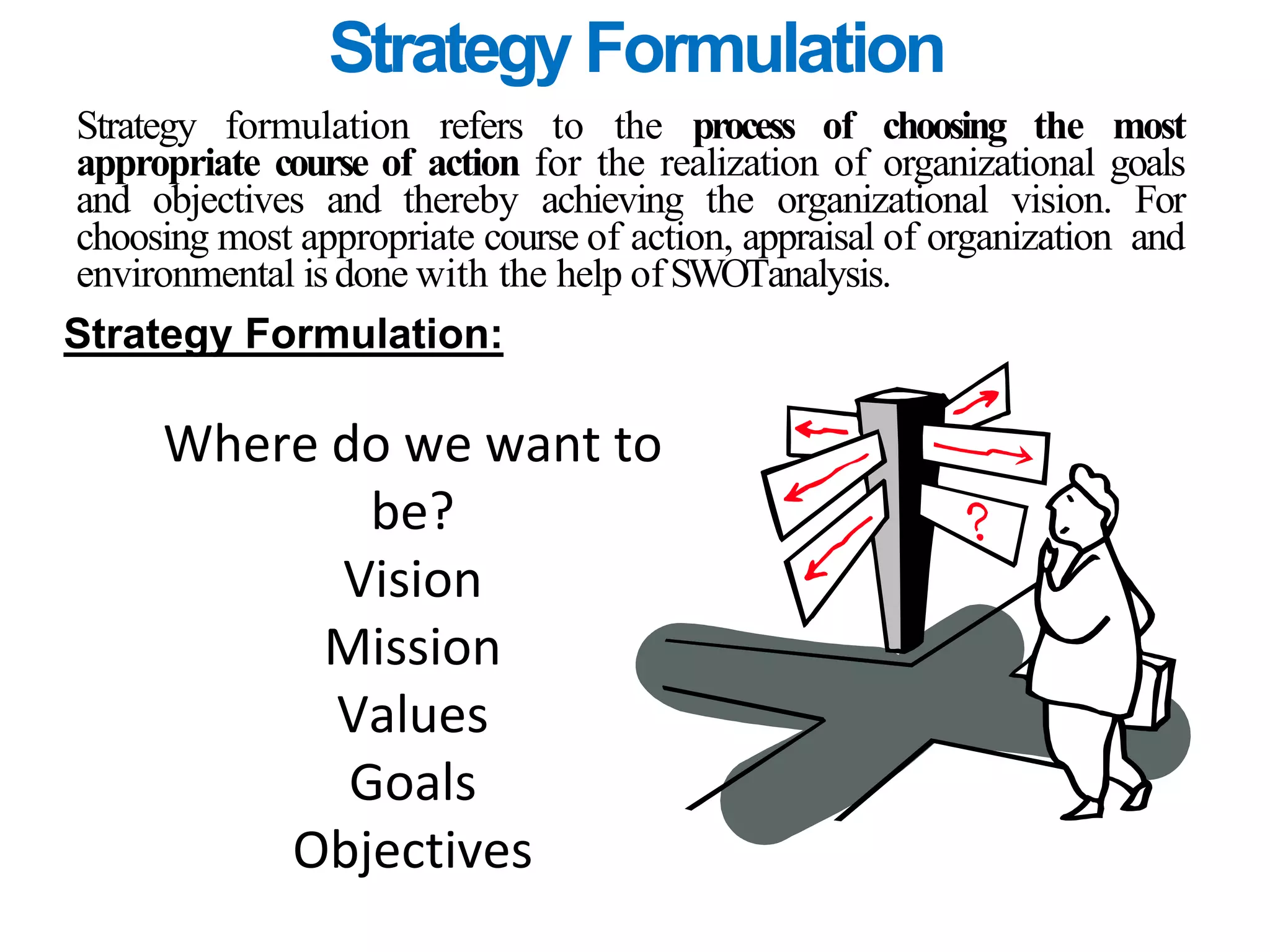
Strategy Formulation
Strategy formulation refers to the process of choosing the most
appropriate course of action for the realization of organizational goals
and objectives and thereby achieving the organizational vision. For
choosing most appropriate course of action, appraisal of organization and
environmental is done with the help ofSWOTanalysis.
Strategy Formulation:
Where do we want to
be?
Vision
Mission
Values
Goals
Objectives
Strategy Implementation
Strategy implementation is the action stageof strategic management. It refers
to decisions that are made to install new strategy or reinforce existing
strategy.
• Designing structure, process & system- Strategy implementation includes
the making of decisions with regard to organizational structure,
developing budgets, programs and procedures in order to accomplish
certain activities.
• Functional Implementation- Functional implementation is
carried out through functionalplan and policies in
five different areas- marketing, finance, operation, personnel and
Information management.
• Behavioral Implementation- It denotes mobilizing employees and
managers to put and formulate strategies into action and require
personal discipline, commitment and sacrifice. It dependsupon
manager’sability to motivateemployees.
• Operationalizing strategy- It includes establishing annual
objectives, devisingpolicies, and allocatingresources.
StrategyEvaluation& Control
• Strategyevaluation-It isthe primary meansto
know when and why particular strategies are
not working well. It is the process in which
corporate activities and performance results
are monitored so that actual performance can
be compared with desired performance. Thus
strategic evaluation activities include
reviewing external and internal factors that
arethe basisfor currentstrategies.
• Strategic control- In this step, organizations
Determine what to control i.e., which
objectives the organization hopes to
accomplish, set control standards, measure
performance, Compare the actual with the
standard, determine the reasons for the
deviations and finally taking corrective
actions and review the policies and activities
if needed.
Project Management
Project:Convertinga vision,a dream ora need to reality.
Project management is the practice of initiating, planning, executing,
controlling, and closing the work of a team to achieve specific goals
and meet specific success criteria at the specified time. ... The primary
challenge of project management is to achieve all of
the project goals within the given constraints.
Input
Man
Money
Machine
Material
Process
Output
Product/Services
Network analysis
Network analysis is a vital technique in PROJECT MANAGEMENT. It
enables us to take a systematic quantitative structured approach to the problem
of managing a project through to successful completion. Network analysis is the
general name given to certain specific techniques which can be used for the
planning, management and control of projects.
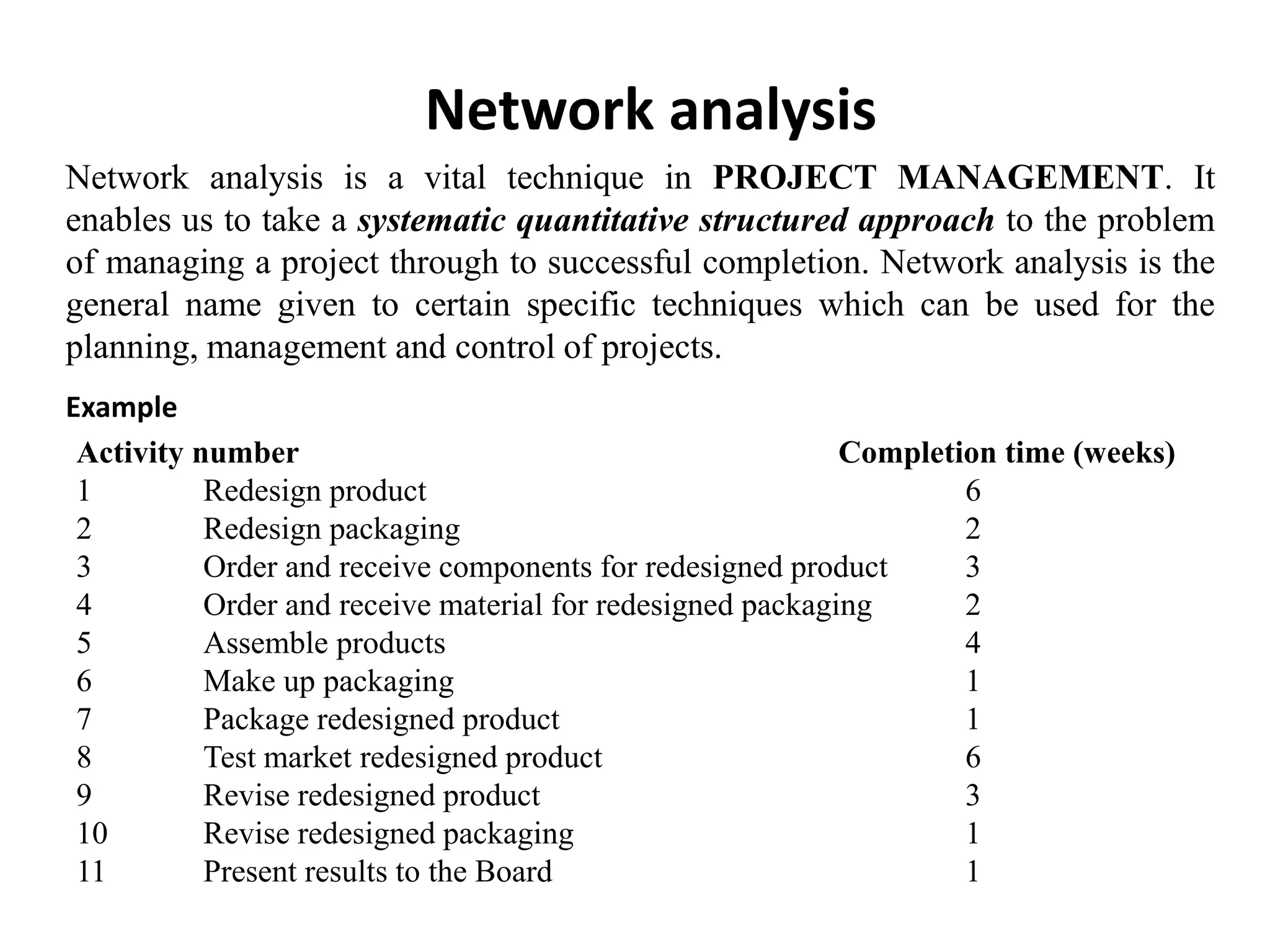
Example
Activity number Completion time (weeks)
1 Redesign product 6
2 Redesign packaging 2
3 Order and receive components for redesigned product 3
4 Order and receive material for redesigned packaging 2
5 Assemble products 4
6 Make up packaging 1
7 Package redesigned product 1
8 Test market redesigned product 6
9 Revise redesigned product 3
10 Revise redesigned packaging 1
11 Present results to the Board 1
PERT/CPM
Critical Path Method (CPM)
DuPont & Remington-Rand (1956)
deterministic task times
activity-on-node network
construction (AON)
Project Evaluation & Review
Technique (PERT)
U.S. Navy, Booz, Allen & Hamilton
multiple task time estimates(
probabilistic)
activity-on-arrow network construction
(AOA)
ThankYou!

Strategic Management and Project Management

  • 1.
    Strategic Management &Project Management Presentation By Dr. H.S. ABZAL BASHA, M.B.A., Ph.D. RUHI AFREEN, M.B.A. Assistant Professor, Department of Management Studies, G. Pullaiah College of Engineering & Technology, Kurnool. Unit-IV
  • 2.
    • What isStrategy? • Features of Strategy • Levelsof Strategy- corporate-level,business- level and functional-level. • What is Strategic Management? • Processof StrategicManagement
  • 4.
    What isstrategy? • Strategyis a tactical course of action which is designed to achieve long term objectives. It is an art and science of planning and marshalling resources for their most efficient and effective usein achangingenvironment. • Strategy of a business enterprise consists of what management decides about the future direction and scope of the business. It entails managerial choice among alternative action programmes, competitive moves and different business approachesto achieveenterprise objectives. • Strategy once formulated has long term implications. It is framed by top management in an organization. In short, it maybecalled asthe ‘gameplanof management’.
  • 5.
    Definition of Strategy •AsperGlueck, Strategy is unified, comprehensive and integrated plan relating the strategic advantages of the firm to the challenges of the environment. It is designed to ensure that the basic objectives of the enterpriseare achieved. • AsperAlfredD.Chandler, Strategy is “The determination of basic long-term goals and objectives of an enterprise and the adoption of the courses of action and the allocation of resources necessary for carrying out thesegoals.”
  • 6.
    Featuresof Strategy • Topmanagementresponsibility • Allocation of large amount ofresources • Impact on long term prosperity of the firm • Future oriented • Multi-functional or multi-business consequences • Consideration of factors in the external environment
  • 7.
  • 8.
    Corporate-level Strategy • Atthis level, strategic decisions relate to organization-wide policies and are taken care by top-level management (BOD) with a visionof determining ‘Where the company wants to be?’ • It has two main aspects- Formulation of Strategy (strategic planning)andStrategyImplementation • The nature of strategy at this level tend to be value-oriented, conceptual andthan otherlevels. • There is also greater risk, cost and profit potential as well as greater need of flexibility associatedwiththis level. • Major financial policy decisions involving acquisition, diversification andstructuralredesigningbelongto this level.
  • 9.
    Business-LevelStrategy • Business-level strategyis more likely related to a unit within the whole. It is concerned with competition in a market. • The concerns are about what products or services should be developed and offered to which markets in order to meet customer needsand organizationalobjectives. • At this level, multifunctional strategies developed at corporate level are formulated and implemented for specific product market in which the business operates. Thus, managers at this level translate general directions and intent into concrete functionalobjectives. • Decisionsat thislevelincludepoliciesinvolvingnew product development, marketing mix, research & development, personnel, etc.
  • 10.
    Functional/Operational-Level Strategy • Functionalstrategy involves decision-making with respect to specific functional areas- production, marketing, personnel, finance etc. • While corporate and business level strategies are concerned with “Doing the right things”, functional strategies stress on “Doingthingsright”. • Operating level strategy is concerned with strategic approaches for managing frontline operating units(like plants, sales, etc) and for handling day to day tasks of strategic significance(like advertising campaign, purchasing materials, inventory control, maintenance, etc.). Thus, it focuses on how the different functions of the enterprise contribute to the other levels of strategy. • Thus, functional level strategic management is the management of relatively narrow areas of activity, which are of vital, pervasive or continuing importance to the total organization.
  • 12.
    StrategicManagement • Strategic managementis a set of management decisions and actions that determines the long-run performance of a corporation. It includes environmental scanning, strategy formulation, strategy implementation and evaluation and control to achieve the objectives ofanorganization. • The study of strategic management emphasizes the monitoring and evaluating of external opportunities and threats in light of a corporation’s strengths and weaknesses. • Asper Fred R. David, strategic management is an art and science of formulating, implementing and evaluating cross functional decisionsthat enableanorganization toachieve its objectives. • As per Channon, strategic management is defined as that set of decisions and actions that result in formulating of strategy an its implementation to achievethe objectivesof the corporation.
  • 14.
    Step1: Strategic Intent •Vision- Vision is the statement that expresses organization’s ultimate long-run objectives. It is what the firm ultimately like to become. Vision once formulated is for forever and long lasting for years to come. Vision is closely related with strategic intent and is a forward thinking process. Eg- Microsoft- ’A computer software on every desk and in every home’. • Mission- It tells who we are and what we doaswell aswhat we’d like to become. Mission of a business is the fundamental, unique purpose that sets it apart from other firms of its kind and identifies the scope of its operations in product and market terms. Eg- Microsoft- ‘Empower every person and every organization on the planet to achievemore’. • Objectives- These are the end results of planned activity that state what is to be accomplished by when and should be quantified if possible and their achievement should result in the fulfillment of a corporation’s mission. Objectives state specifically how the goals shall be achieved. Following are the areas for setting objectives- profit objective, marketing objective, production objective,etc.
  • 15.
    Strategy Formulation Strategy formulationrefers to the process of choosing the most appropriate course of action for the realization of organizational goals and objectives and thereby achieving the organizational vision. For choosing most appropriate course of action, appraisal of organization and environmental is done with the help ofSWOTanalysis. Strategy Formulation: Where do we want to be? Vision Mission Values Goals Objectives
  • 16.
    Strategy Implementation Strategy implementationis the action stageof strategic management. It refers to decisions that are made to install new strategy or reinforce existing strategy. • Designing structure, process & system- Strategy implementation includes the making of decisions with regard to organizational structure, developing budgets, programs and procedures in order to accomplish certain activities. • Functional Implementation- Functional implementation is carried out through functionalplan and policies in five different areas- marketing, finance, operation, personnel and Information management. • Behavioral Implementation- It denotes mobilizing employees and managers to put and formulate strategies into action and require personal discipline, commitment and sacrifice. It dependsupon manager’sability to motivateemployees. • Operationalizing strategy- It includes establishing annual objectives, devisingpolicies, and allocatingresources.
  • 17.
    StrategyEvaluation& Control • Strategyevaluation-Itisthe primary meansto know when and why particular strategies are not working well. It is the process in which corporate activities and performance results are monitored so that actual performance can be compared with desired performance. Thus strategic evaluation activities include reviewing external and internal factors that arethe basisfor currentstrategies. • Strategic control- In this step, organizations Determine what to control i.e., which objectives the organization hopes to accomplish, set control standards, measure performance, Compare the actual with the standard, determine the reasons for the deviations and finally taking corrective actions and review the policies and activities if needed.
  • 18.
    Project Management Project:Convertinga vision,adream ora need to reality. Project management is the practice of initiating, planning, executing, controlling, and closing the work of a team to achieve specific goals and meet specific success criteria at the specified time. ... The primary challenge of project management is to achieve all of the project goals within the given constraints. Input Man Money Machine Material Process Output Product/Services
  • 19.
    Network analysis Network analysisis a vital technique in PROJECT MANAGEMENT. It enables us to take a systematic quantitative structured approach to the problem of managing a project through to successful completion. Network analysis is the general name given to certain specific techniques which can be used for the planning, management and control of projects. Example Activity number Completion time (weeks) 1 Redesign product 6 2 Redesign packaging 2 3 Order and receive components for redesigned product 3 4 Order and receive material for redesigned packaging 2 5 Assemble products 4 6 Make up packaging 1 7 Package redesigned product 1 8 Test market redesigned product 6 9 Revise redesigned product 3 10 Revise redesigned packaging 1 11 Present results to the Board 1
  • 20.
    PERT/CPM Critical Path Method(CPM) DuPont & Remington-Rand (1956) deterministic task times activity-on-node network construction (AON) Project Evaluation & Review Technique (PERT) U.S. Navy, Booz, Allen & Hamilton multiple task time estimates( probabilistic) activity-on-arrow network construction (AOA)
  • 21.