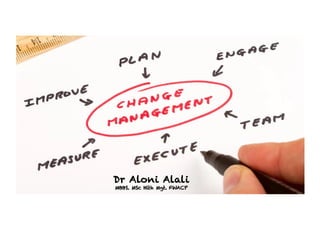
Dr Aloni Alali
MBBS. MSc Hlth Mgt. FWACP
Introduction
All organisations need to deal with change events.
Successful organisations are able to manage change in
a coherent manner and are able to generate the most
benefit from changes and improvements to the way
they do business.
Aspects of Change
•Changes in scale
•Changes in personnel
•Changes in technology
•Changes in service offerings
•Legislative change
Definitions
Change management is a structured approach to
transitioning individuals, teams, and organizations from
a current state to a desired future state, to fulfil or
implement a vision and strategy.
It is an organizational process aimed at empowering
employees to accept and embrace changes in their
current environment.
As a Systematic Process
Change management is the formal process for
organizational change, including a systematic approach
and application of knowledge. Change management
means defining and adopting corporate strategies,
structures, procedures, and technologies to deal with
change stemming from internal and external
conditions.
-Society for Human Resources Management, 2007 Change
Management Survey Report
As a Means of Transitioning People
Change management is a critical part of any project
that leads, manages, and enables people to accept new
processes, technologies, systems, structures, and
values. It is the set of activities that helps people
transition from their present way of working to the
desired way of working.
-Lambeth Change Management Team, Change Management Toolkit.
As a Competitive Tactic
Change management is the continuous process of
aligning an organization with its marketplace—and
doing so more responsively and effectively than
competitors.
- Lisa M. Kudray and Brian H. Kleiner, “Global Trends in Managing
Change,” Industrial Management, May 1997
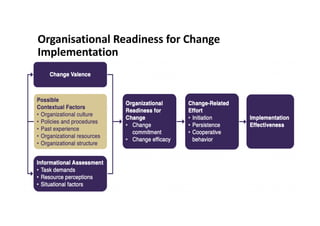
Organisational Readiness for Change
Implementation
Change Management Model
• Step one: Increase Urgency = Raising a feeling of urgency is the first
and most critical step in a successful change effort. With low urgency
and complacency, the change effort cannot get off the ground.
• Step two: Build the Guiding Team = It is important to get the right
people in place who are fully committed to the change initiative,
well-respected within the organization, and have power and
influence to drive the change effort at their levels.
• Step three: Get the Vision Right = While creating a shared need and
urgency for change may push people into action, it is the vision that
will steer them into the new direction.
•Step four: Communicate for Buy-In = Once a vision and
strategy have been developed, they must be
communicated to the organization in order to gain
understanding and buy-in. Sending clear, credible, and
heartfelt messages about the direction of change
establishes genuine gut-level buy-in, which sets the
stage for the following step: getting people to act.
•Step five: Empower Action = Empowering action should
be seen as removing barriers to those whom we want to
assist in pushing the change effort. Removing obstacles
should inspire, promote optimism and build confidence
around the change effort.
• Step six: Generate Short –Term Wins = Short-term wins nourish faith
in the change effort, emotionally reward the hard workers, keep the
critics at bay, and build momentum. By creating short-term wins, and
being honest with feedback, progress is achieved, and people are
inspired.
• Step seven: Sustain acceleration = In successful efforts, people build
on this momentum to make the vision a reality by keeping urgency
up, eliminating unnecessary, exhausting work and not declaring
victory prematurely.
• Step eight: Set the change in stone = By creating a new, supportive,
and sufficiently strong organizational culture, the change should
remain. A supportive culture provides roots for the new ways of
operating.
Lewin’s Change Theory
Lewin (1951) conceptualised change as a three-stage
process involving:
•Unfreezing the existing organisational equilibrium
•Moving to a new position
•Refreezing in a new equilibrium position.
Lewin’s Change Theory
• Unfreezing involves finding a method of making it possible for people
to let go of an old pattern that was somehow counterproductive.
•
• The change stage involves a shift from the current state to “a new
level” or “movement.” This involves a process of change in thoughts,
feeling, behaviour, or all three, that is in some way more liberating or
more productive.
• The refreezing stage is ensuring that the change is sustained and
becomes the usual way of doing things
Concepts that influence Change
• Driving forces are those that push in a direction that causes change to
occur. They facilitate change because they push the system in a
desired direction. They cause a shift in the equilibrium towards
change.
• Restraining forces are those forces that counter the driving forces.
They hinder change because they push the system in the opposite
direction. They cause a shift in the equilibrium that opposes change.
• Equilibrium is a state of being where driving forces equal restraining
forces, and no change occurs. It can be raised or lowered by changes
that occur between the driving and restraining forces.
Some types of change
•Planned versus emergent change
•Episodic versus continuous change
•Developmental, transitional and transformational
change
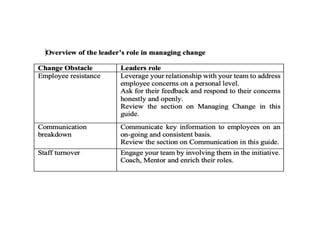
Obstacles to change
•Employee resistance
•Communication breakdown
•Insufficient time devoted to training
•Staff turnover during transition
•Cost exceeded budget
Change management

Change management

  • 1.
    Dr Aloni Alali MBBS.MSc Hlth Mgt. FWACP
  • 4.
    Introduction All organisations needto deal with change events. Successful organisations are able to manage change in a coherent manner and are able to generate the most benefit from changes and improvements to the way they do business.
  • 5.
    Aspects of Change •Changesin scale •Changes in personnel •Changes in technology •Changes in service offerings •Legislative change
  • 6.
    Definitions Change management isa structured approach to transitioning individuals, teams, and organizations from a current state to a desired future state, to fulfil or implement a vision and strategy. It is an organizational process aimed at empowering employees to accept and embrace changes in their current environment.
  • 7.
    As a SystematicProcess Change management is the formal process for organizational change, including a systematic approach and application of knowledge. Change management means defining and adopting corporate strategies, structures, procedures, and technologies to deal with change stemming from internal and external conditions. -Society for Human Resources Management, 2007 Change Management Survey Report
  • 8.
    As a Meansof Transitioning People Change management is a critical part of any project that leads, manages, and enables people to accept new processes, technologies, systems, structures, and values. It is the set of activities that helps people transition from their present way of working to the desired way of working. -Lambeth Change Management Team, Change Management Toolkit.
  • 9.
    As a CompetitiveTactic Change management is the continuous process of aligning an organization with its marketplace—and doing so more responsively and effectively than competitors. - Lisa M. Kudray and Brian H. Kleiner, “Global Trends in Managing Change,” Industrial Management, May 1997
  • 10.
    Organisational Readiness forChange Implementation
  • 11.
  • 12.
    • Step one:Increase Urgency = Raising a feeling of urgency is the first and most critical step in a successful change effort. With low urgency and complacency, the change effort cannot get off the ground. • Step two: Build the Guiding Team = It is important to get the right people in place who are fully committed to the change initiative, well-respected within the organization, and have power and influence to drive the change effort at their levels. • Step three: Get the Vision Right = While creating a shared need and urgency for change may push people into action, it is the vision that will steer them into the new direction.
  • 13.
    •Step four: Communicatefor Buy-In = Once a vision and strategy have been developed, they must be communicated to the organization in order to gain understanding and buy-in. Sending clear, credible, and heartfelt messages about the direction of change establishes genuine gut-level buy-in, which sets the stage for the following step: getting people to act. •Step five: Empower Action = Empowering action should be seen as removing barriers to those whom we want to assist in pushing the change effort. Removing obstacles should inspire, promote optimism and build confidence around the change effort.
  • 14.
    • Step six:Generate Short –Term Wins = Short-term wins nourish faith in the change effort, emotionally reward the hard workers, keep the critics at bay, and build momentum. By creating short-term wins, and being honest with feedback, progress is achieved, and people are inspired. • Step seven: Sustain acceleration = In successful efforts, people build on this momentum to make the vision a reality by keeping urgency up, eliminating unnecessary, exhausting work and not declaring victory prematurely. • Step eight: Set the change in stone = By creating a new, supportive, and sufficiently strong organizational culture, the change should remain. A supportive culture provides roots for the new ways of operating.
  • 15.
    Lewin’s Change Theory Lewin(1951) conceptualised change as a three-stage process involving: •Unfreezing the existing organisational equilibrium •Moving to a new position •Refreezing in a new equilibrium position.
  • 16.
    Lewin’s Change Theory •Unfreezing involves finding a method of making it possible for people to let go of an old pattern that was somehow counterproductive. • • The change stage involves a shift from the current state to “a new level” or “movement.” This involves a process of change in thoughts, feeling, behaviour, or all three, that is in some way more liberating or more productive. • The refreezing stage is ensuring that the change is sustained and becomes the usual way of doing things
  • 17.
    Concepts that influenceChange • Driving forces are those that push in a direction that causes change to occur. They facilitate change because they push the system in a desired direction. They cause a shift in the equilibrium towards change. • Restraining forces are those forces that counter the driving forces. They hinder change because they push the system in the opposite direction. They cause a shift in the equilibrium that opposes change. • Equilibrium is a state of being where driving forces equal restraining forces, and no change occurs. It can be raised or lowered by changes that occur between the driving and restraining forces.
  • 18.
    Some types ofchange •Planned versus emergent change •Episodic versus continuous change •Developmental, transitional and transformational change
  • 19.
    Obstacles to change •Employeeresistance •Communication breakdown •Insufficient time devoted to training •Staff turnover during transition •Cost exceeded budget