By
Dr. H.S. ABZAL BASHA, M.B.A., Ph.D.
Assistant Professor,
Department of Management Studies,
G. Pullaiah College of Engineering & Technology,
Kurnool.
INTRODUCTION TO DECISION MAKING
UNIT-I
 Introduction
 Characteristics
 Nature of Decision Making
 Steps involved in decision making
 Basis for decision making
 Decision making conditions
 Types of decisions
Techniques of Decision Making
 Modern Techniques
 Traditional Techniques
 Decision-Making Behaviour Models
 Group Decision Making
 Techniques of Group Decision-Making
ACCORDING TO PETER DRUCKER,
”WHATEVER A MANAGER DOES, HE
DOES THROUGH DECISION MAKING..!”
What is Decision Making?
• The decision making is the basic and fundamental
key of all managerial activities. It is the study of
identifying and choosing best possible choice (or
option) based on the values and preferences of the
business organization.
•Decision Making is the act of choosing one
alternative from among a set of alternatives.
• We have to first decide that a decision has to be
made and then secondly identify a set o feasible
alternatives before we select one.
Definition
“Decision-Making is a process of selection from a set of
alternative courses of action which is thoughtful to fulfill the
objective of the decision problem more satisfactorily than others.”-
Haynes and Massie
“A decision may be defined as a conscious choice among
alternative courses of action.” - Philip Kotler
“Whatever a manager does through making decisions.”- Peter F.
Ducker:
“Decision making is the selection based on some criteria from two
or more possible alternatives.” - George R. Terry
“Decision is the selection from among alternatives of a course of
actions.” - Koontz &
O’Donnel
“Decision making is the blend of thinking, deciding and acting.”
Characteristics
 1. Decision-making is based on rational thinking.
 2. It is a process of selecting the best from among
alternatives available.
 3. It involves the evaluation of various alternatives available.
 4. Decision-making is the end product because it is
preceded by discussions and deliberations.
 5. Decision-making is aimed to achieve organizational goals.
 6. It also involves certain commitment.
NATURE OF DECISION-MAKING
 A decision is always related to some problem,
difficulty or conflict.
 There are always differences of opinions,
judgments, etc.
 A decision need some sort of prediction for the
future.
 Sometimes Decisions are influenced by
adopting the follow the leader practices.
Revise
Revise
Revise
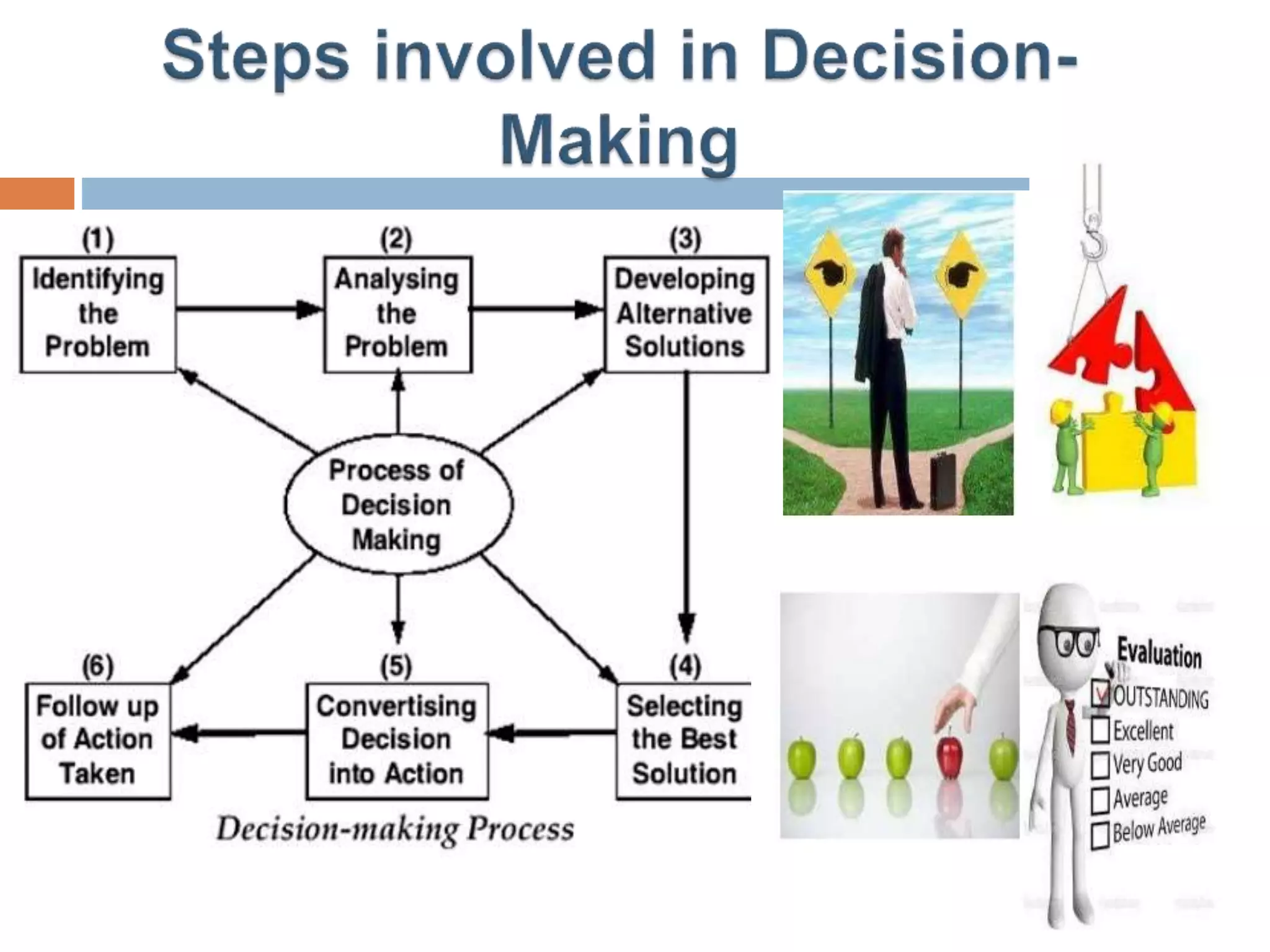
Evaluate and control
Implement decision
Select alternative
Uncertainty
conditions
Risk conditions
Certainty conditions
Evaluate alternative
solutions
Develop alternative
solutions
Identify and define
the problem
Techniques or Basis for Decision Making
 Intuition
 Facts
 Experience
 Considered Opinions
 Operations Research
 Linear Programming
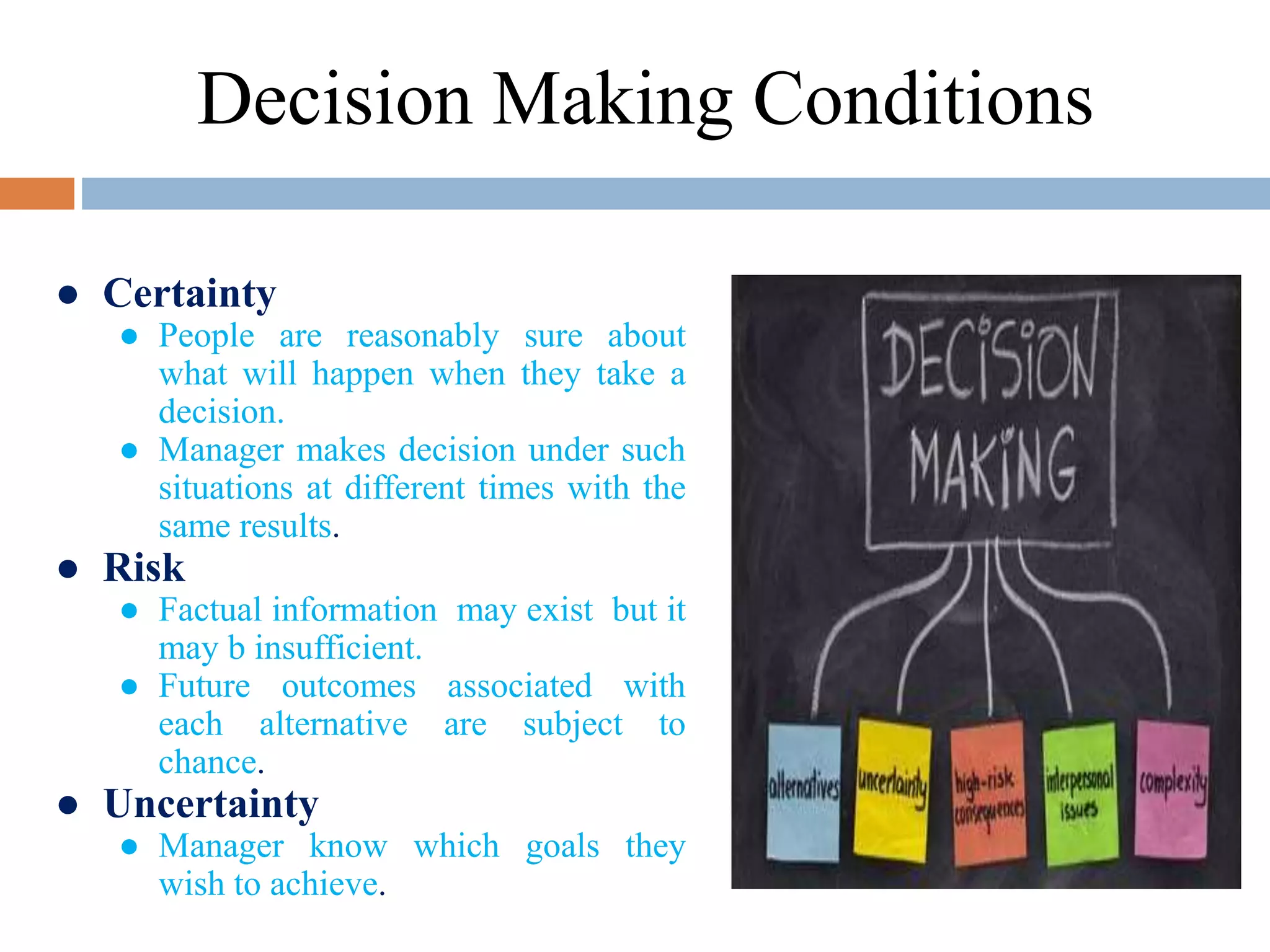
● Certainty
● People are reasonably sure about
what will happen when they take a
decision.
● Manager makes decision under such
situations at different times with the
same results.
● Risk
● Factual information may exist but it
may b insufficient.
● Future outcomes associated with
each alternative are subject to
chance.
● Uncertainty
● Manager know which goals they
wish to achieve.
Decision Making Conditions
Types of Decisions
1. Programmed and
Non-Programmed Decisions
1. Strategic and Tactical Decisions
2. Individual and Group Decisions
 For Solving day to
day and routine
problems.
 Rules & procedures
are described for
taking these
decisions.
 Remain consistent
for longer period.
 For solving both
simple & complex
problems.
 For solving non-
repetitive, tactical or
unique problems.
 Every decision will have
to be taken separately
by analyzing &
evaluating.
 Every decision is
different & no
consistency.
 For solving complex
problems.
 Requires judgments.
Programmed Decisions
Non-Programmed
Decisions
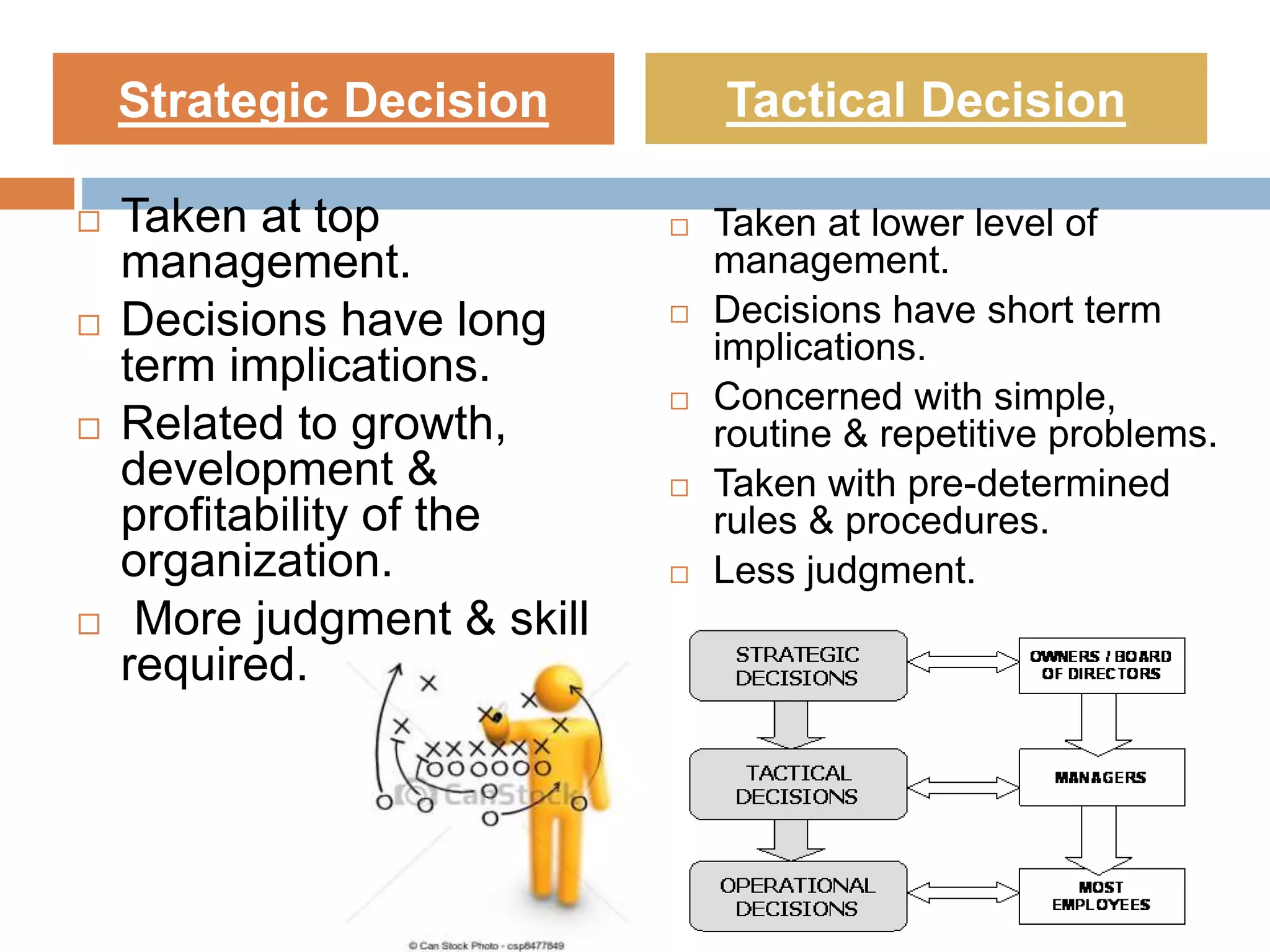
 Taken at top
management.
 Decisions have long
term implications.
 Related to growth,
development &
profitability of the
organization.
 More judgment & skill
required.
 Taken at lower level of
management.
 Decisions have short term
implications.
 Concerned with simple,
routine & repetitive problems.
 Taken with pre-determined
rules & procedures.
 Less judgment.
Strategic Decision Tactical Decision
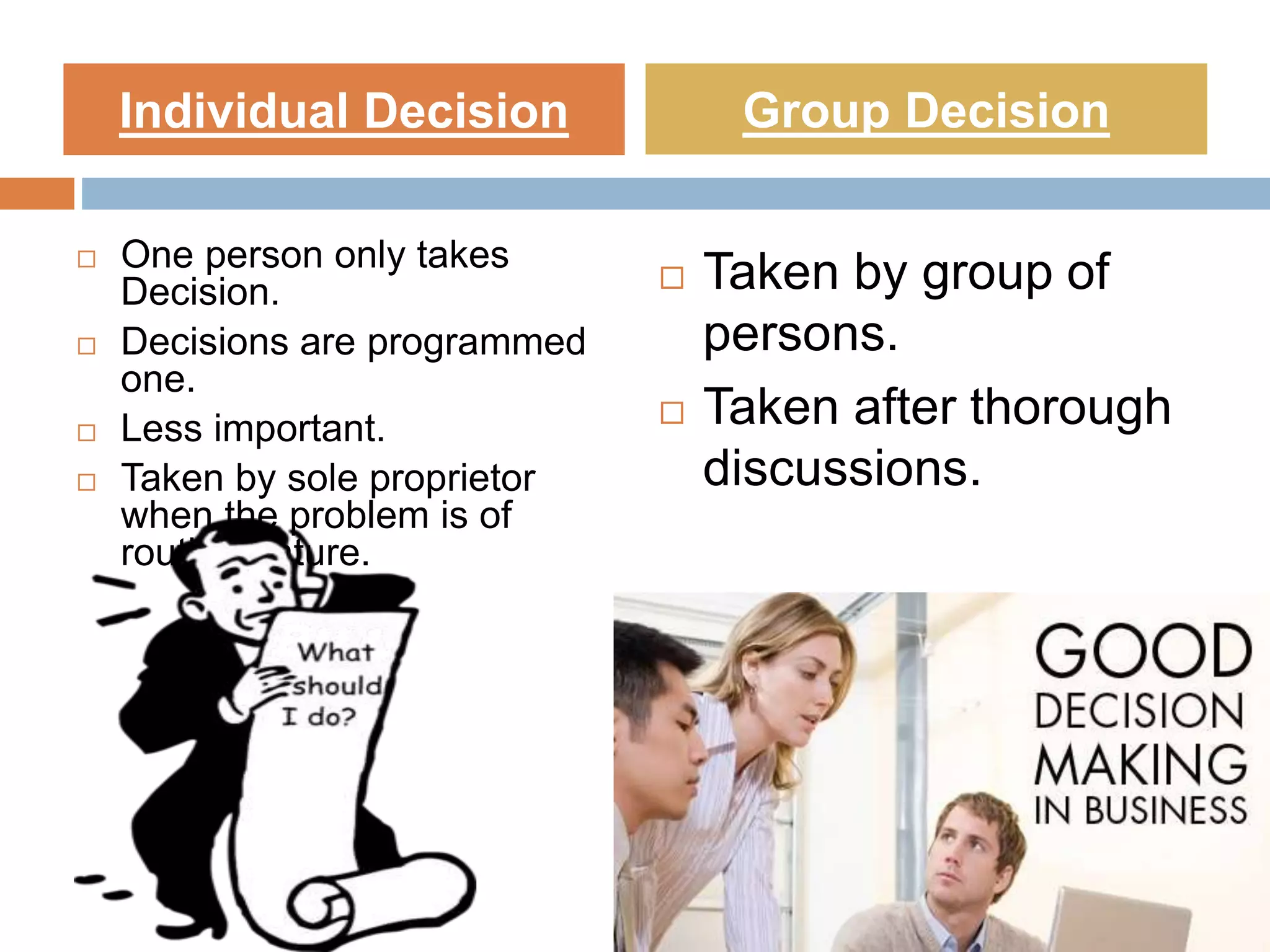
 One person only takes
Decision.
 Decisions are programmed
one.
 Less important.
 Taken by sole proprietor
when the problem is of
routine nature.
 Taken by group of
persons.
 Taken after thorough
discussions.
Individual Decision Group Decision
1. Traditional techniques
2. Modern techniques
Traditional Techniques of Decision Making
i. Standard
Procedures and
Rules
ii. Organizational
Structure
i. Linear
Programming
ii. Probability Theory
iii. Game Theory
iv. Queing Theory
v. Network
Techniques
A. Decision-Making for
programmed Decisions
B. Decision-Making for
Non-Programmed Decisions
MODERN TECHNIQUES OF DECISION MAKING
i) Heuristic Techniques
ii) Participative Decision
Making
DECISION MAKING BEHAVIOUR
MODELS
1.RATIONAL OR ‘ECONOMIC
MAN MODEL’ -
HARBERT A. SIMON defines
rationality in terms of
objective and
intelligent action. It is
characterized by
behavioural nexus
between ends and
means.
• FEATURES -
i) Systematic , logical and full
of reasoning approach
ii) Manager is supposed to be
objective iii)
Managers should try to reach
goals with positive attitude
iv) Understanding of existing
environment
2. BEHAVIOURAL MODEL OR
BOUNDED RATIONALITY OR
ADMINISTRATIVE MAN
HARBERT SIMON has proposed
a theory of ‘bounded rationality’.
This theory states that real life
decision maker must cope up
with inadequate information
about nature of the problem and
its solution. The norm of
rationality is bounded by many
limitations and ,therefore, the
concept is known as‘ bonded
rationality’.
• The managers
rationality is bounded
by the following major
limitations:-
I) Lack of information
ii) Time constraint
iii) Conflicting
objectives
iv) environmental
uncertainties
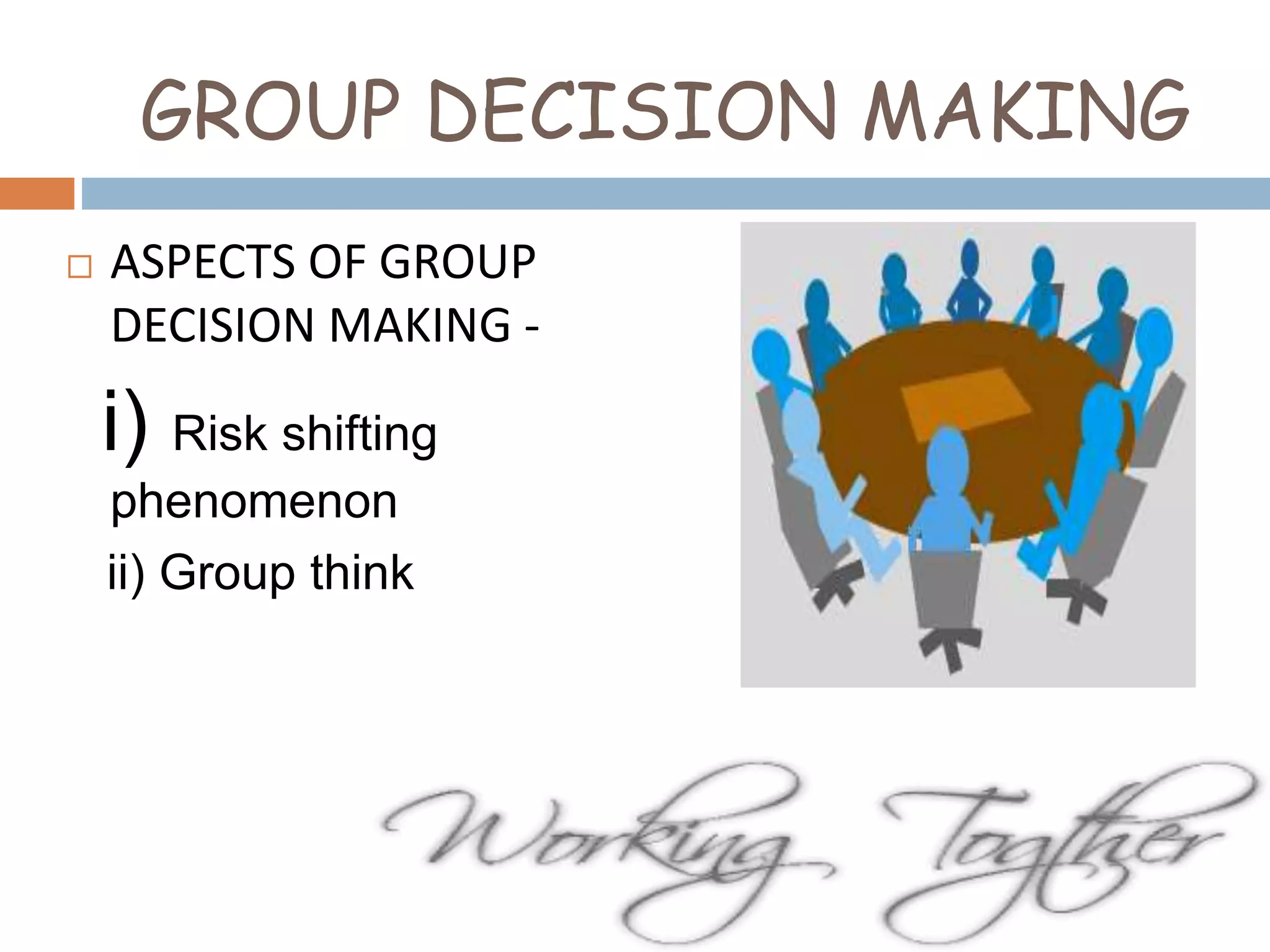
GROUP DECISION MAKING
 ASPECTS OF GROUP
DECISION MAKING -
i) Risk shifting
phenomenon
ii) Group think
Techniques of Group Decision
Making
1. Brainstorming
2. The Delphi
Technique
3. Nominal Group
Technique
4. Synectics
The technique of
brainstorming was
developed by Alex F.
Osborn to help to bring
creative ideas in the field
of advertising.
LIMITATIONS:-
-Costly
-Time consuming
-superficial ideas
Brainstorming
The Delphi technique
The Delphi method was originally conceived in the 1950s by Olaf Helmer and
Norman Dalkey of the Rand Corporation at Rand Corporation’s Think Tank.
The name refers to the Oracle of Delphi, a priestess at a temple of Apollo in
ancient Greece known for her prophecies. The Delphi method allows experts to
work towards a mutual agreement by conducting a circulating series of
questionnaires and releasing related feedback to further the discussion with each
subsequent round. The experts' responses shift as rounds are completed based
on the information brought forth by other experts participating in the analysis.
Nominal group technique
The Technique follows a
highly structured
process and tries to
integrate creative
thinking through group
interaction for solving
orgnisational problems.
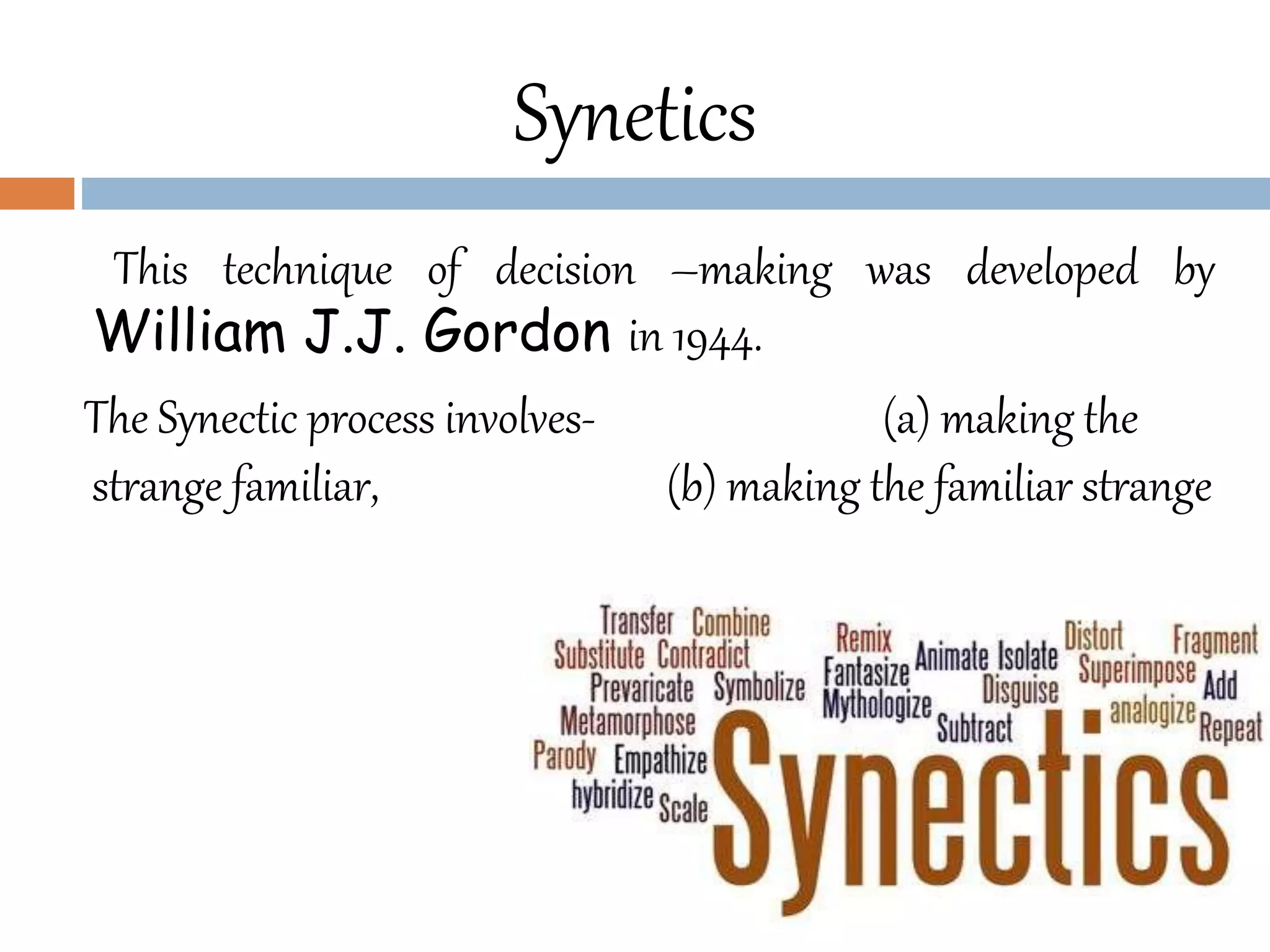
This technique of decision –making was developed by
William J.J. Gordon in 1944.
The Synectic process involves- (a) making the
strange familiar, (b) making the familiar strange
Synetics
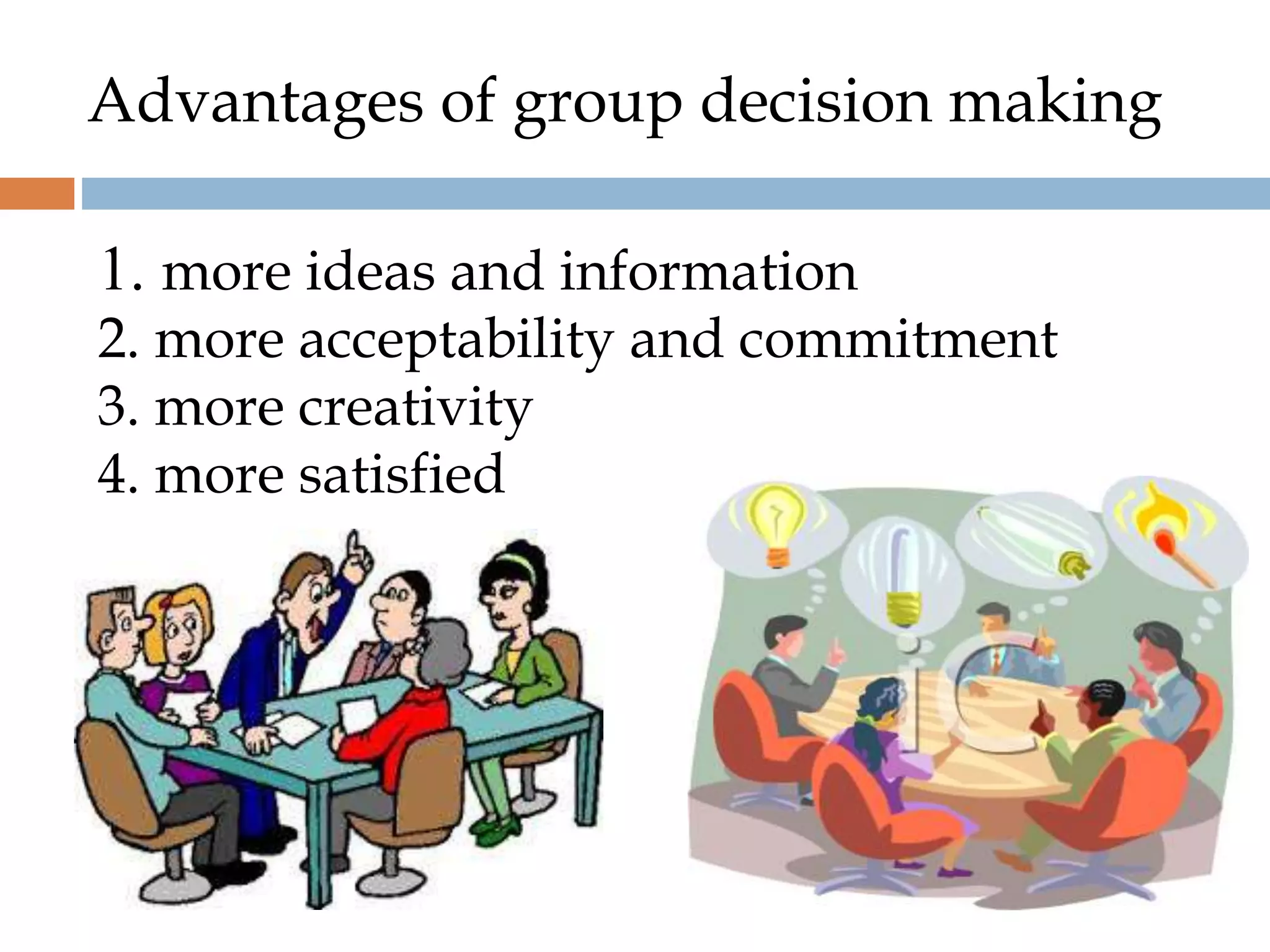
Advantages of group decision making
1. more ideas and information
2. more acceptability and commitment
3. more creativity
4. more satisfied
Disadvantages of group decision making
1. wasting more time
and energy
2. some members
dominate and others
may not express their
views
3. costly
4. conflicts
Administrative Problems In
Decision Making
1. Correctness of Decisions
2. Timing of Decisions
3. Effective communication
of Decisions
4. Participation in Decision-
Making
5. Implementation of
Decision
CHALLENGES FOR DECISION
MAKERS
1. Multiple Criteria
2. Risk and Uncertainty
3. Long term Implications
4. Inputs of different
Sections
5. Pooled Decision Making
"Good Decisions come from experience.
Experience comes from making bad decisions.”
- Mark Twain

Decision Making

  • 1.
    By Dr. H.S. ABZALBASHA, M.B.A., Ph.D. Assistant Professor, Department of Management Studies, G. Pullaiah College of Engineering & Technology, Kurnool. INTRODUCTION TO DECISION MAKING UNIT-I
  • 2.
     Introduction  Characteristics Nature of Decision Making  Steps involved in decision making  Basis for decision making  Decision making conditions  Types of decisions Techniques of Decision Making  Modern Techniques  Traditional Techniques  Decision-Making Behaviour Models  Group Decision Making  Techniques of Group Decision-Making
  • 3.
    ACCORDING TO PETERDRUCKER, ”WHATEVER A MANAGER DOES, HE DOES THROUGH DECISION MAKING..!”
  • 4.
    What is DecisionMaking? • The decision making is the basic and fundamental key of all managerial activities. It is the study of identifying and choosing best possible choice (or option) based on the values and preferences of the business organization. •Decision Making is the act of choosing one alternative from among a set of alternatives. • We have to first decide that a decision has to be made and then secondly identify a set o feasible alternatives before we select one.
  • 5.
    Definition “Decision-Making is aprocess of selection from a set of alternative courses of action which is thoughtful to fulfill the objective of the decision problem more satisfactorily than others.”- Haynes and Massie “A decision may be defined as a conscious choice among alternative courses of action.” - Philip Kotler “Whatever a manager does through making decisions.”- Peter F. Ducker: “Decision making is the selection based on some criteria from two or more possible alternatives.” - George R. Terry “Decision is the selection from among alternatives of a course of actions.” - Koontz & O’Donnel “Decision making is the blend of thinking, deciding and acting.”
  • 6.
    Characteristics  1. Decision-makingis based on rational thinking.  2. It is a process of selecting the best from among alternatives available.  3. It involves the evaluation of various alternatives available.  4. Decision-making is the end product because it is preceded by discussions and deliberations.  5. Decision-making is aimed to achieve organizational goals.  6. It also involves certain commitment.
  • 7.
    NATURE OF DECISION-MAKING A decision is always related to some problem, difficulty or conflict.  There are always differences of opinions, judgments, etc.  A decision need some sort of prediction for the future.  Sometimes Decisions are influenced by adopting the follow the leader practices.
  • 9.
    Revise Revise Revise Evaluate and control Implementdecision Select alternative Uncertainty conditions Risk conditions Certainty conditions Evaluate alternative solutions Develop alternative solutions Identify and define the problem
  • 10.
    Techniques or Basisfor Decision Making  Intuition  Facts  Experience  Considered Opinions  Operations Research  Linear Programming
  • 11.
    ● Certainty ● Peopleare reasonably sure about what will happen when they take a decision. ● Manager makes decision under such situations at different times with the same results. ● Risk ● Factual information may exist but it may b insufficient. ● Future outcomes associated with each alternative are subject to chance. ● Uncertainty ● Manager know which goals they wish to achieve. Decision Making Conditions
  • 12.
    Types of Decisions 1.Programmed and Non-Programmed Decisions 1. Strategic and Tactical Decisions 2. Individual and Group Decisions
  • 13.
     For Solvingday to day and routine problems.  Rules & procedures are described for taking these decisions.  Remain consistent for longer period.  For solving both simple & complex problems.  For solving non- repetitive, tactical or unique problems.  Every decision will have to be taken separately by analyzing & evaluating.  Every decision is different & no consistency.  For solving complex problems.  Requires judgments. Programmed Decisions Non-Programmed Decisions
  • 14.
     Taken attop management.  Decisions have long term implications.  Related to growth, development & profitability of the organization.  More judgment & skill required.  Taken at lower level of management.  Decisions have short term implications.  Concerned with simple, routine & repetitive problems.  Taken with pre-determined rules & procedures.  Less judgment. Strategic Decision Tactical Decision
  • 15.
     One persononly takes Decision.  Decisions are programmed one.  Less important.  Taken by sole proprietor when the problem is of routine nature.  Taken by group of persons.  Taken after thorough discussions. Individual Decision Group Decision
  • 16.
  • 17.
    Traditional Techniques ofDecision Making i. Standard Procedures and Rules ii. Organizational Structure i. Linear Programming ii. Probability Theory iii. Game Theory iv. Queing Theory v. Network Techniques A. Decision-Making for programmed Decisions B. Decision-Making for Non-Programmed Decisions
  • 18.
    MODERN TECHNIQUES OFDECISION MAKING i) Heuristic Techniques ii) Participative Decision Making
  • 19.
    DECISION MAKING BEHAVIOUR MODELS 1.RATIONALOR ‘ECONOMIC MAN MODEL’ - HARBERT A. SIMON defines rationality in terms of objective and intelligent action. It is characterized by behavioural nexus between ends and means. • FEATURES - i) Systematic , logical and full of reasoning approach ii) Manager is supposed to be objective iii) Managers should try to reach goals with positive attitude iv) Understanding of existing environment
  • 20.
    2. BEHAVIOURAL MODELOR BOUNDED RATIONALITY OR ADMINISTRATIVE MAN HARBERT SIMON has proposed a theory of ‘bounded rationality’. This theory states that real life decision maker must cope up with inadequate information about nature of the problem and its solution. The norm of rationality is bounded by many limitations and ,therefore, the concept is known as‘ bonded rationality’. • The managers rationality is bounded by the following major limitations:- I) Lack of information ii) Time constraint iii) Conflicting objectives iv) environmental uncertainties
  • 21.
    GROUP DECISION MAKING ASPECTS OF GROUP DECISION MAKING - i) Risk shifting phenomenon ii) Group think
  • 22.
    Techniques of GroupDecision Making 1. Brainstorming 2. The Delphi Technique 3. Nominal Group Technique 4. Synectics
  • 23.
    The technique of brainstormingwas developed by Alex F. Osborn to help to bring creative ideas in the field of advertising. LIMITATIONS:- -Costly -Time consuming -superficial ideas Brainstorming
  • 24.
    The Delphi technique TheDelphi method was originally conceived in the 1950s by Olaf Helmer and Norman Dalkey of the Rand Corporation at Rand Corporation’s Think Tank. The name refers to the Oracle of Delphi, a priestess at a temple of Apollo in ancient Greece known for her prophecies. The Delphi method allows experts to work towards a mutual agreement by conducting a circulating series of questionnaires and releasing related feedback to further the discussion with each subsequent round. The experts' responses shift as rounds are completed based on the information brought forth by other experts participating in the analysis.
  • 25.
    Nominal group technique TheTechnique follows a highly structured process and tries to integrate creative thinking through group interaction for solving orgnisational problems.
  • 26.
    This technique ofdecision –making was developed by William J.J. Gordon in 1944. The Synectic process involves- (a) making the strange familiar, (b) making the familiar strange Synetics
  • 27.
    Advantages of groupdecision making 1. more ideas and information 2. more acceptability and commitment 3. more creativity 4. more satisfied
  • 28.
    Disadvantages of groupdecision making 1. wasting more time and energy 2. some members dominate and others may not express their views 3. costly 4. conflicts
  • 29.
    Administrative Problems In DecisionMaking 1. Correctness of Decisions 2. Timing of Decisions 3. Effective communication of Decisions 4. Participation in Decision- Making 5. Implementation of Decision
  • 30.
    CHALLENGES FOR DECISION MAKERS 1.Multiple Criteria 2. Risk and Uncertainty 3. Long term Implications 4. Inputs of different Sections 5. Pooled Decision Making
  • 32.
    "Good Decisions comefrom experience. Experience comes from making bad decisions.” - Mark Twain