
Laith Alasadi
A structured approach to
shifting/transitioning
individuals, teams, and
organizations from a current state
to a desired future state.
(wikipedia.org)
Definitions of Change :
2
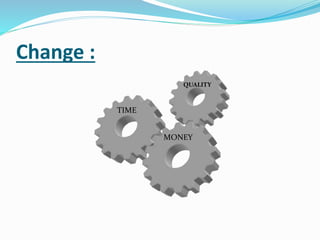
Change :
QUALITY
TIME
MONEY
Change :
“It is not the knowing that is
difficult, but the doing”
Chinese proverb
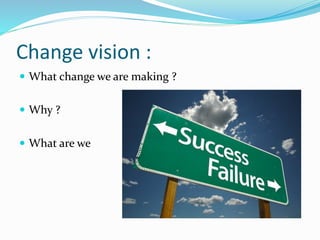
Change vision :
 What change we are making ?
 Why ?
 What are we hoping for?
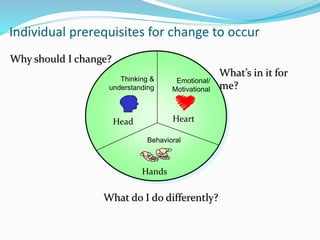
Individual prerequisites for change to occur
Thinking &
understanding
Emotional/
Motivational
Behavioral
Head Heart
Hands
Why should I change?
What’s in it for
me?
What do I do differently?
Change steps
 Use a Checklist to ensure
 Methodical planning
 Appropriate project support
 Effective communications
 Engaged stakeholders
 Resistance mitigation
 Ongoing training
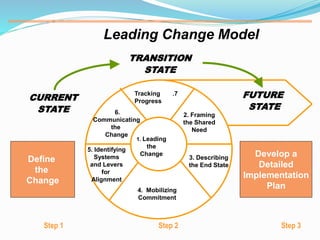
CURRENT
STATE
TRANSITION
STATE
FUTURE
STATE
1. Leading
the
Change
2. Framing
the Shared
Need
3. Describing
the End State
4. Mobilizing
Commitment
5. Identifying
Systems
and Levers
for
Alignment
6.
Communicating
the
Change
.7Tracking
Progress
Define
the
Change
Develop a
Detailed
Implementation
Plan
Step 1 Step 2 Step 3
Leading Change Model
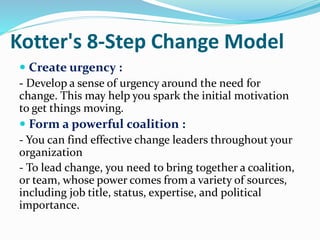
Kotter's 8-Step Change Model
 Create urgency :
- Develop a sense of urgency around the need for
change. This may help you spark the initial motivation
to get things moving.
 Form a powerful coalition :
- You can find effective change leaders throughout your
organization
- To lead change, you need to bring together a coalition,
or team, whose power comes from a variety of sources,
including job title, status, expertise, and political
importance.
-
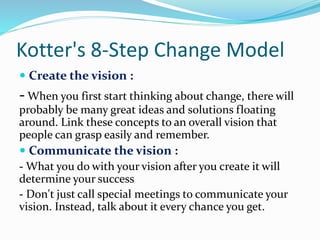
Kotter's 8-Step Change Model
 Create the vision :
- When you first start thinking about change, there will
probably be many great ideas and solutions floating
around. Link these concepts to an overall vision that
people can grasp easily and remember.
 Communicate the vision :
- What you do with your vision after you create it will
determine your success
- Don't just call special meetings to communicate your
vision. Instead, talk about it every chance you get.
 Remove obstacle :
- Identify people who are resisting the change, and help
them see what's needed.
- Take action to quickly remove barriers (human or
otherwise).
 Create short term wins :
- Nothing motivates more than success.
- Give your company a taste of victory early in the
change process
 Build on the change
- Kotter argues that many change projects fail because
victory is declared too early.
- Real change runs deep. Quick wins are only the
beginning of what needs to be done to achieve long-
term change.
 Anchor the change in the culture
- Finally, to make any change stick, it should become
part of the core of your organization.
- Make continuous efforts to ensure that the change is
seen in every aspect of your organization.
Leading change :
 When leaders are planning to lead change, there are
four key principles that need to be kept in mind:
1. Different People React Differently To Change
2. Everyone Has Fundamental Needs That Have To Be
Met
3. Change Often Involves A Loss, And People Go
Through The "Loss Curve“
4. Fears Have To Be Dealt With
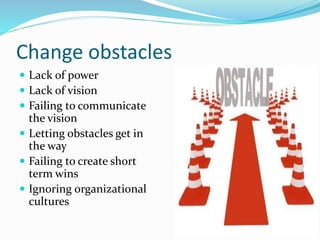
Change obstacles
 Lack of power
 Lack of vision
 Failing to communicate
the vision
 Letting obstacles get in
the way
 Failing to create short
term wins
 Ignoring organizational
cultures
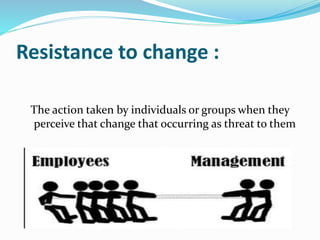
Resistance to change :
The action taken by individuals or groups when they
perceive that change that occurring as threat to them
Resistance to change :
causes of resistance to change :
- Poor communication ( reasons , benefits , time )
- Self interest
- Feeling excluded ( threat)
- Lack of trust
- Skill / training dearth
Change adoption :
 Factors affecting adoption :
- Relative advantage
- Simplicity ( easy to understood )
- Easy to try
- Easy to measure
- Inexpensive
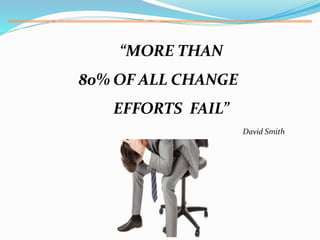
“MORE THAN
80% OF ALL CHANGE
EFFORTS FAIL”
David Smith
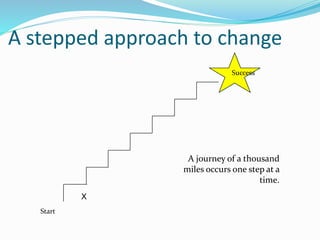
A stepped approach to change
Start
X
A journey of a thousand
miles occurs one step at a
time.
Success
Change Management vs.
Change Leadership
 Change leadership is more collaborative and seeks to
inspire.
 Change management is about controlling change.
 Change leadership requires tolerating risk.
 Change management is making small changes at one
time
 change in a series of manageable steps.
Change Management vs. Change
Leadership
 Change leadership is initiating change on a larger
scale.
 Change management is concerned with order,
timeliness, and budgets.
 Change leadership is a response to an urgent need for
change.
 Change management integrates change into the status
quo.
Change Management vs. Change
Leadership
 Change leadership innovates and sets a vision for a
new normal.
 Change management is encouraging people to adapt
to change.
 Change leadership is empowering people to create
change.
 Becoming skilled at change management is often a
matter of going through the change process a few
times, using some tools and techniques,.
Change Management vs. Change
Leadership
 Change leadership requires leadership skills. These
are more difficult to define and take a longer time to
develop..
Thank you

Leading change

  • 1.
  • 2.
    A structured approachto shifting/transitioning individuals, teams, and organizations from a current state to a desired future state. (wikipedia.org) Definitions of Change : 2
  • 4.
  • 5.
    Change : “It isnot the knowing that is difficult, but the doing” Chinese proverb
  • 6.
    Change vision : What change we are making ?  Why ?  What are we hoping for?
  • 7.
    Individual prerequisites forchange to occur Thinking & understanding Emotional/ Motivational Behavioral Head Heart Hands Why should I change? What’s in it for me? What do I do differently?
  • 8.
    Change steps  Usea Checklist to ensure  Methodical planning  Appropriate project support  Effective communications  Engaged stakeholders  Resistance mitigation  Ongoing training
  • 9.
    CURRENT STATE TRANSITION STATE FUTURE STATE 1. Leading the Change 2. Framing theShared Need 3. Describing the End State 4. Mobilizing Commitment 5. Identifying Systems and Levers for Alignment 6. Communicating the Change .7Tracking Progress Define the Change Develop a Detailed Implementation Plan Step 1 Step 2 Step 3 Leading Change Model
  • 10.
    Kotter's 8-Step ChangeModel  Create urgency : - Develop a sense of urgency around the need for change. This may help you spark the initial motivation to get things moving.  Form a powerful coalition : - You can find effective change leaders throughout your organization - To lead change, you need to bring together a coalition, or team, whose power comes from a variety of sources, including job title, status, expertise, and political importance. -
  • 11.
    Kotter's 8-Step ChangeModel  Create the vision : - When you first start thinking about change, there will probably be many great ideas and solutions floating around. Link these concepts to an overall vision that people can grasp easily and remember.  Communicate the vision : - What you do with your vision after you create it will determine your success - Don't just call special meetings to communicate your vision. Instead, talk about it every chance you get.
  • 12.
     Remove obstacle: - Identify people who are resisting the change, and help them see what's needed. - Take action to quickly remove barriers (human or otherwise).  Create short term wins : - Nothing motivates more than success. - Give your company a taste of victory early in the change process
  • 13.
     Build onthe change - Kotter argues that many change projects fail because victory is declared too early. - Real change runs deep. Quick wins are only the beginning of what needs to be done to achieve long- term change.  Anchor the change in the culture - Finally, to make any change stick, it should become part of the core of your organization. - Make continuous efforts to ensure that the change is seen in every aspect of your organization.
  • 14.
    Leading change : When leaders are planning to lead change, there are four key principles that need to be kept in mind: 1. Different People React Differently To Change 2. Everyone Has Fundamental Needs That Have To Be Met 3. Change Often Involves A Loss, And People Go Through The "Loss Curve“ 4. Fears Have To Be Dealt With
  • 15.
    Change obstacles  Lackof power  Lack of vision  Failing to communicate the vision  Letting obstacles get in the way  Failing to create short term wins  Ignoring organizational cultures
  • 16.
    Resistance to change: The action taken by individuals or groups when they perceive that change that occurring as threat to them
  • 17.
    Resistance to change: causes of resistance to change : - Poor communication ( reasons , benefits , time ) - Self interest - Feeling excluded ( threat) - Lack of trust - Skill / training dearth
  • 18.
    Change adoption : Factors affecting adoption : - Relative advantage - Simplicity ( easy to understood ) - Easy to try - Easy to measure - Inexpensive
  • 19.
    “MORE THAN 80% OFALL CHANGE EFFORTS FAIL” David Smith
  • 20.
    A stepped approachto change Start X A journey of a thousand miles occurs one step at a time. Success
  • 21.
    Change Management vs. ChangeLeadership  Change leadership is more collaborative and seeks to inspire.  Change management is about controlling change.  Change leadership requires tolerating risk.  Change management is making small changes at one time  change in a series of manageable steps.
  • 22.
    Change Management vs.Change Leadership  Change leadership is initiating change on a larger scale.  Change management is concerned with order, timeliness, and budgets.  Change leadership is a response to an urgent need for change.  Change management integrates change into the status quo.
  • 23.
    Change Management vs.Change Leadership  Change leadership innovates and sets a vision for a new normal.  Change management is encouraging people to adapt to change.  Change leadership is empowering people to create change.  Becoming skilled at change management is often a matter of going through the change process a few times, using some tools and techniques,.
  • 24.
    Change Management vs.Change Leadership  Change leadership requires leadership skills. These are more difficult to define and take a longer time to develop..
  • 25.