By
Dr. H.S. ABZAL BASHA, M.B.A., Ph.D.
RUHI AFREEN, M.B.A
Assistant Professor,
Department of Management Studies,
G. Pullaiah College of Engineering & Technology, Kurnool.
HUMAN RESOURCE MANAGEMENT
Flippo defines personnel management as the
planning, organizing, and controlling of the
procurement, development, compensation,
integration and maintenance of people
(employees) for the purpose of contributing to the
organizational goals.
JOB ANALYSIS
Job analysis can be defined as the process of
identifying the tasks comprising a particular job to
assess whether they could be organized in a productive
manner. This will identify the main features of the job,
the major tasks undertaken, the results to be achieved,
and how one job is related to the other jobs in the
organizational hierarchy. The product of job analysis is
job description.
JOB DESCRIPTION
Job description is an accurate and concise description
of (a) The overall purposes of the job (b) The principal
duties of the person doing this job.
Contents of Job Description:
 Job title and grade
 To whom one has to report
 What authority one has
 For whom one is responsible
 The main objectives
 Key responsibilities and tasks
JOB SPECIFICATION
Job specification identifies the requirements on
the part of the person to perform the given job.
It includes:
•The knowledge and understanding required
for the job.
•The skills and abilities required for the job.
•The necessary job related experience.
•The educational and technical qualifications.
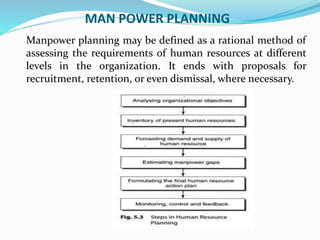
MAN POWER PLANNING
Manpower planning may be defined as a rational method of
assessing the requirements of human resources at different
levels in the organization. It ends with proposals for
recruitment, retention, or even dismissal, where necessary.
RECRUITMENT
Recruitment is the process of searching for the
prospective employee and stimulating and encouraging
them to apply for the job in the organization.
Recruitment is often called a positive function as the
applications are invited from prospective employees at
this stage. The sources of recruitment include: Internet,
advertisements in the media, employment exchanges,
university and college campuses, technical and trade
journals and so on.
SELECTION
The process of identifying the most suitable persons for
the organization is called selection. Selection is also
called a negative function because at a stage the
applications are screened and short-listed based on the
selection criteria. The main purpose of selection is to
choose the right person for the right job.
SELECTION PROCESS INVOLVES THE
FOLLOWING STAGES:
• Initial screening/Short listing
•Comprehensive application/bio data
screening
•Aptitude or written rests
•Group discussion
•Personal interviews
•Medical examination
• Employment offer letter
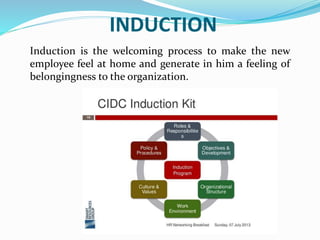
INDUCTION
Induction is the welcoming process to make the new
employee feel at home and generate in him a feeling of
belongingness to the organization.
PLACEMENT
After training, the employee is placed in his/her position under
the charge of a manager. The new recruit is allowed to exercise
full authority and is held responsible for the results.
 a) Promotion: Promotion refers to the advancement of an
employee to a job with a higher authority and responsibility
 b) Demotion: Where an employee is not in a position to
perform a given job, he may be demoted or transferred to a
position with a lower authority and salary.
 c) Transfer: It is a lateral shift that moves an individual
employee from one position to another. It may be in the same
department, or to a different department or location.
 d) Separation: Separation refers to termination of employment.
In other words, the employee is separated from his job.
 e) Absenteeism: Absenteeism refers to the practice of an
employee who does not report to work for any particular reason.
Absenteeism affects the productivity adversely.
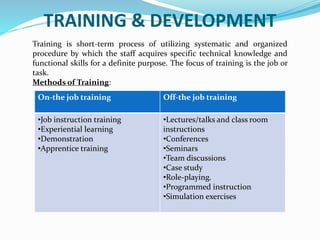
TRAINING & DEVELOPMENT
Training is short-term process of utilizing systematic and organized
procedure by which the staff acquires specific technical knowledge and
functional skills for a definite purpose. The focus of training is the job or
task.
Methods of Training:
On-the job training Off-the job training
•Job instruction training
•Experiential learning
•Demonstration
•Apprentice training
•Lectures/talks and class room
instructions
•Conferences
•Seminars
•Team discussions
•Case study
•Role-playing.
•Programmed instruction
•Simulation exercises
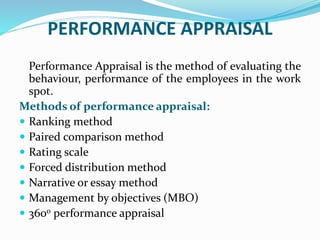
PERFORMANCE APPRAISAL
Performance Appraisal is the method of evaluating the
behaviour, performance of the employees in the work
spot.
Methods of performance appraisal:
 Ranking method
 Paired comparison method
 Rating scale
 Forced distribution method
 Narrative or essay method
 Management by objectives (MBO)
 3600 performance appraisal
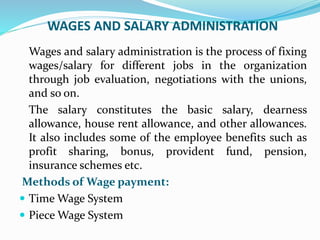
WAGES AND SALARY ADMINISTRATION
Wages and salary administration is the process of fixing
wages/salary for different jobs in the organization
through job evaluation, negotiations with the unions,
and so on.
The salary constitutes the basic salary, dearness
allowance, house rent allowance, and other allowances.
It also includes some of the employee benefits such as
profit sharing, bonus, provident fund, pension,
insurance schemes etc.
Methods of Wage payment:
 Time Wage System
 Piece Wage System
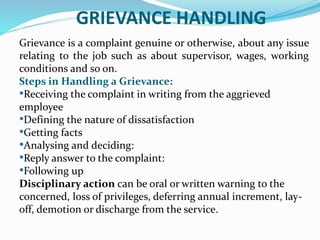
GRIEVANCE HANDLING
Grievance is a complaint genuine or otherwise, about any issue
relating to the job such as about supervisor, wages, working
conditions and so on.
Steps in Handling a Grievance:
•Receiving the complaint in writing from the aggrieved
employee
•Defining the nature of dissatisfaction
•Getting facts
•Analysing and deciding:
•Reply answer to the complaint:
•Following up
Disciplinary action can be oral or written warning to the
concerned, loss of privileges, deferring annual increment, lay-
off, demotion or discharge from the service.
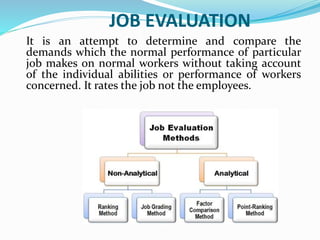
JOB EVALUATION
It is an attempt to determine and compare the
demands which the normal performance of particular
job makes on normal workers without taking account
of the individual abilities or performance of workers
concerned. It rates the job not the employees.
Human Resource Management

Human Resource Management

  • 1.
    By Dr. H.S. ABZALBASHA, M.B.A., Ph.D. RUHI AFREEN, M.B.A Assistant Professor, Department of Management Studies, G. Pullaiah College of Engineering & Technology, Kurnool.
  • 2.
    HUMAN RESOURCE MANAGEMENT Flippodefines personnel management as the planning, organizing, and controlling of the procurement, development, compensation, integration and maintenance of people (employees) for the purpose of contributing to the organizational goals.
  • 3.
    JOB ANALYSIS Job analysiscan be defined as the process of identifying the tasks comprising a particular job to assess whether they could be organized in a productive manner. This will identify the main features of the job, the major tasks undertaken, the results to be achieved, and how one job is related to the other jobs in the organizational hierarchy. The product of job analysis is job description.
  • 4.
    JOB DESCRIPTION Job descriptionis an accurate and concise description of (a) The overall purposes of the job (b) The principal duties of the person doing this job. Contents of Job Description:  Job title and grade  To whom one has to report  What authority one has  For whom one is responsible  The main objectives  Key responsibilities and tasks
  • 5.
    JOB SPECIFICATION Job specificationidentifies the requirements on the part of the person to perform the given job. It includes: •The knowledge and understanding required for the job. •The skills and abilities required for the job. •The necessary job related experience. •The educational and technical qualifications.
  • 7.
    MAN POWER PLANNING Manpowerplanning may be defined as a rational method of assessing the requirements of human resources at different levels in the organization. It ends with proposals for recruitment, retention, or even dismissal, where necessary.
  • 8.
    RECRUITMENT Recruitment is theprocess of searching for the prospective employee and stimulating and encouraging them to apply for the job in the organization. Recruitment is often called a positive function as the applications are invited from prospective employees at this stage. The sources of recruitment include: Internet, advertisements in the media, employment exchanges, university and college campuses, technical and trade journals and so on.
  • 9.
    SELECTION The process ofidentifying the most suitable persons for the organization is called selection. Selection is also called a negative function because at a stage the applications are screened and short-listed based on the selection criteria. The main purpose of selection is to choose the right person for the right job.
  • 10.
    SELECTION PROCESS INVOLVESTHE FOLLOWING STAGES: • Initial screening/Short listing •Comprehensive application/bio data screening •Aptitude or written rests •Group discussion •Personal interviews •Medical examination • Employment offer letter
  • 11.
    INDUCTION Induction is thewelcoming process to make the new employee feel at home and generate in him a feeling of belongingness to the organization.
  • 12.
    PLACEMENT After training, theemployee is placed in his/her position under the charge of a manager. The new recruit is allowed to exercise full authority and is held responsible for the results.  a) Promotion: Promotion refers to the advancement of an employee to a job with a higher authority and responsibility  b) Demotion: Where an employee is not in a position to perform a given job, he may be demoted or transferred to a position with a lower authority and salary.  c) Transfer: It is a lateral shift that moves an individual employee from one position to another. It may be in the same department, or to a different department or location.  d) Separation: Separation refers to termination of employment. In other words, the employee is separated from his job.  e) Absenteeism: Absenteeism refers to the practice of an employee who does not report to work for any particular reason. Absenteeism affects the productivity adversely.
  • 13.
    TRAINING & DEVELOPMENT Trainingis short-term process of utilizing systematic and organized procedure by which the staff acquires specific technical knowledge and functional skills for a definite purpose. The focus of training is the job or task. Methods of Training: On-the job training Off-the job training •Job instruction training •Experiential learning •Demonstration •Apprentice training •Lectures/talks and class room instructions •Conferences •Seminars •Team discussions •Case study •Role-playing. •Programmed instruction •Simulation exercises
  • 14.
    PERFORMANCE APPRAISAL Performance Appraisalis the method of evaluating the behaviour, performance of the employees in the work spot. Methods of performance appraisal:  Ranking method  Paired comparison method  Rating scale  Forced distribution method  Narrative or essay method  Management by objectives (MBO)  3600 performance appraisal
  • 15.
    WAGES AND SALARYADMINISTRATION Wages and salary administration is the process of fixing wages/salary for different jobs in the organization through job evaluation, negotiations with the unions, and so on. The salary constitutes the basic salary, dearness allowance, house rent allowance, and other allowances. It also includes some of the employee benefits such as profit sharing, bonus, provident fund, pension, insurance schemes etc. Methods of Wage payment:  Time Wage System  Piece Wage System
  • 16.
    GRIEVANCE HANDLING Grievance isa complaint genuine or otherwise, about any issue relating to the job such as about supervisor, wages, working conditions and so on. Steps in Handling a Grievance: •Receiving the complaint in writing from the aggrieved employee •Defining the nature of dissatisfaction •Getting facts •Analysing and deciding: •Reply answer to the complaint: •Following up Disciplinary action can be oral or written warning to the concerned, loss of privileges, deferring annual increment, lay- off, demotion or discharge from the service.
  • 17.
    JOB EVALUATION It isan attempt to determine and compare the demands which the normal performance of particular job makes on normal workers without taking account of the individual abilities or performance of workers concerned. It rates the job not the employees.