

UNIT-V
By
Dr. H.S. ABZAL BASHA, M.B.A., Ph.D.
Assistant Professor,
Department of Management Studies,
G. Pullaiah College of Engineering & Technology,
Kurnool.
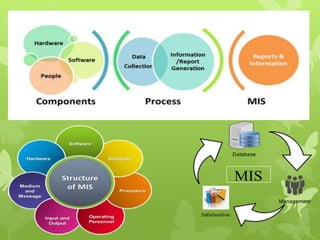
MIS refers to the process of covering the
application of people, technology and
procedures to solve business problems.
It is the responsibility of MIS department to
develop and design the reporting formats for
various functional departments such as
production, finance, marketing, HR etc. MIS
provides all the information that is necessary for
operational, tactical and strategic decisions by
using decision support system, expert systems
and artificial intelligence.
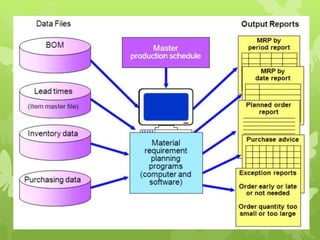
Material Requirements Planning (MRP) is a production
planning, scheduling, and inventory control system used
to manage manufacturing processes.
Objectives:
•To ensure the availability of materials and products for
production and distribute to the customers.
•To maintain the lowest possible level of inventory
•To plan manufacturing activities, delivery schedules and
purchasing activities.
MRP is a tool to deal with these problems. It provides answers
for several questions:
 What items are required?
 How many are required?
 When are they required?...
Just-in-time (JIT) manufacturing, also known as just-in-time
production or the Toyota Production System (TPS), is a
methodology aimed primarily at reducing times within production
system as well as response times from suppliers and to customers.
Its origin and development was in Japan, largely in the 1960s and
1970s and particularly at Toyota.
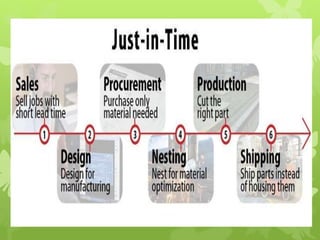
Just in time – JIT – The just-in-time concept is one of
the Lean tools and is essentially an inventory strategy that
prescribes receiving goods only when they are needed thus reducing
waste, inventory costs and decreasing capital needed to run the
business. In addition, having low inventory can be viewed as more
flexible, i.e. if a product does not sell well, you can always switch to
something else (both in terms of finished goods and raw materials).
JIT is also called as “Stockless production” or “Lean production”.
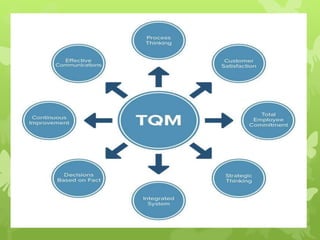
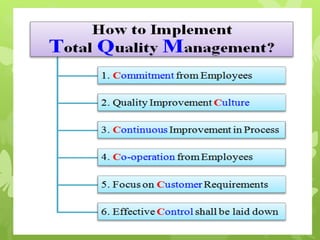
Total Quality Management is an Japanese management approach
focus on long-term success by customer satisfaction. TQM is an
extensive and structured organization management approach that
focuses on continuous quality improvement of products and
services by using continuous feedback. In a TQM effort, all
members of an organization participate in improving processes,
products, services, and the culture as; product quality or service
quality, as well as enhancing the production process or process of
rendering of services. Joseph Juran and William E. Deming were
developed this concept during 1950’s.
The key principles of Total Quality Management
Plan (drive, direct)
Do (deploy, support, and participate)
Check (review)
Act (recognize, communicate, revise)
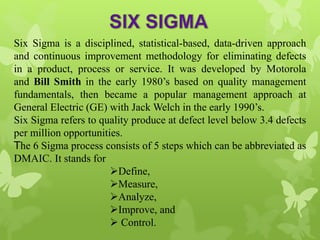
Six Sigma is a disciplined, statistical-based, data-driven approach
and continuous improvement methodology for eliminating defects
in a product, process or service. It was developed by Motorola
and Bill Smith in the early 1980’s based on quality management
fundamentals, then became a popular management approach at
General Electric (GE) with Jack Welch in the early 1990’s.
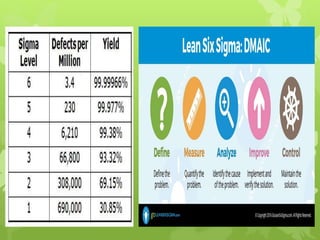
Six Sigma refers to quality produce at defect level below 3.4 defects
per million opportunities.
The 6 Sigma process consists of 5 steps which can be abbreviated as
DMAIC. It stands for
Define,
Measure,
Analyze,
Improve, and
 Control.
Capability maturity Model (CMM) is a collection of
instructions an organization can follow with the
purpose to gain better control over its software
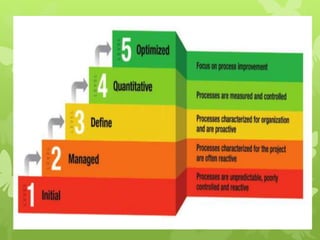
development process. The CMM ranks software
development organizations in a hierarchy of five
levels each with a progressively greater capability of
producing quality software. Each level is described as
a level of maturity.
Level – 1 - Initial
Level – 2 – Repeatable
Level – 3 - Defined
Level – 4 - Managed
Level – 5 - Optimizing
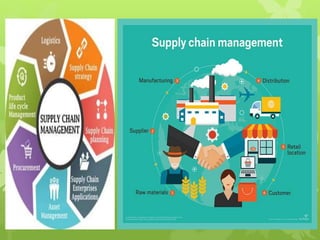
Supply chain management is the process of planning,
implementing and controlling the operations of the supply
chain as efficiently as possible.
In 1982, Keith Oliver, (a consultant at Booz Allen
Hamilton) introduced the term "supply chain
management" to the public domain in an interview for
the Financial Times. Supply chain execution is managing
and co-ordinating the movement of materials, information
and funds across the supply chain in a directional flow.
Supply chain management spans all movement and
storage of raw materials, work-in-process inventory,
and finished goods from point-of-origin to point-of
consumption.
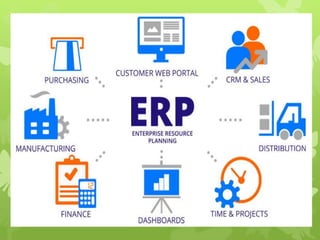
ERP is a method of using computer technology to link various
functions—such as accounting, inventory control, and human
resources—across an entire company. ERP is intended to
facilitate information sharing, business planning, and decision
making on an enterprise-wide basis.
ERP systems track business resources—cash, raw
materials, production capacity—and the status of business
commitments: orders, purchase orders, and payroll.
The applications that make up the system share data across
various departments (manufacturing, purchasing,
sales, accounting, etc.) that provide the data. ERP facilitates
information flow between all business functions and manages
connections to outside stakeholders.
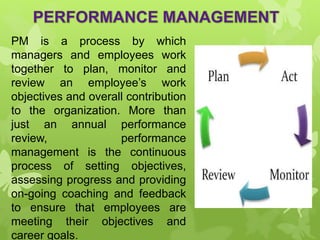
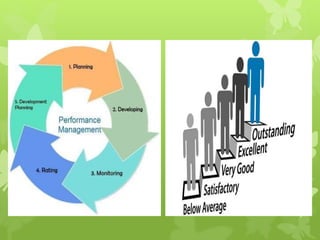
PM is a process by which
managers and employees work
together to plan, monitor and
review an employee’s work
objectives and overall contribution
to the organization. More than
just an annual performance
review, performance
management is the continuous
process of setting objectives,
assessing progress and providing
on-going coaching and feedback
to ensure that employees are
meeting their objectives and
career goals.
Business process outsourcing (BPO) is a method of
subcontracting various business-related operations to third-
party vendors. Although BPO originally applied solely to
manufacturing entities, such as soft drink manufacturers that
outsourced large segments of their supply chains, BPO now
applies to the outsourcing of services, as well.
The main motive for business process outsourcing is allow the
company to invest more time, money and human resources into
core activities and building strategies, which fuel company
growth.
BPO is often divided into two categories.
•Back Office Outsourcing
•Front Office Outsourcing
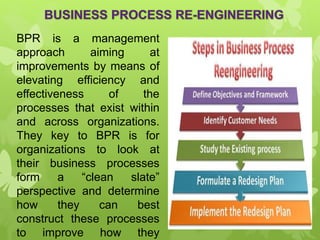
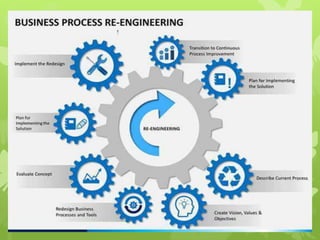
BPR is a management
approach aiming at
improvements by means of
elevating efficiency and
effectiveness of the
processes that exist within
and across organizations.
They key to BPR is for
organizations to look at
their business processes
form a “clean slate”
perspective and determine
how they can best
construct these processes
to improve how they
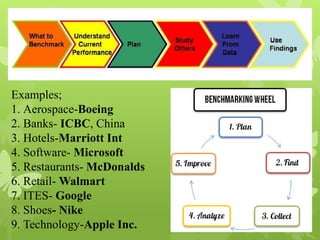
Benchmarking is a process of measuring the performance
of a company's products, services, or processes against
those of another business considered to be the best in the
industry, aka “best in class.” Dr. Robert C. Camp, from
the Best Practice Institute in the USA, invented the
benchmarking method in 1994.
The point of benchmarking is to identify internal
opportunities for improvement. In the process of best
practice benchmarking, management identifies the best
firms in their industry, or in another industry where similar
processes exist, and compares the results and processes of
those studied (the "targets") to one's own results and
processes.
Examples;
1. Aerospace-Boeing
2. Banks- ICBC, China
3. Hotels-Marriott Int
4. Software- Microsoft
5. Restaurants- McDonalds
6. Retail- Walmart
7. ITES- Google
8. Shoes- Nike
9. Technology-Apple Inc.
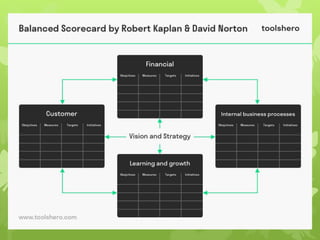
The Balanced Scorecard (or balance score card) is a
strategic performance measurement model which is
developed by Robert Kaplan and David Norton.
Its objective is to translate an organization's mission and
vision into actual (operational) actions (strategic planning).
The balance scorecard suggests that we view the
organization from four perspectives’ and to develop metrics.
• The learning and growth perspective:
• The business process perspective
• The customer perspective
• The financial perspective.
Contemporary Management Practices

Contemporary Management Practices

  • 1.
    UNIT-V By Dr. H.S. ABZALBASHA, M.B.A., Ph.D. Assistant Professor, Department of Management Studies, G. Pullaiah College of Engineering & Technology, Kurnool.
  • 2.
    MIS refers tothe process of covering the application of people, technology and procedures to solve business problems. It is the responsibility of MIS department to develop and design the reporting formats for various functional departments such as production, finance, marketing, HR etc. MIS provides all the information that is necessary for operational, tactical and strategic decisions by using decision support system, expert systems and artificial intelligence.
  • 4.
    Material Requirements Planning(MRP) is a production planning, scheduling, and inventory control system used to manage manufacturing processes. Objectives: •To ensure the availability of materials and products for production and distribute to the customers. •To maintain the lowest possible level of inventory •To plan manufacturing activities, delivery schedules and purchasing activities. MRP is a tool to deal with these problems. It provides answers for several questions:  What items are required?  How many are required?  When are they required?...
  • 6.
    Just-in-time (JIT) manufacturing,also known as just-in-time production or the Toyota Production System (TPS), is a methodology aimed primarily at reducing times within production system as well as response times from suppliers and to customers. Its origin and development was in Japan, largely in the 1960s and 1970s and particularly at Toyota. Just in time – JIT – The just-in-time concept is one of the Lean tools and is essentially an inventory strategy that prescribes receiving goods only when they are needed thus reducing waste, inventory costs and decreasing capital needed to run the business. In addition, having low inventory can be viewed as more flexible, i.e. if a product does not sell well, you can always switch to something else (both in terms of finished goods and raw materials). JIT is also called as “Stockless production” or “Lean production”.
  • 8.
    Total Quality Managementis an Japanese management approach focus on long-term success by customer satisfaction. TQM is an extensive and structured organization management approach that focuses on continuous quality improvement of products and services by using continuous feedback. In a TQM effort, all members of an organization participate in improving processes, products, services, and the culture as; product quality or service quality, as well as enhancing the production process or process of rendering of services. Joseph Juran and William E. Deming were developed this concept during 1950’s. The key principles of Total Quality Management Plan (drive, direct) Do (deploy, support, and participate) Check (review) Act (recognize, communicate, revise)
  • 11.
    Six Sigma isa disciplined, statistical-based, data-driven approach and continuous improvement methodology for eliminating defects in a product, process or service. It was developed by Motorola and Bill Smith in the early 1980’s based on quality management fundamentals, then became a popular management approach at General Electric (GE) with Jack Welch in the early 1990’s. Six Sigma refers to quality produce at defect level below 3.4 defects per million opportunities. The 6 Sigma process consists of 5 steps which can be abbreviated as DMAIC. It stands for Define, Measure, Analyze, Improve, and  Control.
  • 13.
    Capability maturity Model(CMM) is a collection of instructions an organization can follow with the purpose to gain better control over its software development process. The CMM ranks software development organizations in a hierarchy of five levels each with a progressively greater capability of producing quality software. Each level is described as a level of maturity. Level – 1 - Initial Level – 2 – Repeatable Level – 3 - Defined Level – 4 - Managed Level – 5 - Optimizing
  • 15.
    Supply chain managementis the process of planning, implementing and controlling the operations of the supply chain as efficiently as possible. In 1982, Keith Oliver, (a consultant at Booz Allen Hamilton) introduced the term "supply chain management" to the public domain in an interview for the Financial Times. Supply chain execution is managing and co-ordinating the movement of materials, information and funds across the supply chain in a directional flow. Supply chain management spans all movement and storage of raw materials, work-in-process inventory, and finished goods from point-of-origin to point-of consumption.
  • 17.
    ERP is amethod of using computer technology to link various functions—such as accounting, inventory control, and human resources—across an entire company. ERP is intended to facilitate information sharing, business planning, and decision making on an enterprise-wide basis. ERP systems track business resources—cash, raw materials, production capacity—and the status of business commitments: orders, purchase orders, and payroll. The applications that make up the system share data across various departments (manufacturing, purchasing, sales, accounting, etc.) that provide the data. ERP facilitates information flow between all business functions and manages connections to outside stakeholders.
  • 19.
    PM is aprocess by which managers and employees work together to plan, monitor and review an employee’s work objectives and overall contribution to the organization. More than just an annual performance review, performance management is the continuous process of setting objectives, assessing progress and providing on-going coaching and feedback to ensure that employees are meeting their objectives and career goals.
  • 21.
    Business process outsourcing(BPO) is a method of subcontracting various business-related operations to third- party vendors. Although BPO originally applied solely to manufacturing entities, such as soft drink manufacturers that outsourced large segments of their supply chains, BPO now applies to the outsourcing of services, as well. The main motive for business process outsourcing is allow the company to invest more time, money and human resources into core activities and building strategies, which fuel company growth. BPO is often divided into two categories. •Back Office Outsourcing •Front Office Outsourcing
  • 23.
    BPR is amanagement approach aiming at improvements by means of elevating efficiency and effectiveness of the processes that exist within and across organizations. They key to BPR is for organizations to look at their business processes form a “clean slate” perspective and determine how they can best construct these processes to improve how they
  • 25.
    Benchmarking is aprocess of measuring the performance of a company's products, services, or processes against those of another business considered to be the best in the industry, aka “best in class.” Dr. Robert C. Camp, from the Best Practice Institute in the USA, invented the benchmarking method in 1994. The point of benchmarking is to identify internal opportunities for improvement. In the process of best practice benchmarking, management identifies the best firms in their industry, or in another industry where similar processes exist, and compares the results and processes of those studied (the "targets") to one's own results and processes.
  • 26.
    Examples; 1. Aerospace-Boeing 2. Banks-ICBC, China 3. Hotels-Marriott Int 4. Software- Microsoft 5. Restaurants- McDonalds 6. Retail- Walmart 7. ITES- Google 8. Shoes- Nike 9. Technology-Apple Inc.
  • 27.
    The Balanced Scorecard(or balance score card) is a strategic performance measurement model which is developed by Robert Kaplan and David Norton. Its objective is to translate an organization's mission and vision into actual (operational) actions (strategic planning). The balance scorecard suggests that we view the organization from four perspectives’ and to develop metrics. • The learning and growth perspective: • The business process perspective • The customer perspective • The financial perspective.