GRID IRON PATTERN
CASE STUDY: CHANDIGARH
Submitted By: SATYAM RAI
151109031
GRID PLAN
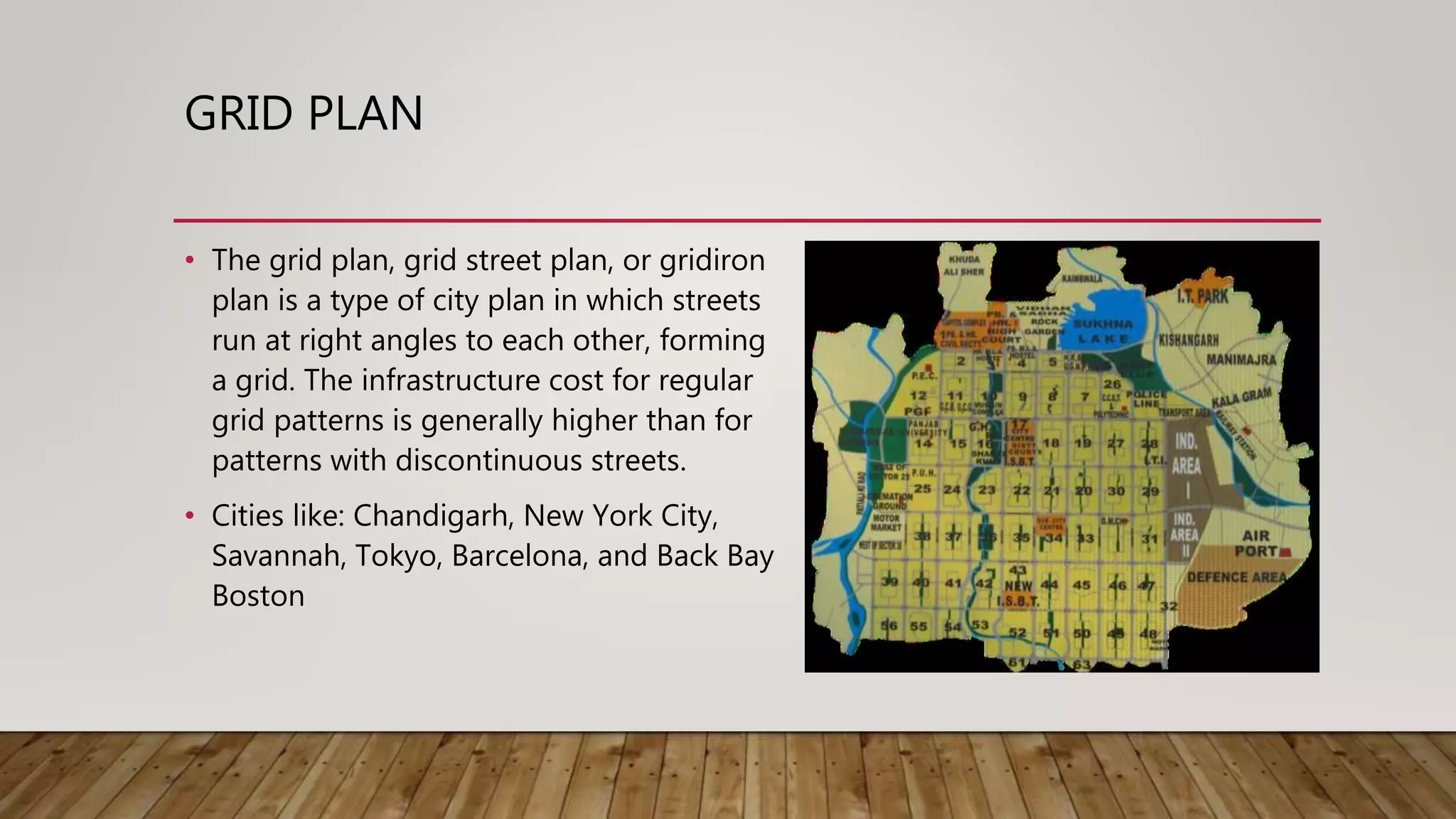
• The grid plan, grid street plan, or gridiron
plan is a type of city plan in which streets
run at right angles to each other, forming
a grid. The infrastructure cost for regular
grid patterns is generally higher than for
patterns with discontinuous streets.
• Cities like: Chandigarh, New York City,
Savannah, Tokyo, Barcelona, and Back Bay
Boston
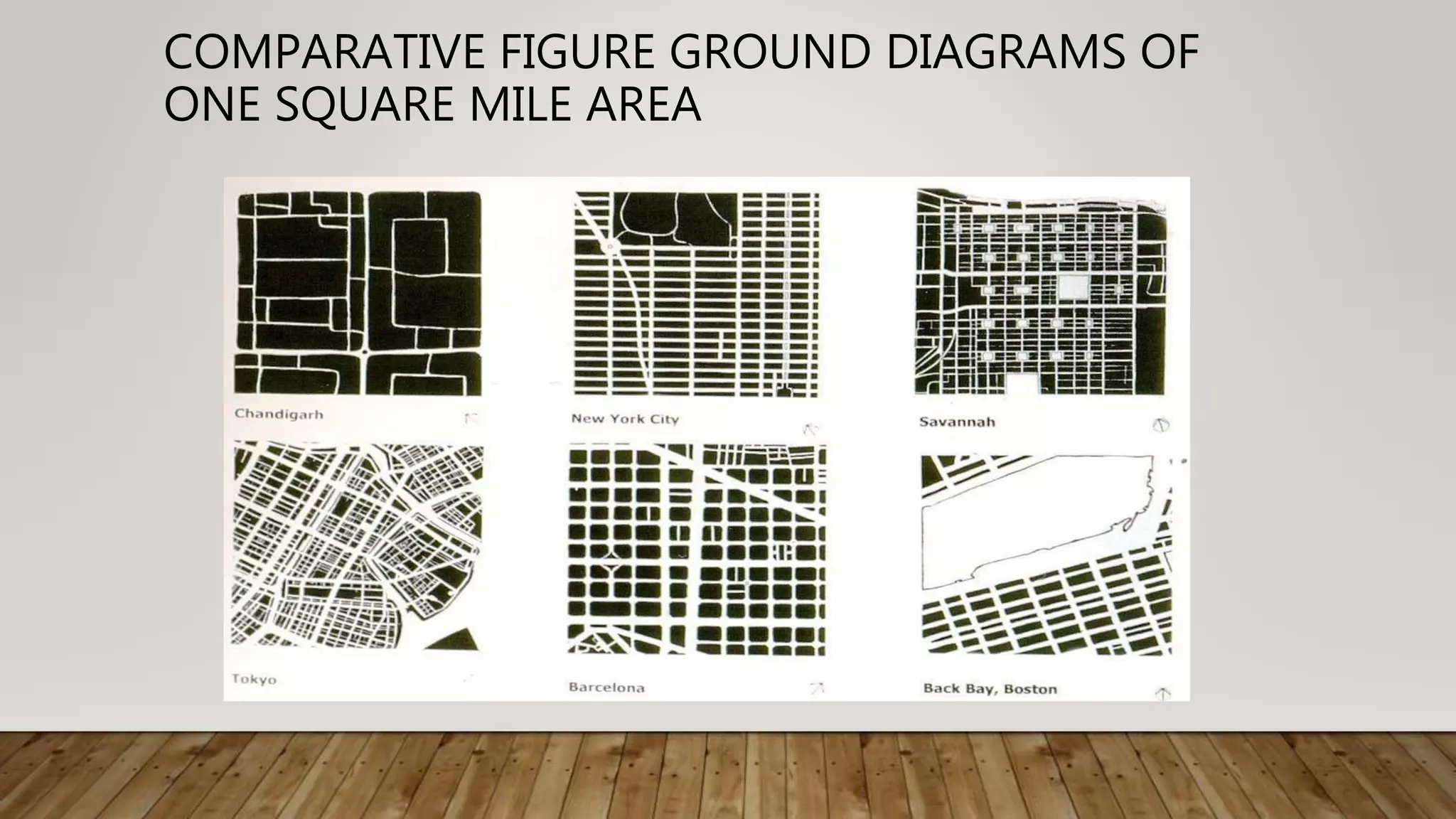
COMPARATIVE FIGURE GROUND DIAGRAMS OF
ONE SQUARE MILE AREA
INTRODUCTION
• CHANDIGARH, the Dream city of India’s first PM, Pt. Jawaharlal Nehru
was planned by the legendary architect LE CORBUSIER.
• 7 V’s road system is used
• The primary module of city’s design is a Sector, a neighborhood unit
of size 800 m X1200 m.
• It is a self-sufficient unit having shops, school, health centers and
places of recreations .
• The population of a sector varies between 3000-20000 depending
upon sizes of plots and topography of the area
• CHANDIGARH is a City and a UNION TERRITORY in the Northern part of India that
serves as the capital of the states of PUNJAB and HARYANA.
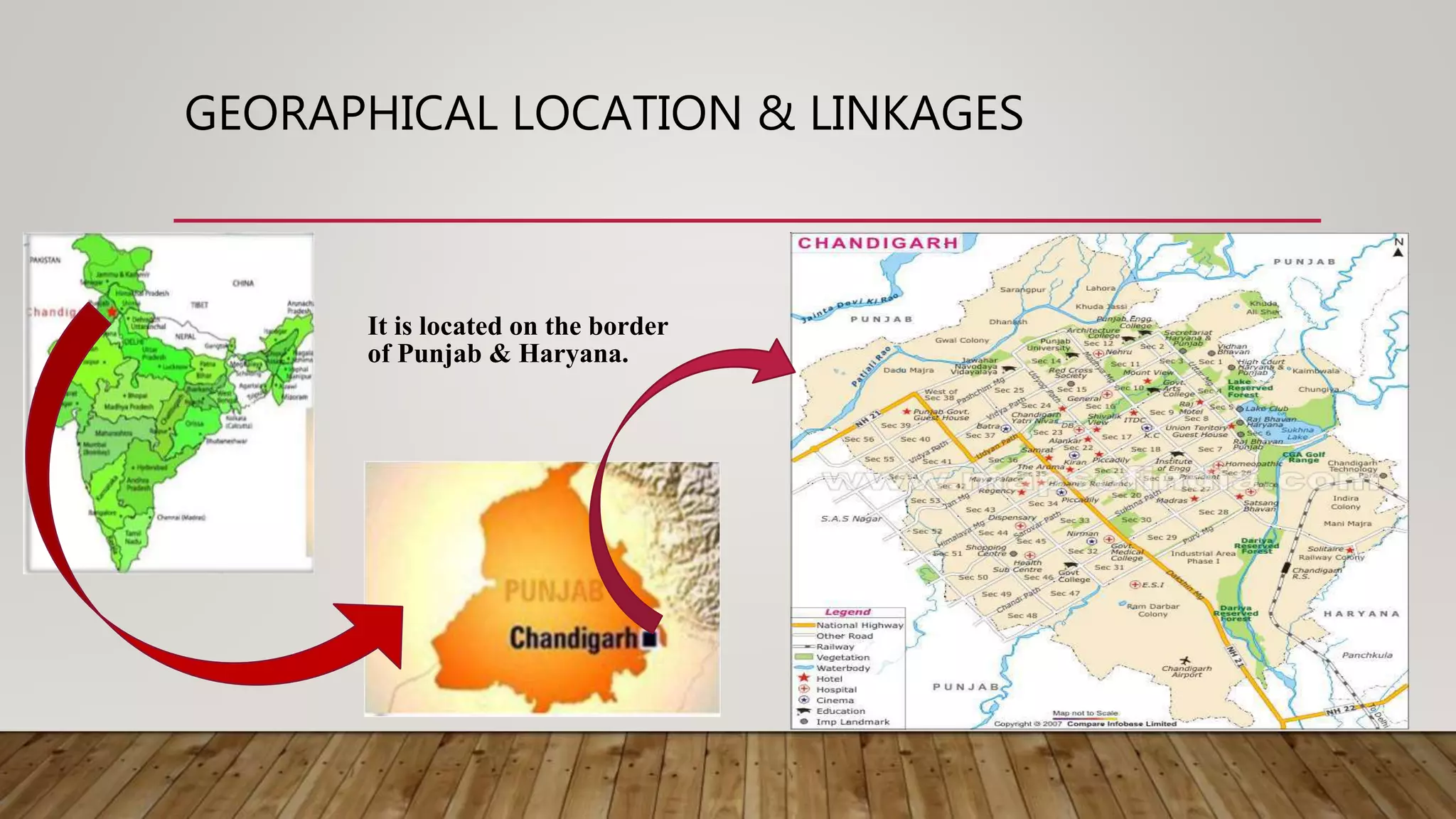
GEORAPHICAL LOCATION & LINKAGES
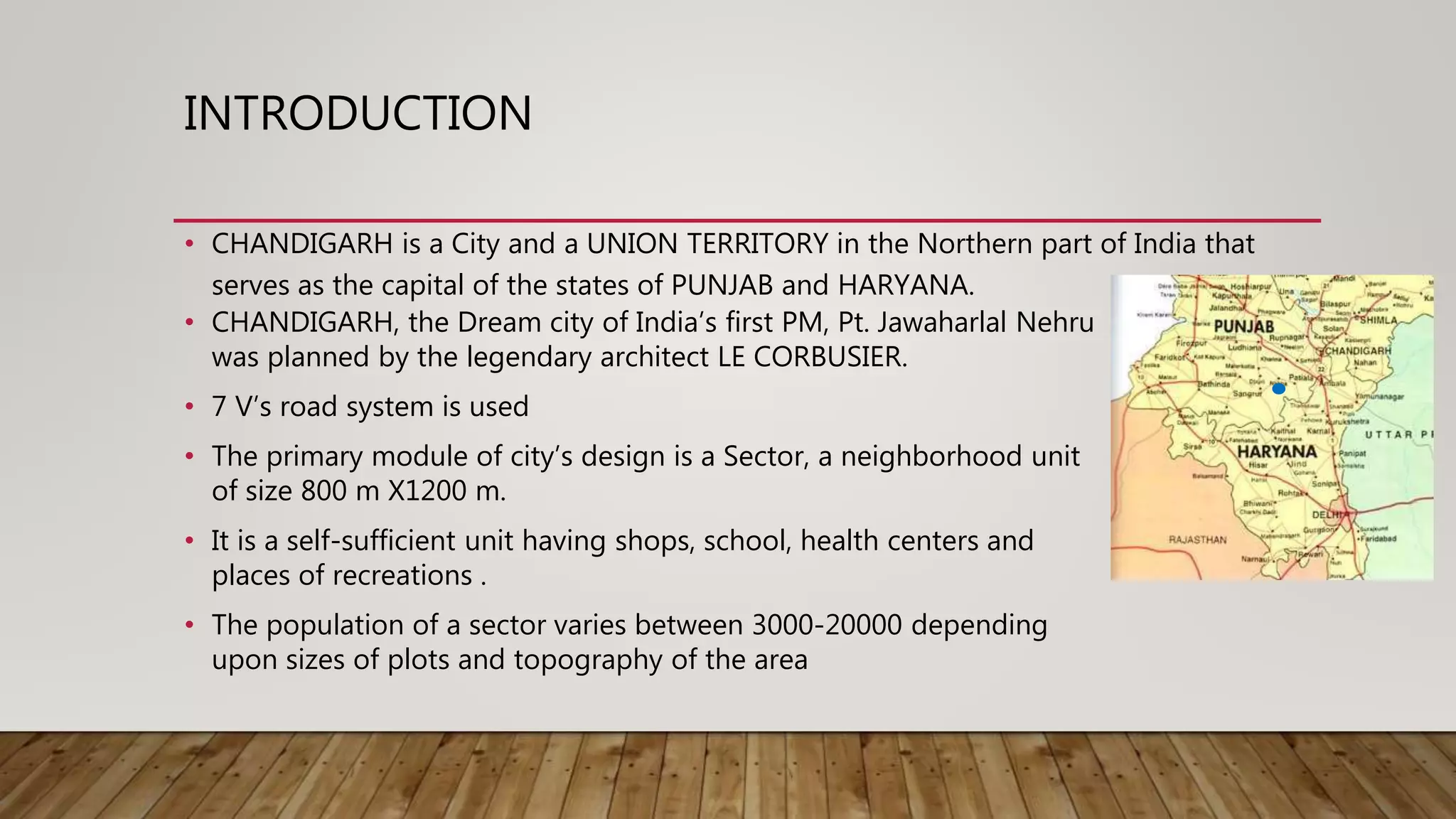
It is located on the border
of Punjab & Haryana.
HISTORY
• After the loss of Lahore, the idea of building a new capital for the Indian part of Punjab
took form in 1948.
• Pandit Jawaharlal Nehru said “Let this be a new town, symbolic of freedom of India
unfettered by the traditions of the past….. an expression of the nation’s faith in the future”.
The city is a product of Nehru’s vision.
• A need for the capital
• Rehabilitating refugees
• A center for governance
• A rich cultural legacy like Lahore
• A vision of the future
SITE SELECTION
• The present site was selected in 1948 taking into account various attributes such as
• Central location in the state
• proximity to the national capital
• availability of sufficient water supply
• fertile of soil
• gradient of land for natural drainage
• beautiful site with the panorama of blue hills as backdrop
• moderate climate.
• The site was the sub mountainous area of the Ambala district about 150 miles north of New
Delhi.
• The area was a flat, gentle sloping plain of agriculture land consisting of 59 villages.
THREE DISCIPLINES
Corbusier noticed three qualities in India
1. The discipline of money- as it was the period of post independence the project
couldn't be made to a grand level and had to be made in a ideal budget.
2. The discipline of technology-even with vast amounts of clay stone , sand
Corbusier went for usage of rough concrete in capitol and central business
district.
3. The discipline of climate- besides the administrative and financial regulations
there was a law of the sun in India. The architectural problem consists; first to
make shade, second to make a current of air[to ventilate], third to control
hydraulics.
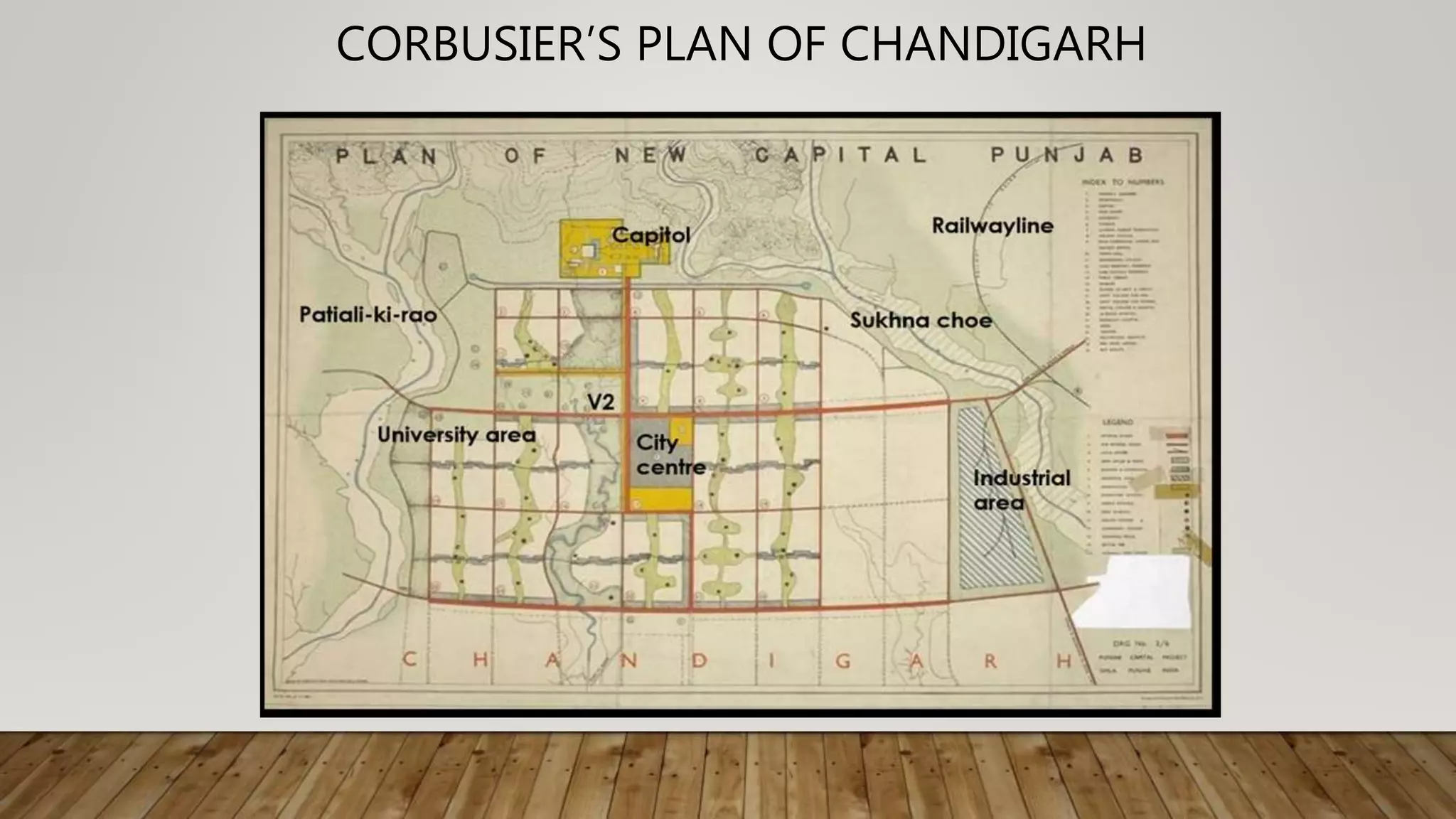
CORBUSIER’S PLAN
• His plan was in grid-iron pattern surrounded by the two rivers in both the sides.
• The unit was a sector instead of a superblock.(nearly 3 sectors made a superblock)
• The basic framework of albert Mayer's plan were retained- capitol, city Centre,
industrial area, parkland
• The city Centre and railway stations remained in the same locations the capitol
was shifted from the north-eastern tip the to northwestern tip
CORBUSIER’S PLAN OF CHANDIGARH
LE CORBUSIER CONCEPT: HUMAN ANALOGY
• LE Corbusier conceived the master plan of Chandigarh as analogous
to human body, with a clearly defined
• • HEAD (the capitol complex, sector 1)
• • HEART (the city Centre sector-17)
• • LUNGS (the leisure valley, innumerable open spaces and sector
greens)
• • INTELLECT (the cultural and educational institutions),
• • CIRCULATORY SYSTEM (the network of roads, the 7Vs)
• • VISCERA (the industrial area).
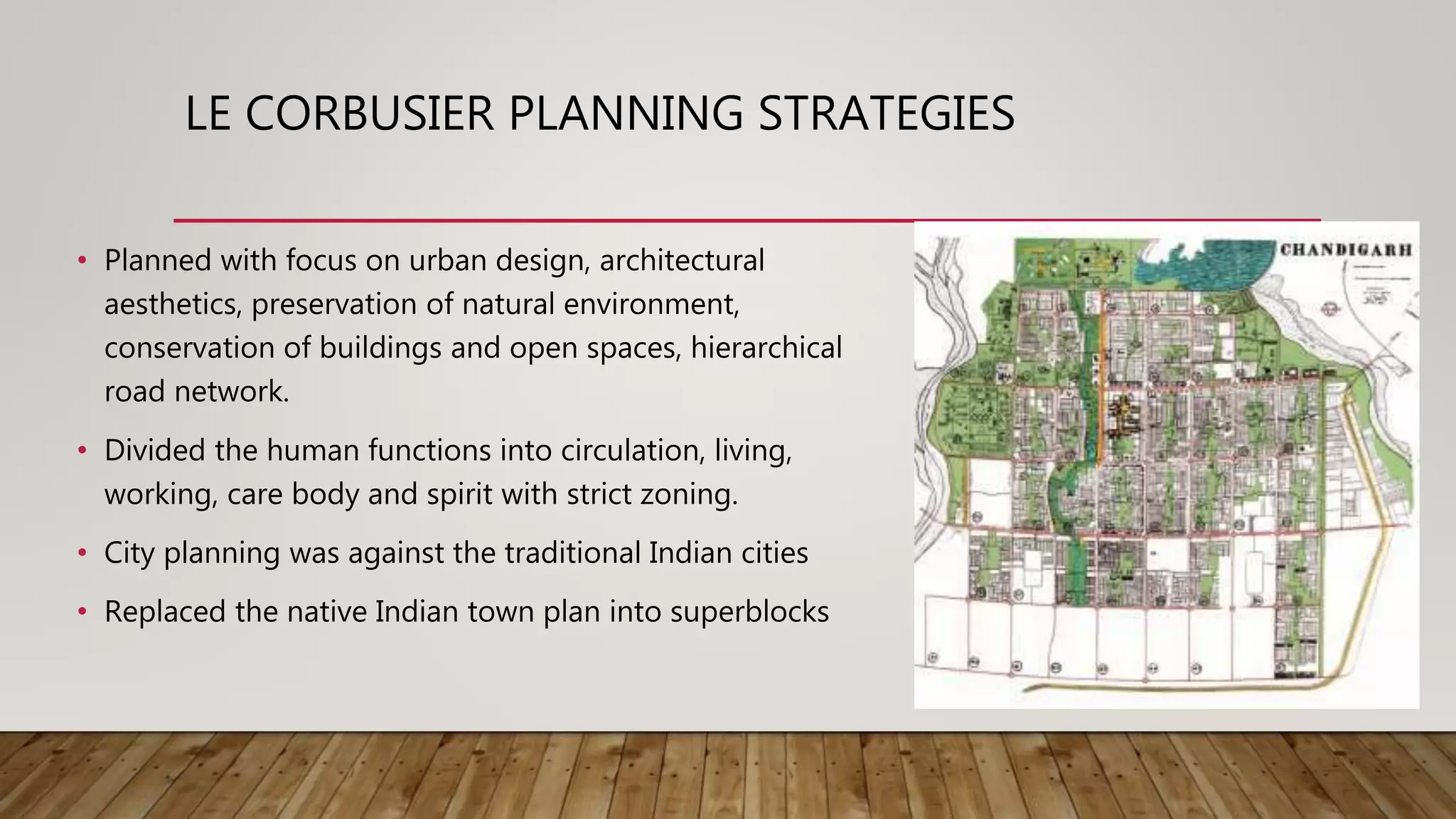
LE CORBUSIER PLANNING STRATEGIES
• Planned with focus on urban design, architectural
aesthetics, preservation of natural environment,
conservation of buildings and open spaces, hierarchical
road network.
• Divided the human functions into circulation, living,
working, care body and spirit with strict zoning.
• City planning was against the traditional Indian cities
• Replaced the native Indian town plan into superblocks
SITE PLAN
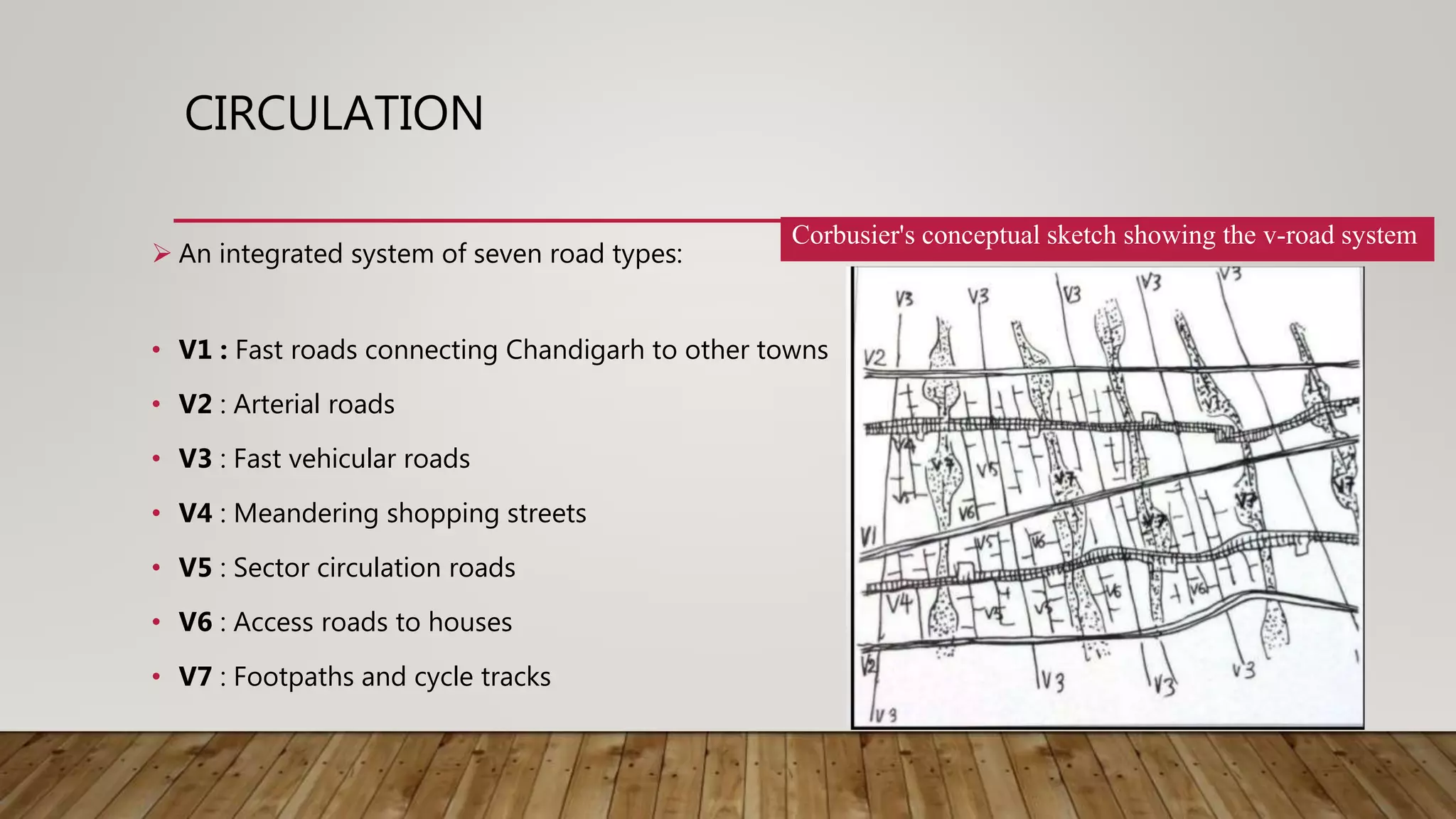
CIRCULATION
 An integrated system of seven road types:
• V1 : Fast roads connecting Chandigarh to other towns
• V2 : Arterial roads
• V3 : Fast vehicular roads
• V4 : Meandering shopping streets
• V5 : Sector circulation roads
• V6 : Access roads to houses
• V7 : Footpaths and cycle tracks
Corbusier's conceptual sketch showing the v-road system
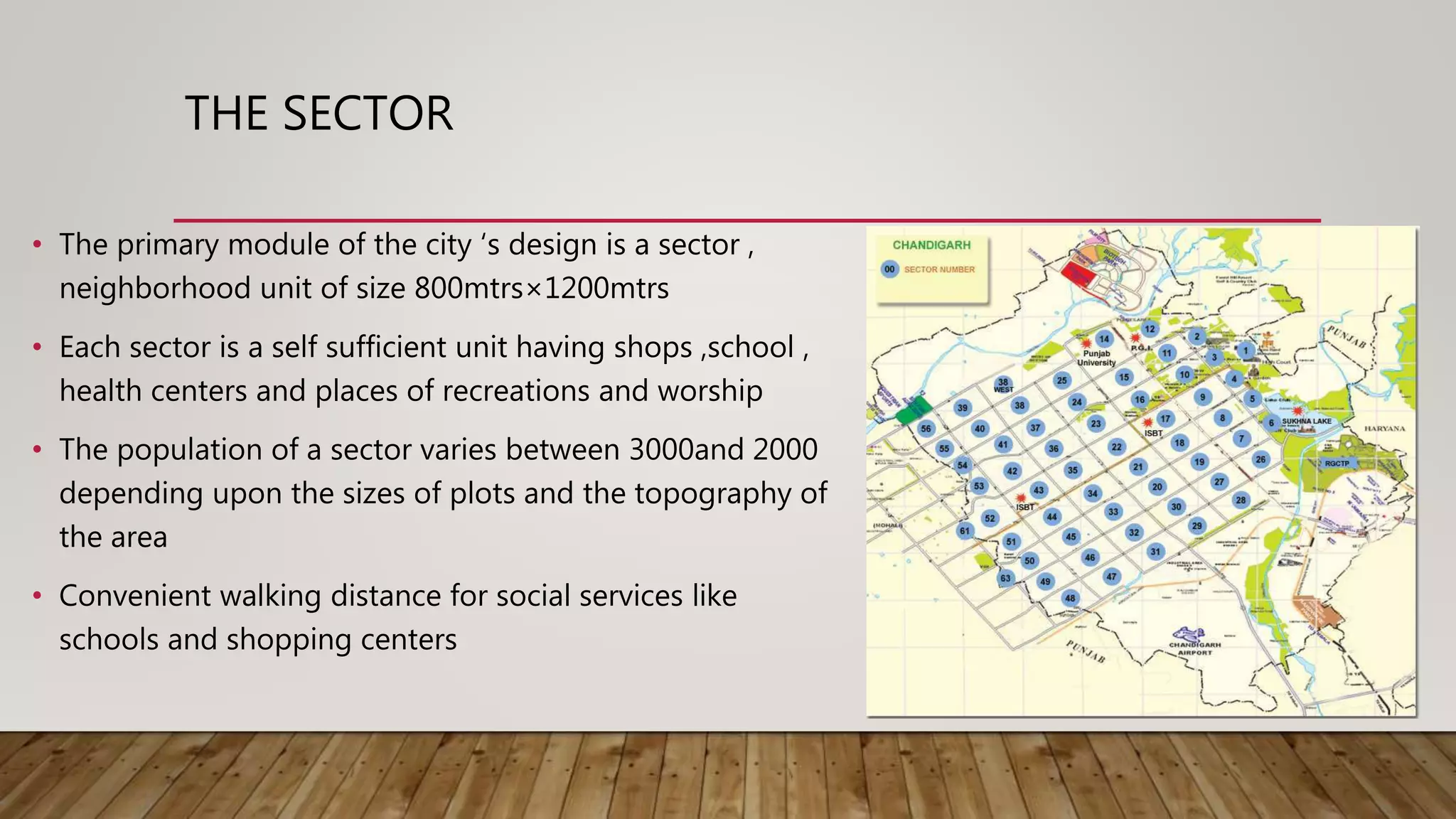
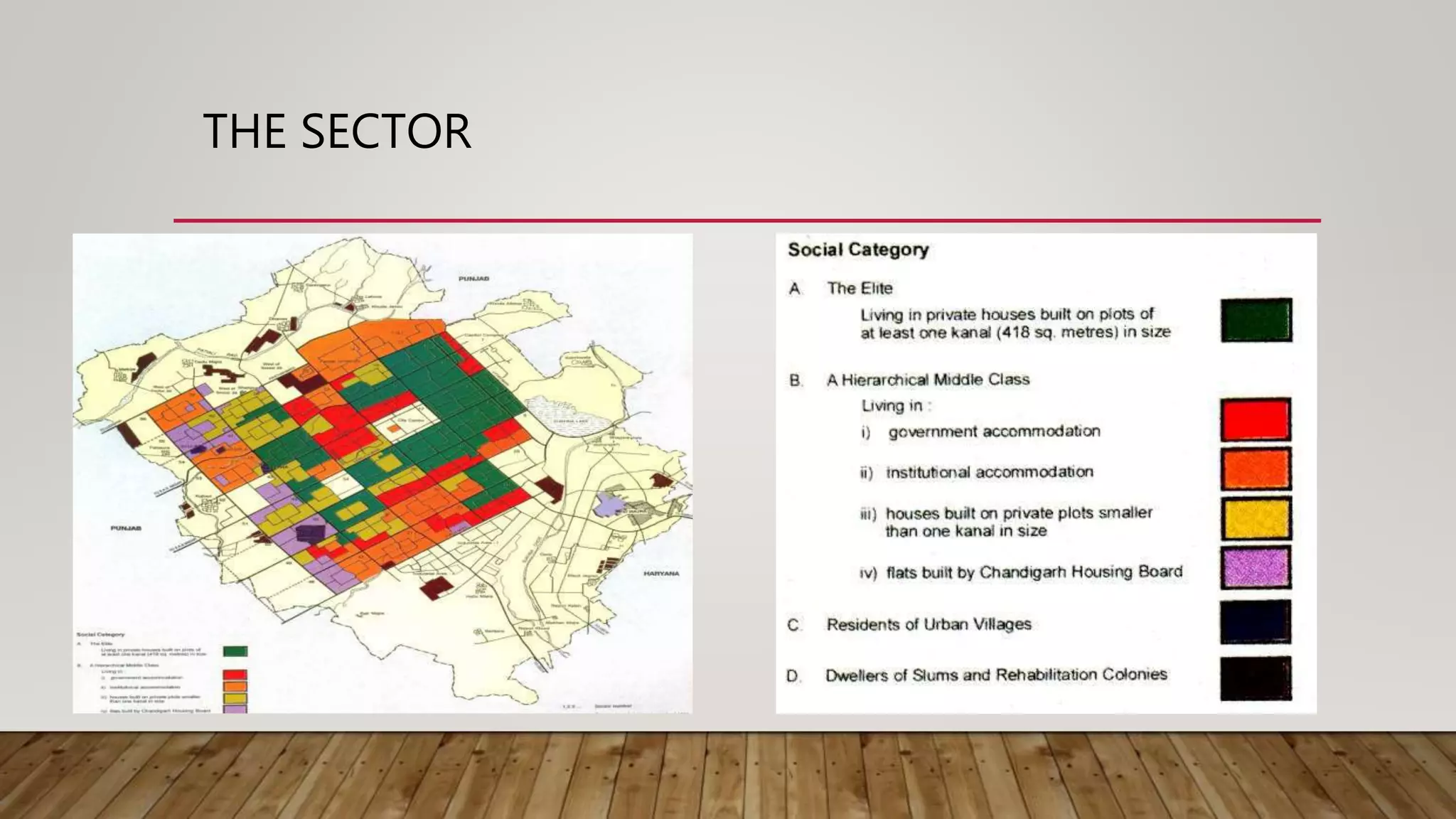
THE SECTOR
• The primary module of the city ‘s design is a sector ,
neighborhood unit of size 800mtrs×1200mtrs
• Each sector is a self sufficient unit having shops ,school ,
health centers and places of recreations and worship
• The population of a sector varies between 3000and 2000
depending upon the sizes of plots and the topography of
the area
• Convenient walking distance for social services like
schools and shopping centers
THE SECTOR
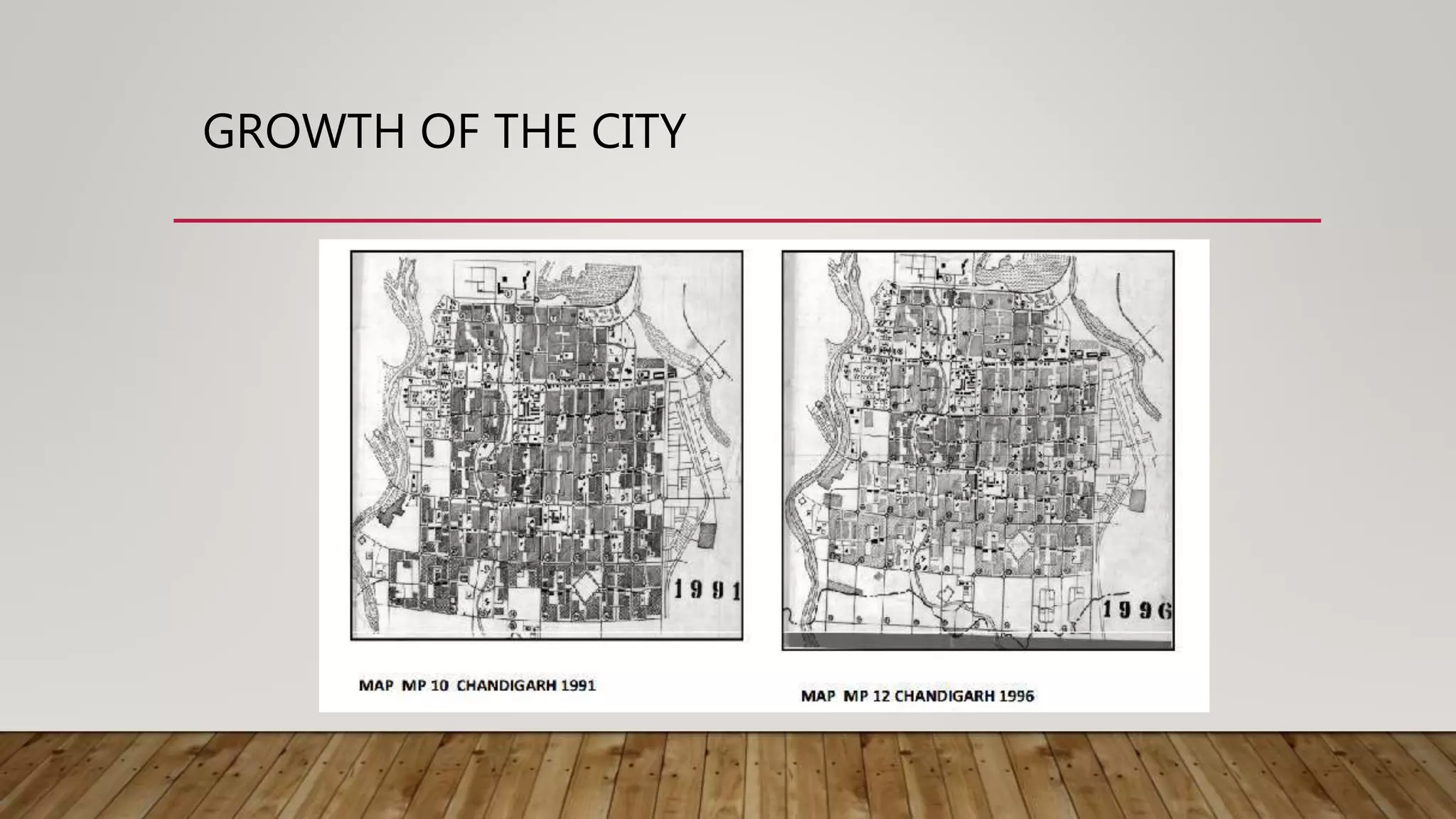
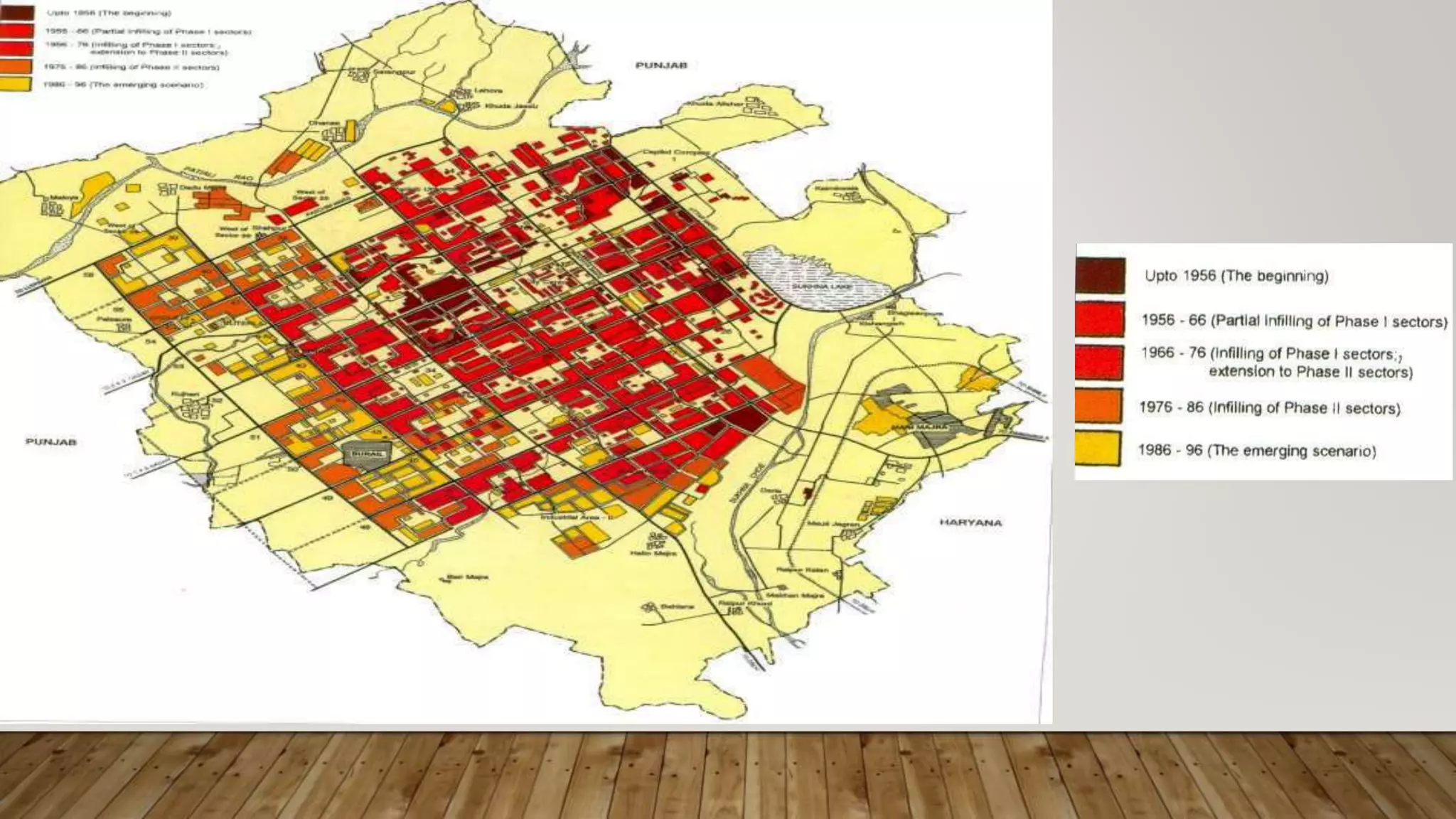
DEVELOPMENT IN CHANDIGARH
The city of Chandigarh was developed in 3 phases:
• Phase-I; Sectors 1 to 30 have been developed, it was completely developed in
1975.
• Phase-II; Sector 31to 47 have been developed, for accommodating population of
5 lakhs in combined.
• Phase III; Sectors from 48 to 56 has been taken up
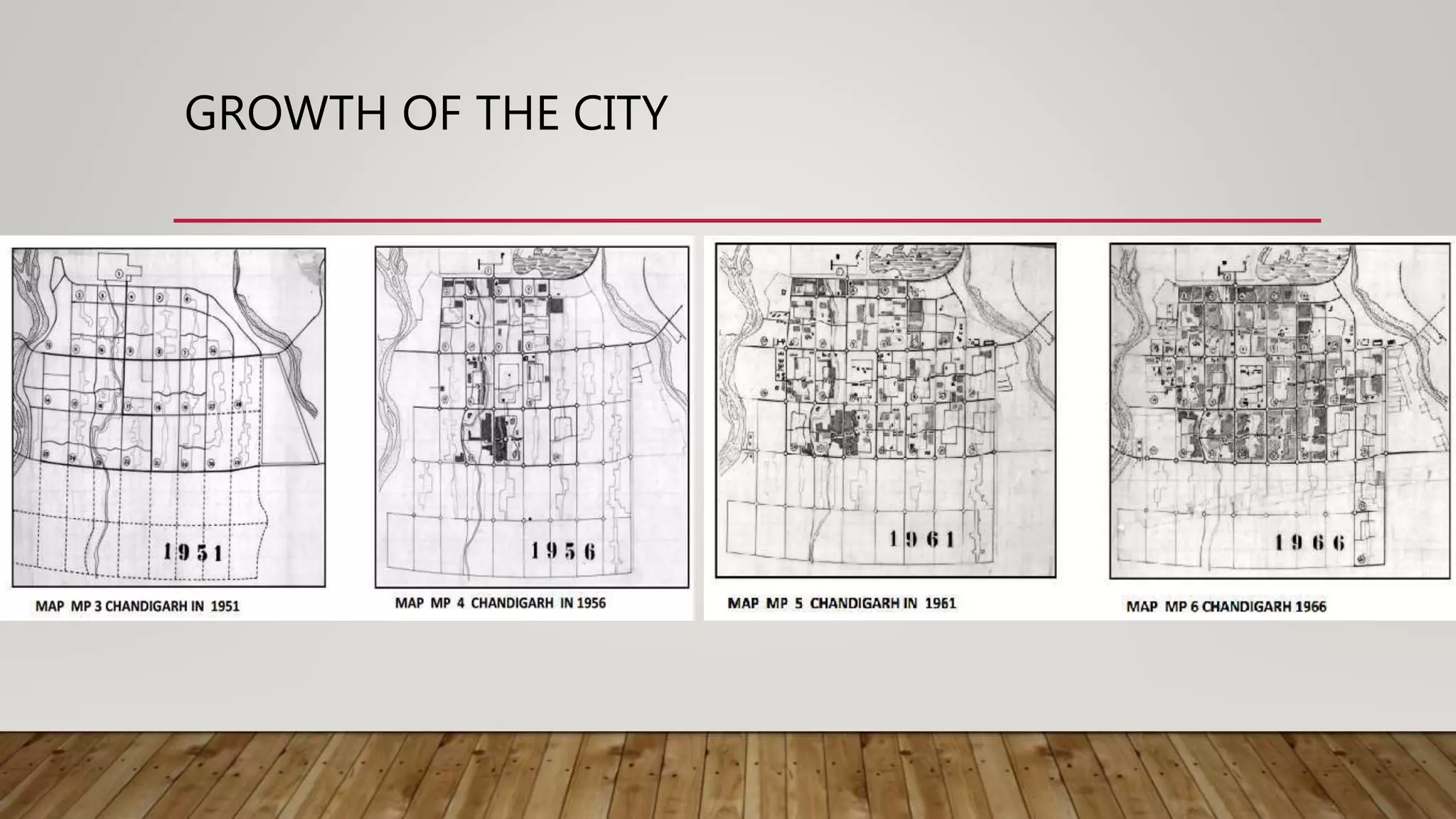
GROWTH OF THE CITY
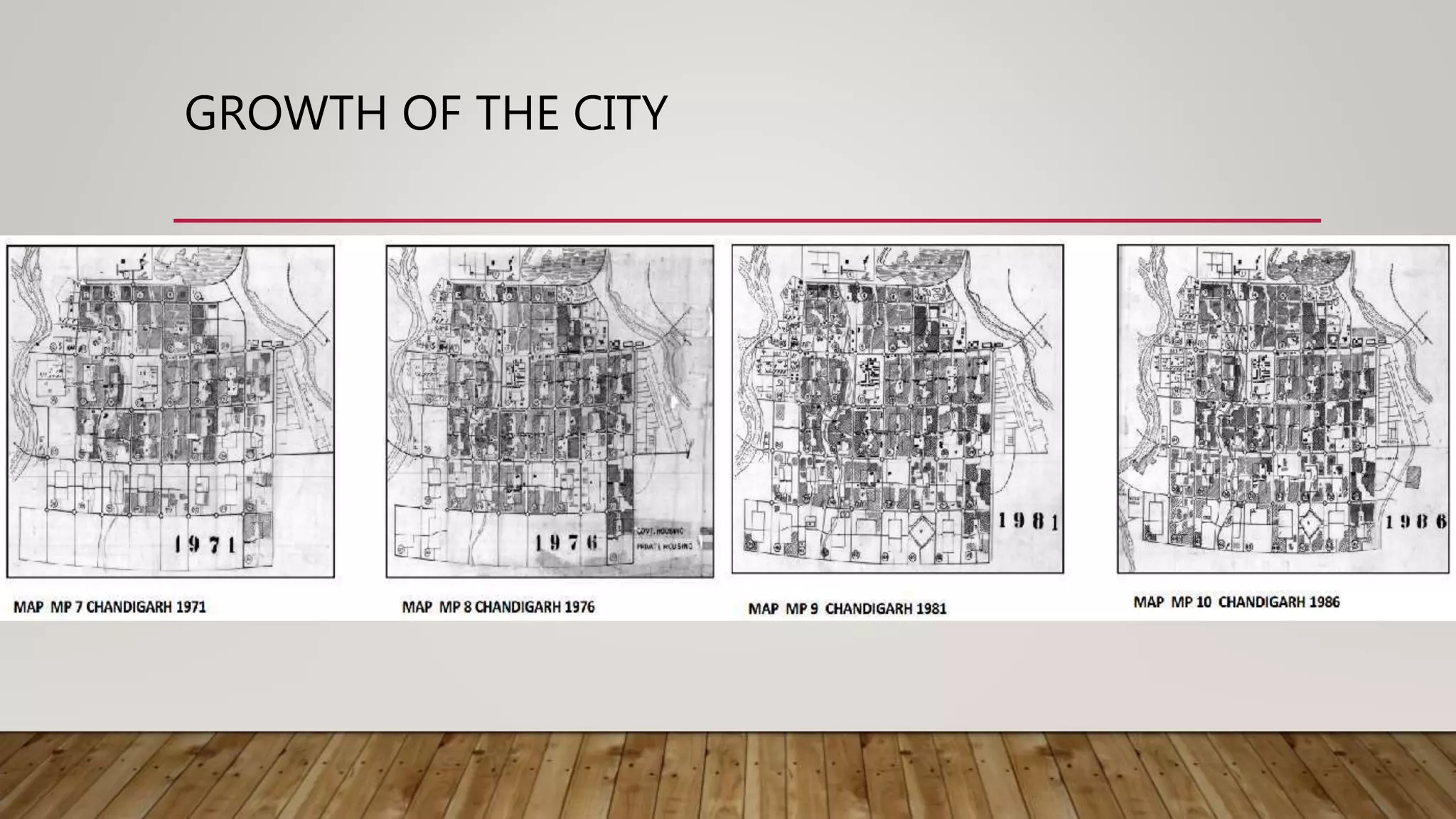
GROWTH OF THE CITY
GROWTH OF THE CITY
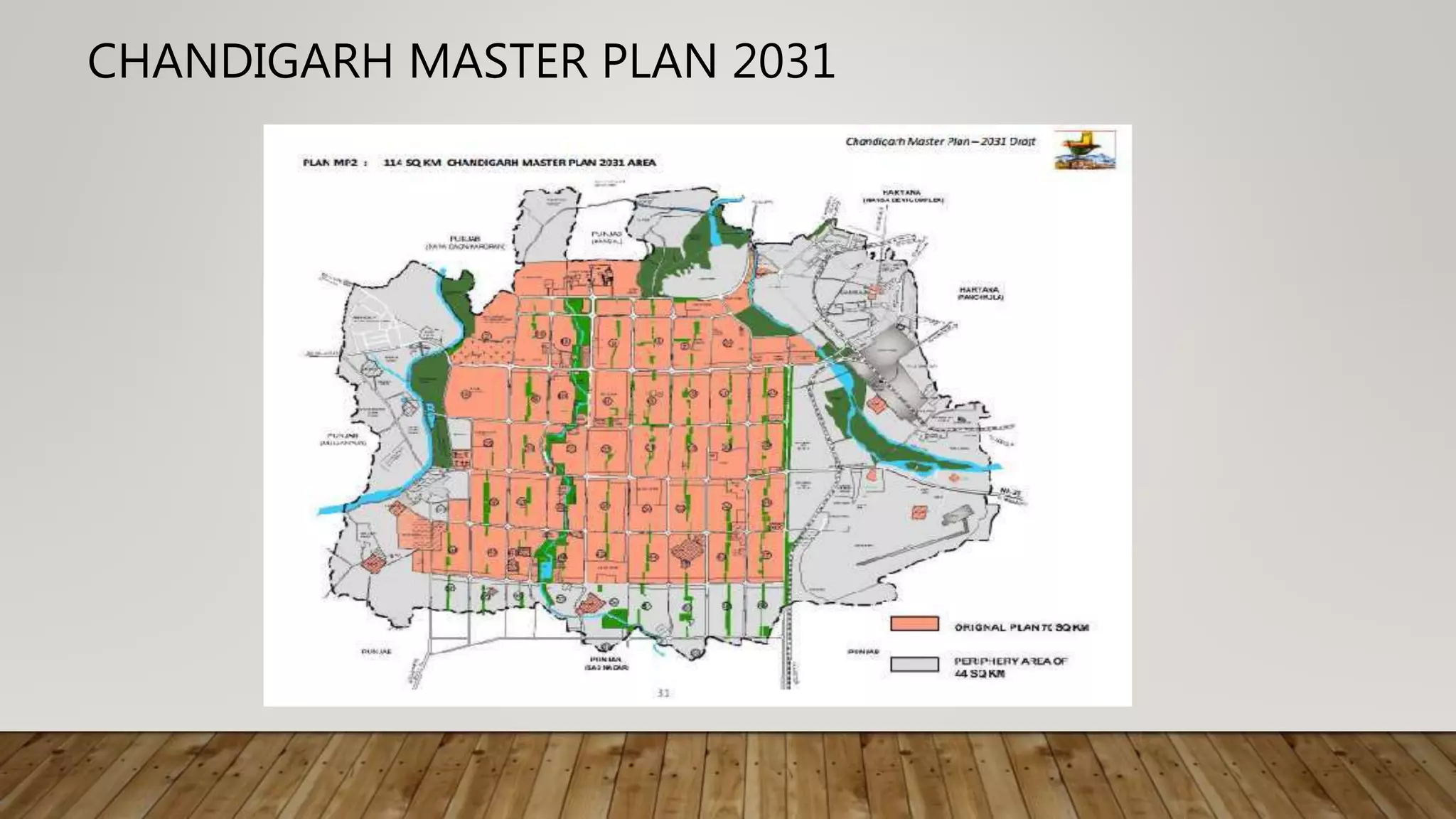
CHANDIGARH MASTER PLAN 2031
GROWTH OF CHANDIGARH
• The Chandigarh has become Hi-tech city by setting up of I.T. park.
• The Chandigarh being the regional center is hub of political and bureaucratic
activities of the 3 neighboring states of Punjab, Haryana and Himachal Pradesh.
• The high profile education and health facilities are available in the Chandigarh,
like Punjab Engineering College and PGI, York, Fortis.
• The Chandigarh has its tourist potential.
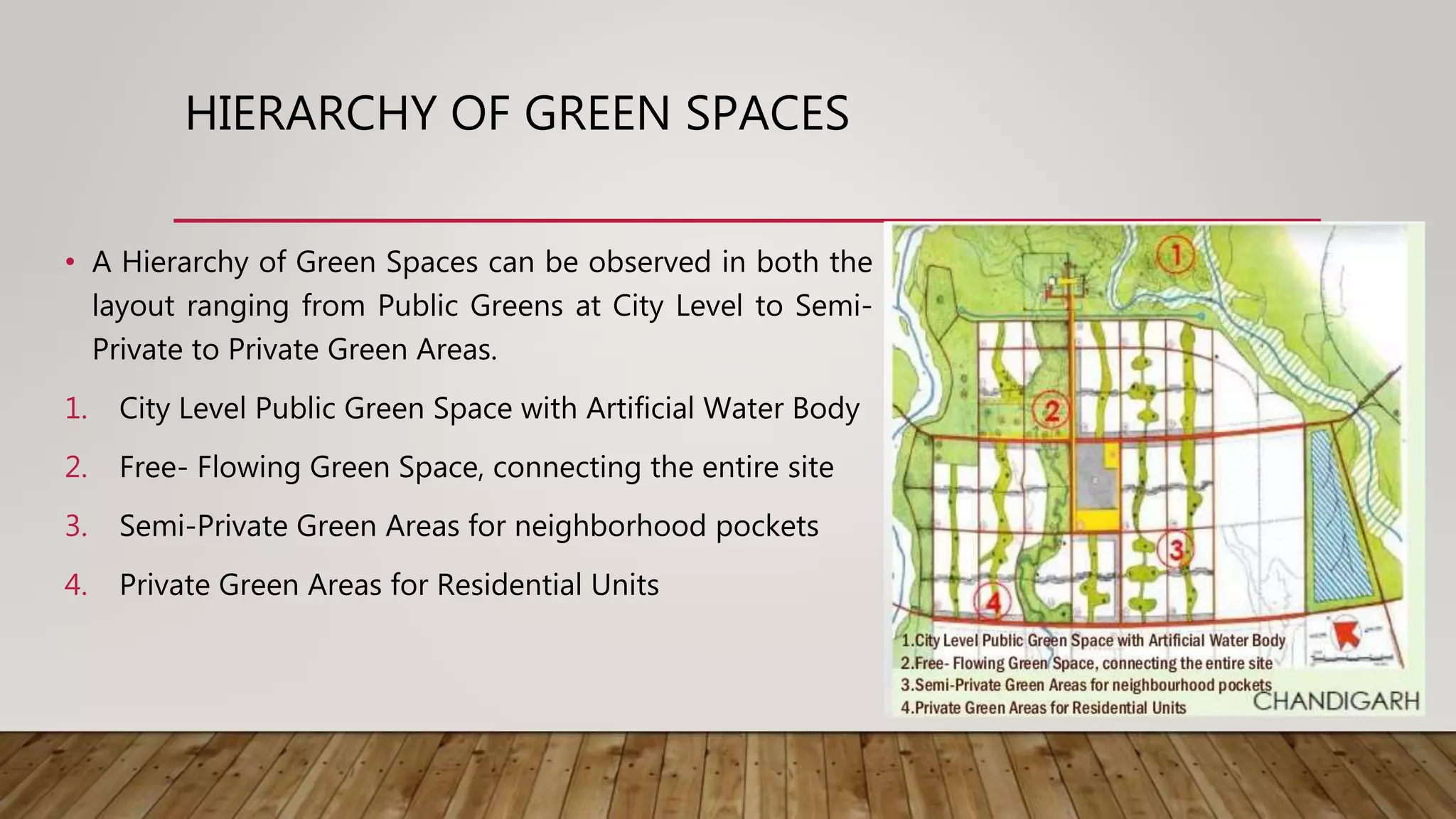
HIERARCHY OF GREEN SPACES
• A Hierarchy of Green Spaces can be observed in both the
layout ranging from Public Greens at City Level to Semi-
Private to Private Green Areas.
1. City Level Public Green Space with Artificial Water Body
2. Free- Flowing Green Space, connecting the entire site
3. Semi-Private Green Areas for neighborhood pockets
4. Private Green Areas for Residential Units
CONT.…
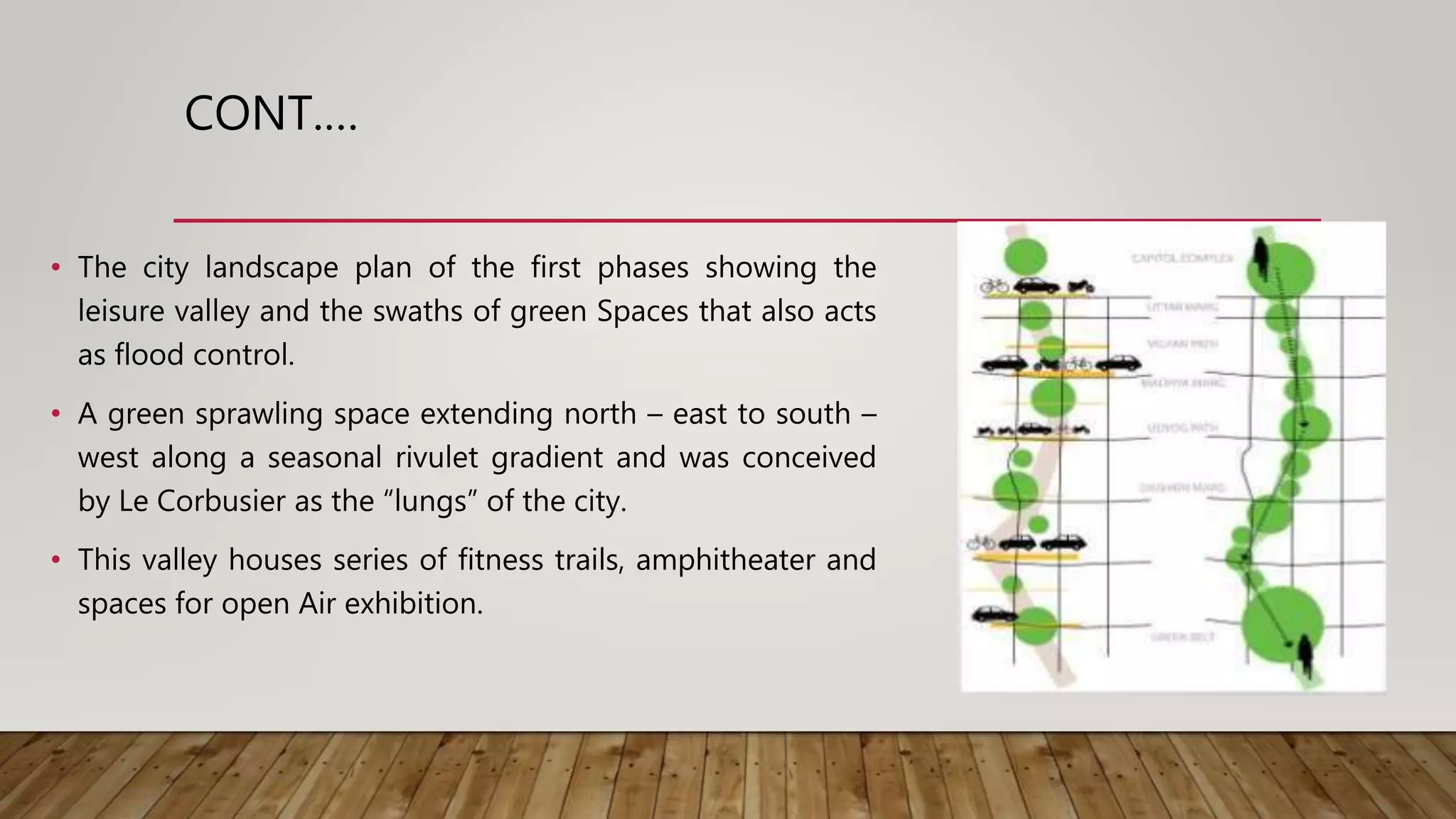
• The city landscape plan of the first phases showing the
leisure valley and the swaths of green Spaces that also acts
as flood control.
• A green sprawling space extending north – east to south –
west along a seasonal rivulet gradient and was conceived
by Le Corbusier as the “lungs” of the city.
• This valley houses series of fitness trails, amphitheater and
spaces for open Air exhibition.
CLIMATIC CONSIDERATIONS
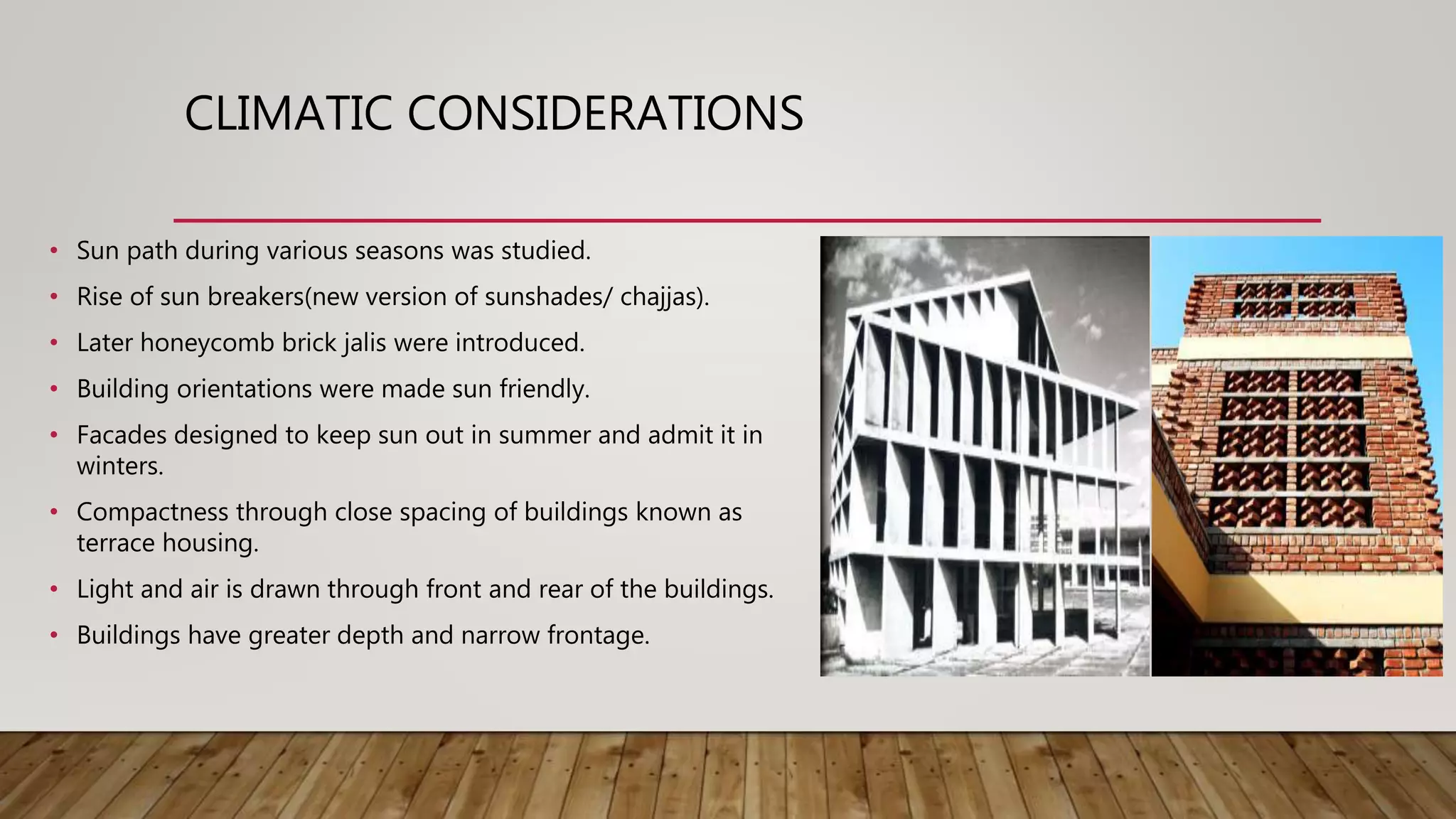
• Sun path during various seasons was studied.
• Rise of sun breakers(new version of sunshades/ chajjas).
• Later honeycomb brick jalis were introduced.
• Building orientations were made sun friendly.
• Facades designed to keep sun out in summer and admit it in
winters.
• Compactness through close spacing of buildings known as
terrace housing.
• Light and air is drawn through front and rear of the buildings.
• Buildings have greater depth and narrow frontage.
POSITIVE
• First modern architecture of Indian city planning
• Each sector satisfies the necessities of human needs
• Separate roads for pedestrian, bicycle and heavy vehicles
• Open spaces in front shopping centers
• Shops on ground floor, Residence on upper floor
• Shop protected from rain and sun, as a covered walkway for the customers
• Roads being similar to each other creates confusion
• Brutal concrete gives a rough look
• City not planned for lower income people.
• Existence of slums around the city
NEGATIVE

Chandigarh: grid iron pattern

  • 1.
    GRID IRON PATTERN CASESTUDY: CHANDIGARH Submitted By: SATYAM RAI 151109031
  • 2.
    GRID PLAN • Thegrid plan, grid street plan, or gridiron plan is a type of city plan in which streets run at right angles to each other, forming a grid. The infrastructure cost for regular grid patterns is generally higher than for patterns with discontinuous streets. • Cities like: Chandigarh, New York City, Savannah, Tokyo, Barcelona, and Back Bay Boston
  • 3.
    COMPARATIVE FIGURE GROUNDDIAGRAMS OF ONE SQUARE MILE AREA
  • 4.
    INTRODUCTION • CHANDIGARH, theDream city of India’s first PM, Pt. Jawaharlal Nehru was planned by the legendary architect LE CORBUSIER. • 7 V’s road system is used • The primary module of city’s design is a Sector, a neighborhood unit of size 800 m X1200 m. • It is a self-sufficient unit having shops, school, health centers and places of recreations . • The population of a sector varies between 3000-20000 depending upon sizes of plots and topography of the area • CHANDIGARH is a City and a UNION TERRITORY in the Northern part of India that serves as the capital of the states of PUNJAB and HARYANA.
  • 5.
    GEORAPHICAL LOCATION &LINKAGES It is located on the border of Punjab & Haryana.
  • 6.
    HISTORY • After theloss of Lahore, the idea of building a new capital for the Indian part of Punjab took form in 1948. • Pandit Jawaharlal Nehru said “Let this be a new town, symbolic of freedom of India unfettered by the traditions of the past….. an expression of the nation’s faith in the future”. The city is a product of Nehru’s vision. • A need for the capital • Rehabilitating refugees • A center for governance • A rich cultural legacy like Lahore • A vision of the future
  • 7.
    SITE SELECTION • Thepresent site was selected in 1948 taking into account various attributes such as • Central location in the state • proximity to the national capital • availability of sufficient water supply • fertile of soil • gradient of land for natural drainage • beautiful site with the panorama of blue hills as backdrop • moderate climate. • The site was the sub mountainous area of the Ambala district about 150 miles north of New Delhi. • The area was a flat, gentle sloping plain of agriculture land consisting of 59 villages.
  • 8.
    THREE DISCIPLINES Corbusier noticedthree qualities in India 1. The discipline of money- as it was the period of post independence the project couldn't be made to a grand level and had to be made in a ideal budget. 2. The discipline of technology-even with vast amounts of clay stone , sand Corbusier went for usage of rough concrete in capitol and central business district. 3. The discipline of climate- besides the administrative and financial regulations there was a law of the sun in India. The architectural problem consists; first to make shade, second to make a current of air[to ventilate], third to control hydraulics.
  • 9.
    CORBUSIER’S PLAN • Hisplan was in grid-iron pattern surrounded by the two rivers in both the sides. • The unit was a sector instead of a superblock.(nearly 3 sectors made a superblock) • The basic framework of albert Mayer's plan were retained- capitol, city Centre, industrial area, parkland • The city Centre and railway stations remained in the same locations the capitol was shifted from the north-eastern tip the to northwestern tip
  • 10.
  • 11.
    LE CORBUSIER CONCEPT:HUMAN ANALOGY • LE Corbusier conceived the master plan of Chandigarh as analogous to human body, with a clearly defined • • HEAD (the capitol complex, sector 1) • • HEART (the city Centre sector-17) • • LUNGS (the leisure valley, innumerable open spaces and sector greens) • • INTELLECT (the cultural and educational institutions), • • CIRCULATORY SYSTEM (the network of roads, the 7Vs) • • VISCERA (the industrial area).
  • 12.
    LE CORBUSIER PLANNINGSTRATEGIES • Planned with focus on urban design, architectural aesthetics, preservation of natural environment, conservation of buildings and open spaces, hierarchical road network. • Divided the human functions into circulation, living, working, care body and spirit with strict zoning. • City planning was against the traditional Indian cities • Replaced the native Indian town plan into superblocks
  • 13.
  • 14.
    CIRCULATION  An integratedsystem of seven road types: • V1 : Fast roads connecting Chandigarh to other towns • V2 : Arterial roads • V3 : Fast vehicular roads • V4 : Meandering shopping streets • V5 : Sector circulation roads • V6 : Access roads to houses • V7 : Footpaths and cycle tracks Corbusier's conceptual sketch showing the v-road system
  • 15.
    THE SECTOR • Theprimary module of the city ‘s design is a sector , neighborhood unit of size 800mtrs×1200mtrs • Each sector is a self sufficient unit having shops ,school , health centers and places of recreations and worship • The population of a sector varies between 3000and 2000 depending upon the sizes of plots and the topography of the area • Convenient walking distance for social services like schools and shopping centers
  • 16.
  • 17.
    DEVELOPMENT IN CHANDIGARH Thecity of Chandigarh was developed in 3 phases: • Phase-I; Sectors 1 to 30 have been developed, it was completely developed in 1975. • Phase-II; Sector 31to 47 have been developed, for accommodating population of 5 lakhs in combined. • Phase III; Sectors from 48 to 56 has been taken up
  • 18.
  • 19.
  • 20.
  • 22.
  • 23.
    GROWTH OF CHANDIGARH •The Chandigarh has become Hi-tech city by setting up of I.T. park. • The Chandigarh being the regional center is hub of political and bureaucratic activities of the 3 neighboring states of Punjab, Haryana and Himachal Pradesh. • The high profile education and health facilities are available in the Chandigarh, like Punjab Engineering College and PGI, York, Fortis. • The Chandigarh has its tourist potential.
  • 24.
    HIERARCHY OF GREENSPACES • A Hierarchy of Green Spaces can be observed in both the layout ranging from Public Greens at City Level to Semi- Private to Private Green Areas. 1. City Level Public Green Space with Artificial Water Body 2. Free- Flowing Green Space, connecting the entire site 3. Semi-Private Green Areas for neighborhood pockets 4. Private Green Areas for Residential Units
  • 25.
    CONT.… • The citylandscape plan of the first phases showing the leisure valley and the swaths of green Spaces that also acts as flood control. • A green sprawling space extending north – east to south – west along a seasonal rivulet gradient and was conceived by Le Corbusier as the “lungs” of the city. • This valley houses series of fitness trails, amphitheater and spaces for open Air exhibition.
  • 26.
    CLIMATIC CONSIDERATIONS • Sunpath during various seasons was studied. • Rise of sun breakers(new version of sunshades/ chajjas). • Later honeycomb brick jalis were introduced. • Building orientations were made sun friendly. • Facades designed to keep sun out in summer and admit it in winters. • Compactness through close spacing of buildings known as terrace housing. • Light and air is drawn through front and rear of the buildings. • Buildings have greater depth and narrow frontage.
  • 27.
    POSITIVE • First modernarchitecture of Indian city planning • Each sector satisfies the necessities of human needs • Separate roads for pedestrian, bicycle and heavy vehicles • Open spaces in front shopping centers • Shops on ground floor, Residence on upper floor • Shop protected from rain and sun, as a covered walkway for the customers
  • 28.
    • Roads beingsimilar to each other creates confusion • Brutal concrete gives a rough look • City not planned for lower income people. • Existence of slums around the city NEGATIVE