1
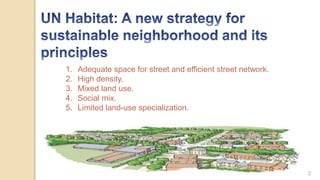
1. Adequate space for street and efficient street network.
2. High density.
3. Mixed land use.
4. Social mix.
5. Limited land-use specialization.
2
Objectives of five Principles
 Promote high density urban growth, alleviate urban sprawl and maximize
land efficiency.
 Promote sustainable, diversified, socially equal and thriving communities in
economically viable ways.
 Encourage walkable neighbourhoods and reduce car dependency.
 Optimise use of land and provide an interconnected network of streets which
facilitate safe, efficient and pleasant walking, cycling and driving.
 Foster local employment, local production and local consumption.
 Provide a variety of lot sizes and housing types to cater for the diverse
housing needs of the community, at densities which can ultimately support
the provision of local services.
3
Key features of sustainable
neighbourhoods
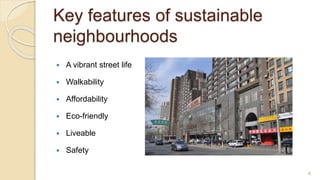
 A vibrant street life
 Walkability
 Affordability
 Eco-friendly
 Liveable
 Safety
4
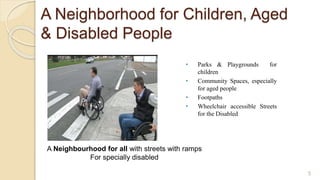
A Neighborhood for Children, Aged
& Disabled People
• Parks & Playgrounds for
children
• Community Spaces, especially
for aged people
• Footpaths
• Wheelchair accessible Streets
for the Disabled
A Neighbourhood for all with streets with ramps
For specially disabled
5
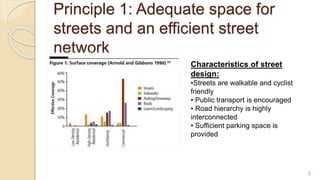
Principle 1: Adequate space for
streets and an efficient street
network
Characteristics of street
design:
•Streets are walkable and cyclist
friendly
• Public transport is encouraged
• Road hierarchy is highly
interconnected
• Sufficient parking space is
provided
6
Principle 2: High density
High density has economic, social and environmental benefits as
follows:
 Efficient land use slows down urban sprawl because high density
neighbourhoods can accommodate more people per area.
 Reduced public service costs.
 Support for better community service.
 Reduced car dependency and parking demand, and increased support for
public transport.
 Provision of social equity.
 Support for better public open space.
 Increased energy efficiency and decreased pollution.
7
Principle 3: Mixed land-use
The purpose of mixed land-use is
 To create local jobs,
 promote the local economy,
 reduce car dependency,
 encourage pedestrian and cyclist traffic,
 reduce landscape fragmentation,
 provide closer public services and
 support mixed communities.
8
Principle 4: Social mix
Social mix is a socio-spatial concept, with the following objectives:
 To promote more social interaction and social cohesion across groups;
 To generate job opportunities;
 To attract additional services to the neighborhood;
 To sustain renewal/regeneration initiatives.
9
Cont…
Possible policies include:
 Promoting social mix by mixing tenures and developing sales programmes
within public estates;
 Achieving social mix through allocation policies and the spatial distribution of
poor households.;
 Investing in and improving public housing;
 Achieving social mix by urban and housing design;
 Promoting multi-level employment within the community;
 Working with private developers to increase public housing supply;
 Providing plots in different sizes and with different regulations, to increase
the diversity of housing options.
10
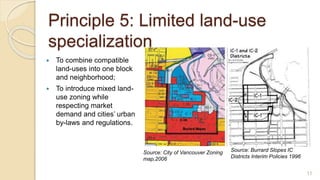
Principle 5: Limited land-use
specialization
 To combine compatible
land-uses into one block
and neighborhood;
 To introduce mixed land-
use zoning while
respecting market
demand and cities’ urban
by-laws and regulations.
Source: City of Vancouver Zoning
map,2006
Source: Burrard Slopes IC
Districts Interim Policies 1996
11
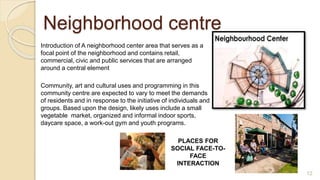
Introduction of A neighborhood center area that serves as a
focal point of the neighborhood and contains retail,
commercial, civic and public services that are arranged
around a central element
Community, art and cultural uses and programming in this
community centre are expected to vary to meet the demands
of residents and in response to the initiative of individuals and
groups. Based upon the design, likely uses include a small
vegetable market, organized and informal indoor sports,
daycare space, a work-out gym and youth programs.
PLACES FOR
SOCIAL FACE-TO-
FACE
INTERACTION
Neighborhood centre
12
Application of the Five
Principles
 Fast growing cities
 New urban settlements and urban extensions
 Urban renewal and renaissance
 Urban densification
13

Neighbourhood development strategy

  • 1.
  • 2.
    1. Adequate spacefor street and efficient street network. 2. High density. 3. Mixed land use. 4. Social mix. 5. Limited land-use specialization. 2
  • 3.
    Objectives of fivePrinciples  Promote high density urban growth, alleviate urban sprawl and maximize land efficiency.  Promote sustainable, diversified, socially equal and thriving communities in economically viable ways.  Encourage walkable neighbourhoods and reduce car dependency.  Optimise use of land and provide an interconnected network of streets which facilitate safe, efficient and pleasant walking, cycling and driving.  Foster local employment, local production and local consumption.  Provide a variety of lot sizes and housing types to cater for the diverse housing needs of the community, at densities which can ultimately support the provision of local services. 3
  • 4.
    Key features ofsustainable neighbourhoods  A vibrant street life  Walkability  Affordability  Eco-friendly  Liveable  Safety 4
  • 5.
    A Neighborhood forChildren, Aged & Disabled People • Parks & Playgrounds for children • Community Spaces, especially for aged people • Footpaths • Wheelchair accessible Streets for the Disabled A Neighbourhood for all with streets with ramps For specially disabled 5
  • 6.
    Principle 1: Adequatespace for streets and an efficient street network Characteristics of street design: •Streets are walkable and cyclist friendly • Public transport is encouraged • Road hierarchy is highly interconnected • Sufficient parking space is provided 6
  • 7.
    Principle 2: Highdensity High density has economic, social and environmental benefits as follows:  Efficient land use slows down urban sprawl because high density neighbourhoods can accommodate more people per area.  Reduced public service costs.  Support for better community service.  Reduced car dependency and parking demand, and increased support for public transport.  Provision of social equity.  Support for better public open space.  Increased energy efficiency and decreased pollution. 7
  • 8.
    Principle 3: Mixedland-use The purpose of mixed land-use is  To create local jobs,  promote the local economy,  reduce car dependency,  encourage pedestrian and cyclist traffic,  reduce landscape fragmentation,  provide closer public services and  support mixed communities. 8
  • 9.
    Principle 4: Socialmix Social mix is a socio-spatial concept, with the following objectives:  To promote more social interaction and social cohesion across groups;  To generate job opportunities;  To attract additional services to the neighborhood;  To sustain renewal/regeneration initiatives. 9
  • 10.
    Cont… Possible policies include: Promoting social mix by mixing tenures and developing sales programmes within public estates;  Achieving social mix through allocation policies and the spatial distribution of poor households.;  Investing in and improving public housing;  Achieving social mix by urban and housing design;  Promoting multi-level employment within the community;  Working with private developers to increase public housing supply;  Providing plots in different sizes and with different regulations, to increase the diversity of housing options. 10
  • 11.
    Principle 5: Limitedland-use specialization  To combine compatible land-uses into one block and neighborhood;  To introduce mixed land- use zoning while respecting market demand and cities’ urban by-laws and regulations. Source: City of Vancouver Zoning map,2006 Source: Burrard Slopes IC Districts Interim Policies 1996 11
  • 12.
    Introduction of Aneighborhood center area that serves as a focal point of the neighborhood and contains retail, commercial, civic and public services that are arranged around a central element Community, art and cultural uses and programming in this community centre are expected to vary to meet the demands of residents and in response to the initiative of individuals and groups. Based upon the design, likely uses include a small vegetable market, organized and informal indoor sports, daycare space, a work-out gym and youth programs. PLACES FOR SOCIAL FACE-TO- FACE INTERACTION Neighborhood centre 12
  • 13.
    Application of theFive Principles  Fast growing cities  New urban settlements and urban extensions  Urban renewal and renaissance  Urban densification 13