PLANNING OF CHANDIGARH
LE CORBUSIER
https://yourarchischool.blogspot.com
FOR MORE LOG ON TO
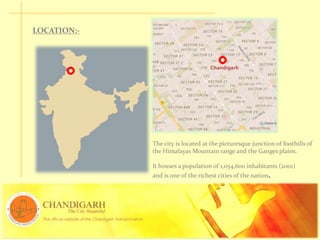
The city is located at the picturesque junction of foothills of
the Himalayas Mountain range and the Ganges plains.
It houses a population of 1,054,600 inhabitants (2001)
and is one of the richest cities of the nation.
LOCATION:-
Description:-
 Chandigarh, the dream city of India's first
Prime Minister, Sh. Jawahar Lal Nehru, was
planned by the famous French architect Le
Corbusier.
 Picturesquely located at the foothills of
Shivaliks, it is known as one of the best
experiments in urban planning and modern
architecture in the twentieth century in India.
 Chandigarh became symbolic of the newly
independent Indian. The foundation stone of
the city was laid in 1952.
 The city is well known for its architecture
and design by architects such as Le Corbusier,
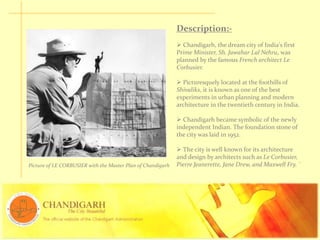
Pierre Jeanerette, Jane Drew, and Maxwell Fry. `Picture of LE CORBUSIER with the Master Plan of Chandigarh
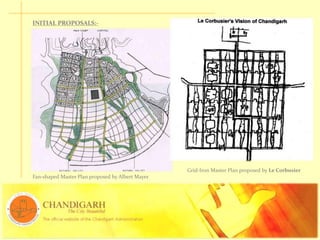
Grid-Iron Master Plan proposed by Le Corbusier
INITIAL PROPOSALS:-
Fan-shaped Master Plan proposed by Albert Mayer
MASTER PLAN:-
 The Master Plan by Le Corbusier was broadly similar to the one prepared by Albert Mayer and
Mathew Novicki, except that the shape of the city plan was modified from one with a curving road
network to rectangular shape with a grid iron pattern for the fast traffic roads, besides
reducing its area for reason of economy.
The city plan was conceived as post war ‘Garden City’ wherein vertical and high rise buildings
were ruled out, keeping in view the socio economic-conditions and living habits of the people.
 All the main roads were straightened out, the dimensions and organization of the
superblocks were reformatted, a complete hierarchy of circulation was established, the
nomenclature was changed, and the Capital “head” was firmly located in place.
The plan incorporated Le Corbusier’s principles of light, space and greenery. What had been
named an “Urban Village” in Mayer’s plan, Le Corbusier renamed a “Sector”.
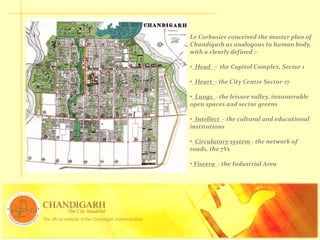
Le Corbusier conceived the master plan of
Chandigarh as analogous to human body,
with a clearly defined :-
• Head - the Capitol Complex, Sector 1
• Heart - the City Centre Sector-17
• Lungs - the leisure valley, innumerable
open spaces and sector greens
• Intellect - the cultural and educational
institutions
• Circulatory system - the network of
roads, the 7Vs
• Viscera - the Industrial Area
Sectors:-
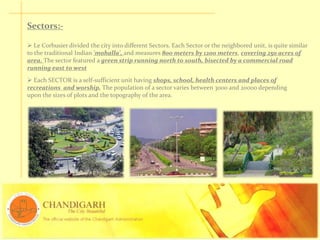
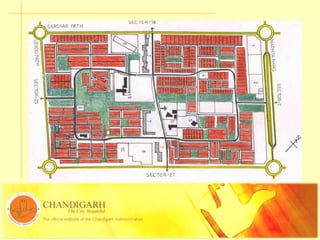
 Le Corbusier divided the city into different Sectors. Each Sector or the neighbored unit, is quite similar
to the traditional Indian 'mohalla', and measures 800 meters by 1200 meters, covering 250 acres of
area. The sector featured a green strip running north to south, bisected by a commercial road
running east to west
 Each SECTOR is a self-sufficient unit having shops, school, health centers and places of
recreations and worship. The population of a sector varies between 3000 and 20000 depending
upon the sizes of plots and the topography of the area.
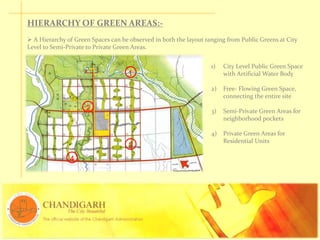
HIERARCHY OF GREEN AREAS:-
 A Hierarchy of Green Spaces can be observed in both the layout ranging from Public Greens at City
Level to Semi-Private to Private Green Areas.
1
2
3
4
1) City Level Public Green Space
with Artificial Water Body
2) Free- Flowing Green Space,
connecting the entire site
3) Semi-Private Green Areas for
neighborhood pockets
4) Private Green Areas for
Residential Units
HIERARCHY OF STREETS:-
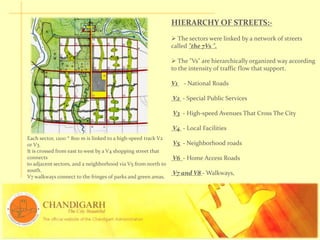
 The sectors were linked by a network of streets
called "the 7Vs ".
 The "Vs" are hierarchically organized way according
to the intensity of traffic flow that support.
V1 - National Roads
V2 - Special Public Services
V3 - High-speed Avenues That Cross The City
V4 - Local Facilities
V5 - Neighborhood roads
V6 - Home Access Roads
V7 and V8 - Walkways,
Each sector, 1200 * 800 m is linked to a high-speed track V2
or V3.
It is crossed from east to west by a V4 shopping street that
connects
to adjacent sectors, and a neighborhood via V5 from north to
south.
V7 walkways connect to the fringes of parks and green areas.
IMPORTANT BUILDINGS BY LE CORBUSIER:-
The educational, cultural and medical facilities are spread all over city, however, major institutions are
located in Sectors 10, 11, 12, 14 and 26.
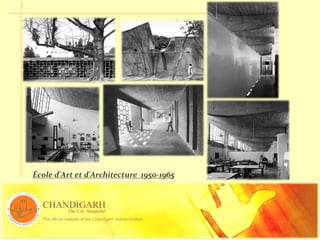
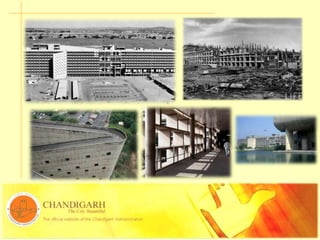
 The two Colleges, the École d'Art et d'Architecture from 1950-1965 are important buildings by Le
Corbusier.
 Their studios and classrooms are grouped around interior courtyards.
 The buildings are severely oriented north and south, so that light enters from the north.
 The halls are separated by low partitions.
 Le Corbusier determined that these school complexes and the Museum had to be built of the reddish-
brown brick that is common in India, or at least faced with this brick; in this way he sought to prevent
buildings within sight of the Capitol from attracting too much attention from his prestige buildings of
concrete.
 The industrial area comprises 2.35 sq kms, set-aside in the Master Plan for non-polluting, light industry
on the extreme southeastern side of the city near the railway line, as far away from the Educational Sectors
and Capitol Complex as possible
École d'Art et d'Architecture 1950-1965
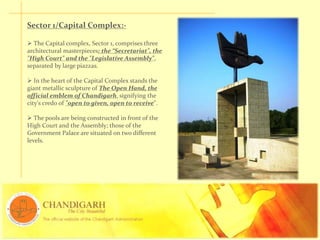
Sector 1/Capital Complex:-
 The Capital complex, Sector 1, comprises three
architectural masterpieces: the “Secretariat", the
"High Court" and the "Legislative Assembly",
separated by large piazzas.
 In the heart of the Capital Complex stands the
giant metallic sculpture of The Open Hand, the
official emblem of Chandigarh, signifying the
city's credo of "open to given, open to receive".
 The pools are being constructed in front of the
High Court and the Assembly; those of the
Government Palace are situated on two different
levels.
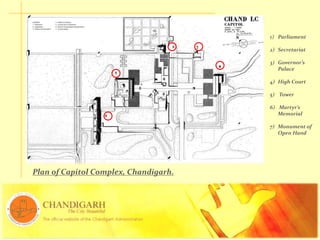
1) Parliament
2) Secretariat
3) Governor’s
Palace
4) High Court
5) Tower
6) Martyr’s
Memorial
7) Monument of
Open Hand
Plan of Capitol Complex, Chandigarh.
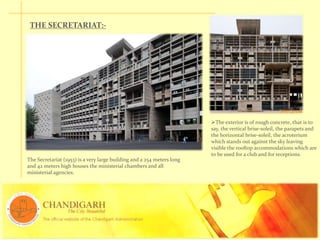
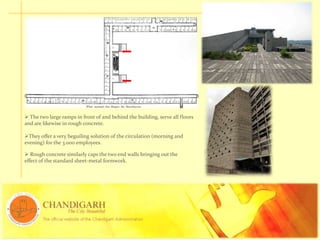
The Secretariat (1953) is a very large building and a 254 meters long
and 42 meters high houses the ministerial chambers and all
ministerial agencies.
THE SECRETARIAT:-
The exterior is of rough concrete, that is to
say, the vertical brise-soleil, the parapets and
the horizontal brise-soleil, the acroterium
which stands out against the sky leaving
visible the rooftop accommodations which are
to be used for a club and for receptions.
 The two large ramps in front of and behind the building, serve all floors
and are likewise in rough concrete.
They offer a very beguiling solution of the circulation (morning and
evening) for the 3.000 employees.
 Rough concrete similarly caps the two end walls bringing out the
effect of the standard sheet-metal formwork.
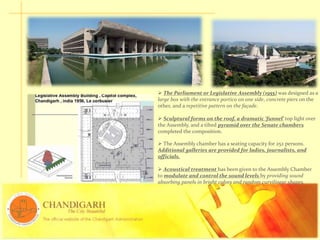
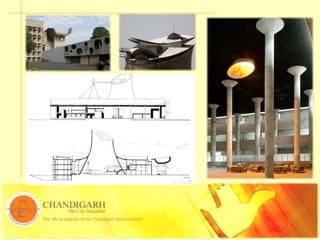
 The Parliament or Legislative Assembly (1955) was designed as a
large box with the entrance portico on one side, concrete piers on the
other, and a repetitive pattern on the façade.
 Sculptural forms on the roof, a dramatic ‘funnel’ top light over
the Assembly, and a tilted pyramid over the Senate chambers
completed the composition.
 The Assembly chamber has a seating capacity for 252 persons.
Additional galleries are provided for ladies, journalists, and
officials.
 Acoustical treatment has been given to the Assembly Chamber
to modulate and control the sound levels by providing sound
absorbing panels in bright colors and random curvilinear shapes.
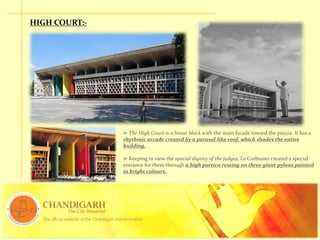
HIGH COURT:-
 The High Court is a linear block with the main facade toward the piazza. It has a
rhythmic arcade created by a parasol-like roof, which shades the entire
building.
 Keeping in view the special dignity of the judges, Le Corbusier created a special
entrance for them through a high portico resting on three giant pylons painted
in bright colours.
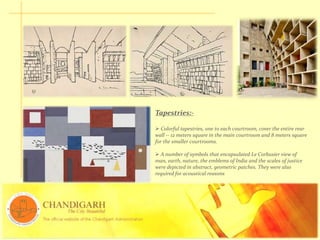
Tapestries:-
 Colorful tapestries, one to each courtroom, cover the entire rear
wall -- 12 meters square in the main courtroom and 8 meters square
for the smaller courtrooms.
 A number of symbols that encapsulated Le Corbusier view of
man, earth, nature, the emblems of India and the scales of justice
were depicted in abstract, geometric patches. They were also
required for acoustical reasons
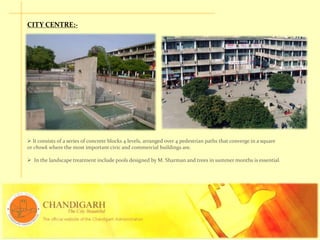
CITY CENTRE:-
 It consists of a series of concrete blocks 4 levels, arranged over 4 pedestrian paths that converge in a square
or chowk where the most important civic and commercial buildings are.
 In the landscape treatment include pools designed by M. Sharman and trees in summer months is essential.
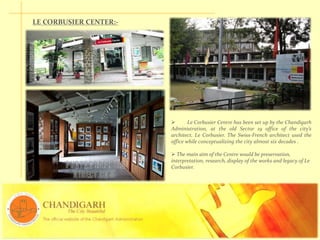
 Le Corbusier Centre has been set up by the Chandigarh
Administration, at the old Sector 19 office of the city’s
architect, Le Corbusier. The Swiss-French architect used the
office while conceptualizing the city almost six decades .
 The main aim of the Centre would be preservation,
interpretation, research, display of the works and legacy of Le
Corbusier.
LE CORBUSIER CENTER:-
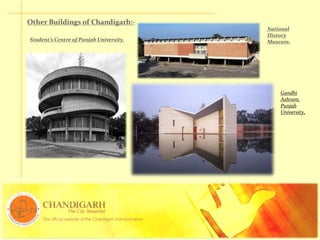
Student’s Centre of Punjab University.
National
History
Museum.
Other Buildings of Chandigarh:-
Gandhi
Ashram,
Punjab
University.
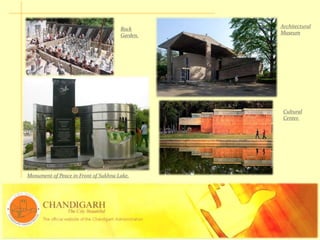
Architectural
Museum
Cultural
Center.
Rock
Garden.
Monument of Peace in Front of Sukhna Lake.
BIBLIOGRAPHY:-
 www.architectuul.com
 www.architecturalmoleskine.blogspot.ru/2012/11/chandigarh-and-le-corbusier
 www.fondationlecorbusier.com
 en.wikipedia.org
 www.fotocommunity.com
 image.slidesharecdn.com
 www.google.co.in
Thank YOU..!!!
PRESENTED BY:-
AAYUSHI DUBEY
III YEAR V SEM

Chandigarh planning

  • 1.
    PLANNING OF CHANDIGARH LECORBUSIER https://yourarchischool.blogspot.com FOR MORE LOG ON TO
  • 2.
    The city islocated at the picturesque junction of foothills of the Himalayas Mountain range and the Ganges plains. It houses a population of 1,054,600 inhabitants (2001) and is one of the richest cities of the nation. LOCATION:-
  • 3.
    Description:-  Chandigarh, thedream city of India's first Prime Minister, Sh. Jawahar Lal Nehru, was planned by the famous French architect Le Corbusier.  Picturesquely located at the foothills of Shivaliks, it is known as one of the best experiments in urban planning and modern architecture in the twentieth century in India.  Chandigarh became symbolic of the newly independent Indian. The foundation stone of the city was laid in 1952.  The city is well known for its architecture and design by architects such as Le Corbusier, Pierre Jeanerette, Jane Drew, and Maxwell Fry. `Picture of LE CORBUSIER with the Master Plan of Chandigarh
  • 4.
    Grid-Iron Master Planproposed by Le Corbusier INITIAL PROPOSALS:- Fan-shaped Master Plan proposed by Albert Mayer
  • 5.
    MASTER PLAN:-  TheMaster Plan by Le Corbusier was broadly similar to the one prepared by Albert Mayer and Mathew Novicki, except that the shape of the city plan was modified from one with a curving road network to rectangular shape with a grid iron pattern for the fast traffic roads, besides reducing its area for reason of economy. The city plan was conceived as post war ‘Garden City’ wherein vertical and high rise buildings were ruled out, keeping in view the socio economic-conditions and living habits of the people.  All the main roads were straightened out, the dimensions and organization of the superblocks were reformatted, a complete hierarchy of circulation was established, the nomenclature was changed, and the Capital “head” was firmly located in place. The plan incorporated Le Corbusier’s principles of light, space and greenery. What had been named an “Urban Village” in Mayer’s plan, Le Corbusier renamed a “Sector”.
  • 6.
    Le Corbusier conceivedthe master plan of Chandigarh as analogous to human body, with a clearly defined :- • Head - the Capitol Complex, Sector 1 • Heart - the City Centre Sector-17 • Lungs - the leisure valley, innumerable open spaces and sector greens • Intellect - the cultural and educational institutions • Circulatory system - the network of roads, the 7Vs • Viscera - the Industrial Area
  • 7.
    Sectors:-  Le Corbusierdivided the city into different Sectors. Each Sector or the neighbored unit, is quite similar to the traditional Indian 'mohalla', and measures 800 meters by 1200 meters, covering 250 acres of area. The sector featured a green strip running north to south, bisected by a commercial road running east to west  Each SECTOR is a self-sufficient unit having shops, school, health centers and places of recreations and worship. The population of a sector varies between 3000 and 20000 depending upon the sizes of plots and the topography of the area.
  • 9.
    HIERARCHY OF GREENAREAS:-  A Hierarchy of Green Spaces can be observed in both the layout ranging from Public Greens at City Level to Semi-Private to Private Green Areas. 1 2 3 4 1) City Level Public Green Space with Artificial Water Body 2) Free- Flowing Green Space, connecting the entire site 3) Semi-Private Green Areas for neighborhood pockets 4) Private Green Areas for Residential Units
  • 10.
    HIERARCHY OF STREETS:- The sectors were linked by a network of streets called "the 7Vs ".  The "Vs" are hierarchically organized way according to the intensity of traffic flow that support. V1 - National Roads V2 - Special Public Services V3 - High-speed Avenues That Cross The City V4 - Local Facilities V5 - Neighborhood roads V6 - Home Access Roads V7 and V8 - Walkways, Each sector, 1200 * 800 m is linked to a high-speed track V2 or V3. It is crossed from east to west by a V4 shopping street that connects to adjacent sectors, and a neighborhood via V5 from north to south. V7 walkways connect to the fringes of parks and green areas.
  • 11.
    IMPORTANT BUILDINGS BYLE CORBUSIER:- The educational, cultural and medical facilities are spread all over city, however, major institutions are located in Sectors 10, 11, 12, 14 and 26.  The two Colleges, the École d'Art et d'Architecture from 1950-1965 are important buildings by Le Corbusier.  Their studios and classrooms are grouped around interior courtyards.  The buildings are severely oriented north and south, so that light enters from the north.  The halls are separated by low partitions.  Le Corbusier determined that these school complexes and the Museum had to be built of the reddish- brown brick that is common in India, or at least faced with this brick; in this way he sought to prevent buildings within sight of the Capitol from attracting too much attention from his prestige buildings of concrete.  The industrial area comprises 2.35 sq kms, set-aside in the Master Plan for non-polluting, light industry on the extreme southeastern side of the city near the railway line, as far away from the Educational Sectors and Capitol Complex as possible
  • 12.
    École d'Art etd'Architecture 1950-1965
  • 13.
    Sector 1/Capital Complex:- The Capital complex, Sector 1, comprises three architectural masterpieces: the “Secretariat", the "High Court" and the "Legislative Assembly", separated by large piazzas.  In the heart of the Capital Complex stands the giant metallic sculpture of The Open Hand, the official emblem of Chandigarh, signifying the city's credo of "open to given, open to receive".  The pools are being constructed in front of the High Court and the Assembly; those of the Government Palace are situated on two different levels.
  • 14.
    1) Parliament 2) Secretariat 3)Governor’s Palace 4) High Court 5) Tower 6) Martyr’s Memorial 7) Monument of Open Hand Plan of Capitol Complex, Chandigarh.
  • 15.
    The Secretariat (1953)is a very large building and a 254 meters long and 42 meters high houses the ministerial chambers and all ministerial agencies. THE SECRETARIAT:- The exterior is of rough concrete, that is to say, the vertical brise-soleil, the parapets and the horizontal brise-soleil, the acroterium which stands out against the sky leaving visible the rooftop accommodations which are to be used for a club and for receptions.
  • 16.
     The twolarge ramps in front of and behind the building, serve all floors and are likewise in rough concrete. They offer a very beguiling solution of the circulation (morning and evening) for the 3.000 employees.  Rough concrete similarly caps the two end walls bringing out the effect of the standard sheet-metal formwork.
  • 18.
     The Parliamentor Legislative Assembly (1955) was designed as a large box with the entrance portico on one side, concrete piers on the other, and a repetitive pattern on the façade.  Sculptural forms on the roof, a dramatic ‘funnel’ top light over the Assembly, and a tilted pyramid over the Senate chambers completed the composition.  The Assembly chamber has a seating capacity for 252 persons. Additional galleries are provided for ladies, journalists, and officials.  Acoustical treatment has been given to the Assembly Chamber to modulate and control the sound levels by providing sound absorbing panels in bright colors and random curvilinear shapes.
  • 20.
    HIGH COURT:-  TheHigh Court is a linear block with the main facade toward the piazza. It has a rhythmic arcade created by a parasol-like roof, which shades the entire building.  Keeping in view the special dignity of the judges, Le Corbusier created a special entrance for them through a high portico resting on three giant pylons painted in bright colours.
  • 21.
    Tapestries:-  Colorful tapestries,one to each courtroom, cover the entire rear wall -- 12 meters square in the main courtroom and 8 meters square for the smaller courtrooms.  A number of symbols that encapsulated Le Corbusier view of man, earth, nature, the emblems of India and the scales of justice were depicted in abstract, geometric patches. They were also required for acoustical reasons
  • 22.
    CITY CENTRE:-  Itconsists of a series of concrete blocks 4 levels, arranged over 4 pedestrian paths that converge in a square or chowk where the most important civic and commercial buildings are.  In the landscape treatment include pools designed by M. Sharman and trees in summer months is essential.
  • 23.
     Le CorbusierCentre has been set up by the Chandigarh Administration, at the old Sector 19 office of the city’s architect, Le Corbusier. The Swiss-French architect used the office while conceptualizing the city almost six decades .  The main aim of the Centre would be preservation, interpretation, research, display of the works and legacy of Le Corbusier. LE CORBUSIER CENTER:-
  • 24.
    Student’s Centre ofPunjab University. National History Museum. Other Buildings of Chandigarh:- Gandhi Ashram, Punjab University.
  • 25.
  • 26.
    BIBLIOGRAPHY:-  www.architectuul.com  www.architecturalmoleskine.blogspot.ru/2012/11/chandigarh-and-le-corbusier www.fondationlecorbusier.com  en.wikipedia.org  www.fotocommunity.com  image.slidesharecdn.com  www.google.co.in Thank YOU..!!! PRESENTED BY:- AAYUSHI DUBEY III YEAR V SEM