
CHANDIGARH
Housing by Le Corbusier
Submitted To -
Farhana Nazneen
Lecturer ,
Dept. of Architecture
COURSE NAME - Housing
COURSE CODE - ARSP 472
Submitted By -
Sumaiya Islam
ID - 152081002
Batch - 8th, Sem - 7th
Dept. of Architecture
Presentation
On
Chandigarh Housing by Le Corbusier
I would like to express my special thanks of gratitude to our course teacher
Farhana Nazneen mam who gave me the opportunity to do this presentation on
“Chandigarh by Le Corbusier” which give me the opportunity to know details
about the City planning and it’s housing design.This also helped me doing a lot of
browsing and learning many things about the architect and his philosophies
towards design.
ThankYou
Sumaiya Islam
Acknowledgement
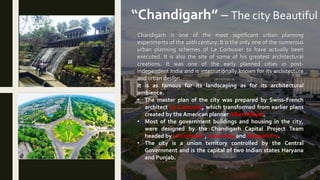
“Chandigarh” – The city Beautiful
Chandigarh is one of the most significant urban planning
experiments of the 20th century. It is the only one of the numerous
urban planning schemes of Le Corbusier to have actually been
executed. It is also the site of some of his greatest architectural
creations. It was one of the early planned cities in post-
independent India and is internationally known for its architecture
and urban design.
It is as famous for its landscaping as for its architectural
ambience.
• The master plan of the city was prepared by Swiss-French
architect Le Corbusier, which transformed from earlier plans
created by the American planner Albert Mayer.
• Most of the government buildings and housing in the city,
were designed by the Chandigarh Capital Project Team
headed by Le Corbusier, Jane Drew and Maxwell Fry.
• The city is a union territory controlled by the Central
Government and is the capital of two Indian states Haryana
and Punjab.
Chandigarh was the dream city of India's first Prime Minister, Jawaharlal
Nehru. After the partition of India in 1947, the former British province of
Punjab was split between (mostly Sikhs) East Punjab in India and (mostly
Muslim) West Punjab in Pakistan.The Indian Punjab required a new capital city
to replace Lahore, which had become part of Pakistan during the
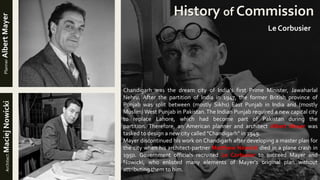
partition. Therefore, an American planner and architect Albert Mayer was
tasked to design a new city called "Chandigarh" in 1949.
Mayer discontinued his work on Chandigarh after developing a master plan for
the city when his architect-partner Matthew Nowicki died in a plane crash in
1950. Government officials recruited Le Corbusier to succeed Mayer and
Nowicki, who enlisted many elements of Mayer's original plan without
attributing them to him.
History of Commission
PlannerAlbertMayerArchitectMaciejNowicki
Le Corbusier
Geography & Location
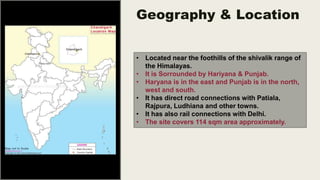
• Located near the foothills of the shivalik range of
the Himalayas.
• It is Sorrounded by Hariyana & Punjab.
• Haryana is in the east and Punjab is in the north,
west and south.
• It has direct road connections with Patiala,
Rajpura, Ludhiana and other towns.
• It has also rail connections with Delhi.
• The site covers 114 sqm area approximately.
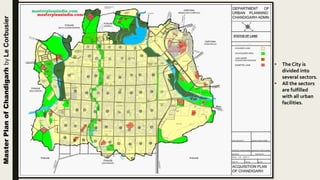
MasterPlanofChandigarhbyLeCorbusier
• The City is
divided into
several sectors.
• All the sectors
are fulfilled
with all urban
facilities.
1
The discipline of
Money
2
The discipline of
Technology
3
The discipline of
Climate
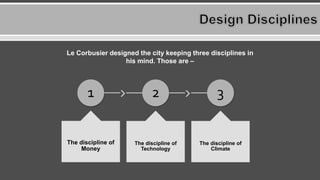
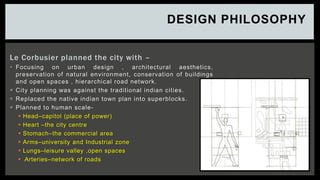
Le Corbusier designed the city keeping three disciplines in
his mind. Those are –
Le Corbusier planned the city with –
 Focusing on urban design , architectural aesthetics,
preservation of natural environment, conservation of buildings
and open spaces , hierarchical road network.
 City planning was against the traditional indian cities.
 Replaced the native indian town plan into superblocks.
 Planned to human scale-
 Head–capitol (place of power)
 Heart –the city centre
 Stomach–the commercial area
 Arms–university and Industrial zone
 Lungs–leisure valley ,open spaces
 Arteries–network of roads
DESIGN PHILOSOPHY
Facilities
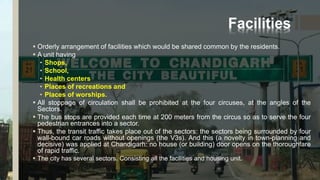
 Orderly arrangement of facilities which would be shared common by the residents.
 A unit having
• Shops,
• School,
• Health centers
• Places of recreations and
• Places of worships.
 All stoppage of circulation shall be prohibited at the four circuses, at the angles of the
Sectors.
 The bus stops are provided each time at 200 meters from the circus so as to serve the four
pedestrian entrances into a sector.
 Thus, the transit traffic takes place out of the sectors: the sectors being surrounded by four
wall-bound car roads without openings (the V3s). And this (a novelty in town-planning and
decisive) was applied at Chandigarh: no house (or building) door opens on the thoroughfare
of rapid traffic.
 The city has several sectors. Consisting all the facilities and housing unit.
Sectors
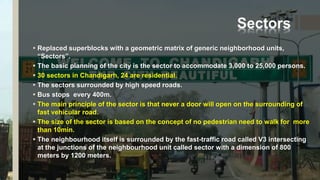
 Replaced superblocks with a geometric matrix of generic neighborhood units,
“Sectors”.
 The basic planning of the city is the sector to accommodate 3,000 to 25,000 persons.
 30 sectors in Chandigarh, 24 are residential.
 The sectors surrounded by high speed roads.
 Bus stops every 400m.
 The main principle of the sector is that never a door will open on the surrounding of
fast vehicular road.
 The size of the sector is based on the concept of no pedestrian need to walk for more
than 10min.
 The neighbourhood itself is surrounded by the fast-traffic road called V3 intersecting
at the junctions of the neighbourhood unit called sector with a dimension of 800
meters by 1200 meters.
HOUSING OF CHANDIGARH
 Initially, two main categories of housing were
planned in the city - public and private
 The residential buildings were governed by a
mechanism known as 'frame control' created by the
municipal administration to control their facades.
 This fixed the building line and height and the use of
building materials.
 Certain standard sizes of doors and windows are
specified and all the gates and boundary walls must
conform to standard design.
 The idea was to ensure that the view from the
street, which belonged to the community, was of
same visual order and discipline to maintain
uniformity.
 The basic typology is extremely rectilinear with
similar proportions.
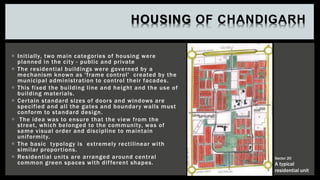
 Residential units are arranged around central
common green spaces with different shapes.
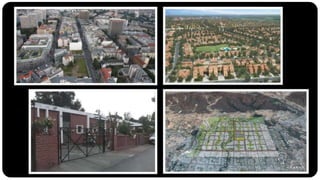
Sector 20
A typical
residential unit
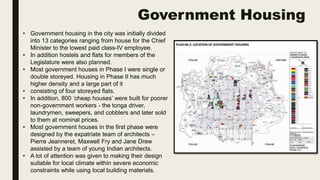
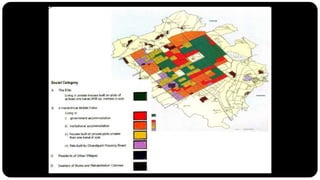
Government Housing
• Government housing in the city was initially divided
into 13 categories ranging from house for the Chief
Minister to the lowest paid class-IV employee.
• In addition hostels and flats for members of the
Legislature were also planned.
• Most government houses in Phase I were single or
double storeyed. Housing in Phase II has much
higher density and a large part of it
• consisting of four storeyed flats.
• In addition, 800 ‘cheap houses’ were built for poorer
non-government workers - the tonga driver,
laundrymen, sweepers, and cobblers and later sold
to them at nominal prices.
• Most government houses in the first phase were
designed by the expatriate team of architects –
Pierre Jeanneret, Maxwell Fry and Jane Drew
assisted by a team of young Indian architects.
• A lot of attention was given to making their design
suitable for local climate within severe economic
constraints while using local building materials.
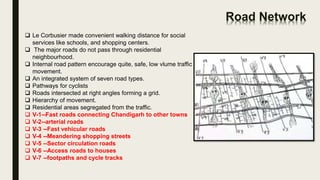
Road Network
 Le Corbusier made convenient walking distance for social
services like schools, and shopping centers.
 The major roads do not pass through residential
neighbourhood.
 Internal road pattern encourage quite, safe, low vlume traffic
movement.
 An integrated system of seven road types.
 Pathways for cyclists
 Roads intersected at right angles forming a grid.
 Hierarchy of movement.
 Residential areas segregated from the traffic.
 V-1--Fast roads connecting Chandigarh to other towns
 V-2--arterial roads
 V-3 --Fast vehicular roads
 V-4 --Meandering shopping streets
 V-5 --Sector circulation roads
 V-6 --Access roads to houses
 V-7 --footpaths and cycle tracks
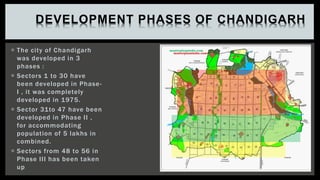
DEVELOPMENT PHASES OF CHANDIGARH
 The city of Chandigarh
was developed in 3
phases :
 Sectors 1 to 30 have
been developed in Phase-
I , it was completely
developed in 1975.
 Sector 31to 47 have been
developed in Phase II ,
for accommodating
population of 5 lakhs in
combined.
 Sectors from 48 to 56 in
Phase III has been taken
up
 POSITIVE HIGHLIGHTS :
O Each sector satisfies the necessities of human needs
O Separate roads for pedestrian, bicycle and heavy vehicles
O Shops on ground floor, Residence on upper floor
O Shop protected from rain and sun, as a covered walkway for
the customers.
 NEGATIVE HIGHLIGHTS :
O Roads being similar to each other creates confusion.
O City not planned for lower income people.
O Existence of slums around the city.
THANKYOU

Chandigarh

  • 1.
  • 2.
    Submitted To - FarhanaNazneen Lecturer , Dept. of Architecture COURSE NAME - Housing COURSE CODE - ARSP 472 Submitted By - Sumaiya Islam ID - 152081002 Batch - 8th, Sem - 7th Dept. of Architecture Presentation On Chandigarh Housing by Le Corbusier
  • 3.
    I would liketo express my special thanks of gratitude to our course teacher Farhana Nazneen mam who gave me the opportunity to do this presentation on “Chandigarh by Le Corbusier” which give me the opportunity to know details about the City planning and it’s housing design.This also helped me doing a lot of browsing and learning many things about the architect and his philosophies towards design. ThankYou Sumaiya Islam Acknowledgement
  • 4.
    “Chandigarh” – Thecity Beautiful Chandigarh is one of the most significant urban planning experiments of the 20th century. It is the only one of the numerous urban planning schemes of Le Corbusier to have actually been executed. It is also the site of some of his greatest architectural creations. It was one of the early planned cities in post- independent India and is internationally known for its architecture and urban design. It is as famous for its landscaping as for its architectural ambience. • The master plan of the city was prepared by Swiss-French architect Le Corbusier, which transformed from earlier plans created by the American planner Albert Mayer. • Most of the government buildings and housing in the city, were designed by the Chandigarh Capital Project Team headed by Le Corbusier, Jane Drew and Maxwell Fry. • The city is a union territory controlled by the Central Government and is the capital of two Indian states Haryana and Punjab.
  • 5.
    Chandigarh was thedream city of India's first Prime Minister, Jawaharlal Nehru. After the partition of India in 1947, the former British province of Punjab was split between (mostly Sikhs) East Punjab in India and (mostly Muslim) West Punjab in Pakistan.The Indian Punjab required a new capital city to replace Lahore, which had become part of Pakistan during the partition. Therefore, an American planner and architect Albert Mayer was tasked to design a new city called "Chandigarh" in 1949. Mayer discontinued his work on Chandigarh after developing a master plan for the city when his architect-partner Matthew Nowicki died in a plane crash in 1950. Government officials recruited Le Corbusier to succeed Mayer and Nowicki, who enlisted many elements of Mayer's original plan without attributing them to him. History of Commission PlannerAlbertMayerArchitectMaciejNowicki Le Corbusier
  • 6.
    Geography & Location •Located near the foothills of the shivalik range of the Himalayas. • It is Sorrounded by Hariyana & Punjab. • Haryana is in the east and Punjab is in the north, west and south. • It has direct road connections with Patiala, Rajpura, Ludhiana and other towns. • It has also rail connections with Delhi. • The site covers 114 sqm area approximately.
  • 7.
    MasterPlanofChandigarhbyLeCorbusier • The Cityis divided into several sectors. • All the sectors are fulfilled with all urban facilities.
  • 8.
    1 The discipline of Money 2 Thediscipline of Technology 3 The discipline of Climate Le Corbusier designed the city keeping three disciplines in his mind. Those are –
  • 9.
    Le Corbusier plannedthe city with –  Focusing on urban design , architectural aesthetics, preservation of natural environment, conservation of buildings and open spaces , hierarchical road network.  City planning was against the traditional indian cities.  Replaced the native indian town plan into superblocks.  Planned to human scale-  Head–capitol (place of power)  Heart –the city centre  Stomach–the commercial area  Arms–university and Industrial zone  Lungs–leisure valley ,open spaces  Arteries–network of roads DESIGN PHILOSOPHY
  • 10.
    Facilities  Orderly arrangementof facilities which would be shared common by the residents.  A unit having • Shops, • School, • Health centers • Places of recreations and • Places of worships.  All stoppage of circulation shall be prohibited at the four circuses, at the angles of the Sectors.  The bus stops are provided each time at 200 meters from the circus so as to serve the four pedestrian entrances into a sector.  Thus, the transit traffic takes place out of the sectors: the sectors being surrounded by four wall-bound car roads without openings (the V3s). And this (a novelty in town-planning and decisive) was applied at Chandigarh: no house (or building) door opens on the thoroughfare of rapid traffic.  The city has several sectors. Consisting all the facilities and housing unit.
  • 11.
    Sectors  Replaced superblockswith a geometric matrix of generic neighborhood units, “Sectors”.  The basic planning of the city is the sector to accommodate 3,000 to 25,000 persons.  30 sectors in Chandigarh, 24 are residential.  The sectors surrounded by high speed roads.  Bus stops every 400m.  The main principle of the sector is that never a door will open on the surrounding of fast vehicular road.  The size of the sector is based on the concept of no pedestrian need to walk for more than 10min.  The neighbourhood itself is surrounded by the fast-traffic road called V3 intersecting at the junctions of the neighbourhood unit called sector with a dimension of 800 meters by 1200 meters.
  • 12.
    HOUSING OF CHANDIGARH Initially, two main categories of housing were planned in the city - public and private  The residential buildings were governed by a mechanism known as 'frame control' created by the municipal administration to control their facades.  This fixed the building line and height and the use of building materials.  Certain standard sizes of doors and windows are specified and all the gates and boundary walls must conform to standard design.  The idea was to ensure that the view from the street, which belonged to the community, was of same visual order and discipline to maintain uniformity.  The basic typology is extremely rectilinear with similar proportions.  Residential units are arranged around central common green spaces with different shapes. Sector 20 A typical residential unit
  • 13.
    Government Housing • Governmenthousing in the city was initially divided into 13 categories ranging from house for the Chief Minister to the lowest paid class-IV employee. • In addition hostels and flats for members of the Legislature were also planned. • Most government houses in Phase I were single or double storeyed. Housing in Phase II has much higher density and a large part of it • consisting of four storeyed flats. • In addition, 800 ‘cheap houses’ were built for poorer non-government workers - the tonga driver, laundrymen, sweepers, and cobblers and later sold to them at nominal prices. • Most government houses in the first phase were designed by the expatriate team of architects – Pierre Jeanneret, Maxwell Fry and Jane Drew assisted by a team of young Indian architects. • A lot of attention was given to making their design suitable for local climate within severe economic constraints while using local building materials.
  • 16.
    Road Network  LeCorbusier made convenient walking distance for social services like schools, and shopping centers.  The major roads do not pass through residential neighbourhood.  Internal road pattern encourage quite, safe, low vlume traffic movement.  An integrated system of seven road types.  Pathways for cyclists  Roads intersected at right angles forming a grid.  Hierarchy of movement.  Residential areas segregated from the traffic.  V-1--Fast roads connecting Chandigarh to other towns  V-2--arterial roads  V-3 --Fast vehicular roads  V-4 --Meandering shopping streets  V-5 --Sector circulation roads  V-6 --Access roads to houses  V-7 --footpaths and cycle tracks
  • 17.
    DEVELOPMENT PHASES OFCHANDIGARH  The city of Chandigarh was developed in 3 phases :  Sectors 1 to 30 have been developed in Phase- I , it was completely developed in 1975.  Sector 31to 47 have been developed in Phase II , for accommodating population of 5 lakhs in combined.  Sectors from 48 to 56 in Phase III has been taken up
  • 18.
     POSITIVE HIGHLIGHTS: O Each sector satisfies the necessities of human needs O Separate roads for pedestrian, bicycle and heavy vehicles O Shops on ground floor, Residence on upper floor O Shop protected from rain and sun, as a covered walkway for the customers.  NEGATIVE HIGHLIGHTS : O Roads being similar to each other creates confusion. O City not planned for lower income people. O Existence of slums around the city.
  • 19.