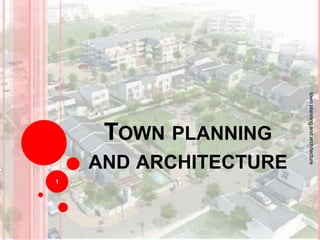
TOWN PLANNING
AND ARCHITECTURE
1
townplanningandarchitecture
TOWN PLANNING ACT
2
townplanningandarchitecture
 Bombay Town planning act(1915)
 The idea of development plan was flourished in this act
 This was soon followed by Madras Town Planning Act in
1920
 The first comprehensive Act requiring the preparation of
development plans and authorieing its enforcement is
the Bombay Town and Country Planning Act,1954
 This came into effect on 1957
 It started a new way of thinking for systematic planning
3
townplanningandarchitecture
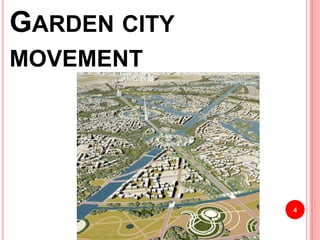
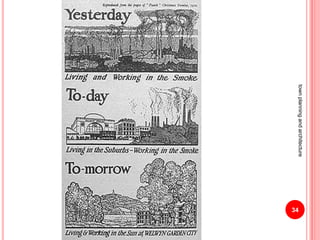
GARDEN CITY
MOVEMENT
4
HISTORY
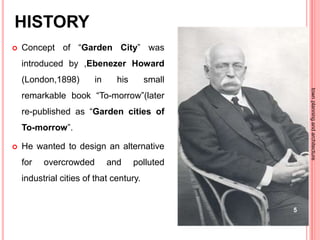
 Concept of “Garden City” was
introduced by ,Ebenezer Howard
(London,1898) in his small
remarkable book “To-morrow”(later
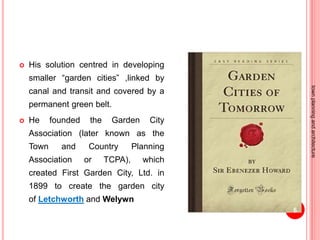
re-published as “Garden cities of
To-morrow”.
 He wanted to design an alternative
for overcrowded and polluted
industrial cities of that century.
5
townplanningandarchitecture
 His solution centred in developing
smaller “garden cities” ,linked by
canal and transit and covered by a
permanent green belt.
 He founded the Garden City
Association (later known as the
Town and Country Planning
Association or TCPA), which
created First Garden City, Ltd. in
1899 to create the garden city
of Letchworth and Welywn
6
townplanningandarchitecture
FEATURES OF GARDEN CITY OF HOWARD
 accommodate 32,000 people
 6,000 acres (2,400 ha),
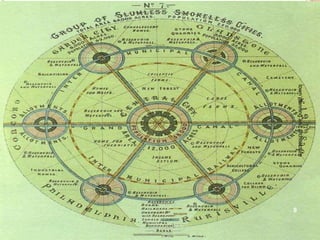
 planned on a concentric pattern with open spaces, public parks and
six radial boulevards, 120 ft (37 m) wide, extending from the centre.
 The garden city would be self-sufficient and when it reached full
population, another garden city would be developed nearby.
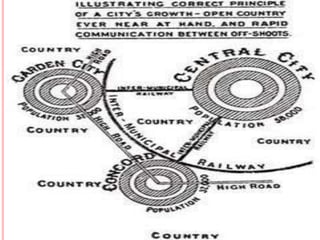
 Howard envisaged a cluster of several garden cities as satellites of a
central city of 50,000 people, linked by road and rail
7
townplanningandarchitecture
8
townplanningandarchitecture
9
“THREE MAGNETS”
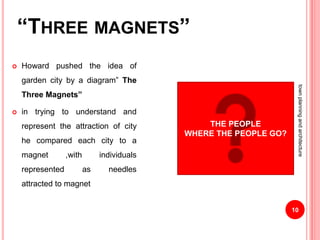
 Howard pushed the idea of
garden city by a diagram” The
Three Magnets”
 in trying to understand and
represent the attraction of city
he compared each city to a
magnet ,with individuals
represented as needles
attracted to magnet
THE PEOPLE
WHERE THE PEOPLE GO?
10
townplanningandarchitecture
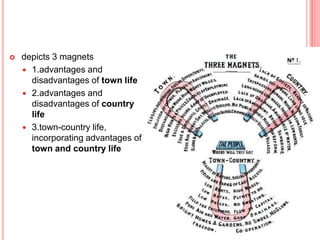
 depicts 3 magnets
 1.advantages and
disadvantages of town life
 2.advantages and
disadvantages of country
life
 3.town-country life,
incorporating advantages of
town and country life
11
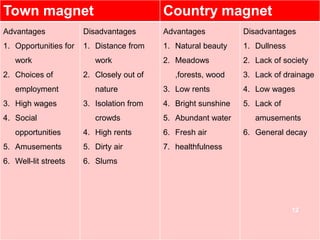
Town magnet Country magnet
Advantages
1. Opportunities for
work
2. Choices of
employment
3. High wages
4. Social
opportunities
5. Amusements
6. Well-lit streets
Disadvantages
1. Distance from
work
2. Closely out of
nature
3. Isolation from
crowds
4. High rents
5. Dirty air
6. Slums
Advantages
1. Natural beauty
2. Meadows
,forests, wood
3. Low rents
4. Bright sunshine
5. Abundant water
6. Fresh air
7. healthfulness
Disadvantages
1. Dullness
2. Lack of society
3. Lack of drainage
4. Low wages
5. Lack of
amusements
6. General decay
12
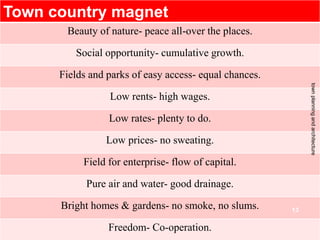
Town country magnet
Beauty of nature- peace all-over the places.
Social opportunity- cumulative growth.
Fields and parks of easy access- equal chances.
Low rents- high wages.
Low rates- plenty to do.
Low prices- no sweating.
Field for enterprise- flow of capital.
Pure air and water- good drainage.
Bright homes & gardens- no smoke, no slums.
Freedom- Co-operation.
13
townplanningandarchitecture
 Solution
 Combination of advantage of town and country planning in the town
country magnet
 He proposed a town in a country
“garden city”
14
townplanningandarchitecture
DEFINITION OF GARDEN CITY
 Term means ‘a city in a garden ‘ or city of gardens’.
 By Garden cities and Town Planning Association ,1919
“a garden city is a town designed for healthy living and
industry; of a size that makes possible a full measure of social
life; but not larger ;surrounded by a rural belt; the whole of the
land being in public ownership or held in trust for community”
15
townplanningandarchitecture
 Garden cities were intended to be planned, self-contained
communities surrounded by "greenbelts", containing proportionate
areas of residences, industry, and agriculture.
 The garden city introduced the use of greenbelts that have served
many uses including the preservation of agricultural and rural life,
nature and heritage conservation, recreation, pollution minimization,
and growth management.
 Garden city tradition endowed urban planning with a social and
community dimensions.
 The garden city idea however, showed how both industrial estates
and collective retailing spaces could be used within a
comprehensive planning approach to serve public purposes.
16
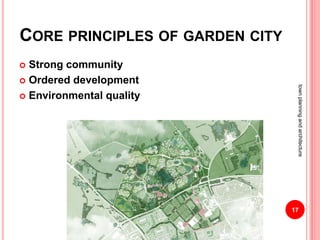
CORE PRINCIPLES OF GARDEN CITY
 Strong community
 Ordered development
 Environmental quality
17
townplanningandarchitecture
PRINCIPLES OF GARDEN CITY
 Co-operatve holding of land to insure that the advantage of
appreciation of land values goes to the community,not the private
individuals
 Economic and social advantages of large scale planning
 Establishment of cities of limited size, but at the same time
possessing a balanced agricultural industrial economy
 Urban decentralisation
 Use of a surrounding green belt to serve as an agricultural
recreational area 18
townplanningandarchitecture
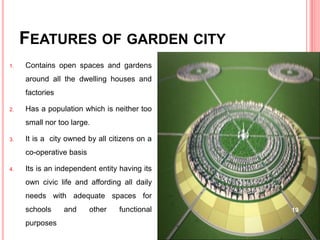
FEATURES OF GARDEN CITY
1. Contains open spaces and gardens
around all the dwelling houses and
factories
2. Has a population which is neither too
small nor too large.
3. It is a city owned by all citizens on a
co-operative basis
4. Its is an independent entity having its
own civic life and affording all daily
needs with adequate spaces for
schools and other functional
purposes
19
5. It is a self sufficient unit having its own
industries
6. It is surrounded by periphery by a green
belt.
7. It need not have the rapid transit
arrangement
8. The surplus fund is utilised for the
development of the community itself
20
townplanningandarchitecture
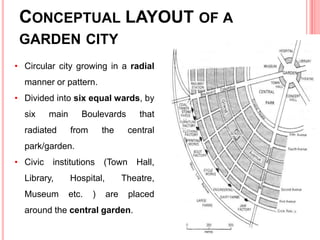
CONCEPTUAL LAYOUT OF A
GARDEN CITY
• Circular city growing in a radial
manner or pattern.
• Divided into six equal wards, by
six main Boulevards that
radiated from the central
park/garden.
• Civic institutions (Town Hall,
Library, Hospital, Theatre,
Museum etc. ) are placed
around the central garden. 21
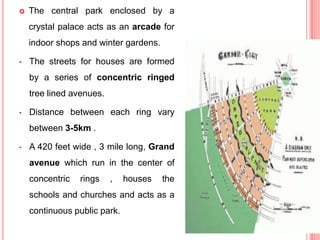
 The central park enclosed by a
crystal palace acts as an arcade for
indoor shops and winter gardens.
• The streets for houses are formed
by a series of concentric ringed
tree lined avenues.
• Distance between each ring vary
between 3-5km .
• A 420 feet wide , 3 mile long, Grand
avenue which run in the center of
concentric rings , houses the
schools and churches and acts as a
continuous public park. 22
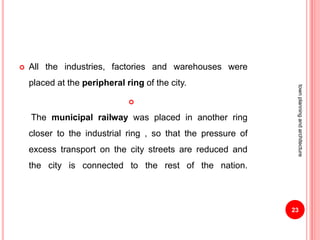
 All the industries, factories and warehouses were
placed at the peripheral ring of the city.

The municipal railway was placed in another ring
closer to the industrial ring , so that the pressure of
excess transport on the city streets are reduced and
the city is connected to the rest of the nation.
23
townplanningandarchitecture
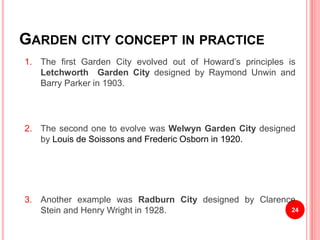
GARDEN CITY CONCEPT IN PRACTICE
1. The first Garden City evolved out of Howard’s principles is
Letchworth Garden City designed by Raymond Unwin and
Barry Parker in 1903.
2. The second one to evolve was Welwyn Garden City designed
by Louis de Soissons and Frederic Osborn in 1920.
3. Another example was Radburn City designed by Clarence
Stein and Henry Wright in 1928. 24
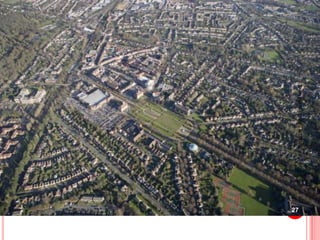
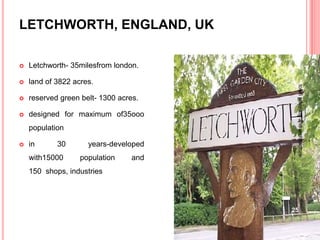
LETCHWORTH, ENGLAND, UK
 Letchworth- 35milesfrom london.
 land of 3822 acres.
 reserved green belt- 1300 acres.
 designed for maximum of35ooo
population
 in 30 years-developed
with15000 population and
150 shops, industries
25
townplanningandarchitecture
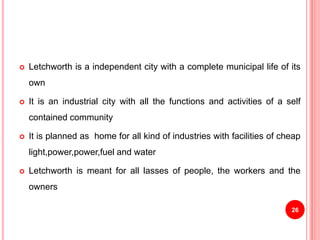
 Letchworth is a independent city with a complete municipal life of its
own
 It is an industrial city with all the functions and activities of a self
contained community
 It is planned as home for all kind of industries with facilities of cheap
light,power,power,fuel and water
 Letchworth is meant for all lasses of people, the workers and the
owners
26
27
townplanningandarchitecture
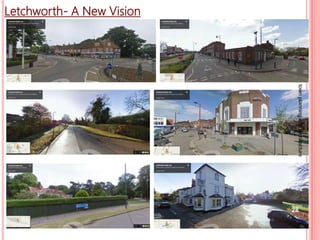
Letchworth- A New Vision
28
townplanningandarchitecture
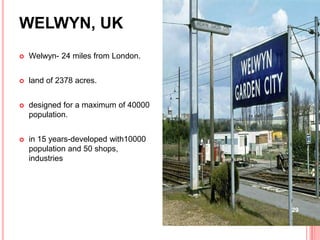
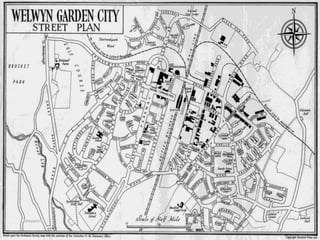
WELWYN, UK
 Welwyn- 24 miles from London.
 land of 2378 acres.
 designed for a maximum of 40000
population.
 in 15 years-developed with10000
population and 50 shops,
industries
29
 Welwyn garden city was
the second garden city in
England (founded 1920)
and one of thefirst new
towns (designated1948).
 it is unique in being both
garden city and a new
town and exemplifies the
physical, social and
cultural planning ideals

30
townplanningandarchitecture
31
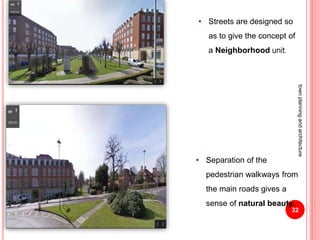
• Streets are designed so
as to give the concept of
a Neighborhood unit.
• Separation of the
pedestrian walkways from
the main roads gives a
sense of natural beauty.
32
townplanningandarchitecture
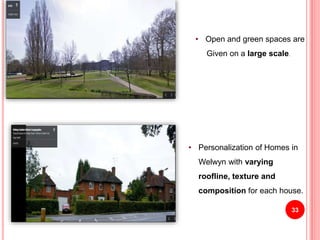
• Personalization of Homes in
Welwyn with varying
roofline, texture and
composition for each house.
• Open and green spaces are
Given on a large scale.
33
34
townplanningandarchitecture
RADBURN ,NEW JERSEY
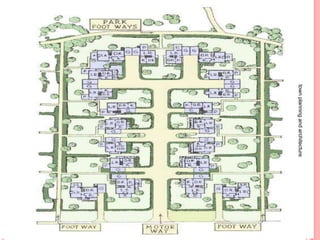
• Radburn was planned by architects Clarence Stein and Henry Wright in
1928.
• It is America’s first garden community, serving as a world wide example of
the harmonious blending of private space and open area.
• Radburn provided a prototype for the new towns to meet the requirements for
contemporary good living.
• Radburn was designed to occupy one square mile of land and house some
25,000 residents.
• However, the Great Depression limited the development to only 149 acres..
• Although Radburn is smaller than planned, it still plays a very important role in
the history of urban planning.
• The Regional Planning Association of America (RPAA) used Radburn as a
garden city experiment.
35
36
townplanningandarchitecture
BANGALORE
 Asia’s fastest growing cosmopolitan city
 It is the home to IT industry and many scientific
establishments
 Blessed with a good climate, gardens,peaks,natural
lakes, architectural land marks, hoping malls
 Bangalore is the ideal gateway o India and beyond
37
townplanningandarchitecture
38
townplanningandarchitecture
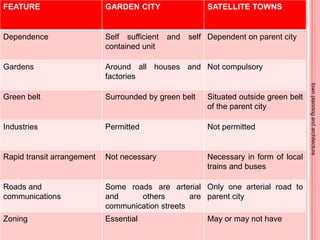
FEATURE GARDEN CITY SATELLITE TOWNS
Dependence Self sufficient and self
contained unit
Dependent on parent city
Gardens Around all houses and
factories
Not compulsory
Green belt Surrounded by green belt Situated outside green belt
of the parent city
Industries Permitted Not permitted
Rapid transit arrangement Not necessary Necessary in form of local
trains and buses
Roads and
communications
Some roads are arterial
and others are
communication streets
Only one arterial road to
parent city
Zoning Essential May or may not have
DEVELOPMENTS INFLUENCED BY THE GARDEN
CITY MOVEMENT
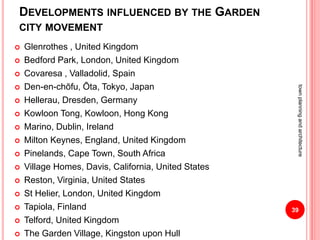
 Glenrothes , United Kingdom
 Bedford Park, London, United Kingdom
 Covaresa , Valladolid, Spain
 Den-en-chōfu, Ōta, Tokyo, Japan
 Hellerau, Dresden, Germany
 Kowloon Tong, Kowloon, Hong Kong
 Marino, Dublin, Ireland
 Milton Keynes, England, United Kingdom
 Pinelands, Cape Town, South Africa
 Village Homes, Davis, California, United States
 Reston, Virginia, United States
 St Helier, London, United Kingdom
 Tapiola, Finland
 Telford, United Kingdom
 The Garden Village, Kingston upon Hull
39
townplanningandarchitecture
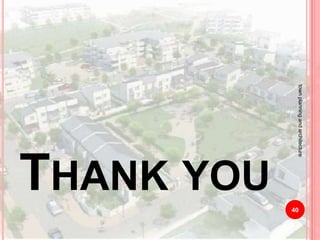
THANK YOU
40
townplanningandarchitecture

GARDEN CITY MOVEMENT

  • 1.
  • 2.
  • 3.
     Bombay Townplanning act(1915)  The idea of development plan was flourished in this act  This was soon followed by Madras Town Planning Act in 1920  The first comprehensive Act requiring the preparation of development plans and authorieing its enforcement is the Bombay Town and Country Planning Act,1954  This came into effect on 1957  It started a new way of thinking for systematic planning 3 townplanningandarchitecture
  • 4.
  • 5.
    HISTORY  Concept of“Garden City” was introduced by ,Ebenezer Howard (London,1898) in his small remarkable book “To-morrow”(later re-published as “Garden cities of To-morrow”.  He wanted to design an alternative for overcrowded and polluted industrial cities of that century. 5 townplanningandarchitecture
  • 6.
     His solutioncentred in developing smaller “garden cities” ,linked by canal and transit and covered by a permanent green belt.  He founded the Garden City Association (later known as the Town and Country Planning Association or TCPA), which created First Garden City, Ltd. in 1899 to create the garden city of Letchworth and Welywn 6 townplanningandarchitecture
  • 7.
    FEATURES OF GARDENCITY OF HOWARD  accommodate 32,000 people  6,000 acres (2,400 ha),  planned on a concentric pattern with open spaces, public parks and six radial boulevards, 120 ft (37 m) wide, extending from the centre.  The garden city would be self-sufficient and when it reached full population, another garden city would be developed nearby.  Howard envisaged a cluster of several garden cities as satellites of a central city of 50,000 people, linked by road and rail 7 townplanningandarchitecture
  • 8.
  • 9.
  • 10.
    “THREE MAGNETS”  Howardpushed the idea of garden city by a diagram” The Three Magnets”  in trying to understand and represent the attraction of city he compared each city to a magnet ,with individuals represented as needles attracted to magnet THE PEOPLE WHERE THE PEOPLE GO? 10 townplanningandarchitecture
  • 11.
     depicts 3magnets  1.advantages and disadvantages of town life  2.advantages and disadvantages of country life  3.town-country life, incorporating advantages of town and country life 11
  • 12.
    Town magnet Countrymagnet Advantages 1. Opportunities for work 2. Choices of employment 3. High wages 4. Social opportunities 5. Amusements 6. Well-lit streets Disadvantages 1. Distance from work 2. Closely out of nature 3. Isolation from crowds 4. High rents 5. Dirty air 6. Slums Advantages 1. Natural beauty 2. Meadows ,forests, wood 3. Low rents 4. Bright sunshine 5. Abundant water 6. Fresh air 7. healthfulness Disadvantages 1. Dullness 2. Lack of society 3. Lack of drainage 4. Low wages 5. Lack of amusements 6. General decay 12
  • 13.
    Town country magnet Beautyof nature- peace all-over the places. Social opportunity- cumulative growth. Fields and parks of easy access- equal chances. Low rents- high wages. Low rates- plenty to do. Low prices- no sweating. Field for enterprise- flow of capital. Pure air and water- good drainage. Bright homes & gardens- no smoke, no slums. Freedom- Co-operation. 13 townplanningandarchitecture
  • 14.
     Solution  Combinationof advantage of town and country planning in the town country magnet  He proposed a town in a country “garden city” 14 townplanningandarchitecture
  • 15.
    DEFINITION OF GARDENCITY  Term means ‘a city in a garden ‘ or city of gardens’.  By Garden cities and Town Planning Association ,1919 “a garden city is a town designed for healthy living and industry; of a size that makes possible a full measure of social life; but not larger ;surrounded by a rural belt; the whole of the land being in public ownership or held in trust for community” 15 townplanningandarchitecture
  • 16.
     Garden citieswere intended to be planned, self-contained communities surrounded by "greenbelts", containing proportionate areas of residences, industry, and agriculture.  The garden city introduced the use of greenbelts that have served many uses including the preservation of agricultural and rural life, nature and heritage conservation, recreation, pollution minimization, and growth management.  Garden city tradition endowed urban planning with a social and community dimensions.  The garden city idea however, showed how both industrial estates and collective retailing spaces could be used within a comprehensive planning approach to serve public purposes. 16
  • 17.
    CORE PRINCIPLES OFGARDEN CITY  Strong community  Ordered development  Environmental quality 17 townplanningandarchitecture
  • 18.
    PRINCIPLES OF GARDENCITY  Co-operatve holding of land to insure that the advantage of appreciation of land values goes to the community,not the private individuals  Economic and social advantages of large scale planning  Establishment of cities of limited size, but at the same time possessing a balanced agricultural industrial economy  Urban decentralisation  Use of a surrounding green belt to serve as an agricultural recreational area 18 townplanningandarchitecture
  • 19.
    FEATURES OF GARDENCITY 1. Contains open spaces and gardens around all the dwelling houses and factories 2. Has a population which is neither too small nor too large. 3. It is a city owned by all citizens on a co-operative basis 4. Its is an independent entity having its own civic life and affording all daily needs with adequate spaces for schools and other functional purposes 19
  • 20.
    5. It isa self sufficient unit having its own industries 6. It is surrounded by periphery by a green belt. 7. It need not have the rapid transit arrangement 8. The surplus fund is utilised for the development of the community itself 20 townplanningandarchitecture
  • 21.
    CONCEPTUAL LAYOUT OFA GARDEN CITY • Circular city growing in a radial manner or pattern. • Divided into six equal wards, by six main Boulevards that radiated from the central park/garden. • Civic institutions (Town Hall, Library, Hospital, Theatre, Museum etc. ) are placed around the central garden. 21
  • 22.
     The centralpark enclosed by a crystal palace acts as an arcade for indoor shops and winter gardens. • The streets for houses are formed by a series of concentric ringed tree lined avenues. • Distance between each ring vary between 3-5km . • A 420 feet wide , 3 mile long, Grand avenue which run in the center of concentric rings , houses the schools and churches and acts as a continuous public park. 22
  • 23.
     All theindustries, factories and warehouses were placed at the peripheral ring of the city.  The municipal railway was placed in another ring closer to the industrial ring , so that the pressure of excess transport on the city streets are reduced and the city is connected to the rest of the nation. 23 townplanningandarchitecture
  • 24.
    GARDEN CITY CONCEPTIN PRACTICE 1. The first Garden City evolved out of Howard’s principles is Letchworth Garden City designed by Raymond Unwin and Barry Parker in 1903. 2. The second one to evolve was Welwyn Garden City designed by Louis de Soissons and Frederic Osborn in 1920. 3. Another example was Radburn City designed by Clarence Stein and Henry Wright in 1928. 24
  • 25.
    LETCHWORTH, ENGLAND, UK Letchworth- 35milesfrom london.  land of 3822 acres.  reserved green belt- 1300 acres.  designed for maximum of35ooo population  in 30 years-developed with15000 population and 150 shops, industries 25 townplanningandarchitecture
  • 26.
     Letchworth isa independent city with a complete municipal life of its own  It is an industrial city with all the functions and activities of a self contained community  It is planned as home for all kind of industries with facilities of cheap light,power,power,fuel and water  Letchworth is meant for all lasses of people, the workers and the owners 26
  • 27.
  • 28.
    Letchworth- A NewVision 28 townplanningandarchitecture
  • 29.
    WELWYN, UK  Welwyn-24 miles from London.  land of 2378 acres.  designed for a maximum of 40000 population.  in 15 years-developed with10000 population and 50 shops, industries 29
  • 30.
     Welwyn gardencity was the second garden city in England (founded 1920) and one of thefirst new towns (designated1948).  it is unique in being both garden city and a new town and exemplifies the physical, social and cultural planning ideals  30 townplanningandarchitecture
  • 31.
  • 32.
    • Streets aredesigned so as to give the concept of a Neighborhood unit. • Separation of the pedestrian walkways from the main roads gives a sense of natural beauty. 32 townplanningandarchitecture
  • 33.
    • Personalization ofHomes in Welwyn with varying roofline, texture and composition for each house. • Open and green spaces are Given on a large scale. 33
  • 34.
  • 35.
    RADBURN ,NEW JERSEY •Radburn was planned by architects Clarence Stein and Henry Wright in 1928. • It is America’s first garden community, serving as a world wide example of the harmonious blending of private space and open area. • Radburn provided a prototype for the new towns to meet the requirements for contemporary good living. • Radburn was designed to occupy one square mile of land and house some 25,000 residents. • However, the Great Depression limited the development to only 149 acres.. • Although Radburn is smaller than planned, it still plays a very important role in the history of urban planning. • The Regional Planning Association of America (RPAA) used Radburn as a garden city experiment. 35
  • 36.
  • 37.
    BANGALORE  Asia’s fastestgrowing cosmopolitan city  It is the home to IT industry and many scientific establishments  Blessed with a good climate, gardens,peaks,natural lakes, architectural land marks, hoping malls  Bangalore is the ideal gateway o India and beyond 37 townplanningandarchitecture
  • 38.
    38 townplanningandarchitecture FEATURE GARDEN CITYSATELLITE TOWNS Dependence Self sufficient and self contained unit Dependent on parent city Gardens Around all houses and factories Not compulsory Green belt Surrounded by green belt Situated outside green belt of the parent city Industries Permitted Not permitted Rapid transit arrangement Not necessary Necessary in form of local trains and buses Roads and communications Some roads are arterial and others are communication streets Only one arterial road to parent city Zoning Essential May or may not have
  • 39.
    DEVELOPMENTS INFLUENCED BYTHE GARDEN CITY MOVEMENT  Glenrothes , United Kingdom  Bedford Park, London, United Kingdom  Covaresa , Valladolid, Spain  Den-en-chōfu, Ōta, Tokyo, Japan  Hellerau, Dresden, Germany  Kowloon Tong, Kowloon, Hong Kong  Marino, Dublin, Ireland  Milton Keynes, England, United Kingdom  Pinelands, Cape Town, South Africa  Village Homes, Davis, California, United States  Reston, Virginia, United States  St Helier, London, United Kingdom  Tapiola, Finland  Telford, United Kingdom  The Garden Village, Kingston upon Hull 39 townplanningandarchitecture
  • 40.