Rationalism
Comparison – Rationalism & Empiricism
Rationalism
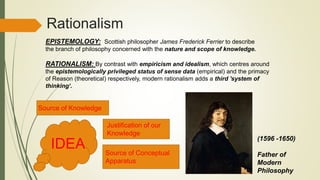
EPISTEMOLOGY: Scottish philosopher James Frederick Ferrier to describe
the branch of philosophy concerned with the nature and scope of knowledge.
RATIONALISM: By contrast with empiricism and idealism, which centres around
the epistemologically privileged status of sense data (empirical) and the primacy
of Reason (theoretical) respectively, modern rationalism adds a third 'system of
thinking‘.
IDEA
Source of Knowledge
Justification of our
Knowledge
Source of Conceptual
Apparatus
(1596 -1650)
Father of
Modern
Philosophy
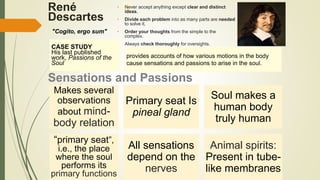
René
Descartes
• Never accept anything except clear and distinct
ideas.
• Divide each problem into as many parts are needed
to solve it.
• Order your thoughts from the simple to the
complex.
• Always check thoroughly for oversights.
"Cogito, ergo sum"
Sensations and Passions
Makes several
observations
about mind-
body relation
Primary seat Is
pineal gland
Soul makes a
human body
truly human
“primary seat”,
i.e., the place
where the soul
performs its
primary functions
All sensations
depend on the
nerves
Animal spirits:
Present in tube-
like membranes
CASE STUDY
His last published
work, Passions of the
Soul
provides accounts of how various motions in the body
cause sensations and passions to arise in the soul.
Rationalism – Thinkers (Post – modern)
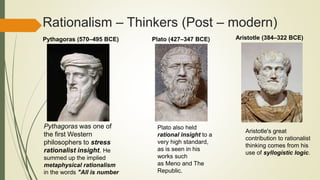
Pythagoras (570–495 BCE) Plato (427–347 BCE) Aristotle (384–322 BCE)
Pythagoras was one of
the first Western
philosophers to stress
rationalist insight. He
summed up the implied
metaphysical rationalism
in the words "All is number
Plato also held
rational insight to a
very high standard,
as is seen in his
works such
as Meno and The
Republic.
Aristotle's great
contribution to rationalist
thinking comes from his
use of syllogistic logic.
CASE STUDY 1 - Rationalism
How do we come to know objects, through the senses or through reason?
Descartes brought some of the strongest arguments to believe that the latter option is
the correct one.
CONSIDER POLYGONS
How do we come to recognize features of polygons. The senses here may seem to play
a key role.
But, now imagine to have two figures in front of you, the first with a thousand sides and
the other with a thousand and one sides. Which is which? Well, presumably the senses
will not suffice in providing an answer to this question: you will need reasoning (e.g.
counting) in order to tell them apart.
CASE STUDY 2 – Rationalism in Architecture
1. In architecture, rationalism is an architectural
current which mostly developed from Italy in the
1920s-1930s.
2. Vitruvius had claimed in his work De
Architectura that architecture is a science that
can be comprehended rationally. This
formulation was taken up and further developed
in the architectural treatises of the Renaissance.
3. The term structural rationalism most often
refers to a 19th-century French movement,
usually associated with the theorists Eugène
Viollet-le-Duc and Auguste Choisy.
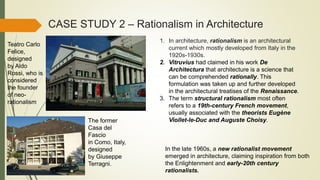
Teatro Carlo
Felice,
designed
by Aldo
Rossi, who is
considered
the founder
of neo-
rationalism
In the late 1960s, a new rationalist movement
emerged in architecture, claiming inspiration from both
the Enlightenment and early-20th century
rationalists.
The former
Casa del
Fascio
in Como, Italy,
designed
by Giuseppe
Terragni.

Rationalism

  • 1.
  • 2.
  • 3.
    Rationalism EPISTEMOLOGY: Scottish philosopherJames Frederick Ferrier to describe the branch of philosophy concerned with the nature and scope of knowledge. RATIONALISM: By contrast with empiricism and idealism, which centres around the epistemologically privileged status of sense data (empirical) and the primacy of Reason (theoretical) respectively, modern rationalism adds a third 'system of thinking‘. IDEA Source of Knowledge Justification of our Knowledge Source of Conceptual Apparatus (1596 -1650) Father of Modern Philosophy
  • 4.
    René Descartes • Never acceptanything except clear and distinct ideas. • Divide each problem into as many parts are needed to solve it. • Order your thoughts from the simple to the complex. • Always check thoroughly for oversights. "Cogito, ergo sum" Sensations and Passions Makes several observations about mind- body relation Primary seat Is pineal gland Soul makes a human body truly human “primary seat”, i.e., the place where the soul performs its primary functions All sensations depend on the nerves Animal spirits: Present in tube- like membranes CASE STUDY His last published work, Passions of the Soul provides accounts of how various motions in the body cause sensations and passions to arise in the soul.
  • 5.
    Rationalism – Thinkers(Post – modern) Pythagoras (570–495 BCE) Plato (427–347 BCE) Aristotle (384–322 BCE) Pythagoras was one of the first Western philosophers to stress rationalist insight. He summed up the implied metaphysical rationalism in the words "All is number Plato also held rational insight to a very high standard, as is seen in his works such as Meno and The Republic. Aristotle's great contribution to rationalist thinking comes from his use of syllogistic logic.
  • 6.
    CASE STUDY 1- Rationalism How do we come to know objects, through the senses or through reason? Descartes brought some of the strongest arguments to believe that the latter option is the correct one. CONSIDER POLYGONS How do we come to recognize features of polygons. The senses here may seem to play a key role. But, now imagine to have two figures in front of you, the first with a thousand sides and the other with a thousand and one sides. Which is which? Well, presumably the senses will not suffice in providing an answer to this question: you will need reasoning (e.g. counting) in order to tell them apart.
  • 7.
    CASE STUDY 2– Rationalism in Architecture 1. In architecture, rationalism is an architectural current which mostly developed from Italy in the 1920s-1930s. 2. Vitruvius had claimed in his work De Architectura that architecture is a science that can be comprehended rationally. This formulation was taken up and further developed in the architectural treatises of the Renaissance. 3. The term structural rationalism most often refers to a 19th-century French movement, usually associated with the theorists Eugène Viollet-le-Duc and Auguste Choisy. Teatro Carlo Felice, designed by Aldo Rossi, who is considered the founder of neo- rationalism In the late 1960s, a new rationalist movement emerged in architecture, claiming inspiration from both the Enlightenment and early-20th century rationalists. The former Casa del Fascio in Como, Italy, designed by Giuseppe Terragni.