
Sabarmati Riverfront
Development
what makes Sabarmati Riverfront Development so special?
By- Shailja Kumari
http://www.indiawaterportal.org/articles/alternative-perspective-sabarmati-riverfront-
development
Sabarmati Riverfront Development
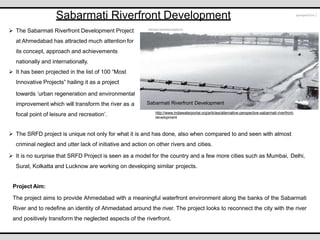
 The Sabarmati Riverfront Development Project
at Ahmedabad has attracted much attention for
its concept, approach and achievements
nationally and internationally.
 It has been projected in the list of 100 “Most
Innovative Projects” hailing it as a project
towards ‘urban regeneration and environmental
improvement which will transform the river as a
focal point of leisure and recreation’.
 The SRFD project is unique not only for what it is and has done, also when compared to and seen with almost
criminal neglect and utter lack of initiative and action on other rivers and cities.
 It is no surprise that SRFD Project is seen as a model for the country and a few more cities such as Mumbai, Delhi,
Surat, Kolkatta and Lucknow are working on developing similar projects.
Project Aim:
The project aims to provide Ahmedabad with a meaningful waterfront environment along the banks of the Sabarmati
River and to redefine an identity of Ahmedabad around the river. The project looks to reconnect the city with the river
and positively transform the neglected aspects of the riverfront.
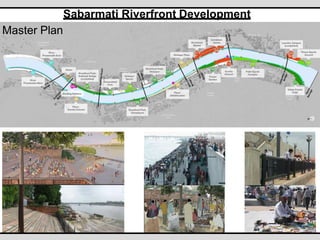
Sabarmati Riverfront Development
Master Plan
what makes Sabarmati Riverfront Development so special?
At a single go the Sabarmati Riverfront Development Project (SRFD Project) has achieved four major
objectives:
(a) converted a liability that the Sabarmati river had become due to waterlessness, pollution and neglect, into
an asset by making it perennially water filled, at least in the city stretch, eliminating the major water
polluting agents by diverting as many as 39 sewage outlets that dumped untreated sewer in the river into
two sewage treatment plants, and drastically reducing possibility of further pollution by putting the river
water and the river banks to multiple public uses
(b) gifted to the citizens a large, centrally located and much needed civic space to the city chronically starved
of open spaces, by amalgamating the existing and the reclaimed lands obtained by trimming the river for
recreation and leisure purposes
(c) creating a precedent in form of an institutional mechanism for project planning and implementation, in form
of a special purpose vehicle, namely the Sabarmati Riverfront Development Corporation Limited
(SRFDCL), that would serve the city well in the future while planning ambitious and high investment
projects, and
(d) created a new and modern landmark, announcing Ahmedabad’s arrival as a `word class’ city to the fast
urbanizing global world—the BRTS is the other such project in the city—wherein vision in urban planning,
creativity in governance, entrepreneurship in problem solving, public participation in alternatives search
and display of sustainability concerns in managing and developing a city are highly rated attributes.
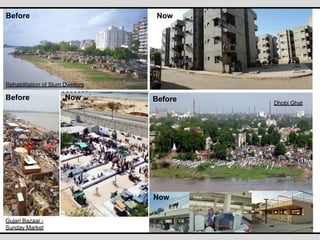
NowBefore
Rehabilitation of Slum Dwellers
Before Now
Gujari Bazaar -
Sunday Market
Before
Now
Dhobi Ghat
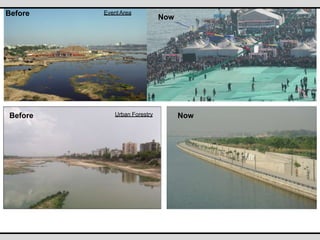
Before Now
EventArea
Urban ForestryBefore Now
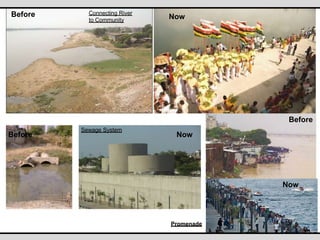
Sewage System
Before Now
Before Now
Connecting River
to Community
Before
Now
Promenade
What made it possible?
A number of factors including
 the political will on part of the Chief Minister of the state;
 the special purpose vehicle that made decision making focused and insulated from the partisan political
wrangling that often characterize project management at the local authority;
 the administrative leadership at the AMC and the SRFDCL that, among other things, succeeded in
transferring all related lands owned by the various authorities to the project,
 and consistent and vigorous follow up by the motivated professionals.
ISSUES
 The first set of issues is in the way the project has been designed and implemented. They are in the process
as also in the outcome.
 The concerns are on the reliability of the technical feasibility considering the peculiarity of the Sabarmati’s
flood behavior and the relatively new climate change phenomenon that brings into the equation hitherto
unknown factors and considerations, which did not figure in the Khadkwasla calculations and modeling tests
in the ‘60s. Climate change was not such a prominent issue then.
 The change in the river ecology by filling in the water, the disruption of the dry-river ecology, neglect of the
river—basin, banks and the water-- beyond the city stretch, the change in the traditional use pattern of the
river bed (especially the river bed agriculture) and the river bank uses; summary eviction of all form of
traditional river users; tempering with the naturalness of the river form through the straightening of the banks,
the artificial and characterless retaining wall and, most importantly, downgrading of a natural river into a
narrow and artificial ‘canal’ does not find approval of the purists and the ecologically learned and sensitive.
THE CHANGE AGENDA NOW
 removing roads: planting one lakh trees instead
 stop selling the riverfront land
 Sabarmati riverfront people’s forest development fund.
 the new vibrant mindset in resource mobilization
 place for the informal sector
 people and environment friendly city
Why Scientist opposes Sabarmati model, says reclaiming floodplain not a
good idea for Yamuna
Sabarmati riverfront is "like an international destination" and cited the fact that there are many riverfronts globally
which have come up by developing a river's floodplains. It was even suggested that a different hydrological model
be used to ensure that Yamuna doesn't overflow its banks if its floodplains are reclaimed like in case of Sabarmati.
 To better understand why Sabarmati remains an unmitigated ecological disaster, one must appreciate a river
as part of a larger water course with its catchment, basin and floodplain. This is an evolutionary marvel
that occurs over millions of years. Every monsoon, a river deposits the water it receives in its vast floodplain
and the deep aquifers underneath. In the lean season, these reserves feed the river by giving back water and
maintaining its base flow.
 Rampant construction and extended embankments destroy floodplains. Building too many dams and
barrages for hydroelectricity and irrigation denies minimum natural flow and fractures riverine ecosystems.
Discharging municipal sewage, agricultural runoff and industrial effluents pollutes waters. These are the
reasons why most of our rivers have become trickling, stinky drains that cannot support life anymore.
 Urban efforts to revive rivers are often cosmetic. The most spectacular of them all, Seoul’s
Cheonggyecheon project, is no tribute to ecology and depends on borrowed water pumped through seven miles
of pipes to keep the river flowing for just three miles. Sabarmati is no exception. Its borrowed waters run
through a narrow canal encased in concrete for 10.5 km. But for all practical purposes, the Sabarmati, like other
poisoned rivers of Gujarat such as Daman Ganga, Amlakhadi and Khari, remains very much the doomed river it
became in the 1990s.
Sabarmati riverfront development

Sabarmati riverfront development

  • 1.
    Sabarmati Riverfront Development what makesSabarmati Riverfront Development so special? By- Shailja Kumari
  • 2.
    http://www.indiawaterportal.org/articles/alternative-perspective-sabarmati-riverfront- development Sabarmati Riverfront Development SabarmatiRiverfront Development  The Sabarmati Riverfront Development Project at Ahmedabad has attracted much attention for its concept, approach and achievements nationally and internationally.  It has been projected in the list of 100 “Most Innovative Projects” hailing it as a project towards ‘urban regeneration and environmental improvement which will transform the river as a focal point of leisure and recreation’.  The SRFD project is unique not only for what it is and has done, also when compared to and seen with almost criminal neglect and utter lack of initiative and action on other rivers and cities.  It is no surprise that SRFD Project is seen as a model for the country and a few more cities such as Mumbai, Delhi, Surat, Kolkatta and Lucknow are working on developing similar projects. Project Aim: The project aims to provide Ahmedabad with a meaningful waterfront environment along the banks of the Sabarmati River and to redefine an identity of Ahmedabad around the river. The project looks to reconnect the city with the river and positively transform the neglected aspects of the riverfront.
  • 3.
  • 4.
    what makes SabarmatiRiverfront Development so special? At a single go the Sabarmati Riverfront Development Project (SRFD Project) has achieved four major objectives: (a) converted a liability that the Sabarmati river had become due to waterlessness, pollution and neglect, into an asset by making it perennially water filled, at least in the city stretch, eliminating the major water polluting agents by diverting as many as 39 sewage outlets that dumped untreated sewer in the river into two sewage treatment plants, and drastically reducing possibility of further pollution by putting the river water and the river banks to multiple public uses (b) gifted to the citizens a large, centrally located and much needed civic space to the city chronically starved of open spaces, by amalgamating the existing and the reclaimed lands obtained by trimming the river for recreation and leisure purposes (c) creating a precedent in form of an institutional mechanism for project planning and implementation, in form of a special purpose vehicle, namely the Sabarmati Riverfront Development Corporation Limited (SRFDCL), that would serve the city well in the future while planning ambitious and high investment projects, and (d) created a new and modern landmark, announcing Ahmedabad’s arrival as a `word class’ city to the fast urbanizing global world—the BRTS is the other such project in the city—wherein vision in urban planning, creativity in governance, entrepreneurship in problem solving, public participation in alternatives search and display of sustainability concerns in managing and developing a city are highly rated attributes.
  • 5.
    NowBefore Rehabilitation of SlumDwellers Before Now Gujari Bazaar - Sunday Market Before Now Dhobi Ghat
  • 6.
  • 7.
    Sewage System Before Now BeforeNow Connecting River to Community Before Now Promenade
  • 8.
    What made itpossible? A number of factors including  the political will on part of the Chief Minister of the state;  the special purpose vehicle that made decision making focused and insulated from the partisan political wrangling that often characterize project management at the local authority;  the administrative leadership at the AMC and the SRFDCL that, among other things, succeeded in transferring all related lands owned by the various authorities to the project,  and consistent and vigorous follow up by the motivated professionals. ISSUES  The first set of issues is in the way the project has been designed and implemented. They are in the process as also in the outcome.  The concerns are on the reliability of the technical feasibility considering the peculiarity of the Sabarmati’s flood behavior and the relatively new climate change phenomenon that brings into the equation hitherto unknown factors and considerations, which did not figure in the Khadkwasla calculations and modeling tests in the ‘60s. Climate change was not such a prominent issue then.  The change in the river ecology by filling in the water, the disruption of the dry-river ecology, neglect of the river—basin, banks and the water-- beyond the city stretch, the change in the traditional use pattern of the river bed (especially the river bed agriculture) and the river bank uses; summary eviction of all form of traditional river users; tempering with the naturalness of the river form through the straightening of the banks, the artificial and characterless retaining wall and, most importantly, downgrading of a natural river into a narrow and artificial ‘canal’ does not find approval of the purists and the ecologically learned and sensitive.
  • 9.
    THE CHANGE AGENDANOW  removing roads: planting one lakh trees instead  stop selling the riverfront land  Sabarmati riverfront people’s forest development fund.  the new vibrant mindset in resource mobilization  place for the informal sector  people and environment friendly city Why Scientist opposes Sabarmati model, says reclaiming floodplain not a good idea for Yamuna Sabarmati riverfront is "like an international destination" and cited the fact that there are many riverfronts globally which have come up by developing a river's floodplains. It was even suggested that a different hydrological model be used to ensure that Yamuna doesn't overflow its banks if its floodplains are reclaimed like in case of Sabarmati.
  • 10.
     To betterunderstand why Sabarmati remains an unmitigated ecological disaster, one must appreciate a river as part of a larger water course with its catchment, basin and floodplain. This is an evolutionary marvel that occurs over millions of years. Every monsoon, a river deposits the water it receives in its vast floodplain and the deep aquifers underneath. In the lean season, these reserves feed the river by giving back water and maintaining its base flow.  Rampant construction and extended embankments destroy floodplains. Building too many dams and barrages for hydroelectricity and irrigation denies minimum natural flow and fractures riverine ecosystems. Discharging municipal sewage, agricultural runoff and industrial effluents pollutes waters. These are the reasons why most of our rivers have become trickling, stinky drains that cannot support life anymore.  Urban efforts to revive rivers are often cosmetic. The most spectacular of them all, Seoul’s Cheonggyecheon project, is no tribute to ecology and depends on borrowed water pumped through seven miles of pipes to keep the river flowing for just three miles. Sabarmati is no exception. Its borrowed waters run through a narrow canal encased in concrete for 10.5 km. But for all practical purposes, the Sabarmati, like other poisoned rivers of Gujarat such as Daman Ganga, Amlakhadi and Khari, remains very much the doomed river it became in the 1990s.