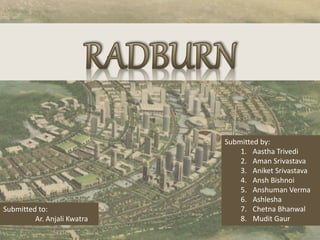
Submitted by:
1. Aastha Trivedi
2. Aman Srivastava
3. Aniket Srivastava
4. Ansh Bishnoi
5. Anshuman Verma
6. Ashlesha
7. Chetna Bhanwal
8. Mudit Gaur
Submitted to:
Ar. Anjali Kwatra
CONTENT:
INTRODUCTION
OBJECTIVES
CONCEPT
FEATURES
PLANNING
LAYOUT
APPLICATIONS
INNOVATIONS
FAILURES
CONCLUSION
INTRODUCTION
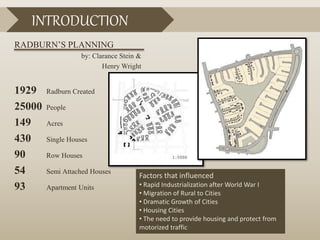
RADBURN’S PLANNING
by: Clarance Stein &
Henry Wright
1929 Radburn Created
25000 People
149 Acres
430 Single Houses
90 Row Houses
54 Semi Attached Houses
93 Apartment Units
Factors that influenced
• Rapid Industrialization after World War I
• Migration of Rural to Cities
• Dramatic Growth of Cities
• Housing Cities
• The need to provide housing and protect from
motorized traffic
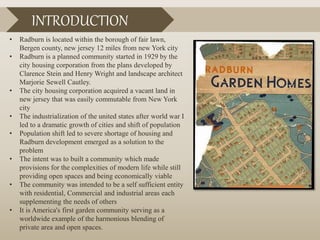
• Radburn is located within the borough of fair lawn,
Bergen county, new jersey 12 miles from new York city
• Radburn is a planned community started in 1929 by the
city housing corporation from the plans developed by
Clarence Stein and Henry Wright and landscape architect
Marjorie Sewell Cautley.
• The city housing corporation acquired a vacant land in
new jersey that was easily commutable from New York
city
• The industrialization of the united states after world war I
led to a dramatic growth of cities and shift of population
• Population shift led to severe shortage of housing and
Radburn development emerged as a solution to the
problem
• The intent was to built a community which made
provisions for the complexities of modern life while still
providing open spaces and being economically viable
• The community was intended to be a self sufficient entity
with residential, Commercial and industrial areas each
supplementing the needs of others
• It is America's first garden community serving as a
worldwide example of the harmonious blending of
private area and open spaces.
INTRODUCTION
• It includes 430 single family homes, 90 row houses, 54 semi attached houses and 93 apartment
units along with shopping centres ,open spaces and other amenities.
• One of the principles that is applied is maximum radius for walking distance from the home to the
community should be 400m at most.
• Shopping areas are situated at the intersecting traffic streets on the outside corners rather than the
centre unit
• The main concept behind the layout of community was cul-de-sac grouping i.e. Cluster grouping
and separation of vehicular and pedestrian movements.
• There are extensive range of recreational activities planned for entire community like tot lots,
preschools, sports, aerobics, amateur dramatics, library, clubroom etc.
• The total area of the city is 139
acres with 23 acres as interior
parks and four tennis courts,
three baseball fields,
two softball fields, two
swimming pools, and
an archery plaza. Young children
and their parents can make use
of two toddler playgroup areas,
two playgrounds, and a toddler
bathing pool.
INTRODUCTION
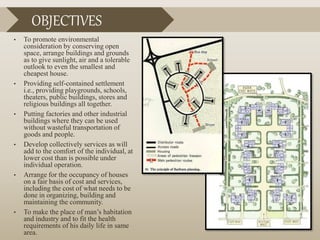
• To promote environmental
consideration by conserving open
space, arrange buildings and grounds
as to give sunlight, air and a tolerable
outlook to even the smallest and
cheapest house.
• Providing self-contained settlement
i.e., providing playgrounds, schools,
theaters, public buildings, stores and
religious buildings all together.
• Putting factories and other industrial
buildings where they can be used
without wasteful transportation of
goods and people.
• Develop collectively services as will
add to the comfort of the individual, at
lower cost than is possible under
individual operation.
• Arrange for the occupancy of houses
on a fair basis of cost and services,
including the cost of what needs to be
done in organizing, building and
maintaining the community.
• To make the place of man’s habitation
and industry and to fit the health
requirements of his daily life in same
area.
OBJECTIVES
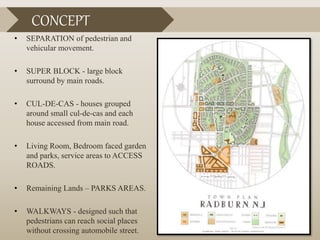
• SEPARATION of pedestrian and
vehicular movement.
• SUPER BLOCK - large block
surround by main roads.
• CUL-DE-CAS - houses grouped
around small cul-de-cas and each
house accessed from main road.
• Living Room, Bedroom faced garden
and parks, service areas to ACCESS
ROADS.
• Remaining Lands – PARKS AREAS.
• WALKWAYS - designed such that
pedestrians can reach social places
without crossing automobile street.
CONCEPT
• Inspired by the garden city idea, the city
housing corporation of New York acquired a
vacant site in new jersey within commuting
distance of New York city for the
community of Radburn.
• The industrialization of the United States
after World War I led to a dramatic growth
of the cities during the 1920's.
• Population shift led to a severe housing
shortage.
• In answer to the needs of "modern society",
Radburn, the "Town for the Motor Age" was
created in 1929.
• It has 25000 people, 149 acres area, 430
single houses, 90 row houses, 54 semi
attached houses, 93 apartment units.
• Its planners were, Clarence Stein and Henry
Wright.
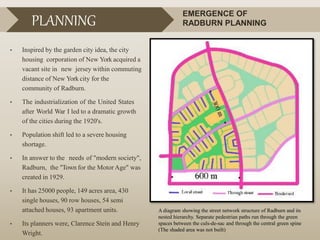
A diagram showing the street network structure of Radburn and its
nested hierarchy. Separate pedestrian paths run through the green
spaces between the culs-de-sac and through the central green spine
(The shaded area was not built)
PLANNING
EMERGENCE OF
RADBURN PLANNING
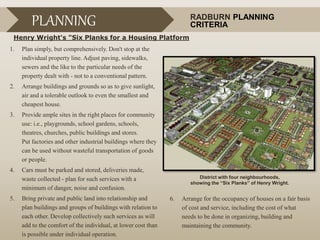
Henry Wright's "Six Planks for a Housing Platform
1. Plan simply, but comprehensively. Don't stop at the
individual property line. Adjust paving, sidewalks,
sewers and the like to the particular needs of the
property dealt with - not to a conventional pattern.
2. Arrange buildings and grounds so as to give sunlight,
air and a tolerable outlook to even the smallest and
cheapest house.
3. Provide ample sites in the right places for community
use: i.e., playgrounds, school gardens, schools,
theatres, churches, public buildings and stores.
Put factories and other industrial buildings where they
can be used without wasteful transportation of goods
or people.
4. Cars must be parked and stored, deliveries made,
waste collected - plan for such services with a
minimum of danger, noise and confusion.
5. Bring private and public land into relationship and
plan buildings and groups of buildings with relation to
each other. Develop collectively such services as will
add to the comfort of the individual, at lower cost than
is possible under individual operation.
District with four neighbourhoods,
showing the “Six Planks” of Henry Wright.
PLANNING RADBURN PLANNING
CRITERIA
6. Arrange for the occupancy of houses on a fair basis
of cost and service, including the cost of what
needs to be done in organizing, building and
maintaining the community.
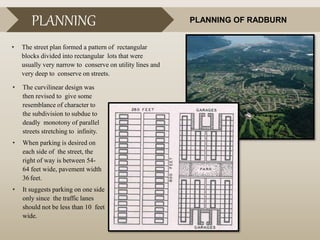
• The street plan formed a pattern of rectangular
blocks divided into rectangular lots that were
usually very narrow to conserve on utility lines and
very deep to conserve on streets.
PLANNING PLANNING OF RADBURN
• The curvilinear design was
then revised to give some
resemblance of character to
the subdivision to subdue to
deadly monotony of parallel
streets stretching to infinity.
• When parking is desired on
each side of the street, the
right of way is between 54-
64 feet wide, pavement width
36 feet.
• It suggests parking on one side
only since the traffic lanes
should not be less than 10 feet
wide.
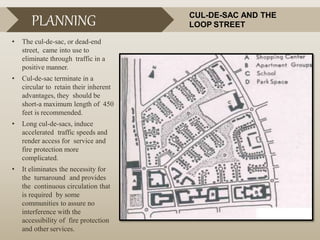
• The cul-de-sac, or dead-end
street, came into use to
eliminate through traffic in a
positive manner.
• Cul-de-sac terminate in a
circular to retain their inherent
advantages, they should be
short-a maximum length of 450
feet is recommended.
• Long cul-de-sacs, induce
accelerated traffic speeds and
render access for service and
fire protection more
complicated.
• It eliminates the necessity for
the turnaround and provides
the continuous circulation that
is required by some
communities to assure no
interference with the
accessibility of fire protection
and other services.
PLANNING CUL-DE-SAC AND THE
LOOP STREET
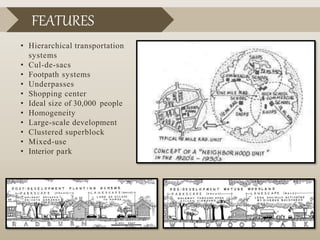
• Hierarchical transportation
systems
• Cul-de-sacs
• Footpath systems
• Underpasses
• Shopping center
• Ideal size of 30,000 people
• Homogeneity
• Large-scale development
• Clustered superblock
• Mixed-use
• Interior park
FEATURES
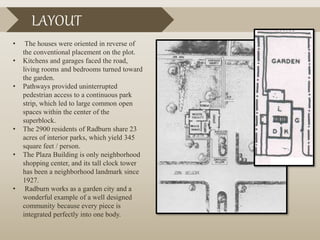
• The houses were oriented in reverse of
the conventional placement on the plot.
• Kitchens and garages faced the road,
living rooms and bedrooms turned toward
the garden.
• Pathways provided uninterrupted
pedestrian access to a continuous park
strip, which led to large common open
spaces within the center of the
superblock.
• The 2900 residents of Radburn share 23
acres of interior parks, which yield 345
square feet / person.
• The Plaza Building is only neighborhood
shopping center, and its tall clock tower
has been a neighborhood landmark since
1927.
• Radburn works as a garden city and a
wonderful example of a well designed
community because every piece is
integrated perfectly into one body.
LAYOUT
• U.S.A
o Baldwin Hills
o Los Angeles
o Kitimat B.C
• ENGLAND
o Coventry
o Stevenage
o Bracknell
o Cumbermauld
• SWEDEN
o Vallingby
o Baronbackavna Estate, Orebro
o Beskopsgaden Estate, Goteborg
APPLICATIONS
• CHANDIGARH, INDIA
• BRAZILIA, BRAZIL
• Several towns in RUSSIA
• Section of OSAKA, JAPAN
• WELLINGTON, NEW ZEALAND
• U.S.A.- RESTON, VIRGINIA,
COLUMBIA, MARYLAND
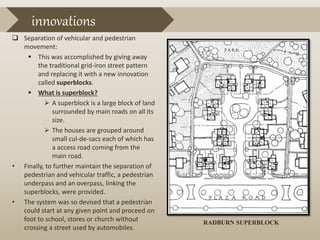
 Separation of vehicular and pedestrian
movement:
 This was accomplished by giving away
the traditional grid-iron street pattern
and replacing it with a new innovation
called superblocks.
 What is superblock?
 A superblock is a large block of land
surrounded by main roads on all its
size.
 The houses are grouped around
small cul-de-sacs each of which has
a access road coming from the
main road.
• Finally, to further maintain the separation of
pedestrian and vehicular traffic, a pedestrian
underpass and an overpass, linking the
superblocks, were provided.
• The system was so devised that a pedestrian
could start at any given point and proceed on
foot to school, stores or church without
crossing a street used by automobiles.
innovations
RADBURN SUPERBLOCK
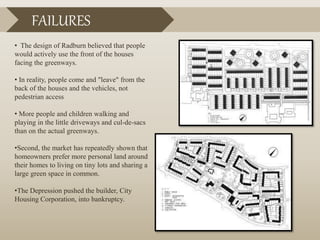
• The design of Radburn believed that people
would actively use the front of the houses
facing the greenways.
• In reality, people come and "leave" from the
back of the houses and the vehicles, not
pedestrian access
• More people and children walking and
playing in the little driveways and cul-de-sacs
than on the actual greenways.
•Second, the market has repeatedly shown that
homeowners prefer more personal land around
their homes to living on tiny lots and sharing a
large green space in common.
•The Depression pushed the builder, City
Housing Corporation, into bankruptcy.
FAILURES
CONCLUSION
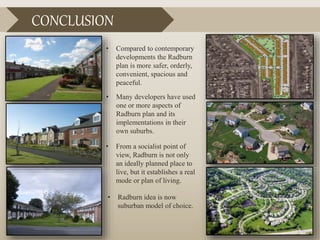
• Compared to contemporary
developments the Radburn
plan is more safer, orderly,
convenient, spacious and
peaceful.
• From a socialist point of
view, Radburn is not only
an ideally planned place to
live, but it establishes a real
mode or plan of living.
• Radburn idea is now
suburban model of choice.
• Many developers have used
one or more aspects of
Radburn plan and its
implementations in their
own suburbs.
Radburn

Radburn

  • 1.
    Submitted by: 1. AasthaTrivedi 2. Aman Srivastava 3. Aniket Srivastava 4. Ansh Bishnoi 5. Anshuman Verma 6. Ashlesha 7. Chetna Bhanwal 8. Mudit Gaur Submitted to: Ar. Anjali Kwatra
  • 2.
  • 3.
    INTRODUCTION RADBURN’S PLANNING by: ClaranceStein & Henry Wright 1929 Radburn Created 25000 People 149 Acres 430 Single Houses 90 Row Houses 54 Semi Attached Houses 93 Apartment Units Factors that influenced • Rapid Industrialization after World War I • Migration of Rural to Cities • Dramatic Growth of Cities • Housing Cities • The need to provide housing and protect from motorized traffic
  • 4.
    • Radburn islocated within the borough of fair lawn, Bergen county, new jersey 12 miles from new York city • Radburn is a planned community started in 1929 by the city housing corporation from the plans developed by Clarence Stein and Henry Wright and landscape architect Marjorie Sewell Cautley. • The city housing corporation acquired a vacant land in new jersey that was easily commutable from New York city • The industrialization of the united states after world war I led to a dramatic growth of cities and shift of population • Population shift led to severe shortage of housing and Radburn development emerged as a solution to the problem • The intent was to built a community which made provisions for the complexities of modern life while still providing open spaces and being economically viable • The community was intended to be a self sufficient entity with residential, Commercial and industrial areas each supplementing the needs of others • It is America's first garden community serving as a worldwide example of the harmonious blending of private area and open spaces. INTRODUCTION
  • 5.
    • It includes430 single family homes, 90 row houses, 54 semi attached houses and 93 apartment units along with shopping centres ,open spaces and other amenities. • One of the principles that is applied is maximum radius for walking distance from the home to the community should be 400m at most. • Shopping areas are situated at the intersecting traffic streets on the outside corners rather than the centre unit • The main concept behind the layout of community was cul-de-sac grouping i.e. Cluster grouping and separation of vehicular and pedestrian movements. • There are extensive range of recreational activities planned for entire community like tot lots, preschools, sports, aerobics, amateur dramatics, library, clubroom etc. • The total area of the city is 139 acres with 23 acres as interior parks and four tennis courts, three baseball fields, two softball fields, two swimming pools, and an archery plaza. Young children and their parents can make use of two toddler playgroup areas, two playgrounds, and a toddler bathing pool. INTRODUCTION
  • 6.
    • To promoteenvironmental consideration by conserving open space, arrange buildings and grounds as to give sunlight, air and a tolerable outlook to even the smallest and cheapest house. • Providing self-contained settlement i.e., providing playgrounds, schools, theaters, public buildings, stores and religious buildings all together. • Putting factories and other industrial buildings where they can be used without wasteful transportation of goods and people. • Develop collectively services as will add to the comfort of the individual, at lower cost than is possible under individual operation. • Arrange for the occupancy of houses on a fair basis of cost and services, including the cost of what needs to be done in organizing, building and maintaining the community. • To make the place of man’s habitation and industry and to fit the health requirements of his daily life in same area. OBJECTIVES
  • 7.
    • SEPARATION ofpedestrian and vehicular movement. • SUPER BLOCK - large block surround by main roads. • CUL-DE-CAS - houses grouped around small cul-de-cas and each house accessed from main road. • Living Room, Bedroom faced garden and parks, service areas to ACCESS ROADS. • Remaining Lands – PARKS AREAS. • WALKWAYS - designed such that pedestrians can reach social places without crossing automobile street. CONCEPT
  • 8.
    • Inspired bythe garden city idea, the city housing corporation of New York acquired a vacant site in new jersey within commuting distance of New York city for the community of Radburn. • The industrialization of the United States after World War I led to a dramatic growth of the cities during the 1920's. • Population shift led to a severe housing shortage. • In answer to the needs of "modern society", Radburn, the "Town for the Motor Age" was created in 1929. • It has 25000 people, 149 acres area, 430 single houses, 90 row houses, 54 semi attached houses, 93 apartment units. • Its planners were, Clarence Stein and Henry Wright. A diagram showing the street network structure of Radburn and its nested hierarchy. Separate pedestrian paths run through the green spaces between the culs-de-sac and through the central green spine (The shaded area was not built) PLANNING EMERGENCE OF RADBURN PLANNING
  • 9.
    Henry Wright's "SixPlanks for a Housing Platform 1. Plan simply, but comprehensively. Don't stop at the individual property line. Adjust paving, sidewalks, sewers and the like to the particular needs of the property dealt with - not to a conventional pattern. 2. Arrange buildings and grounds so as to give sunlight, air and a tolerable outlook to even the smallest and cheapest house. 3. Provide ample sites in the right places for community use: i.e., playgrounds, school gardens, schools, theatres, churches, public buildings and stores. Put factories and other industrial buildings where they can be used without wasteful transportation of goods or people. 4. Cars must be parked and stored, deliveries made, waste collected - plan for such services with a minimum of danger, noise and confusion. 5. Bring private and public land into relationship and plan buildings and groups of buildings with relation to each other. Develop collectively such services as will add to the comfort of the individual, at lower cost than is possible under individual operation. District with four neighbourhoods, showing the “Six Planks” of Henry Wright. PLANNING RADBURN PLANNING CRITERIA 6. Arrange for the occupancy of houses on a fair basis of cost and service, including the cost of what needs to be done in organizing, building and maintaining the community.
  • 10.
    • The streetplan formed a pattern of rectangular blocks divided into rectangular lots that were usually very narrow to conserve on utility lines and very deep to conserve on streets. PLANNING PLANNING OF RADBURN • The curvilinear design was then revised to give some resemblance of character to the subdivision to subdue to deadly monotony of parallel streets stretching to infinity. • When parking is desired on each side of the street, the right of way is between 54- 64 feet wide, pavement width 36 feet. • It suggests parking on one side only since the traffic lanes should not be less than 10 feet wide.
  • 11.
    • The cul-de-sac,or dead-end street, came into use to eliminate through traffic in a positive manner. • Cul-de-sac terminate in a circular to retain their inherent advantages, they should be short-a maximum length of 450 feet is recommended. • Long cul-de-sacs, induce accelerated traffic speeds and render access for service and fire protection more complicated. • It eliminates the necessity for the turnaround and provides the continuous circulation that is required by some communities to assure no interference with the accessibility of fire protection and other services. PLANNING CUL-DE-SAC AND THE LOOP STREET
  • 12.
    • Hierarchical transportation systems •Cul-de-sacs • Footpath systems • Underpasses • Shopping center • Ideal size of 30,000 people • Homogeneity • Large-scale development • Clustered superblock • Mixed-use • Interior park FEATURES
  • 13.
    • The houseswere oriented in reverse of the conventional placement on the plot. • Kitchens and garages faced the road, living rooms and bedrooms turned toward the garden. • Pathways provided uninterrupted pedestrian access to a continuous park strip, which led to large common open spaces within the center of the superblock. • The 2900 residents of Radburn share 23 acres of interior parks, which yield 345 square feet / person. • The Plaza Building is only neighborhood shopping center, and its tall clock tower has been a neighborhood landmark since 1927. • Radburn works as a garden city and a wonderful example of a well designed community because every piece is integrated perfectly into one body. LAYOUT
  • 14.
    • U.S.A o BaldwinHills o Los Angeles o Kitimat B.C • ENGLAND o Coventry o Stevenage o Bracknell o Cumbermauld • SWEDEN o Vallingby o Baronbackavna Estate, Orebro o Beskopsgaden Estate, Goteborg APPLICATIONS • CHANDIGARH, INDIA • BRAZILIA, BRAZIL • Several towns in RUSSIA • Section of OSAKA, JAPAN • WELLINGTON, NEW ZEALAND • U.S.A.- RESTON, VIRGINIA, COLUMBIA, MARYLAND
  • 15.
     Separation ofvehicular and pedestrian movement:  This was accomplished by giving away the traditional grid-iron street pattern and replacing it with a new innovation called superblocks.  What is superblock?  A superblock is a large block of land surrounded by main roads on all its size.  The houses are grouped around small cul-de-sacs each of which has a access road coming from the main road. • Finally, to further maintain the separation of pedestrian and vehicular traffic, a pedestrian underpass and an overpass, linking the superblocks, were provided. • The system was so devised that a pedestrian could start at any given point and proceed on foot to school, stores or church without crossing a street used by automobiles. innovations RADBURN SUPERBLOCK
  • 16.
    • The designof Radburn believed that people would actively use the front of the houses facing the greenways. • In reality, people come and "leave" from the back of the houses and the vehicles, not pedestrian access • More people and children walking and playing in the little driveways and cul-de-sacs than on the actual greenways. •Second, the market has repeatedly shown that homeowners prefer more personal land around their homes to living on tiny lots and sharing a large green space in common. •The Depression pushed the builder, City Housing Corporation, into bankruptcy. FAILURES
  • 17.
    CONCLUSION • Compared tocontemporary developments the Radburn plan is more safer, orderly, convenient, spacious and peaceful. • From a socialist point of view, Radburn is not only an ideally planned place to live, but it establishes a real mode or plan of living. • Radburn idea is now suburban model of choice. • Many developers have used one or more aspects of Radburn plan and its implementations in their own suburbs.