Psychological Disorders
 Psychological Disorder a “harmful
dysfunction” in which behavior is
judged to be (text discussion):
 Atypical
 not enough in itself
 Disturbing
 varies with time and culture
 Maladaptive
 harmful
 Unjustifiable
 By what standard?
Defined as Function
 Individual is not functioning adequately based on
either his/her standards or according to significant
others in the person’s life.
 Almost all the disorders we discuss have symptoms
that everyone experiences. Diagnosis of disorder
depends of intensity, length of time and how much
it’s impacting on the person.
 Depression
 Anxiety
 Psychosis?
Psychological Disorders
 Medical Model
 concept that diseases have physical causes
 can be diagnosed, treated, and in most
cases, cured
 assumes that these “mental” illnesses can
be diagnosed on the basis of their
symptoms and cured through therapy,
which may include treatment in a
psychiatric hospital
Problems with medical model
 Effects of labeling person, especially if based
on limited number of symptoms
 May limit true understanding of behavior in favor
of “listed” symptoms and assumptions about
outcome
 Confirmation bias: future information interpreted
in a biased way based on label
 Similar problems can exist with diagnosis
physical ailments
Psychological Disorders
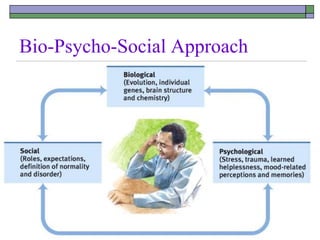
 Bio-Psycho-Social Perspective
 assumes that biological,
sociocultural, and psychological
factors combine and interact to
produce psychological disorders
Bio-Psycho-Social Approach
 These factors change over time. Hence, it’s
harmful to place a constant label on a person
 “Normal” behavior changes over cultures,
sub-cultures and time.
 E.g., is gang behavior or violence “abnormal”?
 It’s more important to understand behavior
(and symptoms) then worry about labels.
Classifying Psychological Disorders
(medical approach dominates)
 DSM-IV
 American Psychiatric Association’s
Diagnostic and Statistical Manual of
Mental Disorders (Fourth Edition)
 a widely used system for classifying
psychological disorders
 presently distributed as DSM-IV-TR (text
revision)
Classifying Psychological
Disorders
 Neurotic Disorder usually distressing but
that allows one to think rationally and
function socially
 Psychotic Disorder
 person loses contact with reality
 experiences irrational ideas and distorted
perceptions
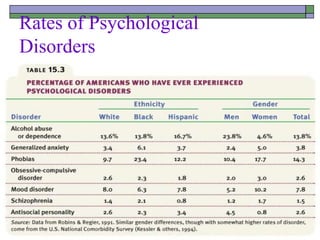
Rates of Psychological
Disorders
Anxiety Disorders
 Anxiety Disorders
 distressing, persistent anxiety or
maladaptive behaviors that reduce anxiety
 Generalized Anxiety Disorder
 person is tense, apprehensive, and in a state
of autonomic nervous system arousal
 Persistence (out of control)
 Problem in identifying source
Anxiety Disorders
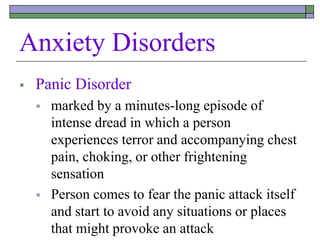
 Panic Disorder
 marked by a minutes-long episode of
intense dread in which a person
experiences terror and accompanying chest
pain, choking, or other frightening
sensation
 Person comes to fear the panic attack itself
and start to avoid any situations or places
that might provoke an attack
Anxiety Disorders
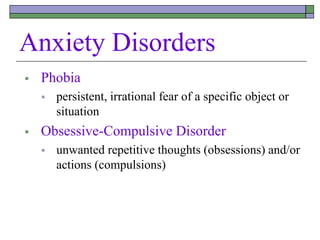
 Phobia
 persistent, irrational fear of a specific object or
situation
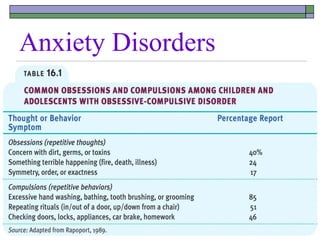
 Obsessive-Compulsive Disorder
 unwanted repetitive thoughts (obsessions) and/or
actions (compulsions)
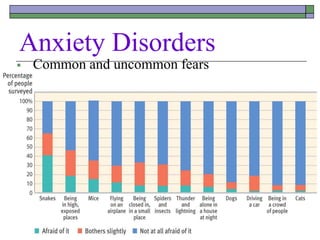
Anxiety Disorders
 Common and uncommon fears
Anxiety Disorders
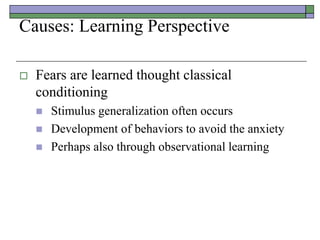
Causes: Learning Perspective
 Fears are learned thought classical
conditioning
 Stimulus generalization often occurs
 Development of behaviors to avoid the anxiety
 Perhaps also through observational learning
Causes: Biological Influence
 Research with identical twins and non-human
primates suggest a genetic aspect
Anxiety Disorders
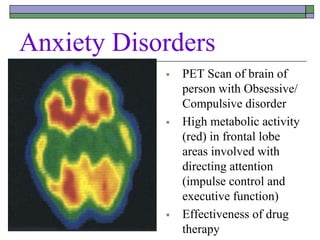
 PET Scan of brain of
person with Obsessive/
Compulsive disorder
 High metabolic activity
(red) in frontal lobe
areas involved with
directing attention
(impulse control and
executive function)
 Effectiveness of drug
therapy
Dissociative Disorders
 Dissociative Disorders
 conscious awareness becomes separated
(dissociated) from previous memories, thoughts,
and feelings
 Not uncommon when in a highly traumatic
situation to feel “removed” from the situation.
Problem is when this becomes more then a brief
situation
Dissociative Disorder
 Dissociative Identity Disorder
 rare dissociative disorder in which a person exhibits two or more
distinct and alternating personalities
 formerly called multiple personality disorder
 At Issue: Is it a real phenomena
 Skeptics– Everyone has difference aspects of their personality. These
get exaggerated by person and perhaps encourage by therapist
 Believers– Personality differences are dramatic (even handedness
might be effected) and person may have many personalities (e.g., 3
faces of eve– 28)
 Origins from sever trauma especially in childhood
 Both may be right
Personality Disorders
 Personality Disorders (vs. mood
disorder)
 disorders characterized by inflexible and
enduring behavior patterns that impair
social functioning
Types of Personality Disorders
 Fearful, afraid of rejection, withdrawn
 Extreme eccentrics– “The Character”
 Narcissistic– Over exaggerates self
importance
 Borderline– Unstable identity, emotions,
relationships, etc.
Personality Disorders
 Antisocial Personality Disorder
 disorder in which the person (usually man)
exhibits a lack of conscience for
wrongdoing, even toward friends and
family members
 may be aggressive and ruthless or a clever
con artist
 Most criminals do not have this– they
show concern for family and friends
Personality Disorders
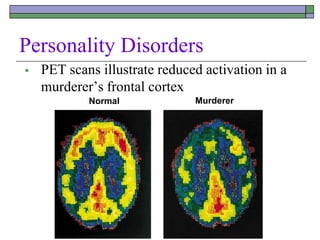
 PET scans illustrate reduced activation in a
murderer’s frontal cortex
Normal Murderer
Mood Disorders
 Mood Disorders
 characterized by emotional extremes
 Major Depressive Disorder
 a mood disorder in which a person, for no
apparent reason, experiences two or more
weeks of depressed moods, feelings of
worthlessness, and diminished interest or
pleasure in most activities
Mood Disorders
 Manic Episode
 a mood disorder marked by a hyperactive,
wildly optimistic state
 Bipolar Disorder
 a mood disorder in which the person
alternates between the hopelessness and
lethargy of depression and the overexcited
state of mania
 formerly called manic-depressive disorder
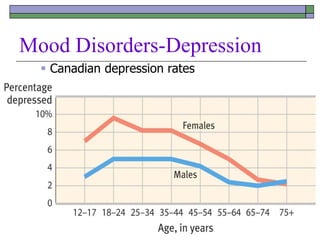
Mood Disorders-Depression
 Canadian depression rates
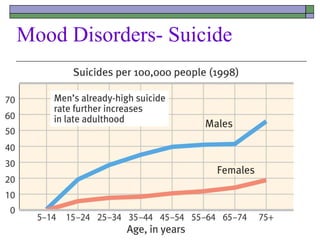
Mood Disorders- Suicide
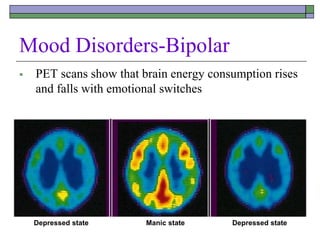
Mood Disorders-Bipolar
 PET scans show that brain energy consumption rises
and falls with emotional switches
Depressed state Manic state Depressed state
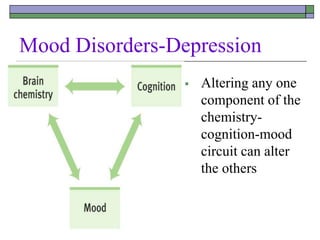
Mood Disorders-Depression
 Altering any one
component of the
chemistry-
cognition-mood
circuit can alter
the others
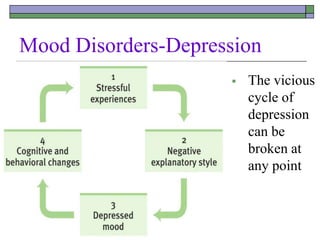
Mood Disorders-Depression
 The vicious
cycle of
depression
can be
broken at
any point
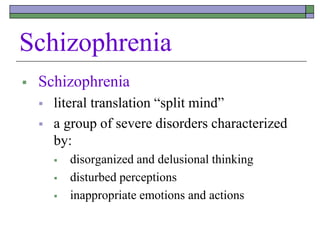
Schizophrenia
 Schizophrenia
 literal translation “split mind”
 a group of severe disorders characterized
by:
 disorganized and delusional thinking
 disturbed perceptions
 inappropriate emotions and actions
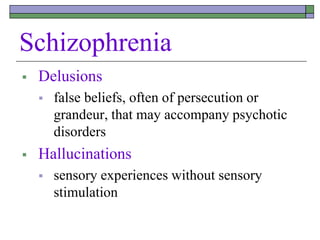
Schizophrenia
 Delusions
 false beliefs, often of persecution or
grandeur, that may accompany psychotic
disorders
 Hallucinations
 sensory experiences without sensory
stimulation
Schizophrenia
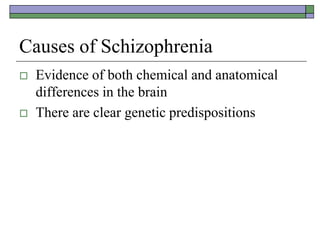
Causes of Schizophrenia
 Evidence of both chemical and anatomical
differences in the brain
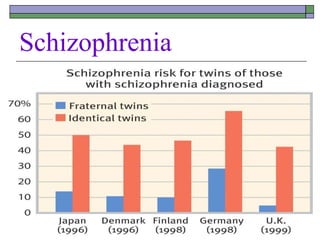
 There are clear genetic predispositions
Schizophrenia
Causes of Schizophrenia
 Viral infections during pregnancy?
 Role of environment is unclear
The End
 Is Psychology a Science?
 Future Courses

Intro Psychological Disorderssssssss.ppt

  • 1.
    Psychological Disorders  PsychologicalDisorder a “harmful dysfunction” in which behavior is judged to be (text discussion):  Atypical  not enough in itself  Disturbing  varies with time and culture  Maladaptive  harmful  Unjustifiable  By what standard?
  • 2.
    Defined as Function Individual is not functioning adequately based on either his/her standards or according to significant others in the person’s life.  Almost all the disorders we discuss have symptoms that everyone experiences. Diagnosis of disorder depends of intensity, length of time and how much it’s impacting on the person.  Depression  Anxiety  Psychosis?
  • 3.
    Psychological Disorders  MedicalModel  concept that diseases have physical causes  can be diagnosed, treated, and in most cases, cured  assumes that these “mental” illnesses can be diagnosed on the basis of their symptoms and cured through therapy, which may include treatment in a psychiatric hospital
  • 4.
    Problems with medicalmodel  Effects of labeling person, especially if based on limited number of symptoms  May limit true understanding of behavior in favor of “listed” symptoms and assumptions about outcome  Confirmation bias: future information interpreted in a biased way based on label  Similar problems can exist with diagnosis physical ailments
  • 5.
    Psychological Disorders  Bio-Psycho-SocialPerspective  assumes that biological, sociocultural, and psychological factors combine and interact to produce psychological disorders
  • 6.
  • 7.
    Bio-Psycho-Social Approach  Thesefactors change over time. Hence, it’s harmful to place a constant label on a person  “Normal” behavior changes over cultures, sub-cultures and time.  E.g., is gang behavior or violence “abnormal”?  It’s more important to understand behavior (and symptoms) then worry about labels.
  • 8.
    Classifying Psychological Disorders (medicalapproach dominates)  DSM-IV  American Psychiatric Association’s Diagnostic and Statistical Manual of Mental Disorders (Fourth Edition)  a widely used system for classifying psychological disorders  presently distributed as DSM-IV-TR (text revision)
  • 9.
    Classifying Psychological Disorders  NeuroticDisorder usually distressing but that allows one to think rationally and function socially  Psychotic Disorder  person loses contact with reality  experiences irrational ideas and distorted perceptions
  • 10.
  • 11.
    Anxiety Disorders  AnxietyDisorders  distressing, persistent anxiety or maladaptive behaviors that reduce anxiety  Generalized Anxiety Disorder  person is tense, apprehensive, and in a state of autonomic nervous system arousal  Persistence (out of control)  Problem in identifying source
  • 12.
    Anxiety Disorders  PanicDisorder  marked by a minutes-long episode of intense dread in which a person experiences terror and accompanying chest pain, choking, or other frightening sensation  Person comes to fear the panic attack itself and start to avoid any situations or places that might provoke an attack
  • 13.
    Anxiety Disorders  Phobia persistent, irrational fear of a specific object or situation  Obsessive-Compulsive Disorder  unwanted repetitive thoughts (obsessions) and/or actions (compulsions)
  • 15.
    Anxiety Disorders  Commonand uncommon fears
  • 16.
  • 17.
    Causes: Learning Perspective Fears are learned thought classical conditioning  Stimulus generalization often occurs  Development of behaviors to avoid the anxiety  Perhaps also through observational learning
  • 18.
    Causes: Biological Influence Research with identical twins and non-human primates suggest a genetic aspect
  • 19.
    Anxiety Disorders  PETScan of brain of person with Obsessive/ Compulsive disorder  High metabolic activity (red) in frontal lobe areas involved with directing attention (impulse control and executive function)  Effectiveness of drug therapy
  • 20.
    Dissociative Disorders  DissociativeDisorders  conscious awareness becomes separated (dissociated) from previous memories, thoughts, and feelings  Not uncommon when in a highly traumatic situation to feel “removed” from the situation. Problem is when this becomes more then a brief situation
  • 21.
    Dissociative Disorder  DissociativeIdentity Disorder  rare dissociative disorder in which a person exhibits two or more distinct and alternating personalities  formerly called multiple personality disorder  At Issue: Is it a real phenomena  Skeptics– Everyone has difference aspects of their personality. These get exaggerated by person and perhaps encourage by therapist  Believers– Personality differences are dramatic (even handedness might be effected) and person may have many personalities (e.g., 3 faces of eve– 28)  Origins from sever trauma especially in childhood  Both may be right
  • 22.
    Personality Disorders  PersonalityDisorders (vs. mood disorder)  disorders characterized by inflexible and enduring behavior patterns that impair social functioning
  • 23.
    Types of PersonalityDisorders  Fearful, afraid of rejection, withdrawn  Extreme eccentrics– “The Character”  Narcissistic– Over exaggerates self importance  Borderline– Unstable identity, emotions, relationships, etc.
  • 24.
    Personality Disorders  AntisocialPersonality Disorder  disorder in which the person (usually man) exhibits a lack of conscience for wrongdoing, even toward friends and family members  may be aggressive and ruthless or a clever con artist  Most criminals do not have this– they show concern for family and friends
  • 25.
    Personality Disorders  PETscans illustrate reduced activation in a murderer’s frontal cortex Normal Murderer
  • 26.
    Mood Disorders  MoodDisorders  characterized by emotional extremes  Major Depressive Disorder  a mood disorder in which a person, for no apparent reason, experiences two or more weeks of depressed moods, feelings of worthlessness, and diminished interest or pleasure in most activities
  • 27.
    Mood Disorders  ManicEpisode  a mood disorder marked by a hyperactive, wildly optimistic state  Bipolar Disorder  a mood disorder in which the person alternates between the hopelessness and lethargy of depression and the overexcited state of mania  formerly called manic-depressive disorder
  • 28.
  • 29.
  • 30.
    Mood Disorders-Bipolar  PETscans show that brain energy consumption rises and falls with emotional switches Depressed state Manic state Depressed state
  • 31.
    Mood Disorders-Depression  Alteringany one component of the chemistry- cognition-mood circuit can alter the others
  • 32.
    Mood Disorders-Depression  Thevicious cycle of depression can be broken at any point
  • 33.
    Schizophrenia  Schizophrenia  literaltranslation “split mind”  a group of severe disorders characterized by:  disorganized and delusional thinking  disturbed perceptions  inappropriate emotions and actions
  • 34.
    Schizophrenia  Delusions  falsebeliefs, often of persecution or grandeur, that may accompany psychotic disorders  Hallucinations  sensory experiences without sensory stimulation
  • 35.
  • 36.
    Causes of Schizophrenia Evidence of both chemical and anatomical differences in the brain  There are clear genetic predispositions
  • 37.
  • 38.
    Causes of Schizophrenia Viral infections during pregnancy?  Role of environment is unclear
  • 39.
    The End  IsPsychology a Science?  Future Courses