Obsessive Compulsive Disorder (OCD) is an anxiety disorder characterized by recurrent, unwanted thoughts (obsessions) and repetitive behaviors or mental acts (compulsions) performed in response to these thoughts. The obsessions or compulsions significantly interfere with daily life. OCD has been linked to imbalances in neurotransmitters like serotonin and dopamine in the brain, as well as genetic and environmental factors. Treatment involves psychotherapy like cognitive behavioral therapy and medication like selective serotonin reuptake inhibitors. Other potential treatments under research include repetitive transcranial magnetic stimulation and electroconvulsive therapy, but more studies are still needed to establish their efficacy for OCD.
Overview of OCD as an anxiety disorder with obsessions and compulsions that lead to significant distress.
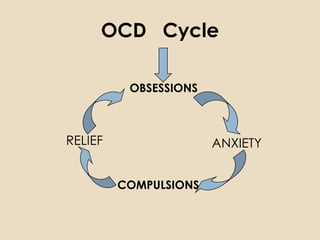
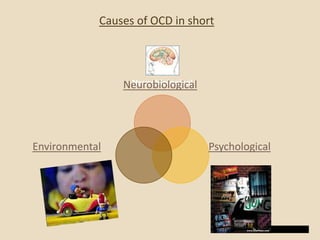
Explains the OCD cycle involving obsessions and compulsions; identifies neurobiological, environmental, and psychological causes.
Details on neurotransmitter involvement, brain imaging studies and genetics showing higher OCD rates in family members.
Discussions on childhood conflicts, cognitive theories of OCD, and the role of neutralizing behaviors in maintaining OCD.
Focus on psychodynamic factors like isolation, undoing, and reaction formation contributing to OCD symptoms.
Ambivalence and magical thinking as psychoanalytic factors influencing OCD behaviors.
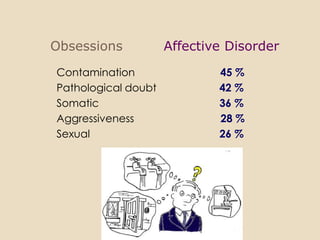
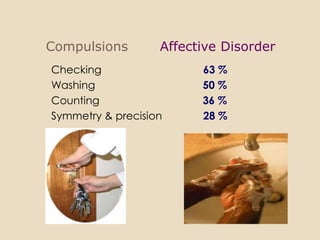
Statistics on common obsessions and compulsions experienced by individuals with OCD.
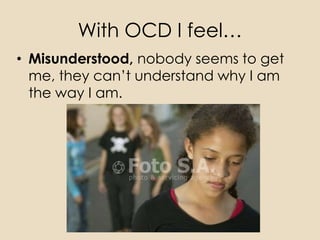
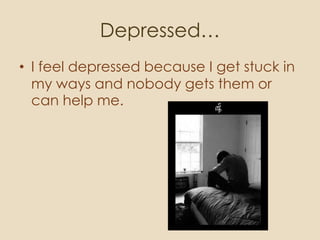
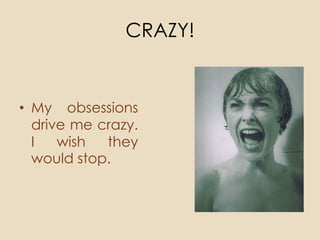
Personal feelings and mental states associated with OCD, including feelings of being misunderstood, depressed, anxious, and scared.OCD's classification as a disabling condition; outlines psychotherapy and pharmacotherapy as treatment methods.
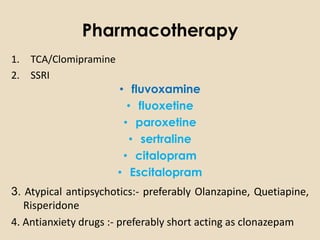
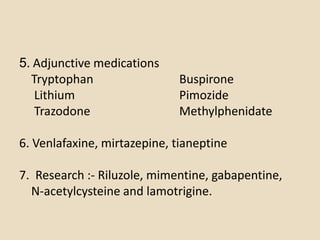
Explores various advanced treatments such as ECT and rTMS, including studies, their efficacy, limitations, and research needs.
Wrap-up of the presentation with a thank you note.
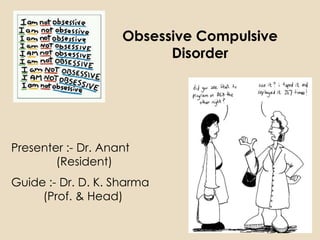
Obsessive Compulsive
Disorder
Presenter :- Dr. Anant
(Resident)
Guide :- Dr. D. K. Sharma
(Prof. & Head)
2.
OBSESSIVE COMPULSIVE DISORDER
OCDis an anxiety disorder distinguished by
recurring thoughts that cause anxiety and the
impulse to perform certain actions in order to
relieve the anxiety.
(Obsessions and Compulsion)
3.
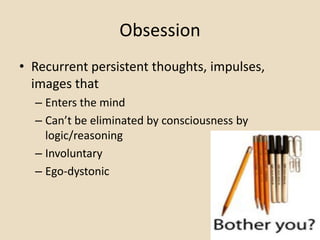
Obsession
• Recurrent persistentthoughts, impulses,
images that
– Enters the mind
– Can’t be eliminated by consciousness by
logic/reasoning
– Involuntary
– Ego-dystonic
4.
Obsession - Characteristicfeatures
• Subjective sense of struggle
• Conviction that to think is to make it more
likely to happen
• Recognized as own
• Regarded as untrue and senseless
• Generally about matters that are distressing
• Often accompanied by compulsion
5.
Compulsion
• Pathological needto act on an impulse that if
restricted produce anxiety
• Repetitive behavior in response to an
obsession, performed according to certain
rules with no true end in itself
6.
The obsessions orcompulsions are a
significant source of distress to the
individual.
Causes of OCDin short
Causes of OCD in short
Neurobiological
Neurobiological
Environmental Psychological
9.
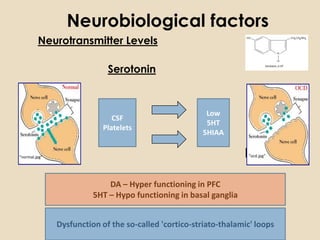
Neurobiological factors
Neurotransmitter Levels
Serotonin
Low
CSF
5HT
Platelets
5HIAA
“normal.jpg” “ocd.jpg”
DA – Hyper functioning in PFC
5HT – Hypo functioning in basal ganglia
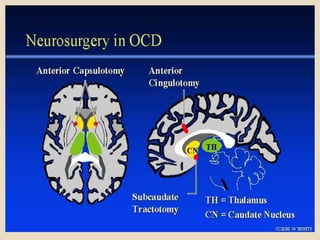
Dysfunction of the so-called 'cortico-striato-thalamic' loops
10.
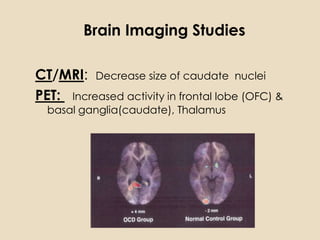
Brain Imaging Studies
CT/MRI:Decrease size of caudate nuclei
PET: Increased activity in frontal lobe (OFC) &
basal ganglia(caudate), Thalamus
11.
BIOLOGICAL
• The orbitofrontalcortex has a circuit that sends information
to the thalamus such as aggression, sexuality and bodily
excretions.
• When these parts of the brain are activated you are bound to
act upon those certain behaviors or actions.
Causes
• These impulses are brought to ones conscience and after
your brain has sent you the information and have acted upon
that information the impulse eventually decreases and you
move on to your daily routine.
• Within people who have OCD, some certain impulses cannot
be turned off or ignored by that part of the brain, which
causes them to repeat the same action over and over again.
• Eventually they become obsessed with these actions and
they have become integrated into their routine and they have
no control over it.
12.
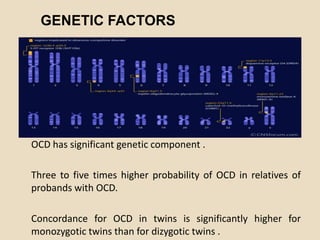
GENETIC FACTORS
OCD hassignificant genetic component .
Three to five times higher probability of OCD in relatives of
probands with OCD.
Concordance for OCD in twins is significantly higher for
monozygotic twins than for dizygotic twins .
13.
Environmental factors
Early childhoodconflicts:
• This is an early theory that suggests conflicts or
problems during childhood are the roots of OCD.
• This is specifically looking at either permissive or
mainly unengaged parenting techniques.
14.
Psychological - COGNITIVE THEORY OF OCD
• Obsessional thoughts:
– It’s not the thought itself that is disturbing, but
rather the interpretation of the thought.
– The issue of responsibility is believed to be a core
belief or cognitive distortion of people with OCD.
15.
Compulsive behaviors:
– Neutralizing,either through compulsive behaviors or
mental strategies, is aimed at preventing terrible
consequences, or averts the possibility of being
responsible
– Seeking reassurance is another form of neutralizing, as it
can serve to spread responsibility to others, thus diluting
that of the individual
– Avoidance, though not an overt neutralizing behavior, is
often used to prevent contact with particular stimuli
16.
• Model:
–Stimuli in the form of unpleasant intrusive thoughts, of
either external or internal origins are experienced
– The thought is ego-dystonic, that is, it is inconsistent with
the individual’s belief system
– It usually involves an element of blame, responsibility, or
control, which interacts with the content of the intrusive
thought
– Disturbances in mood and anxiety follow, which in turn
lead to neutralizing behavior
17.
Main consequencesof neutralizing behavior
It results in reduced discomfort, which leads to the
development of compulsive behavior as a tool for dealing
with stress. This reinforcing behavior may result in a
generalization of this strategy
Neutralizing will be followed by non-punishment, and can
lead to an effect on the perceived validity of the beliefs
The neutralizing behavior itself becomes a powerful and

unavoidable triggering stimulus. The neutralizing behavior
serves to reinforce the belief that something bad may happen
18.
PSYCHODYNAMIC FACTORS
ISOLATION
It protects an individual from anxiety provoking affects
and impulses.
isolation less effective
Patient experience a partial awareness of the impulse
without fully recognizing its meaning
Impulse is displaced from the true object to other people
or object.
19.
PSYCHODYNAMIC FACTORS (CONTD.)
UNDOING
When impulse`s constant threat escape primary defense of
isolation
Secondary defensive operations is started
Compulsive act that is performed in an attempt to prevent or
undo the consequences that the patient irrationally
anticipates from a frightening obsessional thought or impulse.
20.
PSYCHODYNAMIC FACTORS (CONTD.)
REACTIONFORMATION
Manifest patterns of behaviour and consciously
experienced attitudes that are exactly the opposite of the
underlying impulses
Reaction formation results into formation of character
traits of OCD.
21.
PSYCHOANALYTIC FACTORS
AMBIVALENCE
Presentin normal children during the anal sadistic
development phase.
Children feel both love and murderous hate towards the
same object.
Patients with OCD often consciously experience both love
and hate toward an object.
Conflict of opposing emotions is evident in a patient` doing
and undoing patterns of behaviour and in paralyzing doubt
in the face of choice.
22.
PSYCHOANALYTIC FACTORS (CONTD.)
MAGICALTHINKING
Inherent in magical thinking is omnipotence of thought.
An event can occur merely by thinking without
intermediate physical actions.
This feeling causes them to fear having an aggressive
thought.
Repetitive
• I repeatmyself and actions, over and
over and over and over and over and
over and over and over again….
29.
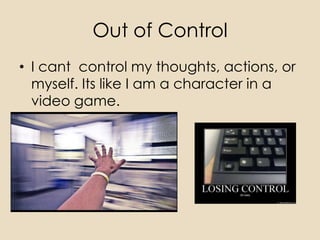
Out of Control
•I cant control my thoughts, actions, or
myself. Its like I am a character in a
video game.
30.
Hyper
• OCD makesme
also feel hyper
and wild
sometimes,
when its not
ruining my life.
31.
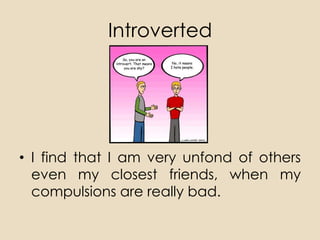
Introverted
• I findthat I am very unfond of others
even my closest friends, when my
compulsions are really bad.
32.
Lazy
•I don’t enjoy
doing things or
leaving my house
because of the
anxiety it causes.
I’d rather just sit
and wait.
33.
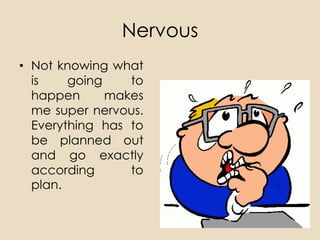
Nervous
• Not knowingwhat
is going to
happen makes
me super nervous.
Everything has to
be planned out
and go exactly
according to
plan.
34.
Anxious
• I getanxious when I
have compulsions
and I obsess over the
little things, it’s a
feeling that never
goes away for me.
35.
Scared
• I getscared when
people don’t
understand me
and judge me and
when things don’t
go according to
plan, I get afraid
something will
happen to me.
36.
OCD- Prevalence
• Ischronic psychiatric disorder and is one of
the 10 most disabling medical conditions
worldwide
• 4th most common psychiatric disorder
• OCD is not received due attention and with its
high prevalence it is being labeled as the
‘hidden epidemic’
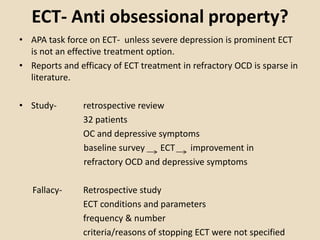
ECT- Anti obsessionalproperty?
• APA task force on ECT- unless severe depression is prominent ECT
is not an effective treatment option.
• Reports and efficacy of ECT treatment in refractory OCD is sparse in
literature.
• Study- retrospective review
32 patients
OC and depressive symptoms
baseline survey ECT improvement in
refractory OCD and depressive symptoms
Fallacy- Retrospective study
ECT conditions and parameters
frequency & number
criteria/reasons of stopping ECT were not specified
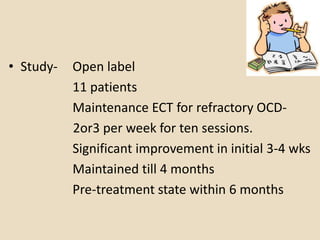
44.
• Study- Open label
11 patients
Maintenance ECT for refractory OCD-
2or3 per week for ten sessions.
Significant improvement in initial 3-4 wks
Maintained till 4 months
Pre-treatment state within 6 months
45.
Research Question
• IsECT is more beneficial in patients of OCD
having co-morbid psychosis/Schizophrenia?
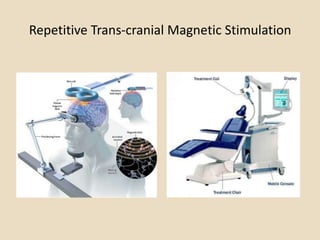
Repetitive Transcranial MagneticStimulation (rTMS)
• In rTMS pulsed magnetic field is applied to the scalp induces
electric currents that depolarizes underlying cortical neurons
influencing their function
• Possible Hypothesis- directly altering the hyper functioning of
PFC with rTMS ameliorate symptoms of OCD
• Speed of Stimulation > 1Hz- high frequency - activates
stimulated areas
• Speed of stimulation < 1Hz- low frequency - inhibit cortical
stimulation
48.
Study-
• Crossover randomizedinvestigator blind study
• 12 right handed pts having current or past depression
• Single session of rTMS at 80% of RMT(resting motor threshold)
at 20Hz/2 second per minute for 20 minutes
• On right lateral pre-frontal, left lateral pre-frontal and mid-
occipital(control) site
• Result- Compulsions decreased significantly for 8hrs after Rt
lateral PFC stimulation with modest increase in positive
mood
• Non-significant reduction in compulsion urges 30 minutes
after left lateral PFC stimulation
• Non-significant increase in compulsive urges after mid-
occipital stimulation
• Obsession did not change significantly
49.
Study-
• Open label12 Rt handed OCD refractory pts none having
depression
• Randomly assigned to 10 sessions of Rt or Lt pre-frontal rTMS of
10Hz, 110% RMT, 30 trains of 5 second each
• Site- in relation to activating 1st dorsal interosseous muscle
• Result- 33% of either group showed clinically significant
improvement (40% reduction in YBOCS)
• No significant differences b/w Rt & Lt sided rTMS
• No difference b/w obsessions & compulsions score
50.
Study (Alonso etal)
• Double blind randomized placebo controlled parallel group design
• 18 Rt handed pts with no other psychiatric co-morbidity
• 10 pts assigned to thrice weekly sessions for 6wk at 1Hz on Rt pre-
frontal at 110% of RMT- 2 pts showed 40% reduction in YBOCS
• 8 pts assigned to placebo group- 1 responded
• Improvement appeared following 5th wk of t/t
• Real rTMS receivers had non-significant greater reduction in
obsessions
51.
Study (Sachdev etal)
• Double blind randomized placebo controlled parallel group design
• 18 pts without depression
• 10 pts received real rTMS over Lt DLPFC
• 8 pts received placebo rTMS
• After 2 wks t/t status were informed to the pts with option of
further 2 wks of rTMS to real rTMS receiver & 4 wks of rTMS to
placebo receivers
• Improvement in 1st 2 wks was not different among both groups
• 6 pts had clinically significant improvement
• Result- study did not support efficacy of high frequency DLPFC
rTMS given over 2 wks in OCD
52.
Study-
• Double blindrandomized placebo controlled parallel
group design
• To assess whether rTMS facilitates effect of anti-
depressants in OCD
• In 33 t/t resistant OCD pts
• Study failed to find any difference in either group
53.
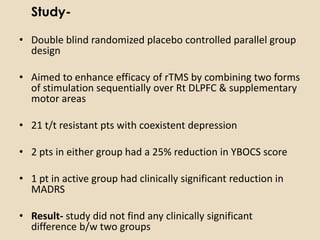
Study-
• Double blindrandomized placebo controlled parallel group
design
• Aimed to enhance efficacy of rTMS by combining two forms
of stimulation sequentially over Rt DLPFC & supplementary
motor areas
• 21 t/t resistant pts with coexistent depression
• 2 pts in either group had a 25% reduction in YBOCS score
• 1 pt in active group had clinically significant reduction in
MADRS
• Result- study did not find any clinically significant
difference b/w two groups
54.
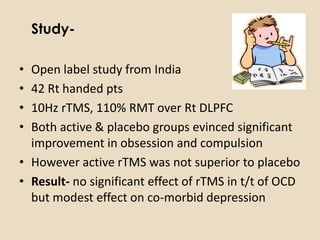
Study-
• Open labelstudy from India
• 42 Rt handed pts
• 10Hz rTMS, 110% RMT over Rt DLPFC
• Both active & placebo groups evinced significant
improvement in obsession and compulsion
• However active rTMS was not superior to placebo
• Result- no significant effect of rTMS in t/t of OCD
but modest effect on co-morbid depression
55.
Limitations of abovementioned studies
• Very small no. of subjects
• Pt selection was not uniform
• Definition of t/t resistant was not clear
• No consistency in symptoms subtypes
• Criteria for response were not very consistent
• Technical parameters of rTMS as exact site of stimulation, side, method
of site selection, strength and duration of sessions have no consensus
• Presence of co-morbid depression makes it difficult to dissociate
improvement in YBOCS from that due to improvement in depression
56.
• With theinformation from current trials for
rTMS in OCD- negligible evidence as none of
the randomized controlled studies was able
to find any difference b/w real and placebo
group
• Both NICE and APA practice guideline for t/t
of OCD conclude “currently rTMS cannot be
recommended as a t/t option”
57.
Research Need
• Forlarger double blind placebo controlled
rTMS studies in co-morbidity free OCD pts
with comparison across different stimulation
sites
• For longer follow up periods to assess if the
beneficial effects are enduring