Abnormal Psychology
A.K.A. Psychological Disorders
A “harmful dysfunction” in which behavior is
judged to be atypical, disturbing,
inappropriate, or unjustifiable.
Who does what?
• Psychologist: studies patients, tests disorders, talks
and counsels
• Psychiatrist : works inside a branch of medicine
dealing with psychological disorders
• Provides medical (drug) treatment
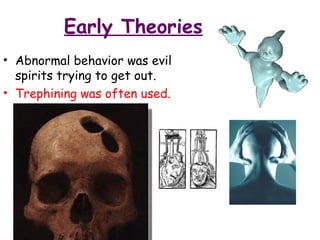
Early Theories
• Abnormal behavior was evil
spirits trying to get out.
• Trephining was often used.
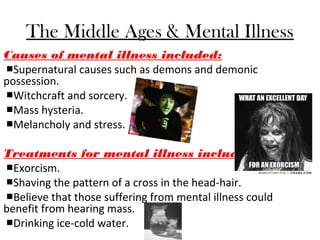
The Middle Ages & Mental Illness
Causes of mental illness included:
■Supernatural causes such as demons and demonic
possession.
■Witchcraft and sorcery.
■Mass hysteria.
■Melancholy and stress.
Treatments for mental illness included:
■Exorcism.
■Shaving the pattern of a cross in the head-hair.
■Believe that those suffering from mental illness could
benefit from hearing mass.
■Drinking ice-cold water.
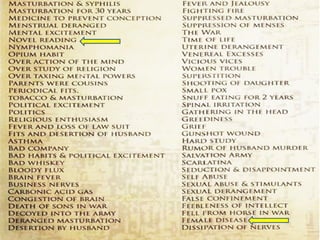
Literally All Of Us Would Have
Been Sent To An Insane Asylum
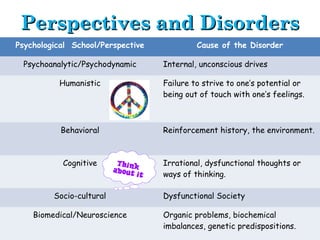
Perspectives and DisordersPerspectives and Disorders
Psychological School/Perspective Cause of the Disorder
Psychoanalytic/Psychodynamic Internal, unconscious drives
Humanistic Failure to strive to one’s potential or
being out of touch with one’s feelings.
Behavioral Reinforcement history, the environment.
Cognitive Irrational, dysfunctional thoughts or
ways of thinking.
Socio-cultural Dysfunctional Society
Biomedical/Neuroscience Organic problems, biochemical
imbalances, genetic predispositions.
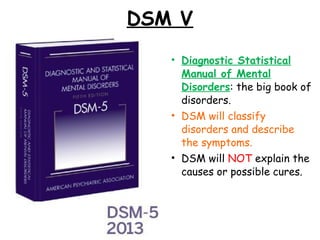
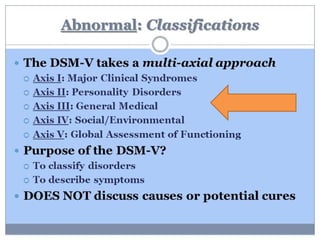
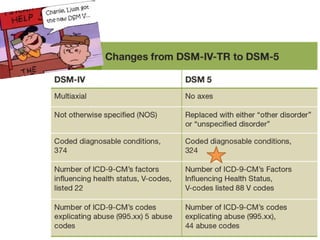
DSM V
• Diagnostic Statistical
Manual of Mental
Disorders: the big book of
disorders.
• DSM will classify
disorders and describe
the symptoms.
• DSM will NOT explain the
causes or possible cures.
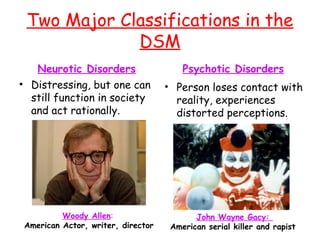
Two Major Classifications in the
DSM
Neurotic Disorders
• Distressing, but one can
still function in society
and act rationally.
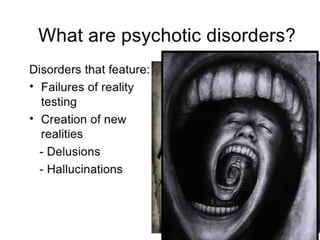
Psychotic Disorders
• Person loses contact with
reality, experiences
distorted perceptions.
John Wayne Gacy:
American serial killer and rapist
Woody Allen:
American Actor, writer, director
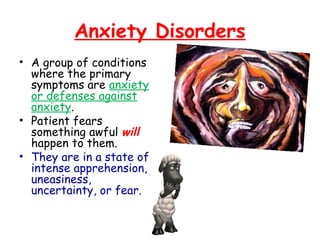
Anxiety Disorders
• A group of conditions
where the primary
symptoms are anxiety
or defenses against
anxiety.
• Patient fears
something awful will
happen to them.
• They are in a state of
intense apprehension,
uneasiness,
uncertainty, or fear.
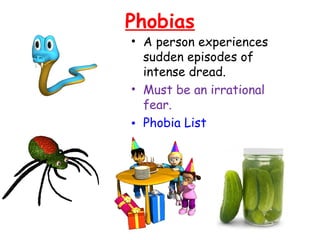
Phobias
• A person experiences
sudden episodes of
intense dread.
• Must be an irrational
fear.
• Phobia List
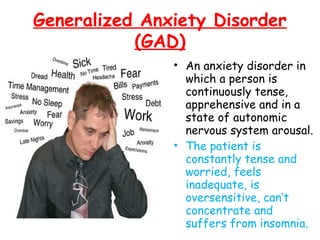
Generalized Anxiety Disorder
(GAD)
• An anxiety disorder in
which a person is
continuously tense,
apprehensive and in a
state of autonomic
nervous system arousal.
• The patient is
constantly tense and
worried, feels
inadequate, is
oversensitive, can’t
concentrate and
suffers from insomnia.
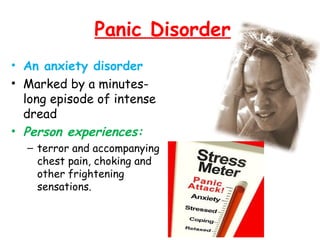
Panic Disorder
• An anxiety disorder
• Marked by a minutes-
long episode of intense
dread
• Person experiences:
– terror and accompanying
chest pain, choking and
other frightening
sensations.
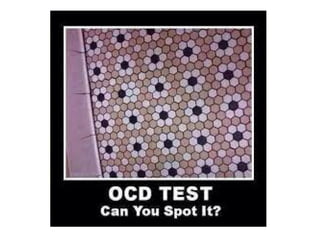
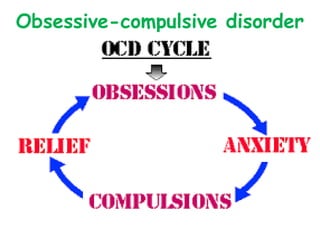
Obsessive-compulsive disorder
• Persistent unwanted
thoughts (obsessions)
cause someone to feel
the need (compulsion)
to engage in a
particular action.
• Obsession about dirt
and germs may lead
to compulsive hand
washing.
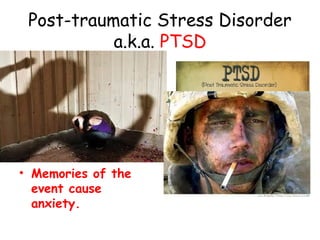
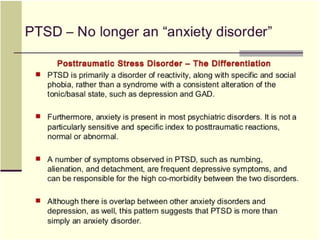
Post-traumatic Stress Disorder
a.k.a. PTSD
• Flashbacks or
nightmares following
a person’s
involvement in/or
observation of an
extremely stressful
event.
• Memories of the
event cause
anxiety.
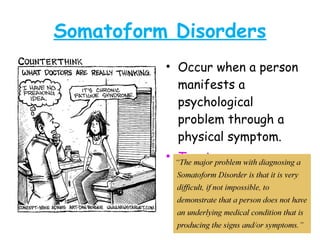
Somatoform Disorders
• Occur when a person
manifests a
psychological
problem through a
physical symptom.
• Two types……
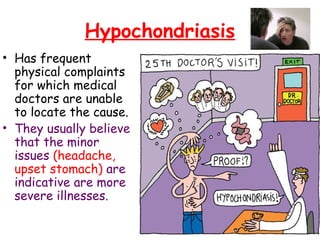
Hypochondriasis
• Has frequent
physical complaints
for which medical
doctors are unable
to locate the cause.
• They usually believe
that the minor
issues (headache,
upset stomach) are
indicative are more
severe illnesses.
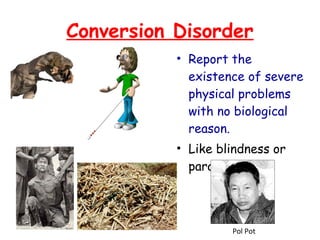
Conversion Disorder
• Report the
existence of severe
physical problems
with no biological
reason.
• Like blindness or
paralysis.
Pol Pot
Example: Conversion Disorder
• Pol Pot of Cambodia
• In one village his soldiers
entered and took all the
children out of their huts
and in front of their
mothers butchered them
• Later on it was reported
that every mother in that
village became blind.
• They brought them to the
States; examined them and
could not find a cause for
their blindness.
• Determined their blindness
was as a result of what they
saw and to avoid seeing it
again they all became blind.
• After several months of
treatment they all
regained their sight.
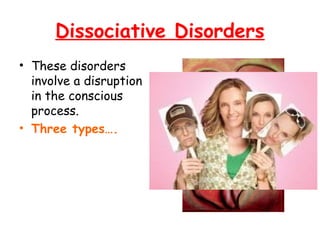
Dissociative Disorders
• These disorders
involve a disruption
in the conscious
process.
• Three types….
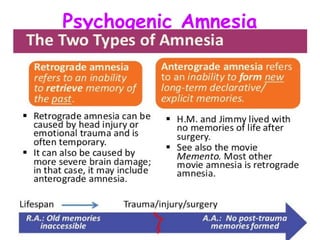
Psychogenic Amnesia
• A person cannot
remember things with no
physical basis for the
disruption in memory.
• Retrograde Amnesia
• NOT organic amnesia.
• Organic amnesia can be
retrograde or
antrograde.
Dissociative Fugue
• People with
psychogenic amnesia
that find themselves
in an unfamiliar
environment.
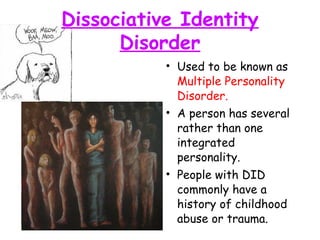
Dissociative Identity
Disorder
• Used to be known as
Multiple Personality
Disorder.
• A person has several
rather than one
integrated
personality.
• People with DID
commonly have a
history of childhood
abuse or trauma.
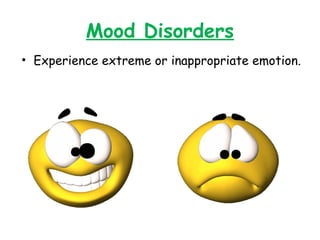
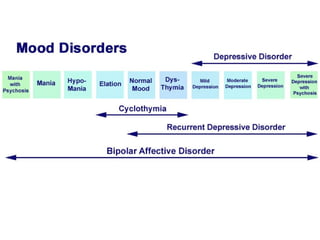
Mood Disorders
• Experience extreme or inappropriate emotion.
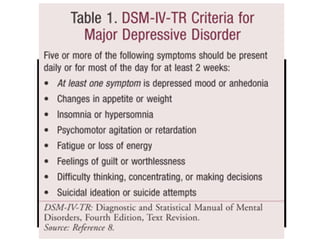
Major Depression
• A.K.A. unipolar
depression
• Unhappy for at least
two weeks with no
apparent cause.
• Depression is the
common cold of
psychological
disorders.
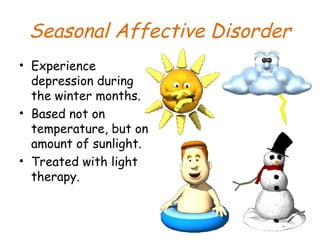
Seasonal Affective Disorder
• Experience
depression during
the winter months.
• Based not on
temperature, but on
amount of sunlight.
• Treated with light
therapy.
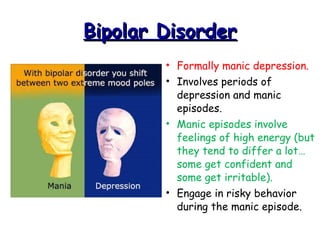
Bipolar DisorderBipolar Disorder
• Formally manic depression.
• Involves periods of
depression and manic
episodes.
• Manic episodes involve
feelings of high energy (but
they tend to differ a lot…
some get confident and
some get irritable).
• Engage in risky behavior
during the manic episode.
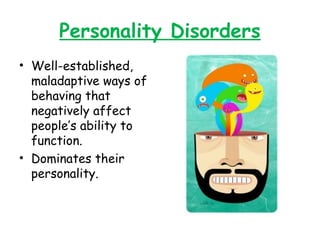
Personality Disorders
• Well-established,
maladaptive ways of
behaving that
negatively affect
people’s ability to
function.
• Dominates their
personality.
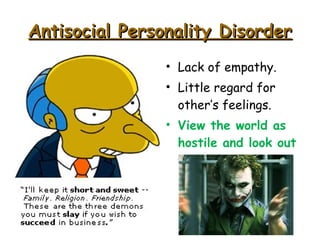
Antisocial Personality DisorderAntisocial Personality Disorder
• Lack of empathy.
• Little regard for
other’s feelings.
• View the world as
hostile and look out
for themselves.
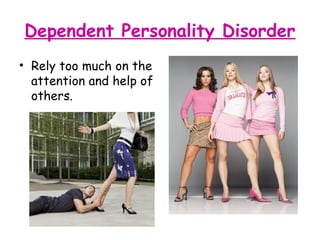
Dependent Personality Disorder
• Rely too much on the
attention and help of
others.
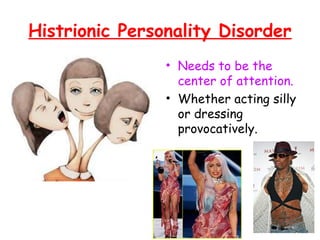
Histrionic Personality Disorder
• Needs to be the
center of attention.
• Whether acting silly
or dressing
provocatively.
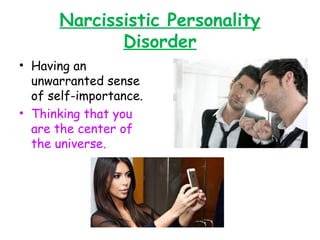
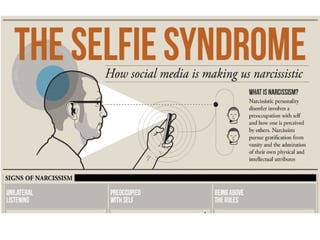
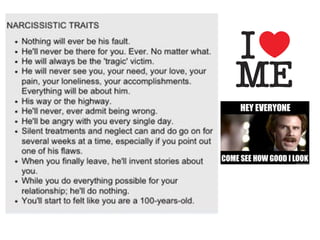
Narcissistic Personality
Disorder
• Having an
unwarranted sense
of self-importance.
• Thinking that you
are the center of
the universe.
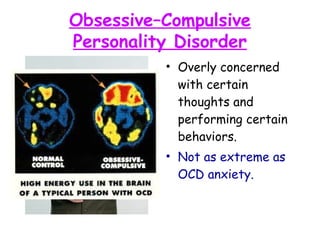
Obsessive–Compulsive
Personality Disorder
• Overly concerned
with certain
thoughts and
performing certain
behaviors.
• Not as extreme as
OCD anxiety.
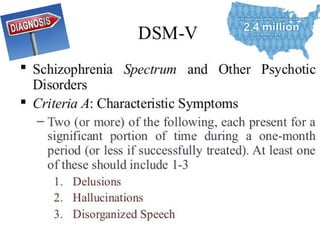
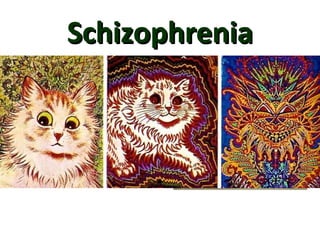
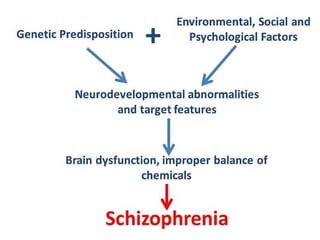
SchizophreniaSchizophrenia
Mental disorder often
characterized by
abnormal social
behavior and failure
to recognize what is
real
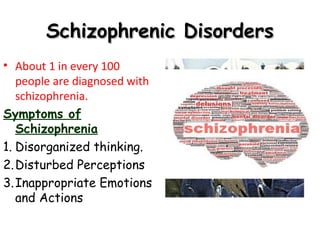
Schizophrenic DisordersSchizophrenic Disorders
• About 1 in every 100
people are diagnosed with
schizophrenia.
Symptoms of
Schizophrenia
1. Disorganized thinking.
2.Disturbed Perceptions
3.Inappropriate Emotions
and Actions
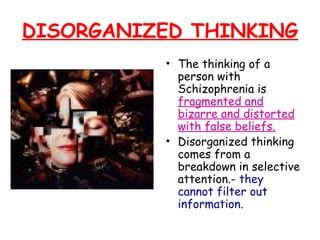
DISORGANIZED THINKING
• The thinking of a
person with
Schizophrenia is
fragmented and
bizarre and distorted
with false beliefs.
• Disorganized thinking
comes from a
breakdown in selective
attention.- they
cannot filter out
information.
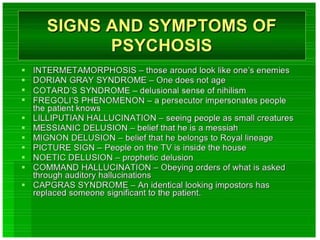
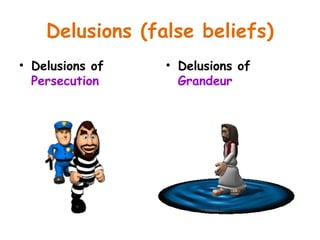
Delusions (false beliefs)
• Delusions of
Persecution
• Delusions of
Grandeur
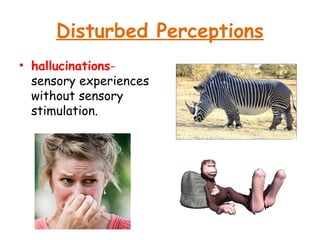
Disturbed Perceptions
• hallucinations-
sensory experiences
without sensory
stimulation.
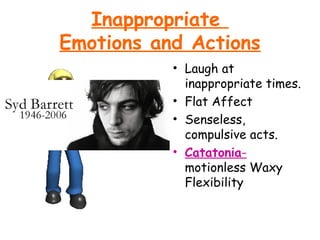
Inappropriate
Emotions and Actions
• Laugh at
inappropriate times.
• Flat Affect
• Senseless,
compulsive acts.
• Catatonia-
motionless Waxy
Flexibility
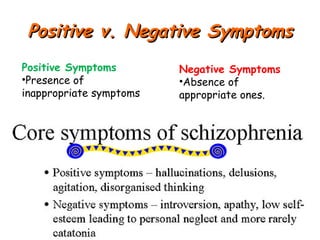
Positive v. Negative SymptomsPositive v. Negative Symptoms
Positive Symptoms
•Presence of
inappropriate symptoms
Negative Symptoms
•Absence of
appropriate ones.
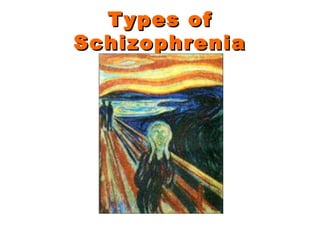
Types ofTypes of
SchizophreniaSchizophrenia
Disorganized SchizophreniaDisorganized Schizophrenia
• disorganized speech or
behavior, or flat or
inappropriate emotion.
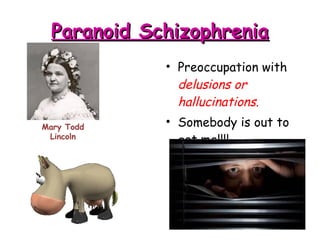
Paranoid SchizophreniaParanoid Schizophrenia
• Preoccupation with
delusions or
hallucinations.
• Somebody is out to
get me!!!!
Mary Todd
Lincoln
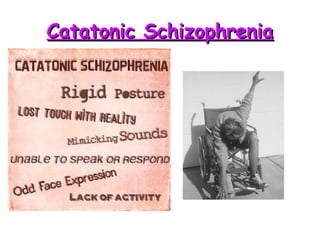
Catatonic SchizophreniaCatatonic Schizophrenia
• Flat effect
• Waxy Flexibility
• Parrot like repeating
of another’s speech
and movements
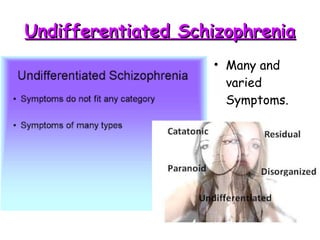
Undifferentiated SchizophreniaUndifferentiated Schizophrenia
• Many and
varied
Symptoms.
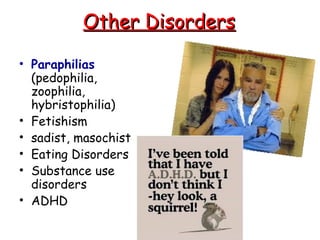
Other DisordersOther Disorders
• Paraphilias
(pedophilia,
zoophilia,
hybristophilia)
• Fetishism
• sadist, masochist
• Eating Disorders
• Substance use
disorders
• ADHD
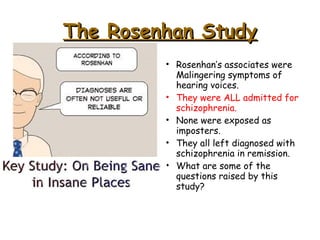
The Rosenhan StudyThe Rosenhan Study
• Rosenhan’s associates were
Malingering symptoms of
hearing voices.
• They were ALL admitted for
schizophrenia.
• None were exposed as
imposters.
• They all left diagnosed with
schizophrenia in remission.
• What are some of the
questions raised by this
study?
Abnormal psychology

Abnormal psychology

  • 1.
    Abnormal Psychology A.K.A. PsychologicalDisorders A “harmful dysfunction” in which behavior is judged to be atypical, disturbing, inappropriate, or unjustifiable.
  • 2.
    Who does what? •Psychologist: studies patients, tests disorders, talks and counsels • Psychiatrist : works inside a branch of medicine dealing with psychological disorders • Provides medical (drug) treatment
  • 6.
    Early Theories • Abnormalbehavior was evil spirits trying to get out. • Trephining was often used.
  • 7.
    The Middle Ages& Mental Illness Causes of mental illness included: ■Supernatural causes such as demons and demonic possession. ■Witchcraft and sorcery. ■Mass hysteria. ■Melancholy and stress. Treatments for mental illness included: ■Exorcism. ■Shaving the pattern of a cross in the head-hair. ■Believe that those suffering from mental illness could benefit from hearing mass. ■Drinking ice-cold water.
  • 8.
    Literally All OfUs Would Have Been Sent To An Insane Asylum
  • 11.
    Perspectives and DisordersPerspectivesand Disorders Psychological School/Perspective Cause of the Disorder Psychoanalytic/Psychodynamic Internal, unconscious drives Humanistic Failure to strive to one’s potential or being out of touch with one’s feelings. Behavioral Reinforcement history, the environment. Cognitive Irrational, dysfunctional thoughts or ways of thinking. Socio-cultural Dysfunctional Society Biomedical/Neuroscience Organic problems, biochemical imbalances, genetic predispositions.
  • 12.
    DSM V • DiagnosticStatistical Manual of Mental Disorders: the big book of disorders. • DSM will classify disorders and describe the symptoms. • DSM will NOT explain the causes or possible cures.
  • 18.
    Two Major Classificationsin the DSM Neurotic Disorders • Distressing, but one can still function in society and act rationally. Psychotic Disorders • Person loses contact with reality, experiences distorted perceptions. John Wayne Gacy: American serial killer and rapist Woody Allen: American Actor, writer, director
  • 19.
    Anxiety Disorders • Agroup of conditions where the primary symptoms are anxiety or defenses against anxiety. • Patient fears something awful will happen to them. • They are in a state of intense apprehension, uneasiness, uncertainty, or fear.
  • 20.
    Phobias • A personexperiences sudden episodes of intense dread. • Must be an irrational fear. • Phobia List
  • 21.
    Generalized Anxiety Disorder (GAD) •An anxiety disorder in which a person is continuously tense, apprehensive and in a state of autonomic nervous system arousal. • The patient is constantly tense and worried, feels inadequate, is oversensitive, can’t concentrate and suffers from insomnia.
  • 22.
    Panic Disorder • Ananxiety disorder • Marked by a minutes- long episode of intense dread • Person experiences: – terror and accompanying chest pain, choking and other frightening sensations.
  • 24.
    Obsessive-compulsive disorder • Persistentunwanted thoughts (obsessions) cause someone to feel the need (compulsion) to engage in a particular action. • Obsession about dirt and germs may lead to compulsive hand washing.
  • 25.
    Post-traumatic Stress Disorder a.k.a.PTSD • Flashbacks or nightmares following a person’s involvement in/or observation of an extremely stressful event. • Memories of the event cause anxiety.
  • 27.
    Somatoform Disorders • Occurwhen a person manifests a psychological problem through a physical symptom. • Two types……
  • 28.
    Hypochondriasis • Has frequent physicalcomplaints for which medical doctors are unable to locate the cause. • They usually believe that the minor issues (headache, upset stomach) are indicative are more severe illnesses.
  • 29.
    Conversion Disorder • Reportthe existence of severe physical problems with no biological reason. • Like blindness or paralysis. Pol Pot
  • 30.
    Example: Conversion Disorder •Pol Pot of Cambodia • In one village his soldiers entered and took all the children out of their huts and in front of their mothers butchered them • Later on it was reported that every mother in that village became blind. • They brought them to the States; examined them and could not find a cause for their blindness. • Determined their blindness was as a result of what they saw and to avoid seeing it again they all became blind. • After several months of treatment they all regained their sight.
  • 33.
    Dissociative Disorders • Thesedisorders involve a disruption in the conscious process. • Three types….
  • 34.
    Psychogenic Amnesia • Aperson cannot remember things with no physical basis for the disruption in memory. • Retrograde Amnesia • NOT organic amnesia. • Organic amnesia can be retrograde or antrograde.
  • 35.
    Dissociative Fugue • Peoplewith psychogenic amnesia that find themselves in an unfamiliar environment.
  • 36.
    Dissociative Identity Disorder • Usedto be known as Multiple Personality Disorder. • A person has several rather than one integrated personality. • People with DID commonly have a history of childhood abuse or trauma.
  • 37.
    Mood Disorders • Experienceextreme or inappropriate emotion.
  • 39.
    Major Depression • A.K.A.unipolar depression • Unhappy for at least two weeks with no apparent cause. • Depression is the common cold of psychological disorders.
  • 41.
    Seasonal Affective Disorder •Experience depression during the winter months. • Based not on temperature, but on amount of sunlight. • Treated with light therapy.
  • 42.
    Bipolar DisorderBipolar Disorder •Formally manic depression. • Involves periods of depression and manic episodes. • Manic episodes involve feelings of high energy (but they tend to differ a lot… some get confident and some get irritable). • Engage in risky behavior during the manic episode.
  • 43.
    Personality Disorders • Well-established, maladaptiveways of behaving that negatively affect people’s ability to function. • Dominates their personality.
  • 44.
    Antisocial Personality DisorderAntisocialPersonality Disorder • Lack of empathy. • Little regard for other’s feelings. • View the world as hostile and look out for themselves.
  • 45.
    Dependent Personality Disorder •Rely too much on the attention and help of others.
  • 46.
    Histrionic Personality Disorder •Needs to be the center of attention. • Whether acting silly or dressing provocatively.
  • 48.
    Narcissistic Personality Disorder • Havingan unwarranted sense of self-importance. • Thinking that you are the center of the universe.
  • 51.
    Obsessive–Compulsive Personality Disorder • Overlyconcerned with certain thoughts and performing certain behaviors. • Not as extreme as OCD anxiety.
  • 52.
    SchizophreniaSchizophrenia Mental disorder often characterizedby abnormal social behavior and failure to recognize what is real
  • 53.
    Schizophrenic DisordersSchizophrenic Disorders •About 1 in every 100 people are diagnosed with schizophrenia. Symptoms of Schizophrenia 1. Disorganized thinking. 2.Disturbed Perceptions 3.Inappropriate Emotions and Actions
  • 54.
    DISORGANIZED THINKING • Thethinking of a person with Schizophrenia is fragmented and bizarre and distorted with false beliefs. • Disorganized thinking comes from a breakdown in selective attention.- they cannot filter out information.
  • 56.
    Delusions (false beliefs) •Delusions of Persecution • Delusions of Grandeur
  • 57.
    Disturbed Perceptions • hallucinations- sensoryexperiences without sensory stimulation.
  • 58.
    Inappropriate Emotions and Actions •Laugh at inappropriate times. • Flat Affect • Senseless, compulsive acts. • Catatonia- motionless Waxy Flexibility
  • 60.
    Positive v. NegativeSymptomsPositive v. Negative Symptoms Positive Symptoms •Presence of inappropriate symptoms Negative Symptoms •Absence of appropriate ones.
  • 61.
  • 62.
    Disorganized SchizophreniaDisorganized Schizophrenia •disorganized speech or behavior, or flat or inappropriate emotion.
  • 63.
    Paranoid SchizophreniaParanoid Schizophrenia •Preoccupation with delusions or hallucinations. • Somebody is out to get me!!!! Mary Todd Lincoln
  • 64.
    Catatonic SchizophreniaCatatonic Schizophrenia •Flat effect • Waxy Flexibility • Parrot like repeating of another’s speech and movements
  • 65.
  • 66.
    Other DisordersOther Disorders •Paraphilias (pedophilia, zoophilia, hybristophilia) • Fetishism • sadist, masochist • Eating Disorders • Substance use disorders • ADHD
  • 67.
    The Rosenhan StudyTheRosenhan Study • Rosenhan’s associates were Malingering symptoms of hearing voices. • They were ALL admitted for schizophrenia. • None were exposed as imposters. • They all left diagnosed with schizophrenia in remission. • What are some of the questions raised by this study?