Chapter 13:  I/O Systems
I/O Hardware Incredible variety of I/O devices Common concepts Port   Bus  ( daisy chain  or shared direct access) Controller  ( host adapter ) I/O instructions control devices Devices have addresses, used by  Direct I/O instructions Memory-mapped  I/O
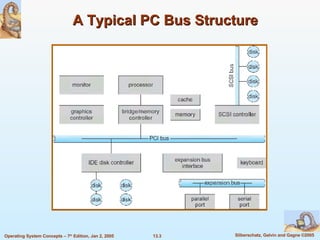
A Typical PC Bus Structure
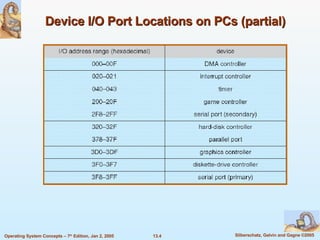
Device I/O Port Locations on PCs (partial)
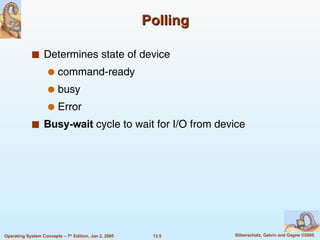
Polling Determines state of device  command-ready busy Error Busy-wait  cycle to wait for I/O from device
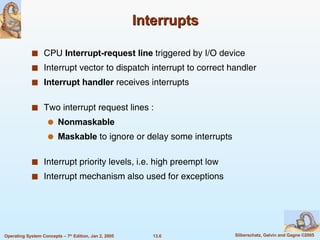
Interrupts CPU  Interrupt-request line  triggered by I/O device Interrupt vector to dispatch interrupt to correct handler Interrupt handler  receives interrupts Two interrupt request lines : Nonmaskable  Maskable  to ignore or delay some interrupts Interrupt priority levels, i.e. high preempt low Interrupt mechanism also used for exceptions
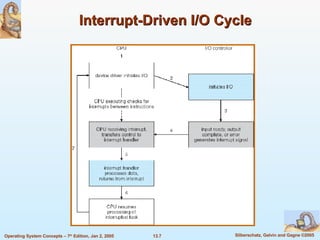
Interrupt-Driven I/O Cycle
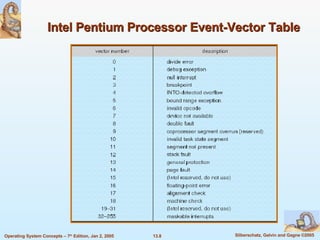
Intel Pentium Processor Event-Vector Table
Direct Memory Access Used to avoid  programmed I/O  for large data movement  Requires  DMA  controller Bypasses CPU to transfer data directly between I/O device and memory
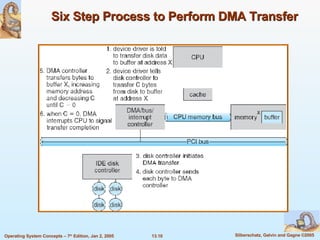
Six Step Process to Perform DMA Transfer
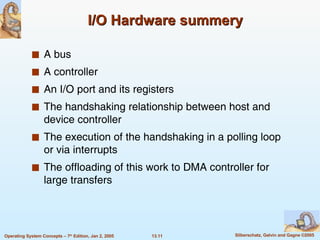
I/O Hardware summery A bus A controller An I/O port and its registers The handshaking relationship between host and device controller The execution of the handshaking in a polling loop or via interrupts  The offloading of this work to DMA controller for large transfers
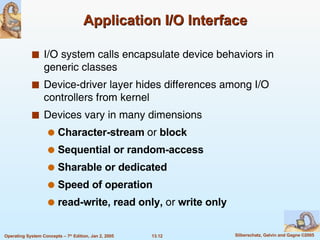
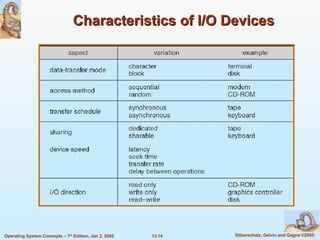
Application I/O Interface I/O system calls encapsulate device behaviors in generic classes Device-driver layer hides differences among I/O controllers from kernel Devices vary in many dimensions Character-stream  or  block Sequential or random-access Sharable or dedicated Speed of operation read-write, read only,  or  write only
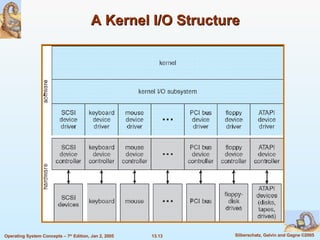
A Kernel I/O Structure
Characteristics of I/O Devices
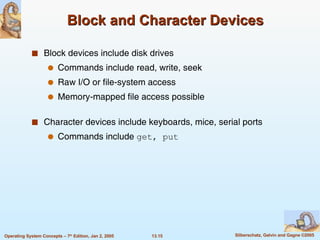
Block and Character Devices Block devices include disk drives Commands include read, write, seek  Raw I/O or file-system access Memory-mapped file access possible Character devices include keyboards, mice, serial ports Commands include  get, put
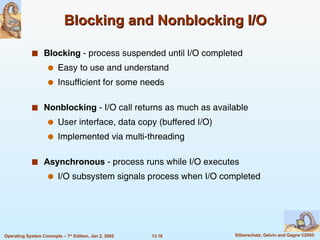
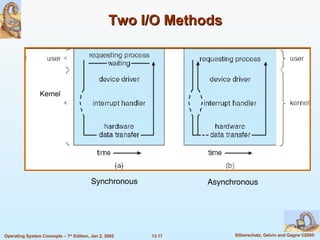
Blocking and Nonblocking I/O Blocking  - process suspended until I/O completed Easy to use and understand Insufficient for some needs Nonblocking  - I/O call returns as much as available User interface, data copy (buffered I/O) Implemented via multi-threading Asynchronous  - process runs while I/O executes I/O subsystem signals process when I/O completed
Two I/O Methods Synchronous Asynchronous Kernel
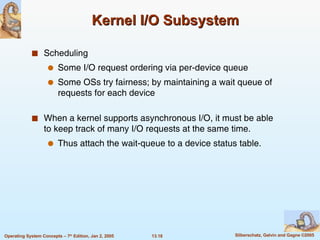
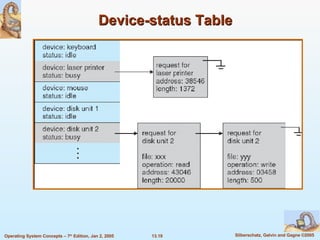
Kernel I/O Subsystem Scheduling Some I/O request ordering via per-device queue Some OSs try fairness; by maintaining a wait queue of requests for each device When a kernel supports asynchronous I/O, it must be able to keep track of many I/O requests at the same time. Thus attach the wait-queue to a device status table.
Device-status Table
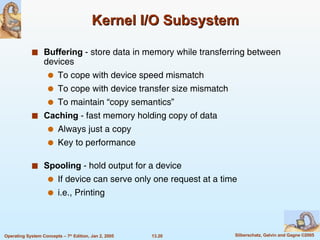
Kernel I/O Subsystem Buffering  - store data in memory while transferring between devices To cope with device speed mismatch To cope with device transfer size mismatch To maintain “copy semantics” Caching  - fast memory holding copy of data Always just a copy Key to performance Spooling  - hold output for a device If device can serve only one request at a time  i.e., Printing
Error Handling OS can recover from disk read, device unavailable, transient write failures Most return an error number or code when I/O request fails  System error logs hold problem reports
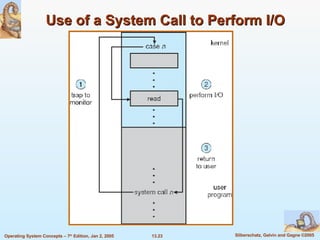
I/O Protection User process may accidentally or purposefully attempt to disrupt normal operation via illegal I/O instructions All I/O instructions defined to be privileged I/O must be performed via system calls Memory-mapped and I/O port memory locations must be protected too
Use of a System Call to Perform I/O
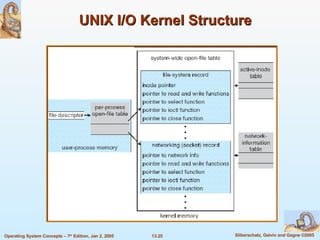
Kernel Data Structures Kernel keeps state info for I/O components, including open file tables, network connections, character device state Many, many complex data structures to track buffers, memory allocation, “dirty” blocks Some use object-oriented methods and message passing to implement I/O
UNIX I/O Kernel Structure
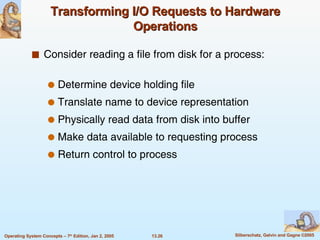
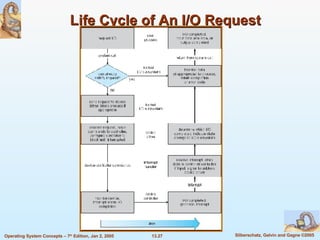
Transforming I/O Requests to Hardware Operations Consider reading a file from disk for a process:   Determine device holding file  Translate name to device representation Physically read data from disk into buffer Make data available to requesting process Return control to process
Life Cycle of An I/O Request

Ch13

  • 1.
    Chapter 13: I/O Systems
  • 2.
    I/O Hardware Incrediblevariety of I/O devices Common concepts Port Bus ( daisy chain or shared direct access) Controller ( host adapter ) I/O instructions control devices Devices have addresses, used by Direct I/O instructions Memory-mapped I/O
  • 3.
    A Typical PCBus Structure
  • 4.
    Device I/O PortLocations on PCs (partial)
  • 5.
    Polling Determines stateof device command-ready busy Error Busy-wait cycle to wait for I/O from device
  • 6.
    Interrupts CPU Interrupt-request line triggered by I/O device Interrupt vector to dispatch interrupt to correct handler Interrupt handler receives interrupts Two interrupt request lines : Nonmaskable Maskable to ignore or delay some interrupts Interrupt priority levels, i.e. high preempt low Interrupt mechanism also used for exceptions
  • 7.
  • 8.
    Intel Pentium ProcessorEvent-Vector Table
  • 9.
    Direct Memory AccessUsed to avoid programmed I/O for large data movement Requires DMA controller Bypasses CPU to transfer data directly between I/O device and memory
  • 10.
    Six Step Processto Perform DMA Transfer
  • 11.
    I/O Hardware summeryA bus A controller An I/O port and its registers The handshaking relationship between host and device controller The execution of the handshaking in a polling loop or via interrupts The offloading of this work to DMA controller for large transfers
  • 12.
    Application I/O InterfaceI/O system calls encapsulate device behaviors in generic classes Device-driver layer hides differences among I/O controllers from kernel Devices vary in many dimensions Character-stream or block Sequential or random-access Sharable or dedicated Speed of operation read-write, read only, or write only
  • 13.
    A Kernel I/OStructure
  • 14.
  • 15.
    Block and CharacterDevices Block devices include disk drives Commands include read, write, seek Raw I/O or file-system access Memory-mapped file access possible Character devices include keyboards, mice, serial ports Commands include get, put
  • 16.
    Blocking and NonblockingI/O Blocking - process suspended until I/O completed Easy to use and understand Insufficient for some needs Nonblocking - I/O call returns as much as available User interface, data copy (buffered I/O) Implemented via multi-threading Asynchronous - process runs while I/O executes I/O subsystem signals process when I/O completed
  • 17.
    Two I/O MethodsSynchronous Asynchronous Kernel
  • 18.
    Kernel I/O SubsystemScheduling Some I/O request ordering via per-device queue Some OSs try fairness; by maintaining a wait queue of requests for each device When a kernel supports asynchronous I/O, it must be able to keep track of many I/O requests at the same time. Thus attach the wait-queue to a device status table.
  • 19.
  • 20.
    Kernel I/O SubsystemBuffering - store data in memory while transferring between devices To cope with device speed mismatch To cope with device transfer size mismatch To maintain “copy semantics” Caching - fast memory holding copy of data Always just a copy Key to performance Spooling - hold output for a device If device can serve only one request at a time i.e., Printing
  • 21.
    Error Handling OScan recover from disk read, device unavailable, transient write failures Most return an error number or code when I/O request fails System error logs hold problem reports
  • 22.
    I/O Protection Userprocess may accidentally or purposefully attempt to disrupt normal operation via illegal I/O instructions All I/O instructions defined to be privileged I/O must be performed via system calls Memory-mapped and I/O port memory locations must be protected too
  • 23.
    Use of aSystem Call to Perform I/O
  • 24.
    Kernel Data StructuresKernel keeps state info for I/O components, including open file tables, network connections, character device state Many, many complex data structures to track buffers, memory allocation, “dirty” blocks Some use object-oriented methods and message passing to implement I/O
  • 25.
    UNIX I/O KernelStructure
  • 26.
    Transforming I/O Requeststo Hardware Operations Consider reading a file from disk for a process: Determine device holding file Translate name to device representation Physically read data from disk into buffer Make data available to requesting process Return control to process
  • 27.
    Life Cycle ofAn I/O Request