I/O Systems
 Overview
 I/O Hardware
 Application I/O Interface
 Kernel I/O Subsystem
 Transforming I/O Requests to Hardware Operations
 STREAMS
 Performance
Objectives
 Explore the structure of an operating system’s I/O
subsystem
 Discuss the principles of I/O hardware and its
complexity
 Provide details of the performance aspects of I/O
hardware and software
Overview
 I/O management is a major component of operating system
design and operation
 Important aspect of computer operation
 I/O devices vary greatly
 Various methods to control them
 Performance management
 New types of devices frequent
 Ports, busses, device controllers connect to various devices
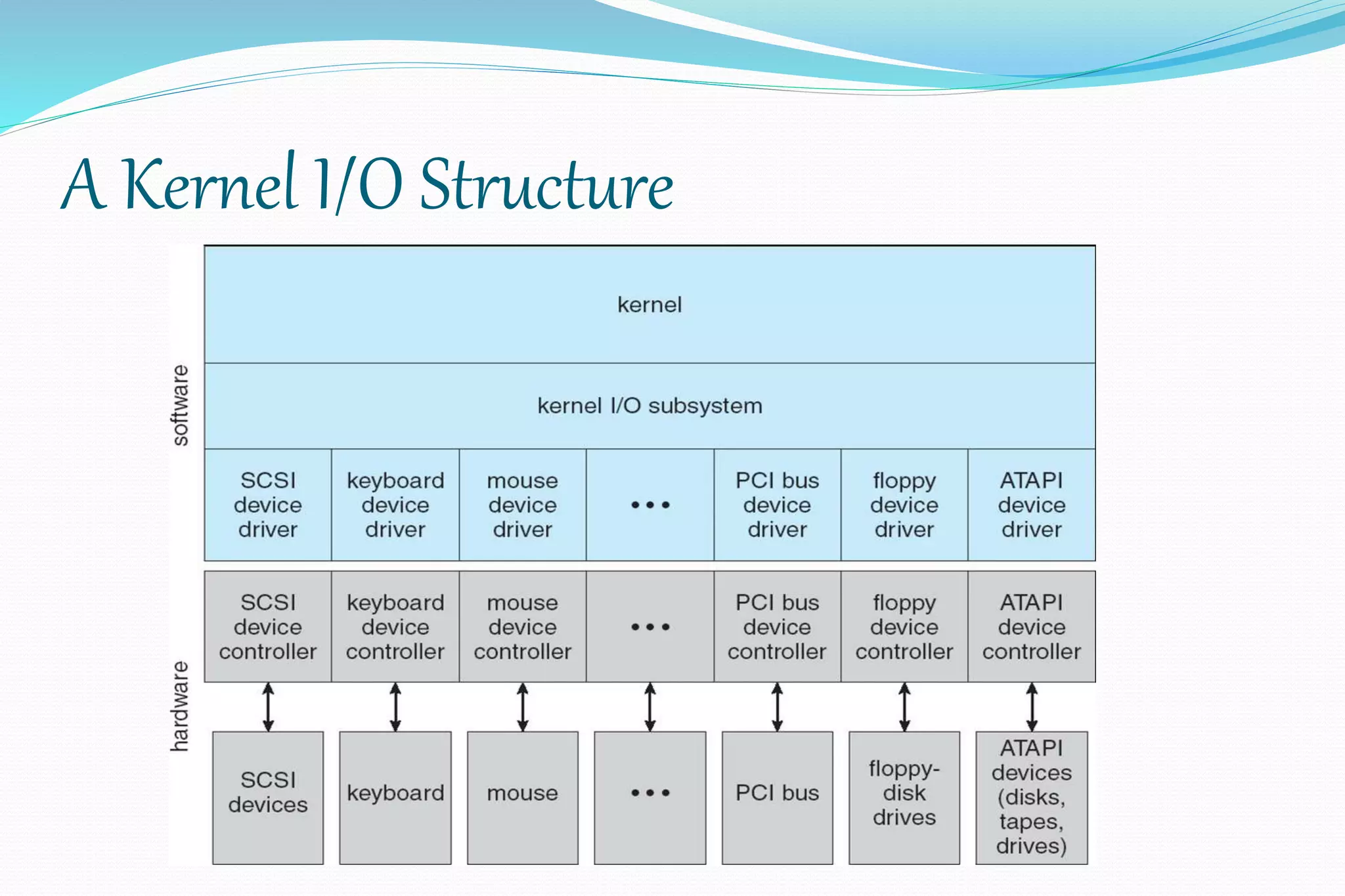
 Device drivers encapsulate device details
 Present uniform device-access interface to I/O subsystem
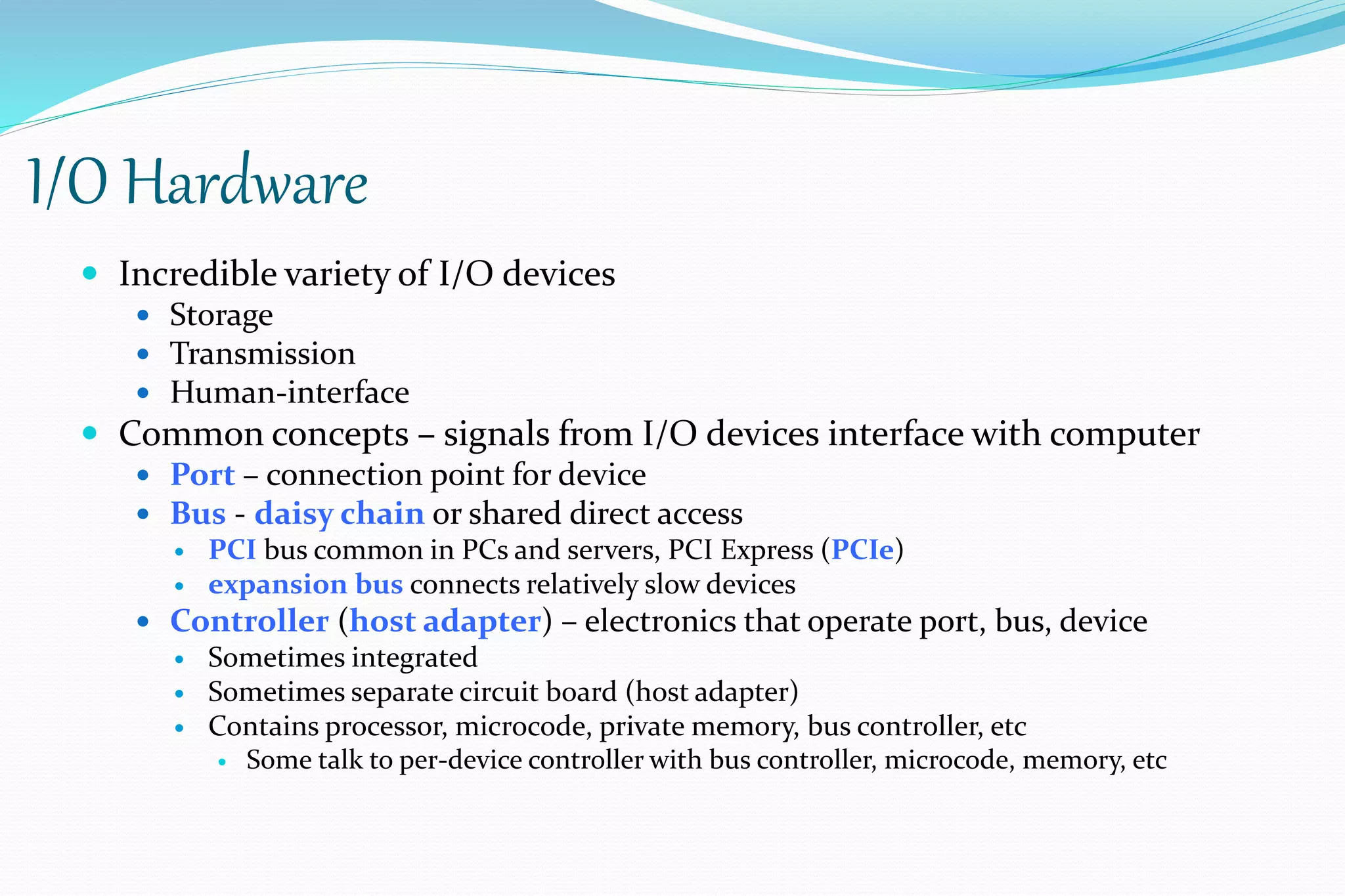
I/O Hardware
 Incredible variety of I/O devices
 Storage
 Transmission
 Human-interface
 Common concepts – signals from I/O devices interface with computer
 Port – connection point for device
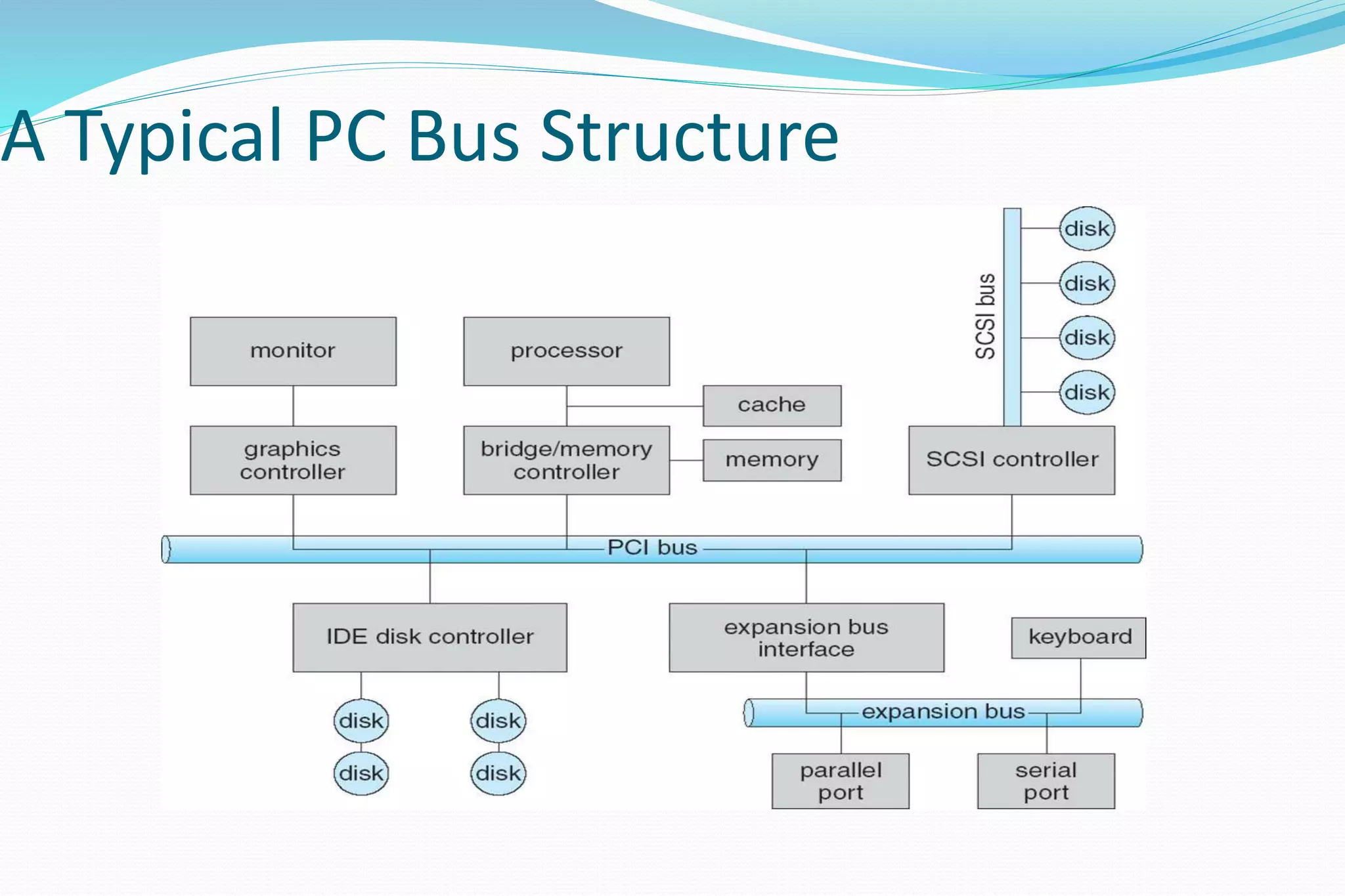
 Bus - daisy chain or shared direct access
 PCI bus common in PCs and servers, PCI Express (PCIe)
 expansion bus connects relatively slow devices
 Controller (host adapter) – electronics that operate port, bus, device
 Sometimes integrated
 Sometimes separate circuit board (host adapter)
 Contains processor, microcode, private memory, bus controller, etc
 Some talk to per-device controller with bus controller, microcode, memory, etc
A Typical PC Bus Structure
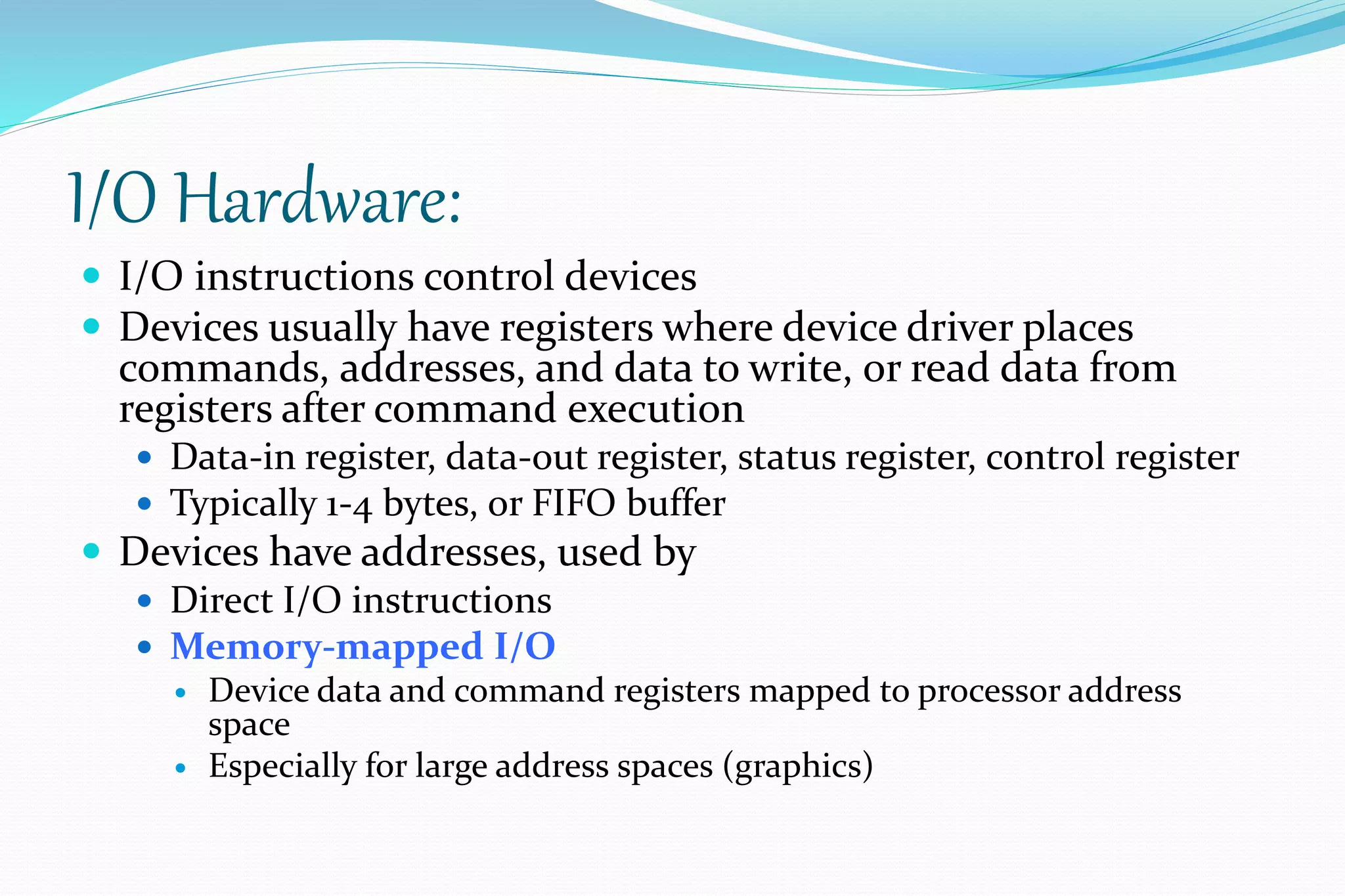
I/O Hardware:
 I/O instructions control devices
 Devices usually have registers where device driver places
commands, addresses, and data to write, or read data from
registers after command execution
 Data-in register, data-out register, status register, control register
 Typically 1-4 bytes, or FIFO buffer
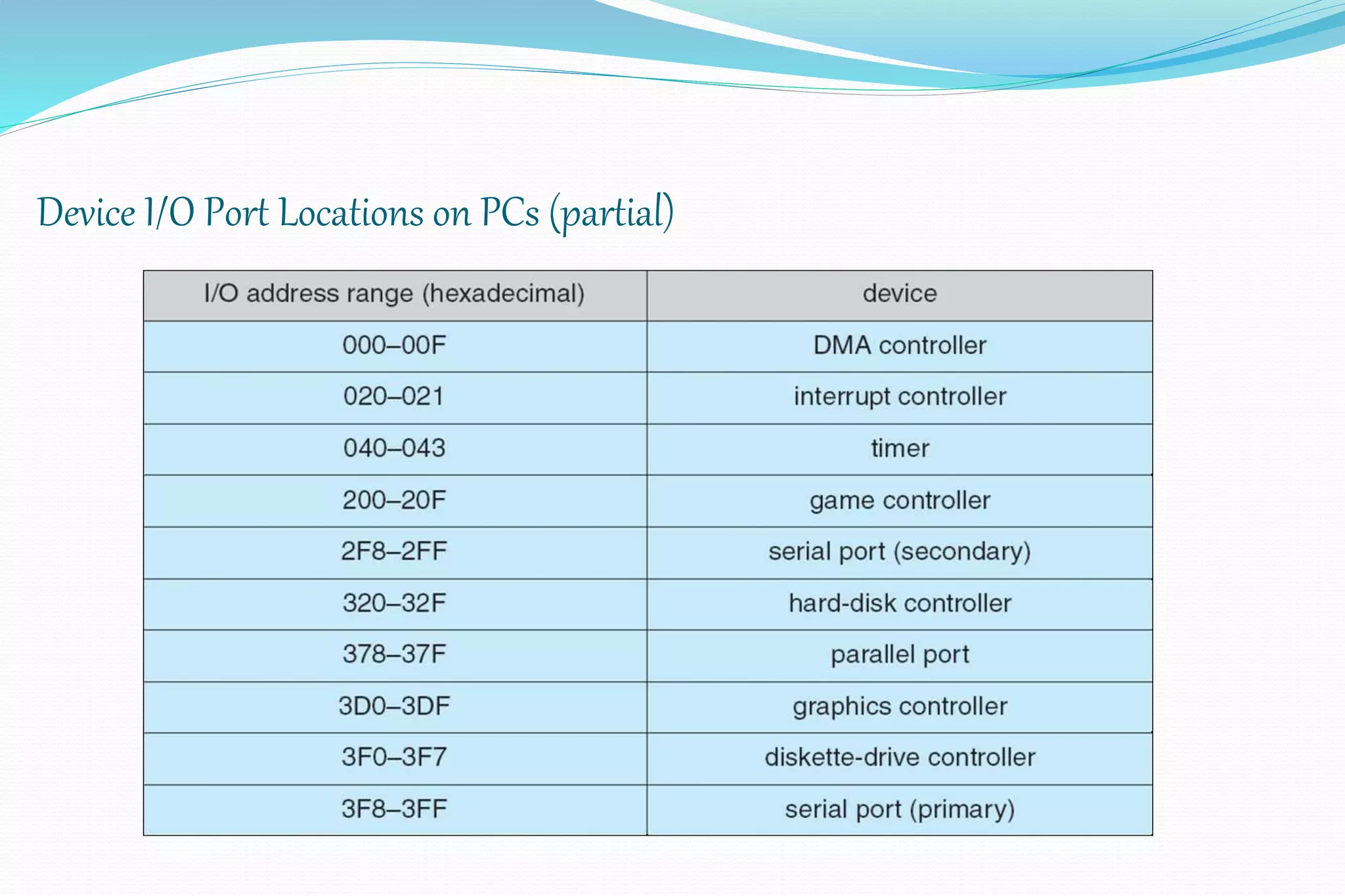
 Devices have addresses, used by
 Direct I/O instructions
 Memory-mapped I/O
 Device data and command registers mapped to processor address
space
 Especially for large address spaces (graphics)
Device I/O Port Locations on PCs (partial)
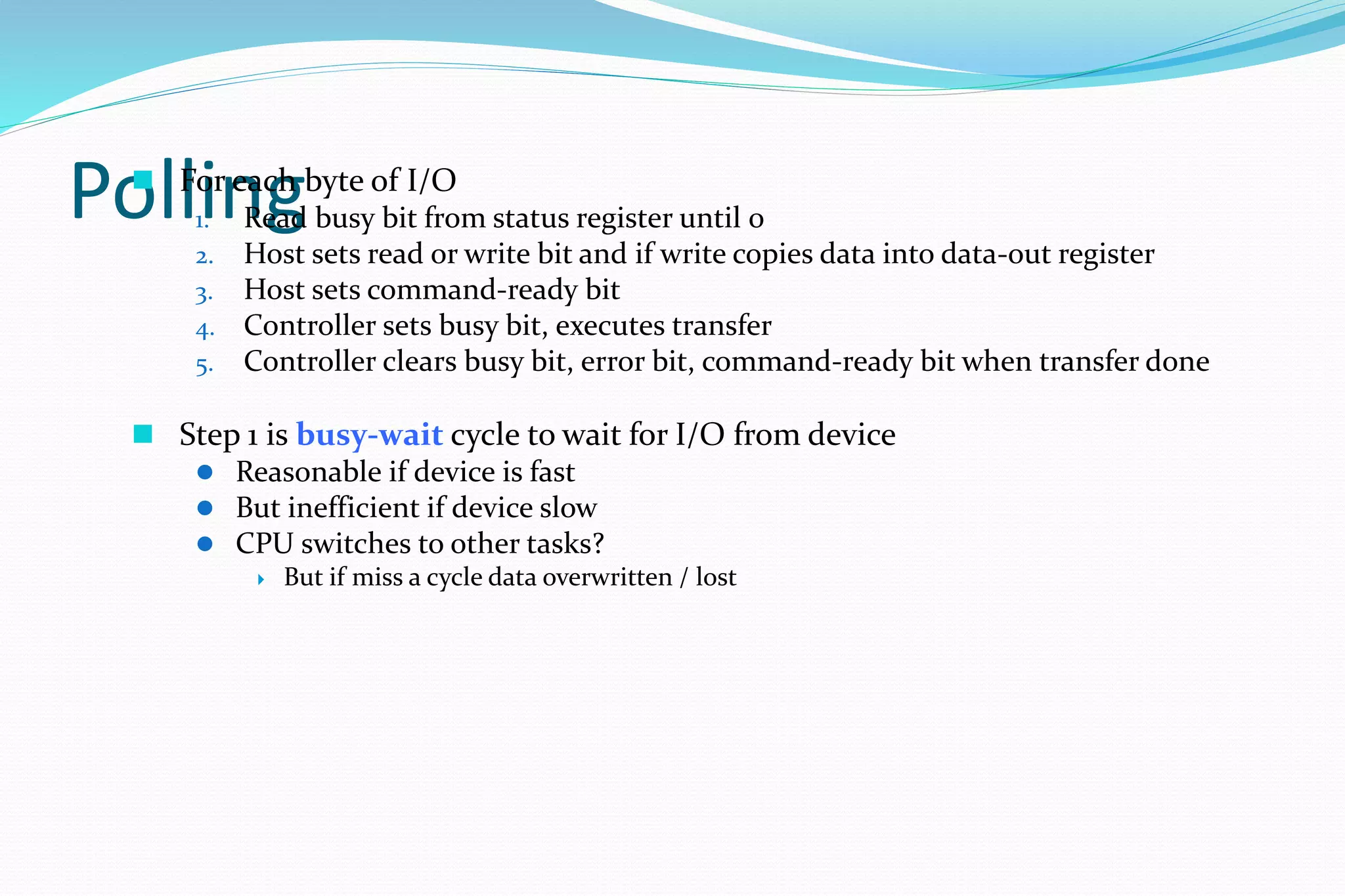
Polling For each byte of I/O
1. Read busy bit from status register until 0
2. Host sets read or write bit and if write copies data into data-out register
3. Host sets command-ready bit
4. Controller sets busy bit, executes transfer
5. Controller clears busy bit, error bit, command-ready bit when transfer done
 Step 1 is busy-wait cycle to wait for I/O from device
 Reasonable if device is fast
 But inefficient if device slow
 CPU switches to other tasks?
 But if miss a cycle data overwritten / lost
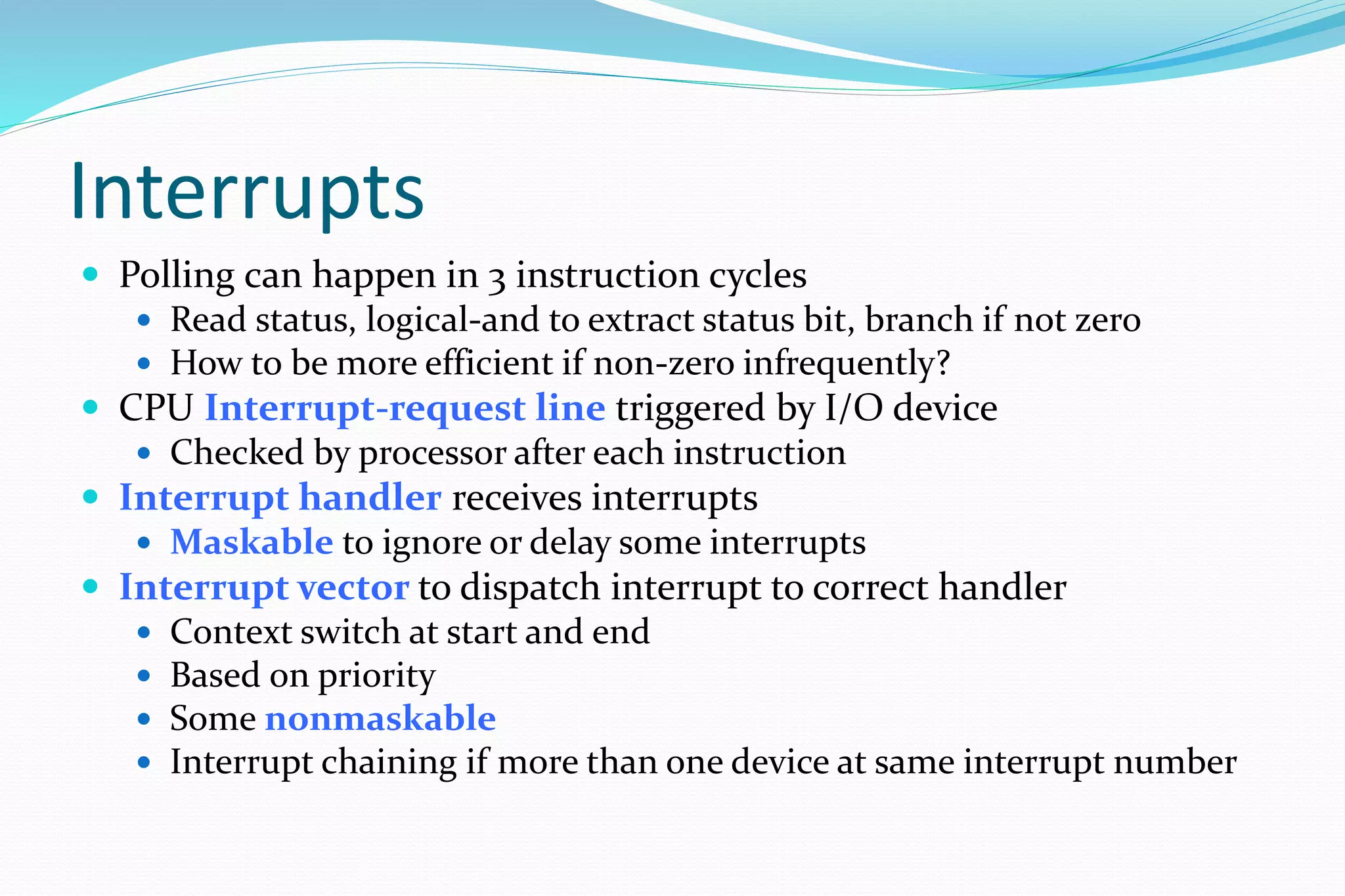
Interrupts
 Polling can happen in 3 instruction cycles
 Read status, logical-and to extract status bit, branch if not zero
 How to be more efficient if non-zero infrequently?
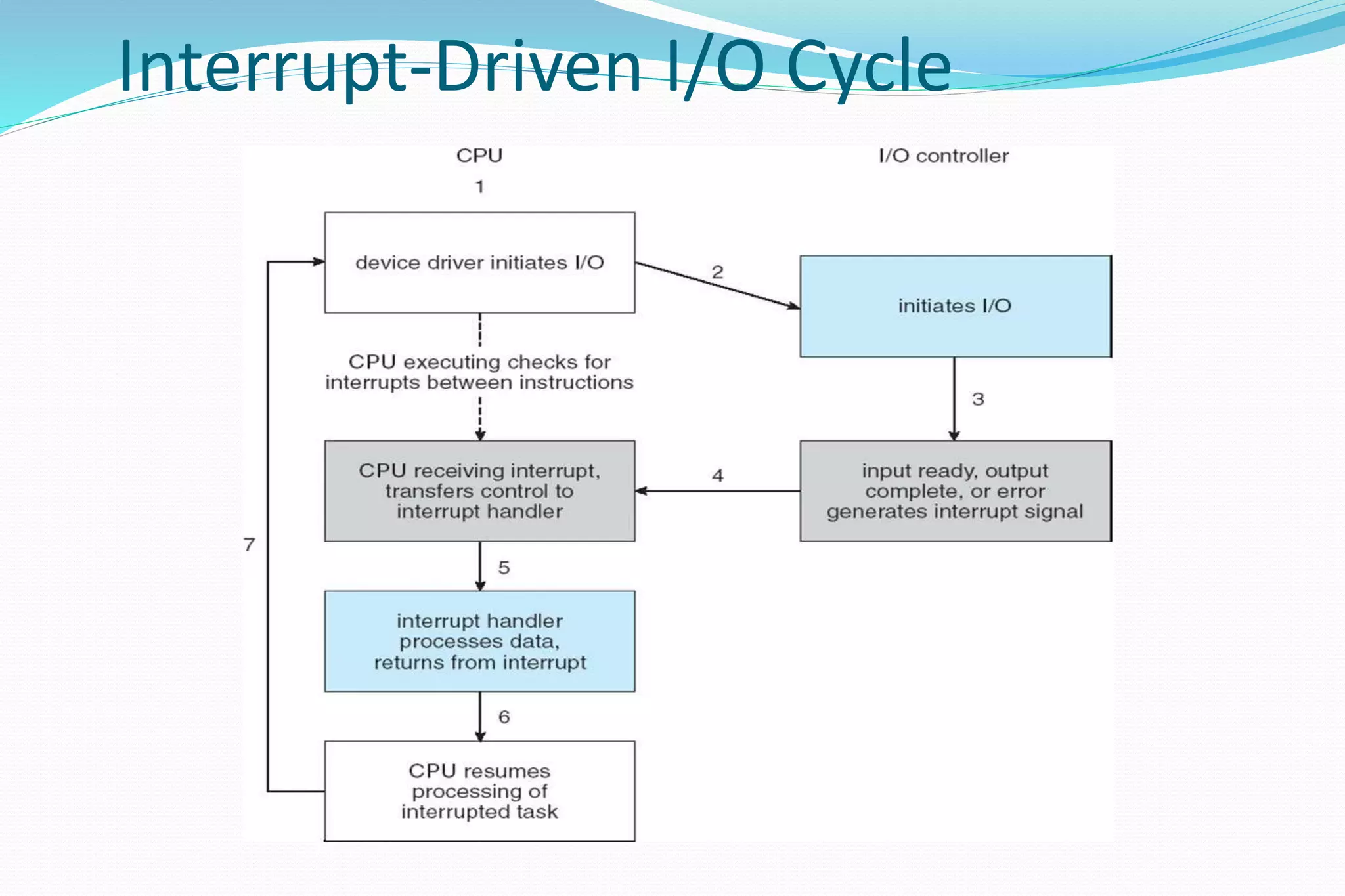
 CPU Interrupt-request line triggered by I/O device
 Checked by processor after each instruction
 Interrupt handler receives interrupts
 Maskable to ignore or delay some interrupts
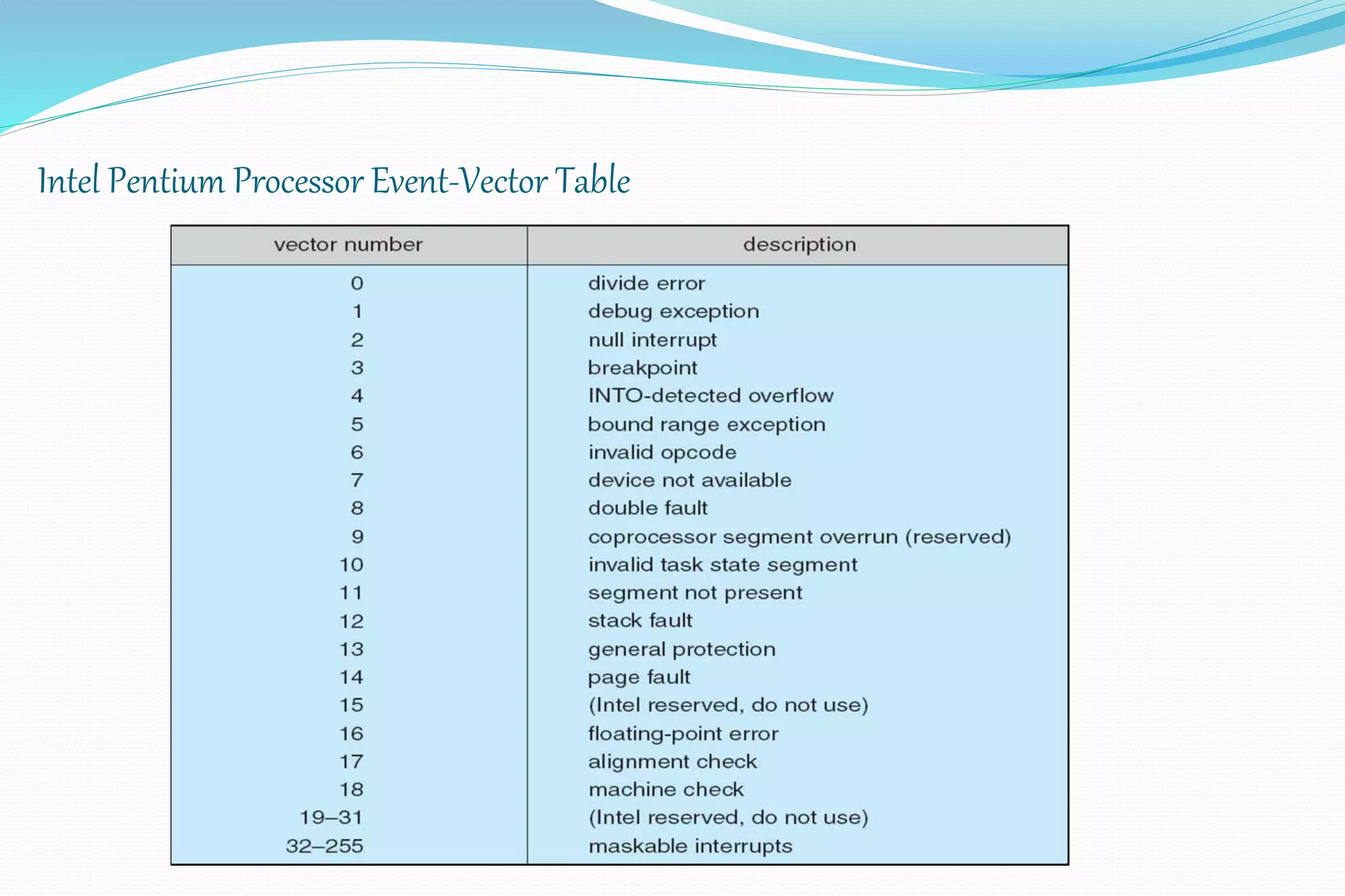
 Interrupt vector to dispatch interrupt to correct handler
 Context switch at start and end
 Based on priority
 Some nonmaskable
 Interrupt chaining if more than one device at same interrupt number
Interrupt-Driven I/O Cycle
Intel Pentium Processor Event-Vector Table
Interrupts
 Interrupt mechanism also used for exceptions
 Terminate process, crash system due to hardware error
 Page fault executes when memory access error
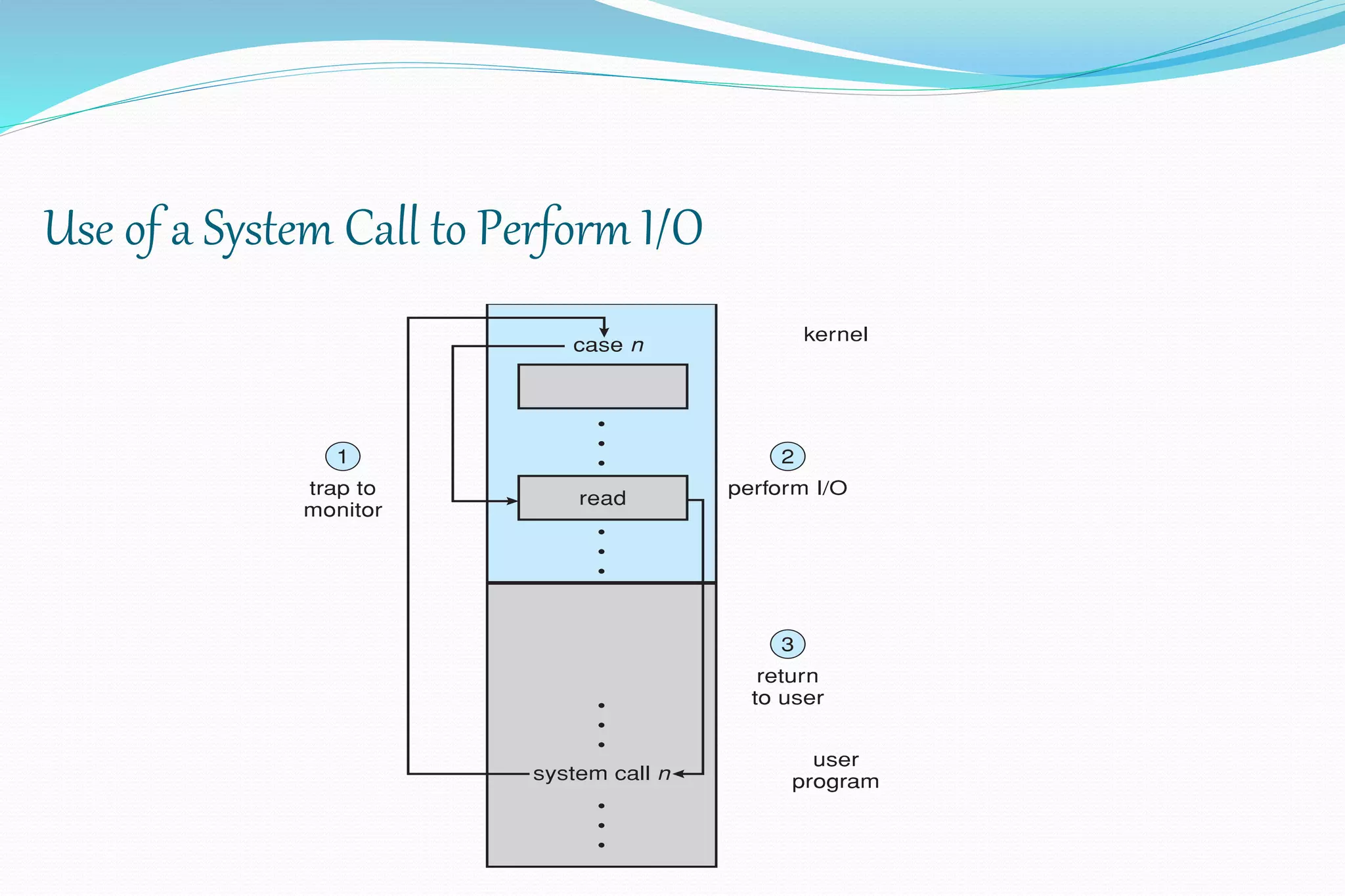
 System call executes via trap to trigger kernel to execute
request
 Multi-CPU systems can process interrupts concurrently
 If operating system designed to handle it
 Used for time-sensitive processing, frequent, must be fast
Direct Memory Access
 Used to avoid programmed I/O (one byte at a time) for large data
movement
 Requires DMA controller
 Bypasses CPU to transfer data directly between I/O device and
memory
 OS writes DMA command block into memory
 Source and destination addresses
 Read or write mode
 Count of bytes
 Writes location of command block to DMA controller
 Bus mastering of DMA controller – grabs bus from CPU
 Cycle stealing from CPU but still much more efficient
 When done, interrupts to signal completion
 Version that is aware of virtual addresses can be even more efficient -
DVMA
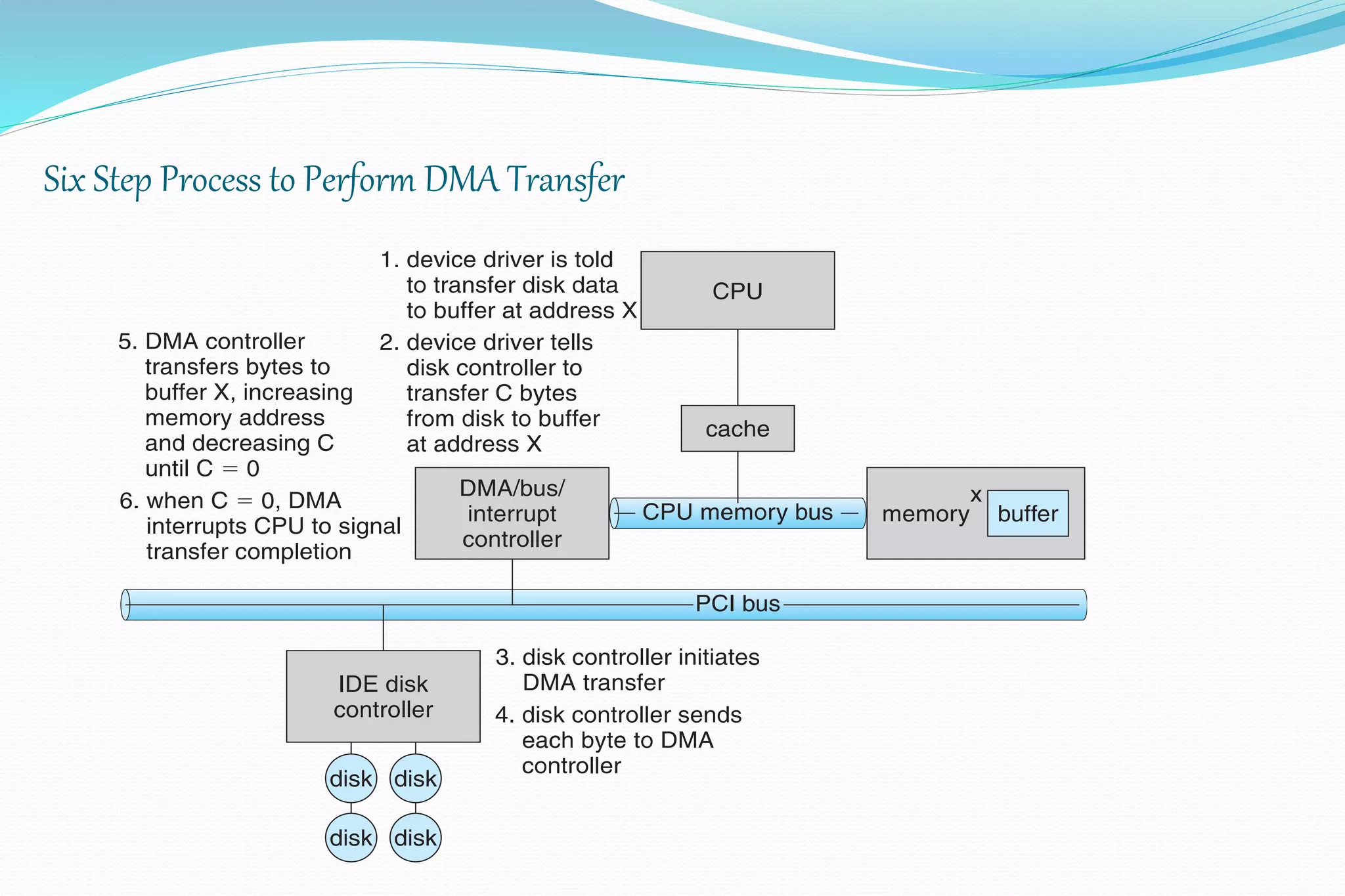
Six Step Process to Perform DMA Transfer
Application I/O Interface
 I/O system calls encapsulate device behaviors in generic classes
 Device-driver layer hides differences among I/O controllers from kernel
 New devices talking already-implemented protocols need no extra work
 Each OS has its own I/O subsystem structures and device driver
frameworks
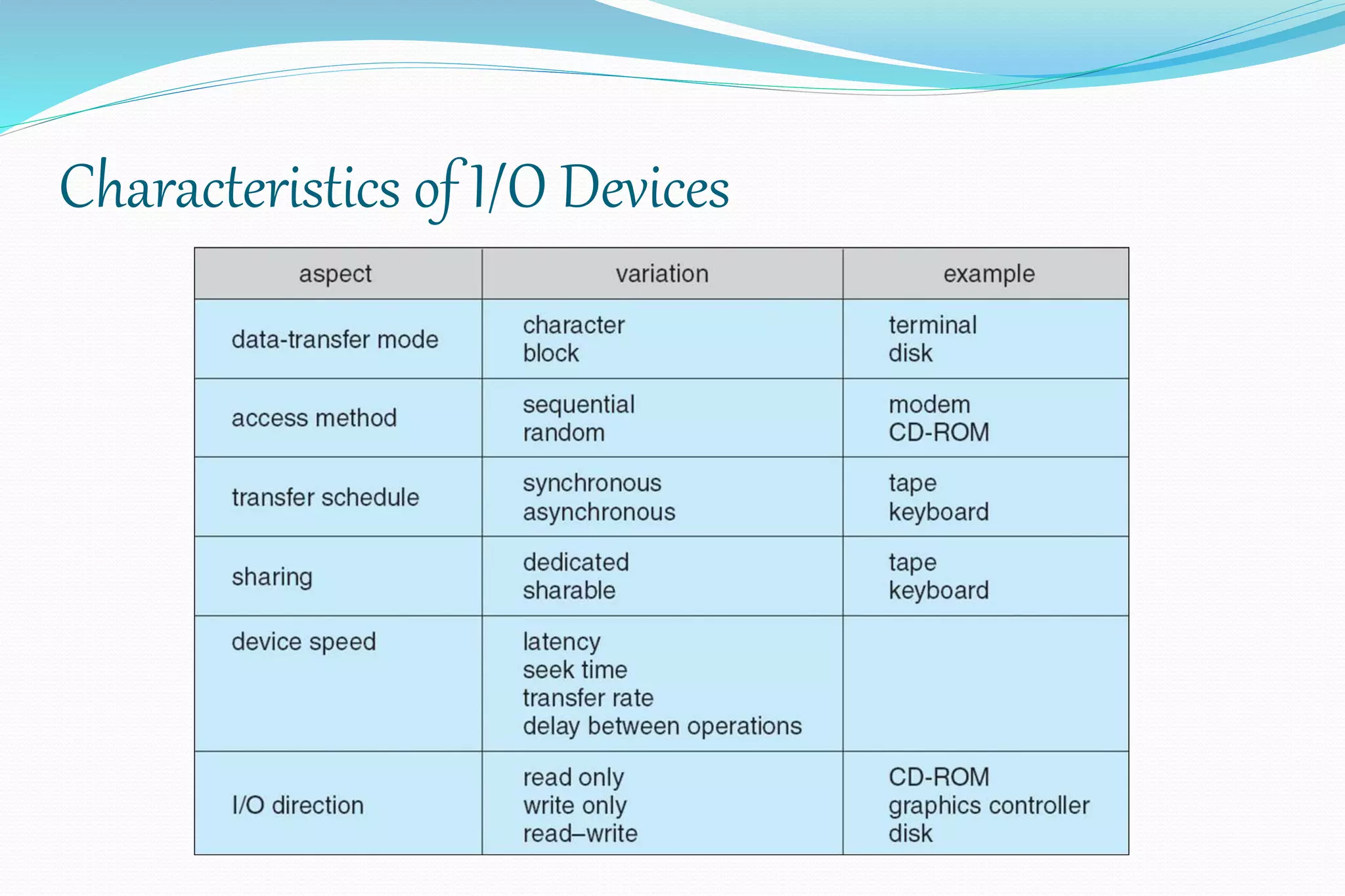
 Devices vary in many dimensions
 Character-stream or block
 Sequential or random-access
 Synchronous or asynchronous (or both)
 Sharable or dedicated
 Speed of operation
 read-write, read only, or write only
A Kernel I/O Structure
Characteristics of I/O Devices
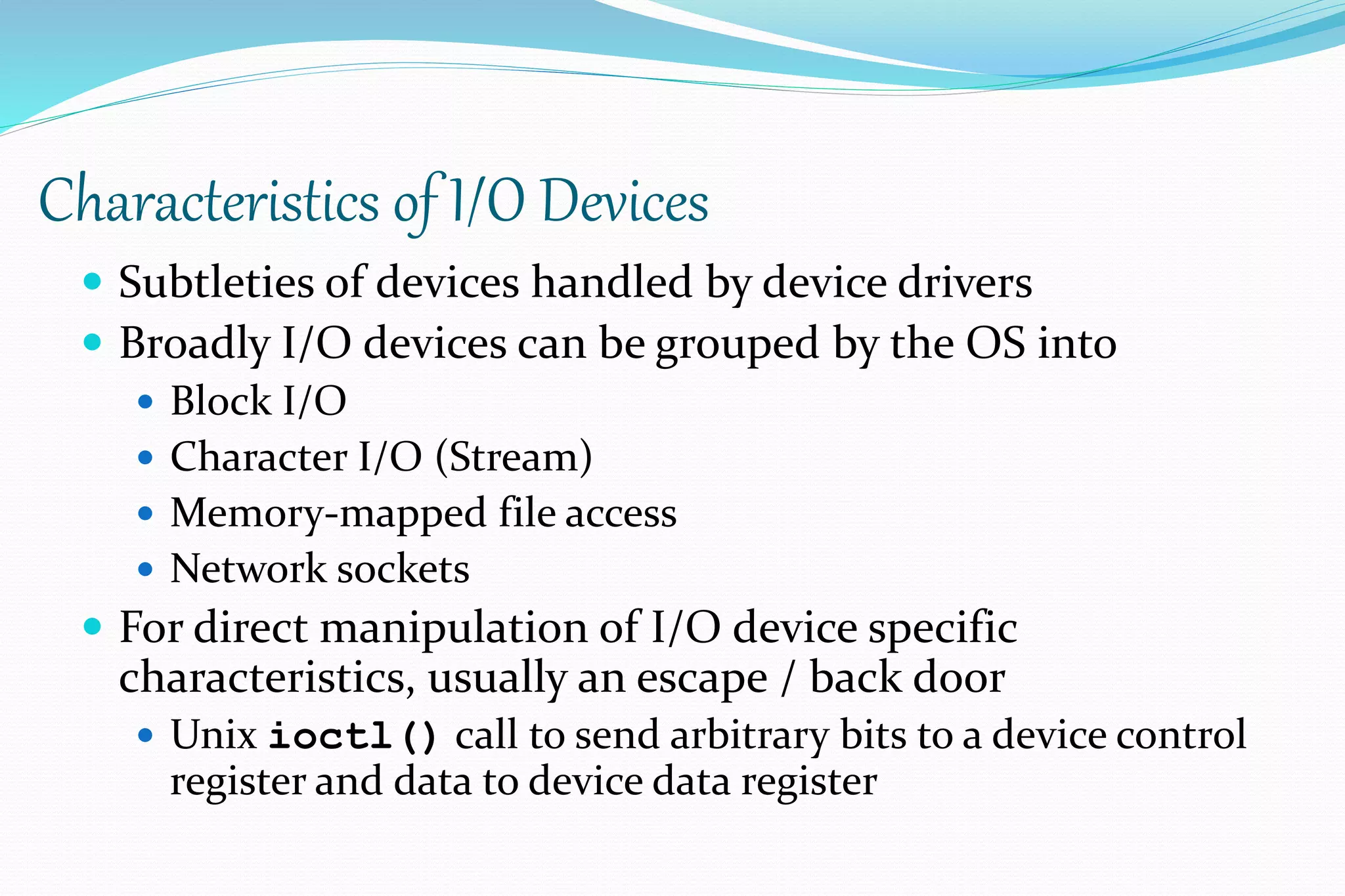
 Subtleties of devices handled by device drivers
 Broadly I/O devices can be grouped by the OS into
 Block I/O
 Character I/O (Stream)
 Memory-mapped file access
 Network sockets
 For direct manipulation of I/O device specific
characteristics, usually an escape / back door
 Unix ioctl() call to send arbitrary bits to a device control
register and data to device data register
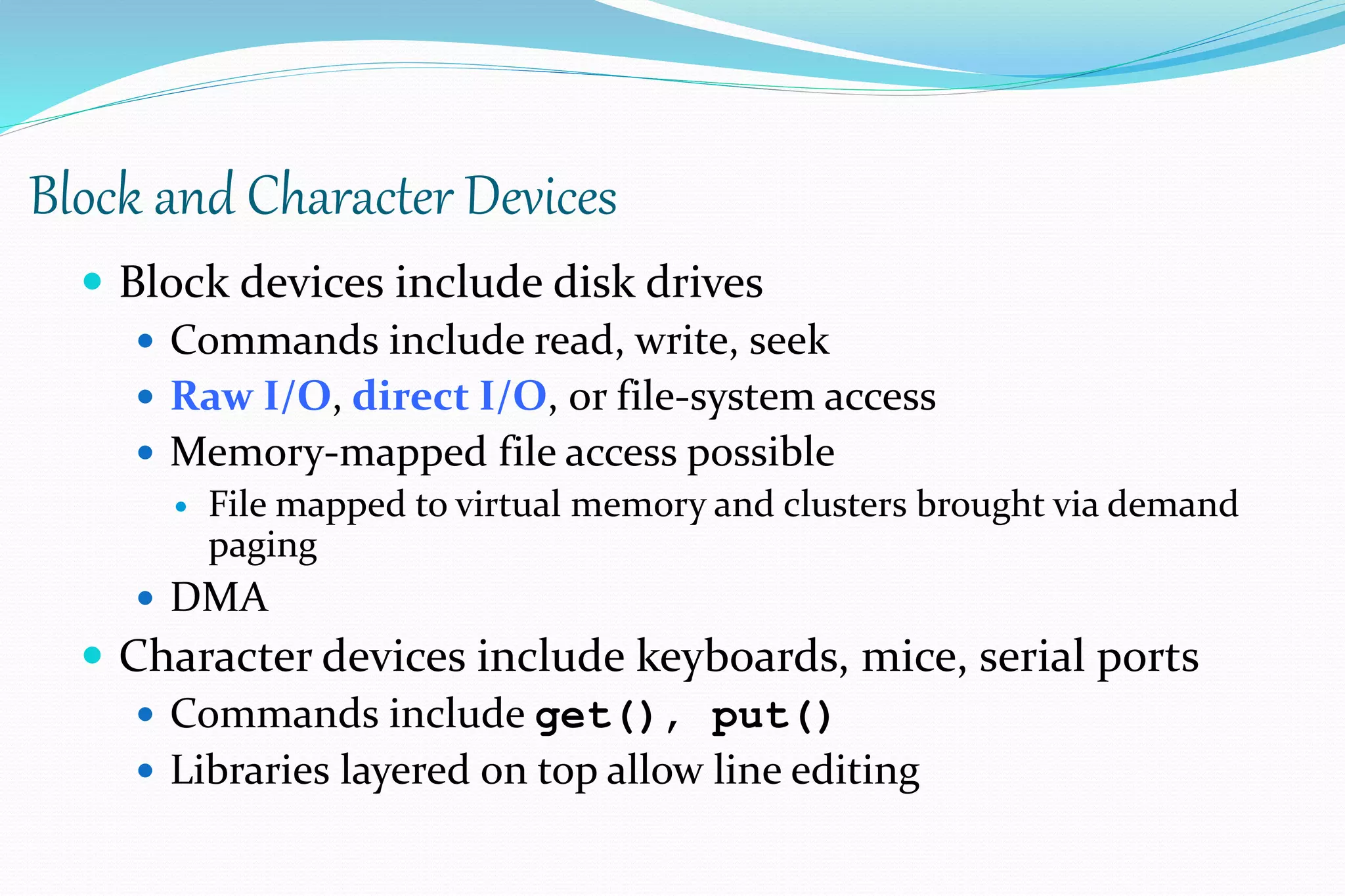
Block and Character Devices
 Block devices include disk drives
 Commands include read, write, seek
 Raw I/O, direct I/O, or file-system access
 Memory-mapped file access possible
 File mapped to virtual memory and clusters brought via demand
paging
 DMA
 Character devices include keyboards, mice, serial ports
 Commands include get(), put()
 Libraries layered on top allow line editing
Network Devices
 Varying enough from block and character to have own
interface
 Linux, Unix, Windows and many others include socket
interface
 Separates network protocol from network operation
 Includes select() functionality
 Approaches vary widely (pipes, FIFOs, streams, queues,
mailboxes)
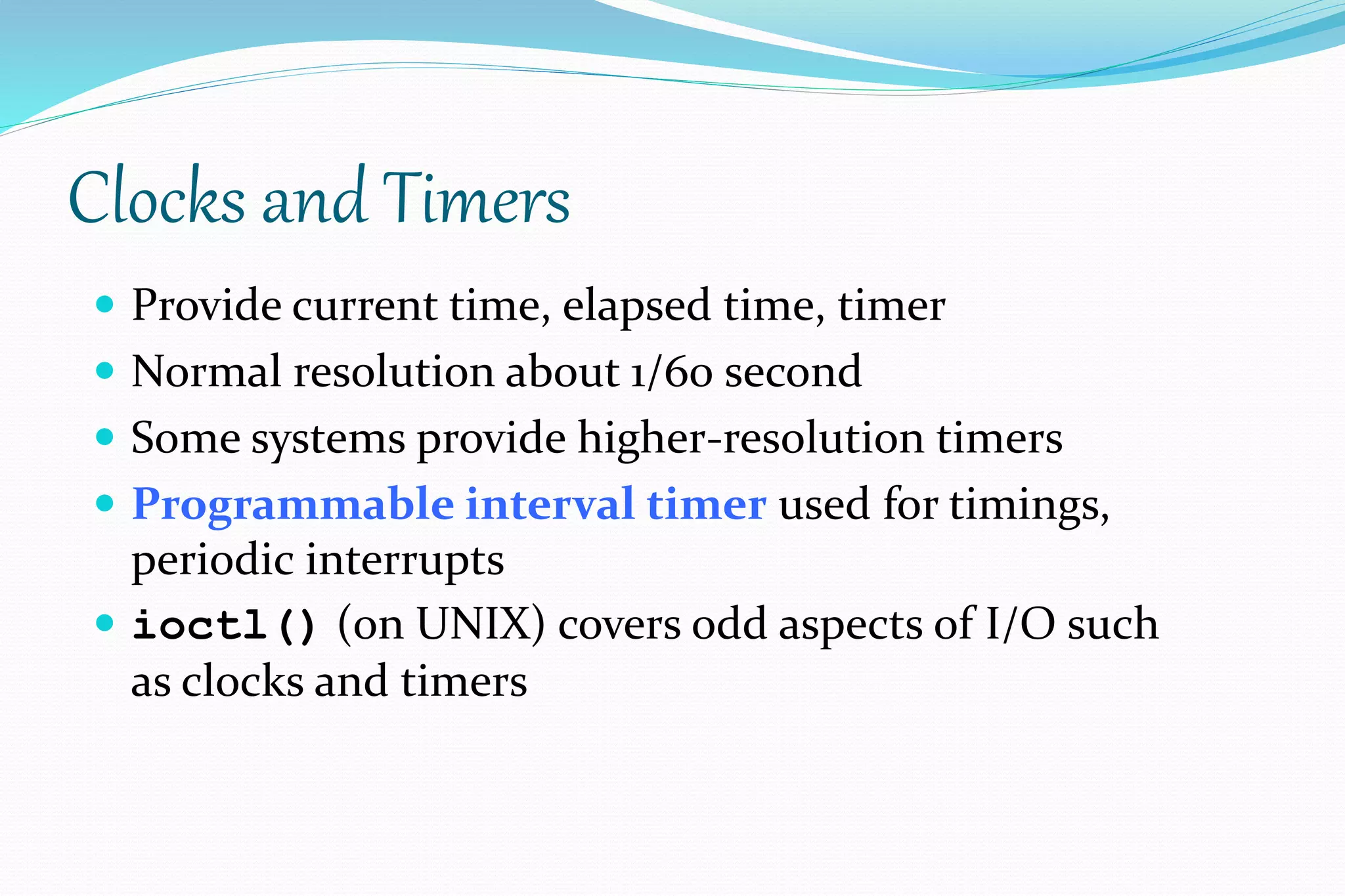
Clocks and Timers
 Provide current time, elapsed time, timer
 Normal resolution about 1/60 second
 Some systems provide higher-resolution timers
 Programmable interval timer used for timings,
periodic interrupts
 ioctl() (on UNIX) covers odd aspects of I/O such
as clocks and timers
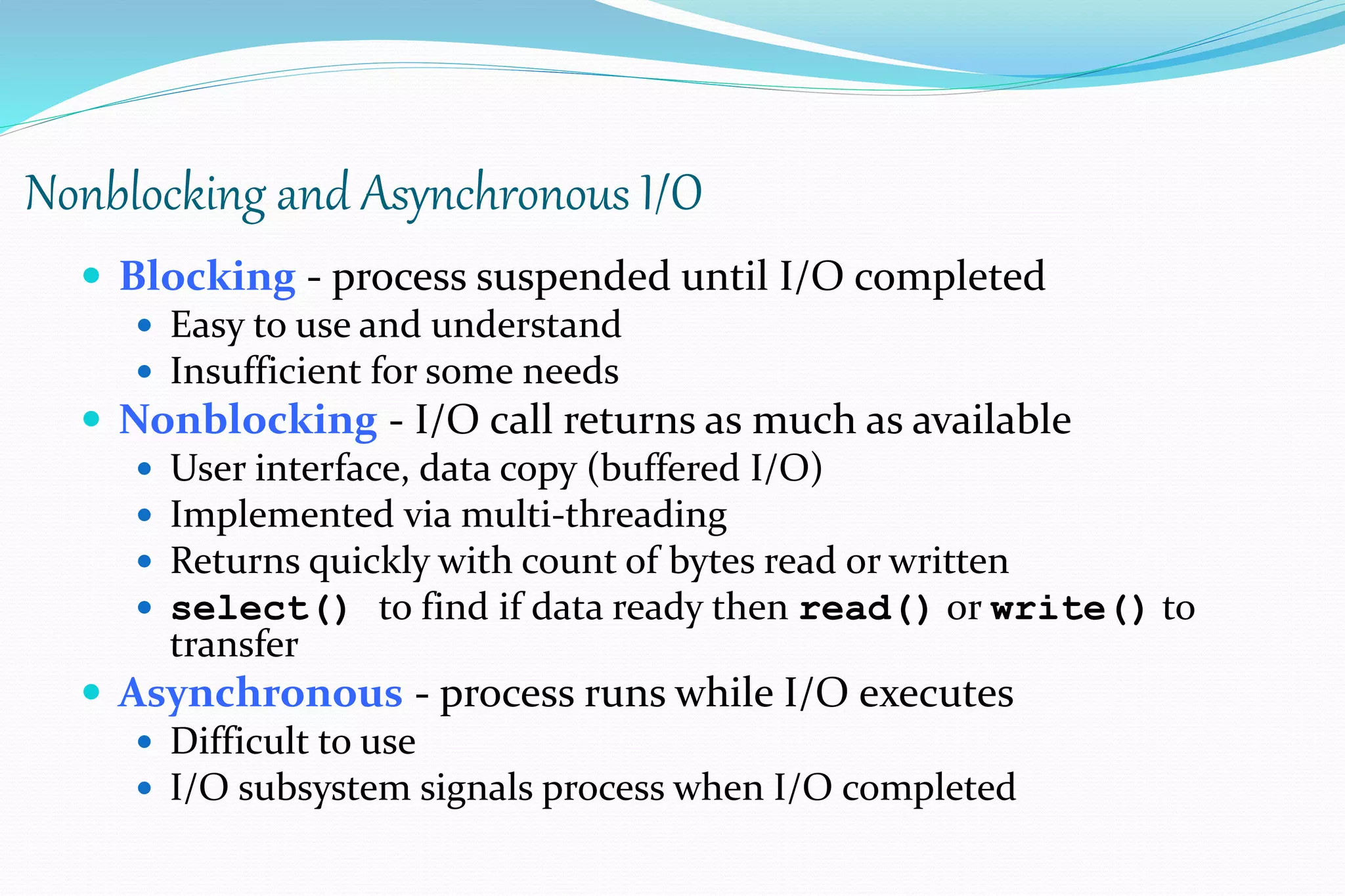
Nonblocking and Asynchronous I/O
 Blocking - process suspended until I/O completed
 Easy to use and understand
 Insufficient for some needs
 Nonblocking - I/O call returns as much as available
 User interface, data copy (buffered I/O)
 Implemented via multi-threading
 Returns quickly with count of bytes read or written
 select() to find if data ready then read() or write() to
transfer
 Asynchronous - process runs while I/O executes
 Difficult to use
 I/O subsystem signals process when I/O completed
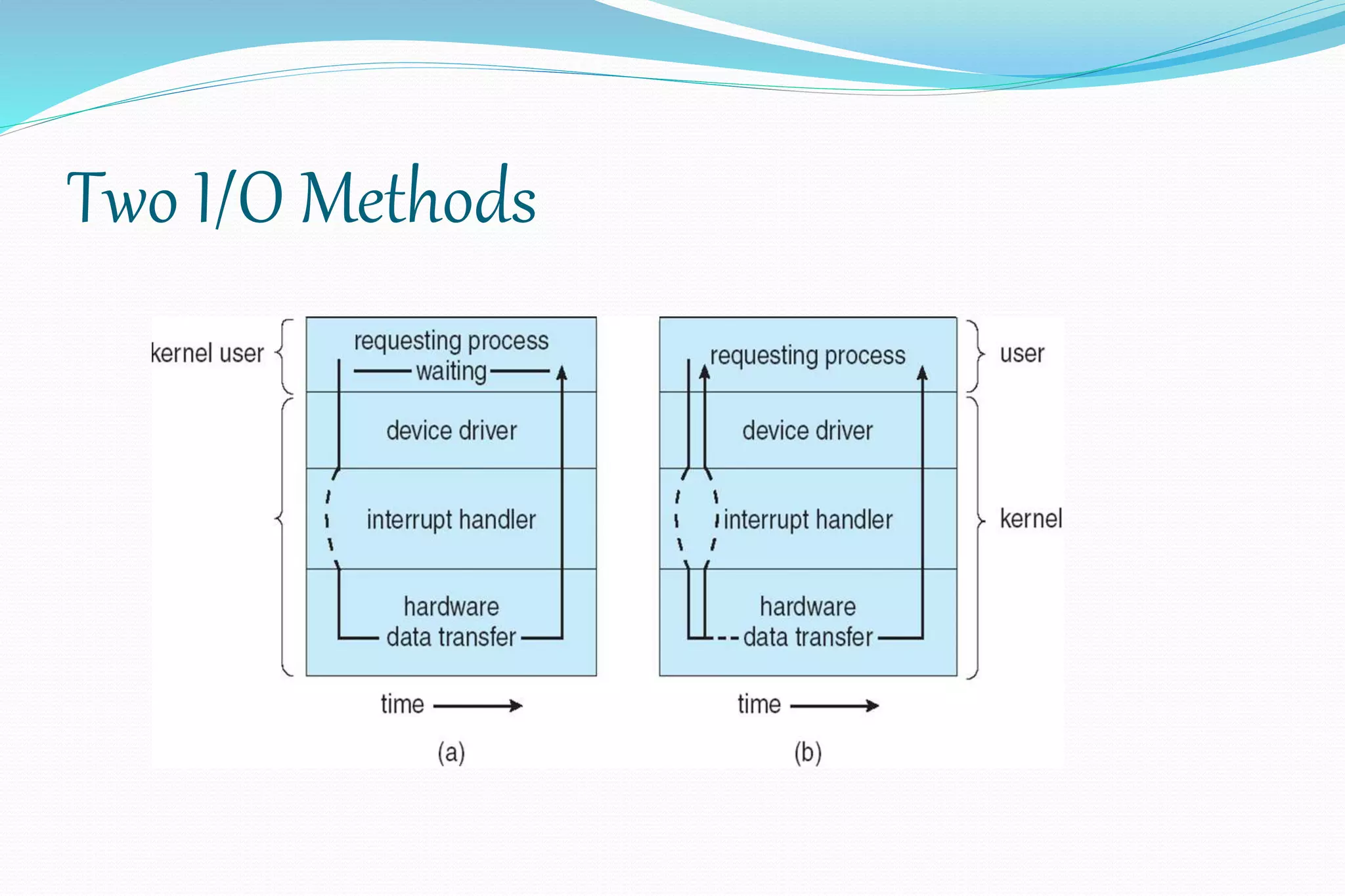
Two I/O Methods
Synchronous Asynchronous
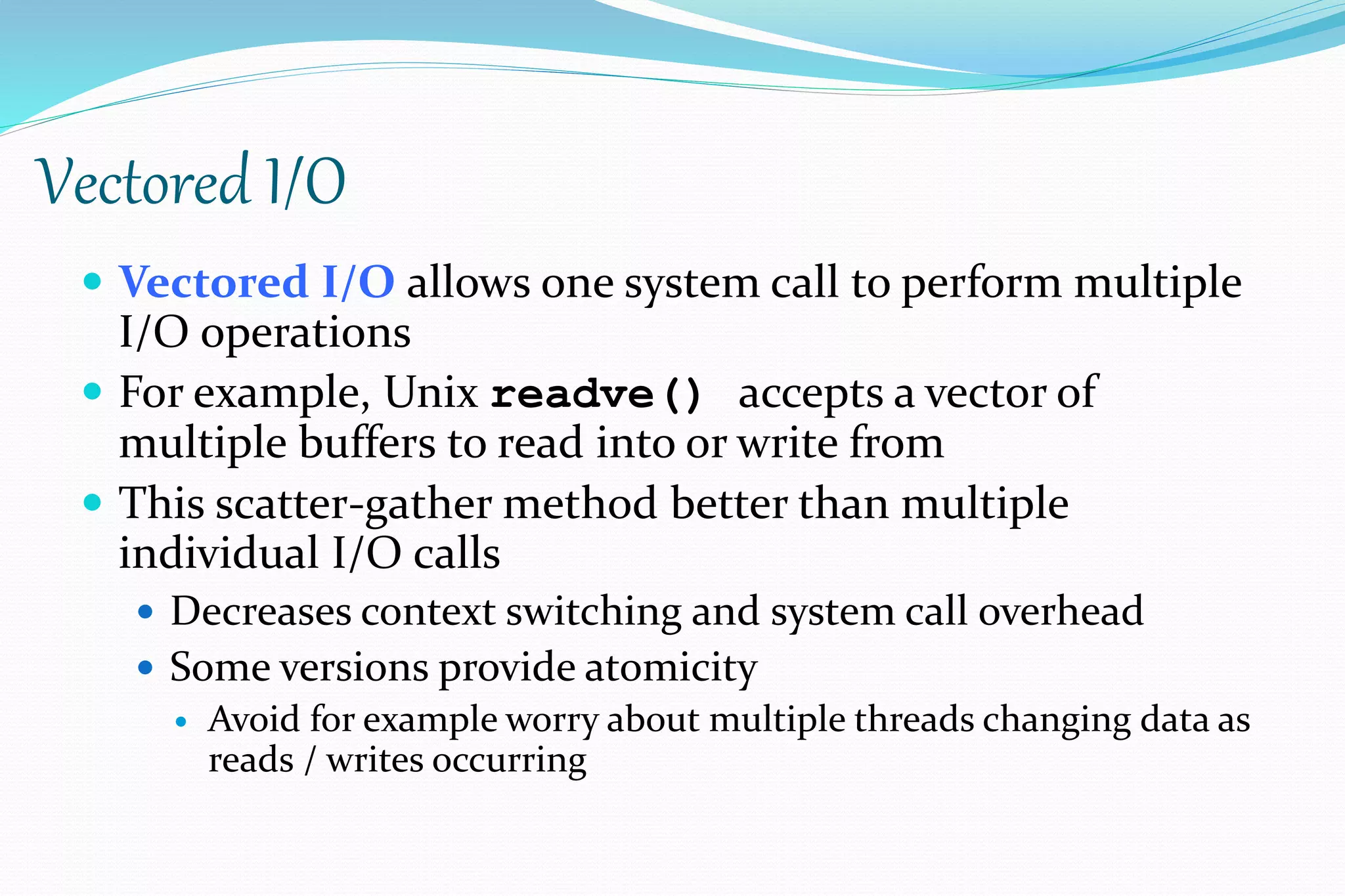
Vectored I/O
 Vectored I/O allows one system call to perform multiple
I/O operations
 For example, Unix readve() accepts a vector of
multiple buffers to read into or write from
 This scatter-gather method better than multiple
individual I/O calls
 Decreases context switching and system call overhead
 Some versions provide atomicity
 Avoid for example worry about multiple threads changing data as
reads / writes occurring
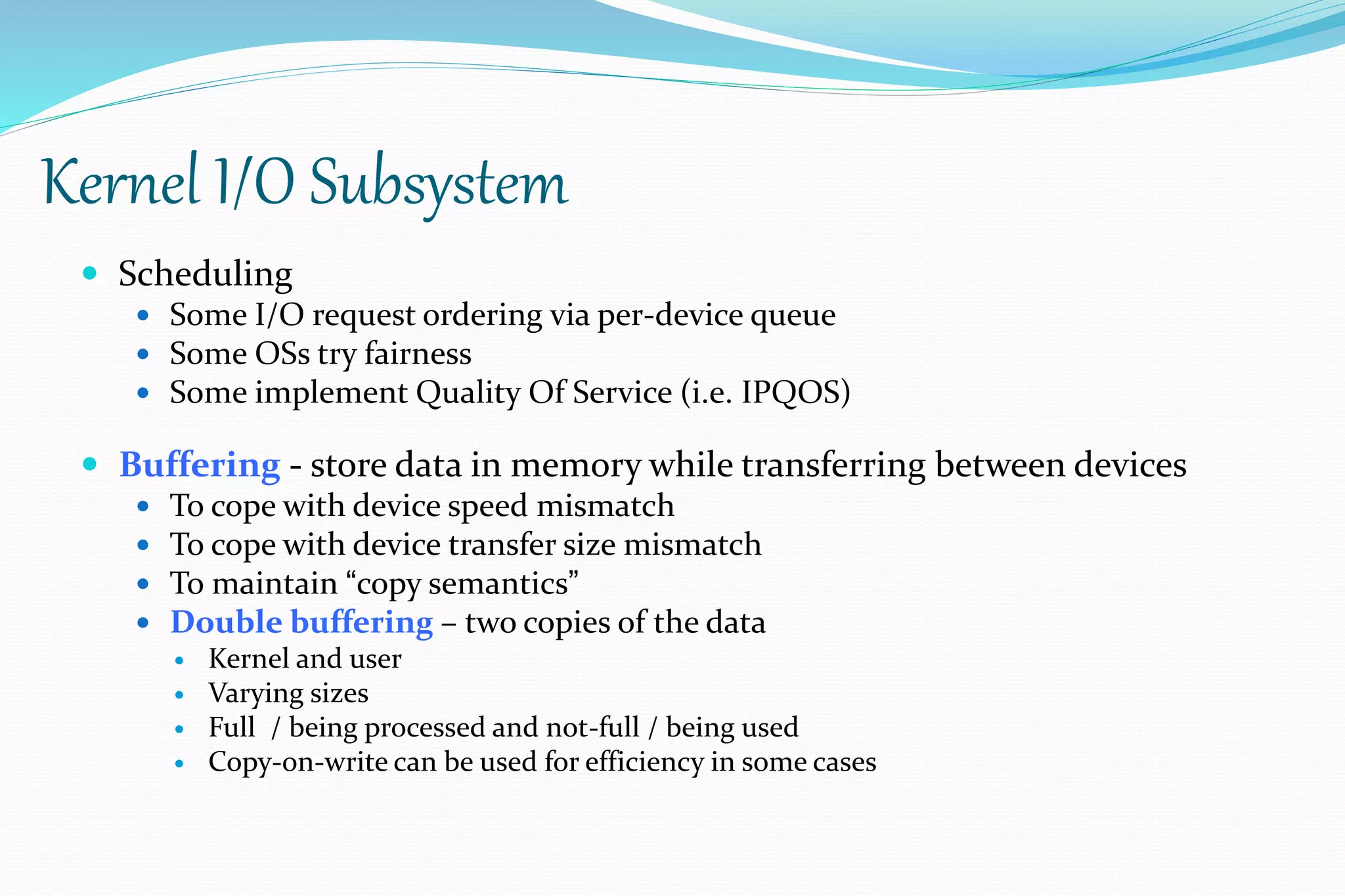
Kernel I/O Subsystem
 Scheduling
 Some I/O request ordering via per-device queue
 Some OSs try fairness
 Some implement Quality Of Service (i.e. IPQOS)
 Buffering - store data in memory while transferring between devices
 To cope with device speed mismatch
 To cope with device transfer size mismatch
 To maintain “copy semantics”
 Double buffering – two copies of the data
 Kernel and user
 Varying sizes
 Full / being processed and not-full / being used
 Copy-on-write can be used for efficiency in some cases
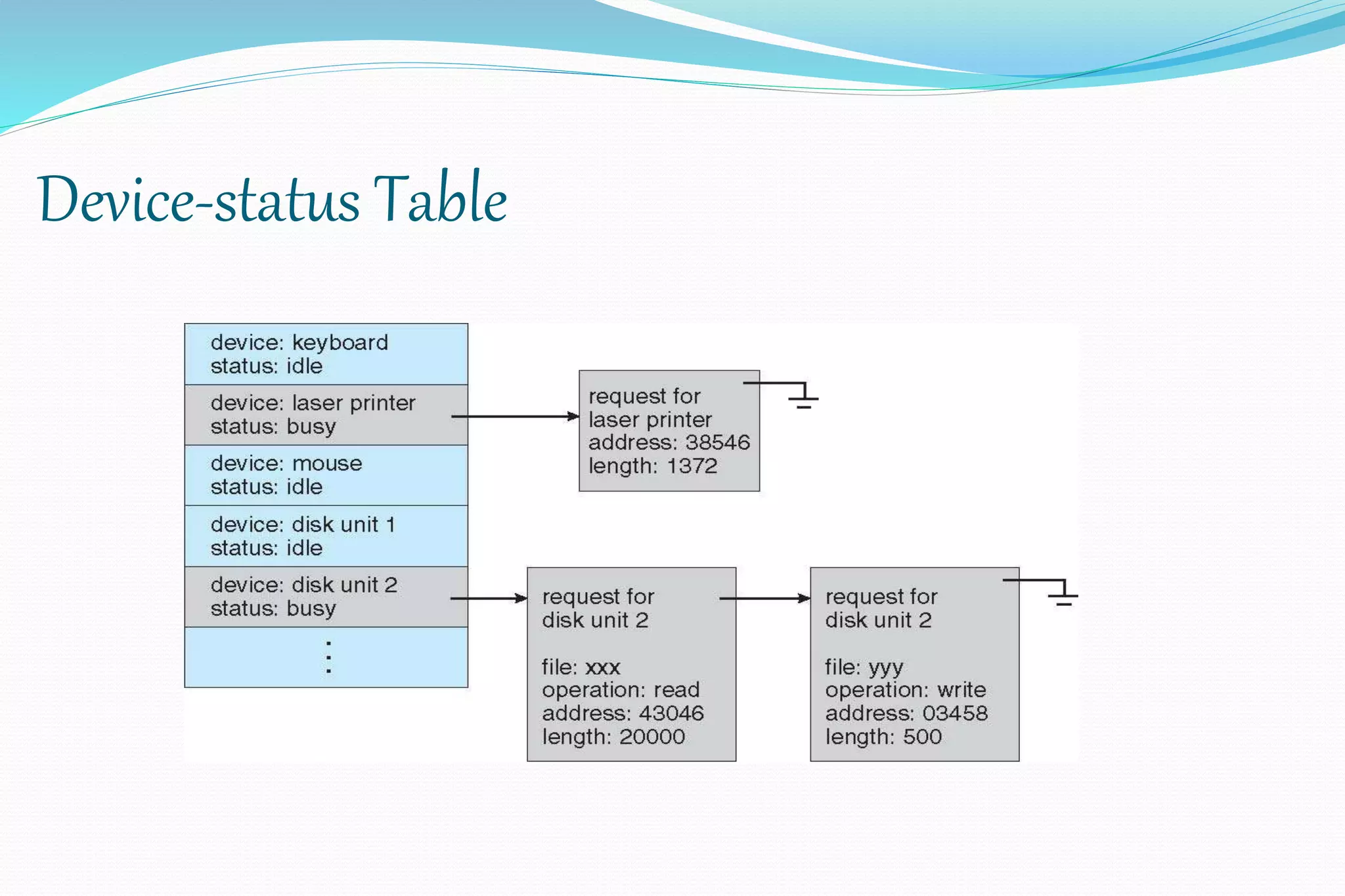
Device-status Table
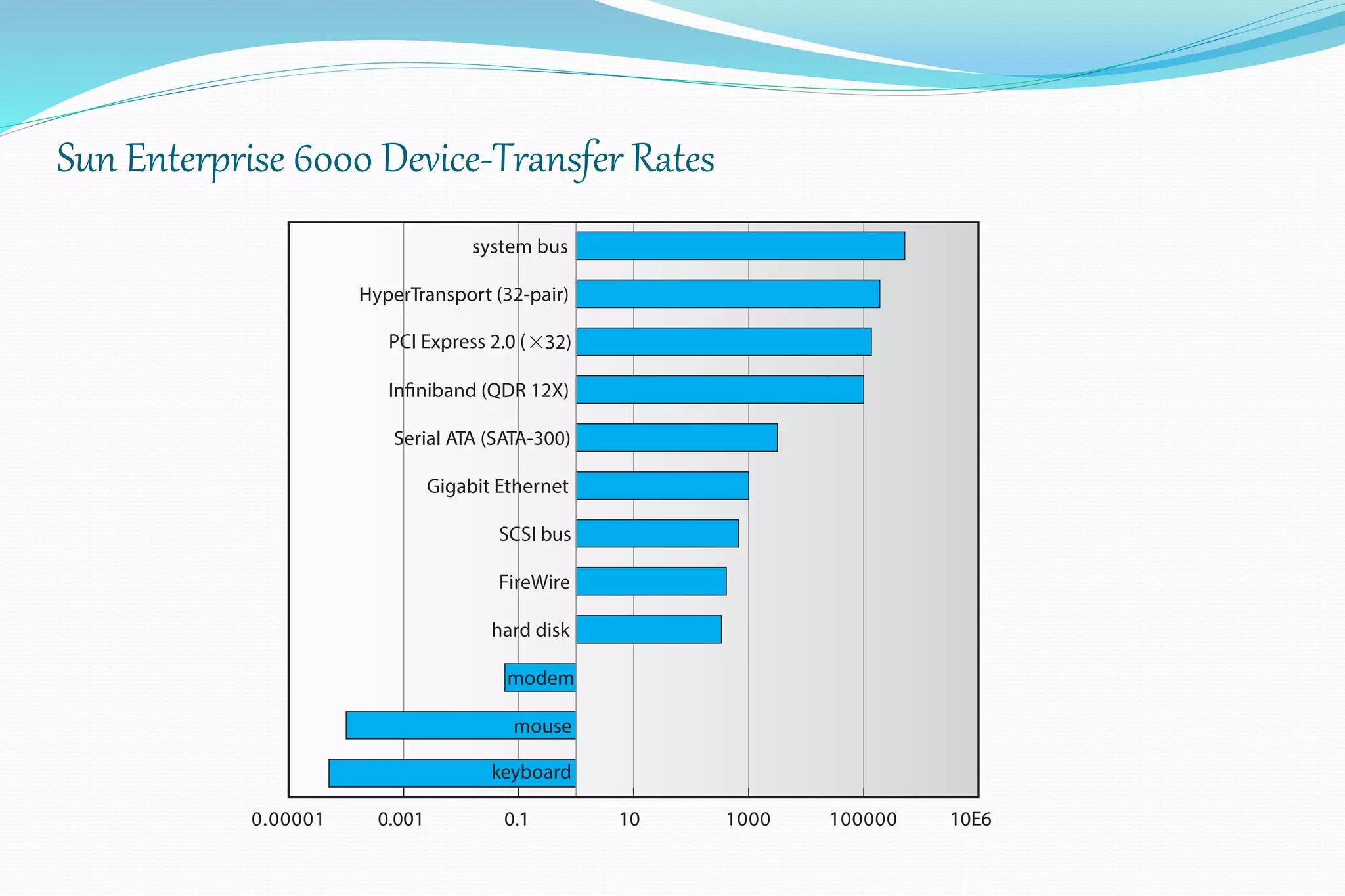
Sun Enterprise 6000 Device-Transfer Rates
Kernel I/O Subsystem
 Caching - faster device holding copy of data
 Always just a copy
 Key to performance
 Sometimes combined with buffering
 Spooling - hold output for a device
 If device can serve only one request at a time
 i.e., Printing
 Device reservation - provides exclusive access to a device
 System calls for allocation and de-allocation
 Watch out for deadlock
Error Handling
 OS can recover from disk read, device unavailable,
transient write failures
 Retry a read or write, for example
 Some systems more advanced – Solaris FMA, AIX
 Track error frequencies, stop using device with increasing
frequency of retry-able errors
 Most return an error number or code when I/O
request fails
 System error logs hold problem reports
I/O Protection
 User process may accidentally or purposefully
attempt to disrupt normal operation via illegal I/O
instructions
 All I/O instructions defined to be privileged
 I/O must be performed via system calls
 Memory-mapped and I/O port memory locations must be
protected too
Use of a System Call to Perform I/O
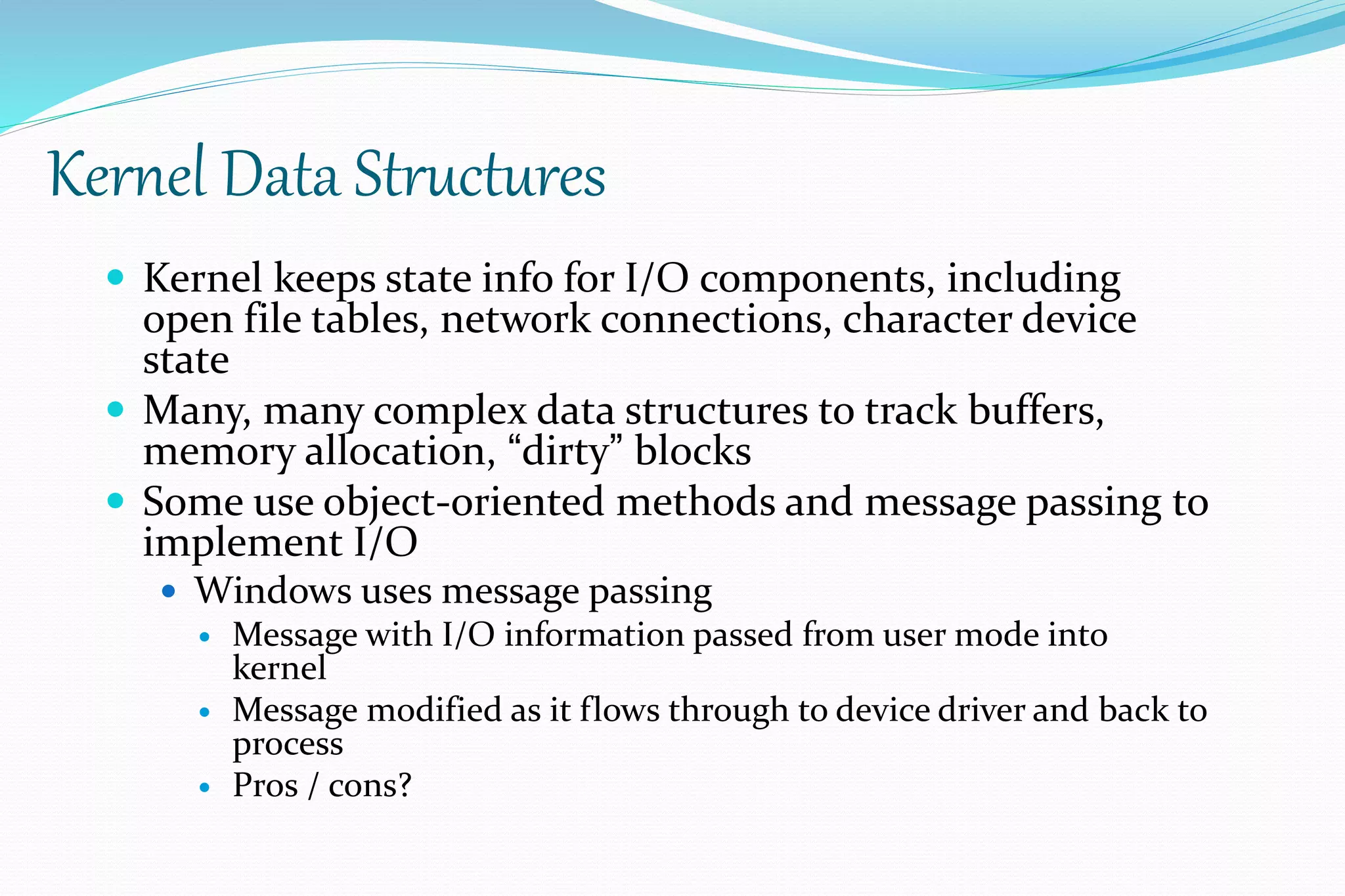
Kernel Data Structures
 Kernel keeps state info for I/O components, including
open file tables, network connections, character device
state
 Many, many complex data structures to track buffers,
memory allocation, “dirty” blocks
 Some use object-oriented methods and message passing to
implement I/O
 Windows uses message passing
 Message with I/O information passed from user mode into
kernel
 Message modified as it flows through to device driver and back to
process
 Pros / cons?
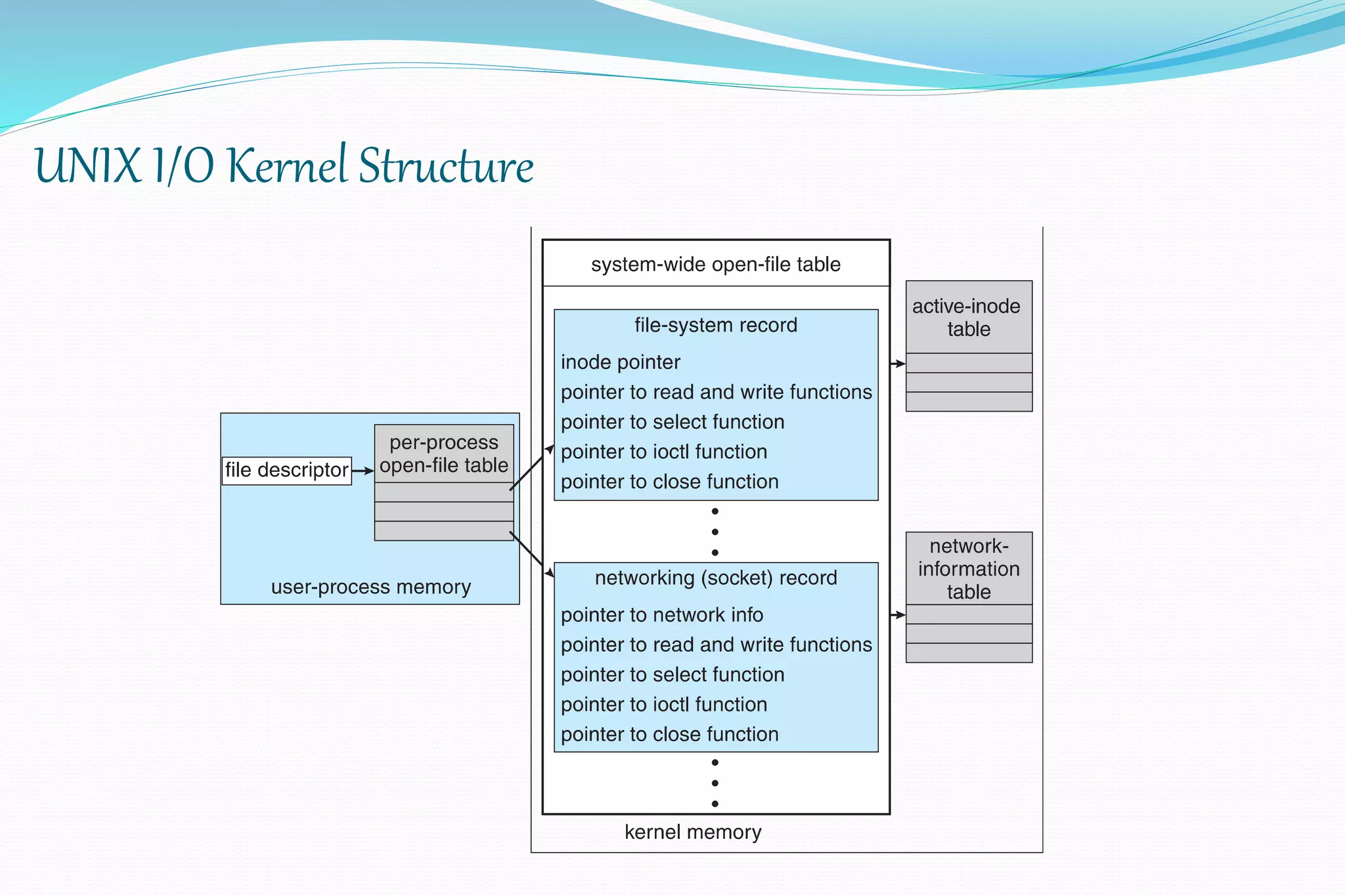
UNIX I/O Kernel Structure
Power Management
 Not strictly domain of I/O, but much is I/O related
 Computers and devices use electricity, generate heat, frequently require cooling
 OSes can help manage and improve use
 Cloud computing environments move virtual machines between servers
 Can end up evacuating whole systems and shutting them down
 Mobile computing has power management as first class OS aspect
 For example, Android implements
 Component-level power management
 Understands relationship between components
 Build device tree representing physical device topology
 System bus -> I/O subsystem -> {flash, USB storage}
 Device driver tracks state of device, whether in use
 Unused component – turn it off
 All devices in tree branch unused – turn off branch
 Wake locks – like other locks but prevent sleep of device when lock is held
 Power collapse – put a device into very deep sleep
 Marginal power use
 Only awake enough to respond to external stimuli (button press, incoming call)
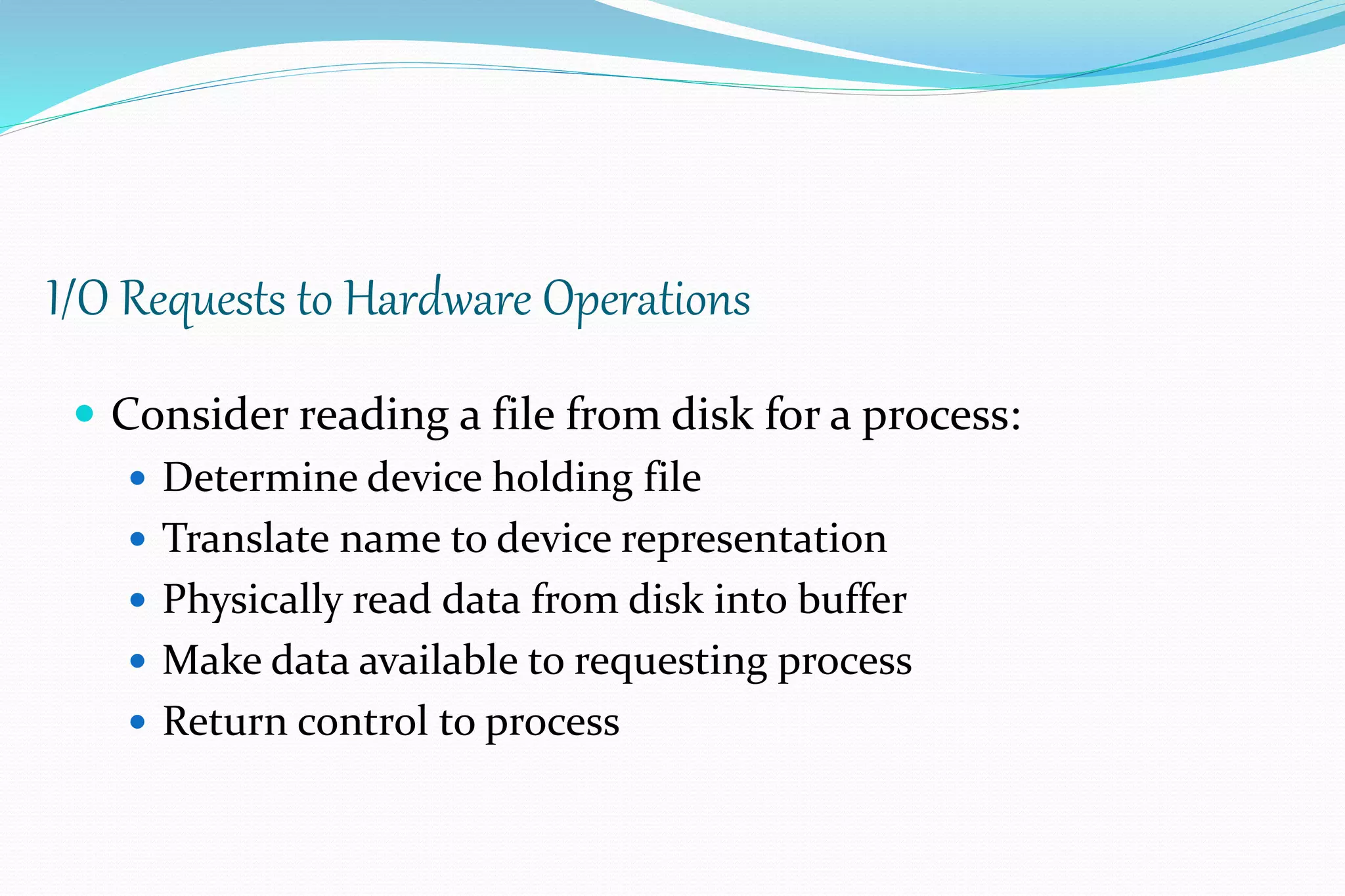
I/O Requests to Hardware Operations
 Consider reading a file from disk for a process:
 Determine device holding file
 Translate name to device representation
 Physically read data from disk into buffer
 Make data available to requesting process
 Return control to process
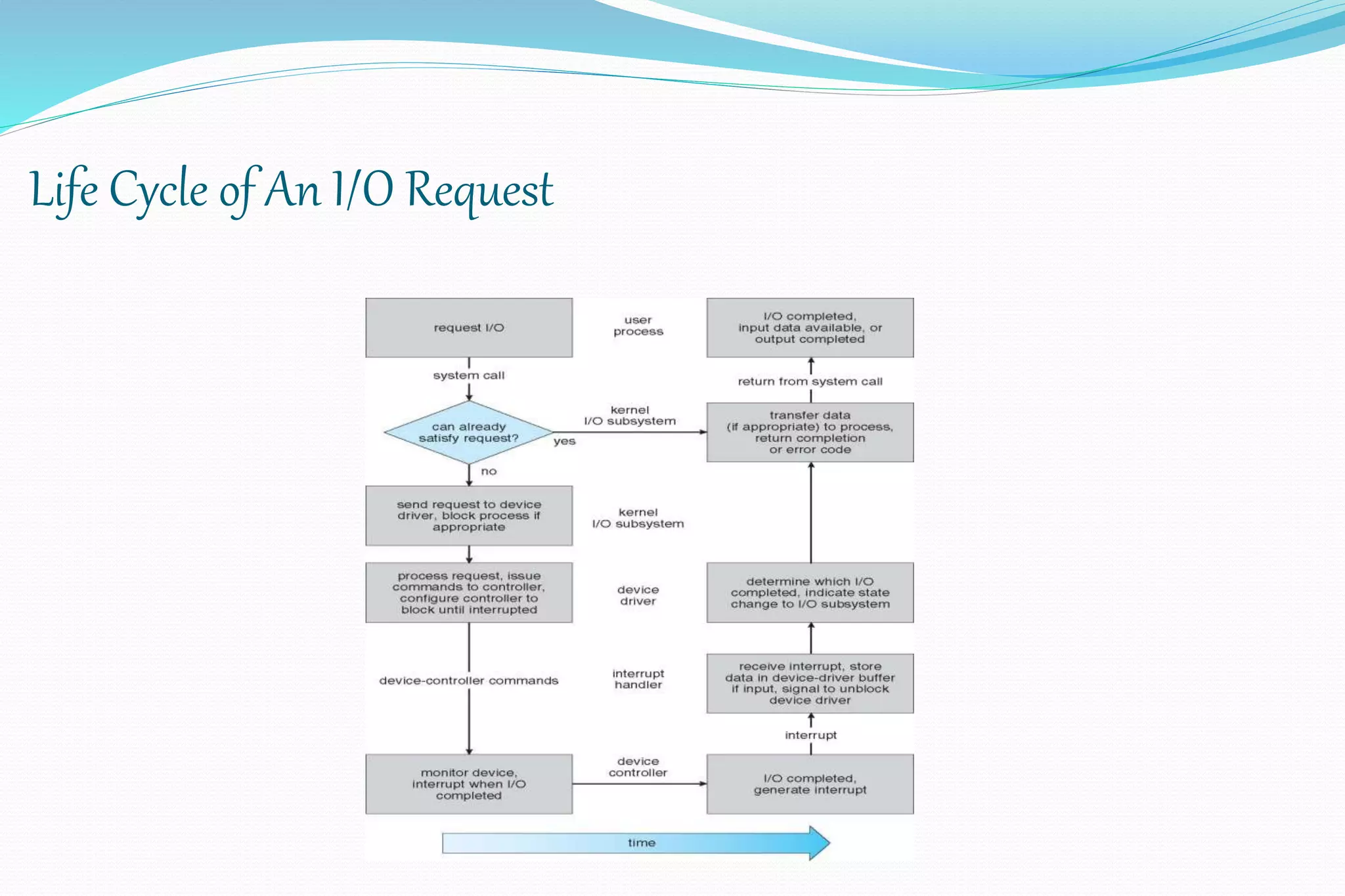
Life Cycle of An I/O Request
STREAMS
 STREAM – a full-duplex communication channel between a user-level
process and a device in Unix System V and beyond
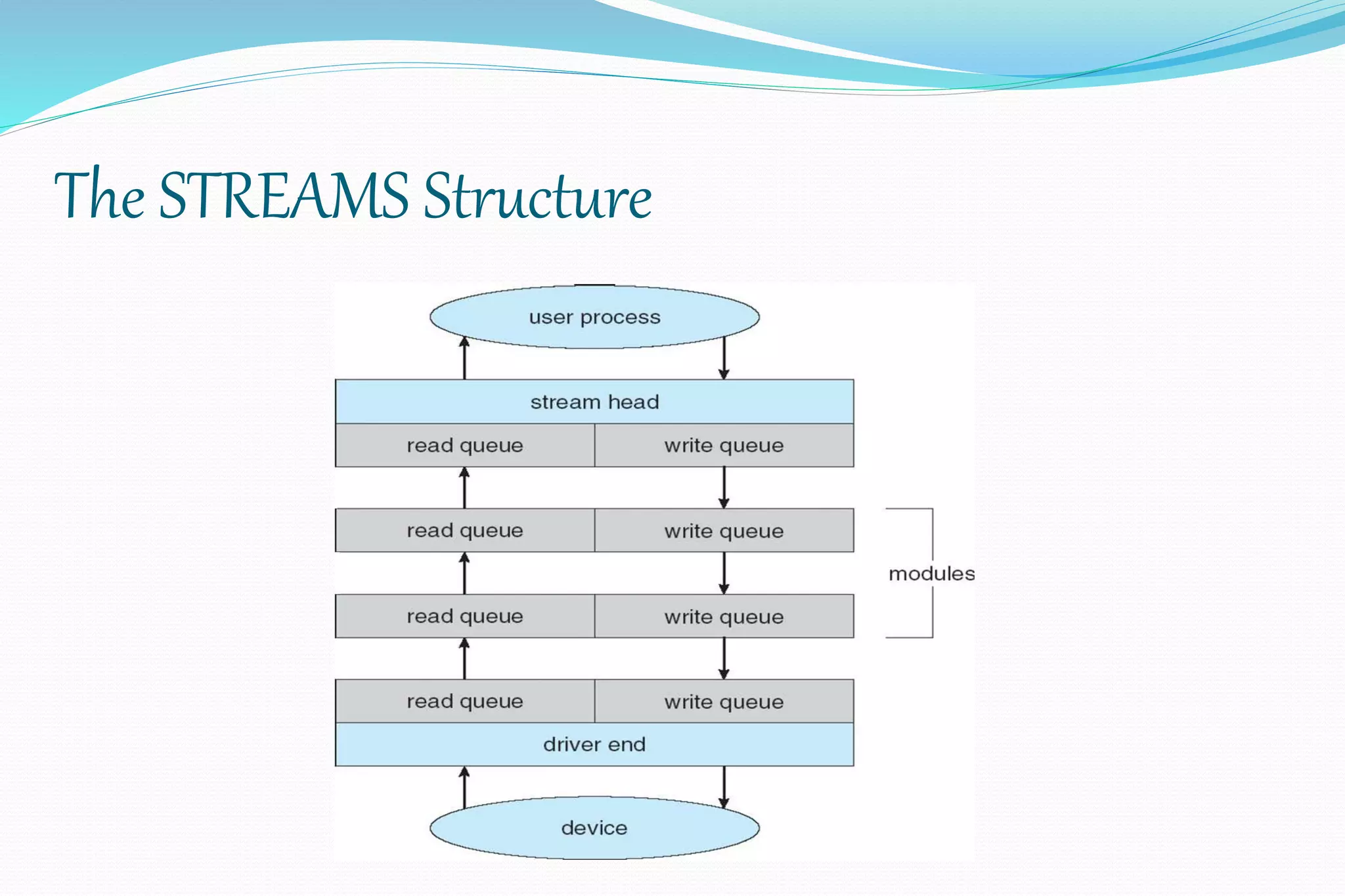
 A STREAM consists of:
- STREAM head interfaces with the user process
- driver end interfaces with the device
- zero or more STREAM modules between them
 Each module contains a read queue and a write queue
 Message passing is used to communicate between queues
 Flow control option to indicate available or busy
 Asynchronous internally, synchronous where user process communicates
with stream head
The STREAMS Structure
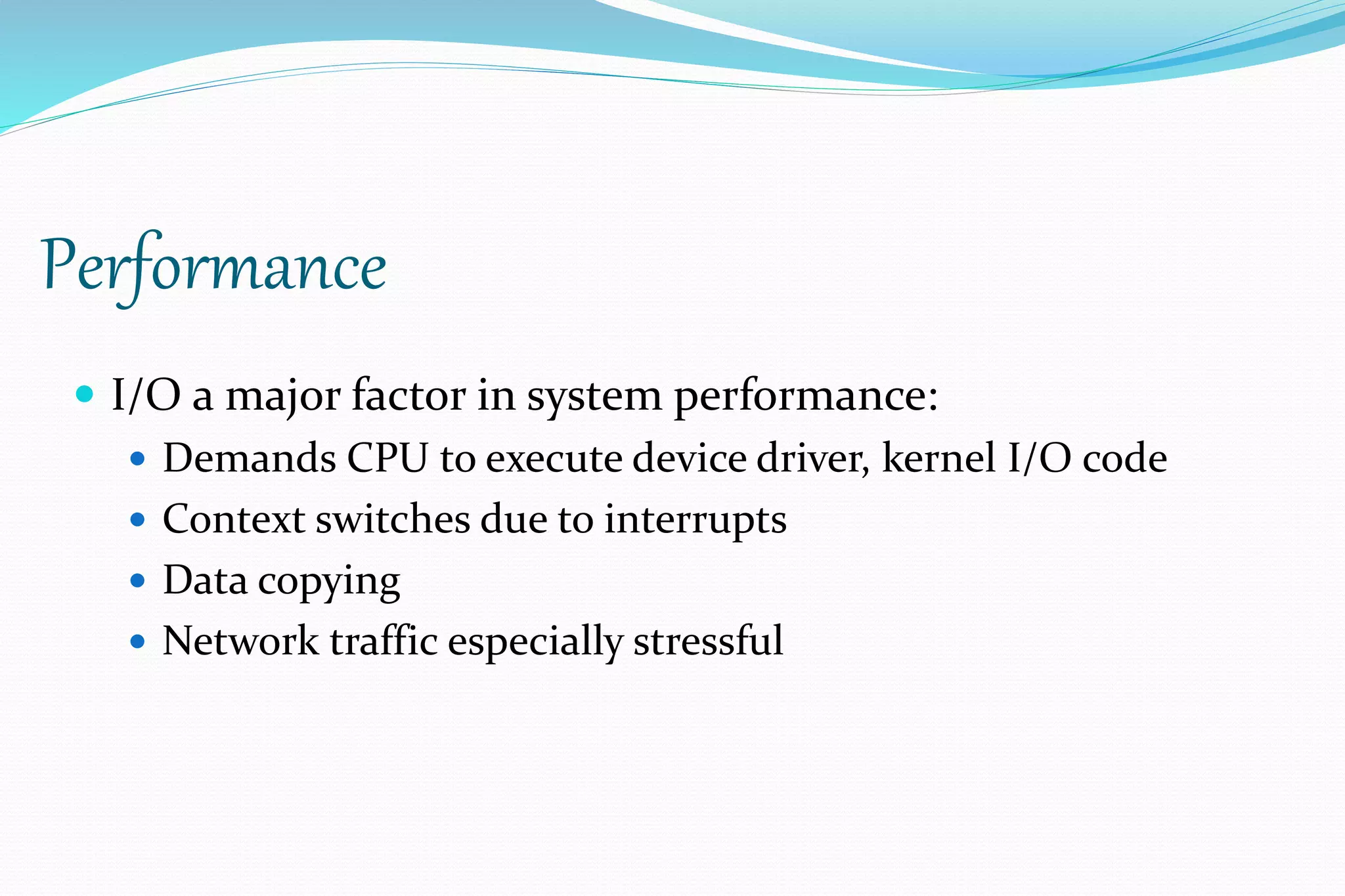
Performance
 I/O a major factor in system performance:
 Demands CPU to execute device driver, kernel I/O code
 Context switches due to interrupts
 Data copying
 Network traffic especially stressful
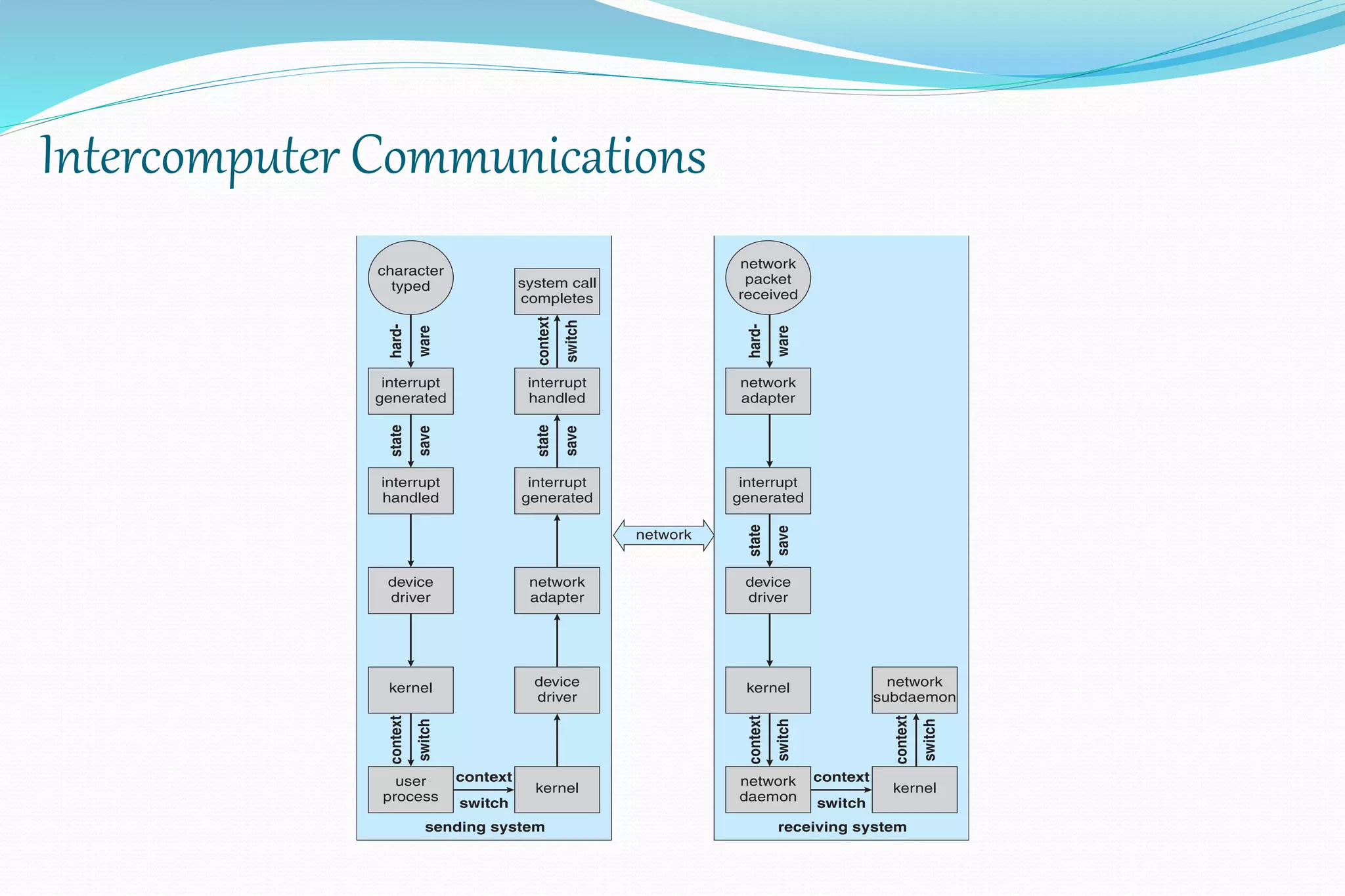
Intercomputer Communications
Improving Performance
 Reduce number of context switches
 Reduce data copying
 Reduce interrupts by using large transfers, smart controllers, polling
 Use DMA
 Use smarter hardware devices
 Balance CPU, memory, bus, and I/O performance for highest throughput
 Move user-mode processes / daemons to kernel threads
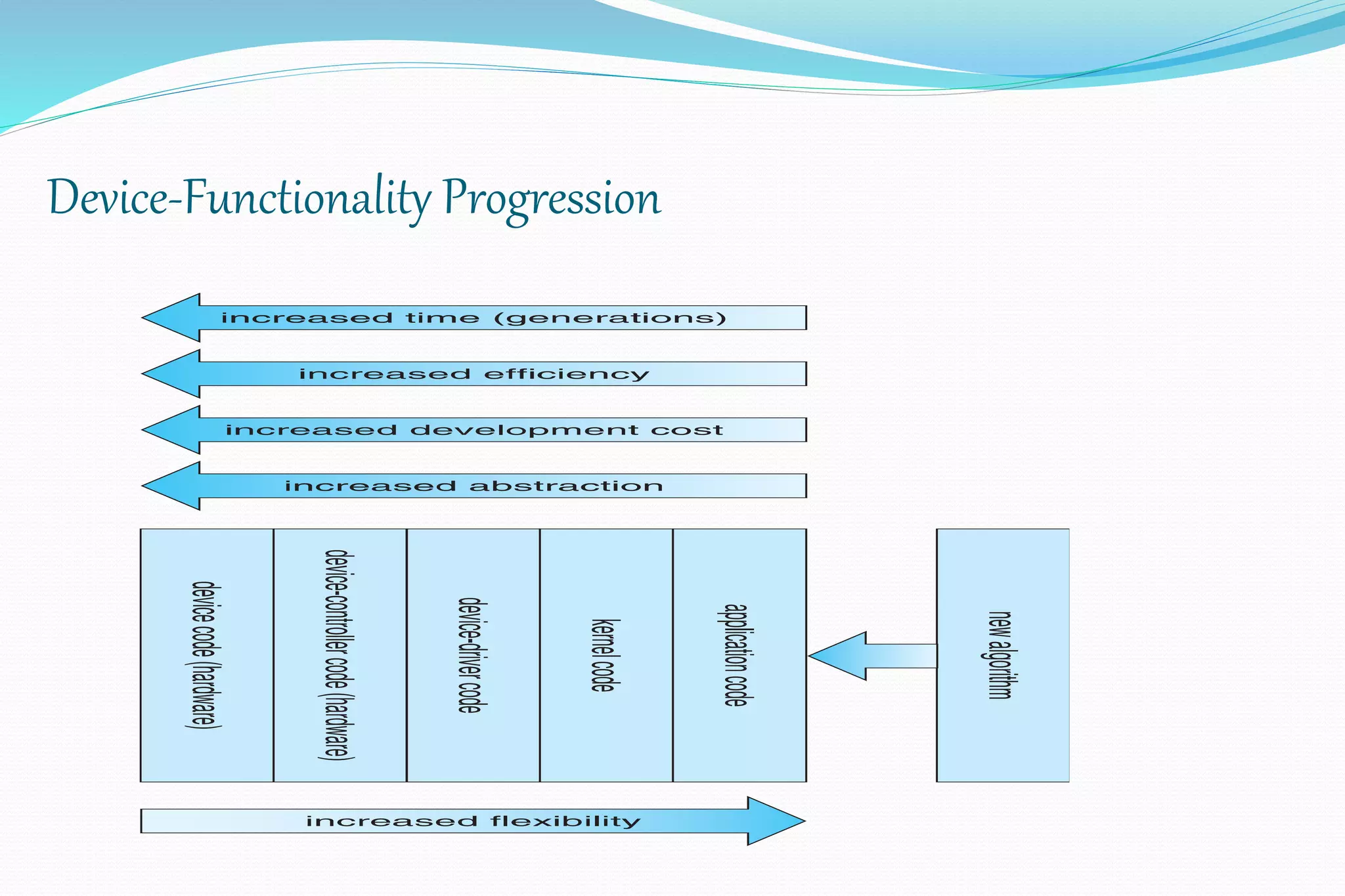
Device-Functionality Progression
End of I/O system

Io system

  • 2.
    I/O Systems  Overview I/O Hardware  Application I/O Interface  Kernel I/O Subsystem  Transforming I/O Requests to Hardware Operations  STREAMS  Performance
  • 3.
    Objectives  Explore thestructure of an operating system’s I/O subsystem  Discuss the principles of I/O hardware and its complexity  Provide details of the performance aspects of I/O hardware and software
  • 4.
    Overview  I/O managementis a major component of operating system design and operation  Important aspect of computer operation  I/O devices vary greatly  Various methods to control them  Performance management  New types of devices frequent  Ports, busses, device controllers connect to various devices  Device drivers encapsulate device details  Present uniform device-access interface to I/O subsystem
  • 5.
    I/O Hardware  Incrediblevariety of I/O devices  Storage  Transmission  Human-interface  Common concepts – signals from I/O devices interface with computer  Port – connection point for device  Bus - daisy chain or shared direct access  PCI bus common in PCs and servers, PCI Express (PCIe)  expansion bus connects relatively slow devices  Controller (host adapter) – electronics that operate port, bus, device  Sometimes integrated  Sometimes separate circuit board (host adapter)  Contains processor, microcode, private memory, bus controller, etc  Some talk to per-device controller with bus controller, microcode, memory, etc
  • 6.
    A Typical PCBus Structure
  • 7.
    I/O Hardware:  I/Oinstructions control devices  Devices usually have registers where device driver places commands, addresses, and data to write, or read data from registers after command execution  Data-in register, data-out register, status register, control register  Typically 1-4 bytes, or FIFO buffer  Devices have addresses, used by  Direct I/O instructions  Memory-mapped I/O  Device data and command registers mapped to processor address space  Especially for large address spaces (graphics)
  • 8.
    Device I/O PortLocations on PCs (partial)
  • 9.
    Polling For eachbyte of I/O 1. Read busy bit from status register until 0 2. Host sets read or write bit and if write copies data into data-out register 3. Host sets command-ready bit 4. Controller sets busy bit, executes transfer 5. Controller clears busy bit, error bit, command-ready bit when transfer done  Step 1 is busy-wait cycle to wait for I/O from device  Reasonable if device is fast  But inefficient if device slow  CPU switches to other tasks?  But if miss a cycle data overwritten / lost
  • 10.
    Interrupts  Polling canhappen in 3 instruction cycles  Read status, logical-and to extract status bit, branch if not zero  How to be more efficient if non-zero infrequently?  CPU Interrupt-request line triggered by I/O device  Checked by processor after each instruction  Interrupt handler receives interrupts  Maskable to ignore or delay some interrupts  Interrupt vector to dispatch interrupt to correct handler  Context switch at start and end  Based on priority  Some nonmaskable  Interrupt chaining if more than one device at same interrupt number
  • 11.
  • 12.
    Intel Pentium ProcessorEvent-Vector Table
  • 13.
    Interrupts  Interrupt mechanismalso used for exceptions  Terminate process, crash system due to hardware error  Page fault executes when memory access error  System call executes via trap to trigger kernel to execute request  Multi-CPU systems can process interrupts concurrently  If operating system designed to handle it  Used for time-sensitive processing, frequent, must be fast
  • 14.
    Direct Memory Access Used to avoid programmed I/O (one byte at a time) for large data movement  Requires DMA controller  Bypasses CPU to transfer data directly between I/O device and memory  OS writes DMA command block into memory  Source and destination addresses  Read or write mode  Count of bytes  Writes location of command block to DMA controller  Bus mastering of DMA controller – grabs bus from CPU  Cycle stealing from CPU but still much more efficient  When done, interrupts to signal completion  Version that is aware of virtual addresses can be even more efficient - DVMA
  • 15.
    Six Step Processto Perform DMA Transfer
  • 16.
    Application I/O Interface I/O system calls encapsulate device behaviors in generic classes  Device-driver layer hides differences among I/O controllers from kernel  New devices talking already-implemented protocols need no extra work  Each OS has its own I/O subsystem structures and device driver frameworks  Devices vary in many dimensions  Character-stream or block  Sequential or random-access  Synchronous or asynchronous (or both)  Sharable or dedicated  Speed of operation  read-write, read only, or write only
  • 17.
    A Kernel I/OStructure
  • 18.
  • 19.
    Characteristics of I/ODevices  Subtleties of devices handled by device drivers  Broadly I/O devices can be grouped by the OS into  Block I/O  Character I/O (Stream)  Memory-mapped file access  Network sockets  For direct manipulation of I/O device specific characteristics, usually an escape / back door  Unix ioctl() call to send arbitrary bits to a device control register and data to device data register
  • 20.
    Block and CharacterDevices  Block devices include disk drives  Commands include read, write, seek  Raw I/O, direct I/O, or file-system access  Memory-mapped file access possible  File mapped to virtual memory and clusters brought via demand paging  DMA  Character devices include keyboards, mice, serial ports  Commands include get(), put()  Libraries layered on top allow line editing
  • 21.
    Network Devices  Varyingenough from block and character to have own interface  Linux, Unix, Windows and many others include socket interface  Separates network protocol from network operation  Includes select() functionality  Approaches vary widely (pipes, FIFOs, streams, queues, mailboxes)
  • 22.
    Clocks and Timers Provide current time, elapsed time, timer  Normal resolution about 1/60 second  Some systems provide higher-resolution timers  Programmable interval timer used for timings, periodic interrupts  ioctl() (on UNIX) covers odd aspects of I/O such as clocks and timers
  • 23.
    Nonblocking and AsynchronousI/O  Blocking - process suspended until I/O completed  Easy to use and understand  Insufficient for some needs  Nonblocking - I/O call returns as much as available  User interface, data copy (buffered I/O)  Implemented via multi-threading  Returns quickly with count of bytes read or written  select() to find if data ready then read() or write() to transfer  Asynchronous - process runs while I/O executes  Difficult to use  I/O subsystem signals process when I/O completed
  • 24.
  • 25.
    Vectored I/O  VectoredI/O allows one system call to perform multiple I/O operations  For example, Unix readve() accepts a vector of multiple buffers to read into or write from  This scatter-gather method better than multiple individual I/O calls  Decreases context switching and system call overhead  Some versions provide atomicity  Avoid for example worry about multiple threads changing data as reads / writes occurring
  • 26.
    Kernel I/O Subsystem Scheduling  Some I/O request ordering via per-device queue  Some OSs try fairness  Some implement Quality Of Service (i.e. IPQOS)  Buffering - store data in memory while transferring between devices  To cope with device speed mismatch  To cope with device transfer size mismatch  To maintain “copy semantics”  Double buffering – two copies of the data  Kernel and user  Varying sizes  Full / being processed and not-full / being used  Copy-on-write can be used for efficiency in some cases
  • 27.
  • 28.
    Sun Enterprise 6000Device-Transfer Rates
  • 29.
    Kernel I/O Subsystem Caching - faster device holding copy of data  Always just a copy  Key to performance  Sometimes combined with buffering  Spooling - hold output for a device  If device can serve only one request at a time  i.e., Printing  Device reservation - provides exclusive access to a device  System calls for allocation and de-allocation  Watch out for deadlock
  • 30.
    Error Handling  OScan recover from disk read, device unavailable, transient write failures  Retry a read or write, for example  Some systems more advanced – Solaris FMA, AIX  Track error frequencies, stop using device with increasing frequency of retry-able errors  Most return an error number or code when I/O request fails  System error logs hold problem reports
  • 31.
    I/O Protection  Userprocess may accidentally or purposefully attempt to disrupt normal operation via illegal I/O instructions  All I/O instructions defined to be privileged  I/O must be performed via system calls  Memory-mapped and I/O port memory locations must be protected too
  • 32.
    Use of aSystem Call to Perform I/O
  • 33.
    Kernel Data Structures Kernel keeps state info for I/O components, including open file tables, network connections, character device state  Many, many complex data structures to track buffers, memory allocation, “dirty” blocks  Some use object-oriented methods and message passing to implement I/O  Windows uses message passing  Message with I/O information passed from user mode into kernel  Message modified as it flows through to device driver and back to process  Pros / cons?
  • 34.
    UNIX I/O KernelStructure
  • 35.
    Power Management  Notstrictly domain of I/O, but much is I/O related  Computers and devices use electricity, generate heat, frequently require cooling  OSes can help manage and improve use  Cloud computing environments move virtual machines between servers  Can end up evacuating whole systems and shutting them down  Mobile computing has power management as first class OS aspect  For example, Android implements  Component-level power management  Understands relationship between components  Build device tree representing physical device topology  System bus -> I/O subsystem -> {flash, USB storage}  Device driver tracks state of device, whether in use  Unused component – turn it off  All devices in tree branch unused – turn off branch  Wake locks – like other locks but prevent sleep of device when lock is held  Power collapse – put a device into very deep sleep  Marginal power use  Only awake enough to respond to external stimuli (button press, incoming call)
  • 36.
    I/O Requests toHardware Operations  Consider reading a file from disk for a process:  Determine device holding file  Translate name to device representation  Physically read data from disk into buffer  Make data available to requesting process  Return control to process
  • 37.
    Life Cycle ofAn I/O Request
  • 38.
    STREAMS  STREAM –a full-duplex communication channel between a user-level process and a device in Unix System V and beyond  A STREAM consists of: - STREAM head interfaces with the user process - driver end interfaces with the device - zero or more STREAM modules between them  Each module contains a read queue and a write queue  Message passing is used to communicate between queues  Flow control option to indicate available or busy  Asynchronous internally, synchronous where user process communicates with stream head
  • 39.
  • 40.
    Performance  I/O amajor factor in system performance:  Demands CPU to execute device driver, kernel I/O code  Context switches due to interrupts  Data copying  Network traffic especially stressful
  • 41.
  • 42.
    Improving Performance  Reducenumber of context switches  Reduce data copying  Reduce interrupts by using large transfers, smart controllers, polling  Use DMA  Use smarter hardware devices  Balance CPU, memory, bus, and I/O performance for highest throughput  Move user-mode processes / daemons to kernel threads
  • 43.
  • 44.
    End of I/Osystem