Chapter 11:  File System Implementation
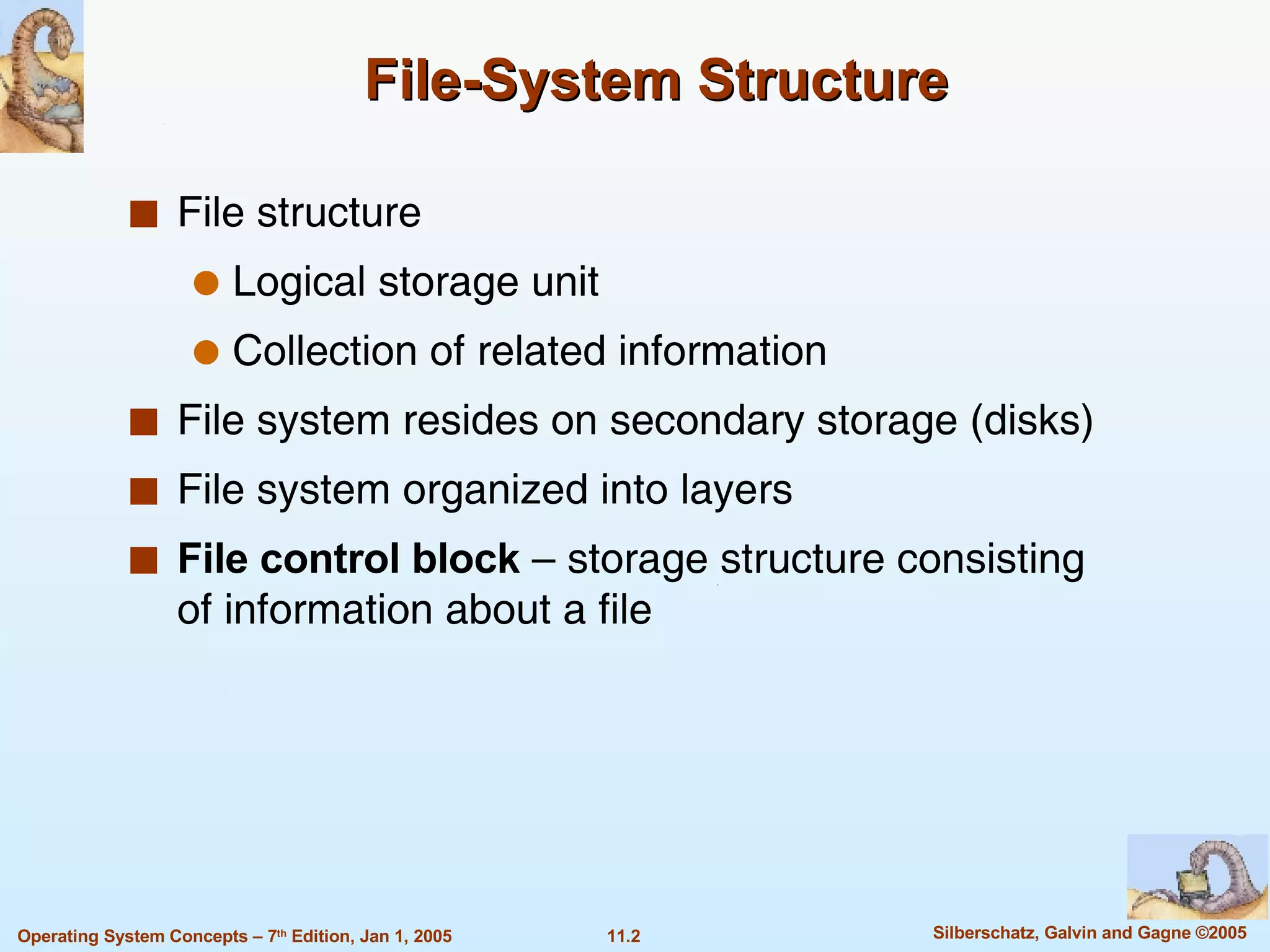
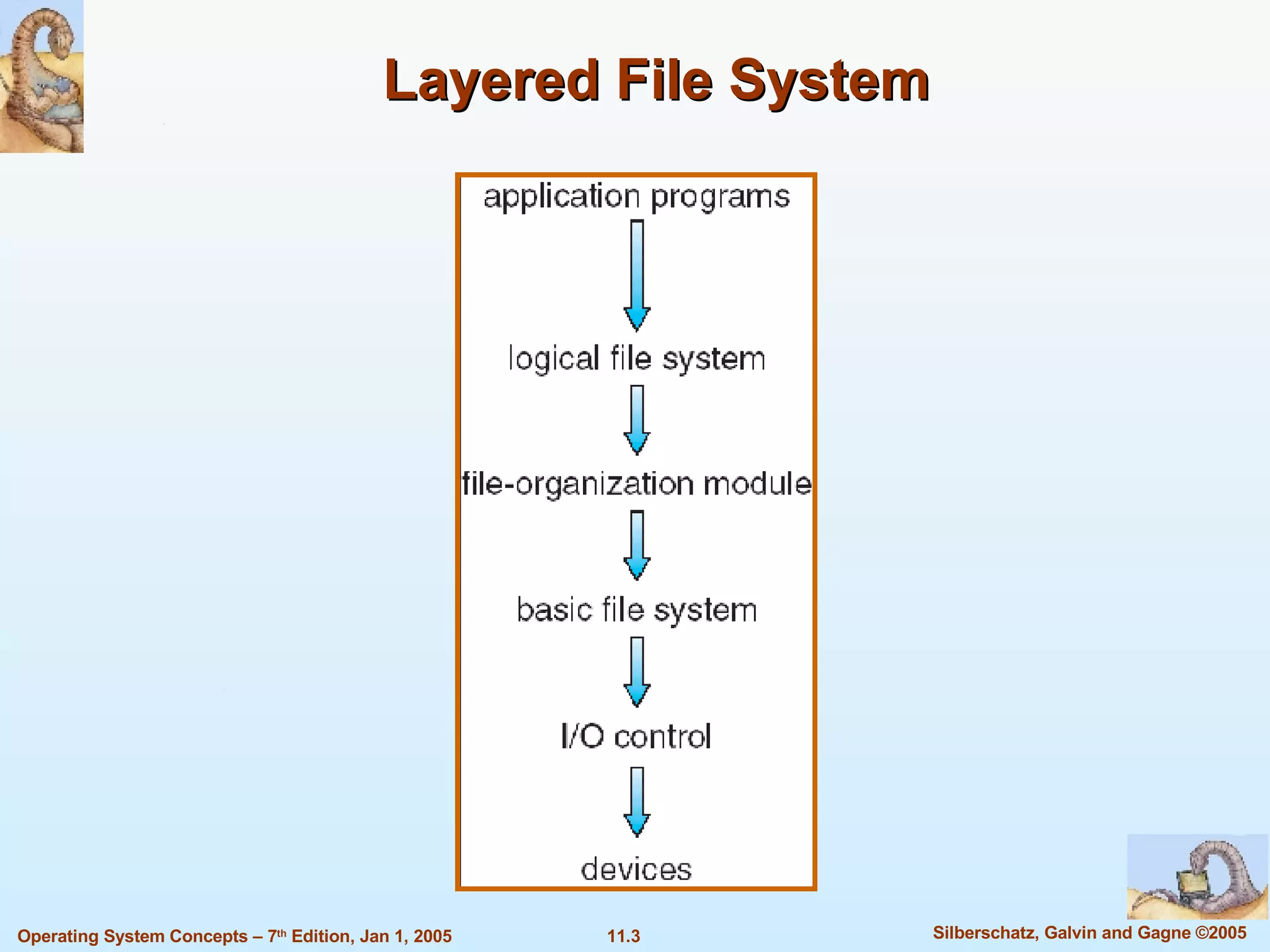
File-System Structure File structure Logical storage unit Collection of related information File system resides on secondary storage (disks) File system organized into layers File control block  – storage structure consisting of information about a file
Layered File System
A Typical File Control Block
File System Implementation  On-disk structures A boot controller block (per volume), contains information needed to boot an OS (in NTFS is called boot sector). A volume controller block (per volume), contains partition details such as number of blocks, size of blocks, etc. (in NTFS is called master file table). A directory structure per file system (in NTFS is called master file table). A per-file FCB, in Unix called inode, in NTFS information is stored in master file table (i.e. DB).
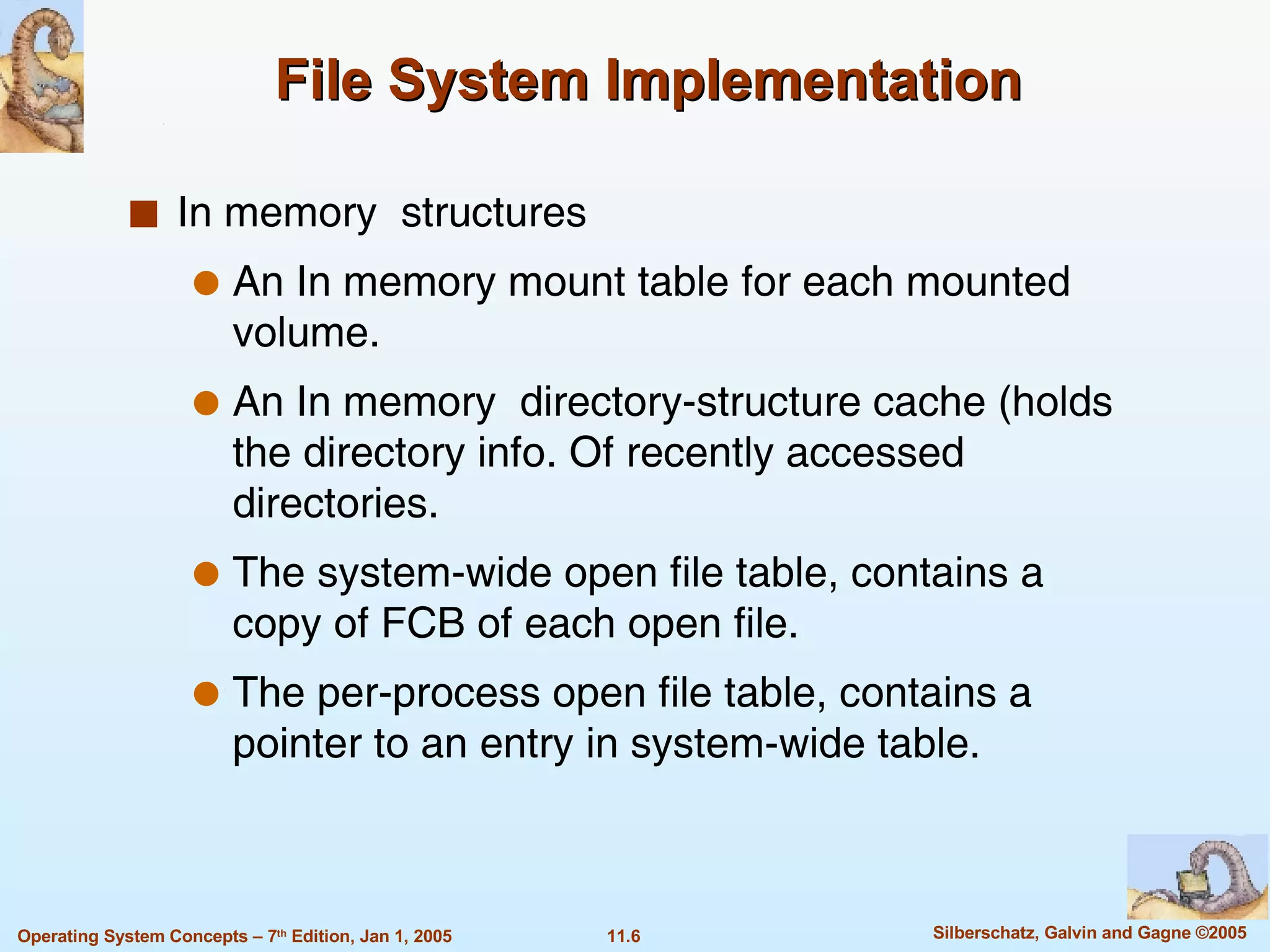
File System Implementation  In memory  structures   An In memory mount table for each mounted volume.  An In memory  directory-structure cache (holds the directory info. Of recently accessed directories.  The system-wide open file table, contains a copy of FCB of each open file. The per-process open file table, contains a pointer to an entry in system-wide table.
In-Memory File System Structures
Partitions and mounting Cooked disk, contains file system. Raw disk, no file system (in UNIX it is used for swap space). Root partition (which contains the OS kernel) is mounted at boot time.  Mount table keeps track of mounted file systems by using pointers to blocks: In windows, file systems are mounted in drive letters. Each volume is a separate name space denoted by a letter and a colon. In UNIX, file systems are mounted as directories.
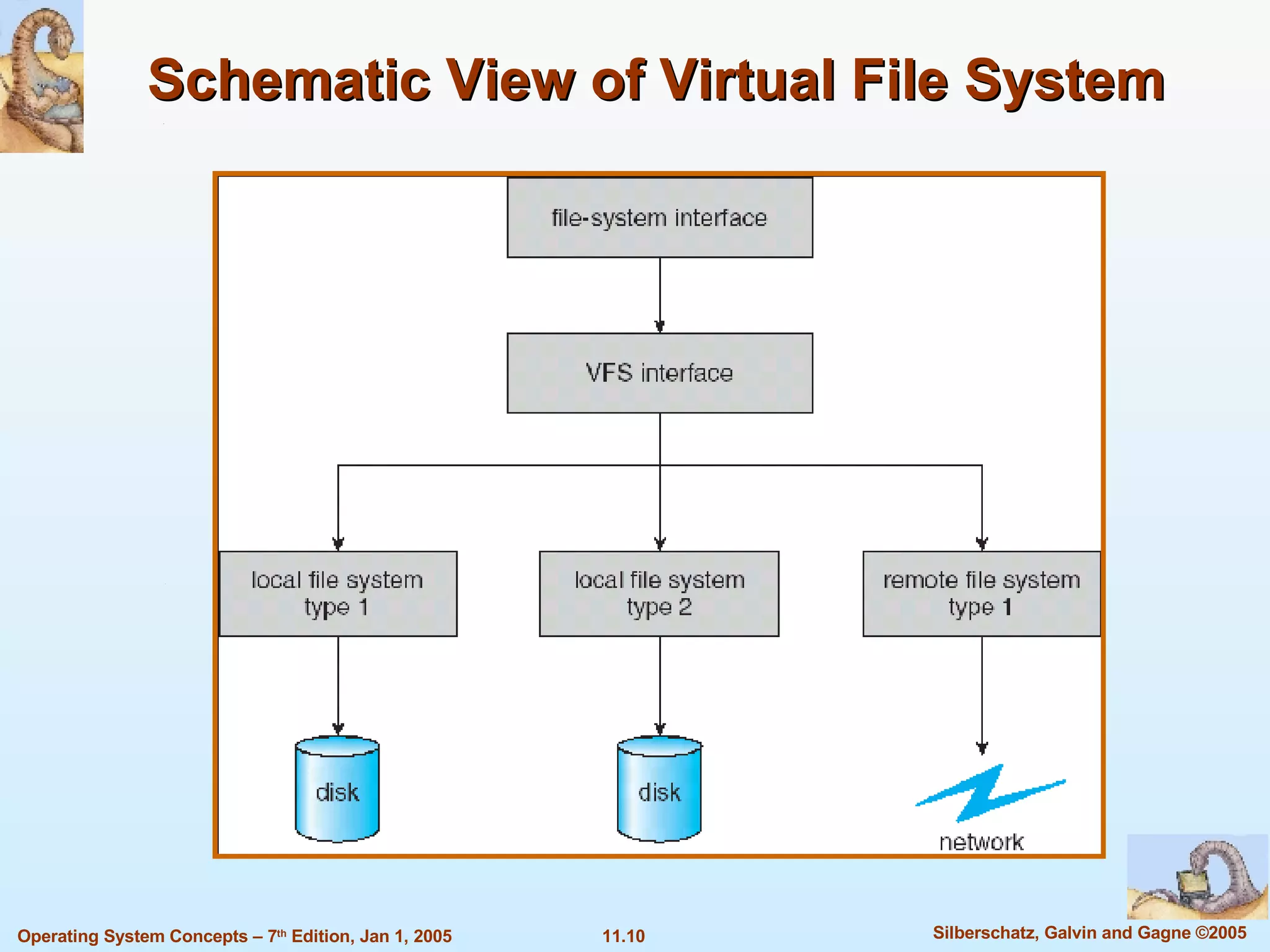
Virtual File Systems There are many different file systems available on any operating systems Windows: NTFS, FAT, FAT32 Linux: ext2/ext3, ufs, vfat, ramfs, tmpfs, reiserfs, xfs ... Virtual File Systems (VFS) provide an object-oriented way of implementing file systems. VFS allows the same system call interface (the API) to be used for different types of file systems. The API is to the VFS interface, rather than any specific type of file system.
Schematic View of Virtual File System
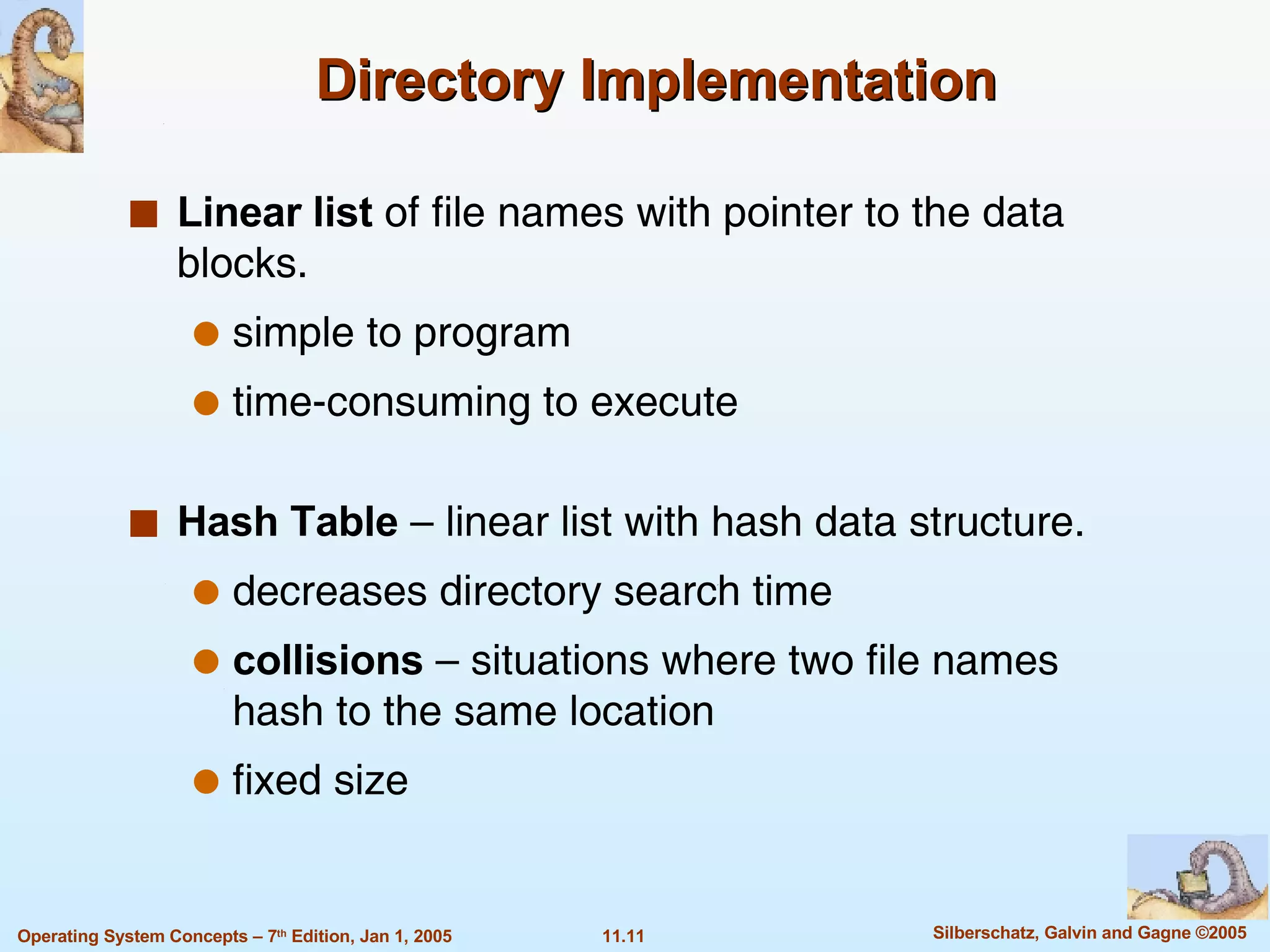
Directory Implementation Linear list  of file names with pointer to the data blocks. simple to program time-consuming to execute Hash Table  – linear list with hash data structure. decreases directory search time collisions  – situations where two file names hash to the same location fixed size
Allocation Methods An allocation method refers to how disk blocks are allocated for files: Contiguous allocation Linked allocation Indexed allocation
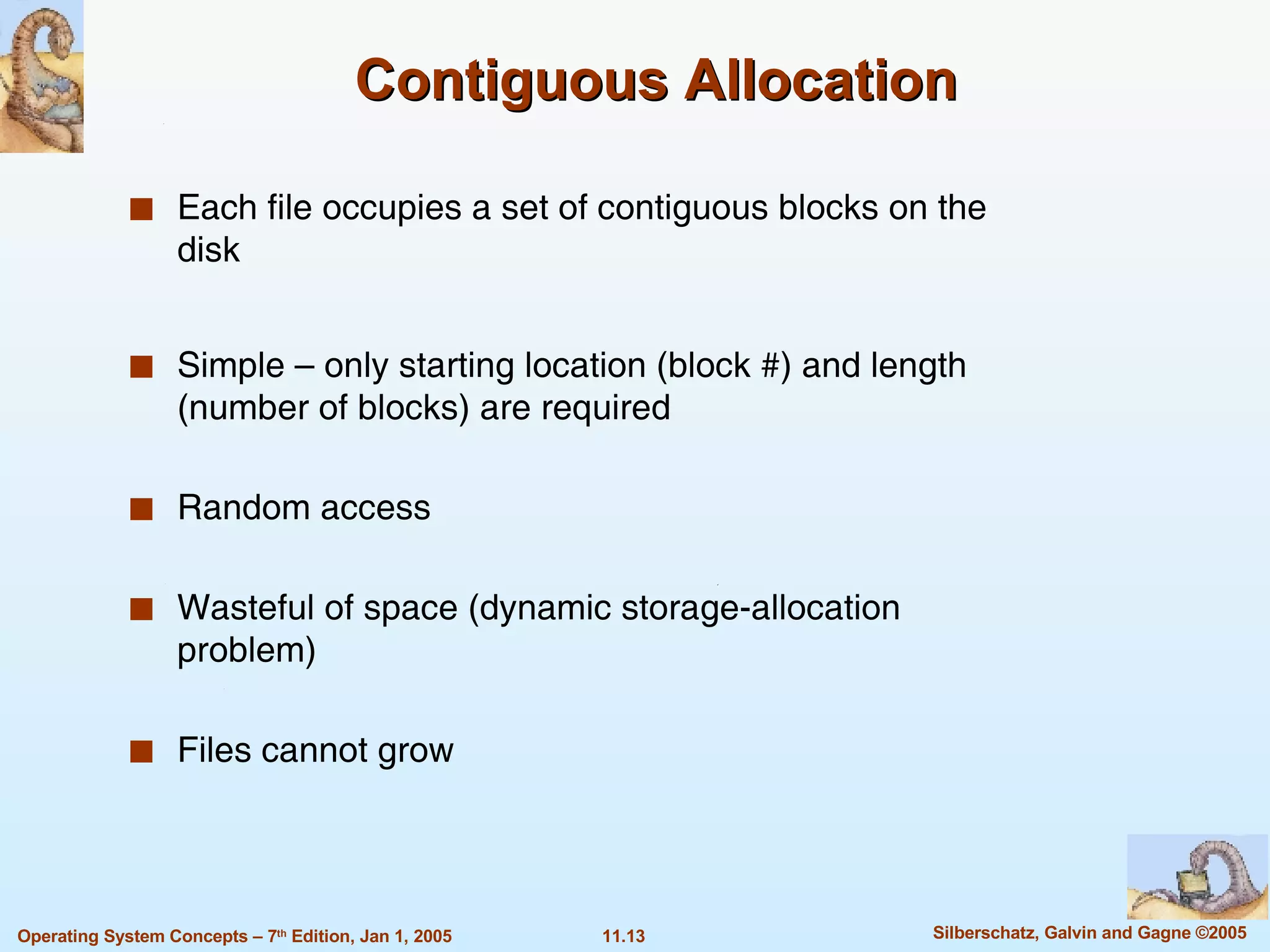
Contiguous Allocation Each file occupies a set of contiguous blocks on the disk Simple – only starting location (block #) and length (number of blocks) are required Random access Wasteful of space (dynamic storage-allocation problem) Files cannot grow
Contiguous Allocation of Disk Space
Extent-Based Systems Many newer file systems (I.e. Veritas File System) use a modified contiguous allocation scheme Extent-based file systems allocate disk blocks in  extents An  extent  is a contiguous block of disks Extents are allocated for file allocation A file consists of one or more extents.
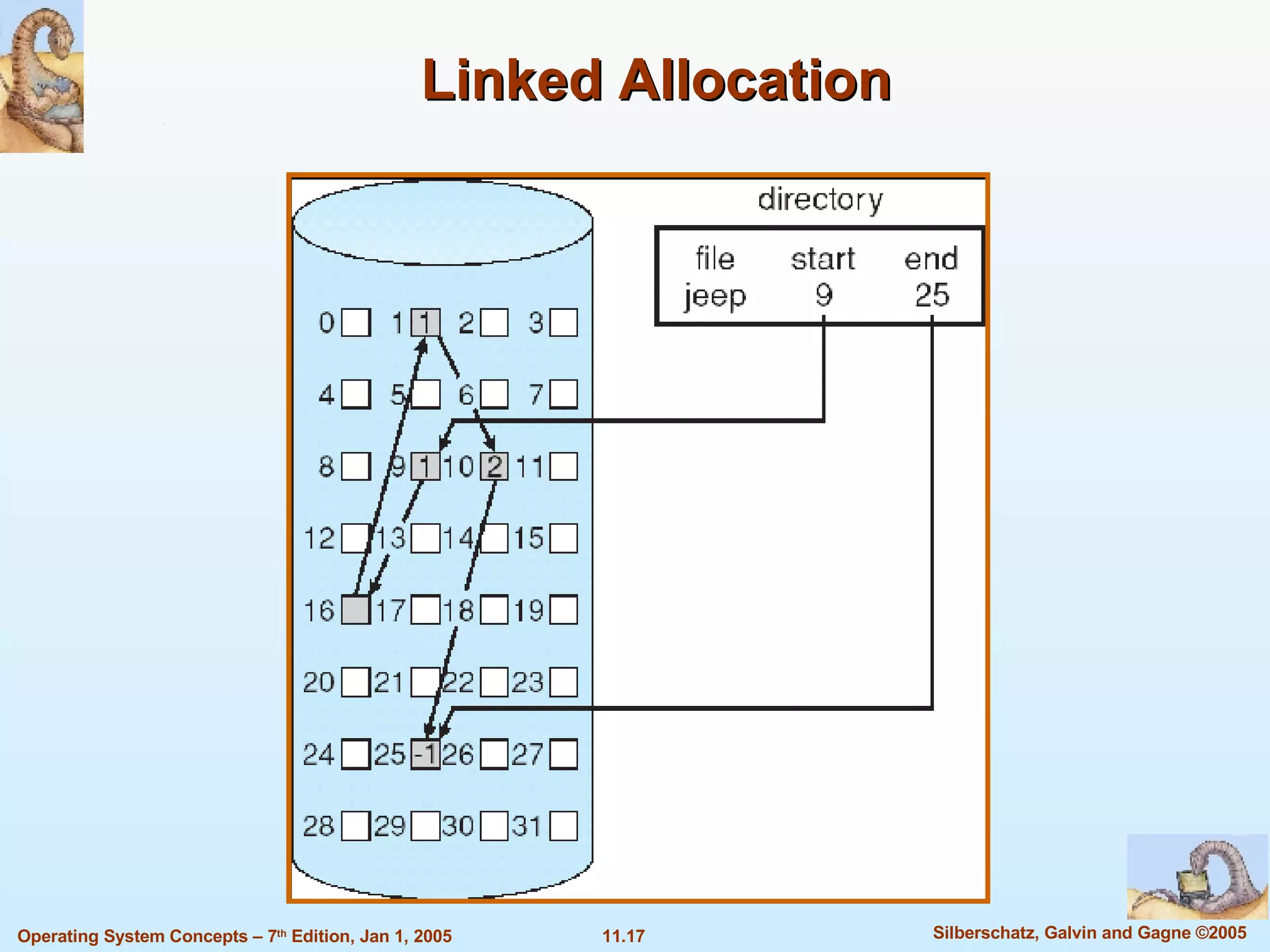
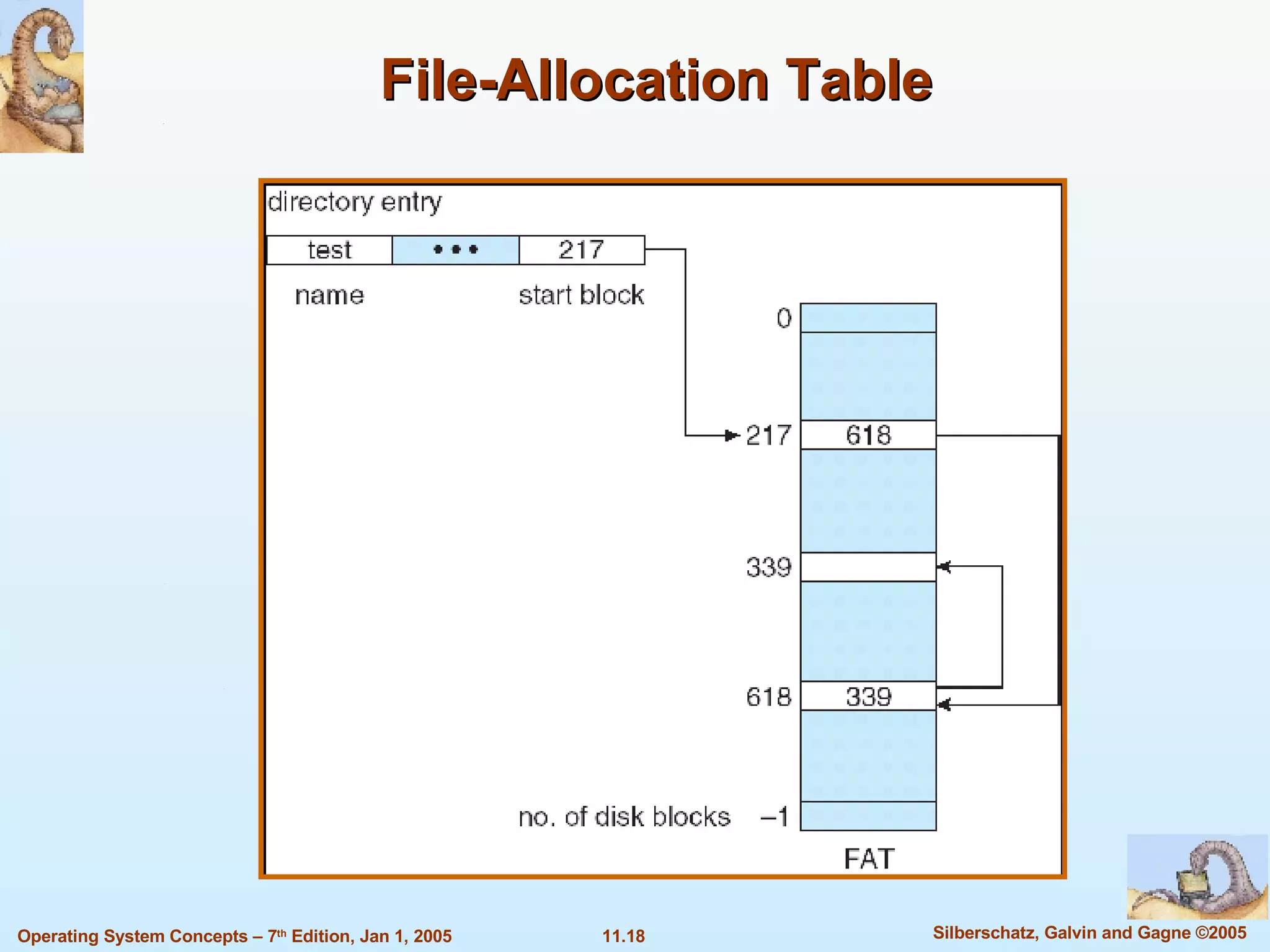
Linked Allocation Each file is a linked list of disk blocks: blocks may be scattered anywhere on the disk. Simple – need only starting address Free-space management system – no waste of space  No random access pointer block  =
Linked Allocation
File-Allocation Table
Indexed Allocation Brings all pointers together into the  index block. Logical view. index table
Example of Indexed Allocation
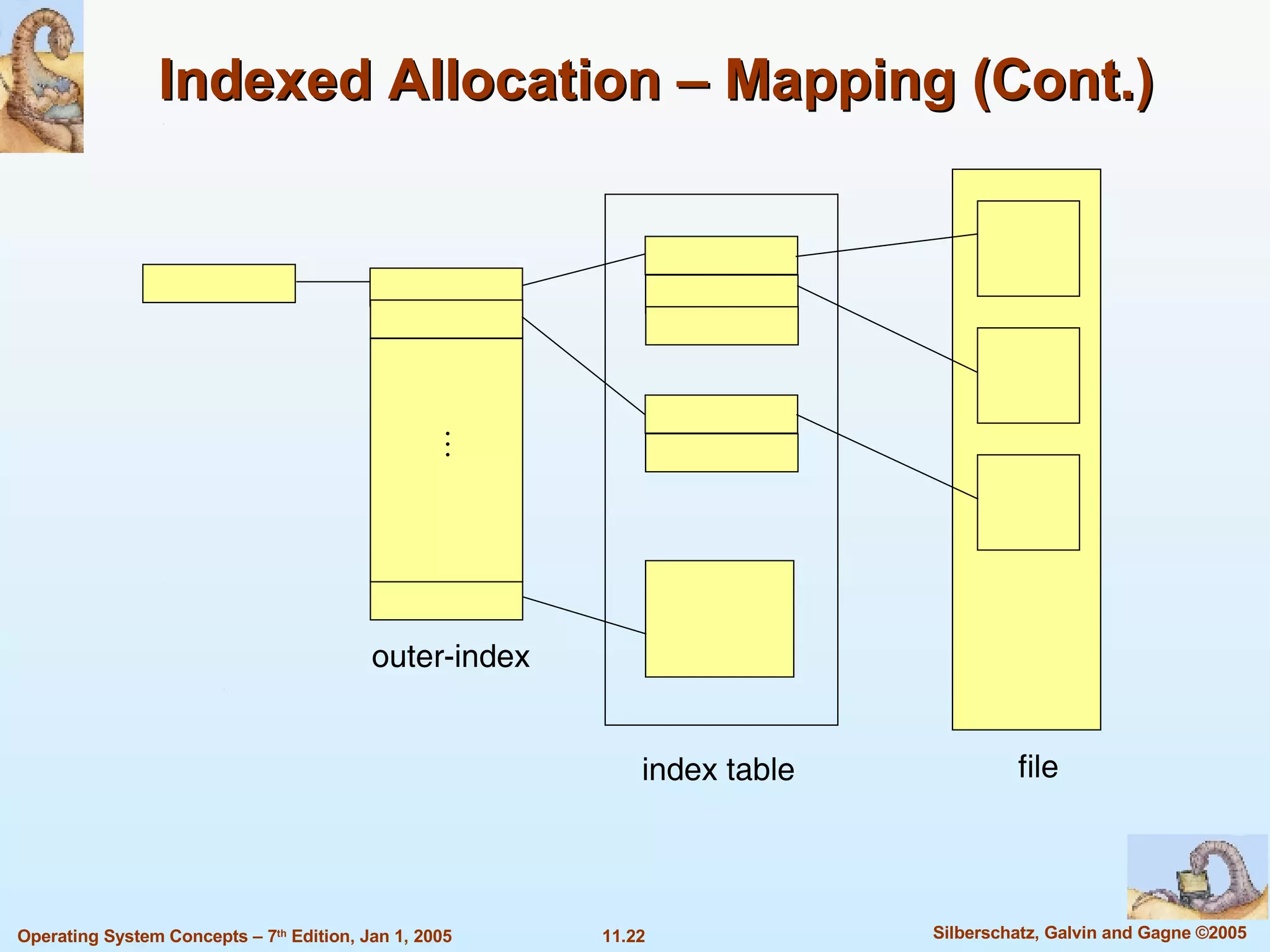
Indexed Allocation (Cont.) Need index table Random access Dynamic access without external fragmentation, but have overhead of index block. Mapping from logical to physical in a file of maximum size of 256K words and block size of 512 words.  We need only 1 block for index table.
Indexed Allocation – Mapping (Cont.)  outer-index index table file
Combined Scheme:  UNIX (4K bytes per block)
Free-Space Management Bit vector  ( n  blocks) … 0 1 2 n-1 bit[ i ] =  0    block[ i ] free 1    block[ i ] occupied Block number calculation =  (number of bits per word) * (number of 0-value words) + offset of first 1 bit
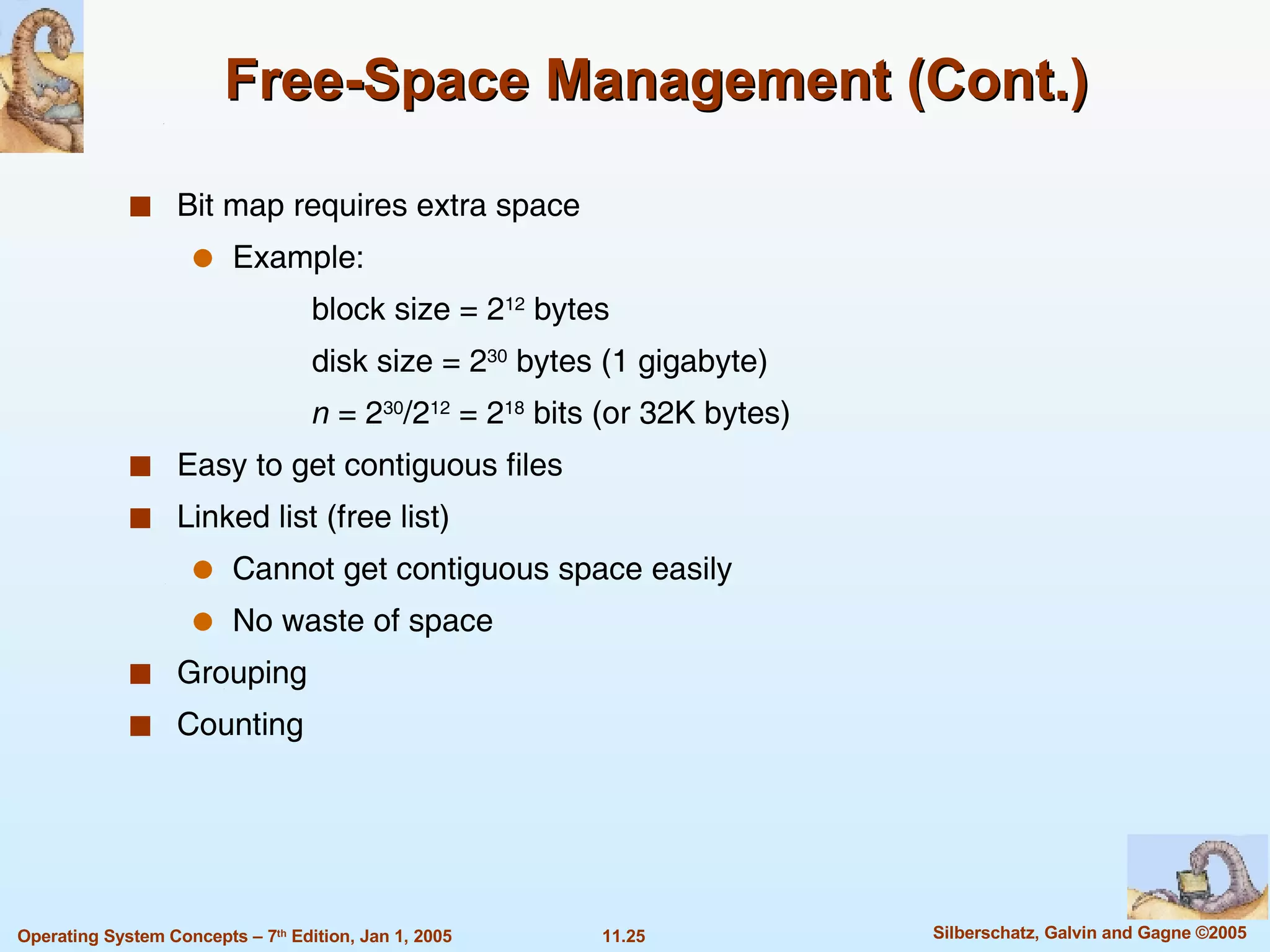
Free-Space Management (Cont.) Bit map requires extra space Example: block size = 2 12  bytes disk size = 2 30  bytes (1 gigabyte) n  = 2 30 /2 12  = 2 18  bits (or 32K bytes) Easy to get contiguous files  Linked list (free list) Cannot get contiguous space easily No waste of space Grouping  Counting
Free-Space Management (Cont.) Need to protect: Pointer to free list Bit map Must be kept on disk Copy in memory and disk may differ Cannot allow for block[ i ] to have a situation where bit[ i ] = 1 in memory and bit[ i ] = 0 on disk Solution: Set bit[ i ] = 1 in disk Allocate block[ i ] Set bit[ i ] = 1 in memory
Linked Free Space List on Disk
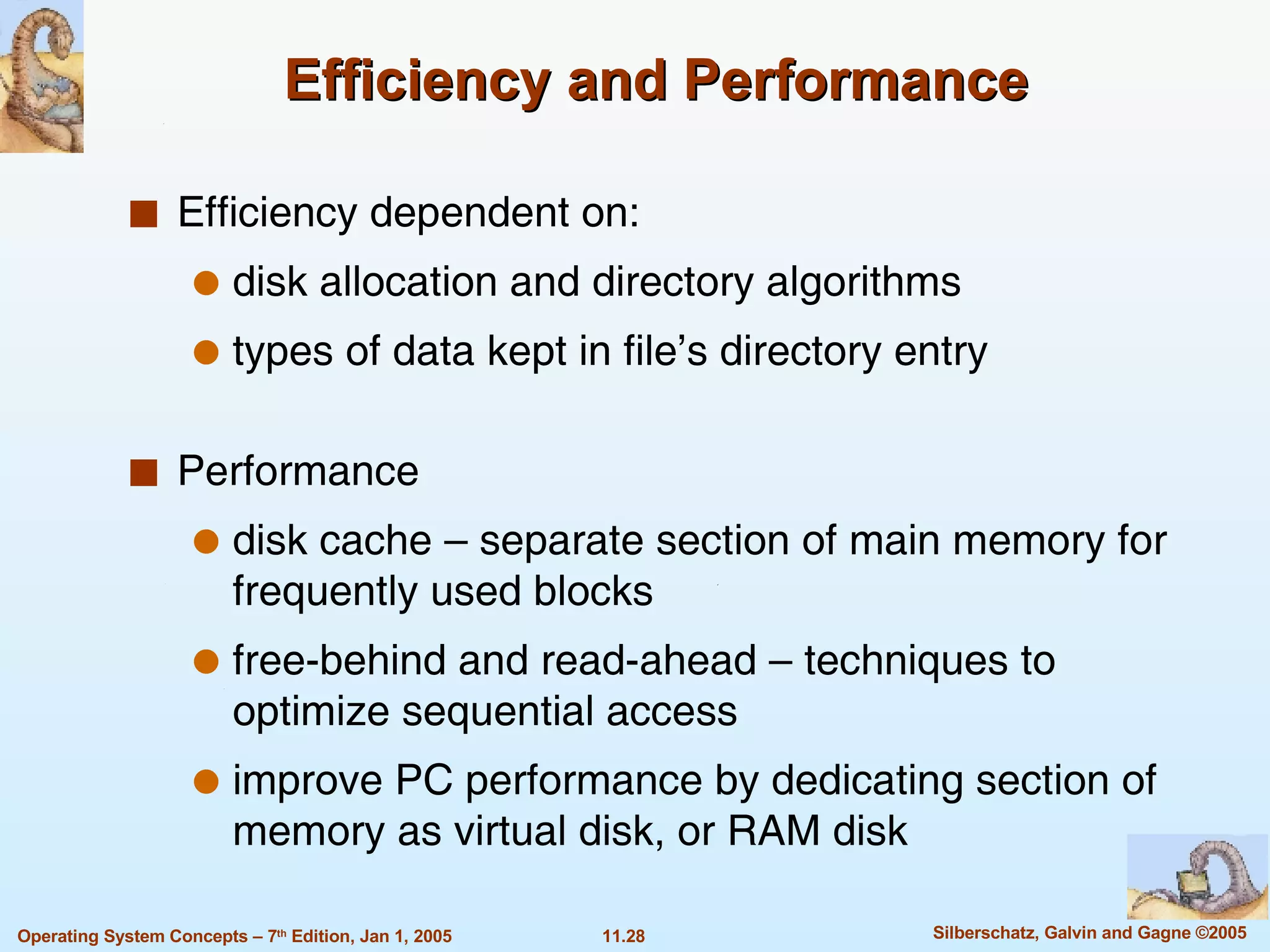
Efficiency and Performance Efficiency dependent on: disk allocation and directory algorithms types of data kept in file’s directory entry Performance disk cache – separate section of main memory for frequently used blocks free-behind and read-ahead – techniques to optimize sequential access improve PC performance by dedicating section of memory as virtual disk, or RAM disk
Page Cache A  page cache  caches pages rather than disk blocks using virtual memory techniques Memory-mapped I/O uses a page cache Routine I/O through the file system uses the buffer (disk) cache This leads to the following figure
I/O Without a Unified Buffer Cache
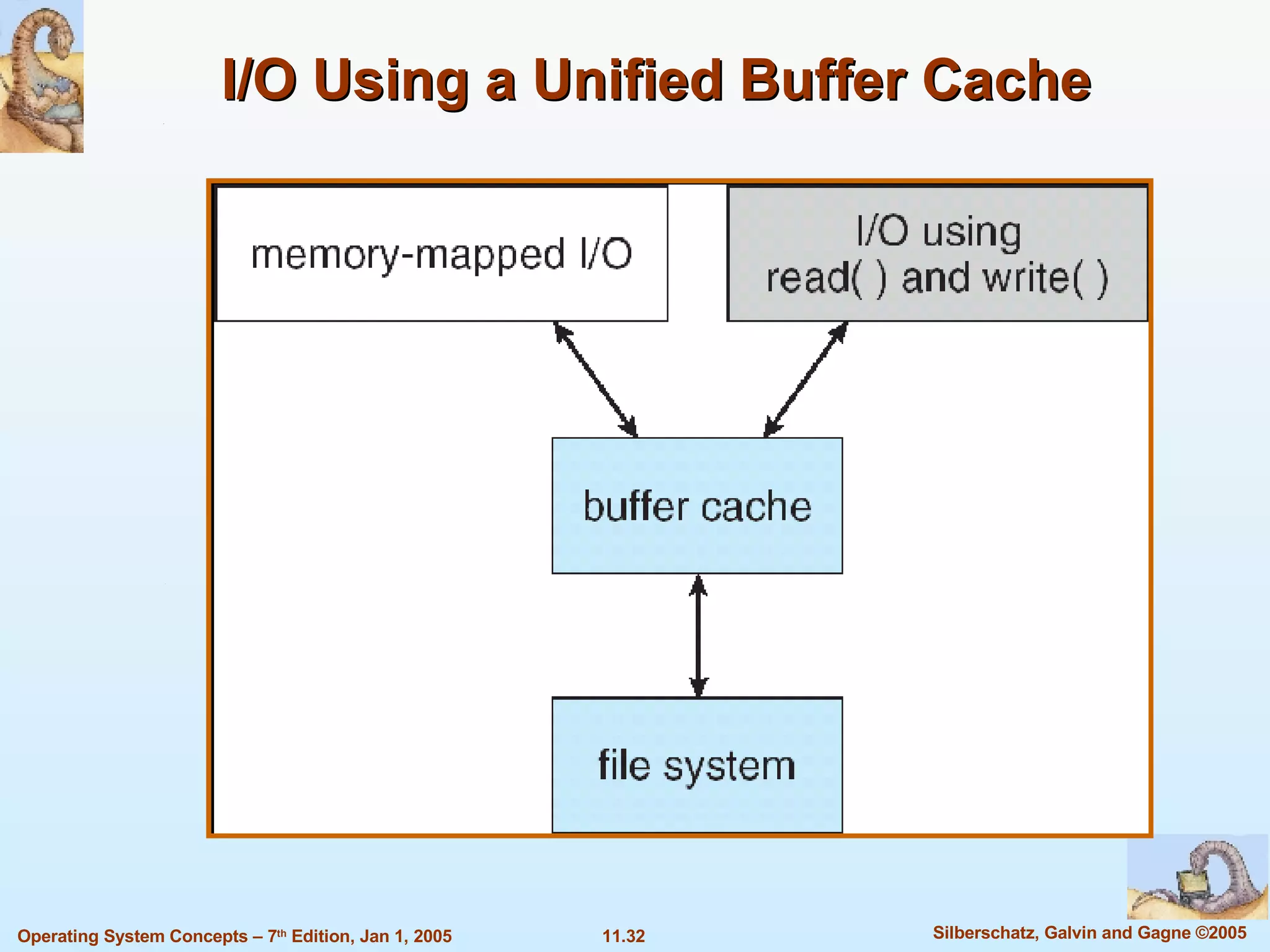
Unified Buffer Cache A unified buffer cache uses the same page cache to cache both memory-mapped pages and ordinary file system I/O
I/O Using a Unified Buffer Cache

Ch11

  • 1.
    Chapter 11: File System Implementation
  • 2.
    File-System Structure Filestructure Logical storage unit Collection of related information File system resides on secondary storage (disks) File system organized into layers File control block – storage structure consisting of information about a file
  • 3.
  • 4.
    A Typical FileControl Block
  • 5.
    File System Implementation On-disk structures A boot controller block (per volume), contains information needed to boot an OS (in NTFS is called boot sector). A volume controller block (per volume), contains partition details such as number of blocks, size of blocks, etc. (in NTFS is called master file table). A directory structure per file system (in NTFS is called master file table). A per-file FCB, in Unix called inode, in NTFS information is stored in master file table (i.e. DB).
  • 6.
    File System Implementation In memory structures An In memory mount table for each mounted volume. An In memory directory-structure cache (holds the directory info. Of recently accessed directories. The system-wide open file table, contains a copy of FCB of each open file. The per-process open file table, contains a pointer to an entry in system-wide table.
  • 7.
  • 8.
    Partitions and mountingCooked disk, contains file system. Raw disk, no file system (in UNIX it is used for swap space). Root partition (which contains the OS kernel) is mounted at boot time. Mount table keeps track of mounted file systems by using pointers to blocks: In windows, file systems are mounted in drive letters. Each volume is a separate name space denoted by a letter and a colon. In UNIX, file systems are mounted as directories.
  • 9.
    Virtual File SystemsThere are many different file systems available on any operating systems Windows: NTFS, FAT, FAT32 Linux: ext2/ext3, ufs, vfat, ramfs, tmpfs, reiserfs, xfs ... Virtual File Systems (VFS) provide an object-oriented way of implementing file systems. VFS allows the same system call interface (the API) to be used for different types of file systems. The API is to the VFS interface, rather than any specific type of file system.
  • 10.
    Schematic View ofVirtual File System
  • 11.
    Directory Implementation Linearlist of file names with pointer to the data blocks. simple to program time-consuming to execute Hash Table – linear list with hash data structure. decreases directory search time collisions – situations where two file names hash to the same location fixed size
  • 12.
    Allocation Methods Anallocation method refers to how disk blocks are allocated for files: Contiguous allocation Linked allocation Indexed allocation
  • 13.
    Contiguous Allocation Eachfile occupies a set of contiguous blocks on the disk Simple – only starting location (block #) and length (number of blocks) are required Random access Wasteful of space (dynamic storage-allocation problem) Files cannot grow
  • 14.
  • 15.
    Extent-Based Systems Manynewer file systems (I.e. Veritas File System) use a modified contiguous allocation scheme Extent-based file systems allocate disk blocks in extents An extent is a contiguous block of disks Extents are allocated for file allocation A file consists of one or more extents.
  • 16.
    Linked Allocation Eachfile is a linked list of disk blocks: blocks may be scattered anywhere on the disk. Simple – need only starting address Free-space management system – no waste of space No random access pointer block =
  • 17.
  • 18.
  • 19.
    Indexed Allocation Bringsall pointers together into the index block. Logical view. index table
  • 20.
  • 21.
    Indexed Allocation (Cont.)Need index table Random access Dynamic access without external fragmentation, but have overhead of index block. Mapping from logical to physical in a file of maximum size of 256K words and block size of 512 words. We need only 1 block for index table.
  • 22.
    Indexed Allocation –Mapping (Cont.)  outer-index index table file
  • 23.
    Combined Scheme: UNIX (4K bytes per block)
  • 24.
    Free-Space Management Bitvector ( n blocks) … 0 1 2 n-1 bit[ i ] =  0  block[ i ] free 1  block[ i ] occupied Block number calculation = (number of bits per word) * (number of 0-value words) + offset of first 1 bit
  • 25.
    Free-Space Management (Cont.)Bit map requires extra space Example: block size = 2 12 bytes disk size = 2 30 bytes (1 gigabyte) n = 2 30 /2 12 = 2 18 bits (or 32K bytes) Easy to get contiguous files Linked list (free list) Cannot get contiguous space easily No waste of space Grouping Counting
  • 26.
    Free-Space Management (Cont.)Need to protect: Pointer to free list Bit map Must be kept on disk Copy in memory and disk may differ Cannot allow for block[ i ] to have a situation where bit[ i ] = 1 in memory and bit[ i ] = 0 on disk Solution: Set bit[ i ] = 1 in disk Allocate block[ i ] Set bit[ i ] = 1 in memory
  • 27.
    Linked Free SpaceList on Disk
  • 28.
    Efficiency and PerformanceEfficiency dependent on: disk allocation and directory algorithms types of data kept in file’s directory entry Performance disk cache – separate section of main memory for frequently used blocks free-behind and read-ahead – techniques to optimize sequential access improve PC performance by dedicating section of memory as virtual disk, or RAM disk
  • 29.
    Page Cache A page cache caches pages rather than disk blocks using virtual memory techniques Memory-mapped I/O uses a page cache Routine I/O through the file system uses the buffer (disk) cache This leads to the following figure
  • 30.
    I/O Without aUnified Buffer Cache
  • 31.
    Unified Buffer CacheA unified buffer cache uses the same page cache to cache both memory-mapped pages and ordinary file system I/O
  • 32.
    I/O Using aUnified Buffer Cache