DEVICE FILE AND INPUT
OUTPUT SUBSYSTEMS
MANAGEMENT
1/25/2015 J.SUDARSHANREDDY
 Device manager ( inside OR outside kernel space ) is
the software that manages these for all.
 The manager co-ordinates B/W application process ,
driver and device- controller.
 The device manager polls the requests at the devices
and the actions occur as per their priorities .
 The device manager manages input & output interrupt
queues .
1/25/2015 J.SUDARSHANREDDY
 The device Manager creates an appropriate kernel
interface & API , and that activate the control register
- specific actions of the device .
 The device controller is activated through the API and
kernel interface . An ‘OS’ device manager provides &
executes the modules for managing the devices & their
driver ISR’s .
1/25/2015 J.SUDARSHANREDDY
1. If manages the physical as well as virtual devices
like the pipes and sockets through a common
strategy .
2. Device management has 3 standard approaches to
3 types of device drives
 Programmed I/O’s by polling the service need
from each device .
 Interrupt from the device driver ISR and
 DMA operation used by the devices to access the
memory.
3. A device manager has the functions given
i.
1/25/2015 J.SUDARSHANREDDY
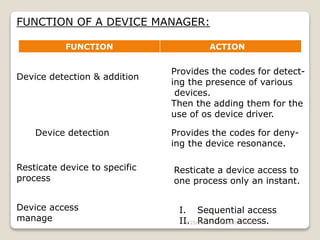
FUNCTION OF A DEVICE MANAGER:
FUNCTION ACTION
Device detection & addition
Provides the codes for detect-
ing the presence of various
devices.
Then the adding them for the
use of os device driver.
Device detection Provides the codes for deny-
ing the device resonance.
Resticate device to specific
process
Resticate a device access to
one process only an instant.
Device access
manage
I. Sequential access
II. Random access.1/25/2015 J.SUDARSHANREDDY
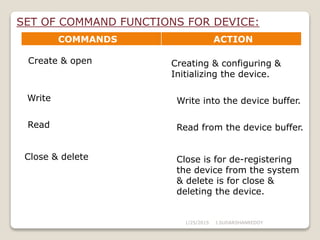
SET OF COMMAND FUNCTIONS FOR DEVICE:
COMMANDS ACTION
Create & open Creating & configuring &
Initializing the device.
Write Write into the device buffer.
Read Read from the device buffer.
Close & delete Close is for de-registering
the device from the system
& delete is for close &
deleting the device.
1/25/2015 J.SUDARSHANREDDY
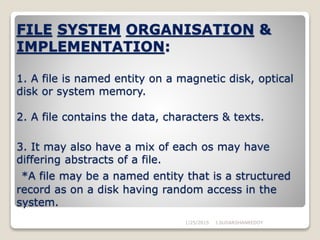
FILE SYSTEM ORGANISATION &
IMPLEMENTATION:
1. A file is named entity on a magnetic disk, optical
disk or system memory.
2. A file contains the data, characters & texts.
3. It may also have a mix of each os may have
differing abstracts of a file.
*A file may be a named entity that is a structured
record as on a disk having random access in the
system.
1/25/2015 J.SUDARSHANREDDY
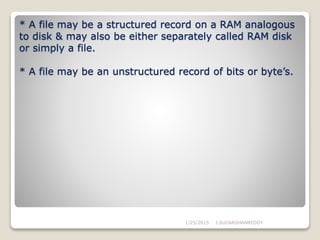
* A file may be a structured record on a RAM analogous
to disk & may also be either separately called RAM disk
or simply a file.
* A file may be an unstructured record of bits or byte’s.
1/25/2015 J.SUDARSHANREDDY
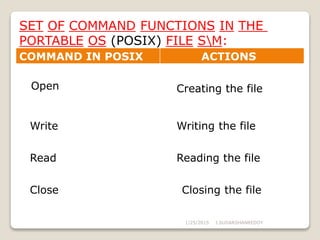
SET OF COMMAND FUNCTIONS IN THE
PORTABLE OS (POSIX) FILE SM:
COMMAND IN POSIX ACTIONS
Open Creating the file
Write Writing the file
Read Reading the file
Close Closing the file
1/25/2015 J.SUDARSHANREDDY
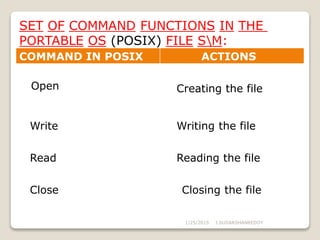
SET OF COMMAND FUNCTIONS IN THE
PORTABLE OS (POSIX) FILE SM:
COMMAND IN POSIX ACTIONS
Open Creating the file
Write Writing the file
Read Reading the file
Close Closing the file
1/25/2015 J.SUDARSHANREDDY
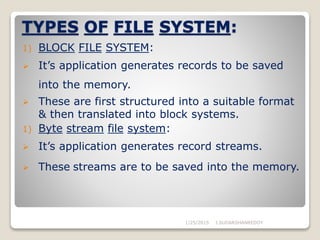
TYPES OF FILE SYSTEM:
1) BLOCK FILE SYSTEM:
 It’s application generates records to be saved
into the memory.
 These are first structured into a suitable format
& then translated into block systems.
1) Byte stream file system:
 It’s application generates record streams.
 These streams are to be saved into the memory.
1/25/2015 J.SUDARSHANREDDY
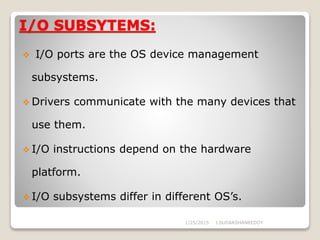
I/O SUBSYTEMS:
 I/O ports are the OS device management
subsystems.
 Drivers communicate with the many devices that
use them.
 I/O instructions depend on the hardware
platform.
 I/O subsystems differ in different OS’s.
1/25/2015 J.SUDARSHANREDDY
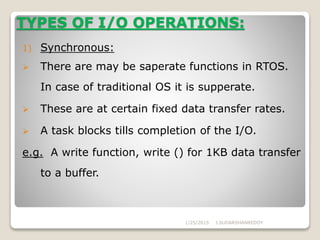
TYPES OF I/O OPERATIONS:
1) Synchronous:
 There are may be saperate functions in RTOS.
In case of traditional OS it is supperate.
 These are at certain fixed data transfer rates.
 A task blocks tills completion of the I/O.
e.g. A write function, write () for 1KB data transfer
to a buffer.
1/25/2015 J.SUDARSHANREDDY
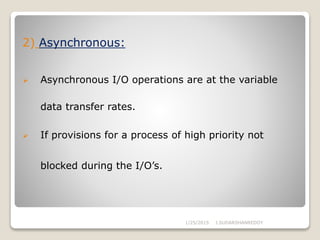
2) Asynchronous:
 Asynchronous I/O operations are at the variable
data transfer rates.
 If provisions for a process of high priority not
blocked during the I/O’s.
1/25/2015 J.SUDARSHANREDDY
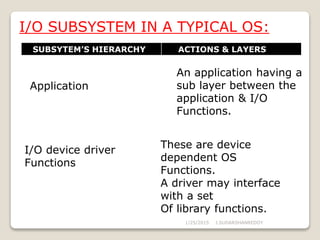
I/O SUBSYSTEM IN A TYPICAL OS:
SUBSYTEM’S HIERARCHY ACTIONS & LAYERS
Application
An application having a
sub layer between the
application & I/O
Functions.
I/O device driver
Functions
These are device
dependent OS
Functions.
A driver may interface
with a set
Of library functions.
1/25/2015 J.SUDARSHANREDDY

DEVICE FILE AND INPUT OUTPUT SUBSYSTEMS MANAGEMENT

  • 1.
    DEVICE FILE ANDINPUT OUTPUT SUBSYSTEMS MANAGEMENT 1/25/2015 J.SUDARSHANREDDY
  • 2.
     Device manager( inside OR outside kernel space ) is the software that manages these for all.  The manager co-ordinates B/W application process , driver and device- controller.  The device manager polls the requests at the devices and the actions occur as per their priorities .  The device manager manages input & output interrupt queues . 1/25/2015 J.SUDARSHANREDDY
  • 3.
     The deviceManager creates an appropriate kernel interface & API , and that activate the control register - specific actions of the device .  The device controller is activated through the API and kernel interface . An ‘OS’ device manager provides & executes the modules for managing the devices & their driver ISR’s . 1/25/2015 J.SUDARSHANREDDY
  • 4.
    1. If managesthe physical as well as virtual devices like the pipes and sockets through a common strategy . 2. Device management has 3 standard approaches to 3 types of device drives  Programmed I/O’s by polling the service need from each device .  Interrupt from the device driver ISR and  DMA operation used by the devices to access the memory. 3. A device manager has the functions given i. 1/25/2015 J.SUDARSHANREDDY
  • 5.
    FUNCTION OF ADEVICE MANAGER: FUNCTION ACTION Device detection & addition Provides the codes for detect- ing the presence of various devices. Then the adding them for the use of os device driver. Device detection Provides the codes for deny- ing the device resonance. Resticate device to specific process Resticate a device access to one process only an instant. Device access manage I. Sequential access II. Random access.1/25/2015 J.SUDARSHANREDDY
  • 6.
    SET OF COMMANDFUNCTIONS FOR DEVICE: COMMANDS ACTION Create & open Creating & configuring & Initializing the device. Write Write into the device buffer. Read Read from the device buffer. Close & delete Close is for de-registering the device from the system & delete is for close & deleting the device. 1/25/2015 J.SUDARSHANREDDY
  • 7.
    FILE SYSTEM ORGANISATION& IMPLEMENTATION: 1. A file is named entity on a magnetic disk, optical disk or system memory. 2. A file contains the data, characters & texts. 3. It may also have a mix of each os may have differing abstracts of a file. *A file may be a named entity that is a structured record as on a disk having random access in the system. 1/25/2015 J.SUDARSHANREDDY
  • 8.
    * A filemay be a structured record on a RAM analogous to disk & may also be either separately called RAM disk or simply a file. * A file may be an unstructured record of bits or byte’s. 1/25/2015 J.SUDARSHANREDDY
  • 9.
    SET OF COMMANDFUNCTIONS IN THE PORTABLE OS (POSIX) FILE SM: COMMAND IN POSIX ACTIONS Open Creating the file Write Writing the file Read Reading the file Close Closing the file 1/25/2015 J.SUDARSHANREDDY
  • 10.
    SET OF COMMANDFUNCTIONS IN THE PORTABLE OS (POSIX) FILE SM: COMMAND IN POSIX ACTIONS Open Creating the file Write Writing the file Read Reading the file Close Closing the file 1/25/2015 J.SUDARSHANREDDY
  • 11.
    TYPES OF FILESYSTEM: 1) BLOCK FILE SYSTEM:  It’s application generates records to be saved into the memory.  These are first structured into a suitable format & then translated into block systems. 1) Byte stream file system:  It’s application generates record streams.  These streams are to be saved into the memory. 1/25/2015 J.SUDARSHANREDDY
  • 12.
    I/O SUBSYTEMS:  I/Oports are the OS device management subsystems.  Drivers communicate with the many devices that use them.  I/O instructions depend on the hardware platform.  I/O subsystems differ in different OS’s. 1/25/2015 J.SUDARSHANREDDY
  • 13.
    TYPES OF I/OOPERATIONS: 1) Synchronous:  There are may be saperate functions in RTOS. In case of traditional OS it is supperate.  These are at certain fixed data transfer rates.  A task blocks tills completion of the I/O. e.g. A write function, write () for 1KB data transfer to a buffer. 1/25/2015 J.SUDARSHANREDDY
  • 14.
    2) Asynchronous:  AsynchronousI/O operations are at the variable data transfer rates.  If provisions for a process of high priority not blocked during the I/O’s. 1/25/2015 J.SUDARSHANREDDY
  • 15.
    I/O SUBSYSTEM INA TYPICAL OS: SUBSYTEM’S HIERARCHY ACTIONS & LAYERS Application An application having a sub layer between the application & I/O Functions. I/O device driver Functions These are device dependent OS Functions. A driver may interface with a set Of library functions. 1/25/2015 J.SUDARSHANREDDY