Chemistry, The Central Science, 11th edition
          Theodore L. Brown; H. Eugene LeMay, Jr.;
                    and Bruce E. Bursten


           Chapter 19
            Chemical
         Thermodynamics

      John D. Bookstaver                                     Chemical
St. Charles Community College                             Thermodynamics

        Cottleville, MO                                 © 2009, Prentice-Hall, Inc.
First Law of Thermodynamics

• You will recall from Chapter 5 that
  energy cannot be created nor
  destroyed.
• Therefore, the total energy of the
  universe is a constant.
• Energy can, however, be converted
  from one form to another or transferred
  from a system to the surroundings or
  vice versa.                            Chemical
                                            Thermodynamics

                                          © 2009, Prentice-Hall, Inc.
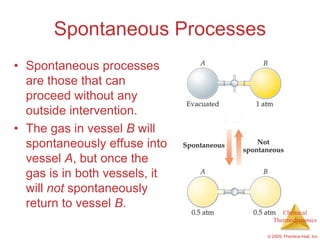
Spontaneous Processes
• Spontaneous processes
  are those that can
  proceed without any
  outside intervention.
• The gas in vessel B will
  spontaneously effuse into
  vessel A, but once the
  gas is in both vessels, it
  will not spontaneously
  return to vessel B.
                                    Chemical
                                 Thermodynamics

                               © 2009, Prentice-Hall, Inc.
Spontaneous Processes

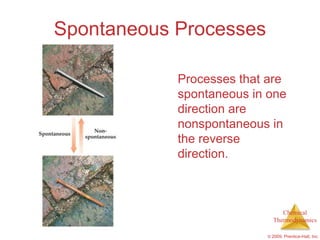
            Processes that are
            spontaneous in one
            direction are
            nonspontaneous in
            the reverse
            direction.


                               Chemical
                            Thermodynamics

                          © 2009, Prentice-Hall, Inc.
Spontaneous Processes
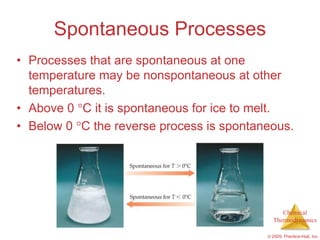
• Processes that are spontaneous at one
  temperature may be nonspontaneous at other
  temperatures.
• Above 0 C it is spontaneous for ice to melt.
• Below 0 C the reverse process is spontaneous.


                                               Chemical
                                            Thermodynamics

                                          © 2009, Prentice-Hall, Inc.
Reversible Processes

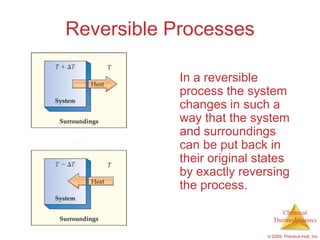
            In a reversible
            process the system
            changes in such a
            way that the system
            and surroundings
            can be put back in
            their original states
            by exactly reversing
            the process.

                                 Chemical
                              Thermodynamics

                            © 2009, Prentice-Hall, Inc.
Irreversible Processes


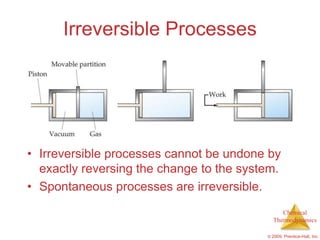
• Irreversible processes cannot be undone by
  exactly reversing the change to the system.
• Spontaneous processes are irreversible.
                                               Chemical
                                            Thermodynamics

                                          © 2009, Prentice-Hall, Inc.
Entropy

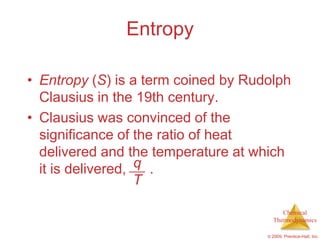
• Entropy (S) is a term coined by Rudolph
  Clausius in the 19th century.
• Clausius was convinced of the
  significance of the ratio of heat
  delivered and the temperature at which
  it is delivered, q .
                   T

                                          Chemical
                                       Thermodynamics

                                     © 2009, Prentice-Hall, Inc.
Entropy

• Entropy can be thought of as a measure
  of the randomness of a system.
• It is related to the various modes of
  motion in molecules.


                                         Chemical
                                      Thermodynamics

                                    © 2009, Prentice-Hall, Inc.
Entropy

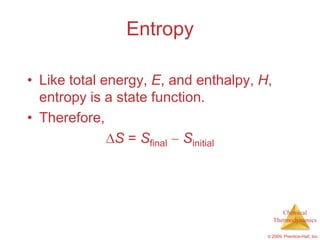
• Like total energy, E, and enthalpy, H,
  entropy is a state function.
• Therefore,
               S = Sfinal Sinitial


                                              Chemical
                                           Thermodynamics

                                       © 2009, Prentice-Hall, Inc.
Entropy

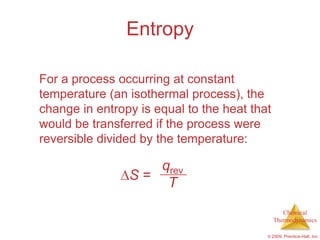
For a process occurring at constant
temperature (an isothermal process), the
change in entropy is equal to the heat that
would be transferred if the process were
reversible divided by the temperature:

                   qrev
                S=
                    T
                                                 Chemical
                                              Thermodynamics

                                          © 2009, Prentice-Hall, Inc.
Second Law of Thermodynamics

  The second law of thermodynamics
  states that the entropy of the universe
  increases for spontaneous
  processes, and the entropy of the
  universe does not change for reversible
  processes.


                                          Chemical
                                       Thermodynamics

                                     © 2009, Prentice-Hall, Inc.
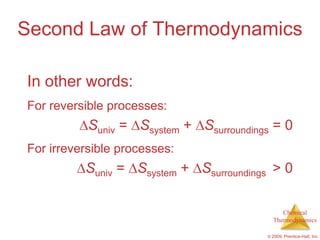
Second Law of Thermodynamics

In other words:
For reversible processes:
           Suniv = Ssystem + Ssurroundings = 0
For irreversible processes:
          Suniv = Ssystem + Ssurroundings > 0

                                              Chemical
                                           Thermodynamics

                                         © 2009, Prentice-Hall, Inc.
Second Law of Thermodynamics

  These last truths mean that as a result
  of all spontaneous processes the
  entropy of the universe increases.


                                           Chemical
                                        Thermodynamics

                                      © 2009, Prentice-Hall, Inc.
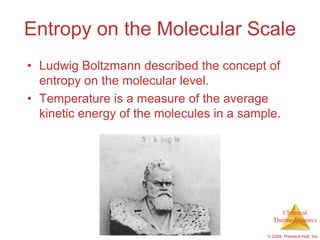
Entropy on the Molecular Scale
• Ludwig Boltzmann described the concept of
  entropy on the molecular level.
• Temperature is a measure of the average
  kinetic energy of the molecules in a sample.


                                                Chemical
                                             Thermodynamics

                                           © 2009, Prentice-Hall, Inc.
Entropy on the Molecular Scale
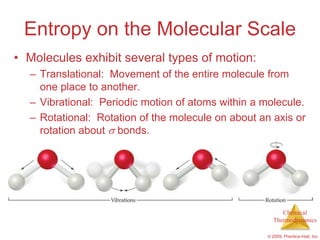
• Molecules exhibit several types of motion:
  – Translational: Movement of the entire molecule from
    one place to another.
  – Vibrational: Periodic motion of atoms within a molecule.
  – Rotational: Rotation of the molecule on about an axis or
    rotation about bonds.


                                                         Chemical
                                                      Thermodynamics

                                                    © 2009, Prentice-Hall, Inc.
Entropy on the Molecular Scale
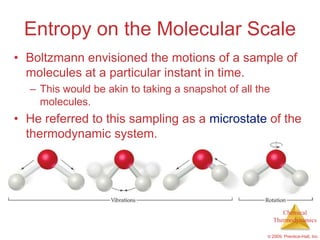
• Boltzmann envisioned the motions of a sample of
  molecules at a particular instant in time.
  – This would be akin to taking a snapshot of all the
    molecules.
• He referred to this sampling as a microstate of the
  thermodynamic system.


                                                            Chemical
                                                         Thermodynamics

                                                     © 2009, Prentice-Hall, Inc.
Entropy on the Molecular Scale
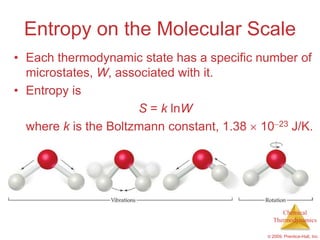
• Each thermodynamic state has a specific number of
  microstates, W, associated with it.
• Entropy is
                      S = k lnW
  where k is the Boltzmann constant, 1.38 10 23 J/K.


                                                 Chemical
                                              Thermodynamics

                                            © 2009, Prentice-Hall, Inc.
Entropy on the Molecular Scale

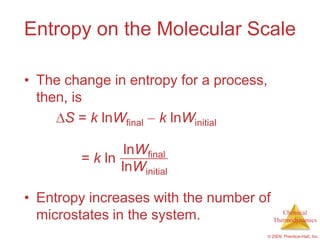
• The change in entropy for a process,
  then, is
      S = k lnWfinal k lnWinitial

                 lnWfinal
       S = k ln
                lnWinitial

• Entropy increases with the number of
  microstates in the system.              Chemical
                                       Thermodynamics

                                            © 2009, Prentice-Hall, Inc.
Entropy on the Molecular Scale
• The number of microstates
  and, therefore, the entropy tends to
  increase with increases in
  – Temperature.
  – Volume.
  – The number of independently moving
    molecules.


                                              Chemical
                                           Thermodynamics

                                         © 2009, Prentice-Hall, Inc.
Entropy and Physical States

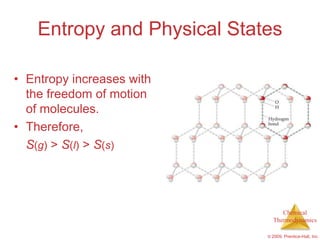
• Entropy increases with
  the freedom of motion
  of molecules.
• Therefore,
  S(g) > S(l) > S(s)


                                  Chemical
                               Thermodynamics

                             © 2009, Prentice-Hall, Inc.
Solutions

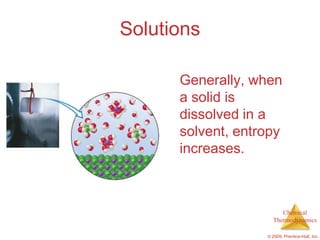
      Generally, when
      a solid is
      dissolved in a
      solvent, entropy
      increases.


                        Chemical
                     Thermodynamics

                   © 2009, Prentice-Hall, Inc.
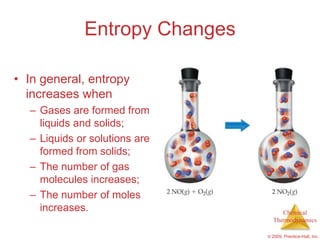
Entropy Changes

• In general, entropy
  increases when
  – Gases are formed from
    liquids and solids;
  – Liquids or solutions are
    formed from solids;
  – The number of gas
    molecules increases;
  – The number of moles
    increases.                      Chemical
                                 Thermodynamics

                               © 2009, Prentice-Hall, Inc.
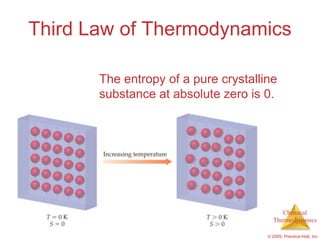
Third Law of Thermodynamics

       The entropy of a pure crystalline
       substance at absolute zero is 0.


                                           Chemical
                                        Thermodynamics

                                      © 2009, Prentice-Hall, Inc.
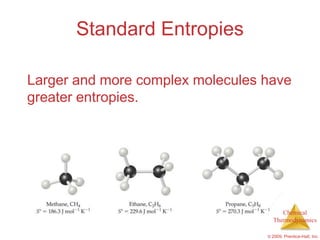
Standard Entropies

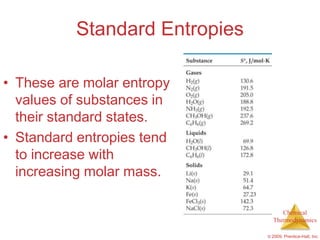
• These are molar entropy
  values of substances in
  their standard states.
• Standard entropies tend
  to increase with
  increasing molar mass.

                                    Chemical
                                 Thermodynamics

                               © 2009, Prentice-Hall, Inc.
Standard Entropies

Larger and more complex molecules have
greater entropies.


                                       Chemical
                                    Thermodynamics

                                  © 2009, Prentice-Hall, Inc.
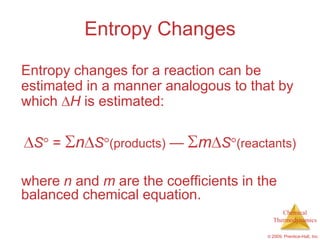
Entropy Changes

Entropy changes for a reaction can be
estimated in a manner analogous to that by
which H is estimated:

  S =   n S   (products) —   m S   (reactants)


where n and m are the coefficients in the
balanced chemical equation.
                                             Chemical
                                          Thermodynamics

                                        © 2009, Prentice-Hall, Inc.
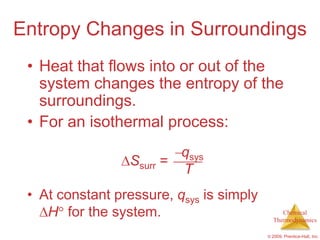
Entropy Changes in Surroundings
 • Heat that flows into or out of the
   system changes the entropy of the
   surroundings.
 • For an isothermal process:
                         qsys
                 Ssurr =
                         T
 • At constant pressure, qsys is simply
    H for the system.                          Chemical
                                            Thermodynamics

                                          © 2009, Prentice-Hall, Inc.
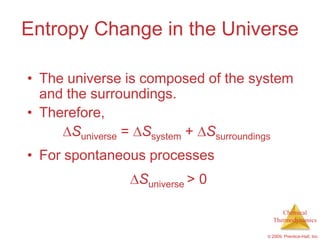
Entropy Change in the Universe

• The universe is composed of the system
  and the surroundings.
• Therefore,
       Suniverse = Ssystem + Ssurroundings
• For spontaneous processes
                 Suniverse > 0

                                          Chemical
                                       Thermodynamics

                                     © 2009, Prentice-Hall, Inc.
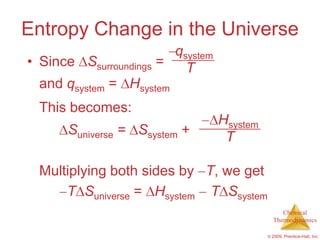
Entropy Change in the Universe
                        qsystem
• Since Ssurroundings =   T
  and qsystem = Hsystem
  This becomes:
                                  Hsystem
      Suniverse = Ssystem +        T

  Multiplying both sides by T, we get
      T Suniverse = Hsystem T Ssystem
                                                 Chemical
                                              Thermodynamics

                                            © 2009, Prentice-Hall, Inc.
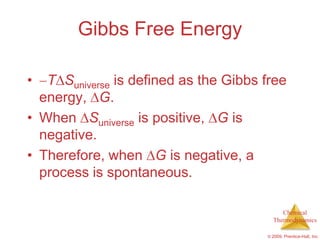
Gibbs Free Energy

•  T Suniverse is defined as the Gibbs free
  energy, G.
• When Suniverse is positive, G is
  negative.
• Therefore, when G is negative, a
  process is spontaneous.

                                            Chemical
                                         Thermodynamics

                                       © 2009, Prentice-Hall, Inc.
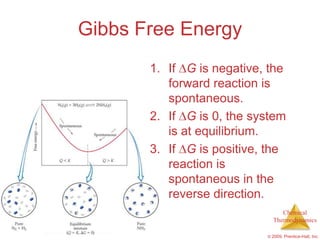
Gibbs Free Energy
       1. If G is negative, the
          forward reaction is
          spontaneous.
       2. If G is 0, the system
          is at equilibrium.
       3. If G is positive, the
          reaction is
          spontaneous in the
          reverse direction.
                                Chemical
                             Thermodynamics

                           © 2009, Prentice-Hall, Inc.
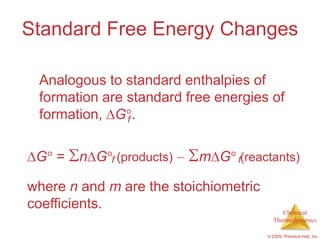
Standard Free Energy Changes

 Analogous to standard enthalpies of
 formation are standard free energies of
 formation, G f .

 G =    n G f (products)   m G f(reactants)

where n and m are the stoichiometric
coefficients.                               Chemical
                                         Thermodynamics

                                       © 2009, Prentice-Hall, Inc.
Free Energy Changes

At temperatures other than 25°C,

          G° = H      T S

How does G change with temperature?


                                        Chemical
                                     Thermodynamics

                                   © 2009, Prentice-Hall, Inc.
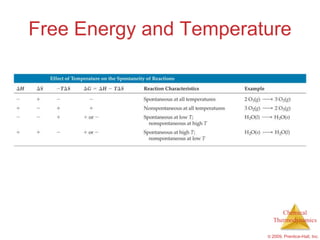
Free Energy and Temperature

• There are two parts to the free energy
  equation:
     H — the enthalpy term
  – T S — the entropy term
• The temperature dependence of free
  energy, then comes from the entropy
  term.
                                           Chemical
                                        Thermodynamics

                                      © 2009, Prentice-Hall, Inc.
Free Energy and Temperature


                             Chemical
                          Thermodynamics

                        © 2009, Prentice-Hall, Inc.
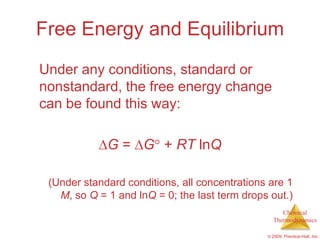
Free Energy and Equilibrium
Under any conditions, standard or
nonstandard, the free energy change
can be found this way:

             G = G + RT lnQ

 (Under standard conditions, all concentrations are 1
   M, so Q = 1 and lnQ = 0; the last term drops out.)
                                                    Chemical
                                                 Thermodynamics

                                               © 2009, Prentice-Hall, Inc.
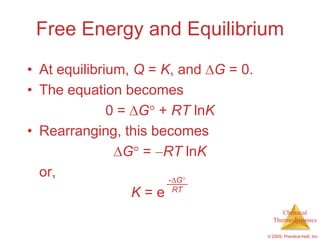
Free Energy and Equilibrium
• At equilibrium, Q = K, and G = 0.
• The equation becomes
              0 = G + RT lnK
• Rearranging, this becomes
                 G = RT lnK
  or,                   - G
                  K = e RT
                                           Chemical
                                        Thermodynamics

                                      © 2009, Prentice-Hall, Inc.

AP Chemistry Chapter 19 Outline

  • 1.
    Chemistry, The CentralScience, 11th edition Theodore L. Brown; H. Eugene LeMay, Jr.; and Bruce E. Bursten Chapter 19 Chemical Thermodynamics John D. Bookstaver Chemical St. Charles Community College Thermodynamics Cottleville, MO © 2009, Prentice-Hall, Inc.
  • 2.
    First Law ofThermodynamics • You will recall from Chapter 5 that energy cannot be created nor destroyed. • Therefore, the total energy of the universe is a constant. • Energy can, however, be converted from one form to another or transferred from a system to the surroundings or vice versa. Chemical Thermodynamics © 2009, Prentice-Hall, Inc.
  • 3.
    Spontaneous Processes • Spontaneousprocesses are those that can proceed without any outside intervention. • The gas in vessel B will spontaneously effuse into vessel A, but once the gas is in both vessels, it will not spontaneously return to vessel B. Chemical Thermodynamics © 2009, Prentice-Hall, Inc.
  • 4.
    Spontaneous Processes Processes that are spontaneous in one direction are nonspontaneous in the reverse direction. Chemical Thermodynamics © 2009, Prentice-Hall, Inc.
  • 5.
    Spontaneous Processes • Processesthat are spontaneous at one temperature may be nonspontaneous at other temperatures. • Above 0 C it is spontaneous for ice to melt. • Below 0 C the reverse process is spontaneous. Chemical Thermodynamics © 2009, Prentice-Hall, Inc.
  • 6.
    Reversible Processes In a reversible process the system changes in such a way that the system and surroundings can be put back in their original states by exactly reversing the process. Chemical Thermodynamics © 2009, Prentice-Hall, Inc.
  • 7.
    Irreversible Processes • Irreversibleprocesses cannot be undone by exactly reversing the change to the system. • Spontaneous processes are irreversible. Chemical Thermodynamics © 2009, Prentice-Hall, Inc.
  • 8.
    Entropy • Entropy (S)is a term coined by Rudolph Clausius in the 19th century. • Clausius was convinced of the significance of the ratio of heat delivered and the temperature at which it is delivered, q . T Chemical Thermodynamics © 2009, Prentice-Hall, Inc.
  • 9.
    Entropy • Entropy canbe thought of as a measure of the randomness of a system. • It is related to the various modes of motion in molecules. Chemical Thermodynamics © 2009, Prentice-Hall, Inc.
  • 10.
    Entropy • Like totalenergy, E, and enthalpy, H, entropy is a state function. • Therefore, S = Sfinal Sinitial Chemical Thermodynamics © 2009, Prentice-Hall, Inc.
  • 11.
    Entropy For a processoccurring at constant temperature (an isothermal process), the change in entropy is equal to the heat that would be transferred if the process were reversible divided by the temperature: qrev S= T Chemical Thermodynamics © 2009, Prentice-Hall, Inc.
  • 12.
    Second Law ofThermodynamics The second law of thermodynamics states that the entropy of the universe increases for spontaneous processes, and the entropy of the universe does not change for reversible processes. Chemical Thermodynamics © 2009, Prentice-Hall, Inc.
  • 13.
    Second Law ofThermodynamics In other words: For reversible processes: Suniv = Ssystem + Ssurroundings = 0 For irreversible processes: Suniv = Ssystem + Ssurroundings > 0 Chemical Thermodynamics © 2009, Prentice-Hall, Inc.
  • 14.
    Second Law ofThermodynamics These last truths mean that as a result of all spontaneous processes the entropy of the universe increases. Chemical Thermodynamics © 2009, Prentice-Hall, Inc.
  • 15.
    Entropy on theMolecular Scale • Ludwig Boltzmann described the concept of entropy on the molecular level. • Temperature is a measure of the average kinetic energy of the molecules in a sample. Chemical Thermodynamics © 2009, Prentice-Hall, Inc.
  • 16.
    Entropy on theMolecular Scale • Molecules exhibit several types of motion: – Translational: Movement of the entire molecule from one place to another. – Vibrational: Periodic motion of atoms within a molecule. – Rotational: Rotation of the molecule on about an axis or rotation about bonds. Chemical Thermodynamics © 2009, Prentice-Hall, Inc.
  • 17.
    Entropy on theMolecular Scale • Boltzmann envisioned the motions of a sample of molecules at a particular instant in time. – This would be akin to taking a snapshot of all the molecules. • He referred to this sampling as a microstate of the thermodynamic system. Chemical Thermodynamics © 2009, Prentice-Hall, Inc.
  • 18.
    Entropy on theMolecular Scale • Each thermodynamic state has a specific number of microstates, W, associated with it. • Entropy is S = k lnW where k is the Boltzmann constant, 1.38 10 23 J/K. Chemical Thermodynamics © 2009, Prentice-Hall, Inc.
  • 19.
    Entropy on theMolecular Scale • The change in entropy for a process, then, is S = k lnWfinal k lnWinitial lnWfinal S = k ln lnWinitial • Entropy increases with the number of microstates in the system. Chemical Thermodynamics © 2009, Prentice-Hall, Inc.
  • 20.
    Entropy on theMolecular Scale • The number of microstates and, therefore, the entropy tends to increase with increases in – Temperature. – Volume. – The number of independently moving molecules. Chemical Thermodynamics © 2009, Prentice-Hall, Inc.
  • 21.
    Entropy and PhysicalStates • Entropy increases with the freedom of motion of molecules. • Therefore, S(g) > S(l) > S(s) Chemical Thermodynamics © 2009, Prentice-Hall, Inc.
  • 22.
    Solutions Generally, when a solid is dissolved in a solvent, entropy increases. Chemical Thermodynamics © 2009, Prentice-Hall, Inc.
  • 23.
    Entropy Changes • Ingeneral, entropy increases when – Gases are formed from liquids and solids; – Liquids or solutions are formed from solids; – The number of gas molecules increases; – The number of moles increases. Chemical Thermodynamics © 2009, Prentice-Hall, Inc.
  • 24.
    Third Law ofThermodynamics The entropy of a pure crystalline substance at absolute zero is 0. Chemical Thermodynamics © 2009, Prentice-Hall, Inc.
  • 25.
    Standard Entropies • Theseare molar entropy values of substances in their standard states. • Standard entropies tend to increase with increasing molar mass. Chemical Thermodynamics © 2009, Prentice-Hall, Inc.
  • 26.
    Standard Entropies Larger andmore complex molecules have greater entropies. Chemical Thermodynamics © 2009, Prentice-Hall, Inc.
  • 27.
    Entropy Changes Entropy changesfor a reaction can be estimated in a manner analogous to that by which H is estimated: S = n S (products) — m S (reactants) where n and m are the coefficients in the balanced chemical equation. Chemical Thermodynamics © 2009, Prentice-Hall, Inc.
  • 28.
    Entropy Changes inSurroundings • Heat that flows into or out of the system changes the entropy of the surroundings. • For an isothermal process: qsys Ssurr = T • At constant pressure, qsys is simply H for the system. Chemical Thermodynamics © 2009, Prentice-Hall, Inc.
  • 29.
    Entropy Change inthe Universe • The universe is composed of the system and the surroundings. • Therefore, Suniverse = Ssystem + Ssurroundings • For spontaneous processes Suniverse > 0 Chemical Thermodynamics © 2009, Prentice-Hall, Inc.
  • 30.
    Entropy Change inthe Universe qsystem • Since Ssurroundings = T and qsystem = Hsystem This becomes: Hsystem Suniverse = Ssystem + T Multiplying both sides by T, we get T Suniverse = Hsystem T Ssystem Chemical Thermodynamics © 2009, Prentice-Hall, Inc.
  • 31.
    Gibbs Free Energy • T Suniverse is defined as the Gibbs free energy, G. • When Suniverse is positive, G is negative. • Therefore, when G is negative, a process is spontaneous. Chemical Thermodynamics © 2009, Prentice-Hall, Inc.
  • 32.
    Gibbs Free Energy 1. If G is negative, the forward reaction is spontaneous. 2. If G is 0, the system is at equilibrium. 3. If G is positive, the reaction is spontaneous in the reverse direction. Chemical Thermodynamics © 2009, Prentice-Hall, Inc.
  • 33.
    Standard Free EnergyChanges Analogous to standard enthalpies of formation are standard free energies of formation, G f . G = n G f (products) m G f(reactants) where n and m are the stoichiometric coefficients. Chemical Thermodynamics © 2009, Prentice-Hall, Inc.
  • 34.
    Free Energy Changes Attemperatures other than 25°C, G° = H T S How does G change with temperature? Chemical Thermodynamics © 2009, Prentice-Hall, Inc.
  • 35.
    Free Energy andTemperature • There are two parts to the free energy equation: H — the enthalpy term – T S — the entropy term • The temperature dependence of free energy, then comes from the entropy term. Chemical Thermodynamics © 2009, Prentice-Hall, Inc.
  • 36.
    Free Energy andTemperature Chemical Thermodynamics © 2009, Prentice-Hall, Inc.
  • 37.
    Free Energy andEquilibrium Under any conditions, standard or nonstandard, the free energy change can be found this way: G = G + RT lnQ (Under standard conditions, all concentrations are 1 M, so Q = 1 and lnQ = 0; the last term drops out.) Chemical Thermodynamics © 2009, Prentice-Hall, Inc.
  • 38.
    Free Energy andEquilibrium • At equilibrium, Q = K, and G = 0. • The equation becomes 0 = G + RT lnK • Rearranging, this becomes G = RT lnK or, - G K = e RT Chemical Thermodynamics © 2009, Prentice-Hall, Inc.