General
Chemistry 1
Quarter 1 Week
Mass Relationships in
Chemical Reactions
After going through this lesson, you are expected to:
1. calculate molecular formula given molar mass (STEM_GC11PClf-
33);
2. write and balance chemical equations (STEM_GC11CRlf-g-37);
3. construct mole or mass ratios for a reaction in order to calculate
the amount of reactant needed or amount of product formed in
terms of moles or mass (STEM_GC11MRlg-h-38);
4. calculate percent yield and theoretical yield of the reaction
(STEM_GC11MRlg- h-39);
5. explain the concept of limiting reagent in a chemical reaction;
identify the excess reagent(s) (STEM_GC11MRlg-h-40); and
6. determine mass relationship in a chemical reaction
(STEM_GC11MRlg-h-42)
Choose the letter of the correct answer. Please write down your
answer in another sheet of paper.
1. Nicotine, an alkaloid in the nightshade family of plants that is
mainly responsible for the addictive nature of cigarettes, contains
74.02% C, 8.710% H, and 17.27% N. If 40.57 g of nicotine contains
0.2500 mol nicotine, what is the molecular formula?
A. CH2N B. C5H7N C. C10H14N2 D. C20H28N4
2. Balance the following equation with the SMALLEST WHOLE
NUMBER
COEFFICIENTS possible. Which is the SUM of the coefficients in the
balanced
equation: ___KClO3 ___ KCl + ____ O2 ?
→
A. 5 B. 6 C. 7 D. 8
3. In the balanced equation 4NH3 + 7O2 4NO2 + 6H2O, how
→
many mole(s) of O2 is
needed to react with 1.00 mole of NH3?
A. 1.25 B. 1.33 C. 1.75 D. 3.5
4. How many grams of H2O will be formed when 32.0 g H2 is
allowed to react with
16.0 g O2 according to 2 H2 + O2 2H2O ?
→
A. 9.0 g B. 16.0 g C. 18.0 g D. 32.0 g
5. What is a limiting reagent? It is a reactant that is _____.
A. is never used up
B. in excess and does not get used up in the reaction
C. used up last and prevents more product from being made
D. used up first and prevents more products from being made
6. Consider the reaction: 2Al + 3Cl2 → 2AlCl3. How many grams
of aluminum chloride could be produced from 34.0 g of
aluminum and 39.0 g of chlorine gas?
A. 0.367 g
B. 1.26 g
C. 12.30 g
D. 48.9g
7. What mass in grams of AgCl is produced when 4.22 g of
AgNO3 react with 7.73 g
of AlCl3? Use the following equation: 3AgNO3 + AlCl3 →
Al(NO3)3 + 3AgCl
A. 0.0248 g B. 0.174 g C. 3.56 g D. 24.9 g
8. In the oxidation of ethane, 2C2H6 + 7O2 → 4CO2 + 6H2O, how
many moles of
O2 are required to react with 1 mole of ethane?
A. 7 mol
B. 2 mol
C. 7/2 mol
D. 2/7 mol
9. In the reaction 2C2H6 + 7O2 → 4CO2 + 6H2O, how many
moles of CO2 are formed when 1 mole of O2 is consumed?
A. 2 mol
B. 7/4 mol
C. 4/7 mol
D. 7 mol
10. How many moles of CO2 are formed when 5 moles of ethane
are consumed,
considering the reaction: 2C2H6 + 7O2 → 4CO2 + 6H2O?
A. 2 mol B. 4 mol C. 5 mol D. 10 mol
11. Which is studied in stoichiometry?
A. rates of chemical reactions
B. activation energy of chemical reactions
C. heat evolved or absorbed during chemical reactions
D. amounts of materials consumed and products in chemical
reactions
12. What do you call the amount of product that can be made in
a chemical reaction
based on the amount of limiting reactant?
A. Actual yield C. Theoretical yield
B. Percent yield D. None of these
13. What is the term for the number written before a chemical
formula to balance a
chemical equation?
A. coefficient B. subscript C. superscript D. unit
14. What is a substance that undergo chemical change called?
A. excess reagent B. limiting reagent C. product D. reactant
15. Which states that matter is neither created nor destroyed
during a physical or
chemical reaction?
A. Periodic Law C. Law of Conservation of Energy
B. Law of Entropy D. Law of Conservation of Matter
Molecular Formula
from Molar Mass
To calculate the actual, molecular formula we
must know the approximate molar mass of the
compound in addition to its empirical formula.
Knowing that the molar mass of a compound
must be an integral multiple of the molar mass of
its empirical formula, we can use the molar mass
to find the molecular formula, as the following
example demonstrates.
Example:
A sample of a compound contains 1.52 g of
nitrogen (N) and 3.47 g of oxygen (O). The molar
mass of this compound is between 90 g and 95 g.
Determine the molecular formula and the
accurate molar mass of the compound.
Strategy:
To determine the molecular formula, we first
need to determine the empirical formula. How do
we convert between grams and moles?
Comparing the empirical molar mass to the
experimentally determined molar mass will reveal
the relationship between the empirical formula
and molecular formula.
Solution:
We are given grams of N and O. Use molar
mass as a conversion factor to convert grams to
moles of each element. Let n represent the
number of moles of each element. We write
Thus, we arrive at the formula N0.108 O0.217 , which
gives the identity and the
ratios of atoms present. However, chemical formulas are
written with whole
numbers. Try to convert to whole numbers by dividing the
subscripts by the smaller
subscript (0.108). After rounding off, we obtain NO2 as
the empirical formula.
The molecular formula might be the same as the empirical
formula or some
integral multiple of it (for example, two, three, four, or more
times the empirical
formula). Comparing the ratio of the molar mass to the molar
mass of the empirical
formula will show the integral relationship between the empirical
and molecular
formulas. The molar mass of the empirical formula NO2 is
Empirical molar mass = 14.01 g + 2(16.00 g) = 46.01 g
Next, we determine the ratio between the molar mass and the
empirical molar mass
Next, we determine the ratio between the molar mass and the
empirical molar mass
The molar mass is twice the empirical molar mass. This means
that there are two
NO2 units in each molecule of the compound, and the molecular
formula is (NO2)2 or N2O4. The actual molar mass of the
compound is two times the empirical molar mass, that is, 2(46.01 g)
or 92.02 g, which is between 90 g and 95 g.
Read each problem carefully and answer what is asked. Show
your solutions. Use a
separate sheet of paper.
1. A sample of a compound containing Boron (B) and hydrogen
(H) contains
6.444 g of B and 1.803 g of H. The molar mass of the compound
is about 30
g. What is its molecular formula?
2. An unknown compound is found to contain 40.0% carbon,
6.7% hydrogen,
and 53.3% oxygen with a molecular mass of 60.0 g/mol. What is
the
molecular formula of the unknown compound?
3. Naphthalene is a compound containing carbon and hydrogen
that is often
used in mothballs. Its empirical formula is C5H4 and its molar
mass is 128.16
g/mol. What is its molecular formula?
Writing and
Balancing Chemical
Equations
At the heart of chemistry, is the study of chemical changes. Some chemical
changes are simple; others are complex. Some are dramatic, while some are very
subtle. Even as you sit reading this module, chemical changes are occurring within
your body. Chemical changes that occur in your eyes and brain, for example, allow
you to see these words and think about them. Although such chemical changes or
reactions are not as obvious as some, they are nevertheless remarkable for how they
allow us to function. In this lesson, we shall look at various chemical changes or
reactions and represent them with chemical equations.
When a car is driven, hydrocarbons such as octane (in
gasoline) react with oxygen from the air to form carbon
dioxide gas and water (Figure 4.2). This reaction produces
heat, which expands the gases in the car’s cylinders,
accelerating it forward. Reactions such as this one—in
which a substance reacts with oxygen, emitting heat and
forming one or more oxygen-containing compounds—are
combustion reactions.
A chemical equation is a representation of a chemical
reaction that displays the reactants and products with
chemical formulas. The chemical equation for the reaction
of methane with oxygen is shown:
It is often important to know the physical states of the reactants
and products
taking part in a reaction. To do this, put the appropriate symbol
in parentheses after
each formula: (s) for solid, (l) for liquid, (g) for gas, and (aq)
for an aqueous (waterbased) solution. At room temperature, the
components of the previous reaction are
in the following states:
CH4(g) + O2(g) → CO2(g) + H2O(l)
The following table shows a listing of symbols used in
chemical equations.
Table 3.1 Symbols Used in Chemical Equations
The following table shows a listing of symbols used in
chemical equations.
Table 3.1 Symbols Used in Chemical Equations
Law of Conservation of Mass
The Law of Conservation of Mass states that, during a
physical or chemical change, matter is neither created nor
destroyed. Therefore, for chemical reactions:
1. The total numbers of each type of atom are the same
before and after a
reaction has occurred.
2. The total mass of the products will be equal to the
total mass of the reactants.
In other words, although chemical reactions involve the
formation of new substances, they do not involve the
formation of new atoms. The only difference between
reactants and products is how atoms are arranged, as a
result of the breaking and forming of chemical bonds.
Balancing Chemical Equations
Often a formula equation does not show equal numbers
of each type of atom on both sides of the equation.
Consider the following equation for the reaction between
nitrogen and hydrogen to form ammonia:
N2 + H2 → NH3
The left side of the equation (the reactants) shows 2 nitrogen
atoms whereas the right side of the equation (the product) shows 1
nitrogen atom. Similarly, the left side of the equation shows 2
hydrogen atoms whereas the right side of the equation shows 3
hydrogen atoms. When a formula equation shows unequal
numbers of atoms on either side of the equation, the equation is
said to be unbalanced. The equation is not demonstrating
conservation of mass. To demonstrate conservation of mass by
having equal numbers of atoms on either side of the equation, the
equation needs to be balanced.
When first learning how to balance chemical equations, it can
be helpful to draw diagrams of reactants and products. For
example, the above reaction between nitrogen and hydrogen can
be illustrated by the following diagram:
If a formula equation is unbalanced when it is first written, it
means that the reactants and products do not exist in equal ratios.
For example, in the above reaction, one nitrogen molecule does
not combine with one hydrogen molecule to form one ammonia
molecule. Therefore, we need to determine the correct ratio for all
reactants and products that will result in equal numbers of each
type of atom on both sides of the equation. When balancing a
chemical equation, deal with one type of atom at a time. Let us
balance the above equation by first balancing the number of
nitrogen atoms. We will use diagrams and tallies to help us.
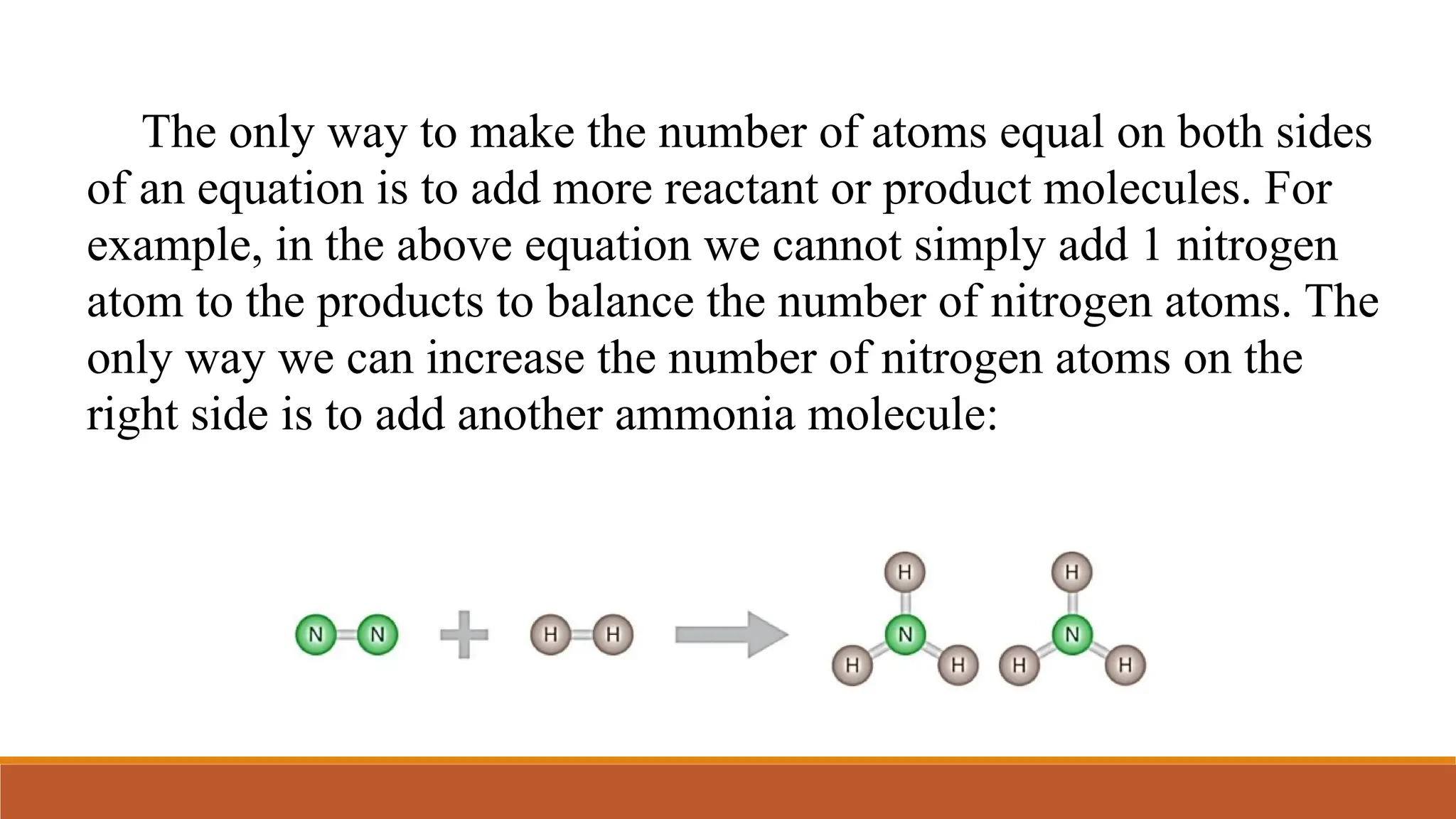
The only way to make the number of atoms equal on both sides
of an equation is to add more reactant or product molecules. For
example, in the above equation we cannot simply add 1 nitrogen
atom to the products to balance the number of nitrogen atoms. The
only way we can increase the number of nitrogen atoms on the
right side is to add another ammonia molecule:
Now we have balanced the number of nitrogen atoms, but the
number of hydrogen atoms remains unbalanced. We have 2
hydrogen atoms on the left and 6 on the right. The only way to
increase the number of hydrogen atoms on the left is to add
hydrogen molecules. To have 6 hydrogen atoms in total, we need
3 hydrogen molecules, so we need to add 2 more:
We have now balanced the number of nitrogen atoms and the
number of hydrogen atoms. The last step is to rewrite the
formula equation so that it corresponds with our diagram. We
do this by adding numbers called coefficients in front of the
chemical formulas of reactants and products that have more than
one copy. So we need to write “3” in front of H2 to represent 3
hydrogen molecules, and a “2” in front of NH3 to represent 2
ammonia molecules.
We do not add a “1” in front of N2 to represent 1 nitrogen
molecule (just as we don’t have a subscript 1 next to the N in
ammonia to represent 1 nitrogen atom). Therefore, our balanced
equation is:
N2 + 3H2 → 2NH3
Tips for Balancing Chemical Equations
• When first learning to balance chemical equations, use
diagrams and tallies.
• Only adjust one type of atom at a time.
• Remember that coefficients change the tallies for all atoms
in a substance, not
just the atom you are trying to balance.
• If the equation contains elements, leave them until last
when adjustingcoefficients. This is because they can be adjusted
without affecting the tallies
of other atoms.
• You can only balance an equation by placing
coefficients in front of
substances. Never adjust the subscript numbers that are part of
a chemical
formula. For example, you cannot change H2O to H2O2, it
must be written as
2 H2O if you wish to double the number of oxygen atoms.
• Only place whole numbers (2, 3, 4 etc.) in front of chemical
formulas. If you
find that a fraction is required to balance an equation, multiply
all coefficients by the smallest number required to convert the
fraction to a whole number.
Stoichiometr
y
Stoichiometry is the area of study that examines the
quantities of substances consumed and produced in chemical
reactions. This study of stoichiometry provides an essential set
of tools that is widely used in chemistry. Aspects of
stoichiometry include such diverse problems as measuring
the concentration of ozone in the atmosphere, determining the
potential yield of gold from an ore, and assessing different
processes for converting coal into gaseous fuels. We will study
stoichiometry in this lesson to understand these processes better.
Making Pancakes: Relationship Between Ingredients
The concepts of stoichiometry are similar to the concepts we use in
following a cooking recipe. Calculating the amount of carbon dioxide
produced by the combustion of a given amount of a fossil fuel is similar to
calculating the number of pancakes that can be made from a given number
of eggs. For example, suppose you use the following pancake recipe:
1 cup flour + 2 eggs + ½ tsp baking powder → 5 pancakes
The recipe shows the numerical relationships between the
pancake ingredients. It says that if we have 2 eggs—and enough of
everything else—we can make 5 pancakes. We can write this relationship as
a ratio.
2 eggs : 5 pancakes
What if we have 8 eggs? Assuming that we have enough of everything
else, how many pancakes can we make? Using the preceding ratio as a
conversion factor, we can determine that 8 eggs are sufficient to make
20 pancakes.
8 eggs × 5 2 = 20 pancakes
The pancake recipe contains numerical conversion factors between
the pancake ingredients and the number of pancakes. Other conversion
factors from this
recipe include:
1 cup flour : 5 pancakes
½ tsp baking powder : 5 pancakes
The recipe also gives us relationships among the ingredients themselves.
For example, how much baking powder is required to go with 3 cups of
flour? From the recipe:
1 cup flour : ½ tsp baking powder
With this ratio, we can form the conversion factor to calculate the
appropriate
amount of baking powder.
1 cup flour
Making Molecules: Mole-to-Mole Conversions (Mole Ratio)
In a balanced chemical equation, we have a “recipe” for how reactants
combine to form products. For example, the following equation shows
how hydrogen and nitrogen combine to form ammonia (NH3).
Making Molecules: Mole-to-Mole Conversions (Mole Ratio)
In a balanced chemical equation, we have a “recipe” for how reactants
combine to form products. For example, the following equation shows
how hydrogen and nitrogen combine to form ammonia (NH3).
The balanced equation shows that 3H2 molecules react with 1 N2
molecule to
form 2 NH3 molecules. We can express these relationships as the
following ratios.
3 H2 molecules : 1 N2 molecule : 2 NH3 molecules
Since we do not ordinarily deal with individual molecules, we can
express the
same ratios in moles.
3 mol H2 : 1 mol N2 : 2 mol NH3
If we have 3 mol of N2, and more than enough H2 how much NH3 can
we
make? We first sort the information in the problem.
Given: 3 mol N2
Find: mol NH3
Solution Map:
We then strategize by drawing a solution map that begins with mol N2
and
ends with mol NH3. The conversion factor comes from the balanced
chemical
equation.
Making Molecules: Mass-to-Mass Conversions
We have seen how a chemical equation contains conversion factors
between moles of reactants and moles of products. However, we are
often interested in relationships between mass of reactants and mass of
products. For example, we might want to know the mass of carbon
dioxide emitted by an
automobile per kilogram of gasoline used. Or we might want to know
the mass of each reactant required to obtain a certain mass of a
production a synthesis reaction. The general outline for these types of
calculations is:
where A and B are two different substances involved in the reaction. We
use the molar mass of A to convert from mass of A to moles of A. We use
the ratio from the balanced equation to convert from moles of A to
moles of B, and we use the molar mass of B to convert moles of B to
mass of B. For example, suppose we want to calculate the mass of CO2
emitted upon the combustion of 5.0 X 10² g of pure octane. The
balanced chemical equation for octane combustion is:
2 C8H18(l) + 25 O2(g) → 16 CO2(g) + 18 H2O(g)
We begin by sorting the information in the problem.
Choose the letter of the correct answer. Write your answers on a
separate sheet of
paper.
1. Consider the reaction: NaCl + AgNO3 → AgCl + NaNO3. If 52 g of
salt reacts with
silver nitrate, what mass in grams of silver chloride will be produced?
A. 0.89 B. 98 C. 128 D. 150
2. How many grams of hydrogen gas will be produced from the reaction
of zinc metal
with 47 grams of hydrochloric acid?
A. 1.3 B. 95 C. 128 D. 132
3. 78.2 g of solid iron reacts with oxygen gas forming iron (III) oxide.
How many moles
of oxygen will react?
A. 1.05 B. 1.40 C. 95 D. 98
4. Consider the reaction: Cu + 2AgNO3 →Cu(NO3)2 + 2Ag. If 12.0 g of
Cu reacts with
silver nitrate, how many grams of Ag are recovered?
A.0.89 B. 40.7 C. 250 D. 309
5. For the reaction H2O + SO2 → H2SO3, what mass in grams of
sulfurous acid is
produced, when 195 g of sulfur dioxide is reacted with water?
A. 1.3 B. 20 C. 150 D. 250
6. Consider the reaction: C + 2ZnO → CO2 + 2Zn. How many grams of
carbon dioxide
will be produced if 74 grams of ZnO is completely reacted?
A. 1.05 B. 3.3 C. 20 D. 38
7. The complete conversion of 128 grams of hydrogen to ammonia
would require how
many moles of nitrogen gas?
A. 3.04 B. 21.1 C. 63.4 D. 190
8. For the reaction 2Fe + 3S → Fe2S3, how many grams of sulfur are
involved in this
reaction if 83 grams of iron are needed to react with sulfur?
A. 2.2 B. 63.4 C. 68.3 D.71
9. A compound with molar mass of 74.1 g/mol is found to contain 64.8%
Carbon,
13.5% Hydrogen, and 21.7% Oxygen. What is its molecular formula?
A. C2H5O B. C4H10O C. C6H12O6 D. C6H14O3
10. Consider the reaction: C + 2H2 → CH4. How many grams of
methane gas will be
produced if 3.4 moles of hydrogen gas are available to react?
A. 21.1 B. 27 C. 59 D. 190
11. A compound having a molar mass of 175 g/mol contains 40.0%
Carbon, 6.7%
Hydrogen, 53.3% Oxygen. What is its molecular formula?
A. C2H5O B. C4H10O C. C6H12O6 D. C6H14O3
12. After analysis, the percentage composition of a certain compound
was found to
be 85.7% Carbon and 14.3% Hydrogen by mass. What is the molecular
formula of
this compound?
A. CH3 B. CH4 C. C6H D. C2H4
13. Calcium carbonate decomposes when heated: CaCO3 → CaO +
CO2. What is the
mass of calcium oxide produced by the complete decomposition of 25
grams of
calcium carbonate?
A: 8 grams B. 10 grams C. 14 grams D. 25 grams
14. Hydrogen gas is easily produced by the reaction between an active
metal and
sulfuric acid solution. The reaction may be represented as: M + H2SO4
→ H2 + MSO4
(where M is a metal). Which of the following, when reacted this way,
would produce
the largest amount of hydrogen per gram of metal?
A. magnesium B. nickel C. tin D. zinc
15. How many moles of oxygen gas are necessary to burn one mole of
acetone?
A. 2.5 B. 3 C. 3.5 D. 4

4_Q1 Gen Chem 1 - Mass relationship.pptx

  • 1.
    General Chemistry 1 Quarter 1Week Mass Relationships in Chemical Reactions
  • 2.
    After going throughthis lesson, you are expected to: 1. calculate molecular formula given molar mass (STEM_GC11PClf- 33); 2. write and balance chemical equations (STEM_GC11CRlf-g-37); 3. construct mole or mass ratios for a reaction in order to calculate the amount of reactant needed or amount of product formed in terms of moles or mass (STEM_GC11MRlg-h-38); 4. calculate percent yield and theoretical yield of the reaction (STEM_GC11MRlg- h-39); 5. explain the concept of limiting reagent in a chemical reaction; identify the excess reagent(s) (STEM_GC11MRlg-h-40); and 6. determine mass relationship in a chemical reaction (STEM_GC11MRlg-h-42)
  • 3.
    Choose the letterof the correct answer. Please write down your answer in another sheet of paper. 1. Nicotine, an alkaloid in the nightshade family of plants that is mainly responsible for the addictive nature of cigarettes, contains 74.02% C, 8.710% H, and 17.27% N. If 40.57 g of nicotine contains 0.2500 mol nicotine, what is the molecular formula? A. CH2N B. C5H7N C. C10H14N2 D. C20H28N4
  • 4.
    2. Balance thefollowing equation with the SMALLEST WHOLE NUMBER COEFFICIENTS possible. Which is the SUM of the coefficients in the balanced equation: ___KClO3 ___ KCl + ____ O2 ? → A. 5 B. 6 C. 7 D. 8 3. In the balanced equation 4NH3 + 7O2 4NO2 + 6H2O, how → many mole(s) of O2 is needed to react with 1.00 mole of NH3? A. 1.25 B. 1.33 C. 1.75 D. 3.5 4. How many grams of H2O will be formed when 32.0 g H2 is allowed to react with 16.0 g O2 according to 2 H2 + O2 2H2O ? → A. 9.0 g B. 16.0 g C. 18.0 g D. 32.0 g
  • 5.
    5. What isa limiting reagent? It is a reactant that is _____. A. is never used up B. in excess and does not get used up in the reaction C. used up last and prevents more product from being made D. used up first and prevents more products from being made 6. Consider the reaction: 2Al + 3Cl2 → 2AlCl3. How many grams of aluminum chloride could be produced from 34.0 g of aluminum and 39.0 g of chlorine gas? A. 0.367 g B. 1.26 g C. 12.30 g D. 48.9g
  • 6.
    7. What massin grams of AgCl is produced when 4.22 g of AgNO3 react with 7.73 g of AlCl3? Use the following equation: 3AgNO3 + AlCl3 → Al(NO3)3 + 3AgCl A. 0.0248 g B. 0.174 g C. 3.56 g D. 24.9 g 8. In the oxidation of ethane, 2C2H6 + 7O2 → 4CO2 + 6H2O, how many moles of O2 are required to react with 1 mole of ethane? A. 7 mol B. 2 mol C. 7/2 mol D. 2/7 mol
  • 7.
    9. In thereaction 2C2H6 + 7O2 → 4CO2 + 6H2O, how many moles of CO2 are formed when 1 mole of O2 is consumed? A. 2 mol B. 7/4 mol C. 4/7 mol D. 7 mol 10. How many moles of CO2 are formed when 5 moles of ethane are consumed, considering the reaction: 2C2H6 + 7O2 → 4CO2 + 6H2O? A. 2 mol B. 4 mol C. 5 mol D. 10 mol
  • 8.
    11. Which isstudied in stoichiometry? A. rates of chemical reactions B. activation energy of chemical reactions C. heat evolved or absorbed during chemical reactions D. amounts of materials consumed and products in chemical reactions 12. What do you call the amount of product that can be made in a chemical reaction based on the amount of limiting reactant? A. Actual yield C. Theoretical yield B. Percent yield D. None of these
  • 9.
    13. What isthe term for the number written before a chemical formula to balance a chemical equation? A. coefficient B. subscript C. superscript D. unit 14. What is a substance that undergo chemical change called? A. excess reagent B. limiting reagent C. product D. reactant 15. Which states that matter is neither created nor destroyed during a physical or chemical reaction? A. Periodic Law C. Law of Conservation of Energy B. Law of Entropy D. Law of Conservation of Matter
  • 10.
  • 11.
    To calculate theactual, molecular formula we must know the approximate molar mass of the compound in addition to its empirical formula. Knowing that the molar mass of a compound must be an integral multiple of the molar mass of its empirical formula, we can use the molar mass to find the molecular formula, as the following example demonstrates.
  • 12.
    Example: A sample ofa compound contains 1.52 g of nitrogen (N) and 3.47 g of oxygen (O). The molar mass of this compound is between 90 g and 95 g. Determine the molecular formula and the accurate molar mass of the compound.
  • 13.
    Strategy: To determine themolecular formula, we first need to determine the empirical formula. How do we convert between grams and moles? Comparing the empirical molar mass to the experimentally determined molar mass will reveal the relationship between the empirical formula and molecular formula.
  • 14.
    Solution: We are givengrams of N and O. Use molar mass as a conversion factor to convert grams to moles of each element. Let n represent the number of moles of each element. We write
  • 15.
    Thus, we arriveat the formula N0.108 O0.217 , which gives the identity and the ratios of atoms present. However, chemical formulas are written with whole numbers. Try to convert to whole numbers by dividing the subscripts by the smaller subscript (0.108). After rounding off, we obtain NO2 as the empirical formula.
  • 16.
    The molecular formulamight be the same as the empirical formula or some integral multiple of it (for example, two, three, four, or more times the empirical formula). Comparing the ratio of the molar mass to the molar mass of the empirical formula will show the integral relationship between the empirical and molecular formulas. The molar mass of the empirical formula NO2 is Empirical molar mass = 14.01 g + 2(16.00 g) = 46.01 g
  • 17.
    Next, we determinethe ratio between the molar mass and the empirical molar mass
  • 18.
    Next, we determinethe ratio between the molar mass and the empirical molar mass
  • 19.
    The molar massis twice the empirical molar mass. This means that there are two NO2 units in each molecule of the compound, and the molecular formula is (NO2)2 or N2O4. The actual molar mass of the compound is two times the empirical molar mass, that is, 2(46.01 g) or 92.02 g, which is between 90 g and 95 g.
  • 20.
    Read each problemcarefully and answer what is asked. Show your solutions. Use a separate sheet of paper. 1. A sample of a compound containing Boron (B) and hydrogen (H) contains 6.444 g of B and 1.803 g of H. The molar mass of the compound is about 30 g. What is its molecular formula?
  • 21.
    2. An unknowncompound is found to contain 40.0% carbon, 6.7% hydrogen, and 53.3% oxygen with a molecular mass of 60.0 g/mol. What is the molecular formula of the unknown compound? 3. Naphthalene is a compound containing carbon and hydrogen that is often used in mothballs. Its empirical formula is C5H4 and its molar mass is 128.16 g/mol. What is its molecular formula?
  • 22.
  • 23.
    At the heartof chemistry, is the study of chemical changes. Some chemical changes are simple; others are complex. Some are dramatic, while some are very subtle. Even as you sit reading this module, chemical changes are occurring within your body. Chemical changes that occur in your eyes and brain, for example, allow you to see these words and think about them. Although such chemical changes or reactions are not as obvious as some, they are nevertheless remarkable for how they allow us to function. In this lesson, we shall look at various chemical changes or reactions and represent them with chemical equations.
  • 25.
    When a caris driven, hydrocarbons such as octane (in gasoline) react with oxygen from the air to form carbon dioxide gas and water (Figure 4.2). This reaction produces heat, which expands the gases in the car’s cylinders, accelerating it forward. Reactions such as this one—in which a substance reacts with oxygen, emitting heat and forming one or more oxygen-containing compounds—are combustion reactions.
  • 26.
    A chemical equationis a representation of a chemical reaction that displays the reactants and products with chemical formulas. The chemical equation for the reaction of methane with oxygen is shown:
  • 27.
    It is oftenimportant to know the physical states of the reactants and products taking part in a reaction. To do this, put the appropriate symbol in parentheses after each formula: (s) for solid, (l) for liquid, (g) for gas, and (aq) for an aqueous (waterbased) solution. At room temperature, the components of the previous reaction are in the following states: CH4(g) + O2(g) → CO2(g) + H2O(l)
  • 28.
    The following tableshows a listing of symbols used in chemical equations. Table 3.1 Symbols Used in Chemical Equations
  • 29.
    The following tableshows a listing of symbols used in chemical equations. Table 3.1 Symbols Used in Chemical Equations
  • 31.
    Law of Conservationof Mass The Law of Conservation of Mass states that, during a physical or chemical change, matter is neither created nor destroyed. Therefore, for chemical reactions: 1. The total numbers of each type of atom are the same before and after a reaction has occurred. 2. The total mass of the products will be equal to the total mass of the reactants.
  • 32.
    In other words,although chemical reactions involve the formation of new substances, they do not involve the formation of new atoms. The only difference between reactants and products is how atoms are arranged, as a result of the breaking and forming of chemical bonds.
  • 33.
    Balancing Chemical Equations Oftena formula equation does not show equal numbers of each type of atom on both sides of the equation. Consider the following equation for the reaction between nitrogen and hydrogen to form ammonia: N2 + H2 → NH3
  • 34.
    The left sideof the equation (the reactants) shows 2 nitrogen atoms whereas the right side of the equation (the product) shows 1 nitrogen atom. Similarly, the left side of the equation shows 2 hydrogen atoms whereas the right side of the equation shows 3 hydrogen atoms. When a formula equation shows unequal numbers of atoms on either side of the equation, the equation is said to be unbalanced. The equation is not demonstrating conservation of mass. To demonstrate conservation of mass by having equal numbers of atoms on either side of the equation, the equation needs to be balanced.
  • 35.
    When first learninghow to balance chemical equations, it can be helpful to draw diagrams of reactants and products. For example, the above reaction between nitrogen and hydrogen can be illustrated by the following diagram:
  • 37.
    If a formulaequation is unbalanced when it is first written, it means that the reactants and products do not exist in equal ratios. For example, in the above reaction, one nitrogen molecule does not combine with one hydrogen molecule to form one ammonia molecule. Therefore, we need to determine the correct ratio for all reactants and products that will result in equal numbers of each type of atom on both sides of the equation. When balancing a chemical equation, deal with one type of atom at a time. Let us balance the above equation by first balancing the number of nitrogen atoms. We will use diagrams and tallies to help us.
  • 38.
    The only wayto make the number of atoms equal on both sides of an equation is to add more reactant or product molecules. For example, in the above equation we cannot simply add 1 nitrogen atom to the products to balance the number of nitrogen atoms. The only way we can increase the number of nitrogen atoms on the right side is to add another ammonia molecule:
  • 40.
    Now we havebalanced the number of nitrogen atoms, but the number of hydrogen atoms remains unbalanced. We have 2 hydrogen atoms on the left and 6 on the right. The only way to increase the number of hydrogen atoms on the left is to add hydrogen molecules. To have 6 hydrogen atoms in total, we need 3 hydrogen molecules, so we need to add 2 more:
  • 42.
    We have nowbalanced the number of nitrogen atoms and the number of hydrogen atoms. The last step is to rewrite the formula equation so that it corresponds with our diagram. We do this by adding numbers called coefficients in front of the chemical formulas of reactants and products that have more than one copy. So we need to write “3” in front of H2 to represent 3 hydrogen molecules, and a “2” in front of NH3 to represent 2 ammonia molecules.
  • 43.
    We do notadd a “1” in front of N2 to represent 1 nitrogen molecule (just as we don’t have a subscript 1 next to the N in ammonia to represent 1 nitrogen atom). Therefore, our balanced equation is: N2 + 3H2 → 2NH3
  • 44.
    Tips for BalancingChemical Equations • When first learning to balance chemical equations, use diagrams and tallies. • Only adjust one type of atom at a time. • Remember that coefficients change the tallies for all atoms in a substance, not just the atom you are trying to balance. • If the equation contains elements, leave them until last when adjustingcoefficients. This is because they can be adjusted without affecting the tallies of other atoms.
  • 45.
    • You canonly balance an equation by placing coefficients in front of substances. Never adjust the subscript numbers that are part of a chemical formula. For example, you cannot change H2O to H2O2, it must be written as 2 H2O if you wish to double the number of oxygen atoms. • Only place whole numbers (2, 3, 4 etc.) in front of chemical formulas. If you find that a fraction is required to balance an equation, multiply all coefficients by the smallest number required to convert the fraction to a whole number.
  • 50.
  • 51.
    Stoichiometry is thearea of study that examines the quantities of substances consumed and produced in chemical reactions. This study of stoichiometry provides an essential set of tools that is widely used in chemistry. Aspects of stoichiometry include such diverse problems as measuring the concentration of ozone in the atmosphere, determining the potential yield of gold from an ore, and assessing different processes for converting coal into gaseous fuels. We will study stoichiometry in this lesson to understand these processes better.
  • 52.
    Making Pancakes: RelationshipBetween Ingredients The concepts of stoichiometry are similar to the concepts we use in following a cooking recipe. Calculating the amount of carbon dioxide produced by the combustion of a given amount of a fossil fuel is similar to calculating the number of pancakes that can be made from a given number of eggs. For example, suppose you use the following pancake recipe: 1 cup flour + 2 eggs + ½ tsp baking powder → 5 pancakes The recipe shows the numerical relationships between the pancake ingredients. It says that if we have 2 eggs—and enough of everything else—we can make 5 pancakes. We can write this relationship as a ratio.
  • 53.
    2 eggs :5 pancakes What if we have 8 eggs? Assuming that we have enough of everything else, how many pancakes can we make? Using the preceding ratio as a conversion factor, we can determine that 8 eggs are sufficient to make 20 pancakes. 8 eggs × 5 2 = 20 pancakes The pancake recipe contains numerical conversion factors between the pancake ingredients and the number of pancakes. Other conversion factors from this recipe include: 1 cup flour : 5 pancakes ½ tsp baking powder : 5 pancakes
  • 54.
    The recipe alsogives us relationships among the ingredients themselves. For example, how much baking powder is required to go with 3 cups of flour? From the recipe: 1 cup flour : ½ tsp baking powder With this ratio, we can form the conversion factor to calculate the appropriate amount of baking powder. 1 cup flour Making Molecules: Mole-to-Mole Conversions (Mole Ratio) In a balanced chemical equation, we have a “recipe” for how reactants combine to form products. For example, the following equation shows how hydrogen and nitrogen combine to form ammonia (NH3).
  • 55.
    Making Molecules: Mole-to-MoleConversions (Mole Ratio) In a balanced chemical equation, we have a “recipe” for how reactants combine to form products. For example, the following equation shows how hydrogen and nitrogen combine to form ammonia (NH3).
  • 56.
    The balanced equationshows that 3H2 molecules react with 1 N2 molecule to form 2 NH3 molecules. We can express these relationships as the following ratios. 3 H2 molecules : 1 N2 molecule : 2 NH3 molecules Since we do not ordinarily deal with individual molecules, we can express the same ratios in moles. 3 mol H2 : 1 mol N2 : 2 mol NH3 If we have 3 mol of N2, and more than enough H2 how much NH3 can we make? We first sort the information in the problem.
  • 57.
    Given: 3 molN2 Find: mol NH3 Solution Map: We then strategize by drawing a solution map that begins with mol N2 and ends with mol NH3. The conversion factor comes from the balanced chemical equation.
  • 59.
    Making Molecules: Mass-to-MassConversions We have seen how a chemical equation contains conversion factors between moles of reactants and moles of products. However, we are often interested in relationships between mass of reactants and mass of products. For example, we might want to know the mass of carbon dioxide emitted by an automobile per kilogram of gasoline used. Or we might want to know the mass of each reactant required to obtain a certain mass of a production a synthesis reaction. The general outline for these types of calculations is:
  • 60.
    where A andB are two different substances involved in the reaction. We use the molar mass of A to convert from mass of A to moles of A. We use the ratio from the balanced equation to convert from moles of A to moles of B, and we use the molar mass of B to convert moles of B to mass of B. For example, suppose we want to calculate the mass of CO2 emitted upon the combustion of 5.0 X 10² g of pure octane. The balanced chemical equation for octane combustion is: 2 C8H18(l) + 25 O2(g) → 16 CO2(g) + 18 H2O(g) We begin by sorting the information in the problem.
  • 64.
    Choose the letterof the correct answer. Write your answers on a separate sheet of paper. 1. Consider the reaction: NaCl + AgNO3 → AgCl + NaNO3. If 52 g of salt reacts with silver nitrate, what mass in grams of silver chloride will be produced? A. 0.89 B. 98 C. 128 D. 150 2. How many grams of hydrogen gas will be produced from the reaction of zinc metal with 47 grams of hydrochloric acid? A. 1.3 B. 95 C. 128 D. 132
  • 65.
    3. 78.2 gof solid iron reacts with oxygen gas forming iron (III) oxide. How many moles of oxygen will react? A. 1.05 B. 1.40 C. 95 D. 98 4. Consider the reaction: Cu + 2AgNO3 →Cu(NO3)2 + 2Ag. If 12.0 g of Cu reacts with silver nitrate, how many grams of Ag are recovered? A.0.89 B. 40.7 C. 250 D. 309 5. For the reaction H2O + SO2 → H2SO3, what mass in grams of sulfurous acid is produced, when 195 g of sulfur dioxide is reacted with water? A. 1.3 B. 20 C. 150 D. 250
  • 66.
    6. Consider thereaction: C + 2ZnO → CO2 + 2Zn. How many grams of carbon dioxide will be produced if 74 grams of ZnO is completely reacted? A. 1.05 B. 3.3 C. 20 D. 38 7. The complete conversion of 128 grams of hydrogen to ammonia would require how many moles of nitrogen gas? A. 3.04 B. 21.1 C. 63.4 D. 190 8. For the reaction 2Fe + 3S → Fe2S3, how many grams of sulfur are involved in this reaction if 83 grams of iron are needed to react with sulfur? A. 2.2 B. 63.4 C. 68.3 D.71
  • 67.
    9. A compoundwith molar mass of 74.1 g/mol is found to contain 64.8% Carbon, 13.5% Hydrogen, and 21.7% Oxygen. What is its molecular formula? A. C2H5O B. C4H10O C. C6H12O6 D. C6H14O3 10. Consider the reaction: C + 2H2 → CH4. How many grams of methane gas will be produced if 3.4 moles of hydrogen gas are available to react? A. 21.1 B. 27 C. 59 D. 190 11. A compound having a molar mass of 175 g/mol contains 40.0% Carbon, 6.7% Hydrogen, 53.3% Oxygen. What is its molecular formula? A. C2H5O B. C4H10O C. C6H12O6 D. C6H14O3
  • 68.
    12. After analysis,the percentage composition of a certain compound was found to be 85.7% Carbon and 14.3% Hydrogen by mass. What is the molecular formula of this compound? A. CH3 B. CH4 C. C6H D. C2H4 13. Calcium carbonate decomposes when heated: CaCO3 → CaO + CO2. What is the mass of calcium oxide produced by the complete decomposition of 25 grams of calcium carbonate? A: 8 grams B. 10 grams C. 14 grams D. 25 grams
  • 69.
    14. Hydrogen gasis easily produced by the reaction between an active metal and sulfuric acid solution. The reaction may be represented as: M + H2SO4 → H2 + MSO4 (where M is a metal). Which of the following, when reacted this way, would produce the largest amount of hydrogen per gram of metal? A. magnesium B. nickel C. tin D. zinc 15. How many moles of oxygen gas are necessary to burn one mole of acetone? A. 2.5 B. 3 C. 3.5 D. 4