Download free for 30 days
Sign in
Upload
Language (EN)
Support
Business
Mobile
Social Media
Marketing
Technology
Art & Photos
Career
Design
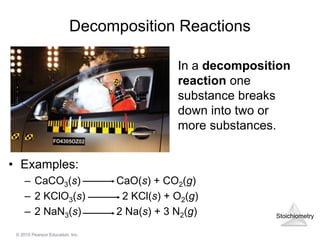
Education
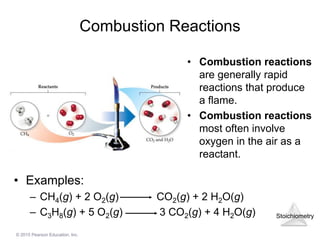
Presentations & Public Speaking
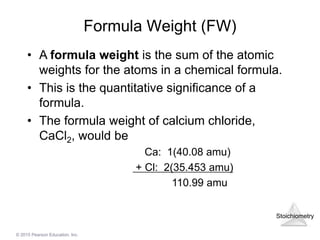
Government & Nonprofit
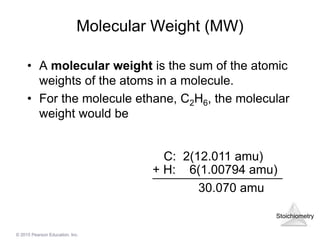
Healthcare
Internet
Law
Leadership & Management
Automotive
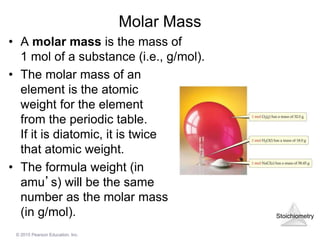
Engineering
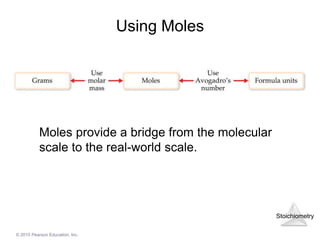
Software
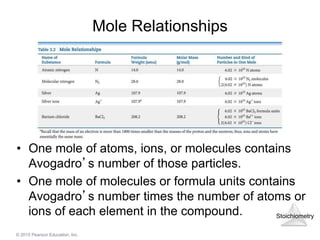
Recruiting & HR
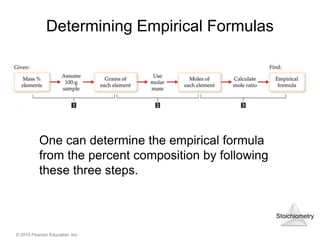
Retail
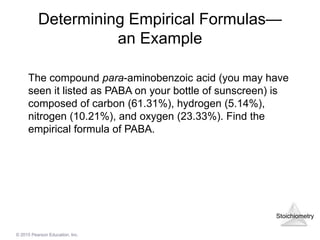
Sales
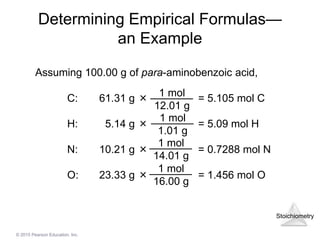
Services
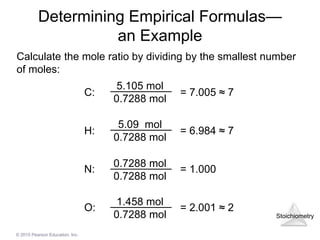
Science
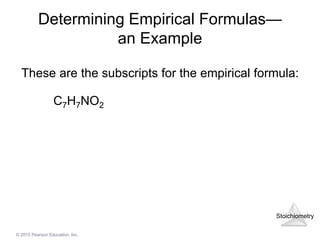
Small Business & Entrepreneurship
Food
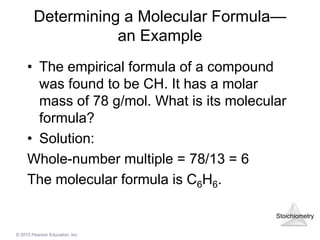
Environment
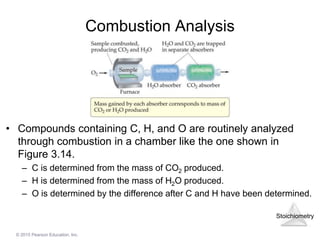
Economy & Finance
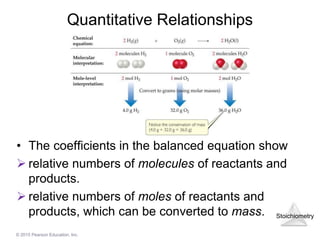
Data & Analytics
Investor Relations
Sports
Spiritual
News & Politics
Travel
Self Improvement
Real Estate
Entertainment & Humor
Health & Medicine
Devices & Hardware
Lifestyle
Change Language
Language
English
Español
Português
Français
Deutsche
Cancel
Save
EN
Uploaded by
madiossaclarisecalo
10 views
03_Lecture.pdf chmistry stoichiometry science
Chemistry
Science
◦
Read more
0
Save
Share
Embed
Embed presentation
Download
Download to read offline
1
/ 41
2
/ 41
3
/ 41
4
/ 41
5
/ 41
6
/ 41
7
/ 41
8
/ 41
9
/ 41
10
/ 41
11
/ 41
12
/ 41
13
/ 41
14
/ 41
15
/ 41
16
/ 41
17
/ 41
18
/ 41
19
/ 41
20
/ 41
21
/ 41
22
/ 41
23
/ 41
24
/ 41
25
/ 41
26
/ 41
27
/ 41
28
/ 41
29
/ 41
30
/ 41
31
/ 41
32
/ 41
33
/ 41
34
/ 41
35
/ 41
36
/ 41
37
/ 41
38
/ 41
39
/ 41
40
/ 41
41
/ 41
More Related Content
PDF
Chapter-3.pdf Mass Relationships in Chemical Reactions
by
amrok3993
PDF
Chapter 3
by
edwardfetecua
PPT
Ch. 3 stoichiometry
by
ewalenta
PPT
STOICHIMETRY.ppt
by
Benjamin Madrigal
PDF
organic and inorganic chemistry stoichiometryp
by
nicelyngalamay
PPT
Stiochiometric calcualations in Chemistry-1.ppt
by
AtaUrRahman50751
PPT
chapter three lecture_2009_123456789.ppt
by
StifanyDianneVillas
PPT
Stoichiometry : Calculations with chemical Formula
by
ShwetaKanungo5
Chapter-3.pdf Mass Relationships in Chemical Reactions
by
amrok3993
Chapter 3
by
edwardfetecua
Ch. 3 stoichiometry
by
ewalenta
STOICHIMETRY.ppt
by
Benjamin Madrigal
organic and inorganic chemistry stoichiometryp
by
nicelyngalamay
Stiochiometric calcualations in Chemistry-1.ppt
by
AtaUrRahman50751
chapter three lecture_2009_123456789.ppt
by
StifanyDianneVillas
Stoichiometry : Calculations with chemical Formula
by
ShwetaKanungo5
Similar to 03_Lecture.pdf chmistry stoichiometry science
PDF
Gen chem topic 3 guobi
by
EasyStudy3
PPT
Blb12 ch03 lecture
by
Eric Buday
PDF
Chemical Reactions and Reaction Stoichiometry
by
PatriciaBabin1
PPT
AP Chemistry Chapter 3 Outline
by
Jane Hamze
PPT
Ch03 outline
by
AP_Chem
PDF
MDCAT Chemistry Notes | Nearpeer
by
MianAliImtiaz
PDF
Chapter 1: Stoichiometry Mole and Avogadro's Number
by
KamranFateh2
PPTX
chemistrystoichiometry-200828050319-1.pptx
by
RamiscalMaChristinaM
PDF
Stochiometry_chemistrytextbookcopy02.pdf
by
jarambangoni22
PPT
hggggghhhhhhhgbvjb hgjhb hbChapter 3.ppt
by
luiisennghiimbwasha
PPTX
Chemistry stoichiometry
by
GeorgeAndrewXu
PDF
Complete CHEM 12 Reviewer: Stoichiometry, Chemical Reactions, Gas Laws, and A...
by
IschyrosGamerPH
PDF
Ch3 stoichiometry
by
Sa'ib J. Khouri
PPTX
4_Q1 Gen Chem 1 - Mass relationship.pptx
by
DeverlyArceo3
PDF
CHY 40_2_CHEMICAL REACTIONS AND STOICHIOMETRY.pdf
by
AliahSarip
PPT
Introduction to stoichiometry
by
MANJUNATH N
PPTX
Stoichiometry: The Mole Percent Composition, Empirical & Molecular Formula, a...
by
angelicamaeflores2
PDF
PHYSICAL-CHEMISTRY-ONE-SHOT-FORMULA-REVISION-SHEETJEEMAINS-AND-NEET.pdf/PREPA...
by
Sandeep Swamy
PPT
Stoichiometry_Intro to Chemistry 11.ppt
by
DewaPutuGedeSudiatmi
PPT
Stoichhhhhhhhhhhhhhiometry_Intro 2014.ppt
by
SunnyAmar
Gen chem topic 3 guobi
by
EasyStudy3
Blb12 ch03 lecture
by
Eric Buday
Chemical Reactions and Reaction Stoichiometry
by
PatriciaBabin1
AP Chemistry Chapter 3 Outline
by
Jane Hamze
Ch03 outline
by
AP_Chem
MDCAT Chemistry Notes | Nearpeer
by
MianAliImtiaz
Chapter 1: Stoichiometry Mole and Avogadro's Number
by
KamranFateh2
chemistrystoichiometry-200828050319-1.pptx
by
RamiscalMaChristinaM
Stochiometry_chemistrytextbookcopy02.pdf
by
jarambangoni22
hggggghhhhhhhgbvjb hgjhb hbChapter 3.ppt
by
luiisennghiimbwasha
Chemistry stoichiometry
by
GeorgeAndrewXu
Complete CHEM 12 Reviewer: Stoichiometry, Chemical Reactions, Gas Laws, and A...
by
IschyrosGamerPH
Ch3 stoichiometry
by
Sa'ib J. Khouri
4_Q1 Gen Chem 1 - Mass relationship.pptx
by
DeverlyArceo3
CHY 40_2_CHEMICAL REACTIONS AND STOICHIOMETRY.pdf
by
AliahSarip
Introduction to stoichiometry
by
MANJUNATH N
Stoichiometry: The Mole Percent Composition, Empirical & Molecular Formula, a...
by
angelicamaeflores2
PHYSICAL-CHEMISTRY-ONE-SHOT-FORMULA-REVISION-SHEETJEEMAINS-AND-NEET.pdf/PREPA...
by
Sandeep Swamy
Stoichiometry_Intro to Chemistry 11.ppt
by
DewaPutuGedeSudiatmi
Stoichhhhhhhhhhhhhhiometry_Intro 2014.ppt
by
SunnyAmar
Recently uploaded
PDF
Control and Coordination - Short Notes (Prashant Kirad) (1).pdf
by
Anu kumari
PDF
Virtualization 1: Virtual Machine, Hypervisor (Virtual Machine Monitor)
by
mrethein98
PPTX
VIRULENCE FACTOR OF BACTERIA: STRUCTURAL ELEMENT, ENZYMES, TOXINS...
by
BIOSPHERE OF KNOWLEDGE
PPTX
Grade 9 - Science Fourth Quarter Physics
by
ModezaPonje
PDF
Surface Chemistry ( पृष्ठ रसायन ) - Notes PDF - Irfanullah Mehar - JJ Sir Che...
by
World of Wisdom
PDF
이영욱 교수님의 물리학회 발표자료 전채_20251120.pdf
by
sciencepeople
PDF
Bio - Molecules ( जैव अणु ) - PDF Notes - Irfanullah Mehar - JJ Sir Chemistry...
by
World of Wisdom
PPTX
Mass selection is one of the oldest methods of plant breeding Commonly use_20...
by
sashanklakineni
PPTX
Mount and repair a fishing net for fishi
by
elsavant25
PPTX
Photogrammetry_Implant_Dentistry_Summary.pptx
by
JeldiKusuma
PPT
GSE s8p3 distance time graphs for 8th Grade Physical Science
by
hfludd
PPTX
Gene Editing_ Rewriting the Code of Life.pptx
by
DrNaderMohamed
PPTX
Cell cycle ( mitosis and meiosis)Msc.pptx
by
PallabiBehera9
PPTX
Chimeric Antigen Receptors T-cell (CAR-T) & Bispecific T- cell engager (BiTEs)
by
rhysudi12
PPTX
History_Taking_and_Physical_Examination_of_Cardiovascular_System.pptx
by
alirazzaghi137900
PDF
Age of exploration - ppt presentation_EAPT
by
ericaangelatoledo06
PDF
Factors affecting Plant Health – Edaphic factors and Biotic Factors
by
Nistarini College, Purulia (W.B) India
PPTX
The Secret Science of MUSIC; A symphony
by
neharaj1617
PDF
Rapid diagnosis and contamination of seafood and aquaculture products
by
Girija90
PPTX
Antigens, Haptens and epitopes in immunology.pptx
by
Gurvinder Kaur
Control and Coordination - Short Notes (Prashant Kirad) (1).pdf
by
Anu kumari
Virtualization 1: Virtual Machine, Hypervisor (Virtual Machine Monitor)
by
mrethein98
VIRULENCE FACTOR OF BACTERIA: STRUCTURAL ELEMENT, ENZYMES, TOXINS...
by
BIOSPHERE OF KNOWLEDGE
Grade 9 - Science Fourth Quarter Physics
by
ModezaPonje
Surface Chemistry ( पृष्ठ रसायन ) - Notes PDF - Irfanullah Mehar - JJ Sir Che...
by
World of Wisdom
이영욱 교수님의 물리학회 발표자료 전채_20251120.pdf
by
sciencepeople
Bio - Molecules ( जैव अणु ) - PDF Notes - Irfanullah Mehar - JJ Sir Chemistry...
by
World of Wisdom
Mass selection is one of the oldest methods of plant breeding Commonly use_20...
by
sashanklakineni
Mount and repair a fishing net for fishi
by
elsavant25
Photogrammetry_Implant_Dentistry_Summary.pptx
by
JeldiKusuma
GSE s8p3 distance time graphs for 8th Grade Physical Science
by
hfludd
Gene Editing_ Rewriting the Code of Life.pptx
by
DrNaderMohamed
Cell cycle ( mitosis and meiosis)Msc.pptx
by
PallabiBehera9
Chimeric Antigen Receptors T-cell (CAR-T) & Bispecific T- cell engager (BiTEs)
by
rhysudi12
History_Taking_and_Physical_Examination_of_Cardiovascular_System.pptx
by
alirazzaghi137900
Age of exploration - ppt presentation_EAPT
by
ericaangelatoledo06
Factors affecting Plant Health – Edaphic factors and Biotic Factors
by
Nistarini College, Purulia (W.B) India
The Secret Science of MUSIC; A symphony
by
neharaj1617
Rapid diagnosis and contamination of seafood and aquaculture products
by
Girija90
Antigens, Haptens and epitopes in immunology.pptx
by
Gurvinder Kaur
03_Lecture.pdf chmistry stoichiometry science
1.
© 2015 Pearson
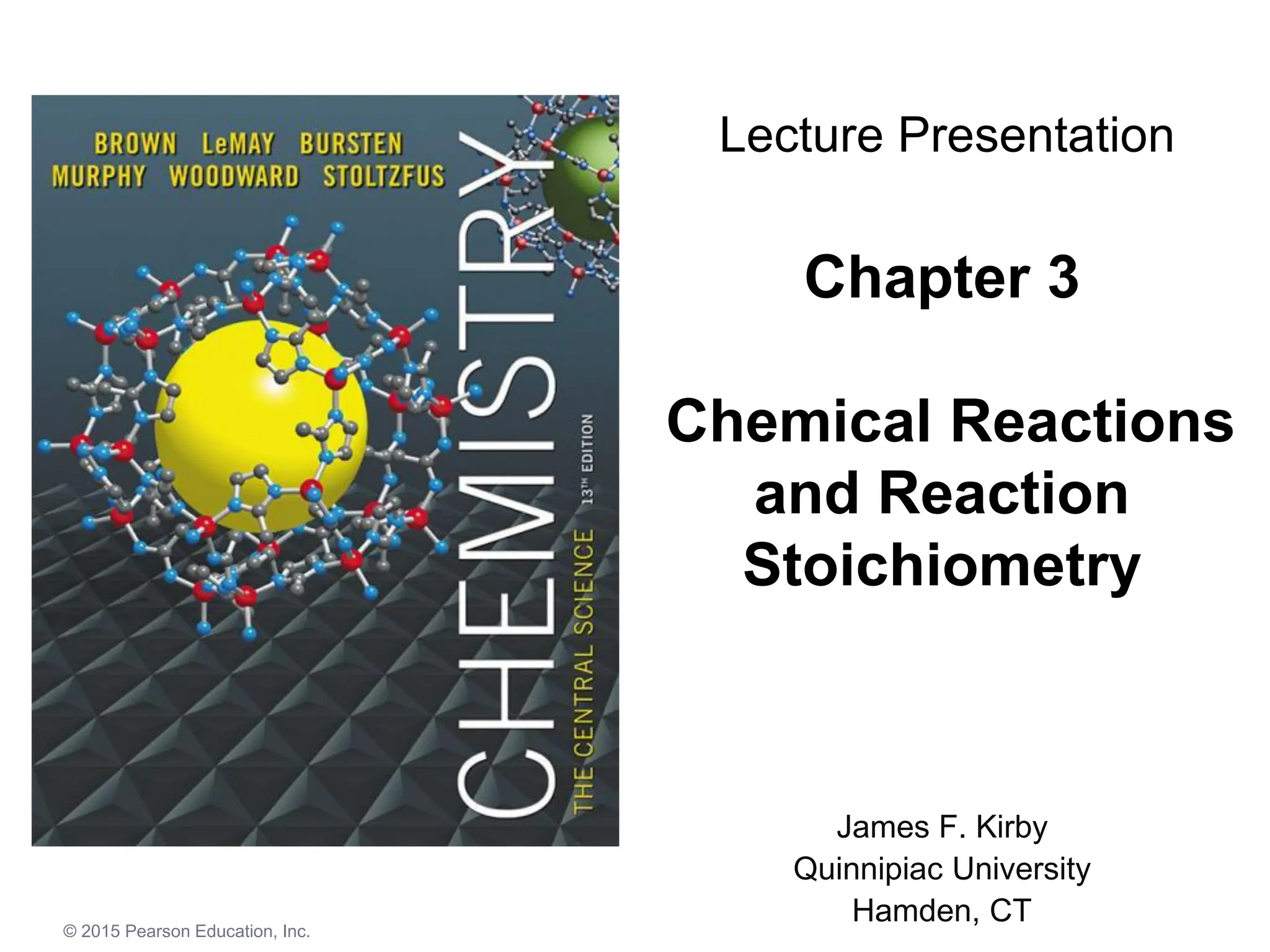
Education, Inc. Chapter 3 Chemical Reactions and Reaction Stoichiometry James F. Kirby Quinnipiac University Hamden, CT Lecture Presentation
2.
© 2015 Pearson
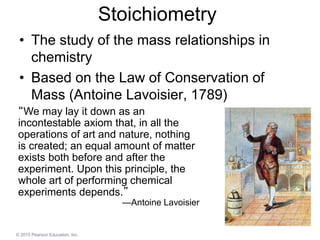
Education, Inc. Stoichiometry • The study of the mass relationships in chemistry • Based on the Law of Conservation of Mass (Antoine Lavoisier, 1789) “We may lay it down as an incontestable axiom that, in all the operations of art and nature, nothing is created; an equal amount of matter exists both before and after the experiment. Upon this principle, the whole art of performing chemical experiments depends.” —Antoine Lavoisier
3.
Stoichiometry © 2015 Pearson
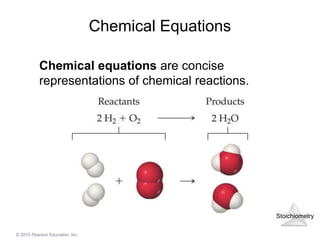
Education, Inc. Chemical Equations Chemical equations are concise representations of chemical reactions.
4.
Stoichiometry © 2015 Pearson
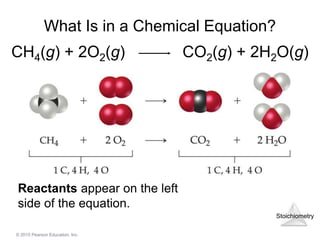
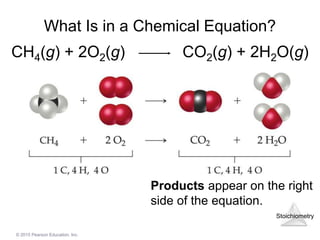
Education, Inc. What Is in a Chemical Equation? CH4(g) + 2O2(g) CO2(g) + 2H2O(g) Reactants appear on the left side of the equation.
5.
Stoichiometry © 2015 Pearson
Education, Inc. What Is in a Chemical Equation? CH4(g) + 2O2(g) CO2(g) + 2H2O(g) Products appear on the right side of the equation.
6.
Stoichiometry © 2015 Pearson
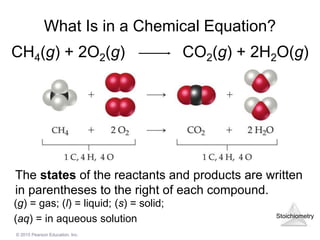
Education, Inc. What Is in a Chemical Equation? CH4(g) + 2O2(g) CO2(g) + 2H2O(g) The states of the reactants and products are written in parentheses to the right of each compound. (g) = gas; (l) = liquid; (s) = solid; (aq) = in aqueous solution
7.
Stoichiometry © 2015 Pearson
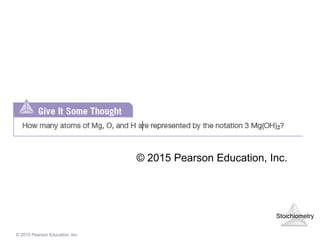
Education, Inc. © 2015 Pearson Education, Inc.
8.
Stoichiometry © 2015 Pearson
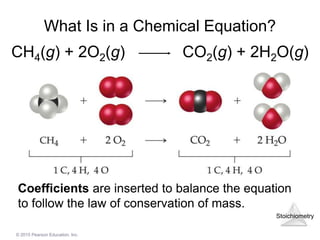
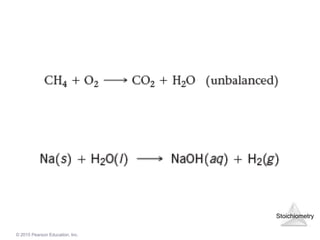
Education, Inc. What Is in a Chemical Equation? CH4(g) + 2O2(g) CO2(g) + 2H2O(g) Coefficients are inserted to balance the equation to follow the law of conservation of mass.
9.
Stoichiometry © 2015 Pearson
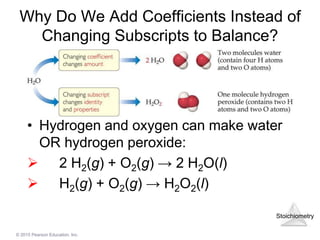
Education, Inc. Why Do We Add Coefficients Instead of Changing Subscripts to Balance? • Hydrogen and oxygen can make water OR hydrogen peroxide: ➢ 2 H2(g) + O2(g) → 2 H2O(l) ➢ H2(g) + O2(g) → H2O2(l)
10.
Stoichiometry © 2015 Pearson
Education, Inc.
11.
Stoichiometry © 2015 Pearson
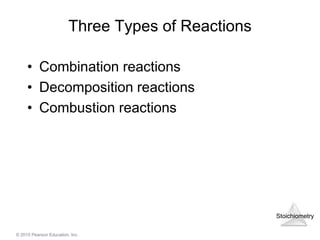
Education, Inc. Three Types of Reactions • Combination reactions • Decomposition reactions • Combustion reactions
12.
Stoichiometry © 2015 Pearson
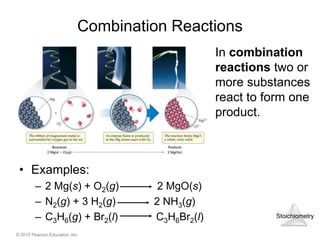
Education, Inc. Combination Reactions • Examples: – 2 Mg(s) + O2(g) 2 MgO(s) – N2(g) + 3 H2(g) 2 NH3(g) – C3H6(g) + Br2(l) C3H6Br2(l) • In combination reactions two or more substances react to form one product.
13.
Stoichiometry © 2015 Pearson
Education, Inc. • In a decomposition reaction one substance breaks down into two or more substances. Decomposition Reactions • Examples: – CaCO3(s) CaO(s) + CO2(g) – 2 KClO3(s) 2 KCl(s) + O2(g) – 2 NaN3(s) 2 Na(s) + 3 N2(g)
14.
Stoichiometry © 2015 Pearson
Education, Inc. Combustion Reactions • Examples: – CH4(g) + 2 O2(g) CO2(g) + 2 H2O(g) – C3H8(g) + 5 O2(g) 3 CO2(g) + 4 H2O(g) • Combustion reactions are generally rapid reactions that produce a flame. • Combustion reactions most often involve oxygen in the air as a reactant.
15.
Stoichiometry © 2015 Pearson
Education, Inc. Formula Weight (FW) • A formula weight is the sum of the atomic weights for the atoms in a chemical formula. • This is the quantitative significance of a formula. • The formula weight of calcium chloride, CaCl2, would be Ca: 1(40.08 amu) + Cl: 2(35.453 amu) 110.99 amu
16.
Stoichiometry © 2015 Pearson
Education, Inc. Molecular Weight (MW) • A molecular weight is the sum of the atomic weights of the atoms in a molecule. • For the molecule ethane, C2H6, the molecular weight would be C: 2(12.011 amu) 30.070 amu + H: 6(1.00794 amu)
17.
Stoichiometry © 2015 Pearson
Education, Inc. Ionic Compounds and Formulas • Remember, ionic compounds exist with a three-dimensional order of ions. There is no simple group of atoms to call a molecule. • As such, ionic compounds use empirical formulas and formula weights (not molecular weights).
18.
Stoichiometry © 2015 Pearson
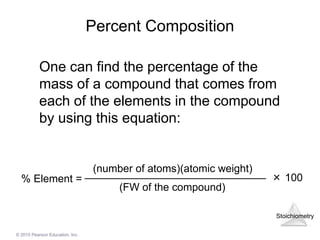
Education, Inc. Percent Composition One can find the percentage of the mass of a compound that comes from each of the elements in the compound by using this equation: % Element = (number of atoms)(atomic weight) (FW of the compound) × 100
19.
Stoichiometry © 2015 Pearson
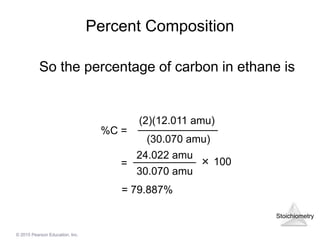
Education, Inc. Percent Composition So the percentage of carbon in ethane is %C = (2)(12.011 amu) (30.070 amu) 24.022 amu 30.070 amu = × 100 = 79.887%
20.
Stoichiometry © 2015 Pearson
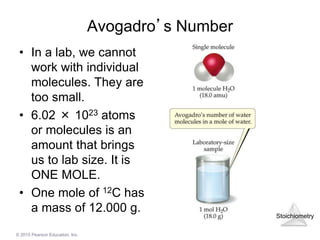
Education, Inc. Avogadro’s Number • In a lab, we cannot work with individual molecules. They are too small. • 6.02 × 10²³ atoms or molecules is an amount that brings us to lab size. It is ONE MOLE. • One mole of 12C has a mass of 12.000 g.
21.
Stoichiometry © 2015 Pearson
Education, Inc. Molar Mass • A molar mass is the mass of 1 mol of a substance (i.e., g/mol). • The molar mass of an element is the atomic weight for the element from the periodic table. If it is diatomic, it is twice that atomic weight. • The formula weight (in amu’s) will be the same number as the molar mass (in g/mol).
22.
Stoichiometry © 2015 Pearson
Education, Inc. Using Moles Moles provide a bridge from the molecular scale to the real-world scale.
23.
Stoichiometry © 2015 Pearson
Education, Inc. Mole Relationships • One mole of atoms, ions, or molecules contains Avogadro’s number of those particles. • One mole of molecules or formula units contains Avogadro’s number times the number of atoms or ions of each element in the compound.
24.
Stoichiometry © 2015 Pearson
Education, Inc. Determining Empirical Formulas One can determine the empirical formula from the percent composition by following these three steps.
25.
Stoichiometry © 2015 Pearson
Education, Inc. Determining Empirical Formulas— an Example The compound para-aminobenzoic acid (you may have seen it listed as PABA on your bottle of sunscreen) is composed of carbon (61.31%), hydrogen (5.14%), nitrogen (10.21%), and oxygen (23.33%). Find the empirical formula of PABA.
26.
Stoichiometry © 2015 Pearson
Education, Inc. Determining Empirical Formulas— an Example 1 mol 12.01 g 1 mol 14.01 g 1 mol 1.01 g 1 mol 16.00 g Assuming 100.00 g of para-aminobenzoic acid, C: 61.31 g × = 5.105 mol C H: 5.14 g × = 5.09 mol H N: 10.21 g × = 0.7288 mol N O: 23.33 g × = 1.456 mol O
27.
Stoichiometry © 2015 Pearson
Education, Inc. Determining Empirical Formulas— an Example Calculate the mole ratio by dividing by the smallest number of moles: 5.105 mol 0.7288 mol 5.09 mol 0.7288 mol 0.7288 mol 0.7288 mol 1.458 mol 0.7288 mol C: = 7.005 ≈ 7 H: = 6.984 ≈ 7 N: = 1.000 O: = 2.001 ≈ 2
28.
Stoichiometry © 2015 Pearson
Education, Inc. Determining Empirical Formulas— an Example These are the subscripts for the empirical formula: C7H7NO2
29.
Stoichiometry © 2015 Pearson
Education, Inc. Determining a Molecular Formula • Remember, the number of atoms in a molecular formula is a multiple of the number of atoms in an empirical formula. • If we find the empirical formula and know a molar mass (molecular weight) for the compound, we can find the molecular formula.
30.
Stoichiometry © 2015 Pearson
Education, Inc. Determining a Molecular Formula— an Example • The empirical formula of a compound was found to be CH. It has a molar mass of 78 g/mol. What is its molecular formula? • Solution: Whole-number multiple = 78/13 = 6 The molecular formula is C6H6.
31.
Stoichiometry © 2015 Pearson
Education, Inc. Combustion Analysis • Compounds containing C, H, and O are routinely analyzed through combustion in a chamber like the one shown in Figure 3.14. – C is determined from the mass of CO2 produced. – H is determined from the mass of H2O produced. – O is determined by the difference after C and H have been determined.
32.
Stoichiometry © 2015 Pearson
Education, Inc. Quantitative Relationships • The coefficients in the balanced equation show ➢ relative numbers of molecules of reactants and products. ➢ relative numbers of moles of reactants and products, which can be converted to mass.
33.
Stoichiometry © 2015 Pearson
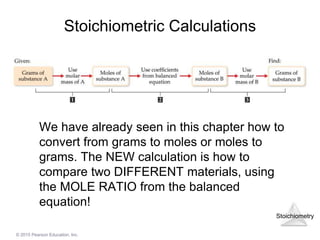
Education, Inc. Stoichiometric Calculations We have already seen in this chapter how to convert from grams to moles or moles to grams. The NEW calculation is how to compare two DIFFERENT materials, using the MOLE RATIO from the balanced equation!
34.
Stoichiometry © 2015 Pearson
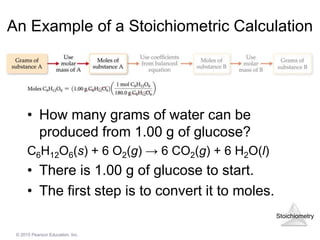
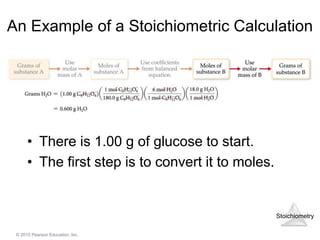
Education, Inc. An Example of a Stoichiometric Calculation • How many grams of water can be produced from 1.00 g of glucose? C6H12O6(s) + 6 O2(g) → 6 CO2(g) + 6 H2O(l) • There is 1.00 g of glucose to start. • The first step is to convert it to moles.
35.
Stoichiometry © 2015 Pearson
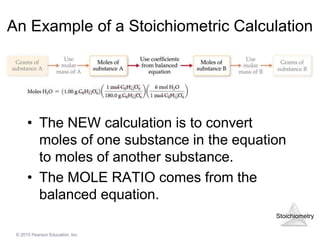
Education, Inc. An Example of a Stoichiometric Calculation • The NEW calculation is to convert moles of one substance in the equation to moles of another substance. • The MOLE RATIO comes from the balanced equation.
36.
Stoichiometry © 2015 Pearson
Education, Inc. An Example of a Stoichiometric Calculation • There is 1.00 g of glucose to start. • The first step is to convert it to moles.
37.
Stoichiometry © 2015 Pearson
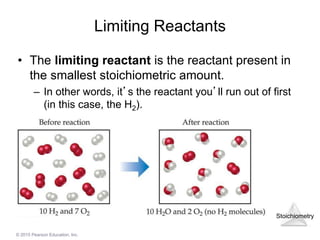
Education, Inc. Limiting Reactants • The limiting reactant is the reactant present in the smallest stoichiometric amount. – In other words, it’s the reactant you’ll run out of first (in this case, the H2).
38.
Stoichiometry © 2015 Pearson
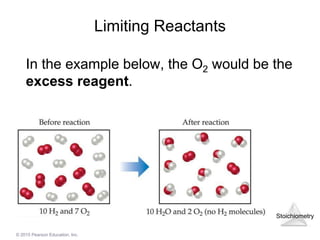
Education, Inc. Limiting Reactants In the example below, the O2 would be the excess reagent.
39.
Stoichiometry © 2015 Pearson
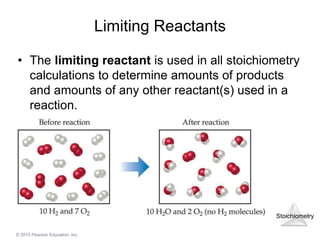
Education, Inc. Limiting Reactants • The limiting reactant is used in all stoichiometry calculations to determine amounts of products and amounts of any other reactant(s) used in a reaction.
40.
Stoichiometry © 2015 Pearson
Education, Inc. Theoretical Yield • The theoretical yield is the maximum amount of product that can be made. – In other words, it’s the amount of product possible as calculated through the stoichiometry problem. • This is different from the actual yield, which is the amount one actually produces and measures.
41.
Stoichiometry © 2015 Pearson
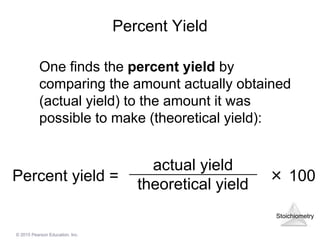
Education, Inc. Percent Yield Percent yield = × 100 actual yield theoretical yield One finds the percent yield by comparing the amount actually obtained (actual yield) to the amount it was possible to make (theoretical yield):
Download