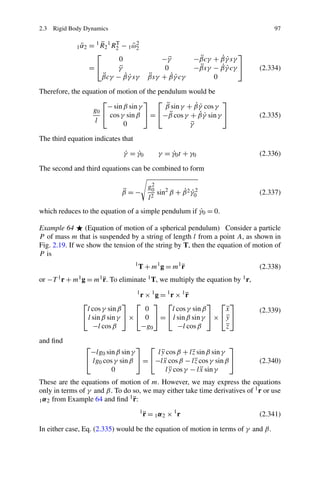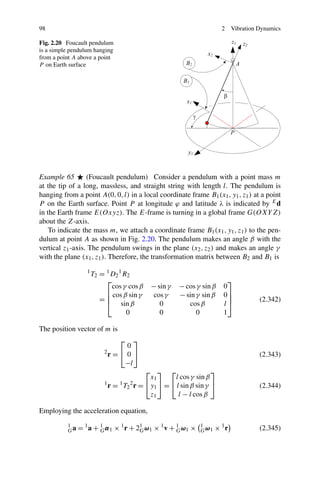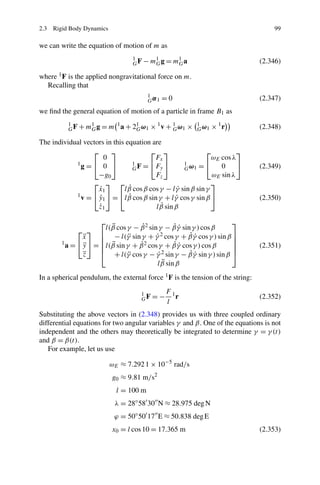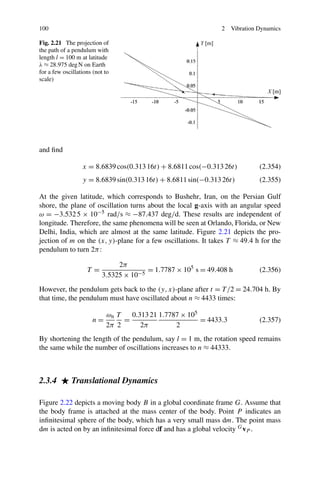
Chapter 2
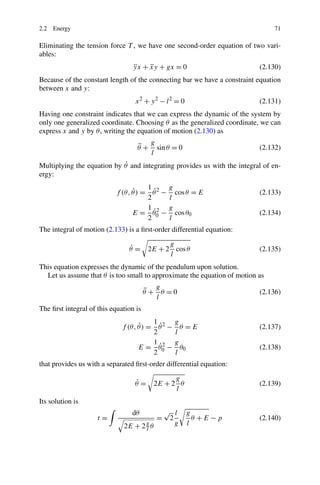
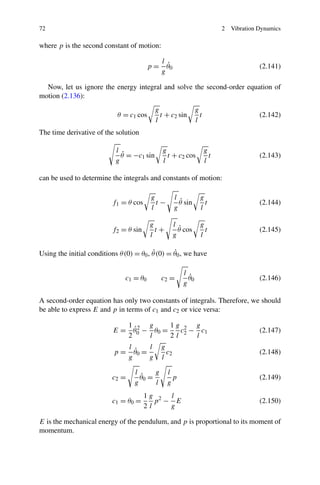
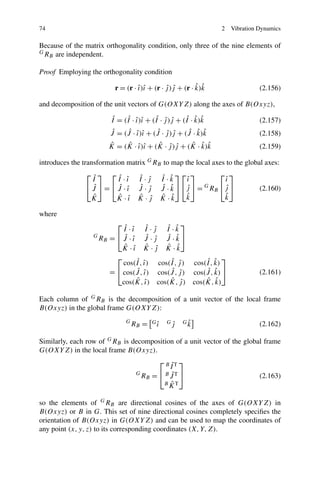
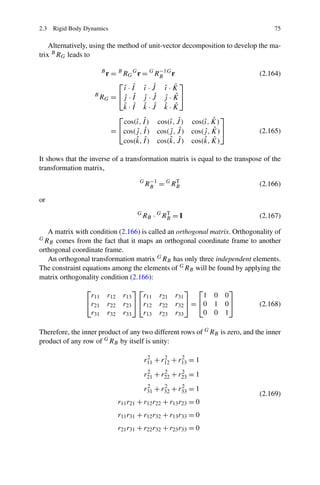
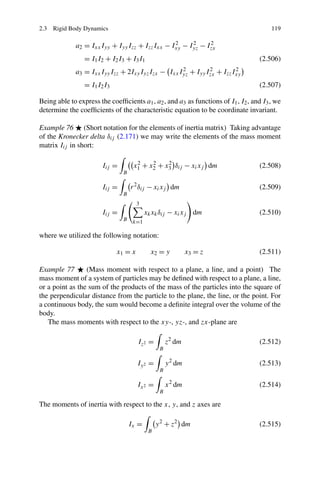
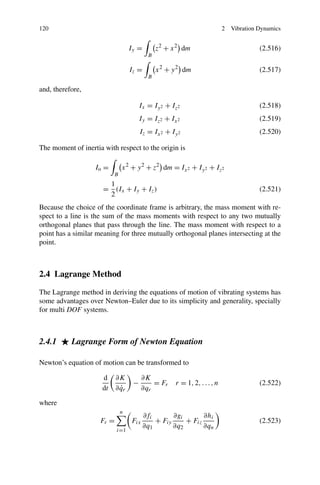
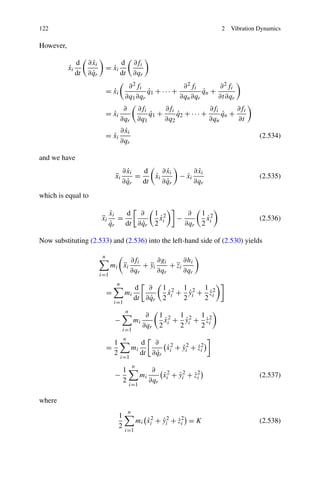
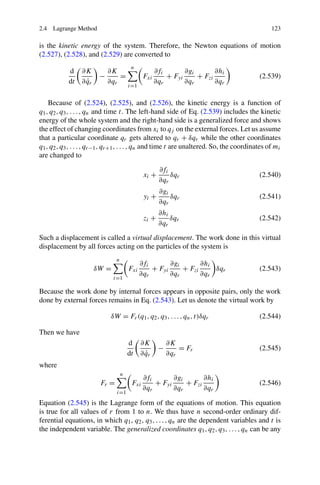
Vibration Dynamics


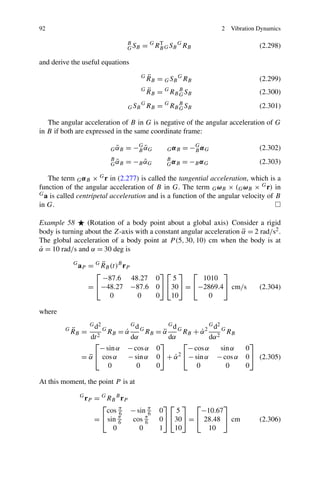
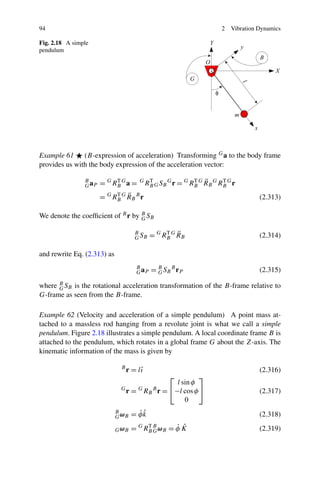
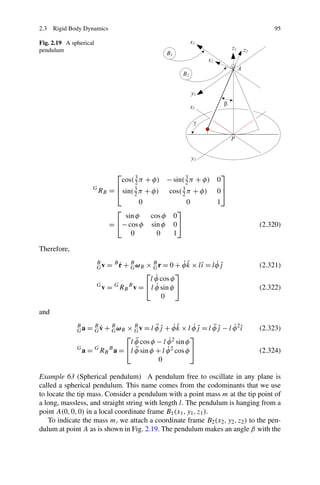
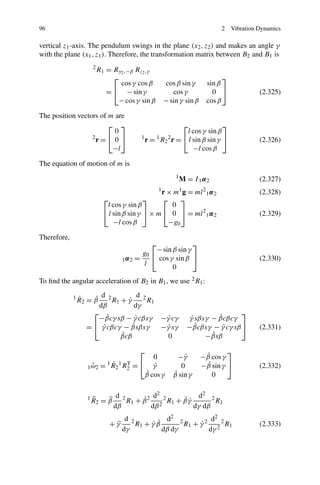
In this chapter, we review the dynamics of vibrations and the methods of deriv-
ing the equations of motion of vibrating systems. The Newton–Euler and Lagrange
methods are the most common methods of deriving the equations of motion. Having
symmetric coefficient matrices is the main advantage of using the Lagrange method
in mechanical vibrations.

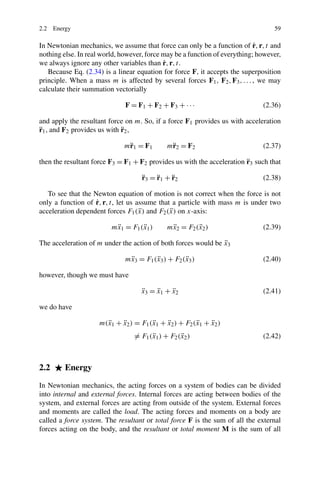
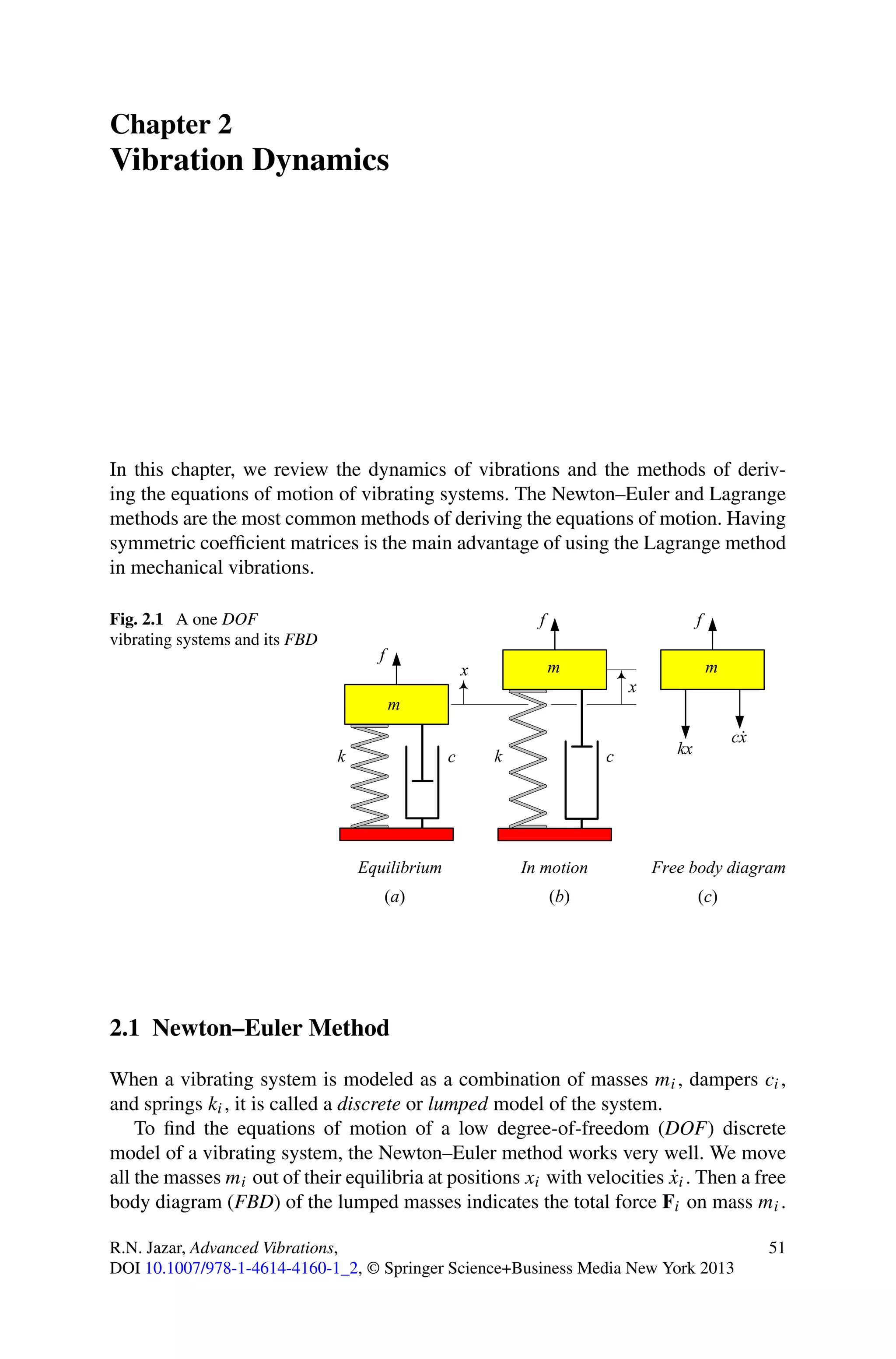
Fig. 2.1 A one DOF
vibrating systems and its FBD


2.1 Newton–Euler Method

When a vibrating system is modeled as a combination of masses mi , dampers ci ,
and springs ki , it is called a discrete or lumped model of the system.
    To find the equations of motion of a low degree-of-freedom (DOF) discrete
model of a vibrating system, the Newton–Euler method works very well. We move
                                                                          ˙
all the masses mi out of their equilibria at positions xi with velocities xi . Then a free
body diagram (FBD) of the lumped masses indicates the total force Fi on mass mi .

R.N. Jazar, Advanced Vibrations,                                                       51
DOI 10.1007/978-1-4614-4160-1_2, © Springer Science+Business Media New York 2013
52                                                             2   Vibration Dynamics

Employing the momentum pi = mi vi of the mass mi , the Newton equation provides
us with the equation of motion of the system:
                                     d      d
                              Fi =      pi = (mi vi )                          (2.1)
                                     dt     dt
When the motion of a massive body with mass moment Ii is rotational, then its equa-
tion of motion will be found by Euler equation, in which we employ the moment of
momentum Li = Ii ω of the mass mi :
                                     d      d
                              Mi =      Li = (Ii ω)                            (2.2)
                                     dt     dt
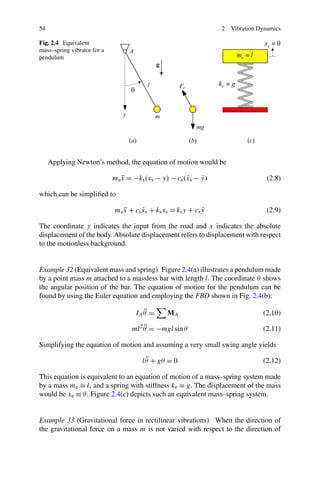
   For example, Fig. 2.1 illustrates a one degree-of-freedom (DOF) vibrating sys-
tem. Figure 2.1(b) depicts the system when m is out of the equilibrium position at x
                           ˙
and moving with velocity x, both in positive direction. The FBD of the system is as
shown in Fig. 2.1(c). The Newton equation generates the equations of motion:

                           ma = −cv − kx + f (x, v, t)                         (2.3)

   The equilibrium position of a vibrating system is where the potential energy of
the system, V , is extremum:
                                     ∂V
                                          =0                                  (2.4)
                                     ∂x
We usually set V = 0 at the equilibrium position. Linear systems with constant
stiffness have only one equilibrium or infinity equilibria, while nonlinear systems
may have multiple equilibria. An equilibrium is stable if

                                      ∂ 2V
                                           >0                                  (2.5)
                                      ∂x 2
and is unstable if
                                       ∂ 2V
                                            <0                               (2.6)
                                       ∂x 2
   The geometric arrangement and the number of employed mechanical elements
can be used to classify discrete vibrating systems. The number of masses times the
DOF of each mass makes the total DOF of the vibrating system n. Each indepen-
dent DOF of a mass is indicated by an independent variable, called the generalized
coordinate. The final set of equations would be n second-order differential equa-
tions to be solved for n generalized coordinates. When each moving mass has one
DOF, then the system’s DOF is equal to the number of masses. The DOF may
also be defined as the minimum number of independent coordinates that defines the
configuration of a system.
   The equation of motion of an n DOF linear mechanical vibrating system of can
always be arranged as a set of second-order differential equations

                              [m]¨ + [c]˙ + [k]x = F
                                 x      x                                      (2.7)
2.1 Newton–Euler Method                                                          53

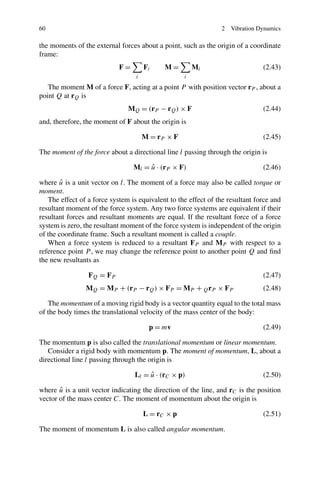
Fig. 2.2 Two, three, and one
DOF models for vertical
vibrations of vehicles


Fig. 2.3 A 1/8 car model
and its free body diagram


in which, x is a column array of describing coordinates of the system, and f is a
column array of the associated applied forces. The square matrices [m], [c], [k] are
the mass, damping, and stiffness matrices.

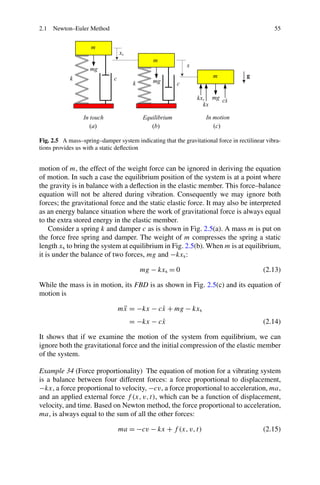
Example 30 (The one, two, and three DOF model of vehicles) The one, two, and
three DOF model for analysis of vertical vibrations of a vehicle are shown in
Fig. 2.2(a)–(c). The system in Fig. 2.2(a) is called the quarter car model, in which
ms represents a quarter mass of the body, and mu represents a wheel. The param-
eters ku and cu are models for tire stiffness and damping. Similarly, ks and cu are
models for the main suspension of the vehicle. Figure 2.2(c) is called the 1/8 car
model, which does not show the wheel of the car, and Fig. 2.2(b) is a quarter car
with a driver md . The driver’s seat is modeled by kd and cd .

Example 31 (1/8 car model) Figure 2.3(a) shows the simplest model for vertical
vibrations of a vehicle. This model is sometimes called 1/8 car model. The mass ms
represents one quarter of the car’s body, which is mounted on a suspension made of
a spring ks and a damper cs . When ms is at a position such as shown in Fig. 2.3(b),
its free body diagram is as in Fig. 2.3(c).
54                                                                2   Vibration Dynamics

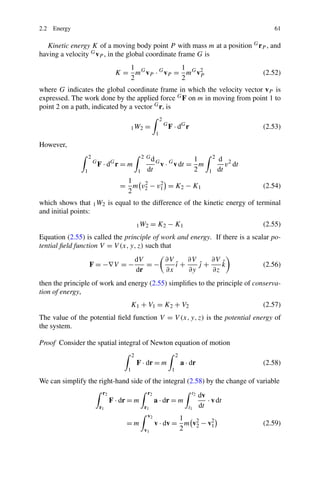
Fig. 2.4 Equivalent
mass–spring vibrator for a
pendulum


     Applying Newton’s method, the equation of motion would be

                             ms x = −ks (xs − y) − cs (xs − y)
                                ¨                      ˙    ˙                     (2.8)

which can be simplified to

                             ms x + cs xs + ks xs = ks y + cs y
                                ¨      ˙                      ˙                   (2.9)

The coordinate y indicates the input from the road and x indicates the absolute
displacement of the body. Absolute displacement refers to displacement with respect
to the motionless background.


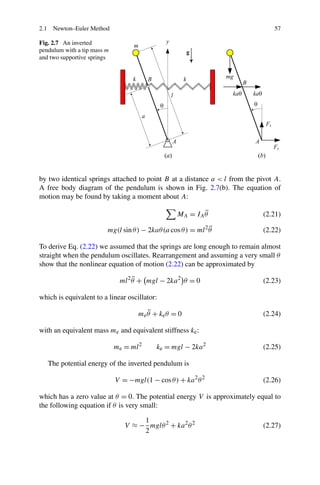
Example 32 (Equivalent mass and spring) Figure 2.4(a) illustrates a pendulum made
by a point mass m attached to a massless bar with length l. The coordinate θ shows
the angular position of the bar. The equation of motion for the pendulum can be
found by using the Euler equation and employing the FBD shown in Fig. 2.4(b):

                                        ¨
                                     IA θ =     MA                               (2.10)
                                        ¨
                                   ml 2 θ = −mgl sin θ                           (2.11)

Simplifying the equation of motion and assuming a very small swing angle yields

                                         ¨
                                       l θ + gθ = 0                              (2.12)

This equation is equivalent to an equation of motion of a mass–spring system made
by a mass me ≡ l, and a spring with stiffness ke ≡ g. The displacement of the mass
would be xe ≡ θ . Figure 2.4(c) depicts such an equivalent mass–spring system.


Example 33 (Gravitational force in rectilinear vibrations) When the direction of
the gravitational force on a mass m is not varied with respect to the direction of
2.1 Newton–Euler Method                                                                        55


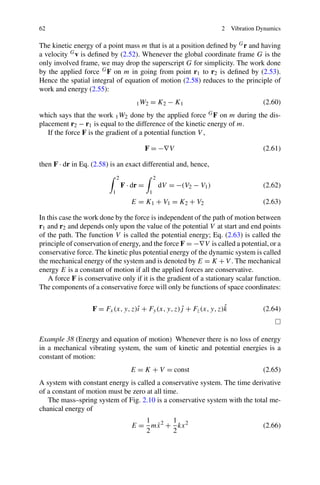
Fig. 2.5 A mass–spring–damper system indicating that the gravitational force in rectilinear vibra-
tions provides us with a static deflection


motion of m, the effect of the weight force can be ignored in deriving the equation
of motion. In such a case the equilibrium position of the system is at a point where
the gravity is in balance with a deflection in the elastic member. This force–balance
equation will not be altered during vibration. Consequently we may ignore both
forces; the gravitational force and the static elastic force. It may also be interpreted
as an energy balance situation where the work of gravitational force is always equal
to the extra stored energy in the elastic member.
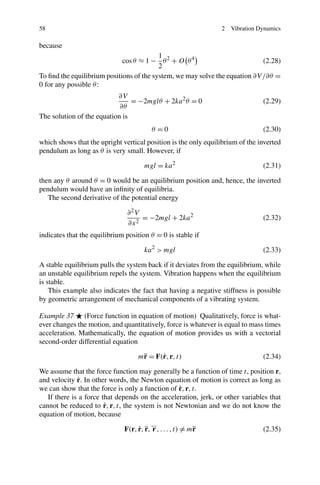
    Consider a spring k and damper c as is shown in Fig. 2.5(a). A mass m is put on
the force free spring and damper. The weight of m compresses the spring a static
length xs to bring the system at equilibrium in Fig. 2.5(b). When m is at equilibrium,
it is under the balance of two forces, mg and −kxs :

                                        mg − kxs = 0                                      (2.13)

While the mass is in motion, its FBD is as shown in Fig. 2.5(c) and its equation of
motion is

                               mx = −kx − cx + mg − kxs
                                ¨          ˙
                                    = −kx − cx
                                             ˙                                            (2.14)

It shows that if we examine the motion of the system from equilibrium, we can
ignore both the gravitational force and the initial compression of the elastic member
of the system.

Example 34 (Force proportionality) The equation of motion for a vibrating system
is a balance between four different forces: a force proportional to displacement,
−kx, a force proportional to velocity, −cv, a force proportional to acceleration, ma,
and an applied external force f (x, v, t), which can be a function of displacement,
velocity, and time. Based on Newton method, the force proportional to acceleration,
ma, is always equal to the sum of all the other forces:

                                ma = −cv − kx + f (x, v, t)                               (2.15)
56                                                                       2   Vibration Dynamics

Fig. 2.6 A 1/4 car model
and its free body diagram


Example 35 (A two DOF base excited system) Figure 2.6(a)–(c) illustrate the equi-
librium, motion, and FBD of a two DOF system. The FBD is plotted based on the
assumption
                                         xs > x u > y                                   (2.16)
Applying Newton’s method provides us with two equations of motion:

                            ms xs = −ks (xs − xu ) − cs (xs − xu )
                               ¨                         ˙    ˙                         (2.17)
                            mu xu = ks (xs − xu ) + cs (xs − xu )
                               ¨                        ˙    ˙
                                      − ku (xu − y) − cu (xu − y)
                                                          ˙    ˙                        (2.18)

    The assumption (2.16) is not necessary. We can find the same Eqs. (2.17)
and (2.18) using any other assumption, such as xs < xu > y, xs > xu < y, or
xs < xu < y. However, having an assumption helps to make a consistent free body
diagram.
    We usually arrange the equations of motion for a linear system in a matrix form
to take advantage of matrix calculus:

                                 [M]˙ + [C]˙ + [K]x = F
                                    x      x                                            (2.19)

Rearrangement of Eqs. (2.17) and (2.18) yields

                        ms      0     ¨
                                      xs    cs            −cs       ˙
                                                                    xs
                                         +
                        0       mu    ¨
                                      xu   −cs          cs + cu     ˙
                                                                    xu
                                 ks      −ks      xs        0
                            +                        =                                  (2.20)
                                −ks    ks + ku    xu   ku y + c u y
                                                                  ˙


Example 36     (Inverted pendulum and negative stiffness) Figure 2.7(a) illustrates
an inverted pendulum with a tip mass m and a length l. The pendulum is supported
2.1 Newton–Euler Method                                                        57

Fig. 2.7 An inverted
pendulum with a tip mass m
and two supportive springs


by two identical springs attached to point B at a distance a < l from the pivot A.
A free body diagram of the pendulum is shown in Fig. 2.7(b). The equation of
motion may be found by taking a moment about A:

                                                           ¨
                                                  MA = I A θ                (2.21)
                                                               ¨
                         mg(l sin θ ) − 2kaθ (a cos θ ) = ml 2 θ            (2.22)

To derive Eq. (2.22) we assumed that the springs are long enough to remain almost
straight when the pendulum oscillates. Rearrangement and assuming a very small θ
show that the nonlinear equation of motion (2.22) can be approximated by

                                   ¨
                              ml 2 θ + mgl − 2ka 2 θ = 0                    (2.23)

which is equivalent to a linear oscillator:

                                        ¨
                                     me θ + ke θ = 0                        (2.24)

with an equivalent mass me and equivalent stiffness ke :

                             me = ml 2     ke = mgl − 2ka 2                 (2.25)

   The potential energy of the inverted pendulum is

                             V = −mgl(1 − cos θ ) + ka 2 θ 2                (2.26)

which has a zero value at θ = 0. The potential energy V is approximately equal to
the following equation if θ is very small:

                                     1
                                V ≈ − mglθ 2 + ka 2 θ 2                     (2.27)
                                     2
58                                                              2   Vibration Dynamics

because
                                          1
                             cos θ ≈ 1 − θ 2 + O θ 4                         (2.28)
                                          2
To find the equilibrium positions of the system, we may solve the equation ∂V /∂θ =
0 for any possible θ :
                           ∂V
                                = −2mglθ + 2ka 2 θ = 0                         (2.29)
                            ∂θ
The solution of the equation is
                                        θ =0                                   (2.30)
which shows that the upright vertical position is the only equilibrium of the inverted
pendulum as long as θ is very small. However, if

                                      mgl = ka 2                               (2.31)

then any θ around θ = 0 would be an equilibrium position and, hence, the inverted
pendulum would have an infinity of equilibria.
   The second derivative of the potential energy

                               ∂ 2V
                                    = −2mgl + 2ka 2                            (2.32)
                               ∂x 2
indicates that the equilibrium position θ = 0 is stable if

                                      ka 2 > mgl                               (2.33)

A stable equilibrium pulls the system back if it deviates from the equilibrium, while
an unstable equilibrium repels the system. Vibration happens when the equilibrium
is stable.
    This example also indicates the fact that having a negative stiffness is possible
by geometric arrangement of mechanical components of a vibrating system.

Example 37 (Force function in equation of motion) Qualitatively, force is what-
ever changes the motion, and quantitatively, force is whatever is equal to mass times
acceleration. Mathematically, the equation of motion provides us with a vectorial
second-order differential equation

                                   m¨ = F(˙ , r, t)
                                    r     r                                    (2.34)

We assume that the force function may generally be a function of time t, position r,
              ˙
and velocity r. In other words, the Newton equation of motion is correct as long as
we can show that the force is only a function of r, r, t.˙
   If there is a force that depends on the acceleration, jerk, or other variables that
                        ˙
cannot be reduced to r, r, t, the system is not Newtonian and we do not know the
equation of motion, because
                                         ...
                                    ˙ ¨
                               F(r, r, r, r , . . . , t) = m¨
                                                            r                   (2.35)
2.2 Energy                                                                        59

                                                                            ˙
In Newtonian mechanics, we assume that force can only be a function of r, r, t and
nothing else. In real world, however, force may be a function of everything; however,
                                            ˙
we always ignore any other variables than r, r, t.
   Because Eq. (2.34) is a linear equation for force F, it accepts the superposition
principle. When a mass m is affected by several forces F1 , F2 , F3 , . . . , we may
calculate their summation vectorially

                              F = F1 + F2 + F3 + · · ·                        (2.36)

and apply the resultant force on m. So, if a force F1 provides us with acceleration
¨                            ¨
r1 , and F2 provides us with r2 ,

                             m¨ 1 = F1
                              r              m¨ 2 = F2
                                              r                               (2.37)

                                                                        ¨
then the resultant force F3 = F1 + F2 provides us with the acceleration r3 such that

                                    ¨    ¨    ¨
                                    r3 = r1 + r 2                             (2.38)

   To see that the Newton equation of motion is not correct when the force is not
                    ˙
only a function of r, r, t, let us assume that a particle with mass m is under two
                                    ¨         ¨
acceleration dependent forces F1 (x) and F2 (x) on x-axis:

                          ¨
                         mx1 = F1 (x1 )
                                   ¨         mx2 = F2 (x2 )
                                              ¨        ¨                      (2.39)

                                                               ¨
The acceleration of m under the action of both forces would be x3

                              mx3 = F1 (x3 ) + F2 (x3 )
                               ¨        ¨          ¨                          (2.40)

however, though we must have

                                   ¨
                                   x3 = x1 + x2
                                        ¨    ¨                                (2.41)

we do have

                       ¨
                     m(x1 + x2 ) = F1 (x1 + x2 ) + F2 (x1 + x2 )
                            ¨          ¨    ¨          ¨    ¨
                                 = F1 (x1 ) + F2 (x2 )
                                       ¨          ¨                           (2.42)


2.2      Energy

In Newtonian mechanics, the acting forces on a system of bodies can be divided
into internal and external forces. Internal forces are acting between bodies of the
system, and external forces are acting from outside of the system. External forces
and moments are called the load. The acting forces and moments on a body are
called a force system. The resultant or total force F is the sum of all the external
forces acting on the body, and the resultant or total moment M is the sum of all
60                                                              2   Vibration Dynamics

the moments of the external forces about a point, such as the origin of a coordinate
frame:
                            F=        Fi    M=         Mi                      (2.43)
                                  i                i
   The moment M of a force F, acting at a point P with position vector rP , about a
point Q at rQ is
                               MQ = (rP − rQ ) × F                             (2.44)
and, therefore, the moment of F about the origin is

                                      M = rP × F                               (2.45)

The moment of the force about a directional line l passing through the origin is

                                 Ml = u · (rP × F)
                                      ˆ                                        (2.46)

        ˆ
where u is a unit vector on l. The moment of a force may also be called torque or
moment.
   The effect of a force system is equivalent to the effect of the resultant force and
resultant moment of the force system. Any two force systems are equivalent if their
resultant forces and resultant moments are equal. If the resultant force of a force
system is zero, the resultant moment of the force system is independent of the origin
of the coordinate frame. Such a resultant moment is called a couple.
   When a force system is reduced to a resultant FP and MP with respect to a
reference point P , we may change the reference point to another point Q and find
the new resultants as

                 FQ = FP                                                       (2.47)
                MQ = MP + (rP − rQ ) × FP = MP + Q rP × FP                     (2.48)

   The momentum of a moving rigid body is a vector quantity equal to the total mass
of the body times the translational velocity of the mass center of the body:

                                       p = mv                                  (2.49)

The momentum p is also called the translational momentum or linear momentum.
   Consider a rigid body with momentum p. The moment of momentum, L, about a
directional line l passing through the origin is

                                  Ll = u · (rC × p)
                                       ˆ                                       (2.50)

       ˆ
where u is a unit vector indicating the direction of the line, and rC is the position
vector of the mass center C. The moment of momentum about the origin is

                                      L = rC × p                               (2.51)

The moment of momentum L is also called angular momentum.
2.2 Energy                                                                                                        61

   Kinetic energy K of a moving body point P with mass m at a position G rP , and
having a velocity G vP , in the global coordinate frame G is
                                      1              1
                                   K = mG vP · G vP = mG v2
                                                          P                                                    (2.52)
                                      2              2
where G indicates the global coordinate frame in which the velocity vector vP is
expressed. The work done by the applied force G F on m in moving from point 1 to
point 2 on a path, indicated by a vector G r, is
                                                               2
                                            1 W2     =             G
                                                                       F · dG r                                (2.53)
                                                           1

However,
                    2                               2 Gd                   1                     2   d 2
                        G
                            F · dG r = m                   G
                                                               v · G v dt = m                           v dt
                1                               1    dt                    2                 1       dt
                                      1
                                     = m v2 − v1 = K2 − K1
                                          2    2
                                                                                                               (2.54)
                                      2
which shows that 1 W2 is equal to the difference of the kinetic energy of terminal
and initial points:
                                                1 W2     = K2 − K1                                             (2.55)
Equation (2.55) is called the principle of work and energy. If there is a scalar po-
tential field function V = V (x, y, z) such that
                                                dV    ∂V    ∂V    ∂V ˆ
                    F = −∇V = −                    =−    ı+
                                                         ˆ     j+
                                                               ˆ     k                                         (2.56)
                                                dr    ∂x    ∂y    ∂z
then the principle of work and energy (2.55) simplifies to the principle of conserva-
tion of energy,
                                         K1 + V1 = K2 + V2                                                     (2.57)
The value of the potential field function V = V (x, y, z) is the potential energy of
the system.

Proof Consider the spatial integral of Newton equation of motion
                                            2                               2
                                                F · dr = m                      a · dr                         (2.58)
                                        1                               1

We can simplify the right-hand side of the integral (2.58) by the change of variable
                             r2                      r2                             t2   dv
                                  F · dr = m              a · dr = m                        · v dt
                            r1                      r1                             t1    dt
                                                     v2           1
                                       =m                 v · dv = m v2 − v2
                                                                      2    1                                   (2.59)
                                                    v1            2
62                                                                        2   Vibration Dynamics

The kinetic energy of a point mass m that is at a position defined by G r and having
a velocity G v is defined by (2.52). Whenever the global coordinate frame G is the
only involved frame, we may drop the superscript G for simplicity. The work done
by the applied force G F on m in going from point r1 to r2 is defined by (2.53).
Hence the spatial integral of equation of motion (2.58) reduces to the principle of
work and energy (2.55):
                                        1 W2   = K2 − K1                                 (2.60)
which says that the work 1 W2 done by the applied force G F on m during the dis-
placement r2 − r1 is equal to the difference of the kinetic energy of m.
   If the force F is the gradient of a potential function V ,

                                              F = −∇V                                    (2.61)

then F · dr in Eq. (2.58) is an exact differential and, hence,
                               2                   2
                                   F · dr =            dV = −(V2 − V1 )                  (2.62)
                           1                   1
                                      E = K1 + V1 = K2 + V2                              (2.63)

In this case the work done by the force is independent of the path of motion between
r1 and r2 and depends only upon the value of the potential V at start and end points
of the path. The function V is called the potential energy; Eq. (2.63) is called the
principle of conservation of energy, and the force F = −∇V is called a potential, or a
conservative force. The kinetic plus potential energy of the dynamic system is called
the mechanical energy of the system and is denoted by E = K + V . The mechanical
energy E is a constant of motion if all the applied forces are conservative.
    A force F is conservative only if it is the gradient of a stationary scalar function.
The components of a conservative force will only be functions of space coordinates:

                                   ı               ˆ               ˆ
                   F = Fx (x, y, z)ˆ + Fy (x, y, z)j + Fz (x, y, z)k                     (2.64)


Example 38 (Energy and equation of motion) Whenever there is no loss of energy
in a mechanical vibrating system, the sum of kinetic and potential energies is a
constant of motion:
                                      E = K + V = const                                  (2.65)
A system with constant energy is called a conservative system. The time derivative
of a constant of motion must be zero at all time.
   The mass–spring system of Fig. 2.10 is a conservative system with the total me-
chanical energy of
                                         1      1
                                           ˙
                                      E = mx 2 + kx 2                                    (2.66)
                                         2      2
2.2 Energy                                                                     63

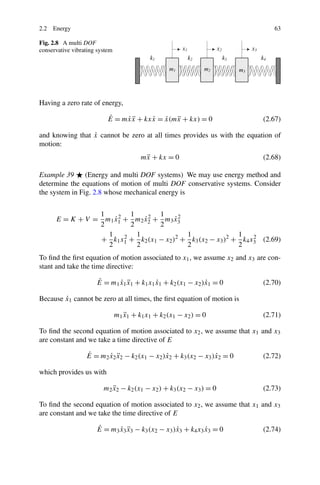
Fig. 2.8 A multi DOF
conservative vibrating system


Having a zero rate of energy,

                           ˙
                           E = mx x + kx x = x(mx + kx) = 0
                                ˙¨       ˙ ˙ ¨                              (2.67)

                 ˙
and knowing that x cannot be zero at all times provides us with the equation of
motion:
                                         mx + kx = 0
                                          ¨                                 (2.68)

Example 39      (Energy and multi DOF systems) We may use energy method and
determine the equations of motion of multi DOF conservative systems. Consider
the system in Fig. 2.8 whose mechanical energy is


                 1        1       1
      E = K + V = m1 x1 + m2 x2 + m3 x3
                     ˙2       ˙2        ˙2
                 2        2       2
                   1        1              1                1
                 + k1 x1 + k2 (x1 − x2 )2 + k3 (x2 − x3 )2 + k4 x3 (2.69)
                        2                                        2
                   2        2              2                2
To find the first equation of motion associated to x1 , we assume x2 and x3 are con-
stant and take the time directive:

                      ˙
                      E = m1 x1 x1 + k1 x1 x1 + k2 (x1 − x2 )x1 = 0
                             ˙ ¨           ˙                 ˙              (2.70)

        ˙
Because x1 cannot be zero at all times, the first equation of motion is

                                m1 x1 + k1 x1 + k2 (x1 − x2 ) = 0
                                   ¨                                        (2.71)

To find the second equation of motion associated to x2 , we assume that x1 and x3
are constant and we take a time directive of E

                  ˙
                  E = m2 x2 x2 − k2 (x1 − x2 )x2 + k3 (x2 − x3 )x2 = 0
                         ˙ ¨                  ˙                 ˙           (2.72)

which provides us with

                         m2 x2 − k2 (x1 − x2 ) + k3 (x2 − x3 ) = 0
                            ¨                                               (2.73)

To find the second equation of motion associated to x2 , we assume that x1 and x3
are constant and we take the time directive of E

                      ˙
                      E = m3 x3 x3 − k3 (x2 − x3 )x3 + k4 x3 x3 = 0
                             ˙ ¨                  ˙          ˙              (2.74)
64                                                                  2   Vibration Dynamics

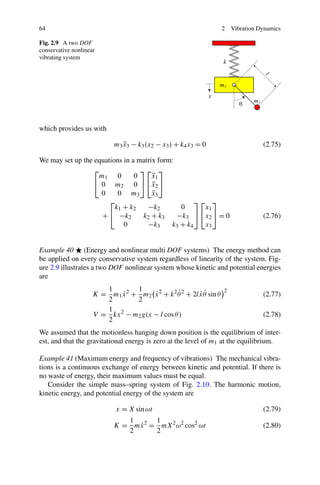
Fig. 2.9 A two DOF
conservative nonlinear
vibrating system


which provides us with

                            m3 x3 − k3 (x2 − x3 ) + k4 x3 = 0
                               ¨                                                   (2.75)

We may set up the equations in a matrix form:
                  ⎡               ⎤⎡ ⎤
                    m1 0        0     ¨
                                      x1
                  ⎣ 0 m2 0 ⎦ ⎣x2 ⎦    ¨
                    0     0 m3        ¨
                                      x3
                       ⎡                            ⎤⎡ ⎤
                         k1 + k2    −k2        0      x1
                     + ⎣ −k2       k2 + k3    −k3 ⎦ ⎣x2 ⎦ = 0                      (2.76)
                            0       −k3     k3 + k4   x3


Example 40 (Energy and nonlinear multi DOF systems) The energy method can
be applied on every conservative system regardless of linearity of the system. Fig-
ure 2.9 illustrates a two DOF nonlinear system whose kinetic and potential energies
are
                        1        1
                                       ˙         ˙      ˙˙
                     K = m1 x 2 + m2 x 2 + k 2 θ 2 + 2l x θ sin θ
                             ˙
                                                                    2
                                                                                   (2.77)
                        2        2
                        1
                     V = kx 2 − m2 g(x − l cos θ )                                 (2.78)
                        2
We assumed that the motionless hanging down position is the equilibrium of inter-
est, and that the gravitational energy is zero at the level of m1 at the equilibrium.

Example 41 (Maximum energy and frequency of vibrations) The mechanical vibra-
tions is a continuous exchange of energy between kinetic and potential. If there is
no waste of energy, their maximum values must be equal.
   Consider the simple mass–spring system of Fig. 2.10. The harmonic motion,
kinetic energy, and potential energy of the system are

                             x = X sin ωt                                          (2.79)
                               1      1
                                 ˙
                            K = mx 2 = mX 2 ω2 cos2 ωt                             (2.80)
                               2      2
2.2 Energy                                                                          65

Fig. 2.10 A mass–spring
system


Fig. 2.11 A wheel turning,
without slip, over a
cylindrical hill


                                1      1
                             V = kx 2 = kX 2 sin2 ωt                            (2.81)
                                2      2
Equating the maximum K and V

                                  1          1
                                    mX 2 ω2 = kX 2                              (2.82)
                                  2          2
provides us with the frequency of vibrations:

                                              k
                                       ω2 =                                     (2.83)
                                              m

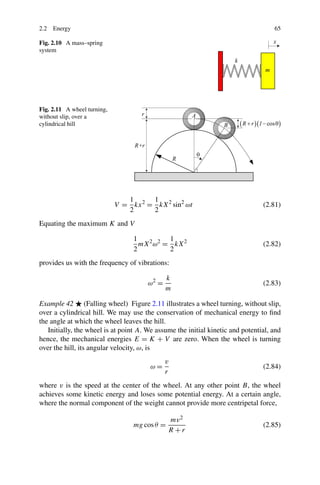
Example 42 (Falling wheel) Figure 2.11 illustrates a wheel turning, without slip,
over a cylindrical hill. We may use the conservation of mechanical energy to find
the angle at which the wheel leaves the hill.
   Initially, the wheel is at point A. We assume the initial kinetic and potential, and
hence, the mechanical energies E = K + V are zero. When the wheel is turning
over the hill, its angular velocity, ω, is
                                              v
                                        ω=                                      (2.84)
                                              r
where v is the speed at the center of the wheel. At any other point B, the wheel
achieves some kinetic energy and loses some potential energy. At a certain angle,
where the normal component of the weight cannot provide more centripetal force,

                                               mv 2
                                  mg cos θ =                                    (2.85)
                                               R+r
66                                                                 2   Vibration Dynamics

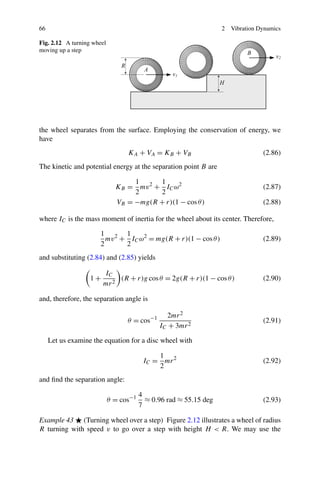
Fig. 2.12 A turning wheel
moving up a step


the wheel separates from the surface. Employing the conservation of energy, we
have
                                  KA + VA = KB + VB                               (2.86)
The kinetic and potential energy at the separation point B are

                                   1     1
                              KB = mv 2 + IC ω2                                   (2.87)
                                   2     2
                              VB = −mg(R + r)(1 − cos θ )                         (2.88)

where IC is the mass moment of inertia for the wheel about its center. Therefore,

                       1 2 1
                         mv + IC ω2 = mg(R + r)(1 − cos θ )                       (2.89)
                       2     2
and substituting (2.84) and (2.85) yields

                        IC
                   1+        (R + r)g cos θ = 2g(R + r)(1 − cos θ )               (2.90)
                        mr 2

and, therefore, the separation angle is

                                                 2mr 2
                                  θ = cos−1                                       (2.91)
                                              IC + 3mr 2

     Let us examine the equation for a disc wheel with

                                             1
                                         IC = mr 2                                (2.92)
                                             2
and find the separation angle:

                                        4
                            θ = cos−1     ≈ 0.96 rad ≈ 55.15 deg                  (2.93)
                                        7

Example 43 (Turning wheel over a step) Figure 2.12 illustrates a wheel of radius
R turning with speed v to go over a step with height H < R. We may use the
2.2 Energy                                                                       67

principle of energy conservation and find the speed of the wheel after getting across
the step. Employing the conservation of energy, we have

                             KA + VA = KB + VB                               (2.94)
                  1 2 1                        1 2 1
                   mv + IC ω1 + 0 =
                            2
                                                mv + IC ω2 + mgH
                                                         2
                                                                             (2.95)
                  2 1 2                        2 2 2
                          IC 2                     IC 2
                       m + 2 v1 =               m + 2 v2 + 2mgH              (2.96)
                          R                        R

and, therefore,

                                                      2gH
                                 v2 =      v1 −
                                            2
                                                           IC
                                                                             (2.97)
                                                  1+      mR 2

The condition for having a real v2 is

                                                 2gH
                                   v1 >                IC
                                                                             (2.98)
                                               1+     mR 2


The second speed (2.97) and the condition (2.98) for a solid disc with IC = mR 2 /2
are

                                                   4
                                  v2 =         v1 − Hg
                                                2                            (2.99)
                                                   3
                                               4
                                  v1 >           Hg                         (2.100)
                                               3

Example 44 (Newton equation) The application of a force system is emphasized by
Newton’s second law of motion, which states that the global rate of change of linear
momentum is proportional to the global applied force:

                                      Gd             Gd
                             G
                                 F=        G
                                               p=            mG v           (2.101)
                                      dt             dt

The second law of motion can be expanded to include rotational motions. Hence, the
second law of motion also states that the global rate of change of angular momentum
is proportional to the global applied moment:

                                                Gd
                                      G
                                          M=         G
                                                         L                  (2.102)
                                                dt
68                                                                                        2   Vibration Dynamics

Proof Differentiating the angular momentum (2.51) shows that
                Gd             Gd                      G dr                          G dp
                                                               C
                     G
                         L=         (rC × p) =                      × p + rC ×
                dt             dt                        dt                              dt
                                          G dp
                           = G rC ×              = G rC × G F = G M                                     (2.103)
                                          dt


Example 45      (Integral and constant of motion) Any equation of the form

                                                  ˙
                                            f (q, q, t) = c                                             (2.104)
                                                  ˙
                                      c = f (q0 , q0 , t0 )                                             (2.105)
                                     q = q1         q2    · · · qn                                      (2.106)

with total differential
                                      n
                           df               ∂f       ∂f        ∂f
                              =                 qi +
                                                ˙         qi +
                                                          ¨       =0                                    (2.107)
                           dt               ∂qi        ˙
                                                     ∂ qi      ∂t
                                    i=1

                                                 ˙
that the generalized positions q and velocities q of a dynamic system must satisfy
at all times t is called an integral of motion. The parameter c, of which the value
depends on the initial conditions, is called a constant of motion. The maximum
number of independent integrals of motion for a dynamic system with n degrees
of freedom is 2n. A constant of motion is a quantity of which the value remains
constant during the motion.
   Any integral of motion is a result of a conservation principle or a combination
of them. There are only three conservation principles for a dynamic system: en-
ergy, momentum, and moment of momentum. Every conservation principle is the
result of a symmetry in position and time. The conservation of energy indicates the
homogeneity of time, the conservation of momentum indicates the homogeneity in
position space, and the conservation of moment of momentum indicates the isotropy
in position space.

Proof Consider a mechanical system with fC degrees of freedom. Mathematically,
the dynamics of the system is expressed by a set of n = fC second-order differential
equations of n unknown generalized coordinates qi (t), i = 1, 2, . . . , n:

                               ¨
                               qi = Fi (qi , qi , t) i = 1, 2, . . . , n
                                             ˙                                                          (2.108)

The general solution of the equations contains 2n constants of integrals.

                         ˙
                         qi = qi (c1 , c2 , . . . , cn , t)
                              ˙                                    i = 1, 2, . . . , n                  (2.109)
                         qi = qi (c1 , c2 , . . . , c2n , t)        i = 1, 2, . . . , n                 (2.110)
2.2 Energy                                                                                    69

To determine these constants and uniquely identify the motion of the system, it is
                                                   ˙
necessary to know the initial conditions qi (t0 ), qi (t0 ), which specify the state of the
system at some given instant t0 :

                                               ˙
                               cj = cj q(t0 ), q(t0 ), t0          j = 1, 2, . . . , 2n   (2.111)
                        ˙                    ˙
               fj q(t), q(t), t = cj q(t0 ), q(t0 ), t0                                   (2.112)

Each of these functions fj is an integral of the motion and each ci is a constant of
the motion. An integral of motion may also be called a first integral, and a constant
of motion may also be called a constant of integral.
   When an integral of motion is given,

                                               ˙
                                        f1 (q, q, t) = c1                                 (2.113)

we can substitute one of the equations of (2.108) with the first-order equation of

                        q1 = f (c1 , qi , qi+1 , t) i = 1, 2, . . . , n
                        ˙                 ˙                                               (2.114)

and solve a set of n − 1 second-order and one first-order differential equations:

                         qi+1 = Fi+1 (qi , qi , t)
                         ¨                   ˙
                                                            i = 1, 2, . . . , n           (2.115)
                         q1 = f (c1 , qi , qi+1 , t)
                         ˙                 ˙

If there exist 2n independent first integrals fj , j = 1, 2, . . . , 2n, then instead of solv-
ing n second-order equations of motion (2.108), we can solve a set of 2n algebraic
equations
                          ˙               ˙
                   fj (q, q) = cj q(t0 ), q(t0 ), t0          j = 1, 2, . . . , 2n        (2.116)
and determine the n generalized coordinates qi , i = 1, 2, . . . , n:

                      qi = qi (c1 , c2 , . . . , c2n , t)   i = 1, 2, . . . , n           (2.117)

   Generally speaking, an integral of motion f is a function of generalized coordi-
                       ˙
nates q and velocities q such that its value remains constant. The value of an integral
of motion is the constant of motion c, which can be calculated by substituting the
                                     ˙
given value of the variables q(t0 ), q(t0 ) at the associated time t0 .

Example 46 (A mass–spring–damper vibrator) Consider a mass m attached to a
spring with stiffness k and a damper with damping c. The equation of motion of the
system and its initial conditions are

                                      mx + cx + kx = 0
                                       ¨    ˙                                             (2.118)
                                  x(0) = x0           x(0) = x0
                                                      ˙      ˙                            (2.119)

Its solution is

                    x = c1 exp(s1 t) + c2 exp(s2 t)                                       (2.120)
70                                                                   2   Vibration Dynamics

Fig. 2.13 A planar pendulum


                              √                              √
                         c−    c2 − 4km                 c+    c2 − 4km
                  s1 =                           s2 =                              (2.121)
                               −2m                            −2m
                                   ˙
Taking the time derivative, we find x:

                          x = c1 s1 exp(s1 t) + c2 s2 exp(s2 t)
                          ˙                                                        (2.122)

            ˙
Using x and x, we determine the integrals of motion f1 and f2 :
                                          x − xs2
                                          ˙
                              f1 =                        = c1                     (2.123)
                                     (s1 − s2 ) exp(s1 t)
                                          x − xs1
                                          ˙
                              f2 =                        = c2                     (2.124)
                                     (s2 − s1 ) exp(s2 t)
Because the constants of integral remain constant during the motion, we can calcu-
late their value at any particular time such as t = 0:
                                x0 − x0 s2
                                ˙                       x0 − x0 s1
                                                        ˙
                         c1 =                    c2 =                              (2.125)
                                (s1 − s2 )              (s2 − s1 )
Substituting s1 and s2 provides us with the constants of motion c1 and c2 :
                        √                    √
                          c2 − 4km(cx0 + x0 c2 − 4km + 2mx0 )  ˙
                  c1 =                    2 − 4km)
                                                                            (2.126)
                                      2(c
                        √                    √
                          c2 − 4km(cx0 − x0 c2 − 4km + 2mx0 )  ˙
                  c2 =                    2 − 4km)
                                                                            (2.127)
                                      2(c


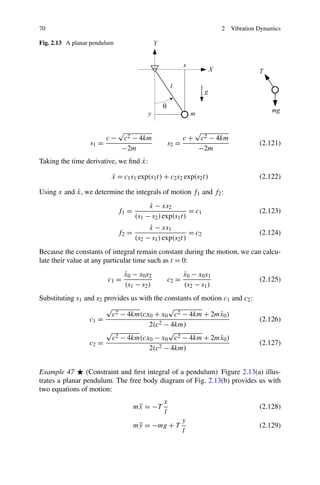
Example 47       (Constraint and first integral of a pendulum) Figure 2.13(a) illus-
trates a planar pendulum. The free body diagram of Fig. 2.13(b) provides us with
two equations of motion:
                                               x
                                     mx = −T
                                      ¨                                            (2.128)
                                               l
                                                        y
                                     my = −mg + T
                                      ¨                                            (2.129)
                                                        l
2.2 Energy                                                                     71

Eliminating the tension force T , we have one second-order equation of two vari-
ables:
                                   yx + xy + gx = 0
                                   ¨    ¨                                 (2.130)
Because of the constant length of the connecting bar we have a constraint equation
between x and y:
                                   x2 + y2 − l2 = 0                       (2.131)
Having one constraint indicates that we can express the dynamic of the system by
only one generalized coordinate. Choosing θ as the generalized coordinate, we can
express x and y by θ , writing the equation of motion (2.130) as
                                         g
                                    ¨
                                    θ+     sin θ = 0                      (2.132)
                                         l
                            ˙
Multiplying the equation by θ and integrating provides us with the integral of en-
ergy:
                                      1         g
                                 ˙      ˙
                           f (θ, θ ) = θ 2 −      cos θ = E               (2.133)
                                      2         l
                                      1 2       g
                                        ˙
                                 E = θ0 −         cos θ0                  (2.134)
                                      2         l
The integral of motion (2.133) is a first-order differential equation:
                                               g
                                ˙
                                θ=       2E + 2 cos θ                     (2.135)
                                               l
This equation expresses the dynamic of the pendulum upon solution.
  Let us assume that θ is too small to approximate the equation of motion as
                                           g
                                        ¨
                                        θ + θ =0                          (2.136)
                                           l
The first integral of this equation is
                                         1        g
                                    ˙      ˙
                              f (θ, θ ) = θ 2 −     θ =E                  (2.137)
                                         2        l
                                         1 2      g
                                           ˙
                                    E = θ0 −        θ0                    (2.138)
                                         2        l
that provides us with a separated first-order differential equation:
                                                 g
                                   ˙
                                   θ=      2E + 2 θ                       (2.139)
                                                 l
Its solution is
                                 dθ            √ l     g
                     t=                    =    2        θ +E−p           (2.140)
                              2E   + 2gθ          g    l
                                      l
72                                                                          2   Vibration Dynamics

where p is the second constant of motion:

                                               l
                                          p=     ˙
                                                 θ0                                       (2.141)
                                               g

  Now, let us ignore the energy integral and solve the second-order equation of
motion (2.136):
                                            g                   g
                            θ = c1 cos        t + c2 sin          t                       (2.142)
                                            l                   l
The time derivative of the solution

                            l                  g                      g
                              ˙
                              θ = −c1 sin        t + c2 cos             t                 (2.143)
                            g                  l                      l

can be used to determine the integrals and constants of motion:

                                          g           l           g
                          f1 = θ cos        t−          ˙
                                                        θ sin       t                     (2.144)
                                          l           g           l

                                          g           l           g
                          f2 = θ sin        t+          ˙
                                                        θ cos       t                     (2.145)
                                          l           g           l

                                          ˙       ˙
Using the initial conditions θ (0) = θ0 , θ (0) = θ0 , we have

                                                         l
                               c1 = θ 0        c2 =        ˙
                                                           θ0                             (2.146)
                                                         g

A second-order equation has only two constants of integrals. Therefore, we should
be able to express E and p in terms of c1 and c2 or vice versa:

                              1 2 g      1g 2 g
                                ˙
                           E = θ0 − θ0 =   c − c1                                         (2.147)
                              2    l     2l 2 l
                                 l      l      g
                           p=      ˙
                                   θ0 =          c2                                       (2.148)
                                 g      g      l

                                   l      g      l
                          c2 =       ˙
                                     θ0 =          p                                      (2.149)
                                   g      l      g
                                       1g 2 l
                          c1 = θ 0 =      p − E                                           (2.150)
                                       2l    g

E is the mechanical energy of the pendulum, and p is proportional to its moment of
momentum.
2.3 Rigid Body Dynamics                                                        73

Fig. 2.14 A globally fixed
G-frame and a body B-frame
with a fixed common origin
at O


2.3      Rigid Body Dynamics
A rigid body may have three translational and three rotational DOF. The transla-
tional and rotational equations of motion of the rigid body are determined by the
Newton–Euler equations.


2.3.1      Coordinate Frame Transformation

Consider a rotation of a body coordinate frame B(Oxyz) with respect to a global
frame G(OXY Z) about their common origin O as illustrated in Fig. 2.14. The com-
ponents of any vector r may be expressed in either frame. There is always a trans-
formation matrix G RB to map the components of r from the frame B(Oxyz) to the
other frame G(OXY Z):
                                      G
                                          r = G RB B r                    (2.151)
                                      −1
In addition, the inverse map B r = G RB G r can be done by B RG ,
                                      B
                                          r = B RG G r                    (2.152)

where
                                  G            B
                                      RB =         RG = 1                 (2.153)
and
                                          −1
                              B
                                  RG = G RB = G RB
                                                 T
                                                                          (2.154)
When the coordinate frames B and G are orthogonal, the rotation matrix    GR
                                                                            B is
called an orthogonal matrix. The transpose R T and inverse R −1 of an orthogonal
matrix [R] are equal:
                                          R T = R −1                      (2.155)
74                                                               2   Vibration Dynamics

Because of the matrix orthogonality condition, only three of the nine elements of
G R are independent.
   B

Proof Employing the orthogonality condition

                                   ˆı          ˆ ˆ         ˆ ˆ
                          r = (r · ı )ˆ + (r · j )j + (r · k)k                 (2.156)

and decomposition of the unit vectors of G(OXY Z) along the axes of B(Oxyz),

                         ˆ    ˆ ˆı        ˆ ˆ ˆ       ˆ ˆ ˆ
                        I = (I · ı )ˆ + (I · j )j + (I · k)k                   (2.157)
                         ˆ    ˆ ˆı        ˆ ˆ ˆ       ˆ ˆ ˆ
                        J = (J · ı )ˆ + (J · j )j + (J · k)k                   (2.158)
                        ˆ    ˆ ˆı        ˆ ˆ ˆ       ˆ ˆ ˆ
                        K = (K · ı )ˆ + (K · j )j + (K · k)k                   (2.159)

introduces the transformation matrix G RB to map the local axes to the global axes:
                ⎡ ⎤ ⎡                               ⎤⎡ ⎤          ⎡ ⎤
                 Iˆ      ˆ ˆ
                        I ·ı        ˆ ˆ
                                   I ·j        ˆ ˆ
                                              I ·k     ˆ
                                                       ı           ˆ
                                                                   ı
                ⎣J ⎦ = ⎣J · ı
                  ˆ      ˆ ˆ        ˆ ˆ
                                   J ·j       J · k ⎦ ⎣j ⎦ = G RB ⎣j ⎦
                                               ˆ ˆ     ˆ           ˆ           (2.160)
                 ˆ
                 K      ˆ ˆ
                        K ·ı       ˆ ˆ
                                   K ·j       ˆ ˆ
                                              K ·k     ˆ
                                                       k           ˆ
                                                                   k

where
                          ⎡                     ⎤
                            ˆ ˆ      ˆ ˆ
                           I ·ı I ·j I ·k ˆ ˆ
                  G
                    RB = ⎣ J · ı J · j J · k ⎦
                            ˆ ˆ      ˆ ˆ  ˆ ˆ
                            ˆ ·ı K ·j K ·k
                           K ˆ       ˆ ˆ ˆ ˆ
                         ⎡                                    ⎤
                                ˆ ˆ         ˆ ˆ         ˆ ˆ
                           cos(I , ı ) cos(I , j ) cos(I , k)
                       = ⎣ cos(J , ı ) cos(J , j ) cos(J , k) ⎦
                                ˆ ˆ         ˆ ˆ         ˆ ˆ                    (2.161)
                                ˆ ˆ        ˆ ˆ         ˆ ˆ
                           cos(K, ı ) cos(K, j ) cos(K, k)

Each column of G RB is the decomposition of a unit vector of the local frame
B(Oxyz) in the global frame G(OXY Z):
                              G
                                  RB =    ˆ
                                         Gı      ˆ
                                                Gj    ˆ
                                                     Gk                        (2.162)

Similarly, each row of G RB is decomposition of a unit vector of the global frame
G(OXY Z) in the local frame B(Oxyz).
                                           ⎡B     ⎤
                                               ˆ
                                              IT
                                   G
                                     RB = ⎣ B J T ⎦
                                               ˆ                               (2.163)
                                              ˆ
                                           B KT


so the elements of G RB are directional cosines of the axes of G(OXY Z) in
B(Oxyz) or B in G. This set of nine directional cosines completely specifies the
orientation of B(Oxyz) in G(OXY Z) and can be used to map the coordinates of
any point (x, y, z) to its corresponding coordinates (X, Y, Z).
2.3 Rigid Body Dynamics                                                           75

    Alternatively, using the method of unit-vector decomposition to develop the ma-
trix B RG leads to

                                        −1
                      r = B RG G r = G RB G r
                       B
                                                                              (2.164)
                          ⎡                     ⎤
                            ˆ ˆ ˆ ˆ ˆ ˆ
                            ı ·I ı ·J ı ·K
                   B
                     RG = ⎣ j · I j · J j · K ⎦
                            ˆ ˆ ˆ ˆ ˆ ˆ
                            ˆ ˆ ˆ ˆ ˆ ˆ
                            k·I k·J k·K
                          ⎡                                  ⎤
                                 ı ˆ       ı ˆ         ı ˆ
                            cos(ˆ, I ) cos(ˆ, J ) cos(ˆ, K)
                        = ⎣cos(j , I ) cos(j , J ) cos(j , K)⎦
                                 ˆ ˆ       ˆ ˆ         ˆ ˆ                    (2.165)
                                 ˆ I ) cos(k, J ) cos(k, K)
                            cos(k,  ˆ      ˆ ˆ         ˆ ˆ

It shows that the inverse of a transformation matrix is equal to the transpose of the
transformation matrix,
                                              −1
                                         G
                                             RB = G RB
                                                     T
                                                                              (2.166)

or
                                        G
                                            RB · G RB = I
                                                    T
                                                                              (2.167)

   A matrix with condition (2.166) is called an orthogonal matrix. Orthogonality of
GR
    B comes from the fact that it maps an orthogonal coordinate frame to another
orthogonal coordinate frame.
   An orthogonal transformation matrix G RB has only three independent elements.
The constraint equations among the elements of G RB will be found by applying the
matrix orthogonality condition (2.166):
                ⎡                     ⎤⎡                    ⎤ ⎡           ⎤
                 r11       r12    r13    r11      r21   r31      1   0   0
                ⎣r21       r22    r23 ⎦ ⎣r12      r22   r32 ⎦ = ⎣0   1   0⎦   (2.168)
                 r31       r32    r33    r13      r23   r33      0   0   1

Therefore, the inner product of any two different rows of G RB is zero, and the inner
product of any row of G RB by itself is unity:

                                             r11 + r12 + r13 = 1
                                              2     2     2


                                             r21 + r22 + r23 = 1
                                              2     2     2


                                             r31 + r32 + r33 = 1
                                              2     2     2
                                                                              (2.169)
                                 r11 r21 + r12 r22 + r13 r23 = 0
                                 r11 r31 + r12 r32 + r13 r33 = 0
                                 r21 r31 + r22 r32 + r23 r33 = 0
76                                                                          2       Vibration Dynamics

These relations are also true for columns of G RB and evidently for rows and
columns of B RG . The orthogonality condition can be summarized by the equation
                               3
                                    rij rik = δj k    j, k = 1, 2, 3                          (2.170)
                              i=1

where rij is the element of row i and column j of the transformation matrix G RB
and δj k is the Kronecker delta δij ,

                                                     1     i=j
                                    δij = δj i =                                              (2.171)
                                                     0     i=j

   Equation (2.170) provides us with six independent relations that must be satisfied
by the nine directional cosines. Therefore, there are only three independent direc-
tional cosines. The independent elements of the matrix G RB cannot be in the same
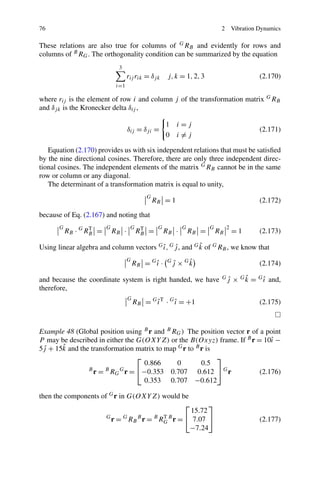
row or column or any diagonal.
   The determinant of a transformation matrix is equal to unity,
                                            G
                                                RB = 1                                        (2.172)

because of Eq. (2.167) and noting that
       G                 G           G           G          G          G        2
           RB · G RB =
                   T
                             RB ·        RB =
                                          T
                                                     RB ·       RB =       RB       =1        (2.173)

                                          ˆ ˆ             ˆ
Using linear algebra and column vectors G ı , G j , and G k of G RB , we know that
                                    G
                                        RB = G ı ·
                                               ˆ      G        ˆ
                                                          j × Gk
                                                          ˆ                                   (2.174)

and because the coordinate system is right handed, we have                   ˆ
                                                                            Gj          ˆ
                                                                                    × G k = G ı and,
                                                                                              ˆ
therefore,
                                    G
                                        RB = G ı T · G ı = +1
                                               ˆ       ˆ                                      (2.175)


Example 48 (Global position using B r and B RG ) The position vector r of a point
P may be described in either the G(OXY Z) or the B(Oxyz) frame. If B r = 10ˆ −ı
       ˆ
5j + 15k and the transformation matrix to map G r to B r is
 ˆ
                                 ⎡                          ⎤
                                   0.866      0        0.5
                B
                  r = B RG G r = ⎣−0.353 0.707 0.612 ⎦ G r                (2.176)
                                   0.353 0.707 −0.612

then the components of G r in G(OXY Z) would be
                                              ⎡             ⎤
                                                      15.72
                         G
                           r = G RB B r = B RG B r = ⎣ 7.07 ⎦
                                             T
                                                                                              (2.177)
                                                      −7.24
2.3 Rigid Body Dynamics                                                                77

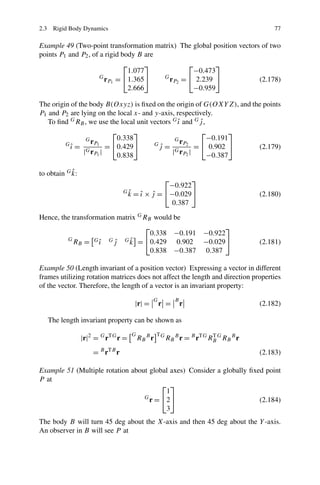
Example 49 (Two-point transformation matrix) The global position vectors of two
points P1 and P2 , of a rigid body B are
                              ⎡      ⎤           ⎡       ⎤
                                1.077              −0.473
                      G
                        rP1 = ⎣1.365⎦    G
                                           rP2 = ⎣ 2.239 ⎦              (2.178)
                                2.666              −0.959

The origin of the body B(Oxyz) is fixed on the origin of G(OXY Z), and the points
P1 and P2 are lying on the local x- and y-axis, respectively.
                                                 ˆ       ˆ
   To find G RB , we use the local unit vectors G ı and G j ,
                          ⎡      ⎤                       ⎡         ⎤
                 Gr         0.338               Gr           −0.191
                        = ⎣0.429⎦                      = ⎣ 0.902 ⎦
                    P1                             P2
         G
           ı= G
           ˆ                            G
                                          j= G
                                          ˆ                             (2.179)
                | rP1 |     0.838              | rP2 |       −0.387

            ˆ
to obtain G k:
                                                  ⎡  ⎤
                                               −0.922
                                 Gˆ
                                  k = ı × j = ⎣−0.029⎦
                                      ˆ ˆ                                          (2.180)
                                               0.387

Hence, the transformation matrix G RB would be
                                    ⎡                   ⎤
                                     0.338 −0.191 −0.922
         G
           RB = G ı G j G k = ⎣0.429 0.902 −0.029⎦
                    ˆ    ˆ    ˆ                                                    (2.181)
                                     0.838 −0.387 0.387

Example 50 (Length invariant of a position vector) Expressing a vector in different
frames utilizing rotation matrices does not affect the length and direction properties
of the vector. Therefore, the length of a vector is an invariant property:
                                             G           B
                                    |r| =        r =         r                     (2.182)

   The length invariant property can be shown as
                                    G            TG
                 |r|2 = G rTG r =       RB B r        RB B r = B rTG RB G RB B r
                                                                      T


                     = B rTB r                                                     (2.183)

Example 51 (Multiple rotation about global axes) Consider a globally fixed point
P at
                                        ⎡ ⎤
                                         1
                                  G
                                    r = ⎣2⎦                             (2.184)
                                         3
The body B will turn 45 deg about the X-axis and then 45 deg about the Y -axis.
An observer in B will see P at
78                                                                    2   Vibration Dynamics

          B
              r = Ry,−45 Rx,−45 G r
                  ⎡                       ⎤ ⎡1                     ⎤⎡ ⎤
                   cos −π 0 − sin −π                0          0      1
                                          ⎦ ⎢0 cos 4        sin −π ⎥ ⎣2⎦
                         4             4             −π
                =⎣ 0        1       0       ⎣                    4 ⎦
                    sin −π 0 cos −π
                         4            4       0 − sin −π cos −π       3
                                                       4         4
                  ⎡                          ⎤⎡ ⎤ ⎡             ⎤
                     0.707    0.5       0.5     1        3.207
                =⎣ 0         0.707 −0.707⎦ ⎣2⎦ = ⎣−0.707⎦                           (2.185)
                   −0.707     0.5       0.5     3        1.793

To check this result, let us change the role of B and G. So, the body point at
                                            ⎡ ⎤
                                              1
                                      B
                                        r = ⎣2⎦                               (2.186)
                                              3

undergoes an active rotation of 45 deg about the x-axis followed by 45 deg about
the y-axis. The global coordinates of the point would be
                                   B
                                       r = Ry,45 Rx,45 G r                          (2.187)

so
                       G
                           r = [Ry,45 Rx,45 ]TB r = Rx,45 Ry,45 B r
                                                     T     T
                                                                                    (2.188)

Example 52 (Multiple rotations about body axes) Consider a globally fixed point P
at
                                         ⎡ ⎤
                                          1
                                   G
                                     r = ⎣2⎦                             (2.189)
                                          3
The body B will turn 45 deg about the x-axis and then 45 deg about the y-axis.
An observer in B will see P at
          B
              r = RY,−45 RX,−45 G r
                  ⎡                      ⎤ ⎡1                    ⎤⎡ ⎤
                    cos −π     0 sin −π           0         0      1
                         4            4    ⎢       −π         −π ⎥
                =⎣     0       1     0 ⎦ ⎣0 cos 4 − sin 4 ⎦ ⎣2⎦
                   − sin −π 0 cos −π
                          4           4      0 sin −π    cos −π    3
                                                    4         4
                  ⎡                      ⎤⎡ ⎤ ⎡            ⎤
                   0.707     0.5    −0.5    1      0.20711
                =⎣ 0        0.707 0.707⎦ ⎣2⎦ = ⎣ 3.5356 ⎦                           (2.190)
                   0.707 −0.5       0.5     3       1.2071

Example 53 (Successive rotations about global axes) After a series of sequential
rotations R1 , R2 , R3 , . . . , Rn about the global axes, the final global position of a
body point P can be found by
                                        G
                                            r = G RB B r                            (2.191)
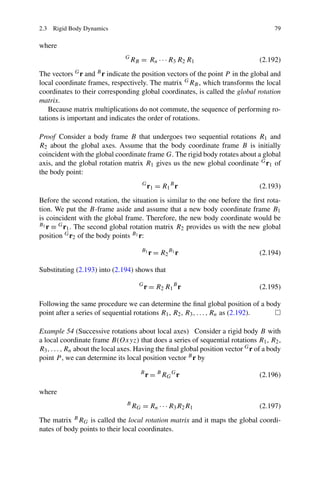
2.3 Rigid Body Dynamics                                                                79

where
                                G
                                    RB = Rn · · · R3 R2 R1                        (2.192)
The vectors G r and B r indicate the position vectors of the point P in the global and
local coordinate frames, respectively. The matrix G RB , which transforms the local
coordinates to their corresponding global coordinates, is called the global rotation
matrix.
    Because matrix multiplications do not commute, the sequence of performing ro-
tations is important and indicates the order of rotations.

Proof Consider a body frame B that undergoes two sequential rotations R1 and
R2 about the global axes. Assume that the body coordinate frame B is initially
coincident with the global coordinate frame G. The rigid body rotates about a global
axis, and the global rotation matrix R1 gives us the new global coordinate G r1 of
the body point:
                                        G
                                            r 1 = R1 B r                          (2.193)
Before the second rotation, the situation is similar to the one before the first rota-
tion. We put the B-frame aside and assume that a new body coordinate frame B1
is coincident with the global frame. Therefore, the new body coordinate would be
B1 r ≡ G r . The second global rotation matrix R provides us with the new global
          1                                       2
position G r2 of the body points B1 r:
                                        B1
                                             r = R2 B1 r                          (2.194)

Substituting (2.193) into (2.194) shows that
                                       G
                                           r = R 2 R1 B r                         (2.195)

Following the same procedure we can determine the final global position of a body
point after a series of sequential rotations R1 , R2 , R3 , . . . , Rn as (2.192).

Example 54 (Successive rotations about local axes) Consider a rigid body B with
a local coordinate frame B(Oxyz) that does a series of sequential rotations R1 , R2 ,
R3 , . . . , Rn about the local axes. Having the final global position vector G r of a body
point P , we can determine its local position vector B r by
                                       B
                                           r = B RG G r                           (2.196)

where
                                B
                                    R G = R n · · · R3 R 2 R 1                    (2.197)
The matrix B RG is called the local rotation matrix and it maps the global coordi-
nates of body points to their local coordinates.
80                                                                2   Vibration Dynamics

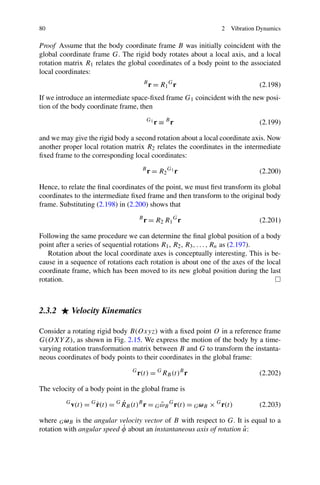
Proof Assume that the body coordinate frame B was initially coincident with the
global coordinate frame G. The rigid body rotates about a local axis, and a local
rotation matrix R1 relates the global coordinates of a body point to the associated
local coordinates:
                                          B
                                              r = R1 G r                        (2.198)
If we introduce an intermediate space-fixed frame G1 coincident with the new posi-
tion of the body coordinate frame, then
                                           G1
                                                r ≡ Br                          (2.199)

and we may give the rigid body a second rotation about a local coordinate axis. Now
another proper local rotation matrix R2 relates the coordinates in the intermediate
fixed frame to the corresponding local coordinates:
                                       B
                                           r = R2 G1 r                          (2.200)

Hence, to relate the final coordinates of the point, we must first transform its global
coordinates to the intermediate fixed frame and then transform to the original body
frame. Substituting (2.198) in (2.200) shows that
                                      B
                                          r = R 2 R1 G r                        (2.201)

Following the same procedure we can determine the final global position of a body
point after a series of sequential rotations R1 , R2 , R3 , . . . , Rn as (2.197).
   Rotation about the local coordinate axes is conceptually interesting. This is be-
cause in a sequence of rotations each rotation is about one of the axes of the local
coordinate frame, which has been moved to its new global position during the last
rotation.


2.3.2        Velocity Kinematics

Consider a rotating rigid body B(Oxyz) with a fixed point O in a reference frame
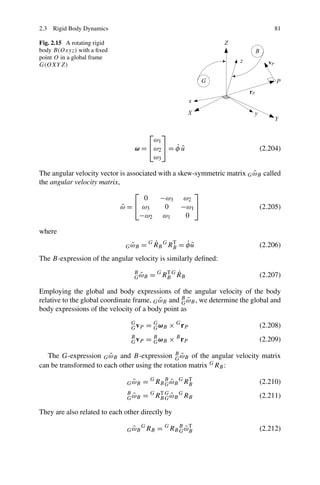
G(OXY Z), as shown in Fig. 2.15. We express the motion of the body by a time-
varying rotation transformation matrix between B and G to transform the instanta-
neous coordinates of body points to their coordinates in the global frame:
                                  G
                                      r(t) = G RB (t)B r                        (2.202)

The velocity of a body point in the global frame is
         G
                      ˙        ˙
             v(t) = G r(t) = G RB (t)B r = G ωB G r(t) = G ωB × G r(t)
                                             ˜                                  (2.203)

where G ωB is the angular velocity vector of B with respect to G. It is equal to a
                            ˙                                         ˆ
rotation with angular speed φ about an instantaneous axis of rotation u:
2.3 Rigid Body Dynamics                                                          81

Fig. 2.15 A rotating rigid
body B(Oxyz) with a fixed
point O in a global frame
G(OXY Z)


                                         ⎤⎡
                                      ω1
                                 ω = ⎣ω2 ⎦ = φ u
                                             ˙ˆ                             (2.204)
                                      ω3

                                                                         ˜
The angular velocity vector is associated with a skew-symmetric matrix G ωB called
the angular velocity matrix,
                                 ⎡                    ⎤
                                     0    −ω3 ω2
                             ω = ⎣ ω3
                             ˜              0     −ω1 ⎦                    (2.205)
                                   −ω2 ω1           0

where
                                ˜
                              G ωB        ˙          ˙˜
                                      = G R B G RB = φ u
                                                 T
                                                                            (2.206)
The B-expression of the angular velocity is similarly defined:
                                                T ˙
                                 B
                                   ˜
                                 G ωB      = G RB G R B                     (2.207)

Employing the global and body expressions of the angular velocity of the body
                                           ˜      G˜
relative to the global coordinate frame, G ωB and B ωB , we determine the global and
body expressions of the velocity of a body point as
                                G
                                G vP      = G ω B × G rP
                                            G                               (2.208)
                                B
                                G vP      = B ω B × B rP
                                            G                               (2.209)

                        ˜                      G˜
   The G-expression G ωB and B-expression B ωB of the angular velocity matrix
can be transformed to each other using the rotation matrix G RB :

                                 ˜
                               G ωB   = G RB B ω B G RB
                                             G˜
                                                      T
                                                                            (2.210)
                               B
                                 ˜
                               G ωB   = G RB G ω B G RB
                                           T
                                             G˜                             (2.211)

They are also related to each other directly by

                                 ˜
                               G ωB
                                      G
                                          RB = G RB B ω B
                                                    G˜
                                                        T
                                                                            (2.212)
82                                                                                  2   Vibration Dynamics

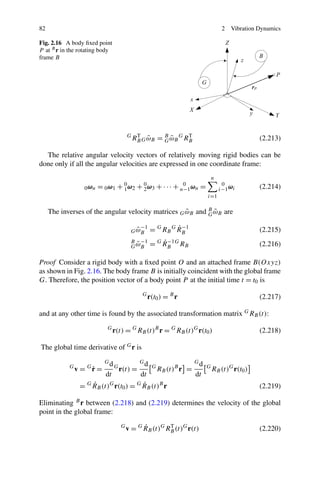
Fig. 2.16 A body fixed point
P at B r in the rotating body
frame B


                                        G
                                            RB G ω B = B ω B G RB
                                             T
                                                 ˜     G˜
                                                                T
                                                                                                  (2.213)

  The relative angular velocity vectors of relatively moving rigid bodies can be
done only if all the angular velocities are expressed in one coordinate frame:
                                                                               n
                  0 ωn = 0 ω1 + 1 ω2 + 2 ω3 + · · · + n−1 ωn =
                                0      0               0                            0
                                                                                   i−1 ωi         (2.214)
                                                                           i=1

                                                     ˜      G˜
     The inverses of the angular velocity matrices G ωB and B ωB are

                                           ˜ −1
                                         G ωB               ˙ −1
                                                   = G RB G R B                                   (2.215)
                                         B −1
                                           ˜
                                         G ωB
                                                       ˙ −1
                                                   = G R B G RB                                   (2.216)

Proof Consider a rigid body with a fixed point O and an attached frame B(Oxyz)
as shown in Fig. 2.16. The body frame B is initially coincident with the global frame
G. Therefore, the position vector of a body point P at the initial time t = t0 is
                                               G
                                                   r(t0 ) = B r                                   (2.217)

and at any other time is found by the associated transformation matrix G RB (t):
                           G
                                r(t) = G RB (t)B r = G RB (t)G r(t0 )                             (2.218)

The global time derivative of G r is
                           Gd                 Gd                      Gd
            G
                     ˙
                v = Gr =        G
                                    r(t) =          G
                                                        RB (t)B r =        G
                                                                               RB (t)G r(t0 )
                           dt      dt                                 dt
                  G ˙             G ˙
                 = RB (t) r(t0 ) = RB (t)B r
                         G
                                                                                                  (2.219)

Eliminating B r between (2.218) and (2.219) determines the velocity of the global
point in the global frame:
                                    G         ˙
                                        v = G RB (t)G RB (t)G r(t)
                                                       T
                                                                                                  (2.220)
2.3 Rigid Body Dynamics                                                            83

                                        ˜
We denote the coefficient of G r(t) by G ωB

                                       ˜
                                     G ωB        ˙
                                             = G R B G RB
                                                        T
                                                                              (2.221)

and rewrite Eq. (2.220) as
                                      G
                                          v = G ωB G r(t)
                                                ˜                             (2.222)
or equivalently as
                                    G
                                        v = G ωB × G r(t)                     (2.223)
where G ωB is the instantaneous angular velocity of the body B relative to the global
frame G as seen from the G-frame.
   Transforming G v to the body frame provides us with the body expression of the
velocity vector:
                                                        T ˙
                B
                G vP   = G RB G v = G RB G ω B G r = G RB G R B G RB G r
                            T          T
                                           ˜                       T

                            T ˙
                       = G RB G R B B r                                       (2.224)

                                   G˜
We denote the coefficient of B r by B ωB

                                                  T ˙
                                     B
                                       ˜
                                     G ωB    = G RB G R B                     (2.225)

and rewrite Eq. (2.224) as
                                     B
                                     G vP    = B ω B B rP
                                               G˜                             (2.226)
or equivalently as
                                    B
                                    G vP   = B ω B × B rP
                                             G                                (2.227)
where  Bω   is the instantaneous angular velocity of B relative to the global frame
       G B
G as seen from the B-frame.
  The time derivative of the orthogonality condition, G RB G RB = I, introduces an
                                                               T

important identity,
                              G   ˙      T          ˙T
                                  R B G RB + G RB G R B = 0                   (2.228)
                                                             ˜       ˙
which can be used to show that the angular velocity matrix G ωB = [G RB G RB ] is
                                                                           T

skew-symmetric:
                               G        ˙T
                                   RB G R B =
                                                 G   ˙      T
                                                     R B G RB
                                                                T
                                                                              (2.229)
   Generally speaking, an angular velocity vector is the instantaneous rotation of
a coordinate frame A with respect to another frame B that can be expressed in or
seen from a third coordinate frame C. We indicate the first coordinate frame A by
a right subscript, the second frame B by a left subscript, and the third frame C by
a left superscript, C ωA . If the left super and subscripts are the same, we only show
                    B
the subscript.
84                                                                                    2   Vibration Dynamics

   We can transform the G-expression of the global velocity of a body point P ,
Gv    and the B-expression of the global velocity of the point P , B vP , to each other
     P,                                                            G
using a rotation matrix:
             B
             G vP   = B RG G vP = B RGG ωB G rP = B RGG ωB G RB B rP
                                        ˜               ˜
                             ˙                            ˙
                    = B RG G R B G RB G RB B r P = B RG G R B B r P
                                    T

                         T ˙
                    = G RB G R B B r P = B ω B B r P = B ω B × B r P
                                         G˜            G                                            (2.230)
             G
                 vP =   G
                            RB B v P
                               G         =   G
                                                    G˜
                                                 RB B ω B B r P    =   G
                                                                              G˜
                                                                                       T
                                                                           RB B ω B G RB G r P
                              T ˙                    ˙
                    = G RB G RB G R B G RB G r P = G R B G RB G r P
                                         T                  T

                                                                             B
                    = G ω B G r P = G ω B × G r P = G RB
                        ˜                                                      ω
                                                                             G B
                                                                                   × B rP           (2.231)

                          ˜        G˜
From the definitions of G ωB and B ωB in (2.221) and (2.225) and comparing with
(2.230) and (2.231), we are able to transform the two angular velocity matrices by

                                          ˜
                                        G ωB     = G RB B ω B G RB
                                                        G˜
                                                                 T
                                                                                                    (2.232)
                                        B
                                          ˜
                                        G ωB     = G RB G ω B G RB
                                                      T
                                                          ˜                                         (2.233)

and derive the following useful equations:
                                                 G   ˙
                                                     R B = G ω B G RB
                                                             ˜                                      (2.234)
                                                 G   ˙
                                                     RB =   G
                                                                   G˜
                                                                RB B ω B                            (2.235)
                                          ˜
                                        G ωB
                                                 G
                                                     RB = G RB B ω B
                                                               G˜                                   (2.236)

   The angular velocity of B in G is negative of the angular velocity of G in B if
both are expressed in the same coordinate frame:
                             G
                               ˜
                             G ωB   = −G ω G
                                       B ˜
                                                            G
                                                            G ωB    = −G ω G
                                                                       B                            (2.237)
                             B
                               ˜
                             G ωB   =     −B ω G
                                           B˜
                                                            B
                                                            G ωB    = −B ω G
                                                                       B                            (2.238)

The vector G ωB can always be expressed in the natural form

                                                  G ωB   = ωu
                                                            ˆ                                       (2.239)

                                        ˆ
with the magnitude ω and a unit vector u parallel to G ωB that indicates the instan-
taneous axis of rotation.
   To show the addition of relative angular velocities in Eq. (2.214), we start from
a combination of rotations,
                                             0
                                                 R2 = 0 R1 1 R2                                     (2.240)
and take the time derivative:
                                    0   ˙       ˙                 ˙
                                        R 2 = 0 R 1 1 R2 + 0 R1 1 R 2                               (2.241)
2.3 Rigid Body Dynamics                                                                        85

Substituting the derivative of the rotation matrices with
                                             0   ˙
                                                 R 2 = 0 ω 2 0 R2
                                                         ˜                                 (2.242)
                                             0   ˙
                                                 R 1 = 0 ω 1 R1
                                                         ˜  0
                                                                                           (2.243)
                                             1   ˙
                                                 R 2 = 1 ω 2 1 R2
                                                         ˜                                 (2.244)

results in

                          ˜
                        0 ω2
                               0
                                   R2 = 0 ω1 0 R1 1 R2 + 0 R11 ω2 1 R2
                                          ˜                    ˜
                                      = 0 ω1 0 R2 + 0 R11 ω2 0 R1 0 R1 1 R2
                                          ˜               ˜     T


                                      = 0 ω 1 0 R2 + 0 ω 2 0 R2
                                          ˜          1˜                                    (2.245)

where
                                         0
                                             R11 ω2 0 R1 = 0 ω2
                                                 ˜     T
                                                           1˜                              (2.246)
Therefore, we find
                                            ˜
                                          0 ω2     = 0 ω1 + 0 ω2
                                                       ˜    1˜                             (2.247)
which indicates that two angular velocities may be added when they are expressed
in the same frame:

                                          0 ω2     = 0 ω1 + 0 ω2
                                                            1                              (2.248)
The expansion of this equation for any number of angular velocities would be
Eq. (2.214).
   Employing the relative angular velocity formula (2.248), we can find the relative
velocity formula of a point P in B2 at 0 rP :

              0 v2   = 0 ω 2 0 rP =       0 ω1    + 0 ω 2 0 rP = 0 ω 1 0 rP + 0 ω 2 0 rP
                                                    1                         1

                     = 0 v1 + 0 v2
                              1                                                            (2.249)

                                   ˜      G˜
   The angular velocity matrices G ωB and B ωB are skew-symmetric and not invert-
ible. However, we can define their inverse by the rules

                                           ˜ −1
                                         G ωB                ˙ −1
                                                    = G RB G R B                           (2.250)
                                         B −1
                                           ˜
                                         G ωB
                                                        ˙ −1
                                                    = G R B G RB                           (2.251)

to get

                                     ˜ −1 ˜
                                   G ωB G ωB           ˜    ˜ −1
                                                   = G ωB G ωB = [I]                       (2.252)
                                   B −1 B
                                     ˜    ˜
                                   G ωB G ωB       =   B
                                                         ˜ B ˜ −1
                                                       G ωB G ωB    = [I]                  (2.253)
86                                                                  2   Vibration Dynamics

Example 55 (Rotation of a body point about a global axis) Consider a rigid body
is turning about the Z-axis with a constant angular speed α = 10 deg/s. The global
                                                           ˙
velocity of a body point at P (5, 30, 10) when the body is at α = 30 deg is

              G          ˙
                  vP = G RB (t)B rP
                           ⎛⎡                       ⎤⎞ ⎡ ⎤
                       Gd      cos α     − sin α  0       5
                     =     ⎝⎣ sin α      cos α    0⎦⎠ ⎣30⎦
                       dt        0          0     1      10
                           ⎡                      ⎤⎡ ⎤
                             − sin α − cos α 0         5
                       = α ⎣ cos α − sin α 0⎦ ⎣30⎦
                         ˙
                                0        0      0     10
                              ⎡                       ⎤⎡ ⎤ ⎡      ⎤
                                − sin π − cos π 0         5  −4.97
                         10π ⎣         6        6
                       =          cos π
                                      6   − sin π 0⎦ ⎣30⎦ = ⎣−1.86⎦
                                                6                                 (2.254)
                         180        0        0       0   10   0

The point P is now at

                   G
                       r P = G RB B r P
                             ⎡                       ⎤⎡ ⎤ ⎡          ⎤
                               cos π − sin π
                                   6         6     0   5      −10.67
                           = ⎣ sin π    cos π      0⎦ ⎣30⎦ = ⎣ 28.48 ⎦            (2.255)
                                   6        6
                                 0        0        1   10       10

Example 56      (Rotation of a global point about a global axis) A body point P at
Br
   P  = [5 30 10]T is turned α = 30 deg about the Z-axis. The global position of P
is at

                   G
                       r P = G RB B r P
                             ⎡                       ⎤⎡ ⎤ ⎡          ⎤
                               cos π − sin π
                                   6         6     0   5      −10.67
                           = ⎣ sin π    cos π      0⎦ ⎣30⎦ = ⎣ 28.48 ⎦            (2.256)
                                   6        6
                                 0        0        1   10       10

If the body is turning with a constant angular speed α = 10 deg/s, the global velocity
                                                     ˙
of the point P would be

         G           ˙
             v P = G R B G RB G r P
                            T

                         ⎡ π                  ⎤⎡ π                ⎤T ⎡       ⎤
                           −s       −c π    0   c6      −s π    0      −10.67
                   10π ⎣ π6            6                    6
                 =          c6      −s π
                                       6    0⎦ ⎣ s π
                                                   6    cπ6     0⎦ ⎣ 28.48 ⎦
                   180       0       0      0     0      0      1       10
                    ⎡      ⎤
                     −4.97
                  = ⎣−1.86⎦                                                       (2.257)
                      0
2.3 Rigid Body Dynamics                                                              87

Example 57 (Simple derivative transformation formula) Consider a point P that
can move in the body coordinate frame B(Oxyz). The body position vector B rP is
not constant, and, therefore, the B-expression of the G-velocity of such a point is
                     Gd                        Bd
                                    G˙
                               rP = B rP =               rP + B ω B × B rP
                           B                        B
                                                              G                  (2.258)
                      dt                       dt
  The result of Eq. (2.258) is used to define the transformation of the differential
operator on a B-vector B from the body to the global coordinate frame:
                         Gd                    Bd
                               B
                                     =B ˙ =
                                      G
                                                    B
                                                             + B ωB × B
                                                               G                 (2.259)
                         dt                    dt
However, special attention must be paid to the coordinate frame in which the vector
B    and the final result are expressed. The final result is B ˙ , showing the global
                                                            G
(G) time derivative expressed in the body frame (B) or simply the B-expression
of the G-derivative of B . The vector B may be any vector quantity such as po-
sition, velocity, angular velocity, momentum, angular momentum, a time-varying
force vector.
    Equation (2.259) is called a simple derivative transformation formula and relates
the derivative of a B-vector as it would be seen from the G-frame to its derivative
as seen from the B-frame. The derivative transformation formula (2.259) is more
general and can be applied to every vector for a derivative transformation between
every two relatively moving coordinate frames.


2.3.3      Acceleration Kinematics

Consider a rotating rigid body B(Oxyz) with a fixed point O in a reference frame
G(OXY Z) such as shown in Fig. 2.17. When the body rotates in G, the global
acceleration of a body point P is given by
                     G
                               ˙     ¨
                         a = G v = G r = G SB G r                                (2.260)
                           = G α B × G r + G ωB ×                  G ωB   × Gr   (2.261)
                           =        ˜
                                    α
                                   G B
                                         + G ωB
                                             ˜2     G
                                                        r                        (2.262)
                               ¨
                           = G R B G RB G r
                                      T
                                                                                 (2.263)

where G α B is the angular acceleration vector of B relative to G,
                                                   Gd
                                         GαB   =            G ωB                 (2.264)
                                                    dt
      ˜
and G αB is the angular acceleration matrix

                        ˜
                      G αB
                                       ˙       ¨            ˙     ˙T
                                   = G ω B = G R B G RB + G R B G R B
                                       ˜              T
                                                                                 (2.265)
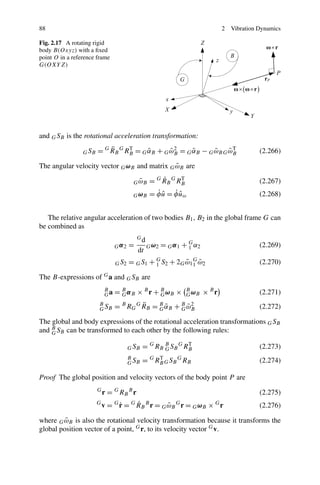
88                                                                                  2   Vibration Dynamics

Fig. 2.17 A rotating rigid
body B(Oxyz) with a fixed
point O in a reference frame
G(OXY Z)


and G SB is the rotational acceleration transformation:

                 G SB       ¨
                        = G RB G RB = G αB + G ωB = G αB − G ωB G ωB
                                  T
                                        ˜      ˜2     ˜      ˜    ˜T                              (2.266)

                                              ˜
The angular velocity vector G ωB and matrix G ωB are

                                            ˜
                                          G ωB             ˙
                                                       = G R B G RB
                                                                  T
                                                                                                  (2.267)
                                          G ωB           ˙ˆ ˙ˆ
                                                       = φ u = φ uω                               (2.268)


   The relative angular acceleration of two bodies B1 , B2 in the global frame G can
be combined as
                                              Gd
                                 Gα2     =         G ω2   = G α 1 + G α2
                                                                    1                             (2.269)
                                              dt
                                 G S2    = G S 1 + G S 2 + 2G ω 1 G ω 2
                                                   1          ˜ 1 ˜                               (2.270)

The B-expressions of G a and G SB are
                            B
                            Ga   = B α B × B r + B ωB ×
                                   G             G
                                                                      B
                                                                      G ωB   × Br                 (2.271)
                        B
                        G SB     =   B      ¨
                                         RG RB = B αB
                                              G
                                                 G˜            + B ωB
                                                                 G˜
                                                                    2
                                                                                                  (2.272)

The global and body expressions of the rotational acceleration transformations G SB
and B SB can be transformed to each other by the following rules:
    G

                                         G SB     = G RB B S B G RB
                                                         G
                                                                  T
                                                                                                  (2.273)
                                         B
                                         G SB     = G RB G S B G RB
                                                       T
                                                                                                  (2.274)

Proof The global position and velocity vectors of the body point P are
                        G
                            r = G RB B r                                                          (2.275)
                        G
                                ˙G  ˙
                            v = r = RB r = G ω B r = G ω B × r
                                          G
                                             ˜     B           G                G
                                                                                                  (2.276)

         ˜
where G ωB is also the rotational velocity transformation because it transforms the
global position vector of a point, G r, to its velocity vector G v.
2.3 Rigid Body Dynamics                                                                                           89

                                                                                                      Gd
  Differentiating Eq. (2.276) and using the notation                                     G αB   =     dt G ωB   yield
Eq. (2.261):

                            G
                                      ¨                          ˙
                                a = G r = G ωB × G r + G ω B × G r
                                            ˙
                                 = G α B × G r + G ωB ×                G ωB    × Gr                         (2.277)

   We may substitute the matrix expressions of angular velocity and acceleration in
(2.277) to derive Eq. (2.262):

                            G
                                ¨
                                r = G αB × G r + G ωB ×                G ωB    × Gr
                                 = G αB G r + G ωB G ωB G r
                                     ˜          ˜    ˜
                                 =        ˜
                                          α
                                         G B
                                                + G ωB
                                                    ˜2      G
                                                                r                                           (2.278)

Recalling that

                                               ˜
                                             G ωB       ˙
                                                    = G R B G RB
                                                               T
                                                                                                            (2.279)
                                            G
                                                ˙
                                                r(t) = G ωB G r(t)
                                                         ˜                                                  (2.280)

we find Eqs. (2.263) and (2.265):

               Gd
      G
          ¨
          r=
                     G   ˙      T
                         R B G RB G r
               dt
              ¨                ˙     ˙T
          = G R B G RB G r + G R B G R B G r +
                     T                                          G   ˙      T
                                                                    R B G RB
                                                                                   G   ˙      T
                                                                                       R B G RB   G
                                                                                                      r

          =    G    ¨            ˙     ˙T
                    R B G RB + G R B G R B +
                           T                            G   ˙      T
                                                            R B G RB
                                                                        2 G
                                                                               r

          =    G    ¨
                    R B G RB −
                           T         G   ˙      T
                                         R B G RB
                                                    2
                                                        +    G   ˙      T
                                                                 R B G RB
                                                                             2 G
                                                                                   r
              ¨
          = G R B G RB G r
                     T
                                                                                                            (2.281)
                       ˜
                     G αB
                                ˙       ¨            ˙     ˙T
                            = G ω B = G R B G RB + G R B G R B
                                ˜              T

                                ¨            ˙               ˙T
                            = G R B G RB + G R B G RB G RB G R B
                                       T            T


                                ¨
                            = G R B G RB +
                                       T            G   ˙      T
                                                        R B G RB       G   ˙      T
                                                                           R B G RB
                                                                                         T


                                ¨      T
                                                   ˜T      ¨
                            = G R B G RB + G ω B G ω B = G R B G RB − G ω B
                                             ˜                    T
                                                                        ˜2                                  (2.282)

which indicates that

                                 G   ¨
                                     RB G RB = G αB + G ωB = G SB
                                           T
                                                 ˜      ˜2                                                  (2.283)
90                                                                          2   Vibration Dynamics

                                                                   ˜
   The expanded forms of the angular accelerations G α B , G αB and rotational ac-
celeration transformation G SB are
                                            ⎡                      ⎤
                                                0   −ω 3 ω 2
                                                         ˙     ˙
                ˜      ˙
                       ˜       ¨˜ ˙˙
              G αB = G ωB = φ u + φ u = ⎣ ω3
                                       ˜       ˙       0      −ω 1 ⎦
                                                                 ˙
                                              −ω 2 ω 1
                                                 ˙     ˙        0
                     ⎡                                                   ⎤
                              0             ˙ ˙      ¨      ˙ ˙
                                         −u3 φ − u3 φ u2 φ + u2 φ    ¨
                   = ⎣ u3 φ + u3 φ
                         ˙ ˙       ¨            0          −u1 φ − u1 φ ⎦
                                                             ˙ ˙       ¨   (2.284)
                       −u2 φ
                          ˙  ˙ − u2 φ u1 φ + u1 φ
                                     ¨    ˙  ˙     ¨             0
                                         ⎡ ⎤ ⎡                ⎤
                                          ˙
                                          ω1      ˙ ˙       ¨
                                                  u1 φ + u1 φ
                                 G α B = ⎣ω2 ⎦ = ⎣u2 φ + u2 φ ⎦
                                          ˙       ˙ ˙       ¨                             (2.285)
                                          ˙
                                          ω3      ˙  ˙ + u3 φ
                                                  u3 φ      ¨


                   G SB
                              ˙
                          = G ωB + G ωB = G αB + G ωB
                              ˜      ˜2     ˜       ˜2
                            ⎡                                 ⎤
                              −ω2 − ω3 ω1 ω2 − ω3 ω2 + ω1 ω3
                                  2    2          ˙    ˙
                          = ⎣ω3 + ω1 ω2 −ω1 − ω3 ω2 ω3 − ω1 ⎦
                              ˙               2    2       ˙                              (2.286)
                              ω1 ω3 − ω2 ω1 + ω2 ω3 −ω1 − ω2
                                      ˙   ˙              2  2


 G SB     ¨˜ ˙˙ ˙ ˜
        = φ u + φ u + φ 2 u2
                   ˜
          ⎡                                                                                    ⎤
                −(1 − u2 )φ 2˙                     ˙     ˙ ˙       ¨
                                             u1 u2 φ 2 − u3 φ − u3 φ         ˙     ˙ ˙       ¨
                                                                       u1 u3 φ 2 + u2 φ + u2 φ
                          1
        = ⎣u1 u2 φ 2 + u3 φ + u3 φ
                  ˙     ˙  ˙      ¨              −(1 − u2     ˙
                                                           2 )φ 2      u2 u3 φ 2 − u1 φ − u1 φ ⎦
                                                                             ˙     ˙ ˙       ¨
                  ˙ 2 − u2 φ − u2 φ
            u1 u3 φ     ˙  ˙      ¨                ˙     ˙ ˙       ¨
                                             u2 u3 φ 2 + u1 φ + u1 φ       −(1 − u3     ˙
                                                                                     2 )φ 2

                                                                                          (2.287)

   The angular velocity of several bodies rotating relative to each other can be re-
lated according to (2.214):

                          0 ωn   = 0 ω1 + 0 ω2 + 0 ω3 + · · · + n−1 ωn
                                          1      2
                                                                 0
                                                                                          (2.288)

The angular accelerations of several relatively rotating rigid bodies follow the same
rule:
                          0αn    = 0 α1 + 0 α 2 + 0 α 3 + · · · + n−1 α n
                                          1       2
                                                                   0
                                                                                          (2.289)
To show this fact and develop the relative acceleration formula, we consider a pair
of relatively rotating rigid links in a base coordinate frame B0 with a fixed point at
O. The angular velocities of the links are related as

                                         0 ω2   = 0 ω1 + 0 ω2
                                                         1                                (2.290)

So, their angular accelerations are
                                             0d
                                   0α1   =        0 ω1                                    (2.291)
                                             dt
2.3 Rigid Body Dynamics                                                                           91

                                            0d
                                  0α2   =        0 ω2   = 0 α 1 + 0 α2
                                                                  1                           (2.292)
                                            dt
and, therefore,
                                                                                     2
                     0 S2   = 0 α2 + 0 ω2 = 0 α1 + 0 α2 +
                                ˜      ˜2     ˜    1˜                  ˜
                                                                     0 ω1   + 0 ω2
                                                                              1˜

                            = 0 α1 + 0 α2 + 0 ω1 + 0 ω2 + 20 ω1 0 ω2
                                ˜    1˜       ˜2 1 ˜2        ˜ 1˜
                            = 0 S1 + 0 S2 + 20 ω 1 0 ω 2
                                     1         ˜ 1˜                                           (2.293)

Equation (2.293) is the required relative acceleration transformation formula. It
indicates the method of calculation of relative accelerations for a multibody. As a
more general case, consider a six-link multibody. The angular acceleration of link
(6) in the base frame would be

                     0 S6   = 0 S1 + 0 S2 + 0 S3 + 0 S4 + 0 S5 + 0 S6
                                     1      2      3      4      5

                               + 20 ω 1 0 ω 2 + 0 ω 3 + 0 ω 4 + 0 ω 5 + 0 ω 6
                                    ˜ 1˜        2˜      3˜      4˜      5˜

                               + 20 ω 2 0 ω 3 + 0 ω 4 + 0 ω 5 + 0 ω 6
                                  1˜ 2˜         3˜      4˜      5˜
                              .
                              .
                              .
                               + 20 ω 5 0 ω 6
                                  4˜ 5˜                                                       (2.294)

   We can transform the G and B-expressions of the global acceleration of a body
point P to each other using a rotation matrix:
             B
             G aP    = B RG G aP = B RGG SB G rP = B RG G SB G RB B rP
                              ¨                            ¨
                     = B RG G R B G RB G RB B r P = B RG G R B B r P
                                     T

                          T ¨                                        B
                     = G RB G R B B r P = B S B B r P =
                                          G                            ˜
                                                                       α
                                                                     G B
                                                                            + B ωB
                                                                              G˜
                                                                                 2   B
                                                                                         rP

                     = B α B × B r + B ωB ×
                       G             G
                                                        B
                                                        G ωB     × Br                         (2.295)

             G
                  a P = G RB B a P = G RB B S B B r P = G RB B S B G RB G r P
                             G            G                  G
                                                                      T

                               T ¨                    ¨
                     = G RB G RB G R B G RB G r P = G R B G RB G r P
                                          T                  T


                     = G S B G rP =       ˜
                                          α
                                         G B
                                                  + G ωB
                                                      ˜2     G
                                                                 r

                     = G α B × G r + G ωB ×             G ωB     × Gr                         (2.296)

From the definitions of G SB and B SB in (2.266) and (2.272) and comparing with
                                  G
(2.295) and (2.296), we are able to transform the two rotational acceleration trans-
formations by

                                     G SB   = G RB B S B G RB
                                                   G
                                                            T
                                                                                              (2.297)
92                                                                         2   Vibration Dynamics

                                        B
                                        G SB   = G RB G S B G RB
                                                    T
                                                                                         (2.298)

and derive the useful equations
                                               G   ¨
                                                   R B = G S B G RB                      (2.299)
                                               G   ¨
                                                   R B = G RB B S B
                                                              G                          (2.300)

                                        G SB
                                               G
                                                   RB = G RB B S B
                                                             G                           (2.301)

   The angular acceleration of B in G is negative of the angular acceleration of G
in B if both are expressed in the same coordinate frame:

                                   ˜
                                 G αB   = −G αG
                                           B˜             GαB   = −G α G
                                                                   B                     (2.302)
                                 B
                                   ˜
                                 G αB   = −B αG
                                             ˜            B
                                                          GαB   = −B α G                 (2.303)

   The term G α B × G r in (2.277) is called the tangential acceleration, which is a
function of the angular acceleration of B in G. The term G ωB × (G ωB × G r) in
G a is called centripetal acceleration and is a function of the angular velocity of B

in G.

Example 58       (Rotation of a body point about a global axis) Consider a rigid
body is turning about the Z-axis with a constant angular acceleration α = 2 rad/s2 .
                                                                      ¨
The global acceleration of a body point at P (5, 30, 10) cm when the body is at
α = 10 rad/s and α = 30 deg is
˙
             G          ¨
                 aP = G RB (t)B rP
                      ⎡                ⎤⎡ ⎤ ⎡         ⎤
                        −87.6 48.27 0     5     1010
                    = ⎣−48.27 −87.6 0⎦ ⎣30⎦ = ⎣−2869.4⎦ cm/s                             (2.304)
                           0       0 0   10      0

where
                      G d2                Gd          Gd          G d2
         G   ¨
             RB =            G
                                 RB = α
                                      ˙       RB = α G RB + α 2 2 G RB
                                               G
                                                    ¨           ˙
                   dt 2                  dα           dα          dα
                     ⎡                             ⎤      ⎡                           ⎤
                       − sin α          − cos α 0          − cos α     sin α        0
                 = α ⎣ cos α
                   ¨                    − sin α 0⎦ + α 2 ⎣ − sin α − cos α
                                                        ˙                           0⎦ (2.305)
                          0                0     0            0          0          0

At this moment, the point P is at
                 G
                     r P = G RB B r P
                           ⎡                             ⎤⎡ ⎤ ⎡          ⎤
                             cos π − sin π
                                 6         6           0   5      −10.67
                         = ⎣ sin π
                                 6    cos π
                                          6            0⎦ ⎣30⎦ = ⎣ 28.48 ⎦ cm            (2.306)
                               0        0              1   10       10
2.3 Rigid Body Dynamics                                                                  93

Example 59     (Rotation of a global point about a global axis) A body point P at
B r = [5 30 10]T cm is turning with a constant angular acceleration α = 2 rad/s2
                                                                     ¨
   P
about the Z-axis. When the body frame is at α = 30 deg, its angular speed
α = 10 deg/s.
˙
   The transformation matrix G RB between the B- and G-frames is
                 ⎡                      ⎤ ⎡                    ⎤
                   cos π − sin π 0
                       6          6          0.866 −0.5 0
          G
            RB = ⎣ sin π
                       6    cos π6    0⎦ ≈ ⎣ 0.5      0.866 0⎦            (2.307)
                     0         0      1        0        0     1

and, therefore, the acceleration of point P is
                                              ⎡    ⎤
                                             1010
                   G        ¨
                     aP = G RB G RB G rP = ⎣−2869.4⎦ cm/s2
                                  T
                                                                                     (2.308)
                                              0

where
                          G d2                Gd                  G d2
                                 G
                                     RB = α
                                          ¨        G
                                                       RB − α 2
                                                            ˙            G
                                                                             RB      (2.309)
                          dt 2                dα                  dα 2
is the same as (2.305).

Example 60 (B-expression of angular acceleration) The angular acceleration ex-
pressed in the body frame is the body derivative of the angular velocity vector. To
show this, we use the derivative transport formula (2.259):
                                             Gd
                              G˙
                            = B ωB =
                    B                             B
                    GαB                           G ωB
                                             dt
                                 Bd                                      Bd
                            =         B
                                      G ωB   + B ωB × B ωB =
                                               G      G
                                                                              B
                                                                              G ωB   (2.310)
                                 dt                                      dt

Interestingly, the global and body derivatives of B ωB are equal:
                                                  G

                                 Gd               Bd
                                      B
                                      G ωB    =        B
                                                       G ωB   = B αB
                                                                G                    (2.311)
                                 dt               dt
                                       ˆ
This is because G ωB is about an axis u that is instantaneously fixed in both B and G.
   A vector α can generally indicate the angular acceleration of a coordinate frame
A with respect to another frame B. It can be expressed in or seen from a third
coordinate frame C. We indicate the first coordinate frame A by a right subscript,
the second frame B by a left subscript, and the third frame C by a left superscript,
C α . If the left super and subscripts are the same, we only show the subscript. So,
B A
the angular acceleration of A with respect to B as seen from C is the C-expression
of B αA :
                                        C
                                        B αA   = C RB B αA                           (2.312)
94                                                                      2   Vibration Dynamics

Fig. 2.18 A simple
pendulum


Example 61 (B-expression of acceleration) Transforming G a to the body frame
provides us with the body expression of the acceleration vector:

                                                              T ¨
                B
                G aP   = G RB G a =
                            T           G
                                            RB G S B G r = G RB G R B G RB G r
                                             T                           T

                            T ¨
                       = G RB G R B B r                                               (2.313)

We denote the coefficient of B r by B SB
                                   G

                                                   T ¨
                                     B
                                     G SB     = G RB G R B                            (2.314)

and rewrite Eq. (2.313) as
                                     B
                                     G aP     = B S B B rP
                                                G                                     (2.315)

where B SB is the rotational acceleration transformation of the B-frame relative to
      G
G-frame as seen from the B-frame.

Example 62 (Velocity and acceleration of a simple pendulum) A point mass at-
tached to a massless rod hanging from a revolute joint is what we call a simple
pendulum. Figure 2.18 illustrates a simple pendulum. A local coordinate frame B is
attached to the pendulum, which rotates in a global frame G about the Z-axis. The
kinematic information of the mass is given by

                              B
                                  r = lˆ
                                       ı                                              (2.316)
                                                       ⎡        ⎤
                                                        l sin φ
                              G
                                  r = RBG      B
                                                   r= ⎣−l cos φ ⎦                     (2.317)
                                                           0
                             B
                             G ωB
                                      ˙ˆ
                                    = φk                                              (2.318)

                             G ωB   =   G    T
                                            RB B ω B
                                               G
                                                        ˙ ˆ
                                                       =φK                            (2.319)
2.3 Rigid Body Dynamics                                                             95

Fig. 2.19 A spherical
pendulum


                           ⎡                                ⎤
                            cos( 3 π + φ) − sin( 3 π + φ) 0
                                  2                2
                           ⎢                                ⎥
                    G
                      RB = ⎣ sin( 3 π + φ) cos( 3 π + φ) 0⎦
                                  2               2
                                    0               0     1
                           ⎡                    ⎤
                              sin φ     cos φ 0
                         = ⎣− cos φ sin φ 0⎦                                   (2.320)
                                0         0   1

Therefore,
                        B
                        Gv      ˙ G         G
                                                       ˙ˆ   ı     ˙ˆ
                            = B r + B ωB × B r = 0 + φ k × lˆ = l φ j          (2.321)
                                         ⎡           ⎤
                                             ˙
                                           l φ cos φ
                        G
                          v = RB v =
                              G    B     ⎣ l φ sin φ ⎦
                                              ˙                                (2.322)
                                                0

and
              B
              Ga    G˙
                                          ¨ ˆ ˙ˆ         ˙ˆ    ¨ˆ      ˙ ˆ
                  = B v + B ωB × B v = l φ j + φ k × l φ j = l φ j − l φ 2 ı
                          G       G                                            (2.323)
                               ⎡                        ⎤
                                  ¨            ˙
                                l φ cos φ − l φ 2 sin φ
              G
                a = G RB B a = ⎣l φ sin φ + l φ 2 cos φ ⎦
                                  ¨           ˙                                (2.324)
                                           0

Example 63 (Spherical pendulum) A pendulum free to oscillate in any plane is
called a spherical pendulum. This name comes from the codominants that we use
to locate the tip mass. Consider a pendulum with a point mass m at the tip point of
a long, massless, and straight string with length l. The pendulum is hanging from a
point A(0, 0, 0) in a local coordinate frame B1 (x1 , y1 , z1 ).
    To indicate the mass m, we attach a coordinate frame B2 (x2 , y2 , z2 ) to the pen-
dulum at point A as is shown in Fig. 2.19. The pendulum makes an angle β with the
96                                                                              2    Vibration Dynamics

vertical z1 -axis. The pendulum swings in the plane (x2 , z2 ) and makes an angle γ
with the plane (x1 , z1 ). Therefore, the transformation matrix between B2 and B1 is
                        2
                            R1 = Ry2 ,−β Rz2 ,γ
                                 ⎡                                               ⎤
                                   cos γ cos β         cos β sin γ         sin β
                               = ⎣ − sin γ                cos γ              0 ⎦               (2.325)
                                   − cos γ sin β       − sin γ sin β       cos β

The position vectors of m are
                        ⎡ ⎤                                        ⎡        ⎤
                          0                                  l cos γ sin β
                  2
                    r=⎣ 0 ⎦                1
                                             r = 1 R2 2 r = ⎣ l sin β sin γ ⎦                  (2.326)
                         −l                                     −l cos β

The equation of motion of m is
                                                           1
                                                               M = I 1α2                       (2.327)
                                                   r × m g = ml 1 α 2
                                                   1           1       2
                                                                                               (2.328)
                              ⎡               ⎤     ⎡    ⎤
                               l cos γ sin β          0
                              ⎣ l sin β sin γ ⎦ × m ⎣ 0 ⎦ = ml 2 1 α 2                         (2.329)
                                  −l cos β           −g0

Therefore,
                                              ⎡               ⎤
                                                − sin β sin γ
                                           g0 ⎣
                                     1α2 =      cos γ sin β ⎦                                  (2.330)
                                            l         0
To find the angular acceleration of B2 in B1 , we use 2 R1 :

                 ˙        d           d 2
             1         ˙
                 R 2 = β 2 R1 + γ ˙       R1
                         dβ         dγ
                       ⎡                                                            ⎤
                             ˙
                         −βcγ sβ − γ cβsγ −γ cγ
                                     ˙        ˙                              ˙
                                                                    γ sβsγ − βcβcγ
                                                                    ˙
                     = ⎣ γ cβcγ − βsβsγ
                           ˙        ˙        −γ sγ
                                              ˙                    −βcβsγ − γ cγ sβ ⎦
                                                                      ˙       ˙                (2.331)
                               ˙
                               βcβ            0                            ˙
                                                                         −βsβ

                                          ⎡                                     ⎤
                                         0                  −γ ˙        ˙
                                                                       −β cos γ
                           1 ˙ 1 T
                    1 ω 2 = R 2 R2 = ⎣ γ
                      ˜                  ˙                   0         −β sin γ ⎦
                                                                         ˙                     (2.332)
                                      ˙
                                      β cos γ             ˙
                                                          β sin γ          0


                        ¨        d         d2             d2 2
                    1         ¨        ˙            ˙˙
                        R 2 = β 2 R1 + β 2 2 2 R1 + β γ        R1
                                dβ        dβ            dγ dβ
                                      d 2           d2 2          d2
                                +γ
                                 ¨             ˙˙
                                          R1 + γ β       R1 + γ 2 2 2 R1
                                                              ˙                                (2.333)
                                     dγ            dβ dγ         dγ
2.3 Rigid Body Dynamics                                                                           97

                 ˜
               1 α2       ¨
                      = 1 R 2 1 R2 − 1 ω 2
                                 T
                                        ˜2
                        ⎡                                                           ⎤
                                  0                   −γ ¨             ¨     ˙˙
                                                                      −βcγ + β γ sγ
                      =⎣          γ¨                   0              −βsγ − β γ cγ ⎦
                                                                       ¨     ˙˙               (2.334)
                           ¨         ˙˙
                          βcγ − β γ sγ            ¨       ˙˙
                                                  βsγ + β γ cγ             0

Therefore, the equation of motion of the pendulum would be
                      ⎡               ⎤ ⎡                      ⎤
                        − sin β sin γ       ¨         ˙˙
                                           β sin γ + β γ cos γ
                  g0 ⎣
                        cos γ sin β ⎦ = ⎣−β cos γ + β γ sin γ ⎦
                                              ¨        ˙˙                                     (2.335)
                   l          0                     ¨
                                                    γ

The third equation indicates that

                                   γ = γ0
                                   ˙   ˙                 γ = γ0 t + γ 0
                                                             ˙                                (2.336)

The second and third equations can be combined to form

                                                  g02
                                   ¨
                                   β =−                        ˙ ˙2
                                                      sin2 β + β 2 γ0                         (2.337)
                                                  l 2

                                                      ˙
which reduces to the equation of a simple pendulum if γ0 = 0.

Example 64      (Equation of motion of a spherical pendulum) Consider a particle
P of mass m that is suspended by a string of length l from a point A, as shown in
Fig. 2.19. If we show the tension of the string by T, then the equation of motion of
P is
                                        1
                                                          ¨
                                            T + m1 g = m1 r                                   (2.338)
or                      ¨
     −T 1 r + m1 g = m1 r.    To eliminate        1 T,   we multiply the equation by   1 r,


                                      r × 1g = 1r × 1r
                                         1
                                                      ¨
                 ⎡               ⎤ ⎡      ⎤ ⎡                  ⎤ ⎡ ⎤
                  l cos γ sin β         0        l cos γ sin β    ¨
                                                                  x                           (2.339)
                 ⎣ l sin β sin γ ⎦ × ⎣ 0 ⎦ = ⎣ l sin β sin γ ⎦ × ⎣y ⎦
                                                                  ¨
                     −l cos β         −g0          −l cos β       ¨
                                                                  z

and find
                  ⎡                 ⎤ ⎡                               ⎤
                   −lg0 sin β sin γ       l y cos β + l z sin β sin γ
                                            ¨           ¨
                  ⎣ lg0 cos γ sin β ⎦ = ⎣−l x cos β − l z cos γ sin β ⎦
                                             ¨           ¨                                    (2.340)
                           0                  l y cos γ − l x sin γ
                                                ¨           ¨
These are the equations of motion of m. However, we may express the equations
only in terms of γ and β. To do so, we may either take time derivatives of 1 r or use
                               1¨
1 α 2 from Example 64 and find r:
                                             1
                                                 ¨
                                                 r = 1α2 × 1r                                 (2.341)

In either case, Eq. (2.335) would be the equation of motion in terms of γ and β.
98                                                                       2    Vibration Dynamics

Fig. 2.20 Foucault pendulum
is a simple pendulum hanging
from a point A above a point
P on Earth surface


Example 65        (Foucault pendulum) Consider a pendulum with a point mass m
at the tip of a long, massless, and straight string with length l. The pendulum is
hanging from a point A(0, 0, l) in a local coordinate frame B1 (x1 , y1 , z1 ) at a point
P on the Earth surface. Point P at longitude ϕ and latitude λ is indicated by E d
in the Earth frame E(Oxyz). The E-frame is turning in a global frame G(OXY Z)
about the Z-axis.
    To indicate the mass m, we attach a coordinate frame B1 (x1 , y1 , z1 ) to the pen-
dulum at point A as shown in Fig. 2.20. The pendulum makes an angle β with the
vertical z1 -axis. The pendulum swings in the plane (x2 , z2 ) and makes an angle γ
with the plane (x1 , z1 ). Therefore, the transformation matrix between B2 and B1 is
                  1
                      T 2 = 1 D 2 1 R2
                            ⎡                                              ⎤
                              cos γ cos β   − sin γ    − cos γ sin β     0
                            ⎢ cos β sin γ   cos γ      − sin γ sin β     0⎥
                          =⎣⎢                                              ⎥            (2.342)
                                   sin β       0          cos β          l⎦
                                     0         0             0           1

The position vector of m is
                                 ⎡ ⎤
                                0
                           2
                             r=⎣0⎦                                                      (2.343)
                                −l
                                            ⎡ ⎤ ⎡                   ⎤
                                             x1      l cos γ sin β
                           1
                             r = 1 T2 2 r = ⎣y1 ⎦ = ⎣ l sin β sin γ ⎦                   (2.344)
                                             z1        l − l cos β

Employing the acceleration equation,

          Ga = a + Gα1         × 1 r + 21 ω 1 × 1 v + 1 ω 1 ×          × 1r
          1   1    1                                            1
                                        G             G         G ω1                    (2.345)
2.3 Rigid Body Dynamics                                                             99

we can write the equation of motion of m as

                                  G F − mG g = mG a
                                  1      1      1
                                                                                (2.346)

where 1 F is the applied nongravitational force on m.
  Recalling that
                                        1
                                        Gα1   =0                                (2.347)
we find the general equation of motion of a particle in frame B1 as

          G F + mG g = m a + 2G ω1      × 1 v + 1 ω1 ×          × 1r
          1      1      1     1                          1
                                                G        G ω1                   (2.348)

The individual vectors in this equation are
                  ⎡      ⎤              ⎡ ⎤                   ⎡          ⎤
                      0                   Fx                    ωE cos λ
            1
              g=⎣ 0 ⎦             1     ⎣ ⎦
                                  G F = Fy           G ω1 =
                                                     1        ⎣ 0 ⎦             (2.349)
                    −g0                   Fz                    ωE sin λ
                  ⎡ ⎤ ⎡                                         ⎤
                    ˙
                    x1          ˙
                              l β cos β cos γ − l γ sin β sin γ
                                                   ˙
            1
              v = ⎣y1 ⎦ = ⎣l β cos β sin γ + l γ cos γ sin β ⎦
                    ˙           ˙                 ˙                             (2.350)
                    ˙
                    z1                      ˙
                                          l β sin β

                    ⎡                                             ⎤
                        ¨         ˙             ˙˙
                      l(β cos γ − β 2 sin γ − β γ sin γ ) cos β
             ⎡ ⎤
              ¨
              x     ⎢ − l(γ sin γ + γ 2 cos γ + β γ cos γ ) sin β ⎥
                              ¨          ˙           ˙˙
                    ⎢                                             ⎥
        1
          a= ⎣y ⎦ = ⎢l(β sin γ + β 2 cos γ + β γ cos γ ) cos β
              ¨         ¨         ˙             ˙˙                ⎥             (2.351)
                    ⎢                                             ⎥
              ¨
              z     ⎣ + l(γ cos γ − γ 2 sin γ − β γ sin γ ) sin β ⎦
                              ¨          ˙           ˙˙
                                           ¨
                                         l β sin β
In a spherical pendulum, the external force 1 F is the tension of the string:
                                            F1
                                     GF = −
                                     1
                                               r                                (2.352)
                                               l
Substituting the above vectors in (2.348) provides us with three coupled ordinary
differential equations for two angular variables γ and β. One of the equations is not
independent and the others may theoretically be integrated to determine γ = γ (t)
and β = β(t).
   For example, let us use

                          ωE ≈ 7.292 1 × 10⁻⁵ rad/s
                          g0 ≈ 9.81 m/s2
                            l = 100 m
                           λ = 28◦ 58 30 N ≈ 28.975 deg N
                           ϕ = 50◦ 50 17 E ≈ 50.838 deg E
                          x0 = l cos 10 = 17.365 m                              (2.353)
100                                                             2   Vibration Dynamics

Fig. 2.21 The projection of
the path of a pendulum with
length l = 100 m at latitude
λ ≈ 28.975 deg N on Earth
for a few oscillations (not to
scale)


and find

                  x = 8.6839 cos(0.313 16t) + 8.6811 cos(−0.313 26t)          (2.354)
                  y = 8.6839 sin(0.313 16t) + 8.6811 sin(−0.313 26t)          (2.355)

At the given latitude, which corresponds to Bushehr, Iran, on the Persian Gulf
shore, the plane of oscillation turns about the local g-axis with an angular speed
ω = −3.532 5 × 10⁻⁵ rad/s ≈ −87.437 deg/d. These results are independent of
longitude. Therefore, the same phenomena will be seen at Orlando, Florida, or New
Delhi, India, which are almost at the same latitude. Figure 2.21 depicts the pro-
jection of m on the (x, y)-plane for a few oscillations. It takes T ≈ 49.4 h for the
pendulum to turn 2π :

                                2π
                    T=                   = 1.7787 × 10⁵ s = 49.408 h          (2.356)
                           3.5325 × 10⁻⁵
However, the pendulum gets back to the (y, x)-plane after t = T /2 = 24.704 h. By
that time, the pendulum must have oscillated about n ≈ 4433 times:

                            ωn T   0.313 21 1.7787 × 10⁵
                      n=         =                       = 4433.3             (2.357)
                            2π 2      2π         2
By shortening the length of the pendulum, say l = 1 m, the rotation speed remains
the same while the number of oscillations increases to n ≈ 44333.


2.3.4        Translational Dynamics

Figure 2.22 depicts a moving body B in a global coordinate frame G. Assume that
the body frame is attached at the mass center of the body. Point P indicates an
infinitesimal sphere of the body, which has a very small mass dm. The point mass
dm is acted on by an infinitesimal force df and has a global velocity G vP .
2.3 Rigid Body Dynamics                                                          101

Fig. 2.22 A body point mass
moving with velocity G vP
and acted on by force df


   According to Newton’s law of motion

                                          df = G aP dm                        (2.358)

However, the equation of motion for the whole body in a global coordinate frame is

                                          G
                                              F = mG aB                       (2.359)

which can be expressed in the body coordinate frame as

                            F = mB aB + mB ωB × B vB
                              B
                                  G      G                                    (2.360)
                        ⎡   ⎤ ⎡                           ⎤
                         Fx       max + m(ωy vz − ωz vy )
                        ⎣Fy ⎦ = ⎣ may − m(ωx vz − ωz vx ) ⎦                   (2.361)
                         Fz      maz + m(ωx vy − ωy vx )

In these equations, G aB is the G-expression of the acceleration vector of the body
mass center C, m is the total mass of the body, and F is the G-expression of the
resultant of the external forces acted on the body at C.

Proof A body coordinate frame at the mass center is called a central frame. If frame
B is a central frame, then the center of mass, C, is defined such that

                                              B
                                                  rdm dm = 0                  (2.362)
                                          B

The global position vector of dm is related to its local position vector by

                                  G
                                      rdm = G dB + G RB B rdm                 (2.363)
102                                                                                       2   Vibration Dynamics

where G dB is the global position vector of the central body frame, and, therefore,

                     G
                         rdm dm =              G
                                                   dB dm + G RB              B
                                                                                 rdm dm
                 B                         B                             m

                                   =           G
                                                   dB dm = G dB              dm = mG dB                 (2.364)
                                           B                             B

The time derivative of both sides shows that

                        ˙
                     mG dB = mG vB =                     G
                                                             ˙
                                                             rdm dm =            G
                                                                                     vdm dm             (2.365)
                                                     B                       B

and the other derivative is

                                  ˙
                               mG vB = mG aB =                      G
                                                                        ˙
                                                                        vdm dm                          (2.366)
                                                                B

                        ˙
However, we have df = G vP dm and, therefore,

                                               mG aB =             df                                   (2.367)
                                                               B

The integral on the right-hand side collects all the forces acting on the body. The
internal forces cancel one another out, so the net result is the vector sum of all the
externally applied forces, F, and, therefore,
                                       G
                                                           ˙
                                           F = mG aB = m G vB                                           (2.368)

In the body coordinate frame we have
                          B
                              F = B RG G F = mB RG G aB = mB aB
                                                           G

                               = mB aB + mB ωB × B vB
                                          G                                                             (2.369)

The expanded form of Newton’s equation in the body coordinate frame is then equal
to

                              F = mB aB + mB ωB × B vB
                               B
                                            G
                          ⎡ ⎤       ⎡ ⎤       ⎡ ⎤ ⎡ ⎤
                           Fx        ax        ωx        vx
                          ⎣Fy ⎦ = m ⎣ay ⎦ + m ⎣ωy ⎦ × ⎣vy ⎦
                           Fz         az       ωz        vz
                                  ⎡                         ⎤
                                    max + m(ωy vz − ωz vy )
                                = ⎣ may − m(ωx vz − ωz vx ) ⎦                                           (2.370)
                                   maz + m(ωx vy − ωy vx )
2.3 Rigid Body Dynamics                                                         103

2.3.5      Rotational Dynamics

The rigid body rotational equation of motion is the Euler equation
                                   Gd
                          B
                              M=        B         ˙
                                            L = B L + B ωB × B L
                                                      G
                                   dt
                                     G˙
                               = B I B ωB + B ωB ×         B B
                                            G               I G ωB          (2.371)

where L is the angular momentum
                                        B
                                            L = B I B ωB
                                                    G                       (2.372)

and I is the mass moment of the rigid body.
                                  ⎡                        ⎤
                                    Ixx Ixy            Ixz
                             I = ⎣Iyx Iyy              Iyz ⎦                (2.373)
                                    Izx Izy            Izz

The expanded form of the Euler equation (2.371) is

                Mx = Ixx ωx + Ixy ωy + Ixz ωz − (Iyy − Izz )ωy ωz
                         ˙        ˙        ˙
                       −Iyz ωz − ωy − ωx (ωz Ixy − ωy Ixz )
                             2    2
                                                                            (2.374)
                My = Iyx ωx + Iyy ωy + Iyz ωz − (Izz − Ixx )ωz ωx
                         ˙        ˙        ˙
                       −Ixz ωx − ωz − ωy (ωx Iyz − ωz Ixy )
                             2    2
                                                                            (2.375)
                 Mz = Izx ωx + Izy ωy + Izz ωz − (Ixx − Iyy )ωx ωy
                          ˙        ˙        ˙
                       −Ixy ωy − ωx − ωz (ωy Ixz − ωx Iyz )
                             2    2
                                                                            (2.376)

which can be reduced to

                              M1 = I1 ω1 − (I2 − I2 )ω2 ω3
                                      ˙
                              M2 = I2 ω2 − (I3 − I1 )ω3 ω1
                                      ˙                                     (2.377)
                              M3 = I3 ω3 − (I1 − I2 )ω1 ω2
                                      ˙

when the body coordinate is the principal coordinate frame. The principal coordi-
nate frame is denoted by numbers 123 to indicate the first, second, and third princi-
pal axes. The parameters Iij , i = j , are zero in the principal frame. The body and
principal coordinate frame sit at the mass center C.
   The kinetic energy of a rotating rigid body is
                              1
                     K=         Ixx ωx + Iyy ωy + Izz ωz
                                     2        2        2
                              2
                              − Ixy ωx ωy − Iyz ωy ωz − Izx ωz ωx           (2.378)
104                                                                                      2   Vibration Dynamics

                                 1       1
                                = ω · L = ωT I ω                                                       (2.379)
                                 2       2
which in the principal coordinate frame reduces to
                                        1
                                  K=      I1 ω 1 + I2 ω 2 + I3 ω 3
                                               2        2        2
                                                                                                       (2.380)
                                        2
Proof Let mi be the mass of the ith particle of a rigid body B, which is made of n
particles and let
                                                                         T
                                    r i = B ri = xi            yi   zi                                 (2.381)
be the Cartesian position vector of mi in a central body fixed coordinate frame
B(Oxyz). Assume that
                                                                             T
                                  ω = B ω B = ωx
                                      G                        ωy    ωz                                (2.382)

is the angular velocity of the rigid body with respect to the global coordinate frame
G(OXY Z), expressed in the body coordinate frame.
    The angular momentum of mi is

                                         ˙
                            Li = ri × mi ri = mi ri × (ω × ri )
                                  = mi (ri · ri )ω − (ri · ω)ri
                                  = mi ri2 ω − mi (ri · ω)ri                                           (2.383)

Hence, the angular momentum of the rigid body would be
                                        n                  n
                                L=ω          mi ri2   −         mi (ri · ω)ri                          (2.384)
                                       i=1                i=1

Substitution for ri and ω gives us
                                                     n
                               ˆ      ˆ
                L = (ωx ı + ωy j + ωz k)
                        ˆ                                 mi xi2 + yi2 + zi
                                                                          2

                                                    i=1
                            n
                       −                                           ˆ      ˆ      ˆ
                                 mi (xi ωx + yi ωy + zi ωz ) · (xi ı + yi j + zi k)                    (2.385)
                           i=1

which can be rearranged as
            n                                n                                    n
      L=         mi yi2 + zi ωx ı +
                           2
                                ˆ                 mi zi + xi2 ωy j +
                                                      2
                                                                 ˆ                                     ˆ
                                                                                       mi xi2 + yi2 ωz k
           i=1                              i=1                                  i=1
                  n                          n
           −           (mi xi yi )ωy +                          ˆ
                                                  (mi xi zi )ωz ı
                 i=1                        i=1
2.3 Rigid Body Dynamics                                                          105

                n                       n
           −         (mi yi zi )ωz +                       ˆ
                                             (mi yi xi )ωx j
               i=1                     i=1
                n                       n
           −         (mi zi xi )ωx +                          ˆ
                                                (mi zi yi )ωy k               (2.386)
               i=1                     i=1

   By introducing the mass moment matrix I with the following elements:

                                            n
                              Ixx =               mi yi2 + zi
                                                            2
                                                                              (2.387)
                                        i=1
                                            n
                               Iyy =              mi zi + xi2
                                                      2
                                                                              (2.388)
                                        i=1
                                            n
                               Izz =              mi xi2 + yi2                (2.389)
                                        i=1
                                                       n
                               Ixy = Iyx = −                (mi xi yi )       (2.390)
                                                      i=1
                                                       n
                               Iyz = Izy = −                (mi yi zi )       (2.391)
                                                      i=1
                                                       n
                               Izx = Ixz = −                (mi zi xi )       (2.392)
                                                      i=1

we may write the angular momentum L in concise form:

                             Lx = Ixx ωx + Ixy ωy + Ixz ωz                    (2.393)
                             Ly = Iyx ωx + Iyy ωy + Iyz ωz                    (2.394)
                             Lz = Izx ωx + Izy ωy + Izz ωz                    (2.395)

or in matrix form:

                              L=I ·ω                                          (2.396)
                          ⎡ ⎤ ⎡                                  ⎤⎡       ⎤
                           Lx      Ixx              Ixy      Ixz    ωx
                          ⎣Ly ⎦ = ⎣Iyx              Iyy      Iyz ⎦ ⎣ωy ⎦      (2.397)
                           Lz      Izx              Izy      Izz    ωz

For a rigid body that is a continuous solid, the summations must be replaced by
integrations over the volume of the body as in Eq. (2.433).
106                                                               2   Vibration Dynamics

   The Euler equation of motion for a rigid body is
                                                  Gd
                                         B
                                             M=        B
                                                           L                       (2.398)
                                                  dt
where B M is the resultant of the external moments applied on the rigid body. The
angular momentum B L is a vector quantity defined in the body coordinate frame.
Hence, its time derivative in the global coordinate frame is
                                G dB L
                                             ˙
                                         = B L + B ωB × B L                        (2.399)
                                                 G
                                  dt
Therefore,
                               dL ˙
                      B
                          M=                      ˙
                                  = L + ω × L = I ω + ω × (I ω)                    (2.400)
                               dt
or in expanded form
      B
          M = (Ixx ωx + Ixy ωy + Ixz ωz )ˆ + ωy (Ixz ωx + Iyz ωy + Izz ωz )ˆ
                   ˙        ˙        ˙ ı                                   ı
                − ωz (Ixy ωx + Iyy ωy + Iyz ωz )ˆ
                                                ı
                + (Iyx ωx + Iyy ωy + Iyz ωz )j + ωz (Ixx ωx + Ixy ωy + Ixz ωz )j
                       ˙        ˙        ˙ ˆ                                   ˆ
                − ωx (Ixz ωx + Iyz ωy + Izz ωz )j
                                                ˆ
                                         ˙ ˆ                                   ˆ
                + (Izx ωx + Izy ωy + Izz ωz )k + ωx (Ixy ωx + Iyy ωy + Iyz ωz )k
                       ˙        ˙
                                                ˆ
                − ωy (Ixx ωx + Ixy ωy + Ixz ωz )k                                  (2.401)

and, therefore, the most general form of the Euler equations of motion for a rigid
body in a body frame attached to C are

                  Mx = Ixx ωx + Ixy ωy + Ixz ωz − (Iyy − Izz )ωy ωz
                           ˙        ˙        ˙
                          − Iyz ωz − ωy − ωx (ωz Ixy − ωy Ixz )
                                 2    2
                                                                                   (2.402)
                  My = Iyx ωx + Iyy ωy + Iyz ωz − (Izz − Ixx )ωz ωx
                           ˙        ˙        ˙
                          − Ixz ωx − ωz − ωy (ωx Iyz − ωz Ixy )
                                 2    2
                                                                                   (2.403)
                  Mz = Izx ωx + Izy ωy + Izz ωz − (Ixx − Iyy )ωx ωy
                           ˙        ˙        ˙
                          − Ixy ωy − ωx − ωz (ωy Ixz − ωx Iyz )
                                 2    2
                                                                                   (2.404)

Assume that we are able to rotate the body frame about its origin to find an orien-
tation that makes Iij = 0, for i = j . In such a coordinate frame, which is called a
principal frame, the Euler equations reduce to

                               M1 = I1 ω1 − (I2 − I2 )ω2 ω3
                                       ˙                                           (2.405)
                               M2 = I2 ω2 − (I3 − I1 )ω3 ω1
                                       ˙                                           (2.406)
2.3 Rigid Body Dynamics                                                                         107

Fig. 2.23 A disc with mass
m and radius r, mounted on a
massless turning shaft


                                   M3 = I3 ω3 − (I1 − I2 )ω1 ω2
                                           ˙                                               (2.407)

   The kinetic energy of a rigid body may be found by the integral of the kinetic
energy of the mass element dm, over the whole body:
             1                    1
      K=              ˙
                      v2 dm =             (ω × r) · (ω × r) dm
             2    B               2   B
              2                               2
                                             ωy                          2
             ωx                                                         ωz
         =                y 2 + z2 dm +                 z2 + x 2 dm +            x 2 + y 2 dm
             2        B                       2     B                   2    B

             − ωx ωy            xy dm − ωy ωz           yz dm − ωz ωx       zx dm
                            B                       B                   B
             1
         =     Ixx ωx + Iyy ωy + Izz ωz
                    2        2        2
             2
             − Ixy ωx ωy − Iyz ωy ωz − Izx ωz ωx                                           (2.408)

The kinetic energy can be rearranged to a matrix multiplication form
                                         1        1
                                      K = ωT I ω = ω · L                                   (2.409)
                                         2        2
When the body frame is principal, the kinetic energy will simplify to
                                           1
                                  K=         I1 ω 1 + I2 ω 2 + I3 ω 3
                                                  2        2        2
                                                                                           (2.410)
                                           2


Example 66 (A tilted disc on a massless shaft) Figure 2.23 illustrates a disc with
mass m and radius R, mounted on a massless shaft. The shaft is turning with a
constant angular speed ω. The disc is attached to the shaft at an angle α. Because of
α, the bearings at A and B must support a rotating force.
   We attach a principal body coordinate frame at the disc center as shown in the
figure. The G-expression of the angular velocity is a constant vector
                                               G
                                                   ωB = ωIˆ                                (2.411)
108                                                                 2   Vibration Dynamics

and the expression of the angular velocity vector in the body frame is
                            B
                            G ωB   = ω cos θ ı + ω sin θ j
                                             ˆ           ˆ                        (2.412)

The mass moment of inertia matrix is
                           ⎡                                    ⎤
                             mR 2 /2              0       0
                     B
                       I=  ⎣ 0                  mR 2 /4   0 ⎦                     (2.413)
                                0                 0     mR 2 /4

Substituting (2.412) and (2.413) in (2.405)–(2.407), with 1 ≡ x, 2 ≡ y, 3 ≡ z, yields

                                Mx = 0                                            (2.414)
                                My = 0                                            (2.415)
                                        mr 2
                                Mz =            ω cos θ sin θ                     (2.416)
                                            4
Therefore, the bearing reaction forces FA and FB are

                                        Mz    mr 2
                     FA = −FB = −          =−      ω cos θ sin θ                  (2.417)
                                         l     4l

Example 67 (Steady rotation of a freely rotating rigid body) Consider a situation in
which the resultant applied force and moment on a rigid body are zero:
                                    G
                                        F = BF = 0                                (2.418)
                                    G
                                        M= M=0  B
                                                                                  (2.419)

Based on Newton’s equation,
                                        G
                                                   ˙
                                            F = mG v                              (2.420)
the velocity of the mass center will be constant in the global coordinate frame. How-
ever, the Euler equation
                            B
                                M = I B ωB + B ω B × B L
                                      G˙     G                                    (2.421)

reduces to
                                            I2 − I3
                                  ˙
                                  ω1 =              ω2 ω3                         (2.422)
                                               I1
                                            I3 − I1
                                  ˙
                                  ω2 =              ω3 ω1                         (2.423)
                                              I22
                                            I1 − I2
                                  ω3 =
                                  ˙                 ω1 ω2                         (2.424)
                                               I3
2.3 Rigid Body Dynamics                                                                  109

which show that the angular velocity can be constant if

                                       I1 = I2 = I3                                 (2.425)

or if two principal moments of inertia, say I1 and I2 , are zero and the third angular
velocity, in this case ω3 , is initially zero, or if the angular velocity vector is initially
parallel to a principal axis.


2.3.6       Mass Moment Matrix

Two types of integral arise in rigid body dynamics that depend solely on the geome-
try and mass distribution of the body. The first type defines the center of mass and is
important when the translation motion of the body is considered. The second is the
mass moment, which appears when the rotational motion of the body is considered.
The mass moment is also called moment of inertia, centrifugal moments, or devia-
tion moment. Every rigid body has a 3 × 3 mass moment matrix I , which is denoted
by
                                     ⎡               ⎤
                                       Ixx Ixy Ixz
                                I = ⎣Iyx Iyy Iyz ⎦                           (2.426)
                                       Izx Izy Izz
The diagonal elements Iij , i = j , are called polar mass moments

                                 Ixx = Ix =       y 2 + z2 dm                       (2.427)
                                              B

                                 Iyy = Iy =       z2 + x 2 dm                       (2.428)
                                              B

                                 Izz = Iz =       x 2 + y 2 dm                      (2.429)
                                              B

and the off-diagonal elements Iij , i = j , are called products of inertia

                                  Ixy = Iyx = −         xy dm                       (2.430)
                                                    B

                                  Iyz = Izy = −         yz dm                       (2.431)
                                                    B

                                  Izx = Ixz = −         zx dm                       (2.432)
                                                    B

The elements of I are functions of the mass distribution of the rigid body and may
be defined by

                     Iij =       ri2 δmn − xim xj n dm i, j = 1, 2, 3               (2.433)
                             B
110                                                                 2   Vibration Dynamics

where δij is Kronecker’s delta (2.171),

                                            1 if m = n
                                 δmn =                                            (2.434)
                                            0 if m = n

   The elements of I are calculated in a body coordinate frame attached to the mass
center C of the body. Therefore, I is a frame-dependent quantity and must be written
with a frame indicator such as B I to show the frame in which it is computed:
                             ⎡ 2                             ⎤
                              y + z2        −xy       −zx
                   B
                     I=      ⎣ −xy         z2 + x 2   −yz ⎦ dm               (2.435)
                           B    −zx         −yz     x 2 + y2


                       =       r 2 I − r rT dm =          −˜ r dm
                                                           r˜                     (2.436)
                           B                          B

      ˜
where r is the associated skew-symmetric matrix of r:
                                 ⎡                 ⎤
                                   0    −r3 r2
                             r = ⎣ r3
                             ˜           0    −r1 ⎦                               (2.437)
                                  −r2 r1        0

   The moments of inertia can be transformed from a coordinate frame B1 to an-
other coordinate frame B2 , both defined at the mass center of the body, according to
the rule of the rotated-axes theorem:
                                B2
                                     I = B2 RB1 B1 I B2 RB1
                                                         T
                                                                                  (2.438)

Transformation of the moment of inertia from a central frame B1 located at B2 rC to
another frame B2 , which is parallel to B1 , is, according to the rule of the parallel-
axes theorem:
                                 B2
                                      I = B1 I + m rC rC
                                                   ˜ ˜T                           (2.439)
   If the local coordinate frame Oxyz is located such that the products of inertia
vanish, the local coordinate frame is the principal coordinate frame and the associ-
ated mass moments are principal mass moments. Principal axes and principal mass
moments can be found by solving the following characteristic equation for I :

                           Ixx − I        Ixy          Ixz
                             Iyx        Iyy − I        Iyz = 0                    (2.440)
                             Izx          Izy        Izz − I
                                        det [Iij ] − I [δij ] = 0                 (2.441)

Equation (2.441) is a cubic equation in I , so we obtain three eigenvalues,

                           I1 = Ix         I2 = Iy        I3 = Iz                 (2.442)
2.3 Rigid Body Dynamics                                                               111

Fig. 2.24 Two coordinate
frames with a common origin
at the mass center of a rigid
body


which are the principal mass moments.

Proof Two coordinate frames with a common origin at the mass center of a rigid
body are shown in Fig. 2.24. The angular velocity and angular momentum of a rigid
body transform from the frame B1 to the frame B2 by the vector transformation rule
                                                   2
                                                       ω = 2 R2 1 ω                (2.443)
                                                   2
                                                       L = R1 L
                                                            2   1
                                                                                   (2.444)

However, L and ω are related according to Eq. (2.372)
                                                    1
                                                        L = 1I 1ω                  (2.445)

and, therefore,
                                     2
                                         L = 2 R1 1 I 2 R1 2 ω = 2 I 2 ω
                                                         T
                                                                                   (2.446)
which shows how to transfer the mass moment from the coordinate frame B1 to a
rotated frame B2
                                               2
                                                   I = 2 R1 1 I 2 R1
                                                                   T
                                                                                   (2.447)
   Now consider a central frame B1 , shown in Fig. 2.25, at 2 rC , which rotates about
the origin of a fixed frame B2 such that their axes remain parallel. The angular
velocity and angular momentum of the rigid body transform from frame B1 to frame
B2 by
                                         2
                                             ω = 1ω                                (2.448)
                                         2
                                             L = L + (rC × mvC )
                                                    1
                                                                                   (2.449)

Therefore,
                                2
                                    L = 1 L + m2 rC ×               2
                                                                        ω × 2 rC
                                         = 1 L + m2 rC 2 rC 2 ω
                                                    ˜ ˜T
                                         =    1
                                                  I + m2 rC 2 rC 2 ω
                                                         ˜ ˜T                      (2.450)
112                                                                     2   Vibration Dynamics

Fig. 2.25 A central
coordinate frame B1 and a
translated frame B2


which shows how to transfer the mass moment from frame B1 to a parallel frame B2
                                     2
                                         I = 1 I + m rC rC
                                                     ˜ ˜T                             (2.451)

The parallel-axes theorem is also called the Huygens–Steiner theorem.
   Referring to Eq. (2.447) for transformation of the moment of inertia to a rotated
frame, we can always find a frame in which 2 I is diagonal. In such a frame, we have
                                         2
                                             R1 1 I = 2 I 2 R1                        (2.452)

or
                            ⎡                     ⎤⎡             ⎤
                             r11   r12        r13    Ixx Ixy Ixz
                            ⎣r21   r22        r23 ⎦ ⎣Iyx Iyy Iyz ⎦
                             r31   r32        r33    Izx Izy Izz
                               ⎡                    ⎤⎡              ⎤
                                I1           0 0        r11 r12 r13
                              =⎣0            I2 0 ⎦ ⎣r21 r22 r23 ⎦                    (2.453)
                                 0           0 I3       r31 r32 r33

which shows that I1 , I2 , and I3 are eigenvalues of 1 I . These eigenvalues can be
found by solving the following characteristic equation for λ:

                              Ixx − λ   Ixy     Ixz
                                Iyx   Iyy − λ   Iyz = 0                               (2.454)
                                Izx     Izy   Izz − λ

The eigenvalues I1 , I2 , and I3 are principal mass moments, and their associated
eigenvectors are principal directions. The coordinate frame made by the eigenvec-
tors is the principal body coordinate frame. In the principal coordinate frame, the
rigid body angular momentum simplifies to
                           ⎡ ⎤ ⎡                 ⎤⎡ ⎤
                             L1       I1 0 0         ω1
                           ⎣ L2 ⎦ = ⎣ 0 I 2 0 ⎦ ⎣ ω 2 ⎦                     (2.455)
                             L3       0 0 I3         ω3
2.3 Rigid Body Dynamics                                                         113

Example 68 (Principal moments of inertia) Consider the inertia matrix I
                                ⎡               ⎤
                                   10 −2 0
                           I = ⎣−2 20 −2⎦                                    (2.456)
                                   0 −2 30

We set up the determinant (2.441)

                            10 − λ  −2       0
                             −2    20 − λ  −2 = 0                            (2.457)
                               0    −2    30 − λ

which leads to the following characteristic equation:

                          −λ3 + 60λ2 − 1092λ + 5840 = 0                      (2.458)

   Three roots of Eq. (2.458) are

                      I1 = 9.6077       I2 = 20        I3 = 30.392           (2.459)

and, therefore, the principal mass moment matrix is
                                ⎡                   ⎤
                                  9.6077 0        0
                            I =⎣ 0        20      0 ⎦                        (2.460)
                                     0    0 30.392

Example 69 (Principal coordinate frame)      Consider the inertia matrix I
                                  ⎡                  ⎤
                                    10       −2 0
                             I = ⎣−2         20 −2⎦                          (2.461)
                                    0        −2 30

the direction of a principal axis xi is established by solving
                  ⎡                                 ⎤⎡        ⎤ ⎡ ⎤
                    Ixx − Ii     Ixy         Ixz      cos αi     0
                  ⎣ Iyx        Iyy − Ii      Iyz ⎦ ⎣cos βi ⎦ = ⎣0⎦           (2.462)
                      Izx        Izy       Izz − Ii    cos γi    0

The direction cosines αi , βi , γi must also satisfy

                            cos2 αi + cos2 βi + cos2 γi = 1                  (2.463)

   For the first principal mass moment I1 = 9.6077, we have
                ⎡                              ⎤⎡        ⎤ ⎡ ⎤
                  10 − 9.6     −2         0       cos α1    0
                ⎣ −2        20 − 9.6     −2 ⎦ ⎣cos β1 ⎦ = ⎣0⎦                (2.464)
                      0        −2     30 − 9.6    cos γ1    0
114                                                               2   Vibration Dynamics

or

                               0.3923 cos α1 − 2 cos β1 + 0 = 0                 (2.465)
                        10.392 cos β1 − 2 cos α1 − 2 cos γ1 = 0                 (2.466)
                               0 + 20.392 cos γ1 − 2 cos β1 = 0                 (2.467)

and we obtain

                                   α1 = 11.148 deg                              (2.468)
                                    β1 = 78.902 deg                             (2.469)
                                    γ1 = 88.917 deg                             (2.470)

     Using I2 = 20 for the second principal axis
                  ⎡                       ⎤⎡        ⎤ ⎡ ⎤
                   10 − 20   −2       0     cos α2     0
                  ⎣ −2     20 − 20   −2 ⎦ ⎣cos β2 ⎦ = ⎣0⎦                       (2.471)
                      0      −2    30 − 20   cos γ2    0

we obtain

                                   α2 = 101.10 deg                              (2.472)
                                    β2 = 15.793 deg                             (2.473)
                                    γ2 = 78.902 deg                             (2.474)

     The third principal axis is for I3 = 30.392
            ⎡                              ⎤⎡        ⎤ ⎡ ⎤
             10 − 30.4    −2         0        cos α3    0
            ⎣ −2       20 − 30.4    −2 ⎦ ⎣cos β3 ⎦ = ⎣0⎦                        (2.475)
                 0        −2     30 − 30.4    cos γ3    0

which leads to

                                   α3 = 88.917 deg                              (2.476)
                                    β3 = 101.10 deg                             (2.477)
                                    γ3 = 11.139 deg                             (2.478)

Example 70 (Mass moment of rectangular bar) Consider a homogeneous rectangu-
lar brick with mass m, length l, width w, and height h, as shown in Fig. 2.26.
    The local central coordinate frame is attached to the brick at its mass center. The
moments of inertia matrix of the brick can be found by the integral method. We
2.3 Rigid Body Dynamics                                                                              115

Fig. 2.26 A homogeneous
rectangular brick


begin by calculating Ixx :
                                                                         m
         Ixx =       y 2 + z2 dm =               y 2 + z2 ρ dv =                    y 2 + z2 dv
                 B                           v                          lwh     v

                m   h/2  w/2                 l/2
             =                                     y 2 + z2 dx dy dz
               lwh −h/2 −w/2             −l/2
               m 2
             =    w + h2                                                                          (2.479)
               12
The mass moments Iyy and Izz can be calculated similarly
                                             m 2
                                       Iyy =    h + l2                                            (2.480)
                                             12
                                             m 2
                                       Izz =    l + w2                                            (2.481)
                                             12
   The coordinate frame is central and, therefore, the products of inertia must be
zero. To show this, we examine Ixy :

                     Ixy = Iyx = −               xy dm =           xyρ dv
                                          B                    v

                              m        h/2         w/2       l/2
                        =                                          xy dx dy dz = 0                (2.482)
                             lwh       −h/2 −w/2 −l/2

    Therefore, the moment of inertia matrix for the rigid rectangular brick in its cen-
tral frame is
                     ⎡m 2                                         ⎤
                       12 (w + h )
                                  2         0               0
                     ⎢                                            ⎥
                  I =⎣      0         12 (h + l )
                                       m 2       2          0     ⎦            (2.483)
                               0                         0            m 2
                                                                      12 (l   + w2 )

Example 71 (Translation of the inertia matrix) The mass moment matrix of the
brick shown in Fig. 2.27, in the principal frame B(oxyz), is given in Eq. (2.483).
The mass moment matrix in the non-principal frame B (ox y z ) can be found by
applying the parallel-axes transformation formula (2.451):
                                   B
                                       I = B I + mB rC B rC
                                                    ˜    ˜T                                       (2.484)
116                                                                   2   Vibration Dynamics

Fig. 2.27 A rigid rectangular
brick in the principal and
non-principal frames


The mass center is at
                                                ⎡ ⎤
                                                 l
                                               1⎣ ⎦
                                      B
                                          rC =   w                                  (2.485)
                                               2 h

and, therefore,
                                          ⎡              ⎤
                                            0    −h   w
                                         1⎣
                                B
                                    rC =
                                    ˜       h     0   −l ⎦                          (2.486)
                                         2 −w     l   0
which provides
             ⎡1                                                           ⎤
                     3 h m + 3 mw          − 1 lmw          − 1 hlm
                        2      1  2
                                             4                4
                   ⎢                                                      ⎥
         B
             I   = ⎣ − 1 lmw
                          4            3h m + 3l m
                                       1 2     1 2
                                                        − 1 hmw
                                                          4               ⎦         (2.487)
                         − 1 hlm
                           4             − 1 hmw
                                           4          3 l m + 3 mw
                                                      1 2     1    2


Example 72 (Principal rotation matrix) Consider a mass moment matrix in the body
frame B1 as
                                ⎡                    ⎤
                                  2/3 −1/2 −1/2
                          1
                            I = ⎣−1/2 5/3 −1/4⎦                          (2.488)
                                 −1/2 −1/4 5/3
The eigenvalues and eigenvectors of 1 I are
                                                ⎡     ⎤
                                                 2.351
                                I1 = 0.2413     ⎣ 1 ⎦                               (2.489)
                                                   1
                                                ⎡       ⎤
                                                 −0.851
                                I2 = 1.8421     ⎣ 1 ⎦                               (2.490)
                                                    1
                                                ⎡ ⎤
                                                  0
                                I3 = 1.9167     ⎣−1⎦                                (2.491)
                                                  1
2.3 Rigid Body Dynamics                                                              117

The normalized eigenvector matrix W is the transpose of the required transforma-
tion matrix to make the inertia matrix diagonal
                          ⎡               ⎤
                              |   |     |
                    W = ⎣ w 1 w 2 w 3 ⎦ = 2 R1  T

                              |   |     |
                          ⎡                                ⎤
                             0.856 9 −0.515 6        0.0
                       = ⎣0.364 48 0.605 88 −0.707 11⎦                   (2.492)
                            0.364 48 0.605 88     0.707 11

We may verify that
                  2
                      I = 2 R1 1 I 2 R1 = W T1 I W
                                      T
                          ⎡                                        ⎤
                               0.2413      −1 × 10⁻⁴       0.0
                        = ⎣−1 × 10      −4   1.842 1    −1 × 10⁻¹⁹ ⎦             (2.493)
                                  0.0           0.0      1.916 7

Example 73 ( (Relative diagonal moments of inertia) By the definitions for the
mass moments (2.427), (2.428), and (2.429) it is seen that the inertia matrix is sym-
metric, and
                                               1
                            x 2 + y 2 + z2 dm = (Ixx + Iyy + Izz )               (2.494)
                        B                      2
and also

           Ixx + Iyy ≥ Izz        Iyy + Izz ≥ Ixx      Izz + Ixx ≥ Iyy           (2.495)

Noting that (y − z)2 ≥ 0, it is evident that (y 2 + z2 ) ≥ 2yz, and therefore

                                        Ixx ≥ 2Iyz                               (2.496)

and similarly
                                Iyy ≥ 2Izx      Izz ≥ 2Ixy                       (2.497)

Example 74        (Coefficients of the characteristic equation)           The determinant
(2.454)
                             Ixx − λ   Ixy     Ixz
                               Iyx   Iyy − λ   Iyz = 0                           (2.498)
                               Izx     Izy   Izz − λ
for calculating the principal mass moments, leads to a third-degree equation for λ,
called the characteristic equation:

                                λ3 − a1 λ2 + a 2 λ − a3 = 0                      (2.499)
118                                                                     2   Vibration Dynamics

The coefficients of the characteristic equation are called the principal invariants
of [I ]. The coefficients of the characteristic equation can directly be found from

                                a1 = Ixx + Iyy + Izz = tr [I ]                        (2.500)


                   a2 = Ixx Iyy + Iyy Izz + Izz Ixx − Ixy − Iyz − Izx
                                                       2     2     2


                          Ixx     Ixy   I          Iyz   I        Ixz
                      =               + yy             + xx
                          Iyx     Iyy   Izy        Izz   Izx      Izz
                          1 2
                      =     a − tr I 2                                                (2.501)
                          2 1

             a3 = Ixx Iyy Izz + Ixy Iyz Izx + Izy Iyx Ixz
                    − (Ixx Iyz Izy + Iyy Izx Ixz + Izz Ixy Iyx )
                = Ixx Iyy Izz + 2Ixy Iyz Izx − Ixx Iyz + Iyy Izx + Izz Ixy
                                                    2         2         2

                = det [I ]                                                            (2.502)

Example 75       (The principal mass moments are coordinate invariants) The roots
of the inertia characteristic equation are the principal mass moments. They are all
real but not necessarily different. The principal mass moments are extreme. That
is, the principal mass moments determine the smallest and the largest values of Iii .
Since the smallest and largest values of Iii do not depend on the choice of the body
coordinate frame, the solution of the characteristic equation is not dependent of the
coordinate frame.
    In other words, if I1 , I2 , and I3 are the principal mass moments for B1 I , the
principal mass moments for B2 I are also I1 , I2 , and I3 when
                                   B2
                                        I = B2 RB1 B1 I B2 RB1
                                                            T


We conclude that I1 , I2 , and I3 are coordinate invariants of the matrix [I ], and
therefore any quantity that depends on I1 , I2 , and I3 is also coordinate invariant.
Because the mass matrix [I ] has rank 3, it has only three independent invariants and
every other invariant can be expressed in terms of I1 , I2 , and I3 .
   Since I1 , I2 , and I3 are the solutions of the characteristic equation of [I ] given in
(2.499), we may write the determinant (2.454) in the form

                                (λ − I1 )(λ − I2 )(λ − I3 ) = 0                       (2.503)

The expanded form of this equation is

       λ3 − (I1 + I2 + I3 )λ2 + (I1 I2 + I2 I3 + I3 I1 )a2 λ − I1 I2 I3 = 0           (2.504)

By comparing (2.504) and (2.499) we conclude that

             a1 = Ixx + Iyy + Izz = I1 + I2 + I3                                      (2.505)
2.3 Rigid Body Dynamics                                                                 119

             a2 = Ixx Iyy + Iyy Izz + Izz Ixx − Ixy − Iyz − Izx
                                                 2     2     2

                 = I1 I2 + I2 I3 + I3 I1                                           (2.506)
             a3 = Ixx Iyy Izz + 2Ixy Iyz Izx − Ixx Iyz + Iyy Izx + Izz Ixy
                                                    2         2         2

                 = I1 I2 I3                                                        (2.507)

Being able to express the coefficients a1 , a2 , and a3 as functions of I1 , I2 , and I3 , we
determine the coefficients of the characteristic equation to be coordinate invariant.

Example 76 (Short notation for the elements of inertia matrix) Taking advantage
of the Kronecker delta δij (2.171) we may write the elements of the mass moment
matrix Iij in short:

                        Iij =        x1 + x2 + x3 δij − xi xj dm
                                      2    2    2
                                                                                   (2.508)
                                B

                        Iij =       r 2 δij − xi xj dm                             (2.509)
                                B
                                       3
                        Iij =              xk xk δij − xi xj dm                    (2.510)
                                B    k=1

where we utilized the following notation:

                              x1 = x         x2 = y           x3 = z               (2.511)

Example 77       (Mass moment with respect to a plane, a line, and a point) The
mass moment of a system of particles may be defined with respect to a plane, a line,
or a point as the sum of the products of the mass of the particles into the square of
the perpendicular distance from the particle to the plane, the line, or the point. For
a continuous body, the sum would become a definite integral over the volume of the
body.
   The mass moments with respect to the xy-, yz-, and zx-plane are

                                       Iz 2 =        z2 dm                         (2.512)
                                                 B

                                       Iy 2 =        y 2 dm                        (2.513)
                                                 B

                                       Ix 2 =        x 2 dm                        (2.514)
                                                 B

The moments of inertia with respect to the x, y, and z axes are

                                    Ix =        y 2 + z2 dm                        (2.515)
                                            B
120                                                                          2   Vibration Dynamics


                                   Iy =        z2 + x 2 dm                                 (2.516)
                                           B

                                   Iz =        x 2 + y 2 dm                                (2.517)
                                           B

and, therefore,

                                        Ix = Iy 2 + Iz 2                                   (2.518)
                                        Iy = Iz 2 + Ix 2                                   (2.519)
                                        Iz = Ix 2 + I y 2                                  (2.520)

The moment of inertia with respect to the origin is

                   Io =        x 2 + y 2 + z2 dm = Ix 2 + Iy 2 + Iz2
                           B
                       1
                      = (Ix + Iy + Iz )                                                    (2.521)
                       2
Because the choice of the coordinate frame is arbitrary, the mass moment with re-
spect to a line is the sum of the mass moments with respect to any two mutually
orthogonal planes that pass through the line. The mass moment with respect to a
point has a similar meaning for three mutually orthogonal planes intersecting at the
point.


2.4 Lagrange Method

The Lagrange method in deriving the equations of motion of vibrating systems has
some advantages over Newton–Euler due to its simplicity and generality, specially
for multi DOF systems.


2.4.1      Lagrange Form of Newton Equation

Newton’s equation of motion can be transformed to

                      d     ∂K           ∂K
                                    −        = Fr      r = 1, 2, . . . , n                 (2.522)
                      dt      ˙
                            ∂ qr         ∂qr

where
                               n
                                         ∂fi       ∂gi       ∂hi
                     Fr =          Fix       + Fiy     + Fiz                               (2.523)
                                         ∂q1       ∂q2       ∂qn
                            i=1
2.4 Lagrange Method                                                                        121

Equation (2.522) is called the Lagrange equation of motion, where K is the kinetic
energy of the n DOF system, qr , r = 1, 2, . . . , n are the generalized coordinates of
the system, Fi = [Fix Fiy Fiz ]T is the external force acting on the ith particle of the
system, and Fr is the generalized force associated to qr . The functions fi , gi , hi ,
are the relationships of x1 , yi , zi , based on the generalized coordinates of the system
xi = fi (qj , t), yi = gi (qj , t), zi = hi (qj , t).

Proof Let mi be the mass of one of the particles of a system and let (xi , yi , zi )
be its Cartesian coordinates in a globally fixed coordinate frame. Assume that the
coordinates of every individual particle are functions of another set of coordinates
q1 , q2 , q3 , . . . , qn , and possibly time t:

                                 xi = fi (q1 , q2 , q3 , . . . , qn , t)                (2.524)
                                 yi = gi (q1 , q2 , q3 , . . . , qn , t)                (2.525)
                                 zi = hi (q1 , q2 , q3 , . . . , qn , t)                (2.526)

   If Fxi , Fyi , Fzi are components of the total force acting on the particle mi , then
the Newton equations of motion for the particle would be

                                            Fxi = mi xi
                                                     ¨                                  (2.527)
                                            Fyi = mi yi
                                                     ¨                                  (2.528)
                                            Fzi = mi zi
                                                     ¨                                  (2.529)

We multiply both sides of these equations by ∂fi /∂qr , ∂gi /∂qr , and ∂hi /∂qr , re-
spectively, and add them up for all the particles to find
  n                                               n
                ∂fi      ∂gi      ∂hi                         ∂fi       ∂gi       ∂hi
       mi    ¨
             xi     + yi
                      ¨      + zi
                               ¨             =          Fxi       + Fyi     + Fzi       (2.530)
                ∂qr      ∂qr      ∂qr                         ∂qr       ∂qr       ∂qr
 i=1                                             i=1

where n is the total number of particles.
  Taking the time derivative of Eq. (2.524),

                           ∂fi      ∂fi      ∂fi              ∂fi      ∂fi
                   ˙
                   xi =        q1 +
                               ˙        q2 +
                                        ˙        q3 + · · · +
                                                 ˙                qn +
                                                                  ˙                     (2.531)
                           ∂q1      ∂q2      ∂q3              ∂qn      ∂t

we find
              ˙
            ∂ xi    ∂      ∂fi      ∂fi              ∂fi      ∂fi                 ∂fi
                 =             q1 +
                               ˙        q2 + · · · +
                                        ˙                qn +
                                                         ˙                   =          (2.532)
              ˙
            ∂ qr     ˙
                   ∂ qr    ∂q1      ∂q2              ∂qn      ∂t                  ∂qr

and, therefore,

                           ∂fi        ˙
                                    ∂ xi   d       ˙
                                                 ∂ xi                 d      ˙
                                                                           ∂ xi
                      ¨
                      xi       = xi
                                 ¨       =    ˙
                                              xi               − xi
                                                                 ˙                      (2.533)
                           ∂qr        ˙
                                    ∂ qr   dt      ˙
                                                 ∂ qr                 dt     ˙
                                                                           ∂ qr
122                                                                                      2   Vibration Dynamics

However,

                d      ˙
                     ∂ xi                 d         ∂fi
           ˙
           xi                    = xi
                                   ˙
                dt     ˙
                     ∂ qr                 dt        ∂qr
                                             ∂ 2 fi               ∂ 2 fi      ∂ 2 fi
                                 = xi
                                   ˙                q1 + · · · +
                                                    ˙                    qn +
                                                                         ˙
                                            ∂q1 ∂qr              ∂qn ∂qr      ∂t∂qr
                                           ∂            ∂fi      ∂fi              ∂fi      ∂fi
                                 = xi
                                   ˙                        q1 +
                                                            ˙        q2 + · · · +
                                                                     ˙                qn +
                                                                                      ˙
                                          ∂qr           ∂q1      ∂q2              ∂qn      ∂t
                                            ˙
                                          ∂ xi
                                 = xi
                                   ˙                                                                   (2.534)
                                          ∂qr

and we have
                                            ˙
                                          ∂ xi   d       ˙
                                                       ∂ xi                      ˙
                                                                               ∂ xi
                                     ¨
                                     xi        =    ˙
                                                    xi                  − xi
                                                                          ˙                            (2.535)
                                            ˙
                                          ∂ qr   dt      ˙
                                                       ∂ qr                    ∂qr
which is equal to

                                 ˙
                                 xi   d ∂                       1 2         ∂      1 2
                            ¨
                            xi      =                            ˙
                                                                 x     −            ˙
                                                                                    x                  (2.536)
                                 ˙
                                 qr        ˙
                                      dt ∂ qr                   2 i        ∂qr     2 i

Now substituting (2.533) and (2.536) into the left-hand side of (2.530) yields

                             n
                                                 ∂fi      ∂gi      ∂hi
                                     ¨
                                  mi xi              + yi
                                                       ¨      + zi
                                                                ¨
                                                 ∂qr      ∂qr      ∂qr
                            i=1
                                      n
                                                    d ∂           1 2 1 2 1 2
                                 =          mi                     x + yi + zi
                                                                   ˙    ˙    ˙
                                                         ˙
                                                    dt ∂ qr       2 i 2    2
                                     i=1
                                             n
                                                           ∂     1 2 1 2 1 2
                                     −              mi            ˙    ˙    ˙
                                                                  x + yi + zi
                                                          ∂qr    2 i 2    2
                                            i=1
                                            n
                                   1                     d ∂
                                 =                  mi           ˙
                                                                 x 2 + yi2 + zi
                                                                       ˙     ˙2
                                   2                          ˙
                                                         dt ∂ qr i
                                          i=1
                                                    n
                                            1                  ∂
                                     −                   mi       ˙
                                                                  x 2 + yi2 + zi
                                                                        ˙     ˙2                       (2.537)
                                            2                 ∂qr i
                                                 i=1

where
                                                n
                                        1
                                                        mi xi2 + yi2 + zi = K
                                                           ˙     ˙     ˙2                              (2.538)
                                        2
                                            i=1
2.4 Lagrange Method                                                                            123

is the kinetic energy of the system. Therefore, the Newton equations of motion
(2.527), (2.528), and (2.529) are converted to
                                         n
            d    ∂K          ∂K                      ∂fi       ∂gi       ∂hi
                         −       =             Fxi       + Fyi     + Fzi                  (2.539)
            dt     ˙
                 ∂ qr        ∂qr                     ∂qr       ∂qr       ∂qr
                                        i=1


    Because of (2.524), (2.525), and (2.526), the kinetic energy is a function of
q1 , q2 , q3 , . . . , qn and time t. The left-hand side of Eq. (2.539) includes the kinetic
energy of the whole system and the right-hand side is a generalized force and shows
the effect of changing coordinates from xi to qj on the external forces. Let us assume
that a particular coordinate qr gets altered to qr + δqr while the other coordinates
q1 , q2 , q3 , . . . , qr−1 , qr+1 , . . . , qn and time t are unaltered. So, the coordinates of mi
are changed to

                                                      ∂fi
                                               xi +       δqr                             (2.540)
                                                      ∂qr
                                                      ∂gi
                                               yi +       δqr                             (2.541)
                                                      ∂qr
                                                      ∂hi
                                               zi +       δqr                             (2.542)
                                                      ∂qr
Such a displacement is called a virtual displacement. The work done in this virtual
displacement by all forces acting on the particles of the system is
                                n
                                              ∂fi       ∂gi       ∂hi
                        δW =            Fxi       + Fyi     + Fzi     δqr                 (2.543)
                                              ∂qr       ∂qr       ∂qr
                               i=1

Because the work done by internal forces appears in opposite pairs, only the work
done by external forces remains in Eq. (2.543). Let us denote the virtual work by

                             δW = Fr (q1 , q2 , q3 , . . . , qn , t)δqr                   (2.544)

Then we have
                                        d     ∂K          ∂K
                                                      −       = Fr                        (2.545)
                                        dt      ˙
                                              ∂ qr        ∂qr
where
                                    n
                                               ∂fi       ∂gi       ∂hi
                         Fr =            Fxi       + Fyi     + Fzi                        (2.546)
                                               ∂qr       ∂qr       ∂qr
                                i=1
Equation (2.545) is the Lagrange form of the equations of motion. This equation
is true for all values of r from 1 to n. We thus have n second-order ordinary dif-
ferential equations, in which q1 , q2 , q3 , . . . , qn are the dependent variables and t is
the independent variable. The generalized coordinates q1 , q2 , q3 , . . . , qn can be any
124                                                             2   Vibration Dynamics

Fig. 2.28 A simple
pendulum


measurable parameters to provide the configuration of the system. The number of
equations and the number of dependent variables are equal; therefore, the equations
are theoretically sufficient to determine the motion of all mi .

Example 78      (A simple pendulum) A pendulum is shown in Fig. 2.28. Using x
and y for the Cartesian position of m, and using θ = q as the generalized coordinate,
we have

                            x = f (θ ) = l sin θ                              (2.547)
                            y = g(θ ) = l cos θ                               (2.548)
                               1             1
                                  ˙     ˙          ˙
                            K = m x 2 + y 2 = ml 2 θ 2                        (2.549)
                               2             2
and, therefore,
                       d    ∂K        ∂K   d
                                  −      =         ˙        ¨
                                              ml 2 θ = ml 2 θ                 (2.550)
                       dt    ˙
                            ∂θ        ∂θ   dt

   The external force components, acting on m, are

                                       Fx = 0                                 (2.551)
                                       Fy = mg                                (2.552)

and, therefore,
                                ∂f       ∂g
                        Fθ = Fx     + Fy    = −mgl sin θ                      (2.553)
                                ∂θ       ∂θ
Hence, the equation of motion for the pendulum is
                                      ¨
                                 ml 2 θ = −mgl sin θ                          (2.554)

Example 79 (A pendulum attached to an oscillating mass) Figure 2.29 illustrates
a vibrating mass with a hanging pendulum. The pendulum can act as a vibration
absorber if designed properly. Starting with coordinate relationships

                               xM = f M = x                                   (2.555)
2.4 Lagrange Method                                                               125

Fig. 2.29 A vibrating mass
with a hanging pendulum


                                    y M = gM = 0                             (2.556)
                                    xm = fm = x + l sin θ                    (2.557)
                                    ym = gm = l cos θ                        (2.558)

we may find the kinetic energy in terms of the generalized coordinates x and θ :

                        1               1
                             ˙2
                     K = M xM + yM + m xm + ym
                                  ˙2            ˙2    ˙2
                        2               2
                        1       1
                           ˙         ˙       ˙        ˙˙
                       = M x 2 + m x 2 + l 2 θ 2 + 2l x θ cos θ              (2.559)
                        2       2
Then the left-hand sides of the Lagrange equations are

              d    ∂K            ∂K
                             −                      ¨            ˙
                                    = (M + m)x + ml θ cos θ − ml θ 2 sin θ
                                             ¨                               (2.560)
              dt    ˙
                   ∂x            ∂x
              d    ∂K            ∂K
                             −             ¨
                                    = ml 2 θ + ml x cos θ
                                                  ¨                          (2.561)
              dt    ˙
                   ∂θ            ∂θ

The external forces acting on M and m are

                                         FxM = −kx                           (2.562)
                                         FyM = 0                             (2.563)
                                         Fxm = 0                             (2.564)
                                         Fym = mg                            (2.565)

Therefore, the generalized forces are

                  ∂fM        ∂gM         ∂fm         ∂gm
         Fx = FxM     + FyM      + Fxm       + Fym       = −kx               (2.566)
                   ∂x         ∂x          ∂x          ∂x
               ∂fM        ∂gM        ∂fm         ∂gm
      Fθ = FxM      + FyM      + Fxm       + Fym       = −mgl sin θ          (2.567)
                ∂θ         ∂θ         ∂θ          ∂θ
and finally the equations of motion are
126                                                                                2   Vibration Dynamics

                               ¨            ˙
                 (M + m)x + ml θ cos θ − ml θ 2 sin θ = −kx
                        ¨                                                                        (2.568)
                                                   2¨
                                               ml θ + ml x cos θ = −mgl sin θ
                                                         ¨                                       (2.569)


2.4.2 Lagrangean Mechanics

Let us assume that for some forces F = [Fix Fiy Fiz ]T there is a function V , called
potential energy, such that the force is derivable from V

                                                 F = −∇V                                         (2.570)

Such a force is called a potential or conservative force. Then the Lagrange equation
of motion can be written as
                      d        ∂L              ∂L
                                           −       = Qr      r = 1, 2, . . . , n                 (2.571)
                      dt         ˙
                               ∂ qr            ∂qr
where
                                                 L=K −V                                          (2.572)
is the Lagrangean of the system and Qr is the nonpotential generalized force
                                     n
                                                 ∂fi       ∂gi       ∂hi
                     Qr =                  Fix       + Fiy     + Fiz                             (2.573)
                                                 ∂q1       ∂q2       ∂qn
                                 i=1

for which there is no potential function.

Proof Assume that the external forces F = [Fxi Fyi Fzi ]T acting on the system are
conservative:
                                                 F = −∇V                                         (2.574)
The work done by these forces in an arbitrary virtual displacement δq1 , δq2 ,
δq3 , . . . , δqn is
                                         ∂V        ∂V              ∂V
                     ∂W = −                  δq1 −     δq2 − · · ·     δqn                       (2.575)
                                         ∂q1       ∂q2             ∂qn
and then the Lagrange equation becomes
                    d         ∂K             ∂K     ∂V
                                         −       =−            r = 1, 2, . . . , n               (2.576)
                    dt          ˙
                              ∂ qr           ∂qr    ∂q1
Introducing the Lagrangean function L = K − V converts the Lagrange equation of
a conservative system to
                         d      ∂L               ∂L
                                             −       = 0 r = 1, 2, . . . , n                     (2.577)
                         dt       ˙
                                ∂ qr             ∂qr
2.4 Lagrange Method                                                             127

Fig. 2.30 An undamped
three DOF system


If a force is not conservative, then the virtual work done by the force is
                              n
                                          ∂fi       ∂gi       ∂hi
                   δW =             Fxi       + Fyi     + Fzi     δqr
                                          ∂qr       ∂qr       ∂qr
                             i=1
                         = Qr δqr                                            (2.578)

and the equation of motion would be

                        d    ∂L           ∂L
                                     −        = Qr   r = 1, 2, . . . , n     (2.579)
                        dt     ˙
                             ∂ qr         ∂qr

where Qr is the nonpotential generalized force doing work in a virtual displacement
of the rth generalized coordinate qr .
   The Lagrangean L is also called the kinetic potential.

Example 80 (An undamped three DOF system) Figure 2.30 illustrates an undamped
three DOF linear vibrating system. The kinetic and potential energies of the system
are
                 1        1         1
              K = m1 x1 + m2 x2 + m3 x3
                      ˙2       ˙2         ˙2                                 (2.580)
                 2        2         2
                 1       1                 1               1
              V = k1 x1 + k2 (x1 − x2 )2 + k3 (x2 − x3 )2 + k4 x3
                      2                                         2
                                                                             (2.581)
                 2       2                 2               2
Because there is no damping in the system, we may find the Lagrangean L

                                           L=K −V                            (2.582)

and use Eq. (2.644) with Qr = 0

                             ∂L
                                 = −k1 x1 − k2 (x1 − x2 )                    (2.583)
                             ∂x1
                             ∂L
                                 = k2 (x1 − x2 ) − k3 (x2 − x3 )             (2.584)
                             ∂x2
                             ∂L
                                 = k3 (x2 − x3 ) − k4 x3                     (2.585)
                             ∂x3
                             ∂L
                                  = m1 x1
                                       ˙                                     (2.586)
                               ˙
                             ∂ x1
128                                                                 2   Vibration Dynamics

Fig. 2.31 A spherical
pendulum


                           ∂L
                                = m2 x2
                                     ˙                                            (2.587)
                             ˙
                           ∂ x2
                           ∂L
                                = m3 x3
                                     ˙                                            (2.588)
                             ˙
                           ∂ x3
to find the equations of motion:

                               m1 x1 + k1 x1 + k2 (x1 − x2 ) = 0
                                  ¨                                               (2.589)
                        m2 x2 − k2 (x1 − x2 ) + k3 (x2 − x3 ) = 0
                           ¨                                                      (2.590)
                               m3 x3 − k3 (x2 − x3 ) + k4 x3 = 0
                                  ¨                                               (2.591)

These equations can be rewritten in matrix form for simpler calculation:
                  ⎡               ⎤⎡ ⎤
                    m1 0        0      ¨
                                       x1
                  ⎣ 0 m2 0 ⎦ ⎣x2 ⎦     ¨
                     0    0 m3         ¨
                                       x3
                       ⎡                              ⎤⎡ ⎤
                         k1 + k2     −k2         0      x1
                     + ⎣ −k2        k2 + k3    −k3 ⎦ ⎣x2 ⎦ = 0                    (2.592)
                            0        −k3      k3 + k4   x3

Example 81 (Spherical pendulum) A pendulum analogy is utilized in modeling of
many dynamical problems. Figure 2.31 illustrates a spherical pendulum with mass
m and length l. The angles ϕ and θ may be used as describing coordinates of the
system.
   The Cartesian coordinates of the mass as a function of the generalized coordi-
nates are
                            ⎡ ⎤ ⎡                   ⎤
                              X       r cos ϕ sin θ
                            ⎣ Y ⎦ = ⎣ r sin θ sin ϕ ⎦                     (2.593)
                              Z         −r cos θ
and, therefore, the kinetic and potential energies of the pendulum are
                                1
                                       ˙
                             K = m l 2 θ 2 + l 2 ϕ 2 sin2 θ
                                                 ˙                                (2.594)
                                2
2.4 Lagrange Method                                                                129

Fig. 2.32 A controlled
compound pendulum


                               V = −mgl cos θ                                  (2.595)
The kinetic potential function of this system is
                            1
                                   ˙
                         L = m l 2 θ 2 + l 2 ϕ 2 sin2 θ + mgl cos θ
                                             ˙                                 (2.596)
                            2
which leads to the following equations of motion:
                                                     g
                             ¨ ˙
                             θ − ϕ 2 sin θ cos θ +     sin θ = 0               (2.597)
                                                     l
                                ¨           ˙˙
                                ϕ sin2 θ + 2ϕ θ sin θ cos θ = 0                (2.598)

Example 82 (Controlled compound pendulum) A massive arm is attached to a ceil-
ing at a pin joint O as illustrated in Fig. 2.32. Assume that there is viscous friction
in the joint where an ideal motor can apply a torque Q to move the arm. The rotor
of an ideal motor has no mass moment by assumption.
    The kinetic and potential energies of the manipulator are
                                  1      1
                                    ˙               ˙
                              K = I θ 2 = IC + ml 2 θ 2                        (2.599)
                                  2      2
                              V = −mg cos θ                                    (2.600)
where m is the mass and I is the mass moment of the pendulum about O. The
Lagrangean of the manipulator is
                                        1
                                           ˙
                             L = K − V = I θ 2 + mg cos θ                      (2.601)
                                        2
and, therefore, the equation of motion of the pendulum is
                               d    ∂L   ∂L
                         M=            −        ¨
                                            = I θ + mgl sin θ                  (2.602)
                               dt    ˙
                                    ∂θ   ∂θ
   The generalized force M is the contribution of the motor torque Q and the vis-
                       ˙
cous friction torque −cθ . Hence, the equation of motion of the manipulator is
                                       ¨    ˙
                                 Q = I θ + cθ + mgl sin θ                      (2.603)
130                                                              2   Vibration Dynamics

Fig. 2.33 A uniform disc,
rolling in a circular path


Example 83      (A rolling disc in a circular path) Figure 2.33 illustrates a uniform
disc with mass m and radius r. The disc is rolling without slip in a circular path with
radius R. The disc may have a free oscillation around θ = 0.
   To find the equation of motion, we employ the Lagrange method. The energies
of the system are
                         1 2 1
                      K = mvC + Ic ω2
                         2      2
                         1                1 1 2
                                    ˙
                        = m(R − r)2 θ 2 +         ˙ ˙
                                              mr (ϕ − θ)2                      (2.604)
                         2                2 2
                       V = −mg(R − r) cos θ                                    (2.605)

When there is no slip, there is a constraint between θ and ϕ:

                                         Rθ = rϕ                               (2.606)

which can be used to eliminate ϕ from K:
                                      3
                                                 ˙
                                   K = m(R − r)2 θ 2                           (2.607)
                                      4
Based on the partial derivatives

                             d     ∂L    3
                                                    ¨
                                        = m(R − r)2 θ                          (2.608)
                             dt     ˙
                                   ∂θ    2
                                    ∂L
                                       = −mg(R − r) sin θ                      (2.609)
                                    ∂θ
we find the equation of motion for the oscillating disc:
                                  3
                                           ¨
                                    (R − r)θ + g sin θ = 0                     (2.610)
                                  2
When the oscillation is very small, we may substitute the oscillating disc with an
equivalent mass–spring system. When θ is very small, this equation is equivalent to
a mass–spring system with me = 3(R − r) and ke = 2g.

Example 84      (A double pendulum) Figure 2.34 illustrates a double pendulum.
There are two massless rods with lengths l1 and l2 , and two point masses m1 and
m2 . The variables θ1 and θ2 can be used as the generalized coordinates to express
2.4 Lagrange Method                                                                          131

Fig. 2.34 A double
pendulum


the system configuration. To calculate the Lagrangean of the system and find the
equations of motion, we start by defining the global position of the masses:

                                     x1 = l1 sin θ1                                       (2.611)
                                     y1 = −l1 cos θ1                                      (2.612)
                                     x2 = l1 sin θ1 + l2 sin θ2                           (2.613)
                                     y2 = −l1 cos θ1 − l2 cos θ2                          (2.614)

The time derivatives of the coordinates are

                                 ˙       ˙
                                 x1 = l1 θ1 cos θ1                                        (2.615)
                                 ˙       ˙
                                 y1 = l1 θ1 sin θ1                                        (2.616)
                                 ˙       ˙              ˙
                                 x2 = l1 θ1 cos θ1 + l2 θ2 cos θ2                         (2.617)
                                 ˙       ˙              ˙
                                 y2 = l1 θ1 sin θ1 + l2 θ2 sin θ2                         (2.618)

and, therefore, the squares of the masses’ velocities are

                                  2 ˙2
               v 1 = x 1 + y 1 = l1 θ 1
                 2
                     ˙2 ˙2                                                                (2.619)
                                        2 ˙2       2 ˙2             ˙ ˙
                2
               v2    =   ˙2
                         x2   + y2
                                ˙2   = l1 θ 1   + l2 θ 2   + 2l1 l2 θ1 θ2 cos(θ1 − θ2 )   (2.620)

The kinetic energy of the pendulum is then equal to

              1         1
           K = m1 v1 + m2 v2
                    2       2
              2         2
              1    2 ˙2   1   2 ˙2    2 ˙2          ˙ ˙
             = m1 l1 θ1 + m2 l1 θ1 + l2 θ2 + 2l1 l2 θ1 θ2 cos(θ1 − θ2 )                   (2.621)
              2           2
132                                                                             2   Vibration Dynamics

Fig. 2.35 A chain pendulum


  The potential energy of the pendulum is equal to the sum of the potentials of each
mass:
                      V = m1 gy1 + m2 gy2
                         = −m1 gl1 cos θ1 − m2 g(l1 cos θ1 + l2 cos θ2 )                      (2.622)

The kinetic and potential energies constitute the following Lagrangean:

              L=K −V
                1    2 ˙2   1     2 ˙2     2 ˙2         ˙ ˙
               = m1 l1 θ1 + m2 l1 θ1 + l2 θ2 + 2l1 l2 θ1 θ2 cos(θ1 − θ2 )
                2           2
                + m1 gl1 cos θ1 + m2 g(l1 cos θ1 + l2 cos θ2 )                                (2.623)

Employing Lagrange method (2.644) we find the following equations of motion:

      d    ∂L         ∂L               2 ¨
                  −                                    ¨
                          = (m1 + m2 )l1 θ1 + m2 l1 l2 θ2 cos(θ1 − θ2 )
      dt     ˙
           ∂ θ1       ∂θ1
                                         ˙2
                              − m2 l1 l2 θ2 sin(θ1 − θ2 ) + (m1 + m2 )l1 g sin θ1 = 0 (2.624)


             d    ∂L         ∂L        2¨
                         −                             ¨
                                 = m2 l2 θ2 + m2 l1 l2 θ1 cos(θ1 − θ2 )
             dt     ˙
                  ∂ θ2       ∂θ2
                                                   ˙2
                                        + m2 l1 l2 θ1 sin(θ1 − θ2 ) + m2 l2 g sin θ2 = 0 (2.625)

Example 85        (Chain pendulum) Consider an n-chain-pendulum as shown in
Fig. 2.35. Each pendulum has a massless length li with a concentrated point mass
mi , and a generalized angular coordinate θi measured from the vertical direction.
   The xi and yi components of the mass mi are
                                  i                           i
                          xi =          lj sin θj   yi = −          lj cos θj                 (2.626)
                                 j =1                        j =1
2.4 Lagrange Method                                                                                                           133

We find their time derivatives:
                                           i                                              i
                                ˙
                                xi =                      ˙
                                                       lj θj cos θj            yi =
                                                                               ˙                  ˙
                                                                                               lj θj sin θj                (2.627)
                                          j =1                                          j =1

                  ˙      ˙
and the square of xi and yi :

           i                                       i                                n     n
  ˙
  xi2 =               ˙
                   lj θj cos θj                             ˙
                                                         lk θk cos θk =                              ˙ ˙
                                                                                               lj lk θj θk cos θj cos θk (2.628)
          j =1                              k=1                                 j =1 k=1

               i                                   i                                i      i
  yi2 =
  ˙                   ˙
                   lj θj sin θj                             ˙
                                                         lk θk sin θk =                              ˙ ˙
                                                                                               lj lk θj θk sin θj sin θk   (2.629)
          j =1                                 k=1                              j =1 k=1

to calculate the velocity vi of the mass mi :

                       vi2 = xi2 + yi2
                             ˙     ˙
                                      i        i
                            =                                 ˙ ˙
                                                        lj lk θj θk (cos θj cos θk + sin θj sin θk )
                                  j =1 k=1

                                      i        i
                            =                                 ˙ ˙
                                                        lj lk θj θk cos(θj − θk )
                                  j =1 k=1

                                      i                         i          i
                                            2˙                                       ˙ ˙
                            =              lr θr2 + 2                          lj lk θj θk cos(θj − θk )                   (2.630)
                                  r=1                         j =1 k=j +1

Now, we calculate the kinetic energy, K, of the chain:
                            n
                       1
           K=                    mi vi2
                       2
                           i=1
                            n                  i                      i        i
                       1                                 2˙
                   =             mi                     lr θr2 + 2                            ˙ ˙
                                                                                        lj lk θj θk cos(θj − θk )
                       2
                           i=1             r=1                       j =1 k=j +1

                            n     i                             n      i        i
                       1                      2˙
                   =                      mi lr θr2 +                                            ˙ ˙
                                                                                        mi lj lk θj θk cos(θj − θk )       (2.631)
                       2
                           i=1 r=1                            i=1 j =1 k=j +1

The potential energy of the ith pendulum is related to mi ,

                                                                                    i
                                          Vi = mi gyi = −mi g                             lj cos θj                        (2.632)
                                                                                   j =1
134                                                                                     2   Vibration Dynamics

and, therefore, the potential energy of the chain is
                                  n                    n        i
                        V=               mi gyi = −                     mi glj cos θj                 (2.633)
                                 i=1                  i=1 j =1

To find the equations of motion for the chain, we may use the Lagrangean L

                                                 L=K −V                                               (2.634)

and apply the Lagrange equation

                        d        ∂L              ∂L
                                             −       =0     s = 1, 2, . . . , n                       (2.635)
                        dt         ˙
                                 ∂ qs            ∂qs
or
                   d    ∂K                   ∂K    ∂V
                                         −       +     = 0 s = 1, 2, . . . , n                        (2.636)
                   dt     ˙
                        ∂ qs                 ∂qs   ∂qs

Example 86 (Mechanical energy) If a system of masses mi are moving in a poten-
tial force field
                                               Fmi = −∇i V                                            (2.637)
their Newton equations of motion will be

                                    ¨
                                 mi ri = −∇i V         i = 1, 2, . . . , n                            (2.638)

                                              ˙
The inner product of equations of motion with ri and adding the equations
                                     n                      n
                                            ˙ ¨
                                         mi ri · ri = −             ˙
                                                                    ri · ∇i V                         (2.639)
                                 i=1                       i=1

and then integrating over time
                                     n                              n
                             1
                                            ˙ ˙
                                         mi ri · ri = −                  ri · ∇i V                    (2.640)
                             2
                                 i=1                            i=1

shows that
                                 n
                                         ∂V       ∂V       ∂V
               K =−                          xi +     yi +     zi = −V + E                            (2.641)
                                         ∂xi      ∂yi      ∂zi
                             i=1

where E is the constant of integration. E is called the mechanical energy of the
system and is equal to kinetic plus potential energies:

                                                 E =K +V                                              (2.642)
2.5 Dissipation Function                                                              135

2.5 Dissipation Function
The Lagrange equation,
                       d     ∂K         ∂K
                                    −       = Fr       r = 1, 2, . . . , n         (2.643)
                       dt      ˙
                             ∂ qr       ∂qr
or
                       d     ∂L         ∂L
                                    −       = Qr       r = 1, 2, . . . , n         (2.644)
                       dt      ˙
                             ∂ qr       ∂qr
as introduced in Eqs. (2.522) and (2.571) can both be applied to find the equations
of motion of a vibrating system. However, for small and linear vibrations, we may
use a simpler and more practical Lagrange equation, thus:
           d    ∂K          ∂K    ∂D     ∂V
                       −        +      +     = fr            r = 1, 2, . . . , n   (2.645)
           dt     ˙
                ∂ qr        ∂qr     ˙
                                  ∂ qr   ∂qr
where K is the kinetic energy, V is the potential energy, and D is the dissipation
function of the system
                                                   n     n
                               1          1
                                 ˙    ˙
                            K = qT [m]q =                     ˙      ˙
                                                              qi mij qj            (2.646)
                               2          2
                                                 i=1 j =1
                                                   n     n
                               1          1
                            V = qT [k]q =                     qi kij qj            (2.647)
                               2          2
                                                 i=1 j =1
                                                   n     n
                               1          1
                                 ˙    ˙
                            D = qT [c]q =                     ˙      ˙
                                                              qi cij qj            (2.648)
                               2          2
                                                 i=1 j =1

and fr is the applied force on the mass mr .

Proof Consider a one DOF mass–spring–damper vibrating system. When viscous
damping is the only type of damping in the system, we may employ a function
known as the Rayleigh dissipation function
                                            1
                                         D = cx 2
                                              ˙                                    (2.649)
                                            2
to find the damping force fc by differentiation:
                                                 ∂D
                                        fc = −                                     (2.650)
                                                  ˙
                                                 ∂x
Remembering that the elastic force fk can be found from a potential energy V
                                                 ∂V
                                        fk = −                                     (2.651)
                                                 ∂x
136                                                             2   Vibration Dynamics

Fig. 2.36 A one DOF forced
mass–spring–damper system


then the generalized force F can be separated to

                                              ∂D ∂V
                        F = fc + fk + f = −      −    +f                      (2.652)
                                               ˙
                                              ∂x   ∂x

where f is the non-conservative applied force on mass m. Substituting (2.652) in
(2.643)
                        d     ∂K       ∂K    ∂D ∂V
                                   −      =−    −    +f                       (2.653)
                        dt     ˙
                              ∂x       ∂x     ˙
                                             ∂x   ∂x
gives us the Lagrange equation for a viscous damped vibrating system.

                         d    ∂K       ∂K ∂D ∂V
                                   −      +    +    =f                        (2.654)
                         dt    ˙
                              ∂x       ∂x    ˙
                                            ∂x   ∂x

    For vibrating systems with n DOF, the kinetic energy K, potential energy V ,
and dissipating function D are as (2.646)–(2.648). Applying the Lagrange equation
to the n DOF system would result n second-order differential equations (2.645).

Example 87 (A one DOF forced mass–spring–damper system) Figure 2.36 illus-
trates a single DOF mass–spring–damper system with an external force f applied
on the mass m. The kinetic and potential energies of the system, when it is in motion,
are

                                          1
                                       K = mx 2
                                             ˙                                (2.655)
                                          2
                                          1
                                       V = kx 2                               (2.656)
                                          2

and its dissipation function is
                                          1
                                            ˙
                                       D = cx 2                               (2.657)
                                          2
2.5 Dissipation Function                                                        137

Substituting (2.655)–(2.657) into the Lagrange equation (2.645) provides us with
the equation of motion:
                                 d
                                    (mx) + cx + kx = f
                                      ˙     ˙                               (2.658)
                                 dt
because
                ∂K               ∂K          ∂D              ∂V
                   = mx
                      ˙             =0          = cx
                                                   ˙            = kx        (2.659)
                 ˙
                ∂x               ∂x           ˙
                                             ∂x              ∂x

Example 88 (An eccentric excited one DOF system) An eccentric excited one DOF
system is shown in Fig. 3.30 with mass m supported by a suspension made up of
a spring k and a damper c. There is also a mass me at a distance e that is rotating
with an angular velocity ω. We may find the equation of motion by applying the
Lagrange method.
   The kinetic energy of the system is

        1              1                     1
     K = (m − me )x 2 + me (x + eω cos ωt)2 + me (−eω sin ωt)2
                  ˙         ˙                                               (2.660)
        2              2                     2
                                                          ˙
because the velocity of the main vibrating mass m − me is x, and the velocity of the
eccentric mass me has two components x + eω cos ωt and −eω sin ωt. The potential
                                         ˙
energy and dissipation function of the system are

                                   1            1
                                V = kx 2     D = cx 2
                                                  ˙                         (2.661)
                                   2            2
Applying the Lagrange equation (2.645),

                                  ∂K
                                      = mx + me eω cos ωt
                                         ˙                                  (2.662)
                                  ∂x˙
                           d     ∂K
                                      = mx − me eω2 sin ωt
                                         ¨                                  (2.663)
                           dt     ˙
                                 ∂x
                                  ∂D
                                     = cx
                                        ˙                                   (2.664)
                                   ˙
                                  ∂x
                                  ∂V
                                     = kx                                   (2.665)
                                  ∂x
provides us with the equation of motion

                           mx + cx + kx = me eω2 sin ωt
                            ¨    ˙                                          (2.666)

which is the same as Eq. (3.267).

Example 89 (An eccentric base excited vibrating system) Figure 2.37 illustrates
a one DOF eccentric base excited vibrating system. A mass m is mounted on an
eccentric excited base by a spring k and a damper c. The base has a mass mb with
138                                                           2     Vibration Dynamics

Fig. 2.37 A one DOF
eccentric base excited
vibrating system


an attached unbalance mass me at a distance e. The mass me is rotating with an
angular velocity ω.
   We may derive the equation of motion of the system by applying Lagrange
method. The required functions are

                      1        1
                   K = mx 2 + (mb − me )y 2
                         ˙               ˙
                      2        2
                        1                    1
                      + me (y − eω cos ωt)2 + me (eω sin ωt)2
                              ˙                                               (2.667)
                        2                    2
                      1
                   V = k(x − y)2                                              (2.668)
                      2
                      1
                   D = c(x − y)2
                         ˙ ˙                                                  (2.669)
                      2
Applying the Lagrange method (2.645) provides us with the equations

                                    mx + c(x − y) + k(x − y) = 0
                                     ¨     ˙ ˙                                (2.670)
                   mb y + me eω2 sin ωt − c(x − y) − k(x − y) = 0
                      ¨                     ˙ ˙                               (2.671)

because
                                ∂K
                                    = mx
                                       ˙                                      (2.672)
                                ∂x˙
                          d    ∂K
                                    = mx
                                       ¨                                      (2.673)
                          dt    ˙
                               ∂x
                                ∂D
                                   = c(x − y)
                                       ˙ ˙                                    (2.674)
                                 ˙
                                ∂x
                                ∂V
                                   = k(x − y)                                 (2.675)
                                ∂x
                                ∂K
                                   = mb y − me eω cos ωt
                                        ˙                                     (2.676)
                                 ˙
                                ∂y
                          d    ∂K
                                    = mb y + me eω2 sin ωt
                                         ¨                                    (2.677)
                          dt    ˙
                               ∂y
2.5 Dissipation Function                                                           139

                                ∂D
                                   = −c(x − y)
                                        ˙ ˙                                    (2.678)
                                 ˙
                                ∂y
                                ∂V
                                   = −k(x − y)                                 (2.679)
                                ∂y

Using z = x − y, we may combine Eqs. (2.670) and (2.671) to find the equation of
relative motion
                    mmb                   mme
                          z + c˙ + kz =
                          ¨    z                eω2 sin ωt             (2.680)
                   mb + m                mb + m
which is equal to

                           z + 2ξ ωn z + ωn z = εeω2 sin ωt
                           ¨         ˙    2
                                                                               (2.681)
                                                me
                                            ε=                                 (2.682)
                                                mb

Example 90 (Generalized forces)
   1. Elastic force:
   An elastic force is a recoverable force from an elastic body that has changed its
internal energy. An elastic body is a body for which any produced work is stored in
the body in the form of internal energy, and is recoverable. Therefore, the variation
of the internal potential energy of the body, V = V (q, t) would be
                                                 n
                              δV = −δW =             Qi δqi                    (2.683)
                                              i=1

where qi is the generalized coordinate of the particle i of the body, δW is the virtual
work of the generalized elastic force Q:

                                              ∂V
                                     Qi = −                                    (2.684)
                                              ∂qi

   2. Dissipation force:
   A dissipative force between two bodies is proportional to and in opposite direc-
tion of the relative velocity vector v between two bodies:
                                                         vi
                                 Qi = −ci fi (vi )                             (2.685)
                                                         vi

The coefficient ci is a constant, fi (vi ) is the velocity function of the force, and vi
is the magnitude of the relative velocity:

                                             3
                                    vi =            2
                                                   vij                         (2.686)
                                            j =1
140                                                                        2   Vibration Dynamics

The virtual work of the dissipation force is
                                       n1
                             δW =            Qi δqi                                      (2.687)
                                       i=1
                                            n1
                                                                ∂vk
                              Qi = −              ck fk (vk )                            (2.688)
                                                                  ˙
                                                                ∂ qi
                                         k=1

where n1 is the total number of dissipation forces. By introducing the dissipation
function D as
                                    n1           vi
                              D=                      ck fk (zk ) dz                     (2.689)
                                   i=1 0

we have
                                                       ∂D
                                       Qi = −                                            (2.690)
                                                         ˙
                                                       ∂ qi
The dissipation power P of the dissipation force Qi is
                                   n                      n
                                                                    ∂D
                             P=          Qi qi =
                                            ˙                  ˙
                                                               qi                        (2.691)
                                                                      ˙
                                                                    ∂ qi
                                  i=1                    i=1


2.6       Quadratures

If [m] is an n × n square matrix and x is an n × 1 vector, then S is a scalar function
called quadrature and is defined by

                                       S = xT [m]x                                       (2.692)

The derivative of the quadrature S with respect to the vector x is

                                ∂S
                                   = [m] + [m]T x                                        (2.693)
                                ∂x
Kinetic energy K, potential energy V , and dissipation function D are quadratures

                                      1
                                        ˙
                                   K = xT [m]˙x                                          (2.694)
                                      2
                                      1
                                   V = xT [k]x                                           (2.695)
                                      2
                                      1
                                        ˙
                                   D = xT [c]˙
                                             x                                           (2.696)
                                      2
2.6 Quadratures                                                                141

and, therefore,
                              ∂K  1
                                 = [m] + [m]T x ˙                         (2.697)
                               ˙
                              ∂x  2
                              ∂V  1
                                 = [k] + [k]T x                           (2.698)
                              ∂x  2
                              ∂D  1
                                              ˙
                                 = [c] + [c]T x                           (2.699)
                               ˙
                              ∂x  2
Employing quadrature derivatives and the Lagrange method,
                       d ∂K ∂K ∂D ∂V
                              +    +    +    =F                           (2.700)
                            ˙
                       dt ∂ x   ∂x    ˙
                                     ∂x   ∂x
                                                         δW = FT ∂x       (2.701)

the equation of motion for a linear n degree-of-freedom vibrating system becomes

                             [m]¨ + [c]˙ + [k]x = F
                                x      x                                  (2.702)

where [m], [c], [k] are symmetric matrices:

                                    1
                              [m] =   [m] + [m]T                          (2.703)
                                    2
                                    1
                               [c] = [c] + [c]T                           (2.704)
                                    2
                                    1
                               [k] = [k] + [k]T                           (2.705)
                                    2
Quadratures are also called Hermitian forms.

Proof Let us define a general asymmetric quadrature as

                          S = xT [a]y =                   xi aij yj       (2.706)
                                               i     j

If the quadrature is symmetric, then x = y and

                          S = xT [a]x =                   xi aij xj       (2.707)
                                               i     j

The vectors x and y may be functions of n generalized coordinates qi and time t:

                             x = x(q1 , q2 , . . . , qn , t)              (2.708)
                             y = y(q1 , q2 , . . . , qn , t)              (2.709)
                                                               T
                            q = q1        q2       · · · qn               (2.710)
142                                                                                 2    Vibration Dynamics

The derivative of x with respect to q is a square matrix
                                        ⎡ ∂x1       ∂x2              ∂xn ⎤
                                          ∂q1       ∂q1        ···   ∂q1
                                        ⎢ ∂x1                           ⎥
                             ∂x         ⎢ ∂q        ∂x2
                                                               ···   ...⎥
                                =       ⎢ 2         ∂q2                 ⎥                          (2.711)
                             ∂q ⎢ . . .
                                  ⎣                 ···        ...
                                                                        ⎥
                                                                     ···⎦
                                            ∂x1                      ∂xn
                                            ∂qn     ···        ···   ∂qn


which can also be expressed by
                                                     ⎡ ∂x ⎤
                                                       ∂q1
                                                     ⎢ ∂x ⎥
                                            ∂x       ⎢ ∂q ⎥
                                               =     ⎢ 2⎥                                          (2.712)
                                            ∂q ⎢ . . . ⎥
                                                 ⎣ ⎦
                                                         ∂x
                                                         ∂qn

or
                             ∂x             ∂x1     ∂x2              ∂xn
                                =           ∂q      ∂q         ...   ∂q                            (2.713)
                             ∂q
The derivative of S with respect to an element of qk is

                     ∂S     ∂
                         =                        xi aij yj
                     ∂qk   ∂qk
                                        i    j

                                            ∂xi                                   ∂yj
                         =                      aij yj +                 xi aij
                                            ∂qk                                   ∂qk
                              i     j                           i    j

                                            ∂xi                            ∂yj
                         =                      aij yj +                       aij xi
                                            ∂qk                            ∂qk
                              j     i                           i    j

                                            ∂xi                            ∂yi
                         =                      aij yj +                       aj i xj             (2.714)
                                            ∂qk                            ∂qk
                              j     i                           j    i


and, hence, the derivative of S with respect to q is

                                  ∂S   ∂x        ∂y T
                                     =    [a]y +    [a] x                                          (2.715)
                                  ∂q ∂q          ∂q

     If S is a symmetric quadrature, then

                       ∂S   ∂ T        ∂x        ∂x T
                          =   x [a]x =    [a]x +    [a] x                                          (2.716)
                       ∂q ∂q           ∂q        ∂q
2.6 Quadratures                                                              143

and if q = x, then the derivative of a symmetric S with respect to x is

                     ∂S   ∂ T       ∂x     ∂x
                        =   x [a]x = [a]x + [a]T x
                     ∂x ∂x          ∂x     ∂x
                         = [a]x + [a]T x = [a] + [a]T x                   (2.717)

   If [a] is a symmetric matrix, then

                                 [a] + [a]T = 2[a]                        (2.718)

however, if [a] is not a symmetric matrix, then [a] = [a] + [a]T is a symmetric
matrix because
                         a ij = aij + aj i = aj i + aij = a j i           (2.719)
and, therefore,
                                        [a] = [a]T                        (2.720)
   Kinetic energy K, potential energy V , and dissipation function D can be ex-
pressed by quadratures:

                                      1
                                        ˙
                                   K = xT [m]˙x                           (2.721)
                                      2
                                      1
                                   V = xT [k]x                            (2.722)
                                      2
                                      1
                                        ˙
                                   D = xT [c]˙
                                             x                            (2.723)
                                      2
Substituting K, V , and D in the Lagrange equation provides us with the equations
of motion:
               d ∂K ∂K ∂D ∂V
           F=           +     +      +
                    ˙
               dt ∂ x      ∂x     ˙
                                 ∂x     ∂x
               1 d ∂ T              1 ∂ T         1 ∂ T
             =           ˙
                         x [m]˙ +
                               x         ˙
                                         x [c]˙ +
                                              x        x [k]x
                      ˙
               2 dt ∂ x                ˙
                                    2 ∂x          2 ∂x
               1 d
             =                      ˙              ˙
                        [m] + [m]T x + [c] + [c]T x + [k] + [k]T x
               2 dt
               1                  1           1
             =                ¨             ˙
                 [m] + [m]T x + [c] + [c]T x+ [k] + [k]T x
               2                  2           2
             = [m]¨ + [c]˙ + [k]x
                  x      x                                                (2.724)

where
                                         1
                               [m] =       [m] + [m]T                     (2.725)
                                         2
144                                                            2   Vibration Dynamics

Fig. 2.38 A quarter car
model with driver


                                      1
                                 [c] =  [k] + [k]T                           (2.726)
                                      2
                                      1
                                 [k] = [c] + [c]T                            (2.727)
                                      2
   From now on, we assume that every equation of motion is found from the La-
grange method to have symmetric coefficient matrices. Hence, we show the equa-
tions of motion, thus:
                                [m]¨ + [c]˙ + [k]x = F
                                   x      x                                  (2.728)
and use [m], [c], [k] as a substitute for [m], [c], [k]:

                                       [m] ≡ [m]                             (2.729)
                                         [c] ≡ [c]                           (2.730)
                                         [k] ≡ [k]                           (2.731)

Symmetric matrices are equal to their transpose:

                                      [m] ≡ [m]T                             (2.732)
                                       [c] ≡ [c] T
                                                                             (2.733)
                                       [k] ≡ [k]T                            (2.734)


Example 91     (A quarter car model with driver’s chair) Figure 2.38 illustrates a
quarter car model plus a driver, which is modeled by a mass md over a linear cushion
above the sprung mass ms .
2.6 Quadratures                                                              145

  Assuming
                                      y=0                                (2.735)
we find the free vibration equations of motion. The kinetic energy K of the system
can be expressed by

                      1        1        1
                  K = mu xu + ms xs + md xd
                          ˙2       ˙2      ˙2
                      2        2        2
                                    ⎡           ⎤⎡ ⎤
                                      mu 0    0   ˙
                                                  xu
                      1
                    =   xu xs xd ⎣ 0 ms 0 ⎦ ⎣ xs ⎦
                        ˙    ˙   ˙                ˙
                      2               0   0 md    ˙
                                                  xd
                     1
                       ˙
                    = xT [m]˙
                            x                                            (2.736)
                     2
and the potential energy V can be expressed as

               1          1                 1
           V = ku (xu )2 + ks (xs − xu )2 + kd (xd − xs )2
               2          2                 2
                              ⎡                        ⎤⎡ ⎤
                                ku + ks     −ks     0      xu
               1
             =   xu xs xd ⎣ −ks           ks + kd −kd ⎦ ⎣ xs ⎦
               2                   0       −k       k      x
                                                 d     d        d

              1
             = xT [k]x                                                   (2.737)
              2
Similarly, the dissipation function D can be expressed by

               1          1                 1
           D = cu (xu )2 + cs (xs − xu )2 + cd (xd − xs )2
                   ˙           ˙     ˙           ˙    ˙
               2          2                 2
                              ⎡                         ⎤⎡ ⎤
                                cu + cs     −cs     0      ˙
                                                           xu
               1
             =   xu xs xd ⎣ −cs
                 ˙     ˙   ˙              cs + cd −cd ⎦ ⎣ xs ⎦
                                                           ˙
               2                   0       −c       c      ˙
                                                           x
                                                  d    d        d

               1
                 ˙
              = xT [c]˙
                      x                                                  (2.738)
               2
Employing the quadrature derivative method, we may find the derivatives of K, V ,
and D with respect to their variable vectors:
                                                       ⎡ ⎤
                                                         ˙
                                                         xu
                 ∂K      1                    1     T ⎣ ⎦
                                         ˙
                      = [m] + [m] x = [k] + [k]
                                       T
                                                         ˙
                                                         xs
                 ∂x ˙    2                    2          ˙
                                                         x  d
                       ⎡                ⎤⎡ ⎤
                        mu      0    0     ˙
                                          xu
                      =⎣ 0      ms   0 ⎦ ⎣ xs ⎦
                                           ˙                             (2.739)
                         0      0    md    ˙
                                          xd
146                                                               2      Vibration Dynamics
                                                     ⎡ ⎤
                                                       xu
                   ∂V   1                1
                      = [k] + [k]T x = [k] + [k]T ⎣ xs ⎦
                   ∂x   2                2             xd
                        ⎡                     ⎤⎡ ⎤
                          ku + ks   −ks    0     xu
                      = ⎣ −ks     ks + kd −kd ⎦ ⎣ xs ⎦                             (2.740)
                             0     −kd     kd    xd
                   ∂D  1
                                   ˙
                      = [c] + [c]T x
                    ˙
                   ∂x  2
                                   ⎡ ⎤
                                     ˙
                                     xu
                       1
                      = [c] + [c]T ⎣ xs ⎦
                                     ˙
                       2             ˙
                                     x     d
                           ⎡                        ⎤⎡ ⎤
                            cu + cs     −cs      0      ˙
                                                       xu
                         = ⎣ −cs      cs + cd   −cd ⎦ ⎣ xs ⎦
                                                        ˙                          (2.741)
                               0       −cd       cd     ˙
                                                       xd

Therefore, we find the system’s free vibration equations of motion:

                               [m]¨ + [c]˙ + [k]x = 0
                                  x      x                                         (2.742)

            ⎡              ⎤⎡ ⎤ ⎡                                  ⎤⎡ ⎤
             mu     0    0     ¨
                               xu      cu + cs    −cs           0      ˙
                                                                      xu
            ⎣0      ms   0 ⎦ ⎣ xs ⎦ + ⎣ −cs
                               ¨                cs + cd        −cd ⎦ ⎣ xs ⎦
                                                                       ˙
             0      0   md     ¨
                               xd         0      −cd            cd     ˙
                                                                      xd
                  ⎡                      ⎤⎡ ⎤
                   ku + ks    −ks      0     xu
                + ⎣ −ks     ks + kd −kd ⎦ ⎣ xs ⎦ = 0                               (2.743)
                      0      −kd      kd     xd

Example 92 (Different [m], [c], and [k] arrangements) Mass, damping, and stiff-
ness matrices [m], [c], [k] for a vibrating system may be arranged in different forms
with the same overall kinetic energy K, potential energy V , and dissipation function
D. For example, the potential energy V for the quarter car model that is shown in
Fig. 2.38 may be expressed by different [k]:

                     1             1                  1
                  V = ku (xu )2 + ks (xs − xu )2 +      kd (xd − xs )2             (2.744)
                     2             2                  2
                                ⎡                            ⎤
                                  ku + ks   −ks          0
                          1
                     V = xT ⎣ −ks         ks + kd       −kd ⎦ x                    (2.745)
                          2          0      −k           kd
                                                 d
                           ⎡                                 ⎤
                             k + ks          −2ks        0
                        1 T⎣ u
                      V= x     0            ks + kd    −2kd ⎦ x                    (2.746)
                        2      0               0         kd
2.6 Quadratures                                                                              147
                               ⎡                                      ⎤
                                 k + ks                   0        0
                            1 T⎣ u
                          V= x    −2ks                 ks + kd     0 ⎦x                   (2.747)
                            2      0                    −2kd       kd

   The matrices [m], [c], and [k], in K, D, and V , may not be symmetric; however,
                                        ˙      ˙
the matrices [m], [c], and [k] in ∂K/∂ x, ∂D/∂ x, ∂V /∂x are always symmetric.
   When a matrix [a] is diagonal, it is symmetric and

                                               [a] = [a]                                  (2.748)

A diagonal matrix cannot be written in different forms. The matrix [m] in Exam-
ple 91 is diagonal and, hence, K has only one form, (2.736).

Example 93 (Quadratic form and sum of squares) We can write the sum of xi2 in the
quadratic form,
                                        n
                                             xi2 = xT x = xT I x                          (2.749)
                                       i=1

where
                              xT = x1           x2   x3    · · · xn                       (2.750)
and I is an n × n identity matrix. If we are looking for the sum of squares around a
mean value x0 , then
             n                     n                                  n         n
                                                               1
                  (xi − x0 )2 =         xi2 − nx0 = xT x −
                                                2
                                                                          xi         xi
                                                               n
            i=1                   i=1                              i=1         i=1
                                           1 T
                             = xT x −         x 1n 1T x
                                                    n
                                           n
                                            1
                             = xT       I − 1n 1T x
                                                 n                                        (2.751)
                                            n

where
                                       1T = 1 1
                                        n              ··· 1                              (2.752)

Example 94       (Positive definite matrix) A matrix [a] is called positive definite if
xT [a]x > 0 for all x = 0. A matrix [a] is called positive semidefinite if xT [a]x ≥ 0
for all x.
    The kinetic energy is positive definite, and this means we cannot have K = 0
        ˙
unless x = 0. The potential energy is positive semidefinite and this means that we
have V ≥ 0 as long as x > 0; however, it is possible to have a especial x0 > 0 at
which V = 0.
    A positive definite matrix, such as the mass matrix [m], satisfies Silvester’s crite-
rion, which is that the determinant of [m] and determinant of all the diagonal minors
148                                                                           2   Vibration Dynamics

must be positive:


                           m11            m12    ···     m1n
                           m21            m22    ···     m2n
                       Δn = .             ..     ..       . >0
                            .
                            .                .      .     .
                                                          .
                                    mn1   mn2    ···     mnn
                          m11             m12    ···       m1,n−1
                          m21             m22    ···       m2,n−1
                    Δn−1 = .              ..     ..           .          >0
                           .
                           .                 .      .         .
                                                              .
                                    mn1   mn2    ···     mn−1,n−1
                                    m11   m12
                    · · · Δ2 =                >0            Δ1 = m11 > 0                    (2.753)
                                    m21   m22


Example 95      (Symmetric matrices) Employing the Lagrange method guarantees
that the coefficient matrices of equations of motion of linear vibrating systems are
symmetric. A matrix [A] is symmetric if the columns and rows of [A] are inter-
changeable, so [A] is equal to its transpose:


                                          [A] = [A]T                                        (2.754)


    The characteristic equation of a symmetric matrix [A] is a polynomial for which
all the roots are real. Therefore, the eigenvalues of [A] are real and distinct and [A]
is diagonalizable.
    Any two eigenvectors that come from distinct eigenvalues of the symmetric ma-
trix [A] are orthogonal.


Example 96 (Linearization of energies) The kinetic energy of a system with n par-
ticles is

                                 n                                 3n
                           1                                   1
                    K=               mi xi2 + yi2 + zi =
                                        ˙     ˙     ˙2                      ˙i
                                                                         mi u2              (2.755)
                           2                                   2
                               i=1                                 i=1


Expressing the configuration coordinate ui in terms of generalized coordinates qj ,
we have

                                n
                                     ∂ui      ∂ui
                      ˙
                      ui =               qs +
                                         ˙              s = 1, 2, . . . , N                 (2.756)
                                     ∂qs      ∂t
                               s=1
2.6 Quadratures                                                                                              149

Therefore, the kinetic energy in terms of generalized coordinates is

                                      N                    n                         2
                         1                                      ∂ui      ∂ui
                      K=                   mi                       qs +
                                                                    ˙
                         2                                      ∂qs      ∂t
                                  i=1                  s=1
                                      n     n                              n
                              1
                        =                          aj k qj qk +
                                                        ˙ ˙                      bj qj + c
                                                                                    ˙                     (2.757)
                              2
                                  j =1 k=1                                j =1

where
                                                       N
                                                                    ∂ui ∂ui
                                  aj k =                       mi                                         (2.758)
                                                                    ∂qj ∂qk
                                                   i=1
                                                       N
                                                                    ∂ui ∂ui
                                      bj =                     mi                                         (2.759)
                                                                    ∂qj ∂t
                                                   i=1
                                                           N                     2
                                                   1                   ∂ui
                                          c=                     mi                                       (2.760)
                                                   2                   ∂t
                                                           i=1

where
           n                      2                n                                  n
               ∂ui      ∂ui                                ∂ui      ∂ui                    ∂ui      ∂ui
                   qs +
                   ˙                  =                        qj +
                                                               ˙                               qk +
                                                                                               ˙
               ∂qs      ∂t                                 ∂qj      ∂t                     ∂qk      ∂t
         s=1                                   j =1                                  k=1
                                            n          n
                                                                 ∂ui ∂ui
                                      =                                  ˙ ˙
                                                                         qj qk
                                                                 ∂qj ∂qk
                                           j =1 k=1
                                                           n                                 2
                                                                 ∂ui ∂ui      ∂ui
                                           +2                            ˙
                                                                         qj +                             (2.761)
                                                                 ∂qj ∂t       ∂t
                                                       j =1

Using these expressions, we may show the kinetic energy of the dynamic system:

                                          K = K0 + K1 + K2                                                (2.762)

where
                                           N                          2
                             1                                 ∂ui
                        K0 =                    mi                                                        (2.763)
                             2                                 ∂t
                                          i=1
                                      n        N
                                                               ∂ui ∂ui
                        K1 =                           mi              ˙
                                                                       qj                                 (2.764)
                                                               ∂qj ∂t
                                  j =1 i=1
150                                                                                             2    Vibration Dynamics

                                                n      n    N
                                           1                             ∂ui ∂ui
                           K2 =                                  mi              ˙ ˙
                                                                                 qj qk                         (2.765)
                                           2                             ∂qj ∂qk
                                               j =1 k=1 i=1

where
                                               N                              N
                                                          ∂ui ∂ui                          ˙ ˙
                                                                                         ∂ ui ∂ ui
                   akj = aj k =                      mi           =                 mi                         (2.766)
                                                          ∂qk ∂qj                          ˙ ˙
                                                                                         ∂ qk ∂ qj
                                               i=1                            i=1

If the coordinates ui do not depend explicitly on time t, then ∂ui /∂t = 0, and we
have
                                       n        n                             n     n
                               1                                         1               ∂ 2 K(0)
              K = K2 =                               aj k qj qk =
                                                          ˙ ˙                                     ˙ ˙
                                                                                                  qj qk
                               2                                         2               ∂qj ∂qi
                                    j =1 k=1                                 j =1 k=1
                          n        n
                     1
                 =                          ˙ ˙
                                        mij qj qk                                                              (2.767)
                     2
                         j =1 k=1

    The kinetic energy is a scalar quantity and, because of (2.755), must be positive
definite. The first term of (2.757) is a positive quadratic form. The third term of
(2.757) is also a nonnegative quantity, as indicated by (2.760). The second term of
                                   ˙
(2.755) can be negative for some qj and t. However, because of (2.755), the sum of
all three terms of (2.757) must be positive:

                                                       1
                                                         ˙    ˙
                                                    K = qT [m]q                                                (2.768)
                                                       2
    The generalized coordinate qi represent deviations from equilibrium. The poten-
tial energy V is a continuous function of generalized coordinates qi and, hence, its
expansion is
                               n                                 n       n
                                       ∂V (0)      1                          ∂ 2 V (0)
        V (q) = V (0) +                       qi +                                      qi qj + · · ·          (2.769)
                                        ∂qi        2                          ∂qj ∂qi
                              i=1                               j =1 i=1


where ∂V (0)/∂qi and ∂ 2 V (0)/(∂qj ∂qi ) are the values of ∂V /∂qi and ∂ 2 V /(∂qj ∂qi )
at q = 0, respectively. By assuming V (0) = 0, and knowing that the first derivative
of V is zero at equilibrium

                                       ∂V
                                           = 0 i = 1, 2, 3, . . . , n                                          (2.770)
                                       ∂qi

we have the second-order approximation
                                                            n        n
                                                       1
                                       V (q) =                           kij qi qj                             (2.771)
                                                       2
                                                           j =1 i=1
2.7 Variational Dynamics                                                        151

                                       ∂ 2 V (0)
                               kij =                                        (2.772)
                                       ∂qj ∂qi

where kij are the elastic coefficients. The second-order approximation of V is zero
only at q = 0. The expression (2.771) can also be written as a quadrature:
                                      1
                                   V = qT [k]q                              (2.773)
                                      2


2.7      Variational Dynamics
                               ˙
Consider a function f of x(t), x(t), and t:

                                  f = f (x, x, t)
                                            ˙                               (2.774)

The unknown variable x(t), which is a function of the independent variable t, is
called a path. Let us assume that the path is connecting the fixed points x0 and xf
during a given time t = tf − t0 . So x = x(t) satisfies the boundary conditions

                             x(t0 ) = x0           x(tf ) = xf              (2.775)

The time integral of the function f over x0 ≤ x ≤ xf is J (x) such that its value
depends on the path x(t):
                                           tf
                             J (x) =                  ˙
                                                f (x, x, t) dt              (2.776)
                                        t0

where J (x) is called an objective function or a functional.
  The particular path x(t) that minimizes J (x) must satisfy the following equation:
                                  ∂f   d ∂f
                                     −       =0                             (2.777)
                                  ∂x dt ∂ x˙
This equation is the Lagrange or Euler–Lagrange differential equation and is in
general of second order.

Proof To show that a path x = x (t) is a minimizing path for the functional J (x) =
  tf
          ˙
 t0 f (x, x, t) dt with boundary conditions (2.775), we need to show that

                                  J (x) ≥ J x                               (2.778)

for all continuous paths x(t). Any path x(t) satisfying the boundary conditions
(2.775) is called an admissible path. To see that x (t) is the optimal path, we may
examine the integral J for every admissible path. Let us define an admissible path
by superposing another admissible path y(t) onto x ,

                                x(t) = x          + y(t)                    (2.779)
152                                                                                             2     Vibration Dynamics

where
                                                  y(t0 ) = y(tf ) = 0                                           (2.780)
and     is a small parameter
                                                                   1                                            (2.781)
Substituting x(t) in J of Eq. (2.776) and subtracting from J (x ) provides us with
ΔJ :

            ΔJ = J x             + y(t) − J x
                       tf                                                             tf
                =           f x            + y, x
                                                ˙        + y, t dt −
                                                           ˙                                     ˙
                                                                                           f x , x , t dt       (2.782)
                      t0                                                          t0

Let us expand f (x          + y, x
                                 ˙               + y, t) about (x , x )
                                                   ˙                ˙

                f x        + y, x
                                ˙            + y, t
                                               ˙
                                                             ∂f    ∂f
                  = f x ,x ,t +
                         ˙                               y      +y
                                                                 ˙
                                                             ∂x    ∂x˙
                                           ∂ 2f         ∂ 2f       ∂ 2f
                       +         2
                                     y2         + 2y y
                                                     ˙         + y2 2
                                                                 ˙                           dt + O     3
                                                                                                                (2.783)
                                           ∂x 2        ∂x ∂ x˙     ∂x ˙
and find
                                       ΔJ = V1 +               2
                                                                   V2 + O         3
                                                                                                                (2.784)
where
                                       tf         ∂f    ∂f
                       V1 =                  y       +y
                                                      ˙     dt                                                  (2.785)
                                      t0          ∂x    ∂x˙
                                       tf          ∂ 2f         ∂ 2f       ∂ 2f
                       V2 =                  y2         + 2y y
                                                             ˙         + y2 2
                                                                         ˙                                      (2.786)
                                      t0           ∂x 2        ∂x ∂ x˙     ∂x ˙

The first integral, V1 , is called the first variation of J , and the second integral, V2 , is
called the second variation of J . All the higher variations are combined and shown
as O( 3 ). If x is the minimizing path, then it is necessary that ΔJ ≥ 0 for every
admissible y(t). If we divide ΔJ by and make → 0, then we find a necessary
condition for x to be the optimal path as V1 = 0. This condition is equivalent to
                                             tf        ∂f    ∂f
                                                   y      +y
                                                           ˙     dt = 0                                         (2.787)
                                            t0         ∂x    ∂x˙

By integrating by parts, we may write
                            tf                                tf        tf
                                     ∂f         ∂f                               d         ∂f
                                 ˙
                                 y       dt = y                    −         y                 dt               (2.788)
                           t0        ∂x˙        ∂x˙           t0       t0        dt        ∂x˙
2.7 Variational Dynamics                                                             153

Because of y(t0 ) = y(tf ) = 0, the first term on the right-hand side is zero. Therefore,
the minimization integral condition (2.787) for every admissible y(t) reduces to
                               tf            ∂f   d ∂f
                                    y           −       dt = 0                   (2.789)
                              t0             ∂x dt ∂ x˙

The terms in parentheses are continuous functions of t, evaluated on the optimal path
x , and they do not involve y(t). Therefore, the only way for the bounded integral
of the parentheses, ( ∂f − dt ∂f˙ ), multiplied by a nonzero function y(t) from t0 and
                      ∂x
                           d
                              ∂x
tf , to be zero is
                                        ∂f   d ∂f
                                           −       =0                            (2.790)
                                        ∂x dt ∂ x˙
Equation (2.790) is a necessary condition for x = x (t) to be a solution of the min-
imization problem (2.776). This differential equation is called the Euler–Lagrange
or Lagrange equation. The second necessary condition to have x = x (t) as a min-
imizing solution is that the second variation, evaluated on x (t), must be negative.


Example 97 (Basic lemma) Consider two fixed points x1 and x2 (> x1 ) and g(x)
as a continuous function for x1 ≤ x ≤ x2 . If
                                        x2
                                             f (x)g(x) dx = 0                    (2.791)
                                    x1

for every choice of the continuous and differentiable function f (x) for which

                                    f (x1 ) = f (x2 ) = 0                        (2.792)

then
                                              g(x) = 0                           (2.793)
identically in x1 ≤ x ≤ x2 . This result is called the basic lemma.
    To prove the lemma, let us assume that (2.793) does not hold. Therefore, suppose
there is a particular x0 of x in x1 ≤ x0 ≤ x2 for which g(x0 ) = 0. At the moment,
let us assume that g(x0 ) > 0. Because g(x) is continuous, there must be an interval
around x0 such as x10 ≤ x0 ≤ x20 in which g(x) > 0 everywhere. However, (2.791)
cannot then hold for every permissible choice of f (x). A similar contradiction is
reached if we assume g(x0 ) < 0. Therefore, the lemma is correct.

                                                                   2 2
Example 98       (Lagrange equation for extremizing J =             ˙
                                                                  1 x dt)   The Lagrange
equation for extremizing the functional J ,
                                                     2
                                         J=              ˙
                                                         x 2 dt                  (2.794)
                                                 1
154                                                                     2   Vibration Dynamics

is
                             ∂f      d ∂f
                                 −         = −x = 0
                                              ¨                                       (2.795)
                             ∂x dt ∂ x   ˙
which shows that the optimal path is

                                    x = C1 t + C 2                                    (2.796)

The boundary conditions x(1), x(2) provide C1 and C2 . For example, assuming
boundary conditions x(1) = 0, x(2) = 3 provides us with

                                      x = 3t − 3                                      (2.797)

Example 99      (Geodesics) The problem of determining the shortest path be-
tween two given points at the same level of a quantitative characteristic is called
the geodesic problem.
   An example of a geodesic problem is: What is the shortest arc lying on the surface
of a sphere and connecting two given points? We can generalize the problem as
follows.
   Given two points on the surface of

                                    g(x, y, z) = 0                                    (2.798)

what is the equation of the shortest arc lying on (2.798) and connecting the points?
Let us express the equation of the surface in parametric form using parameters u
and v:
                     x = x(u, v)      y = (u, v)          z = z(u, v)                 (2.799)
the differential of the arc length may be written as

              (ds)2 = (dx)2 + (dy)2 + (dz)2
                    = P (u, v)(du)2 + 2Q(u, v) du dv + R(u, v)(dv)2                   (2.800)

where
                                         2            2            2
                                    ∂x           ∂y           ∂z
                      P (u, v) =             +            +                           (2.801)
                                    ∂u           ∂u           ∂u
                                         2            2            2
                                    ∂x           ∂y           ∂z
                       R(u, v) =             +            +                           (2.802)
                                    ∂v           ∂v           ∂v
                                   ∂x ∂x ∂y ∂y   ∂z ∂z
                      Q(u, v) =         +      +                                      (2.803)
                                   ∂u ∂v ∂u ∂v ∂u ∂v
If the curves u = const are orthogonal to the curves v = const, the quantity Q is
zero. If the given fixed points on the surface are (u1 , v1 ) and (u2 , v2 ) with u2 > u1
and we express the arcs and points by

                      v = v(u)       v(u1 ) = v1          v(u2 ) = v2                 (2.804)
2.7 Variational Dynamics                                                                 155

then the length of the arc is given by

                          u2                                                     2
                                                         dv           dv
                J=                 P (u, v) + 2Q(u, v)      + R(u, v)                 (2.805)
                       u1                                du           du
Our problem, then, is to find the function v(u) that renders the integral (2.805) a
minimum. Employing the Lagrange equation, we find
                        dv 2 ∂R
       ∂P
            + 2 du ∂Q +
                dv
                        du                  dv           Q + R du
                                                               dv
       ∂v          ∂v        ∂v
                                        −                                       =0    (2.806)
                           dv 2             du                          dv 2
       2 P    + 2Q du + R du
                   dv
                                                   P + 2Q du + R
                                                          dv
                                                                        du

In the special case where P , Q, and R are explicitly functions of u alone, this last
result becomes
                                         Q + R du
                                               dv
                                                              = C1                    (2.807)
                                                       dv 2
                                     P + 2Q du + R
                                            dv
                                                       du
If the curves u = const are orthogonal to the curves v = const, we have
                                            √
                                               P du
                               v = C1                                                 (2.808)
                                            R 2 − C1 R
                                                   2


Still supposing that Q = 0 but having P and R as explicit functions of v alone, we
have
                                          √
                                            R dv
                             u = C1                                        (2.809)
                                         P 2 − C1 P
                                                 2


    As a particular case let us consider the geodesic connecting two points on a
sphere with radius r. The most convenient parameters u and v for describing po-
sition on the sphere surface are the colatitude θ and the longitude ϕ:

                x = r cos θ sin ϕ            y = r sin θ sin ϕ       z = r cos ϕ      (2.810)

where θ is the angle between the positive z-axis and the line drawn from the sphere
center to the designated point and ϕ is the angle between the (x, z)-plane and the
half plane bounded by the z-axis and containing the designated point. Therefore,

                            P = r 2 sin2 θ         R=r           Q=0                  (2.811)
                                   dv                            cot θ
      ϕ = C1                                      = − sin−1                    + C2   (2.812)
                                                                 r 2
                     r 2 sin θ 4
                                    − C1 sin2 θ
                                       2
                                                                 C1      −1

from which it follows that
                                                                    z
        r sin θ cos ϕ sin C2 − r sin θ sin ϕ cos C2 −                          =0     (2.813)
                                                                 r 2
                                                                 C1     −1
156                                                                     2   Vibration Dynamics

Fig. 2.39 A curve joining
points P1 and P2 and a
frictionless sliding point


Using (2.810) we find that the sphere geodesic lies on the following plane, which
passes through the center of the sphere:
                                                         z
                         x sin C2 − y cos C2 −                     =0                 (2.814)
                                                        r 2
                                                        C1    −1

Therefore the shortest arc connecting two points on the surface of a sphere is the
intersection of the sphere with the plane containing the given points and the center
of the sphere. Such an arc is called a great-circle arc.

Example 100 (Brachistochrone problem) We may use the Lagrange equation and
find the frictionless curve joining points P1 and P2 , as shown in Fig. 2.39, along
which a particle falling from rest due to gravity travels from the higher to the lower
point in minimum time. This is called the brachistochrone problem.
   If v is the velocity of the falling point along the curve, then the time required
to fall an arc length ds is ds/v. Then the objective function to find the curve of
minimum time is
                                              s2   ds
                                      J=                                              (2.815)
                                             s1    v
However,
                                                     dy
                             ds =   1 + y 2 dx          y =                           (2.816)
                                                     dx
and according to the law of conservation of energy, we have

                                      v=      2gy                                     (2.817)

Therefore, the objective function simplifies to

                                        x2    1+y 2
                                 J=                 dx                                (2.818)
                                       x1      2gy

Applying the Lagrange equations, we find

                                    y 1 + y 2 = 2R                                    (2.819)
2.7 Variational Dynamics                                                              157

where R is a constant. The optimal curve starting from y(0) = 0 can be expressed
by the two parametric equations

                       x = R(θ − sin θ )       y = R(1 − cos θ )                  (2.820)

The optimal curve is a cycloid.
   The name of the problem is derived from the Greek words “βραχισ τ oζ ,” mean-
ing “shortest,” and “χρoνoζ ,” meaning “time.” The brachistochrone problem was
originally discussed in 1630 by Galileo Galilei (1564–1642) and was solved in 1696
by Johann and Jacob Bernoulli.

Example 101 (Lagrange multiplier) Assume f (x) is defined on an open interval
x ∈ (a, b) and has continuous first and second-order derivatives in some neighbor-
hood of x0 ∈ (a, b). The point x0 is a local extremum of f (x) if
                                      df (x0 )
                                               =0                                 (2.821)
                                        dx
Assume that f (x) = 0, x ∈ Rn , and gi (x) = 0, i = 1, 2, . . . , j , are functions defined
on an open region Rn and have continuous first- and second-order derivatives in Rn .
The necessary condition that x0 is an extremum of f (x) subject to the constraints
gi (x) = 0 is that there exist j Lagrange multipliers λi , i = 1, 2, . . . , j , such that

                                 ∇ s+        λi gi = 0                            (2.822)

   For example, we can find the minimum of f ,

                                   f = 1 − x1 − x2
                                            2    2
                                                                                  (2.823)

subject to the constraint g
                                 g = x1 + x 2 − 1 = 0
                                      2
                                                                                  (2.824)
by finding the gradient of f + λg:

                        ∇ 1 − x1 − x2 + λ x 1 + x2 − 1
                               2    2       2
                                                             =0                   (2.825)

which leads to
                               ∂f
                                   = −2x1 + 2λx1 = 0                              (2.826)
                               ∂x1
                               ∂f
                                   = −2x2 + λ = 0                                 (2.827)
                               ∂x2
To find the three unknowns x1 , x2 , and λ, we employ Eqs. (2.826), (2.827), and
(2.824). There are two sets of solutions as follows:

                        x1 = 0 √            x2 = 1         λ=2
                                                                                  (2.828)
                        x1 = ±1/ 2          x2 = 1/2       λ=1
158                                                                        2   Vibration Dynamics

Fig. 2.40 Dido problem is to
find a planar curve y(x) with
a constant length l to
maximize the enclosed area


Example 102 (Dido problem) Consider a planar curve y(x) with a constant length l
that connects the points (−R, 0) and (R, 0) as shown in Fig. 2.40. The Dido problem
is to find the y(x) that maximized the enclosed area. The objective function of the
Dido problem is
                                                R
                                         J=          y dx                                (2.829)
                                                −R

However, the constant length provides us with a constraint equation:

                                     R               R
                               l=        ds =            1 + y 2 dx                      (2.830)
                                    −R           −R
                                                               dy
                           ds =     1 + y 2 dx           y =                             (2.831)
                                                               dx
Therefore, using the Lagrange multiplier λ, the objective function with constraint
would be
                                R
                        J=          f y, y , x + λg y, y , x          dx                 (2.832)
                               −R

                       f =y          g=       1+y 2                                      (2.833)

The Lagrange equation for the constraint objective function (2.832) is

                         ∂f   d ∂f    ∂g   d ∂g
                            −      +λ    −                          =0                   (2.834)
                         ∂y dx ∂y     ∂y dx ∂y

Equation (2.834) leads to
                                     1   d           y
                                       =                                                 (2.835)
                                     λ dx        1+y 2
This differential equation must be solved to determine the maximizing curve y(x).
First integration provides us with

                                         λy
                                                = x + C1                                 (2.836)
                                      1+y 2
2.7 Variational Dynamics                                                                     159

Solving this equation for y yields

                                                 ±(x + C1 )
                                     y =                                                  (2.837)
                                                λ2 − (x + C1 )

and a second integration yields

                                 y = ± λ2 − (x + C1 ) + C2                                (2.838)

Satisfying the boundary conditions (−R, 0) and (R, 0), we have

                                   C1 = C 2 = 0               λ=R                         (2.839)

which indicates that the function y(x) is

                                           x 2 + y 2 = R2                                 (2.840)

It is a circle with center at O and radius R.

Example 103              (Several independent variables) We now derive the differen-
tial equations that must be satisfied by the twice-differentiable functions q1 (t),
q2 (t), . . . , qn (t) that extremize the integral J :
                            t2
                    J=                                     ˙ ˙               ˙
                                 f (q1 , q2 , . . . , qn , q1 , q2 , . . . , qn , t) dt   (2.841)
                           t1

The functions q1 (t), q2 (t), . . . , qn (t) achieve given the values at the fixed limits of
integration t1 and t2 , where t1 < t2 .
   Let us show the optimal functions by qi (t), i = 1, 2, . . . , n. We may examine
the integral J for every admissible function. An admissible function may be defined
by

                                      qi (t) = qi + yi (t)                                (2.842)

where

                                       yi (t1 ) = yi (t2 ) = 0                            (2.843)

and     is a small parameter,

                                                        1                                 (2.844)

                                ˙
Consider a function f = f (qi , qi , t). The variables qi (t) satisfy the boundary con-
ditions

                                 q1 (t1 ) = q1           q(t2 ) = q2                      (2.845)
160                                                                                               2   Vibration Dynamics

Substituting qi (t) in J and subtracting from (2.841) yields

          ΔJ = J qi + yi (t) − J qi
                     tf                                                                tf
              =             f qi + yi , qi + yi , t dt −
                                        ˙    ˙                                                     ˙
                                                                                            f qi , qi , t dt    (2.846)
                  t0                                                               t0

Let us expand f (x          + y, x
                                 ˙                 + y, t) about (x , x ):
                                                     ˙                ˙

                  f qi + yi , q i + yi , t
                              ˙     ˙
                                                                    ∂f       ∂f
                        = f qi , qi , t +
                                 ˙                            yi        + yi
                                                                          ˙
                                                                    ∂qi        ˙
                                                                             ∂ qi
                                                    ∂ 2f           ∂ 2f         ∂ 2f
                             +     2
                                              yi2        + 2yi yj
                                                               ˙           + yi2 2
                                                                             ˙                        dt
                                                    ∂qi2                ˙
                                                                  ∂qi ∂ qj         ˙
                                                                                ∂ qi
                             +O               3
                                                                                                                (2.847)
and find
                                         ΔJ = V1 +             2
                                                                   V2 + O          3
                                                                                                                (2.848)
where
                                    tf              ∂f       ∂f
                   V1 =                       yi        + yj
                                                          ˙             dt                                      (2.849)
                                  t0                ∂qi        ˙
                                                             ∂ qj
                                    tf              ∂ 2f           ∂ 2f         ∂ 2f
                   V2 =                       yi2        + 2yi yj
                                                               ˙           + yi2 2
                                                                             ˙                                  (2.850)
                                  t0                ∂qi2                ˙
                                                                  ∂qi ∂ qj         ˙
                                                                                ∂ qi
If we divide ΔJ by and make → 0, then we find a necessary condition V1 = 0
for qi to be the optimal path. By integrating V1 by parts, we may write
                       tf                                      t2            t2
                                 ∂f           ∂f                                       d      ∂f
                            ˙
                            y1        dt = y1                       −             y1               dt           (2.851)
                   t0              ˙
                                 ∂ q1           ˙
                                              ∂ q1             t1        t1            dt       ˙
                                                                                              ∂ q1

Since y1 (t1 ) = y2 (t2 ) = 0, the first term on the right-hand side is zero and the inte-
gral of V1 reduces to
                                          t2            ∂f   d ∂f
                                                  y1       −        dt = 0                                      (2.852)
                                         t1                      ˙
                                                        ∂q1 dt ∂ q1
The terms in parentheses are continuous functions of t evaluated on the optimal path
x , and they do not involve y1 (t). So, the only way for the bounded integral of the
               ∂f
parentheses, ( ∂q1 − dt ∂∂f1 ), multiplied by a nonzero function y1 (t) to be zero is if
                     d
                          ˙
                          q
the parentheses are zero. Therefore, the minimization integral condition for every
admissible y1 (t) is
                                                       ∂f   d ∂f
                                                          −        =0                                           (2.853)
                                                                ˙
                                                       ∂q1 dt ∂ q1
2.8 Key Symbols                                                                 161

Using a similar treatment of the successive pairs of terms of (2.851), we derive the
following n conditions to minimize (2.841):
                          ∂f    d ∂f
                              −         = 0 i = 1, 2, . . . , n             (2.854)
                          ∂qi        ˙
                                dt ∂ qi
Therefore, when a definite integral is given which contains n functions to be deter-
mined by the condition that the integral be stationary, we can vary these functions
independently. So, the Euler–Lagrange equation can be formed for each function
separately. This provides us with n differential equations.


2.8 Key Symbols
a≡x   ¨        acceleration
a, b           distance, Fourier series coefficients
a, b, w, h     length
a              acceleration
A, B           weight factor, coefficients for frequency responses
c              damping
[c]            damping matrix
ce             equivalent damping
C              mass center
d              position vector of the body coordinate frame
df             infinitesimal force
dm             infinitesimal mass
dm             infinitesimal moment
E              mechanical energy, Young modulus of elasticity
f = 1/T        cyclic frequency [Hz]
f, F, f, F     force
FC             Coriolis force
g              gravitational acceleration
H              height
I              moment of inertia matrix
I1 , I2 , I3   principal moment of inertia
k              stiffness
ke             equivalent stiffness
kij            element of row i and column j of a stiffness matrix
[k]            stiffness matrix
K              kinetic energy
l              directional line
L              moment of momentum
L=K −V         Lagrangean
m              mass
me             eccentric mass, equivalent mass
162                                                                2   Vibration Dynamics

mij             element of row i and column j of a mass matrix
mk              spring mass
ms              sprung mass
[m]             mass matrix
n               number of coils, number of decibels, number of note
N               natural numbers
p               pitch of a coil
P               power
r               frequency ratio
r               position vector
t               time
t0              initial time
T               period
Tn              natural period
v ≡ x, v
     ˙          velocity
V               potential energy
x, y, z, x      displacement
x0              initial displacement
 ˙
x0              initial velocity
 ˙ ˙ ˙
x, y, z         velocity, time derivative of x, y, z
x¨              acceleration
X               amplitude of x
z               relative displacement

Greek
α, β, γ      angle, angle of spring with respect to displacement
δ            deflection, angle
δs           static deflection
ε            mass ratio
θ            angular motion coordinate
ω, ω, Ω      angular frequency
ϕ, Φ         phase angle
λ            eigenvalue


2.9 Exercises

 1. Equation of motion of vibrating systems.
       Determine the equation of motion of the systems in Figs. 2.41(a) and (b) by
    (a) using the energy method
    (b) using the Newton method
    (c) using the Lagrange method
2.9 Exercises                                                                      163


Fig. 2.41 Two undamped discrete vibrating systems

Fig. 2.42 A friction
coefficient measurement
device


Fig. 2.43 A slab on a
semi-cylinder


 2. Friction coefficient measurement.
        Figure 2.42 illustrates two rollers that turn in opposite direction with equal
    angular speed ω. A slab of size t × w × l and mass m is put on the rollers.
    A small disturbance or misplacement will cause the slab to oscillate about the
    equilibrium position. If the coefficient of friction between the roller and the slab
    is μ, determine
    (a) the equation of motion of the slab
    (b) the natural frequency of the slab’s oscillation for a given μ
    (c) the value of μ for a measured frequency of oscillation ω
 3. A slab on a semi-cylinder.
        Determine the equation of motion of the slab t × w × l in Figs. 2.43 if
    (a) the thickness of the slab is ignorable, t = 0
    (b)     the thickness of the slab is not ignorable, t = 0
 4.     Velocity dependent friction.
        The device in problem 2 is to measure the friction coefficient between the
    slab and the rollers.
        Assume the friction force is f = f0 − Cv where v is the relative velocity of
    slab and rollers.
164                                                                  2   Vibration Dynamics

Fig. 2.44 Spring connected
pendulum


                                                               ˙
    (a) Determine the equation of motion of the slab if x and x are assumed small.
                                                         ˙
    (b) Determine the equation of motion of the slab if x is comparable with Rω.
    (c) Determine the equation of motion of the slab if one roller is turning with
                                       ˙
        angular speed of 2ω, assuming x is very small.
 5. Moving on x-axis.
       The displacement of a particle moving along the x-axis is given by

                             x = 0.01t 4 − t 3 + 4.5t 2 − 10 t ≥ 0


      (a)
        Determine t1 at which x becomes positive.
        For how long does x remain positive after t = t1 ?
      (b)
      (c)
        How long does it take for x to become positive for the second time?
      (d)
        When and where does the particle reach its maximum acceleration?
      (e)
        Derive an equation to calculate its acceleration when its speed is given.
 6.    Kinetic energy of a rigid link.
       Consider a straight and uniform bar as a rigid link of a manipulator. The link
    has a mass m. Show that the kinetic energy of the bar can be expressed as
                                1
                             K = m(v1 · v1 + v1 · v2 + v2 · v2 )
                                6
    where v1 and v2 are the velocity vectors of the end points of the link.
 7. Ideal spring connected pendulum.
        Determine the kinetic and potential energies of the pendulum in Fig. 2.44, at
    an arbitrary angle θ . The free length of the spring is l = a − b.
 8.     General spring connected pendulum.
        Determine the potential energy of the pendulum in Fig. 2.44, at an angle θ ,
    if:
    (a) The free length of the spring is l = a − 1.2b.
    (b) The free length of the spring is l = a − 0.8b.
 9.     Moving on a cycloid.
        A particle is moving on a planar curve with the following parametric expres-
    sion:
                        x = r(ωt − sin ωt)        y = r(1 − cos ωt)
2.9 Exercises                                                                       165

Fig. 2.45 Spring connected
rectilinear oscillator


Fig. 2.46 Mathematical
model for cushion suspension


      (a) Determine the speed of the particle at time t.
      (b) Show that the magnitude of acceleration of the particle is constant.
      (c) Determine the tangential and normal accelerations of the particle.
      (d) Using ds = v dt, determine the length of the path that the particle travels up
          to time t.
      (e) Check if the magnitude of acceleration of the particle is constant for the
          following path:

                             x = a(ωt − sin ωt)     y = b(1 − cos ωt)

10.    Spring connected rectilinear oscillator.
       Determine the kinetic and potential energies of the oscillator shown in
    Fig. 2.45. The free length of the spring is a.
    (a) Express your answers in terms of the variable angle θ .
    (b) Express your answers in terms of the variable distance x.
    (c) Determine the equation of motion for large and small θ .
    (d) Determine the equation of motion for large and small x.
11.    Cushion mathematical model.
       Figure 2.46 illustrates a mathematical model for cushion suspension. Such a
    model can be used to analyze the driver’s seat, or a rubbery pad suspension.
    (a) Derive the equations of motion for the variables x and z and using y as a
        known input function.
    (b) Eliminate z and derive a third-order equation for x.
12.    Relative frequency.
       Consider a body B that is moving along the x-axis with a constant velocity u
    and every T seconds emits small particles which move with a constant velocity
    c along the x-axis. If f denotes the frequency and λ the distance between two
166                                                             2   Vibration Dynamics

Fig. 2.47 A two DOF
vibrating system


      successively emitted particles, then we have
                                          1   c−u
                                     f=     =
                                          T    λ
      Now suppose that an observer moves along the x-axis with velocity v. Let us
      show the number of particles per second that the observer meets by the relative
      frequency f and the time between meeting the two successive particles by the
      relative period T , where
                                            c−v
                                       f =
                                               λ
      Show that
                                               v−u
                                  f ≈f 1−
                                                c
13. Equation of motion of a multiple DOF system.
        Figure 2.47 illustrates a two DOF vibrating system.
    (a) Determine the K, V , and D functions.
    (b) Determine the equations of motion using the Lagrange method.
    (c)     Rewrite K, V , and D in quadrature form.
    (d) Determine the natural frequencies and mode shapes of the system.
14. Absolute and relative coordinates.
        Figure 2.48 illustrates two similar double pendulums. We express the motion
    of the left one using absolute coordinates θ1 and θ2 , and express the motion of
    the right one with absolute coordinate θ1 and relative coordinate θ2 .
    (a) Determine the equation of motion of the absolute coordinate double pendu-
         lum.
    (b) Determine the equation of motion of the relative coordinate double pendu-
         lum.
    (c) Compare their mass and stiffness matrices.
15. Static equilibrium position.
        Figure 2.49 illustrates a combination of pendulums and springs.
2.9 Exercises                                                                  167

Fig. 2.48 Two similar double
pendulums, expressed by
absolute and relative
coordinates


Fig. 2.49 A combination of
pendulums and springs


Fig. 2.50 An elastic
pendulum


    (a) Determine the value of equilibrium θ0 and static stretch of spring δ0 if we
        assemble the system and let it go slowly.
    (b) Determine the equation of motion of the system in terms of x measured
        from the shown equilibrium position.
    (c) Determine the equation of motion of the system in terms of y.
16. Elastic pendulum.
       Figure 2.50 illustrates an elastic pendulum. Such a pendulum has two DOF.
    (a) Determine the equations of motion using the energy method.
    (b) Determine the equations of motion using the Lagrange method.
    (c) Determine the equations of motion using the Newton–Euler method.
    (d) Linearize the equations of motion.
168                                                            2   Vibration Dynamics

Fig. 2.51 (a) A slender as a
pendulum with variable
density. (b) A simple
pendulum with the same
length


Fig. 2.52 Four connected
pendulums


Fig. 2.53 Two spring
connected heavy discs


17. Variable density.
       Figure 2.51(a) illustrates a slender as a pendulum with variable density, and
    Fig. 2.51(b) illustrates a simple pendulum with the same length. Determine the
    equivalent mass me is the mass density ρ = m/ l is
    (a) ρ = C1 z
    (b) ρ = C2 (l − z)
    (c) ρ = C3 (z − 2 )2
                      l

    (d) ρ = C4 ( 2 − (z − 2 ))2
                  l         l

18. Four pendulums are connected as shown in Fig. 2.52.
    (a) Determine the kinetic energy K, linearize the equation and find the mass
        matrix [m].
    (b) Determine the potential energy V , linearize the equation and find the stiff-
        ness matrix [k].
    (c) Determine the equations of motion using K and V and determine the sym-
        metric matrices [m] and [k].
19. Two spring connected heavy discs.
       The two spring connected disc system of Fig. 2.53 is linear for small θ1
    and θ2 . Find the equations of motion by energy and Lagrange methods.
2.9 Exercises                                                                   169

Fig. 2.54 Two connected
disc system


Fig. 2.55 A pendulum and a
peg


Fig. 2.56 A pendulum on
circular wall


20. Two connected heavy discs.
        Determine the equations of motion of the two connected disc system of
    Fig. 2.54 by energy and Lagrange methods.
21.     A pendulum and a peg.
        Determine the equation of motion of the pendulum in Fig. 2.55 using only
    one variable θ or ϕ.
22.     A pendulum on circular wall.
        Determine the equation of motion of the pendulum in Fig. 2.56 using the
    variable θ .
23.     A wire of the shape y = f (x).
        Consider a wire in an arbitrary shape given by y = f (x) as is shown in
    Fig. 2.57. Determine the equation of motion of a bid with mass m that is sliding
    frictionless on the wire.
24.     A particle in a cone.
        A particle of mass m slides without friction inside an upside down conical
    shell of semivertical angle α, as is shown in Fig. 2.58.
    (a) Use the Euler equation M = dt L to determine the equations of motion of
                                        d

         the particle.
170                                                               2   Vibration Dynamics

Fig. 2.57 A wire of the
shape of y = f (x)


Fig. 2.58 A particle of mass
m slides inside a conical shell


Fig. 2.59 A particle on a circular surface


    (b) Show that it is possible for the particle to move such that it is at a constant
        R with the cone axis.
    (c) Determine the angular speed of the particle for a uniform motion of part (b).
25.    A particle on a circular surface.
       Draw FBD of the particle in Figs. 2.59(a) and (b) for a = cR, c < 1, and
    determine their equation of motion. The spring is linear and applies a tangential
    force on m.
26.    Falling on a spring.
       A solid mass m falls on a spring as shown in Fig. 2.60(a) or with a spring
    as shown Fig. 2.60(b). The spring exerts a stiffness force Fs . Determine the
    maximum compression xMax of the springs if:
    (a) The restitution coefficient e = 0 and Fs = kx.
    (b) The restitution coefficient e = 0 and Fs = kx 3 .
    (c) The restitution coefficient e = 1 and Fs = kx 3 .
       We define a restitution coefficient e by v2 − v1 = e(v1 − v2 ), 0 ≤ e ≤ 1,
    where v1 , v2 are the speed of the two particles before impact and v1 , v2 are their
    speeds after impact. The case e = 1 indicates an inelastic collision in which the
    particles stick to each other after impact, and the case e = 0 is called the plastic
    collision in which the energy conserves in impact.
2.9 Exercises                                                                    171

Fig. 2.60 A solid mass m
falls on or with a spring


Fig. 2.61 Pendulums with
flexible support


Fig. 2.62 Heavy pendulums,
with and without a revolute
joint


27.    Pendulum with flexible support.
       Figures 2.61(a) and (b) illustrate two pendulums with flexible supports in
    directions of x and y, respectively. Determine the equations of motion for:
    (a) A pendulum with a flexible support in the x-direction of Fig. 2.61(a).
    (b) A pendulum with a flexible support in the y-direction of Fig. 2.61(b).
28.    Heavy pendulum.
       Figure 2.62(a) illustrates a heavy disc with mass m and radius R suspended
    by a massless rod of length l. Figure 2.62(b) illustrates another heavy disc with
    mass m and radius R that is attached to a massless rod of length l by a friction-
    less revolute joint at its center.
172                                                             2   Vibration Dynamics

      (a) Derive the equations of motion for the pendulums in (a) and (b).
      (b) Linearize the equations of motion. Is it possible to compare the periods of
          the oscillations?
      (c)    Assume that the disc of Fig. 2.62(b) has an angular velocity of ω when
          θ = 0. Determine the equation of motion, linearize the equation, and deter-
          mine the period of oscillation.
http://www.springer.com/978-1-4614-4159-5

Advanced vibrations

  • 1.
    Chapter 2 Vibration Dynamics Inthis chapter, we review the dynamics of vibrations and the methods of deriv- ing the equations of motion of vibrating systems. The Newton–Euler and Lagrange methods are the most common methods of deriving the equations of motion. Having symmetric coefficient matrices is the main advantage of using the Lagrange method in mechanical vibrations. Fig. 2.1 A one DOF vibrating systems and its FBD 2.1 Newton–Euler Method When a vibrating system is modeled as a combination of masses mi , dampers ci , and springs ki , it is called a discrete or lumped model of the system. To find the equations of motion of a low degree-of-freedom (DOF) discrete model of a vibrating system, the Newton–Euler method works very well. We move ˙ all the masses mi out of their equilibria at positions xi with velocities xi . Then a free body diagram (FBD) of the lumped masses indicates the total force Fi on mass mi . R.N. Jazar, Advanced Vibrations, 51 DOI 10.1007/978-1-4614-4160-1_2, © Springer Science+Business Media New York 2013
  • 2.
    52 2 Vibration Dynamics Employing the momentum pi = mi vi of the mass mi , the Newton equation provides us with the equation of motion of the system: d d Fi = pi = (mi vi ) (2.1) dt dt When the motion of a massive body with mass moment Ii is rotational, then its equa- tion of motion will be found by Euler equation, in which we employ the moment of momentum Li = Ii ω of the mass mi : d d Mi = Li = (Ii ω) (2.2) dt dt For example, Fig. 2.1 illustrates a one degree-of-freedom (DOF) vibrating sys- tem. Figure 2.1(b) depicts the system when m is out of the equilibrium position at x ˙ and moving with velocity x, both in positive direction. The FBD of the system is as shown in Fig. 2.1(c). The Newton equation generates the equations of motion: ma = −cv − kx + f (x, v, t) (2.3) The equilibrium position of a vibrating system is where the potential energy of the system, V , is extremum: ∂V =0 (2.4) ∂x We usually set V = 0 at the equilibrium position. Linear systems with constant stiffness have only one equilibrium or infinity equilibria, while nonlinear systems may have multiple equilibria. An equilibrium is stable if ∂ 2V >0 (2.5) ∂x 2 and is unstable if ∂ 2V <0 (2.6) ∂x 2 The geometric arrangement and the number of employed mechanical elements can be used to classify discrete vibrating systems. The number of masses times the DOF of each mass makes the total DOF of the vibrating system n. Each indepen- dent DOF of a mass is indicated by an independent variable, called the generalized coordinate. The final set of equations would be n second-order differential equa- tions to be solved for n generalized coordinates. When each moving mass has one DOF, then the system’s DOF is equal to the number of masses. The DOF may also be defined as the minimum number of independent coordinates that defines the configuration of a system. The equation of motion of an n DOF linear mechanical vibrating system of can always be arranged as a set of second-order differential equations [m]¨ + [c]˙ + [k]x = F x x (2.7)
  • 3.
    2.1 Newton–Euler Method 53 Fig. 2.2 Two, three, and one DOF models for vertical vibrations of vehicles Fig. 2.3 A 1/8 car model and its free body diagram in which, x is a column array of describing coordinates of the system, and f is a column array of the associated applied forces. The square matrices [m], [c], [k] are the mass, damping, and stiffness matrices. Example 30 (The one, two, and three DOF model of vehicles) The one, two, and three DOF model for analysis of vertical vibrations of a vehicle are shown in Fig. 2.2(a)–(c). The system in Fig. 2.2(a) is called the quarter car model, in which ms represents a quarter mass of the body, and mu represents a wheel. The param- eters ku and cu are models for tire stiffness and damping. Similarly, ks and cu are models for the main suspension of the vehicle. Figure 2.2(c) is called the 1/8 car model, which does not show the wheel of the car, and Fig. 2.2(b) is a quarter car with a driver md . The driver’s seat is modeled by kd and cd . Example 31 (1/8 car model) Figure 2.3(a) shows the simplest model for vertical vibrations of a vehicle. This model is sometimes called 1/8 car model. The mass ms represents one quarter of the car’s body, which is mounted on a suspension made of a spring ks and a damper cs . When ms is at a position such as shown in Fig. 2.3(b), its free body diagram is as in Fig. 2.3(c).
  • 4.
    54 2 Vibration Dynamics Fig. 2.4 Equivalent mass–spring vibrator for a pendulum Applying Newton’s method, the equation of motion would be ms x = −ks (xs − y) − cs (xs − y) ¨ ˙ ˙ (2.8) which can be simplified to ms x + cs xs + ks xs = ks y + cs y ¨ ˙ ˙ (2.9) The coordinate y indicates the input from the road and x indicates the absolute displacement of the body. Absolute displacement refers to displacement with respect to the motionless background. Example 32 (Equivalent mass and spring) Figure 2.4(a) illustrates a pendulum made by a point mass m attached to a massless bar with length l. The coordinate θ shows the angular position of the bar. The equation of motion for the pendulum can be found by using the Euler equation and employing the FBD shown in Fig. 2.4(b): ¨ IA θ = MA (2.10) ¨ ml 2 θ = −mgl sin θ (2.11) Simplifying the equation of motion and assuming a very small swing angle yields ¨ l θ + gθ = 0 (2.12) This equation is equivalent to an equation of motion of a mass–spring system made by a mass me ≡ l, and a spring with stiffness ke ≡ g. The displacement of the mass would be xe ≡ θ . Figure 2.4(c) depicts such an equivalent mass–spring system. Example 33 (Gravitational force in rectilinear vibrations) When the direction of the gravitational force on a mass m is not varied with respect to the direction of
  • 5.
    2.1 Newton–Euler Method 55 Fig. 2.5 A mass–spring–damper system indicating that the gravitational force in rectilinear vibra- tions provides us with a static deflection motion of m, the effect of the weight force can be ignored in deriving the equation of motion. In such a case the equilibrium position of the system is at a point where the gravity is in balance with a deflection in the elastic member. This force–balance equation will not be altered during vibration. Consequently we may ignore both forces; the gravitational force and the static elastic force. It may also be interpreted as an energy balance situation where the work of gravitational force is always equal to the extra stored energy in the elastic member. Consider a spring k and damper c as is shown in Fig. 2.5(a). A mass m is put on the force free spring and damper. The weight of m compresses the spring a static length xs to bring the system at equilibrium in Fig. 2.5(b). When m is at equilibrium, it is under the balance of two forces, mg and −kxs : mg − kxs = 0 (2.13) While the mass is in motion, its FBD is as shown in Fig. 2.5(c) and its equation of motion is mx = −kx − cx + mg − kxs ¨ ˙ = −kx − cx ˙ (2.14) It shows that if we examine the motion of the system from equilibrium, we can ignore both the gravitational force and the initial compression of the elastic member of the system. Example 34 (Force proportionality) The equation of motion for a vibrating system is a balance between four different forces: a force proportional to displacement, −kx, a force proportional to velocity, −cv, a force proportional to acceleration, ma, and an applied external force f (x, v, t), which can be a function of displacement, velocity, and time. Based on Newton method, the force proportional to acceleration, ma, is always equal to the sum of all the other forces: ma = −cv − kx + f (x, v, t) (2.15)
  • 6.
    56 2 Vibration Dynamics Fig. 2.6 A 1/4 car model and its free body diagram Example 35 (A two DOF base excited system) Figure 2.6(a)–(c) illustrate the equi- librium, motion, and FBD of a two DOF system. The FBD is plotted based on the assumption xs > x u > y (2.16) Applying Newton’s method provides us with two equations of motion: ms xs = −ks (xs − xu ) − cs (xs − xu ) ¨ ˙ ˙ (2.17) mu xu = ks (xs − xu ) + cs (xs − xu ) ¨ ˙ ˙ − ku (xu − y) − cu (xu − y) ˙ ˙ (2.18) The assumption (2.16) is not necessary. We can find the same Eqs. (2.17) and (2.18) using any other assumption, such as xs < xu > y, xs > xu < y, or xs < xu < y. However, having an assumption helps to make a consistent free body diagram. We usually arrange the equations of motion for a linear system in a matrix form to take advantage of matrix calculus: [M]˙ + [C]˙ + [K]x = F x x (2.19) Rearrangement of Eqs. (2.17) and (2.18) yields ms 0 ¨ xs cs −cs ˙ xs + 0 mu ¨ xu −cs cs + cu ˙ xu ks −ks xs 0 + = (2.20) −ks ks + ku xu ku y + c u y ˙ Example 36 (Inverted pendulum and negative stiffness) Figure 2.7(a) illustrates an inverted pendulum with a tip mass m and a length l. The pendulum is supported
  • 7.
    2.1 Newton–Euler Method 57 Fig. 2.7 An inverted pendulum with a tip mass m and two supportive springs by two identical springs attached to point B at a distance a < l from the pivot A. A free body diagram of the pendulum is shown in Fig. 2.7(b). The equation of motion may be found by taking a moment about A: ¨ MA = I A θ (2.21) ¨ mg(l sin θ ) − 2kaθ (a cos θ ) = ml 2 θ (2.22) To derive Eq. (2.22) we assumed that the springs are long enough to remain almost straight when the pendulum oscillates. Rearrangement and assuming a very small θ show that the nonlinear equation of motion (2.22) can be approximated by ¨ ml 2 θ + mgl − 2ka 2 θ = 0 (2.23) which is equivalent to a linear oscillator: ¨ me θ + ke θ = 0 (2.24) with an equivalent mass me and equivalent stiffness ke : me = ml 2 ke = mgl − 2ka 2 (2.25) The potential energy of the inverted pendulum is V = −mgl(1 − cos θ ) + ka 2 θ 2 (2.26) which has a zero value at θ = 0. The potential energy V is approximately equal to the following equation if θ is very small: 1 V ≈ − mglθ 2 + ka 2 θ 2 (2.27) 2
  • 8.
    58 2 Vibration Dynamics because 1 cos θ ≈ 1 − θ 2 + O θ 4 (2.28) 2 To find the equilibrium positions of the system, we may solve the equation ∂V /∂θ = 0 for any possible θ : ∂V = −2mglθ + 2ka 2 θ = 0 (2.29) ∂θ The solution of the equation is θ =0 (2.30) which shows that the upright vertical position is the only equilibrium of the inverted pendulum as long as θ is very small. However, if mgl = ka 2 (2.31) then any θ around θ = 0 would be an equilibrium position and, hence, the inverted pendulum would have an infinity of equilibria. The second derivative of the potential energy ∂ 2V = −2mgl + 2ka 2 (2.32) ∂x 2 indicates that the equilibrium position θ = 0 is stable if ka 2 > mgl (2.33) A stable equilibrium pulls the system back if it deviates from the equilibrium, while an unstable equilibrium repels the system. Vibration happens when the equilibrium is stable. This example also indicates the fact that having a negative stiffness is possible by geometric arrangement of mechanical components of a vibrating system. Example 37 (Force function in equation of motion) Qualitatively, force is what- ever changes the motion, and quantitatively, force is whatever is equal to mass times acceleration. Mathematically, the equation of motion provides us with a vectorial second-order differential equation m¨ = F(˙ , r, t) r r (2.34) We assume that the force function may generally be a function of time t, position r, ˙ and velocity r. In other words, the Newton equation of motion is correct as long as we can show that the force is only a function of r, r, t.˙ If there is a force that depends on the acceleration, jerk, or other variables that ˙ cannot be reduced to r, r, t, the system is not Newtonian and we do not know the equation of motion, because ... ˙ ¨ F(r, r, r, r , . . . , t) = m¨ r (2.35)
  • 9.
    2.2 Energy 59 ˙ In Newtonian mechanics, we assume that force can only be a function of r, r, t and nothing else. In real world, however, force may be a function of everything; however, ˙ we always ignore any other variables than r, r, t. Because Eq. (2.34) is a linear equation for force F, it accepts the superposition principle. When a mass m is affected by several forces F1 , F2 , F3 , . . . , we may calculate their summation vectorially F = F1 + F2 + F3 + · · · (2.36) and apply the resultant force on m. So, if a force F1 provides us with acceleration ¨ ¨ r1 , and F2 provides us with r2 , m¨ 1 = F1 r m¨ 2 = F2 r (2.37) ¨ then the resultant force F3 = F1 + F2 provides us with the acceleration r3 such that ¨ ¨ ¨ r3 = r1 + r 2 (2.38) To see that the Newton equation of motion is not correct when the force is not ˙ only a function of r, r, t, let us assume that a particle with mass m is under two ¨ ¨ acceleration dependent forces F1 (x) and F2 (x) on x-axis: ¨ mx1 = F1 (x1 ) ¨ mx2 = F2 (x2 ) ¨ ¨ (2.39) ¨ The acceleration of m under the action of both forces would be x3 mx3 = F1 (x3 ) + F2 (x3 ) ¨ ¨ ¨ (2.40) however, though we must have ¨ x3 = x1 + x2 ¨ ¨ (2.41) we do have ¨ m(x1 + x2 ) = F1 (x1 + x2 ) + F2 (x1 + x2 ) ¨ ¨ ¨ ¨ ¨ = F1 (x1 ) + F2 (x2 ) ¨ ¨ (2.42) 2.2 Energy In Newtonian mechanics, the acting forces on a system of bodies can be divided into internal and external forces. Internal forces are acting between bodies of the system, and external forces are acting from outside of the system. External forces and moments are called the load. The acting forces and moments on a body are called a force system. The resultant or total force F is the sum of all the external forces acting on the body, and the resultant or total moment M is the sum of all
  • 10.
    60 2 Vibration Dynamics the moments of the external forces about a point, such as the origin of a coordinate frame: F= Fi M= Mi (2.43) i i The moment M of a force F, acting at a point P with position vector rP , about a point Q at rQ is MQ = (rP − rQ ) × F (2.44) and, therefore, the moment of F about the origin is M = rP × F (2.45) The moment of the force about a directional line l passing through the origin is Ml = u · (rP × F) ˆ (2.46) ˆ where u is a unit vector on l. The moment of a force may also be called torque or moment. The effect of a force system is equivalent to the effect of the resultant force and resultant moment of the force system. Any two force systems are equivalent if their resultant forces and resultant moments are equal. If the resultant force of a force system is zero, the resultant moment of the force system is independent of the origin of the coordinate frame. Such a resultant moment is called a couple. When a force system is reduced to a resultant FP and MP with respect to a reference point P , we may change the reference point to another point Q and find the new resultants as FQ = FP (2.47) MQ = MP + (rP − rQ ) × FP = MP + Q rP × FP (2.48) The momentum of a moving rigid body is a vector quantity equal to the total mass of the body times the translational velocity of the mass center of the body: p = mv (2.49) The momentum p is also called the translational momentum or linear momentum. Consider a rigid body with momentum p. The moment of momentum, L, about a directional line l passing through the origin is Ll = u · (rC × p) ˆ (2.50) ˆ where u is a unit vector indicating the direction of the line, and rC is the position vector of the mass center C. The moment of momentum about the origin is L = rC × p (2.51) The moment of momentum L is also called angular momentum.
  • 11.
    2.2 Energy 61 Kinetic energy K of a moving body point P with mass m at a position G rP , and having a velocity G vP , in the global coordinate frame G is 1 1 K = mG vP · G vP = mG v2 P (2.52) 2 2 where G indicates the global coordinate frame in which the velocity vector vP is expressed. The work done by the applied force G F on m in moving from point 1 to point 2 on a path, indicated by a vector G r, is 2 1 W2 = G F · dG r (2.53) 1 However, 2 2 Gd 1 2 d 2 G F · dG r = m G v · G v dt = m v dt 1 1 dt 2 1 dt 1 = m v2 − v1 = K2 − K1 2 2 (2.54) 2 which shows that 1 W2 is equal to the difference of the kinetic energy of terminal and initial points: 1 W2 = K2 − K1 (2.55) Equation (2.55) is called the principle of work and energy. If there is a scalar po- tential field function V = V (x, y, z) such that dV ∂V ∂V ∂V ˆ F = −∇V = − =− ı+ ˆ j+ ˆ k (2.56) dr ∂x ∂y ∂z then the principle of work and energy (2.55) simplifies to the principle of conserva- tion of energy, K1 + V1 = K2 + V2 (2.57) The value of the potential field function V = V (x, y, z) is the potential energy of the system. Proof Consider the spatial integral of Newton equation of motion 2 2 F · dr = m a · dr (2.58) 1 1 We can simplify the right-hand side of the integral (2.58) by the change of variable r2 r2 t2 dv F · dr = m a · dr = m · v dt r1 r1 t1 dt v2 1 =m v · dv = m v2 − v2 2 1 (2.59) v1 2
  • 12.
    62 2 Vibration Dynamics The kinetic energy of a point mass m that is at a position defined by G r and having a velocity G v is defined by (2.52). Whenever the global coordinate frame G is the only involved frame, we may drop the superscript G for simplicity. The work done by the applied force G F on m in going from point r1 to r2 is defined by (2.53). Hence the spatial integral of equation of motion (2.58) reduces to the principle of work and energy (2.55): 1 W2 = K2 − K1 (2.60) which says that the work 1 W2 done by the applied force G F on m during the dis- placement r2 − r1 is equal to the difference of the kinetic energy of m. If the force F is the gradient of a potential function V , F = −∇V (2.61) then F · dr in Eq. (2.58) is an exact differential and, hence, 2 2 F · dr = dV = −(V2 − V1 ) (2.62) 1 1 E = K1 + V1 = K2 + V2 (2.63) In this case the work done by the force is independent of the path of motion between r1 and r2 and depends only upon the value of the potential V at start and end points of the path. The function V is called the potential energy; Eq. (2.63) is called the principle of conservation of energy, and the force F = −∇V is called a potential, or a conservative force. The kinetic plus potential energy of the dynamic system is called the mechanical energy of the system and is denoted by E = K + V . The mechanical energy E is a constant of motion if all the applied forces are conservative. A force F is conservative only if it is the gradient of a stationary scalar function. The components of a conservative force will only be functions of space coordinates: ı ˆ ˆ F = Fx (x, y, z)ˆ + Fy (x, y, z)j + Fz (x, y, z)k (2.64) Example 38 (Energy and equation of motion) Whenever there is no loss of energy in a mechanical vibrating system, the sum of kinetic and potential energies is a constant of motion: E = K + V = const (2.65) A system with constant energy is called a conservative system. The time derivative of a constant of motion must be zero at all time. The mass–spring system of Fig. 2.10 is a conservative system with the total me- chanical energy of 1 1 ˙ E = mx 2 + kx 2 (2.66) 2 2
  • 13.
    2.2 Energy 63 Fig. 2.8 A multi DOF conservative vibrating system Having a zero rate of energy, ˙ E = mx x + kx x = x(mx + kx) = 0 ˙¨ ˙ ˙ ¨ (2.67) ˙ and knowing that x cannot be zero at all times provides us with the equation of motion: mx + kx = 0 ¨ (2.68) Example 39 (Energy and multi DOF systems) We may use energy method and determine the equations of motion of multi DOF conservative systems. Consider the system in Fig. 2.8 whose mechanical energy is 1 1 1 E = K + V = m1 x1 + m2 x2 + m3 x3 ˙2 ˙2 ˙2 2 2 2 1 1 1 1 + k1 x1 + k2 (x1 − x2 )2 + k3 (x2 − x3 )2 + k4 x3 (2.69) 2 2 2 2 2 2 To find the first equation of motion associated to x1 , we assume x2 and x3 are con- stant and take the time directive: ˙ E = m1 x1 x1 + k1 x1 x1 + k2 (x1 − x2 )x1 = 0 ˙ ¨ ˙ ˙ (2.70) ˙ Because x1 cannot be zero at all times, the first equation of motion is m1 x1 + k1 x1 + k2 (x1 − x2 ) = 0 ¨ (2.71) To find the second equation of motion associated to x2 , we assume that x1 and x3 are constant and we take a time directive of E ˙ E = m2 x2 x2 − k2 (x1 − x2 )x2 + k3 (x2 − x3 )x2 = 0 ˙ ¨ ˙ ˙ (2.72) which provides us with m2 x2 − k2 (x1 − x2 ) + k3 (x2 − x3 ) = 0 ¨ (2.73) To find the second equation of motion associated to x2 , we assume that x1 and x3 are constant and we take the time directive of E ˙ E = m3 x3 x3 − k3 (x2 − x3 )x3 + k4 x3 x3 = 0 ˙ ¨ ˙ ˙ (2.74)
  • 14.
    64 2 Vibration Dynamics Fig. 2.9 A two DOF conservative nonlinear vibrating system which provides us with m3 x3 − k3 (x2 − x3 ) + k4 x3 = 0 ¨ (2.75) We may set up the equations in a matrix form: ⎡ ⎤⎡ ⎤ m1 0 0 ¨ x1 ⎣ 0 m2 0 ⎦ ⎣x2 ⎦ ¨ 0 0 m3 ¨ x3 ⎡ ⎤⎡ ⎤ k1 + k2 −k2 0 x1 + ⎣ −k2 k2 + k3 −k3 ⎦ ⎣x2 ⎦ = 0 (2.76) 0 −k3 k3 + k4 x3 Example 40 (Energy and nonlinear multi DOF systems) The energy method can be applied on every conservative system regardless of linearity of the system. Fig- ure 2.9 illustrates a two DOF nonlinear system whose kinetic and potential energies are 1 1 ˙ ˙ ˙˙ K = m1 x 2 + m2 x 2 + k 2 θ 2 + 2l x θ sin θ ˙ 2 (2.77) 2 2 1 V = kx 2 − m2 g(x − l cos θ ) (2.78) 2 We assumed that the motionless hanging down position is the equilibrium of inter- est, and that the gravitational energy is zero at the level of m1 at the equilibrium. Example 41 (Maximum energy and frequency of vibrations) The mechanical vibra- tions is a continuous exchange of energy between kinetic and potential. If there is no waste of energy, their maximum values must be equal. Consider the simple mass–spring system of Fig. 2.10. The harmonic motion, kinetic energy, and potential energy of the system are x = X sin ωt (2.79) 1 1 ˙ K = mx 2 = mX 2 ω2 cos2 ωt (2.80) 2 2
  • 15.
    2.2 Energy 65 Fig. 2.10 A mass–spring system Fig. 2.11 A wheel turning, without slip, over a cylindrical hill 1 1 V = kx 2 = kX 2 sin2 ωt (2.81) 2 2 Equating the maximum K and V 1 1 mX 2 ω2 = kX 2 (2.82) 2 2 provides us with the frequency of vibrations: k ω2 = (2.83) m Example 42 (Falling wheel) Figure 2.11 illustrates a wheel turning, without slip, over a cylindrical hill. We may use the conservation of mechanical energy to find the angle at which the wheel leaves the hill. Initially, the wheel is at point A. We assume the initial kinetic and potential, and hence, the mechanical energies E = K + V are zero. When the wheel is turning over the hill, its angular velocity, ω, is v ω= (2.84) r where v is the speed at the center of the wheel. At any other point B, the wheel achieves some kinetic energy and loses some potential energy. At a certain angle, where the normal component of the weight cannot provide more centripetal force, mv 2 mg cos θ = (2.85) R+r
  • 16.
    66 2 Vibration Dynamics Fig. 2.12 A turning wheel moving up a step the wheel separates from the surface. Employing the conservation of energy, we have KA + VA = KB + VB (2.86) The kinetic and potential energy at the separation point B are 1 1 KB = mv 2 + IC ω2 (2.87) 2 2 VB = −mg(R + r)(1 − cos θ ) (2.88) where IC is the mass moment of inertia for the wheel about its center. Therefore, 1 2 1 mv + IC ω2 = mg(R + r)(1 − cos θ ) (2.89) 2 2 and substituting (2.84) and (2.85) yields IC 1+ (R + r)g cos θ = 2g(R + r)(1 − cos θ ) (2.90) mr 2 and, therefore, the separation angle is 2mr 2 θ = cos−1 (2.91) IC + 3mr 2 Let us examine the equation for a disc wheel with 1 IC = mr 2 (2.92) 2 and find the separation angle: 4 θ = cos−1 ≈ 0.96 rad ≈ 55.15 deg (2.93) 7 Example 43 (Turning wheel over a step) Figure 2.12 illustrates a wheel of radius R turning with speed v to go over a step with height H < R. We may use the
  • 17.
    2.2 Energy 67 principle of energy conservation and find the speed of the wheel after getting across the step. Employing the conservation of energy, we have KA + VA = KB + VB (2.94) 1 2 1 1 2 1 mv + IC ω1 + 0 = 2 mv + IC ω2 + mgH 2 (2.95) 2 1 2 2 2 2 IC 2 IC 2 m + 2 v1 = m + 2 v2 + 2mgH (2.96) R R and, therefore, 2gH v2 = v1 − 2 IC (2.97) 1+ mR 2 The condition for having a real v2 is 2gH v1 > IC (2.98) 1+ mR 2 The second speed (2.97) and the condition (2.98) for a solid disc with IC = mR 2 /2 are 4 v2 = v1 − Hg 2 (2.99) 3 4 v1 > Hg (2.100) 3 Example 44 (Newton equation) The application of a force system is emphasized by Newton’s second law of motion, which states that the global rate of change of linear momentum is proportional to the global applied force: Gd Gd G F= G p= mG v (2.101) dt dt The second law of motion can be expanded to include rotational motions. Hence, the second law of motion also states that the global rate of change of angular momentum is proportional to the global applied moment: Gd G M= G L (2.102) dt
  • 18.
    68 2 Vibration Dynamics Proof Differentiating the angular momentum (2.51) shows that Gd Gd G dr G dp C G L= (rC × p) = × p + rC × dt dt dt dt G dp = G rC × = G rC × G F = G M (2.103) dt Example 45 (Integral and constant of motion) Any equation of the form ˙ f (q, q, t) = c (2.104) ˙ c = f (q0 , q0 , t0 ) (2.105) q = q1 q2 · · · qn (2.106) with total differential n df ∂f ∂f ∂f = qi + ˙ qi + ¨ =0 (2.107) dt ∂qi ˙ ∂ qi ∂t i=1 ˙ that the generalized positions q and velocities q of a dynamic system must satisfy at all times t is called an integral of motion. The parameter c, of which the value depends on the initial conditions, is called a constant of motion. The maximum number of independent integrals of motion for a dynamic system with n degrees of freedom is 2n. A constant of motion is a quantity of which the value remains constant during the motion. Any integral of motion is a result of a conservation principle or a combination of them. There are only three conservation principles for a dynamic system: en- ergy, momentum, and moment of momentum. Every conservation principle is the result of a symmetry in position and time. The conservation of energy indicates the homogeneity of time, the conservation of momentum indicates the homogeneity in position space, and the conservation of moment of momentum indicates the isotropy in position space. Proof Consider a mechanical system with fC degrees of freedom. Mathematically, the dynamics of the system is expressed by a set of n = fC second-order differential equations of n unknown generalized coordinates qi (t), i = 1, 2, . . . , n: ¨ qi = Fi (qi , qi , t) i = 1, 2, . . . , n ˙ (2.108) The general solution of the equations contains 2n constants of integrals. ˙ qi = qi (c1 , c2 , . . . , cn , t) ˙ i = 1, 2, . . . , n (2.109) qi = qi (c1 , c2 , . . . , c2n , t) i = 1, 2, . . . , n (2.110)
  • 19.
    2.2 Energy 69 To determine these constants and uniquely identify the motion of the system, it is ˙ necessary to know the initial conditions qi (t0 ), qi (t0 ), which specify the state of the system at some given instant t0 : ˙ cj = cj q(t0 ), q(t0 ), t0 j = 1, 2, . . . , 2n (2.111) ˙ ˙ fj q(t), q(t), t = cj q(t0 ), q(t0 ), t0 (2.112) Each of these functions fj is an integral of the motion and each ci is a constant of the motion. An integral of motion may also be called a first integral, and a constant of motion may also be called a constant of integral. When an integral of motion is given, ˙ f1 (q, q, t) = c1 (2.113) we can substitute one of the equations of (2.108) with the first-order equation of q1 = f (c1 , qi , qi+1 , t) i = 1, 2, . . . , n ˙ ˙ (2.114) and solve a set of n − 1 second-order and one first-order differential equations: qi+1 = Fi+1 (qi , qi , t) ¨ ˙ i = 1, 2, . . . , n (2.115) q1 = f (c1 , qi , qi+1 , t) ˙ ˙ If there exist 2n independent first integrals fj , j = 1, 2, . . . , 2n, then instead of solv- ing n second-order equations of motion (2.108), we can solve a set of 2n algebraic equations ˙ ˙ fj (q, q) = cj q(t0 ), q(t0 ), t0 j = 1, 2, . . . , 2n (2.116) and determine the n generalized coordinates qi , i = 1, 2, . . . , n: qi = qi (c1 , c2 , . . . , c2n , t) i = 1, 2, . . . , n (2.117) Generally speaking, an integral of motion f is a function of generalized coordi- ˙ nates q and velocities q such that its value remains constant. The value of an integral of motion is the constant of motion c, which can be calculated by substituting the ˙ given value of the variables q(t0 ), q(t0 ) at the associated time t0 . Example 46 (A mass–spring–damper vibrator) Consider a mass m attached to a spring with stiffness k and a damper with damping c. The equation of motion of the system and its initial conditions are mx + cx + kx = 0 ¨ ˙ (2.118) x(0) = x0 x(0) = x0 ˙ ˙ (2.119) Its solution is x = c1 exp(s1 t) + c2 exp(s2 t) (2.120)
  • 20.
    70 2 Vibration Dynamics Fig. 2.13 A planar pendulum √ √ c− c2 − 4km c+ c2 − 4km s1 = s2 = (2.121) −2m −2m ˙ Taking the time derivative, we find x: x = c1 s1 exp(s1 t) + c2 s2 exp(s2 t) ˙ (2.122) ˙ Using x and x, we determine the integrals of motion f1 and f2 : x − xs2 ˙ f1 = = c1 (2.123) (s1 − s2 ) exp(s1 t) x − xs1 ˙ f2 = = c2 (2.124) (s2 − s1 ) exp(s2 t) Because the constants of integral remain constant during the motion, we can calcu- late their value at any particular time such as t = 0: x0 − x0 s2 ˙ x0 − x0 s1 ˙ c1 = c2 = (2.125) (s1 − s2 ) (s2 − s1 ) Substituting s1 and s2 provides us with the constants of motion c1 and c2 : √ √ c2 − 4km(cx0 + x0 c2 − 4km + 2mx0 ) ˙ c1 = 2 − 4km) (2.126) 2(c √ √ c2 − 4km(cx0 − x0 c2 − 4km + 2mx0 ) ˙ c2 = 2 − 4km) (2.127) 2(c Example 47 (Constraint and first integral of a pendulum) Figure 2.13(a) illus- trates a planar pendulum. The free body diagram of Fig. 2.13(b) provides us with two equations of motion: x mx = −T ¨ (2.128) l y my = −mg + T ¨ (2.129) l
  • 21.
    2.2 Energy 71 Eliminating the tension force T , we have one second-order equation of two vari- ables: yx + xy + gx = 0 ¨ ¨ (2.130) Because of the constant length of the connecting bar we have a constraint equation between x and y: x2 + y2 − l2 = 0 (2.131) Having one constraint indicates that we can express the dynamic of the system by only one generalized coordinate. Choosing θ as the generalized coordinate, we can express x and y by θ , writing the equation of motion (2.130) as g ¨ θ+ sin θ = 0 (2.132) l ˙ Multiplying the equation by θ and integrating provides us with the integral of en- ergy: 1 g ˙ ˙ f (θ, θ ) = θ 2 − cos θ = E (2.133) 2 l 1 2 g ˙ E = θ0 − cos θ0 (2.134) 2 l The integral of motion (2.133) is a first-order differential equation: g ˙ θ= 2E + 2 cos θ (2.135) l This equation expresses the dynamic of the pendulum upon solution. Let us assume that θ is too small to approximate the equation of motion as g ¨ θ + θ =0 (2.136) l The first integral of this equation is 1 g ˙ ˙ f (θ, θ ) = θ 2 − θ =E (2.137) 2 l 1 2 g ˙ E = θ0 − θ0 (2.138) 2 l that provides us with a separated first-order differential equation: g ˙ θ= 2E + 2 θ (2.139) l Its solution is dθ √ l g t= = 2 θ +E−p (2.140) 2E + 2gθ g l l
  • 22.
    72 2 Vibration Dynamics where p is the second constant of motion: l p= ˙ θ0 (2.141) g Now, let us ignore the energy integral and solve the second-order equation of motion (2.136): g g θ = c1 cos t + c2 sin t (2.142) l l The time derivative of the solution l g g ˙ θ = −c1 sin t + c2 cos t (2.143) g l l can be used to determine the integrals and constants of motion: g l g f1 = θ cos t− ˙ θ sin t (2.144) l g l g l g f2 = θ sin t+ ˙ θ cos t (2.145) l g l ˙ ˙ Using the initial conditions θ (0) = θ0 , θ (0) = θ0 , we have l c1 = θ 0 c2 = ˙ θ0 (2.146) g A second-order equation has only two constants of integrals. Therefore, we should be able to express E and p in terms of c1 and c2 or vice versa: 1 2 g 1g 2 g ˙ E = θ0 − θ0 = c − c1 (2.147) 2 l 2l 2 l l l g p= ˙ θ0 = c2 (2.148) g g l l g l c2 = ˙ θ0 = p (2.149) g l g 1g 2 l c1 = θ 0 = p − E (2.150) 2l g E is the mechanical energy of the pendulum, and p is proportional to its moment of momentum.
  • 23.
    2.3 Rigid BodyDynamics 73 Fig. 2.14 A globally fixed G-frame and a body B-frame with a fixed common origin at O 2.3 Rigid Body Dynamics A rigid body may have three translational and three rotational DOF. The transla- tional and rotational equations of motion of the rigid body are determined by the Newton–Euler equations. 2.3.1 Coordinate Frame Transformation Consider a rotation of a body coordinate frame B(Oxyz) with respect to a global frame G(OXY Z) about their common origin O as illustrated in Fig. 2.14. The com- ponents of any vector r may be expressed in either frame. There is always a trans- formation matrix G RB to map the components of r from the frame B(Oxyz) to the other frame G(OXY Z): G r = G RB B r (2.151) −1 In addition, the inverse map B r = G RB G r can be done by B RG , B r = B RG G r (2.152) where G B RB = RG = 1 (2.153) and −1 B RG = G RB = G RB T (2.154) When the coordinate frames B and G are orthogonal, the rotation matrix GR B is called an orthogonal matrix. The transpose R T and inverse R −1 of an orthogonal matrix [R] are equal: R T = R −1 (2.155)
  • 24.
    74 2 Vibration Dynamics Because of the matrix orthogonality condition, only three of the nine elements of G R are independent. B Proof Employing the orthogonality condition ˆı ˆ ˆ ˆ ˆ r = (r · ı )ˆ + (r · j )j + (r · k)k (2.156) and decomposition of the unit vectors of G(OXY Z) along the axes of B(Oxyz), ˆ ˆ ˆı ˆ ˆ ˆ ˆ ˆ ˆ I = (I · ı )ˆ + (I · j )j + (I · k)k (2.157) ˆ ˆ ˆı ˆ ˆ ˆ ˆ ˆ ˆ J = (J · ı )ˆ + (J · j )j + (J · k)k (2.158) ˆ ˆ ˆı ˆ ˆ ˆ ˆ ˆ ˆ K = (K · ı )ˆ + (K · j )j + (K · k)k (2.159) introduces the transformation matrix G RB to map the local axes to the global axes: ⎡ ⎤ ⎡ ⎤⎡ ⎤ ⎡ ⎤ Iˆ ˆ ˆ I ·ı ˆ ˆ I ·j ˆ ˆ I ·k ˆ ı ˆ ı ⎣J ⎦ = ⎣J · ı ˆ ˆ ˆ ˆ ˆ J ·j J · k ⎦ ⎣j ⎦ = G RB ⎣j ⎦ ˆ ˆ ˆ ˆ (2.160) ˆ K ˆ ˆ K ·ı ˆ ˆ K ·j ˆ ˆ K ·k ˆ k ˆ k where ⎡ ⎤ ˆ ˆ ˆ ˆ I ·ı I ·j I ·k ˆ ˆ G RB = ⎣ J · ı J · j J · k ⎦ ˆ ˆ ˆ ˆ ˆ ˆ ˆ ·ı K ·j K ·k K ˆ ˆ ˆ ˆ ˆ ⎡ ⎤ ˆ ˆ ˆ ˆ ˆ ˆ cos(I , ı ) cos(I , j ) cos(I , k) = ⎣ cos(J , ı ) cos(J , j ) cos(J , k) ⎦ ˆ ˆ ˆ ˆ ˆ ˆ (2.161) ˆ ˆ ˆ ˆ ˆ ˆ cos(K, ı ) cos(K, j ) cos(K, k) Each column of G RB is the decomposition of a unit vector of the local frame B(Oxyz) in the global frame G(OXY Z): G RB = ˆ Gı ˆ Gj ˆ Gk (2.162) Similarly, each row of G RB is decomposition of a unit vector of the global frame G(OXY Z) in the local frame B(Oxyz). ⎡B ⎤ ˆ IT G RB = ⎣ B J T ⎦ ˆ (2.163) ˆ B KT so the elements of G RB are directional cosines of the axes of G(OXY Z) in B(Oxyz) or B in G. This set of nine directional cosines completely specifies the orientation of B(Oxyz) in G(OXY Z) and can be used to map the coordinates of any point (x, y, z) to its corresponding coordinates (X, Y, Z).
  • 25.
    2.3 Rigid BodyDynamics 75 Alternatively, using the method of unit-vector decomposition to develop the ma- trix B RG leads to −1 r = B RG G r = G RB G r B (2.164) ⎡ ⎤ ˆ ˆ ˆ ˆ ˆ ˆ ı ·I ı ·J ı ·K B RG = ⎣ j · I j · J j · K ⎦ ˆ ˆ ˆ ˆ ˆ ˆ ˆ ˆ ˆ ˆ ˆ ˆ k·I k·J k·K ⎡ ⎤ ı ˆ ı ˆ ı ˆ cos(ˆ, I ) cos(ˆ, J ) cos(ˆ, K) = ⎣cos(j , I ) cos(j , J ) cos(j , K)⎦ ˆ ˆ ˆ ˆ ˆ ˆ (2.165) ˆ I ) cos(k, J ) cos(k, K) cos(k, ˆ ˆ ˆ ˆ ˆ It shows that the inverse of a transformation matrix is equal to the transpose of the transformation matrix, −1 G RB = G RB T (2.166) or G RB · G RB = I T (2.167) A matrix with condition (2.166) is called an orthogonal matrix. Orthogonality of GR B comes from the fact that it maps an orthogonal coordinate frame to another orthogonal coordinate frame. An orthogonal transformation matrix G RB has only three independent elements. The constraint equations among the elements of G RB will be found by applying the matrix orthogonality condition (2.166): ⎡ ⎤⎡ ⎤ ⎡ ⎤ r11 r12 r13 r11 r21 r31 1 0 0 ⎣r21 r22 r23 ⎦ ⎣r12 r22 r32 ⎦ = ⎣0 1 0⎦ (2.168) r31 r32 r33 r13 r23 r33 0 0 1 Therefore, the inner product of any two different rows of G RB is zero, and the inner product of any row of G RB by itself is unity: r11 + r12 + r13 = 1 2 2 2 r21 + r22 + r23 = 1 2 2 2 r31 + r32 + r33 = 1 2 2 2 (2.169) r11 r21 + r12 r22 + r13 r23 = 0 r11 r31 + r12 r32 + r13 r33 = 0 r21 r31 + r22 r32 + r23 r33 = 0
  • 26.
    76 2 Vibration Dynamics These relations are also true for columns of G RB and evidently for rows and columns of B RG . The orthogonality condition can be summarized by the equation 3 rij rik = δj k j, k = 1, 2, 3 (2.170) i=1 where rij is the element of row i and column j of the transformation matrix G RB and δj k is the Kronecker delta δij , 1 i=j δij = δj i = (2.171) 0 i=j Equation (2.170) provides us with six independent relations that must be satisfied by the nine directional cosines. Therefore, there are only three independent direc- tional cosines. The independent elements of the matrix G RB cannot be in the same row or column or any diagonal. The determinant of a transformation matrix is equal to unity, G RB = 1 (2.172) because of Eq. (2.167) and noting that G G G G G G 2 RB · G RB = T RB · RB = T RB · RB = RB =1 (2.173) ˆ ˆ ˆ Using linear algebra and column vectors G ı , G j , and G k of G RB , we know that G RB = G ı · ˆ G ˆ j × Gk ˆ (2.174) and because the coordinate system is right handed, we have ˆ Gj ˆ × G k = G ı and, ˆ therefore, G RB = G ı T · G ı = +1 ˆ ˆ (2.175) Example 48 (Global position using B r and B RG ) The position vector r of a point P may be described in either the G(OXY Z) or the B(Oxyz) frame. If B r = 10ˆ −ı ˆ 5j + 15k and the transformation matrix to map G r to B r is ˆ ⎡ ⎤ 0.866 0 0.5 B r = B RG G r = ⎣−0.353 0.707 0.612 ⎦ G r (2.176) 0.353 0.707 −0.612 then the components of G r in G(OXY Z) would be ⎡ ⎤ 15.72 G r = G RB B r = B RG B r = ⎣ 7.07 ⎦ T (2.177) −7.24
  • 27.
    2.3 Rigid BodyDynamics 77 Example 49 (Two-point transformation matrix) The global position vectors of two points P1 and P2 , of a rigid body B are ⎡ ⎤ ⎡ ⎤ 1.077 −0.473 G rP1 = ⎣1.365⎦ G rP2 = ⎣ 2.239 ⎦ (2.178) 2.666 −0.959 The origin of the body B(Oxyz) is fixed on the origin of G(OXY Z), and the points P1 and P2 are lying on the local x- and y-axis, respectively. ˆ ˆ To find G RB , we use the local unit vectors G ı and G j , ⎡ ⎤ ⎡ ⎤ Gr 0.338 Gr −0.191 = ⎣0.429⎦ = ⎣ 0.902 ⎦ P1 P2 G ı= G ˆ G j= G ˆ (2.179) | rP1 | 0.838 | rP2 | −0.387 ˆ to obtain G k: ⎡ ⎤ −0.922 Gˆ k = ı × j = ⎣−0.029⎦ ˆ ˆ (2.180) 0.387 Hence, the transformation matrix G RB would be ⎡ ⎤ 0.338 −0.191 −0.922 G RB = G ı G j G k = ⎣0.429 0.902 −0.029⎦ ˆ ˆ ˆ (2.181) 0.838 −0.387 0.387 Example 50 (Length invariant of a position vector) Expressing a vector in different frames utilizing rotation matrices does not affect the length and direction properties of the vector. Therefore, the length of a vector is an invariant property: G B |r| = r = r (2.182) The length invariant property can be shown as G TG |r|2 = G rTG r = RB B r RB B r = B rTG RB G RB B r T = B rTB r (2.183) Example 51 (Multiple rotation about global axes) Consider a globally fixed point P at ⎡ ⎤ 1 G r = ⎣2⎦ (2.184) 3 The body B will turn 45 deg about the X-axis and then 45 deg about the Y -axis. An observer in B will see P at
  • 28.
    78 2 Vibration Dynamics B r = Ry,−45 Rx,−45 G r ⎡ ⎤ ⎡1 ⎤⎡ ⎤ cos −π 0 − sin −π 0 0 1 ⎦ ⎢0 cos 4 sin −π ⎥ ⎣2⎦ 4 4 −π =⎣ 0 1 0 ⎣ 4 ⎦ sin −π 0 cos −π 4 4 0 − sin −π cos −π 3 4 4 ⎡ ⎤⎡ ⎤ ⎡ ⎤ 0.707 0.5 0.5 1 3.207 =⎣ 0 0.707 −0.707⎦ ⎣2⎦ = ⎣−0.707⎦ (2.185) −0.707 0.5 0.5 3 1.793 To check this result, let us change the role of B and G. So, the body point at ⎡ ⎤ 1 B r = ⎣2⎦ (2.186) 3 undergoes an active rotation of 45 deg about the x-axis followed by 45 deg about the y-axis. The global coordinates of the point would be B r = Ry,45 Rx,45 G r (2.187) so G r = [Ry,45 Rx,45 ]TB r = Rx,45 Ry,45 B r T T (2.188) Example 52 (Multiple rotations about body axes) Consider a globally fixed point P at ⎡ ⎤ 1 G r = ⎣2⎦ (2.189) 3 The body B will turn 45 deg about the x-axis and then 45 deg about the y-axis. An observer in B will see P at B r = RY,−45 RX,−45 G r ⎡ ⎤ ⎡1 ⎤⎡ ⎤ cos −π 0 sin −π 0 0 1 4 4 ⎢ −π −π ⎥ =⎣ 0 1 0 ⎦ ⎣0 cos 4 − sin 4 ⎦ ⎣2⎦ − sin −π 0 cos −π 4 4 0 sin −π cos −π 3 4 4 ⎡ ⎤⎡ ⎤ ⎡ ⎤ 0.707 0.5 −0.5 1 0.20711 =⎣ 0 0.707 0.707⎦ ⎣2⎦ = ⎣ 3.5356 ⎦ (2.190) 0.707 −0.5 0.5 3 1.2071 Example 53 (Successive rotations about global axes) After a series of sequential rotations R1 , R2 , R3 , . . . , Rn about the global axes, the final global position of a body point P can be found by G r = G RB B r (2.191)
  • 29.
    2.3 Rigid BodyDynamics 79 where G RB = Rn · · · R3 R2 R1 (2.192) The vectors G r and B r indicate the position vectors of the point P in the global and local coordinate frames, respectively. The matrix G RB , which transforms the local coordinates to their corresponding global coordinates, is called the global rotation matrix. Because matrix multiplications do not commute, the sequence of performing ro- tations is important and indicates the order of rotations. Proof Consider a body frame B that undergoes two sequential rotations R1 and R2 about the global axes. Assume that the body coordinate frame B is initially coincident with the global coordinate frame G. The rigid body rotates about a global axis, and the global rotation matrix R1 gives us the new global coordinate G r1 of the body point: G r 1 = R1 B r (2.193) Before the second rotation, the situation is similar to the one before the first rota- tion. We put the B-frame aside and assume that a new body coordinate frame B1 is coincident with the global frame. Therefore, the new body coordinate would be B1 r ≡ G r . The second global rotation matrix R provides us with the new global 1 2 position G r2 of the body points B1 r: B1 r = R2 B1 r (2.194) Substituting (2.193) into (2.194) shows that G r = R 2 R1 B r (2.195) Following the same procedure we can determine the final global position of a body point after a series of sequential rotations R1 , R2 , R3 , . . . , Rn as (2.192). Example 54 (Successive rotations about local axes) Consider a rigid body B with a local coordinate frame B(Oxyz) that does a series of sequential rotations R1 , R2 , R3 , . . . , Rn about the local axes. Having the final global position vector G r of a body point P , we can determine its local position vector B r by B r = B RG G r (2.196) where B R G = R n · · · R3 R 2 R 1 (2.197) The matrix B RG is called the local rotation matrix and it maps the global coordi- nates of body points to their local coordinates.
  • 30.
    80 2 Vibration Dynamics Proof Assume that the body coordinate frame B was initially coincident with the global coordinate frame G. The rigid body rotates about a local axis, and a local rotation matrix R1 relates the global coordinates of a body point to the associated local coordinates: B r = R1 G r (2.198) If we introduce an intermediate space-fixed frame G1 coincident with the new posi- tion of the body coordinate frame, then G1 r ≡ Br (2.199) and we may give the rigid body a second rotation about a local coordinate axis. Now another proper local rotation matrix R2 relates the coordinates in the intermediate fixed frame to the corresponding local coordinates: B r = R2 G1 r (2.200) Hence, to relate the final coordinates of the point, we must first transform its global coordinates to the intermediate fixed frame and then transform to the original body frame. Substituting (2.198) in (2.200) shows that B r = R 2 R1 G r (2.201) Following the same procedure we can determine the final global position of a body point after a series of sequential rotations R1 , R2 , R3 , . . . , Rn as (2.197). Rotation about the local coordinate axes is conceptually interesting. This is be- cause in a sequence of rotations each rotation is about one of the axes of the local coordinate frame, which has been moved to its new global position during the last rotation. 2.3.2 Velocity Kinematics Consider a rotating rigid body B(Oxyz) with a fixed point O in a reference frame G(OXY Z), as shown in Fig. 2.15. We express the motion of the body by a time- varying rotation transformation matrix between B and G to transform the instanta- neous coordinates of body points to their coordinates in the global frame: G r(t) = G RB (t)B r (2.202) The velocity of a body point in the global frame is G ˙ ˙ v(t) = G r(t) = G RB (t)B r = G ωB G r(t) = G ωB × G r(t) ˜ (2.203) where G ωB is the angular velocity vector of B with respect to G. It is equal to a ˙ ˆ rotation with angular speed φ about an instantaneous axis of rotation u:
  • 31.
    2.3 Rigid BodyDynamics 81 Fig. 2.15 A rotating rigid body B(Oxyz) with a fixed point O in a global frame G(OXY Z) ⎤⎡ ω1 ω = ⎣ω2 ⎦ = φ u ˙ˆ (2.204) ω3 ˜ The angular velocity vector is associated with a skew-symmetric matrix G ωB called the angular velocity matrix, ⎡ ⎤ 0 −ω3 ω2 ω = ⎣ ω3 ˜ 0 −ω1 ⎦ (2.205) −ω2 ω1 0 where ˜ G ωB ˙ ˙˜ = G R B G RB = φ u T (2.206) The B-expression of the angular velocity is similarly defined: T ˙ B ˜ G ωB = G RB G R B (2.207) Employing the global and body expressions of the angular velocity of the body ˜ G˜ relative to the global coordinate frame, G ωB and B ωB , we determine the global and body expressions of the velocity of a body point as G G vP = G ω B × G rP G (2.208) B G vP = B ω B × B rP G (2.209) ˜ G˜ The G-expression G ωB and B-expression B ωB of the angular velocity matrix can be transformed to each other using the rotation matrix G RB : ˜ G ωB = G RB B ω B G RB G˜ T (2.210) B ˜ G ωB = G RB G ω B G RB T G˜ (2.211) They are also related to each other directly by ˜ G ωB G RB = G RB B ω B G˜ T (2.212)
  • 32.
    82 2 Vibration Dynamics Fig. 2.16 A body fixed point P at B r in the rotating body frame B G RB G ω B = B ω B G RB T ˜ G˜ T (2.213) The relative angular velocity vectors of relatively moving rigid bodies can be done only if all the angular velocities are expressed in one coordinate frame: n 0 ωn = 0 ω1 + 1 ω2 + 2 ω3 + · · · + n−1 ωn = 0 0 0 0 i−1 ωi (2.214) i=1 ˜ G˜ The inverses of the angular velocity matrices G ωB and B ωB are ˜ −1 G ωB ˙ −1 = G RB G R B (2.215) B −1 ˜ G ωB ˙ −1 = G R B G RB (2.216) Proof Consider a rigid body with a fixed point O and an attached frame B(Oxyz) as shown in Fig. 2.16. The body frame B is initially coincident with the global frame G. Therefore, the position vector of a body point P at the initial time t = t0 is G r(t0 ) = B r (2.217) and at any other time is found by the associated transformation matrix G RB (t): G r(t) = G RB (t)B r = G RB (t)G r(t0 ) (2.218) The global time derivative of G r is Gd Gd Gd G ˙ v = Gr = G r(t) = G RB (t)B r = G RB (t)G r(t0 ) dt dt dt G ˙ G ˙ = RB (t) r(t0 ) = RB (t)B r G (2.219) Eliminating B r between (2.218) and (2.219) determines the velocity of the global point in the global frame: G ˙ v = G RB (t)G RB (t)G r(t) T (2.220)
  • 33.
    2.3 Rigid BodyDynamics 83 ˜ We denote the coefficient of G r(t) by G ωB ˜ G ωB ˙ = G R B G RB T (2.221) and rewrite Eq. (2.220) as G v = G ωB G r(t) ˜ (2.222) or equivalently as G v = G ωB × G r(t) (2.223) where G ωB is the instantaneous angular velocity of the body B relative to the global frame G as seen from the G-frame. Transforming G v to the body frame provides us with the body expression of the velocity vector: T ˙ B G vP = G RB G v = G RB G ω B G r = G RB G R B G RB G r T T ˜ T T ˙ = G RB G R B B r (2.224) G˜ We denote the coefficient of B r by B ωB T ˙ B ˜ G ωB = G RB G R B (2.225) and rewrite Eq. (2.224) as B G vP = B ω B B rP G˜ (2.226) or equivalently as B G vP = B ω B × B rP G (2.227) where Bω is the instantaneous angular velocity of B relative to the global frame G B G as seen from the B-frame. The time derivative of the orthogonality condition, G RB G RB = I, introduces an T important identity, G ˙ T ˙T R B G RB + G RB G R B = 0 (2.228) ˜ ˙ which can be used to show that the angular velocity matrix G ωB = [G RB G RB ] is T skew-symmetric: G ˙T RB G R B = G ˙ T R B G RB T (2.229) Generally speaking, an angular velocity vector is the instantaneous rotation of a coordinate frame A with respect to another frame B that can be expressed in or seen from a third coordinate frame C. We indicate the first coordinate frame A by a right subscript, the second frame B by a left subscript, and the third frame C by a left superscript, C ωA . If the left super and subscripts are the same, we only show B the subscript.
  • 34.
    84 2 Vibration Dynamics We can transform the G-expression of the global velocity of a body point P , Gv and the B-expression of the global velocity of the point P , B vP , to each other P, G using a rotation matrix: B G vP = B RG G vP = B RGG ωB G rP = B RGG ωB G RB B rP ˜ ˜ ˙ ˙ = B RG G R B G RB G RB B r P = B RG G R B B r P T T ˙ = G RB G R B B r P = B ω B B r P = B ω B × B r P G˜ G (2.230) G vP = G RB B v P G = G G˜ RB B ω B B r P = G G˜ T RB B ω B G RB G r P T ˙ ˙ = G RB G RB G R B G RB G r P = G R B G RB G r P T T B = G ω B G r P = G ω B × G r P = G RB ˜ ω G B × B rP (2.231) ˜ G˜ From the definitions of G ωB and B ωB in (2.221) and (2.225) and comparing with (2.230) and (2.231), we are able to transform the two angular velocity matrices by ˜ G ωB = G RB B ω B G RB G˜ T (2.232) B ˜ G ωB = G RB G ω B G RB T ˜ (2.233) and derive the following useful equations: G ˙ R B = G ω B G RB ˜ (2.234) G ˙ RB = G G˜ RB B ω B (2.235) ˜ G ωB G RB = G RB B ω B G˜ (2.236) The angular velocity of B in G is negative of the angular velocity of G in B if both are expressed in the same coordinate frame: G ˜ G ωB = −G ω G B ˜ G G ωB = −G ω G B (2.237) B ˜ G ωB = −B ω G B˜ B G ωB = −B ω G B (2.238) The vector G ωB can always be expressed in the natural form G ωB = ωu ˆ (2.239) ˆ with the magnitude ω and a unit vector u parallel to G ωB that indicates the instan- taneous axis of rotation. To show the addition of relative angular velocities in Eq. (2.214), we start from a combination of rotations, 0 R2 = 0 R1 1 R2 (2.240) and take the time derivative: 0 ˙ ˙ ˙ R 2 = 0 R 1 1 R2 + 0 R1 1 R 2 (2.241)
  • 35.
    2.3 Rigid BodyDynamics 85 Substituting the derivative of the rotation matrices with 0 ˙ R 2 = 0 ω 2 0 R2 ˜ (2.242) 0 ˙ R 1 = 0 ω 1 R1 ˜ 0 (2.243) 1 ˙ R 2 = 1 ω 2 1 R2 ˜ (2.244) results in ˜ 0 ω2 0 R2 = 0 ω1 0 R1 1 R2 + 0 R11 ω2 1 R2 ˜ ˜ = 0 ω1 0 R2 + 0 R11 ω2 0 R1 0 R1 1 R2 ˜ ˜ T = 0 ω 1 0 R2 + 0 ω 2 0 R2 ˜ 1˜ (2.245) where 0 R11 ω2 0 R1 = 0 ω2 ˜ T 1˜ (2.246) Therefore, we find ˜ 0 ω2 = 0 ω1 + 0 ω2 ˜ 1˜ (2.247) which indicates that two angular velocities may be added when they are expressed in the same frame: 0 ω2 = 0 ω1 + 0 ω2 1 (2.248) The expansion of this equation for any number of angular velocities would be Eq. (2.214). Employing the relative angular velocity formula (2.248), we can find the relative velocity formula of a point P in B2 at 0 rP : 0 v2 = 0 ω 2 0 rP = 0 ω1 + 0 ω 2 0 rP = 0 ω 1 0 rP + 0 ω 2 0 rP 1 1 = 0 v1 + 0 v2 1 (2.249) ˜ G˜ The angular velocity matrices G ωB and B ωB are skew-symmetric and not invert- ible. However, we can define their inverse by the rules ˜ −1 G ωB ˙ −1 = G RB G R B (2.250) B −1 ˜ G ωB ˙ −1 = G R B G RB (2.251) to get ˜ −1 ˜ G ωB G ωB ˜ ˜ −1 = G ωB G ωB = [I] (2.252) B −1 B ˜ ˜ G ωB G ωB = B ˜ B ˜ −1 G ωB G ωB = [I] (2.253)
  • 36.
    86 2 Vibration Dynamics Example 55 (Rotation of a body point about a global axis) Consider a rigid body is turning about the Z-axis with a constant angular speed α = 10 deg/s. The global ˙ velocity of a body point at P (5, 30, 10) when the body is at α = 30 deg is G ˙ vP = G RB (t)B rP ⎛⎡ ⎤⎞ ⎡ ⎤ Gd cos α − sin α 0 5 = ⎝⎣ sin α cos α 0⎦⎠ ⎣30⎦ dt 0 0 1 10 ⎡ ⎤⎡ ⎤ − sin α − cos α 0 5 = α ⎣ cos α − sin α 0⎦ ⎣30⎦ ˙ 0 0 0 10 ⎡ ⎤⎡ ⎤ ⎡ ⎤ − sin π − cos π 0 5 −4.97 10π ⎣ 6 6 = cos π 6 − sin π 0⎦ ⎣30⎦ = ⎣−1.86⎦ 6 (2.254) 180 0 0 0 10 0 The point P is now at G r P = G RB B r P ⎡ ⎤⎡ ⎤ ⎡ ⎤ cos π − sin π 6 6 0 5 −10.67 = ⎣ sin π cos π 0⎦ ⎣30⎦ = ⎣ 28.48 ⎦ (2.255) 6 6 0 0 1 10 10 Example 56 (Rotation of a global point about a global axis) A body point P at Br P = [5 30 10]T is turned α = 30 deg about the Z-axis. The global position of P is at G r P = G RB B r P ⎡ ⎤⎡ ⎤ ⎡ ⎤ cos π − sin π 6 6 0 5 −10.67 = ⎣ sin π cos π 0⎦ ⎣30⎦ = ⎣ 28.48 ⎦ (2.256) 6 6 0 0 1 10 10 If the body is turning with a constant angular speed α = 10 deg/s, the global velocity ˙ of the point P would be G ˙ v P = G R B G RB G r P T ⎡ π ⎤⎡ π ⎤T ⎡ ⎤ −s −c π 0 c6 −s π 0 −10.67 10π ⎣ π6 6 6 = c6 −s π 6 0⎦ ⎣ s π 6 cπ6 0⎦ ⎣ 28.48 ⎦ 180 0 0 0 0 0 1 10 ⎡ ⎤ −4.97 = ⎣−1.86⎦ (2.257) 0
  • 37.
    2.3 Rigid BodyDynamics 87 Example 57 (Simple derivative transformation formula) Consider a point P that can move in the body coordinate frame B(Oxyz). The body position vector B rP is not constant, and, therefore, the B-expression of the G-velocity of such a point is Gd Bd G˙ rP = B rP = rP + B ω B × B rP B B G (2.258) dt dt The result of Eq. (2.258) is used to define the transformation of the differential operator on a B-vector B from the body to the global coordinate frame: Gd Bd B =B ˙ = G B + B ωB × B G (2.259) dt dt However, special attention must be paid to the coordinate frame in which the vector B and the final result are expressed. The final result is B ˙ , showing the global G (G) time derivative expressed in the body frame (B) or simply the B-expression of the G-derivative of B . The vector B may be any vector quantity such as po- sition, velocity, angular velocity, momentum, angular momentum, a time-varying force vector. Equation (2.259) is called a simple derivative transformation formula and relates the derivative of a B-vector as it would be seen from the G-frame to its derivative as seen from the B-frame. The derivative transformation formula (2.259) is more general and can be applied to every vector for a derivative transformation between every two relatively moving coordinate frames. 2.3.3 Acceleration Kinematics Consider a rotating rigid body B(Oxyz) with a fixed point O in a reference frame G(OXY Z) such as shown in Fig. 2.17. When the body rotates in G, the global acceleration of a body point P is given by G ˙ ¨ a = G v = G r = G SB G r (2.260) = G α B × G r + G ωB × G ωB × Gr (2.261) = ˜ α G B + G ωB ˜2 G r (2.262) ¨ = G R B G RB G r T (2.263) where G α B is the angular acceleration vector of B relative to G, Gd GαB = G ωB (2.264) dt ˜ and G αB is the angular acceleration matrix ˜ G αB ˙ ¨ ˙ ˙T = G ω B = G R B G RB + G R B G R B ˜ T (2.265)
  • 38.
    88 2 Vibration Dynamics Fig. 2.17 A rotating rigid body B(Oxyz) with a fixed point O in a reference frame G(OXY Z) and G SB is the rotational acceleration transformation: G SB ¨ = G RB G RB = G αB + G ωB = G αB − G ωB G ωB T ˜ ˜2 ˜ ˜ ˜T (2.266) ˜ The angular velocity vector G ωB and matrix G ωB are ˜ G ωB ˙ = G R B G RB T (2.267) G ωB ˙ˆ ˙ˆ = φ u = φ uω (2.268) The relative angular acceleration of two bodies B1 , B2 in the global frame G can be combined as Gd Gα2 = G ω2 = G α 1 + G α2 1 (2.269) dt G S2 = G S 1 + G S 2 + 2G ω 1 G ω 2 1 ˜ 1 ˜ (2.270) The B-expressions of G a and G SB are B Ga = B α B × B r + B ωB × G G B G ωB × Br (2.271) B G SB = B ¨ RG RB = B αB G G˜ + B ωB G˜ 2 (2.272) The global and body expressions of the rotational acceleration transformations G SB and B SB can be transformed to each other by the following rules: G G SB = G RB B S B G RB G T (2.273) B G SB = G RB G S B G RB T (2.274) Proof The global position and velocity vectors of the body point P are G r = G RB B r (2.275) G ˙G ˙ v = r = RB r = G ω B r = G ω B × r G ˜ B G G (2.276) ˜ where G ωB is also the rotational velocity transformation because it transforms the global position vector of a point, G r, to its velocity vector G v.
  • 39.
    2.3 Rigid BodyDynamics 89 Gd Differentiating Eq. (2.276) and using the notation G αB = dt G ωB yield Eq. (2.261): G ¨ ˙ a = G r = G ωB × G r + G ω B × G r ˙ = G α B × G r + G ωB × G ωB × Gr (2.277) We may substitute the matrix expressions of angular velocity and acceleration in (2.277) to derive Eq. (2.262): G ¨ r = G αB × G r + G ωB × G ωB × Gr = G αB G r + G ωB G ωB G r ˜ ˜ ˜ = ˜ α G B + G ωB ˜2 G r (2.278) Recalling that ˜ G ωB ˙ = G R B G RB T (2.279) G ˙ r(t) = G ωB G r(t) ˜ (2.280) we find Eqs. (2.263) and (2.265): Gd G ¨ r= G ˙ T R B G RB G r dt ¨ ˙ ˙T = G R B G RB G r + G R B G R B G r + T G ˙ T R B G RB G ˙ T R B G RB G r = G ¨ ˙ ˙T R B G RB + G R B G R B + T G ˙ T R B G RB 2 G r = G ¨ R B G RB − T G ˙ T R B G RB 2 + G ˙ T R B G RB 2 G r ¨ = G R B G RB G r T (2.281) ˜ G αB ˙ ¨ ˙ ˙T = G ω B = G R B G RB + G R B G R B ˜ T ¨ ˙ ˙T = G R B G RB + G R B G RB G RB G R B T T ¨ = G R B G RB + T G ˙ T R B G RB G ˙ T R B G RB T ¨ T ˜T ¨ = G R B G RB + G ω B G ω B = G R B G RB − G ω B ˜ T ˜2 (2.282) which indicates that G ¨ RB G RB = G αB + G ωB = G SB T ˜ ˜2 (2.283)
  • 40.
    90 2 Vibration Dynamics ˜ The expanded forms of the angular accelerations G α B , G αB and rotational ac- celeration transformation G SB are ⎡ ⎤ 0 −ω 3 ω 2 ˙ ˙ ˜ ˙ ˜ ¨˜ ˙˙ G αB = G ωB = φ u + φ u = ⎣ ω3 ˜ ˙ 0 −ω 1 ⎦ ˙ −ω 2 ω 1 ˙ ˙ 0 ⎡ ⎤ 0 ˙ ˙ ¨ ˙ ˙ −u3 φ − u3 φ u2 φ + u2 φ ¨ = ⎣ u3 φ + u3 φ ˙ ˙ ¨ 0 −u1 φ − u1 φ ⎦ ˙ ˙ ¨ (2.284) −u2 φ ˙ ˙ − u2 φ u1 φ + u1 φ ¨ ˙ ˙ ¨ 0 ⎡ ⎤ ⎡ ⎤ ˙ ω1 ˙ ˙ ¨ u1 φ + u1 φ G α B = ⎣ω2 ⎦ = ⎣u2 φ + u2 φ ⎦ ˙ ˙ ˙ ¨ (2.285) ˙ ω3 ˙ ˙ + u3 φ u3 φ ¨ G SB ˙ = G ωB + G ωB = G αB + G ωB ˜ ˜2 ˜ ˜2 ⎡ ⎤ −ω2 − ω3 ω1 ω2 − ω3 ω2 + ω1 ω3 2 2 ˙ ˙ = ⎣ω3 + ω1 ω2 −ω1 − ω3 ω2 ω3 − ω1 ⎦ ˙ 2 2 ˙ (2.286) ω1 ω3 − ω2 ω1 + ω2 ω3 −ω1 − ω2 ˙ ˙ 2 2 G SB ¨˜ ˙˙ ˙ ˜ = φ u + φ u + φ 2 u2 ˜ ⎡ ⎤ −(1 − u2 )φ 2˙ ˙ ˙ ˙ ¨ u1 u2 φ 2 − u3 φ − u3 φ ˙ ˙ ˙ ¨ u1 u3 φ 2 + u2 φ + u2 φ 1 = ⎣u1 u2 φ 2 + u3 φ + u3 φ ˙ ˙ ˙ ¨ −(1 − u2 ˙ 2 )φ 2 u2 u3 φ 2 − u1 φ − u1 φ ⎦ ˙ ˙ ˙ ¨ ˙ 2 − u2 φ − u2 φ u1 u3 φ ˙ ˙ ¨ ˙ ˙ ˙ ¨ u2 u3 φ 2 + u1 φ + u1 φ −(1 − u3 ˙ 2 )φ 2 (2.287) The angular velocity of several bodies rotating relative to each other can be re- lated according to (2.214): 0 ωn = 0 ω1 + 0 ω2 + 0 ω3 + · · · + n−1 ωn 1 2 0 (2.288) The angular accelerations of several relatively rotating rigid bodies follow the same rule: 0αn = 0 α1 + 0 α 2 + 0 α 3 + · · · + n−1 α n 1 2 0 (2.289) To show this fact and develop the relative acceleration formula, we consider a pair of relatively rotating rigid links in a base coordinate frame B0 with a fixed point at O. The angular velocities of the links are related as 0 ω2 = 0 ω1 + 0 ω2 1 (2.290) So, their angular accelerations are 0d 0α1 = 0 ω1 (2.291) dt
  • 41.
    2.3 Rigid BodyDynamics 91 0d 0α2 = 0 ω2 = 0 α 1 + 0 α2 1 (2.292) dt and, therefore, 2 0 S2 = 0 α2 + 0 ω2 = 0 α1 + 0 α2 + ˜ ˜2 ˜ 1˜ ˜ 0 ω1 + 0 ω2 1˜ = 0 α1 + 0 α2 + 0 ω1 + 0 ω2 + 20 ω1 0 ω2 ˜ 1˜ ˜2 1 ˜2 ˜ 1˜ = 0 S1 + 0 S2 + 20 ω 1 0 ω 2 1 ˜ 1˜ (2.293) Equation (2.293) is the required relative acceleration transformation formula. It indicates the method of calculation of relative accelerations for a multibody. As a more general case, consider a six-link multibody. The angular acceleration of link (6) in the base frame would be 0 S6 = 0 S1 + 0 S2 + 0 S3 + 0 S4 + 0 S5 + 0 S6 1 2 3 4 5 + 20 ω 1 0 ω 2 + 0 ω 3 + 0 ω 4 + 0 ω 5 + 0 ω 6 ˜ 1˜ 2˜ 3˜ 4˜ 5˜ + 20 ω 2 0 ω 3 + 0 ω 4 + 0 ω 5 + 0 ω 6 1˜ 2˜ 3˜ 4˜ 5˜ . . . + 20 ω 5 0 ω 6 4˜ 5˜ (2.294) We can transform the G and B-expressions of the global acceleration of a body point P to each other using a rotation matrix: B G aP = B RG G aP = B RGG SB G rP = B RG G SB G RB B rP ¨ ¨ = B RG G R B G RB G RB B r P = B RG G R B B r P T T ¨ B = G RB G R B B r P = B S B B r P = G ˜ α G B + B ωB G˜ 2 B rP = B α B × B r + B ωB × G G B G ωB × Br (2.295) G a P = G RB B a P = G RB B S B B r P = G RB B S B G RB G r P G G G T T ¨ ¨ = G RB G RB G R B G RB G r P = G R B G RB G r P T T = G S B G rP = ˜ α G B + G ωB ˜2 G r = G α B × G r + G ωB × G ωB × Gr (2.296) From the definitions of G SB and B SB in (2.266) and (2.272) and comparing with G (2.295) and (2.296), we are able to transform the two rotational acceleration trans- formations by G SB = G RB B S B G RB G T (2.297)
  • 42.
    92 2 Vibration Dynamics B G SB = G RB G S B G RB T (2.298) and derive the useful equations G ¨ R B = G S B G RB (2.299) G ¨ R B = G RB B S B G (2.300) G SB G RB = G RB B S B G (2.301) The angular acceleration of B in G is negative of the angular acceleration of G in B if both are expressed in the same coordinate frame: ˜ G αB = −G αG B˜ GαB = −G α G B (2.302) B ˜ G αB = −B αG ˜ B GαB = −B α G (2.303) The term G α B × G r in (2.277) is called the tangential acceleration, which is a function of the angular acceleration of B in G. The term G ωB × (G ωB × G r) in G a is called centripetal acceleration and is a function of the angular velocity of B in G. Example 58 (Rotation of a body point about a global axis) Consider a rigid body is turning about the Z-axis with a constant angular acceleration α = 2 rad/s2 . ¨ The global acceleration of a body point at P (5, 30, 10) cm when the body is at α = 10 rad/s and α = 30 deg is ˙ G ¨ aP = G RB (t)B rP ⎡ ⎤⎡ ⎤ ⎡ ⎤ −87.6 48.27 0 5 1010 = ⎣−48.27 −87.6 0⎦ ⎣30⎦ = ⎣−2869.4⎦ cm/s (2.304) 0 0 0 10 0 where G d2 Gd Gd G d2 G ¨ RB = G RB = α ˙ RB = α G RB + α 2 2 G RB G ¨ ˙ dt 2 dα dα dα ⎡ ⎤ ⎡ ⎤ − sin α − cos α 0 − cos α sin α 0 = α ⎣ cos α ¨ − sin α 0⎦ + α 2 ⎣ − sin α − cos α ˙ 0⎦ (2.305) 0 0 0 0 0 0 At this moment, the point P is at G r P = G RB B r P ⎡ ⎤⎡ ⎤ ⎡ ⎤ cos π − sin π 6 6 0 5 −10.67 = ⎣ sin π 6 cos π 6 0⎦ ⎣30⎦ = ⎣ 28.48 ⎦ cm (2.306) 0 0 1 10 10
  • 43.
    2.3 Rigid BodyDynamics 93 Example 59 (Rotation of a global point about a global axis) A body point P at B r = [5 30 10]T cm is turning with a constant angular acceleration α = 2 rad/s2 ¨ P about the Z-axis. When the body frame is at α = 30 deg, its angular speed α = 10 deg/s. ˙ The transformation matrix G RB between the B- and G-frames is ⎡ ⎤ ⎡ ⎤ cos π − sin π 0 6 6 0.866 −0.5 0 G RB = ⎣ sin π 6 cos π6 0⎦ ≈ ⎣ 0.5 0.866 0⎦ (2.307) 0 0 1 0 0 1 and, therefore, the acceleration of point P is ⎡ ⎤ 1010 G ¨ aP = G RB G RB G rP = ⎣−2869.4⎦ cm/s2 T (2.308) 0 where G d2 Gd G d2 G RB = α ¨ G RB − α 2 ˙ G RB (2.309) dt 2 dα dα 2 is the same as (2.305). Example 60 (B-expression of angular acceleration) The angular acceleration ex- pressed in the body frame is the body derivative of the angular velocity vector. To show this, we use the derivative transport formula (2.259): Gd G˙ = B ωB = B B GαB G ωB dt Bd Bd = B G ωB + B ωB × B ωB = G G B G ωB (2.310) dt dt Interestingly, the global and body derivatives of B ωB are equal: G Gd Bd B G ωB = B G ωB = B αB G (2.311) dt dt ˆ This is because G ωB is about an axis u that is instantaneously fixed in both B and G. A vector α can generally indicate the angular acceleration of a coordinate frame A with respect to another frame B. It can be expressed in or seen from a third coordinate frame C. We indicate the first coordinate frame A by a right subscript, the second frame B by a left subscript, and the third frame C by a left superscript, C α . If the left super and subscripts are the same, we only show the subscript. So, B A the angular acceleration of A with respect to B as seen from C is the C-expression of B αA : C B αA = C RB B αA (2.312)
  • 44.
    94 2 Vibration Dynamics Fig. 2.18 A simple pendulum Example 61 (B-expression of acceleration) Transforming G a to the body frame provides us with the body expression of the acceleration vector: T ¨ B G aP = G RB G a = T G RB G S B G r = G RB G R B G RB G r T T T ¨ = G RB G R B B r (2.313) We denote the coefficient of B r by B SB G T ¨ B G SB = G RB G R B (2.314) and rewrite Eq. (2.313) as B G aP = B S B B rP G (2.315) where B SB is the rotational acceleration transformation of the B-frame relative to G G-frame as seen from the B-frame. Example 62 (Velocity and acceleration of a simple pendulum) A point mass at- tached to a massless rod hanging from a revolute joint is what we call a simple pendulum. Figure 2.18 illustrates a simple pendulum. A local coordinate frame B is attached to the pendulum, which rotates in a global frame G about the Z-axis. The kinematic information of the mass is given by B r = lˆ ı (2.316) ⎡ ⎤ l sin φ G r = RBG B r= ⎣−l cos φ ⎦ (2.317) 0 B G ωB ˙ˆ = φk (2.318) G ωB = G T RB B ω B G ˙ ˆ =φK (2.319)
  • 45.
    2.3 Rigid BodyDynamics 95 Fig. 2.19 A spherical pendulum ⎡ ⎤ cos( 3 π + φ) − sin( 3 π + φ) 0 2 2 ⎢ ⎥ G RB = ⎣ sin( 3 π + φ) cos( 3 π + φ) 0⎦ 2 2 0 0 1 ⎡ ⎤ sin φ cos φ 0 = ⎣− cos φ sin φ 0⎦ (2.320) 0 0 1 Therefore, B Gv ˙ G G ˙ˆ ı ˙ˆ = B r + B ωB × B r = 0 + φ k × lˆ = l φ j (2.321) ⎡ ⎤ ˙ l φ cos φ G v = RB v = G B ⎣ l φ sin φ ⎦ ˙ (2.322) 0 and B Ga G˙ ¨ ˆ ˙ˆ ˙ˆ ¨ˆ ˙ ˆ = B v + B ωB × B v = l φ j + φ k × l φ j = l φ j − l φ 2 ı G G (2.323) ⎡ ⎤ ¨ ˙ l φ cos φ − l φ 2 sin φ G a = G RB B a = ⎣l φ sin φ + l φ 2 cos φ ⎦ ¨ ˙ (2.324) 0 Example 63 (Spherical pendulum) A pendulum free to oscillate in any plane is called a spherical pendulum. This name comes from the codominants that we use to locate the tip mass. Consider a pendulum with a point mass m at the tip point of a long, massless, and straight string with length l. The pendulum is hanging from a point A(0, 0, 0) in a local coordinate frame B1 (x1 , y1 , z1 ). To indicate the mass m, we attach a coordinate frame B2 (x2 , y2 , z2 ) to the pen- dulum at point A as is shown in Fig. 2.19. The pendulum makes an angle β with the
  • 46.
    96 2 Vibration Dynamics vertical z1 -axis. The pendulum swings in the plane (x2 , z2 ) and makes an angle γ with the plane (x1 , z1 ). Therefore, the transformation matrix between B2 and B1 is 2 R1 = Ry2 ,−β Rz2 ,γ ⎡ ⎤ cos γ cos β cos β sin γ sin β = ⎣ − sin γ cos γ 0 ⎦ (2.325) − cos γ sin β − sin γ sin β cos β The position vectors of m are ⎡ ⎤ ⎡ ⎤ 0 l cos γ sin β 2 r=⎣ 0 ⎦ 1 r = 1 R2 2 r = ⎣ l sin β sin γ ⎦ (2.326) −l −l cos β The equation of motion of m is 1 M = I 1α2 (2.327) r × m g = ml 1 α 2 1 1 2 (2.328) ⎡ ⎤ ⎡ ⎤ l cos γ sin β 0 ⎣ l sin β sin γ ⎦ × m ⎣ 0 ⎦ = ml 2 1 α 2 (2.329) −l cos β −g0 Therefore, ⎡ ⎤ − sin β sin γ g0 ⎣ 1α2 = cos γ sin β ⎦ (2.330) l 0 To find the angular acceleration of B2 in B1 , we use 2 R1 : ˙ d d 2 1 ˙ R 2 = β 2 R1 + γ ˙ R1 dβ dγ ⎡ ⎤ ˙ −βcγ sβ − γ cβsγ −γ cγ ˙ ˙ ˙ γ sβsγ − βcβcγ ˙ = ⎣ γ cβcγ − βsβsγ ˙ ˙ −γ sγ ˙ −βcβsγ − γ cγ sβ ⎦ ˙ ˙ (2.331) ˙ βcβ 0 ˙ −βsβ ⎡ ⎤ 0 −γ ˙ ˙ −β cos γ 1 ˙ 1 T 1 ω 2 = R 2 R2 = ⎣ γ ˜ ˙ 0 −β sin γ ⎦ ˙ (2.332) ˙ β cos γ ˙ β sin γ 0 ¨ d d2 d2 2 1 ¨ ˙ ˙˙ R 2 = β 2 R1 + β 2 2 2 R1 + β γ R1 dβ dβ dγ dβ d 2 d2 2 d2 +γ ¨ ˙˙ R1 + γ β R1 + γ 2 2 2 R1 ˙ (2.333) dγ dβ dγ dγ
  • 47.
    2.3 Rigid BodyDynamics 97 ˜ 1 α2 ¨ = 1 R 2 1 R2 − 1 ω 2 T ˜2 ⎡ ⎤ 0 −γ ¨ ¨ ˙˙ −βcγ + β γ sγ =⎣ γ¨ 0 −βsγ − β γ cγ ⎦ ¨ ˙˙ (2.334) ¨ ˙˙ βcγ − β γ sγ ¨ ˙˙ βsγ + β γ cγ 0 Therefore, the equation of motion of the pendulum would be ⎡ ⎤ ⎡ ⎤ − sin β sin γ ¨ ˙˙ β sin γ + β γ cos γ g0 ⎣ cos γ sin β ⎦ = ⎣−β cos γ + β γ sin γ ⎦ ¨ ˙˙ (2.335) l 0 ¨ γ The third equation indicates that γ = γ0 ˙ ˙ γ = γ0 t + γ 0 ˙ (2.336) The second and third equations can be combined to form g02 ¨ β =− ˙ ˙2 sin2 β + β 2 γ0 (2.337) l 2 ˙ which reduces to the equation of a simple pendulum if γ0 = 0. Example 64 (Equation of motion of a spherical pendulum) Consider a particle P of mass m that is suspended by a string of length l from a point A, as shown in Fig. 2.19. If we show the tension of the string by T, then the equation of motion of P is 1 ¨ T + m1 g = m1 r (2.338) or ¨ −T 1 r + m1 g = m1 r. To eliminate 1 T, we multiply the equation by 1 r, r × 1g = 1r × 1r 1 ¨ ⎡ ⎤ ⎡ ⎤ ⎡ ⎤ ⎡ ⎤ l cos γ sin β 0 l cos γ sin β ¨ x (2.339) ⎣ l sin β sin γ ⎦ × ⎣ 0 ⎦ = ⎣ l sin β sin γ ⎦ × ⎣y ⎦ ¨ −l cos β −g0 −l cos β ¨ z and find ⎡ ⎤ ⎡ ⎤ −lg0 sin β sin γ l y cos β + l z sin β sin γ ¨ ¨ ⎣ lg0 cos γ sin β ⎦ = ⎣−l x cos β − l z cos γ sin β ⎦ ¨ ¨ (2.340) 0 l y cos γ − l x sin γ ¨ ¨ These are the equations of motion of m. However, we may express the equations only in terms of γ and β. To do so, we may either take time derivatives of 1 r or use 1¨ 1 α 2 from Example 64 and find r: 1 ¨ r = 1α2 × 1r (2.341) In either case, Eq. (2.335) would be the equation of motion in terms of γ and β.
  • 48.
    98 2 Vibration Dynamics Fig. 2.20 Foucault pendulum is a simple pendulum hanging from a point A above a point P on Earth surface Example 65 (Foucault pendulum) Consider a pendulum with a point mass m at the tip of a long, massless, and straight string with length l. The pendulum is hanging from a point A(0, 0, l) in a local coordinate frame B1 (x1 , y1 , z1 ) at a point P on the Earth surface. Point P at longitude ϕ and latitude λ is indicated by E d in the Earth frame E(Oxyz). The E-frame is turning in a global frame G(OXY Z) about the Z-axis. To indicate the mass m, we attach a coordinate frame B1 (x1 , y1 , z1 ) to the pen- dulum at point A as shown in Fig. 2.20. The pendulum makes an angle β with the vertical z1 -axis. The pendulum swings in the plane (x2 , z2 ) and makes an angle γ with the plane (x1 , z1 ). Therefore, the transformation matrix between B2 and B1 is 1 T 2 = 1 D 2 1 R2 ⎡ ⎤ cos γ cos β − sin γ − cos γ sin β 0 ⎢ cos β sin γ cos γ − sin γ sin β 0⎥ =⎣⎢ ⎥ (2.342) sin β 0 cos β l⎦ 0 0 0 1 The position vector of m is ⎡ ⎤ 0 2 r=⎣0⎦ (2.343) −l ⎡ ⎤ ⎡ ⎤ x1 l cos γ sin β 1 r = 1 T2 2 r = ⎣y1 ⎦ = ⎣ l sin β sin γ ⎦ (2.344) z1 l − l cos β Employing the acceleration equation, Ga = a + Gα1 × 1 r + 21 ω 1 × 1 v + 1 ω 1 × × 1r 1 1 1 1 G G G ω1 (2.345)
  • 49.
    2.3 Rigid BodyDynamics 99 we can write the equation of motion of m as G F − mG g = mG a 1 1 1 (2.346) where 1 F is the applied nongravitational force on m. Recalling that 1 Gα1 =0 (2.347) we find the general equation of motion of a particle in frame B1 as G F + mG g = m a + 2G ω1 × 1 v + 1 ω1 × × 1r 1 1 1 1 1 G G ω1 (2.348) The individual vectors in this equation are ⎡ ⎤ ⎡ ⎤ ⎡ ⎤ 0 Fx ωE cos λ 1 g=⎣ 0 ⎦ 1 ⎣ ⎦ G F = Fy G ω1 = 1 ⎣ 0 ⎦ (2.349) −g0 Fz ωE sin λ ⎡ ⎤ ⎡ ⎤ ˙ x1 ˙ l β cos β cos γ − l γ sin β sin γ ˙ 1 v = ⎣y1 ⎦ = ⎣l β cos β sin γ + l γ cos γ sin β ⎦ ˙ ˙ ˙ (2.350) ˙ z1 ˙ l β sin β ⎡ ⎤ ¨ ˙ ˙˙ l(β cos γ − β 2 sin γ − β γ sin γ ) cos β ⎡ ⎤ ¨ x ⎢ − l(γ sin γ + γ 2 cos γ + β γ cos γ ) sin β ⎥ ¨ ˙ ˙˙ ⎢ ⎥ 1 a= ⎣y ⎦ = ⎢l(β sin γ + β 2 cos γ + β γ cos γ ) cos β ¨ ¨ ˙ ˙˙ ⎥ (2.351) ⎢ ⎥ ¨ z ⎣ + l(γ cos γ − γ 2 sin γ − β γ sin γ ) sin β ⎦ ¨ ˙ ˙˙ ¨ l β sin β In a spherical pendulum, the external force 1 F is the tension of the string: F1 GF = − 1 r (2.352) l Substituting the above vectors in (2.348) provides us with three coupled ordinary differential equations for two angular variables γ and β. One of the equations is not independent and the others may theoretically be integrated to determine γ = γ (t) and β = β(t). For example, let us use ωE ≈ 7.292 1 × 10⁻⁵ rad/s g0 ≈ 9.81 m/s2 l = 100 m λ = 28◦ 58 30 N ≈ 28.975 deg N ϕ = 50◦ 50 17 E ≈ 50.838 deg E x0 = l cos 10 = 17.365 m (2.353)
  • 50.
    100 2 Vibration Dynamics Fig. 2.21 The projection of the path of a pendulum with length l = 100 m at latitude λ ≈ 28.975 deg N on Earth for a few oscillations (not to scale) and find x = 8.6839 cos(0.313 16t) + 8.6811 cos(−0.313 26t) (2.354) y = 8.6839 sin(0.313 16t) + 8.6811 sin(−0.313 26t) (2.355) At the given latitude, which corresponds to Bushehr, Iran, on the Persian Gulf shore, the plane of oscillation turns about the local g-axis with an angular speed ω = −3.532 5 × 10⁻⁵ rad/s ≈ −87.437 deg/d. These results are independent of longitude. Therefore, the same phenomena will be seen at Orlando, Florida, or New Delhi, India, which are almost at the same latitude. Figure 2.21 depicts the pro- jection of m on the (x, y)-plane for a few oscillations. It takes T ≈ 49.4 h for the pendulum to turn 2π : 2π T= = 1.7787 × 10⁵ s = 49.408 h (2.356) 3.5325 × 10⁻⁵ However, the pendulum gets back to the (y, x)-plane after t = T /2 = 24.704 h. By that time, the pendulum must have oscillated about n ≈ 4433 times: ωn T 0.313 21 1.7787 × 10⁵ n= = = 4433.3 (2.357) 2π 2 2π 2 By shortening the length of the pendulum, say l = 1 m, the rotation speed remains the same while the number of oscillations increases to n ≈ 44333. 2.3.4 Translational Dynamics Figure 2.22 depicts a moving body B in a global coordinate frame G. Assume that the body frame is attached at the mass center of the body. Point P indicates an infinitesimal sphere of the body, which has a very small mass dm. The point mass dm is acted on by an infinitesimal force df and has a global velocity G vP .
  • 51.
    2.3 Rigid BodyDynamics 101 Fig. 2.22 A body point mass moving with velocity G vP and acted on by force df According to Newton’s law of motion df = G aP dm (2.358) However, the equation of motion for the whole body in a global coordinate frame is G F = mG aB (2.359) which can be expressed in the body coordinate frame as F = mB aB + mB ωB × B vB B G G (2.360) ⎡ ⎤ ⎡ ⎤ Fx max + m(ωy vz − ωz vy ) ⎣Fy ⎦ = ⎣ may − m(ωx vz − ωz vx ) ⎦ (2.361) Fz maz + m(ωx vy − ωy vx ) In these equations, G aB is the G-expression of the acceleration vector of the body mass center C, m is the total mass of the body, and F is the G-expression of the resultant of the external forces acted on the body at C. Proof A body coordinate frame at the mass center is called a central frame. If frame B is a central frame, then the center of mass, C, is defined such that B rdm dm = 0 (2.362) B The global position vector of dm is related to its local position vector by G rdm = G dB + G RB B rdm (2.363)
  • 52.
    102 2 Vibration Dynamics where G dB is the global position vector of the central body frame, and, therefore, G rdm dm = G dB dm + G RB B rdm dm B B m = G dB dm = G dB dm = mG dB (2.364) B B The time derivative of both sides shows that ˙ mG dB = mG vB = G ˙ rdm dm = G vdm dm (2.365) B B and the other derivative is ˙ mG vB = mG aB = G ˙ vdm dm (2.366) B ˙ However, we have df = G vP dm and, therefore, mG aB = df (2.367) B The integral on the right-hand side collects all the forces acting on the body. The internal forces cancel one another out, so the net result is the vector sum of all the externally applied forces, F, and, therefore, G ˙ F = mG aB = m G vB (2.368) In the body coordinate frame we have B F = B RG G F = mB RG G aB = mB aB G = mB aB + mB ωB × B vB G (2.369) The expanded form of Newton’s equation in the body coordinate frame is then equal to F = mB aB + mB ωB × B vB B G ⎡ ⎤ ⎡ ⎤ ⎡ ⎤ ⎡ ⎤ Fx ax ωx vx ⎣Fy ⎦ = m ⎣ay ⎦ + m ⎣ωy ⎦ × ⎣vy ⎦ Fz az ωz vz ⎡ ⎤ max + m(ωy vz − ωz vy ) = ⎣ may − m(ωx vz − ωz vx ) ⎦ (2.370) maz + m(ωx vy − ωy vx )
  • 53.
    2.3 Rigid BodyDynamics 103 2.3.5 Rotational Dynamics The rigid body rotational equation of motion is the Euler equation Gd B M= B ˙ L = B L + B ωB × B L G dt G˙ = B I B ωB + B ωB × B B G I G ωB (2.371) where L is the angular momentum B L = B I B ωB G (2.372) and I is the mass moment of the rigid body. ⎡ ⎤ Ixx Ixy Ixz I = ⎣Iyx Iyy Iyz ⎦ (2.373) Izx Izy Izz The expanded form of the Euler equation (2.371) is Mx = Ixx ωx + Ixy ωy + Ixz ωz − (Iyy − Izz )ωy ωz ˙ ˙ ˙ −Iyz ωz − ωy − ωx (ωz Ixy − ωy Ixz ) 2 2 (2.374) My = Iyx ωx + Iyy ωy + Iyz ωz − (Izz − Ixx )ωz ωx ˙ ˙ ˙ −Ixz ωx − ωz − ωy (ωx Iyz − ωz Ixy ) 2 2 (2.375) Mz = Izx ωx + Izy ωy + Izz ωz − (Ixx − Iyy )ωx ωy ˙ ˙ ˙ −Ixy ωy − ωx − ωz (ωy Ixz − ωx Iyz ) 2 2 (2.376) which can be reduced to M1 = I1 ω1 − (I2 − I2 )ω2 ω3 ˙ M2 = I2 ω2 − (I3 − I1 )ω3 ω1 ˙ (2.377) M3 = I3 ω3 − (I1 − I2 )ω1 ω2 ˙ when the body coordinate is the principal coordinate frame. The principal coordi- nate frame is denoted by numbers 123 to indicate the first, second, and third princi- pal axes. The parameters Iij , i = j , are zero in the principal frame. The body and principal coordinate frame sit at the mass center C. The kinetic energy of a rotating rigid body is 1 K= Ixx ωx + Iyy ωy + Izz ωz 2 2 2 2 − Ixy ωx ωy − Iyz ωy ωz − Izx ωz ωx (2.378)
  • 54.
    104 2 Vibration Dynamics 1 1 = ω · L = ωT I ω (2.379) 2 2 which in the principal coordinate frame reduces to 1 K= I1 ω 1 + I2 ω 2 + I3 ω 3 2 2 2 (2.380) 2 Proof Let mi be the mass of the ith particle of a rigid body B, which is made of n particles and let T r i = B ri = xi yi zi (2.381) be the Cartesian position vector of mi in a central body fixed coordinate frame B(Oxyz). Assume that T ω = B ω B = ωx G ωy ωz (2.382) is the angular velocity of the rigid body with respect to the global coordinate frame G(OXY Z), expressed in the body coordinate frame. The angular momentum of mi is ˙ Li = ri × mi ri = mi ri × (ω × ri ) = mi (ri · ri )ω − (ri · ω)ri = mi ri2 ω − mi (ri · ω)ri (2.383) Hence, the angular momentum of the rigid body would be n n L=ω mi ri2 − mi (ri · ω)ri (2.384) i=1 i=1 Substitution for ri and ω gives us n ˆ ˆ L = (ωx ı + ωy j + ωz k) ˆ mi xi2 + yi2 + zi 2 i=1 n − ˆ ˆ ˆ mi (xi ωx + yi ωy + zi ωz ) · (xi ı + yi j + zi k) (2.385) i=1 which can be rearranged as n n n L= mi yi2 + zi ωx ı + 2 ˆ mi zi + xi2 ωy j + 2 ˆ ˆ mi xi2 + yi2 ωz k i=1 i=1 i=1 n n − (mi xi yi )ωy + ˆ (mi xi zi )ωz ı i=1 i=1
  • 55.
    2.3 Rigid BodyDynamics 105 n n − (mi yi zi )ωz + ˆ (mi yi xi )ωx j i=1 i=1 n n − (mi zi xi )ωx + ˆ (mi zi yi )ωy k (2.386) i=1 i=1 By introducing the mass moment matrix I with the following elements: n Ixx = mi yi2 + zi 2 (2.387) i=1 n Iyy = mi zi + xi2 2 (2.388) i=1 n Izz = mi xi2 + yi2 (2.389) i=1 n Ixy = Iyx = − (mi xi yi ) (2.390) i=1 n Iyz = Izy = − (mi yi zi ) (2.391) i=1 n Izx = Ixz = − (mi zi xi ) (2.392) i=1 we may write the angular momentum L in concise form: Lx = Ixx ωx + Ixy ωy + Ixz ωz (2.393) Ly = Iyx ωx + Iyy ωy + Iyz ωz (2.394) Lz = Izx ωx + Izy ωy + Izz ωz (2.395) or in matrix form: L=I ·ω (2.396) ⎡ ⎤ ⎡ ⎤⎡ ⎤ Lx Ixx Ixy Ixz ωx ⎣Ly ⎦ = ⎣Iyx Iyy Iyz ⎦ ⎣ωy ⎦ (2.397) Lz Izx Izy Izz ωz For a rigid body that is a continuous solid, the summations must be replaced by integrations over the volume of the body as in Eq. (2.433).
  • 56.
    106 2 Vibration Dynamics The Euler equation of motion for a rigid body is Gd B M= B L (2.398) dt where B M is the resultant of the external moments applied on the rigid body. The angular momentum B L is a vector quantity defined in the body coordinate frame. Hence, its time derivative in the global coordinate frame is G dB L ˙ = B L + B ωB × B L (2.399) G dt Therefore, dL ˙ B M= ˙ = L + ω × L = I ω + ω × (I ω) (2.400) dt or in expanded form B M = (Ixx ωx + Ixy ωy + Ixz ωz )ˆ + ωy (Ixz ωx + Iyz ωy + Izz ωz )ˆ ˙ ˙ ˙ ı ı − ωz (Ixy ωx + Iyy ωy + Iyz ωz )ˆ ı + (Iyx ωx + Iyy ωy + Iyz ωz )j + ωz (Ixx ωx + Ixy ωy + Ixz ωz )j ˙ ˙ ˙ ˆ ˆ − ωx (Ixz ωx + Iyz ωy + Izz ωz )j ˆ ˙ ˆ ˆ + (Izx ωx + Izy ωy + Izz ωz )k + ωx (Ixy ωx + Iyy ωy + Iyz ωz )k ˙ ˙ ˆ − ωy (Ixx ωx + Ixy ωy + Ixz ωz )k (2.401) and, therefore, the most general form of the Euler equations of motion for a rigid body in a body frame attached to C are Mx = Ixx ωx + Ixy ωy + Ixz ωz − (Iyy − Izz )ωy ωz ˙ ˙ ˙ − Iyz ωz − ωy − ωx (ωz Ixy − ωy Ixz ) 2 2 (2.402) My = Iyx ωx + Iyy ωy + Iyz ωz − (Izz − Ixx )ωz ωx ˙ ˙ ˙ − Ixz ωx − ωz − ωy (ωx Iyz − ωz Ixy ) 2 2 (2.403) Mz = Izx ωx + Izy ωy + Izz ωz − (Ixx − Iyy )ωx ωy ˙ ˙ ˙ − Ixy ωy − ωx − ωz (ωy Ixz − ωx Iyz ) 2 2 (2.404) Assume that we are able to rotate the body frame about its origin to find an orien- tation that makes Iij = 0, for i = j . In such a coordinate frame, which is called a principal frame, the Euler equations reduce to M1 = I1 ω1 − (I2 − I2 )ω2 ω3 ˙ (2.405) M2 = I2 ω2 − (I3 − I1 )ω3 ω1 ˙ (2.406)
  • 57.
    2.3 Rigid BodyDynamics 107 Fig. 2.23 A disc with mass m and radius r, mounted on a massless turning shaft M3 = I3 ω3 − (I1 − I2 )ω1 ω2 ˙ (2.407) The kinetic energy of a rigid body may be found by the integral of the kinetic energy of the mass element dm, over the whole body: 1 1 K= ˙ v2 dm = (ω × r) · (ω × r) dm 2 B 2 B 2 2 ωy 2 ωx ωz = y 2 + z2 dm + z2 + x 2 dm + x 2 + y 2 dm 2 B 2 B 2 B − ωx ωy xy dm − ωy ωz yz dm − ωz ωx zx dm B B B 1 = Ixx ωx + Iyy ωy + Izz ωz 2 2 2 2 − Ixy ωx ωy − Iyz ωy ωz − Izx ωz ωx (2.408) The kinetic energy can be rearranged to a matrix multiplication form 1 1 K = ωT I ω = ω · L (2.409) 2 2 When the body frame is principal, the kinetic energy will simplify to 1 K= I1 ω 1 + I2 ω 2 + I3 ω 3 2 2 2 (2.410) 2 Example 66 (A tilted disc on a massless shaft) Figure 2.23 illustrates a disc with mass m and radius R, mounted on a massless shaft. The shaft is turning with a constant angular speed ω. The disc is attached to the shaft at an angle α. Because of α, the bearings at A and B must support a rotating force. We attach a principal body coordinate frame at the disc center as shown in the figure. The G-expression of the angular velocity is a constant vector G ωB = ωIˆ (2.411)
  • 58.
    108 2 Vibration Dynamics and the expression of the angular velocity vector in the body frame is B G ωB = ω cos θ ı + ω sin θ j ˆ ˆ (2.412) The mass moment of inertia matrix is ⎡ ⎤ mR 2 /2 0 0 B I= ⎣ 0 mR 2 /4 0 ⎦ (2.413) 0 0 mR 2 /4 Substituting (2.412) and (2.413) in (2.405)–(2.407), with 1 ≡ x, 2 ≡ y, 3 ≡ z, yields Mx = 0 (2.414) My = 0 (2.415) mr 2 Mz = ω cos θ sin θ (2.416) 4 Therefore, the bearing reaction forces FA and FB are Mz mr 2 FA = −FB = − =− ω cos θ sin θ (2.417) l 4l Example 67 (Steady rotation of a freely rotating rigid body) Consider a situation in which the resultant applied force and moment on a rigid body are zero: G F = BF = 0 (2.418) G M= M=0 B (2.419) Based on Newton’s equation, G ˙ F = mG v (2.420) the velocity of the mass center will be constant in the global coordinate frame. How- ever, the Euler equation B M = I B ωB + B ω B × B L G˙ G (2.421) reduces to I2 − I3 ˙ ω1 = ω2 ω3 (2.422) I1 I3 − I1 ˙ ω2 = ω3 ω1 (2.423) I22 I1 − I2 ω3 = ˙ ω1 ω2 (2.424) I3
  • 59.
    2.3 Rigid BodyDynamics 109 which show that the angular velocity can be constant if I1 = I2 = I3 (2.425) or if two principal moments of inertia, say I1 and I2 , are zero and the third angular velocity, in this case ω3 , is initially zero, or if the angular velocity vector is initially parallel to a principal axis. 2.3.6 Mass Moment Matrix Two types of integral arise in rigid body dynamics that depend solely on the geome- try and mass distribution of the body. The first type defines the center of mass and is important when the translation motion of the body is considered. The second is the mass moment, which appears when the rotational motion of the body is considered. The mass moment is also called moment of inertia, centrifugal moments, or devia- tion moment. Every rigid body has a 3 × 3 mass moment matrix I , which is denoted by ⎡ ⎤ Ixx Ixy Ixz I = ⎣Iyx Iyy Iyz ⎦ (2.426) Izx Izy Izz The diagonal elements Iij , i = j , are called polar mass moments Ixx = Ix = y 2 + z2 dm (2.427) B Iyy = Iy = z2 + x 2 dm (2.428) B Izz = Iz = x 2 + y 2 dm (2.429) B and the off-diagonal elements Iij , i = j , are called products of inertia Ixy = Iyx = − xy dm (2.430) B Iyz = Izy = − yz dm (2.431) B Izx = Ixz = − zx dm (2.432) B The elements of I are functions of the mass distribution of the rigid body and may be defined by Iij = ri2 δmn − xim xj n dm i, j = 1, 2, 3 (2.433) B
  • 60.
    110 2 Vibration Dynamics where δij is Kronecker’s delta (2.171), 1 if m = n δmn = (2.434) 0 if m = n The elements of I are calculated in a body coordinate frame attached to the mass center C of the body. Therefore, I is a frame-dependent quantity and must be written with a frame indicator such as B I to show the frame in which it is computed: ⎡ 2 ⎤ y + z2 −xy −zx B I= ⎣ −xy z2 + x 2 −yz ⎦ dm (2.435) B −zx −yz x 2 + y2 = r 2 I − r rT dm = −˜ r dm r˜ (2.436) B B ˜ where r is the associated skew-symmetric matrix of r: ⎡ ⎤ 0 −r3 r2 r = ⎣ r3 ˜ 0 −r1 ⎦ (2.437) −r2 r1 0 The moments of inertia can be transformed from a coordinate frame B1 to an- other coordinate frame B2 , both defined at the mass center of the body, according to the rule of the rotated-axes theorem: B2 I = B2 RB1 B1 I B2 RB1 T (2.438) Transformation of the moment of inertia from a central frame B1 located at B2 rC to another frame B2 , which is parallel to B1 , is, according to the rule of the parallel- axes theorem: B2 I = B1 I + m rC rC ˜ ˜T (2.439) If the local coordinate frame Oxyz is located such that the products of inertia vanish, the local coordinate frame is the principal coordinate frame and the associ- ated mass moments are principal mass moments. Principal axes and principal mass moments can be found by solving the following characteristic equation for I : Ixx − I Ixy Ixz Iyx Iyy − I Iyz = 0 (2.440) Izx Izy Izz − I det [Iij ] − I [δij ] = 0 (2.441) Equation (2.441) is a cubic equation in I , so we obtain three eigenvalues, I1 = Ix I2 = Iy I3 = Iz (2.442)
  • 61.
    2.3 Rigid BodyDynamics 111 Fig. 2.24 Two coordinate frames with a common origin at the mass center of a rigid body which are the principal mass moments. Proof Two coordinate frames with a common origin at the mass center of a rigid body are shown in Fig. 2.24. The angular velocity and angular momentum of a rigid body transform from the frame B1 to the frame B2 by the vector transformation rule 2 ω = 2 R2 1 ω (2.443) 2 L = R1 L 2 1 (2.444) However, L and ω are related according to Eq. (2.372) 1 L = 1I 1ω (2.445) and, therefore, 2 L = 2 R1 1 I 2 R1 2 ω = 2 I 2 ω T (2.446) which shows how to transfer the mass moment from the coordinate frame B1 to a rotated frame B2 2 I = 2 R1 1 I 2 R1 T (2.447) Now consider a central frame B1 , shown in Fig. 2.25, at 2 rC , which rotates about the origin of a fixed frame B2 such that their axes remain parallel. The angular velocity and angular momentum of the rigid body transform from frame B1 to frame B2 by 2 ω = 1ω (2.448) 2 L = L + (rC × mvC ) 1 (2.449) Therefore, 2 L = 1 L + m2 rC × 2 ω × 2 rC = 1 L + m2 rC 2 rC 2 ω ˜ ˜T = 1 I + m2 rC 2 rC 2 ω ˜ ˜T (2.450)
  • 62.
    112 2 Vibration Dynamics Fig. 2.25 A central coordinate frame B1 and a translated frame B2 which shows how to transfer the mass moment from frame B1 to a parallel frame B2 2 I = 1 I + m rC rC ˜ ˜T (2.451) The parallel-axes theorem is also called the Huygens–Steiner theorem. Referring to Eq. (2.447) for transformation of the moment of inertia to a rotated frame, we can always find a frame in which 2 I is diagonal. In such a frame, we have 2 R1 1 I = 2 I 2 R1 (2.452) or ⎡ ⎤⎡ ⎤ r11 r12 r13 Ixx Ixy Ixz ⎣r21 r22 r23 ⎦ ⎣Iyx Iyy Iyz ⎦ r31 r32 r33 Izx Izy Izz ⎡ ⎤⎡ ⎤ I1 0 0 r11 r12 r13 =⎣0 I2 0 ⎦ ⎣r21 r22 r23 ⎦ (2.453) 0 0 I3 r31 r32 r33 which shows that I1 , I2 , and I3 are eigenvalues of 1 I . These eigenvalues can be found by solving the following characteristic equation for λ: Ixx − λ Ixy Ixz Iyx Iyy − λ Iyz = 0 (2.454) Izx Izy Izz − λ The eigenvalues I1 , I2 , and I3 are principal mass moments, and their associated eigenvectors are principal directions. The coordinate frame made by the eigenvec- tors is the principal body coordinate frame. In the principal coordinate frame, the rigid body angular momentum simplifies to ⎡ ⎤ ⎡ ⎤⎡ ⎤ L1 I1 0 0 ω1 ⎣ L2 ⎦ = ⎣ 0 I 2 0 ⎦ ⎣ ω 2 ⎦ (2.455) L3 0 0 I3 ω3
  • 63.
    2.3 Rigid BodyDynamics 113 Example 68 (Principal moments of inertia) Consider the inertia matrix I ⎡ ⎤ 10 −2 0 I = ⎣−2 20 −2⎦ (2.456) 0 −2 30 We set up the determinant (2.441) 10 − λ −2 0 −2 20 − λ −2 = 0 (2.457) 0 −2 30 − λ which leads to the following characteristic equation: −λ3 + 60λ2 − 1092λ + 5840 = 0 (2.458) Three roots of Eq. (2.458) are I1 = 9.6077 I2 = 20 I3 = 30.392 (2.459) and, therefore, the principal mass moment matrix is ⎡ ⎤ 9.6077 0 0 I =⎣ 0 20 0 ⎦ (2.460) 0 0 30.392 Example 69 (Principal coordinate frame) Consider the inertia matrix I ⎡ ⎤ 10 −2 0 I = ⎣−2 20 −2⎦ (2.461) 0 −2 30 the direction of a principal axis xi is established by solving ⎡ ⎤⎡ ⎤ ⎡ ⎤ Ixx − Ii Ixy Ixz cos αi 0 ⎣ Iyx Iyy − Ii Iyz ⎦ ⎣cos βi ⎦ = ⎣0⎦ (2.462) Izx Izy Izz − Ii cos γi 0 The direction cosines αi , βi , γi must also satisfy cos2 αi + cos2 βi + cos2 γi = 1 (2.463) For the first principal mass moment I1 = 9.6077, we have ⎡ ⎤⎡ ⎤ ⎡ ⎤ 10 − 9.6 −2 0 cos α1 0 ⎣ −2 20 − 9.6 −2 ⎦ ⎣cos β1 ⎦ = ⎣0⎦ (2.464) 0 −2 30 − 9.6 cos γ1 0
  • 64.
    114 2 Vibration Dynamics or 0.3923 cos α1 − 2 cos β1 + 0 = 0 (2.465) 10.392 cos β1 − 2 cos α1 − 2 cos γ1 = 0 (2.466) 0 + 20.392 cos γ1 − 2 cos β1 = 0 (2.467) and we obtain α1 = 11.148 deg (2.468) β1 = 78.902 deg (2.469) γ1 = 88.917 deg (2.470) Using I2 = 20 for the second principal axis ⎡ ⎤⎡ ⎤ ⎡ ⎤ 10 − 20 −2 0 cos α2 0 ⎣ −2 20 − 20 −2 ⎦ ⎣cos β2 ⎦ = ⎣0⎦ (2.471) 0 −2 30 − 20 cos γ2 0 we obtain α2 = 101.10 deg (2.472) β2 = 15.793 deg (2.473) γ2 = 78.902 deg (2.474) The third principal axis is for I3 = 30.392 ⎡ ⎤⎡ ⎤ ⎡ ⎤ 10 − 30.4 −2 0 cos α3 0 ⎣ −2 20 − 30.4 −2 ⎦ ⎣cos β3 ⎦ = ⎣0⎦ (2.475) 0 −2 30 − 30.4 cos γ3 0 which leads to α3 = 88.917 deg (2.476) β3 = 101.10 deg (2.477) γ3 = 11.139 deg (2.478) Example 70 (Mass moment of rectangular bar) Consider a homogeneous rectangu- lar brick with mass m, length l, width w, and height h, as shown in Fig. 2.26. The local central coordinate frame is attached to the brick at its mass center. The moments of inertia matrix of the brick can be found by the integral method. We
  • 65.
    2.3 Rigid BodyDynamics 115 Fig. 2.26 A homogeneous rectangular brick begin by calculating Ixx : m Ixx = y 2 + z2 dm = y 2 + z2 ρ dv = y 2 + z2 dv B v lwh v m h/2 w/2 l/2 = y 2 + z2 dx dy dz lwh −h/2 −w/2 −l/2 m 2 = w + h2 (2.479) 12 The mass moments Iyy and Izz can be calculated similarly m 2 Iyy = h + l2 (2.480) 12 m 2 Izz = l + w2 (2.481) 12 The coordinate frame is central and, therefore, the products of inertia must be zero. To show this, we examine Ixy : Ixy = Iyx = − xy dm = xyρ dv B v m h/2 w/2 l/2 = xy dx dy dz = 0 (2.482) lwh −h/2 −w/2 −l/2 Therefore, the moment of inertia matrix for the rigid rectangular brick in its cen- tral frame is ⎡m 2 ⎤ 12 (w + h ) 2 0 0 ⎢ ⎥ I =⎣ 0 12 (h + l ) m 2 2 0 ⎦ (2.483) 0 0 m 2 12 (l + w2 ) Example 71 (Translation of the inertia matrix) The mass moment matrix of the brick shown in Fig. 2.27, in the principal frame B(oxyz), is given in Eq. (2.483). The mass moment matrix in the non-principal frame B (ox y z ) can be found by applying the parallel-axes transformation formula (2.451): B I = B I + mB rC B rC ˜ ˜T (2.484)
  • 66.
    116 2 Vibration Dynamics Fig. 2.27 A rigid rectangular brick in the principal and non-principal frames The mass center is at ⎡ ⎤ l 1⎣ ⎦ B rC = w (2.485) 2 h and, therefore, ⎡ ⎤ 0 −h w 1⎣ B rC = ˜ h 0 −l ⎦ (2.486) 2 −w l 0 which provides ⎡1 ⎤ 3 h m + 3 mw − 1 lmw − 1 hlm 2 1 2 4 4 ⎢ ⎥ B I = ⎣ − 1 lmw 4 3h m + 3l m 1 2 1 2 − 1 hmw 4 ⎦ (2.487) − 1 hlm 4 − 1 hmw 4 3 l m + 3 mw 1 2 1 2 Example 72 (Principal rotation matrix) Consider a mass moment matrix in the body frame B1 as ⎡ ⎤ 2/3 −1/2 −1/2 1 I = ⎣−1/2 5/3 −1/4⎦ (2.488) −1/2 −1/4 5/3 The eigenvalues and eigenvectors of 1 I are ⎡ ⎤ 2.351 I1 = 0.2413 ⎣ 1 ⎦ (2.489) 1 ⎡ ⎤ −0.851 I2 = 1.8421 ⎣ 1 ⎦ (2.490) 1 ⎡ ⎤ 0 I3 = 1.9167 ⎣−1⎦ (2.491) 1
  • 67.
    2.3 Rigid BodyDynamics 117 The normalized eigenvector matrix W is the transpose of the required transforma- tion matrix to make the inertia matrix diagonal ⎡ ⎤ | | | W = ⎣ w 1 w 2 w 3 ⎦ = 2 R1 T | | | ⎡ ⎤ 0.856 9 −0.515 6 0.0 = ⎣0.364 48 0.605 88 −0.707 11⎦ (2.492) 0.364 48 0.605 88 0.707 11 We may verify that 2 I = 2 R1 1 I 2 R1 = W T1 I W T ⎡ ⎤ 0.2413 −1 × 10⁻⁴ 0.0 = ⎣−1 × 10 −4 1.842 1 −1 × 10⁻¹⁹ ⎦ (2.493) 0.0 0.0 1.916 7 Example 73 ( (Relative diagonal moments of inertia) By the definitions for the mass moments (2.427), (2.428), and (2.429) it is seen that the inertia matrix is sym- metric, and 1 x 2 + y 2 + z2 dm = (Ixx + Iyy + Izz ) (2.494) B 2 and also Ixx + Iyy ≥ Izz Iyy + Izz ≥ Ixx Izz + Ixx ≥ Iyy (2.495) Noting that (y − z)2 ≥ 0, it is evident that (y 2 + z2 ) ≥ 2yz, and therefore Ixx ≥ 2Iyz (2.496) and similarly Iyy ≥ 2Izx Izz ≥ 2Ixy (2.497) Example 74 (Coefficients of the characteristic equation) The determinant (2.454) Ixx − λ Ixy Ixz Iyx Iyy − λ Iyz = 0 (2.498) Izx Izy Izz − λ for calculating the principal mass moments, leads to a third-degree equation for λ, called the characteristic equation: λ3 − a1 λ2 + a 2 λ − a3 = 0 (2.499)
  • 68.
    118 2 Vibration Dynamics The coefficients of the characteristic equation are called the principal invariants of [I ]. The coefficients of the characteristic equation can directly be found from a1 = Ixx + Iyy + Izz = tr [I ] (2.500) a2 = Ixx Iyy + Iyy Izz + Izz Ixx − Ixy − Iyz − Izx 2 2 2 Ixx Ixy I Iyz I Ixz = + yy + xx Iyx Iyy Izy Izz Izx Izz 1 2 = a − tr I 2 (2.501) 2 1 a3 = Ixx Iyy Izz + Ixy Iyz Izx + Izy Iyx Ixz − (Ixx Iyz Izy + Iyy Izx Ixz + Izz Ixy Iyx ) = Ixx Iyy Izz + 2Ixy Iyz Izx − Ixx Iyz + Iyy Izx + Izz Ixy 2 2 2 = det [I ] (2.502) Example 75 (The principal mass moments are coordinate invariants) The roots of the inertia characteristic equation are the principal mass moments. They are all real but not necessarily different. The principal mass moments are extreme. That is, the principal mass moments determine the smallest and the largest values of Iii . Since the smallest and largest values of Iii do not depend on the choice of the body coordinate frame, the solution of the characteristic equation is not dependent of the coordinate frame. In other words, if I1 , I2 , and I3 are the principal mass moments for B1 I , the principal mass moments for B2 I are also I1 , I2 , and I3 when B2 I = B2 RB1 B1 I B2 RB1 T We conclude that I1 , I2 , and I3 are coordinate invariants of the matrix [I ], and therefore any quantity that depends on I1 , I2 , and I3 is also coordinate invariant. Because the mass matrix [I ] has rank 3, it has only three independent invariants and every other invariant can be expressed in terms of I1 , I2 , and I3 . Since I1 , I2 , and I3 are the solutions of the characteristic equation of [I ] given in (2.499), we may write the determinant (2.454) in the form (λ − I1 )(λ − I2 )(λ − I3 ) = 0 (2.503) The expanded form of this equation is λ3 − (I1 + I2 + I3 )λ2 + (I1 I2 + I2 I3 + I3 I1 )a2 λ − I1 I2 I3 = 0 (2.504) By comparing (2.504) and (2.499) we conclude that a1 = Ixx + Iyy + Izz = I1 + I2 + I3 (2.505)
  • 69.
    2.3 Rigid BodyDynamics 119 a2 = Ixx Iyy + Iyy Izz + Izz Ixx − Ixy − Iyz − Izx 2 2 2 = I1 I2 + I2 I3 + I3 I1 (2.506) a3 = Ixx Iyy Izz + 2Ixy Iyz Izx − Ixx Iyz + Iyy Izx + Izz Ixy 2 2 2 = I1 I2 I3 (2.507) Being able to express the coefficients a1 , a2 , and a3 as functions of I1 , I2 , and I3 , we determine the coefficients of the characteristic equation to be coordinate invariant. Example 76 (Short notation for the elements of inertia matrix) Taking advantage of the Kronecker delta δij (2.171) we may write the elements of the mass moment matrix Iij in short: Iij = x1 + x2 + x3 δij − xi xj dm 2 2 2 (2.508) B Iij = r 2 δij − xi xj dm (2.509) B 3 Iij = xk xk δij − xi xj dm (2.510) B k=1 where we utilized the following notation: x1 = x x2 = y x3 = z (2.511) Example 77 (Mass moment with respect to a plane, a line, and a point) The mass moment of a system of particles may be defined with respect to a plane, a line, or a point as the sum of the products of the mass of the particles into the square of the perpendicular distance from the particle to the plane, the line, or the point. For a continuous body, the sum would become a definite integral over the volume of the body. The mass moments with respect to the xy-, yz-, and zx-plane are Iz 2 = z2 dm (2.512) B Iy 2 = y 2 dm (2.513) B Ix 2 = x 2 dm (2.514) B The moments of inertia with respect to the x, y, and z axes are Ix = y 2 + z2 dm (2.515) B
  • 70.
    120 2 Vibration Dynamics Iy = z2 + x 2 dm (2.516) B Iz = x 2 + y 2 dm (2.517) B and, therefore, Ix = Iy 2 + Iz 2 (2.518) Iy = Iz 2 + Ix 2 (2.519) Iz = Ix 2 + I y 2 (2.520) The moment of inertia with respect to the origin is Io = x 2 + y 2 + z2 dm = Ix 2 + Iy 2 + Iz2 B 1 = (Ix + Iy + Iz ) (2.521) 2 Because the choice of the coordinate frame is arbitrary, the mass moment with re- spect to a line is the sum of the mass moments with respect to any two mutually orthogonal planes that pass through the line. The mass moment with respect to a point has a similar meaning for three mutually orthogonal planes intersecting at the point. 2.4 Lagrange Method The Lagrange method in deriving the equations of motion of vibrating systems has some advantages over Newton–Euler due to its simplicity and generality, specially for multi DOF systems. 2.4.1 Lagrange Form of Newton Equation Newton’s equation of motion can be transformed to d ∂K ∂K − = Fr r = 1, 2, . . . , n (2.522) dt ˙ ∂ qr ∂qr where n ∂fi ∂gi ∂hi Fr = Fix + Fiy + Fiz (2.523) ∂q1 ∂q2 ∂qn i=1
  • 71.
    2.4 Lagrange Method 121 Equation (2.522) is called the Lagrange equation of motion, where K is the kinetic energy of the n DOF system, qr , r = 1, 2, . . . , n are the generalized coordinates of the system, Fi = [Fix Fiy Fiz ]T is the external force acting on the ith particle of the system, and Fr is the generalized force associated to qr . The functions fi , gi , hi , are the relationships of x1 , yi , zi , based on the generalized coordinates of the system xi = fi (qj , t), yi = gi (qj , t), zi = hi (qj , t). Proof Let mi be the mass of one of the particles of a system and let (xi , yi , zi ) be its Cartesian coordinates in a globally fixed coordinate frame. Assume that the coordinates of every individual particle are functions of another set of coordinates q1 , q2 , q3 , . . . , qn , and possibly time t: xi = fi (q1 , q2 , q3 , . . . , qn , t) (2.524) yi = gi (q1 , q2 , q3 , . . . , qn , t) (2.525) zi = hi (q1 , q2 , q3 , . . . , qn , t) (2.526) If Fxi , Fyi , Fzi are components of the total force acting on the particle mi , then the Newton equations of motion for the particle would be Fxi = mi xi ¨ (2.527) Fyi = mi yi ¨ (2.528) Fzi = mi zi ¨ (2.529) We multiply both sides of these equations by ∂fi /∂qr , ∂gi /∂qr , and ∂hi /∂qr , re- spectively, and add them up for all the particles to find n n ∂fi ∂gi ∂hi ∂fi ∂gi ∂hi mi ¨ xi + yi ¨ + zi ¨ = Fxi + Fyi + Fzi (2.530) ∂qr ∂qr ∂qr ∂qr ∂qr ∂qr i=1 i=1 where n is the total number of particles. Taking the time derivative of Eq. (2.524), ∂fi ∂fi ∂fi ∂fi ∂fi ˙ xi = q1 + ˙ q2 + ˙ q3 + · · · + ˙ qn + ˙ (2.531) ∂q1 ∂q2 ∂q3 ∂qn ∂t we find ˙ ∂ xi ∂ ∂fi ∂fi ∂fi ∂fi ∂fi = q1 + ˙ q2 + · · · + ˙ qn + ˙ = (2.532) ˙ ∂ qr ˙ ∂ qr ∂q1 ∂q2 ∂qn ∂t ∂qr and, therefore, ∂fi ˙ ∂ xi d ˙ ∂ xi d ˙ ∂ xi ¨ xi = xi ¨ = ˙ xi − xi ˙ (2.533) ∂qr ˙ ∂ qr dt ˙ ∂ qr dt ˙ ∂ qr
  • 72.
    122 2 Vibration Dynamics However, d ˙ ∂ xi d ∂fi ˙ xi = xi ˙ dt ˙ ∂ qr dt ∂qr ∂ 2 fi ∂ 2 fi ∂ 2 fi = xi ˙ q1 + · · · + ˙ qn + ˙ ∂q1 ∂qr ∂qn ∂qr ∂t∂qr ∂ ∂fi ∂fi ∂fi ∂fi = xi ˙ q1 + ˙ q2 + · · · + ˙ qn + ˙ ∂qr ∂q1 ∂q2 ∂qn ∂t ˙ ∂ xi = xi ˙ (2.534) ∂qr and we have ˙ ∂ xi d ˙ ∂ xi ˙ ∂ xi ¨ xi = ˙ xi − xi ˙ (2.535) ˙ ∂ qr dt ˙ ∂ qr ∂qr which is equal to ˙ xi d ∂ 1 2 ∂ 1 2 ¨ xi = ˙ x − ˙ x (2.536) ˙ qr ˙ dt ∂ qr 2 i ∂qr 2 i Now substituting (2.533) and (2.536) into the left-hand side of (2.530) yields n ∂fi ∂gi ∂hi ¨ mi xi + yi ¨ + zi ¨ ∂qr ∂qr ∂qr i=1 n d ∂ 1 2 1 2 1 2 = mi x + yi + zi ˙ ˙ ˙ ˙ dt ∂ qr 2 i 2 2 i=1 n ∂ 1 2 1 2 1 2 − mi ˙ ˙ ˙ x + yi + zi ∂qr 2 i 2 2 i=1 n 1 d ∂ = mi ˙ x 2 + yi2 + zi ˙ ˙2 2 ˙ dt ∂ qr i i=1 n 1 ∂ − mi ˙ x 2 + yi2 + zi ˙ ˙2 (2.537) 2 ∂qr i i=1 where n 1 mi xi2 + yi2 + zi = K ˙ ˙ ˙2 (2.538) 2 i=1
  • 73.
    2.4 Lagrange Method 123 is the kinetic energy of the system. Therefore, the Newton equations of motion (2.527), (2.528), and (2.529) are converted to n d ∂K ∂K ∂fi ∂gi ∂hi − = Fxi + Fyi + Fzi (2.539) dt ˙ ∂ qr ∂qr ∂qr ∂qr ∂qr i=1 Because of (2.524), (2.525), and (2.526), the kinetic energy is a function of q1 , q2 , q3 , . . . , qn and time t. The left-hand side of Eq. (2.539) includes the kinetic energy of the whole system and the right-hand side is a generalized force and shows the effect of changing coordinates from xi to qj on the external forces. Let us assume that a particular coordinate qr gets altered to qr + δqr while the other coordinates q1 , q2 , q3 , . . . , qr−1 , qr+1 , . . . , qn and time t are unaltered. So, the coordinates of mi are changed to ∂fi xi + δqr (2.540) ∂qr ∂gi yi + δqr (2.541) ∂qr ∂hi zi + δqr (2.542) ∂qr Such a displacement is called a virtual displacement. The work done in this virtual displacement by all forces acting on the particles of the system is n ∂fi ∂gi ∂hi δW = Fxi + Fyi + Fzi δqr (2.543) ∂qr ∂qr ∂qr i=1 Because the work done by internal forces appears in opposite pairs, only the work done by external forces remains in Eq. (2.543). Let us denote the virtual work by δW = Fr (q1 , q2 , q3 , . . . , qn , t)δqr (2.544) Then we have d ∂K ∂K − = Fr (2.545) dt ˙ ∂ qr ∂qr where n ∂fi ∂gi ∂hi Fr = Fxi + Fyi + Fzi (2.546) ∂qr ∂qr ∂qr i=1 Equation (2.545) is the Lagrange form of the equations of motion. This equation is true for all values of r from 1 to n. We thus have n second-order ordinary dif- ferential equations, in which q1 , q2 , q3 , . . . , qn are the dependent variables and t is the independent variable. The generalized coordinates q1 , q2 , q3 , . . . , qn can be any
  • 74.
    124 2 Vibration Dynamics Fig. 2.28 A simple pendulum measurable parameters to provide the configuration of the system. The number of equations and the number of dependent variables are equal; therefore, the equations are theoretically sufficient to determine the motion of all mi . Example 78 (A simple pendulum) A pendulum is shown in Fig. 2.28. Using x and y for the Cartesian position of m, and using θ = q as the generalized coordinate, we have x = f (θ ) = l sin θ (2.547) y = g(θ ) = l cos θ (2.548) 1 1 ˙ ˙ ˙ K = m x 2 + y 2 = ml 2 θ 2 (2.549) 2 2 and, therefore, d ∂K ∂K d − = ˙ ¨ ml 2 θ = ml 2 θ (2.550) dt ˙ ∂θ ∂θ dt The external force components, acting on m, are Fx = 0 (2.551) Fy = mg (2.552) and, therefore, ∂f ∂g Fθ = Fx + Fy = −mgl sin θ (2.553) ∂θ ∂θ Hence, the equation of motion for the pendulum is ¨ ml 2 θ = −mgl sin θ (2.554) Example 79 (A pendulum attached to an oscillating mass) Figure 2.29 illustrates a vibrating mass with a hanging pendulum. The pendulum can act as a vibration absorber if designed properly. Starting with coordinate relationships xM = f M = x (2.555)
  • 75.
    2.4 Lagrange Method 125 Fig. 2.29 A vibrating mass with a hanging pendulum y M = gM = 0 (2.556) xm = fm = x + l sin θ (2.557) ym = gm = l cos θ (2.558) we may find the kinetic energy in terms of the generalized coordinates x and θ : 1 1 ˙2 K = M xM + yM + m xm + ym ˙2 ˙2 ˙2 2 2 1 1 ˙ ˙ ˙ ˙˙ = M x 2 + m x 2 + l 2 θ 2 + 2l x θ cos θ (2.559) 2 2 Then the left-hand sides of the Lagrange equations are d ∂K ∂K − ¨ ˙ = (M + m)x + ml θ cos θ − ml θ 2 sin θ ¨ (2.560) dt ˙ ∂x ∂x d ∂K ∂K − ¨ = ml 2 θ + ml x cos θ ¨ (2.561) dt ˙ ∂θ ∂θ The external forces acting on M and m are FxM = −kx (2.562) FyM = 0 (2.563) Fxm = 0 (2.564) Fym = mg (2.565) Therefore, the generalized forces are ∂fM ∂gM ∂fm ∂gm Fx = FxM + FyM + Fxm + Fym = −kx (2.566) ∂x ∂x ∂x ∂x ∂fM ∂gM ∂fm ∂gm Fθ = FxM + FyM + Fxm + Fym = −mgl sin θ (2.567) ∂θ ∂θ ∂θ ∂θ and finally the equations of motion are
  • 76.
    126 2 Vibration Dynamics ¨ ˙ (M + m)x + ml θ cos θ − ml θ 2 sin θ = −kx ¨ (2.568) 2¨ ml θ + ml x cos θ = −mgl sin θ ¨ (2.569) 2.4.2 Lagrangean Mechanics Let us assume that for some forces F = [Fix Fiy Fiz ]T there is a function V , called potential energy, such that the force is derivable from V F = −∇V (2.570) Such a force is called a potential or conservative force. Then the Lagrange equation of motion can be written as d ∂L ∂L − = Qr r = 1, 2, . . . , n (2.571) dt ˙ ∂ qr ∂qr where L=K −V (2.572) is the Lagrangean of the system and Qr is the nonpotential generalized force n ∂fi ∂gi ∂hi Qr = Fix + Fiy + Fiz (2.573) ∂q1 ∂q2 ∂qn i=1 for which there is no potential function. Proof Assume that the external forces F = [Fxi Fyi Fzi ]T acting on the system are conservative: F = −∇V (2.574) The work done by these forces in an arbitrary virtual displacement δq1 , δq2 , δq3 , . . . , δqn is ∂V ∂V ∂V ∂W = − δq1 − δq2 − · · · δqn (2.575) ∂q1 ∂q2 ∂qn and then the Lagrange equation becomes d ∂K ∂K ∂V − =− r = 1, 2, . . . , n (2.576) dt ˙ ∂ qr ∂qr ∂q1 Introducing the Lagrangean function L = K − V converts the Lagrange equation of a conservative system to d ∂L ∂L − = 0 r = 1, 2, . . . , n (2.577) dt ˙ ∂ qr ∂qr
  • 77.
    2.4 Lagrange Method 127 Fig. 2.30 An undamped three DOF system If a force is not conservative, then the virtual work done by the force is n ∂fi ∂gi ∂hi δW = Fxi + Fyi + Fzi δqr ∂qr ∂qr ∂qr i=1 = Qr δqr (2.578) and the equation of motion would be d ∂L ∂L − = Qr r = 1, 2, . . . , n (2.579) dt ˙ ∂ qr ∂qr where Qr is the nonpotential generalized force doing work in a virtual displacement of the rth generalized coordinate qr . The Lagrangean L is also called the kinetic potential. Example 80 (An undamped three DOF system) Figure 2.30 illustrates an undamped three DOF linear vibrating system. The kinetic and potential energies of the system are 1 1 1 K = m1 x1 + m2 x2 + m3 x3 ˙2 ˙2 ˙2 (2.580) 2 2 2 1 1 1 1 V = k1 x1 + k2 (x1 − x2 )2 + k3 (x2 − x3 )2 + k4 x3 2 2 (2.581) 2 2 2 2 Because there is no damping in the system, we may find the Lagrangean L L=K −V (2.582) and use Eq. (2.644) with Qr = 0 ∂L = −k1 x1 − k2 (x1 − x2 ) (2.583) ∂x1 ∂L = k2 (x1 − x2 ) − k3 (x2 − x3 ) (2.584) ∂x2 ∂L = k3 (x2 − x3 ) − k4 x3 (2.585) ∂x3 ∂L = m1 x1 ˙ (2.586) ˙ ∂ x1
  • 78.
    128 2 Vibration Dynamics Fig. 2.31 A spherical pendulum ∂L = m2 x2 ˙ (2.587) ˙ ∂ x2 ∂L = m3 x3 ˙ (2.588) ˙ ∂ x3 to find the equations of motion: m1 x1 + k1 x1 + k2 (x1 − x2 ) = 0 ¨ (2.589) m2 x2 − k2 (x1 − x2 ) + k3 (x2 − x3 ) = 0 ¨ (2.590) m3 x3 − k3 (x2 − x3 ) + k4 x3 = 0 ¨ (2.591) These equations can be rewritten in matrix form for simpler calculation: ⎡ ⎤⎡ ⎤ m1 0 0 ¨ x1 ⎣ 0 m2 0 ⎦ ⎣x2 ⎦ ¨ 0 0 m3 ¨ x3 ⎡ ⎤⎡ ⎤ k1 + k2 −k2 0 x1 + ⎣ −k2 k2 + k3 −k3 ⎦ ⎣x2 ⎦ = 0 (2.592) 0 −k3 k3 + k4 x3 Example 81 (Spherical pendulum) A pendulum analogy is utilized in modeling of many dynamical problems. Figure 2.31 illustrates a spherical pendulum with mass m and length l. The angles ϕ and θ may be used as describing coordinates of the system. The Cartesian coordinates of the mass as a function of the generalized coordi- nates are ⎡ ⎤ ⎡ ⎤ X r cos ϕ sin θ ⎣ Y ⎦ = ⎣ r sin θ sin ϕ ⎦ (2.593) Z −r cos θ and, therefore, the kinetic and potential energies of the pendulum are 1 ˙ K = m l 2 θ 2 + l 2 ϕ 2 sin2 θ ˙ (2.594) 2
  • 79.
    2.4 Lagrange Method 129 Fig. 2.32 A controlled compound pendulum V = −mgl cos θ (2.595) The kinetic potential function of this system is 1 ˙ L = m l 2 θ 2 + l 2 ϕ 2 sin2 θ + mgl cos θ ˙ (2.596) 2 which leads to the following equations of motion: g ¨ ˙ θ − ϕ 2 sin θ cos θ + sin θ = 0 (2.597) l ¨ ˙˙ ϕ sin2 θ + 2ϕ θ sin θ cos θ = 0 (2.598) Example 82 (Controlled compound pendulum) A massive arm is attached to a ceil- ing at a pin joint O as illustrated in Fig. 2.32. Assume that there is viscous friction in the joint where an ideal motor can apply a torque Q to move the arm. The rotor of an ideal motor has no mass moment by assumption. The kinetic and potential energies of the manipulator are 1 1 ˙ ˙ K = I θ 2 = IC + ml 2 θ 2 (2.599) 2 2 V = −mg cos θ (2.600) where m is the mass and I is the mass moment of the pendulum about O. The Lagrangean of the manipulator is 1 ˙ L = K − V = I θ 2 + mg cos θ (2.601) 2 and, therefore, the equation of motion of the pendulum is d ∂L ∂L M= − ¨ = I θ + mgl sin θ (2.602) dt ˙ ∂θ ∂θ The generalized force M is the contribution of the motor torque Q and the vis- ˙ cous friction torque −cθ . Hence, the equation of motion of the manipulator is ¨ ˙ Q = I θ + cθ + mgl sin θ (2.603)
  • 80.
    130 2 Vibration Dynamics Fig. 2.33 A uniform disc, rolling in a circular path Example 83 (A rolling disc in a circular path) Figure 2.33 illustrates a uniform disc with mass m and radius r. The disc is rolling without slip in a circular path with radius R. The disc may have a free oscillation around θ = 0. To find the equation of motion, we employ the Lagrange method. The energies of the system are 1 2 1 K = mvC + Ic ω2 2 2 1 1 1 2 ˙ = m(R − r)2 θ 2 + ˙ ˙ mr (ϕ − θ)2 (2.604) 2 2 2 V = −mg(R − r) cos θ (2.605) When there is no slip, there is a constraint between θ and ϕ: Rθ = rϕ (2.606) which can be used to eliminate ϕ from K: 3 ˙ K = m(R − r)2 θ 2 (2.607) 4 Based on the partial derivatives d ∂L 3 ¨ = m(R − r)2 θ (2.608) dt ˙ ∂θ 2 ∂L = −mg(R − r) sin θ (2.609) ∂θ we find the equation of motion for the oscillating disc: 3 ¨ (R − r)θ + g sin θ = 0 (2.610) 2 When the oscillation is very small, we may substitute the oscillating disc with an equivalent mass–spring system. When θ is very small, this equation is equivalent to a mass–spring system with me = 3(R − r) and ke = 2g. Example 84 (A double pendulum) Figure 2.34 illustrates a double pendulum. There are two massless rods with lengths l1 and l2 , and two point masses m1 and m2 . The variables θ1 and θ2 can be used as the generalized coordinates to express
  • 81.
    2.4 Lagrange Method 131 Fig. 2.34 A double pendulum the system configuration. To calculate the Lagrangean of the system and find the equations of motion, we start by defining the global position of the masses: x1 = l1 sin θ1 (2.611) y1 = −l1 cos θ1 (2.612) x2 = l1 sin θ1 + l2 sin θ2 (2.613) y2 = −l1 cos θ1 − l2 cos θ2 (2.614) The time derivatives of the coordinates are ˙ ˙ x1 = l1 θ1 cos θ1 (2.615) ˙ ˙ y1 = l1 θ1 sin θ1 (2.616) ˙ ˙ ˙ x2 = l1 θ1 cos θ1 + l2 θ2 cos θ2 (2.617) ˙ ˙ ˙ y2 = l1 θ1 sin θ1 + l2 θ2 sin θ2 (2.618) and, therefore, the squares of the masses’ velocities are 2 ˙2 v 1 = x 1 + y 1 = l1 θ 1 2 ˙2 ˙2 (2.619) 2 ˙2 2 ˙2 ˙ ˙ 2 v2 = ˙2 x2 + y2 ˙2 = l1 θ 1 + l2 θ 2 + 2l1 l2 θ1 θ2 cos(θ1 − θ2 ) (2.620) The kinetic energy of the pendulum is then equal to 1 1 K = m1 v1 + m2 v2 2 2 2 2 1 2 ˙2 1 2 ˙2 2 ˙2 ˙ ˙ = m1 l1 θ1 + m2 l1 θ1 + l2 θ2 + 2l1 l2 θ1 θ2 cos(θ1 − θ2 ) (2.621) 2 2
  • 82.
    132 2 Vibration Dynamics Fig. 2.35 A chain pendulum The potential energy of the pendulum is equal to the sum of the potentials of each mass: V = m1 gy1 + m2 gy2 = −m1 gl1 cos θ1 − m2 g(l1 cos θ1 + l2 cos θ2 ) (2.622) The kinetic and potential energies constitute the following Lagrangean: L=K −V 1 2 ˙2 1 2 ˙2 2 ˙2 ˙ ˙ = m1 l1 θ1 + m2 l1 θ1 + l2 θ2 + 2l1 l2 θ1 θ2 cos(θ1 − θ2 ) 2 2 + m1 gl1 cos θ1 + m2 g(l1 cos θ1 + l2 cos θ2 ) (2.623) Employing Lagrange method (2.644) we find the following equations of motion: d ∂L ∂L 2 ¨ − ¨ = (m1 + m2 )l1 θ1 + m2 l1 l2 θ2 cos(θ1 − θ2 ) dt ˙ ∂ θ1 ∂θ1 ˙2 − m2 l1 l2 θ2 sin(θ1 − θ2 ) + (m1 + m2 )l1 g sin θ1 = 0 (2.624) d ∂L ∂L 2¨ − ¨ = m2 l2 θ2 + m2 l1 l2 θ1 cos(θ1 − θ2 ) dt ˙ ∂ θ2 ∂θ2 ˙2 + m2 l1 l2 θ1 sin(θ1 − θ2 ) + m2 l2 g sin θ2 = 0 (2.625) Example 85 (Chain pendulum) Consider an n-chain-pendulum as shown in Fig. 2.35. Each pendulum has a massless length li with a concentrated point mass mi , and a generalized angular coordinate θi measured from the vertical direction. The xi and yi components of the mass mi are i i xi = lj sin θj yi = − lj cos θj (2.626) j =1 j =1
  • 83.
    2.4 Lagrange Method 133 We find their time derivatives: i i ˙ xi = ˙ lj θj cos θj yi = ˙ ˙ lj θj sin θj (2.627) j =1 j =1 ˙ ˙ and the square of xi and yi : i i n n ˙ xi2 = ˙ lj θj cos θj ˙ lk θk cos θk = ˙ ˙ lj lk θj θk cos θj cos θk (2.628) j =1 k=1 j =1 k=1 i i i i yi2 = ˙ ˙ lj θj sin θj ˙ lk θk sin θk = ˙ ˙ lj lk θj θk sin θj sin θk (2.629) j =1 k=1 j =1 k=1 to calculate the velocity vi of the mass mi : vi2 = xi2 + yi2 ˙ ˙ i i = ˙ ˙ lj lk θj θk (cos θj cos θk + sin θj sin θk ) j =1 k=1 i i = ˙ ˙ lj lk θj θk cos(θj − θk ) j =1 k=1 i i i 2˙ ˙ ˙ = lr θr2 + 2 lj lk θj θk cos(θj − θk ) (2.630) r=1 j =1 k=j +1 Now, we calculate the kinetic energy, K, of the chain: n 1 K= mi vi2 2 i=1 n i i i 1 2˙ = mi lr θr2 + 2 ˙ ˙ lj lk θj θk cos(θj − θk ) 2 i=1 r=1 j =1 k=j +1 n i n i i 1 2˙ = mi lr θr2 + ˙ ˙ mi lj lk θj θk cos(θj − θk ) (2.631) 2 i=1 r=1 i=1 j =1 k=j +1 The potential energy of the ith pendulum is related to mi , i Vi = mi gyi = −mi g lj cos θj (2.632) j =1
  • 84.
    134 2 Vibration Dynamics and, therefore, the potential energy of the chain is n n i V= mi gyi = − mi glj cos θj (2.633) i=1 i=1 j =1 To find the equations of motion for the chain, we may use the Lagrangean L L=K −V (2.634) and apply the Lagrange equation d ∂L ∂L − =0 s = 1, 2, . . . , n (2.635) dt ˙ ∂ qs ∂qs or d ∂K ∂K ∂V − + = 0 s = 1, 2, . . . , n (2.636) dt ˙ ∂ qs ∂qs ∂qs Example 86 (Mechanical energy) If a system of masses mi are moving in a poten- tial force field Fmi = −∇i V (2.637) their Newton equations of motion will be ¨ mi ri = −∇i V i = 1, 2, . . . , n (2.638) ˙ The inner product of equations of motion with ri and adding the equations n n ˙ ¨ mi ri · ri = − ˙ ri · ∇i V (2.639) i=1 i=1 and then integrating over time n n 1 ˙ ˙ mi ri · ri = − ri · ∇i V (2.640) 2 i=1 i=1 shows that n ∂V ∂V ∂V K =− xi + yi + zi = −V + E (2.641) ∂xi ∂yi ∂zi i=1 where E is the constant of integration. E is called the mechanical energy of the system and is equal to kinetic plus potential energies: E =K +V (2.642)
  • 85.
    2.5 Dissipation Function 135 2.5 Dissipation Function The Lagrange equation, d ∂K ∂K − = Fr r = 1, 2, . . . , n (2.643) dt ˙ ∂ qr ∂qr or d ∂L ∂L − = Qr r = 1, 2, . . . , n (2.644) dt ˙ ∂ qr ∂qr as introduced in Eqs. (2.522) and (2.571) can both be applied to find the equations of motion of a vibrating system. However, for small and linear vibrations, we may use a simpler and more practical Lagrange equation, thus: d ∂K ∂K ∂D ∂V − + + = fr r = 1, 2, . . . , n (2.645) dt ˙ ∂ qr ∂qr ˙ ∂ qr ∂qr where K is the kinetic energy, V is the potential energy, and D is the dissipation function of the system n n 1 1 ˙ ˙ K = qT [m]q = ˙ ˙ qi mij qj (2.646) 2 2 i=1 j =1 n n 1 1 V = qT [k]q = qi kij qj (2.647) 2 2 i=1 j =1 n n 1 1 ˙ ˙ D = qT [c]q = ˙ ˙ qi cij qj (2.648) 2 2 i=1 j =1 and fr is the applied force on the mass mr . Proof Consider a one DOF mass–spring–damper vibrating system. When viscous damping is the only type of damping in the system, we may employ a function known as the Rayleigh dissipation function 1 D = cx 2 ˙ (2.649) 2 to find the damping force fc by differentiation: ∂D fc = − (2.650) ˙ ∂x Remembering that the elastic force fk can be found from a potential energy V ∂V fk = − (2.651) ∂x
  • 86.
    136 2 Vibration Dynamics Fig. 2.36 A one DOF forced mass–spring–damper system then the generalized force F can be separated to ∂D ∂V F = fc + fk + f = − − +f (2.652) ˙ ∂x ∂x where f is the non-conservative applied force on mass m. Substituting (2.652) in (2.643) d ∂K ∂K ∂D ∂V − =− − +f (2.653) dt ˙ ∂x ∂x ˙ ∂x ∂x gives us the Lagrange equation for a viscous damped vibrating system. d ∂K ∂K ∂D ∂V − + + =f (2.654) dt ˙ ∂x ∂x ˙ ∂x ∂x For vibrating systems with n DOF, the kinetic energy K, potential energy V , and dissipating function D are as (2.646)–(2.648). Applying the Lagrange equation to the n DOF system would result n second-order differential equations (2.645). Example 87 (A one DOF forced mass–spring–damper system) Figure 2.36 illus- trates a single DOF mass–spring–damper system with an external force f applied on the mass m. The kinetic and potential energies of the system, when it is in motion, are 1 K = mx 2 ˙ (2.655) 2 1 V = kx 2 (2.656) 2 and its dissipation function is 1 ˙ D = cx 2 (2.657) 2
  • 87.
    2.5 Dissipation Function 137 Substituting (2.655)–(2.657) into the Lagrange equation (2.645) provides us with the equation of motion: d (mx) + cx + kx = f ˙ ˙ (2.658) dt because ∂K ∂K ∂D ∂V = mx ˙ =0 = cx ˙ = kx (2.659) ˙ ∂x ∂x ˙ ∂x ∂x Example 88 (An eccentric excited one DOF system) An eccentric excited one DOF system is shown in Fig. 3.30 with mass m supported by a suspension made up of a spring k and a damper c. There is also a mass me at a distance e that is rotating with an angular velocity ω. We may find the equation of motion by applying the Lagrange method. The kinetic energy of the system is 1 1 1 K = (m − me )x 2 + me (x + eω cos ωt)2 + me (−eω sin ωt)2 ˙ ˙ (2.660) 2 2 2 ˙ because the velocity of the main vibrating mass m − me is x, and the velocity of the eccentric mass me has two components x + eω cos ωt and −eω sin ωt. The potential ˙ energy and dissipation function of the system are 1 1 V = kx 2 D = cx 2 ˙ (2.661) 2 2 Applying the Lagrange equation (2.645), ∂K = mx + me eω cos ωt ˙ (2.662) ∂x˙ d ∂K = mx − me eω2 sin ωt ¨ (2.663) dt ˙ ∂x ∂D = cx ˙ (2.664) ˙ ∂x ∂V = kx (2.665) ∂x provides us with the equation of motion mx + cx + kx = me eω2 sin ωt ¨ ˙ (2.666) which is the same as Eq. (3.267). Example 89 (An eccentric base excited vibrating system) Figure 2.37 illustrates a one DOF eccentric base excited vibrating system. A mass m is mounted on an eccentric excited base by a spring k and a damper c. The base has a mass mb with
  • 88.
    138 2 Vibration Dynamics Fig. 2.37 A one DOF eccentric base excited vibrating system an attached unbalance mass me at a distance e. The mass me is rotating with an angular velocity ω. We may derive the equation of motion of the system by applying Lagrange method. The required functions are 1 1 K = mx 2 + (mb − me )y 2 ˙ ˙ 2 2 1 1 + me (y − eω cos ωt)2 + me (eω sin ωt)2 ˙ (2.667) 2 2 1 V = k(x − y)2 (2.668) 2 1 D = c(x − y)2 ˙ ˙ (2.669) 2 Applying the Lagrange method (2.645) provides us with the equations mx + c(x − y) + k(x − y) = 0 ¨ ˙ ˙ (2.670) mb y + me eω2 sin ωt − c(x − y) − k(x − y) = 0 ¨ ˙ ˙ (2.671) because ∂K = mx ˙ (2.672) ∂x˙ d ∂K = mx ¨ (2.673) dt ˙ ∂x ∂D = c(x − y) ˙ ˙ (2.674) ˙ ∂x ∂V = k(x − y) (2.675) ∂x ∂K = mb y − me eω cos ωt ˙ (2.676) ˙ ∂y d ∂K = mb y + me eω2 sin ωt ¨ (2.677) dt ˙ ∂y
  • 89.
    2.5 Dissipation Function 139 ∂D = −c(x − y) ˙ ˙ (2.678) ˙ ∂y ∂V = −k(x − y) (2.679) ∂y Using z = x − y, we may combine Eqs. (2.670) and (2.671) to find the equation of relative motion mmb mme z + c˙ + kz = ¨ z eω2 sin ωt (2.680) mb + m mb + m which is equal to z + 2ξ ωn z + ωn z = εeω2 sin ωt ¨ ˙ 2 (2.681) me ε= (2.682) mb Example 90 (Generalized forces) 1. Elastic force: An elastic force is a recoverable force from an elastic body that has changed its internal energy. An elastic body is a body for which any produced work is stored in the body in the form of internal energy, and is recoverable. Therefore, the variation of the internal potential energy of the body, V = V (q, t) would be n δV = −δW = Qi δqi (2.683) i=1 where qi is the generalized coordinate of the particle i of the body, δW is the virtual work of the generalized elastic force Q: ∂V Qi = − (2.684) ∂qi 2. Dissipation force: A dissipative force between two bodies is proportional to and in opposite direc- tion of the relative velocity vector v between two bodies: vi Qi = −ci fi (vi ) (2.685) vi The coefficient ci is a constant, fi (vi ) is the velocity function of the force, and vi is the magnitude of the relative velocity: 3 vi = 2 vij (2.686) j =1
  • 90.
    140 2 Vibration Dynamics The virtual work of the dissipation force is n1 δW = Qi δqi (2.687) i=1 n1 ∂vk Qi = − ck fk (vk ) (2.688) ˙ ∂ qi k=1 where n1 is the total number of dissipation forces. By introducing the dissipation function D as n1 vi D= ck fk (zk ) dz (2.689) i=1 0 we have ∂D Qi = − (2.690) ˙ ∂ qi The dissipation power P of the dissipation force Qi is n n ∂D P= Qi qi = ˙ ˙ qi (2.691) ˙ ∂ qi i=1 i=1 2.6 Quadratures If [m] is an n × n square matrix and x is an n × 1 vector, then S is a scalar function called quadrature and is defined by S = xT [m]x (2.692) The derivative of the quadrature S with respect to the vector x is ∂S = [m] + [m]T x (2.693) ∂x Kinetic energy K, potential energy V , and dissipation function D are quadratures 1 ˙ K = xT [m]˙x (2.694) 2 1 V = xT [k]x (2.695) 2 1 ˙ D = xT [c]˙ x (2.696) 2
  • 91.
    2.6 Quadratures 141 and, therefore, ∂K 1 = [m] + [m]T x ˙ (2.697) ˙ ∂x 2 ∂V 1 = [k] + [k]T x (2.698) ∂x 2 ∂D 1 ˙ = [c] + [c]T x (2.699) ˙ ∂x 2 Employing quadrature derivatives and the Lagrange method, d ∂K ∂K ∂D ∂V + + + =F (2.700) ˙ dt ∂ x ∂x ˙ ∂x ∂x δW = FT ∂x (2.701) the equation of motion for a linear n degree-of-freedom vibrating system becomes [m]¨ + [c]˙ + [k]x = F x x (2.702) where [m], [c], [k] are symmetric matrices: 1 [m] = [m] + [m]T (2.703) 2 1 [c] = [c] + [c]T (2.704) 2 1 [k] = [k] + [k]T (2.705) 2 Quadratures are also called Hermitian forms. Proof Let us define a general asymmetric quadrature as S = xT [a]y = xi aij yj (2.706) i j If the quadrature is symmetric, then x = y and S = xT [a]x = xi aij xj (2.707) i j The vectors x and y may be functions of n generalized coordinates qi and time t: x = x(q1 , q2 , . . . , qn , t) (2.708) y = y(q1 , q2 , . . . , qn , t) (2.709) T q = q1 q2 · · · qn (2.710)
  • 92.
    142 2 Vibration Dynamics The derivative of x with respect to q is a square matrix ⎡ ∂x1 ∂x2 ∂xn ⎤ ∂q1 ∂q1 ··· ∂q1 ⎢ ∂x1 ⎥ ∂x ⎢ ∂q ∂x2 ··· ...⎥ = ⎢ 2 ∂q2 ⎥ (2.711) ∂q ⎢ . . . ⎣ ··· ... ⎥ ···⎦ ∂x1 ∂xn ∂qn ··· ··· ∂qn which can also be expressed by ⎡ ∂x ⎤ ∂q1 ⎢ ∂x ⎥ ∂x ⎢ ∂q ⎥ = ⎢ 2⎥ (2.712) ∂q ⎢ . . . ⎥ ⎣ ⎦ ∂x ∂qn or ∂x ∂x1 ∂x2 ∂xn = ∂q ∂q ... ∂q (2.713) ∂q The derivative of S with respect to an element of qk is ∂S ∂ = xi aij yj ∂qk ∂qk i j ∂xi ∂yj = aij yj + xi aij ∂qk ∂qk i j i j ∂xi ∂yj = aij yj + aij xi ∂qk ∂qk j i i j ∂xi ∂yi = aij yj + aj i xj (2.714) ∂qk ∂qk j i j i and, hence, the derivative of S with respect to q is ∂S ∂x ∂y T = [a]y + [a] x (2.715) ∂q ∂q ∂q If S is a symmetric quadrature, then ∂S ∂ T ∂x ∂x T = x [a]x = [a]x + [a] x (2.716) ∂q ∂q ∂q ∂q
  • 93.
    2.6 Quadratures 143 and if q = x, then the derivative of a symmetric S with respect to x is ∂S ∂ T ∂x ∂x = x [a]x = [a]x + [a]T x ∂x ∂x ∂x ∂x = [a]x + [a]T x = [a] + [a]T x (2.717) If [a] is a symmetric matrix, then [a] + [a]T = 2[a] (2.718) however, if [a] is not a symmetric matrix, then [a] = [a] + [a]T is a symmetric matrix because a ij = aij + aj i = aj i + aij = a j i (2.719) and, therefore, [a] = [a]T (2.720) Kinetic energy K, potential energy V , and dissipation function D can be ex- pressed by quadratures: 1 ˙ K = xT [m]˙x (2.721) 2 1 V = xT [k]x (2.722) 2 1 ˙ D = xT [c]˙ x (2.723) 2 Substituting K, V , and D in the Lagrange equation provides us with the equations of motion: d ∂K ∂K ∂D ∂V F= + + + ˙ dt ∂ x ∂x ˙ ∂x ∂x 1 d ∂ T 1 ∂ T 1 ∂ T = ˙ x [m]˙ + x ˙ x [c]˙ + x x [k]x ˙ 2 dt ∂ x ˙ 2 ∂x 2 ∂x 1 d = ˙ ˙ [m] + [m]T x + [c] + [c]T x + [k] + [k]T x 2 dt 1 1 1 = ¨ ˙ [m] + [m]T x + [c] + [c]T x+ [k] + [k]T x 2 2 2 = [m]¨ + [c]˙ + [k]x x x (2.724) where 1 [m] = [m] + [m]T (2.725) 2
  • 94.
    144 2 Vibration Dynamics Fig. 2.38 A quarter car model with driver 1 [c] = [k] + [k]T (2.726) 2 1 [k] = [c] + [c]T (2.727) 2 From now on, we assume that every equation of motion is found from the La- grange method to have symmetric coefficient matrices. Hence, we show the equa- tions of motion, thus: [m]¨ + [c]˙ + [k]x = F x x (2.728) and use [m], [c], [k] as a substitute for [m], [c], [k]: [m] ≡ [m] (2.729) [c] ≡ [c] (2.730) [k] ≡ [k] (2.731) Symmetric matrices are equal to their transpose: [m] ≡ [m]T (2.732) [c] ≡ [c] T (2.733) [k] ≡ [k]T (2.734) Example 91 (A quarter car model with driver’s chair) Figure 2.38 illustrates a quarter car model plus a driver, which is modeled by a mass md over a linear cushion above the sprung mass ms .
  • 95.
    2.6 Quadratures 145 Assuming y=0 (2.735) we find the free vibration equations of motion. The kinetic energy K of the system can be expressed by 1 1 1 K = mu xu + ms xs + md xd ˙2 ˙2 ˙2 2 2 2 ⎡ ⎤⎡ ⎤ mu 0 0 ˙ xu 1 = xu xs xd ⎣ 0 ms 0 ⎦ ⎣ xs ⎦ ˙ ˙ ˙ ˙ 2 0 0 md ˙ xd 1 ˙ = xT [m]˙ x (2.736) 2 and the potential energy V can be expressed as 1 1 1 V = ku (xu )2 + ks (xs − xu )2 + kd (xd − xs )2 2 2 2 ⎡ ⎤⎡ ⎤ ku + ks −ks 0 xu 1 = xu xs xd ⎣ −ks ks + kd −kd ⎦ ⎣ xs ⎦ 2 0 −k k x d d d 1 = xT [k]x (2.737) 2 Similarly, the dissipation function D can be expressed by 1 1 1 D = cu (xu )2 + cs (xs − xu )2 + cd (xd − xs )2 ˙ ˙ ˙ ˙ ˙ 2 2 2 ⎡ ⎤⎡ ⎤ cu + cs −cs 0 ˙ xu 1 = xu xs xd ⎣ −cs ˙ ˙ ˙ cs + cd −cd ⎦ ⎣ xs ⎦ ˙ 2 0 −c c ˙ x d d d 1 ˙ = xT [c]˙ x (2.738) 2 Employing the quadrature derivative method, we may find the derivatives of K, V , and D with respect to their variable vectors: ⎡ ⎤ ˙ xu ∂K 1 1 T ⎣ ⎦ ˙ = [m] + [m] x = [k] + [k] T ˙ xs ∂x ˙ 2 2 ˙ x d ⎡ ⎤⎡ ⎤ mu 0 0 ˙ xu =⎣ 0 ms 0 ⎦ ⎣ xs ⎦ ˙ (2.739) 0 0 md ˙ xd
  • 96.
    146 2 Vibration Dynamics ⎡ ⎤ xu ∂V 1 1 = [k] + [k]T x = [k] + [k]T ⎣ xs ⎦ ∂x 2 2 xd ⎡ ⎤⎡ ⎤ ku + ks −ks 0 xu = ⎣ −ks ks + kd −kd ⎦ ⎣ xs ⎦ (2.740) 0 −kd kd xd ∂D 1 ˙ = [c] + [c]T x ˙ ∂x 2 ⎡ ⎤ ˙ xu 1 = [c] + [c]T ⎣ xs ⎦ ˙ 2 ˙ x d ⎡ ⎤⎡ ⎤ cu + cs −cs 0 ˙ xu = ⎣ −cs cs + cd −cd ⎦ ⎣ xs ⎦ ˙ (2.741) 0 −cd cd ˙ xd Therefore, we find the system’s free vibration equations of motion: [m]¨ + [c]˙ + [k]x = 0 x x (2.742) ⎡ ⎤⎡ ⎤ ⎡ ⎤⎡ ⎤ mu 0 0 ¨ xu cu + cs −cs 0 ˙ xu ⎣0 ms 0 ⎦ ⎣ xs ⎦ + ⎣ −cs ¨ cs + cd −cd ⎦ ⎣ xs ⎦ ˙ 0 0 md ¨ xd 0 −cd cd ˙ xd ⎡ ⎤⎡ ⎤ ku + ks −ks 0 xu + ⎣ −ks ks + kd −kd ⎦ ⎣ xs ⎦ = 0 (2.743) 0 −kd kd xd Example 92 (Different [m], [c], and [k] arrangements) Mass, damping, and stiff- ness matrices [m], [c], [k] for a vibrating system may be arranged in different forms with the same overall kinetic energy K, potential energy V , and dissipation function D. For example, the potential energy V for the quarter car model that is shown in Fig. 2.38 may be expressed by different [k]: 1 1 1 V = ku (xu )2 + ks (xs − xu )2 + kd (xd − xs )2 (2.744) 2 2 2 ⎡ ⎤ ku + ks −ks 0 1 V = xT ⎣ −ks ks + kd −kd ⎦ x (2.745) 2 0 −k kd d ⎡ ⎤ k + ks −2ks 0 1 T⎣ u V= x 0 ks + kd −2kd ⎦ x (2.746) 2 0 0 kd
  • 97.
    2.6 Quadratures 147 ⎡ ⎤ k + ks 0 0 1 T⎣ u V= x −2ks ks + kd 0 ⎦x (2.747) 2 0 −2kd kd The matrices [m], [c], and [k], in K, D, and V , may not be symmetric; however, ˙ ˙ the matrices [m], [c], and [k] in ∂K/∂ x, ∂D/∂ x, ∂V /∂x are always symmetric. When a matrix [a] is diagonal, it is symmetric and [a] = [a] (2.748) A diagonal matrix cannot be written in different forms. The matrix [m] in Exam- ple 91 is diagonal and, hence, K has only one form, (2.736). Example 93 (Quadratic form and sum of squares) We can write the sum of xi2 in the quadratic form, n xi2 = xT x = xT I x (2.749) i=1 where xT = x1 x2 x3 · · · xn (2.750) and I is an n × n identity matrix. If we are looking for the sum of squares around a mean value x0 , then n n n n 1 (xi − x0 )2 = xi2 − nx0 = xT x − 2 xi xi n i=1 i=1 i=1 i=1 1 T = xT x − x 1n 1T x n n 1 = xT I − 1n 1T x n (2.751) n where 1T = 1 1 n ··· 1 (2.752) Example 94 (Positive definite matrix) A matrix [a] is called positive definite if xT [a]x > 0 for all x = 0. A matrix [a] is called positive semidefinite if xT [a]x ≥ 0 for all x. The kinetic energy is positive definite, and this means we cannot have K = 0 ˙ unless x = 0. The potential energy is positive semidefinite and this means that we have V ≥ 0 as long as x > 0; however, it is possible to have a especial x0 > 0 at which V = 0. A positive definite matrix, such as the mass matrix [m], satisfies Silvester’s crite- rion, which is that the determinant of [m] and determinant of all the diagonal minors
  • 98.
    148 2 Vibration Dynamics must be positive: m11 m12 ··· m1n m21 m22 ··· m2n Δn = . .. .. . >0 . . . . . . mn1 mn2 ··· mnn m11 m12 ··· m1,n−1 m21 m22 ··· m2,n−1 Δn−1 = . .. .. . >0 . . . . . . mn1 mn2 ··· mn−1,n−1 m11 m12 · · · Δ2 = >0 Δ1 = m11 > 0 (2.753) m21 m22 Example 95 (Symmetric matrices) Employing the Lagrange method guarantees that the coefficient matrices of equations of motion of linear vibrating systems are symmetric. A matrix [A] is symmetric if the columns and rows of [A] are inter- changeable, so [A] is equal to its transpose: [A] = [A]T (2.754) The characteristic equation of a symmetric matrix [A] is a polynomial for which all the roots are real. Therefore, the eigenvalues of [A] are real and distinct and [A] is diagonalizable. Any two eigenvectors that come from distinct eigenvalues of the symmetric ma- trix [A] are orthogonal. Example 96 (Linearization of energies) The kinetic energy of a system with n par- ticles is n 3n 1 1 K= mi xi2 + yi2 + zi = ˙ ˙ ˙2 ˙i mi u2 (2.755) 2 2 i=1 i=1 Expressing the configuration coordinate ui in terms of generalized coordinates qj , we have n ∂ui ∂ui ˙ ui = qs + ˙ s = 1, 2, . . . , N (2.756) ∂qs ∂t s=1
  • 99.
    2.6 Quadratures 149 Therefore, the kinetic energy in terms of generalized coordinates is N n 2 1 ∂ui ∂ui K= mi qs + ˙ 2 ∂qs ∂t i=1 s=1 n n n 1 = aj k qj qk + ˙ ˙ bj qj + c ˙ (2.757) 2 j =1 k=1 j =1 where N ∂ui ∂ui aj k = mi (2.758) ∂qj ∂qk i=1 N ∂ui ∂ui bj = mi (2.759) ∂qj ∂t i=1 N 2 1 ∂ui c= mi (2.760) 2 ∂t i=1 where n 2 n n ∂ui ∂ui ∂ui ∂ui ∂ui ∂ui qs + ˙ = qj + ˙ qk + ˙ ∂qs ∂t ∂qj ∂t ∂qk ∂t s=1 j =1 k=1 n n ∂ui ∂ui = ˙ ˙ qj qk ∂qj ∂qk j =1 k=1 n 2 ∂ui ∂ui ∂ui +2 ˙ qj + (2.761) ∂qj ∂t ∂t j =1 Using these expressions, we may show the kinetic energy of the dynamic system: K = K0 + K1 + K2 (2.762) where N 2 1 ∂ui K0 = mi (2.763) 2 ∂t i=1 n N ∂ui ∂ui K1 = mi ˙ qj (2.764) ∂qj ∂t j =1 i=1
  • 100.
    150 2 Vibration Dynamics n n N 1 ∂ui ∂ui K2 = mi ˙ ˙ qj qk (2.765) 2 ∂qj ∂qk j =1 k=1 i=1 where N N ∂ui ∂ui ˙ ˙ ∂ ui ∂ ui akj = aj k = mi = mi (2.766) ∂qk ∂qj ˙ ˙ ∂ qk ∂ qj i=1 i=1 If the coordinates ui do not depend explicitly on time t, then ∂ui /∂t = 0, and we have n n n n 1 1 ∂ 2 K(0) K = K2 = aj k qj qk = ˙ ˙ ˙ ˙ qj qk 2 2 ∂qj ∂qi j =1 k=1 j =1 k=1 n n 1 = ˙ ˙ mij qj qk (2.767) 2 j =1 k=1 The kinetic energy is a scalar quantity and, because of (2.755), must be positive definite. The first term of (2.757) is a positive quadratic form. The third term of (2.757) is also a nonnegative quantity, as indicated by (2.760). The second term of ˙ (2.755) can be negative for some qj and t. However, because of (2.755), the sum of all three terms of (2.757) must be positive: 1 ˙ ˙ K = qT [m]q (2.768) 2 The generalized coordinate qi represent deviations from equilibrium. The poten- tial energy V is a continuous function of generalized coordinates qi and, hence, its expansion is n n n ∂V (0) 1 ∂ 2 V (0) V (q) = V (0) + qi + qi qj + · · · (2.769) ∂qi 2 ∂qj ∂qi i=1 j =1 i=1 where ∂V (0)/∂qi and ∂ 2 V (0)/(∂qj ∂qi ) are the values of ∂V /∂qi and ∂ 2 V /(∂qj ∂qi ) at q = 0, respectively. By assuming V (0) = 0, and knowing that the first derivative of V is zero at equilibrium ∂V = 0 i = 1, 2, 3, . . . , n (2.770) ∂qi we have the second-order approximation n n 1 V (q) = kij qi qj (2.771) 2 j =1 i=1
  • 101.
    2.7 Variational Dynamics 151 ∂ 2 V (0) kij = (2.772) ∂qj ∂qi where kij are the elastic coefficients. The second-order approximation of V is zero only at q = 0. The expression (2.771) can also be written as a quadrature: 1 V = qT [k]q (2.773) 2 2.7 Variational Dynamics ˙ Consider a function f of x(t), x(t), and t: f = f (x, x, t) ˙ (2.774) The unknown variable x(t), which is a function of the independent variable t, is called a path. Let us assume that the path is connecting the fixed points x0 and xf during a given time t = tf − t0 . So x = x(t) satisfies the boundary conditions x(t0 ) = x0 x(tf ) = xf (2.775) The time integral of the function f over x0 ≤ x ≤ xf is J (x) such that its value depends on the path x(t): tf J (x) = ˙ f (x, x, t) dt (2.776) t0 where J (x) is called an objective function or a functional. The particular path x(t) that minimizes J (x) must satisfy the following equation: ∂f d ∂f − =0 (2.777) ∂x dt ∂ x˙ This equation is the Lagrange or Euler–Lagrange differential equation and is in general of second order. Proof To show that a path x = x (t) is a minimizing path for the functional J (x) = tf ˙ t0 f (x, x, t) dt with boundary conditions (2.775), we need to show that J (x) ≥ J x (2.778) for all continuous paths x(t). Any path x(t) satisfying the boundary conditions (2.775) is called an admissible path. To see that x (t) is the optimal path, we may examine the integral J for every admissible path. Let us define an admissible path by superposing another admissible path y(t) onto x , x(t) = x + y(t) (2.779)
  • 102.
    152 2 Vibration Dynamics where y(t0 ) = y(tf ) = 0 (2.780) and is a small parameter 1 (2.781) Substituting x(t) in J of Eq. (2.776) and subtracting from J (x ) provides us with ΔJ : ΔJ = J x + y(t) − J x tf tf = f x + y, x ˙ + y, t dt − ˙ ˙ f x , x , t dt (2.782) t0 t0 Let us expand f (x + y, x ˙ + y, t) about (x , x ) ˙ ˙ f x + y, x ˙ + y, t ˙ ∂f ∂f = f x ,x ,t + ˙ y +y ˙ ∂x ∂x˙ ∂ 2f ∂ 2f ∂ 2f + 2 y2 + 2y y ˙ + y2 2 ˙ dt + O 3 (2.783) ∂x 2 ∂x ∂ x˙ ∂x ˙ and find ΔJ = V1 + 2 V2 + O 3 (2.784) where tf ∂f ∂f V1 = y +y ˙ dt (2.785) t0 ∂x ∂x˙ tf ∂ 2f ∂ 2f ∂ 2f V2 = y2 + 2y y ˙ + y2 2 ˙ (2.786) t0 ∂x 2 ∂x ∂ x˙ ∂x ˙ The first integral, V1 , is called the first variation of J , and the second integral, V2 , is called the second variation of J . All the higher variations are combined and shown as O( 3 ). If x is the minimizing path, then it is necessary that ΔJ ≥ 0 for every admissible y(t). If we divide ΔJ by and make → 0, then we find a necessary condition for x to be the optimal path as V1 = 0. This condition is equivalent to tf ∂f ∂f y +y ˙ dt = 0 (2.787) t0 ∂x ∂x˙ By integrating by parts, we may write tf tf tf ∂f ∂f d ∂f ˙ y dt = y − y dt (2.788) t0 ∂x˙ ∂x˙ t0 t0 dt ∂x˙
  • 103.
    2.7 Variational Dynamics 153 Because of y(t0 ) = y(tf ) = 0, the first term on the right-hand side is zero. Therefore, the minimization integral condition (2.787) for every admissible y(t) reduces to tf ∂f d ∂f y − dt = 0 (2.789) t0 ∂x dt ∂ x˙ The terms in parentheses are continuous functions of t, evaluated on the optimal path x , and they do not involve y(t). Therefore, the only way for the bounded integral of the parentheses, ( ∂f − dt ∂f˙ ), multiplied by a nonzero function y(t) from t0 and ∂x d ∂x tf , to be zero is ∂f d ∂f − =0 (2.790) ∂x dt ∂ x˙ Equation (2.790) is a necessary condition for x = x (t) to be a solution of the min- imization problem (2.776). This differential equation is called the Euler–Lagrange or Lagrange equation. The second necessary condition to have x = x (t) as a min- imizing solution is that the second variation, evaluated on x (t), must be negative. Example 97 (Basic lemma) Consider two fixed points x1 and x2 (> x1 ) and g(x) as a continuous function for x1 ≤ x ≤ x2 . If x2 f (x)g(x) dx = 0 (2.791) x1 for every choice of the continuous and differentiable function f (x) for which f (x1 ) = f (x2 ) = 0 (2.792) then g(x) = 0 (2.793) identically in x1 ≤ x ≤ x2 . This result is called the basic lemma. To prove the lemma, let us assume that (2.793) does not hold. Therefore, suppose there is a particular x0 of x in x1 ≤ x0 ≤ x2 for which g(x0 ) = 0. At the moment, let us assume that g(x0 ) > 0. Because g(x) is continuous, there must be an interval around x0 such as x10 ≤ x0 ≤ x20 in which g(x) > 0 everywhere. However, (2.791) cannot then hold for every permissible choice of f (x). A similar contradiction is reached if we assume g(x0 ) < 0. Therefore, the lemma is correct. 2 2 Example 98 (Lagrange equation for extremizing J = ˙ 1 x dt) The Lagrange equation for extremizing the functional J , 2 J= ˙ x 2 dt (2.794) 1
  • 104.
    154 2 Vibration Dynamics is ∂f d ∂f − = −x = 0 ¨ (2.795) ∂x dt ∂ x ˙ which shows that the optimal path is x = C1 t + C 2 (2.796) The boundary conditions x(1), x(2) provide C1 and C2 . For example, assuming boundary conditions x(1) = 0, x(2) = 3 provides us with x = 3t − 3 (2.797) Example 99 (Geodesics) The problem of determining the shortest path be- tween two given points at the same level of a quantitative characteristic is called the geodesic problem. An example of a geodesic problem is: What is the shortest arc lying on the surface of a sphere and connecting two given points? We can generalize the problem as follows. Given two points on the surface of g(x, y, z) = 0 (2.798) what is the equation of the shortest arc lying on (2.798) and connecting the points? Let us express the equation of the surface in parametric form using parameters u and v: x = x(u, v) y = (u, v) z = z(u, v) (2.799) the differential of the arc length may be written as (ds)2 = (dx)2 + (dy)2 + (dz)2 = P (u, v)(du)2 + 2Q(u, v) du dv + R(u, v)(dv)2 (2.800) where 2 2 2 ∂x ∂y ∂z P (u, v) = + + (2.801) ∂u ∂u ∂u 2 2 2 ∂x ∂y ∂z R(u, v) = + + (2.802) ∂v ∂v ∂v ∂x ∂x ∂y ∂y ∂z ∂z Q(u, v) = + + (2.803) ∂u ∂v ∂u ∂v ∂u ∂v If the curves u = const are orthogonal to the curves v = const, the quantity Q is zero. If the given fixed points on the surface are (u1 , v1 ) and (u2 , v2 ) with u2 > u1 and we express the arcs and points by v = v(u) v(u1 ) = v1 v(u2 ) = v2 (2.804)
  • 105.
    2.7 Variational Dynamics 155 then the length of the arc is given by u2 2 dv dv J= P (u, v) + 2Q(u, v) + R(u, v) (2.805) u1 du du Our problem, then, is to find the function v(u) that renders the integral (2.805) a minimum. Employing the Lagrange equation, we find dv 2 ∂R ∂P + 2 du ∂Q + dv du dv Q + R du dv ∂v ∂v ∂v − =0 (2.806) dv 2 du dv 2 2 P + 2Q du + R du dv P + 2Q du + R dv du In the special case where P , Q, and R are explicitly functions of u alone, this last result becomes Q + R du dv = C1 (2.807) dv 2 P + 2Q du + R dv du If the curves u = const are orthogonal to the curves v = const, we have √ P du v = C1 (2.808) R 2 − C1 R 2 Still supposing that Q = 0 but having P and R as explicit functions of v alone, we have √ R dv u = C1 (2.809) P 2 − C1 P 2 As a particular case let us consider the geodesic connecting two points on a sphere with radius r. The most convenient parameters u and v for describing po- sition on the sphere surface are the colatitude θ and the longitude ϕ: x = r cos θ sin ϕ y = r sin θ sin ϕ z = r cos ϕ (2.810) where θ is the angle between the positive z-axis and the line drawn from the sphere center to the designated point and ϕ is the angle between the (x, z)-plane and the half plane bounded by the z-axis and containing the designated point. Therefore, P = r 2 sin2 θ R=r Q=0 (2.811) dv cot θ ϕ = C1 = − sin−1 + C2 (2.812) r 2 r 2 sin θ 4 − C1 sin2 θ 2 C1 −1 from which it follows that z r sin θ cos ϕ sin C2 − r sin θ sin ϕ cos C2 − =0 (2.813) r 2 C1 −1
  • 106.
    156 2 Vibration Dynamics Fig. 2.39 A curve joining points P1 and P2 and a frictionless sliding point Using (2.810) we find that the sphere geodesic lies on the following plane, which passes through the center of the sphere: z x sin C2 − y cos C2 − =0 (2.814) r 2 C1 −1 Therefore the shortest arc connecting two points on the surface of a sphere is the intersection of the sphere with the plane containing the given points and the center of the sphere. Such an arc is called a great-circle arc. Example 100 (Brachistochrone problem) We may use the Lagrange equation and find the frictionless curve joining points P1 and P2 , as shown in Fig. 2.39, along which a particle falling from rest due to gravity travels from the higher to the lower point in minimum time. This is called the brachistochrone problem. If v is the velocity of the falling point along the curve, then the time required to fall an arc length ds is ds/v. Then the objective function to find the curve of minimum time is s2 ds J= (2.815) s1 v However, dy ds = 1 + y 2 dx y = (2.816) dx and according to the law of conservation of energy, we have v= 2gy (2.817) Therefore, the objective function simplifies to x2 1+y 2 J= dx (2.818) x1 2gy Applying the Lagrange equations, we find y 1 + y 2 = 2R (2.819)
  • 107.
    2.7 Variational Dynamics 157 where R is a constant. The optimal curve starting from y(0) = 0 can be expressed by the two parametric equations x = R(θ − sin θ ) y = R(1 − cos θ ) (2.820) The optimal curve is a cycloid. The name of the problem is derived from the Greek words “βραχισ τ oζ ,” mean- ing “shortest,” and “χρoνoζ ,” meaning “time.” The brachistochrone problem was originally discussed in 1630 by Galileo Galilei (1564–1642) and was solved in 1696 by Johann and Jacob Bernoulli. Example 101 (Lagrange multiplier) Assume f (x) is defined on an open interval x ∈ (a, b) and has continuous first and second-order derivatives in some neighbor- hood of x0 ∈ (a, b). The point x0 is a local extremum of f (x) if df (x0 ) =0 (2.821) dx Assume that f (x) = 0, x ∈ Rn , and gi (x) = 0, i = 1, 2, . . . , j , are functions defined on an open region Rn and have continuous first- and second-order derivatives in Rn . The necessary condition that x0 is an extremum of f (x) subject to the constraints gi (x) = 0 is that there exist j Lagrange multipliers λi , i = 1, 2, . . . , j , such that ∇ s+ λi gi = 0 (2.822) For example, we can find the minimum of f , f = 1 − x1 − x2 2 2 (2.823) subject to the constraint g g = x1 + x 2 − 1 = 0 2 (2.824) by finding the gradient of f + λg: ∇ 1 − x1 − x2 + λ x 1 + x2 − 1 2 2 2 =0 (2.825) which leads to ∂f = −2x1 + 2λx1 = 0 (2.826) ∂x1 ∂f = −2x2 + λ = 0 (2.827) ∂x2 To find the three unknowns x1 , x2 , and λ, we employ Eqs. (2.826), (2.827), and (2.824). There are two sets of solutions as follows: x1 = 0 √ x2 = 1 λ=2 (2.828) x1 = ±1/ 2 x2 = 1/2 λ=1
  • 108.
    158 2 Vibration Dynamics Fig. 2.40 Dido problem is to find a planar curve y(x) with a constant length l to maximize the enclosed area Example 102 (Dido problem) Consider a planar curve y(x) with a constant length l that connects the points (−R, 0) and (R, 0) as shown in Fig. 2.40. The Dido problem is to find the y(x) that maximized the enclosed area. The objective function of the Dido problem is R J= y dx (2.829) −R However, the constant length provides us with a constraint equation: R R l= ds = 1 + y 2 dx (2.830) −R −R dy ds = 1 + y 2 dx y = (2.831) dx Therefore, using the Lagrange multiplier λ, the objective function with constraint would be R J= f y, y , x + λg y, y , x dx (2.832) −R f =y g= 1+y 2 (2.833) The Lagrange equation for the constraint objective function (2.832) is ∂f d ∂f ∂g d ∂g − +λ − =0 (2.834) ∂y dx ∂y ∂y dx ∂y Equation (2.834) leads to 1 d y = (2.835) λ dx 1+y 2 This differential equation must be solved to determine the maximizing curve y(x). First integration provides us with λy = x + C1 (2.836) 1+y 2
  • 109.
    2.7 Variational Dynamics 159 Solving this equation for y yields ±(x + C1 ) y = (2.837) λ2 − (x + C1 ) and a second integration yields y = ± λ2 − (x + C1 ) + C2 (2.838) Satisfying the boundary conditions (−R, 0) and (R, 0), we have C1 = C 2 = 0 λ=R (2.839) which indicates that the function y(x) is x 2 + y 2 = R2 (2.840) It is a circle with center at O and radius R. Example 103 (Several independent variables) We now derive the differen- tial equations that must be satisfied by the twice-differentiable functions q1 (t), q2 (t), . . . , qn (t) that extremize the integral J : t2 J= ˙ ˙ ˙ f (q1 , q2 , . . . , qn , q1 , q2 , . . . , qn , t) dt (2.841) t1 The functions q1 (t), q2 (t), . . . , qn (t) achieve given the values at the fixed limits of integration t1 and t2 , where t1 < t2 . Let us show the optimal functions by qi (t), i = 1, 2, . . . , n. We may examine the integral J for every admissible function. An admissible function may be defined by qi (t) = qi + yi (t) (2.842) where yi (t1 ) = yi (t2 ) = 0 (2.843) and is a small parameter, 1 (2.844) ˙ Consider a function f = f (qi , qi , t). The variables qi (t) satisfy the boundary con- ditions q1 (t1 ) = q1 q(t2 ) = q2 (2.845)
  • 110.
    160 2 Vibration Dynamics Substituting qi (t) in J and subtracting from (2.841) yields ΔJ = J qi + yi (t) − J qi tf tf = f qi + yi , qi + yi , t dt − ˙ ˙ ˙ f qi , qi , t dt (2.846) t0 t0 Let us expand f (x + y, x ˙ + y, t) about (x , x ): ˙ ˙ f qi + yi , q i + yi , t ˙ ˙ ∂f ∂f = f qi , qi , t + ˙ yi + yi ˙ ∂qi ˙ ∂ qi ∂ 2f ∂ 2f ∂ 2f + 2 yi2 + 2yi yj ˙ + yi2 2 ˙ dt ∂qi2 ˙ ∂qi ∂ qj ˙ ∂ qi +O 3 (2.847) and find ΔJ = V1 + 2 V2 + O 3 (2.848) where tf ∂f ∂f V1 = yi + yj ˙ dt (2.849) t0 ∂qi ˙ ∂ qj tf ∂ 2f ∂ 2f ∂ 2f V2 = yi2 + 2yi yj ˙ + yi2 2 ˙ (2.850) t0 ∂qi2 ˙ ∂qi ∂ qj ˙ ∂ qi If we divide ΔJ by and make → 0, then we find a necessary condition V1 = 0 for qi to be the optimal path. By integrating V1 by parts, we may write tf t2 t2 ∂f ∂f d ∂f ˙ y1 dt = y1 − y1 dt (2.851) t0 ˙ ∂ q1 ˙ ∂ q1 t1 t1 dt ˙ ∂ q1 Since y1 (t1 ) = y2 (t2 ) = 0, the first term on the right-hand side is zero and the inte- gral of V1 reduces to t2 ∂f d ∂f y1 − dt = 0 (2.852) t1 ˙ ∂q1 dt ∂ q1 The terms in parentheses are continuous functions of t evaluated on the optimal path x , and they do not involve y1 (t). So, the only way for the bounded integral of the ∂f parentheses, ( ∂q1 − dt ∂∂f1 ), multiplied by a nonzero function y1 (t) to be zero is if d ˙ q the parentheses are zero. Therefore, the minimization integral condition for every admissible y1 (t) is ∂f d ∂f − =0 (2.853) ˙ ∂q1 dt ∂ q1
  • 111.
    2.8 Key Symbols 161 Using a similar treatment of the successive pairs of terms of (2.851), we derive the following n conditions to minimize (2.841): ∂f d ∂f − = 0 i = 1, 2, . . . , n (2.854) ∂qi ˙ dt ∂ qi Therefore, when a definite integral is given which contains n functions to be deter- mined by the condition that the integral be stationary, we can vary these functions independently. So, the Euler–Lagrange equation can be formed for each function separately. This provides us with n differential equations. 2.8 Key Symbols a≡x ¨ acceleration a, b distance, Fourier series coefficients a, b, w, h length a acceleration A, B weight factor, coefficients for frequency responses c damping [c] damping matrix ce equivalent damping C mass center d position vector of the body coordinate frame df infinitesimal force dm infinitesimal mass dm infinitesimal moment E mechanical energy, Young modulus of elasticity f = 1/T cyclic frequency [Hz] f, F, f, F force FC Coriolis force g gravitational acceleration H height I moment of inertia matrix I1 , I2 , I3 principal moment of inertia k stiffness ke equivalent stiffness kij element of row i and column j of a stiffness matrix [k] stiffness matrix K kinetic energy l directional line L moment of momentum L=K −V Lagrangean m mass me eccentric mass, equivalent mass
  • 112.
    162 2 Vibration Dynamics mij element of row i and column j of a mass matrix mk spring mass ms sprung mass [m] mass matrix n number of coils, number of decibels, number of note N natural numbers p pitch of a coil P power r frequency ratio r position vector t time t0 initial time T period Tn natural period v ≡ x, v ˙ velocity V potential energy x, y, z, x displacement x0 initial displacement ˙ x0 initial velocity ˙ ˙ ˙ x, y, z velocity, time derivative of x, y, z x¨ acceleration X amplitude of x z relative displacement Greek α, β, γ angle, angle of spring with respect to displacement δ deflection, angle δs static deflection ε mass ratio θ angular motion coordinate ω, ω, Ω angular frequency ϕ, Φ phase angle λ eigenvalue 2.9 Exercises 1. Equation of motion of vibrating systems. Determine the equation of motion of the systems in Figs. 2.41(a) and (b) by (a) using the energy method (b) using the Newton method (c) using the Lagrange method
  • 113.
    2.9 Exercises 163 Fig. 2.41 Two undamped discrete vibrating systems Fig. 2.42 A friction coefficient measurement device Fig. 2.43 A slab on a semi-cylinder 2. Friction coefficient measurement. Figure 2.42 illustrates two rollers that turn in opposite direction with equal angular speed ω. A slab of size t × w × l and mass m is put on the rollers. A small disturbance or misplacement will cause the slab to oscillate about the equilibrium position. If the coefficient of friction between the roller and the slab is μ, determine (a) the equation of motion of the slab (b) the natural frequency of the slab’s oscillation for a given μ (c) the value of μ for a measured frequency of oscillation ω 3. A slab on a semi-cylinder. Determine the equation of motion of the slab t × w × l in Figs. 2.43 if (a) the thickness of the slab is ignorable, t = 0 (b) the thickness of the slab is not ignorable, t = 0 4. Velocity dependent friction. The device in problem 2 is to measure the friction coefficient between the slab and the rollers. Assume the friction force is f = f0 − Cv where v is the relative velocity of slab and rollers.
  • 114.
    164 2 Vibration Dynamics Fig. 2.44 Spring connected pendulum ˙ (a) Determine the equation of motion of the slab if x and x are assumed small. ˙ (b) Determine the equation of motion of the slab if x is comparable with Rω. (c) Determine the equation of motion of the slab if one roller is turning with ˙ angular speed of 2ω, assuming x is very small. 5. Moving on x-axis. The displacement of a particle moving along the x-axis is given by x = 0.01t 4 − t 3 + 4.5t 2 − 10 t ≥ 0 (a) Determine t1 at which x becomes positive. For how long does x remain positive after t = t1 ? (b) (c) How long does it take for x to become positive for the second time? (d) When and where does the particle reach its maximum acceleration? (e) Derive an equation to calculate its acceleration when its speed is given. 6. Kinetic energy of a rigid link. Consider a straight and uniform bar as a rigid link of a manipulator. The link has a mass m. Show that the kinetic energy of the bar can be expressed as 1 K = m(v1 · v1 + v1 · v2 + v2 · v2 ) 6 where v1 and v2 are the velocity vectors of the end points of the link. 7. Ideal spring connected pendulum. Determine the kinetic and potential energies of the pendulum in Fig. 2.44, at an arbitrary angle θ . The free length of the spring is l = a − b. 8. General spring connected pendulum. Determine the potential energy of the pendulum in Fig. 2.44, at an angle θ , if: (a) The free length of the spring is l = a − 1.2b. (b) The free length of the spring is l = a − 0.8b. 9. Moving on a cycloid. A particle is moving on a planar curve with the following parametric expres- sion: x = r(ωt − sin ωt) y = r(1 − cos ωt)
  • 115.
    2.9 Exercises 165 Fig. 2.45 Spring connected rectilinear oscillator Fig. 2.46 Mathematical model for cushion suspension (a) Determine the speed of the particle at time t. (b) Show that the magnitude of acceleration of the particle is constant. (c) Determine the tangential and normal accelerations of the particle. (d) Using ds = v dt, determine the length of the path that the particle travels up to time t. (e) Check if the magnitude of acceleration of the particle is constant for the following path: x = a(ωt − sin ωt) y = b(1 − cos ωt) 10. Spring connected rectilinear oscillator. Determine the kinetic and potential energies of the oscillator shown in Fig. 2.45. The free length of the spring is a. (a) Express your answers in terms of the variable angle θ . (b) Express your answers in terms of the variable distance x. (c) Determine the equation of motion for large and small θ . (d) Determine the equation of motion for large and small x. 11. Cushion mathematical model. Figure 2.46 illustrates a mathematical model for cushion suspension. Such a model can be used to analyze the driver’s seat, or a rubbery pad suspension. (a) Derive the equations of motion for the variables x and z and using y as a known input function. (b) Eliminate z and derive a third-order equation for x. 12. Relative frequency. Consider a body B that is moving along the x-axis with a constant velocity u and every T seconds emits small particles which move with a constant velocity c along the x-axis. If f denotes the frequency and λ the distance between two
  • 116.
    166 2 Vibration Dynamics Fig. 2.47 A two DOF vibrating system successively emitted particles, then we have 1 c−u f= = T λ Now suppose that an observer moves along the x-axis with velocity v. Let us show the number of particles per second that the observer meets by the relative frequency f and the time between meeting the two successive particles by the relative period T , where c−v f = λ Show that v−u f ≈f 1− c 13. Equation of motion of a multiple DOF system. Figure 2.47 illustrates a two DOF vibrating system. (a) Determine the K, V , and D functions. (b) Determine the equations of motion using the Lagrange method. (c) Rewrite K, V , and D in quadrature form. (d) Determine the natural frequencies and mode shapes of the system. 14. Absolute and relative coordinates. Figure 2.48 illustrates two similar double pendulums. We express the motion of the left one using absolute coordinates θ1 and θ2 , and express the motion of the right one with absolute coordinate θ1 and relative coordinate θ2 . (a) Determine the equation of motion of the absolute coordinate double pendu- lum. (b) Determine the equation of motion of the relative coordinate double pendu- lum. (c) Compare their mass and stiffness matrices. 15. Static equilibrium position. Figure 2.49 illustrates a combination of pendulums and springs.
  • 117.
    2.9 Exercises 167 Fig. 2.48 Two similar double pendulums, expressed by absolute and relative coordinates Fig. 2.49 A combination of pendulums and springs Fig. 2.50 An elastic pendulum (a) Determine the value of equilibrium θ0 and static stretch of spring δ0 if we assemble the system and let it go slowly. (b) Determine the equation of motion of the system in terms of x measured from the shown equilibrium position. (c) Determine the equation of motion of the system in terms of y. 16. Elastic pendulum. Figure 2.50 illustrates an elastic pendulum. Such a pendulum has two DOF. (a) Determine the equations of motion using the energy method. (b) Determine the equations of motion using the Lagrange method. (c) Determine the equations of motion using the Newton–Euler method. (d) Linearize the equations of motion.
  • 118.
    168 2 Vibration Dynamics Fig. 2.51 (a) A slender as a pendulum with variable density. (b) A simple pendulum with the same length Fig. 2.52 Four connected pendulums Fig. 2.53 Two spring connected heavy discs 17. Variable density. Figure 2.51(a) illustrates a slender as a pendulum with variable density, and Fig. 2.51(b) illustrates a simple pendulum with the same length. Determine the equivalent mass me is the mass density ρ = m/ l is (a) ρ = C1 z (b) ρ = C2 (l − z) (c) ρ = C3 (z − 2 )2 l (d) ρ = C4 ( 2 − (z − 2 ))2 l l 18. Four pendulums are connected as shown in Fig. 2.52. (a) Determine the kinetic energy K, linearize the equation and find the mass matrix [m]. (b) Determine the potential energy V , linearize the equation and find the stiff- ness matrix [k]. (c) Determine the equations of motion using K and V and determine the sym- metric matrices [m] and [k]. 19. Two spring connected heavy discs. The two spring connected disc system of Fig. 2.53 is linear for small θ1 and θ2 . Find the equations of motion by energy and Lagrange methods.
  • 119.
    2.9 Exercises 169 Fig. 2.54 Two connected disc system Fig. 2.55 A pendulum and a peg Fig. 2.56 A pendulum on circular wall 20. Two connected heavy discs. Determine the equations of motion of the two connected disc system of Fig. 2.54 by energy and Lagrange methods. 21. A pendulum and a peg. Determine the equation of motion of the pendulum in Fig. 2.55 using only one variable θ or ϕ. 22. A pendulum on circular wall. Determine the equation of motion of the pendulum in Fig. 2.56 using the variable θ . 23. A wire of the shape y = f (x). Consider a wire in an arbitrary shape given by y = f (x) as is shown in Fig. 2.57. Determine the equation of motion of a bid with mass m that is sliding frictionless on the wire. 24. A particle in a cone. A particle of mass m slides without friction inside an upside down conical shell of semivertical angle α, as is shown in Fig. 2.58. (a) Use the Euler equation M = dt L to determine the equations of motion of d the particle.
  • 120.
    170 2 Vibration Dynamics Fig. 2.57 A wire of the shape of y = f (x) Fig. 2.58 A particle of mass m slides inside a conical shell Fig. 2.59 A particle on a circular surface (b) Show that it is possible for the particle to move such that it is at a constant R with the cone axis. (c) Determine the angular speed of the particle for a uniform motion of part (b). 25. A particle on a circular surface. Draw FBD of the particle in Figs. 2.59(a) and (b) for a = cR, c < 1, and determine their equation of motion. The spring is linear and applies a tangential force on m. 26. Falling on a spring. A solid mass m falls on a spring as shown in Fig. 2.60(a) or with a spring as shown Fig. 2.60(b). The spring exerts a stiffness force Fs . Determine the maximum compression xMax of the springs if: (a) The restitution coefficient e = 0 and Fs = kx. (b) The restitution coefficient e = 0 and Fs = kx 3 . (c) The restitution coefficient e = 1 and Fs = kx 3 . We define a restitution coefficient e by v2 − v1 = e(v1 − v2 ), 0 ≤ e ≤ 1, where v1 , v2 are the speed of the two particles before impact and v1 , v2 are their speeds after impact. The case e = 1 indicates an inelastic collision in which the particles stick to each other after impact, and the case e = 0 is called the plastic collision in which the energy conserves in impact.
  • 121.
    2.9 Exercises 171 Fig. 2.60 A solid mass m falls on or with a spring Fig. 2.61 Pendulums with flexible support Fig. 2.62 Heavy pendulums, with and without a revolute joint 27. Pendulum with flexible support. Figures 2.61(a) and (b) illustrate two pendulums with flexible supports in directions of x and y, respectively. Determine the equations of motion for: (a) A pendulum with a flexible support in the x-direction of Fig. 2.61(a). (b) A pendulum with a flexible support in the y-direction of Fig. 2.61(b). 28. Heavy pendulum. Figure 2.62(a) illustrates a heavy disc with mass m and radius R suspended by a massless rod of length l. Figure 2.62(b) illustrates another heavy disc with mass m and radius R that is attached to a massless rod of length l by a friction- less revolute joint at its center.
  • 122.
    172 2 Vibration Dynamics (a) Derive the equations of motion for the pendulums in (a) and (b). (b) Linearize the equations of motion. Is it possible to compare the periods of the oscillations? (c) Assume that the disc of Fig. 2.62(b) has an angular velocity of ω when θ = 0. Determine the equation of motion, linearize the equation, and deter- mine the period of oscillation.
  • 123.