Chapter 4 Forces and Newton’s Laws of Motion
4.1  The Concepts of Force and Mass A  force  is a push or a pull. Arrows are used to represent forces.  The length of the arrow is proportional to the magnitude of the force.  15 N 5 N
4.1  The Concepts of Force and Mass Mass   is a measure of the amount  of “stuff” contained in an object.
4.2  Newton’s First Law of Motion An object continues in a state of rest or in a state of motion at a constant  Speed unless changed by a net force The  net force   is the SUM of all of the forces acting on an object. Newton’s First Law (Law of Inertia)
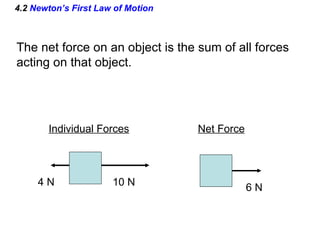
4.2  Newton’s First Law of Motion The net force on an object is the sum of all forces acting on that object. Individual Forces Net Force 10 N 4 N 6 N
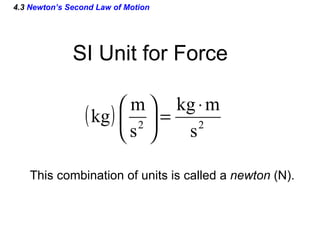
4.3  Newton’s Second Law of Motion SI Unit for Force This combination of units is called a  newton  (N).
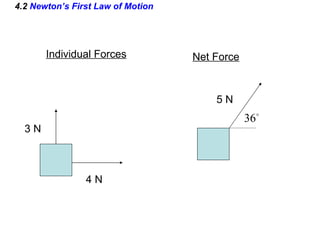
4.2  Newton’s First Law of Motion Individual Forces Net Force 3 N 4 N 5 N
4.2  Newton’s First Law of Motion The  mass  of an object is a quantitative measure of inertia. SI Unit of Mass:  kilogram (kg)
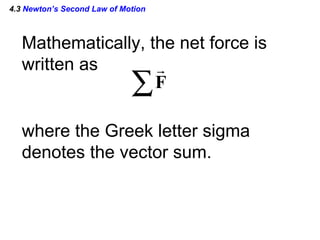
4.3  Newton’s Second Law of Motion Mathematically, the net force is  written as where the Greek letter sigma denotes the vector sum.
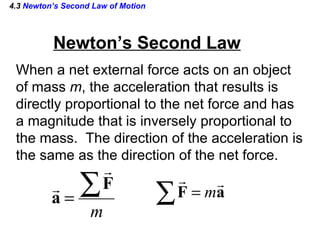
4.3  Newton’s Second Law of Motion Newton’s Second Law When a net external force acts on an object of mass  m , the acceleration that results is  directly proportional to the net force and has a magnitude that is inversely proportional to the mass.  The direction of the acceleration is the same as the direction of the net force.
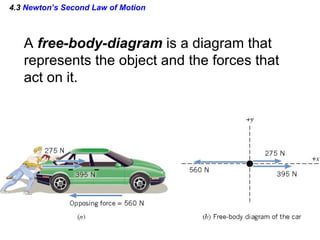
4.3  Newton’s Second Law of Motion A  free-body-diagram  is a diagram that  represents the object and the forces that  act on it.
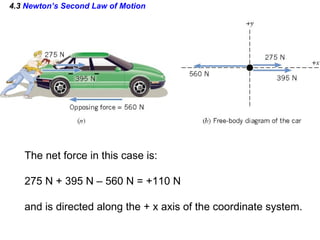
4.3  Newton’s Second Law of Motion The net force in this case is: 275 N + 395 N – 560 N = +110 N and is directed along the + x axis of the coordinate system.
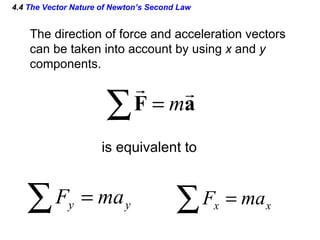
4.4  The Vector Nature of Newton’s Second Law The direction of force and acceleration vectors can be taken into account by using  x  and  y components. is equivalent to
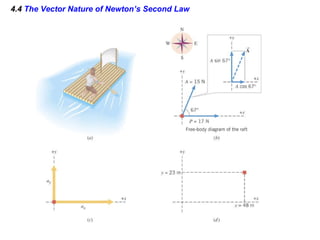
4.4  The Vector Nature of Newton’s Second Law
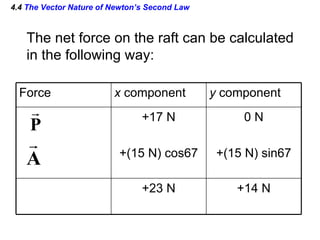
4.4  The Vector Nature of Newton’s Second Law The net force on the raft can be calculated in the following way: Force x  component y  component +17 N +(15 N) cos67 0 N +(15 N) sin67 +23 N +14 N
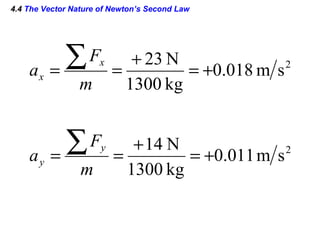
4.4  The Vector Nature of Newton’s Second Law
4.5  Newton’s Third Law of Motion Newton’s Third Law of Motion Whenever one body exerts a force on a  second body, the second body exerts an  oppositely directed force of equal magnitude on the first body.
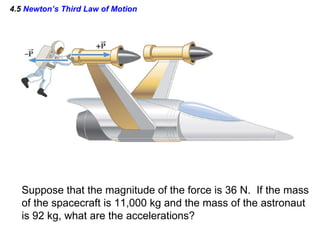
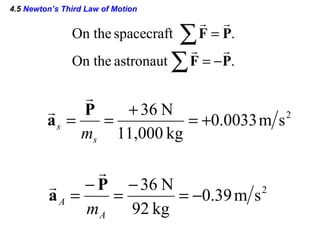
4.5  Newton’s Third Law of Motion Suppose that the magnitude of the force is 36 N.  If the mass of the spacecraft is 11,000 kg and the mass of the astronaut is 92 kg, what are the accelerations?
4.5  Newton’s Third Law of Motion
4.6  Types of Forces: An Overview Examples of different forces: Friction force Tension force Normal force Weight (Force due to gravity) Gravitational Force Magnetic Force Electric Force
4.7  The Gravitational Force Newton’s Law of Universal Gravitation Every particle in the universe exerts an attractive force on every other particle.
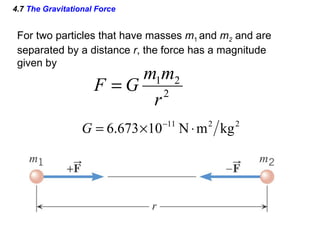
4.7  The Gravitational Force For two particles that have masses  m 1  and  m 2   and are  separated by a distance  r , the force has a magnitude  given by
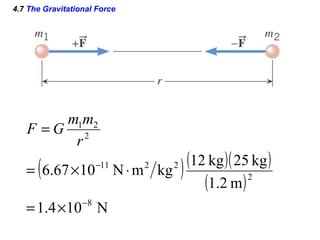
4.7  The Gravitational Force
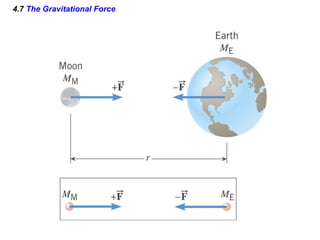
4.7  The Gravitational Force Definition of Weight The weight of an object on or above the earth is the gravitational force that the earth exerts on the object. The weight always acts downwards, toward the center  of the earth. SI Unit of Weight:  newton (N)
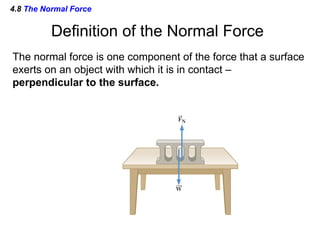
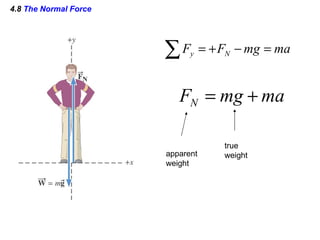
4.8  The Normal Force Definition of the Normal Force The normal force is one component of the force that a surface exerts on an object with which it is in contact – perpendicular to the surface.
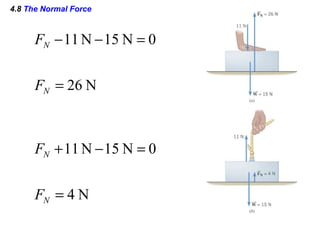
4.8  The Normal Force
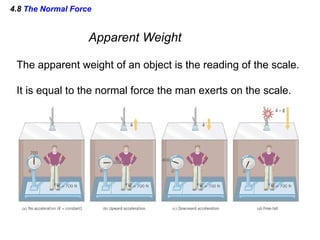
4.8  The Normal Force Apparent Weight The apparent weight of an object is the reading of the scale. It is equal to the normal force the man exerts on the scale.
4.8  The Normal Force apparent  weight true weight
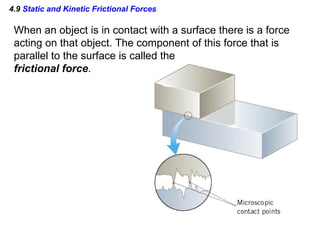
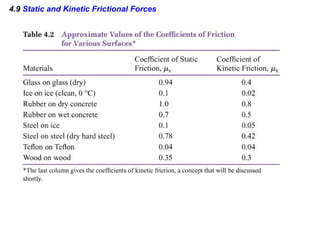
4.9  Static and Kinetic Frictional Forces When an object is in contact with a surface there is a force acting on that object. The component of this force that is  parallel to the surface is called the  frictional force .
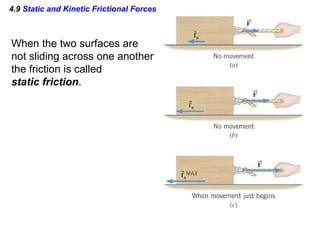
4.9  Static and Kinetic Frictional Forces When the two surfaces are  not sliding across one another the friction is called  static friction .
4.9  Static and Kinetic Frictional Forces The magnitude of the static frictional force can have any value from zero up to a maximum value. is called the coefficient of static friction.
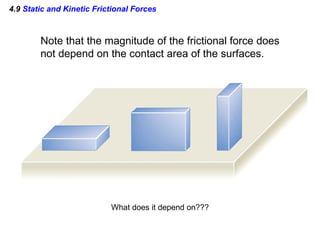
4.9  Static and Kinetic Frictional Forces Note that the magnitude of the frictional force does not depend on the contact area of the surfaces. What does it depend on???
4.9  Static and Kinetic Frictional Forces Static friction opposes the  impending  relative motion between two objects. Kinetic friction opposes the relative sliding motion motions that actually does occur. is called the coefficient of kinetic friction.
4.9  Static and Kinetic Frictional Forces
4.9  Static and Kinetic Frictional Forces The sled comes to a halt because the kinetic frictional force opposes its motion and causes the sled to slow down.
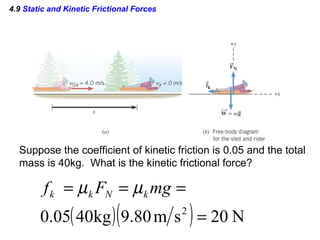
4.9  Static and Kinetic Frictional Forces Suppose the coefficient of kinetic friction is 0.05 and the total  mass is 40kg.  What is the kinetic frictional force?
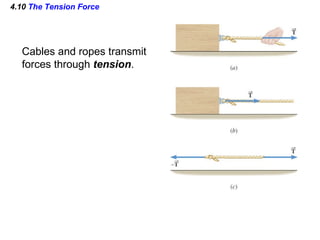
4.10  The Tension Force Cables and ropes transmit  forces through  tension .
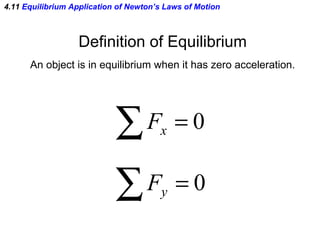
4.11  Equilibrium Application of Newton’s Laws of Motion Definition of Equilibrium An object is in equilibrium when it has zero acceleration.
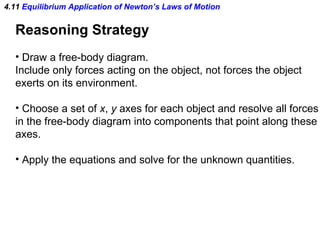
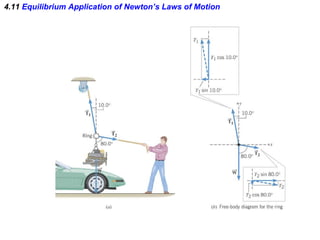
4.11  Equilibrium Application of Newton’s Laws of Motion Reasoning Strategy Draw a free-body diagram. Include only forces acting on the object, not forces the object exerts on its environment. Choose a set of  x ,  y  axes for each object and resolve all forces in the free-body diagram into components that point along these axes. Apply the equations and solve for the unknown quantities.
4.11  Equilibrium Application of Newton’s Laws of Motion
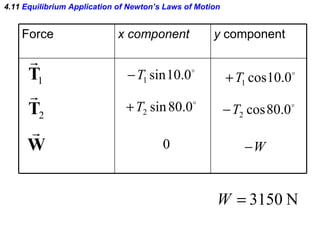
4.11  Equilibrium Application of Newton’s Laws of Motion Force x component y  component
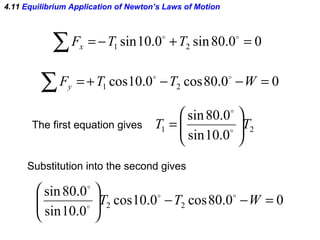
4.11  Equilibrium Application of Newton’s Laws of Motion The first equation gives Substitution into the second gives
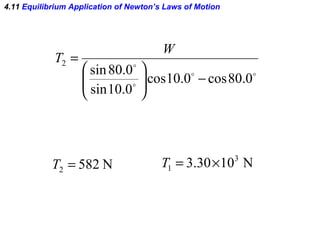
4.11  Equilibrium Application of Newton’s Laws of Motion

AP Physics - Chapter 4 Powerpoint

  • 1.
    Chapter 4 Forcesand Newton’s Laws of Motion
  • 2.
    4.1 TheConcepts of Force and Mass A force is a push or a pull. Arrows are used to represent forces. The length of the arrow is proportional to the magnitude of the force. 15 N 5 N
  • 3.
    4.1 TheConcepts of Force and Mass Mass is a measure of the amount of “stuff” contained in an object.
  • 4.
    4.2 Newton’sFirst Law of Motion An object continues in a state of rest or in a state of motion at a constant Speed unless changed by a net force The net force is the SUM of all of the forces acting on an object. Newton’s First Law (Law of Inertia)
  • 5.
    4.2 Newton’sFirst Law of Motion The net force on an object is the sum of all forces acting on that object. Individual Forces Net Force 10 N 4 N 6 N
  • 6.
    4.3 Newton’sSecond Law of Motion SI Unit for Force This combination of units is called a newton (N).
  • 7.
    4.2 Newton’sFirst Law of Motion Individual Forces Net Force 3 N 4 N 5 N
  • 8.
    4.2 Newton’sFirst Law of Motion The mass of an object is a quantitative measure of inertia. SI Unit of Mass: kilogram (kg)
  • 9.
    4.3 Newton’sSecond Law of Motion Mathematically, the net force is written as where the Greek letter sigma denotes the vector sum.
  • 10.
    4.3 Newton’sSecond Law of Motion Newton’s Second Law When a net external force acts on an object of mass m , the acceleration that results is directly proportional to the net force and has a magnitude that is inversely proportional to the mass. The direction of the acceleration is the same as the direction of the net force.
  • 11.
    4.3 Newton’sSecond Law of Motion A free-body-diagram is a diagram that represents the object and the forces that act on it.
  • 12.
    4.3 Newton’sSecond Law of Motion The net force in this case is: 275 N + 395 N – 560 N = +110 N and is directed along the + x axis of the coordinate system.
  • 13.
    4.4 TheVector Nature of Newton’s Second Law The direction of force and acceleration vectors can be taken into account by using x and y components. is equivalent to
  • 14.
    4.4 TheVector Nature of Newton’s Second Law
  • 15.
    4.4 TheVector Nature of Newton’s Second Law The net force on the raft can be calculated in the following way: Force x component y component +17 N +(15 N) cos67 0 N +(15 N) sin67 +23 N +14 N
  • 16.
    4.4 TheVector Nature of Newton’s Second Law
  • 17.
    4.5 Newton’sThird Law of Motion Newton’s Third Law of Motion Whenever one body exerts a force on a second body, the second body exerts an oppositely directed force of equal magnitude on the first body.
  • 18.
    4.5 Newton’sThird Law of Motion Suppose that the magnitude of the force is 36 N. If the mass of the spacecraft is 11,000 kg and the mass of the astronaut is 92 kg, what are the accelerations?
  • 19.
    4.5 Newton’sThird Law of Motion
  • 20.
    4.6 Typesof Forces: An Overview Examples of different forces: Friction force Tension force Normal force Weight (Force due to gravity) Gravitational Force Magnetic Force Electric Force
  • 21.
    4.7 TheGravitational Force Newton’s Law of Universal Gravitation Every particle in the universe exerts an attractive force on every other particle.
  • 22.
    4.7 TheGravitational Force For two particles that have masses m 1 and m 2 and are separated by a distance r , the force has a magnitude given by
  • 23.
    4.7 TheGravitational Force
  • 24.
    4.7 TheGravitational Force
  • 25.
    4.7 TheGravitational Force Definition of Weight The weight of an object on or above the earth is the gravitational force that the earth exerts on the object. The weight always acts downwards, toward the center of the earth. SI Unit of Weight: newton (N)
  • 26.
    4.8 TheNormal Force Definition of the Normal Force The normal force is one component of the force that a surface exerts on an object with which it is in contact – perpendicular to the surface.
  • 27.
    4.8 TheNormal Force
  • 28.
    4.8 TheNormal Force Apparent Weight The apparent weight of an object is the reading of the scale. It is equal to the normal force the man exerts on the scale.
  • 29.
    4.8 TheNormal Force apparent weight true weight
  • 30.
    4.9 Staticand Kinetic Frictional Forces When an object is in contact with a surface there is a force acting on that object. The component of this force that is parallel to the surface is called the frictional force .
  • 31.
    4.9 Staticand Kinetic Frictional Forces When the two surfaces are not sliding across one another the friction is called static friction .
  • 32.
    4.9 Staticand Kinetic Frictional Forces The magnitude of the static frictional force can have any value from zero up to a maximum value. is called the coefficient of static friction.
  • 33.
    4.9 Staticand Kinetic Frictional Forces Note that the magnitude of the frictional force does not depend on the contact area of the surfaces. What does it depend on???
  • 34.
    4.9 Staticand Kinetic Frictional Forces Static friction opposes the impending relative motion between two objects. Kinetic friction opposes the relative sliding motion motions that actually does occur. is called the coefficient of kinetic friction.
  • 35.
    4.9 Staticand Kinetic Frictional Forces
  • 36.
    4.9 Staticand Kinetic Frictional Forces The sled comes to a halt because the kinetic frictional force opposes its motion and causes the sled to slow down.
  • 37.
    4.9 Staticand Kinetic Frictional Forces Suppose the coefficient of kinetic friction is 0.05 and the total mass is 40kg. What is the kinetic frictional force?
  • 38.
    4.10 TheTension Force Cables and ropes transmit forces through tension .
  • 39.
    4.11 EquilibriumApplication of Newton’s Laws of Motion Definition of Equilibrium An object is in equilibrium when it has zero acceleration.
  • 40.
    4.11 EquilibriumApplication of Newton’s Laws of Motion Reasoning Strategy Draw a free-body diagram. Include only forces acting on the object, not forces the object exerts on its environment. Choose a set of x , y axes for each object and resolve all forces in the free-body diagram into components that point along these axes. Apply the equations and solve for the unknown quantities.
  • 41.
    4.11 EquilibriumApplication of Newton’s Laws of Motion
  • 42.
    4.11 EquilibriumApplication of Newton’s Laws of Motion Force x component y component
  • 43.
    4.11 EquilibriumApplication of Newton’s Laws of Motion The first equation gives Substitution into the second gives
  • 44.
    4.11 EquilibriumApplication of Newton’s Laws of Motion