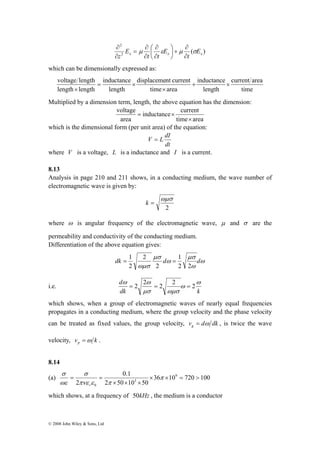
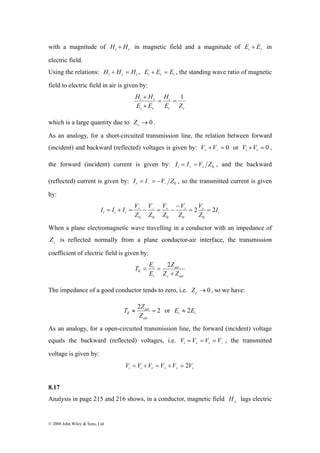
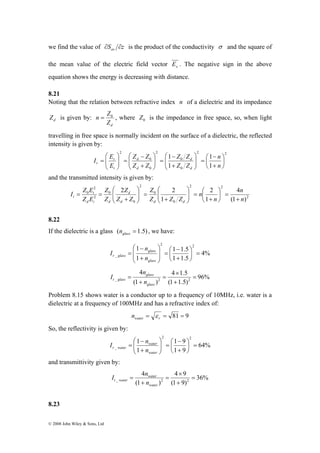
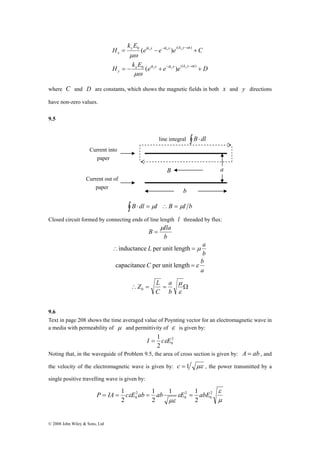
Solutions Manual for 
The Physics of Vibrations and Waves – 
6th Edition 
Compiled by 
Dr Youfang Hu 
Optoelectronics Research Centre (ORC), University of Southampton, UK 
In association with the author 
H. J. Pain 
Formerly of Department of Physics, Imperial College of Science and Technology, London, UK 
© 2008 John Wiley & Sons, Ltd
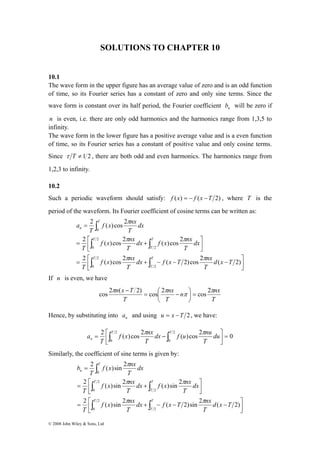
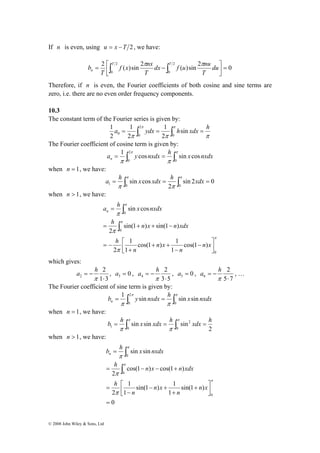
SOLUTIONS TO CHAPTER 1 
1.1 
In Figure 1.1(a), the restoring force is given by: 
© 2008 John Wiley & Sons, Ltd 
F = −mg sinθ 
By substitution of relation sinθ = x l into the above equation, we have: 
F = −mg x l 
so the stiffness is given by: 
s = − F x = mg l 
so we have the frequency given by: 
ω2 = s m = g l 
Since θ is a very small angle, i.e. θ = sinθ = x l , or x = lθ , we have the restoring force 
given by: 
F = −mgθ 
Now, the equation of motion using angular displacement θ can by derived from Newton’s 
second law: 
F = m&x& 
i.e. −mgθ = mlθ&& 
&& g 
i.e. θ + θ = 0 
l 
which shows the frequency is given by: 
ω 2 = g l 
In Figure 1.1(b), restoring couple is given by −Cθ , which has relation to moment of inertia I 
given by: 
−Cθ = Iθ&& 
&& C 
i.e. θ + θ = 0 
I 
which shows the frequency is given by: 
ω2 = C I
In Figure 1.1(d), the restoring force is given by: 
© 2008 John Wiley & Sons, Ltd 
F = −2T x l 
so Newton’s second law gives: 
F = m&x& = −2Tx l 
i.e. &x&+ 2Tx lm = 0 
which shows the frequency is given by: 
ω2 = 2T 
lm 
In Figure 1.1(e), the displacement for liquid with a height of x has a displacement of x 2 and 
a mass of ρAx , so the stiffness is given by: 
s G ρ 
Ag 
Axg 
= = = 
x 
x 
ρ 
2 2 
2 
Newton’s second law gives: 
−G = m&x& 
i.e. − 2ρAxg = ρAl&x& 
&x& g 
i.e. + 2 x = 0 
l 
which show the frequency is given by: 
ω 2 = 2g l 
In Figure 1.1(f), by taking logarithms of equation pVγ = constant , we have: 
ln p +γ lnV = constant 
dV 
dp γ 
so we have: + = 0 
V 
p 
i.e. 
dp = −γp dV 
V 
The change of volume is given by dV = Ax , so we have: 
dp = −γp Ax 
V 
The gas in the flask neck has a mass of ρAl , so Newton’s second law gives: 
Adp = m&x&
2 
−γp A x = ρ && 
i.e. Alx 
© 2008 John Wiley & Sons, Ltd 
V 
x γ 
pA 
i.e. + x = 0 
l ρ 
V 
&& 
which show the frequency is given by: 
pA 
ρ 
γ 
l V 
ω 2 = 
In Figure 1.1 (g), the volume of liquid displaced is Ax , so the restoring force is − ρgAx . Then, 
Newton’s second law gives: 
F = −ρgAx = m&x& 
x g A ρ 
i.e. + x = 0 
m 
&& 
which shows the frequency is given by: 
ω 2 = gρA m 
1.2 
Write solution x = a cos(ωt +φ ) in form: x = a cosφ cosωt − asinφ sinωt and 
compare with equation (1.2) we find: A = a cosφ and B = −asinφ . We can also 
find, with the same analysis, that the values of A and B for solution 
x = asin(ωt −φ ) are given by: A = −asinφ and B = acosφ , and for solution 
x = acos(ωt −φ ) are given by: A = a cosφ and B = asinφ . 
Try solution x = a cos(ωt +φ ) in expression &x&+ω 2x , we have: 
&x&+ω 2x = −aω 2 cos(ωt +φ ) +ω2a cos(ωt +φ ) = 0 
Try solution x = asin(ωt −φ ) in expression &x&+ω 2x , we have: 
&x&+ω 2x = −aω2 sin(ωt −φ ) +ω 2asin(ωt −φ ) = 0 
Try solution x = a cos(ωt −φ ) in expression &x&+ω 2x , we have: 
&x&+ω 2x = −aω 2 cos(ωt −φ ) +ω2a cos(ωt −φ ) = 0
1.3 
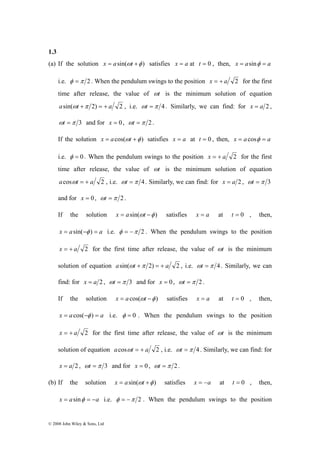
(a) If the solution x = asin(ωt +φ ) satisfies x = a at t = 0 , then, x = asinφ = a 
i.e. φ =π 2 . When the pendulum swings to the position x = + a 2 for the first 
time after release, the value of ωt is the minimum solution of equation 
asin(ωt +π 2) = + a 2 , i.e. ωt =π 4 . Similarly, we can find: for x = a 2 , 
ωt =π 3 and for x = 0 , ωt =π 2 . 
If the solution x = acos(ωt +φ ) satisfies x = a at t = 0 , then, x = a cosφ = a 
i.e. φ = 0 . When the pendulum swings to the position x = + a 2 for the first 
time after release, the value of ωt is the minimum solution of equation 
acosωt = + a 2 , i.e. ωt =π 4 . Similarly, we can find: for x = a 2 , ωt =π 3 
and for x = 0, ωt =π 2 . 
If the solution x = asin(ωt −φ ) satisfies x = a at t = 0 , then, 
x = asin(−φ ) = a i.e. φ = −π 2 . When the pendulum swings to the position 
x = + a 2 for the first time after release, the value of ωt is the minimum 
solution of equation asin(ωt +π 2) = + a 2 , i.e. ωt =π 4 . Similarly, we can 
find: for x = a 2 , ωt =π 3 and for x = 0 , ωt =π 2 . 
If the solution x = a cos(ωt −φ ) satisfies x = a at t = 0 , then, 
x = a cos(−φ ) = a i.e. φ = 0 . When the pendulum swings to the position 
x = + a 2 for the first time after release, the value of ωt is the minimum 
solution of equation acosωt = + a 2 , i.e. ωt =π 4 . Similarly, we can find: for 
x = a 2 , ωt =π 3 and for x = 0 , ωt =π 2 . 
(b) If the solution x = asin(ωt +φ ) satisfies x = −a at t = 0 , then, 
x = asinφ = −a i.e. φ = −π 2 . When the pendulum swings to the position 
© 2008 John Wiley & Sons, Ltd
x = + a 2 for the first time after release, the value of ωt is the minimum 
solution of equation asin(ωt −π 2) = + a 2 , i.e. ωt = 3π 4 . Similarly, we can 
find: for x = a 2 , ωt = 2π 3 and for x = 0 , ωt =π 2 . 
If the solution x = acos(ωt +φ ) satisfies x = −a at t = 0 , then, 
x = a cosφ = −a i.e. φ =π . When the pendulum swings to the position 
x = + a 2 for the first time after release, the value of ωt is the minimum 
solution of equation acos(ωt +π ) = + a 2 , i.e. ωt = 3π 4 . Similarly, we can 
find: for x = a 2 , ωt = 2π 3 and for x = 0 , ωt =π 2 . 
If the solution x = asin(ωt −φ ) satisfies x = −a at t = 0 , then, 
x = asin(−φ ) = −a i.e. φ =π 2 . When the pendulum swings to the position 
x = + a 2 for the first time after release, the value of ωt is the minimum 
solution of equation asin(ωt −π 2) = + a 2 , i.e. ωt = 3π 4 . Similarly, we can 
find: for x = a 2 , ωt = 2π 3 and for x = 0 , ωt =π 2 . 
If the solution x = a cos(ωt −φ ) satisfies x = −a at t = 0 , then, 
x = acos(−φ ) = −a i.e. φ =π . When the pendulum swings to the position 
x = + a 2 for the first time after release, the value of ωt is the minimum 
solution of equation acos(ωt −π ) = + a 2 , i.e. ωt = 3π 4 . Similarly, we can 
find: for x = a 2 , ωt = 2π 3 and for x = 0 , ωt =π 2 . 
1.4 
The frequency of such a simple harmonic motion is given by: 
s 
e 
πε π 
e e = = = rad s 
© 2008 John Wiley & Sons, Ltd 
4.5 10 [ ] 
19 2 
− 
(1.6 × 
10 ) 
4 8.85 10 (0.05 10 ) 9.1 10 
4 
16 1 
12 9 3 31 
3 
0 
2 
0 
− 
− − − 
≈ × ⋅ 
× × × × × × × 
r m 
m 
ω 
Its radiation generates an electromagnetic wave with a wavelength λ given by:
= = − π 
ω 
© 2008 John Wiley & Sons, Ltd 
c ≈ × m = nm 
2 2 3 10 8 
4.2 10 [ ] 42[ ] 
× × × 
16 
4.5 10 
8 
0 
× 
π 
λ 
Therefore such a radiation is found in X-ray region of electromagnetic spectrum. 
1.5 
(a) If the mass m is displaced a distance of x from its equilibrium position, either 
the upper or the lower string has an extension of x 2 . So, the restoring force of 
the mass is given by: F = −sx 2 and the stiffness of the system is given by: 
s′ = −F x = s 2 . Hence the frequency is given by s m s m a ω2 = ′ = 2 . 
(b) The frequency of the system is given by: s m b ω2 = 
(c) If the mass m is displaced a distance of x from its equilibrium position, the 
restoring force of the mass is given by: F = −sx − sx = −2sx and the stiffness of 
the system is given by: s′ = −F x = 2s . Hence the frequency is given by 
s m s m c ω2 = ′ =2 . 
Therefore, we have the relation: 2 : 2 : 2 = s 2m: s m: 2s m = 1: 2 : 4 a b c ω ω ω 
1.6 
At time t = 0 , 0 x = x gives: 
0 asinφ = x (1.6.1) 
0 x& = v gives: 
0 aω cosφ = v (1.6.2) 
From (1.6.1) and (1.6.2), we have 
0 0 tanφ =ωx v and 2 2 1 2 
a = (x 2 
+ v ω ) 
0 0 
1.7 
The equation of this simple harmonic motion can be written as: x = asin(ωt +φ ) . 
The time spent in moving from x to x + dx is given by: t dt = dx v , where t v is 
the velocity of the particle at time t and is given by: v = x = aω cos(ωt +φ ) t & .
Noting that the particle will appear twice between x and x + dx within one period 
of oscillation. We have the probability η of finding it between x to x + dx given 
by: 
η = 2dt where the period is given by: 
T 
dt 
2 2 
ω 
© 2008 John Wiley & Sons, Ltd 
2π T = , so we have: 
ω 
dx 
dx 
dx 
dx 
2 cos( ) cos( ) a 1 sin2 ( t 
) a 2 x 
2 
a t 
a t 
T 
− 
= 
− + 
= 
+ 
= 
+ 
= = 
π ω ω φ π ω φ π ω φ π 
η 
1.8 
Since the displacements of the equally spaced oscillators in y direction is a sine 
curve, the phase difference δφ between two oscillators a distance x apart given is 
proportional to the phase difference 2π between two oscillators a distance λ apart 
by: δφ 2π = x λ , i.e. δφ = 2πx λ . 
1.9 
The mass loses contact with the platform when the system is moving downwards and 
the acceleration of the platform equals the acceleration of gravity. The acceleration of 
a simple harmonic vibration can be written as: a = Aω 2 sin(ωt +φ ) , where A is the 
amplitude, ω is the angular frequency and φ is the initial phase. So we have: 
Aω 2 sin(ωt +φ ) = g 
i.e. 
ω 2 sin(ω +φ ) 
= 
t 
A g 
Therefore, the minimum amplitude, which makes the mass lose contact with the 
platform, is given by: 
A g g ≈ 
min 2 4 2 2 2 2 m 
0.01[ ] 
9.8 
= = = 
ω π π 
4 5 
f 
× × 
1.10 
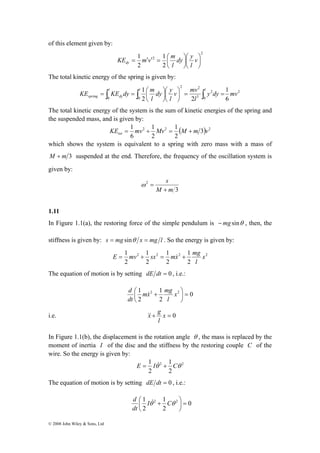
The mass of the element dy is given by: m′ = mdy l . The velocity of an element 
dy of its length is proportional to its distance y from the fixed end of the spring, and 
is given by: v′ = yv l . where v is the velocity of the element at the other end of the 
spring, i.e. the velocity of the suspended mass M . Hence we have the kinetic energy
of this element given by: 
2 2 
v mv 
l 
KE KE dy 1 
m 
= = ⎛ l l l 
1 
spring dy y dy mv 
© 2008 John Wiley & Sons, Ltd 
2 
dy y 
l 
= ′ ′ 2 
= ⎛ v 
1 
2 
1 
2 
⎞ 
⎟⎠ 
⎛ 
⎞ 
⎜⎝ 
⎟⎠ 
⎜⎝ 
l 
KE m v m dy 
The total kinetic energy of the spring is given by: 
⎞ 
⎛ 
⎞ 
∫ ∫ ∫ = = ⎟⎠ 
⎜⎝ 
⎟⎠ 
⎜⎝ 
l 
dy y 
l 
0 0 
2 
0 
2 
3 
6 
2 2 
The total kinetic energy of the system is the sum of kinetic energies of the spring and 
the suspended mass, and is given by: 
KE = 1 mv + 1 
Mv = 1 
M + 
m v tot 2 2 ( 3) 2 
2 
2 
6 
which shows the system is equivalent to a spring with zero mass with a mass of 
M + m 3 suspended at the end. Therefore, the frequency of the oscillation system is 
given by: 
3 
2 
s 
+ 
M m 
ω = 
1.11 
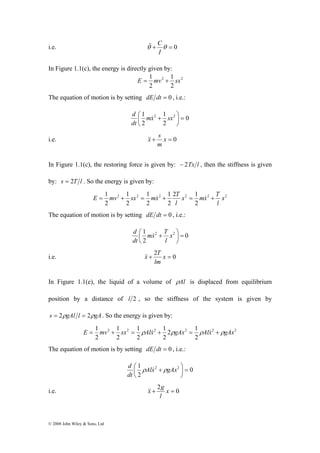
In Figure 1.1(a), the restoring force of the simple pendulum is −mg sinθ , then, the 
stiffness is given by: s = mg sinθ x = mg l . So the energy is given by: 
E = mv + sx = mx& + mg 
1 1 
1 
1 
x 
2 2 2 2 
2 
2 
2 
2 
l 
The equation of motion is by setting dE dt = 0 , i.e.: 
0 
mx mg 
d & 
⎟⎠ 
1 2 1 
2 = ⎛ + x 
2 
2 
⎞ 
⎜⎝ 
l 
dt 
&x& g 
i.e. + x = 0 
l 
In Figure 1.1(b), the displacement is the rotation angle θ , the mass is replaced by the 
moment of inertia I of the disc and the stiffness by the restoring couple C of the 
wire. So the energy is given by: 
E = 1 Iθ& + 1 
Cθ 
2 2 
2 
2 
The equation of motion is by setting dE dt = 0 , i.e.: 
0 
d & 
⎟⎠ 
1 2 1 
2 = ⎛ Iθ + Cθ 
dt 
2 
2 
⎞ 
⎜⎝
&& C 
i.e. θ + θ = 0 
E = 1 mv + sx = ρAlx& + ρgAx = ρAlx& + ρgAx 
© 2008 John Wiley & Sons, Ltd 
I 
In Figure 1.1(c), the energy is directly given by: 
E = 1 mv + 1 
sx 
2 2 
2 
2 
The equation of motion is by setting dE dt = 0 , i.e.: 
0 
d & 
⎟⎠ 
1 2 1 
2 = ⎛ mx + sx 
dt 
2 
2 
⎞ 
⎜⎝ 
&x& s 
i.e. + x = 0 
m 
In Figure 1.1(c), the restoring force is given by: − 2Tx l , then the stiffness is given 
by: s = 2T l . So the energy is given by: 
x mx T 
l 
1 x 
2 1 
2 
1 
1 
2 2 2 2 2 2 
2 
1 
2 
2 
2 
l 
E = mv + sx = mx& + T = & + 
The equation of motion is by setting dE dt = 0 , i.e.: 
0 
mx T 
d & 
1 2 2 = ⎟⎠ 
⎛ + x 
2 
⎞ 
⎜⎝ 
l 
dt 
&x& T 
i.e. + 2 x = 0 
lm 
In Figure 1.1(e), the liquid of a volume of ρAl is displaced from equilibrium 
position by a distance of l 2 , so the stiffness of the system is given by 
s = 2ρgAl l = 2ρgA. So the energy is given by: 
2 1 
2 
1 
1 
2 2 2 2 2 2 
2 
1 
2 
2 
2 
The equation of motion is by setting dE dt = 0 , i.e.: 
0 
d ρ & ρ 
1 2 2 = ⎟⎠ 
⎛ Alx + gAx 
dt 
2 
⎞ 
⎜⎝ 
&x& g 
i.e. + 2 x = 0 
l
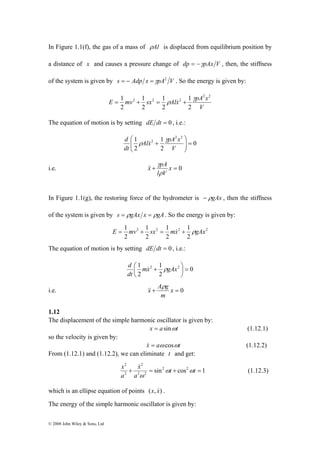
In Figure 1.1(f), the gas of a mass of ρAl is displaced from equilibrium position by 
a distance of x and causes a pressure change of dp = −γpAx V , then, the stiffness 
of the system is given by s = − Adp x =γpA2 V . So the energy is given by: 
© 2008 John Wiley & Sons, Ltd 
2 2 
E mv sx Alx pA x 
V 
= 1 2 + 1 
2 γ 
= 1 
ρ & 2 
+ 
1 
2 
2 
2 
2 
The equation of motion is by setting dE dt = 0 , i.e.: 
0 
1 2 2 
d γ 
Alx 1 
pA x 
2 
2 
⎞ 
2 = ⎟ ⎟⎠ 
⎛ 
⎜ ⎜⎝ 
+ 
V 
dt 
ρ & 
x γ 
pA 
i.e. + x = 0 
l ρ 
V 
&& 
In Figure 1.1(g), the restoring force of the hydrometer is − ρgAx , then the stiffness 
of the system is given by s = ρgAx x = ρgA. So the energy is given by: 
E = 1 mv + 1 
sx = 1 
mx& + 1 
ρgAx 
2 2 2 2 
2 
2 
2 
2 
The equation of motion is by setting dE dt = 0 , i.e.: 
0 
d & ρ 
⎟⎠ 
1 2 1 
2 = ⎛ mx + gAx 
dt 
2 
2 
⎞ 
⎜⎝ 
x A g ρ 
i.e. + x = 0 
m 
&& 
1.12 
The displacement of the simple harmonic oscillator is given by: 
x = asinωt (1.12.1) 
so the velocity is given by: 
x& = aω cosωt (1.12.2) 
From (1.12.1) and (1.12.2), we can eliminate t and get: 
2 
+ = t + t = 
x ω ω 
& (1.12.3) 
sin2 cos2 1 
2 
2 2 
2 
a 
x 
a 
ω 
which is an ellipse equation of points (x, x&) . 
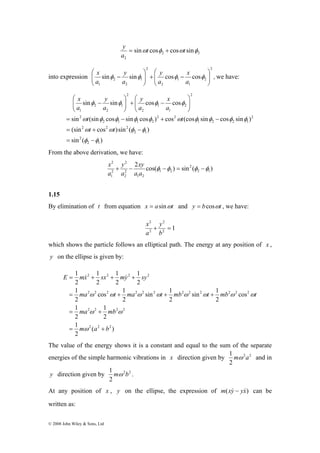
The energy of the simple harmonic oscillator is given by:
⎛ 
y 
− + ⎟ ⎟⎠ 
x 
y 
sin sin cos cos 
2 
φ φ φ φ 
2 
2 
⎞ 
xy 
x 
y 
xy 
y 
x 
sin sin 2 sin sin cos cos 2 cos cos 
⎛ 
x 
= + − + + − 
φ φ φ φ φ φ φ φ 
2 
xy 
y 
(sin cos ) (sin cos ) 2 (sin sin cos cos ) 
x 
= + + + − + 
2 
2 
2 
2 
φ φ φ φ φ φ φ φ 
xy 
y 
x 
= + − − 
© 2008 John Wiley & Sons, Ltd 
E = 1 mx& 2 + 1 
sx 2 
(1.12.4) 
2 
2 
Write (1.12.3) in form x&2 =ω2 (a2 − x2 ) and substitute into (1.12.4), then we have: 
E = 1 mx& + 1 
sx = 1 
mω ( a − x ) + 1 
sx 
2 2 2 2 2 2 
2 
2 
2 
2 
Noting that the frequency ω is given by: ω 2 = s m , we have: 
E = 1 s a − x + sx = 1 
sa 
( ) 1 
2 
2 2 2 2 
2 
2 
which is a constant value. 
1.13 
The equations of the two simple harmonic oscillations can be written as: 
sin( ) 1 y = a ωt +φ and sin( ) 2 y = a ωt +φ +δ 
The resulting superposition amplitude is given by: 
[sin( ) sin( )] 2 sin( 2)cos( 2) 1 2 R = y + y = a ωt +φ + ωt +φ +δ = a ωt +φ +δ δ 
and the intensity is given by: 
I = R2 = 4a2 cos2 (δ 2)sin2 (ωt +φ +δ 2) 
i.e. I ∝ 4a2 cos2 (δ 2) 
Noting that sin2 (ωt +φ +δ 2) varies between 0 and 1, we have: 
0 ≤ I ≤ 4a2 cos2 (δ 2) 
1.14 
2 cos( ) 
1 2 
1 2 
2 
2 
2 
1 
1 2 1 2 
1 2 
1 
2 
1 
2 
2 
2 
2 
2 
2 
2 
2 
1 
1 2 
1 2 
2 
2 
2 
1 
1 
2 
2 
2 
1 2 
1 2 
1 
2 
2 
2 
2 
2 
2 
1 
2 
2 
1 
1 
2 
2 
1 
2 
2 
1 
φ φ 
⎟ ⎟⎠ 
⎜ ⎜⎝ 
⎞ 
⎜ ⎜⎝ 
− 
a a 
a 
a 
a a 
a 
a 
a a 
a 
a 
a a 
a 
a 
a 
a 
a 
a 
On the other hand, by substitution of : 
x = + 
1 1 
1 
sinωt cosφ cosωt sinφ 
a
⎛ 
x 
⎛ 
y 
− + ⎟ ⎟⎠ 
x 
y 
sin sin cos cos 
φ φ φ φ 
⎞ 
⎛ 
t t 
x 
sin (sin cos sin cos ) cos (cos sin cos sin ) 
= − + − 
ω φ φ φ φ ω φ φ φ φ 
(sin cos )sin ( ) 
= + − 
ω ω φ φ 
= − 
1 
E = mx + sx + my + 
sy 
1 
& & 
ω ω ω ω ω ω ω ω 
= + + + 
1 
ω ω 
= + 
1 
1 
1 
2 2 2 2 
cos 1 
2 2 2 2 2 2 2 2 2 2 2 2 
ma t ma t mb t mb t 
1 
2 2 2 2 
ma mb 
ω 
© 2008 John Wiley & Sons, Ltd 
y = + 
2 2 
2 
sinωt cosφ cosωt sinφ 
a 
into expression 
2 
2 
x 
1 
⎞ 
y 
+ − 1 
2 
⎟⎠ 
⎟ 2 
1 
y 
2 
2 
1 
⎞ 
⎛ 
⎜ ⎜⎝ 
cos cos sin sin ⎟ ⎟⎠ 
⎜ ⎜⎝ 
φ − φ φ φ 
a 
a 
a 
a 
, we have: 
sin ( ) 
2 1 
2 
2 1 
2 2 2 
2 
1 2 2 1 
2 2 
2 1 1 2 
2 
2 
2 
1 
1 
2 
2 
1 
2 
2 
1 
φ φ 
⎟ ⎟⎠ 
⎜ ⎜⎝ 
⎞ 
⎜ ⎜⎝ 
− 
t t 
a 
a 
a 
a 
From the above derivation, we have: 
2 
+ − xy 
φ −φ = φ −φ 
2 cos( ) sin ( ) 
2 1 
2 
1 2 
1 2 
2 
y 
2 
2 
x 
2 
1 
a a 
a 
a 
1.15 
By elimination of t from equation x = asinωt and y = bcosωt , we have: 
2 
2 
+ = 
1 2 
2 
y 
b 
x 
a 
which shows the particle follows an elliptical path. The energy at any position of x , 
y on the ellipse is given by: 
( ) 
2 
2 
2 
cos 
sin 1 
2 
sin 1 
2 
2 
2 
1 
2 
2 
2 
2 
2 2 2 
m a b 
= + 
The value of the energy shows it is a constant and equal to the sum of the separate 
energies of the simple harmonic vibrations in x direction given by 2 2 
1 mω a and in 
2 
1 mω b . 
y direction given by 2 2 
2 
At any position of x , y on the ellipse, the expression of m(xy& − yx&) can be 
written as:
m(xy& − yx&) = m(−abω sin2ωt − abω cos2ωt) = −abmω(sin2ωt + cos2ωt) = −abmω 
which is a constant. The quantity abmω is the angular momentum of the particle. 
1.16 
All possible paths described by equation 1.3 fall within a rectangle of 1 2a wide and 
2 2a high, where 1 max a = x and 2 max a = y , see Figure 1.8. 
When x = 0 in equation (1.3) the positive value of sin( ) 2 2 1 y = a φ −φ . The value of 
max 2 y = a . So sin( ) 0 max 2 1 = φ −φ = y y x which defines 2 1 φ −φ . 
1.17 
In the range 0 ≤φ ≤π , the values of i cosφ are −1 ≤ cos ≤ +1 i φ 
© 2008 John Wiley & Sons, Ltd 
. For n random 
values of i φ , statistically there will be n 2 values −1 ≤ cos ≤ 0 i φ 
and n 2 values 
0 ≤ cos ≤ 1 i φ 
. The positive and negative values will tend to cancel each other and the 
n 
Σ → 
sum of the n values: cos 0 
i i 
1 
j ≠ = 
i φ 
→ Σ= 
, similarly cos 0 
1 
n 
j 
j φ 
. i.e. 
Σ Σ → 
cos cos 0 
1 = 
1 
≠ = 
n 
j 
j 
n 
j i i 
i φ φ 
1.18 
The exponential form of the expression: 
a sinωt + a sin(ωt +δ ) + a sin(ωt + 2δ ) +L+ a sin[ωt + (n −1)δ ] 
is given by: 
aeiωt + aei(ωt+δ ) + aei(ωt+2δ ) +L+ aei[ωt+(n−1)δ ] 
From the analysis in page 28, the above expression can be rearranged as: 
⎡ 
⎞ 
⎛ − 
+ 
ae ω δ nδ 
2 sin 2 
sin 2 
1 
δ 
i t n ⎥⎦ 
⎤ 
⎢⎣ 
⎟⎠ 
⎜⎝ 
with the imaginary part: 
δ ω n n t a ⎥⎦ 
sin δ 
2 
sin 2 
⎡ 
− 
sin + 
⎛ 1 
2 
δ 
⎤ 
⎢⎣ 
⎞ 
⎟⎠ 
⎜⎝ 
which is the value of the original expression in sine term.
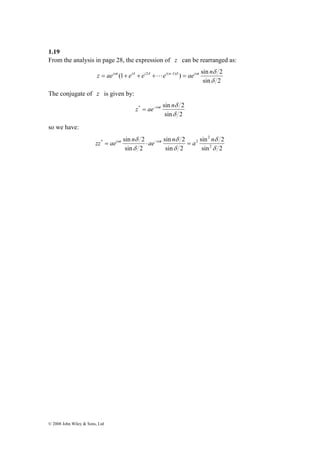
1.19 
From the analysis in page 28, the expression of z can be rearranged as: 
z aeiωt eiδ ei δ ei n δ aeiωt nδ = + + + − = L 
zz aeiωt nδ ae iωt n a n = ⋅ − = 
© 2008 John Wiley & Sons, Ltd 
(1 2 ( 1) ) sin 2 
sin δ 
2 
The conjugate of z is given by: 
z ae−iωt nδ = 
* sin 2 
sin δ 
2 
so we have: 
2 
sin δ 
2 
sin 2 
sin δ 
2 
sin 2 
sin 2 
sin 2 
2 
* 2 
δ 
δ 
δ
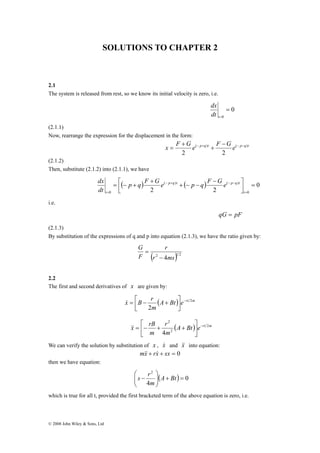
SOLUTIONS TO CHAPTER 2 
2.1 
The system is released from rest, so we know its initial velocity is zero, i.e. 
dx 
© 2008 John Wiley & Sons, Ltd 
0 
0 
= 
dx 
t= dt 
(2.1.1) 
Now, rearrange the expression for the displacement in the form: 
x F + 
G e( − p + q ) t + 
F − G e ( − p − 
q ) 
t 2 2 
= 
(2.1.2) 
Then, substitute (2.1.2) into (2.1.1), we have 
⎤ 
⎡ − 
( ) ( p q ) t ( ) ( p q ) 
t 
0 
2 2 0 
0 
= ⎥⎦ 
⎢⎣ 
+ − − 
+ 
= − + 
= 
− + − − 
= t 
t 
p q F G e p q F G e 
dt 
i.e. 
qG = pF 
(2.1.3) 
By substitution of the expressions of q and p into equation (2.1.3), we have the ratio given by: 
r 
(r2 4ms)1 2 
G 
F 
− 
= 
2.2 
The first and second derivatives of x are given by: 
x ⎡ r ⎤ 
& = B − + 
2 
(A Bt) e rt m 
m 
2 
− 
⎥⎦ 
⎢⎣ 
⎤ 
⎡ 
x rB 2 
(A Bt) e rt m 
r 
&& = − + + 
m 
m 
2 
2 
4 
− ⎥⎦ 
⎢⎣ 
We can verify the solution by substitution of x , x& and &x& into equation: 
m&x&+ rx& + sx = 0 
then we have equation: 
⎛ 
− A Bt 
( ) 0 
s r 
4 
2 
⎞ 
= + ⎟ ⎟⎠ 
⎜ ⎜⎝ 
m 
which is true for all t, provided the first bracketed term of the above equation is zero, i.e.
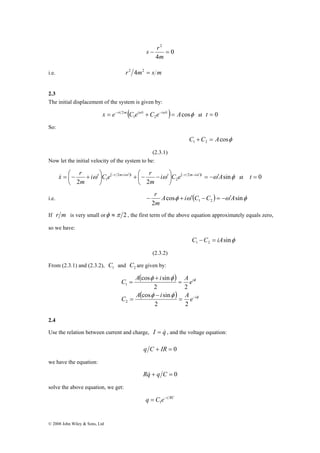
⎟⎠ 
x r i C e r m i t r 
r m i t = − ′ & = ⎛− + ′ − + ′ − − ′ at t = 0 
+ ⎛− − ′ ⎟⎠ 
© 2008 John Wiley & Sons, Ltd 
0 
s r 
4 
2 
− = 
m 
i.e. r2 4m2 = s m 
2.3 
The initial displacement of the system is given by: 
( ω ω ) cosφ 1 2 
x = e−rt 2m C ei ′t +C e−i ′t = A at t = 0 
So: 
cosφ 1 2 C +C = A 
(2.3.1) 
Now let the initial velocity of the system to be: 
ω ( ω ) ω ( ω ) ω sinφ 
2 2 
2 
2 
2 
1 i C e A 
m 
m 
⎞ 
⎜⎝ 
⎞ 
⎜⎝ 
− r + ′ − = − ′ 
i.e. cosφ ω ( ) ω sinφ 
2 1 2 A i C C A 
m 
If r m is very small orφ ≈π 2 , the first term of the above equation approximately equals zero, 
so we have: 
sinφ 1 2 C −C = iA 
(2.3.2) 
From (2.3.1) and (2.3.2), 1 C and 2 C are given by: 
( ) 
φ 
( ) φ 
C A cos φ i sin 
φ 
A e 
2 2 
cos sin 
φ φ 
i 
i 
1 
C A i A e 
= − 
− 
= 
= 
+ 
= 
2 2 
2 
2.4 
Use the relation between current and charge, I = q& , and the voltage equation: 
q C + IR = 0 
we have the equation: 
Rq& + q C = 0 
solve the above equation, we get: 
q = C e−t RC 1
where 1 C is arbitrary in value. Use initial condition, we get 1 0 C = q , 
i.e. q = q e−t RC 0 
which shows the relaxation time of the process is RC s. 
2.5 
(a) 2 2 2 
2 2 -6 
0 ω -ω′ =10 ω = r 4m => 500 0 ω m r = 
π 
1 2 4 3 
E = mx&2 + sx2 = sx = × × − = × − J 
E E E − 
© 2008 John Wiley & Sons, Ltd 
0 
ω′ ≈ , so: 
The condition also shows 0 ω 
500 0 Q =ω′m r ≈ω m r = 
Use 
ω 
τ 
′ 
′ = 2 
, we have: 
π π 
r 
π 
r 
δ τ = = 
′ 
2 ω 
500 
= ′ = 
m Q 
m 
(b) The stiffness of the system is given by: 
2 1012 10 10 100[ 1] 
0 
s =ω m = × − = Nm− 
and the resistive constant is given by: 
6 10 
10 10 7 1 
r m ω 
0 − − 
2 10 [ ] 
500 
− 
= × ⋅ 
× 
= = N sm 
Q 
(c) At t = 0 and maximum displacement, x& = 0 , energy is given by: 
100 10 5 10 [ ] 
1 
2 
1 
2 
1 
2 
2 
max 
Time for energy to decay to e−1of initial value is given by: 
0.5[ ] 
t m 10 
= 
= = − 
2 10 
7 
10 
ms 
r 
× 
− 
(d) Use definition of Q factor: 
E 
Q E 
− Δ 
= 2π 
where, E is energy stored in system, and − ΔE is energy lost per cycle, so energy loss in the 
first cycle, 1 − ΔE , is given by: 
2 2 5 10 5 
2 10 [ ] 
500 
3 
1 J 
Q 
− 
= × 
× 
− Δ = −Δ = π = π × π 
2.6
The frequency of a damped simple harmonic oscillation is given by: 
ω′ =ω − r => 2 
m Q 0 ω 
= we find fractional change in the resonant frequency is given by: 
© 2008 John Wiley & Sons, Ltd 
2 
2 
2 
0 
2 
4m 
2 
ω′ 2 
−ω 2 
= r 0 
=> 4m 
2 
( ) 0 
2 
0 4 
- 
ω ω 
ω ω ω 
′ + 
Δ = ′ = 
m 
r 
Use ω′ ≈ω and 
r 
r 
ω ω 
ω 
Δ Q 
( 2 ) 1 
− ≈ = 
2 
0 
2 
2 
0 
0 
0 
8 
8 
′ − 
= 
m 
ω ω 
ω 
2.7 
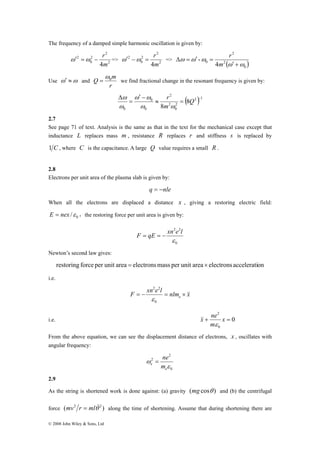
See page 71 of text. Analysis is the same as that in the text for the mechanical case except that 
inductance L replaces mass m , resistance R replaces r and stiffness s is replaced by 
1 C , where C is the capacitance. A large Q value requires a small R . 
2.8 
Electrons per unit area of the plasma slab is given by: 
q = −nle 
When all the electrons are displaced a distance x , giving a restoring electric field: 
0 E = nex /ε ,the restoring force per unit area is given by: 
2 2 
ε 
F = qE = − xn e l 
0 
Newton’s second law gives: 
restoring force per unit area = electronsmass per unit area × electrons acceleration 
i.e. 
2 2 
ε 
F xn e l nlm x = − = e × && 
0 
2 
+ x = 
m 
i.e. 0 
0 
x ne 
ε 
&& 
From the above equation, we can see the displacement distance of electrons, x , oscillates with 
angular frequency: 
2 
0 
2 
= ne 
ε 
ω 
e m 
e 
2.9 
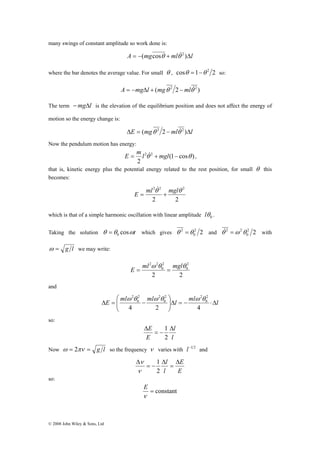
As the string is shortened work is done against: (a) gravity (mg cosθ ) and (b) the centrifugal 
force (mv2 r = mlθ&2 ) along the time of shortening. Assume that during shortening there are
many swings of constant amplitude so work done is: 
© 2008 John Wiley & Sons, Ltd 
A = −(mgcosθ + mlθ&2 )Δl 
where the bar denotes the average value. For small θ , cosθ =1−θ 2 2 so: 
A = −mgΔl + (mgθ 2 2 −mlθ&2 ) 
The term −mgΔl is the elevation of the equilibrium position and does not affect the energy of 
motion so the energy change is: 
ΔE = (mgθ 2 2 −mlθ&2 )Δl 
Now the pendulum motion has energy: 
E = ml2θ&2 + mgl (1 − cos θ ) 
, 
2 
that is, kinetic energy plus the potential energy related to the rest position, for small θ this 
becomes: 
& 
ml2θ 2 mglθ 2 E = + 
2 2 
which is that of a simple harmonic oscillation with linear amplitude 0 θ l . 
Taking the solution θ θ cosωt 0 = which gives 2 2 
θ&2 =ω 2θ with 
θ 2 =θ and 2 2 
0 
0 
ω = g l we may write: 
ml2ω 2θ mglθ E = = 
2 2 
2 
0 
2 
0 
and 
⎞ 
⎛ 
ω 2θ ω θ ω θ 
l ml l ml ml E Δ ⋅ − = Δ ⎟ ⎟⎠ 
⎜ ⎜⎝ 
Δ = − 
4 2 4 
2 
0 
2 2 
0 
2 2 
0 
so: 
E Δ 
= − 
l 
l 
Δ 
E 
1 
2 
Now ω = 2πν = g l so the frequency ν varies with l−1 2 and 
E 
E 
l 
l Δ 
= 
Δ 
= − 
Δ 
1 
2 
ν 
ν 
so: 
E 
= constant 
ν
SOLUTIONS TO CHAPTER 3 
3.1 
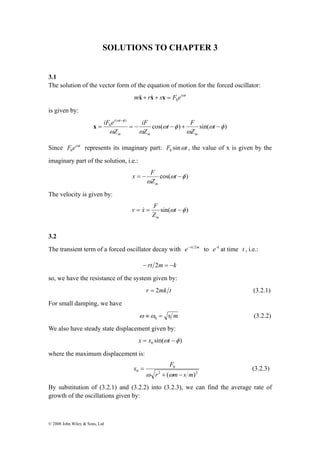
The solution of the vector form of the equation of motion for the forced oscillator: 
− 
t F 
iF 
iF e 
i t 
= = − − + − 
© 2008 John Wiley & Sons, Ltd 
m r s F eiωt 
0 &x& + x& + x = 
is given by: 
cos( ) sin( ) 
ω φ 
( ) 
0 ω φ 
ω 
ω φ 
ω ω 
t 
Z 
Z 
Z 
m m m 
x 
Since F eiωt 
0 represents its imaginary part: F sinωt 0 , the value of x is given by the 
imaginary part of the solution, i.e.: 
x F 
= − t − 
cos(ω φ ) 
Z 
ω 
m 
The velocity is given by: 
v x F 
= = sin(ωt −φ ) 
Z 
m 
& 
3.2 
The transient term of a forced oscillator decay with e−rt 2m to e-k at time t , i.e.: 
− rt 2m = −k 
so, we have the resistance of the system given by: 
r = 2mk t (3.2.1) 
For small damping, we have 
s m 0 ω ≈ω = (3.2.2) 
We also have steady state displacement given by: 
sin( ) 0 x = x ωt −φ 
where the maximum displacement is: 
x F 
= 
0 
ω ω 
0 r ( m s m) 
2 2 
+ − 
(3.2.3) 
By substitution of (3.2.1) and (3.2.2) into (3.2.3), we can find the average rate of 
growth of the oscillations given by:
© 2008 John Wiley & Sons, Ltd 
0 
F 
x = 
0 0 
2kmω 
t 
3.3 
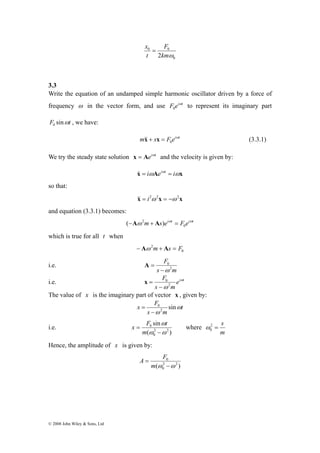
Write the equation of an undamped simple harmonic oscillator driven by a force of 
frequency ω in the vector form, and use F eiωt 
0 to represent its imaginary part 
F sinωt 0 , we have: 
m s F eiωt 
0 &x& + x = (3.3.1) 
We try the steady state solution x = Aeiωt and the velocity is given by: 
x& = iωAeiωt = iωx 
so that: 
&x& = i2ω2x = −ω2x 
and equation (3.3.1) becomes: 
ω m s eiωt F eiωt 0 
(−A 2 + A ) = 
which is true for all t when 
− Aω 2m+ As = F 
0 
i.e. 
F 
0ω 
2 
s − 
m 
A = 
F ω 
ω 2 
i.e. ei t 
0 
− 
s m 
x = 
The value of x is the imaginary part of vector x , given by: 
x F ω 
t 
sin 2 
0 
− 
s ω 
m 
= 
i.e. 
x F t where 
sin 
ω 
2 − 
2 
0 
0 
ω ω 
( ) 
= 
m 
2 = s 
m 
0 ω 
Hence, the amplitude of x is given by: 
A F 
( 2 2 ) 
0 
0 
ω −ω 
= 
m
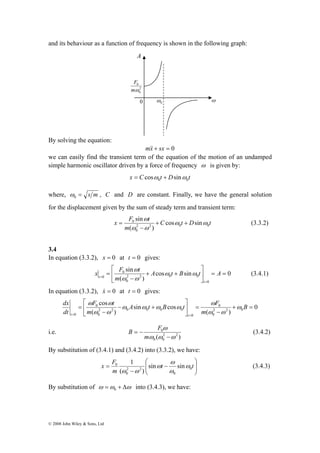
and its behaviour as a function of frequency is shown in the following graph: 
By solving the equation: 
⎡ 
A 
F 
0 ω m 
2 
0 
0 ω 
x F t 
ω 
0 ω 
= A t B t A 
0 = = ⎥⎦ 
cos 
⎡ 
dx 
ω ω 
x F 0 
© 2008 John Wiley & Sons, Ltd 
m&x&+ sx = 0 
we can easily find the transient term of the equation of the motion of an undamped 
simple harmonic oscillator driven by a force of frequency ω is given by: 
x C t D t 0 0 = cosω + sinω 
where, = s m 0 ω 
, C and D are constant. Finally, we have the general solution 
for the displacement given by the sum of steady term and transient term: 
x F t 2 2 0 0 
sin ω ω 
ω ω 
C t D t 
= (3.3.2) 
m 
0 cos sin 
( ) 
0 
ω 
+ + 
− 
3.4 
In equation (3.3.2), x = 0 at t = 0 gives: 
cos sin 0 
sin 
( ) 
0 
2 2 0 0 
0 
0 
⎤ 
⎢⎣ 
+ + 
− 
= 
= 
m 
t 
t ω ω 
ω ω 
(3.4.1) 
In equation (3.3.2), x& = 0 at t = 0 gives: 
0 
A t B t F 
0 
ω 
( ) 
sin cos 
( ) 
2 2 0 
0 
0 
2 2 0 0 0 0 
0 
0 
0 
+ = 
− 
⎤ 
= ⎥⎦ 
⎢⎣ 
− + 
− 
= 
= = 
B 
m 
m 
F t 
dt 
t t 
ω 
ω ω 
ω ω ω ω 
ω ω 
i.e. 
B F (3.4.2) 
ω 
− 
0 
( 2 2 ) 
0 0 
ω ω ω 
= − 
m 
By substitution of (3.4.1) and (3.4.2) into (3.3.2), we have: 
⎞ 
⎟ ⎟⎠ 
⎛ 
1 ω 
⎜ ⎜⎝ 
ω 
= 0 sin t − 
sin 
t 
m 
( − 
) 
0 
2 2 
0 
ω 
ω 
ω ω 
(3.4.3) 
By substitution of ω =ω + Δω 0 into (3.4.3), we have:
x F ω 
0 
= − t t t t t 
x F ω 
0 
= − t t t t 
x 
F 
π 
m 
0 
2 ω 
2 
0 
0 
F 
π 
m 
0ω 
2 
0 
© 2008 John Wiley & Sons, Ltd 
⎞ 
⎟ ⎟⎠ 
⎛ 
⎜ ⎜⎝ 
Δ + Δ − 
+ Δ 
m 
0 
0 0 
0 
0 sin cos sin cos sin 
( ) 
ω 
ω 
ω ω ω ω 
ω ω ω 
(3.4.4) 
Since 1 0 Δω ω << and Δωt << 1, we have: 
ω ≈ , sin Δωt ≈ Δωt , and cosΔωt ≈ 1 
0 ω 
Then, equation (3.4.4) becomes: 
⎞ 
⎟ ⎟⎠ 
⎛ 
⎜ ⎜⎝ 
0 sin + Δ cos − 
sin 
Δ 
m 
0 
0 0 
0 
2 
ω 
ω 
ω ω ω 
ω ω 
⎞ 
⎛ 
x F ω 
0 0 
i.e. ⎟ ⎟⎠ 
⎜ ⎜⎝ 
= − 0 sin t + Δ 
t cos 
t 
Δ 
− 
Δ 
m 
0 0 
2 
ω ω ω 
ω 
ω ω 
⎞ 
⎛ 
x F 0 
= t − t t 
sin ω 
0 cos 
2 
i.e. ⎟ ⎟⎠ 
⎜ ⎜⎝ 
m 
0 
0 
0 
ω 
ω 
ω 
x F ω ω ω 
0 t t t 
m 
i.e. = (sin − 
cos ) 
2 ω 
2 0 0 0 
0 
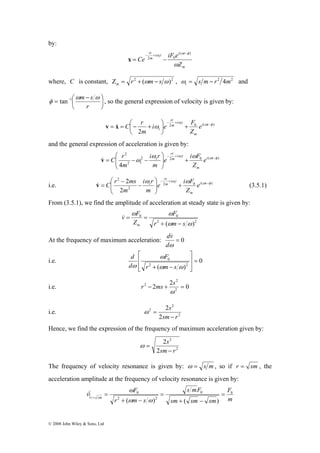
The behaviour of displacement x as a function of t 0 ω 
is shown in the following 
F t 
0 
2mω 
t 0 ω 
0 
− F t 
0 
2mω 
0 
F 
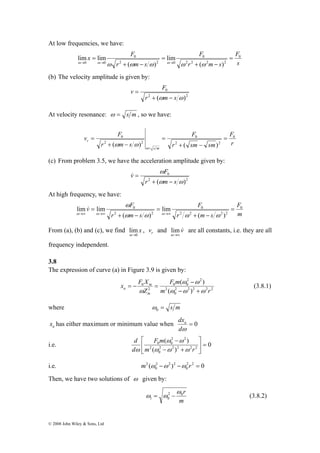
7 
ω 
π 
m 
0 
2 
F 2 
5 
ω 
π 
m 
0 
2 
F 2 
3 
ω 
π 
m 
2 
0 
F 
0 
2 
0 2 
ω 
π 
m 
2 
0 
0 
F 
0 3 
ω 
π 
m 
2 
0 
0 
graph: 
3.5 
The general expression of displacement of a simple damped mechanical oscillator 
driven by a force F cosωt 0 is the sum of transient term and steady state term, given
by: 
ωm s ω 
⎞ 
⎛ − 
φ tan 1 , so the general expression of velocity is given by: 
C r i v& 
C r ms i v& (3.5.1) 
v ω 
F r sm 
= = ω ω 
© 2008 John Wiley & Sons, Ltd 
i t i t 
ω (ω φ ) 
− + − x = − 
m 
rt 
Ce iF e 2 m 
i 
0 
Z 
ω 
where, C is constant, Z r2 (ωm s ω)2 m = + − , s m r2 4m2 t ω = − and 
⎟⎠ 
⎜⎝ 
= − 
r 
rt 
i e F 
C r i v x& 
= = ⎛− + i t 
2 0 ( ) 
2 
⎞ 
ω ω φ ω − + − + ⎟⎠ 
⎜⎝ 
t e 
m 
i t 
m 
Z 
m 
and the general expression of acceleration is given by: 
⎞ 
rt 
e i F 
i r 
2 2 0 ( ) 
2 
2 
4 
ω ω ω ω φ 
ω − + − + ⎟ ⎟⎠ 
⎛ 
⎜ ⎜⎝ 
= − − i t 
t e 
m 
i t 
m 
t 
Z 
m 
m 
⎞ 
⎛ 
rt 
e i F 
i r 
i.e. 2 0 ( ) 
2 
2 
2 
2 ω − + ω ω ω −φ + ⎟ ⎟⎠ 
⎜ ⎜⎝ 
− 
− 
= i t 
t e 
m 
i t 
m 
Z 
m 
m 
From (3.5.1), we find the amplitude of acceleration at steady state is given by: 
F 
v F 
ω ω 
& = = 
0 0 
2 2 
r m s 
(ω ω) 
Z 
m + − 
dv& 
At the frequency of maximum acceleration: = 0 
dω 
⎤ 
⎡ 
F 
ω 
d 
i.e. 0 = 
0 
ω r m s 
2 ( )2 
⎥ ⎥ 
⎦ 
⎢ ⎢ 
⎣ 
+ ω − ω 
d 
2 
r ms s 
i.e. 2 − 2 + 2 = 
0 2 
ω 
2 
2 
s 
− 
i.e. 2 
2 
2 
sm r 
ω = 
Hence, we find the expression of the frequency of maximum acceleration given by: 
2 
2 
2 
s 
− 
2 
sm r 
ω = 
The frequency of velocity resonance is given by: ω = s m , so if r = sm , the 
acceleration amplitude at the frequency of velocity resonance is given by: 
F 
m 
s mF 
sm sm sm 
0 
r m s 
0 0 
2 2 
( ) ( ) 
= 
+ − 
= 
+ − 
&
The limit of the acceleration amplitude at high frequencies is given by: 
v ω 
F 0 
lim & 
lim = 
© 2008 John Wiley & Sons, Ltd 
F 
m 
F 
2 
0 
r m s 
0 lim 
r m s 
2 
+ ⎛ − 
2 2 
2 2 
( ) 
⎞ 
⎟⎠ 
⎜⎝ 
= 
+ − 
= 
→∞ →∞ →∞ 
ω ω 
ω ω 
ω ω ω 
So we have: 
v lim 
v r sm 
= →∞ = 
ω 
& & 
3.6 
The displacement amplitude of a driven mechanical oscillator is given by: 
x F 
0 
2 2 
ω r + (ωm − 
s ω) 
= 
i.e. 
x F 
0 
2 2 2 2 
r + ( m − 
s) 
= 
ω ω 
(3.6.1) 
The displacement resonance frequency is given by: 
ω = s − (3.6.2) 
2 
r 
2 
2m 
m 
By substitution of (3.6.2) into (3.6.1), we have: 
2 2 
2 
x F 
2 
r 2 
s 
0 
⎞ 
⎛ 
+ ⎟ ⎟⎠ 
r 
r 
2 2 ⎟ ⎟⎠ 
⎜ ⎜⎝ 
⎞ 
⎛ 
⎜ ⎜⎝ 
− 
= 
m 
m 
m 
i.e. 
2 
2 
x F 
0 
r 
4m 
r s 
m 
− 
= 
which proves the exact amplitude at the displacement resonance of a driven 
mechanical oscillator may be written as: 
= 0 
r 
x F 
ω ′ 
where, 
2 
2 
ω′ 2 
= s − 
r 
4m 
m 
3.7 
(a) The displacement amplitude is given by: 
x F 
0 
2 2 
ω r + (ωm − 
s ω) 
=
At low frequencies, we have: 
x F 0 
lim lim = 
v F 
v ω 
F 0 
lim & 
lim = 
© 2008 John Wiley & Sons, Ltd 
F 
s 
F 
0 
r m s 
0 
r m s 
2 2 2 2 
lim 
2 2 0 
0 0 ( ) 
+ ( − 
) 
= 
+ − 
= 
ω→ ω→ ω ω ω ω→ ω ω 
(b) The velocity amplitude is given by: 
v F 
0 
2 2 
r + (ωm − 
s ω) 
= 
At velocity resonance: ω = s m , so we have: 
F 
r 
F 
0 
r sm sm 
0 
r m s 
s m 
r 
0 
2 2 
2 2 
( ) ( ) 
= 
+ − 
= 
+ − 
= 
ω= 
ω ω 
(c) From problem 3.5, we have the acceleration amplitude given by: 
v F 
0 
ω 
2 2 
r m s 
(ω ω) 
+ − 
& = 
At high frequency, we have: 
F 
m 
F 
0 
r m s 
0 
r m s 
2 2 2 2 
2 2 
( ) 
lim 
( ) 
+ − 
= 
+ − 
= 
→∞ →∞ ω ω →∞ ω ω 
ω ω ω 
From (a), (b) and (c), we find x 
lim 
ω→ 
0 
, r v and v& 
lim are all constants, i.e. they are all 
ω→∞ 
frequency independent. 
3.8 
The expression of curve (a) in Figure 3.9 is given by: 
( ) 
F m 
− 
= − = (3.8.1) 
a ω ω ω 
2 2 2 2 2 
0 
2 
2 2 
0 0 
x F X 
m 
2 
0 
m ( ) 
r 
Z 
m 
ω ω 
ω − + 
where = s m 0 ω 
dxa 
a x has either maximum or minimum value when = 0 
dω 
( ) 
⎤ 
⎡ 
− 
F m 
d 
ω ω 
i.e. 0 
2 2 2 2 2 
0 
m r 
( ) 
2 
2 2 
0 0 = ⎥⎦ 
⎢⎣ 
− + 
d 
ω ω ω 
ω 
i.e. m2 ( ω −ω ) −ω 2 r 2 = 
0 
0 
2 2 2 
0 
Then, we have two solutions of ω given by: 
r 2 0 
m 
1 0 
ω 
ω = ω − (3.8.2)
and 
= − = ⎛ω − ω 
= + = ⎛ω + ω 
ω = : 
© 2008 John Wiley & Sons, Ltd 
2 0r 
m 
2 0 
ω 
ω = ω + (3.8.3) 
Since r is very small, rearrange the expressions of 1 ω 
and 2 ω 
, we have: 
r 
m 
2 2 
r 
m 
r 
m 
r 
m 
⎞ 
2 4 2 0 2 
0 
2 0 
1 0 − ≈ − ⎟⎠ 
⎜⎝ 
ω 
ω ω 
r 
m 
2 2 
r 
m 
r 
m 
r 
m 
⎞ 
2 4 2 0 2 
0 
2 0 
2 0 + ≈ − ⎟⎠ 
⎜⎝ 
ω 
ω ω 
1 ω 
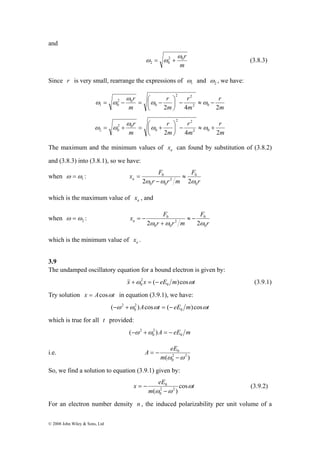
The maximum and the minimum values of x can found by substitution of (3.8.2) 
a and (3.8.3) into (3.8.1), so we have: 
when ω = : 
r 
F 
x F a 
0 
r r m 
0 
2ω ω 2ω 
0 
2 
0 0 
≈ 
− 
= 
which is the maximum value of a x , and 
when 2 ω 
r 
F 
x F a 
0 
r r m 
0 
2ω ω 2ω 
0 
2 
0 0 
≈ − 
+ 
= − 
which is the minimum value of a x . 
3.9 
The undamped oscillatory equation for a bound electron is given by: 
&&+ x ω 2 
x = ( − eE m)cosωt (3.9.1) 
0 0 
Try solution x = Acosωt in equation (3.9.1), we have: 
− 2 + = − 
2 
0 
( ω ω )Acosωt ( eE m)cosωt 0 
which is true for all t provided: 
(−ω 2 +ω ) = − 
A eE m 0 
2 
0 
i.e. 
A eE 
( 2 2 ) 
0 
0 
ω −ω 
= − 
m 
So, we find a solution to equation (3.9.1) given by: 
x eE ω 
t 
= − (3.9.2) 
m 
ω ω 
cos 
( 2 2 ) 
0 
0− 
For an electron number density n , the induced polarizability per unit volume of a
medium is given by: 
x F X 
= − = (3.10.3) 
© 2008 John Wiley & Sons, Ltd 
nex 
χ = − (3.9.3) 
E 
e 
0 ε 
By substitution of (3.9.2) and E E cosωt 0 = into (3.9.3), we have 
( 2 2 ) 
0 0 
2 
nex 
0 ε ε ω ω 
χ 
− 
= − = 
m 
ne 
E 
e 
3.10 
The forced mechanical oscillator equation is given by: 
mx rx sx F cosωt 0 &&+ & + = 
which can be written as: 
2 
0 &&+ & + = (3.10.1) 
mx rx mω x F cosωt 0 
where, = s m 0 ω 
. Its solution can be written as: 
t 
t F X 
= 0 − (3.10.2) 
Z 
x F r 
Z 
m 
m 
m 
ω 
ω 
ω 
ω 
sin 0 
cos 2 
2 
ωm s ω 
⎞ 
⎛ − 
where, X ωm s ω m = − , Z r2 (ωm s ω)2 m − + = , ⎟⎠ 
⎜⎝ 
= − 
r 
φ tan 1 
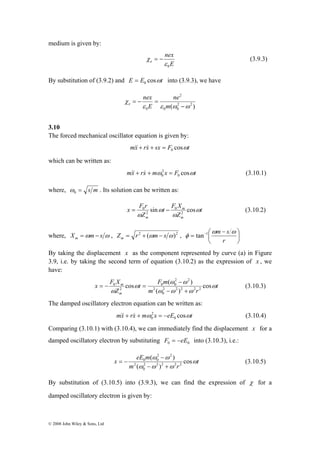
By taking the displacement x as the component represented by curve (a) in Figure 
3.9, i.e. by taking the second term of equation (3.10.2) as the expression of x , we 
have: 
t 
t F m 
ω − 
ω 
cos ( ) 2 2 2 2 2 
m ω 
m r 
Z 
m 
ω ω ω 
ω 
ω 
cos 
( ) 
0 
2 
2 2 
0 0 
2 
0 
− + 
The damped oscillatory electron equation can be written as: 
2 
0 &&+ & + = − (3.10.4) 
mx rx mω x eE cosωt 0 
Comparing (3.10.1) with (3.10.4), we can immediately find the displacement x for a 
damped oscillatory electron by substituting 0 0 F = −eE into (3.10.3), i.e.: 
x eE m ω 
t 
( ω − 
ω 
) 
= − (3.10.5) 
2 2 2 2 2 
0 
m ω ω ω 
r 
cos 
( ) 
2 
2 2 
0 0 
− + 
By substitution of (3.10.5) into (3.9.3), we can find the expression of χ for a 
damped oscillatory electron is given by:
2 
− + 
ω ω 
1 1 ( ) 2 2 2 2 2 
ε χ cos 
r ω 
© 2008 John Wiley & Sons, Ltd 
ne m 
( ) 
2 2 2 2 2 
0 
2 
ω − 
ω 
[ ( ) ] 
0 
2 2 
0 
2 
nex 
E 
ε m ω ω ω 
r 
0 ε 
χ 
− + 
= − = 
So we have: 
t 
ne m 
m r 
[ ( ) ] 
ε ω ω ω 
0 
2 
0 
2 − 
2 
0 
= + = + 
3.11 
The instantaneous power dissipated is equal to the product of frictional force and the 
instantaneous velocity, i.e.: 
2 
P rx x r F 
( ) cos2 ( ) 
= = 0 ωt −φ 
2 
Z 
m 
& & 
The period for a given frequency ω is given by: 
2π T = 
ω 
Therefore, the energy dissipated per cycle is given by: 
2 
0 
E Pdt r F 
∫ ∫ 
= = − 
2 
0 
rF 
π ω 
2 
0 2 
= − − 
rF 
2 
0 
π 
ω 
rF 
2 
2 
0 
2 
0 
2 
0 
2 
2 
2 
2 
ω φ 
[1 cos2( )] 
2 
cos ( ) 
m 
m 
m 
T 
m 
π 
Z 
Z 
t dt 
Z 
t dt 
Z 
ω 
ω φ 
π ω 
= 
= 
∫ 
(3.11.1) 
The displacement is given by: 
x F 
= t − 
0 sin(ω φ ) 
ω 
Z 
m 
so we have: 
x F 
max = (3.11.2) 
m Z 
ω 
0 
By substitution of (3.11.2) into (3.11.1), we have: 
2 
max E =πrωx 
3.12 
The low frequency limit of the bandwidth of the resonance absorption curve 1 ω 
satisfies the equation:
© 2008 John Wiley & Sons, Ltd 
m − s = −r 1 1 ω ω 
which defines the phase angle given by: 
ω m − 
s ω 
tan 1 1 1 
= 
= − 
1 r 
φ 
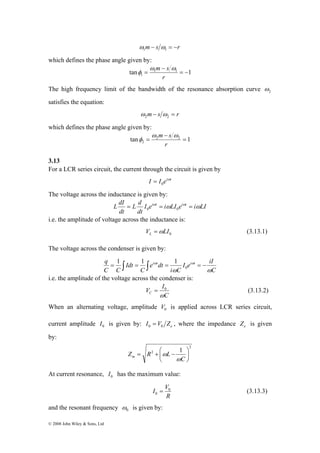
The high frequency limit of the bandwidth of the resonance absorption curve 2 ω 
satisfies the equation: 
m− s = r 2 2 ω ω 
which defines the phase angle given by: 
ω m − 
s ω 
tan 2 2 1 
= 
= 
2 r 
φ 
3.13 
For a LCR series circuit, the current through the circuit is given by 
I I eiωt 
0 = 
The voltage across the inductance is given by: 
L dI = L d 
iωt = ω iωt = ω 0 0 
I e i LI e i LI 
dt 
dt 
i.e. the amplitude of voltage across the inductance is: 
0 V LI L =ω (3.13.1) 
The voltage across the condenser is given by: 
q i t i t 
I e iI 
C 
1 1 1 
= ∫ = ∫ ω = ω = − 0 
i C 
e dt 
C 
Idt 
C C 
ω ω 
i.e. the amplitude of the voltage across the condenser is: 
V I C ω 
= 0 (3.13.2) 
C 
When an alternating voltage, amplitude 0 V is applied across LCR series circuit, 
current amplitude 0 I is given by: e I V Z 0 0 = , where the impedance e Z is given 
by: 
2 
2 1 
⎞ 
⎟⎠ 
= + ⎛ − 
Z R L m ω 
⎜⎝ 
C 
ω 
At current resonance, 0 I has the maximum value: 
I V0 
0 = (3.13.3) 
R 
and the resonant frequency 0 ω 
is given by:
V V C 
© 2008 John Wiley & Sons, Ltd 
1 0 
0 
ω or 
0 − = 
C 
L 
ω 
1 
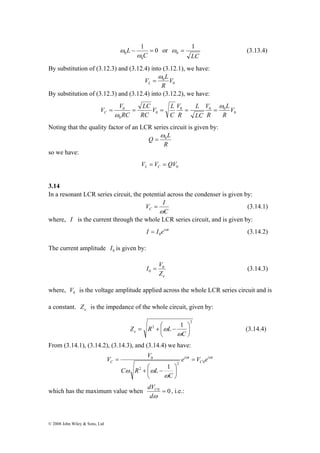
0 ω = (3.13.4) 
LC 
By substitution of (3.12.3) and (3.12.4) into (3.12.1), we have: 
0 V 
R 
0 
V ω 
= 
L L 
By substitution of (3.12.3) and (3.12.4) into (3.12.2), we have: 
0 
V 
L 
V 
C 
= = = = = 
0 0 0 
0 
0 
L 
LC 
0 V 
R 
R 
LC 
R 
V L 
RC 
RC 
ω 
ω 
Noting that the quality factor of an LCR series circuit is given by: 
L Q 0 ω 
R 
= 
so we have: 
0 V V QV L C = = 
3.14 
In a resonant LCR series circuit, the potential across the condenser is given by: 
V I C ω 
= (3.14.1) 
C 
where, I is the current through the whole LCR series circuit, and is given by: 
I I eiωt 
0 = (3.14.2) 
The current amplitude 0 I is given by: 
I V0 
0 = (3.14.3) 
e Z 
where, 0 V is the voltage amplitude applied across the whole LCR series circuit and is 
a constant. e Z is the impedance of the whole circuit, given by: 
2 
2 1 
⎞ 
ω (3.14.4) 
⎟⎠ 
= + ⎛ − 
Z R L e ω 
⎜⎝ 
C 
From (3.14.1), (3.14.2), (3.14.3), and (3.14.4) we have: 
V V ω i ω 
t 
C 
i t 
C e V e 
C 
+ ⎛ − 
C R L 
ω 
ω ω 
2 0 
2 
0 
1 
= 
⎞ 
⎟⎠ 
⎜⎝ 
= 
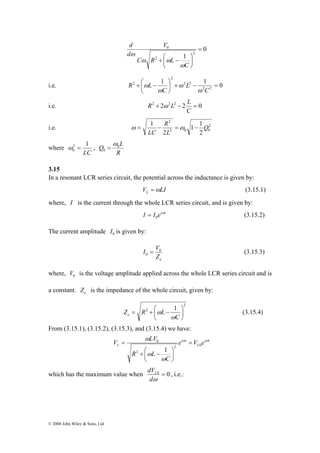
dVC , i.e.: 
which has the maximum value when 0 = 0 
dω
2 1 
0 ω = , 
Q 0L 
0 
© 2008 John Wiley & Sons, Ltd 
0 
1 2 
2 
V 
0 = 
⎞ 
⎟⎠ 
+ ⎛ − 
⎜⎝ 
C 
C R L 
d 
d 
ω 
ω ω 
ω 
i.e. 1 1 0 
2 2 
2 2 
2 
⎞ 
+ ⎛ − 
2 = − + ⎟⎠ 
⎜⎝ 
C 
L 
C 
R L 
ω 
ω 
ω 
ω 
R ω L L 
i.e. 2 + 2 2 2 − 2 = 0 
C 
2 
1 1 
R 
1 Q 
i.e. ω = − =ω − 
2 
2 0 0 
2 
2 
L 
LC 
where 
LC 
ω 
= 
R 
3.15 
In a resonant LCR series circuit, the potential across the inductance is given by: 
V LI L =ω (3.15.1) 
where, I is the current through the whole LCR series circuit, and is given by: 
I I eiωt 
0 = (3.15.2) 
The current amplitude 0 I is given by: 
I V0 
0 = (3.15.3) 
e Z 
where, 0 V is the voltage amplitude applied across the whole LCR series circuit and is 
a constant. e Z is the impedance of the whole circuit, given by: 
2 
2 1 
⎞ 
ω (3.15.4) 
⎟⎠ 
= + ⎛ − 
Z R L e ω 
⎜⎝ 
C 
From (3.15.1), (3.15.2), (3.15.3), and (3.15.4) we have: 
V LV ω i ω 
t 
L 
i t 
ω 
L e V e 
C 
+ ⎛ − 
R L 
ω 
ω 
2 0 
2 
0 
1 
= 
⎞ 
⎟⎠ 
⎜⎝ 
= 
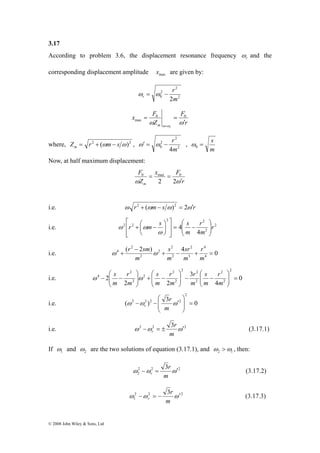
dVL , i.e.: 
which has the maximum value when 0 = 0 
dω
LC R C LC R C − 
2 1 
0 ω = , 
Q 0L 
0 
© 2008 John Wiley & Sons, Ltd 
0 
1 2 
2 
LV 
0 = 
⎞ 
⎟⎠ 
ω 
+ ⎛ − 
⎜⎝ 
C 
R L 
d 
d 
ω 
ω 
ω 
i.e. 1 1 0 
2 2 
2 2 
2 
⎞ 
+ ⎛ − 
2 = + − ⎟⎠ 
⎜⎝ 
C 
L 
C 
R L 
ω 
ω 
ω 
ω 
L 
i.e. 2 + 2 − 2 = 
0 
2 2 
C 
C 
R 
ω 
i.e. 
2 
0 
0 
2 
0 
1 1 
2 2 2 0 2 
R 
2 
1 1 
2 
2 
1 
1 
2 
1 
2 
1 
Q 
L 
L 
= 
− 
= 
− 
= 
− 
= 
ω 
ω 
ω ω 
where 
LC 
ω 
= 
R 
3.16 
Considering an electron in an atom as a lightly damped simple harmonic oscillator, 
we know its resonance absorption bandwidth is given by: 
δω = r (3.16.1) 
m 
On the other hand, the relation between frequency and wavelength of light is given 
by: 
f = c (3.16.2) 
λ 
where, c is speed of light in vacuum. From (3.16.2) we find at frequency resonance: 
f = − c 
δ 20 
δλ 
λ 
where 0 λ 
is the wavelength at frequency resonance. Then, the relation between 
angular frequency bandwidth δω and the width of spectral line δλ is given by: 
π 
= 2 f = 2 c δλ 
(3.16.3) 
δω π δ 20 
λ 
From (3.16.1) and (3.16.3) we have: 
r λ 
r 
0 
δλ = = 0 
= 
m Q 
λ 
cm 
0 
20 
2 
λ 
ω 
π 
So the width of the spectral line from such an atom is given by: 
− 
= × 
0.6 10 − 
14 
1.2 10 [ ] 
× 
5 10 
7 
6 
λ 
0 m 
Q 
× 
= = 
δλ
3.17 
According to problem 3.6, the displacement resonance frequency r ω 
⎛ 
− − 
ω s ω 
© 2008 John Wiley & Sons, Ltd 
and the 
corresponding displacement amplitude max x are given by: 
2 
2 
r 
2 
0 2m 
ωr = ω − 
= = 
0 0 
r m ω ω ω ω ′ 
r 
F 
x F 
Z 
= 
max 
2 
ω′ = ω − r , 
where, Z r2 (ωm s ω)2 m = + − , 2 
2 
0 4m 
= s 0 ω 
m 
Now, at half maximum displacement: 
0 max 0 
m ω ω′ 
r 
x F 
F 
Z 
= = 
2 2 
i.e. ω r2 + (ωm− s ω)2 = 2ω′r 
⎛ 
⎤ 
r m s s ⎟ ⎟⎠ 
r 
⎡ 
⎞ 
+ ⎛ − 
i.e. 2 
4 r 
2 
2 2 
2 2 
4 
m 
m 
⎞ 
⎜ ⎜⎝ 
= − 
⎥ ⎥⎦ 
⎢ ⎢⎣ 
⎟⎠ 
⎜⎝ 
ω 
ω ω 
4 
2 
r 
sr 
s 
ω r sm ω 
i.e. ( 2 ) 4 0 
4 
3 
2 
2 
2 
2 
2 
− 
4 + 
+ − + = 
m 
m 
m 
m 
2 2 
⎞ 
⎛ 
− − ⎟ ⎟⎠ ⎞ 
⎛ 
⎞ 
r 
s 
r 
r 
s 
r 
i.e. 0 
4 
3 
2 2 
2 
2 
2 
2 
2 
2 
2 
2 
2 
2 
4 = ⎟ ⎟⎠ 
⎜ ⎜⎝ 
⎜ ⎜⎝ 
− + ⎟ ⎟⎠ 
⎜ ⎜⎝ 
m 
m 
m 
m 
m 
m 
m 
2 
⎞ 
⎛ 
r 
i.e. ( ) 3 0 
2 2 2 2 = ⎟ ⎟⎠ 
⎜ ⎜⎝ 
ω −ω − ω′ 
m 
r 
r 
i.e. ω 2 −ω 2 = ± 3 ω′2 
r (3.17.1) 
m 
If 1 ω 
and 2 ω 
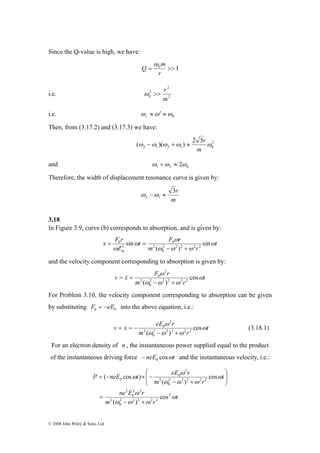
are the two solutions of equation (3.17.1), and 2 1 ω >ω , then: 
r 
ω −ω = 3 ω′ 
2 2 2 
2 
r (3.17.2) 
m 
r 
ω −ω = − 3 ω′ 
2 2 2 
1 
r (3.17.3) 
m
Since the Q-value is high, we have: 
x F r 
⎛ 
P neE t eE r 
© 2008 John Wiley & Sons, Ltd 
m 
= 0 >> 1 
r 
Q 
ω 
2 
ω >> r 
2 
0 m 
i.e. 2 
ω ≈ω′ ≈ r 
i.e. 0 ω 
Then, from (3.17.2) and (3.17.3) we have: 
− + ≈ r 
(ω ω )(ω ω ) 2 3 ω 
2 
2 1 2 1 0 
m 
and 1 2 0 ω +ω ≈ 2ω 
Therefore, the width of displacement resonance curve is given by: 
3r 
m 
2 1 ω −ω ≈ 
3.18 
In Figure 3.9, curve (b) corresponds to absorption, and is given by: 
t 
t F ω 
r 
sin 2 2 2 2 2 
m r 
Z 
m 
ω 
ω ω ω 
ω 
ω 
sin 
( ) 
0 
2 
0 
2 
0 
− + 
= = 
and the velocity component corresponding to absorption is given by: 
v x F ω 
r ω 
t 
m ω ω ω 
r 
cos 
( 2 2 )2 2 2 
0 
2 
2 
0 
− + 
= & = 
For Problem 3.10, the velocity component corresponding to absorption can be given 
by substituting 0 0 F = −eE into the above equation, i.e.: 
v x eE r ω 
t 
ω 
= & = − (3.18.1) 
m ω ω ω 
r 
cos 
( 2 2 )2 2 2 
0 
2 
2 
0 
− + 
For an electron density of n , the instantaneous power supplied equal to the product 
of the instantaneous driving force neE cosωt 0 − and the instantaneous velocity, i.e.: 
t 
ne E ω 
r 
m r 
t 
ω 
m r 
ω 
ω ω ω 
ω 
ω ω ω 
ω 
2 
2 2 2 2 2 
0 
2 
2 2 
0 
2 
2 2 2 2 2 
0 
2 
2 
0 
0 
cos 
( ) 
cos 
( ) 
( cos ) 
− + 
= 
⎞ 
⎟ ⎟⎠ 
⎜ ⎜⎝ 
− + 
= − × −
The average power supplied per unit volume is then given by: 
© 2008 John Wiley & Sons, Ltd 
ne E r 
ω 
π ω 
∫ 
P Pdt av 
2 2 
0 
π 
ω 
ne E ω 
r 
ω 
2 2 2 2 2 
0 
2 
2 
2 
0 
2 
2 2 2 2 2 
0 
2 
2 2 
0 
2 
2 
0 
2 ( ) 
cos 
2 
2 ( ) 
m r 
t 
m r 
ω ω ω 
ω 
ω ω ω 
π 
π ω 
− + 
= 
= 
− + 
= 
∫ 
which is also the mean rate of energy absorption per unit volume.
SOLUTIONS TO CHAPTER 4 
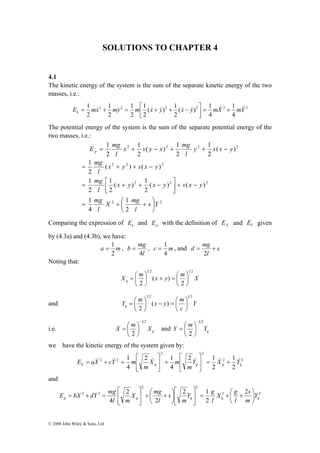
4.1 
The kinetic energy of the system is the sum of the separate kinetic energy of the two 
masses, i.e.: 
E 1 mx my m x y x y mX 1 
mY k 
( ) 1 
2 
1 
1 
1 
⎤ 
= + = ⎡ + + − 
2 2 2 2 2 2 
1 
= + − + + − 
= + + − 
1 
= ⎡ + + − 
1 
mg 
mg 
x s y x mg 
l 
X mg 
l 
= + ⎛ + 
⎡ 
⎤ 
⎡ 
m Y c X a E & & & & & & + = ⎥⎦ 
k q q q q Y X Y 
⎡ 
⎡ 
E bX dY mg ⎟⎠ 
© 2008 John Wiley & Sons, Ltd 
4 
4 
( ) 1 
2 
2 
2 
2 
& & & & & & & & + = ⎥⎦ 
⎢⎣ 
The potential energy of the system is the sum of the separate potential energy of the 
two masses, i.e.: 
1 
( ) 1 
2 
2 2 2 2 
2 2 2 
1 
( ) 1 
2 
⎤ 
2 2 2 
1 
⎞ 
2 2 
2 
4 
( ) ( ) 
2 
1 
2 
( ) ( ) 
2 
( ) 
2 
2 
1 
2 
s Y 
l 
mg 
x y x y s x y 
l 
x y s x y 
l 
y s x y 
l 
E mg p 
⎟⎠ 
⎜⎝ 
− + ⎥⎦ 
⎢⎣ 
Comparing the expression of k E and p E with the definition of X E and Y E given 
by (4.3a) and (4.3b), we have: 
= 1 , 
a m 
2 
b mg 
d = mg + 
= 1 , and s 
= , c m 
l 
4 
4 
l 
2 
Noting that: 
1 2 1 2 
X m x y m X q 
2 
( ) 
2 
⎞ 
⎟⎠ 
⎞ 
⎜⎝⎛ = + ⎟⎠ 
= ⎛ 
⎜⎝ 
1 2 1 2 
( ) 
2 
Y m x y m q 
⎞ 
− = ⎛ ⎟⎠ 
= ⎛ 
and Y 
c 
⎟⎠ 
⎜⎝ 
⎞ 
⎜⎝ 
1 2 
i.e. q X m X 
⎜⎝⎛ = and q Y m Y 
2 
− 
⎞ 
⎟⎠ 
1 2 
2 
− 
⎞ 
⎟⎠ 
= ⎛ 
⎜⎝ 
we have the kinetic energy of the system given by: 
1 
2 2 
2 2 
2 2 
2 
2 1 
2 
2 1 
4 
1 
4 
m 
X m 
m 
⎤ 
⎢⎣ 
+ ⎥⎦ 
⎢⎣ 
= + = 
and 
s 
X g 
l 
= + ⎛ + ⎥⎦ 
2 2 
2 2 
X mg 
2 2 2 1 
2 
2 
+ ⎛ + 2 
⎥⎦ 
2 
⎞ 
Y 
p 4 q q q l 
m 
q Y g 
m 
s 
l 
l m 
⎞ 
⎜⎝ 
⎤ 
⎢⎣ 
⎟⎠ 
⎜⎝ 
⎤ 
⎢⎣ 
= + =
which are the expressions given by (4.4a) and (4.4b) 
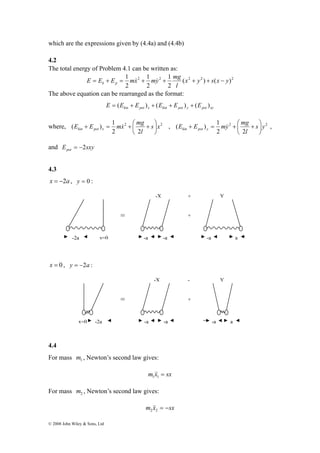
4.2 
The total energy of Problem 4.1 can be written as: 
E E E mx my mg k p = + = & + & + + + − 
E E mx mg x pot kin ⎟⎠ 
( ) 1 s x 
E E my mg y pot kin ⎟⎠ 
( ) 1 s y 
+ = & + ⎛ + , 2 2 
© 2008 John Wiley & Sons, Ltd 
1 1 
1 
x y s x y 
2 2 ( 2 2 ) ( )2 
2 
2 
2 
l 
The above equation can be rearranged as the format: 
kin pot x kin pot y pot xy E = (E + E ) + (E + E ) + (E ) 
where, 2 2 
l 
2 2 
⎞ 
⎜⎝ 
+ = & + ⎛ + , 
l 
2 2 
⎞ 
⎜⎝ 
and E sxy pot = −2 
4.3 
x = −2a , y = 0 : 
x = 0 , y = −2a : 
-X + Y 
-X - Y 
4.4 
For mass 1 m , Newton’s second law gives: 
m x = sx 1&&1 
For mass 2 m , Newton’s second law gives: 
m x = −sx 2&&2 
≡ 
x=0 -2a -a -a 
+ 
-a a 
y=0 
≡ 
-2a -a -a 
+ 
-a a
Provided x is the extension of the spring and l is the natural length of the spring, 
we have: 
2 2 13 2 27 2 
s m m 
(2 ) 4 × (1.14 × 10 ) × (23 × 35) × (1.67 × 
10 ) 1 
Na Cl πν π 
2 − 
= = Nm 
m m 
© 2008 John Wiley & Sons, Ltd 
x − x = l + x 2 1 
By elimination of 1 x and 2 x , we have: 
s − − = && 
x s 
x x 
m 
m 
2 1 
x& m + 
m 
&i.e. 0 
+ sx 
m m 
1 2 = 
1 2 
which shows the system oscillate at a frequency: 
ω2 = s 
μ 
where, 
m m 
+ 
1 2 
m m 
1 2 
μ = 
For a sodium chloride molecule the interatomic force constant s is given by: 
120[ ] 
(23 35) 1.67 10 
27 
− 
− 
≈ 
+ × × 
= 
+ 
Na Cl 
ω μ 
4.5 
If the upper mass oscillate with a displacement of x and the lower mass oscillate 
with a displacement of y , the equations of motion of the two masses are given by 
Newton’s second law as: 
mx s ( y x ) 
sx 
= − − 
&& 
my s x y 
( ) 
= − 
&& 
i.e. 
mx s x y sx 
&& 
( ) 0 
− − = 
+ − − = 
my s x y 
( ) 0 
&& 
Suppose the system starts from rest and oscillates in only one of its normal modes of 
frequency ω , we may assume the solutions: 
i t 
ω 
i t 
x = 
Ae 
y Be 
ω 
= 
where A and B are the displacement amplitude of x and y at frequency ω .
Using these solutions, the equations of motion become: 
x 2 a cos ( ) 
t t 2 1 1 2 
a t t 
2 sin ( ) 
© 2008 John Wiley & Sons, Ltd 
2 
m A s A B sA e 
[ − ω 
+ ( − ) + ] = 
0 
2 
i t 
[ − − ( − )] = 
0 
i t 
m B s A B e 
ω 
ω 
ω 
We may, by dividing through by meiωt , rewrite the above equations in matrix form 
as: 
0 
2 
2 
2 
A 
⎤ 
= ⎥⎦ 
⎡ 
⎢⎣ 
⎤ 
⎥⎦ 
⎡ 
⎢⎣ 
s m − − 
s m 
− − 
B 
s m s m 
ω 
ω 
(4.5.1) 
which has a non-zero solution if and only if the determinant of the matrix vanishes; 
that is, if 
(2s m−ω 2 )(s m−ω2 ) − s2 m2 = 0 
i.e. ω 4 − (3s m)ω 2 + s2 m2 = 0 
i.e. 
s 
2 
m 
ω 2 = (3± 5) 
In the slower mode, ω 2 = (3 − 5) s 2m . By substitution of the value of frequency 
into equation (4.5.1), we have: 
5 1 
2 
A ω 
2 
2 
2 
− 
= 
s − 
m 
= 
− 
= 
s 
s 
s m 
B 
ω 
which is the ratio of the amplitude of the upper mass to that of the lower mass. 
Similarly, in the slower mode, ω 2 = (3 + 5) s 2m . By substitution of the value of 
frequency into equation (4.5.1), we have: 
5 1 
2 
A ω 
2 
2 
2 
+ 
= − 
s − 
m 
= 
− 
= 
s 
s 
s m 
B 
ω 
4.6 
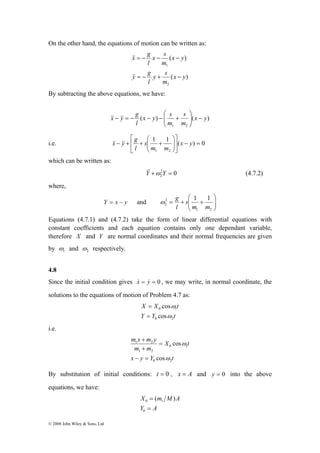
The motions of the two pendulums in Figure 4.3 are given by: 
m a 
cos ( ) 
y a t t a ω t ω 
t 
m a 
sin ( ) 
ω ω ω ω 
ω ω 
ω ω ω ω 
2 sin sin 
2 
2 
2 cos cos 
2 
2 
2 1 1 2 
= 
− + 
= 
= 
− + 
= 
a ω 
where, the amplitude of the two masses, 2 a cosω t and 2 a sinω t , are constants 
m m over one cycle at the frequency . 
Supposing the spring is very weak, the stiffness of the spring is ignorable, i.e. s ≈ 0.
Noting that 2 = g l 
1 ω 
E s a 1 
mg 
2 2 2 2 2 
= = = 
ω ω ω 
1 
x x x m a m 
E = ma ω ω − ω t = E + ω − 
ω 
t 
x a 
= − = − − 
© 2008 John Wiley & Sons, Ltd 
and 2 ( 2 ) 
2 ω = g l + s m , we have: 
g ω 
2 
2 
⎛ + 
ω ω 
2 1 2 
2 
2 
⎞ 
= ≈ ≈ 
ω ω = ⎟⎠ 
⎜⎝ 
l 1 2 a 
Hence, the energies of the masses are given by: 
( ) 
( a t) ma t 
l 
E s a mg 
a t ma t 
l 
1 
2 2 2 2 2 
2 sin 2 sin 
ω ω ω 
1 
y y y m a m 
2 
2 
2 cos 2 cos 
2 
2 
= = = 
The total energy is given by: 
2 2 2 (cos2 sin2 ) 2 2 2 x y a m m a E = E + E = ma ω ω t + ω t = ma ω 
Noting that ( ) 2 2 1 ω = ω −ω m , we have: 
[1 cos( ) ] 
2 
2 sin ( ) 
[1 cos( ) ] 
2 
2 cos ( ) 
ω ω ω ω ω 
2 1 2 1 
2 2 2 
2 1 2 1 
2 2 2 
E ma t E t 
y a 
which show that the constant energy E is completed exchanged between the two 
pendulums at the beat frequency ( ) 2 1 ω −ω . 
4.7 
By adding up the two equations of motion, we have: 
( )( ) 1 2 1 2 m &x&+m &y& = − m x +m y g l 
By multiplying the equation by 1 ( ) 1 2 m +m on both sides, we have: 
m x + 
m y 
1 2 
l 
1 2 
m x m y 
&&+ && 
1 2 
1 2 
m m 
g 
m m 
+ 
= − 
+ 
m x + 
m y 
l 
m &x& + 
m &y& 
i.e. 1 2 1 2 
= 
0 
1 2 
1 2 
+ 
+ 
+ 
m m 
g 
m m 
which can be written as: 
2 0 
1 X&& +ω X = (4.7.1) 
where, 
X m x + 
m y 
= and 2 = g l 
1 2 
m + 
m 
1 2 
1 ω
On the other hand, the equations of motion can be written as: 
© 2008 John Wiley & Sons, Ltd 
( ) 
x s 
l 
= − − − 
1 
x y 
m 
( ) 
y s 
l 
2 
&& 
y g 
x y 
m 
x g 
= − + − 
&& 
By subtracting the above equations, we have: 
⎛ 
x y g x y s 
s 
l 
⎟⎠ 
− ⎟ ( ) ( ) 
1 2 
x y 
m 
m 
⎞ 
⎜ ⎜⎝ 
&&− && = − − − + 
⎤ 
⎡ 
⎞ 
⎛ 
&x& &y& g 
i.e. 1 1 ( ) 0 
1 2 
= − ⎥⎦ 
⎢⎣ 
⎟ ⎟⎠ 
⎜ ⎜⎝ 
− + + + x y 
m m 
s 
l 
which can be written as: 
2 0 
2 Y&&+ω Y = (4.7.2) 
where, 
⎞ 
⎛ 
ω g 
y x Y − = and ⎟ ⎟⎠ 
⎜ ⎜⎝ 
= + + 
1 2 
2 
2 
1 1 
m m 
s 
l 
2 1 ω 
ω 
Equations (4.7.1) and (4.7.2) take the form of linear differential equations with 
constant coefficients and each equation contains only one dependant variable, 
therefore X and Y are normal coordinates and their normal frequencies are given 
by and respectively. 
4.8 
Since the initial condition gives x& = y& = 0 , we may write, in normal coordinate, the 
solutions to the equations of motion of Problem 4.7 as: 
X X t 
cos 
ω 
ω 
0 1 
cos 
= 
Y Y t 
0 2 
= 
i.e. 
X t 
m x + 
m y 
1 2 
m m 
cos 
ω 
0 1 
x y Y t 
0 2 
1 2 
cos 
ω 
− = 
= 
+ 
By substitution of initial conditions: t = 0 , x = A and y = 0 into the above 
equations, we have: 
X = 
m M A 
= 
Y A 
0 
0 1 ( )
where, 1 2 M = m +m 
so the equations of motion in original coordinates x , y are given by: 
[ cos( ω ω ) cos( ω ω 
) ] 
= − + + 
a m a m 
1 2 
[ (cos ω cos ω sin ω sin ω ) (cos ω cos ω sin ω sin ω 
)] 
= + + − 
m a m a m a m a 
1 2 
m m t t m m t t 
x A 
A 
A 
[( )cos ω cos ω ( )sin ω sin ω 
] 
= + + − 
m a m a 
1 2 1 2 
A t t A 
cos cos ( )sin sin 
ω ω ω ω 
= + − 
E 1 
m x s x m x mg 
x m x m ω 
x 
l 
= & + = & + = & 
+ 
x x a 
E 1 
m y s y m y mg 
= + = + = + 
© 2008 John Wiley & Sons, Ltd 
m 
A t 
M 
m x + 
m y 
1 2 
m m 
x y A t 
2 
1 
1 
1 2 
cos 
cos 
ω 
ω 
− = 
= 
+ 
The solutions to the above equations are given by: 
m t m t 
( cos ω cos ω 
) 
= + 
(cos cos ) 
1 2 
x A 
y A m 
1 
1 1 2 2 
t t 
M 
M 
ω ω 
= − 
Noting that a m ω =ω −ω 1 and a m ω =ω +ω 2 , where ( ) 2 2 1 ω = ω −ω m and 
( ) 2 1 2 ω = ω +ω a , the above equations can be rearranged as: 
m m t t 
M 
M 
m t t t t m t t t t 
M 
m t m t 
M 
m a 1 2 
m a 
and 
[cos( ) cos( ) ] 
= − − + 
ω ω ω ω 
a m a m 
t t 
y A m 
A m 
2 sin sin 
M 
t t 
M 
ω ω 
m a 
1 
1 
= 
4.9 
From the analysis in Problem 4.6, we know, at weak coupling conditions, t m cosω 
and t m sinω are constants over one cycle, and the relation: g l a ω ≈ , so the energy 
of the mass 1 m , x E , and the energy of the mass 2 m , y E , are the sums of their 
separate kinetic and potential energies, i.e.: 
2 2 
ω 
1 
2 
& & & 
1 
1 
1 
2 2 
2 
1 
1 
2 2 
21 
2 2 
1 
2 
1 
2 2 
1 
2 2 
1 
1 
2 
1 
2 
2 
1 
2 
2 
2 
1 
2 
1 
2 
2 
1 
2 
2 
2 
y m y m y 
l 
y y a
By substitution of the expressions of x and y in terms of t acosω and t a ω 
E 1 
m A t t A 
= ⎡− + − 
ω ω ω ω ω ω 
x a m a a m a 
m A t t A 
⎡ + − 
ω ω ω ω ω 
a m a m a 
m A 
2 
= + + − 
ω ω ω 
a m m 
m A 
2 
= + + − 
ω ω ω 
a m m 
m A 
1 
1 
1 
1 
E 
ω ω 
= + + − 
E m A m 
2 sin cos 1 
1 
+ ⎡ ⎥⎦ 
ω ω ω ω ω ω 
= ⎡ 
y a m a a m a 
m m A 
2 
2 ω sin ω (cos ω sin ω 
) 
= + 
a m a a 
m m A 
2 
2 sin 
ω ω 
a m 
m A m m 
1 
⎞ 
⎛ 
2 2 1 2 
⎞ 
ω ω 
= ⎛ 
E m m 
1 2 
= ⎛ 
m(x y) mg ( ) ( ) 2 ( ) cosω 0 &&− && + − + & − & + − = 
© 2008 John Wiley & Sons, Ltd 
sin 
given by Problem 4.8 into the above equations, we have: 
[ ] 
[ ] 
[ 2 cos2 
] 
2 
[m m m m t] 
M 
m m m m t 
M 
m m m m t t 
M 
m m t m m t 
M 
m m t t 
M 
m m t t 
M 
a m 
2 cos( ) 
2 
2 (cos sin ) 
2 
( ) cos ( ) sin 
2 
cos cos ( )sin sin 
2 
cos sin ( )sin cos 
2 
1 2 2 1 
2 
2 
2 
2 1 
1 2 
2 
2 
2 
2 1 
2 
1 
2 2 
1 2 
2 
2 
2 
2 1 
2 
1 
2 2 
1 2 
2 2 
2 1 2 
2 
1 
2 
1 2 
2 
1 
2 
1 1 2 
ω ω 
= + + 
⎤ 
⎥⎦ 
⎢⎣ 
⎤ 
+ ⎥⎦ 
⎢⎣ 
and 
t t m A m 
[ ] 
2 1 cos2 
[ ] 
2 
⎞ 
⎟⎠ 
[ t] 
M 
t 
M 
t 
M 
t t t 
M 
t t 
M 
M 
a m 
2 1 cos( ) 
2 
2 sin sin 
2 
2 
2 2 1 
1 
2 
2 
2 
2 
2 
1 
2 2 2 
2 
2 
2 
2 
1 
2 
2 1 
1 
2 
1 
2 
ω ω 
− − ⎟⎠ 
⎜⎝ 
− ⎟⎠ 
⎜⎝ 
⎜⎝ 
= 
⎤ 
⎥⎦ 
⎢⎣ 
⎤ 
⎢⎣ 
where, 
E 1 m A a ω 
2 2 
2 1 
= 
4.10 
Add up the two equations and we have: 
m(&&+ x && y) + mg ( x + y ) + r ( x & + y & ) = 
F cosω t 
0 l 
mX rX mg cosω 0 && + & + = (4.10.1) 
i.e. X F t 
l 
Subtract the two equations and we have: 
x y r x y s x y F t 
l
mY rY mg 2 cosω 0 = ⎟⎠ 
&&+ & + ⎛ + (4.10.2) 
i.e. s Y F t 
© 2008 John Wiley & Sons, Ltd 
l 
⎞ 
⎜⎝ 
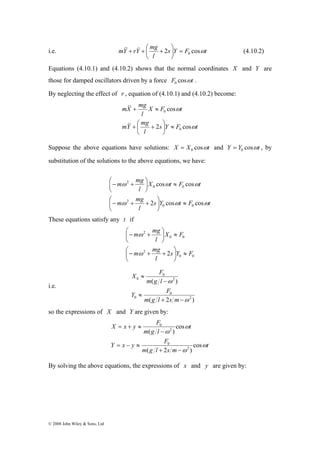
Equations (4.10.1) and (4.10.2) shows that the normal coordinates X and Y are 
those for damped oscillators driven by a force F cosωt 0 . 
By neglecting the effect of r , equation of (4.10.1) and (4.10.2) become: 
mX mg 
X F cos 
t 
l 
⎞ 
s Y F t 
+ ≈ 
&& 
mY mg 
+ ⎛ + 
l 
ω 
ω 
2 cos 
0 
0 
≈ ⎟⎠ 
⎜⎝ 
&& 
Suppose the above equations have solutions: X X cosωt 0 = and Y Y cosωt 0 = , by 
substitution of the solutions to the above equations, we have: 
cos cos 
⎞ 
⎛− + 
ω ω ω 
⎞ 
s Y t F t 
m mg 
m mg 
⎛− + + 
l 
X t F t 
l 
2 cos cos 
ω ω ω 
0 0 
2 
0 0 
2 
≈ ⎟⎠ 
⎜⎝ 
≈ ⎟⎠ 
⎜⎝ 
These equations satisfy any t if 
0 0 
m mg 
⎛− + 
ω 
m mg 
⎞ 
⎛− 2 
+ + 
0 0 
2 
⎞ 
2s Y F 
l 
X F 
l 
≈ ⎟⎠ 
⎜⎝ 
≈ ⎟⎠ 
⎜⎝ 
ω 
i.e. 
X F 
m g l 
( ) 
2 
Y F 
0 
( 2 ) 
0 
2 
0 
0 
ω 
ω 
+ − 
≈ 
− 
≈ 
m g l s m 
so the expressions of X and Y are given by: 
t 
X x y F 
2 
0 
( ) 
Y x y F 
cos 
0 
m g l s m 
t 
m g l 
ω 
ω 
2 
ω 
ω 
cos 
( + 2 − 
) 
= − ≈ 
− 
= + ≈ 
By solving the above equations, the expressions of x and y are given by:
⎡ 
⎡ 
F 
F 
y 
2 
− 
2 
ω ω 
© 2008 John Wiley & Sons, Ltd 
⎤ 
⎤ 
⎥⎦ 
⎡ 
⎡ 
⎢⎣ 
− 
− 
− 
x F 
y ≈ 
F 
⎥⎦ 
⎢⎣ 
− 
+ 
− 
≈ 
2 2 
2 
2 2 
1 
0 
2 2 
2 
2 2 
1 
0 
cos 1 1 
2 
cos 1 1 
2 
ω ω ω ω 
ω 
ω ω ω ω 
ω 
t 
m 
t 
m 
where, 
2 = g 
l 
1 ω 
and 
s 
2 g 2 
2 ω = + 
m 
l 
The ratio of y x is given by: 
ω − 
ω 
2 2 
1 
2 
2 
2 
1 
2 
2 
1 1 
ω ω ω ω 
2 2 
2 
2 2 
1 
2 2 
2 
2 2 
1 
2 2 
2 
2 2 
1 
0 
2 2 
2 
2 2 
1 
0 
1 1 2 
cos 1 1 
2 
cos 1 1 
2 
ω ω ω 
ω ω ω ω 
ω ω ω ω 
ω 
ω ω ω ω 
ω 
+ − 
= 
− 
− 
− 
− 
+ 
= − 
⎤ 
⎤ 
⎥⎦ 
⎢⎣ 
− 
− 
− 
⎥⎦ 
⎢⎣ 
− 
+ 
− 
≈ 
t 
m 
t 
m 
x 
y 
2 
2 ω +ω 
0 ω 
The behaviour of y x as a function of frequency ω is shown as the figure below: 
The figure shows y x is less than 1 if 1 ω 
ω < or 2 ω 
ω > , i.e. outside frequency 
range 2 1 ω −ω the motion of y is attenuated. 
4.11 
Suppose the displacement of mass M is x , the displacement of mass m is y , 
and the tension of the spring is T . Equations of motion give: 
Mx + kx = F cosωt +T 0 && (4.11.1) 
m&y& = −T (4.11.2) 
s( y − x) = T (4.11.3) 
2 
1 
2 
2 
2 
1 
ω ω 
+ 
x 
1 ω 
1 
-1 
2 
2 
1 
2 ω
Eliminating T , we have: 
© 2008 John Wiley & Sons, Ltd 
cos ( ) 0 M&x&+ kx = F ωt + s y − x 
so for x = 0 at all times, we have 
cos 0 0 F ωt + sy = 
that is 
y = − F0 cosω 
t 
s 
Equation (4.11.2) and (4.11.3) now give: 
m&y&+ sy = 0 
with ω 2 = s m , so M is stationary at ω 2 = s m . 
This value of ω satisfies all equations of motion for x = 0 including 
T F cosωt 0 = − 
4.12 
Noting the relation: V = q C , the voltage equations can be written as: 
L dI 
a 
L dI 
dt 
q 
− = 
1 2 
q 
C 
q 
q 
C 
dt 
C 
C 
b 
− = 
2 3 
so we have: 
& & && 
− = 
q q LCI 
& & && 
a 
b 
− = 
1 2 
q q LCI 
2 3 
i.e. 
& & && 
− = 
q q LCI 
& & && 
a 
b 
− = 
1 2 
q q LCI 
2 3 
By substitution of a q = −I 1 & , a b q = I − I 2 & and b q = I 3 & into the above equations, we 
have: 
I I I LCI 
− − + = 
a a b a 
I I I LCI 
&& 
a b b b 
&& 
− − = 
i.e. 
&& 
LCI I I 
+ 2 − = 
0 
− + = 
a a b 
&& 
LCI I I 
2 0 
b a b
By adding up and subtracting the above equations, we have: 
© 2008 John Wiley & Sons, Ltd 
&& && 
LC I I I I 
( + ) + + = 
0 
a b a b 
&& && 
LC I I I I 
( − ) + 3( − ) = 
0 
a b a b 
Supposing the solutions to the above normal modes equations are given by: 
I I A t a b + = cosω 
I I B t a b − = cosω 
so we have: 
2 
A LC A t 
ω ω 
( ) cos 0 
− ω + ω 
= 
B 2 
LC B t 
( − + 3 ) cos = 
0 
which are true for all t when 
ω 2 = 1 and B = 0 
LC 
or 
ω 2 = 3 and A = 0 
LC 
which show that the normal modes of oscillation are given by: 
a b I = I at 
2 1 
1 ω = 
LC 
and 
a b I = −I at 
2 3 
2 ω = 
LC 
4.13 
From the given equations, we have the relation between 1 I and 2 I given by: 
1 
I i M 
ω 
+ 
2 I 
Z i L 
2 
s ω 
= 
so: 
1 
⎛ 
E i L I i MI i L M 
p p 2 
⎟⎠ 
⎟ 2 
1 2 I 
Z i L 
s 
⎞ 
⎜ ⎜⎝ 
+ 
= − = + 
ω 
ω 
ω ω ω 
i.e. 
p Z i L 
s 
i L M 
E 
I 
ω 
ω 
ω 
+ 
= + 
2 
2 2 
1 
which shows that 1 E I , the impedance of the whole system seen by the generator, is 
the sum of the primary impedance, p iωL , and a ‘reflected impedance’ from the
secondary circuit of ω2M2 Zs , where s s Z = Z + iωL 2 . 
4.14 
Problem 4.13 shows the impedance seen by the generator Z is given by: 
i ω L Z − ω L L + 
ω 
M 
Z i L 
2 1 1 1 1 1 
© 2008 John Wiley & Sons, Ltd 
p Z i L 
s 
Z i L M 
ω 
ω 
ω 
+ 
= + 
2 
2 2 
Noting that p s M = L L and 2 2 
p s p s L L = n n , the impedance can be written as: 
s 
i L Z 
p 
i ω L Z − ω M + 
ω 
M 
s 
p 
s 
p p s 
Z i L 
Z i L 
Z i L 
Z 
ω 
ω 
ω 
ω 
+ 
= 
+ 
= 
+ 
= 
2 
2 
2 
2 2 2 2 
2 
2 
2 2 2 
2 
so we have: 
2 
s == + = + 
p p 
2 2 
Z i L n 
L 
2 
ω 
p 2 
p p 
Z 
n 
i L Z i L L 
Z 
s 
s 
+ 
= 
ω ω ω 
which shows the impedance Z is equivalent to the primary impedance iωL 
p connected in parallel with an impedance (n n )2Z . 
p s 2 
4.15 
Suppose a generator with the internal impedance of 1 Z is connected with a load with 
an impedance of 2 Z via an ideal transformer with a primary inductance of p L and 
the ratio of the number of primary and secondary transformer coil turns given by 
p s n n , and the whole circuit oscillate at a frequency of ω . From the analysis in 
Problem 4.13, the impedance of the load is given by: 
1 1 1 
2 
L p p 
Z 
n 
2 2 
Z i L n 
s 
= + 
ω 
At the maximum output power: 1 Z Z L = , i.e.: 
1 1 1 1 
1 
= + = 
ω 
2 
L p p 
2 2 
Z 
Z i L n 
Z 
n 
s 
which is the relation used for matching a load to a generator.
4.16 
From the second equation, we have: 
I E 
I E ≤ = 
M R R 
2 i M R R 
2 2 
⎡ 
− = ⎥⎦⎤ 
2 1 2 
π 
= ⎡ − 
2 
1 (2 2) 
ω ω − = ⎥⎦ 
⎡ 
+ = ⎥⎦ 
π 
2 1 cos 3 2 ω 1 2 
ω 
= ⎡ − 
2 
1 (2 2) 
ω ω + = ⎥⎦ 
© 2008 John Wiley & Sons, Ltd 
2 
I Z 
2 
I 
1 Z 
M 
= − 
By substitution into the first equation, we have: 
I Z I E 
Z Z 
− 1 2 
+ = 2 2 
Z 
M 
M 
2 I 
i.e. 1 
Z Z Z 
M ⎟ ⎟⎠ 
1 2 
Z 
I E 
M 
⎞ 
⎛ 
⎜ ⎜⎝ 
− 
= 
Noting that Z i M M = ω and 2 I has the maximum value when 0 1 2 X = X = , i.e. 
1 1 Z = R and 2 2 Z = R , we have: 
1 
1 2 
1 
M R R 
1 2 
1 
1 2 
1 
1 2 
I 
R R 
M 
I E 
M 
I E 
i M 
+ 
= 
− 
= 
ω 
ω ω 
ω 
ω 
ω 
E , when 
which shows 2 I has the maximum value of 1 
1 2 2 
I 
R R 
M R R 
ω = 1 2 , i.e. 
M 
ω 
1 2 ωM = R R 
4.17 
By substitution of j = 1 and n = 3 into equation (4.15), we have: 
2 
0 
2 
0 
2 
0 
2 1 cos ω ω 
2 
4 
⎤ 
⎢⎣ 
⎢⎣ 
By substitution of j = 2 and n = 3 into equation (4.15), we have: 
2 1 cos 2 ω 
2 
0 
π 
= ⎡ − 
2 
2 
2 
1 0 
ω ω = ⎥⎦ 
4 
⎤ 
⎢⎣ 
By substitution of j = 3 and n = 3 into equation (4.15), we have: 
2 
0 
2 
0 
2 
0 
2 
4 
⎤ 
⎢⎣ 
⎤ 
⎢⎣
In equation (4.14), we have 0 4 0 A = A = when n = 3 , and noting that 2 = T ma 
2 1 0 
⎛ 
2 
1 ω = (2 − 2)ω ,` 2 
2 
1 ω = (2 − 2)ω into equation (4.17.1), we have: 
2 
1 ω = (2 − 2)ω into equation (4.17.3), we have: 
2 
1 ω = (2 − 2)ω , the relative displacements are given by: 
2 
2 ω = 2ω into equation (4.17.1), we have: 
© 2008 John Wiley & Sons, Ltd 
0 ω 
, 
equation (4.14) gives: 
⎛ 
when r 1: ω 
2 
= 2 0 2 1 2 
− = 0 0 
⎟⎠ 
⎟ ⎞ 
⎜ ⎜⎝ 
− A + − A A 
ω 
⎛ 
2 
⎞ 
− A A 
ω (4.17.1) 
i.e. 2 0 2 1 2 
0 
= − ⎟ ⎟⎠ 
⎜ ⎜⎝ 
ω 
2 
⎛ 
ω (4.17.2) 
1 = − ⎟ ⎟⎠ 
when r = 2 : 2 0 2 2 3 
0 
⎞ 
⎜ ⎜⎝ 
− A + − A A 
ω 
2 
⎛ 
ω 
2 = − ⎟ ⎟⎠ 
when r = 3: 2 0 2 3 4 
0 
⎞ 
⎜ ⎜⎝ 
− A + − A A 
ω 
2 
⎛ 
ω (4.17.3) 
2 = ⎟ ⎟⎠ 
i.e. 2 0 2 3 
0 
⎞ 
⎜ ⎜⎝ 
− A + − A 
ω 
Write the above equations in matrix format, we have: 
0 
− − 
1 2 1 
− − − 
0 1 2 
A 
1 
A 
2 
3 
2 
0 
2 
2 
0 
2 
2 
0 
2 
= 
⎞ 
⎟ ⎟ ⎟ 
⎠ 
⎞ 
⎛ 
⎟ ⎟ ⎟ 
⎜ ⎜ ⎜ 
⎝ 
⎠ 
⎜ ⎜ ⎜ 
⎝ 
− − 
A 
ω ω 
ω ω 
ω ω 
which has non zero solutions provided the determinant of the matrix is zero, i.e.: 
(2 −ω 2 ω ) − 2(2 −ω ω 2 ) = 
0 
0 
2 3 2 
0 
The solutions to the above equations are given by: 
2 
0 
ω 2 
= 2ω , and 2 
2 0 
ω 2 
= (2 + 2)ω 
1 0 
4.18 
By substitution of 2 
0 
2 0 1 2 A − A = i.e. : 1: 2 1 2 A A = 
By substitution of 2 
0 
2 0 2 3 − A + A = i.e. : 2 :1 2 3 A A = 
Hence, when 2 
0 
: : 1: 2 :1 1 2 3 A A A = 
By substitution of 2 
0
2 
2 ω = 2ω into equation (4.17.2), we have: 
2 
2 ω = 2ω , the relative displacements are given by: 
2 
2 ω = (2 + 2)ω into equation (4.17.1), we have: 
2 
1 ω = (2 + 2)ω into equation (4.17.3), we have: 
2 
1 ω = (2 + 2)ω , the relative displacements are given by: 
ω 2 = (2 − 2)ω 2 
2 
0 
© 2008 John Wiley & Sons, Ltd 
A2 = 0 
By substitution of 2 
0 
0 1 3 − A + A = i.e. : 1: 1 1 3 A A = − 
Hence, when 2 
0 
: : 1: 0 : 1 1 2 3 A A A = − 
By substitution of 2 
0 
2 0 1 2 − A − A = i.e. : 1: 2 1 2 A A = − 
By substitution of 2 
0 
2 0 2 3 − A − A = i.e. : 2 :1 2 3 A A = − 
Hence, when 2 
0 
: : 1: 2 :1 1 2 3 A A A = − 
The relative displacements of the three masses at different normal frequencies are 
shown below: 
ω 2 = 2ω 2 
0 
ω 2 = (2 + 2)ω 
0 
As we can see from the above figures that tighter coupling corresponds to higher 
frequency. 
4.19 
Suppose the displacement of the left mass m is x , and that of the central mass M 
is y , and that of the right mass m is z . The equations of motion are given by:
− = − 
− = − − + − 
© 2008 John Wiley & Sons, Ltd 
mx s y x 
( ) 
= − 
&& 
My s y x s z y 
( ) ( ) 
= − − + − 
&& 
mz s z y 
( ) 
= − − 
&& 
If the system has a normal frequency of ω , and the displacements of the three masses 
can by written as: 
i t 
ω 
i t 
x η 
e 
1 
= 
y e 
ω 
i t 
η 
2 
= 
z e 
ω 
η 
3 
= 
By substitution of the expressions of displacements into the above equations of 
motion, we have: 
i t i t 
ω ω 
m e s e 
( ) 
ω η η η 
i t i t i t 
ω ω ω 
M e s e s e 
( ) ( ) 
ω η η η η η 
i t i t 
ω ω 
m e s e 
( ) 
ω η η η 
3 3 2 
2 
2 2 1 3 2 
2 
1 2 1 
2 
− = − − 
i.e. 
s m s e 
[( − ω ) η − η 
] = 
0 
s s M s e 
[ − η + (2 − ω ) η − η 
] = 
0 
i t 
[ ( ) ] 0 
3 
2 
2 
2 3 
2 
1 
1 2 
2 
− + − = 
i t 
i t 
s s m e 
ω 
ω 
ω 
η ω η 
which is true for all t if 
s m s 
( − ω ) η − η 
= 
0 
s s M s 
(2 ) 0 
− η + − ω η − η 
= 
s s m 
( ) 0 
3 
2 
2 
2 3 
2 
1 
1 2 
2 
− η + − ω η 
= 
The matrix format of these equations is given by: 
0 
s − m − 
s 
s s M s 
− − − 
0 
2 
0 
η 
1 
η 
2 
3 
2 
2 
2 
= 
⎞ 
⎟ ⎟ ⎟ 
⎠ 
⎞ 
⎛ 
⎟ ⎟ ⎟ 
⎜ ⎜ ⎜ 
⎝ 
⎠ 
⎛ 
⎜ ⎜ ⎜ 
⎝ 
− − 
η 
ω 
ω 
ω 
s s m 
which has non zero solutions if and only if the determinant of the matrix is zero, i.e.: 
(s −mω2 )2 (2s −Mω 2 ) − 2s2 (s −mω2 ) = 0 
i.e. (s −mω2 )[(s −mω 2 )(2s −Mω 2 ) − 2s2 ] = 0 
i.e. (s −mω2 )[mMω 4 − s(M + 2m)ω 2 ] = 0 
i.e. ω2 (s −mω2 )[mMω 2 − s(M + 2m)] = 0 
The solutions to the above equation, i.e. the frequencies of the normal modes, are 
given by: 
2 0 
1 ω = , 
2 = s 
m 
2 ω 
and 
2 s(M + 
2m) 
3 
mM 
ω =
At the normal mode of ω2 = 0 , all the atoms are stationary, 1 2 3 η =η =η , i.e. all the 
masses has the same displacement; 
At the normal mode of 
A C rj r 
© 2008 John Wiley & Sons, Ltd 
ω2 = s , 0 2 η = and 1 3 η = −η , i.e. the mass M is 
m 
stationary, and the two masses m have the same amplitude but are “anti-phase” with 
respect to each other; 
At the normal mode of 
2 s(M + 2m) 
ω = , : : M : 2m:M 1 2 3 η η η = − , i.e. the two 
mM 
mass m have the same amplitude and are “in-phase” with respect to each other. 
They are both “anti-phase” with respect to the mass M . The ratio of amplitude 
between the mass m and M is M 2m. 
4.20 
In understanding the motion of the masses it is more instructive to consider the range 
n 2 ≤ j ≤ n . For each value of the frequency j ω 
the amplitude of the rth mass is 
1 
sin 
+ 
= 
n 
π 
where C is a constant. For j = n 2 adjacent masses have a π 2 
phase difference, so the ratios: : : 1: 0 :1 1 1 = − r− r r+ A A A , with the rth masses 
stationary and the amplitude r−1 A anti-phase with respect to r+1 A , so that: 
2j ω 
As n 2→n , A begins to move, the coupling between masses tightens and when 
r j is close to n each mass is anti-phase with respect to its neighbour, the amplitude 
of each mass decreases until in the limit j = n no motion is transmitted as the cut off 
frequency ω 2 = 4 T ma is reached. The end points are fixed and this restricts the 
j motion of the masses near the end points at all frequencies except the lowest. 
4.21 
By expansion of the expression of , we have: 
→0 r A 
j →n 
r+1 A 
r−1 A 
r A 
j = n 2
2 1 cos 2 4 6 
2 ⎛ 
j n j n j n 
( 1) 
( 1) 
T 
2 ( 1) 
j 
T 
= − L 
© 2008 John Wiley & Sons, Ltd 
⎤ 
⎥⎦ 
⎡ 
⎢⎣ 
− 
+ 
+ 
+ 
− 
+ 
⎞ 
= ⎟⎠ 
⎜⎝ 
+ 
6! 
4! 
2! 
1 
ma 
n 
ma 
j 
π π π π 
ω 
If n >> 1 and j << n , jπ n +1 has a very small value, so the high order terms of 
the above equation can be neglected, so the above equation become: 
2 2 
2 
⎡ + 
j n T 
T 
2 ( 1) 
⎛ 
⎤ 
j 
2! 1 
⎞ 
⎟⎠ 
⎜⎝ 
+ 
= ⎥⎦ 
⎢⎣ 
= 
n 
ma 
ma 
j 
π π 
ω 
i.e. 
T 
ma 
j 
j +1 
n 
= 
π 
ω 
which can be written as: 
ω T 
ρ 
j 
π 
l 
j = 
where, ρ = m a and l = (n +1)a 
4.22 
From the first equation, we have: 
LI && qr & − qr 
& 
C 
r 
= − 
− 
1 
1 
By substitution of r r r q = I − I & −1 and −1 −2 −1 = − r r r q& I I into the above equation, we 
have: 
LI Ir Ir Ir 
&& 2 (4.22.1) 
C 
r 
− + 
= − − 
− 
2 1 
1 
If, in the normal mode, the currents oscillate at a frequency ω , we may write the 
displacements as: 
= i t 
, i t 
−2 −2 r r I A e ω 
−1 −1 = and i t 
r r I A e ω 
r rI = A e ω 
Using these values of I in equation (4.22.1) gives: 
ω 2 LA e i ω t A − 2 
A + 
A r r r i ω 
t 
r e 
− = − − 
C 
− 
2 1 
1 
or 
2 
− A + (2 − LCω ) A − A = 0 (4.22.2) 
r− 2 r− 1 
r By comparison of equation (4.22.2) with equation (4.14) in text book, we may find 
the expression of r I is the same as that of r y in the case of mass-loaded string, i.e. 
I A e i ω t D rjπ i ω 
t 
r r e 
n 
1 
sin 
+ 
= = 
Where D is constant, and the frequency ω is given by:
© 2008 John Wiley & Sons, Ltd 
⎞ 
⎟⎠ 
⎛ 
⎜⎝ 
j 
+ 
= − 
1 
2 1 1 cos 
n 
j LC 
π 
ω 
where, j = 1,2,3...n 
4.23 
By substitution of y into 2 
2 
t 
y 
∂ 
∂ 
, we have: 
y = − + 
∂ ω ω ω 
2 ( ) 
2 
2 
2 
2 
(ei teikx ) ei t kx 
∂ 
= 
t ∂ 
t 
∂ 
2 
x 
y 
∂ 
∂ 
By substitution of y into 2 
, we have: 
y = − + 
∂ ω ω 
2 ( ) 
2 
2 
2 
2 
(ei teikx ) k ei t kx 
∂ 
= 
x ∂ 
x 
∂ 
If ω = ck , we have: 
c y 
∂ c k ei t+kx 
( 2 2 2 ) ( ) 0 
2 
2 
2 
2 
2 
= − + = 
∂ 
∂ 
− 
∂ 
x 
t 
y ω ω 
i.e. 
c y 
2 
2 
2 
2 
2 
x 
t 
y 
∂ 
∂ 
= 
∂ 
∂
SOLUTIONS TO CHAPTER 5 
5.1 
Write u = ct + x , and try 2 
2 
1 
∂ 
© 2008 John Wiley & Sons, Ltd 
2 
x 
y 
∂ 
∂ 
with ( ) 2 y = f ct + x , we have: 
f u 
2 f ( u 
) 
∂ ( ) 2 , and 2 
u 
y 
x 
∂ 
∂ 
= 
∂ 
2 
2 
2 
u 
x 
y 
∂ 
∂ 
= 
∂ 
∂ 
Try 2 
2 
t 
y 
c ∂ 
with ( ) 2 y = f ct + x , we have: 
c f u 
2 ( ) 
c f u 
∂ ( ) 2 , and 2 
u 
y 
t 
∂ 
∂ 
= 
∂ 
2 
2 
2 
2 
u 
t 
y 
∂ 
∂ 
= 
∂ 
∂ 
so: 
f u 
c f u 
y 
1 1 ( ) ( ) 
2 
2 
2 
2 
2 
2 
2 
2 2 
2 
2 
∂ 
c ∂ 
u 
u 
t c 
∂ 
= 
∂ 
∂ 
= 
∂ 
Therefore: 
2 
2 
2 y 
1 
2 2 
t 
y 
x c 
∂ 
∂ 
= 
∂ 
∂ 
5.2 
If ( ) 1 y = f ct − x , the expression for y at a time t + Δt and a position x + Δx , where 
Δt = Δx c , is given by: 
y f c t t x x 
[ ( ) ( )] 
= + Δ − + Δ +Δ +Δ 
, 1 
f c t x c x x 
[ ( ) ( )] 
= + Δ − + Δ 
1 
f ct x x x 
[ ] 
= + Δ − − Δ 
t x 
t t x x 
1 
f [ ct x ] 
y 
= − = 
1 , 
i.e. the wave profile remains unchanged. 
If ( ) 2 y = f ct + x , the expression for y at a time t + Δt and a position x + Δx , where 
Δt = −Δx c , is given by:
y 
c y 
x 
y 
∂ 
= 
∂ 
t 
∂ 
∂ 
© 2008 John Wiley & Sons, Ltd 
y f c t t x x 
[ ( ) ( )] 
= + Δ + + Δ +Δ +Δ 
, 1 
f c t x c x x 
[ ( ) ( )] 
= − Δ + + Δ 
1 
f ct x x x 
[ ] 
= − Δ + + Δ 
t x 
t t x x 
1 
f [ ct x ] 
y 
= + = 
1 , 
i.e. the wave profile also remains unchanged. 
5.3 
5.4 
The pulse shape before reflection is given by the graph below: 
The pulse shapes after of a length of Δl of the pulse being reflected are shown below: 
(a) Δl = l 4 
x 
x 
l 
l 
2 
3 
l 
4 
1 
1 Z = ∞ 2 Z
(b) Δl = l 2 
(c) Δl = 3l 4 
(d) Δl = l 
1 Z = ∞ 2 Z 
3 
l 
4 
1 
l 
2 
1 Z = ∞ 2 Z 
l 
1 Z = ∞ 2 Z 
5.5 
The boundary condition i r t y + y = y gives: 
© 2008 John Wiley & Sons, Ltd 
Aei ωt−kx + B ei ωt+kx = A ei ωt−kx 
( ) 
2 
( ) 
1 
( ) 
1 
At x = 0 , this equation gives: 
1 1 2 A + B = A (5.5.1)
∂ 
∂ 
The boundary condition ( ) t i r y y 
Ma = −ikTA ei ωt−kx + ikTA ei ωt−kx − ikTB ei ωt+kx 
A 2 
= − 
sin 
tan 
i 
iq 
− 
= e i 
θ θ 
= 
− + − 
= 
B 
1 sin 
© 2008 John Wiley & Sons, Ltd 
Ma T + 
= gives: 
x 
y T 
x 
∂ 
− 
∂ 
( ) 
1 
( ) 
1 
( ) 
2 
At x = 0 , t i r a = &y& = &y& + &y& , so the above equation becomes: 
−ω MA = −iω T + ω − ω 
A i T 
c 
2 B 
2 2 1 1 
c 
A i T 
c 
i T − B ⎟⎠ 
= ⎛−ω M + 
i T 
c 
i.e. 1 1 2 A 
c 
A i T 
c 
⎞ 
⎜⎝ 
Noting that T c = ρc , the above equation becomes: 
( ) 1 1 2 iρcA − iρcB = −ωM + iρc A (5.5.2) 
By substitution of (5.5.1) into (5.5.2), we have: 
( )( ) 1 1 1 1 iρcA − iρcB = −ωM + iρc A + B 
i.e. 
iq 
iq 
B 
− 
= 
1 1 
A 
+ 
1 
where q =ωM 2ρc 
By substitution of the above equation into (5.5.1), we have: 
A iq = 
A A 
iq 
1 1 + 
1 2 
− 
i.e. 
A 
2 
A + 
iq 
= 
1 
1 
1 
5.6 
Writing q = tanθ , we have: 
θ θ 
cos 
θ 
1 
= cos 
θ θ 
θ 
e i 
A iq i + 
i 
= 
+ 
= 
+ 
cos sin 
1 tan 
1 
1 
1 
and 
( 2) 
1 
cos sin 
1 tan 
1 
θ θ π 
θ θ 
θ 
+ 
− 
= 
+ 
+ 
i 
i 
i 
iq 
A 
which show that 2 A lags 1 A by θ and that 1 B lags 1 A by (π 2 +θ ) for 0 <θ <π 2
The reflected energy coefficients are given by: 
2 
0 
ω 
∫ ∫ 
W = − T − ka t − kx a t − 
kx dxdt 
k a T π ω 
k 
t kx dxdt 
∫ ∫ 
= − 
k a T t kx dxdt 
2 2 2 
= ⋅ ⋅ ⋅ 
F T y ω 
max sin( ) 
© 2008 John Wiley & Sons, Ltd 
θ (θ π 2) 2 2θ 
2 
B 
1 = sin e−i + = sin 
A 
1 
and the transmitted energy coefficients are given by: 
θ θ 2 2θ 
2 
A 
2 = cos e−i = cos 
A 
1 
5.7 
Suppose T is the tension of the string, the average rate of working by the force over one period 
of oscillation on one-wavelength-long string is given by: 
∂ 
y 
x 
∂ 
∂ 
ω 2 
= − π ω 
∫ ∫ ∂ 
π 
0 
1 
2 0 
dxdt 
t 
W T y k 
By substitution of y = asin(ωt − kx) into the above equation, we have: 
2 
1 
1 cos(2 2 ) 
2 1 
2 
2 
2 
2 
sin ( ) 
2 
[ sin( )][ sin( )] 
2 
2 
2 
0 
1 
0 
2 2 2 
2 
0 
1 
0 
2 
2 2 2 
1 
0 
ka T 
k 
k a T 
k 
k 
ω 
π 
ω 
π 
ω 
ω 
π 
ω 
ω 
π 
ω 
ω ω ω 
π 
π ω 
π ω 
= 
− − 
= 
∫ ∫ 
Noting that k =ω c and T = ρc2 , the above equation becomes 
2 2 2 2a2 c 
c 
W ω a ρ c ω ρ 
= = 
2 2 
which equals the rate of energy transfer along the string. 
5.8 
Suppose the wave equation is given by: y = sin(ωt − kx) . The maximum value of transverse 
harmonic force max F is given by: 
A t kx TAk TA 
x 
c 
T 
⎛ 
∂ 
x 
⎤ 
⎡ − 
∂ 
ω = = ⎥⎦ 
⎢⎣ 
∂ 
⎞ 
= ⎟⎠ 
⎜⎝ 
∂ 
= 
max max 
i.e.
P ρ ω 
π 
= c A = T = × × × × = 
c P 
1 R 
1 θ 
1 θ 
2 θ 
© 2008 John Wiley & Sons, Ltd 
0.3 
0.3 max = 
0.1 × 2 × 
5 
= = 
A 
ω π π 
F 
T 
c 
Noting that ρc = T c , the rate of energy transfer along the string is given by: 
0.3 (2 5) 0.1 3 
[ ] 
20 
1 
2 
1 
2 
2 
2 2 2 2 
2 2 
A W 
c 
π 
π 
ω 
so the velocity of the wave c is given by: 
2 2 3 20 1 
2 2 2 2 
30[ ] 
× 
π 
= = ms 
0.01 (2 5) 0.1 
= − 
× × × 
A 
π π 
ρω 
5.9 
This problem is not viable in its present form and it will be revised in the next printing. The first 
part in the zero reflected amplitude may be solved by replacing Z3 by Z1, which then equates r 
with R′ because each is a reflection at a 1 2 Z Z boundary. We then have the total reflected 
amplitude as: 
2 
R tTR R 2 R 4 
R tTR 
1 
(1 ) 
− ′ 
R 
′ 
+ ′ + ′ + ′ +L = + 
Stokes’ relations show that the incident amplitude may be reconstructed by reversing the paths of 
the transmitted and reflected amplitudes. 
T is transmitted back along the incident direction as tT in 1 Z and is reflected as TR′ in 
2 Z . 
R is reflected in 1 Z as (R)R = R2 back along the incident direction and is refracted as TR 
in the TR′ direction in 2 Z . 
We therefore have tT + R2 = 1 in 1 Z , i.e. tT = 1− R2 and T(R + R′) = 0 in 2 Z giving 
R = −R′ , ∴tT = 1− R2 = 1− R′2 giving the total reflected amplitude in 1 Z as R + R′ = 0 
with R = −R′ . 
T 
R2 
tT R 
1 θ 
1 θ 
TR′ θ 
θ 
2 2 T TR 
Fig Q.5.9(a) Fig Q.5.9(b) 
1 Z 
2 Z 
1 Z
Note that for zero total reflection in medium Z1, the first reflection R is cancelled by the sum of all 
subsequent reflections. 
5.10 
The impedance of the anti-reflection coating coat Z should have a relation to the impedance of air 
air Z and the impedance of the lens lens Z given by: 
2 
2 
y n n 
∂ 
k n ω 
= , we have: 
© 2008 John Wiley & Sons, Ltd 
Z = Z Z = 1 
coat air lens n n 
air lens 
So the reflective index of the coating is given by: 
= 1 = = 1.5 = 1.22 air lens 
coat n n 
coat 
Z 
n 
and the thickness of the coating d should be a quarter of light wavelength in the coating, i.e. 
1.12 10 [ ] 
5.5 × 
10 
4 1.22 
4 
7 
7 
m 
λ 
n 
d 
coat 
− 
− 
= × 
× 
= = 
5.11 
By substitution of equation (5.10) into 
y 
∂ 
∂ 
x 
, we have: 
y n 
A t B t t 
ω 
= ( cos + sin )cos 
n ω 
c 
∂ 
x c 
ω ω 
n n n n 
∂ 
so: 
y 
A t B t t 
c c 
x c 
n n n n 
n 
2 
2 
2 
2 
( cos sin )sin 
ω ω 
ω ω 
ω 
= − + = − 
∂ 
Noting that 
c 
2 
2 
+ = − + = 
∂ 
∂ y 
0 2 
2 
2 
2 
2 
c 
y 
c 
k y 
x 
y n n ω ω 
5.12 
By substitution of the expression of max 
( 2 ) n y into the integral, we have:
y dx A B x 
( ) 1 
∫ ∫ 
1 
2 2 
n c 
l n , the above equation becomes: 
ω = , i.e. sin 2 = sin 2 π = 0 
y x t A t kx rA t kx 
( , ) = cos( ω − ) + cos( ω 
+ 
) 
A t kx A t kx rA t kx rA t kx 
cos cos sin sin cos cos sin sin 
= + + − 
ω ω ω ω 
= + + − 
© 2008 John Wiley & Sons, Ltd 
2 2 2 2 
A B x c dx 
( ) 1 cos(2 ) 
⎞ 
⎟ ⎟⎠ 
∫ 
⎛ 
A B l c l 
⎜ ⎜⎝ 
− 
= + 
1 
= + 
1 
= + − 
c 
dx 
c 
n 
n 
n n n 
l n 
n n n 
l n 
n n n 
l 
n n 
ω 
ω 
ρω 
ω 
ρω 
ω 
ρω ρω 
sin 2 
2 
( ) 
4 
2 
2 
( ) sin 
2 
2 
2 2 2 
0 
2 2 2 
0 
0 max 
Noting that 
l 
n 
π 
ω n 
c 
1 2 2 2 
( ) 
( ) 1 
4 
2 
2 2 
0 max 
n n n 
l 
n n ρω ∫ y dx = ρlω A + B 
which gives the expected result. 
5.13 
Expand the expression of y(x,t) , we have: 
A r t kx A r t kx 
(1 )cos ω cos (1 )sin ω 
sin 
which is the superposition of standing waves. 
5.14 
The wave group has a modulation envelope of: 
⎞ 
⎟⎠ 
A A ⎛ t Δ 
= k x 
⎜⎝ 
− 
Δ 
2 2 
cos 0 
ω 
where 1 2 Δω =ω −ω is the frequency difference and 1 2 Δk = k − k is the wave number 
difference. At a certain time t , the distance between two successive zeros of the modulation 
envelope Δx satisfies: 
Δ k x 
2 
Δ =π 
Noting that k = 2π λ , for a small value of Δλ λ , we have: Δk ≈ (2π λ2 )Δλ , so the above 
equation becomes: 
π 
π λ 
Δ x 2 λ 
2 
Δ ≈ 
2 
i.e. 
λ 
Δ 
λ 
λ 
Δx ≈ 
which shows that the number of wavelengths λ contained between two successive zeros of the 
modulating envelop is ≈ λ Δλ
5.15 
The expression for group velocity is given by: 
v c ka g 
c ka 
c ka 
⎡ 
= + − 
⎛ 
∂ 
⎞ 
⎛ 
∂ 
V v v r 
2 
= = − ⎛ 
ε e 
r v 
© 2008 John Wiley & Sons, Ltd 
v d g = = ( ) = + 
kv v k dv 
dk 
d 
dk 
ω 
dk 
By substitution of the expression of v into the above equation, we have: 
sin( 2) 
sin( 2) 
sin( 2) 
2 
cos 
c ka 
sin( 2) 
k d 
⎤ 
ck ka ka a ka 
( 4)cos( 2) ( 2)sin( 2) 
c ka c ka 
sin( 2) 
2 
2 
cos 
2 
( 2) 
2 
2 
2 
2 
2 
c ka 
ka 
ka 
ka 
ka 
ka 
dk 
ka 
= 
− 
= + 
⎥⎦ 
⎢⎣ 
= + 
At long wavelengths, i.e. k →0, the limiting value of group velocity is the phase velocity c . 
5.16 
Noting that the group velocity of light in gas is given on page 131 as: 
⎞ 
⎟ ⎟⎠ 
⎛ 
⎜ ⎜⎝ 
∂ 
λ r 
r 
ε 
∂ 
= + 
λ 
ε 
g V v 
2 
1 
we have: 
λ ε 
ε 
λ 
2 2 
⎞ 
v ⎡ 
A B D ⎞ 
∂ 
⎛ A + B − 
D 
= ⎛ + − 
v ⎡ 
A B D B D 
= ⎛ + − 
v ⎡ 
A B D B D 
= ⎛ + − 
( 2 ) 
2 2 
2 
2 
1 
2 
2 
+ ⎛− − 2 
⎟⎠ 
2 
2 
3 
2 
2 
2 
2 
2 
2 
λ 
λ 
λ 
λ 
λ 
⎞ 
λ 
λ 
λ 
λ 
λ 
λ 
λ λ 
λ 
λ 
λ 
λ 
ε ε 
λ 
ε 
ε 
v A D 
r r 
r 
r 
g r 
= − 
⎤ 
⎥⎦ 
⎢⎣ 
⎞ 
⎟⎠ 
⎜⎝ 
⎞ 
⎜⎝ 
⎤ 
⎥⎦ 
⎢⎣ 
⎟⎠ 
⎜⎝+ ⎛− − ⎟⎠ 
⎞ 
⎜⎝ 
⎤ 
⎥⎦ 
⎢⎣ 
⎞ 
⎟⎠ 
⎜⎝ 
∂ 
+ ⎟⎠ 
⎜⎝ 
⎟⎠ 
⎜⎝ 
∂ 
+ = ⎟ ⎟⎠ 
⎜ ⎜⎝ 
∂ 
= + 
5.17 
The relation 
2 
2 
⎞ 
ω 
1 ⎟⎠ 
⎜⎝ 
ω 
c 
gives: 
2 2 
v e 
c ω ω 
2 2 
2 
ω 
= − 
By substitution of v =ω k , the above equation becomes:
e n 
= = × × rad s 
ω 
v 
© 2008 John Wiley & Sons, Ltd 
2 2 c2k 2 e ω =ω + (5.17.1) 
As e ω 
ω → , we have: 
2 
⎞ 
= − ⎛ 
ωe 
1 1 
2 
2 
< ⎟⎠ 
⎜⎝ 
ω 
c 
v 
i.e. v > c , which means the phase velocity exceeds that of light c . 
From equation (5.17.1), we have: 
d( 2 ) d( 2 c2k 2 ) e ω = ω + 
i.e. 2ωdω = 2kc2dk 
which shows the group velocity g v is given by: 
v = d = = = c 
< 
g c c 
v 
c k c 
v 
dk 
2 
2 
ω 
ω 
i.e. the group velocity is always less than c . 
5.18 
From equation (5.17.1), we know that only electromagnetic waves of e ωω > can propagate 
through the electron plasma media. 
For an electron number density ~ 1020 e n , the electron plasma frequency is given by: 
20 
1.6 10 − 10 = × 11 ⋅ 
1 
5.65 10 [ ] 
31 12 
9.1 10 8.8 10 
19 
0 
− 
− − 
× × × 
m 
e 
e 
e ε 
Now consider the wavelength of the wave in the media given by: 
2 2 2 2 3 10 3 
3 10 [ ] 
11 
× × 
5.65 10 
8 
v v c m 
f 
π 
π 
e e 
= × − 
× 
π 
= = < < = 
π 
ω 
ω 
ω 
λ 
which shows the wavelength has an upper limit of 3×10⁻³m. 
5.19 
The dispersion relation ω 2 c2 = k 2 + m2c2 h2 gives 
d(ω 2 c2 ) = d(k 2 + m2c2 h2 ) 
2 ω 
ω = 
2 
2 i.e. d kdk 
c
d 
k 
i.e. c2 
⎞ 
⎛ 
T 
2 1 1 2 15 1 13 1 
⎞ 
⎛ 
T 
2 1 1 2 15 1 13 1 
© 2008 John Wiley & Sons, Ltd 
dk 
= 
ω ω 
Noting that the group velocity is dω dk and the particle (phase) velocity is ω k , the above 
equation shows their product is c2 . 
5.20 
The series in the problem is that at the bottom of page 132. The frequency components can be 
expressed as: 
R na t ω 
t 
sin( ω 
2) 
Δ ⋅ 
t 
ω 
cos 
2 
Δ ⋅ 
= 
which is a symmetric function to the average frequency 0 ω 
. It shows that at 
Δt = 2 , R = 0 , 
π 
Δ 
ω 
∴Δt ⋅Δω = 2π 
In k space, we may write the series as: 
y(k) a cos k x a cos(k k)x a cos[k (n 1) k]x 1 1 1 = + +δ +L+ + − δ 
As an analogy to the above analysis, we may replace ω by k and t by x , and R is zero at 
k 
x 
Δ 
Δ = 
2π 
, i.e. ΔkΔx = 2π 
5.21 
The frequency of infrared absorption of NaCl is given by: 
3.608 10 [ ] 
1 
35 1.66 10 
23 1.66 10 
27 27 
− 
⎞ 
− − ⋅ × = ⎟⎠ 
⎛ 
⎜⎝ 
× × 
+ 
× × 
× × = ⎟ ⎟⎠ 
⎜ ⎜⎝ 
= + rad s 
a m m 
Na Cl 
ω 
The corresponding wavelength is given by: 
52[ ] 
2 2 × 3 × 
10 
λ ≈ 
13 
3.608 10 
8 
c π 
μm 
π 
ω 
× 
= = 
which is close to the experimental value: 61μm 
The frequency of infrared absorption of KCl is given by: 
3.13 10 [ ] 
1 
35 1.66 10 
39 1.66 10 
27 27 
− 
⎞ 
− − ⋅ × = ⎟⎠ 
⎛ 
⎜⎝ 
× × 
+ 
× × 
× × = ⎟ ⎟⎠ 
⎜ ⎜⎝ 
= + rad s 
a m m 
K Cl 
ω 
The corresponding wavelength is given by: 
60[ ] 
2 2 × 3 × 
10 
λ ≈ 
13 
3.13 10 
8 
c π 
μm 
π 
ω 
× 
= = 
which is close to the experimental value: 71μm
5.22 
Before the source passes by the observer, the source has a velocity of u , the frequency noted by 
the observer is given by: 
′ = ν 
ν can be written in the format of wavelength as: 
© 2008 John Wiley & Sons, Ltd 
c 
− 
ν ν 
c u 
= 1 
After the source passes by the observer, the source has a velocity of − u , the frequency noted by 
the observer is given by: 
c 
+ 
ν ν 
c u 
= 2 
So the change of frequency noted by the observer is given by: 
2 
cu 
c 
c 
⎞ 
⎛ 
2 1 c2 u2 
( ) 
c u 
c u 
− 
= ⎟⎠ 
⎜⎝ 
+ 
− 
− 
Δ = − = 
ν 
ν ν ν ν 
5.23 
By superimposing a velocity of − v on the system, the observer becomes stationary and the 
source has a velocity of u − v and the wave has a velocity of c − v . So the frequency registered 
by the observer is given by: 
c v 
c v 
− 
− 
ν ν 
c u 
c v u v 
− 
= 
− − − 
′′′ = 
( ) 
5.24 
The relation between wavelength λ and frequency ν of light is given by: 
ν = c 
λ 
So the Doppler Effect 
c 
− 
c u 
2 
c u 
c c 
( − 
) 
= 
λ′ λ 
c − u 
i.e. λ λ 
c 
′ = 
Noting that wavelength shift is towards red, i.e. λ′ > λ , so we have: 
Δ = ′ − = − u 
λ λ λ λ 
c 
8 11 
u = − c Kms 
3 × 10 × 
10 1 
λ 
i.e. 5[ ] 
6 10 
7 
− 
− 
− 
= − 
× 
= − 
Δ 
λ 
which shows the earth and the star are separating at a velocity of 5Kms−1 . 
5.25
Suppose the aircraft is flying at a speed of u , and the signal is being transmitted from the aircraft 
at a frequency of ν and registered at the distant point at a frequency of ν ′ . Then, the Doppler 
Effect gives: 
′′ − 
ν 
ν ν 
u = c c ms 
− 
T mNau ≈ 
v vc ⎞ 
: Observer is at rest with a moving source. 
⎛ 
− ′ 
© 2008 John Wiley & Sons, Ltd 
c 
− 
c u 
ν ′ =ν 
Now, let the distant point be the source, reflecting a frequency of ν ′ and the flying aircraft be the 
receiver, registering a frequency of ν ′′ . By superimposing a velocity of − u on the flying 
aircraft, the distant point and signal waves, we bring the aircraft to rest; the distant point now has a 
velocity of − u and signal waves a velocity of − c − u . Then, the Doppler Effect gives: 
c + 
u 
c u 
c u 
′ − − ν ′′ =ν ν ν 
c 
c u 
c u u 
− 
= 
′ + = 
( ) 
− − − − 
which gives: 
3 
× × = − 
3 10 750[ ] 
15 × 
10 
2 3 10 
2 
8 1 
9 
× × 
= 
Δ 
+ Δ 
= 
′′ + 
ν ν 
ν ν 
i.e. the aircraft is flying at a speed of 750m s 
5.26 
Problem 5.24 shows the Doppler Effect in the format of wavelength is given by: 
c − u 
λ λ 
c 
′ = 
where u is the velocity of gas atom. So we have: 
u 
λ λ λ λ 
c 
Δ = ′ − = 
i.e. 
12 
− 
× × = × 
2 10 8 3 1 
3 10 1 10 [ ] 
× 
6 10 
7 
− 
− 
× 
= 
Δ 
λ 
u = ′ − = c ms 
λ 
λ λ 
The thermal energy of sodium gas is given by: 
3 
1 2 = 
m u kT Na 2 
2 
where k = 1.38×10⁻²³[JK−1] is Boltzmann’s constant, so the gas temperature is given by: 
900[ ] 
2 27 2 
23 × 1.66 × 10 × 
1000 
= = − 
3 3 1.38 10 
23 
K 
k 
× × 
5.27 
A point source radiates spherical waves equally in all directions. 
⎟⎠ 
⎜⎝ 
′ = 
c u
s′ 
θ 
u 
u′ = u cosθ 
v c v ⎞ 
: Source at rest with a moving observer. 
⎟⎠ 
⎛ − ′ 
⎜⎝ 
′′ = 
c 
v 
s v′ = v cosθ ′ 
v c v ⎞ 
: Source and observer both moving. 
⎟⎠ 
− ′ 
⎛ 
− ′ 
⎜⎝ 
′′′ = 
c u 
θ o′ 
v 
o′ 
5.28 
By substitution of equation (2) into (3) and eliminating x′ , we can find the expression of t′ 
given by: 
2 
⎡ 
⎞ 
⎛ 
⎤ 
⎡ 
k ⎞ 
xt k v c 
⎛ − 
′ 
⎤ 
k ⎞ 
x kv k c 
⎛ − 
′ 
k c 
2 = ⎥⎦ 
⎡ 
− + c t 
© 2008 John Wiley & Sons, Ltd 
⎤ 
⎥⎦ 
x 
′ = 1 k(x vt) 
⎡ − − 
′ 
⎢⎣ 
k 
v 
t 
Now we can eliminate x′ and t′ by substituting the above equation and the equation (2) into 
equation (1), i.e. 
2 
2 
x 
⎡ − − 
′ 
x c t k x vt c 
2 − 2 2 = 2 ( − )2 − k ( x vt 
2 
)⎥⎦ 
⎤ 
⎢⎣ 
k 
v 
i.e. 
2 
2 
1 1 2 1 1 2 2 0 
2 
2 2 
2 
2 
2 
2 
⎤ 
⎢⎣ 
− ⎟ ⎟⎠ 
⎜ ⎜⎝ 
− + ⎥⎦ 
⎢⎣ 
⎟⎠ 
⎜⎝ 
+ + 
⎥ ⎥⎦ 
⎢ ⎢⎣ 
⎟⎠ 
⎜⎝ 
v 
v k 
v k 
which is true for all x and t if and only if the coefficients of all terms are zeros, so we have: 
2 
2 
k c 
1 2 ⎛ 
1 ⎞ 
2 
⎟⎠ 
⎜⎝ 
′ 
− = − 
k 
k 
v 
2 
2 
2 
1 
⎟⎠ 
c 2 
⎟ ′ = kk c 
v 
v 
⎞ 
⎛ 
⎜ ⎜⎝ 
− 
α o′ 
s′ 
u 
θ 
u′ = u cosθ v′ = v cosθ
t k t v i.e. 2 2 1 2 1 (x x ) t t 
∴Δ ′ = ⎡Δ − x − x 
2 
⎤ 
⎡ 
l x x k x x v t k x x v 2 1 
∴ ′ = ′ − ′ = − − Δ = − − − 
2 1 2 1 2 1 [( ) ( )] ( ) ( ) 
t k t v i.e. 1 2 x ≠ x 
x t k t v 
c 
⎜⎝⎛ − = ′ 1 1 2 1 2 2 2 2 x 
© 2008 John Wiley & Sons, Ltd 
k 2 (c2 − v2 ) = c2 
The solution to the above equations gives: 
1 
−β 
1 2 
k = k′ = 
where, β = v c 
5.29 
Source at rest at 1 x in O frame gives signals at intervals measured by O as 2 1 Δt = t − t 
where 2 t is later than 1 t . O′ moving with velocity v with respect to O measures these 
intervals as: 
t′ − t′ = Δt′ = k Δt − v Δ with Δx = 0 
( ) 2 1 2 x 
c 
∴Δt′ = kΔt 
( ) 2 1 l = x − x as seen by O, O′ sees it as ( ) [( ) ( )] 2 1 2 1 2 1 x′ − x′ = k x − x − v t − t . 
Measuring l′ puts 2 1 t′ = t′ or Δt′ = 0 
⎤ 
( ) 0 2 2 1 = ⎥⎦ 
⎢⎣ 
c 
Δt = v − = − 
c 
x x x x 
k 
c 
2 2 1 
− 
= ⎥⎦ 
⎢⎣ 
∴l′ = l k 
5.30 
Two events are simultaneous ( ) 1 2 t = t at 1 x and 2 x in O frame. They are not simultaneous 
in O′ frame because: 
⎞ 
⎟⎠ 
≠ ′ = ⎛ − ⎟⎠ 
⎜⎝ 
⎞ 
c 
5.31 
The order of cause followed by effect can never be reversed. 
2 events 1 1 x ,t and 2 2 x ,t in O frame with 2 1 t > t i.e. 0 2 1 t − t > ( 2 t is later).
t k t v2 in O′ frame. 
⎥⎦ 
t ′ − t ′ = k ⎡( t − t ) − v ( x − x 
) 2 1 2 1 2 2 1 i.e. Δx 
© 2008 John Wiley & Sons, Ltd 
⎤ 
⎥⎦ 
⎢⎣ 
c 
⎤ 
Δ ′ = ⎡Δ − Δx 
⎢⎣ 
c 
t v ⎛ Δ 
x 
⎞ 
where 
t′ Δ real requires k real that is c v < , t′ Δ is ve + if ⎟⎠ 
⎜⎝ 
Δ > 
c 
c 
v 
c 
is + ve 
but < 1 and 
c 
is shortest possible time for signal to traverse Δx . 
SOLUTIONS TO CHAPTER 6 
6.1 
Elementary kinetic theory shows that, for particles of mass m in a gas at temperature T , the 
energy of each particle is given by: 
3 
1 2 = 
mv kT 
2 
2 
where v is the root mean square velocity and k is Boltzmann’s constant. 
Page 154 of the text shows that the velocity of sound c is a gas at pressure P is given by: 
c P PV γ γ γ 
NkT 
M 
RT 
2 = = = = 
M 
M 
γ 
ρ 
where V is the molar volume, M is the molar mass and N is Avogadro’s number, so: 
2 = γ =α ≈ 5 
Mc NkT kT kT 
3 
6.2 
The intensity of sound wave can be written as: 
= 2 ρ 
I P c 0 
where P is acoustic pressure, 0 ρ 
is air density, and c is sound velocity, so we have: 
10 1.29 330 65[ ] 0 P = Iρ c = × × ≈ Pa 
which is 6.5×10⁻⁴ of the pressure of an atmosphere. 
6.3 
The intensity of sound wave can be written as: 
I = 1 ρ cω η 
2 2 
2 0 
where η is the displacement amplitude of an air molecule, so we have:
− − − 
2 10 1 
water 
p 
© 2008 John Wiley & Sons, Ltd 
I = × − 
6.9 10 [ ] 
2 × 
10 
1.29 330 
2 1 
2 500 
2 
1 5 
0 
m 
c 
× 
× 
× 
= = 
πν ρ π 
η 
6.4 
The expression of displacement amplitude is given by Problem 6.3, i.e.: 
10 [ ] 
10 2 
2 × 10 × 10 × 
10 
1.29 330 
2 500 
2 
1 10 
0 
0 
10 
m 
c 
I − 
≈ 
× 
× 
× 
= 
× 
= 
πν ρ π 
η 
6.5 
The audio output is the product of sound intensity and the cross section area of the room, i.e.: 
100 100 10 2 3 3 10[ ] 
0 P = IA = I A = × − × × ≈ W 
6.6 
The expression of acoustic pressure amplitude is given by Problem 6.2, so the ratio of the pressure 
amplitude in water and in air, at the same sound intensity, are given by: 
60 
I c 
( ) 6 
1.45 10 
water 
c 
ρ 
ρ 
0 ≈ 
400 
( ) 
water 
( ) 
( ) 
0 
0 
0 
× 
= = = 
air 
air 
air 
c 
I c 
p 
ρ 
ρ 
And at the same pressure amplitudes, we have: 
4 
c 
( ) ≈ × − 
6 
ρ 
0 
400 
0 3 10 
1.45 10 
( ) 
× 
= air 
= 
water 
water 
air 
c 
I 
I 
ρ 
6.7 
If η is the displacement of a section of a stretched spring by a disturbance, which travels along it 
in the x direction, the force at that section is given by: 
x 
F Y 
∂ 
∂ 
= 
η 
, where Y is young’s 
modulus. 
The relation between Y and s , the stiffness of the spring, is found by considering the force 
required to increase the length L of the spring slowly by a small amount l << L , the force F 
being the same at all points of the spring in equilibrium. Thus 
l 
L 
∂η 
x 
= 
∂ 
F Y ⎟⎠ 
= ⎛ 
and l 
L 
⎞ 
⎜⎝ 
If l = x in the stretched spring, we have: 
F sx Y ⎟⎠ 
= = ⎛ ⎞ 
and Y = sL . 
x 
L 
⎜⎝ 
If the spring has mass m per unit length, the equation of motion of a section of length dx is 
given by:
© 2008 John Wiley & Sons, Ltd 
∂ η ∂ 
η 
∂ 
= 
m 2 
dx 
x 
dx F 
t 
dx Y 
x 
2 
2 
2 
∂ 
= 
∂ 
∂ 
2 
sL 
Y 
∂ η ∂ 
η η 
or 2 
2 
2 
2 
2 
t ∂ 
m x 
m x 
∂ 
= 
∂ 
= 
∂ 
a wave equation with a phase velocity 
sL 
m 
6.8 
At x = 0, 
η = Bsin kx sinωt 
At x = L , 
∂ η η 
x 
sL 
t 
M 
∂ 
∂ 
= − 
∂ 
2 
2 
i.e. −Mω 2 sin kL = −sLk cos kL 
(which for k =ω v , ρ = m L and v = sL ρ from problem 7 when l << L ) 
becomes: 
m 
tan (6.8.1) 
M 
2 
L = = L 
= 
ω ω ρ 
M 
sL 
Mv 
L 
v 
v 
2 
For M >> m, v >>ωL and writing ωL v =θ where θ is small, we have: 
tanθ =θ +θ 3 3+... 
and the left hand side of equation 6.8.1 becomes 
θ 2[1+θ 2 3+...] = (ωL v)2[1+ (ωL v)2 3+...] 
Now v = (sL ρ )1 2 = (sL2 m)1 2 = L(s m)1 2 and ωL v =ω m s 
So eq. 6.8.1 becomes: 
ω 2m s (1+ω 2m 3s +...) = m M 
or 
ω 2 (1+ω 2m 3s) = s M (6.8.2) 
Using ω2 = s M as a second approximation in the bracket of eq. 6.8.2, we have:
⎛ 
r 
I 
t 
I 
© 2008 John Wiley & Sons, Ltd 
s 
M 
m = ⎟⎠ 
M 
⎞ 
ω 2 ⎛ 1 + 
1 
⎜⎝ 
3 
i.e. 
s 
1 
M m 
3 
2 
+ 
ω = 
6.9 
The Poissons ratio σ = 0.25 gives: 
0.25 
λ 
2( ) 
= 
λ + μ 
i.e. λ = μ 
So the ratio of the longitudinal wave velocity to the transverse wave velocity is given by: 
2 + 
= 
2 = 3 
λ μ 
+ 
= 
μ μ 
μ 
μ 
v 
l 
v 
t 
In the text, the longitudinal wave velocity of the earth is 8kms−1 and the transverse wave 
velocity is 4.45kms−1 , so we have: 
2 = 8 
4.45 
λ μ 
+ 
μ 
i.e. λ = 1.23μ 
so the Poissons ratio for the earth is given by: 
0.276 
1.23 
μ 
2 (1.23 ) 
λ 
2( ) 
≈ 
× + 
= 
+ 
= 
μ μ 
λ μ 
σ 
6.10 
At a plane steel water interface, the energy ratio of reflected wave is given by: 
86% 
2 7 6 
3.9 × 10 − 1.43 × 
10 2 
7 6 
3.9 10 1.43 10 
⎞ 
≈ ⎟ ⎟⎠ 
⎛ 
⎜ ⎜⎝ 
× + × 
⎞ 
= ⎟ ⎟⎠ 
⎜ ⎜⎝ 
Z − 
Z 
steel water 
+ 
= 
steel water 
i 
Z Z 
I 
At a plane steel water interface, the energy ratio of transmitted wave is given by: 
82.3% 
6 6 
4 × 3.49 × 10 × 1.43 × 
10 
2 ≈ 
(3.49 10 1.43 10 ) 
4 
Z Z 
ice water 
( ) 
6 6 2 
× + × 
= 
+ 
= 
ice water 
i 
Z Z 
I 
6.11 
Solution follow directly from the coefficients at top of page 165.
n (node). 
Closed end is zero displacement with = −1 
n (antinode, η is a max) 
r 
n 
p . Pressure doubles at antinode 
r 
p 
p (out of phase – cancels to give zero pressure, i.e. node) 
r 
p 
© 2008 John Wiley & Sons, Ltd 
r 
n 
i 
Open end: = 1 
i 
Pressure: closed end: = 1 
i 
Open end : = −1 
i 
6.12 
(a) The boundary condition = 0 
∂ 
x 
η 
∂ 
at x = 0 gives: 
( sin cos )sin 0 0 − + = x= Ak kx Bk kx ωt 
i.e. B = 0, so we have: η = Acos kx sinωt 
∂ 
x 
η 
The boundary condition = 0 
∂ 
at x = L gives: 
− sin sin = 0 x=l kA kx ωt 
i.e. kAsin kLsinωt = 0 
which is true for all t if kl = nπ , i.e. π 
π 2 l = n or 
λ 
λ = 2l 
n 
The first three harmonics are shown below:
0 l 2 l x n =1: 
η 
0 l 
l 4 3l 4 x 
0 x 
∂ 
x 
η 
η 
η 
l 6 l 2 5l 6 l 
n = 2 : 
n = 3: 
(b) The boundary condition = 0 
© 2008 John Wiley & Sons, Ltd 
∂ 
at x = 0 gives: 
( sin cos )sin 0 0 − + = x= Ak kx Bk kx ωt 
i.e. B = 0, so we have: η = Acos kx sinωt 
The boundary condition η = 0 at x = L gives: 
sin sin = 0 x=l A kx ωt 
i.e. Acoskl sinωt = 0 
kl = ⎛ n + 
1 ⎞ 
, i.e. π 
which is true for all t if π⎟⎠ 
⎜⎝ 
2 
2 π 
l n 1 or 
λ 
⎞ 
⎟⎠ 
= ⎛ + 
⎜⎝ 
2 
λ l 
4 
+ 
2 1 
= 
n 
The first three harmonics are shown below:
η 
0 l x n = 0 : 
n =1: 
η 
0 l 
6.13 
The boundary condition for pressure continuity at x = 0 gives: 
Aei ωt k x B ei ωt k x A e ω B e ω 
Ae ω B e ω ω ω 
© 2008 John Wiley & Sons, Ltd 
0 
( ) 
− + − = + 2 
x 
( ) 
0 2 
( ) 
1 
( ) 
1 [ 1 1 ] [ 2 2 ] 
= 
− − 
= 
i t k x i t k x 
x 
i.e. 1 1 2 2 A + B = A + B (6.13.1) 
In acoustic wave, the pressure is given by: p = Zη& , so the continuity of particle velocity η& at 
x = 0 gives: 
( ) 
A e B e 
2 
− − + 
2 0 
( ) 
2 
( ) 
1 
1 0 
( ) 
1 
1 1 2 2 
= 
− − 
= 
= 
+ 
x 
i t k x i t k x 
x 
i t k x i t k x 
Z 
Z 
i.e. ( ) ( ) 2 1 1 1 2 2 Z A − B = Z A − B (6.13.2) 
At x = l , the continuity of pressure gives: 
x l 
i t k x 
A ei t k x B ei t k x A e 
− + − = ( ) 
[ ω 2 ω 2 ] ω 3 
x l 
= 
− 
= 
3 
( ) 
2 
( ) 
2 
A e−ik2l + B eik2l = A (6.13.3) 
i.e. 2 2 3 
The continuity of particle velocity gives: 
l 3 x 
n = 2 : 
η 
0 x 
l 5 3l 5 l
Z 
r = Z 3 
, 
r = Z , and 
21 Z 
l = , cos 0 2 k l = and sin 1 2 k l = , we have: 
Z 2 
= or 1 
3 © 2008 John Wiley & Sons, Ltd 
x l 
i t k x 
x l 
i t k x i t k x 
( ) 
Z 
A e 
A e B e 
Z 
= 
− 
= 
− − 
= 
+ 
3 
3 
2 
( ) 
2 
( ) 
2 
ω 2 ω 2 ω 3 
i.e. 3 2 2 2 3 Z (A e−ik2l − B eik2l ) = Z A (6.13.4) 
By comparison of the boundary conditions derived above with the derivation in page 121-124, we 
can easily find: 
r 
4 
r k l r r k l 
2 
3 
A 
A 
Z 
2 
2 2 
2 21 32 
2 2 
31 
31 
2 
1 
1 
3 
( + 1) cos + ( + 
) sin 
= 
where 
1 
31 Z 
2 
1 
r = Z 3 
. 
2 
32 Z 
If we choose 4 2 λ 
1 
4 
r 
A 
1 = 
= 
r r 
31 
( ) 
2 
21 32 
2 
3 
2 
1 
3 
+ 
A 
Z 
Z 
when 21 32 r = r , i.e. 
3 
2 
1 
Z 
Z 
Z 
2 
2 Z = Z Z . 
6.14 
The differentiation of the adiabatic condition: 
γ 
⎤ 
δ ⎥⎦ 
⎡ 
⎢⎣ 
V 
0 
+ 
= 
P 
0 V 
(1 ) 0 
P 
gives: 
∂ − + η 
2 
2 
( 1) 
0 (1 ) 
x 
P 
p 
x 
P 
x 
∂ 
∂ 
= − + 
∂ 
= 
∂ 
∂ 
γ δ γ 
since δ = ∂η ∂x . 
Since (1+δ )(1+ s) = 1, we may write: 
∂ + η 
2 
2 
1 
0 (1 ) 
x 
P s 
p 
x 
∂ 
∂ 
= − + 
∂ 
γ γ 
and from Newton’s second law we have: 
∂ η 
2 
2 
p 
∂ 
x 0 ∂ 
t 
= − 
∂ 
ρ 
so that 
∂ η γ + η , where 
2 
2 
2 1 
= + 
2 0 
2 
(1 ) 
x 
c s 
∂ 
t ∂ 
∂ 
c γP = 
2 0 
0 ρ 
0
which shows the sound velocity of high amplitude wave is given by ( 1) 2 
© 2008 John Wiley & Sons, Ltd 
0 c (1+ s) γ + 
6.15 
The differentiation of equation 2 2 3aTk 2 e ω =ω + gives: 
aTk 
ω 
2 d = 6 
dk 
ω 
d 
k 
i.e. aT 
dk 
= 3 
ω ω 
where a represents Boltzmann constant, ω k is the phase velocity, dω dk is the group 
velocity. 
6.16 
The fluid is incompressible so that during the wave motion there is no change in the volume of the 
fluid element of height h , horizontal length Δx and unit width. The distortion η in the 
element Δx is therefore directly translated to a change in its height h and its constant volume 
requires that: 
hΔx = (h +α )(Δx + Δη ) = hΔx + hΔη +αΔx +αΔη 
Because α << h and Δη << Δx , the second order term αΔη is ignorable, we then have 
α = −hΔη Δx = −h∂η ∂x , and from now on we replace Δx by dx . 
We see that for α + ve (or increase in height), we have ∂η ∂x − ve , that is, a compression. 
On page 153 of the text, the horizontal motion of the element is shown to be due to the difference 
in forces acting on the opposing faces of the element hΔx , that is: 
F Δ 
x 
∂ 
− 2 
t 
x h 
x 
∂ 
∂ 
Δ = 
∂ 
2η 
ρ 
where the force difference, dF is − ve when measured in the + ve x direction for a 
compression. 
Thus: 
F av 
dx h P 
t 
dx 
x 
∂ 
− 2 
dx h 
x 
∂ 
∂ 
= − 
∂ 
∂ 
= 
∂ 
2η 
ρ (6.16.1) 
where the pressure must be averaged over the height of the element because it varies with the 
liquid depth. This average value is found from the pressure difference (to unit depth) at the liquid 
surface to between the two values of α on the opposing faces of the element. This gives: 
dP ρgdα av =
dPav α 
dx g d 
so dx 
F av 
∂ 
− 
⎡ 
= + 
v2 g tanh ≈ + ≥ 2 ⋅ = 2 ⎥⎦ 
g = Tk 
, i.e. 
k gρ 
2 = or 
λ >> , k →0 , and for a shallow liquid, h→0 . Noting that when hk →0, 
© 2008 John Wiley & Sons, Ltd 
dx 
dx 
= ρ 
and we have from eq. 6.16.1: 
dx 
t 
dx h 
x 
dx h g d 
x 
dx h g 
dx 
dx h P 
x 
2 
2 
2 
2 
2 
∂ 
∂ 
= 
∂ 
∂ 
= − = 
∂ 
∂ 
= − 
∂ 
η 
ρ 
η 
ρ 
α 
ρ 
The last two terms equate to give the wave equation. For horizontal motion as: 
∂ η η 
2 
2 
2 
2 
x 
gh 
∂ 
= 
t ∂ 
∂ 
with phase velocity v = gh . 
The horizontal motion translates directly to the vertical displacement α to give an equation of 
wave motion: 
∂ α α 
2 
2 
2 
2 
x 
gh 
∂ 
= 
t ∂ 
∂ 
with a similar phase velocity v = gh 
6.17 
(a) Since h >>λ , i.e. kh >>1, we have: tanhkh ≈1, therefore: 
Tk g 
Tk gT 
k 
Tk kh g 
k 
ρ ρ ρ ρ 
k 
⎤ 
⎢⎣ 
i.e. the velocity has a minimum value given by: 
v4 = 4gT 
ρ 
when 
ρ 
k 
T 
T 
c ρ 
g 
λ = 2π 
(b) If T is negligible, we have: 
kh 
v2 ≈ g tanh 
k 
and when c λ 
tanhkh→kh, we have: 
v = g tanh kh ≈ g 
= 
kh gh 
k 
k 
(c) For a deep liquid, h→+∞ i.e. tanh kh→1, the phase velocity is given by: 
v 2 = g tanh kh ≈ g 
p i.e. 
k 
k 
v g p = 
k
and the group velocity is given by: 
v v p 
3 = + = − = − = 
kdv 
g p Tk v 
© 2008 John Wiley & Sons, Ltd 
g 
k 
g 
k 
g 
k 
v k g 
k 
kdv 
dk 
p 
1 
1 
1 
g p 2 
2 
2 
(d) For the case of short ripples dominated by surface tension in a deep liquid, i.e. 
Tk 
ρ 
g << 
k 
and h→+∞, we have: 
v Tk kh Tk 
2 = lim tanh = 
p i.e. 
ρ ρ 
h 
→+∞ 
v Tk p = 
ρ 
and the group velocity is given by: 
p 
p 
Tk k T 
= + = + = = 
k 
dk 
v v 
3 
2 
3 
2 
2 
ρ ρ ρ
SOLUTIONS TO CHAPTER 7 
7.1 
The equation 
© 2008 John Wiley & Sons, Ltd 
q C dx d 
dt 
r r r r V 
dt 
I I d 1 0 − = = − 
at the limit of dx→0 becomes: 
C dV 
dt 
dI 
dx 
0 = 
(7.1.1) 
The equation 
L dx d 
0 +1 = − r r r I V V 
dt 
at the limit of dx→0 becomes: 
L I 
t 
V 
x 
∂ 
∂ 
= 
∂ 
∂ 
0 
(7.1.2) 
The derivative of equation (7.1.1) on t gives: 
C V 
2 
2 
0 
2 
t 
I 
∂ 
x t 
∂ 
∂ 
= 
∂ ∂ 
(7.1.3) 
The derivative of equation (7.1.2) on x gives: 
∂ 2 
L ∂ 
I 
x t 
V 
x 
∂ ∂ 
= 
∂ 
2 0 
2 
(7.1.4) 
Equation (7.1.3) and (7.1.4) give: 
L C V 
2 
2 
V 
2 0 0 
2 
t 
x 
∂ 
∂ 
= 
∂ 
∂ 
The derivative of equation (7.1.1) on x gives: 
∂ 2 
C ∂ 
V 
x t 
I 
x 
∂ ∂ 
= 
∂ 
2 0 
2 
(7.1.5) 
The derivative of equation (7.1.2) on t gives: 
L I 
2 
2 
0 
2 
t 
V 
∂ 
x t 
∂ 
∂ 
= 
∂ ∂ 
(7.1.6) 
Equation (7.1.5) and (7.1.6) give:
2d 
lI d 
l Idr 2 2 
μ 
ln 2 
0 0 2 
μ 
= ⎛ d a 
a a 
⎞ 
π 
L = ln 2 0⎛ 
d © 2008 John Wiley & Sons, Ltd 
L C I 
2 
2 
I 
2 0 0 
2 
t 
∂ 
x 
∂ 
∂ 
= 
∂ 
7.2 
l 
I 
Fig Q.7.2.1 
2a 
A pair of parallel wires of circular cross section and radius a are separated at a distance 2d 
between their centres. 
To find the inductance per unit length we close the circuit by joining the sides of a section of 
length l . 
The self inductance of this circuit is the magnetic flux through the circuit when a current of 1 amp 
flows around it. 
If the current is 1 amp the field outside the wire at a distance r from the centre is μ I 2πr 0 , 
where 0 μ 
is the permeability of free space. For a clockwise current in the circuit (Fig Q.7.2.1) 
both wires contribute to the magnetic flux B which points downwards into the page and the total 
flux through the circuit is given by: 
∫ − 
⎞ 
⎟⎠ 
⎜⎝ 
r 
2 
π 
π 
for d >> a 
Hence the self inductance per unit length is: 
⎟⎠ 
⎜⎝ 
a 
μ 
To find the capacitance per unit length of such a pair of wires we first find the electrostatic 
potential at a distance r from a single wire and proceed to find the potential from a pair of wires 
via the principle of electrostatic images. 
If the radius of the wire is a and it carries a charge of λ per unit length then the electrostatic 
flux E per unit length of the cylindrical surface is: 0 2πrE(r) = λ ε , where 0 ε is the 
permittivity of free space. Thus E r r 0 ( ) = λ 2πε for r > a and we have the potential:
r λ 
= − r λ 
+ = ln ⎛ 
b 
φ for φ = 0 at r = b . 
πε 
⎛ 
a λ 
d + 
ln p 
a 
r r r 
θ 
y 
−λ +λ 
o 
p p 
d d 
p 
x 
φ , independent of θ , and the right-hand conductor is an equipotential of 
© 2008 John Wiley & Sons, Ltd 
⎞ 
⎟⎠ 
⎜⎝ 
r 
2 
ln( ) constant 
2 
( ) 
0 0 πε 
Fig Q.7.2.2 
The conducting wires are now represented in the image system of Fig Q.7.2.2. The equipotential 
surfaces will be seen to be cylindrical but not coaxial with the wires. Neither the electric field nor 
the charge density is uniform on the conducting surface. 
The surface charge is collapsed onto two line carrying charges ±λ per unit length. The y axis 
represents an equipotential plane. 
The conducting wires, of radius a , are centred a distance d from the origin ο (x = y = 0) . 
The distances ± p can be chosen of the line charges so that the conducting surfaces lie on the 
equipotentials of the image charge. Choosing the potential to be zero at ∞ on the y axis, the 
potential at point p in the xy plane is given by: 
⎞ 
⎟ ⎟⎠ 
⎛ 
⎜ ⎜⎝ 
⎞ 
= ⎟ ⎟⎠ 
⎛ 
⎜ ⎜⎝ 
⎞ 
− ⎟ ⎟⎠ 
⎛ 
⎜ ⎜⎝ 
2 
2 
r 
λ 
λ 
λ 
= 2 
1 
p r r πε 
0 1 0 2 0 
ln 
4 
ln 1 
2 
ln 1 
2 πε 
πε 
r 
φ 
In Fig Q.7.2.2: 
2 
αγ δ 
= + 
= + 
2 
βγ δ 
r 
2 
2 
r 
2 
1 
where α = (d + p) ; β = (d − p) ; γ = (d + r cosθ ) and δ = (r2 + p2 − d 2 ) . 
If the position of the image charge is such that p2 = (d 2 − a2 ) , then, at r = a : 
⎞ 
⎟ ⎟⎠ 
⎜ ⎜⎝ 
− 
= 
d p 
4 
( ) 
0 πε 
the image charge. Symmetry requires that the potential at the surface of the other conductor is
−φ (a) and the potential difference between the conductors is: 
⎞ 
⎛ 
L I dx 1 
L V + 
1 
∫ = ∫ ∫ π λ λ 
1 2 
∫ C V dx = ∫ 1 
C V kx dx = ∫ C V π x λ dx λ 
C V ⎤ 
⎡ 
⎞ 
⎛ 
kx L V 
E L I L V m 
( ) 1 + 
max 0 2 cos 2 2 
= ⎛ C V 
⎥⎦ 
( E ) = ⎛ 1 C V C V kx = C V e 
+ + © 2008 John Wiley & Sons, Ltd 
⎞ 
⎟ ⎟⎠ 
⎛ 
V ln d p 
⎜ ⎜⎝ 
+ 
− 
= 
d p 
λ 
2 0 πε 
Gauss’s theorem applied to one of the equipotentials surrounding each conductor proves that the 
surface charge on each conductor is equal to the image charge. 
The capacitance per unit length is now given by: 
⎞ 
⎟⎠ 
λ 2 πε 2 
πε 
0 0 ⎛ 
⎜⎝ 
≈ 
⎞ 
⎟ ⎟⎠ 
V ⎛ 
d p 
⎜ ⎜⎝ 
+ 
− 
= = 
d 
a 
d p 
C 
ln 2 
ln 
for d >> a 
and 
⎞ 
ln 2 1 2 
μ 
L ln ⎛ 
2 
⎞ 
⎛ 
≈ 
⎞ 
⎛ 
⎞ 
⎛ 
d 
d 
a 
μ 
0 Z for the parallel wires ⎟⎠ 
⎜⎝ 
⎟ ⎟⎠ 
⎜ ⎜⎝ 
⎟ ⎟ ⎟ ⎟ 
⎠ 
⎜ ⎜ ⎜ ⎜ 
⎝ 
⎟⎠ 
⎜⎝ 
= = 
a 
d a 
C 
2 
ln(2 ) 
0 
2 
0 
1 2 
0 
0 
π ε 
πε 
π 
7.3 
The integral of magnetic energy over the last quarter wavelength is given by: 
x dx L V 
2 
0 
2 
0 0 
kx dx L V 
2 cos 0 
2 1 cos 4 
2 
0 
4 2 
0 
0 
0 
4 
2 
0 
0 
0 
0 
4 
2 
0 2 
2 4 
2 
Z 
Z 
Z 
− 
+ 
− 
+ 
− 
= − 
+ 
= ⎟ ⎟⎠ 
⎜ ⎜⎝ 
λ λ λ 
The integral of electric energy over the last quarter wavelength is given by: 
2 sin 2 1 cos4 
( ) 
2 4 
2 
2 
0 0 0 
4 
2 
0 0 
0 
4 
2 
0 0 
0 
4 
2 
0 
+ 
− − + − + 
= − 
− 
λ λ λ 
Noting that 0 0 0 Z = L C , we have: 
1 
L I dx L V 
λ λ C V C V dx 
Z 
∫ + + 
∫− 
− 
= = = 0 
4 
2 
0 
2 
0 0 
2 
0 
2 
0 0 0 
4 
2 
1 
0 2 
2 4 4 
λ λ 
7.4 
The maximum of the magnetic energy is given by: 
2 
2 
0 0 
2 0 0 
0 
max 
2 
0 
0 
0 
max 
2 
1 
2 
2 
⎥ ⎥ 
+ = + = 
⎦ 
⎢ ⎢ 
⎣ 
⎟ ⎟⎠ 
⎜ ⎜⎝ 
⎞ 
= ⎟⎠ 
⎜⎝ 
Z 
Z 
The maximum of the electric energy is given by: 
( ) 2 
0 0 
max 
2 
0 0 
= ⎡ ⎟⎠ 
max 
2 
1 
max 0 2 sin 2 
2 
2 
⎤ 
⎢⎣ 
⎞ 
⎜⎝ 
The instantaneous value of the two energies over the last quarter wavelength is given by:
E E L V m e i 
( ) 1 
γ γ 
− + 
− + 
Z V + 
V Z Ae − 
Z Be 
− 
= + − 
0 
γ γ 
x Ae Be 
© 2008 John Wiley & Sons, Ltd 
⎞ 
2 cos 1 
⎛ 
C V kx C V kx 
2 cos 2 sin 
= + 
+ + 
2 
0 0 
2 2 
0 0 
0 
2 2 
0 0 
2 2 
0 0 
2 
0 
0 
2 
(2 sin ) 
2 
2 
+ 
+ 
+ 
= 
+ ⎟ ⎟⎠ 
⎜ ⎜⎝ 
+ = 
C V 
kx C V kx 
Z 
So we have: 
2 
max max 0 0 ( ) ( ) ( ) 2 + E = E = E + E = C V m e m e i 
7.5 
For a real transmission line with a propagation constant γ , the forward current wave x+ I at 
position x is given by: 
x x 
I = I e−γ = Ae−γ 
x + 0 
+ where I = A 0+ is the forward current wave at position x = 0. So the forward voltage wave at 
position x is given by: 
x 
V = Z I = Z Ae−γ 
x + 0 x + 0 
The backward current wave x− I at position x is given by: 
x x 
I = I e+γ = Be+γ 
x − 0 
− where I = B 0− is the backward current wave at position x = 0. So the backward voltage wave 
at position x is given by: 
x 
V = − Z I = − Z Be+γ 
x − 0 x − 0 
Therefore the impedance seen from position x is given by: 
x x 
x x 
x x 
x x 
x x 
x x 
Z Ae Be 
Ae Be 
I I 
γ γ 
γ γ 
− + 
− + 
+ − 
+ 
= 
+ 
= 
+ 
0 0 
If the line has a length l and is terminated by a load L Z , the value of L Z is given by: 
l l 
Z V V + 
− 
= = V 
+ − 
0 
γ γ 
L Ae Be 
l l 
l l 
l l 
L 
L 
Z Ae Be 
I I 
I 
γ γ 
− + 
− + 
+ − 
+ 
= 
+ 
7.6 
The impedance of the line at x = 0 is given by: 
Z A B 
⎞ 
⎛ 
− + 
γ γ 
− 
i + 
A B 
x x 
Z Z A Be 
Ae Be 
x 
x x 
− 
= ⎟ ⎟⎠ 
⎜ ⎜⎝ 
+ 
= 
= 
− + 
0 
0 
0 γ γ
Noting that: 
Z Z A B 
1 
− + + 
− 
= − − 
0 0 + 
© 2008 John Wiley & Sons, Ltd 
l l 
γ γ 
+ 
− 
Z Z Ae − 
Beγ γ 
L Ae Be 
l l 
= 0 
− 
we have: 
l 
L 
l 
L (Z Z )Ae γ (Z Z )Beγ 0 0 − − = + 
A ( Z + 
Z 
) 
2γ 
i.e. l 
L e 
0 
( ) 
L 
Z Z 
B 
0 
− 
= 
so we have: 
Z Z sinh l Z cosh 
l 
γ γ 
L 
0 
Z l Z l 
γ γ γ γ 
Z Z e e Z e e 
( ) ( ) 
0 
Z e e Z e e 
A B 
L 
l l 
L 
l l 
l l 
L 
l l 
i γ γ γ γ 
γ γ 
cosh sinh 
( ) ( ) 
1 
0 
0 
0 
+ 
= 
+ + − 
= 
+ 
− − 
7.7 
If the transmission line of Problem 7.6 is short-circuited, i.e. = 0 L Z , The expression of input 
impedance in Problem 7.6 gives: 
Z Z Z sinh 
γ 
= l 0 
= 
Z γ 
l 
sc 0 Z l 
γ 
tanh 
cosh 
0 
0 
If the transmission line of Problem 7.6 is open-circuited, i.e. = ∞ L Z , The expression of input 
impedance in Problem 7.6 gives: 
Z l 
Z Z Z l 
γ 
cosh 
= L 
= 
γ 
oc 0 0 Z l 
L 
γ 
coth 
sinh 
By taking the product of these two impedances we have: 
2 
0 Z Z Z sc oc = , i.e. sc oc Z = Z Z 0 
which shows the characteristic impedance of the line can be obtained by measuring the 
impedances of short-circuited line and open-circuited line separately and then taking the square 
root of the product of the two values. 
7.8 
The forward and reflected voltage waves at the end of the line are given by: 
ikl 
V = − V = V e− 
l + l − 0 
+ where 0+ V is the forward voltage at the beginning of the line. So the reflected voltage wave at 
the beginning of the line is given by: 
ikl i kl 
V = V e − 
= − 
V e − 
2 
0 − l − 0 
+
The forward and reflected current waves at the end of the line are given by: 
i kl 
Z V + 
V − 
− 
= ikl − 
ikl 
0 + 0 − 
= = 
Zi 
0 0 L C 
… … 
− 3λ 4 
© 2008 John Wiley & Sons, Ltd 
I V Z V e Z I e 
ikl 
= = = 
0 0 0 0 
l l l 
ikl ikl 
l l 
I V Z V Z I e 
− 
− − + + 
− 
+ 
− 
+ + + 
= − = = 
0 0 0 
where 0+ I is the forward current at the beginning of the line. So the reflected current wave at the 
beginning of the line is given by: 
ikl i kl 
I = I e − 
= 
I e − 
2 
0 − l − 0 
+ 
Therefore the input impedance of the line is given by: 
πl 
λ 
i L 
0 
C 
iZ kl 
kl 
V e e 
( ) 
0 
I e e 
V e 
(1 ) 
I e 
I I 
ikl ikl 
i kl 
i 
tan 2 
sin 
cos 
( ) 
(1 ) 
0 
0 
0 
2 
0 
2 
0 
0 0 
+ 
= 
+ 
= 
+ 
+ 
− 
+ 
− 
+ 
− 
+ 
+ − 
The variation of the ratio 0 0 Z L C i with l is shown in the figure below: 
λ 4 3λ 4 
0 l λ 2 
−λ 4 
−λ 2 
7.9 
The boundary condition at m Z Z 0 junction gives: 
+ − + − + = + 0 0 m0 m0 V V V V 
+ − + − + = + 0 0 m0 m0 I I I I 
where 0+ V , 0− V are the voltages of forward and backward waves on 0 Z side of m Z Z 0 
junction; 0+ I , 0− I are the currents of forward and backward waves on 0 Z side of m Z Z 0 
junction; m0+ V , m0− V are the voltages of forward and backward waves on m Z side of m Z Z 0
junction; m0+ I , m0− I are the currents of forward and backward waves on m Z side of m Z Z 0 
junction; 
The boundary condition at m L Z Z junction gives: 
© 2008 John Wiley & Sons, Ltd 
mL mL L V +V = V + − 
mL mL L I + I = I + − 
where mL+ V , mL− V are the voltages of forward and backward waves on m Z side of m L Z Z 
junction; mL+ I , mL− I are the currents of forward and backward waves on m Z side of m L Z Z 
junction; L V , L I are the voltage and current across the load. 
If the length of the matching line is l , we have: 
ikl 
m mL V V e + + = 0 
ikl 
m mL I I e + + = 0 
ikl 
V = V e− 
m 0 
− mL − ikl 
I = I e− 
m 0 
− mL − In addition, we have the relations: 
L 
V = 
L Z 
I 
L 
0 
V = 
0 Z 
I 
0 
m 
V = − V 
= V 
= − V 
= 
m mL 
Z 
mL 
mL 
mL 
m 
m 
m 
I 
I 
I 
I 
− 
− 
+ 
+ 
− 
− 
+ 
+ 
0 
0 
0 
0 
The above conditions yield: 
ikl 
V = V e− 
mL + m 0 
+ ikl 
I = I e− 
mL + m 0 
+ V Z − 
Z 
mL V 
= L m 
mL 
− + + 
Z Z 
L m
V V e Z Z 2 
V e V Z − 
Z 
− 
= 
e 
m 0 mL 0 
I I e Z Z 2 
I e I Z − 
Z 
− 
= 
e 
m mL 0 0 
Z Z ( Z + Z ) e + ( Z − 
Z ) 
e 
= − 
0 + 
© 2008 John Wiley & Sons, Ltd 
I Z − 
Z 
mL I 
= m L 
mL 
− + + 
Z Z 
m L 
i kl 
L m 
L m 
m 
ikl 
mL 
ikl L m 
L m 
Z Z 
Z Z 
− 
+ 
− 
+ 
− 
− − + 
+ 
= = 
i kl 
m L 
L m 
m 
ikl 
mL 
ikl m L 
L m 
Z Z 
Z Z 
− 
+ 
− 
+ 
− 
− − + 
+ 
= = 
Impedance mating requires 0 0 = − V and 0 0 = − I , i.e.: 
+ + − = + 0 m0 m0 V V V 
+ + − = + 0 m0 m0 I I I 
i.e. 
⎞ 
⎟ ⎟⎠ 
⎛ 
V V Z Z 2 
0 0 1 
⎜ ⎜⎝ 
− 
= + − 
+ + 
L m 
e 
m Z + 
Z 
i kl 
L m 
⎞ 
⎟ ⎟⎠ 
⎛ 
I I Z Z 2 
0 0 1 
⎜ ⎜⎝ 
− 
= + − 
+ + 
m L 
e 
m Z + 
Z 
i kl 
L m 
By dividing the above equations we have: 
Z Z cos kl iZ sin 
kl 
L m 
Z kl iZ kl 
Z Z e Z Z e 
L m 
ikl m 
m L 
ikl 
L m 
ikl 
L m 
ikl 
L m 
m ( ) ( ) 
sin cos 
+ 
= 
+ + − 
− 
which is true if kl =π 2 , or l = λ 4 and yields: 
2 = 
m L Z Z Z 0 
7.10 
Analysis in Problem 7.8 shows the impedance of a short-circuited loss-free line has an impedance 
given by: 
Z π= 
iZ tan 2 l i 
0 λ 
so, if the length of the line is a quarter of one wavelength, we have: 
tan 2 0 0 
π Z iZ iZ i 
λ π 
λ 
= = = ∞ 
2 
tan 
4 
If this line is bridged across another transmission line, due to the infinite impedance, the 
transmission of fundamental wavelength λ will not be affected. However for the second 
harmonic wavelength λ 2 , the impedance of the bridge line is given by:
© 2008 John Wiley & Sons, Ltd 
tan 2 0 0 = = π = 
tan 0 
Z iZ π λ 
iZ i 
2 4 
λ 
which shows the bridge line short circuits the second harmonic waves. 
7.11 
For 0 Z to act as a high pass filter with zero attenuation, the frequency 
ω 2 > 1 , where 
2LC 
Z = L C 0 . 
The exact physical length of 0 Z is determined by ω . Choosing the frequency 1 ω 
determines 
1 1 k = 2π λ . 
For a high frequency load L Z and a loss- free line, we have, for the input impedance: 
⎞ 
⎟ ⎟⎠ 
⎛ 
Z Z Z kl iZ kl 
⎜ ⎜⎝ 
cos + 
sin 
+ 
0 
= 
0 
Z kl iZ kl 
L 
L 
in 0 
cos sin 
For n even, we have: 
π k l n n 
cos 1 
cos cos 2 1 
1 = = π = 
2 
1 
λ 
λ 
For n odd, we have: 
π k l n n 
cos 1 
cos cos 2 1 
1 = = π = − 
2 
1 
λ 
λ 
The sine terms are zero. 
So in L Z = Z for n odd or even, and the high frequency circuits, input and load, are uniquely 
matched at 1 ω 
when the circuits are tuned to 1 ω 
. 
7.12 
The phase shift per section β should satisfy: 
Z ω 
1 LC 
2 
1 
i L 
β = + = + = − 
2 
1 
2 
cos 1 
2 
2 
ω 
i C 
Z 
ω 
i.e. 
2 
1 cos 
ω2LC 
− β = 
i.e. 
2 2 
2sin 
2 
2 β ω LC 
=
For a small β , β ≈ sinβ , so the above equation becomes: 
R i L G i C 
( )( ) 
γ ω ω 
= + + 
0 0 0 0 
i G 
L C R 
L C i R 
L C i R 
α = R C + , and k =ω L C =ω v 0 0 
0 0 
2 2 C 
k ω L C ω L C 
ω 
α 
2 R 
R = G 
= 
0 0 
, where K is constant, the characteristic impedance of a lossless line is 
© 2008 John Wiley & Sons, Ltd 
⎞ 
2 2 
⎛ 
2 
2 2β ω LC 
= ⎟⎠ 
⎜⎝ 
i.e. β =ω LC =ω v = k 
where the phase velocity is given by v = 1 LC and is independent of the frequency. 
7.13 
The propagation constant γ can be expanded as: 
⎞ 
⎟ ⎟⎠ 
i R 
0 
⎛ 
⎞ 
G 
2 
0 
G 
+ + − ⎟ ⎟⎠ 
⎜ ⎜⎝ 
⎞ 
⎛ 
0 
2 0 
⎛ 
⎜ ⎜⎝ 
⎛ 
⎛ 
⎞ 
= + + 
⎞ 
+ ⎟ ⎟⎠ 
⎜ ⎜⎝ 
= + + 
⎟ ⎟⎠ 
⎜ ⎜⎝ 
+ ⎟ ⎟⎠ 
⎜ ⎜⎝ 
= + 
0 
G 
0 
R 
0 
0 
2 
0 
2 
0 
2 
0 
2 
2 
0 
G 
G 
0 
0 
0 
0 0 
0 
0 
0 
0 
0 
0 
0 0 
0 
0 
0 
0 0 
2 2 4 4 
C 
L 
C 
L 
R 
C 
L 
C 
L 
C 
L 
i 
C 
L 
ω ω ω ω ω ω 
ω 
ω ω ω ω 
ω 
ω ω 
ω 
Since 0 0 R ωL and 0 0 G ωC are both small quantities, the above equation becomes: 
ik 
⎛ 
L C i R G 
= + ⎟⎠ 
⎟ L 
C 
⎞ 
⎜ ⎜⎝ 
= + + α 
ω ω 
γ ω 
0 
0 
0 
0 
0 0 2 2 
where 
0 0 
0 
0 
G L 
L 
If G = 0 , we have: 
0 
0 
0 0 
0 0 0 
0 0 
0 0 0 0 0 0 
L 
R C L 
R C L G L C 
= = 
+ 
= 
which is the Q value of this transmission line. 
7.14 
Suppose K 
C 
L 
0 
0 
given by: 
0 
Z R + 
i ω 
L KL + 
i ω 
L 
= 
0 C 
0 
0 0 
0 0 
0 0 
0 0 
L 
KC i C 
G i C 
+ 
= 
+ 
= 
ω 
ω
which is a real value. 
7.15 
Try solution x 
ψ =ψ meγ in wave equation: 
© 2008 John Wiley & Sons, Ltd 
2 
8 ( ) 0 
2 
2 
2 
+ − = 
∂ 
∂ 
ψ 
ψ π E V 
h 
m 
x 
we have: 
2 
= m − 
8 π 
( ) 
2 V E 
2 
h 
γ 
For E > V (inside the potential well), the value of γ is given by: 
2 π 
2m(E V ) 
h 
i in = ± − 
γ 
So the ψ has a standing wave expression given by: 
π π 
i Ae Be 2 ( − ) − 2 ( − ) 
m V E x 
h 
m V E x i 
= h 
+ 
ψ 
where A , B are constants. 
For E <V (outside the potential well), the value of γ is given by: 
2 π 
2m(V E) 
γ 
out h = ± − 
So the expression of ψ is given by: 
π π 
Ae h Be 2 ( − ) −2 ( − ) 
m V E x 
h 
m V E x 
= + 
ψ 
where A , B are constants. i.e. the x dependence of ψ is e±γx , where 
2 π 
2m(V E) 
h 
= − 
γ 
7.16 
Form the diffusion equation: 
H 
2 
1 2 
x 
H 
t 
∂ 
∂ 
= 
∂ 
∂ 
μσ 
we know the diffusivity is given by: d = 1 μσ . The time of decay of the field is approximately 
given by Einstein’s diffusivity relation: 
μσ 
t = L = = 
μσ 
2 
2 2 
1 
L L 
d 
where L is the extent of the medium.
For a copper sphere of radius 1m, the time of decay of the field is approximately given by: 
t = L2μσ = 12 ×1.26×10−6 ×5.8×107 ≈ 73[s] < 100[s] 
7.17 
f α t = r e− r in 
Try solution ( , ) ( α )2 
f t 
f α t = r e− r in 
f t 
© 2008 John Wiley & Sons, Ltd 
π 
f t 
∂ 
∂ (α , ) 
t 
, we have: 
dr 
⎤ 
⎡ 
∂ 
r e r dr 
2 2 
r r 
α α 
( ) ( ) 
− − 
= − + 
r e 2 
dr 
2 
2 
r 
α 
( ) 
1 2 
α 
π 
2 2 
( ) 
2 2 
( ) 
r 
2 1 
4 
( 2 ) 1 
( , ) 
α 
α 
α 
π 
π 
α α 
π 
π 
α 
r 
r 
e 
t dt 
dt 
e 
dt 
dt 
r e 
t t 
− 
− 
− 
− 
= 
− 
= 
⎥⎦ 
⎢⎣ 
∂ 
= 
∂ 
∂ 
(A.7.17.1) 
Try solution ( , ) ( α )2 
π 
f t 
∂ 
∂ (α , ) 
x 
, we have: 
( , ) 2 3 α 
f t = − − 
∂ 
α r α e r 
x 
( )2 
π 
∂ 
so: 
r e r e r r 
( , ) 2 − r α 2 2 α 
= − − − 
r 
α 
2 
( − 
2 ) 
r r e 
2 
2 
( ) 
= − − 
2 2 
2 2 ( ) 
3 
( ) 
3 
( ) 
3 
2 
2 
r 
2 1 
4 
2 (1 2 ) 
α 
α 
α 
π 
α 
π 
α 
π 
π 
α 
r 
r 
e 
td dt 
x 
− 
− 
− 
= 
∂ 
∂ 
(A.7.17.2) 
By comparing the above derivatives, A.7.17.1 and 2, we can find the solution 
f α t = r e− r 
( , ) ( α )2 
π 
satisfies the equation: 
2 
2 
x 
d f 
f 
t 
∂ 
∂ 
= 
∂ 
∂
SOLUTIONS TO CHAPTER 8 
8.1 
Write the expressions of x E and y H as: 
π 
π 
π 
π 
− μ 
− = − − 
Energy 
© 2008 John Wiley & Sons, Ltd 
π 
sin 2 ( ) 
E = E v t − 
z 
λ 
π 
sin 2 ( ) 
0 
0 
H H v t z 
H 
H 
y 
E 
E 
x 
= − 
λ 
where E λ and H λ are the wavelengths of electric and magnetic waves respectively, 
and E v and H v are the velocities of electric and magnetic waves respectively. 
By substitution of the these expressions into equation (8.1a), we have: 
2 cos 2 ( ) 2 cos 2 ( ) 
0 0 v H v t z E v t z E 
E E 
H 
H 
H 
H 
λ 
λ 
λ 
λ 
i.e. v H0 cos 2 π 
H (v t − z) = E0 π 
cos 2 (v t − 
z) 
E 
E E 
H 
H H 
λ 
λ λ 
λ 
μ 
which is true for all t and z , provided: 
0 
v v E H E μ 
0 
H 
= = 
and H E λ = λ 
so, at any t and z , we have: 
t z 
E 
E H = = − 
H 
0 
0 
μ 
φ φ 
Therefore x E and y H have the same wavelength and phase. 
8.2 
pressure 
Force Distance Force 
Area 
Volume 
3 = = 
⋅ 
= 
L
C W A W C 
Currents in W into page. Field lines at A cancel. Those at C force wires together. 
Reverse current in one wire. Field lines at A in same direction, force wires apart. 
1 2 2 
2 
C W A Motion 
− 
a e − 
= = 
πε π 
© 2008 John Wiley & Sons, Ltd 
Fig Q.8.2.a 
Field lines at C in same direction as those from current in wire – 
in opposite direction at A . Motion to the right 
Fig Q.8.2.b 
8.3 
The volume of a thin shell of thickness dr is given by: 4πr2dr , so the electrostatic 
energy over the spherical volume from radius a to infinity is given 
by: ∫+∞ 
a 
E (4 r )dr 
2 
0 ε π , which equals mc2 , i.e.: 
1 E r dr mc 
∫ = +∞ ε π 
2 2 2 
0 (4 ) 
2 
a 
By substitution of 2 
0 E = e 4πε r into the above equation, we have: 
1 r dr mc 
∫ = +∞ π 
2 2 
(4 ) 
2 0 (4 2 ) 
2 
2 
0 
r 
e 
a 
πε 
ε 
2 1 
8 
∫ = +∞ 
i.e. 2 
2 
0 
dr mc 
r 
e 
a 
πε 
2 
8 
e = 
πε 
i.e. 2 
0 
mc 
a 
Then, the value of radius a is given by: 
1.41 10 [ ] 
19 2 
(1.6 × 
10 ) 
8 8.8 10 9.1 10 (3 10 ) 
8 
15 
12 31 8 2 
2 
0 
m 
mc 
− − 
≈ × 
× × × × × ×
Another approach to the problem yields the value: 
© 2008 John Wiley & Sons, Ltd 
a = 2.82×10⁻¹⁵[m] 
8.4 
The magnitude of Poynting vector on the surface of the wire can be calculated by 
deriving the electric and magnetic fields respectively. 
The vector of magnetic field on the surface of the cylindrical wire points towards the 
azimuthal direction, and its magnitude is given by Ampere’s Law: 
H e e 
θ θ θ π 
r 
H I 
2 
= = 
where r is the radius of the wire’s cross circular section, and I is the current in the 
wire. 
Ohm’s Law, J =σE , shows the vector of electric field on the surface of the 
cylindrical wire points towards the current’s direction, and its magnitude equals the 
voltage drop per unit length, i.e.: 
E = E e = V e = IR 
e 
z z l 
z l z 
where, l is the length of the wire, and the V is the voltage drop along the whole 
length of the wire and is given by Ohm’s Law: V = IR, where R is the resistance of 
the wire. 
Hence, the Poynting vector on the surface of the wire points towards the axis of the 
wire is given by: 
z z z r S E H E e H e E H e θ θ θ = × = × = − 
which shows the Poynting vector on the surface of the wire points towards the axis of 
the wire, which corresponds to the flow of energy into the wire from surrounding 
space. The product of its magnitude and the surface area of the wire is given by: 
rl I R 
× 2 = × 2 = π = 
r 
I 
S rl E H rl IR z 
l 
2 2 
2 
π 
π π θ 
which is the rate of generation of heat in the wire. 
8.5 
By relating Poynting vector to magnetic energy, we first need to derive the magnitude 
of Poynting vector in terms of magnetic field. 
The electric field on the inner surface of the solenoid can be derived from the integral 
format of Faraday’s Law: 
Edl ∂ 
μ H 
∫ ∫∂ 
= − dS 
t 
where S is the area of the solenoid’s cross section. E is the electric field on the 
inner surface of the solenoid, and H is the magnetic field inside the solenoid. 
For a long uniformly wound solenoid the electric field uniformly points towards 
azimuthal direction, i.e. θ θ E = E e , and the magnetic field inside the solenoid
uniformly points along the axis direction, i.e. z z H = H e . So the above equation 
becomes 
S = E H = E E = E = ε E = 
cε E 
x y x © 2008 John Wiley & Sons, Ltd 
E πr μ Hz π θ ∂ 
2 r2 
t 
∂ 
× = − 
i.e. 
E r Hz 
t 
∂ 
∂ 
= − 
μ 
2 
θ 
where r is the radius of the cross section of the solenoid. 
Hence, the Poynting vector on the inner surface of the solenoid is given by: 
r 
E H E e H e μ 
r H ∂ 
H z 
e 
z z z ∂ 
t 
× = × = − 
2 
θ θ 
which points towards the axis of the solenoid and corresponds to the inward energy 
flow. The product of its magnitude and the surface area of the solenoid is given by: 
S rl r H H rl r lH H 
z 
t 
μ 
× 2 = 2 π π 
2 
t 
z 
z 
∂ 
× = 
∂ 
z ∂ 
∂ 
2 
π 
where l is the length of the solenoid. 
On the other hand, the time rate of change of magnetic energy stored in the solenoid 
of a length l is given by: 
d z 
H r l r lH H 
t 
dt 
∂ 
z ∂ 
⎛ 2 × 2 ⎞ 
2 
2 
= ⎟⎠ 
⎜⎝ 
1 μ π π 
which equals S × 2πrl 
8.6 
For plane polarized electromagnetic wave ( x , y ) E H in free space, we have the 
relation: 
μ 
0 
ε 
0 
= 
y 
E 
x 
H 
Its Poynting vector is given by: 
2 
0 
2 
0 
0 0 
2 
ε 
0 
0 
0 0 
1 
x x x 
x 
μ μ ε 
μ ε 
where 0 0 c = 1 μ ε is the velocity of light. 
Noting that: 
2 
0 
2 
μ 
⎞ 
⎛ 
ε ε 0 
⎟ = ⎟ 
0 
0 
2 
1 
1 
0 2 
2 
1 
2 
x y y E H μ H 
ε 
⎠ 
⎜ ⎜ 
⎝ 
= 
we have: 
2 
= = ⎛ + 
S E H c ε E μ H = c ε ⎟⎠ 
E x y x y 0 
x 2 
0 
2 
1 
0 2 
1 
2 
⎞ 
⎜⎝
Since the intensity in such a wave is given by: 
S = 1 × × × × − × E ≈ × − E 
= S = S S Vm 
ε 
= 0 
= S = S S Am 
Power 8 2 
I = = Wm 
× 
E I 
2 − 
E = S = × ≈ Vm− 
1 2 12 2 6 
= ε + μ =ε = × − × = × − 
© 2008 John Wiley & Sons, Ltd 
2 
I S c E 1 c E av = = ε = ε 
0 max 
2 
0 2 
we have: 
2 
max 
3 108 8.8 10 12 1.327 10 
2 3 
max 
2 
2 2 1 2 1 2 1 
27.45 [ ] 
8 12 
3 10 8.8 10 
1 2 
0 
max 
− 
− ≈ 
× × × 
c 
E 
ε 
2 2 1 2 2 1 2 1 
7.3 10 [ ] 
8 -7 
3 10 4 10 
1 2 
0 
max 
0 
max 
≈ × − − 
× × × 
c 
H E 
μ μ π 
8.7 
The average intensity of the beam and is given by: 
1.53 10 [ ] 
0.3 
(2.5 10 ) 10 
Energy 
area pulse duration 
area 
3 2 4 
− 
− − = × 
× × × 
= 
× 
π 
Using the result in Problem 8.6, the root mean square value of the electric field in 
the wave is given by: 
8 
1.53 10 5 1 
8 12 
= = Vm 
2.4 10 [ ] 
3 10 8.8 10 
0 
− ≈ × 
× × × 
c 
ε 
8.8 
Using the result of Problem 8.6, the amplitude of the electric field at the earth’s 
surface is given by: 
27.45 1 2 27.45 1350 1010[ 1] 
0 
and the amplitude of the associated magnetic field in the wave is given by: 
7.3 10 2 1350 2.7[ 1] 
H = × − × ≈ Am− 
0 
The radiation pressure of the sunlight upon the earth equals the sum of the electric 
field energy density and the magnetic field energy density, i.e. 
8.8 10 1010 8.98 10 [ ] 
1 
2 
2 
0 0 
2 
0 0 
2 
0 0 p E H E Pa rad 
8.9 
The total radiant energy loss per second of the sun is given by: 
E S 4 r2 1350 4 (15 1010 )2 3.82 1026[J ] loss = × π = × π × × = × 
which is associated with a mass of: 
3.82 10 9 
4.2 10 [ ] 
8 2 
(3 10 ) 
26 
m E c2 kg loss = × 
× 
× 
= =
8.10 
At a point 10km from the station, the Poynting vector is given by: 
S P = × − 
0 E = × S = × × − = V m 
0 H = × − S = × − × × − = × − A m 
© 2008 John Wiley & Sons, Ltd 
1.6 10 [ ] 
10 
2 (10 10 ) 
2 
4 2 
3 2 
5 
W m 
r 
2 × × × 
= = 
π π 
Using the result in Problem 8.6, the amplitude of electric field is given by: 
27.45 1 2 27.45 1.6 10 4 0.346[ ] 
The amplitude of magnetic field is given by: 
7.3 10 2 1 2 7.3 10 2 1.6 10 4 9.2 10 4[ ] 
8.11 
The surface current in the strip is given by: 
I = Qv 
where Q is surface charge per unit area on the strip and is given by: x Q =εE , and 
v is the velocity of surface charges along the transmission line. 
Since the surface charges change along the transmission line at the same speed as the 
electromagnetic wave travels, i.e. 
v = c = 1 , the surface current becomes: 
με 
ε 
= = ε 1 = 
x x I Qv E E 
μ 
με 
Analysis in page 207 shows, for plane electromagnetic wave, y x μ H = ε E , so the 
surface current is now given by: 
μ 
ε 
y y I = H = H 
ε 
μ 
On the other hand, the voltage across the two strips is given by: 
x x V = E L = E 
where L = 1 is the distance between the two strips. 
Therefore the characteristic impedance of the transmission line is given by: 
μ 
ε 
Z V 
= = = 
x 
H 
y 
E 
I 
8.12 
Write equation (8.6) in form:
voltage length inductance 
+ × 
= = π 
πνε ε π 
σ 
© 2008 John Wiley & Sons, Ltd 
2 
∂ 
⎞ 
⎛ 
∂ 
∂ 
x x x E 
( ) 2 
t 
E 
t t 
∂ 
E 
z 
μ ε μ σ 
∂ 
+ ⎟⎠ 
⎜⎝ 
∂ 
∂ 
= 
∂ 
which can be dimensionally expressed as: 
current area 
time 
inductance 
length 
displacement current 
time area 
length 
length length 
× 
= × 
× 
Multiplied by a dimension term, length, the above equation has the dimension: 
inductance current 
time area 
voltage 
area 
× 
= × 
which is the dimensional form (per unit area) of the equation: 
V = L dI 
dt 
where V is a voltage, L is a inductance and I is a current. 
8.13 
Analysis in page 210 and 211 shows, in a conducting medium, the wave number of 
electromagnetic wave is given by: 
ωμσ 
2 
k = 
where ω is angular frequency of the electromagnetic wave, μ and σ are the 
permeability and conductivity of the conducting medium. 
Differentiation of the above equation gives: 
1 
= 1 = 
dk d d 
ω 
μσ 
ω 
ω 
μσ 
ωμσ 
2 2 
2 
2 
2 
i.e. 
d ω 
ω ω 
= 2 2 = 2 2 ω 
= 2 
dk μσ ωμσ 
k 
which shows, when a group of electromagnetic waves of nearly equal frequencies 
propagates in a conducting medium, where the group velocity and the phase velocity 
can be treated as fixed values, the group velocity, v d dk g = ω , is twice the wave 
velocity, v k p =ω . 
8.14 
(a) 0.1 
36 10 720 100 
2 50 10 50 
2 
9 
3 
0 
× × = > 
× × × 
σ 
ωε 
r 
which shows, at a frequency of 50kHz , the medium is a conductor
0.1 
σ 
(b) = = π 
9 3 2 
πνε ε π 
σ 
< π 
π ε ε π 
T H 
© 2008 John Wiley & Sons, Ltd 
4 6 
0 
36 10 3.6 10 10 
2 10 10 50 
2 
× × = × − < − 
× × × 
σ 
ωε 
r 
which shows, at a frequency of 104MHz , the medium is a dielectric. 
8.15 
The Atlantic Ocean is a conductor when: 
100 
σ 
= > 
2 πνε ε 
0 
σ 
ωε 
r 
4.3 
i.e. 36 10 10[ ] 
2 100 81 
2 100 
9 
0 
MHz 
r 
× × ≈ 
× × 
= 
× × 
ν 
Therefore the longest wavelength that could propagate under water is given by: 
6 
v c 
= = = 10×10 
λ ε λ 
max max 
ν 
r 
c 3 10 
m 
max 6 8 
× 
i.e. 3[ ] 
10 10 81 10 10 
6 
r 
≈ 
× × 
= 
× × 
= 
ε 
λ 
8.16 
When a plane electromagnetic wave travelling in air with an impedance of air Z is 
reflected normally from a plane conducting surface with an impedance of c Z , the 
transmission coefficient of magnetic field is given by: 
t 
i 
T = H 
H H 
Using the relations: t c t E = Z H , i air i E = Z H , and 
= 2 c 
, the above equation 
Z 
c air 
E 
t 
i 
Z Z 
E 
+ 
becomes: 
air 
Z 
Z 
E Z 
= = = 2 2 
H Z Z 
c air 
c 
c air 
air 
c 
t air 
i c 
t 
i 
Z 
Z Z 
Z 
E Z 
H 
+ 
= 
+ 
The impedance of a good conductor tends to zero, i.e. →0 c Z , so we have: 
T ≈ 2 Z air 
= 2 
or H ≈ 2H 
t i air 
H Z 
After reflection from the air-conductor interface, standing waves are formed in the air
with a magnitude of i r H + H in magnetic field and a magnitude of i r E + E in 
electric field. 
Using the relations: i r t H + H = H , i r t E + E = E , the standing wave ratio of magnetic 
field to electric field in air is given by: 
I I I V 2 2 
© 2008 John Wiley & Sons, Ltd 
H H = H 
1 
t 
= t c 
+ 
i r 
i r 
E Z 
E + 
E 
which is a large quantity due to →0 c Z . 
As an analogy, for a short-circuited transmission line, the relation between forward 
(incident) and backward (reflected) voltages is given by: + = 0 + − V V or + = 0 i r V V , 
the forward (incident) current is given by: 0 I I V Z i + + = = , and the backward 
(reflected) current is given by: 0 I I V Z r − − = = − , so the transmitted current is given 
by: 
V 
V 
V 
V 
− 
= + = + − − = + − + = + 
= 
I 
t i r i Z 
Z 
Z 
Z 
Z 
0 0 0 0 0 
When a plane electromagnetic wave travelling in a conductor with an impedance of 
c Z is reflected normally from a plane conductor-air interface, the transmission 
coefficient of electric field is given by: 
air 
T E 
= = 2 
E Z Z 
c air 
t 
i 
Z 
E 
+ 
The impedance of a good conductor tends to zero, i.e. →0 c Z , so we have: 
T ≈ 2 Z air 
= 2 
or E ≈ 2E 
t i air 
E Z 
As an analogy, for a open-circuited transmission line, the forward (incident) voltage 
equals the backward (reflected) voltages, i.e. + − V = V = V = V i r , the transmitted 
voltage is given by: 
+ + + V = V +V = V +V = V t i r 2 
8.17 
Analysis in page 215 and 216 shows, in a conductor, magnetic field y H lags electric
field Ex by a phase angle of φ = 45o , so we can write the electric field and magnetic 
field in a conductor as: 
(real part of ) 2 
Z = 
Z 
copper copper 376.6 376.6 2 
2 
© 2008 John Wiley & Sons, Ltd 
E E t x cosω 0 = and cos( ) 0 H = H ωt −φ y 
so the average value of the Poynting vector is the integral of the Poynting vector 
x y E H over one time period T divided by the time period, i.e.: 
∫ 
0 
= 
1 cos ω cos( ω φ 
) 
cos 45 [ ] 
∫ 
= − 
0 0 0 
1 
∫ 
= − + 
cos 1 
2 
E H 
1 
2 
[cos(2 ) cos ] 
2 
1 
2 
0 0 
0 
0 0 
E H 
0 0 
T E H Wm 
T 
t dt 
T 
E tH t dt 
T 
E H 
T 
S 
T 
T 
T 
av x y 
= φ 
= o 
ω φ φ 
Noting that the real part of impedance of the conductor is given by: 
E 
Z E c = φ = 
(real part of ) cos 0 
cos 45o 
0 
0 
0 
H 
H 
0 c E = H × Z o 
i.e. 0 
(real part of ) 
cos45 
so we have: 
S E H 
0 0 
H Z 
= 
= × × 
(real part of )[ ] 
1 
1 
2 
real part of cos45 
1 
2 
0 
2 cos45 
cos45 
2 
2 2 
0 
H Z Wm 
c 
c 
av 
= × 
o 
o 
o 
We know from analysis in page 216 that, at a frequency ν = 3000MHz , the value of 
ωε σ for copper is 2.9×10⁻⁹ , hence, at of frequency of 1000MHz , the value of 
ωε σ for copper is given by 2.9×10⁻⁹ 3 = 9.7×10⁻¹⁰ , and ≈ ≈ 1 r r μ ε . So, the real 
part of impedance of the large copper sheet is given by: 
9.7 10 8.2 10 [ ] 
2 
2 
2 
ωε 
μ 
= × × = × × × − 10 = × − 
3 Ω 
σ 
r 
ε 
r 
Noting that, at an air-conductor interface, the transmitted magnetic field in copper 
copper H doubles the incident magnetic field 0 H , i.e. 0 H 2H copper = , the average
power absorbed by the copper per square metre is the average value of transmitted 
Poynting vector, which is given by: 
⎛ 
1 I 
1 1 2 ⎟ ⎟⎠ 
2ωε 0 = 8 8 8 0 = = r ∫ 
0 
= 
1 cos cos 
= 
∫ 
∫ 
E H 
ω ω 
= + 
1 
0 0 0 
1 
0 
0 0 
T E H E Wm 
E H 
© 2008 John Wiley & Sons, Ltd 
S H Z 
copper copper copper 
1 
1 
H Z 
(2 ) (real part of ) 
2 
= × 
copper copper 
H Z 
2 (real part of ) 
8.2 10 1.16 10 [ ] 
= × 
= ×⎛ 
2 1 
376.6 
(real part of ) 
376.6 
2 
(real part of ) 
2 
3 7 
2 
2 
0 
2 
2 
2 
W 
E Z 
copper 
copper copper 
⎞ 
⎞ 
− − × = × × ⎟⎠ 
= ×⎛ 
⎜⎝ 
× ⎟⎠ 
⎜⎝ 
= × 
8.18 
Analysis in page 222 and 223 shows that when an electromagnetic wave is reflected 
normally from a conducting surface its reflection coefficient r I is given by: 
ωε 0 = 1− 2 2 r I 
σ 
Noting that = 1 r ε 
, the fractional loss of energy is given by: 
ωε 
σ 
ωε ε 
σ 
ωε 
σ 
σ 
⎞ 
⎜ ⎜⎝ 
− = − − r 
8.19 
Following the discussion of solution to problem 8.17, we can also find the average 
value of Poynting vector in air. 
The electric and magnetic field of plane wave in air have the same phase, so the 
Poynting vector in air is given by: 
S = E H = E cos ω t × H cos ω t = E H cos 
2ω 
t air x y 0 0 0 0 and its average value is given by: 
1.33 10 [ ] 
1 
2 376.6 
1 
2 376.6 
1 
2 
2 
[1 cos(2 )] 
2 
1 
3 1 
2 
0 
0 0 
0 0 
= × − − 
× 
= = = × = 
T 
t dt 
T 
E tH tdt 
T 
E H 
T 
S 
T 
T 
T 
air x y 
ω
So, the ratio of transmitted Poynting vector in copper to the incident Poynting vector 
in air is given by: 
⎞ 
⎛ 
− − − − − 
E H Ae e A e e e 
1 
1 
⎞ 
⎛ 
real part of 1 2 2 
S = ⎛ E H A e kz Wm 
av x y ωμ 
(average electric energy density) 1ε ε 
T kz kz T kz 
= ∫ = ∫ ω 
2 2 2 2 
© 2008 John Wiley & Sons, Ltd 
− 
= × 
1.16 10 − 
5 
7 
3 
8.81 10 
× 
1.33 10 
− 
× 
= 
copper 
S 
air 
S 
which equals the fractional loss of energy r I given by: 
ωε 
= 8 = 8×9.7×10−10 = 8.81×10⁻⁵ 
σ 
r I 
8.20 
x E and y H are in complex expression, we have: 
σ 
kz i t kz kz i t kz i 
ω ω π 
2 4 
1 2 
2 
( ) 4 
1 2 
1 
* ( ) 
2 
2 
2 
π 
σ 
⎞ 
ωμ 
ωμ 
kz i 
x y 
− 
⎛ 
A e e 
⎟ ⎟⎠ 
⎜ ⎜⎝ 
= 
⎟ ⎟⎠ 
⎜ ⎜⎝ 
= 
So, the average value of the Poynting vector in the conductor is given by: 
[ ] 
1 
2 2 
2 
1 2 
⎞ 
* 2 − − 
⎟ ⎟⎠ 
⎜ ⎜⎝ 
= ⎟⎠ 
⎜⎝ 
σ 
The mean value of the electric field vector, x E , is a constant value, which contributes 
to the same electric energy density at the same amount of time, i.e.: 
1 1 
= = ∫T 
2 2 
x x E dt 
T 
E 
0 
2 
2 
i.e. 
1 cos 1 1 cos2 2 2 
2 2 
0 
2 2 
0 
x 
t dt A e 
T 
tdt A e 
T 
E A e 
− 
+ 
− ω 
− = 
2 
or: kz 
x E = Ae− 
2 
Noting that: 
2 1 
σ 
⎞ 
⎛ 
av kz 
k A e 
2 2 
ωμ 
⎛ 
ωμσ σ 
⎞ 
⎞ 
∂ 
= − ⎛ 
A e 
2 2 
2 
2 
1 2 1 2 
2 
2 
1 2 
2 
2 
2 2 
x 
kz 
kz 
A e E 
S 
z 
σ 
σ 
ωμ 
= − = − 
⎟ ⎟⎠ 
⎜ ⎜⎝ 
⎟⎠ 
⎜⎝ 
⎟ ⎟⎠ 
⎜ ⎜⎝ 
= − × 
∂ 
− 
− 
−
we find the value of S z av ∂ ∂ is the product of the conductivity σ and the square of 
the mean value of the electric field vector x E . The negative sign in the above 
equation shows the energy is decreasing with distance. 
8.21 
Noting that the relation between refractive index n of a dielectric and its impedance 
d Z is given by: 
n = Z0 , where 0 Z is the impedance in free space, so, when light 
⎛ 
= 
I E 
2 
I Z E 
t 
⎞ 
⎛ 
+ 
⎞ 
⎛ 
+ 
⎞ 
⎛ 
t + 
© 2008 John Wiley & Sons, Ltd 
d Z 
travelling in free space is normally incident on the surface of a dielectric, the reflected 
intensity is given by: 
2 2 
Z Z 
0 
0 
2 
0 
0 
2 
1 
⎛ 
+ 
1 
⎛ 
1 
+ 
1 
⎞ 
⎟⎠ 
⎜⎝ 
− 
⎞ 
= ⎟ ⎟⎠ 
⎜ ⎜⎝ 
− 
⎞ 
= ⎟ ⎟⎠ 
⎛ 
⎜ ⎜⎝ 
Z − 
Z 
+ 
⎞ 
= ⎟ ⎟⎠ 
⎜ ⎜⎝ 
n 
n 
Z Z 
d 
Z Z 
r 
E 
d 
d 
d 
i 
r 
and the transmitted intensity is given by: 
2 
2 2 
Z 
Z 
2 2 
0 
0 
2 
0 
0 
2 
0 
4 
n 
(1 ) 
1 
2 
1 
n 
n 
n 
Z Z Z 
d 
Z Z 
Z 
Z 
Z E 
d d d 
d i d 
= ⎟⎠ 
⎜⎝ 
= ⎟ ⎟⎠ 
⎜ ⎜⎝ 
= ⎟ ⎟⎠ 
⎜ ⎜⎝ 
+ 
= = 
8.22 
If the dielectric is a glass ( = 1.5) glass n , we have: 
4% 
1 2 2 
1 1.5 
⎛ 
+ 
⎞ 
⎛ 
+ 
glass 
n 
= ⎟⎠ 
_ 1 
1 1.5 
⎞ 
⎜⎝ 
− 
= ⎟ ⎟ 
⎠ 
⎜ ⎜ 
⎝ 
− 
= 
glass 
r glass n 
I 
96% 
4 × 
1.5 
glass 
n 
_ 2 2 = 
(1 1.5) 
4 
(1 ) 
+ 
= 
+ 
= 
glass 
t glass n 
I 
Problem 8.15 shows water is a conductor up to a frequency of 10MHz, i.e. water is a 
dielectric at a frequency of 100MHz and has a refractive index of: 
= = 81 = 9 water r n ε 
So, the reflectivity is given by: 
64% 
1 2 1 9 
2 
⎛ 
+ 
⎞ 
⎛ 
+ 
I n 
_ 1 9 
⎟⎠ 
= r water n 
1 
⎞ 
⎜⎝ 
− 
= ⎟ ⎟⎠ 
⎜ ⎜⎝ 
− 
= 
water 
water 
and transmittivity given by: 
36% 
4 × 
9 
_ 2 2 = 
(1 9) 
4 
water 
t water n 
(1 ) 
+ 
= 
+ 
= 
water 
I n 
8.23
The loss of intensity is given by: 
2 
⎞ 
⎛ 
+ 
⎞ 
⎛ 
+ 
⎞ 
⎛ 
I Z E Z 
2 Z 
Z 
2 
1 2 
n 
= 
i t 
I 
t 2 (1 ) 
© 2008 John Wiley & Sons, Ltd 
1 2 1 loss t t I = − I I 
where t1 I is the transmittivity from air to glass and t 2 I is the transmittivity from 
glass to air. Following the discussion in problem 8.21, we have: 
2 1 
2 2 
0 0 
2 
0 
0 
0 
2 
4 
1 1 
1 
t 
d 
d 
d 
d 
t i 
n 
Z Z Z n n 
Z Z 
Z 
Z E 
+ 
= ⎟ ⎟⎠ 
⎜ ⎜⎝ 
= ⎟ ⎟⎠ 
⎜ ⎜⎝ 
= ⎟ ⎟⎠ 
⎜ ⎜⎝ 
+ 
= = 
So we have: 
1 2 1 0.962 7.84% 
1 = − = − = loss t I I 
8.24 
Noting that 1 μ ε λω 2π 0 0 c = = , the radiating power can be written as: 
2 
0 
q x 
q 
ω 
x I 
2 
μ ε 
0 
ω 
πε λ ω 
π μ 
= × 0 
⎛ 
0 
2 
2 2 0 0 0 
x 
P dE 
0 
2 
0 
2 2 
2 2 
2 
0 
2 
0 
2 
3 
0 
2 
0 
2 4 
2 
3 
12 
4 
12 
1 
2 
12 
x I 
c c 
c 
dt 
⎞ 
⎟⎠ 
⎜⎝ 
= 
⋅ 
= 
= = 
ε λ 
π ω 
ω 
πε 
πε 
2 2 
R π μ x x 
= ⎛ ⎟⎠ 
= ⎛ 
i.e. 787 [ ] 
3 
0 0 
⎟⎠ 
Ω 2 
0 
0 
⎞ 
⎜⎝ 
⎞ 
⎜⎝ 
ε λ λ 
By substitution of given parameters, the wavelength is given by: 
m x m 
600[ ] 30[ ] 
8 
3 × 
10 
5 10 
5 0 
ν 
c 
= >> = 
× 
= = 
λ 
So the radiation resistance and the radiated power are given by: 
1.97[ ] 
2 2 
R x 
787 787 30 
= ×⎛ ⎟⎠ 
0 = Ω ⎟⎠ 
600 
⎞ 
⎜⎝ 
⎞ 
= ×⎛ 
⎜⎝ 
λ 
1 2 1 
2 
0 P = RI = × × ≈ W 
1.97 20 400[ ] 
2 
2
SOLUTIONS TO CHAPTER 9 
9.1 
∂ 
+ 
∂ 
Substituting the expression of z into 2 
∂ ω − + 
k 2 =ω2 c2 = k + k , we have: 
z = A{ei ωt− k1x+k2 y − ei ωt− k1x−k2 y } = A [ei ωt−k1x (e−ik2 y − eik2 y )] = −2iA sin(k y)ei ωt−k1x 
Therefore, the real part of z is given by: 
© 2008 John Wiley & Sons, Ltd 
2 
2 
2 
y 
z 
x 
z 
∂ 
∂ 
, we have: 
k k Ae k k z 
∂ 
+ 
y 
z 
x 
z ( ) i t k x k y ( 2 ) 
2 
2 
1 
2 [ ( )] 
2 
2 
2 1 
2 
2 
2 
= − + 1 2 = − + 
∂ 
∂ 
Noting that 2 
2 
2 
1 
z 
2 ω 
z 
∂ 
+ 
y c 
∂ 
x 
z 
2 
2 
2 
2 
2 
= − 
∂ 
∂ 
2 
1 
∂ 
Substituting the expression of z into 2 
2 
t 
z 
c ∂ 
, we have: 
2 
1 2 1 = −ω ω = −ω 
∂ 
z 
c 
Ae 
z 
t c 
c 
t k x k y 
2 
[ ( )] 
2 
2 
2 
2 
2 
∂ − + 
So we have: 
2 
2 
2 1 
z 
2 2 
2 
2 
t 
z 
∂ 
+ 
y c 
∂ 
x 
z 
∂ 
∂ 
= 
∂ 
∂ 
9.2 
Boundary condition z = 0 at y = 0 gives: 
Aei ωt−k1x + A ei ( ωt−k1x ) = 0 
i.e. A = −A 
1 2 2 
( ) 
1 
so the expression of z can be written as: 
( ) 
1 2 
( ) 
1 
[ ( )] [ ( )] 
1 
2 sin sin( ) 1 2 1z A k y t k x real = + ω − 
Using the above expression, boundary condition z = 0 at y = b gives: 
z = − iA k bei ωt−k1x = 
2 sin ( ) 0 
1 2 
which is true for any t and x , provided: sin 0 2 k b = , i.e. 
k nπ 
= 2 . 
b
9.3 
As an analogy to discussion in text page 242, electric field z E between these two planes is the 
superposition of the incident and reflected waves, which can be written as: 
0 ( ) i k x k y t i k x k y t ik x ik x i k y t 
z 
+ = ⎛ 
μ 
© 2008 John Wiley & Sons, Ltd 
[( ) ] 
E E e x y E e x y + −ω − + −ω = + 
2 
[( ) ] 
1 
i k x k y t i k x k y t 
z 
where k k cosθ x = and k k sinθ y = 
Boundary condition = 0 z E at x = 0 gives: 
1 2 + = E E ei ky y− t ω 
( ) 0 ( ) 
which is true for any t and y if 1 2 0 E = −E = E , so we have: 
( ) 
0 
[( ) ] 
0 
[( ) ] 
E E e x y E e x y E e x e x e y + −ω − + −ω − −ω = − = − 
Using the above equation, boundary condition = 0 z E at x = a gives: 
( ) 0 ( ) 
0 = − = ik a −ik a i k y− t 
z 
E E e x e x e y ω 
i.e. sin k ae i ( k y y− ω 
t 
) = 0 x 
which is true for any t and y if sin k a = 0 x , i.e. k n a x = π . 
By substitution of the expressions for c λ 
and g λ 
1 1 
c g λ λ 
+ , we have: 
into 2 2 
20 
2 
= = ⎛ 
2 
2 
2 2 2 2 
2 
2 2 
1 
ω 
⎞ 
⎛ 
+ ⎟⎠ 
2 2 (2 ) (2 ) 2 
1 1 
⎞ 
π λ 
λ λ π π π π 
= ⎟⎠ 
⎜⎝ 
+ 
= ⎟ ⎟⎠ 
⎜ ⎜⎝ 
⎞ 
⎜⎝ 
c 
kx ky kx ky k 
c g 
9.4 
Electric field components in x, y, z directions in problem 9.3 are given by: 
0 ( ) ik x ik x i k y t 
E = E = 0 and E = E e − e − e ( y −ω 
) 
x x x y z 
By substitution of these values into equation 8.1, we have: 
− − 
x x y 
ik x ik x i k y t 
( ) 
( ) 
∂ 
E ik E e e e 
x 
0 
( ) 
0 
( ) 
∂ 
= 
y z x 
ik x ik x i k y t 
x z y 
x x y 
∂ 
∂ 
H 
t 
E ik E e e e 
y 
H 
t 
ω 
ω 
μ 
− − 
= − + 
∂ 
= − 
∂ 
− 
= − 
∂ 
∂ 
− 
which yields:
P = IA = 1 c E ab = ab E = abE 
© 2008 John Wiley & Sons, Ltd 
0 − ( − 
) 
e e e C 
k E 
H 
( ) 
= x − x y 
+ 
μω 
H k E x e ik x e ik x e i k y t 
D 
y 
y ik x ik x i k y t 
x 
0 − ( − 
) 
( ) 
= − x + x y 
+ 
ω 
ω 
μω 
where C and D are constants, which shows the magnetic fields in both x and y directions 
have non-zero values. 
9.5 
∫ B⋅ dl = μI ∴B = μI b 
Closed circuit formed by connecting ends of line length l threaded by flux: 
B Ila μ 
b 
= 
∴inductance L per unit length = μ a 
b 
capacitanceC per unit length =ε b 
a 
μ 
a 
Z L 0 
∴ = = Ω 
ε 
b 
C 
9.6 
Text in page 208 shows the time averaged value of Poynting vector for an electromagnetic wave in 
a media with permeability of μ and permittivity of ε is given by: 
2 
I = 1 cεE 
2 0 
Noting that, in the waveguide of Problem 9.5, the area of cross section is given by: A = ab , and 
the velocity of the electromagnetic wave is given by: c = 1 με , the power transmitted by a 
single positive travelling wave is given by: 
ε 
μ 
1 1 
1 
ε 2 
2 
ε 
0 με 
2 
0 
2 
0 
2 
2 
B a 
b 
Current into 
paper 
Current out of 
paper 
line integral ∫ B⋅ dl
9.7 
The wave equation of such an electromagnetic wave is given by: 
⎤ 
k E y z E y z x x x − 
⎡ 
2 
ω 
k = − 
© 2008 John Wiley & Sons, Ltd 
∇ E = E 
2 1 ( , ) 
2 
2 
2 
t 
y z 
∂ 
c ∂ 
2 1 
2 
x y z c ∂t 
∂ E E E E 
∂ 
+ 
∂ 
+ 
i.e. 2 2 
2 
2 
2 
2 
2 
∂ 
= 
∂ 
∂ 
∂ 
By substitution of the solution E( y, z) cos( t k x) x E = n ω − into the above equation, we have: 
2 
2 
E y z 
( , ) ( , ) ω 
( , ) cos( ) ( , )cos( ) 2 
2 
2 
2 
2 
2 
∂ 
2 E y z t k x 
c t 
t k x 
z 
y 
∂ 
− = − ⎥⎦ 
⎢⎣ 
∂ 
∂ 
+ 
∂ 
∂ 
− + ω 
ω 
which is true for any t and x if: 
2 
E y z 
E y z 
⎞ 
⎛ 
= − 
( , ) ( , ) ( , ) 
∂ ω 
2 
2 
2 
2 
2 
2 
E y z 
c 
k 
z 
y 
x ⎟ ⎟⎠ 
⎜ ⎜⎝ 
∂ 
∂ 
+ 
∂ 
E y z E y z 
= − 
or: ( , ) ( , ) ( , ) 2 
2 
2 
2 
2 
k E y z 
z 
y 
∂ 
∂ 
+ 
∂ 
∂ 
where 2 
2 
2 
x k 
c 
9.8 
Using the result of Problem 9.7, the electric field in x direction can be written as: 
E F( y, z) cos( t k z) x x = ω − 
and equation: 
F y z F y z 
= − 
( , ) ( , ) 2 ( , ) 
2 
2 
2 
2 
k F y z 
z 
y 
∂ 
∂ 
+ 
∂ 
∂ 
is satisfied. 
Write F( y, z) in form: F( y, z) = G( y)H(z) and substitute to the above equation, we have: 
2 
2 G y 
H ( z 
) 
1 k 
2 
2 
( ) 1 
2 
( ) 
( ) 
z 
y H z 
G y 
= − 
∂ 
∂ 
+ 
∂ 
∂ 
The solution to the above equation is given by: 
G y C eiky y C e iky y − = + 1 2 ( ) and H z = D eikz z + D e−ikz z 1 2 ( ) 
where 1 2 1 2 C ,C ,D ,D are constants and k 2 k 2 k 2 y z + =
So the electric field in x direction is given by: 
E = F y z ω t − k x = G y H z ω 
t − 
k x 
x x x 
= y + y z + z − 
( )( )cos( ) 
© 2008 John Wiley & Sons, Ltd 
( , ) cos( ) ( ) ( ) cos( ) 
1 2 1 2 C e C e D e D e t k x 
x 
ik y ik y ik z ik z 
− − ω 
(9.8.1) 
Using boundary condition = 0 x E at y = 0 in equation (9.8.1) gives: 1 2 C = −C . 
Using boundary condition = 0 x E at z = 0 in equation (9.8.1) gives: 1 2 D = −D . 
So equation (9.8.1) becomes: 
ik y ik y ik z ik z 
E C D ( e e )( e e )cos( t k x ) x 
1 1 x 
= y − − y z − − z − ω 
or E Asin k y sin k z cos( t k x) x y z x = ω − (9.8.2) 
where A is constant. 
Using boundary condition = 0 x E at y = a in equation (9.8.2) gives: sin k a = 0 y , i.e. 
k m a y = π , where m = 1,2,3,L. 
Using boundary condition = 0 x E at z = b in equation (9.8.2) gives: sin k b = 0 z , i.e. 
k n b z = π , where n = 1,2,3,L. 
Finally, we have: 
E A m π y n π 
= z 
ω − 
x x sin sin cos( t k x) 
b 
a 
where 
⎞ 
⎟ ⎟⎠ 
⎛ 
k k k m y z π 
⎜ ⎜⎝ 
2 
2 
n 
= + = + 2 
2 
2 2 2 2 
b 
a 
9.9 
From problem 9.7 and 9.8, we know: 
⎞ 
⎟ ⎟⎠ 
⎛ 
k c k c m x ω ω π 
⎜ ⎜⎝ 
2 
2 
n 
= − = − + 2 
2 
2 2 2 2 2 2 2 
b 
a 
For x k to be real, we have: 
2 
⎛ 
n 
k c m x ω π 
2 2 2 2 > ⎟ ⎟⎠ 
0 2 
2 
2 
⎞ 
⎜ ⎜⎝ 
= − + 
b 
a 
2 
2 
n 
ω ≥πc m + 
i.e. 2 
2 
b 
a 
Therefore, when m = n = 1, ω has the lowest possible value (the cut-off frequency) given by:
i ω t − k x + k y i ω t − − k x + k y i ω t − k x − k y i ω 
t − − k x − 
k y 
z = A { e − e } + A { 
e − 
e 
1 2 1 2 1 2 1 2 
i ω t − k y i ω 
t + 
k y 
Ai k xe A i k xe 
2 sin 2 sin 
= − + 
− + 
ω ω 
i k x Ae A e 
= − − 
k nπ 1 
1 = , where 1,2,3,L 1 n = . 
© 2008 John Wiley & Sons, Ltd 
1 1 
a b 
ω =πc + 
min 2 2 
9.10 
The dispersion relation of the waves of Problem 9.7 – 9.9 is given by: 
⎞ 
⎟ ⎟⎠ 
⎛ 
k c m x ω π 
⎜ ⎜⎝ 
2 
2 
n 
= − + 2 
2 
2 2 2 2 
b 
a 
The differentiation of this equation gives: 
2 = 2 
k dkx x 2 
ωdω 
c 
d 
k x x 
i.e. c2 
dk 
= 
ω ω 
or v v c2 p g = 
9.11 
Using boundary condition z = 0 at x = 0 in the displacement equation gives: 
A + A ei ωt−k2 y + A + A ei ωt+k2 y = 
( ) ( ) ( ) 0 
2 3 
( ) 
1 4 
which is true for any t and y if: 
1 4 A = −A and 2 3 A = −A 
so we have: 
2 2 
i t k y i t k y 
( ) 
2 sin [ ] 
2 
( ) 
1 1 
( ) 
2 1 
( ) 
1 1 
[ ( )] [ ( )] 
2 
[ ( )] [ ( )] 
1 
2 2 
(9.11.1) 
Using boundary condition z = 0 at y = 0 in equation (9.11.1) gives: 
2 sin ( ) 0 1 1 2 − i k x A − A eiωt = 
which is true for any t and x if: 
1 2 A = A 
Therefore, equation (9.11.1) becomes: 
z A k x k yeiωt 
1 1 2 = −4 sin sin 
and the real part of z is given by: 
z A k x k y t real 4 sin sin cosω 1 1 2 = − (9.11.2) 
Using boundary condition z = 0 at x = a in equation (9.11.2) gives: 
sin 0 1 k a = , i.e. 
a
Using boundary condition z = 0 at y = b in equation (9.11.2) gives: 
sin 0 2 k b = , i.e. 
k n π 2 
2 = , where 1,2,3,L 2 n = . 
e−hν kTN = e−hν kTΣN = N e− ν + e− ν + e− ν +L+ e− + ν 
=Σ =Σ = Σ 
E E N nh h N n 
ν ν ν ν ν 
= − + − + − + + − 
Ee−hν kT = hνN e− hν kT + e− hν kT + e− hν kT +L+ ne− n+ hν kT 
ν ν ν ν ν ν 
E Ee h N e e e e ne 
ν ν ν ν ν 
h N e e e e ne 
lim[1 ] 
= + + + + − 
ν 
⎛ 
h ν 
N e e 
lim 1 
0 
− 
h kT 
h kT 
h kT 
N h e 
e 
E 
ν 
= = − − 
© 2008 John Wiley & Sons, Ltd 
b 
9.12 
Multiplying the equation of geometric progression series by e−hν kT on both sides gives: 
h kT h kT h kT n h kT 
[ 2 3 ( 1) ] 
0 
n 
n 
so we have: 
0 
N − e − h ν kT N = N [1 − lime − ( n + 1) 
h ν 
kT ] = 
N 
0 n 
→∞ 
i.e. 
N N − − ν 
e h kT 
= 
1 
0 
The total energy over all the n energy states is given by: 
n 
n 
n 
n 
ν ν 
h kT h kT h kT nh kT 
( 2 2 3 3 ) 
0 
n 
n 
h N e e e L 
ne 
Multiplying the above equation by e−hν kT on both sides gives: 
[ 2 2 3 3 4 ( 1) ] 
0 
so we have: 
− 
− 
1 
h kT 
h kT 
nh ν 
kT 
h kT nh kT 
n 
h kT 
h kT h kT n h kT nh kT 
n 
h kT 
h kT h kT h kT nh kT n h kT 
n 
h kT 
e 
h N e 
e 
n 
e 
ν 
ν 
ν ν 
ν 
ν 
ν 
− 
− 
− 
→∞ 
− 
− − − − − 
→∞ 
− 
− − − − − + 
→∞ 
− 
− 
= 
⎞ 
⎟ ⎟⎠ 
⎜ ⎜⎝ 
− 
− 
= 
− = + + + + − 
1 
1 
lim[ ] 
0 
2 ( 1) 
0 
2 3 ( 1) 
0 
L 
L 
− 
h kT 
e 
ν ν 
E N h e ν 
i.e. 0 (1 − 
− 
h kT )2 
= 
Hence, the average energy per oscillator is given by: 
1 1 
0 2 
(1 ) 
1 
0 
− 
= 
− 
= 
− 
− 
N 
− 
− 
h kT h kT 
h kT 
e 
h 
e 
h e 
e 
N 
ν ν 
ν 
ν 
ν 
ν 
ν 
ν 
ε 
By expanding the denominator of the above equation for hν << kT , we have:
2 ( ) 8 
1 ( ) 1 
( ) 1 
π 
X x 2 
© 2008 John Wiley & Sons, Ltd 
kT 
h h 
ν 
≈ = 
h kT 
ν 
h kT h kT 
+ + + − 
= 
ν 
ν ν 
ε 
[1 ( )2 2 L] 1 
which is the classical expression of Rayleigh-Jeans for an oscillator with two degrees of freedom. 
Alternative derivation for E and ε : 
E = Nε = Nnhν where 
ν ν 
nh e 
Σ 
Σ 
∞ 
= 
− 
∞ 
= 
− 
= 
0 
0 
( ) 
n 
nh kT 
n 
nh kT 
e 
nh 
ν 
ν 
ν 
∂ 
log 1 
kT e 
h ν 
kT 
h kT 
n 
h kT 
nh kT 
h e 
− 
e 
e 
kT 
nh 
ν 
ν 
ν 
ν 
− 
− − 
∞ 
= 
− 
− 
− 
= 
∂ − 
= − 
∂ 
∂ 
∴ = − Σ 
1 
1 
( ) 
log 
( ) 
1 
0 
1 
h kT 
2 
ν ν 
E Nnh ν N h e− 
ν 
0 
(1 e 
h kT ) 
− 
− 
∴ = = 
and 
−1 
nh h ν 
ν 
ε ν 
= = e−h kT 
9.13 
One solution of this Schrodinger’s time-independent equation can be written as: 
ψ = X (x)Y( y)Z(z) 
Substituting this expression into the Schrodinger’s equation and dividing ψ on both sides of the 
equation, we have: 
E 
h 
m 
Z z 
z 
Y y 
y Z z 
X x 
x Y y 
2 
2 
2 
2 
2 
2 
( ) 
( ) 
( ) 
= − 
∂ 
∂ 
+ 
∂ 
∂ 
+ 
∂ 
∂ 
which yields: 
X x 
( ) ( ) 0 
Y y 
x 
( ) ( ) 0 
Z z 
y 
( ) ( ) 0 
2 
2 
2 
2 
2 
2 
+ = 
∂ 
∂ 
+ = 
∂ 
∂ 
+ = 
∂ 
∂ 
E Z z 
z 
E Y y 
y 
E X x 
x 
z 
8π 2 
E E E m x y z 2 
where x y z E ,E ,E are constants and satisfy: E 
h 
+ + = 
By solving the above three equations, we have:
C e x D e x C e y D e y C e z D e z ψ = + − + − + − 
i E x i E x i E y i E y i E z i E z 
ψ = − − − − − − 
C C C e e e e e e 
x y z 
( )( )( ) 
sin sin sin 
⎛ 
= 
E nπ 
z L 
© 2008 John Wiley & Sons, Ltd 
X x C e D e 
− 
= + 
x x 
( ) 
Y y C e D e 
− 
= + 
y y 
i E z 
( ) 
Z z C e D e 
z 
i E z 
z 
i E y 
y 
i E y 
y 
i E x 
x 
i E x 
x 
− 
= + 
z z 
( ) 
and 
( )( )( i E z ) 
z 
i E z 
z 
i E y 
y 
i E y 
y 
i E x 
x 
i E x 
x 
where x x y y z z C ,D ,C ,D ,C ,D are constants. 
Boundary condition ψ = 0 at x = 0 gives x x C = −D , boundary condition ψ = 0 at 
y = 0 gives y y C = −D , boundary condition ψ = 0 at z = 0 gives z z C = −D , so we 
have: 
x x y y z z 
A E x E y E z 
x y z 
= 
Using the above expression ψ , boundary condition ψ = 0 at x x = L gives: 
2 
⎞ 
E lπ 
⎟ ⎟⎠ 
⎜ ⎜⎝ ⎛ 
= 
x L 
x 
, 
boundary condition ψ = 0 at y x = L gives: 
2 
⎞ 
E rπ 
⎟ ⎟ 
⎠ 
⎛ 
= 
⎜ ⎜ 
⎝ 
y 
y L 
, boundary condition ψ = 0 at 
z x = L gives: 
2 
⎞ 
⎟ ⎟⎠ 
⎜ ⎜⎝ 
z 
, where l, r,n = 0,1,2,L, so we have: 
E 
2 2 2 2 π π π 8π 
h 
m 
⎛ 
+ ⎟ ⎟ 
⎠ 
⎛ 
+ ⎟ ⎟⎠ 
l 
r 
n 
L 
L 
L 
x y z 
2 
⎞ 
= ⎟ ⎟⎠ 
⎜ ⎜⎝ 
⎞ 
⎜ ⎜ 
⎝ 
⎞ 
⎛ 
⎜ ⎜⎝ 
⎞ 
⎛ 
2 2 
8 x y z L 
2 
2 
r 
l 
E h 
i.e. ⎟ ⎟ 
⎠ 
⎜ ⎜ ⎝ 
= + + 2 
2 
2 
n 
L 
L 
m 
E = h + + . If 0 E = E for l = 1, r = n = 0 , the 
When L L L L x y z = = = , ( 2 2 2 ) 
2 
2 
8 
l r n 
mL 
next energy levels are given by: 
0 E = 3E for l = r = n = 1. 
0 E = 6E for l = r =1,n = 2 ; l = n = 1, r = 2 and n = r = 1,l = 2 , which is a three-fold 
degenerate state. 
0 E = 9E for l = r = 2,n = 1; l = n = 2, r = 1 and n = r = 2,l = 1 which is a three-fold
degenerate state. 
E = 11E0 for l = r = 1,n = 3; l = n = 1, r = 3 and n = r = 1,l = 3 which is a three-fold 
degenerate state. 
0 E = 12E for l = r = n = 2 . 
0 E = 14E for l = 1,r = 2,n = 3 ; l = 1,n = 3, r = 2 ; l = 2,n = 1, r = 3 ; 
l = 2,n = 3, r = 1; l = 3,n = 1, r = 2 and l = 3,n = 2, r = 1 which is a six-fold degenerate 
state. 
9.14 
Planck’s Radiation Law is given by: 
© 2008 John Wiley & Sons, Ltd 
ν 
πν ν 
E d h kT 1 
ν ν ν d 
e 
h 
c 
8 
3 
2 
− 
= 
At low energy levels hν << kT , by expansion of ehν kT in series, the above equation 
becomes: 
⎞ 
ν 
2 
πν ν 
h 
h 
+ + ⎛ 
2 
1 1 
d πν 
ν 
kT 
h 
πν ν 
ν 
ν 
ν ν 
ν ν 
d 
c 
h kT 
c 
d 
kT 
kT 
h 
c 
E d 
3 
3 
2 
3 2 
8 8 
1 
2 
8 
≈ = 
− + ⎟⎠ 
⎜⎝ 
= 
L 
which is Rayleigh-Jeans expression 
9.15 
Using the variable x = ch λkT , energy per unit range of wavelength can be written as: 
E ch kTx π π 
λ 
8 ( ) 
= x ch ex 
( ) ( 1) 
8 ( ) 
( ) ( 1) 
4 
5 
5 
5 
− 
= 
− 
kTx 
ch e 
Substitute the expression of λ E into integral ∫∞ 
0 
λ λ E d and, we have:
5 4 
15 
a k π 
8 
c h 
= 
x ch 
© 2008 John Wiley & Sons, Ltd 
E d kTx 
8 ( ) 
∞ ∞ 
∫ ∫ 
0 4 
kT x 
8 ( ) 
kT 
8 ( ) 
( ) ( 1) 
π π 
= × 
ch 
( ) 15 
4 
5 4 
k 
3 3 
4 
3 
4 
0 3 
4 3 
5 
0 
8 
15 
( ) ( 1) 
T 
c h 
dx 
ch e 
d ch 
xkT 
ch e 
x 
x 
π 
π 
π 
λ λ 
= 
− 
= 
− 
= 
∫ 
∞ 
i.e. 
4 
∫ E d = aT ∞ λ λ 
0 
where 3 3 
9.16 
Using the expression of λ E in Problem 9.15, the wavelength m λ at which λ E is maximum 
should satisfy the equation: 
d 
= 0 λ E 
dx 
which yields: 
0 
5 
x 
( 1) 
= 
ex − 
d 
dx 
x x 
e 
4 5 
x e e x 
5 ( 1) 
− − 
x 
i.e. 0 
( 1) 
2 
= 
− 
⎛ − x ex 
i.e. 1 
1 5 
⎟⎠ 
= ⎞ 
⎜⎝ 
where 
kT 
λ 
= 
9.17 
The most sensitive wavelength to the human eye can be given by substituting the sun’s 
temperature T = 6000[K] into equation ch kT m λ = 5 , i.e.: 
4.7 10 [ ] 
8 34 
3 × 10 × 6.63 × 
10 
5 1.38 10 6000 
ch 
5 
7 
23 
m 
kT 
m 
− 
− 
− 
≈ × 
× × × 
λ = = 
which is in the green region of the visible spectrum.
9.18 
Substituting the tungsten’s temperature T = 2000[K] into equation ch kT m λ = 5 , i.e.: 
S E dE m Ed E L 
© 2008 John Wiley & Sons, Ltd 
14 10 [ ] 
8 34 
3 × 10 × 6.63 × 
10 
5 1.38 10 2000 
ch 
5 
7 
23 
m 
kT 
m 
− 
− 
− 
≈ × 
× × × 
λ = = 
which is well into infrared. 
9.19 
As an analogy to the derivation of number of points in ν state shown in text page 250, 251, the 
number of points in k space between k and k + dk is given by: 
(volume of spherical shell) 
8 
2 3 
8 
πk dk L 
4 
volume of cell 
1 
⎞ 
⎟⎠ 
= ⋅⎛ 
⎜⎝ 
π 
Noting that for each value of k there are two allowed states, the total number of states in k 
space between k and k + dk is given by: 
2 3 
8 
P k πk dk L 
( ) = 2 ⋅ 4 ⋅⎛ 
⎞ 
⎟⎠ 
⎜⎝ 
π 
From E = (h2 2m*)k 2 , we have k = (2m* h2 )E . By substitution into the above equation, 
we get the number of states S(E)dE in the energy interval dE given by: 
( ) 2 4 (2 ) 
3 * 2 3 2 
h 
⎞ 
dE L m E dE 
3 * 2 3 2 
L m E 
(2 ) 
E 
(2 ) 
2 
2 
* 2 3 2 3 
2 
2 
8 
π π 
π 
π 
h h 
= = 
⎟⎠ 
⎜⎝= ⋅ ⎛ 
Provided m ≈ m* and A = L3 , we have: 
3 2 
S E = A ⎛ 
2 
m E 
⎟⎠ 
( ) 2 
2 2 
⎞ 
⎜⎝ 
π h 
Since Fermi energy level satisfies the equation: 
∫ Ef S ( E ) 
dE = N 0 
By substitution of the expression of S(E) , we have: 
⎟⎠ 
Ef A m ⎞ 
EdE = N ⎛ ∫0 
⎜⎝ 
3 2 
2 
2 2 
2π h 
i.e.
© 2008 John Wiley & Sons, Ltd 
N 
⎟⎠ 
A ⎛ 
m ⎞ 
Ef = ⎜⎝ 
3 2 
2 
2 
3 2 3 2 
π 2 h2 
which gives: 
2 2 3 
⎛ 
2 3 
2 ⎟ ⎟⎠ 
* 
⎞ 
⎜ ⎜⎝ 
= 
A 
N 
m 
Ef 
h π 
provided m ≈ m*
SOLUTIONS TO CHAPTER 10 
10.1 
The wave form in the upper figure has an average value of zero and is an odd function 
of time, so its Fourier series has a constant of zero and only sine terms. Since the 
wave form is constant over its half period, the Fourier coefficient n b will be zero if 
n is even, i.e. there are only odd harmonics and the harmonics range from 1,3,5 to 
infinity. 
The wave form in the lower figure has a positive average value and is a even function 
of time, so its Fourier series has a constant of positive value and only cosine terms. 
Since τ T ≠ 1 2 , there are both odd and even harmonics. The harmonics range from 
1,2,3 to infinity. 
10.2 
Such a periodic waveform should satisfy: f (x) = − f (x −T 2) , where T is the 
period of the waveform. Its Fourier coefficient of cosine terms can be written as: 
⎤ 
2 T 
( ) cos 2 
∫ 
f x nx 
dx f x nx 
π 
f x nx 
0 
2 ( )cos 2 ( ) cos 2 
π π 
= ⎡ + 
T 
T 
T 
∫ ∫ 
dx f x T nx 
f x nx 
= ⎡ T 
+ − − − 
π π 2 cos 2 cos ) 2 ( 2 cos = ⎟⎠ 
dx f u nu 
f x nx 
a π π 
= ⎡∫ − ∫T T 
n du 
⎤ 
2 T 
( )sin 2 
∫ 
dx f x nx 
f x π 
nx 
f x nx 
0 
2 ( )sin 2 ( )sin 2 
π π 
= ⎡ + 
T 
T 
T 
∫ ∫ 
dx f x T nx 
f x nx 
= ⎡ T 
+ − − − 
© 2008 John Wiley & Sons, Ltd 
⎤ 
⎥⎦ 
⎢⎣ 
⎢⎣ 
⎥⎦ 
= 
T 
T 
∫ ∫ 
n 
d x T 
T 
T 
T 
dx 
T 
T 
T 
dx 
T 
T 
a 
2 
2 
0 
2 
2 
0 
2 2 π 2 π 
( )cos ( 2)cos ( 2) 
If n is even, we have 
n nx 
n x T π 
T 
nx 
T 
T 
⎞ 
π 
⎜⎝= ⎛ − 
− 
Hence, by substituting into n a and using u = x −T 2 , we have: 
2 ( ) cos 2 2 ( )cos 2 0 
0 
2 
0 
⎤ 
= ⎥⎦ 
⎢⎣ 
T 
T 
T 
Similarly, the coefficient of sine terms is given by: 
⎤ 
⎥⎦ 
⎢⎣ 
⎢⎣ 
⎥⎦ 
= 
T 
T 
∫ ∫ 
n 
d x T 
T 
T 
T 
dx 
T 
T 
T 
dx 
T 
T 
b 
2 
2 
0 
2 
2 
0 
2 2 π 2 π 
( )sin ( 2)sin ( 2)
If n is even, using u = x −T 2 , we have: 
dx f u nu 
f x nx 
2 ( )sin 2 2 ( )sin 2 0 
b π π 
= ⎡∫ − ∫T T 
n du 
a h x nxdx n 
= 
∫ 
h n x n xdx 
= + + − 
a h 2 
, a = 0 , 
3 2 ⋅ 
© 2008 John Wiley & Sons, Ltd 
0 
2 
0 
⎤ 
= ⎥⎦ 
⎢⎣ 
T 
T 
T 
Therefore, if n is even, the Fourier coefficients of both cosine and sine terms are 
zero, i.e. there are no even order frequency components. 
10.3 
The constant term of the Fourier series is given by: 
a = 1 
∫ 2 
π ydx = 1 
∫π h sin 
xdx = h 0 0 0 
2 
2 
π π π 
1 
2 
The Fourier coefficient of cosine term is given by: 
a 1 y cosnxdx h sin x cos nxdx n 
= ∫ 2 
π = ∫π 
π 0 
π 0 
when n = 1, we have: 
a h x xdx h xdx 
1 0 0 = ∫ = ∫ = π π 
sin 2 0 
2 
sin cos 
π π 
when n > 1, we have: 
π 
π 
π 
π 
π 
π 
0 
0 
0 
⎡ − 
cos(1 ) 
cos(1 ) 1 
1 
1 
1 
2 
sin(1 ) sin(1 ) 
2 
sin cos 
⎥⎦⎤ 
⎢⎣ 
− 
+ + 
+ 
= − 
∫ 
n x 
n 
n x 
n 
h 
which gives: 
1 3 
= − 
π 
a h 2 
, a = 0 , 
5 4 ⋅ 
3 5 
= − 
π 
a h 2 
, … 
6 ⋅ 
5 7 
= − 
π 
The Fourier coefficient of sine term is given by: 
b 1 y sin nxdx h sin xsin nxdx n 
= ∫ 2 
π = ∫π 
π 0 
π 0 
when n = 1, we have: 
b = h ∫ x xdx = h ∫ xdx = h π π 
2 
sin sin sin 
0 
2 
1 0 
π π 
when n > 1, we have: 
b h x nxdx n 
π 
h n x n xdx 
= − − + 
π 
0 
⎡ + 
sin(1 ) 
sin(1 ) 1 
1 
1 
1 
2 
cos(1 ) cos(1 ) 
2 
sin sin 
0 
0 
0 
= 
⎤ 
⎥⎦ 
⎢⎣ 
+ 
− + 
− 
= 
= 
∫ 
∫ 
π 
π 
π 
π 
n x 
n 
n x 
n 
h
Overall, the Fourier series is given by: 
1 
= +Σ +Σ∞ ∞ 
y a a nx b nx n n 
0 
π 
h 
⎛ 
x x x xL a = 
4 h sin x cos 2 
nx dx n 
h x nxdx 
4 π 
sin cos2 
π 
π 
∫ 
h n x n x dx 
2 [sin(1 2 ) sin(1 2 ) ] 
= 
= + + − 
π 
a h , 
1 ⋅ 
y a a nx n 
© 2008 John Wiley & Sons, Ltd 
⎞ 
⎟⎠ 
⎜⎝ 
cos4 2 
⋅ 
− 
cos2 2 
⋅ 
− 
sin 2 
⋅ 
− 
⋅ 
= + 
cos6 
5 7 
3 5 
1 3 
1 2 
1 
cos sin 
2 
1 1 
π 
10.4 
Such a wave form is a even function with a period of π . Hence, there are only 
constant term and cosine terms. 
The constant term is given by: 
a 1 π hsin xdx 2h 
2 
π π 
1 
0 0 = ∫ = 
which doubles the constant shown in Problem 10.3 
The coefficient of cosine term is given by: 
2 
0 
2 
0 
2 
0 
2 
0 
⎡ − 
cos(1 2 ) 
cos(1 2 ) 1 
1 2 
2 1 
1 2 
π 
π 
π 
π 
π 
π 
⎤ 
⎥⎦ 
⎢⎣ 
− 
+ + 
+ 
= − 
∫ 
∫ 
n x 
n 
n x 
n 
h 
which gives: 
2 
1 3 
= − 
π 
a h 2 
, 
2 ⋅ 
3 5 
= − 
π 
a h 2 
, … 
3 ⋅ 
5 7 
= − 
π 
Therefore the Fourier series is given by: 
⎞ 
⎟⎠ 
1 
+ = Σ∞ 
π 
h 
⎛ 
x x xL ⎜⎝ 
cos4 2 
⋅ 
− 
cos2 2 
⋅ 
− 
1 2 
⋅ 
= − 
cos6 
5 7 
3 5 
1 3 
cos 2 
2 
1 
0 
π 
π 
Compared with Problem 10.3, the modulating ripple of the first harmonic h sin x 
2 
disappears. 
10.5 
f (x) is even function in the interval ±π , so its Fourier series has a constant term 
given by: 
1 2 
( ) 1 
2 3 
1 
2 
2 
2 
0 
π 
π π 
π 
π 
π 
π 
= ∫ = ∫ = − − 
a f x dx x dx
The coefficient of cosine term is given by: 
a 2 f ( x π 
)cos 2 
nx dx 
2 π cos 2 π 
sin 
∫ ∫ 
= = 
π π 
2 sin π π sin 4 π 
cos 
∫ 2 
∫ 
0 
π π 
2 0 0 2 2 
( ) 1 nx 
= ∫ = ⋅ = 
© 2008 John Wiley & Sons, Ltd 
0 2 0 
0 
2 
0 
2 
0 
2 
4 cos cos 4 cos ( 1) 4 
n 
n 
n 
x nx nxdx 
n 
xd nx 
n 
x nx nxdx 
n 
x d nx 
n 
x nxdx 
n 
n 
− = = ⎥⎦ ⎤ 
⎢⎣ ⎡ 
= − 
= ⎥⎦ ⎤ 
⎢⎣ ⎡ 
= − 
2 
= 
∫ 
∫ 
π 
π 
π 
π 
π π 
π 
Therefore the Fourier series is given by: 
cos 2 
π 
1 
( 1) 4 cos 
0 Σ Σ∞ ∞ 
= + = + − 
1 
2 
2 
1 
3 
2 
2 
n 
f x a a nx n 
n π 
π 
10.6 
The square wave function of unit height f (x) has a constant value of 1 over its first 
half period [0,π ], so we have: 
f (π 2) = 1 
By substitution into its Fourier series, we have: 
1 
sin 5 
5 
⎟⎠ 
( 2 ) ≈ 4 ⎛ sin + 1 
sin 3 
+ 
1 
⎞ 
= 2 
3 
2 
2 
⎜⎝ 
π π π 
π 
f π 
i.e. 
1 
7 4 
1 
5 
1 1 
3 
π 
− + − = 
10.7 
It is obvious that the pulse train satisfies f (t) = f (−t) , i.e. it is an even function. The 
cosine coefficients of its Fourier series are given by: 
nx 
nx 
τ n 
τ 
π 
π 
π π 
τ 
π 
T n T 
n 
T 
T 
dx 
T 
T 
an 
sin 2 2 sin 2 
2 
4 cos 2 4 
0 
0 
10.8 
As τ becomes very small, τ 
2 π π 
sin τ 
→ 2 n 
, so we have: 
T 
n 
T 
= 2 sin 2 ≈ 2 ⋅ 2 = 4 
T 
n 
n T 
n 
n T 
an 
τ 
τ 
π 
π 
τ 
π 
π 
We can see as τ →0 , →0 n a , which shows as the energy representation in time
domain →0 , the energy representation in frequency domain →0 as well. 
10.9 
The constant term of the Fourier series is given by: 
= ∫ = ⋅ ⋅ = 
f t a a nt π π 
( ) 1 
© 2008 John Wiley & Sons, Ltd 
T 
dt 
1 1 
T 
dt 
1 2 
1 1 
a T 
T 
T 
1 
2 
2 
2 
τ 
0 2 = ∫ = ∫ = − − 
τ τ τ 
The coefficient of cosine term is given by: 
n 
T 
nt 
T n 
n 
T 
nt 
cos 2 4 1 
2 
T T 
T 
an 
π τ 
πτ 
π 
τ π 
π 
τ 
τ 
τ sin 2 1 sin 2 
2 2 
4 1 
0 
0 
As τ →0 , we have: 
n 
T T 
n 
T n 
n 
an 
π τ 
= 1 sin 2 ≈ 1 ⋅ 2 = 2 
πτ 
π τ 
πτ 
Now we have the Fourier series given by: 
Σ Σ∞ 
n T 
1 = 
1 
∞ 
= + = + 
= 
0 
cos 2 1 2 cos 2 
2 
n n 
nt 
T T T 
10.10 
Following the derivation in the problem, we have: 
i t 
( ) 1 
f t F e d 
+∞ 
−∞ 
∫ 
1 
= − 
∫ 
1 
= − 
ω 
i T i t 
ω ω 
i T i t 
ω ω 
1 1 ( ) 
1 
= ⎡ − 
∫ 
∫ 
+∞ 
−∞ 
− 
+∞ 
−∞ 
+∞ 
−∞ 
⎤ 
⎥⎦ 
⎢⎣ 
= 
ω 
π ω ω 
ω 
π ω 
ω 
π ω 
ω ω 
π 
ω ω 
e d 
i 
e 
i 
e e d 
i 
e e d 
i 
i t i t T 
2 
1 (1 ) 
2 
1 (1 ) 
2 
( ) 
2 
Using the fact that for T very large: 
1 i (t T ) 1 i T 
∫ ω − = ∫ +∞ 
e ω d 
= − ω π 
+∞ − 
−∞ 
ω 
ω 
ω 
−∞ 
i 
e d 
i 
we have: 
f t 1 i t 
∫+∞ 
1 
( ) 1 
= + ω 
π −∞ 
ω 
e ω d 
i 
2 
2 
10.11 
Following the derivation in the problem, we have:
+∞ − ′ 
−∞ 
F f t e dt 
= ′ 
© 2008 John Wiley & Sons, Ltd 
( ) ( ) 
2 2 ( ) 
2 0 
f e dt 
2 π ( ν ν 
) 
i t 
0 
( ) 
sin[ π ( ν ν ) τ 
] 
π ν ν τ 
τ 
π ν ν 
π ν ν 
ν 
π ν ν τ π ν ν τ 
τ 
τ 
π ν ν 
τ π ν ν 
τ 
πν 
( ) 
[ 2 ( ) ] 
2 ( ) 
0 
0 
0 
2 ( ) 2 2 ( ) 2 
0 
0 
2 
2 ( ) 
2 0 
0 
0 
2 
0 0 
0 
− 
− 
= 
− 
− − 
= 
− − ′ 
− − 
= 
= ′ ′ 
− − − 
+ 
− 
− − ′ 
+ − − ′ 
− 
∫ 
∫ 
∫ 
f 
e e 
i 
f 
e d i t 
i 
f 
i i 
i t 
i t 
which shows the relative energy distribution in the spectrum given by: 
π ( ) ( ) sin [ ( ν ν ) τ 
] 
2 
0 
0 
2 
2 
0 
2 
[ π ( ν ν ) τ 
] 
ν τ 
− 
− 
F = f 
follows the intensity distribution curve in a single slit diffraction pattern given by: 
I = I d 
sin ( sin ) 
π θ λ 
π θ λ 
d 
2 
2 
0 ( sin ) 
10.12 
The energy spectrum has a maximum when: 
1 
sin [ π ( ν ν ) τ 
] 
2 
max 0 
[ ( ) ] 
max 0 
2 
= 
− 
− 
π ν ν τ 
i.e. ( ) 0 min 0 π ν −ν τ = or min 0 ν =ν 
The frequencies for the minima of the energy spectrum are given by: 
0 
sin [ π ( ν ν τ 
( ) ( ) ) ] min 0 
2 
[ ( ) ] 
min 0 
2 
2 
min 0 = 
− 
− 
= 
π ν ν τ 
F ν f τ 
i.e. π (ν n −ν )τ = nπ min 0 or 
ν n −ν = n min 0 
τ 
where n = −∞,L,−3,−2,−1,1,2,3,L,+∞ 
Hence, the total width of the first maximum of the energy spectrum is given by: 
2 ν ν ν 1 2 
1 
min Δ = + − − = or 
τ 
min 
Δν = 1 
τ 
Using the differentiation of the relation 
ν = c : 
λ 
c 
Δν = Δ 2 
λ 
λ 
we have
E = E e−ω0t Q = E e− where Q = t 0 ω 
(ν ) ( ) 2πν πν 0 τ πν π ν 0 ν τ 
© 2008 John Wiley & Sons, Ltd 
2 Δ = c or 
τ 
λ 
λ 
1 
λ 
λ 
τ 
Δ 
= 
2 
c 
which is the coherence length l of Problem 10.11. 
10.13 
Use the relation ν 
20 
λ 
Δλ = Δ 
c 
, we have: 
(6.936 10 ) 4 17 
10 1.6 10 [ ] 
× 
3 10 
8 
7 2 
− m 
− 
× ≈ × 
× 
Δλ = 
Then, using the result in Problem 10.12, the coherence length is given by: 
2 7 20 
(6.936 × 
10 ) 4 
λ 
l = × m 
3 10 [ ] 
= − 
1.6 10 
17 
× 
= 
Δ 
− 
λ 
10.14 
Referring to pages 46 and 47 of the text, and in particular to the example of the 
radiating atom, we see that the energy of the damped simple harmonic motion: 
1 
0 0 
, the period for which the atom radiates 
0 before cut off at 0 ω 
ω 
e−1 . 
The length of the wave train radiated by the atom is l = ct where c is the velocity 
of light and l is the coherence length which contains Q radians. 
Since the coherence length is finite the radiation cannot be represented by a single 
angular frequency but by a bandwidth Δω centred about . 
Now =ω Δω 0 Q so ω = =1 Δω 0 Q t . Writing t = Δt we have ΔωΔt =1 or 
ΔνΔt =1 2π . 
The bandwidth effect on the spectral line is increased in a gas of radiating atoms at 
temperature T . Collisions between the atoms shorten the coherence length and the 
Doppler effect from atomic thermal velocities adds to Δν . 
10.15 
The Fourier transform of f (t) gives: 
∫ ∫ ∫+∞ 
+∞ − − 
−∞ 
−∞ 
+∞ − − 
−∞ 
F = f t e−i tdt = f ei te t e i tdt = f e[i2 ( ) 1 ]tdt 
0 
2 2 
0 
Noting that t ≥ 0 for f (t) , we have:
F f 
= f f 
P F 
2 
0 ( ) 
P F r av = 
r m s 
2 
f = F r and 
2 0 
0 2m 
© 2008 John Wiley & Sons, Ltd 
i π ν ν τ 
t 
F f e dt 
{ } 
( ) 
2 ( ) 1 
π ν ν τ 
2 ( ) 1 1 2 ( ) 
0 
0 
0 
0 
0 
[ 2 ( ) 1 ] 
0 
0 
0 
[ 2 ( ) 1 ] 
0 
0 
0 
π ν ν τ τ π ν ν 
ν 
π ν ν τ 
+ − 
= 
− − 
= − 
− − 
= 
= 
− − +∞ 
+∞ − − ∫ 
i 
f 
i 
f 
e 
i 
f 
i t 
Hence, the energy distribution of frequencies in the region 0 ν −ν is given by: 
2 
0 
2 
2 
0 
2 
0 
2 
2 
0 
2 
0 
2 
2 
0 
2 0 
f 
1 2 ( ) (1 ) [2 ( )] (1 ) ( ) 
( ) 
τ π ν ν τ π ν ν τ ω ω 
ν 
+ − 
= 
+ − 
= = 
+ − 
r 
i 
10.16 
In the text of Chapter 3, the resonance power curve is given by the expression: 
2 
0 
F r 
F r 
= = = 
av + − 
2 2[ ( ) ] 
cos 
2 2 
2 2 
2 
0 
2 
0 
ω ω 
φ 
r m s 
Z 
Z 
m m 
In the vicinity of = s m 0 ω 
, we have 0 ω 
ω ≈ , so the above equation becomes: 
2 
f F 
2 
0 
2 
2 
0 
2 
0 
F r 
2 2 
2 
0 
2 2 
r m 
2[ ( ) ] 2[ ( ) ] (1 ) ( ) 
ν 
ω ω ω ω τ + ω − 
ω 
= 
+ − 
= 
+ − 
≈ 
where 2 
τ = m 
r 
The frequency at half the maximum value of 2 F(ν ) is given by: 
ν o F f = f 
( ) 
2 
(1 ) ( ) 
( ) 
2 
2 
0 
2 
2 
2 0 τ 
τ + ω − 
ω 
= 
i.e. ω ω 1τ 0 − = ± 
so the frequency width at half maximum is given by: 
Δω = 2 τ or Δν = 1 πτ 
In Problem 10.12 the spectrum width is given by: 
Δν ′ = 1τ 
so we have the relation between the two respectively defined frequency spectrum 
widths given by: 
ν 
π 
ν 
Δ ′ 
Δ =
20 
λ 
Noting that Δλ = Δ 
ν 
c 
© 2008 John Wiley & Sons, Ltd 
20 
λ 
Δλ′ = Δ ′ 
and ν 
c 
, we have: 
λ 
π 
λ 
Δ ′ 
Δ = 
where Δλ and Δλ′ are the wavelength spectrum widths defined here and in 
Problem 10.12, respectively. 
If the spectrum line has a value Δλ = 3×10⁻⁹m in Problem 10.12, the coherence 
length is given by: 
2 7 20 
(5.46 10 ) 6 
32 10 [ ] 
× 
3 10 
9 
20 
λ 
λ 
l − m 
− 
− 
≈ × 
× × 
= 
Δ 
= 
Δ ′ 
= 
λπ π 
λ 
10.17 
The double slit function (upper figure) and its self convolution (lower figure) are 
shown below: 
Fig. A.10.17 
10.18 
The convolution of the two functions is shown in Fig. A.10.18.1. 
Fig. A.10.18.1 
τ 
d 
τ 
2τ d −τ 2τ d −τ 2τ 
⊗ = 
d d d d
The respective Fourier transforms of the two functions are shown in Fig. A.10.18.2. 
F( ) = 
F( ) = 
© 2008 John Wiley & Sons, Ltd 
Fig. A.10.18.2 
d 
1 d 
2 d 
d 
1 d 
2 d 
Hence, the Fourier transform of the convolution of the two functions is the product of 
the Fourier transform of the individual function, which is shown in Fig. A.10.18.3
R 
2 
F( ) 
F( ) ) 
θ = − R 
cosθ = and 2 
© 2008 John Wiley & Sons, Ltd 
Fig. A.10.18.3 
10.19 
The area of the overlap is given by: 
2 1 
= ⎛ ⋅ − ⋅ ⋅ 
r 
A r r r 
2 sin cos 
2 
2 1 
2 
⎞ 
θ θ θ 
2 θ θ θ 
(2 2sin cos ) 
= − 
⎟⎠ 
⎜⎝ 
where 
r 
2 
4 
sin 1 
r 
Hence the convolution is given by: 
⎤ 
⎥ ⎥ ⎥ 
⎦ 
⎡ 
O R r R 
⎢ ⎢ ⎢ 
⎣ 
⎞ 
⎟ ⎟⎠ 
⎛ 
⎜ ⎜⎝ 
= − − − 
R 
r 
R 
2 
r 
r 
1 
4 2 
2 1 
2 
( ) 2cos 
2 
2 
2 1 
⊗ 
d d 
= 
d 
d 
1 d 
2 d 
F( 
2 d 
1 d 
× 
= × 
= 
1 d 
2 d
The convolution O(R) in the region [0,2r] is sketched below: 
© 2008 John Wiley & Sons, Ltd 
O(R) 
0 2r R 
Fig. A.10.19 
πr2
SOLUTIONS TO CHAPTER 11 
11.1 
r 
2 
2R 
r r 
2 R 
1 R 
+ ⋅ = ⎛ 
nd 
© 2008 John Wiley & Sons, Ltd 
A′ 
2 
2R 
1 
r 
z 
B′ 
A B 
d 
Fig A.11.1 
f 
2 
O 
In a bi-convex lens, as shown in Fig A.11.1, the time taken by the wavefront to travel 
through path AB is the same as through path A′B′ , so we have: 
⎞ 
⎟ ⎟⎠ 
⎞ 
⎛ 
⎟⎠ 
+ ⎜ ⎜⎝ 
+ ⎛ ⎟ ⎟⎠ 
⎜⎝ 
⎞ 
⎛ 
⎞ 
⎜ ⎜⎝ 
d r 
− + ⎟⎠ 
⎜⎝ 
1 
2 
1 
2 
2 
2 
2 
2 
z r 
2 
1 
r 
2 2 
1 
n 
2 R 
R c 
R 
c 
R c 
c 
which yields: 
2 
⎛ 
( 1) 1 1 
2 
z n 1 2 
⎟⎠ 
⎟ r 
R R 
⎞ 
⎜ ⎜⎝ 
= − − 
⎞ 
⎛ 
1 ( 1) 1 1 
i.e. ⎟ ⎟⎠ 
⎜ ⎜⎝ 
= = − − 
R R 
1 2 
n 
f 
P 
11.2 
A′ z 
B′ 
A B O 
d f 
Fig A.11.2 
r 
As shown in Fig A.11.2, the time taken by the wavefront to travel through path AB
is the same as through path A′B′ , so we have: 
λ 
sin 
x = . 
′ 
y ′ 
= 
l 
© 2008 John Wiley & Sons, Ltd 
z 
c 
= ( ) 2 
n d n α 
r d 
0 0 + 
c 
c 
− 
which yields: 
z =αr2d 
i.e. 
= 1 
d 
f 
2α 
11.3 
Choosing the distance PF = λ 2 then, for the path difference BF − BF′ , the phase 
difference is π radians. 
Similarly for the path difference AF′ − AF the phase difference is π radians. 
Thus for the path difference AF′ − BF′ the phase difference is 2π radians and the 
resulting amplitude of the secondary waves is zero. 
Writing F′F = x 2 , we then have in the triangle F′FP : 
x θ = , so the width of 
2 
sin 
2 
λ 
the focal spot is 
θ 
11.4 
If a man’s near point is 40cm from his eye, his eye has a range of accommodation of: 
2.5[dioptres] 
1 = 
0.4 
Noting that a healthy eye has a range of accommodation of 4 dioptres, he needs 
spectacles of power: 
P = 4 − 2.5 = 1.5[dioptres] 
If anther man is unable to focus at distance greater than 2m, his eye’s minimum 
accommodation is: 
0.5[dioptres] 
1 = 
2 
Therefore, he needs diverging spectacles with a power of -0.5 dioptres for clear image 
of infinite distance. 
11.5 
Noting that 
l 
y 
, we have the transverse magnification given by: 
′ 
= . The 
M l T 
l 
angular magnification is given by: 
M y l d 
0 
l 
= = = 
γ 
y d 
0 
β 
α . Using the thin lens power
equation: 
= 1 − 
1 , we have 
− ′ 
l l 
P 
− 
M x 
′ 
= − . Suppose the objective lens is a thin lens, we have: 
© 2008 John Wiley & Sons, Ltd 
1 = + 1 , i.e. ( 1 ) 1 0 0 M = d P + l′ = Pd + α 
l 
P 
l ′ 
11.6 
The power of the whole two-lens telescope system is zero, so we have: 
0 1 2 1 2 P = P + P − LPP = 
where L is the separation of the two lenses. Noting that 
0 
1 
1 
f 
P = and 
P 1 
2 = , we 
e f 
have: 
1 + 1 − L 
1 1 = 
0 
f f 
0 
e o e f f 
which gives: e L = f + f 0 
Suppose the image height at point I is h , we have: 
o α = d 2 L = h f and e α ′ = D 2 L = h f 
which yields: 
D 
d 
M f 
= o = 
f 
e 
′ 
α 
= 
α 
α 
11.7 
As shown from Figure 11.20, the magnification of objective lens is given by: 
o 
o f 
′ 
= 1 i.e. 
o 
P 
o f 
′ 
M P x o o = − ′ . 
Similarly, the magnification of eye lens is given by: 
= o 
. Suppose the eye lens 
e 
M d 
e f 
′ 
is a thin lens, we have: 
= 1 i.e. o e o M = P d . 
e 
P 
e f 
′ 
So we have the total magnification given by: 
M M M P P d x o e o e o = = − ′
11.8 
I O C 
© 2008 John Wiley & Sons, Ltd 
Fig.A.11.8(a) 
As shown in Fig.A.11.8(a), Snell’s law gives: 
nsin∠OPC = sinα = sin∠IPC 
In triangle OCP , we have: 
PC 
POC 
OC 
OPC 
∠ 
= 
sin∠ sin 
i.e. 
R 
POC 
R 
n OPC 
∠ 
= 
sin∠ sin 
i.e. 
R 
POC 
R 
IPC 
∠ 
= 
sin∠ sin 
i.e. ∠IPC = ∠POC 
i.e. Δ ’s OPC and PIC are similar 
PC 
i.e. 
IC 
OC 
PC 
= 
2 2 
R 
PC 
i.e. IC = = = 
nR 
R n 
OC 
Alternative proof using Fermat’s Principle: 
P 
n 
Glass 
Air 
α 
I O C 
P 
Glass n 
Air 
α 
B
IP k c d n OP n R 
P n n and 1 1.5 0 
1 = − 
α α α 
⎡ 
′ 
2 
⎡ 
= 
⎤ 
1 0 
© 2008 John Wiley & Sons, Ltd 
Fig.A.11.8(b) 
Equate optical paths 2 2 2 IP = n OP . Let IC = k , CB = l and PB = d , then: 
⎤ 
⎥ ⎥⎦ 
⎡ 
= + + = = ⎛ + 2 
⎢ ⎢⎣ 
⎞ 
+ ⎟⎠ 
⎜⎝ 
2 
2 2 2 2 2 2 ( ) ( ) l d 
n 
i.e. k 2 + 2kl + l2 + d 2 = R2 + 2nRl + n2 (l2 + d 2 ) 
i.e. k 2 + 2kl + R2 = R2 + 2nRl + n2R2 
that is k = IC = nR 
11.9 
(a) The powers of the two spherical surfaces are given by: 
0.5 
1.5 1 
1 
− 
− 
= 
′ − 
= 
R 
− 
P n n 
2 = 
∞ 
= 
′ − 
= 
R 
Suppose a parallel incident ray ( 0) 1 α = strikes the front surface of the system at a 
height of 1 y . By using matrix method, we can find the ray angle 2 α ′ and height 2 y′ 
at the back surface of the system given by: 
⎤ 
1 1 
⎤ 
⎥⎦ 
⎡ 
⎤ 
1 
1 0 
0 0.5 
⎡− 
= ⎥⎦ 
⎢⎣ 
⎤ 
⎡ 
⎡ 
⎢⎣ 
⎤ 
1 
1 0.5 
⎤ 
⎥⎦ 
⎡ 
= ⎥⎦ 
⎡ − 
⎢⎣ 
⎤ 
⎥⎦ 
⎡ 
− ⎥⎦ 
⎢⎣ 
⎤ 
⎢⎣ 
⎥⎦ ⎤ 
⎡ 
⎢⎣ 
⎥⎦ 
⎢⎣ 
⎥⎦ 
⎢⎣ 
′ − ⎥⎦ 
⎢⎣ 
⎤ 
⎡ 
⎢⎣ 
= ⎥⎦ 
⎢⎣ 
′ 
y 
1 
1 
1 
1 
1 
2 
1 
1 
2 12 1 
2 
1.15 
0 1 
1 0 
0.3 1 
0 1 
0 1 
1 
0 1 
y 
y 
y 
P 
d 
P 
y 
R T R 
y 
So the focal length is given by: 
f y = y = 
1 m 
2[ ] 
1 
0.5 1 
= 
α 
2 
y 
′ 
The principal plane is located at a distance d to the left side of the right-end surface 
of the system, which is given by: 
′ − 
y y y − 
y 
2 1 m 
0.3[ ] 
1.15 
1 1 
d = 
0.5 
1 
2 
y 
= 
′ 
= 
α 
(b) The powers of the four spherical surfaces are given by: 
1.5 − 
1 0 
P n n 
1 = 
∞ 
= 
′ − 
= 
R 
1 
1 − 
1.5 
P n n 
2 = 
0.5 
− 
= 
− ′ 
= 
R 
0.5 
1.5 1 
P n n 
3 = − 
1 
− 
− 
= 
′ − 
= 
R
⎡ 
⎤ 
⎡ 
− ⎥⎦ 
⎤ 
⎡ 
′ 
4 
⎡ 
= 
⎡ 
= 
⎡ 
= 
⎤ 
y 
1 
1 
1 0 
0.6 
1 0 
1 0 
© 2008 John Wiley & Sons, Ltd 
1 − 
1.5 0 
P n n 
4 = 
∞ 
= 
− ′ 
= 
R 
Suppose a parallel incident ray ( 0) 1 α = strikes the front surface of the system at a 
height of 1 y . By using matrix method, we can find the ray angle 4 α ′ and height 4 y′ 
at the back surface of the system given by: 
⎥⎦ 
⎢⎣ 
⎤ 
⎥⎦ 
⎡ 
⎢⎣ 
⎤ 
⎤ 
⎥⎦ 
1 1 
⎡ 
⎢⎣ 
⎤ 
⎥⎦ 
1 1 
1 0 
⎡ 
− ⎥⎦ 
⎢⎣ 
⎤ 
⎡ 
⎢⎣ 
⎤ 
⎥⎦ 
1 0 
⎡ 
− ⎥⎦ 
⎢⎣ 
⎤ 
1 
⎤ 
⎡ 
1 
1 0.5 
⎡ − 
⎢⎣ 
⎡ 
⎥ 
⎦ 
⎤ 
⎥⎦ 
⎢⎣ 
⎤ 
⎢⎣ 
⎥⎦ 
⎡ 
⎢⎣ 
⎤ 
⎥⎦ 
1 
⎡ 
⎢⎣ 
⎤ 
⎥⎦ 
⎡ 
⎢⎣ 
⎤ 
′ − ⎥⎦ 
⎡ 
⎢⎣ 
⎤ 
⎥⎦ 
⎤ 
⎡ 
⎢⎣ 
′ − ⎥⎦ 
⎢⎣ 
⎤ 
⎢⎣ 
′ − ⎥⎦ 
⎢⎣ 
⎥⎦ 
⎢⎣ 
= ⎥⎦ 
⎢⎣ 
′ 
1 
1 
1 
1 
2 
2 
3 
3 
4 
1 
4 34 3 23 2 12 1 
4 
0.71 
0 
1 0 
0 1 
1 0 
0.15 1 
0 1 
1 
1 0 
0.2 1 
0 1 
0.15 1 
0 1 
0 1 
1 
0 1 
1 
0 1 
1 
0 1 
y 
y 
y 
P 
d 
P 
d 
P 
d 
P 
y 
R T R T R T R 
y 
α 
α α 
So the focal length is given by: 
f y = y = 
1 m 
1.67[ ] 
1 
0.6 1 
= 
α 
4 
y 
′ 
The principal plane is located at a distance d to the left side of the right-end surface 
of the system, which is given by: 
′ − 
y y y − 
y 
4 1 m 
0.48[ ] 
0.71 
1 1 
d = 
0.6 
1 
4 
y 
= 
′ 
= 
α 
(c) The powers of the four spherical surfaces are given by: 
1.5 − 
1 0 
P n n 
1 = 
∞ 
= 
′ − 
= 
R 
1 
1 − 
1.5 
P n n 
2 = 
0.5 
− 
= 
− ′ 
= 
R 
1 
1.5 − 
1 
P n n 
3 = 
0.5 
= 
′ − 
= 
R 
1 − 
1.5 0 
P n n 
4 = 
∞ 
= 
− ′ 
= 
R 
Suppose a parallel incident ray ( 0) 1 α = strikes the front surface of the system at a 
height of 1 y . By using matrix method, we can find the ray angle 4 α ′ and height 4 y′ 
at the back surface of the system given by:
⎡ 
⎤ 
⎡ 
− ⎥⎦ 
⎤ 
⎥⎦ 
⎡ 
′ 
4 
⎡ 
= 
⎡ 
= 
⎡ 
= 
⎢⎣ 
⎤ 
1 
1 0 
1.4 
y 
© 2008 John Wiley & Sons, Ltd 
⎤ 
⎤ 
⎥⎦ 
⎡ 
1 1 
⎡ 
⎢⎣ 
⎤ 
⎤ 
⎥⎦ 
1 
1 0 
⎡ 
⎢⎣ 
⎡ 
⎤ 
⎥⎦ 
⎡ 
⎤ 
1 
1 1 
⎡ 
− ⎥⎦ 
⎢⎣ 
⎤ 
⎡ 
⎡ 
⎢⎣ 
⎤ 
⎤ 
⎥⎦ 
⎤ 
⎡ 
1 
⎤ 
1 
1 1 
⎡ 
− ⎥⎦ 
⎢⎣ 
⎤ 
⎡ 
⎢⎣ 
⎡ 
⎤ 
⎥⎦ 
⎢⎣ 
⎤ 
⎢⎣ 
⎥⎦ 
⎢⎣ 
⎥⎦ 
⎢⎣ 
⎤ 
⎥⎦ 
⎢⎣ 
1 0 
′ − ⎥⎦ 
⎢⎣ 
⎥⎦ 
⎢⎣ 
1 0 
′ − ⎥⎦ 
⎢⎣ 
⎤ 
⎥⎦ 
⎢⎣ 
1 0 
′ − ⎥⎦ 
⎢⎣ 
⎥⎦ 
⎡ 
⎢⎣ 
= ⎥⎦ 
⎢⎣ 
′ 
1 
1 
y 
1 
1 
1 
2 
2 
3 
3 
4 
1 
4 34 3 23 2 12 1 
4 
0.19 
0 
0 1 
1 0 
0.15 1 
0 1 
1 0 
0.6 1 
0 1 
1 0 
0.15 1 
0 1 
0 1 
1 
0 1 
1 
0 1 
1 
0 1 
y 
y 
P 
d 
P 
d 
P 
d 
P 
y 
R T R T R T R 
y 
α 
α α 
So the focal length is given by: 
f y = y = 
1 m 
0.71[ ] 
1 
1.4 1 
= 
α 
4 
y 
′ 
The principal plane is located at a distance d to the left side of the right-end surface 
of the system, which is given by: 
′ − 
y y y − 
y 
4 1 m 
0.58[ ] 
0.19 
1 1 
d = 
1.4 
1 
4 
y 
= 
′ 
= 
α
SOLUTIONS TO CHAPTER 12 
12.1 
© 2008 John Wiley & Sons, Ltd 
2 R 1 R 
r 
Fig.A.12.1 
2 t t 
1 t 
As shown in Fig.A.12.1, the air gap thickness t is given by: 
1 
2 
t = t − t = r − 
2 
2 
r 
2 1 2 R 
2R 
Noting that there is a π rad of phase shift upon the reflection at the lower surface of 
the air gap, the thickness of air gap at dark rings should satisfy: 
2t = nλ 
2 
2 
r − r 
= 
i.e. nλ 
R 
R 
1 
2 
which yields the radius n r of the nth dark ring given by: 
r 2 R R n 1 2 
n − 
R R 
1 2 
= 
λ 
12.2 
The matrix relating reflection coefficient r and transmission coefficient t for the 
λ 4 film is given by: 
⎤ 
⎥⎦ 
⎡ 
= ⎥⎦ 
⎢⎣ 
⎤ 
⎡ 
= 
⎢⎣ 
0 
0 
cos sin 
δ δ 
sin cos 
2 
2 
2 
2 
in 
i n 
in 
i n 
M 
δ δ 
where the phase change δ =π 2 for the λ 4 film. 
Following the analysis in text page 352, we can find the coefficient A and B are 
given by: 
1 11 12 3 1 3 2 A = n (M +M n ) = in n n
sin 2 sin 2 8 3 × × = 
δ θ 400 sin 4 sin 
I = a = I + 
max 0 I = 4I 
θ =150o θ = 30o 
© 2008 John Wiley & Sons, Ltd 
21 22 3 2 B = (M +M n ) = in 
A perfect anti-reflector requires: 
0 
in n n − 
in 
1 3 2 2 = 
+ 
1 3 2 2 
= 
R A − 
B 
+ 
= 
in n n in 
A B 
which gives: 
2 
2 n = n n 
1 3 
12.3 
As shown in page 357 of the text, the intensity distribution of the interference pattern 
is given by: 
4 2 cos2 δ I = a 
2 
where δ is the phase difference between the two waves transmitted from the two 
radio masts to a point P and is given by: 
θ π θ 
π 
θ 
π 
λ 
3 × 10 1500 × 
10 
= kf = f = 
so we have: 
4 π 4 cos sin θ 
0 
2 2 π θ 
2 [1 cos(4 sin )] 
2 
where 2 
0 I = a represents the radiated intensity of each mast. 
The intensity distribution is shown in the polar diagram below: 
Fig.A.12.3 
θ = 210o 
θ = 0o 
θ =180o 
θ = 90o 
θ = 270o 
θ = 330o 
I 
θ
12.4 
(a) 
Analysis is the same as Problem 12.3 except: 
sin 2 0 = + kf = + ⋅ = + 
δ δ θ π sin sin 
4 2 cos2 2 2 2 δ π π θ π θ 
= ⎛ 
s I a a I 
θ = 90o 
θ =180o θ = 0o 
θ = 270o 
δ π π θ π 
4 2 cos2 2 2 2 θ 
s I a a I 
© 2008 John Wiley & Sons, Ltd 
θ π π θ 
λ 
π 
λ 
2 
Hence, the intensity distribution is given by: 
⎞ 
⎟⎠ 
4 sin sin 
= ⎛ ⎟⎠ 
⎜⎝ 
⎞ 
+ 
4 cos ⎛ sin 
⎜⎝ 
⎞ 
= ⎟⎠ 
⎜⎝ 
2 
2 
2 
where I a2 s = is the intensity of each source. 
The polar diagram for I versus θ is shown below: 
Fig.A.12.4(a) 
(b) 
In this case, the phase difference is given by: 
sin sin 
4 
2 
2 
π π 
2 
sin 0 
π π θ 
θ 
λ 
λ 
δ δ θ 
+ 
= + kf = + ⋅ = 
Hence, the intensity distribution is given by: 
⎤ 
⎥⎦ 
= ⎡ + 
⎢⎣ 
+ 
4 cos sin 
= = (1 sin ) 
4 
4 cos 
4 
2 
where I a2 s = is the intensity of each source. 
The polar diagram for I versus θ is shown below: 
s I 4I max = 
I 
θ
θ s I = 2I s I = 2I 
θ =180o θ = 0o 
© 2008 John Wiley & Sons, Ltd 
Fig.A.12.4(b) 
12.5 
(a) 
Fig.A.12.5(a) 
Fig.A.12.5(a) shows elements of a vertical column and a horizontal row of radiators in 
a rectangular lattice with unit square cells of side d . Rays leave each lattice point at 
an angle θ to reach a distant point P . If P is simultaneously the location of the 
mth spectral order of interference from the column radiation and the nth spectral 
order of interference from the row radiation, we have from pages 364/5 the relations: 
d sinθ = mλ and d cosθ = nλ 
Thus 
= θ = m 
θ 
n 
sin 
θ 
tan 
cos 
where m and n are integers. 
(b) 
θ = 90o 
θ = 270o 
s I 4I max = 
I 
θ 
θ θ 
d 
d
π 
θ θ 
A C 
B 
d 
d sinθ 
θ = ± , we have: f = nλ , which shows the minimum separation of equal 
sources is given by: f = λ . 
When N = 4 , the intensity distribution as a function of θ is given by: 
© 2008 John Wiley & Sons, Ltd 
Fig.A.12.5(b) 
Waves scattered elastically (without change of λ ) by successive planes separated by 
a distance d in a crystal reinforce to give maxima on reflection when the path 
difference 2d sinθ = nλ . In Fig.A.12.5(b), the path difference ABC between the 
incident and the reflected rays = 2d sinθ . 
12.6 
Using the Principal Maximum condition: 
f sinθ = nλ 
at 
2 
2 
π θ 
sin (4 sin ) 
2 
π θ 
sin ( sin ) 
s I = I 
The N −1 = 3 points of zero intensity occur when: 
, 3 
2 
4 
, 
4 
sin 
λ λ λ 
f θ = 
i.e. 
, 3 
2 
4 
sinθ = 1 
, 1 
4 
The position of the N − 2 = 2 points of secondary intensity maxima should occur 
between the zero intensity points and should satisfy: 
= 0 
dI 
dθ 
2 
sin (4 sin ) 
⎤ 
⎡ 
π θ 
d 
dI 
i.e. 0 
2 
sin ( sin ) 
= ⎥⎦ 
⎢⎣ 
= 
π θ 
θ θ s I 
d 
d 
i.e. 6cos2 (π sinθ ) −1 = 0
sin = 1 arccos ⎛± 
1 
which yields: ⎟⎠ 
s I 16I max = 
θ =150o θ = 30o 
sin 2 2 0.21 = × − 
© 2008 John Wiley & Sons, Ltd 
⎞ 
⎜⎝ 
6 
π 
θ 
i.e. secondary intensity maxima occur when θ = 21.5o and θ = 39.3o . 
The angular distribution of the intensity is shown below: 
12.7 
The angular width of the central maximum δθ is the angular difference between +1 
and -1 order zero intensity position and should satisfy: 
δθ 1.875 10 3 
or δθ = 6′ 
32 × 
7 
× 
λ 
= = 
Nf 
The angular separation between successive principal maxima Δθ is given by: 
θ 0.03 
or Δθ = 1o42′ 
sin Δ = = 0.21 = 
7 
λ 
f 
θ = 210o 
θ = 0o 
θ =180o 
θ = 90o 
θ = 270o 
θ = 330o 
I 
θ
12.8 
150o 
180o 
© 2008 John Wiley & Sons, Ltd 
60o 
d λ = 1 d λ = 2 
180o 0o 
d λ = 3 330o 
Fig.A.12.8 
120o 
The above polar diagrams show the traces of the tip of the intensity of diffracted light 
I for monochromatic light normally incident on a single slit when the ratio of slit 
width to the wavelength d λ changes from 1 to 4. It is evidently shown that the 
polar diagram becomes concentrated along the direction θ = 0 as d λ becomes 
larger. 
12.9 
It is evident that α = 0 satisfies the condition: α = tanα . 
By substitution of α = 3π 2 −δ into the condition: α = tanα we have: 
3π 2 −δ = tan(3π 2 −δ ) 
30o 
210o 
60o 
240o 270o 
300o 
150o 
330o 
90o 
d λ = 4 
30o 
120o 60o 
150o 
90o 
180o 0o 
210o 
240o 270o 
300o 
90o 
30o 
0o 
330o 
300o 
270o 
240o 
210o 
120o 
30o 
120o 60o 
150o 
90o 
180o 0o 
210o 
240o 300o 
330o 
270o
i.e. 3π 2 −δ = cotδ 
i.e. (3π 2 −δ )sinδ = cosδ 
when δ is small, we have: 
d d f f d f λ π 
= ⎛ sin (sin ) 
β = ⋅ = = ⎟⎠ 
© 2008 John Wiley & Sons, Ltd 
2 
(3 2 ) 1 
δ 2 
π −δ δ = − 
The solution to the above equation is given by: δ = 0.7π . 
Using the similar analysis for α = 5π 2 −δ and α = 7π 2 −δ , we can find 
δ = 0.041π and δ = 0.029π respectively. Therefore the real solutions for α are 
α = 0,±1.43π ,±2.459π ,3.471π ,etc . 
12.10 
If only interference effects are considered the intensity of this grating is given by: 
I = I sin 3 
β 
2 
β 
2 
0 sin 
The intensity of the principal maximum is given by: max 0 I = 9I when β = 0 . 
The β for the secondary maximum should satisfy: 
0 
⎛ 3 
sin 
2 
sin 
2 
⎞ 
β 
= ⎟ ⎟⎠ 
⎜ ⎜⎝ 
β 
d 
dβ 
i.e. sin2 β = 1 
i.e. 
2 
(2 1) sec_ max 
π 
β = n + , where n is integer 
Hence, at the secondary maximum: 
1 
β 
I = I = I = I 
0 max 
sec_ max 
sin 3 
2 
sec_ max 
2 
sec_ max 0 sin 
β 
9 
12.11 
Suppose a monochromatic light incident on a grating, the phase change dβ required 
to move the diffracted light from the principal maximum to the first minimum is given 
by: 
Nf N 
π 
λ 
θ 
π 
λ 
π θ 
λ 
⎞ 
⎜⎝
Since N is a very large number, we have: 
d d f f d f d 
− − 
dl − 
© 2008 John Wiley & Sons, Ltd 
d π 
= ≈ 0 
N 
β 
Then, suppose a non-monochromatic light, i.e. λ is not constant, incident on the 
same grating, the phase change dβ required to move the diffracted light from the 
principal maximum to the first minimum should be the same value as given above, so 
we have: 
sin π 
(sin ) sin 1 
π θ 
= + ⎛ ⎟⎠ 
= ⎛ 
π θ 
cos sin 0 
π 
2 = − = ≈ 
⎞ 
⎟⎠ 
⎜⎝ 
⎞ 
⎜⎝ 
N 
f d f d 
π 
λ 
λ 
θ θ 
λ 
λ 
θ π θ 
λ 
λ 
β 
which gives: 
dθ = (nN cotθ )−1 
12.12 
(a) 
The derivative of the equation: 
f sinθ = nλ 
gives: 
f cosθdθ = ndλ 
when θ is a small angle we have: 
n 
f 
d θ 
= 
λ 
d 
When the diffracted light from the grating is projected by a lens of focal length F 
on the screen, the relation between linear spacing on the screen l and the diffraction 
angle θ is given by: 
l = Fθ 
Its derivative over λ gives: 
nF 
f 
F d 
dl θ 
= = 
d 
d 
λ 
λ 
(b) 
Using the result given above, the change in linear separation per unit increase in 
spectral order is given by: 
7 7 
2 (5.2 10 5 10 ) 2 
2 10 [ ] 
× × − × 
2 10 
6 
m 
Fd 
f 
n 
− 
= × 
× 
λ 
= =
12.13 
(a) 
Using the resolving power equation: 
© 2008 John Wiley & Sons, Ltd 
nN 
λ 
= 
λ 
d 
we have: 
328 
7 7 
− − 
(5.89 × 10 + 5.896 × 
10 ) 2 
λ 
nd 
= = − − 
7 7 
3 (5.896 10 5.89 10 ) 
≈ 
× × − × 
λ 
N 
(b) 
Using the resolving power equation: 
nN 
λ 
= 
λ 
d 
we have: 
7 
6.5 × 
10 12 
λ 
d − 
2.4 10 [ ] 
3 9 10 
4 
m 
nN 
− 
= × 
× × 
= = 
λ 
12.14 
When the objects O and O′ are just resolved at I and I′ the principal 
maximum of O and the first minimum of O′ are located at I . Rayleigh’s criterion 
thus defines the path difference: 
O′BI −O′AI = O′B −O′A = 1.22λ (BI = AI) 
Also OB = OA giving 
(O′B −OB) + (OA−O′A) = 1.22λ 
Fig.Q.12.14 shows OA parallel to O′A and OB parallel to O′B , so: 
OA−O′A = O′C = OO′sin i = s sin i 
and 
O′B −OB = O′C′ = OO′sin i = s sin i 
We therefore write: 
1.22λ 
≈ or 
i 
s 
2sin 
1.22λ 
= if i = 45o 
i 
s 
2sin 
O′ C C′ 
ii 
O 
i 
A 
B
© 2008 John Wiley & Sons, Ltd 
Fig.A.12.14 
SOLUTIONS TO CHAPTER 13 
13.1 
For such an electron, the uncertainty of momentum Δp roughly equals the magnitude of 
momentum p , and the uncertainty of radius Δr roughly equals the magnitude of radius r . So 
we have: 
p p h h ≈ 
r r 
Δ 
≈ Δ = 
By substitution of the above equation into the expression of electron energy, we have: 
r 
2 2 
r 
e 
2 4πε 2 4πε 
= − = − h 
m 
r 
e 
E p 
m 
0 
2 2 2 
0 
(13.1.1) 
The minimum energy occurs when dE dr = 0 , i.e.: 
0 
2 2 2 
r 
2 4 0 
⎞ 
= ⎟ ⎟⎠ 
⎛ 
⎜ ⎜⎝ 
− 
r 
e 
m 
d 
dr 
πε 
h 
2 
h 
i.e. 0 
4 2 
0 
3 
2 
− + = 
r 
e 
mr πε 
which yields the minimum Bohr radius given by: 
2 
2 
πε ε 
0 
2 
2 
0 4 
h 
me 
me 
r 
π 
= = h 
By substitution into equation 13.1.1, we find the electron’s ground state energy given by: 
4 
e me 
me 
⎞ 
π π 
− 
= − ⎟ ⎟⎠ 
⎛ 
0 2 4 8 h 
2 2 
0 
2 
0 
2 
0 
2 2 
2 2 
2 
0 
me 
h 
h 
m 
E 
ε ε 
ε πε 
⎜ ⎜⎝ 
= h 
13.2 
Use the uncertainty relation ΔpΔx ≈ h we have: 
h 
p 
x h ≥ 
p 
Δ 
Δ ≈ 
Photons’ energy converted from mass m is given by: 
E = pc = mc2
So, the momentum of these photons is given by: 
1 
h 
E p 
1 
1 
© 2008 John Wiley & Sons, Ltd 
p = mc 
Therefore, these photons’ spatial uncertainty should satisfy: 
Δx ≥ h 
mc 
which shows the short wavelength limit on length measurement, i.e. the Compton wavelength, is 
given by: 
λ = h 
mc 
By substitution of electron mass: m 9.1 10 31[kg] e 
= × − into the above equation, we have the 
Compton wavelength for an electron given by: 
34 
6.63 10 12 
2.42 10 [ ] 
× 
31 8 
9.1 10 3 10 
m 
h 
e 
m c 
− 
− 
− 
≈ × 
× × × 
λ = = 
13.3 
The energy of a simple harmonic oscillation at frequency ω should satisfy: 
E p + Δ 
2 2 
2 
m 2 x 2 
p 
2 
1 
2 
1 
2 2 
2 
m x 
m 
m 
Δ 
= + ω ≥ ω 
The relation: 
4 
( )( ) 
2 
2 2 h Δx Δp ≈ gives: 
2 
2 
Δ 2 
≈ h 
4 x 
p 
Δ 
, by substitution into the above equation, 
we have: 
1 
1 
⎛ Δ 
ω ω ω 
ω ν 
m x 
m x 
m x 
m x 
m x 
m 
2 
2 
2 
8 
2 
2 
2 8 
2 
2 2 
2 
2 
2 2 
2 
2 
2 2 
2 
= = 
⎞ 
⎟⎠ 
⎜⎝ 
Δ 
+ Δ ≥ 
Δ 
+ Δ = 
Δ 
≥ 
h 
h h 
1 
i.e. the simple harmonic oscillation has a minimum energy of hν 
2 
. 
13.4 
When an electron passes through a slit of width Δx , the intensity distribution of diffraction 
pattern is given by: 
2 
2 
0 
sin 
α 
π 
I α = I , where α = Δxsin 
θ 
λ 
The first minimum of the intensity pattern occurs when α =π , 
π 
i.e. θ π 
α = Δxsin = 
λ 
Noting that λ = h p , we have:
h 
h 
© 2008 John Wiley & Sons, Ltd 
θ π 
π 
α = Δxpsin = 
h 
i.e. ΔxΔp = h 
where Δp = psinθ is the change of the electron’s momentum in the direction parallel to the 
plane of the slit. This relation is in accordance with Heisenberg’s uncertainty principle. 
13.5 
The angular spread due to diffraction can be seen as the half angular width of the principal 
maximum Δθ of the diffraction pattern. Use the same analysis as Problem 13.4, we have: 
α = d sin ≈ dΔ = 
θ π 
π 
λ 
θ 
π 
λ 
10 
5 
− 
λ 
Δ = = = ≈ ′ − 
i.e. 0.1 5 44 
10 
4 
o 
d 
θ 
13.6 
The energy of the electron after acceleration across a potential difference V is given by: 
E = eV , so its momentum is given by: p m E m eV e e = 2 = 2 , therefore its de Broglie 
wavelength is given by: 
1.23 10 [ ] 
6.63 10 
34 
− 
× 
2 9.1 10 1.6 10 
2 
9 1 2 
31 19 
V m 
m eV V 
p 
e 
− − 
− − 
= × 
× × × × 
λ = = = 
13.7 
From problem 13.6 we have: 
4.1 
9 9 
− − 
1.23 10 1.23 10 
1 2 = 
3 10 
10 
× 
× 
= 
× 
= − 
λ 
V 
∴V = 16.81[V] 
13.8 
The energy per unit volume of electromagnetic wave is given by: 2 
E = 1ε E , where 0 E is the 
2 0 0 
electric field amplitude. For photons of zero rest mass, the energy is given by: E = mc2 = pc , 
where p is the average momentum per unit volume associated with this electromagnetic wave. 
So we have: 
1 2 
2 0 0 
E = pc 
ε
= 1ε 
i.e. p E2 c 
2 -2 
F ⋅ V ⋅ 
m = ⋅ ⋅ 
P ε E I 
1 1 
6 11 
1 hν = 1 
× × −34 × × 11 = × −22 = × −3 
© 2008 John Wiley & Sons, Ltd 
2 0 0 
The dimension the above equation is given by: 
-1 -1 
A ⋅ s ⋅ kg ⋅ m ⋅ 
m 
-1 3 
2 -2 
C ⋅ W ⋅ 
m 
1 - 
-2 
C V m 
1 - 
-2 
1 - 
kg m s 
m s s A 
m s A 
⋅ ⋅ 
m s 
m s 
⋅ ⋅ ⋅ 
= 
⋅ ⋅ 
= 
⋅ 
= 
⋅ 
which is the dimension of momentum. 
13.9 
When the wave is normally incident on a perfect absorber, all the photons’ velocity changes from 
c to 0, the radiation pressure should equal the energy density of the incident wave, i.e.: 
2 
P = cp − 0 = cp = 1ε E 
2 0 0 
When the wave is normally incident on a perfect reflector, all the photons’ velocity changes to the 
opposite directing but keeps the same value, hence, the radiation pressure is given by: 
2 
0 0 P = cp − (−cp) = 2cp =ε E 
13.10 
Using the result of Problem 13.9, we have the radiation pressure from the sun incident upon the 
perfectly absorbing surface of the earth given by: 
1.5 10 [Pa] 10 [atm] 
1.4 × 
10 
3 10 
1 
3 
1 
3 
2 
3 
8 
3 
2 
0 0 
= × − ≈ − 
× 
= × = × = × 
c 
13.11 
Using the result of Problem 13.3, we have the minimum energy, i.e. the zero point energy, of such 
an oscillation given by: 
6.63 10 6.43 10 2.13 10 [J] 1.33 10 [eV] 
2 
2 
13.12 
The probability of finding the mass in the box is given by the integral: 
4 4 
⎛ 
x 
π π 
x 
0.96 
∫ ∫ 
− − 
2 2 
2 
320 
⎛ 
2 2 
12 
4 64 
1 1 
2 2 
8 
( ) 1 1 
2 4 
4 
2 
2 
x 
2 
2 
= − + ≈ 
⎞ 
⎟ ⎟⎠ 
⎜ ⎜⎝ 
= − + 
⎞ 
⎟ ⎟⎠ 
⎜ ⎜⎝ 
= − 
∫ 
− 
π π 
π 
ψ 
dx 
a 
a 
a 
dx 
a 
a 
x dx 
a 
a 
a 
a 
a 
a 
The general expression of the wave function is given by: ψ = Ceikx + De−ikx , where A,B are 
constants. Using boundary condition at x = a and x = −a , we have:
ψ L 
© 2008 John Wiley & Sons, Ltd 
ika − 
ika 
a Ce De 
( ) = + = 
0 
− = − 
ika + ika 
= 
a Ce De 
ψ 
( ) 0 
ψ 
which gives: C = D, so we have: 
ψ = Ceikx + Ce−ikx = Acos kx 
where A = 2C . 
Boundary condition: ψ = 0 at x = a gives: cos ka = 0 , i.e.: 
1 
k n π 
a 
⎞ 
⎟⎠ 
= ⎛ + 
⎜⎝ 
2 
, where n = 0,1,2,3,L 
Hence, the ground state equation is given by letting n = 0 , i.e.: 
⎞ 
⎟⎠ 
A x 
= ⎛ 
⎜⎝ 
a 
2 
cos 
π 
ψ 
By normalization of the wave function, we have: 
∫+∞ 
−∞ 
( ) = 1 2 ψ x dx 
i.e. ∫ +∞ 
−∞ 
A x π 
⎛ ⎞ 
1 
2 
2 cos2 dx 
= ⎟⎠ 
⎜⎝ 
a 
i.e. ∫+ 
− 
A 2 1 cos(π x a ) 
dx = 
1 
a + 
a 
2 
i.e. A = 1 a 
Therefore the normalized ground state wave function is: 
ψ (x) = (1 a) cos(πx 2a) 
which can be expanded as: 
⎞ 
⎟ ⎟⎠ 
⎛ 
( ) 1 1 1 
x 
x 
x π π 
= − ⎛ 2 
⎜ ⎜⎝ 
≈ − 
⎤ 
⎥ ⎥⎦ 
⎡ 
⎢ ⎢⎣ 
+ ⎟⎠⎞ 
⎜⎝ 
2 2 2 
8 
1 1 
2 2 
a 
a a 
a 
13.13 
At ground state, i.e. at the bottom of the deep potential well, 1 1 2 3 n = n = n = . 
By normalization of the wave function at ground state, we have:
xyz dV c b a 
A x 
∫∫∫ ∫ ∫ ∫ 
y 
π π π 
( ) sin sin sin 
z 
dy z 
π π π 
⋅ ⎛ ⎟⎠ 
dx y 
⋅ ⎛ ⎟⎠ 
A x 
a a a 
∫ ∫ ∫ 
sin sin sin 
dx y 
A x 
cos 2 1 
2 
1 
= ⎛ 
= ⎛ − 
m = × − , the number of free electrons per unit volume in Copper is given by: 
⎛ ⋅ 
⎞ 
⎡ 
28 34 3 
⎤ 
= − 
E n h 
3 18 
F m 
© 2008 John Wiley & Sons, Ltd 
1 
2 2 2 
dy z 
cos 2 
2 
1 
⎞ 
cos 2 1 
2 
π π π 
⋅ ⎛ − 2 
⎟⎠ 
1 
⋅ ⎛ − 2 
⎟⎠ 
1 
2 
2 
0 0 0 
2 
0 
2 
0 
2 
0 
2 
2 
0 0 0 
2 
2 
= ⋅ ⋅ ⋅ = 
⎞ 
⎟⎠ 
⎜⎝ 
⎞ 
⎜⎝ 
⎞ 
⎜⎝ 
⎟⎠ 
⎜⎝ 
⎞ 
⎜⎝ 
⎞ 
⎜⎝ 
= 
∫ ∫ ∫ 
A a b c 
dz 
c 
b 
a 
dz 
c 
b 
a 
dxdydz 
c 
b 
a 
a b c 
ψ 
i.e. A = 8 abc 
13.14 
Text in page 426 shows number of electrons per unit volume in energy interval dE is given by: 
dE 
2 × 4π (2 3 )1 2 1 2 
= 
dn m E 3 
h 
and the total number of electrons given by: 
3 1 2 3 2 
3 
N 16 π 
(2 me ) 
EF 3 
h 
= 
so we have the total energy of these electrons given by: 
F 
U Edn E dn 
∫ ∫ 
m E 
= = 
∫ 
2 × 
4 π 
(2 ) 
0 3 
3 1 2 5 2 
F 
E 
E 
NE 
m E 
16 (2 ) 
h 
dE 
h 
dE 
dE 
f 
f 
3 
5 
5 
3 
3 1 2 3 2 
0 
= 
π 
= = 
13.15 
Noting that Copper has one conduction electron per atom and one atom has a mass of 
1.66 10 27 kg 
0 
8 10 [m ] 
9 × 
10 
0 ≈ × 
= = m − 
64 1.66 10 
64 
28 -3 
27 
3 
0 
× × 
n ρ 
Using the expression of number of electrons per unit volume in text of page 426, we have the 
Fermi energy level of Copper given by: 
1.08 10 [J] 7[eV] 
8 × 10 × 3 × (6.63 × 
10 ) 
16 2 (9.1 10 ) 
16 2 
2 3 
31 3 
2 3 
3 
3 
0 ≈ × = 
⎥ ⎥ 
⎦ 
⎢ ⎢ 
⎣ 
× × × 
= 
⎟ ⎟ 
⎠ 
⎜ ⎜ 
⎝ 
− 
− 
π π e
13.16 
By substitution of values of x , V − E , and m into the expression e−2αx , we have: 
For an electron: 
[ ] ( ) 
− − − × × ⎥⎦ − 
= = = − ≈ ⎤ 
2 α 2 2 ( ) h 2 2 9.1 10 1.6 10 6.63 10 2 π 
2 10 2.05 0.1 
α h π 
© 2008 John Wiley & Sons, Ltd 
31 19 34 10 
⎢⎣ ⎡ 
− − − − × × × × × 
e x e me V E x e e 
For a proton: 
[ ] 2 2 1.67 10 − 2 2 ( ) 27 1.6 10 − 19 ( 2 6.63 10 − 34 2 ) × 2 × 10 ⎥⎦ − 
10 
− 87.4 10 − ⎤ 
38 
⎢⎣ ⎡ 
− = − − = − × × × × × = ≈ 
e e e e x mp V E x 
13.17 
Text in page 432-434 shows the amplitude reflection and transmission coefficients for such a 
particle are given by: 
k − 
k 
= = and 
1 2 
k k 
1 2 
r B 
A 
+ 
k 
1 2 
k k 
1 2 
t C 
A 
+ 
= = 
where, 
k 2mE 
1 = and 
h 
k m E V 
2 ( ) 
h 
2 
− 
= 
If V is a very large negative value at x > 0 , we have the amplitude reflection coefficient given 
by: 
1 
r mE m E V 
2 − 2 ( − 
) 
lim = − 
2 + 2 ( − 
) 
= 
→−∞ mE m E V 
V 
and the amplitude transmission coefficient given by: 
0 
t mE 
lim 2 2 = 
2 + 2 ( − 
) 
= 
→−∞ mE m E V 
V 
i.e. the amplitude of reflected wave tends to unity and that of transmitted wave to zero. 
13.18 
The potential energy of one dimensional simple harmonic oscillator of frequency ω is given by: 
V = 1 mω x 
2 2 
2 
By substitution into Schrödinger’s equation, we have: 
0 
ψ m E m x 
dx 
2 1 2 2 
+ ⎡ − ω ψ 
2 
2 2 
2 
⎤ 
= ⎥⎦ 
⎢⎣ 
d 
h 
(13.18.1) 
Try 2 2 2 ψ (x) = a π e−a x in dψ dx :
2 2 2 2 2 2 2 
d − − − 
a a e a x a e a x a a e 
d − − − 
2 2 2 2 2 2 2 
d − − − 
© 2008 John Wiley & Sons, Ltd 
a2x2 
d − 
a x a e 
2 2 
dx 
= − 
π 
ψ 
so: 
a x a x a x 
2 2 4 2 2 4 2 2 2 
2 
( ) 
dx 
= − + = − 
π π π 
ψ 
In order to satisfy the Schrödinger’s equation (13.18.1), we should have: 
2 2 
m = a 
h 
a = mE and 4 
2 
2 2 
h 
ω 
2 
which yields: 
hω 
E h 
a 
1 
2 
2 2 
0 = = 
2 
m 
Try 2 2 2 ψ (x) = a 2 π 2axe−a x in dψ dx : 
2 2 2 2 2 2 
2 3 2 2 3 2 2 
2 
(2 2 ) 
2 
2 
2 
2 
a x a x a x 
a a e a x a e a a x a e 
dx 
= − = − 
π π π 
ψ 
so: 
3 2 5 3 3 2 5 3 3 2 
2 
2 
(2 6 ) 
2 
(2 2 ) 
2 
4 
a x a x a x 
a x a e a x a x a e a x a x a e 
dx 
= − + − = − 
π π π 
ψ 
In order to satisfy the Schrödinger’s equation (13.18.1), we should have: 
2 2 
m = a 
h 
a = mE and 4 
2 
3 2 2 
h 
ω 
2 
which yields: 
hω 
3 2 2 
E h 
a 
3 
2 
1 = = 
2 
m 
13.19 
When n = 0 : 
N = a π 1 2 0 1 2 = a π 
0 ( 2 0!) 
( ) ( 1) 1 0 2 2 2 2 
0 H ax = − ea x e−a x = 
Hence: 
2 2 2 2 ψ = N H (ax)e−a x = a π e−a x 
2 2 
0 0 0 
When n = 1: 
( π 1 2211!)1 2 2 π 
1 N = a = a
H ax ea x d a x a x a x ( 2 ) 2 
( ) ( 1) 1 2 2 2 2 2 2 2 2 
1 = − − = − ⋅ − ⋅ − = 
2 2 2 2 ψ = N H (ax)e−a x = a 2 π 2axe−a x 
H ax = − ea x d −a x = − + 
2 2 2 2 ψ = N H (ax)e−a x = a 2 π (2a x −1)e−a x 
H ax ea x d a x 8 12 
2 2 2 2 ψ = N H (ax)e−a x = a 3 π (2a x − 3ax)e−a x 
© 2008 John Wiley & Sons, Ltd 
e e e ax ax 
d ax 
( ) 
Hence: 
2 2 
1 1 1 
When n = 2 : 
2 
2 
( 1 2222!)1 2 8 
2 
π 
π π a 
N = a = a = 
( ) ( 1) 2 2 2 2 e a x 
2 2 
2 
2 
2 
2 2 4 
d ax 
( ) 
Hence: 
2 2 2 2 
2 2 2 
When n = 3 : 
3 
4 
( 1 2233!)1 2 48 
3 
π 
π π a 
N = a = a = 
( ) ( 1) 3 3 
e a x ax 
d ax 
( ) 
3 
3 
3 
3 
2 2 2 2 = − − = − 
Hence: 
2 3 3 2 
3 3 3 
13.20 
The reflection angle r θ 
and reflection wavelength d λ should satisfy Bragg condition: 
r r 2asinθ = λ 
where a is separation of the atomic plane of the nickel crystal. Hence the reflected electron 
momentum r p should satisfy: 
p = h = 
h 
r a 
λ 2 sinθ 
r r 
Hence, the reflected electron energy is given by:
V dx 
ψ ψ 
Δ = = − 
© 2008 John Wiley & Sons, Ltd 
2 2 
2 2 
E p 
2 8 sin 
34 2 
− 
(6.63 10 ) 
31 10 2 2 
8 × 9.1 × 10 × (0.91 × 10 ) × 
sin 65 
19 
8.88 10 [J] 55.5[eV] 
= × = 
× 
= 
= = 
− 
− − 
o 
e e r 
r 
r m a 
h 
m 
θ 
The difference between the incident and scattered kinetic energies is given by: 
55.5 54 × = < 
100% 2.8% 3.9% 
− 
54 
= 
E − 
E 
r i 
E 
i 
13.21 
For ψ = sin ka : 
Since ψ ,ψ *,V are all periodic functions with a period of a , we have: 
∞ 
Σ 
∫ 
∫ 
= 
Σ 
kxV mx 
sin cos 2 
nx a mx 
1 cos(2 ) 
∫ 
Σ 
∫ 
∫ 
Σ 
∫ 
∫ 
∫ 
∞ 
= 
∞ 
= 
∞ 
= 
⎤ 
⎥⎦ 
π π 
1 cos(2 ) 
nx 
π 
cos 2 cos 2 
1 
m n x 
π π 
m n x 
mx 
⎡ − 
⎢⎣ 
+ 
+ 
= 
− ⋅ 
= − 
− 
− 
= − 
1 
0 
1 
0 
1 
0 
0 
1 
0 
2 
0 
2 
* 
* 
cos 2 ( ) cos 2 ( ) 
1 
2 
2 
2 
2 
cos 2 
2 
sin 
m 
a 
m 
m 
a 
m 
m 
a 
a 
m 
m 
a 
a 
m 
a 
dx 
a 
a 
V 
a 
dx 
a 
a 
V 
nx a dx 
dx 
a 
V 
kxdx 
dx 
a 
dx 
E 
π π 
π 
ψ ψ 
The above equation has non-zero term only when m = n , so we have: 
V a 
1 
⎞ 
⎟⎠ 
⎛ + 
0 = = 
n n 
a 
nx 
cos 4 1 
n V 
a 
a 
dx 
a 
E V 
2 
2 2 
⎜⎝ 
Δ = 
∫ π 
For ψ = cos ka :
∫ 
V dx 
ψ ψ 
Δ = = − 
∞ 
= 
∞ 
= 
Σ 
© 2008 John Wiley & Sons, Ltd 
kxV mx 
cos cos 2 
nx a mx 
1 cos(2 ) 
∫ 
Σ 
∫ 
Σ 
∫ 
∫ 
Σ 
∫ 
∫ 
∫ 
∞ 
= 
∞ 
= 
⎤ 
⎥⎦ 
π π 
1 cos(2 ) 
nx 
π 
cos 2 cos 2 
m n x 
π π 
m n x 
mx 
⎡ − 
⎢⎣ 
+ 
+ 
= − 
⋅ 
= − 
+ 
+ 
= − 
1 
0 
1 
0 
1 
0 
0 
1 
0 
2 
0 
2 
* 
* 
cos 2 ( ) cos 2 ( ) 
1 
1 
2 
2 
2 
2 
cos 2 
2 
cos 
m 
a 
m 
m 
a 
m 
m 
a 
a 
m 
m 
a 
a 
m 
a 
dx 
a 
a 
V 
a 
dx 
a 
a 
V 
nx a dx 
dx 
a 
V 
kxdx 
dx 
a 
dx 
E 
π π 
π 
ψ ψ 
The above equation has non-zero term only when m = n , so we have: 
V a 
1 
⎞ 
⎟⎠ 
⎛ + 
0 = − = − 
n n 
a 
nx 
cos 4 1 
n V 
a 
a 
dx 
a 
E V 
2 
2 2 
⎜⎝ 
Δ = − 
∫ π
SOLUTIONS TO CHAPTER 14 
14.1 
For 30o 0 θ < , we have: 
m ⎛ dx = ∫ x − ∫ 
x = ⎟⎠ 
− © 2008 John Wiley & Sons, Ltd 
⎛ 
T T 1 1 = T ⎟ ⎟⎠ 
0 
sin 2 
30 
4 
0 1.017 
2 
⎞ 
⎜ ⎜⎝ 
< + 
o 
T T 
i.e. 1.7% 2% 
0 
0 = < 
− 
T 
For 90o 0 θ = , we have: 
⎛ 
T T 1 1 = T ⎟ ⎟⎠ 
0 
sin 2 
90 
4 
0 1.125 
2 
⎞ 
⎜ ⎜⎝ 
= + 
o 
T T 
i.e. 12.5% 
0 
0 = 
− 
T 
14.2 
Multiplying the equation of motion by 2dx dt and integrating with respect to t 
gives: 
m dx 
⎛ ⎞ 
A x f x dx 
dt 
∫ − = ⎟⎠ 
⎜⎝ 
0 
2 
2 ( ) 
where A is the constant of integration. The velocity 
dx is zero at the maximum 
dt 
2 ( ) x A f x dx . 
displacement 0 x = x , giving = ∫ 0 
0 
2 
0 f x dx f x dx F x F x 
i.e. 2 ( ) 2 ( ) 2 ( ) 2 ( ) 0 0 0 
dt 
⎞ 
⎜⎝ 
dx = − 
i.e. 2 [ ( ) ( )] 
0 F x F x 
dt m 
Upon integration of the above equation, we have:
⎤ 
⎡ 
⎞ 
⎛ 
⎞ 
⎛ 
− = + Σ∞ 
( ) 0 
⎡ 
− Σ∞ 
= 
3 1 9 1 a s − + a s − − +L= F 
3 1 9 1 9 1 a s − − a s − + a s − +L= F 
V V dV 
© 2008 John Wiley & Sons, Ltd 
t m dx 
2 F ( x ) − 
F ( x 
) 0 = ∫ 
If x = 0 at time t = 0 and 0 τ is the period of oscillation, then 0 x = x at 4 0 t =τ , 
so we have: 
τ m dx 
∫ − 
= 0 
0 2 0 
( ) ( ) 
0 
4 x 
F x F x 
14.3 
By substitution of the solution into &x& : 
&x& a n nφ b n nφ 
Σ∞ 
= − − 
= 
⎤ 
⎥⎦ 
⎡ 
⎢⎣ 
1 
2 2 
3 
sin 
n n 
3 9 
cos 
n 9 
Since 3 1 s << s , we have s x s x 1 ( ) ≈ , so: 
x s x a s n n b s n n F t 
n 
n n φ φ cosω 
3 
sin 
3 9 
cos 
9 
1 
2 
1 
2 
1 = ⎥⎦ 
⎢⎣ 
⎟ ⎟⎠ 
⎜ ⎜⎝ 
− + ⎟ ⎟⎠ 
⎜ ⎜⎝ 
= 
&& 
⎤ 
⎞ 
⎛ 
⎞ 
⎛ 
i.e. φ φ cosφ 
3 
sin 
3 9 
cos 
9 0 
1 
2 
1 
2 
1 a s n n b s n n F 
n 
n n = ⎥⎦ 
⎢⎣ 
⎟ ⎟⎠ 
⎜ ⎜⎝ 
− + ⎟ ⎟⎠ 
⎜ ⎜⎝ 
i.e. 
The above equation is true only if = 0 n b and the even numbered cosine terms are 
zero. By neglecting the zero terms, we have: 
( 1) cosφ ( 9) cos3φ cosφ 3 1 9 1 0 a s − + a s − +L= F 
3 
i.e. ( 1) cosφ ( 9)(4cos φ 3cosφ ) cosφ 0 
3 
i.e. [ ( 1) 3 ( 9)]cosφ 4 ( 9) cos φ cosφ 0 
As we can see, only 3 a and 9 a are the main coefficients in the solution, i.e. the 
fundamental frequency term and its third harmonic term are the significant terms in 
the solution. 
14.4 
Since 0 V = V at 0 r = r , by expanding V at 0 r , we have: 
⎞ 
r r d V 
= + ⎛ 2 
L + − ⎟ ⎟⎠ 
⎛ 
+ − ⎟⎠ 
⎜ ⎜⎝ 
⎞ 
⎜⎝ 
2 0 
2 
0 0 ( ) ( ) 
0 0 
r r 
dr 
dr 
r r
Noting that: 
s = V , and the oscillation frequency is given by: 
V = V + 1 sx , hence 2 
B α 
A2 α 
x = − = − , we have: 
&& = && −ω cosω − 4ω sin 2ω = && −ω cosω − 4αω ω (a) 
x2 = x + A cos ω t + B sin 2ω t + 2ABcosω t sin 2ω t + 2(Acosω t + Bsin 2ω t)x 
© 2008 John Wiley & Sons, Ltd 
12 
0 
6 
0 
⎞ 
⎛ 
r 
V r 
12 0 13 
0 
7 
0 
0 
0 
= ⎟ ⎟⎠ 
⎜ ⎜⎝ 
⎞ 
− = ⎟⎠ 
⎛ 
⎜⎝ 
r 
r 
dV 
dr 
r 
V 
0 
2 
0 
6 
0 
r 
8 
0 
12 
0 
⎛ 
V r 
14 
0 
d V 
⎞ 
2 0 
2 
⎞ 
12 13 7 72 
0 
r 
r 
r 
dr 
r 
= ⎟ ⎟⎠ 
⎜ ⎜⎝ 
− = ⎟ ⎟⎠ 
⎛ 
⎜ ⎜⎝ 
We have: 
V V V 
0 72 (r r ) 
= + 0 
− 2 +L 
2 0 
0 
r 
The expression of potential energy for harmonic oscillation is given by: 
2 
0 2 
0 72 
r 
0 
V 
ω = s = 
2 72 0 
2 
0 
mr 
m 
14.5 
The restoring force of this oscillator is given by: 
F x = − dV x = − + 
( ) ( ) kx ax2 
dx 
Hence, the equation of motion is given by: 
m&x& = F(x) 
x a 
m 
i.e. + − x2 = 0 
m 
&x& k 
At 2 = 2 = k m 
0 ω ω , using α = a m, the equation of motion becomes: 
2 2 0 
0 &x&+ω x −αx = 
2 
try the solution 0 0 1 x = Acosω t + Bsin 2ω t + x in the above equation with 2 
1 2ω 
0 
x = A 
and 
6 3 
1 
2 
0 
ω 
x & = x & −ω A sinω t + 2ω B cos2ω 
t 1 0 0 0 0 x x 2 
A t 2 
B t x 2 
A t 2 
x sin 2 
t 1 0 0 0 
0 1 0 
0 0 
1 0 
3 
0 0 0 0 0 1 
2 2 
0 
2 2 2 
1
x x A cos t B sin 2 t 2 AB cos t sin 2 
t 
− = − − − − 
α α α ω α ω α ω ω 
A t B t x 
− + 
0 0 1 
2 ABcos t sin 2 t 2 A t t x ⎟⎠ 
− α ω ω = ⎛ α ω ω (c) 
ω − 4αω ω − αω ω − α ω ω − α ω 
2 
0 sin 2 2 cos 2 cos sin 2 2 cos 
α << leaves 1 
λ > 3 and also noting that ( * ) 
f 2' x = f ′ x f ′ x and ( ) ( ) ( *) 
© 2008 John Wiley & Sons, Ltd 
0 0 0 
2 2 
0 
2 2 2 
1 
2 
2 α ( cos ω sin 2 ω 
) 
where 
−α 2 cos2ω = −2αω cos 2 
ω (b) 
A t x t 1 
0 
2 
0 0 
α 
2 2 sin 2 
2 2 
1 
2 
B t x t 0 
−α sin 2 ω = − ω 
(e) 
0 
9 
0 0 1 
2 
0 0 cos sin 2 
3 
⎞ 
⎜⎝ 
Ax t Bx t Ax t 1 0 1 0 1 0 − 2α cosω − 2α sin 2ω = −2α cosω (d) 
+ 2α ω (f) 
2 sin 2 
2 
1 
x t 0 
3 
Using (a)(b)(c)(d) the coefficients of 1 x are: 
2 
t t A t t A t 0 
0 0 0 
2 2 
0 0 
2 
0 
3 
which with 2 
0 ω 
2 
0 ω x as the only significant term. 
Similarly using (e) and (f) the coefficients of 2 
1 x are: 
2 
sin 2 2 
9 
t t 0 
ω α ω 
0 
2 
sin 2 
3 
α 
−α − + 
with 2 
1 −αx the dominant term. (Note 4 
0 
2 
1 
1 
ω 
x ∝ ). 
We therefore have 2 0 
1 1 
2 
1 0 &x& +ω x −αx = as a good approximation to the original 
equation. 
14.6 
Extending the chain rule at the bottom of page 472 and noting that the fixed point 0 x 
is the origin of the cycle: * 
x * 
→ x * 
→ x * 
→ x which are fixed points for f 2 when 
1 2 
1 
2 
4 
x * 
= f x and ( *) 
1 2 
1 
* 
2 x = f x , we have: 
( ) ( ) ( *) 
2 
* 
1 
* 
2 
f 2' x = f ′ x f ′ x 
1 
* 
2 
* 
1 
So the slopes of f 2 at * 
1 x and * 
2 x are equal.
14.7 
The fractal dimension of the Koch Snowflake is: 
d = log3 = (a fractal) 
© 2008 John Wiley & Sons, Ltd 
1.262 
d = log 4 = 
log3 
The Hausdorff–Besicovitch definition uses a scaling process for both integral and 
fractal dimensions to produce the relation: 
c = ad 
where c is the number of copies(including the original) produced when a shape of 
dimensions d has its side length increased by a factor a . 
Thus, for a = 2 
(i) a line d = 1 has c = 2 
(ii) a square d = 2 has c = 4 
(iii) a cube d = 3 has c = 8 
(iv) an equilateral triangle with a horizontal base produces 3 copies to give 
1.5849 
log 2
SOLUTIONS TO CHAPTER 15 
15.1 
In the energy conservation equation the internal energy: 
⎛ 
1 u p c c c ⎟ ⎟⎠ ⎞ 
u 2 = c *2 
γ= p . 
© 2008 John Wiley & Sons, Ltd 
e c T 1 
p V − 
1 
γ ρ 
= = 
so the two terms: 
e p γ 
p 
γ ρ 
ρ 
−1 
+ = 
γ 
In the reservoir there is no flow energy, so its total energy is internal 2 
0 
= 
0 
γ ρ γ 
0 
1 
1 
1 
p c 
− 
= 
− 
, 
where 0 c is the velocity of sound in the reservoir. 
When the diaphragm where is flow along the tube of velocity u and energy 1 2u2 so the total 
energy of flow along the tube is: 
1 
*2 *2 *2 
* 
γ 
+ 
γ ρ * 
γ γ 
2 
1 
1 
2 
1 
1 
1 
2 
2 1 
⎜ ⎜⎝ 
− 
= + 
− 
= + 
− 
* 
where u = c* , * 
ρ 
Hence, 
1 c 2 + ( γ 
− 
1) 
c γ 
+ 
1 
c 
2 *2 *2 
0 2( 1) 
2( 1) 
1 
− 
= 
− 
= 
− γ 
γ 
γ 
If the wavefront flows at a velocity 1 u with a local velocity of sound 1 c , the energy 
conservation condition gives: 
1 u c γ 
+ 
1 
c 
2 *2 
1 
2 
1 1 
2( 1) 
1 
2 
− 
= 
− 
+ 
γ 
γ 
i.e. 
2 
2 * 
1 
c 
1 
1 
1 
γ 
+ 
2( 1) 
⎛ 
− 
1 
1 
1 
2 
⎞ 
⎟ ⎟⎠ 
⎛ 
⎜ ⎜⎝ 
− 
⎞ 
= ⎟ ⎟⎠ 
⎜ ⎜⎝ 
+ 
c 
u 
u 
γ 
γ 
1 
1 
1 
γ 
+ 
= 
i.e. 2 
( − 
1) 
M 2 s 2( − 
1) 
M *2 + 
γ 
γ
i.e. 
1 c u c u c 
c u u u γ 
+ 2 
© 2008 John Wiley & Sons, Ltd 
M ( 1) 
M 
2 
2 
γ 
+ 
( 1) 2 
*2 
− + 
= 
s 
s 
M 
γ 
15.2 
Energy conservation gives 
1 
1 
+ 
γ 
2 
1 2( 1) 
2 *2 
2 
2 
2 
2 
1 
1 
2 
1 
1 
2 
1 
− 
+ = 
− 
+ = 
− γ 
γ γ 
from Problem 15.1 
So 
c 1u c u c + 
2 
1 2 
2 *2 
2 
2 
2 
2 
1 
1 
2 
1 
2 
= 
− 
= + 
− 
+ 
γ γ γ 
(A) 
Momentum conservation gives 
c u ρ 
c γu u γ 
2 
1 c u 
2 1 
2 
( ) ( 2 ) 
2 
2 
2 
+γ = + = + 
2 
2 
2 
2 2 
1 
1 
u 
ρ 
(B) 
Combine equations A and B to eliminate 2 
1 c and 2 
2 c and rearrange terms to give 
⎤ 
⎥⎦ 
⎡ + 
⎢⎣ 
− 
− 
+ 
2 1 
1 
+ = 
− 
− 
2 
2 
2 
*2 
2 
2 
1 
*2 
2 
1 
2 
1 
2 
1 
2 
1 c u u 
u 
γ γ 
γ 
γ γ 
c u u + ⎟⎠ 
( ) 1 
γ + γ 
⎛ + 
*2 c u 
2 1 
1 
i.e. ( ) 
2 
2 
1 2 
2 
*2 
2 
u 
⎞ 
⎜⎝ 
+ = 
2 
i.e. ( ) ( ) ( ) 1 2 
1 2 1 2 
2 
2 1 
*2 
1 2 u − u c = u u − u u = u u u − u 
c*2 = u u 
i.e. 1 2 
15.3 
The three conservation equations are given by: 
1 1 2 2 ρ u = ρ u 
(15.3.1) 
2 
2 2 2 
2 
1 1 1 p + ρ u = p + ρ u 
(15.3.2) 
2 
2 
u + e + p = u + e + p 
2 
2 
2 
2 
1 
1 2 
1 
1 
1 
1 
2 
ρ ρ 
(15.3.3) 
Using equation 15.3.1 and 15.3.2 to eliminate 1 u gives:
© 2008 John Wiley & Sons, Ltd 
2 
2 u = p − p 
2 1 
2 
2 
ρ ρ ρ 
1 
1 2 
− 
ρ 
(15.3.4) 
Using equation 15.3.1 and 15.3.3 and the relation 
e c T 1 
p V − 
1 
γ ρ 
= = 
to eliminate 1 u gives: 
⎞ 
⎟ ⎟⎠ 
⎛ 
2 
2 
2 γ 1 ρ ρ 
ρ ρ u p p 
⎜ ⎜⎝ 
− 
2 2 
− 
= 
− 
1 
1 
2 
2 
1 
2 2 
1 
γ 
ρ 
(15.3.5) 
Then, using equation 15.3.4 and 15.3.5 to eliminate 2 u , we have: 
2 1 ( ) 
1 
2 1 p p 
2 1 
p p 
1 2 2 1 
− 
− 
ρ ρ γ 
− 
= 
+ 
ρ ρ 
γ 
i.e. 
1 
p p ρ ρ 
ρ ρ γ 
2 1 2 1 2 1 
2 1 1 
2 1 
− 
− 
− 
= 
+ 
p p 
γ 
i.e. [(1 ρ ρ )(γ 1) 2γ ] (1 ρ ρ )(γ 1) 2γβ 2 1 2 1 2 1 + − − p p = + − − 
i.e. [ ( 1) ( 1)] ( 1) ( 1) 2 1 β γ − − γ + p p = γ − −β γ + 
which yields: 
β − 
α 
− 
βα 
p 
= 
1 1 
2 
p 
where α = (γ −1) (γ +1) and 2 1 β = ρ ρ . 
15.4 
Using the result of Problems 15.1 and 15.2, we have: 
( 1) 
M 
2 
2 
+ 
γ 
( 1) 2 
u 
1 
2 
2 
1 
u 
1 2 
2 
M = ⎛ 
u 
*2 1 
* 
− + 
⎞ 
= = = ⎟⎠ 
⎜⎝ 
s 
s 
M 
u 
u u 
c 
γ 
(15.4.1) 
Using equation 15.3.1 and 15.3.2 to eliminate 1 ρ 
gives: 
u 
1 
2 
p p = − 
− 
ρ 
1 2 1 
2 
2 2 
u 
u
(15.4.2) 
Using equation 15.3.1 and 15.3.3 to eliminate 1 ρ 
© 2008 John Wiley & Sons, Ltd 
gives: 
⎞ 
⎟ ⎟⎠ 
⎛ 
⎛ 
− 1 2 
⎜ ⎜⎝ 
− 
γ 
− 
⎞ 
= ⎟ ⎟⎠ 
⎜ ⎜⎝ 
u 
1 
2 
2 
2 2 
2 
1 
2 
2 
1 
u 
1 1 
2 
1 p p 
u 
u u 
γ 
ρ 
(15.4.3) 
Using equation 15.4.2 and 15.4.3 to eliminate 2 ρ gives: 
y u 
1 1 
⎛ + 
α α 
1 + = ⎟⎠ 
2 
⎞ 
⎜⎝ 
y 
u 
(15.4.4) 
where 2 1 y = p p and α = (γ −1) (γ +1) . 
Then, using equation 15.4.1 and 15.4.4 to eliminate 1 2 u u we have: 
+ 
α 
+ 
α 
M u s 
1 y 
c 
= = 
1 1 
(15.4.5) 
Frome equation 15.4.4 and 15.4.5 we have: 
y 
α 
+ 
+ + 
α α 
= 
y 
u 
2 
c 
1 
1 
1 
(15.4.6) 
Hence, from equations 15.4.5 and 15.4.6 we have the flow velocity behind the shock give by: 
u u u c y 
(1 − )( − 
1) 1 
α 
+ + 
1 2 α α 
1(1 )( ) 
= − = 
y 
15.5 
In the case of reflected shock wave, as shown in Fig.(b), the shock strength is 3 2 p p and the 
velocity of sound ahead of the shock front is 2 c . Hence, using the result of Problem 15.4, we 
have the flow velocity r u behind the reflected wave given by: 
p p 
(1 − )( − 
1) 
α 
3 2 
+ + 
(1 )( ) 
ur 
2 α α 
3 2 
= 
p p 
c 
(15.5.1) 
In Fig.(a) the flow velocity u behind of the incident shock front is given by:
⎞ 
⎛ 
y 1 + 
α 
y 
T 
2 , where 1 2 y = p p , we have: 
p − 
p 
3 1 
p − 
p 
3 1 
© 2008 John Wiley & Sons, Ltd 
y 
(1 − )( − 
1) 
α 
+ + 
y 
(1 )( ) 
= 
u 
c 
1 α α 
(15.5.2) 
Using equation 15.5.1 and 15.5.2 together with the relation + = 0 r u u , 1 2 
2 1 1 2 c c = (T T ) and 
⎟ ⎟⎠ 
⎜ ⎜⎝ 
+ 
= 
y 
T 
α 
1 
y p p α 
(1 ) 
2 
( − 1) ( + 
) 
3 2 
( 1) 
2 
3 2 
y y 
p p 
α 
= + 
− 
which yields: 
α + − 
α 
1 
(2 1) 
p 
3 
2 
+ 
= 
y 
y 
p 
α 
15.6 
y p p 
1 
1 
p p y 
1 1 
1 
p p p p 
3 2 1 2 
1 
3 2 3 2 
1 2 
2 1 
− 
− 
= 
− 
− 
= 
− 
− 
= 
− 
y 
y 
p p 
p p 
By substitution of 2 1 y = p p and 
α + − 
α 
1 
(2 1) 
p 
3 
2 
+ 
= 
y 
y 
p 
α 
into the above equation, we have: 
y y 
(2 1) 2 1 
α α α 
+ − − 
( 1)( 1) 
y y 
+ − 
1 
1 
1 
(2 1) 
2 
2 
2 1 
− + 
= 
− 
− 
+ 
= 
− 
y y 
y 
y 
p p 
α 
α α 
In the limit of very strong shock, i.e. y >> 1, we have: 
2 
α 1 (2 1) 2 
p − 
p 
3 1 = + 
2 
α α 
2 1 
+ 
≈ 
− 
y 
y 
p p 
15.7 
u u tu f t t = −( + ) ′ 
i.e. 
′ 
u uf t + ′ 
tf 
= − 
1 
From equation 15.9 in the text, we have: 
′ 
u f x + ′ 
tf 
= 
1
so we have: 
⎛ 
ψ ψ ψ ψ 
ψψ ψ ψ 
ψ 
ψ ψ 
ψ 
ν xt t x ν 
x xx x xxx x xx x 
2 = ⎟ ⎟⎠ 
© 2008 John Wiley & Sons, Ltd 
0 
′ 
u uu uf t x 
1 1 
= 
′ 
uf 
+ ′ 
+ 
+ ′ 
+ = − 
tf 
tf 
15.8 
Using νψ ψ x u = −2 , we have: 
t u − 
ψ ψ ψ ψ 
ν xt t x 
2 2 
ψ 
= − 
x u − 
ψ ψ ψ 
ν xx x 
2 
2 
2 
ψ 
= − 
⎤ 
⎥⎦ 
⎡ 
2 3 2 
ψ 
ψ ψ 
ψ 
ν xxx x xx x 
= − − + 3 
⎢⎣ 
3 
2 
ψ 
ψ 
ψ 
xx u 
By substitution of the above expression into Burger’s equation, we have: 
3 
2 4 2 2 
3 2 0 3 
2 
3 
3 
2 
⎞ 
⎜ ⎜⎝ 
+ − + 
− 
+ 
− 
− 
ψ 
ψ 
ψ 
ν 
ψ 
ψ 
ψψ ψ ψ xt t x xxx x xx − 
ψψ ψ ψ 
ν 
i.e. 2 ψ 2 
ψ 
= 
− 
i.e. 
x 
⎛ 
= ⎟ ⎟⎠ 
ψ 
ν 
ψ 
t ⎟ ⎟⎠ 
xx 
x 
⎞ 
⎜ ⎜⎝ 
⎞ 
⎛ 
⎜ ⎜⎝ 
ψ 
ψ 
which yields: 
t xx ψ =νψ 
15.9 
Using the relation tanh′φ ≡ sech2φ and sech′φ = sechφtanhφ, where φ = α(x – ct), we have the 
derivatives: 
ut = 4α3 c sech2φ tanhφ = 2αuc tanhφ 
ux = –4α3 sech2φ tanhφ = –2αu tanhφ 
uxx = 8α4 sech2φ tanh2φ – 4α4 sech4φ = 4α2u tanh2φ – u2 
uxx = –16α5 sech2φ tanhφ + 48α5 sech4φ tanhφ = –8α3u tanhφ + 12αu2 tanhφ 
Then, using the relation c = 4α 2 we have:
u 6 
uu ut x xxx 
2 tanh 12 tanh 8 tanh 12 tanh 
= − − + 
0 
∂ 
∂ 
( , ) 2 log[1 x ct ] 2 e x ct 8 e x ct 
u x t = − α − − α − = α − α 
− 
u 6 
uu ut x xxx 
2 3 2 
uc u u u 
2 tanh 12 tanh 8 tanh 12 tanh 
= + + − 
α φ α φ α φ α φ 
3 3 
u u 
= − + 
© 2008 John Wiley & Sons, Ltd 
2 3 2 
= 
+ + 
αuc φ αu φ α u φ αu φ 
15.10 
At the peak of Figure 15.5(a), φ = 2α (x − ct) = 0 , and near the base of Figure 15.5(a), 
φ = 2α (x − ct) >> 0, i.e. e−φ ≈ 0 . Hence, the solution of the KdV equation can be written as: 
2 ( ) 2 2 ( ) 
2 
2 
2 ( ) 
2 
2 
x 
e 
x 
∂ 
+ ≈ 
∂ 
Then, we have the derivatives, 
16 3 2 ( x ct) 
t u = α ce− α − 
64 5 2 ( x ct) 
xxx u = − α e− α − 
Therefore, if c = 4α 2 , 
+ = 0 t xxx u u 
3 
α15.11 
Using the substitution z = x − ct and the relation tanh′φ ≡ sech2φ and sech′φ ≡ –sechφtanhφ, 
where φ =α ( z − z ) 0 , we have the derivatives: 
ut = –4α3c sech2φ tanhφ = 2αuc tanhφ 
ux = –4 sech2φ tanhφ = –2αu tanhφ 
uxx = 4 α4 
sech4φ + 4α2u tanh2φ = 4α2u tanh2φ + u2 
uxx = –16α5 sech2φ tanhφ + 48α5 sech4φ tanhφ = –8α3u tanhφ – 12αu2 tanhφ 
Then, using the relation c = 4α 2 , we have: 
0 
8 tanh 8 tanh 
= 
− + 
α φ α φ 
15.12 
If v v u x 2 + = , then:
x x xx u = 2vv + v 
xx x xx xxx u = 2(v2 + vv ) + v 
xxx x xx xxx x xx xxxx x xx xxx xxxx u = 2(2v v + vv + v v ) + v = 6v v + 2vv + v 
t t xt u = 2vv + v 
The left side terms of equation mark in equation 15.13 give: 
⎞ 
2 
v v v v v 
2 ( 6 ) 
+ − ⎟⎠ 
∂ 
⎛ + 
∂ 
2 2 2 
v vv v v v v v v v v 
⎜⎝ 
6(2 ) 2 ( 6 ) 
= − + + + − + 
3 2 2 
2 12 12 6 2 
u − uu + 
u 
t x xxx 
2 
vv v v v vv v v v vv v 
2 6( )(2 ) 6 2 
= + − + + + + + 
t xt x x xx x xx xxx xxxx 
vv v v v vv v v vv v 
2 12 12 6 2 
= − + − − + + 
⎛ + 
∂ 
© 2008 John Wiley & Sons, Ltd 
t x xxx 
xt x xx xxxx t x xxx 
vv v v v vv v v vv v 
t x xt x xx xxx xxxx 
x 
= − + − − + + 
The right side terms of equation mark in equation 15.13 give: 
t x xt x xx xxx xxxx 
6 
3 2 2 
So we have: 
⎞ 
t x xxx t x xxx v v v v v u uu u 
x 
+ − = + − ⎟⎠ 
⎜⎝ 
∂ 
2 ( 6 2 ) 6 
15.13 
By substitution of ψ ψ x v = into u(x) v v2 x = + , we have: 
− 
ψ ψ ψ ψ 
xx x x xx 
ψ 
ψ 
x u x v v + = 
= + = 2 
ψ 
ψ 
2 
2 
2 
( ) 2 
hence, 
ψ 
− ( ) = − = 0 
ψ ψ ψ ψ xx 
ψ 
xx xx u x 
15.14 
ψx 
= –αA sechα (x – x0) tanhα (x – x0) 
ψxx = α2 
A sechα(x – x0) – 2 α2 
A sech3α (x – x0) 
Using the soliton solution 
u = –2α2 sech2α (x – x0) 
we have:
ψxx + (λ – u(x))ψ 
= α2A sechα(x – x0) – 2α2A sech3α (x – x0) + [–α2 sech2α (x – x0)]A sechα (x – x0) 
= 0 
15.15 
Using transformation u →u* −λ and x → x* + 6λt , where u* and x* are the variables 
before transformation, we have: u* = u +λ and x* = x − 6λt , hence: 
A 
v c ⎛ 
εa y c ε a y 
1 1 
ε π cosπ 
1 1 1 0 0 
= + c a x 
© 2008 John Wiley & Sons, Ltd 
( * ) *t t t u = u −λ = u 
u = ( u * −λ ) x∗ = u 
* 
x x * x x * * * * 
u = u x = u 
xx x*x* x x*x* = ∗ * 
= ∗ * * * * * * 
xxx x x x x x x x u u x u 
Using the above relations, equation + 6 + = 0 t x xxx u uu u is transformed to its original form: 
* 6 * * * 0 
* * * * + + = t x x x x u u u u 
15.16 
Fig.A.15.16 
In Fig.A.15.16, A is the peak and B is the base point of the leading edge of the right going 
wave: y = asinπx . The phase velocity of any point on the leading edge is given by: 
⎞ 
⎟⎠ 
= ⎛ + ⎟⎠ 
⎜⎝ 
⎞ 
⎛ 
⎜⎝ 
∂ 
∂ 
⎞ 
+ = ⎟⎠ 
⎜⎝ 
∂ 
∂ 
x 
x 
2 
2 
1 2 
0 
y = asinπx 
D B
π 
∴ = ⎛ = = 
A v c π 
x 
and phase velocity at : 1 1 
© 2008 John Wiley & Sons, Ltd 
⎞ 
(cos x cos -1) 
B v c a 
2 
0 
2 
phase velocity at : cos cos 
= ⎛ − 
0 
0 
⎞ 
= = ⎟⎠ 
⎜⎝ 
⎜⎝ 
⎟⎠ 
ε π π π 
B 
A 
∴phase velocity of A related to B : 
1 1 
− = − ⎛ − ε π ⎞ 
ε π 0 0 2 0 
v v c c a c a du A B = = ⎟⎠ 
⎜⎝ 
1 
2 
The phase distance dx between A and B =π 2 
∴Time for A to reach the position vertically above B is : 
1 [secs] 
π 
= = 
1 2 
1 
dx 
du 2 c ε a π c ε 
a 
0 0

physics-of-vibration-and-waves-solutions-pain

  • 1.
    Solutions Manual for The Physics of Vibrations and Waves – 6th Edition Compiled by Dr Youfang Hu Optoelectronics Research Centre (ORC), University of Southampton, UK In association with the author H. J. Pain Formerly of Department of Physics, Imperial College of Science and Technology, London, UK © 2008 John Wiley & Sons, Ltd
  • 2.
    SOLUTIONS TO CHAPTER1 1.1 In Figure 1.1(a), the restoring force is given by: © 2008 John Wiley & Sons, Ltd F = −mg sinθ By substitution of relation sinθ = x l into the above equation, we have: F = −mg x l so the stiffness is given by: s = − F x = mg l so we have the frequency given by: ω2 = s m = g l Since θ is a very small angle, i.e. θ = sinθ = x l , or x = lθ , we have the restoring force given by: F = −mgθ Now, the equation of motion using angular displacement θ can by derived from Newton’s second law: F = m&x& i.e. −mgθ = mlθ&& && g i.e. θ + θ = 0 l which shows the frequency is given by: ω 2 = g l In Figure 1.1(b), restoring couple is given by −Cθ , which has relation to moment of inertia I given by: −Cθ = Iθ&& && C i.e. θ + θ = 0 I which shows the frequency is given by: ω2 = C I
  • 3.
    In Figure 1.1(d),the restoring force is given by: © 2008 John Wiley & Sons, Ltd F = −2T x l so Newton’s second law gives: F = m&x& = −2Tx l i.e. &x&+ 2Tx lm = 0 which shows the frequency is given by: ω2 = 2T lm In Figure 1.1(e), the displacement for liquid with a height of x has a displacement of x 2 and a mass of ρAx , so the stiffness is given by: s G ρ Ag Axg = = = x x ρ 2 2 2 Newton’s second law gives: −G = m&x& i.e. − 2ρAxg = ρAl&x& &x& g i.e. + 2 x = 0 l which show the frequency is given by: ω 2 = 2g l In Figure 1.1(f), by taking logarithms of equation pVγ = constant , we have: ln p +γ lnV = constant dV dp γ so we have: + = 0 V p i.e. dp = −γp dV V The change of volume is given by dV = Ax , so we have: dp = −γp Ax V The gas in the flask neck has a mass of ρAl , so Newton’s second law gives: Adp = m&x&
  • 4.
    2 −γp Ax = ρ && i.e. Alx © 2008 John Wiley & Sons, Ltd V x γ pA i.e. + x = 0 l ρ V && which show the frequency is given by: pA ρ γ l V ω 2 = In Figure 1.1 (g), the volume of liquid displaced is Ax , so the restoring force is − ρgAx . Then, Newton’s second law gives: F = −ρgAx = m&x& x g A ρ i.e. + x = 0 m && which shows the frequency is given by: ω 2 = gρA m 1.2 Write solution x = a cos(ωt +φ ) in form: x = a cosφ cosωt − asinφ sinωt and compare with equation (1.2) we find: A = a cosφ and B = −asinφ . We can also find, with the same analysis, that the values of A and B for solution x = asin(ωt −φ ) are given by: A = −asinφ and B = acosφ , and for solution x = acos(ωt −φ ) are given by: A = a cosφ and B = asinφ . Try solution x = a cos(ωt +φ ) in expression &x&+ω 2x , we have: &x&+ω 2x = −aω 2 cos(ωt +φ ) +ω2a cos(ωt +φ ) = 0 Try solution x = asin(ωt −φ ) in expression &x&+ω 2x , we have: &x&+ω 2x = −aω2 sin(ωt −φ ) +ω 2asin(ωt −φ ) = 0 Try solution x = a cos(ωt −φ ) in expression &x&+ω 2x , we have: &x&+ω 2x = −aω 2 cos(ωt −φ ) +ω2a cos(ωt −φ ) = 0
  • 5.
    1.3 (a) Ifthe solution x = asin(ωt +φ ) satisfies x = a at t = 0 , then, x = asinφ = a i.e. φ =π 2 . When the pendulum swings to the position x = + a 2 for the first time after release, the value of ωt is the minimum solution of equation asin(ωt +π 2) = + a 2 , i.e. ωt =π 4 . Similarly, we can find: for x = a 2 , ωt =π 3 and for x = 0 , ωt =π 2 . If the solution x = acos(ωt +φ ) satisfies x = a at t = 0 , then, x = a cosφ = a i.e. φ = 0 . When the pendulum swings to the position x = + a 2 for the first time after release, the value of ωt is the minimum solution of equation acosωt = + a 2 , i.e. ωt =π 4 . Similarly, we can find: for x = a 2 , ωt =π 3 and for x = 0, ωt =π 2 . If the solution x = asin(ωt −φ ) satisfies x = a at t = 0 , then, x = asin(−φ ) = a i.e. φ = −π 2 . When the pendulum swings to the position x = + a 2 for the first time after release, the value of ωt is the minimum solution of equation asin(ωt +π 2) = + a 2 , i.e. ωt =π 4 . Similarly, we can find: for x = a 2 , ωt =π 3 and for x = 0 , ωt =π 2 . If the solution x = a cos(ωt −φ ) satisfies x = a at t = 0 , then, x = a cos(−φ ) = a i.e. φ = 0 . When the pendulum swings to the position x = + a 2 for the first time after release, the value of ωt is the minimum solution of equation acosωt = + a 2 , i.e. ωt =π 4 . Similarly, we can find: for x = a 2 , ωt =π 3 and for x = 0 , ωt =π 2 . (b) If the solution x = asin(ωt +φ ) satisfies x = −a at t = 0 , then, x = asinφ = −a i.e. φ = −π 2 . When the pendulum swings to the position © 2008 John Wiley & Sons, Ltd
  • 6.
    x = +a 2 for the first time after release, the value of ωt is the minimum solution of equation asin(ωt −π 2) = + a 2 , i.e. ωt = 3π 4 . Similarly, we can find: for x = a 2 , ωt = 2π 3 and for x = 0 , ωt =π 2 . If the solution x = acos(ωt +φ ) satisfies x = −a at t = 0 , then, x = a cosφ = −a i.e. φ =π . When the pendulum swings to the position x = + a 2 for the first time after release, the value of ωt is the minimum solution of equation acos(ωt +π ) = + a 2 , i.e. ωt = 3π 4 . Similarly, we can find: for x = a 2 , ωt = 2π 3 and for x = 0 , ωt =π 2 . If the solution x = asin(ωt −φ ) satisfies x = −a at t = 0 , then, x = asin(−φ ) = −a i.e. φ =π 2 . When the pendulum swings to the position x = + a 2 for the first time after release, the value of ωt is the minimum solution of equation asin(ωt −π 2) = + a 2 , i.e. ωt = 3π 4 . Similarly, we can find: for x = a 2 , ωt = 2π 3 and for x = 0 , ωt =π 2 . If the solution x = a cos(ωt −φ ) satisfies x = −a at t = 0 , then, x = acos(−φ ) = −a i.e. φ =π . When the pendulum swings to the position x = + a 2 for the first time after release, the value of ωt is the minimum solution of equation acos(ωt −π ) = + a 2 , i.e. ωt = 3π 4 . Similarly, we can find: for x = a 2 , ωt = 2π 3 and for x = 0 , ωt =π 2 . 1.4 The frequency of such a simple harmonic motion is given by: s e πε π e e = = = rad s © 2008 John Wiley & Sons, Ltd 4.5 10 [ ] 19 2 − (1.6 × 10 ) 4 8.85 10 (0.05 10 ) 9.1 10 4 16 1 12 9 3 31 3 0 2 0 − − − − ≈ × ⋅ × × × × × × × r m m ω Its radiation generates an electromagnetic wave with a wavelength λ given by:
  • 7.
    = = −π ω © 2008 John Wiley & Sons, Ltd c ≈ × m = nm 2 2 3 10 8 4.2 10 [ ] 42[ ] × × × 16 4.5 10 8 0 × π λ Therefore such a radiation is found in X-ray region of electromagnetic spectrum. 1.5 (a) If the mass m is displaced a distance of x from its equilibrium position, either the upper or the lower string has an extension of x 2 . So, the restoring force of the mass is given by: F = −sx 2 and the stiffness of the system is given by: s′ = −F x = s 2 . Hence the frequency is given by s m s m a ω2 = ′ = 2 . (b) The frequency of the system is given by: s m b ω2 = (c) If the mass m is displaced a distance of x from its equilibrium position, the restoring force of the mass is given by: F = −sx − sx = −2sx and the stiffness of the system is given by: s′ = −F x = 2s . Hence the frequency is given by s m s m c ω2 = ′ =2 . Therefore, we have the relation: 2 : 2 : 2 = s 2m: s m: 2s m = 1: 2 : 4 a b c ω ω ω 1.6 At time t = 0 , 0 x = x gives: 0 asinφ = x (1.6.1) 0 x& = v gives: 0 aω cosφ = v (1.6.2) From (1.6.1) and (1.6.2), we have 0 0 tanφ =ωx v and 2 2 1 2 a = (x 2 + v ω ) 0 0 1.7 The equation of this simple harmonic motion can be written as: x = asin(ωt +φ ) . The time spent in moving from x to x + dx is given by: t dt = dx v , where t v is the velocity of the particle at time t and is given by: v = x = aω cos(ωt +φ ) t & .
  • 8.
    Noting that theparticle will appear twice between x and x + dx within one period of oscillation. We have the probability η of finding it between x to x + dx given by: η = 2dt where the period is given by: T dt 2 2 ω © 2008 John Wiley & Sons, Ltd 2π T = , so we have: ω dx dx dx dx 2 cos( ) cos( ) a 1 sin2 ( t ) a 2 x 2 a t a t T − = − + = + = + = = π ω ω φ π ω φ π ω φ π η 1.8 Since the displacements of the equally spaced oscillators in y direction is a sine curve, the phase difference δφ between two oscillators a distance x apart given is proportional to the phase difference 2π between two oscillators a distance λ apart by: δφ 2π = x λ , i.e. δφ = 2πx λ . 1.9 The mass loses contact with the platform when the system is moving downwards and the acceleration of the platform equals the acceleration of gravity. The acceleration of a simple harmonic vibration can be written as: a = Aω 2 sin(ωt +φ ) , where A is the amplitude, ω is the angular frequency and φ is the initial phase. So we have: Aω 2 sin(ωt +φ ) = g i.e. ω 2 sin(ω +φ ) = t A g Therefore, the minimum amplitude, which makes the mass lose contact with the platform, is given by: A g g ≈ min 2 4 2 2 2 2 m 0.01[ ] 9.8 = = = ω π π 4 5 f × × 1.10 The mass of the element dy is given by: m′ = mdy l . The velocity of an element dy of its length is proportional to its distance y from the fixed end of the spring, and is given by: v′ = yv l . where v is the velocity of the element at the other end of the spring, i.e. the velocity of the suspended mass M . Hence we have the kinetic energy
  • 9.
    of this elementgiven by: 2 2 v mv l KE KE dy 1 m = = ⎛ l l l 1 spring dy y dy mv © 2008 John Wiley & Sons, Ltd 2 dy y l = ′ ′ 2 = ⎛ v 1 2 1 2 ⎞ ⎟⎠ ⎛ ⎞ ⎜⎝ ⎟⎠ ⎜⎝ l KE m v m dy The total kinetic energy of the spring is given by: ⎞ ⎛ ⎞ ∫ ∫ ∫ = = ⎟⎠ ⎜⎝ ⎟⎠ ⎜⎝ l dy y l 0 0 2 0 2 3 6 2 2 The total kinetic energy of the system is the sum of kinetic energies of the spring and the suspended mass, and is given by: KE = 1 mv + 1 Mv = 1 M + m v tot 2 2 ( 3) 2 2 2 6 which shows the system is equivalent to a spring with zero mass with a mass of M + m 3 suspended at the end. Therefore, the frequency of the oscillation system is given by: 3 2 s + M m ω = 1.11 In Figure 1.1(a), the restoring force of the simple pendulum is −mg sinθ , then, the stiffness is given by: s = mg sinθ x = mg l . So the energy is given by: E = mv + sx = mx& + mg 1 1 1 1 x 2 2 2 2 2 2 2 2 l The equation of motion is by setting dE dt = 0 , i.e.: 0 mx mg d & ⎟⎠ 1 2 1 2 = ⎛ + x 2 2 ⎞ ⎜⎝ l dt &x& g i.e. + x = 0 l In Figure 1.1(b), the displacement is the rotation angle θ , the mass is replaced by the moment of inertia I of the disc and the stiffness by the restoring couple C of the wire. So the energy is given by: E = 1 Iθ& + 1 Cθ 2 2 2 2 The equation of motion is by setting dE dt = 0 , i.e.: 0 d & ⎟⎠ 1 2 1 2 = ⎛ Iθ + Cθ dt 2 2 ⎞ ⎜⎝
  • 10.
    && C i.e.θ + θ = 0 E = 1 mv + sx = ρAlx& + ρgAx = ρAlx& + ρgAx © 2008 John Wiley & Sons, Ltd I In Figure 1.1(c), the energy is directly given by: E = 1 mv + 1 sx 2 2 2 2 The equation of motion is by setting dE dt = 0 , i.e.: 0 d & ⎟⎠ 1 2 1 2 = ⎛ mx + sx dt 2 2 ⎞ ⎜⎝ &x& s i.e. + x = 0 m In Figure 1.1(c), the restoring force is given by: − 2Tx l , then the stiffness is given by: s = 2T l . So the energy is given by: x mx T l 1 x 2 1 2 1 1 2 2 2 2 2 2 2 1 2 2 2 l E = mv + sx = mx& + T = & + The equation of motion is by setting dE dt = 0 , i.e.: 0 mx T d & 1 2 2 = ⎟⎠ ⎛ + x 2 ⎞ ⎜⎝ l dt &x& T i.e. + 2 x = 0 lm In Figure 1.1(e), the liquid of a volume of ρAl is displaced from equilibrium position by a distance of l 2 , so the stiffness of the system is given by s = 2ρgAl l = 2ρgA. So the energy is given by: 2 1 2 1 1 2 2 2 2 2 2 2 1 2 2 2 The equation of motion is by setting dE dt = 0 , i.e.: 0 d ρ & ρ 1 2 2 = ⎟⎠ ⎛ Alx + gAx dt 2 ⎞ ⎜⎝ &x& g i.e. + 2 x = 0 l
  • 11.
    In Figure 1.1(f),the gas of a mass of ρAl is displaced from equilibrium position by a distance of x and causes a pressure change of dp = −γpAx V , then, the stiffness of the system is given by s = − Adp x =γpA2 V . So the energy is given by: © 2008 John Wiley & Sons, Ltd 2 2 E mv sx Alx pA x V = 1 2 + 1 2 γ = 1 ρ & 2 + 1 2 2 2 2 The equation of motion is by setting dE dt = 0 , i.e.: 0 1 2 2 d γ Alx 1 pA x 2 2 ⎞ 2 = ⎟ ⎟⎠ ⎛ ⎜ ⎜⎝ + V dt ρ & x γ pA i.e. + x = 0 l ρ V && In Figure 1.1(g), the restoring force of the hydrometer is − ρgAx , then the stiffness of the system is given by s = ρgAx x = ρgA. So the energy is given by: E = 1 mv + 1 sx = 1 mx& + 1 ρgAx 2 2 2 2 2 2 2 2 The equation of motion is by setting dE dt = 0 , i.e.: 0 d & ρ ⎟⎠ 1 2 1 2 = ⎛ mx + gAx dt 2 2 ⎞ ⎜⎝ x A g ρ i.e. + x = 0 m && 1.12 The displacement of the simple harmonic oscillator is given by: x = asinωt (1.12.1) so the velocity is given by: x& = aω cosωt (1.12.2) From (1.12.1) and (1.12.2), we can eliminate t and get: 2 + = t + t = x ω ω & (1.12.3) sin2 cos2 1 2 2 2 2 a x a ω which is an ellipse equation of points (x, x&) . The energy of the simple harmonic oscillator is given by:
  • 12.
    ⎛ y −+ ⎟ ⎟⎠ x y sin sin cos cos 2 φ φ φ φ 2 2 ⎞ xy x y xy y x sin sin 2 sin sin cos cos 2 cos cos ⎛ x = + − + + − φ φ φ φ φ φ φ φ 2 xy y (sin cos ) (sin cos ) 2 (sin sin cos cos ) x = + + + − + 2 2 2 2 φ φ φ φ φ φ φ φ xy y x = + − − © 2008 John Wiley & Sons, Ltd E = 1 mx& 2 + 1 sx 2 (1.12.4) 2 2 Write (1.12.3) in form x&2 =ω2 (a2 − x2 ) and substitute into (1.12.4), then we have: E = 1 mx& + 1 sx = 1 mω ( a − x ) + 1 sx 2 2 2 2 2 2 2 2 2 2 Noting that the frequency ω is given by: ω 2 = s m , we have: E = 1 s a − x + sx = 1 sa ( ) 1 2 2 2 2 2 2 2 which is a constant value. 1.13 The equations of the two simple harmonic oscillations can be written as: sin( ) 1 y = a ωt +φ and sin( ) 2 y = a ωt +φ +δ The resulting superposition amplitude is given by: [sin( ) sin( )] 2 sin( 2)cos( 2) 1 2 R = y + y = a ωt +φ + ωt +φ +δ = a ωt +φ +δ δ and the intensity is given by: I = R2 = 4a2 cos2 (δ 2)sin2 (ωt +φ +δ 2) i.e. I ∝ 4a2 cos2 (δ 2) Noting that sin2 (ωt +φ +δ 2) varies between 0 and 1, we have: 0 ≤ I ≤ 4a2 cos2 (δ 2) 1.14 2 cos( ) 1 2 1 2 2 2 2 1 1 2 1 2 1 2 1 2 1 2 2 2 2 2 2 2 2 1 1 2 1 2 2 2 2 1 1 2 2 2 1 2 1 2 1 2 2 2 2 2 2 1 2 2 1 1 2 2 1 2 2 1 φ φ ⎟ ⎟⎠ ⎜ ⎜⎝ ⎞ ⎜ ⎜⎝ − a a a a a a a a a a a a a a a a a a a a On the other hand, by substitution of : x = + 1 1 1 sinωt cosφ cosωt sinφ a
  • 13.
    ⎛ x ⎛ y − + ⎟ ⎟⎠ x y sin sin cos cos φ φ φ φ ⎞ ⎛ t t x sin (sin cos sin cos ) cos (cos sin cos sin ) = − + − ω φ φ φ φ ω φ φ φ φ (sin cos )sin ( ) = + − ω ω φ φ = − 1 E = mx + sx + my + sy 1 & & ω ω ω ω ω ω ω ω = + + + 1 ω ω = + 1 1 1 2 2 2 2 cos 1 2 2 2 2 2 2 2 2 2 2 2 2 ma t ma t mb t mb t 1 2 2 2 2 ma mb ω © 2008 John Wiley & Sons, Ltd y = + 2 2 2 sinωt cosφ cosωt sinφ a into expression 2 2 x 1 ⎞ y + − 1 2 ⎟⎠ ⎟ 2 1 y 2 2 1 ⎞ ⎛ ⎜ ⎜⎝ cos cos sin sin ⎟ ⎟⎠ ⎜ ⎜⎝ φ − φ φ φ a a a a , we have: sin ( ) 2 1 2 2 1 2 2 2 2 1 2 2 1 2 2 2 1 1 2 2 2 2 1 1 2 2 1 2 2 1 φ φ ⎟ ⎟⎠ ⎜ ⎜⎝ ⎞ ⎜ ⎜⎝ − t t a a a a From the above derivation, we have: 2 + − xy φ −φ = φ −φ 2 cos( ) sin ( ) 2 1 2 1 2 1 2 2 y 2 2 x 2 1 a a a a 1.15 By elimination of t from equation x = asinωt and y = bcosωt , we have: 2 2 + = 1 2 2 y b x a which shows the particle follows an elliptical path. The energy at any position of x , y on the ellipse is given by: ( ) 2 2 2 cos sin 1 2 sin 1 2 2 2 1 2 2 2 2 2 2 2 m a b = + The value of the energy shows it is a constant and equal to the sum of the separate energies of the simple harmonic vibrations in x direction given by 2 2 1 mω a and in 2 1 mω b . y direction given by 2 2 2 At any position of x , y on the ellipse, the expression of m(xy& − yx&) can be written as:
  • 14.
    m(xy& − yx&)= m(−abω sin2ωt − abω cos2ωt) = −abmω(sin2ωt + cos2ωt) = −abmω which is a constant. The quantity abmω is the angular momentum of the particle. 1.16 All possible paths described by equation 1.3 fall within a rectangle of 1 2a wide and 2 2a high, where 1 max a = x and 2 max a = y , see Figure 1.8. When x = 0 in equation (1.3) the positive value of sin( ) 2 2 1 y = a φ −φ . The value of max 2 y = a . So sin( ) 0 max 2 1 = φ −φ = y y x which defines 2 1 φ −φ . 1.17 In the range 0 ≤φ ≤π , the values of i cosφ are −1 ≤ cos ≤ +1 i φ © 2008 John Wiley & Sons, Ltd . For n random values of i φ , statistically there will be n 2 values −1 ≤ cos ≤ 0 i φ and n 2 values 0 ≤ cos ≤ 1 i φ . The positive and negative values will tend to cancel each other and the n Σ → sum of the n values: cos 0 i i 1 j ≠ = i φ → Σ= , similarly cos 0 1 n j j φ . i.e. Σ Σ → cos cos 0 1 = 1 ≠ = n j j n j i i i φ φ 1.18 The exponential form of the expression: a sinωt + a sin(ωt +δ ) + a sin(ωt + 2δ ) +L+ a sin[ωt + (n −1)δ ] is given by: aeiωt + aei(ωt+δ ) + aei(ωt+2δ ) +L+ aei[ωt+(n−1)δ ] From the analysis in page 28, the above expression can be rearranged as: ⎡ ⎞ ⎛ − + ae ω δ nδ 2 sin 2 sin 2 1 δ i t n ⎥⎦ ⎤ ⎢⎣ ⎟⎠ ⎜⎝ with the imaginary part: δ ω n n t a ⎥⎦ sin δ 2 sin 2 ⎡ − sin + ⎛ 1 2 δ ⎤ ⎢⎣ ⎞ ⎟⎠ ⎜⎝ which is the value of the original expression in sine term.
  • 15.
    1.19 From theanalysis in page 28, the expression of z can be rearranged as: z aeiωt eiδ ei δ ei n δ aeiωt nδ = + + + − = L zz aeiωt nδ ae iωt n a n = ⋅ − = © 2008 John Wiley & Sons, Ltd (1 2 ( 1) ) sin 2 sin δ 2 The conjugate of z is given by: z ae−iωt nδ = * sin 2 sin δ 2 so we have: 2 sin δ 2 sin 2 sin δ 2 sin 2 sin 2 sin 2 2 * 2 δ δ δ
  • 16.
    SOLUTIONS TO CHAPTER2 2.1 The system is released from rest, so we know its initial velocity is zero, i.e. dx © 2008 John Wiley & Sons, Ltd 0 0 = dx t= dt (2.1.1) Now, rearrange the expression for the displacement in the form: x F + G e( − p + q ) t + F − G e ( − p − q ) t 2 2 = (2.1.2) Then, substitute (2.1.2) into (2.1.1), we have ⎤ ⎡ − ( ) ( p q ) t ( ) ( p q ) t 0 2 2 0 0 = ⎥⎦ ⎢⎣ + − − + = − + = − + − − = t t p q F G e p q F G e dt i.e. qG = pF (2.1.3) By substitution of the expressions of q and p into equation (2.1.3), we have the ratio given by: r (r2 4ms)1 2 G F − = 2.2 The first and second derivatives of x are given by: x ⎡ r ⎤ & = B − + 2 (A Bt) e rt m m 2 − ⎥⎦ ⎢⎣ ⎤ ⎡ x rB 2 (A Bt) e rt m r && = − + + m m 2 2 4 − ⎥⎦ ⎢⎣ We can verify the solution by substitution of x , x& and &x& into equation: m&x&+ rx& + sx = 0 then we have equation: ⎛ − A Bt ( ) 0 s r 4 2 ⎞ = + ⎟ ⎟⎠ ⎜ ⎜⎝ m which is true for all t, provided the first bracketed term of the above equation is zero, i.e.
  • 17.
    ⎟⎠ x ri C e r m i t r r m i t = − ′ & = ⎛− + ′ − + ′ − − ′ at t = 0 + ⎛− − ′ ⎟⎠ © 2008 John Wiley & Sons, Ltd 0 s r 4 2 − = m i.e. r2 4m2 = s m 2.3 The initial displacement of the system is given by: ( ω ω ) cosφ 1 2 x = e−rt 2m C ei ′t +C e−i ′t = A at t = 0 So: cosφ 1 2 C +C = A (2.3.1) Now let the initial velocity of the system to be: ω ( ω ) ω ( ω ) ω sinφ 2 2 2 2 2 1 i C e A m m ⎞ ⎜⎝ ⎞ ⎜⎝ − r + ′ − = − ′ i.e. cosφ ω ( ) ω sinφ 2 1 2 A i C C A m If r m is very small orφ ≈π 2 , the first term of the above equation approximately equals zero, so we have: sinφ 1 2 C −C = iA (2.3.2) From (2.3.1) and (2.3.2), 1 C and 2 C are given by: ( ) φ ( ) φ C A cos φ i sin φ A e 2 2 cos sin φ φ i i 1 C A i A e = − − = = + = 2 2 2 2.4 Use the relation between current and charge, I = q& , and the voltage equation: q C + IR = 0 we have the equation: Rq& + q C = 0 solve the above equation, we get: q = C e−t RC 1
  • 18.
    where 1 Cis arbitrary in value. Use initial condition, we get 1 0 C = q , i.e. q = q e−t RC 0 which shows the relaxation time of the process is RC s. 2.5 (a) 2 2 2 2 2 -6 0 ω -ω′ =10 ω = r 4m => 500 0 ω m r = π 1 2 4 3 E = mx&2 + sx2 = sx = × × − = × − J E E E − © 2008 John Wiley & Sons, Ltd 0 ω′ ≈ , so: The condition also shows 0 ω 500 0 Q =ω′m r ≈ω m r = Use ω τ ′ ′ = 2 , we have: π π r π r δ τ = = ′ 2 ω 500 = ′ = m Q m (b) The stiffness of the system is given by: 2 1012 10 10 100[ 1] 0 s =ω m = × − = Nm− and the resistive constant is given by: 6 10 10 10 7 1 r m ω 0 − − 2 10 [ ] 500 − = × ⋅ × = = N sm Q (c) At t = 0 and maximum displacement, x& = 0 , energy is given by: 100 10 5 10 [ ] 1 2 1 2 1 2 2 max Time for energy to decay to e−1of initial value is given by: 0.5[ ] t m 10 = = = − 2 10 7 10 ms r × − (d) Use definition of Q factor: E Q E − Δ = 2π where, E is energy stored in system, and − ΔE is energy lost per cycle, so energy loss in the first cycle, 1 − ΔE , is given by: 2 2 5 10 5 2 10 [ ] 500 3 1 J Q − = × × − Δ = −Δ = π = π × π 2.6
  • 19.
    The frequency ofa damped simple harmonic oscillation is given by: ω′ =ω − r => 2 m Q 0 ω = we find fractional change in the resonant frequency is given by: © 2008 John Wiley & Sons, Ltd 2 2 2 0 2 4m 2 ω′ 2 −ω 2 = r 0 => 4m 2 ( ) 0 2 0 4 - ω ω ω ω ω ′ + Δ = ′ = m r Use ω′ ≈ω and r r ω ω ω Δ Q ( 2 ) 1 − ≈ = 2 0 2 2 0 0 0 8 8 ′ − = m ω ω ω 2.7 See page 71 of text. Analysis is the same as that in the text for the mechanical case except that inductance L replaces mass m , resistance R replaces r and stiffness s is replaced by 1 C , where C is the capacitance. A large Q value requires a small R . 2.8 Electrons per unit area of the plasma slab is given by: q = −nle When all the electrons are displaced a distance x , giving a restoring electric field: 0 E = nex /ε ,the restoring force per unit area is given by: 2 2 ε F = qE = − xn e l 0 Newton’s second law gives: restoring force per unit area = electronsmass per unit area × electrons acceleration i.e. 2 2 ε F xn e l nlm x = − = e × && 0 2 + x = m i.e. 0 0 x ne ε && From the above equation, we can see the displacement distance of electrons, x , oscillates with angular frequency: 2 0 2 = ne ε ω e m e 2.9 As the string is shortened work is done against: (a) gravity (mg cosθ ) and (b) the centrifugal force (mv2 r = mlθ&2 ) along the time of shortening. Assume that during shortening there are
  • 20.
    many swings ofconstant amplitude so work done is: © 2008 John Wiley & Sons, Ltd A = −(mgcosθ + mlθ&2 )Δl where the bar denotes the average value. For small θ , cosθ =1−θ 2 2 so: A = −mgΔl + (mgθ 2 2 −mlθ&2 ) The term −mgΔl is the elevation of the equilibrium position and does not affect the energy of motion so the energy change is: ΔE = (mgθ 2 2 −mlθ&2 )Δl Now the pendulum motion has energy: E = ml2θ&2 + mgl (1 − cos θ ) , 2 that is, kinetic energy plus the potential energy related to the rest position, for small θ this becomes: & ml2θ 2 mglθ 2 E = + 2 2 which is that of a simple harmonic oscillation with linear amplitude 0 θ l . Taking the solution θ θ cosωt 0 = which gives 2 2 θ&2 =ω 2θ with θ 2 =θ and 2 2 0 0 ω = g l we may write: ml2ω 2θ mglθ E = = 2 2 2 0 2 0 and ⎞ ⎛ ω 2θ ω θ ω θ l ml l ml ml E Δ ⋅ − = Δ ⎟ ⎟⎠ ⎜ ⎜⎝ Δ = − 4 2 4 2 0 2 2 0 2 2 0 so: E Δ = − l l Δ E 1 2 Now ω = 2πν = g l so the frequency ν varies with l−1 2 and E E l l Δ = Δ = − Δ 1 2 ν ν so: E = constant ν
  • 21.
    SOLUTIONS TO CHAPTER3 3.1 The solution of the vector form of the equation of motion for the forced oscillator: − t F iF iF e i t = = − − + − © 2008 John Wiley & Sons, Ltd m r s F eiωt 0 &x& + x& + x = is given by: cos( ) sin( ) ω φ ( ) 0 ω φ ω ω φ ω ω t Z Z Z m m m x Since F eiωt 0 represents its imaginary part: F sinωt 0 , the value of x is given by the imaginary part of the solution, i.e.: x F = − t − cos(ω φ ) Z ω m The velocity is given by: v x F = = sin(ωt −φ ) Z m & 3.2 The transient term of a forced oscillator decay with e−rt 2m to e-k at time t , i.e.: − rt 2m = −k so, we have the resistance of the system given by: r = 2mk t (3.2.1) For small damping, we have s m 0 ω ≈ω = (3.2.2) We also have steady state displacement given by: sin( ) 0 x = x ωt −φ where the maximum displacement is: x F = 0 ω ω 0 r ( m s m) 2 2 + − (3.2.3) By substitution of (3.2.1) and (3.2.2) into (3.2.3), we can find the average rate of growth of the oscillations given by:
  • 22.
    © 2008 JohnWiley & Sons, Ltd 0 F x = 0 0 2kmω t 3.3 Write the equation of an undamped simple harmonic oscillator driven by a force of frequency ω in the vector form, and use F eiωt 0 to represent its imaginary part F sinωt 0 , we have: m s F eiωt 0 &x& + x = (3.3.1) We try the steady state solution x = Aeiωt and the velocity is given by: x& = iωAeiωt = iωx so that: &x& = i2ω2x = −ω2x and equation (3.3.1) becomes: ω m s eiωt F eiωt 0 (−A 2 + A ) = which is true for all t when − Aω 2m+ As = F 0 i.e. F 0ω 2 s − m A = F ω ω 2 i.e. ei t 0 − s m x = The value of x is the imaginary part of vector x , given by: x F ω t sin 2 0 − s ω m = i.e. x F t where sin ω 2 − 2 0 0 ω ω ( ) = m 2 = s m 0 ω Hence, the amplitude of x is given by: A F ( 2 2 ) 0 0 ω −ω = m
  • 23.
    and its behaviouras a function of frequency is shown in the following graph: By solving the equation: ⎡ A F 0 ω m 2 0 0 ω x F t ω 0 ω = A t B t A 0 = = ⎥⎦ cos ⎡ dx ω ω x F 0 © 2008 John Wiley & Sons, Ltd m&x&+ sx = 0 we can easily find the transient term of the equation of the motion of an undamped simple harmonic oscillator driven by a force of frequency ω is given by: x C t D t 0 0 = cosω + sinω where, = s m 0 ω , C and D are constant. Finally, we have the general solution for the displacement given by the sum of steady term and transient term: x F t 2 2 0 0 sin ω ω ω ω C t D t = (3.3.2) m 0 cos sin ( ) 0 ω + + − 3.4 In equation (3.3.2), x = 0 at t = 0 gives: cos sin 0 sin ( ) 0 2 2 0 0 0 0 ⎤ ⎢⎣ + + − = = m t t ω ω ω ω (3.4.1) In equation (3.3.2), x& = 0 at t = 0 gives: 0 A t B t F 0 ω ( ) sin cos ( ) 2 2 0 0 0 2 2 0 0 0 0 0 0 0 + = − ⎤ = ⎥⎦ ⎢⎣ − + − = = = B m m F t dt t t ω ω ω ω ω ω ω ω ω i.e. B F (3.4.2) ω − 0 ( 2 2 ) 0 0 ω ω ω = − m By substitution of (3.4.1) and (3.4.2) into (3.3.2), we have: ⎞ ⎟ ⎟⎠ ⎛ 1 ω ⎜ ⎜⎝ ω = 0 sin t − sin t m ( − ) 0 2 2 0 ω ω ω ω (3.4.3) By substitution of ω =ω + Δω 0 into (3.4.3), we have:
  • 24.
    x F ω 0 = − t t t t t x F ω 0 = − t t t t x F π m 0 2 ω 2 0 0 F π m 0ω 2 0 © 2008 John Wiley & Sons, Ltd ⎞ ⎟ ⎟⎠ ⎛ ⎜ ⎜⎝ Δ + Δ − + Δ m 0 0 0 0 0 sin cos sin cos sin ( ) ω ω ω ω ω ω ω ω ω (3.4.4) Since 1 0 Δω ω << and Δωt << 1, we have: ω ≈ , sin Δωt ≈ Δωt , and cosΔωt ≈ 1 0 ω Then, equation (3.4.4) becomes: ⎞ ⎟ ⎟⎠ ⎛ ⎜ ⎜⎝ 0 sin + Δ cos − sin Δ m 0 0 0 0 2 ω ω ω ω ω ω ω ⎞ ⎛ x F ω 0 0 i.e. ⎟ ⎟⎠ ⎜ ⎜⎝ = − 0 sin t + Δ t cos t Δ − Δ m 0 0 2 ω ω ω ω ω ω ⎞ ⎛ x F 0 = t − t t sin ω 0 cos 2 i.e. ⎟ ⎟⎠ ⎜ ⎜⎝ m 0 0 0 ω ω ω x F ω ω ω 0 t t t m i.e. = (sin − cos ) 2 ω 2 0 0 0 0 The behaviour of displacement x as a function of t 0 ω is shown in the following F t 0 2mω t 0 ω 0 − F t 0 2mω 0 F 7 ω π m 0 2 F 2 5 ω π m 0 2 F 2 3 ω π m 2 0 F 0 2 0 2 ω π m 2 0 0 F 0 3 ω π m 2 0 0 graph: 3.5 The general expression of displacement of a simple damped mechanical oscillator driven by a force F cosωt 0 is the sum of transient term and steady state term, given
  • 25.
    by: ωm sω ⎞ ⎛ − φ tan 1 , so the general expression of velocity is given by: C r i v& C r ms i v& (3.5.1) v ω F r sm = = ω ω © 2008 John Wiley & Sons, Ltd i t i t ω (ω φ ) − + − x = − m rt Ce iF e 2 m i 0 Z ω where, C is constant, Z r2 (ωm s ω)2 m = + − , s m r2 4m2 t ω = − and ⎟⎠ ⎜⎝ = − r rt i e F C r i v x& = = ⎛− + i t 2 0 ( ) 2 ⎞ ω ω φ ω − + − + ⎟⎠ ⎜⎝ t e m i t m Z m and the general expression of acceleration is given by: ⎞ rt e i F i r 2 2 0 ( ) 2 2 4 ω ω ω ω φ ω − + − + ⎟ ⎟⎠ ⎛ ⎜ ⎜⎝ = − − i t t e m i t m t Z m m ⎞ ⎛ rt e i F i r i.e. 2 0 ( ) 2 2 2 2 ω − + ω ω ω −φ + ⎟ ⎟⎠ ⎜ ⎜⎝ − − = i t t e m i t m Z m m From (3.5.1), we find the amplitude of acceleration at steady state is given by: F v F ω ω & = = 0 0 2 2 r m s (ω ω) Z m + − dv& At the frequency of maximum acceleration: = 0 dω ⎤ ⎡ F ω d i.e. 0 = 0 ω r m s 2 ( )2 ⎥ ⎥ ⎦ ⎢ ⎢ ⎣ + ω − ω d 2 r ms s i.e. 2 − 2 + 2 = 0 2 ω 2 2 s − i.e. 2 2 2 sm r ω = Hence, we find the expression of the frequency of maximum acceleration given by: 2 2 2 s − 2 sm r ω = The frequency of velocity resonance is given by: ω = s m , so if r = sm , the acceleration amplitude at the frequency of velocity resonance is given by: F m s mF sm sm sm 0 r m s 0 0 2 2 ( ) ( ) = + − = + − &
  • 26.
    The limit ofthe acceleration amplitude at high frequencies is given by: v ω F 0 lim & lim = © 2008 John Wiley & Sons, Ltd F m F 2 0 r m s 0 lim r m s 2 + ⎛ − 2 2 2 2 ( ) ⎞ ⎟⎠ ⎜⎝ = + − = →∞ →∞ →∞ ω ω ω ω ω ω ω So we have: v lim v r sm = →∞ = ω & & 3.6 The displacement amplitude of a driven mechanical oscillator is given by: x F 0 2 2 ω r + (ωm − s ω) = i.e. x F 0 2 2 2 2 r + ( m − s) = ω ω (3.6.1) The displacement resonance frequency is given by: ω = s − (3.6.2) 2 r 2 2m m By substitution of (3.6.2) into (3.6.1), we have: 2 2 2 x F 2 r 2 s 0 ⎞ ⎛ + ⎟ ⎟⎠ r r 2 2 ⎟ ⎟⎠ ⎜ ⎜⎝ ⎞ ⎛ ⎜ ⎜⎝ − = m m m i.e. 2 2 x F 0 r 4m r s m − = which proves the exact amplitude at the displacement resonance of a driven mechanical oscillator may be written as: = 0 r x F ω ′ where, 2 2 ω′ 2 = s − r 4m m 3.7 (a) The displacement amplitude is given by: x F 0 2 2 ω r + (ωm − s ω) =
  • 27.
    At low frequencies,we have: x F 0 lim lim = v F v ω F 0 lim & lim = © 2008 John Wiley & Sons, Ltd F s F 0 r m s 0 r m s 2 2 2 2 lim 2 2 0 0 0 ( ) + ( − ) = + − = ω→ ω→ ω ω ω ω→ ω ω (b) The velocity amplitude is given by: v F 0 2 2 r + (ωm − s ω) = At velocity resonance: ω = s m , so we have: F r F 0 r sm sm 0 r m s s m r 0 2 2 2 2 ( ) ( ) = + − = + − = ω= ω ω (c) From problem 3.5, we have the acceleration amplitude given by: v F 0 ω 2 2 r m s (ω ω) + − & = At high frequency, we have: F m F 0 r m s 0 r m s 2 2 2 2 2 2 ( ) lim ( ) + − = + − = →∞ →∞ ω ω →∞ ω ω ω ω ω From (a), (b) and (c), we find x lim ω→ 0 , r v and v& lim are all constants, i.e. they are all ω→∞ frequency independent. 3.8 The expression of curve (a) in Figure 3.9 is given by: ( ) F m − = − = (3.8.1) a ω ω ω 2 2 2 2 2 0 2 2 2 0 0 x F X m 2 0 m ( ) r Z m ω ω ω − + where = s m 0 ω dxa a x has either maximum or minimum value when = 0 dω ( ) ⎤ ⎡ − F m d ω ω i.e. 0 2 2 2 2 2 0 m r ( ) 2 2 2 0 0 = ⎥⎦ ⎢⎣ − + d ω ω ω ω i.e. m2 ( ω −ω ) −ω 2 r 2 = 0 0 2 2 2 0 Then, we have two solutions of ω given by: r 2 0 m 1 0 ω ω = ω − (3.8.2)
  • 28.
    and = −= ⎛ω − ω = + = ⎛ω + ω ω = : © 2008 John Wiley & Sons, Ltd 2 0r m 2 0 ω ω = ω + (3.8.3) Since r is very small, rearrange the expressions of 1 ω and 2 ω , we have: r m 2 2 r m r m r m ⎞ 2 4 2 0 2 0 2 0 1 0 − ≈ − ⎟⎠ ⎜⎝ ω ω ω r m 2 2 r m r m r m ⎞ 2 4 2 0 2 0 2 0 2 0 + ≈ − ⎟⎠ ⎜⎝ ω ω ω 1 ω The maximum and the minimum values of x can found by substitution of (3.8.2) a and (3.8.3) into (3.8.1), so we have: when ω = : r F x F a 0 r r m 0 2ω ω 2ω 0 2 0 0 ≈ − = which is the maximum value of a x , and when 2 ω r F x F a 0 r r m 0 2ω ω 2ω 0 2 0 0 ≈ − + = − which is the minimum value of a x . 3.9 The undamped oscillatory equation for a bound electron is given by: &&+ x ω 2 x = ( − eE m)cosωt (3.9.1) 0 0 Try solution x = Acosωt in equation (3.9.1), we have: − 2 + = − 2 0 ( ω ω )Acosωt ( eE m)cosωt 0 which is true for all t provided: (−ω 2 +ω ) = − A eE m 0 2 0 i.e. A eE ( 2 2 ) 0 0 ω −ω = − m So, we find a solution to equation (3.9.1) given by: x eE ω t = − (3.9.2) m ω ω cos ( 2 2 ) 0 0− For an electron number density n , the induced polarizability per unit volume of a
  • 29.
    medium is givenby: x F X = − = (3.10.3) © 2008 John Wiley & Sons, Ltd nex χ = − (3.9.3) E e 0 ε By substitution of (3.9.2) and E E cosωt 0 = into (3.9.3), we have ( 2 2 ) 0 0 2 nex 0 ε ε ω ω χ − = − = m ne E e 3.10 The forced mechanical oscillator equation is given by: mx rx sx F cosωt 0 &&+ & + = which can be written as: 2 0 &&+ & + = (3.10.1) mx rx mω x F cosωt 0 where, = s m 0 ω . Its solution can be written as: t t F X = 0 − (3.10.2) Z x F r Z m m m ω ω ω ω sin 0 cos 2 2 ωm s ω ⎞ ⎛ − where, X ωm s ω m = − , Z r2 (ωm s ω)2 m − + = , ⎟⎠ ⎜⎝ = − r φ tan 1 By taking the displacement x as the component represented by curve (a) in Figure 3.9, i.e. by taking the second term of equation (3.10.2) as the expression of x , we have: t t F m ω − ω cos ( ) 2 2 2 2 2 m ω m r Z m ω ω ω ω ω cos ( ) 0 2 2 2 0 0 2 0 − + The damped oscillatory electron equation can be written as: 2 0 &&+ & + = − (3.10.4) mx rx mω x eE cosωt 0 Comparing (3.10.1) with (3.10.4), we can immediately find the displacement x for a damped oscillatory electron by substituting 0 0 F = −eE into (3.10.3), i.e.: x eE m ω t ( ω − ω ) = − (3.10.5) 2 2 2 2 2 0 m ω ω ω r cos ( ) 2 2 2 0 0 − + By substitution of (3.10.5) into (3.9.3), we can find the expression of χ for a damped oscillatory electron is given by:
  • 30.
    2 − + ω ω 1 1 ( ) 2 2 2 2 2 ε χ cos r ω © 2008 John Wiley & Sons, Ltd ne m ( ) 2 2 2 2 2 0 2 ω − ω [ ( ) ] 0 2 2 0 2 nex E ε m ω ω ω r 0 ε χ − + = − = So we have: t ne m m r [ ( ) ] ε ω ω ω 0 2 0 2 − 2 0 = + = + 3.11 The instantaneous power dissipated is equal to the product of frictional force and the instantaneous velocity, i.e.: 2 P rx x r F ( ) cos2 ( ) = = 0 ωt −φ 2 Z m & & The period for a given frequency ω is given by: 2π T = ω Therefore, the energy dissipated per cycle is given by: 2 0 E Pdt r F ∫ ∫ = = − 2 0 rF π ω 2 0 2 = − − rF 2 0 π ω rF 2 2 0 2 0 2 0 2 2 2 2 ω φ [1 cos2( )] 2 cos ( ) m m m T m π Z Z t dt Z t dt Z ω ω φ π ω = = ∫ (3.11.1) The displacement is given by: x F = t − 0 sin(ω φ ) ω Z m so we have: x F max = (3.11.2) m Z ω 0 By substitution of (3.11.2) into (3.11.1), we have: 2 max E =πrωx 3.12 The low frequency limit of the bandwidth of the resonance absorption curve 1 ω satisfies the equation:
  • 31.
    © 2008 JohnWiley & Sons, Ltd m − s = −r 1 1 ω ω which defines the phase angle given by: ω m − s ω tan 1 1 1 = = − 1 r φ The high frequency limit of the bandwidth of the resonance absorption curve 2 ω satisfies the equation: m− s = r 2 2 ω ω which defines the phase angle given by: ω m − s ω tan 2 2 1 = = 2 r φ 3.13 For a LCR series circuit, the current through the circuit is given by I I eiωt 0 = The voltage across the inductance is given by: L dI = L d iωt = ω iωt = ω 0 0 I e i LI e i LI dt dt i.e. the amplitude of voltage across the inductance is: 0 V LI L =ω (3.13.1) The voltage across the condenser is given by: q i t i t I e iI C 1 1 1 = ∫ = ∫ ω = ω = − 0 i C e dt C Idt C C ω ω i.e. the amplitude of the voltage across the condenser is: V I C ω = 0 (3.13.2) C When an alternating voltage, amplitude 0 V is applied across LCR series circuit, current amplitude 0 I is given by: e I V Z 0 0 = , where the impedance e Z is given by: 2 2 1 ⎞ ⎟⎠ = + ⎛ − Z R L m ω ⎜⎝ C ω At current resonance, 0 I has the maximum value: I V0 0 = (3.13.3) R and the resonant frequency 0 ω is given by:
  • 32.
    V V C © 2008 John Wiley & Sons, Ltd 1 0 0 ω or 0 − = C L ω 1 0 ω = (3.13.4) LC By substitution of (3.12.3) and (3.12.4) into (3.12.1), we have: 0 V R 0 V ω = L L By substitution of (3.12.3) and (3.12.4) into (3.12.2), we have: 0 V L V C = = = = = 0 0 0 0 0 L LC 0 V R R LC R V L RC RC ω ω Noting that the quality factor of an LCR series circuit is given by: L Q 0 ω R = so we have: 0 V V QV L C = = 3.14 In a resonant LCR series circuit, the potential across the condenser is given by: V I C ω = (3.14.1) C where, I is the current through the whole LCR series circuit, and is given by: I I eiωt 0 = (3.14.2) The current amplitude 0 I is given by: I V0 0 = (3.14.3) e Z where, 0 V is the voltage amplitude applied across the whole LCR series circuit and is a constant. e Z is the impedance of the whole circuit, given by: 2 2 1 ⎞ ω (3.14.4) ⎟⎠ = + ⎛ − Z R L e ω ⎜⎝ C From (3.14.1), (3.14.2), (3.14.3), and (3.14.4) we have: V V ω i ω t C i t C e V e C + ⎛ − C R L ω ω ω 2 0 2 0 1 = ⎞ ⎟⎠ ⎜⎝ = dVC , i.e.: which has the maximum value when 0 = 0 dω
  • 33.
    2 1 0ω = , Q 0L 0 © 2008 John Wiley & Sons, Ltd 0 1 2 2 V 0 = ⎞ ⎟⎠ + ⎛ − ⎜⎝ C C R L d d ω ω ω ω i.e. 1 1 0 2 2 2 2 2 ⎞ + ⎛ − 2 = − + ⎟⎠ ⎜⎝ C L C R L ω ω ω ω R ω L L i.e. 2 + 2 2 2 − 2 = 0 C 2 1 1 R 1 Q i.e. ω = − =ω − 2 2 0 0 2 2 L LC where LC ω = R 3.15 In a resonant LCR series circuit, the potential across the inductance is given by: V LI L =ω (3.15.1) where, I is the current through the whole LCR series circuit, and is given by: I I eiωt 0 = (3.15.2) The current amplitude 0 I is given by: I V0 0 = (3.15.3) e Z where, 0 V is the voltage amplitude applied across the whole LCR series circuit and is a constant. e Z is the impedance of the whole circuit, given by: 2 2 1 ⎞ ω (3.15.4) ⎟⎠ = + ⎛ − Z R L e ω ⎜⎝ C From (3.15.1), (3.15.2), (3.15.3), and (3.15.4) we have: V LV ω i ω t L i t ω L e V e C + ⎛ − R L ω ω 2 0 2 0 1 = ⎞ ⎟⎠ ⎜⎝ = dVL , i.e.: which has the maximum value when 0 = 0 dω
  • 34.
    LC R CLC R C − 2 1 0 ω = , Q 0L 0 © 2008 John Wiley & Sons, Ltd 0 1 2 2 LV 0 = ⎞ ⎟⎠ ω + ⎛ − ⎜⎝ C R L d d ω ω ω i.e. 1 1 0 2 2 2 2 2 ⎞ + ⎛ − 2 = + − ⎟⎠ ⎜⎝ C L C R L ω ω ω ω L i.e. 2 + 2 − 2 = 0 2 2 C C R ω i.e. 2 0 0 2 0 1 1 2 2 2 0 2 R 2 1 1 2 2 1 1 2 1 2 1 Q L L = − = − = − = ω ω ω ω where LC ω = R 3.16 Considering an electron in an atom as a lightly damped simple harmonic oscillator, we know its resonance absorption bandwidth is given by: δω = r (3.16.1) m On the other hand, the relation between frequency and wavelength of light is given by: f = c (3.16.2) λ where, c is speed of light in vacuum. From (3.16.2) we find at frequency resonance: f = − c δ 20 δλ λ where 0 λ is the wavelength at frequency resonance. Then, the relation between angular frequency bandwidth δω and the width of spectral line δλ is given by: π = 2 f = 2 c δλ (3.16.3) δω π δ 20 λ From (3.16.1) and (3.16.3) we have: r λ r 0 δλ = = 0 = m Q λ cm 0 20 2 λ ω π So the width of the spectral line from such an atom is given by: − = × 0.6 10 − 14 1.2 10 [ ] × 5 10 7 6 λ 0 m Q × = = δλ
  • 35.
    3.17 According toproblem 3.6, the displacement resonance frequency r ω ⎛ − − ω s ω © 2008 John Wiley & Sons, Ltd and the corresponding displacement amplitude max x are given by: 2 2 r 2 0 2m ωr = ω − = = 0 0 r m ω ω ω ω ′ r F x F Z = max 2 ω′ = ω − r , where, Z r2 (ωm s ω)2 m = + − , 2 2 0 4m = s 0 ω m Now, at half maximum displacement: 0 max 0 m ω ω′ r x F F Z = = 2 2 i.e. ω r2 + (ωm− s ω)2 = 2ω′r ⎛ ⎤ r m s s ⎟ ⎟⎠ r ⎡ ⎞ + ⎛ − i.e. 2 4 r 2 2 2 2 2 4 m m ⎞ ⎜ ⎜⎝ = − ⎥ ⎥⎦ ⎢ ⎢⎣ ⎟⎠ ⎜⎝ ω ω ω 4 2 r sr s ω r sm ω i.e. ( 2 ) 4 0 4 3 2 2 2 2 2 − 4 + + − + = m m m m 2 2 ⎞ ⎛ − − ⎟ ⎟⎠ ⎞ ⎛ ⎞ r s r r s r i.e. 0 4 3 2 2 2 2 2 2 2 2 2 2 2 2 4 = ⎟ ⎟⎠ ⎜ ⎜⎝ ⎜ ⎜⎝ − + ⎟ ⎟⎠ ⎜ ⎜⎝ m m m m m m m 2 ⎞ ⎛ r i.e. ( ) 3 0 2 2 2 2 = ⎟ ⎟⎠ ⎜ ⎜⎝ ω −ω − ω′ m r r i.e. ω 2 −ω 2 = ± 3 ω′2 r (3.17.1) m If 1 ω and 2 ω are the two solutions of equation (3.17.1), and 2 1 ω >ω , then: r ω −ω = 3 ω′ 2 2 2 2 r (3.17.2) m r ω −ω = − 3 ω′ 2 2 2 1 r (3.17.3) m
  • 36.
    Since the Q-valueis high, we have: x F r ⎛ P neE t eE r © 2008 John Wiley & Sons, Ltd m = 0 >> 1 r Q ω 2 ω >> r 2 0 m i.e. 2 ω ≈ω′ ≈ r i.e. 0 ω Then, from (3.17.2) and (3.17.3) we have: − + ≈ r (ω ω )(ω ω ) 2 3 ω 2 2 1 2 1 0 m and 1 2 0 ω +ω ≈ 2ω Therefore, the width of displacement resonance curve is given by: 3r m 2 1 ω −ω ≈ 3.18 In Figure 3.9, curve (b) corresponds to absorption, and is given by: t t F ω r sin 2 2 2 2 2 m r Z m ω ω ω ω ω ω sin ( ) 0 2 0 2 0 − + = = and the velocity component corresponding to absorption is given by: v x F ω r ω t m ω ω ω r cos ( 2 2 )2 2 2 0 2 2 0 − + = & = For Problem 3.10, the velocity component corresponding to absorption can be given by substituting 0 0 F = −eE into the above equation, i.e.: v x eE r ω t ω = & = − (3.18.1) m ω ω ω r cos ( 2 2 )2 2 2 0 2 2 0 − + For an electron density of n , the instantaneous power supplied equal to the product of the instantaneous driving force neE cosωt 0 − and the instantaneous velocity, i.e.: t ne E ω r m r t ω m r ω ω ω ω ω ω ω ω ω 2 2 2 2 2 2 0 2 2 2 0 2 2 2 2 2 2 0 2 2 0 0 cos ( ) cos ( ) ( cos ) − + = ⎞ ⎟ ⎟⎠ ⎜ ⎜⎝ − + = − × −
  • 37.
    The average powersupplied per unit volume is then given by: © 2008 John Wiley & Sons, Ltd ne E r ω π ω ∫ P Pdt av 2 2 0 π ω ne E ω r ω 2 2 2 2 2 0 2 2 2 0 2 2 2 2 2 2 0 2 2 2 0 2 2 0 2 ( ) cos 2 2 ( ) m r t m r ω ω ω ω ω ω ω π π ω − + = = − + = ∫ which is also the mean rate of energy absorption per unit volume.
  • 38.
    SOLUTIONS TO CHAPTER4 4.1 The kinetic energy of the system is the sum of the separate kinetic energy of the two masses, i.e.: E 1 mx my m x y x y mX 1 mY k ( ) 1 2 1 1 1 ⎤ = + = ⎡ + + − 2 2 2 2 2 2 1 = + − + + − = + + − 1 = ⎡ + + − 1 mg mg x s y x mg l X mg l = + ⎛ + ⎡ ⎤ ⎡ m Y c X a E & & & & & & + = ⎥⎦ k q q q q Y X Y ⎡ ⎡ E bX dY mg ⎟⎠ © 2008 John Wiley & Sons, Ltd 4 4 ( ) 1 2 2 2 2 & & & & & & & & + = ⎥⎦ ⎢⎣ The potential energy of the system is the sum of the separate potential energy of the two masses, i.e.: 1 ( ) 1 2 2 2 2 2 2 2 2 1 ( ) 1 2 ⎤ 2 2 2 1 ⎞ 2 2 2 4 ( ) ( ) 2 1 2 ( ) ( ) 2 ( ) 2 2 1 2 s Y l mg x y x y s x y l x y s x y l y s x y l E mg p ⎟⎠ ⎜⎝ − + ⎥⎦ ⎢⎣ Comparing the expression of k E and p E with the definition of X E and Y E given by (4.3a) and (4.3b), we have: = 1 , a m 2 b mg d = mg + = 1 , and s = , c m l 4 4 l 2 Noting that: 1 2 1 2 X m x y m X q 2 ( ) 2 ⎞ ⎟⎠ ⎞ ⎜⎝⎛ = + ⎟⎠ = ⎛ ⎜⎝ 1 2 1 2 ( ) 2 Y m x y m q ⎞ − = ⎛ ⎟⎠ = ⎛ and Y c ⎟⎠ ⎜⎝ ⎞ ⎜⎝ 1 2 i.e. q X m X ⎜⎝⎛ = and q Y m Y 2 − ⎞ ⎟⎠ 1 2 2 − ⎞ ⎟⎠ = ⎛ ⎜⎝ we have the kinetic energy of the system given by: 1 2 2 2 2 2 2 2 2 1 2 2 1 4 1 4 m X m m ⎤ ⎢⎣ + ⎥⎦ ⎢⎣ = + = and s X g l = + ⎛ + ⎥⎦ 2 2 2 2 X mg 2 2 2 1 2 2 + ⎛ + 2 ⎥⎦ 2 ⎞ Y p 4 q q q l m q Y g m s l l m ⎞ ⎜⎝ ⎤ ⎢⎣ ⎟⎠ ⎜⎝ ⎤ ⎢⎣ = + =
  • 39.
    which are theexpressions given by (4.4a) and (4.4b) 4.2 The total energy of Problem 4.1 can be written as: E E E mx my mg k p = + = & + & + + + − E E mx mg x pot kin ⎟⎠ ( ) 1 s x E E my mg y pot kin ⎟⎠ ( ) 1 s y + = & + ⎛ + , 2 2 © 2008 John Wiley & Sons, Ltd 1 1 1 x y s x y 2 2 ( 2 2 ) ( )2 2 2 2 l The above equation can be rearranged as the format: kin pot x kin pot y pot xy E = (E + E ) + (E + E ) + (E ) where, 2 2 l 2 2 ⎞ ⎜⎝ + = & + ⎛ + , l 2 2 ⎞ ⎜⎝ and E sxy pot = −2 4.3 x = −2a , y = 0 : x = 0 , y = −2a : -X + Y -X - Y 4.4 For mass 1 m , Newton’s second law gives: m x = sx 1&&1 For mass 2 m , Newton’s second law gives: m x = −sx 2&&2 ≡ x=0 -2a -a -a + -a a y=0 ≡ -2a -a -a + -a a
  • 40.
    Provided x isthe extension of the spring and l is the natural length of the spring, we have: 2 2 13 2 27 2 s m m (2 ) 4 × (1.14 × 10 ) × (23 × 35) × (1.67 × 10 ) 1 Na Cl πν π 2 − = = Nm m m © 2008 John Wiley & Sons, Ltd x − x = l + x 2 1 By elimination of 1 x and 2 x , we have: s − − = && x s x x m m 2 1 x& m + m &i.e. 0 + sx m m 1 2 = 1 2 which shows the system oscillate at a frequency: ω2 = s μ where, m m + 1 2 m m 1 2 μ = For a sodium chloride molecule the interatomic force constant s is given by: 120[ ] (23 35) 1.67 10 27 − − ≈ + × × = + Na Cl ω μ 4.5 If the upper mass oscillate with a displacement of x and the lower mass oscillate with a displacement of y , the equations of motion of the two masses are given by Newton’s second law as: mx s ( y x ) sx = − − && my s x y ( ) = − && i.e. mx s x y sx && ( ) 0 − − = + − − = my s x y ( ) 0 && Suppose the system starts from rest and oscillates in only one of its normal modes of frequency ω , we may assume the solutions: i t ω i t x = Ae y Be ω = where A and B are the displacement amplitude of x and y at frequency ω .
  • 41.
    Using these solutions,the equations of motion become: x 2 a cos ( ) t t 2 1 1 2 a t t 2 sin ( ) © 2008 John Wiley & Sons, Ltd 2 m A s A B sA e [ − ω + ( − ) + ] = 0 2 i t [ − − ( − )] = 0 i t m B s A B e ω ω ω We may, by dividing through by meiωt , rewrite the above equations in matrix form as: 0 2 2 2 A ⎤ = ⎥⎦ ⎡ ⎢⎣ ⎤ ⎥⎦ ⎡ ⎢⎣ s m − − s m − − B s m s m ω ω (4.5.1) which has a non-zero solution if and only if the determinant of the matrix vanishes; that is, if (2s m−ω 2 )(s m−ω2 ) − s2 m2 = 0 i.e. ω 4 − (3s m)ω 2 + s2 m2 = 0 i.e. s 2 m ω 2 = (3± 5) In the slower mode, ω 2 = (3 − 5) s 2m . By substitution of the value of frequency into equation (4.5.1), we have: 5 1 2 A ω 2 2 2 − = s − m = − = s s s m B ω which is the ratio of the amplitude of the upper mass to that of the lower mass. Similarly, in the slower mode, ω 2 = (3 + 5) s 2m . By substitution of the value of frequency into equation (4.5.1), we have: 5 1 2 A ω 2 2 2 + = − s − m = − = s s s m B ω 4.6 The motions of the two pendulums in Figure 4.3 are given by: m a cos ( ) y a t t a ω t ω t m a sin ( ) ω ω ω ω ω ω ω ω ω ω 2 sin sin 2 2 2 cos cos 2 2 2 1 1 2 = − + = = − + = a ω where, the amplitude of the two masses, 2 a cosω t and 2 a sinω t , are constants m m over one cycle at the frequency . Supposing the spring is very weak, the stiffness of the spring is ignorable, i.e. s ≈ 0.
  • 42.
    Noting that 2= g l 1 ω E s a 1 mg 2 2 2 2 2 = = = ω ω ω 1 x x x m a m E = ma ω ω − ω t = E + ω − ω t x a = − = − − © 2008 John Wiley & Sons, Ltd and 2 ( 2 ) 2 ω = g l + s m , we have: g ω 2 2 ⎛ + ω ω 2 1 2 2 2 ⎞ = ≈ ≈ ω ω = ⎟⎠ ⎜⎝ l 1 2 a Hence, the energies of the masses are given by: ( ) ( a t) ma t l E s a mg a t ma t l 1 2 2 2 2 2 2 sin 2 sin ω ω ω 1 y y y m a m 2 2 2 cos 2 cos 2 2 = = = The total energy is given by: 2 2 2 (cos2 sin2 ) 2 2 2 x y a m m a E = E + E = ma ω ω t + ω t = ma ω Noting that ( ) 2 2 1 ω = ω −ω m , we have: [1 cos( ) ] 2 2 sin ( ) [1 cos( ) ] 2 2 cos ( ) ω ω ω ω ω 2 1 2 1 2 2 2 2 1 2 1 2 2 2 E ma t E t y a which show that the constant energy E is completed exchanged between the two pendulums at the beat frequency ( ) 2 1 ω −ω . 4.7 By adding up the two equations of motion, we have: ( )( ) 1 2 1 2 m &x&+m &y& = − m x +m y g l By multiplying the equation by 1 ( ) 1 2 m +m on both sides, we have: m x + m y 1 2 l 1 2 m x m y &&+ && 1 2 1 2 m m g m m + = − + m x + m y l m &x& + m &y& i.e. 1 2 1 2 = 0 1 2 1 2 + + + m m g m m which can be written as: 2 0 1 X&& +ω X = (4.7.1) where, X m x + m y = and 2 = g l 1 2 m + m 1 2 1 ω
  • 43.
    On the otherhand, the equations of motion can be written as: © 2008 John Wiley & Sons, Ltd ( ) x s l = − − − 1 x y m ( ) y s l 2 && y g x y m x g = − + − && By subtracting the above equations, we have: ⎛ x y g x y s s l ⎟⎠ − ⎟ ( ) ( ) 1 2 x y m m ⎞ ⎜ ⎜⎝ &&− && = − − − + ⎤ ⎡ ⎞ ⎛ &x& &y& g i.e. 1 1 ( ) 0 1 2 = − ⎥⎦ ⎢⎣ ⎟ ⎟⎠ ⎜ ⎜⎝ − + + + x y m m s l which can be written as: 2 0 2 Y&&+ω Y = (4.7.2) where, ⎞ ⎛ ω g y x Y − = and ⎟ ⎟⎠ ⎜ ⎜⎝ = + + 1 2 2 2 1 1 m m s l 2 1 ω ω Equations (4.7.1) and (4.7.2) take the form of linear differential equations with constant coefficients and each equation contains only one dependant variable, therefore X and Y are normal coordinates and their normal frequencies are given by and respectively. 4.8 Since the initial condition gives x& = y& = 0 , we may write, in normal coordinate, the solutions to the equations of motion of Problem 4.7 as: X X t cos ω ω 0 1 cos = Y Y t 0 2 = i.e. X t m x + m y 1 2 m m cos ω 0 1 x y Y t 0 2 1 2 cos ω − = = + By substitution of initial conditions: t = 0 , x = A and y = 0 into the above equations, we have: X = m M A = Y A 0 0 1 ( )
  • 44.
    where, 1 2M = m +m so the equations of motion in original coordinates x , y are given by: [ cos( ω ω ) cos( ω ω ) ] = − + + a m a m 1 2 [ (cos ω cos ω sin ω sin ω ) (cos ω cos ω sin ω sin ω )] = + + − m a m a m a m a 1 2 m m t t m m t t x A A A [( )cos ω cos ω ( )sin ω sin ω ] = + + − m a m a 1 2 1 2 A t t A cos cos ( )sin sin ω ω ω ω = + − E 1 m x s x m x mg x m x m ω x l = & + = & + = & + x x a E 1 m y s y m y mg = + = + = + © 2008 John Wiley & Sons, Ltd m A t M m x + m y 1 2 m m x y A t 2 1 1 1 2 cos cos ω ω − = = + The solutions to the above equations are given by: m t m t ( cos ω cos ω ) = + (cos cos ) 1 2 x A y A m 1 1 1 2 2 t t M M ω ω = − Noting that a m ω =ω −ω 1 and a m ω =ω +ω 2 , where ( ) 2 2 1 ω = ω −ω m and ( ) 2 1 2 ω = ω +ω a , the above equations can be rearranged as: m m t t M M m t t t t m t t t t M m t m t M m a 1 2 m a and [cos( ) cos( ) ] = − − + ω ω ω ω a m a m t t y A m A m 2 sin sin M t t M ω ω m a 1 1 = 4.9 From the analysis in Problem 4.6, we know, at weak coupling conditions, t m cosω and t m sinω are constants over one cycle, and the relation: g l a ω ≈ , so the energy of the mass 1 m , x E , and the energy of the mass 2 m , y E , are the sums of their separate kinetic and potential energies, i.e.: 2 2 ω 1 2 & & & 1 1 1 2 2 2 1 1 2 2 21 2 2 1 2 1 2 2 1 2 2 1 1 2 1 2 2 1 2 2 2 1 2 1 2 2 1 2 2 2 y m y m y l y y a
  • 45.
    By substitution ofthe expressions of x and y in terms of t acosω and t a ω E 1 m A t t A = ⎡− + − ω ω ω ω ω ω x a m a a m a m A t t A ⎡ + − ω ω ω ω ω a m a m a m A 2 = + + − ω ω ω a m m m A 2 = + + − ω ω ω a m m m A 1 1 1 1 E ω ω = + + − E m A m 2 sin cos 1 1 + ⎡ ⎥⎦ ω ω ω ω ω ω = ⎡ y a m a a m a m m A 2 2 ω sin ω (cos ω sin ω ) = + a m a a m m A 2 2 sin ω ω a m m A m m 1 ⎞ ⎛ 2 2 1 2 ⎞ ω ω = ⎛ E m m 1 2 = ⎛ m(x y) mg ( ) ( ) 2 ( ) cosω 0 &&− && + − + & − & + − = © 2008 John Wiley & Sons, Ltd sin given by Problem 4.8 into the above equations, we have: [ ] [ ] [ 2 cos2 ] 2 [m m m m t] M m m m m t M m m m m t t M m m t m m t M m m t t M m m t t M a m 2 cos( ) 2 2 (cos sin ) 2 ( ) cos ( ) sin 2 cos cos ( )sin sin 2 cos sin ( )sin cos 2 1 2 2 1 2 2 2 2 1 1 2 2 2 2 2 1 2 1 2 2 1 2 2 2 2 2 1 2 1 2 2 1 2 2 2 2 1 2 2 1 2 1 2 2 1 2 1 1 2 ω ω = + + ⎤ ⎥⎦ ⎢⎣ ⎤ + ⎥⎦ ⎢⎣ and t t m A m [ ] 2 1 cos2 [ ] 2 ⎞ ⎟⎠ [ t] M t M t M t t t M t t M M a m 2 1 cos( ) 2 2 sin sin 2 2 2 2 1 1 2 2 2 2 2 1 2 2 2 2 2 2 2 1 2 2 1 1 2 1 2 ω ω − − ⎟⎠ ⎜⎝ − ⎟⎠ ⎜⎝ ⎜⎝ = ⎤ ⎥⎦ ⎢⎣ ⎤ ⎢⎣ where, E 1 m A a ω 2 2 2 1 = 4.10 Add up the two equations and we have: m(&&+ x && y) + mg ( x + y ) + r ( x & + y & ) = F cosω t 0 l mX rX mg cosω 0 && + & + = (4.10.1) i.e. X F t l Subtract the two equations and we have: x y r x y s x y F t l
  • 46.
    mY rY mg2 cosω 0 = ⎟⎠ &&+ & + ⎛ + (4.10.2) i.e. s Y F t © 2008 John Wiley & Sons, Ltd l ⎞ ⎜⎝ Equations (4.10.1) and (4.10.2) shows that the normal coordinates X and Y are those for damped oscillators driven by a force F cosωt 0 . By neglecting the effect of r , equation of (4.10.1) and (4.10.2) become: mX mg X F cos t l ⎞ s Y F t + ≈ && mY mg + ⎛ + l ω ω 2 cos 0 0 ≈ ⎟⎠ ⎜⎝ && Suppose the above equations have solutions: X X cosωt 0 = and Y Y cosωt 0 = , by substitution of the solutions to the above equations, we have: cos cos ⎞ ⎛− + ω ω ω ⎞ s Y t F t m mg m mg ⎛− + + l X t F t l 2 cos cos ω ω ω 0 0 2 0 0 2 ≈ ⎟⎠ ⎜⎝ ≈ ⎟⎠ ⎜⎝ These equations satisfy any t if 0 0 m mg ⎛− + ω m mg ⎞ ⎛− 2 + + 0 0 2 ⎞ 2s Y F l X F l ≈ ⎟⎠ ⎜⎝ ≈ ⎟⎠ ⎜⎝ ω i.e. X F m g l ( ) 2 Y F 0 ( 2 ) 0 2 0 0 ω ω + − ≈ − ≈ m g l s m so the expressions of X and Y are given by: t X x y F 2 0 ( ) Y x y F cos 0 m g l s m t m g l ω ω 2 ω ω cos ( + 2 − ) = − ≈ − = + ≈ By solving the above equations, the expressions of x and y are given by:
  • 47.
    ⎡ ⎡ F F y 2 − 2 ω ω © 2008 John Wiley & Sons, Ltd ⎤ ⎤ ⎥⎦ ⎡ ⎡ ⎢⎣ − − − x F y ≈ F ⎥⎦ ⎢⎣ − + − ≈ 2 2 2 2 2 1 0 2 2 2 2 2 1 0 cos 1 1 2 cos 1 1 2 ω ω ω ω ω ω ω ω ω ω t m t m where, 2 = g l 1 ω and s 2 g 2 2 ω = + m l The ratio of y x is given by: ω − ω 2 2 1 2 2 2 1 2 2 1 1 ω ω ω ω 2 2 2 2 2 1 2 2 2 2 2 1 2 2 2 2 2 1 0 2 2 2 2 2 1 0 1 1 2 cos 1 1 2 cos 1 1 2 ω ω ω ω ω ω ω ω ω ω ω ω ω ω ω ω ω + − = − − − − + = − ⎤ ⎤ ⎥⎦ ⎢⎣ − − − ⎥⎦ ⎢⎣ − + − ≈ t m t m x y 2 2 ω +ω 0 ω The behaviour of y x as a function of frequency ω is shown as the figure below: The figure shows y x is less than 1 if 1 ω ω < or 2 ω ω > , i.e. outside frequency range 2 1 ω −ω the motion of y is attenuated. 4.11 Suppose the displacement of mass M is x , the displacement of mass m is y , and the tension of the spring is T . Equations of motion give: Mx + kx = F cosωt +T 0 && (4.11.1) m&y& = −T (4.11.2) s( y − x) = T (4.11.3) 2 1 2 2 2 1 ω ω + x 1 ω 1 -1 2 2 1 2 ω
  • 48.
    Eliminating T ,we have: © 2008 John Wiley & Sons, Ltd cos ( ) 0 M&x&+ kx = F ωt + s y − x so for x = 0 at all times, we have cos 0 0 F ωt + sy = that is y = − F0 cosω t s Equation (4.11.2) and (4.11.3) now give: m&y&+ sy = 0 with ω 2 = s m , so M is stationary at ω 2 = s m . This value of ω satisfies all equations of motion for x = 0 including T F cosωt 0 = − 4.12 Noting the relation: V = q C , the voltage equations can be written as: L dI a L dI dt q − = 1 2 q C q q C dt C C b − = 2 3 so we have: & & && − = q q LCI & & && a b − = 1 2 q q LCI 2 3 i.e. & & && − = q q LCI & & && a b − = 1 2 q q LCI 2 3 By substitution of a q = −I 1 & , a b q = I − I 2 & and b q = I 3 & into the above equations, we have: I I I LCI − − + = a a b a I I I LCI && a b b b && − − = i.e. && LCI I I + 2 − = 0 − + = a a b && LCI I I 2 0 b a b
  • 49.
    By adding upand subtracting the above equations, we have: © 2008 John Wiley & Sons, Ltd && && LC I I I I ( + ) + + = 0 a b a b && && LC I I I I ( − ) + 3( − ) = 0 a b a b Supposing the solutions to the above normal modes equations are given by: I I A t a b + = cosω I I B t a b − = cosω so we have: 2 A LC A t ω ω ( ) cos 0 − ω + ω = B 2 LC B t ( − + 3 ) cos = 0 which are true for all t when ω 2 = 1 and B = 0 LC or ω 2 = 3 and A = 0 LC which show that the normal modes of oscillation are given by: a b I = I at 2 1 1 ω = LC and a b I = −I at 2 3 2 ω = LC 4.13 From the given equations, we have the relation between 1 I and 2 I given by: 1 I i M ω + 2 I Z i L 2 s ω = so: 1 ⎛ E i L I i MI i L M p p 2 ⎟⎠ ⎟ 2 1 2 I Z i L s ⎞ ⎜ ⎜⎝ + = − = + ω ω ω ω ω i.e. p Z i L s i L M E I ω ω ω + = + 2 2 2 1 which shows that 1 E I , the impedance of the whole system seen by the generator, is the sum of the primary impedance, p iωL , and a ‘reflected impedance’ from the
  • 50.
    secondary circuit ofω2M2 Zs , where s s Z = Z + iωL 2 . 4.14 Problem 4.13 shows the impedance seen by the generator Z is given by: i ω L Z − ω L L + ω M Z i L 2 1 1 1 1 1 © 2008 John Wiley & Sons, Ltd p Z i L s Z i L M ω ω ω + = + 2 2 2 Noting that p s M = L L and 2 2 p s p s L L = n n , the impedance can be written as: s i L Z p i ω L Z − ω M + ω M s p s p p s Z i L Z i L Z i L Z ω ω ω ω + = + = + = 2 2 2 2 2 2 2 2 2 2 2 2 2 so we have: 2 s == + = + p p 2 2 Z i L n L 2 ω p 2 p p Z n i L Z i L L Z s s + = ω ω ω which shows the impedance Z is equivalent to the primary impedance iωL p connected in parallel with an impedance (n n )2Z . p s 2 4.15 Suppose a generator with the internal impedance of 1 Z is connected with a load with an impedance of 2 Z via an ideal transformer with a primary inductance of p L and the ratio of the number of primary and secondary transformer coil turns given by p s n n , and the whole circuit oscillate at a frequency of ω . From the analysis in Problem 4.13, the impedance of the load is given by: 1 1 1 2 L p p Z n 2 2 Z i L n s = + ω At the maximum output power: 1 Z Z L = , i.e.: 1 1 1 1 1 = + = ω 2 L p p 2 2 Z Z i L n Z n s which is the relation used for matching a load to a generator.
  • 51.
    4.16 From thesecond equation, we have: I E I E ≤ = M R R 2 i M R R 2 2 ⎡ − = ⎥⎦⎤ 2 1 2 π = ⎡ − 2 1 (2 2) ω ω − = ⎥⎦ ⎡ + = ⎥⎦ π 2 1 cos 3 2 ω 1 2 ω = ⎡ − 2 1 (2 2) ω ω + = ⎥⎦ © 2008 John Wiley & Sons, Ltd 2 I Z 2 I 1 Z M = − By substitution into the first equation, we have: I Z I E Z Z − 1 2 + = 2 2 Z M M 2 I i.e. 1 Z Z Z M ⎟ ⎟⎠ 1 2 Z I E M ⎞ ⎛ ⎜ ⎜⎝ − = Noting that Z i M M = ω and 2 I has the maximum value when 0 1 2 X = X = , i.e. 1 1 Z = R and 2 2 Z = R , we have: 1 1 2 1 M R R 1 2 1 1 2 1 1 2 I R R M I E M I E i M + = − = ω ω ω ω ω ω E , when which shows 2 I has the maximum value of 1 1 2 2 I R R M R R ω = 1 2 , i.e. M ω 1 2 ωM = R R 4.17 By substitution of j = 1 and n = 3 into equation (4.15), we have: 2 0 2 0 2 0 2 1 cos ω ω 2 4 ⎤ ⎢⎣ ⎢⎣ By substitution of j = 2 and n = 3 into equation (4.15), we have: 2 1 cos 2 ω 2 0 π = ⎡ − 2 2 2 1 0 ω ω = ⎥⎦ 4 ⎤ ⎢⎣ By substitution of j = 3 and n = 3 into equation (4.15), we have: 2 0 2 0 2 0 2 4 ⎤ ⎢⎣ ⎤ ⎢⎣
  • 52.
    In equation (4.14),we have 0 4 0 A = A = when n = 3 , and noting that 2 = T ma 2 1 0 ⎛ 2 1 ω = (2 − 2)ω ,` 2 2 1 ω = (2 − 2)ω into equation (4.17.1), we have: 2 1 ω = (2 − 2)ω into equation (4.17.3), we have: 2 1 ω = (2 − 2)ω , the relative displacements are given by: 2 2 ω = 2ω into equation (4.17.1), we have: © 2008 John Wiley & Sons, Ltd 0 ω , equation (4.14) gives: ⎛ when r 1: ω 2 = 2 0 2 1 2 − = 0 0 ⎟⎠ ⎟ ⎞ ⎜ ⎜⎝ − A + − A A ω ⎛ 2 ⎞ − A A ω (4.17.1) i.e. 2 0 2 1 2 0 = − ⎟ ⎟⎠ ⎜ ⎜⎝ ω 2 ⎛ ω (4.17.2) 1 = − ⎟ ⎟⎠ when r = 2 : 2 0 2 2 3 0 ⎞ ⎜ ⎜⎝ − A + − A A ω 2 ⎛ ω 2 = − ⎟ ⎟⎠ when r = 3: 2 0 2 3 4 0 ⎞ ⎜ ⎜⎝ − A + − A A ω 2 ⎛ ω (4.17.3) 2 = ⎟ ⎟⎠ i.e. 2 0 2 3 0 ⎞ ⎜ ⎜⎝ − A + − A ω Write the above equations in matrix format, we have: 0 − − 1 2 1 − − − 0 1 2 A 1 A 2 3 2 0 2 2 0 2 2 0 2 = ⎞ ⎟ ⎟ ⎟ ⎠ ⎞ ⎛ ⎟ ⎟ ⎟ ⎜ ⎜ ⎜ ⎝ ⎠ ⎜ ⎜ ⎜ ⎝ − − A ω ω ω ω ω ω which has non zero solutions provided the determinant of the matrix is zero, i.e.: (2 −ω 2 ω ) − 2(2 −ω ω 2 ) = 0 0 2 3 2 0 The solutions to the above equations are given by: 2 0 ω 2 = 2ω , and 2 2 0 ω 2 = (2 + 2)ω 1 0 4.18 By substitution of 2 0 2 0 1 2 A − A = i.e. : 1: 2 1 2 A A = By substitution of 2 0 2 0 2 3 − A + A = i.e. : 2 :1 2 3 A A = Hence, when 2 0 : : 1: 2 :1 1 2 3 A A A = By substitution of 2 0
  • 53.
    2 2 ω= 2ω into equation (4.17.2), we have: 2 2 ω = 2ω , the relative displacements are given by: 2 2 ω = (2 + 2)ω into equation (4.17.1), we have: 2 1 ω = (2 + 2)ω into equation (4.17.3), we have: 2 1 ω = (2 + 2)ω , the relative displacements are given by: ω 2 = (2 − 2)ω 2 2 0 © 2008 John Wiley & Sons, Ltd A2 = 0 By substitution of 2 0 0 1 3 − A + A = i.e. : 1: 1 1 3 A A = − Hence, when 2 0 : : 1: 0 : 1 1 2 3 A A A = − By substitution of 2 0 2 0 1 2 − A − A = i.e. : 1: 2 1 2 A A = − By substitution of 2 0 2 0 2 3 − A − A = i.e. : 2 :1 2 3 A A = − Hence, when 2 0 : : 1: 2 :1 1 2 3 A A A = − The relative displacements of the three masses at different normal frequencies are shown below: ω 2 = 2ω 2 0 ω 2 = (2 + 2)ω 0 As we can see from the above figures that tighter coupling corresponds to higher frequency. 4.19 Suppose the displacement of the left mass m is x , and that of the central mass M is y , and that of the right mass m is z . The equations of motion are given by:
  • 54.
    − = − − = − − + − © 2008 John Wiley & Sons, Ltd mx s y x ( ) = − && My s y x s z y ( ) ( ) = − − + − && mz s z y ( ) = − − && If the system has a normal frequency of ω , and the displacements of the three masses can by written as: i t ω i t x η e 1 = y e ω i t η 2 = z e ω η 3 = By substitution of the expressions of displacements into the above equations of motion, we have: i t i t ω ω m e s e ( ) ω η η η i t i t i t ω ω ω M e s e s e ( ) ( ) ω η η η η η i t i t ω ω m e s e ( ) ω η η η 3 3 2 2 2 2 1 3 2 2 1 2 1 2 − = − − i.e. s m s e [( − ω ) η − η ] = 0 s s M s e [ − η + (2 − ω ) η − η ] = 0 i t [ ( ) ] 0 3 2 2 2 3 2 1 1 2 2 − + − = i t i t s s m e ω ω ω η ω η which is true for all t if s m s ( − ω ) η − η = 0 s s M s (2 ) 0 − η + − ω η − η = s s m ( ) 0 3 2 2 2 3 2 1 1 2 2 − η + − ω η = The matrix format of these equations is given by: 0 s − m − s s s M s − − − 0 2 0 η 1 η 2 3 2 2 2 = ⎞ ⎟ ⎟ ⎟ ⎠ ⎞ ⎛ ⎟ ⎟ ⎟ ⎜ ⎜ ⎜ ⎝ ⎠ ⎛ ⎜ ⎜ ⎜ ⎝ − − η ω ω ω s s m which has non zero solutions if and only if the determinant of the matrix is zero, i.e.: (s −mω2 )2 (2s −Mω 2 ) − 2s2 (s −mω2 ) = 0 i.e. (s −mω2 )[(s −mω 2 )(2s −Mω 2 ) − 2s2 ] = 0 i.e. (s −mω2 )[mMω 4 − s(M + 2m)ω 2 ] = 0 i.e. ω2 (s −mω2 )[mMω 2 − s(M + 2m)] = 0 The solutions to the above equation, i.e. the frequencies of the normal modes, are given by: 2 0 1 ω = , 2 = s m 2 ω and 2 s(M + 2m) 3 mM ω =
  • 55.
    At the normalmode of ω2 = 0 , all the atoms are stationary, 1 2 3 η =η =η , i.e. all the masses has the same displacement; At the normal mode of A C rj r © 2008 John Wiley & Sons, Ltd ω2 = s , 0 2 η = and 1 3 η = −η , i.e. the mass M is m stationary, and the two masses m have the same amplitude but are “anti-phase” with respect to each other; At the normal mode of 2 s(M + 2m) ω = , : : M : 2m:M 1 2 3 η η η = − , i.e. the two mM mass m have the same amplitude and are “in-phase” with respect to each other. They are both “anti-phase” with respect to the mass M . The ratio of amplitude between the mass m and M is M 2m. 4.20 In understanding the motion of the masses it is more instructive to consider the range n 2 ≤ j ≤ n . For each value of the frequency j ω the amplitude of the rth mass is 1 sin + = n π where C is a constant. For j = n 2 adjacent masses have a π 2 phase difference, so the ratios: : : 1: 0 :1 1 1 = − r− r r+ A A A , with the rth masses stationary and the amplitude r−1 A anti-phase with respect to r+1 A , so that: 2j ω As n 2→n , A begins to move, the coupling between masses tightens and when r j is close to n each mass is anti-phase with respect to its neighbour, the amplitude of each mass decreases until in the limit j = n no motion is transmitted as the cut off frequency ω 2 = 4 T ma is reached. The end points are fixed and this restricts the j motion of the masses near the end points at all frequencies except the lowest. 4.21 By expansion of the expression of , we have: →0 r A j →n r+1 A r−1 A r A j = n 2
  • 56.
    2 1 cos2 4 6 2 ⎛ j n j n j n ( 1) ( 1) T 2 ( 1) j T = − L © 2008 John Wiley & Sons, Ltd ⎤ ⎥⎦ ⎡ ⎢⎣ − + + + − + ⎞ = ⎟⎠ ⎜⎝ + 6! 4! 2! 1 ma n ma j π π π π ω If n >> 1 and j << n , jπ n +1 has a very small value, so the high order terms of the above equation can be neglected, so the above equation become: 2 2 2 ⎡ + j n T T 2 ( 1) ⎛ ⎤ j 2! 1 ⎞ ⎟⎠ ⎜⎝ + = ⎥⎦ ⎢⎣ = n ma ma j π π ω i.e. T ma j j +1 n = π ω which can be written as: ω T ρ j π l j = where, ρ = m a and l = (n +1)a 4.22 From the first equation, we have: LI && qr & − qr & C r = − − 1 1 By substitution of r r r q = I − I & −1 and −1 −2 −1 = − r r r q& I I into the above equation, we have: LI Ir Ir Ir && 2 (4.22.1) C r − + = − − − 2 1 1 If, in the normal mode, the currents oscillate at a frequency ω , we may write the displacements as: = i t , i t −2 −2 r r I A e ω −1 −1 = and i t r r I A e ω r rI = A e ω Using these values of I in equation (4.22.1) gives: ω 2 LA e i ω t A − 2 A + A r r r i ω t r e − = − − C − 2 1 1 or 2 − A + (2 − LCω ) A − A = 0 (4.22.2) r− 2 r− 1 r By comparison of equation (4.22.2) with equation (4.14) in text book, we may find the expression of r I is the same as that of r y in the case of mass-loaded string, i.e. I A e i ω t D rjπ i ω t r r e n 1 sin + = = Where D is constant, and the frequency ω is given by:
  • 57.
    © 2008 JohnWiley & Sons, Ltd ⎞ ⎟⎠ ⎛ ⎜⎝ j + = − 1 2 1 1 cos n j LC π ω where, j = 1,2,3...n 4.23 By substitution of y into 2 2 t y ∂ ∂ , we have: y = − + ∂ ω ω ω 2 ( ) 2 2 2 2 (ei teikx ) ei t kx ∂ = t ∂ t ∂ 2 x y ∂ ∂ By substitution of y into 2 , we have: y = − + ∂ ω ω 2 ( ) 2 2 2 2 (ei teikx ) k ei t kx ∂ = x ∂ x ∂ If ω = ck , we have: c y ∂ c k ei t+kx ( 2 2 2 ) ( ) 0 2 2 2 2 2 = − + = ∂ ∂ − ∂ x t y ω ω i.e. c y 2 2 2 2 2 x t y ∂ ∂ = ∂ ∂
  • 58.
    SOLUTIONS TO CHAPTER5 5.1 Write u = ct + x , and try 2 2 1 ∂ © 2008 John Wiley & Sons, Ltd 2 x y ∂ ∂ with ( ) 2 y = f ct + x , we have: f u 2 f ( u ) ∂ ( ) 2 , and 2 u y x ∂ ∂ = ∂ 2 2 2 u x y ∂ ∂ = ∂ ∂ Try 2 2 t y c ∂ with ( ) 2 y = f ct + x , we have: c f u 2 ( ) c f u ∂ ( ) 2 , and 2 u y t ∂ ∂ = ∂ 2 2 2 2 u t y ∂ ∂ = ∂ ∂ so: f u c f u y 1 1 ( ) ( ) 2 2 2 2 2 2 2 2 2 2 2 ∂ c ∂ u u t c ∂ = ∂ ∂ = ∂ Therefore: 2 2 2 y 1 2 2 t y x c ∂ ∂ = ∂ ∂ 5.2 If ( ) 1 y = f ct − x , the expression for y at a time t + Δt and a position x + Δx , where Δt = Δx c , is given by: y f c t t x x [ ( ) ( )] = + Δ − + Δ +Δ +Δ , 1 f c t x c x x [ ( ) ( )] = + Δ − + Δ 1 f ct x x x [ ] = + Δ − − Δ t x t t x x 1 f [ ct x ] y = − = 1 , i.e. the wave profile remains unchanged. If ( ) 2 y = f ct + x , the expression for y at a time t + Δt and a position x + Δx , where Δt = −Δx c , is given by:
  • 59.
    y c y x y ∂ = ∂ t ∂ ∂ © 2008 John Wiley & Sons, Ltd y f c t t x x [ ( ) ( )] = + Δ + + Δ +Δ +Δ , 1 f c t x c x x [ ( ) ( )] = − Δ + + Δ 1 f ct x x x [ ] = − Δ + + Δ t x t t x x 1 f [ ct x ] y = + = 1 , i.e. the wave profile also remains unchanged. 5.3 5.4 The pulse shape before reflection is given by the graph below: The pulse shapes after of a length of Δl of the pulse being reflected are shown below: (a) Δl = l 4 x x l l 2 3 l 4 1 1 Z = ∞ 2 Z
  • 60.
    (b) Δl =l 2 (c) Δl = 3l 4 (d) Δl = l 1 Z = ∞ 2 Z 3 l 4 1 l 2 1 Z = ∞ 2 Z l 1 Z = ∞ 2 Z 5.5 The boundary condition i r t y + y = y gives: © 2008 John Wiley & Sons, Ltd Aei ωt−kx + B ei ωt+kx = A ei ωt−kx ( ) 2 ( ) 1 ( ) 1 At x = 0 , this equation gives: 1 1 2 A + B = A (5.5.1)
  • 61.
    ∂ ∂ Theboundary condition ( ) t i r y y Ma = −ikTA ei ωt−kx + ikTA ei ωt−kx − ikTB ei ωt+kx A 2 = − sin tan i iq − = e i θ θ = − + − = B 1 sin © 2008 John Wiley & Sons, Ltd Ma T + = gives: x y T x ∂ − ∂ ( ) 1 ( ) 1 ( ) 2 At x = 0 , t i r a = &y& = &y& + &y& , so the above equation becomes: −ω MA = −iω T + ω − ω A i T c 2 B 2 2 1 1 c A i T c i T − B ⎟⎠ = ⎛−ω M + i T c i.e. 1 1 2 A c A i T c ⎞ ⎜⎝ Noting that T c = ρc , the above equation becomes: ( ) 1 1 2 iρcA − iρcB = −ωM + iρc A (5.5.2) By substitution of (5.5.1) into (5.5.2), we have: ( )( ) 1 1 1 1 iρcA − iρcB = −ωM + iρc A + B i.e. iq iq B − = 1 1 A + 1 where q =ωM 2ρc By substitution of the above equation into (5.5.1), we have: A iq = A A iq 1 1 + 1 2 − i.e. A 2 A + iq = 1 1 1 5.6 Writing q = tanθ , we have: θ θ cos θ 1 = cos θ θ θ e i A iq i + i = + = + cos sin 1 tan 1 1 1 and ( 2) 1 cos sin 1 tan 1 θ θ π θ θ θ + − = + + i i i iq A which show that 2 A lags 1 A by θ and that 1 B lags 1 A by (π 2 +θ ) for 0 <θ <π 2
  • 62.
    The reflected energycoefficients are given by: 2 0 ω ∫ ∫ W = − T − ka t − kx a t − kx dxdt k a T π ω k t kx dxdt ∫ ∫ = − k a T t kx dxdt 2 2 2 = ⋅ ⋅ ⋅ F T y ω max sin( ) © 2008 John Wiley & Sons, Ltd θ (θ π 2) 2 2θ 2 B 1 = sin e−i + = sin A 1 and the transmitted energy coefficients are given by: θ θ 2 2θ 2 A 2 = cos e−i = cos A 1 5.7 Suppose T is the tension of the string, the average rate of working by the force over one period of oscillation on one-wavelength-long string is given by: ∂ y x ∂ ∂ ω 2 = − π ω ∫ ∫ ∂ π 0 1 2 0 dxdt t W T y k By substitution of y = asin(ωt − kx) into the above equation, we have: 2 1 1 cos(2 2 ) 2 1 2 2 2 2 sin ( ) 2 [ sin( )][ sin( )] 2 2 2 0 1 0 2 2 2 2 0 1 0 2 2 2 2 1 0 ka T k k a T k k ω π ω π ω ω π ω ω π ω ω ω ω π π ω π ω = − − = ∫ ∫ Noting that k =ω c and T = ρc2 , the above equation becomes 2 2 2 2a2 c c W ω a ρ c ω ρ = = 2 2 which equals the rate of energy transfer along the string. 5.8 Suppose the wave equation is given by: y = sin(ωt − kx) . The maximum value of transverse harmonic force max F is given by: A t kx TAk TA x c T ⎛ ∂ x ⎤ ⎡ − ∂ ω = = ⎥⎦ ⎢⎣ ∂ ⎞ = ⎟⎠ ⎜⎝ ∂ = max max i.e.
  • 63.
    P ρ ω π = c A = T = × × × × = c P 1 R 1 θ 1 θ 2 θ © 2008 John Wiley & Sons, Ltd 0.3 0.3 max = 0.1 × 2 × 5 = = A ω π π F T c Noting that ρc = T c , the rate of energy transfer along the string is given by: 0.3 (2 5) 0.1 3 [ ] 20 1 2 1 2 2 2 2 2 2 2 2 A W c π π ω so the velocity of the wave c is given by: 2 2 3 20 1 2 2 2 2 30[ ] × π = = ms 0.01 (2 5) 0.1 = − × × × A π π ρω 5.9 This problem is not viable in its present form and it will be revised in the next printing. The first part in the zero reflected amplitude may be solved by replacing Z3 by Z1, which then equates r with R′ because each is a reflection at a 1 2 Z Z boundary. We then have the total reflected amplitude as: 2 R tTR R 2 R 4 R tTR 1 (1 ) − ′ R ′ + ′ + ′ + ′ +L = + Stokes’ relations show that the incident amplitude may be reconstructed by reversing the paths of the transmitted and reflected amplitudes. T is transmitted back along the incident direction as tT in 1 Z and is reflected as TR′ in 2 Z . R is reflected in 1 Z as (R)R = R2 back along the incident direction and is refracted as TR in the TR′ direction in 2 Z . We therefore have tT + R2 = 1 in 1 Z , i.e. tT = 1− R2 and T(R + R′) = 0 in 2 Z giving R = −R′ , ∴tT = 1− R2 = 1− R′2 giving the total reflected amplitude in 1 Z as R + R′ = 0 with R = −R′ . T R2 tT R 1 θ 1 θ TR′ θ θ 2 2 T TR Fig Q.5.9(a) Fig Q.5.9(b) 1 Z 2 Z 1 Z
  • 64.
    Note that forzero total reflection in medium Z1, the first reflection R is cancelled by the sum of all subsequent reflections. 5.10 The impedance of the anti-reflection coating coat Z should have a relation to the impedance of air air Z and the impedance of the lens lens Z given by: 2 2 y n n ∂ k n ω = , we have: © 2008 John Wiley & Sons, Ltd Z = Z Z = 1 coat air lens n n air lens So the reflective index of the coating is given by: = 1 = = 1.5 = 1.22 air lens coat n n coat Z n and the thickness of the coating d should be a quarter of light wavelength in the coating, i.e. 1.12 10 [ ] 5.5 × 10 4 1.22 4 7 7 m λ n d coat − − = × × = = 5.11 By substitution of equation (5.10) into y ∂ ∂ x , we have: y n A t B t t ω = ( cos + sin )cos n ω c ∂ x c ω ω n n n n ∂ so: y A t B t t c c x c n n n n n 2 2 2 2 ( cos sin )sin ω ω ω ω ω = − + = − ∂ Noting that c 2 2 + = − + = ∂ ∂ y 0 2 2 2 2 2 c y c k y x y n n ω ω 5.12 By substitution of the expression of max ( 2 ) n y into the integral, we have:
  • 65.
    y dx AB x ( ) 1 ∫ ∫ 1 2 2 n c l n , the above equation becomes: ω = , i.e. sin 2 = sin 2 π = 0 y x t A t kx rA t kx ( , ) = cos( ω − ) + cos( ω + ) A t kx A t kx rA t kx rA t kx cos cos sin sin cos cos sin sin = + + − ω ω ω ω = + + − © 2008 John Wiley & Sons, Ltd 2 2 2 2 A B x c dx ( ) 1 cos(2 ) ⎞ ⎟ ⎟⎠ ∫ ⎛ A B l c l ⎜ ⎜⎝ − = + 1 = + 1 = + − c dx c n n n n n l n n n n l n n n n l n n ω ω ρω ω ρω ω ρω ρω sin 2 2 ( ) 4 2 2 ( ) sin 2 2 2 2 2 0 2 2 2 0 0 max Noting that l n π ω n c 1 2 2 2 ( ) ( ) 1 4 2 2 2 0 max n n n l n n ρω ∫ y dx = ρlω A + B which gives the expected result. 5.13 Expand the expression of y(x,t) , we have: A r t kx A r t kx (1 )cos ω cos (1 )sin ω sin which is the superposition of standing waves. 5.14 The wave group has a modulation envelope of: ⎞ ⎟⎠ A A ⎛ t Δ = k x ⎜⎝ − Δ 2 2 cos 0 ω where 1 2 Δω =ω −ω is the frequency difference and 1 2 Δk = k − k is the wave number difference. At a certain time t , the distance between two successive zeros of the modulation envelope Δx satisfies: Δ k x 2 Δ =π Noting that k = 2π λ , for a small value of Δλ λ , we have: Δk ≈ (2π λ2 )Δλ , so the above equation becomes: π π λ Δ x 2 λ 2 Δ ≈ 2 i.e. λ Δ λ λ Δx ≈ which shows that the number of wavelengths λ contained between two successive zeros of the modulating envelop is ≈ λ Δλ
  • 66.
    5.15 The expressionfor group velocity is given by: v c ka g c ka c ka ⎡ = + − ⎛ ∂ ⎞ ⎛ ∂ V v v r 2 = = − ⎛ ε e r v © 2008 John Wiley & Sons, Ltd v d g = = ( ) = + kv v k dv dk d dk ω dk By substitution of the expression of v into the above equation, we have: sin( 2) sin( 2) sin( 2) 2 cos c ka sin( 2) k d ⎤ ck ka ka a ka ( 4)cos( 2) ( 2)sin( 2) c ka c ka sin( 2) 2 2 cos 2 ( 2) 2 2 2 2 2 c ka ka ka ka ka ka dk ka = − = + ⎥⎦ ⎢⎣ = + At long wavelengths, i.e. k →0, the limiting value of group velocity is the phase velocity c . 5.16 Noting that the group velocity of light in gas is given on page 131 as: ⎞ ⎟ ⎟⎠ ⎛ ⎜ ⎜⎝ ∂ λ r r ε ∂ = + λ ε g V v 2 1 we have: λ ε ε λ 2 2 ⎞ v ⎡ A B D ⎞ ∂ ⎛ A + B − D = ⎛ + − v ⎡ A B D B D = ⎛ + − v ⎡ A B D B D = ⎛ + − ( 2 ) 2 2 2 2 1 2 2 + ⎛− − 2 ⎟⎠ 2 2 3 2 2 2 2 2 2 λ λ λ λ λ ⎞ λ λ λ λ λ λ λ λ λ λ λ λ ε ε λ ε ε v A D r r r r g r = − ⎤ ⎥⎦ ⎢⎣ ⎞ ⎟⎠ ⎜⎝ ⎞ ⎜⎝ ⎤ ⎥⎦ ⎢⎣ ⎟⎠ ⎜⎝+ ⎛− − ⎟⎠ ⎞ ⎜⎝ ⎤ ⎥⎦ ⎢⎣ ⎞ ⎟⎠ ⎜⎝ ∂ + ⎟⎠ ⎜⎝ ⎟⎠ ⎜⎝ ∂ + = ⎟ ⎟⎠ ⎜ ⎜⎝ ∂ = + 5.17 The relation 2 2 ⎞ ω 1 ⎟⎠ ⎜⎝ ω c gives: 2 2 v e c ω ω 2 2 2 ω = − By substitution of v =ω k , the above equation becomes:
  • 67.
    e n == × × rad s ω v © 2008 John Wiley & Sons, Ltd 2 2 c2k 2 e ω =ω + (5.17.1) As e ω ω → , we have: 2 ⎞ = − ⎛ ωe 1 1 2 2 < ⎟⎠ ⎜⎝ ω c v i.e. v > c , which means the phase velocity exceeds that of light c . From equation (5.17.1), we have: d( 2 ) d( 2 c2k 2 ) e ω = ω + i.e. 2ωdω = 2kc2dk which shows the group velocity g v is given by: v = d = = = c < g c c v c k c v dk 2 2 ω ω i.e. the group velocity is always less than c . 5.18 From equation (5.17.1), we know that only electromagnetic waves of e ωω > can propagate through the electron plasma media. For an electron number density ~ 1020 e n , the electron plasma frequency is given by: 20 1.6 10 − 10 = × 11 ⋅ 1 5.65 10 [ ] 31 12 9.1 10 8.8 10 19 0 − − − × × × m e e e ε Now consider the wavelength of the wave in the media given by: 2 2 2 2 3 10 3 3 10 [ ] 11 × × 5.65 10 8 v v c m f π π e e = × − × π = = < < = π ω ω ω λ which shows the wavelength has an upper limit of 3×10⁻³m. 5.19 The dispersion relation ω 2 c2 = k 2 + m2c2 h2 gives d(ω 2 c2 ) = d(k 2 + m2c2 h2 ) 2 ω ω = 2 2 i.e. d kdk c
  • 68.
    d k i.e.c2 ⎞ ⎛ T 2 1 1 2 15 1 13 1 ⎞ ⎛ T 2 1 1 2 15 1 13 1 © 2008 John Wiley & Sons, Ltd dk = ω ω Noting that the group velocity is dω dk and the particle (phase) velocity is ω k , the above equation shows their product is c2 . 5.20 The series in the problem is that at the bottom of page 132. The frequency components can be expressed as: R na t ω t sin( ω 2) Δ ⋅ t ω cos 2 Δ ⋅ = which is a symmetric function to the average frequency 0 ω . It shows that at Δt = 2 , R = 0 , π Δ ω ∴Δt ⋅Δω = 2π In k space, we may write the series as: y(k) a cos k x a cos(k k)x a cos[k (n 1) k]x 1 1 1 = + +δ +L+ + − δ As an analogy to the above analysis, we may replace ω by k and t by x , and R is zero at k x Δ Δ = 2π , i.e. ΔkΔx = 2π 5.21 The frequency of infrared absorption of NaCl is given by: 3.608 10 [ ] 1 35 1.66 10 23 1.66 10 27 27 − ⎞ − − ⋅ × = ⎟⎠ ⎛ ⎜⎝ × × + × × × × = ⎟ ⎟⎠ ⎜ ⎜⎝ = + rad s a m m Na Cl ω The corresponding wavelength is given by: 52[ ] 2 2 × 3 × 10 λ ≈ 13 3.608 10 8 c π μm π ω × = = which is close to the experimental value: 61μm The frequency of infrared absorption of KCl is given by: 3.13 10 [ ] 1 35 1.66 10 39 1.66 10 27 27 − ⎞ − − ⋅ × = ⎟⎠ ⎛ ⎜⎝ × × + × × × × = ⎟ ⎟⎠ ⎜ ⎜⎝ = + rad s a m m K Cl ω The corresponding wavelength is given by: 60[ ] 2 2 × 3 × 10 λ ≈ 13 3.13 10 8 c π μm π ω × = = which is close to the experimental value: 71μm
  • 69.
    5.22 Before thesource passes by the observer, the source has a velocity of u , the frequency noted by the observer is given by: ′ = ν ν can be written in the format of wavelength as: © 2008 John Wiley & Sons, Ltd c − ν ν c u = 1 After the source passes by the observer, the source has a velocity of − u , the frequency noted by the observer is given by: c + ν ν c u = 2 So the change of frequency noted by the observer is given by: 2 cu c c ⎞ ⎛ 2 1 c2 u2 ( ) c u c u − = ⎟⎠ ⎜⎝ + − − Δ = − = ν ν ν ν ν 5.23 By superimposing a velocity of − v on the system, the observer becomes stationary and the source has a velocity of u − v and the wave has a velocity of c − v . So the frequency registered by the observer is given by: c v c v − − ν ν c u c v u v − = − − − ′′′ = ( ) 5.24 The relation between wavelength λ and frequency ν of light is given by: ν = c λ So the Doppler Effect c − c u 2 c u c c ( − ) = λ′ λ c − u i.e. λ λ c ′ = Noting that wavelength shift is towards red, i.e. λ′ > λ , so we have: Δ = ′ − = − u λ λ λ λ c 8 11 u = − c Kms 3 × 10 × 10 1 λ i.e. 5[ ] 6 10 7 − − − = − × = − Δ λ which shows the earth and the star are separating at a velocity of 5Kms−1 . 5.25
  • 70.
    Suppose the aircraftis flying at a speed of u , and the signal is being transmitted from the aircraft at a frequency of ν and registered at the distant point at a frequency of ν ′ . Then, the Doppler Effect gives: ′′ − ν ν ν u = c c ms − T mNau ≈ v vc ⎞ : Observer is at rest with a moving source. ⎛ − ′ © 2008 John Wiley & Sons, Ltd c − c u ν ′ =ν Now, let the distant point be the source, reflecting a frequency of ν ′ and the flying aircraft be the receiver, registering a frequency of ν ′′ . By superimposing a velocity of − u on the flying aircraft, the distant point and signal waves, we bring the aircraft to rest; the distant point now has a velocity of − u and signal waves a velocity of − c − u . Then, the Doppler Effect gives: c + u c u c u ′ − − ν ′′ =ν ν ν c c u c u u − = ′ + = ( ) − − − − which gives: 3 × × = − 3 10 750[ ] 15 × 10 2 3 10 2 8 1 9 × × = Δ + Δ = ′′ + ν ν ν ν i.e. the aircraft is flying at a speed of 750m s 5.26 Problem 5.24 shows the Doppler Effect in the format of wavelength is given by: c − u λ λ c ′ = where u is the velocity of gas atom. So we have: u λ λ λ λ c Δ = ′ − = i.e. 12 − × × = × 2 10 8 3 1 3 10 1 10 [ ] × 6 10 7 − − × = Δ λ u = ′ − = c ms λ λ λ The thermal energy of sodium gas is given by: 3 1 2 = m u kT Na 2 2 where k = 1.38×10⁻²³[JK−1] is Boltzmann’s constant, so the gas temperature is given by: 900[ ] 2 27 2 23 × 1.66 × 10 × 1000 = = − 3 3 1.38 10 23 K k × × 5.27 A point source radiates spherical waves equally in all directions. ⎟⎠ ⎜⎝ ′ = c u
  • 71.
    s′ θ u u′ = u cosθ v c v ⎞ : Source at rest with a moving observer. ⎟⎠ ⎛ − ′ ⎜⎝ ′′ = c v s v′ = v cosθ ′ v c v ⎞ : Source and observer both moving. ⎟⎠ − ′ ⎛ − ′ ⎜⎝ ′′′ = c u θ o′ v o′ 5.28 By substitution of equation (2) into (3) and eliminating x′ , we can find the expression of t′ given by: 2 ⎡ ⎞ ⎛ ⎤ ⎡ k ⎞ xt k v c ⎛ − ′ ⎤ k ⎞ x kv k c ⎛ − ′ k c 2 = ⎥⎦ ⎡ − + c t © 2008 John Wiley & Sons, Ltd ⎤ ⎥⎦ x ′ = 1 k(x vt) ⎡ − − ′ ⎢⎣ k v t Now we can eliminate x′ and t′ by substituting the above equation and the equation (2) into equation (1), i.e. 2 2 x ⎡ − − ′ x c t k x vt c 2 − 2 2 = 2 ( − )2 − k ( x vt 2 )⎥⎦ ⎤ ⎢⎣ k v i.e. 2 2 1 1 2 1 1 2 2 0 2 2 2 2 2 2 2 ⎤ ⎢⎣ − ⎟ ⎟⎠ ⎜ ⎜⎝ − + ⎥⎦ ⎢⎣ ⎟⎠ ⎜⎝ + + ⎥ ⎥⎦ ⎢ ⎢⎣ ⎟⎠ ⎜⎝ v v k v k which is true for all x and t if and only if the coefficients of all terms are zeros, so we have: 2 2 k c 1 2 ⎛ 1 ⎞ 2 ⎟⎠ ⎜⎝ ′ − = − k k v 2 2 2 1 ⎟⎠ c 2 ⎟ ′ = kk c v v ⎞ ⎛ ⎜ ⎜⎝ − α o′ s′ u θ u′ = u cosθ v′ = v cosθ
  • 72.
    t k tv i.e. 2 2 1 2 1 (x x ) t t ∴Δ ′ = ⎡Δ − x − x 2 ⎤ ⎡ l x x k x x v t k x x v 2 1 ∴ ′ = ′ − ′ = − − Δ = − − − 2 1 2 1 2 1 [( ) ( )] ( ) ( ) t k t v i.e. 1 2 x ≠ x x t k t v c ⎜⎝⎛ − = ′ 1 1 2 1 2 2 2 2 x © 2008 John Wiley & Sons, Ltd k 2 (c2 − v2 ) = c2 The solution to the above equations gives: 1 −β 1 2 k = k′ = where, β = v c 5.29 Source at rest at 1 x in O frame gives signals at intervals measured by O as 2 1 Δt = t − t where 2 t is later than 1 t . O′ moving with velocity v with respect to O measures these intervals as: t′ − t′ = Δt′ = k Δt − v Δ with Δx = 0 ( ) 2 1 2 x c ∴Δt′ = kΔt ( ) 2 1 l = x − x as seen by O, O′ sees it as ( ) [( ) ( )] 2 1 2 1 2 1 x′ − x′ = k x − x − v t − t . Measuring l′ puts 2 1 t′ = t′ or Δt′ = 0 ⎤ ( ) 0 2 2 1 = ⎥⎦ ⎢⎣ c Δt = v − = − c x x x x k c 2 2 1 − = ⎥⎦ ⎢⎣ ∴l′ = l k 5.30 Two events are simultaneous ( ) 1 2 t = t at 1 x and 2 x in O frame. They are not simultaneous in O′ frame because: ⎞ ⎟⎠ ≠ ′ = ⎛ − ⎟⎠ ⎜⎝ ⎞ c 5.31 The order of cause followed by effect can never be reversed. 2 events 1 1 x ,t and 2 2 x ,t in O frame with 2 1 t > t i.e. 0 2 1 t − t > ( 2 t is later).
  • 73.
    t k tv2 in O′ frame. ⎥⎦ t ′ − t ′ = k ⎡( t − t ) − v ( x − x ) 2 1 2 1 2 2 1 i.e. Δx © 2008 John Wiley & Sons, Ltd ⎤ ⎥⎦ ⎢⎣ c ⎤ Δ ′ = ⎡Δ − Δx ⎢⎣ c t v ⎛ Δ x ⎞ where t′ Δ real requires k real that is c v < , t′ Δ is ve + if ⎟⎠ ⎜⎝ Δ > c c v c is + ve but < 1 and c is shortest possible time for signal to traverse Δx . SOLUTIONS TO CHAPTER 6 6.1 Elementary kinetic theory shows that, for particles of mass m in a gas at temperature T , the energy of each particle is given by: 3 1 2 = mv kT 2 2 where v is the root mean square velocity and k is Boltzmann’s constant. Page 154 of the text shows that the velocity of sound c is a gas at pressure P is given by: c P PV γ γ γ NkT M RT 2 = = = = M M γ ρ where V is the molar volume, M is the molar mass and N is Avogadro’s number, so: 2 = γ =α ≈ 5 Mc NkT kT kT 3 6.2 The intensity of sound wave can be written as: = 2 ρ I P c 0 where P is acoustic pressure, 0 ρ is air density, and c is sound velocity, so we have: 10 1.29 330 65[ ] 0 P = Iρ c = × × ≈ Pa which is 6.5×10⁻⁴ of the pressure of an atmosphere. 6.3 The intensity of sound wave can be written as: I = 1 ρ cω η 2 2 2 0 where η is the displacement amplitude of an air molecule, so we have:
  • 74.
    − − − 2 10 1 water p © 2008 John Wiley & Sons, Ltd I = × − 6.9 10 [ ] 2 × 10 1.29 330 2 1 2 500 2 1 5 0 m c × × × = = πν ρ π η 6.4 The expression of displacement amplitude is given by Problem 6.3, i.e.: 10 [ ] 10 2 2 × 10 × 10 × 10 1.29 330 2 500 2 1 10 0 0 10 m c I − ≈ × × × = × = πν ρ π η 6.5 The audio output is the product of sound intensity and the cross section area of the room, i.e.: 100 100 10 2 3 3 10[ ] 0 P = IA = I A = × − × × ≈ W 6.6 The expression of acoustic pressure amplitude is given by Problem 6.2, so the ratio of the pressure amplitude in water and in air, at the same sound intensity, are given by: 60 I c ( ) 6 1.45 10 water c ρ ρ 0 ≈ 400 ( ) water ( ) ( ) 0 0 0 × = = = air air air c I c p ρ ρ And at the same pressure amplitudes, we have: 4 c ( ) ≈ × − 6 ρ 0 400 0 3 10 1.45 10 ( ) × = air = water water air c I I ρ 6.7 If η is the displacement of a section of a stretched spring by a disturbance, which travels along it in the x direction, the force at that section is given by: x F Y ∂ ∂ = η , where Y is young’s modulus. The relation between Y and s , the stiffness of the spring, is found by considering the force required to increase the length L of the spring slowly by a small amount l << L , the force F being the same at all points of the spring in equilibrium. Thus l L ∂η x = ∂ F Y ⎟⎠ = ⎛ and l L ⎞ ⎜⎝ If l = x in the stretched spring, we have: F sx Y ⎟⎠ = = ⎛ ⎞ and Y = sL . x L ⎜⎝ If the spring has mass m per unit length, the equation of motion of a section of length dx is given by:
  • 75.
    © 2008 JohnWiley & Sons, Ltd ∂ η ∂ η ∂ = m 2 dx x dx F t dx Y x 2 2 2 ∂ = ∂ ∂ 2 sL Y ∂ η ∂ η η or 2 2 2 2 2 t ∂ m x m x ∂ = ∂ = ∂ a wave equation with a phase velocity sL m 6.8 At x = 0, η = Bsin kx sinωt At x = L , ∂ η η x sL t M ∂ ∂ = − ∂ 2 2 i.e. −Mω 2 sin kL = −sLk cos kL (which for k =ω v , ρ = m L and v = sL ρ from problem 7 when l << L ) becomes: m tan (6.8.1) M 2 L = = L = ω ω ρ M sL Mv L v v 2 For M >> m, v >>ωL and writing ωL v =θ where θ is small, we have: tanθ =θ +θ 3 3+... and the left hand side of equation 6.8.1 becomes θ 2[1+θ 2 3+...] = (ωL v)2[1+ (ωL v)2 3+...] Now v = (sL ρ )1 2 = (sL2 m)1 2 = L(s m)1 2 and ωL v =ω m s So eq. 6.8.1 becomes: ω 2m s (1+ω 2m 3s +...) = m M or ω 2 (1+ω 2m 3s) = s M (6.8.2) Using ω2 = s M as a second approximation in the bracket of eq. 6.8.2, we have:
  • 76.
    ⎛ r I t I © 2008 John Wiley & Sons, Ltd s M m = ⎟⎠ M ⎞ ω 2 ⎛ 1 + 1 ⎜⎝ 3 i.e. s 1 M m 3 2 + ω = 6.9 The Poissons ratio σ = 0.25 gives: 0.25 λ 2( ) = λ + μ i.e. λ = μ So the ratio of the longitudinal wave velocity to the transverse wave velocity is given by: 2 + = 2 = 3 λ μ + = μ μ μ μ v l v t In the text, the longitudinal wave velocity of the earth is 8kms−1 and the transverse wave velocity is 4.45kms−1 , so we have: 2 = 8 4.45 λ μ + μ i.e. λ = 1.23μ so the Poissons ratio for the earth is given by: 0.276 1.23 μ 2 (1.23 ) λ 2( ) ≈ × + = + = μ μ λ μ σ 6.10 At a plane steel water interface, the energy ratio of reflected wave is given by: 86% 2 7 6 3.9 × 10 − 1.43 × 10 2 7 6 3.9 10 1.43 10 ⎞ ≈ ⎟ ⎟⎠ ⎛ ⎜ ⎜⎝ × + × ⎞ = ⎟ ⎟⎠ ⎜ ⎜⎝ Z − Z steel water + = steel water i Z Z I At a plane steel water interface, the energy ratio of transmitted wave is given by: 82.3% 6 6 4 × 3.49 × 10 × 1.43 × 10 2 ≈ (3.49 10 1.43 10 ) 4 Z Z ice water ( ) 6 6 2 × + × = + = ice water i Z Z I 6.11 Solution follow directly from the coefficients at top of page 165.
  • 77.
    n (node). Closedend is zero displacement with = −1 n (antinode, η is a max) r n p . Pressure doubles at antinode r p p (out of phase – cancels to give zero pressure, i.e. node) r p © 2008 John Wiley & Sons, Ltd r n i Open end: = 1 i Pressure: closed end: = 1 i Open end : = −1 i 6.12 (a) The boundary condition = 0 ∂ x η ∂ at x = 0 gives: ( sin cos )sin 0 0 − + = x= Ak kx Bk kx ωt i.e. B = 0, so we have: η = Acos kx sinωt ∂ x η The boundary condition = 0 ∂ at x = L gives: − sin sin = 0 x=l kA kx ωt i.e. kAsin kLsinωt = 0 which is true for all t if kl = nπ , i.e. π π 2 l = n or λ λ = 2l n The first three harmonics are shown below:
  • 78.
    0 l 2l x n =1: η 0 l l 4 3l 4 x 0 x ∂ x η η η l 6 l 2 5l 6 l n = 2 : n = 3: (b) The boundary condition = 0 © 2008 John Wiley & Sons, Ltd ∂ at x = 0 gives: ( sin cos )sin 0 0 − + = x= Ak kx Bk kx ωt i.e. B = 0, so we have: η = Acos kx sinωt The boundary condition η = 0 at x = L gives: sin sin = 0 x=l A kx ωt i.e. Acoskl sinωt = 0 kl = ⎛ n + 1 ⎞ , i.e. π which is true for all t if π⎟⎠ ⎜⎝ 2 2 π l n 1 or λ ⎞ ⎟⎠ = ⎛ + ⎜⎝ 2 λ l 4 + 2 1 = n The first three harmonics are shown below:
  • 79.
    η 0 lx n = 0 : n =1: η 0 l 6.13 The boundary condition for pressure continuity at x = 0 gives: Aei ωt k x B ei ωt k x A e ω B e ω Ae ω B e ω ω ω © 2008 John Wiley & Sons, Ltd 0 ( ) − + − = + 2 x ( ) 0 2 ( ) 1 ( ) 1 [ 1 1 ] [ 2 2 ] = − − = i t k x i t k x x i.e. 1 1 2 2 A + B = A + B (6.13.1) In acoustic wave, the pressure is given by: p = Zη& , so the continuity of particle velocity η& at x = 0 gives: ( ) A e B e 2 − − + 2 0 ( ) 2 ( ) 1 1 0 ( ) 1 1 1 2 2 = − − = = + x i t k x i t k x x i t k x i t k x Z Z i.e. ( ) ( ) 2 1 1 1 2 2 Z A − B = Z A − B (6.13.2) At x = l , the continuity of pressure gives: x l i t k x A ei t k x B ei t k x A e − + − = ( ) [ ω 2 ω 2 ] ω 3 x l = − = 3 ( ) 2 ( ) 2 A e−ik2l + B eik2l = A (6.13.3) i.e. 2 2 3 The continuity of particle velocity gives: l 3 x n = 2 : η 0 x l 5 3l 5 l
  • 80.
    Z r =Z 3 , r = Z , and 21 Z l = , cos 0 2 k l = and sin 1 2 k l = , we have: Z 2 = or 1 3 © 2008 John Wiley & Sons, Ltd x l i t k x x l i t k x i t k x ( ) Z A e A e B e Z = − = − − = + 3 3 2 ( ) 2 ( ) 2 ω 2 ω 2 ω 3 i.e. 3 2 2 2 3 Z (A e−ik2l − B eik2l ) = Z A (6.13.4) By comparison of the boundary conditions derived above with the derivation in page 121-124, we can easily find: r 4 r k l r r k l 2 3 A A Z 2 2 2 2 21 32 2 2 31 31 2 1 1 3 ( + 1) cos + ( + ) sin = where 1 31 Z 2 1 r = Z 3 . 2 32 Z If we choose 4 2 λ 1 4 r A 1 = = r r 31 ( ) 2 21 32 2 3 2 1 3 + A Z Z when 21 32 r = r , i.e. 3 2 1 Z Z Z 2 2 Z = Z Z . 6.14 The differentiation of the adiabatic condition: γ ⎤ δ ⎥⎦ ⎡ ⎢⎣ V 0 + = P 0 V (1 ) 0 P gives: ∂ − + η 2 2 ( 1) 0 (1 ) x P p x P x ∂ ∂ = − + ∂ = ∂ ∂ γ δ γ since δ = ∂η ∂x . Since (1+δ )(1+ s) = 1, we may write: ∂ + η 2 2 1 0 (1 ) x P s p x ∂ ∂ = − + ∂ γ γ and from Newton’s second law we have: ∂ η 2 2 p ∂ x 0 ∂ t = − ∂ ρ so that ∂ η γ + η , where 2 2 2 1 = + 2 0 2 (1 ) x c s ∂ t ∂ ∂ c γP = 2 0 0 ρ 0
  • 81.
    which shows thesound velocity of high amplitude wave is given by ( 1) 2 © 2008 John Wiley & Sons, Ltd 0 c (1+ s) γ + 6.15 The differentiation of equation 2 2 3aTk 2 e ω =ω + gives: aTk ω 2 d = 6 dk ω d k i.e. aT dk = 3 ω ω where a represents Boltzmann constant, ω k is the phase velocity, dω dk is the group velocity. 6.16 The fluid is incompressible so that during the wave motion there is no change in the volume of the fluid element of height h , horizontal length Δx and unit width. The distortion η in the element Δx is therefore directly translated to a change in its height h and its constant volume requires that: hΔx = (h +α )(Δx + Δη ) = hΔx + hΔη +αΔx +αΔη Because α << h and Δη << Δx , the second order term αΔη is ignorable, we then have α = −hΔη Δx = −h∂η ∂x , and from now on we replace Δx by dx . We see that for α + ve (or increase in height), we have ∂η ∂x − ve , that is, a compression. On page 153 of the text, the horizontal motion of the element is shown to be due to the difference in forces acting on the opposing faces of the element hΔx , that is: F Δ x ∂ − 2 t x h x ∂ ∂ Δ = ∂ 2η ρ where the force difference, dF is − ve when measured in the + ve x direction for a compression. Thus: F av dx h P t dx x ∂ − 2 dx h x ∂ ∂ = − ∂ ∂ = ∂ 2η ρ (6.16.1) where the pressure must be averaged over the height of the element because it varies with the liquid depth. This average value is found from the pressure difference (to unit depth) at the liquid surface to between the two values of α on the opposing faces of the element. This gives: dP ρgdα av =
  • 82.
    dPav α dxg d so dx F av ∂ − ⎡ = + v2 g tanh ≈ + ≥ 2 ⋅ = 2 ⎥⎦ g = Tk , i.e. k gρ 2 = or λ >> , k →0 , and for a shallow liquid, h→0 . Noting that when hk →0, © 2008 John Wiley & Sons, Ltd dx dx = ρ and we have from eq. 6.16.1: dx t dx h x dx h g d x dx h g dx dx h P x 2 2 2 2 2 ∂ ∂ = ∂ ∂ = − = ∂ ∂ = − ∂ η ρ η ρ α ρ The last two terms equate to give the wave equation. For horizontal motion as: ∂ η η 2 2 2 2 x gh ∂ = t ∂ ∂ with phase velocity v = gh . The horizontal motion translates directly to the vertical displacement α to give an equation of wave motion: ∂ α α 2 2 2 2 x gh ∂ = t ∂ ∂ with a similar phase velocity v = gh 6.17 (a) Since h >>λ , i.e. kh >>1, we have: tanhkh ≈1, therefore: Tk g Tk gT k Tk kh g k ρ ρ ρ ρ k ⎤ ⎢⎣ i.e. the velocity has a minimum value given by: v4 = 4gT ρ when ρ k T T c ρ g λ = 2π (b) If T is negligible, we have: kh v2 ≈ g tanh k and when c λ tanhkh→kh, we have: v = g tanh kh ≈ g = kh gh k k (c) For a deep liquid, h→+∞ i.e. tanh kh→1, the phase velocity is given by: v 2 = g tanh kh ≈ g p i.e. k k v g p = k
  • 83.
    and the groupvelocity is given by: v v p 3 = + = − = − = kdv g p Tk v © 2008 John Wiley & Sons, Ltd g k g k g k v k g k kdv dk p 1 1 1 g p 2 2 2 (d) For the case of short ripples dominated by surface tension in a deep liquid, i.e. Tk ρ g << k and h→+∞, we have: v Tk kh Tk 2 = lim tanh = p i.e. ρ ρ h →+∞ v Tk p = ρ and the group velocity is given by: p p Tk k T = + = + = = k dk v v 3 2 3 2 2 ρ ρ ρ
  • 84.
    SOLUTIONS TO CHAPTER7 7.1 The equation © 2008 John Wiley & Sons, Ltd q C dx d dt r r r r V dt I I d 1 0 − = = − at the limit of dx→0 becomes: C dV dt dI dx 0 = (7.1.1) The equation L dx d 0 +1 = − r r r I V V dt at the limit of dx→0 becomes: L I t V x ∂ ∂ = ∂ ∂ 0 (7.1.2) The derivative of equation (7.1.1) on t gives: C V 2 2 0 2 t I ∂ x t ∂ ∂ = ∂ ∂ (7.1.3) The derivative of equation (7.1.2) on x gives: ∂ 2 L ∂ I x t V x ∂ ∂ = ∂ 2 0 2 (7.1.4) Equation (7.1.3) and (7.1.4) give: L C V 2 2 V 2 0 0 2 t x ∂ ∂ = ∂ ∂ The derivative of equation (7.1.1) on x gives: ∂ 2 C ∂ V x t I x ∂ ∂ = ∂ 2 0 2 (7.1.5) The derivative of equation (7.1.2) on t gives: L I 2 2 0 2 t V ∂ x t ∂ ∂ = ∂ ∂ (7.1.6) Equation (7.1.5) and (7.1.6) give:
  • 85.
    2d lI d l Idr 2 2 μ ln 2 0 0 2 μ = ⎛ d a a a ⎞ π L = ln 2 0⎛ d © 2008 John Wiley & Sons, Ltd L C I 2 2 I 2 0 0 2 t ∂ x ∂ ∂ = ∂ 7.2 l I Fig Q.7.2.1 2a A pair of parallel wires of circular cross section and radius a are separated at a distance 2d between their centres. To find the inductance per unit length we close the circuit by joining the sides of a section of length l . The self inductance of this circuit is the magnetic flux through the circuit when a current of 1 amp flows around it. If the current is 1 amp the field outside the wire at a distance r from the centre is μ I 2πr 0 , where 0 μ is the permeability of free space. For a clockwise current in the circuit (Fig Q.7.2.1) both wires contribute to the magnetic flux B which points downwards into the page and the total flux through the circuit is given by: ∫ − ⎞ ⎟⎠ ⎜⎝ r 2 π π for d >> a Hence the self inductance per unit length is: ⎟⎠ ⎜⎝ a μ To find the capacitance per unit length of such a pair of wires we first find the electrostatic potential at a distance r from a single wire and proceed to find the potential from a pair of wires via the principle of electrostatic images. If the radius of the wire is a and it carries a charge of λ per unit length then the electrostatic flux E per unit length of the cylindrical surface is: 0 2πrE(r) = λ ε , where 0 ε is the permittivity of free space. Thus E r r 0 ( ) = λ 2πε for r > a and we have the potential:
  • 86.
    r λ =− r λ + = ln ⎛ b φ for φ = 0 at r = b . πε ⎛ a λ d + ln p a r r r θ y −λ +λ o p p d d p x φ , independent of θ , and the right-hand conductor is an equipotential of © 2008 John Wiley & Sons, Ltd ⎞ ⎟⎠ ⎜⎝ r 2 ln( ) constant 2 ( ) 0 0 πε Fig Q.7.2.2 The conducting wires are now represented in the image system of Fig Q.7.2.2. The equipotential surfaces will be seen to be cylindrical but not coaxial with the wires. Neither the electric field nor the charge density is uniform on the conducting surface. The surface charge is collapsed onto two line carrying charges ±λ per unit length. The y axis represents an equipotential plane. The conducting wires, of radius a , are centred a distance d from the origin ο (x = y = 0) . The distances ± p can be chosen of the line charges so that the conducting surfaces lie on the equipotentials of the image charge. Choosing the potential to be zero at ∞ on the y axis, the potential at point p in the xy plane is given by: ⎞ ⎟ ⎟⎠ ⎛ ⎜ ⎜⎝ ⎞ = ⎟ ⎟⎠ ⎛ ⎜ ⎜⎝ ⎞ − ⎟ ⎟⎠ ⎛ ⎜ ⎜⎝ 2 2 r λ λ λ = 2 1 p r r πε 0 1 0 2 0 ln 4 ln 1 2 ln 1 2 πε πε r φ In Fig Q.7.2.2: 2 αγ δ = + = + 2 βγ δ r 2 2 r 2 1 where α = (d + p) ; β = (d − p) ; γ = (d + r cosθ ) and δ = (r2 + p2 − d 2 ) . If the position of the image charge is such that p2 = (d 2 − a2 ) , then, at r = a : ⎞ ⎟ ⎟⎠ ⎜ ⎜⎝ − = d p 4 ( ) 0 πε the image charge. Symmetry requires that the potential at the surface of the other conductor is
  • 87.
    −φ (a) andthe potential difference between the conductors is: ⎞ ⎛ L I dx 1 L V + 1 ∫ = ∫ ∫ π λ λ 1 2 ∫ C V dx = ∫ 1 C V kx dx = ∫ C V π x λ dx λ C V ⎤ ⎡ ⎞ ⎛ kx L V E L I L V m ( ) 1 + max 0 2 cos 2 2 = ⎛ C V ⎥⎦ ( E ) = ⎛ 1 C V C V kx = C V e + + © 2008 John Wiley & Sons, Ltd ⎞ ⎟ ⎟⎠ ⎛ V ln d p ⎜ ⎜⎝ + − = d p λ 2 0 πε Gauss’s theorem applied to one of the equipotentials surrounding each conductor proves that the surface charge on each conductor is equal to the image charge. The capacitance per unit length is now given by: ⎞ ⎟⎠ λ 2 πε 2 πε 0 0 ⎛ ⎜⎝ ≈ ⎞ ⎟ ⎟⎠ V ⎛ d p ⎜ ⎜⎝ + − = = d a d p C ln 2 ln for d >> a and ⎞ ln 2 1 2 μ L ln ⎛ 2 ⎞ ⎛ ≈ ⎞ ⎛ ⎞ ⎛ d d a μ 0 Z for the parallel wires ⎟⎠ ⎜⎝ ⎟ ⎟⎠ ⎜ ⎜⎝ ⎟ ⎟ ⎟ ⎟ ⎠ ⎜ ⎜ ⎜ ⎜ ⎝ ⎟⎠ ⎜⎝ = = a d a C 2 ln(2 ) 0 2 0 1 2 0 0 π ε πε π 7.3 The integral of magnetic energy over the last quarter wavelength is given by: x dx L V 2 0 2 0 0 kx dx L V 2 cos 0 2 1 cos 4 2 0 4 2 0 0 0 4 2 0 0 0 0 4 2 0 2 2 4 2 Z Z Z − + − + − = − + = ⎟ ⎟⎠ ⎜ ⎜⎝ λ λ λ The integral of electric energy over the last quarter wavelength is given by: 2 sin 2 1 cos4 ( ) 2 4 2 2 0 0 0 4 2 0 0 0 4 2 0 0 0 4 2 0 + − − + − + = − − λ λ λ Noting that 0 0 0 Z = L C , we have: 1 L I dx L V λ λ C V C V dx Z ∫ + + ∫− − = = = 0 4 2 0 2 0 0 2 0 2 0 0 0 4 2 1 0 2 2 4 4 λ λ 7.4 The maximum of the magnetic energy is given by: 2 2 0 0 2 0 0 0 max 2 0 0 0 max 2 1 2 2 ⎥ ⎥ + = + = ⎦ ⎢ ⎢ ⎣ ⎟ ⎟⎠ ⎜ ⎜⎝ ⎞ = ⎟⎠ ⎜⎝ Z Z The maximum of the electric energy is given by: ( ) 2 0 0 max 2 0 0 = ⎡ ⎟⎠ max 2 1 max 0 2 sin 2 2 2 ⎤ ⎢⎣ ⎞ ⎜⎝ The instantaneous value of the two energies over the last quarter wavelength is given by:
  • 88.
    E E LV m e i ( ) 1 γ γ − + − + Z V + V Z Ae − Z Be − = + − 0 γ γ x Ae Be © 2008 John Wiley & Sons, Ltd ⎞ 2 cos 1 ⎛ C V kx C V kx 2 cos 2 sin = + + + 2 0 0 2 2 0 0 0 2 2 0 0 2 2 0 0 2 0 0 2 (2 sin ) 2 2 + + + = + ⎟ ⎟⎠ ⎜ ⎜⎝ + = C V kx C V kx Z So we have: 2 max max 0 0 ( ) ( ) ( ) 2 + E = E = E + E = C V m e m e i 7.5 For a real transmission line with a propagation constant γ , the forward current wave x+ I at position x is given by: x x I = I e−γ = Ae−γ x + 0 + where I = A 0+ is the forward current wave at position x = 0. So the forward voltage wave at position x is given by: x V = Z I = Z Ae−γ x + 0 x + 0 The backward current wave x− I at position x is given by: x x I = I e+γ = Be+γ x − 0 − where I = B 0− is the backward current wave at position x = 0. So the backward voltage wave at position x is given by: x V = − Z I = − Z Be+γ x − 0 x − 0 Therefore the impedance seen from position x is given by: x x x x x x x x x x x x Z Ae Be Ae Be I I γ γ γ γ − + − + + − + = + = + 0 0 If the line has a length l and is terminated by a load L Z , the value of L Z is given by: l l Z V V + − = = V + − 0 γ γ L Ae Be l l l l l l L L Z Ae Be I I I γ γ − + − + + − + = + 7.6 The impedance of the line at x = 0 is given by: Z A B ⎞ ⎛ − + γ γ − i + A B x x Z Z A Be Ae Be x x x − = ⎟ ⎟⎠ ⎜ ⎜⎝ + = = − + 0 0 0 γ γ
  • 89.
    Noting that: ZZ A B 1 − + + − = − − 0 0 + © 2008 John Wiley & Sons, Ltd l l γ γ + − Z Z Ae − Beγ γ L Ae Be l l = 0 − we have: l L l L (Z Z )Ae γ (Z Z )Beγ 0 0 − − = + A ( Z + Z ) 2γ i.e. l L e 0 ( ) L Z Z B 0 − = so we have: Z Z sinh l Z cosh l γ γ L 0 Z l Z l γ γ γ γ Z Z e e Z e e ( ) ( ) 0 Z e e Z e e A B L l l L l l l l L l l i γ γ γ γ γ γ cosh sinh ( ) ( ) 1 0 0 0 + = + + − = + − − 7.7 If the transmission line of Problem 7.6 is short-circuited, i.e. = 0 L Z , The expression of input impedance in Problem 7.6 gives: Z Z Z sinh γ = l 0 = Z γ l sc 0 Z l γ tanh cosh 0 0 If the transmission line of Problem 7.6 is open-circuited, i.e. = ∞ L Z , The expression of input impedance in Problem 7.6 gives: Z l Z Z Z l γ cosh = L = γ oc 0 0 Z l L γ coth sinh By taking the product of these two impedances we have: 2 0 Z Z Z sc oc = , i.e. sc oc Z = Z Z 0 which shows the characteristic impedance of the line can be obtained by measuring the impedances of short-circuited line and open-circuited line separately and then taking the square root of the product of the two values. 7.8 The forward and reflected voltage waves at the end of the line are given by: ikl V = − V = V e− l + l − 0 + where 0+ V is the forward voltage at the beginning of the line. So the reflected voltage wave at the beginning of the line is given by: ikl i kl V = V e − = − V e − 2 0 − l − 0 +
  • 90.
    The forward andreflected current waves at the end of the line are given by: i kl Z V + V − − = ikl − ikl 0 + 0 − = = Zi 0 0 L C … … − 3λ 4 © 2008 John Wiley & Sons, Ltd I V Z V e Z I e ikl = = = 0 0 0 0 l l l ikl ikl l l I V Z V Z I e − − − + + − + − + + + = − = = 0 0 0 where 0+ I is the forward current at the beginning of the line. So the reflected current wave at the beginning of the line is given by: ikl i kl I = I e − = I e − 2 0 − l − 0 + Therefore the input impedance of the line is given by: πl λ i L 0 C iZ kl kl V e e ( ) 0 I e e V e (1 ) I e I I ikl ikl i kl i tan 2 sin cos ( ) (1 ) 0 0 0 2 0 2 0 0 0 + = + = + + − + − + − + + − The variation of the ratio 0 0 Z L C i with l is shown in the figure below: λ 4 3λ 4 0 l λ 2 −λ 4 −λ 2 7.9 The boundary condition at m Z Z 0 junction gives: + − + − + = + 0 0 m0 m0 V V V V + − + − + = + 0 0 m0 m0 I I I I where 0+ V , 0− V are the voltages of forward and backward waves on 0 Z side of m Z Z 0 junction; 0+ I , 0− I are the currents of forward and backward waves on 0 Z side of m Z Z 0 junction; m0+ V , m0− V are the voltages of forward and backward waves on m Z side of m Z Z 0
  • 91.
    junction; m0+ I, m0− I are the currents of forward and backward waves on m Z side of m Z Z 0 junction; The boundary condition at m L Z Z junction gives: © 2008 John Wiley & Sons, Ltd mL mL L V +V = V + − mL mL L I + I = I + − where mL+ V , mL− V are the voltages of forward and backward waves on m Z side of m L Z Z junction; mL+ I , mL− I are the currents of forward and backward waves on m Z side of m L Z Z junction; L V , L I are the voltage and current across the load. If the length of the matching line is l , we have: ikl m mL V V e + + = 0 ikl m mL I I e + + = 0 ikl V = V e− m 0 − mL − ikl I = I e− m 0 − mL − In addition, we have the relations: L V = L Z I L 0 V = 0 Z I 0 m V = − V = V = − V = m mL Z mL mL mL m m m I I I I − − + + − − + + 0 0 0 0 The above conditions yield: ikl V = V e− mL + m 0 + ikl I = I e− mL + m 0 + V Z − Z mL V = L m mL − + + Z Z L m
  • 92.
    V V eZ Z 2 V e V Z − Z − = e m 0 mL 0 I I e Z Z 2 I e I Z − Z − = e m mL 0 0 Z Z ( Z + Z ) e + ( Z − Z ) e = − 0 + © 2008 John Wiley & Sons, Ltd I Z − Z mL I = m L mL − + + Z Z m L i kl L m L m m ikl mL ikl L m L m Z Z Z Z − + − + − − − + + = = i kl m L L m m ikl mL ikl m L L m Z Z Z Z − + − + − − − + + = = Impedance mating requires 0 0 = − V and 0 0 = − I , i.e.: + + − = + 0 m0 m0 V V V + + − = + 0 m0 m0 I I I i.e. ⎞ ⎟ ⎟⎠ ⎛ V V Z Z 2 0 0 1 ⎜ ⎜⎝ − = + − + + L m e m Z + Z i kl L m ⎞ ⎟ ⎟⎠ ⎛ I I Z Z 2 0 0 1 ⎜ ⎜⎝ − = + − + + m L e m Z + Z i kl L m By dividing the above equations we have: Z Z cos kl iZ sin kl L m Z kl iZ kl Z Z e Z Z e L m ikl m m L ikl L m ikl L m ikl L m m ( ) ( ) sin cos + = + + − − which is true if kl =π 2 , or l = λ 4 and yields: 2 = m L Z Z Z 0 7.10 Analysis in Problem 7.8 shows the impedance of a short-circuited loss-free line has an impedance given by: Z π= iZ tan 2 l i 0 λ so, if the length of the line is a quarter of one wavelength, we have: tan 2 0 0 π Z iZ iZ i λ π λ = = = ∞ 2 tan 4 If this line is bridged across another transmission line, due to the infinite impedance, the transmission of fundamental wavelength λ will not be affected. However for the second harmonic wavelength λ 2 , the impedance of the bridge line is given by:
  • 93.
    © 2008 JohnWiley & Sons, Ltd tan 2 0 0 = = π = tan 0 Z iZ π λ iZ i 2 4 λ which shows the bridge line short circuits the second harmonic waves. 7.11 For 0 Z to act as a high pass filter with zero attenuation, the frequency ω 2 > 1 , where 2LC Z = L C 0 . The exact physical length of 0 Z is determined by ω . Choosing the frequency 1 ω determines 1 1 k = 2π λ . For a high frequency load L Z and a loss- free line, we have, for the input impedance: ⎞ ⎟ ⎟⎠ ⎛ Z Z Z kl iZ kl ⎜ ⎜⎝ cos + sin + 0 = 0 Z kl iZ kl L L in 0 cos sin For n even, we have: π k l n n cos 1 cos cos 2 1 1 = = π = 2 1 λ λ For n odd, we have: π k l n n cos 1 cos cos 2 1 1 = = π = − 2 1 λ λ The sine terms are zero. So in L Z = Z for n odd or even, and the high frequency circuits, input and load, are uniquely matched at 1 ω when the circuits are tuned to 1 ω . 7.12 The phase shift per section β should satisfy: Z ω 1 LC 2 1 i L β = + = + = − 2 1 2 cos 1 2 2 ω i C Z ω i.e. 2 1 cos ω2LC − β = i.e. 2 2 2sin 2 2 β ω LC =
  • 94.
    For a smallβ , β ≈ sinβ , so the above equation becomes: R i L G i C ( )( ) γ ω ω = + + 0 0 0 0 i G L C R L C i R L C i R α = R C + , and k =ω L C =ω v 0 0 0 0 2 2 C k ω L C ω L C ω α 2 R R = G = 0 0 , where K is constant, the characteristic impedance of a lossless line is © 2008 John Wiley & Sons, Ltd ⎞ 2 2 ⎛ 2 2 2β ω LC = ⎟⎠ ⎜⎝ i.e. β =ω LC =ω v = k where the phase velocity is given by v = 1 LC and is independent of the frequency. 7.13 The propagation constant γ can be expanded as: ⎞ ⎟ ⎟⎠ i R 0 ⎛ ⎞ G 2 0 G + + − ⎟ ⎟⎠ ⎜ ⎜⎝ ⎞ ⎛ 0 2 0 ⎛ ⎜ ⎜⎝ ⎛ ⎛ ⎞ = + + ⎞ + ⎟ ⎟⎠ ⎜ ⎜⎝ = + + ⎟ ⎟⎠ ⎜ ⎜⎝ + ⎟ ⎟⎠ ⎜ ⎜⎝ = + 0 G 0 R 0 0 2 0 2 0 2 0 2 2 0 G G 0 0 0 0 0 0 0 0 0 0 0 0 0 0 0 0 0 0 2 2 4 4 C L C L R C L C L C L i C L ω ω ω ω ω ω ω ω ω ω ω ω ω ω ω Since 0 0 R ωL and 0 0 G ωC are both small quantities, the above equation becomes: ik ⎛ L C i R G = + ⎟⎠ ⎟ L C ⎞ ⎜ ⎜⎝ = + + α ω ω γ ω 0 0 0 0 0 0 2 2 where 0 0 0 0 G L L If G = 0 , we have: 0 0 0 0 0 0 0 0 0 0 0 0 0 0 0 L R C L R C L G L C = = + = which is the Q value of this transmission line. 7.14 Suppose K C L 0 0 given by: 0 Z R + i ω L KL + i ω L = 0 C 0 0 0 0 0 0 0 0 0 L KC i C G i C + = + = ω ω
  • 95.
    which is areal value. 7.15 Try solution x ψ =ψ meγ in wave equation: © 2008 John Wiley & Sons, Ltd 2 8 ( ) 0 2 2 2 + − = ∂ ∂ ψ ψ π E V h m x we have: 2 = m − 8 π ( ) 2 V E 2 h γ For E > V (inside the potential well), the value of γ is given by: 2 π 2m(E V ) h i in = ± − γ So the ψ has a standing wave expression given by: π π i Ae Be 2 ( − ) − 2 ( − ) m V E x h m V E x i = h + ψ where A , B are constants. For E <V (outside the potential well), the value of γ is given by: 2 π 2m(V E) γ out h = ± − So the expression of ψ is given by: π π Ae h Be 2 ( − ) −2 ( − ) m V E x h m V E x = + ψ where A , B are constants. i.e. the x dependence of ψ is e±γx , where 2 π 2m(V E) h = − γ 7.16 Form the diffusion equation: H 2 1 2 x H t ∂ ∂ = ∂ ∂ μσ we know the diffusivity is given by: d = 1 μσ . The time of decay of the field is approximately given by Einstein’s diffusivity relation: μσ t = L = = μσ 2 2 2 1 L L d where L is the extent of the medium.
  • 96.
    For a coppersphere of radius 1m, the time of decay of the field is approximately given by: t = L2μσ = 12 ×1.26×10−6 ×5.8×107 ≈ 73[s] < 100[s] 7.17 f α t = r e− r in Try solution ( , ) ( α )2 f t f α t = r e− r in f t © 2008 John Wiley & Sons, Ltd π f t ∂ ∂ (α , ) t , we have: dr ⎤ ⎡ ∂ r e r dr 2 2 r r α α ( ) ( ) − − = − + r e 2 dr 2 2 r α ( ) 1 2 α π 2 2 ( ) 2 2 ( ) r 2 1 4 ( 2 ) 1 ( , ) α α α π π α α π π α r r e t dt dt e dt dt r e t t − − − − = − = ⎥⎦ ⎢⎣ ∂ = ∂ ∂ (A.7.17.1) Try solution ( , ) ( α )2 π f t ∂ ∂ (α , ) x , we have: ( , ) 2 3 α f t = − − ∂ α r α e r x ( )2 π ∂ so: r e r e r r ( , ) 2 − r α 2 2 α = − − − r α 2 ( − 2 ) r r e 2 2 ( ) = − − 2 2 2 2 ( ) 3 ( ) 3 ( ) 3 2 2 r 2 1 4 2 (1 2 ) α α α π α π α π π α r r e td dt x − − − = ∂ ∂ (A.7.17.2) By comparing the above derivatives, A.7.17.1 and 2, we can find the solution f α t = r e− r ( , ) ( α )2 π satisfies the equation: 2 2 x d f f t ∂ ∂ = ∂ ∂
  • 97.
    SOLUTIONS TO CHAPTER8 8.1 Write the expressions of x E and y H as: π π π π − μ − = − − Energy © 2008 John Wiley & Sons, Ltd π sin 2 ( ) E = E v t − z λ π sin 2 ( ) 0 0 H H v t z H H y E E x = − λ where E λ and H λ are the wavelengths of electric and magnetic waves respectively, and E v and H v are the velocities of electric and magnetic waves respectively. By substitution of the these expressions into equation (8.1a), we have: 2 cos 2 ( ) 2 cos 2 ( ) 0 0 v H v t z E v t z E E E H H H H λ λ λ λ i.e. v H0 cos 2 π H (v t − z) = E0 π cos 2 (v t − z) E E E H H H λ λ λ λ μ which is true for all t and z , provided: 0 v v E H E μ 0 H = = and H E λ = λ so, at any t and z , we have: t z E E H = = − H 0 0 μ φ φ Therefore x E and y H have the same wavelength and phase. 8.2 pressure Force Distance Force Area Volume 3 = = ⋅ = L
  • 98.
    C W AW C Currents in W into page. Field lines at A cancel. Those at C force wires together. Reverse current in one wire. Field lines at A in same direction, force wires apart. 1 2 2 2 C W A Motion − a e − = = πε π © 2008 John Wiley & Sons, Ltd Fig Q.8.2.a Field lines at C in same direction as those from current in wire – in opposite direction at A . Motion to the right Fig Q.8.2.b 8.3 The volume of a thin shell of thickness dr is given by: 4πr2dr , so the electrostatic energy over the spherical volume from radius a to infinity is given by: ∫+∞ a E (4 r )dr 2 0 ε π , which equals mc2 , i.e.: 1 E r dr mc ∫ = +∞ ε π 2 2 2 0 (4 ) 2 a By substitution of 2 0 E = e 4πε r into the above equation, we have: 1 r dr mc ∫ = +∞ π 2 2 (4 ) 2 0 (4 2 ) 2 2 0 r e a πε ε 2 1 8 ∫ = +∞ i.e. 2 2 0 dr mc r e a πε 2 8 e = πε i.e. 2 0 mc a Then, the value of radius a is given by: 1.41 10 [ ] 19 2 (1.6 × 10 ) 8 8.8 10 9.1 10 (3 10 ) 8 15 12 31 8 2 2 0 m mc − − ≈ × × × × × × ×
  • 99.
    Another approach tothe problem yields the value: © 2008 John Wiley & Sons, Ltd a = 2.82×10⁻¹⁵[m] 8.4 The magnitude of Poynting vector on the surface of the wire can be calculated by deriving the electric and magnetic fields respectively. The vector of magnetic field on the surface of the cylindrical wire points towards the azimuthal direction, and its magnitude is given by Ampere’s Law: H e e θ θ θ π r H I 2 = = where r is the radius of the wire’s cross circular section, and I is the current in the wire. Ohm’s Law, J =σE , shows the vector of electric field on the surface of the cylindrical wire points towards the current’s direction, and its magnitude equals the voltage drop per unit length, i.e.: E = E e = V e = IR e z z l z l z where, l is the length of the wire, and the V is the voltage drop along the whole length of the wire and is given by Ohm’s Law: V = IR, where R is the resistance of the wire. Hence, the Poynting vector on the surface of the wire points towards the axis of the wire is given by: z z z r S E H E e H e E H e θ θ θ = × = × = − which shows the Poynting vector on the surface of the wire points towards the axis of the wire, which corresponds to the flow of energy into the wire from surrounding space. The product of its magnitude and the surface area of the wire is given by: rl I R × 2 = × 2 = π = r I S rl E H rl IR z l 2 2 2 π π π θ which is the rate of generation of heat in the wire. 8.5 By relating Poynting vector to magnetic energy, we first need to derive the magnitude of Poynting vector in terms of magnetic field. The electric field on the inner surface of the solenoid can be derived from the integral format of Faraday’s Law: Edl ∂ μ H ∫ ∫∂ = − dS t where S is the area of the solenoid’s cross section. E is the electric field on the inner surface of the solenoid, and H is the magnetic field inside the solenoid. For a long uniformly wound solenoid the electric field uniformly points towards azimuthal direction, i.e. θ θ E = E e , and the magnetic field inside the solenoid
  • 100.
    uniformly points alongthe axis direction, i.e. z z H = H e . So the above equation becomes S = E H = E E = E = ε E = cε E x y x © 2008 John Wiley & Sons, Ltd E πr μ Hz π θ ∂ 2 r2 t ∂ × = − i.e. E r Hz t ∂ ∂ = − μ 2 θ where r is the radius of the cross section of the solenoid. Hence, the Poynting vector on the inner surface of the solenoid is given by: r E H E e H e μ r H ∂ H z e z z z ∂ t × = × = − 2 θ θ which points towards the axis of the solenoid and corresponds to the inward energy flow. The product of its magnitude and the surface area of the solenoid is given by: S rl r H H rl r lH H z t μ × 2 = 2 π π 2 t z z ∂ × = ∂ z ∂ ∂ 2 π where l is the length of the solenoid. On the other hand, the time rate of change of magnetic energy stored in the solenoid of a length l is given by: d z H r l r lH H t dt ∂ z ∂ ⎛ 2 × 2 ⎞ 2 2 = ⎟⎠ ⎜⎝ 1 μ π π which equals S × 2πrl 8.6 For plane polarized electromagnetic wave ( x , y ) E H in free space, we have the relation: μ 0 ε 0 = y E x H Its Poynting vector is given by: 2 0 2 0 0 0 2 ε 0 0 0 0 1 x x x x μ μ ε μ ε where 0 0 c = 1 μ ε is the velocity of light. Noting that: 2 0 2 μ ⎞ ⎛ ε ε 0 ⎟ = ⎟ 0 0 2 1 1 0 2 2 1 2 x y y E H μ H ε ⎠ ⎜ ⎜ ⎝ = we have: 2 = = ⎛ + S E H c ε E μ H = c ε ⎟⎠ E x y x y 0 x 2 0 2 1 0 2 1 2 ⎞ ⎜⎝
  • 101.
    Since the intensityin such a wave is given by: S = 1 × × × × − × E ≈ × − E = S = S S Vm ε = 0 = S = S S Am Power 8 2 I = = Wm × E I 2 − E = S = × ≈ Vm− 1 2 12 2 6 = ε + μ =ε = × − × = × − © 2008 John Wiley & Sons, Ltd 2 I S c E 1 c E av = = ε = ε 0 max 2 0 2 we have: 2 max 3 108 8.8 10 12 1.327 10 2 3 max 2 2 2 1 2 1 2 1 27.45 [ ] 8 12 3 10 8.8 10 1 2 0 max − − ≈ × × × c E ε 2 2 1 2 2 1 2 1 7.3 10 [ ] 8 -7 3 10 4 10 1 2 0 max 0 max ≈ × − − × × × c H E μ μ π 8.7 The average intensity of the beam and is given by: 1.53 10 [ ] 0.3 (2.5 10 ) 10 Energy area pulse duration area 3 2 4 − − − = × × × × = × π Using the result in Problem 8.6, the root mean square value of the electric field in the wave is given by: 8 1.53 10 5 1 8 12 = = Vm 2.4 10 [ ] 3 10 8.8 10 0 − ≈ × × × × c ε 8.8 Using the result of Problem 8.6, the amplitude of the electric field at the earth’s surface is given by: 27.45 1 2 27.45 1350 1010[ 1] 0 and the amplitude of the associated magnetic field in the wave is given by: 7.3 10 2 1350 2.7[ 1] H = × − × ≈ Am− 0 The radiation pressure of the sunlight upon the earth equals the sum of the electric field energy density and the magnetic field energy density, i.e. 8.8 10 1010 8.98 10 [ ] 1 2 2 0 0 2 0 0 2 0 0 p E H E Pa rad 8.9 The total radiant energy loss per second of the sun is given by: E S 4 r2 1350 4 (15 1010 )2 3.82 1026[J ] loss = × π = × π × × = × which is associated with a mass of: 3.82 10 9 4.2 10 [ ] 8 2 (3 10 ) 26 m E c2 kg loss = × × × = =
  • 102.
    8.10 At apoint 10km from the station, the Poynting vector is given by: S P = × − 0 E = × S = × × − = V m 0 H = × − S = × − × × − = × − A m © 2008 John Wiley & Sons, Ltd 1.6 10 [ ] 10 2 (10 10 ) 2 4 2 3 2 5 W m r 2 × × × = = π π Using the result in Problem 8.6, the amplitude of electric field is given by: 27.45 1 2 27.45 1.6 10 4 0.346[ ] The amplitude of magnetic field is given by: 7.3 10 2 1 2 7.3 10 2 1.6 10 4 9.2 10 4[ ] 8.11 The surface current in the strip is given by: I = Qv where Q is surface charge per unit area on the strip and is given by: x Q =εE , and v is the velocity of surface charges along the transmission line. Since the surface charges change along the transmission line at the same speed as the electromagnetic wave travels, i.e. v = c = 1 , the surface current becomes: με ε = = ε 1 = x x I Qv E E μ με Analysis in page 207 shows, for plane electromagnetic wave, y x μ H = ε E , so the surface current is now given by: μ ε y y I = H = H ε μ On the other hand, the voltage across the two strips is given by: x x V = E L = E where L = 1 is the distance between the two strips. Therefore the characteristic impedance of the transmission line is given by: μ ε Z V = = = x H y E I 8.12 Write equation (8.6) in form:
  • 103.
    voltage length inductance + × = = π πνε ε π σ © 2008 John Wiley & Sons, Ltd 2 ∂ ⎞ ⎛ ∂ ∂ x x x E ( ) 2 t E t t ∂ E z μ ε μ σ ∂ + ⎟⎠ ⎜⎝ ∂ ∂ = ∂ which can be dimensionally expressed as: current area time inductance length displacement current time area length length length × = × × Multiplied by a dimension term, length, the above equation has the dimension: inductance current time area voltage area × = × which is the dimensional form (per unit area) of the equation: V = L dI dt where V is a voltage, L is a inductance and I is a current. 8.13 Analysis in page 210 and 211 shows, in a conducting medium, the wave number of electromagnetic wave is given by: ωμσ 2 k = where ω is angular frequency of the electromagnetic wave, μ and σ are the permeability and conductivity of the conducting medium. Differentiation of the above equation gives: 1 = 1 = dk d d ω μσ ω ω μσ ωμσ 2 2 2 2 2 i.e. d ω ω ω = 2 2 = 2 2 ω = 2 dk μσ ωμσ k which shows, when a group of electromagnetic waves of nearly equal frequencies propagates in a conducting medium, where the group velocity and the phase velocity can be treated as fixed values, the group velocity, v d dk g = ω , is twice the wave velocity, v k p =ω . 8.14 (a) 0.1 36 10 720 100 2 50 10 50 2 9 3 0 × × = > × × × σ ωε r which shows, at a frequency of 50kHz , the medium is a conductor
  • 104.
    0.1 σ (b)= = π 9 3 2 πνε ε π σ < π π ε ε π T H © 2008 John Wiley & Sons, Ltd 4 6 0 36 10 3.6 10 10 2 10 10 50 2 × × = × − < − × × × σ ωε r which shows, at a frequency of 104MHz , the medium is a dielectric. 8.15 The Atlantic Ocean is a conductor when: 100 σ = > 2 πνε ε 0 σ ωε r 4.3 i.e. 36 10 10[ ] 2 100 81 2 100 9 0 MHz r × × ≈ × × = × × ν Therefore the longest wavelength that could propagate under water is given by: 6 v c = = = 10×10 λ ε λ max max ν r c 3 10 m max 6 8 × i.e. 3[ ] 10 10 81 10 10 6 r ≈ × × = × × = ε λ 8.16 When a plane electromagnetic wave travelling in air with an impedance of air Z is reflected normally from a plane conducting surface with an impedance of c Z , the transmission coefficient of magnetic field is given by: t i T = H H H Using the relations: t c t E = Z H , i air i E = Z H , and = 2 c , the above equation Z c air E t i Z Z E + becomes: air Z Z E Z = = = 2 2 H Z Z c air c c air air c t air i c t i Z Z Z Z E Z H + = + The impedance of a good conductor tends to zero, i.e. →0 c Z , so we have: T ≈ 2 Z air = 2 or H ≈ 2H t i air H Z After reflection from the air-conductor interface, standing waves are formed in the air
  • 105.
    with a magnitudeof i r H + H in magnetic field and a magnitude of i r E + E in electric field. Using the relations: i r t H + H = H , i r t E + E = E , the standing wave ratio of magnetic field to electric field in air is given by: I I I V 2 2 © 2008 John Wiley & Sons, Ltd H H = H 1 t = t c + i r i r E Z E + E which is a large quantity due to →0 c Z . As an analogy, for a short-circuited transmission line, the relation between forward (incident) and backward (reflected) voltages is given by: + = 0 + − V V or + = 0 i r V V , the forward (incident) current is given by: 0 I I V Z i + + = = , and the backward (reflected) current is given by: 0 I I V Z r − − = = − , so the transmitted current is given by: V V V V − = + = + − − = + − + = + = I t i r i Z Z Z Z Z 0 0 0 0 0 When a plane electromagnetic wave travelling in a conductor with an impedance of c Z is reflected normally from a plane conductor-air interface, the transmission coefficient of electric field is given by: air T E = = 2 E Z Z c air t i Z E + The impedance of a good conductor tends to zero, i.e. →0 c Z , so we have: T ≈ 2 Z air = 2 or E ≈ 2E t i air E Z As an analogy, for a open-circuited transmission line, the forward (incident) voltage equals the backward (reflected) voltages, i.e. + − V = V = V = V i r , the transmitted voltage is given by: + + + V = V +V = V +V = V t i r 2 8.17 Analysis in page 215 and 216 shows, in a conductor, magnetic field y H lags electric
  • 106.
    field Ex bya phase angle of φ = 45o , so we can write the electric field and magnetic field in a conductor as: (real part of ) 2 Z = Z copper copper 376.6 376.6 2 2 © 2008 John Wiley & Sons, Ltd E E t x cosω 0 = and cos( ) 0 H = H ωt −φ y so the average value of the Poynting vector is the integral of the Poynting vector x y E H over one time period T divided by the time period, i.e.: ∫ 0 = 1 cos ω cos( ω φ ) cos 45 [ ] ∫ = − 0 0 0 1 ∫ = − + cos 1 2 E H 1 2 [cos(2 ) cos ] 2 1 2 0 0 0 0 0 E H 0 0 T E H Wm T t dt T E tH t dt T E H T S T T T av x y = φ = o ω φ φ Noting that the real part of impedance of the conductor is given by: E Z E c = φ = (real part of ) cos 0 cos 45o 0 0 0 H H 0 c E = H × Z o i.e. 0 (real part of ) cos45 so we have: S E H 0 0 H Z = = × × (real part of )[ ] 1 1 2 real part of cos45 1 2 0 2 cos45 cos45 2 2 2 0 H Z Wm c c av = × o o o We know from analysis in page 216 that, at a frequency ν = 3000MHz , the value of ωε σ for copper is 2.9×10⁻⁹ , hence, at of frequency of 1000MHz , the value of ωε σ for copper is given by 2.9×10⁻⁹ 3 = 9.7×10⁻¹⁰ , and ≈ ≈ 1 r r μ ε . So, the real part of impedance of the large copper sheet is given by: 9.7 10 8.2 10 [ ] 2 2 2 ωε μ = × × = × × × − 10 = × − 3 Ω σ r ε r Noting that, at an air-conductor interface, the transmitted magnetic field in copper copper H doubles the incident magnetic field 0 H , i.e. 0 H 2H copper = , the average
  • 107.
    power absorbed bythe copper per square metre is the average value of transmitted Poynting vector, which is given by: ⎛ 1 I 1 1 2 ⎟ ⎟⎠ 2ωε 0 = 8 8 8 0 = = r ∫ 0 = 1 cos cos = ∫ ∫ E H ω ω = + 1 0 0 0 1 0 0 0 T E H E Wm E H © 2008 John Wiley & Sons, Ltd S H Z copper copper copper 1 1 H Z (2 ) (real part of ) 2 = × copper copper H Z 2 (real part of ) 8.2 10 1.16 10 [ ] = × = ×⎛ 2 1 376.6 (real part of ) 376.6 2 (real part of ) 2 3 7 2 2 0 2 2 2 W E Z copper copper copper ⎞ ⎞ − − × = × × ⎟⎠ = ×⎛ ⎜⎝ × ⎟⎠ ⎜⎝ = × 8.18 Analysis in page 222 and 223 shows that when an electromagnetic wave is reflected normally from a conducting surface its reflection coefficient r I is given by: ωε 0 = 1− 2 2 r I σ Noting that = 1 r ε , the fractional loss of energy is given by: ωε σ ωε ε σ ωε σ σ ⎞ ⎜ ⎜⎝ − = − − r 8.19 Following the discussion of solution to problem 8.17, we can also find the average value of Poynting vector in air. The electric and magnetic field of plane wave in air have the same phase, so the Poynting vector in air is given by: S = E H = E cos ω t × H cos ω t = E H cos 2ω t air x y 0 0 0 0 and its average value is given by: 1.33 10 [ ] 1 2 376.6 1 2 376.6 1 2 2 [1 cos(2 )] 2 1 3 1 2 0 0 0 0 0 = × − − × = = = × = T t dt T E tH tdt T E H T S T T T air x y ω
  • 108.
    So, the ratioof transmitted Poynting vector in copper to the incident Poynting vector in air is given by: ⎞ ⎛ − − − − − E H Ae e A e e e 1 1 ⎞ ⎛ real part of 1 2 2 S = ⎛ E H A e kz Wm av x y ωμ (average electric energy density) 1ε ε T kz kz T kz = ∫ = ∫ ω 2 2 2 2 © 2008 John Wiley & Sons, Ltd − = × 1.16 10 − 5 7 3 8.81 10 × 1.33 10 − × = copper S air S which equals the fractional loss of energy r I given by: ωε = 8 = 8×9.7×10−10 = 8.81×10⁻⁵ σ r I 8.20 x E and y H are in complex expression, we have: σ kz i t kz kz i t kz i ω ω π 2 4 1 2 2 ( ) 4 1 2 1 * ( ) 2 2 2 π σ ⎞ ωμ ωμ kz i x y − ⎛ A e e ⎟ ⎟⎠ ⎜ ⎜⎝ = ⎟ ⎟⎠ ⎜ ⎜⎝ = So, the average value of the Poynting vector in the conductor is given by: [ ] 1 2 2 2 1 2 ⎞ * 2 − − ⎟ ⎟⎠ ⎜ ⎜⎝ = ⎟⎠ ⎜⎝ σ The mean value of the electric field vector, x E , is a constant value, which contributes to the same electric energy density at the same amount of time, i.e.: 1 1 = = ∫T 2 2 x x E dt T E 0 2 2 i.e. 1 cos 1 1 cos2 2 2 2 2 0 2 2 0 x t dt A e T tdt A e T E A e − + − ω − = 2 or: kz x E = Ae− 2 Noting that: 2 1 σ ⎞ ⎛ av kz k A e 2 2 ωμ ⎛ ωμσ σ ⎞ ⎞ ∂ = − ⎛ A e 2 2 2 2 1 2 1 2 2 2 1 2 2 2 2 2 x kz kz A e E S z σ σ ωμ = − = − ⎟ ⎟⎠ ⎜ ⎜⎝ ⎟⎠ ⎜⎝ ⎟ ⎟⎠ ⎜ ⎜⎝ = − × ∂ − − −
  • 109.
    we find thevalue of S z av ∂ ∂ is the product of the conductivity σ and the square of the mean value of the electric field vector x E . The negative sign in the above equation shows the energy is decreasing with distance. 8.21 Noting that the relation between refractive index n of a dielectric and its impedance d Z is given by: n = Z0 , where 0 Z is the impedance in free space, so, when light ⎛ = I E 2 I Z E t ⎞ ⎛ + ⎞ ⎛ + ⎞ ⎛ t + © 2008 John Wiley & Sons, Ltd d Z travelling in free space is normally incident on the surface of a dielectric, the reflected intensity is given by: 2 2 Z Z 0 0 2 0 0 2 1 ⎛ + 1 ⎛ 1 + 1 ⎞ ⎟⎠ ⎜⎝ − ⎞ = ⎟ ⎟⎠ ⎜ ⎜⎝ − ⎞ = ⎟ ⎟⎠ ⎛ ⎜ ⎜⎝ Z − Z + ⎞ = ⎟ ⎟⎠ ⎜ ⎜⎝ n n Z Z d Z Z r E d d d i r and the transmitted intensity is given by: 2 2 2 Z Z 2 2 0 0 2 0 0 2 0 4 n (1 ) 1 2 1 n n n Z Z Z d Z Z Z Z Z E d d d d i d = ⎟⎠ ⎜⎝ = ⎟ ⎟⎠ ⎜ ⎜⎝ = ⎟ ⎟⎠ ⎜ ⎜⎝ + = = 8.22 If the dielectric is a glass ( = 1.5) glass n , we have: 4% 1 2 2 1 1.5 ⎛ + ⎞ ⎛ + glass n = ⎟⎠ _ 1 1 1.5 ⎞ ⎜⎝ − = ⎟ ⎟ ⎠ ⎜ ⎜ ⎝ − = glass r glass n I 96% 4 × 1.5 glass n _ 2 2 = (1 1.5) 4 (1 ) + = + = glass t glass n I Problem 8.15 shows water is a conductor up to a frequency of 10MHz, i.e. water is a dielectric at a frequency of 100MHz and has a refractive index of: = = 81 = 9 water r n ε So, the reflectivity is given by: 64% 1 2 1 9 2 ⎛ + ⎞ ⎛ + I n _ 1 9 ⎟⎠ = r water n 1 ⎞ ⎜⎝ − = ⎟ ⎟⎠ ⎜ ⎜⎝ − = water water and transmittivity given by: 36% 4 × 9 _ 2 2 = (1 9) 4 water t water n (1 ) + = + = water I n 8.23
  • 110.
    The loss ofintensity is given by: 2 ⎞ ⎛ + ⎞ ⎛ + ⎞ ⎛ I Z E Z 2 Z Z 2 1 2 n = i t I t 2 (1 ) © 2008 John Wiley & Sons, Ltd 1 2 1 loss t t I = − I I where t1 I is the transmittivity from air to glass and t 2 I is the transmittivity from glass to air. Following the discussion in problem 8.21, we have: 2 1 2 2 0 0 2 0 0 0 2 4 1 1 1 t d d d d t i n Z Z Z n n Z Z Z Z E + = ⎟ ⎟⎠ ⎜ ⎜⎝ = ⎟ ⎟⎠ ⎜ ⎜⎝ = ⎟ ⎟⎠ ⎜ ⎜⎝ + = = So we have: 1 2 1 0.962 7.84% 1 = − = − = loss t I I 8.24 Noting that 1 μ ε λω 2π 0 0 c = = , the radiating power can be written as: 2 0 q x q ω x I 2 μ ε 0 ω πε λ ω π μ = × 0 ⎛ 0 2 2 2 0 0 0 x P dE 0 2 0 2 2 2 2 2 0 2 0 2 3 0 2 0 2 4 2 3 12 4 12 1 2 12 x I c c c dt ⎞ ⎟⎠ ⎜⎝ = ⋅ = = = ε λ π ω ω πε πε 2 2 R π μ x x = ⎛ ⎟⎠ = ⎛ i.e. 787 [ ] 3 0 0 ⎟⎠ Ω 2 0 0 ⎞ ⎜⎝ ⎞ ⎜⎝ ε λ λ By substitution of given parameters, the wavelength is given by: m x m 600[ ] 30[ ] 8 3 × 10 5 10 5 0 ν c = >> = × = = λ So the radiation resistance and the radiated power are given by: 1.97[ ] 2 2 R x 787 787 30 = ×⎛ ⎟⎠ 0 = Ω ⎟⎠ 600 ⎞ ⎜⎝ ⎞ = ×⎛ ⎜⎝ λ 1 2 1 2 0 P = RI = × × ≈ W 1.97 20 400[ ] 2 2
  • 111.
    SOLUTIONS TO CHAPTER9 9.1 ∂ + ∂ Substituting the expression of z into 2 ∂ ω − + k 2 =ω2 c2 = k + k , we have: z = A{ei ωt− k1x+k2 y − ei ωt− k1x−k2 y } = A [ei ωt−k1x (e−ik2 y − eik2 y )] = −2iA sin(k y)ei ωt−k1x Therefore, the real part of z is given by: © 2008 John Wiley & Sons, Ltd 2 2 2 y z x z ∂ ∂ , we have: k k Ae k k z ∂ + y z x z ( ) i t k x k y ( 2 ) 2 2 1 2 [ ( )] 2 2 2 1 2 2 2 = − + 1 2 = − + ∂ ∂ Noting that 2 2 2 1 z 2 ω z ∂ + y c ∂ x z 2 2 2 2 2 = − ∂ ∂ 2 1 ∂ Substituting the expression of z into 2 2 t z c ∂ , we have: 2 1 2 1 = −ω ω = −ω ∂ z c Ae z t c c t k x k y 2 [ ( )] 2 2 2 2 2 ∂ − + So we have: 2 2 2 1 z 2 2 2 2 t z ∂ + y c ∂ x z ∂ ∂ = ∂ ∂ 9.2 Boundary condition z = 0 at y = 0 gives: Aei ωt−k1x + A ei ( ωt−k1x ) = 0 i.e. A = −A 1 2 2 ( ) 1 so the expression of z can be written as: ( ) 1 2 ( ) 1 [ ( )] [ ( )] 1 2 sin sin( ) 1 2 1z A k y t k x real = + ω − Using the above expression, boundary condition z = 0 at y = b gives: z = − iA k bei ωt−k1x = 2 sin ( ) 0 1 2 which is true for any t and x , provided: sin 0 2 k b = , i.e. k nπ = 2 . b
  • 112.
    9.3 As ananalogy to discussion in text page 242, electric field z E between these two planes is the superposition of the incident and reflected waves, which can be written as: 0 ( ) i k x k y t i k x k y t ik x ik x i k y t z + = ⎛ μ © 2008 John Wiley & Sons, Ltd [( ) ] E E e x y E e x y + −ω − + −ω = + 2 [( ) ] 1 i k x k y t i k x k y t z where k k cosθ x = and k k sinθ y = Boundary condition = 0 z E at x = 0 gives: 1 2 + = E E ei ky y− t ω ( ) 0 ( ) which is true for any t and y if 1 2 0 E = −E = E , so we have: ( ) 0 [( ) ] 0 [( ) ] E E e x y E e x y E e x e x e y + −ω − + −ω − −ω = − = − Using the above equation, boundary condition = 0 z E at x = a gives: ( ) 0 ( ) 0 = − = ik a −ik a i k y− t z E E e x e x e y ω i.e. sin k ae i ( k y y− ω t ) = 0 x which is true for any t and y if sin k a = 0 x , i.e. k n a x = π . By substitution of the expressions for c λ and g λ 1 1 c g λ λ + , we have: into 2 2 20 2 = = ⎛ 2 2 2 2 2 2 2 2 2 1 ω ⎞ ⎛ + ⎟⎠ 2 2 (2 ) (2 ) 2 1 1 ⎞ π λ λ λ π π π π = ⎟⎠ ⎜⎝ + = ⎟ ⎟⎠ ⎜ ⎜⎝ ⎞ ⎜⎝ c kx ky kx ky k c g 9.4 Electric field components in x, y, z directions in problem 9.3 are given by: 0 ( ) ik x ik x i k y t E = E = 0 and E = E e − e − e ( y −ω ) x x x y z By substitution of these values into equation 8.1, we have: − − x x y ik x ik x i k y t ( ) ( ) ∂ E ik E e e e x 0 ( ) 0 ( ) ∂ = y z x ik x ik x i k y t x z y x x y ∂ ∂ H t E ik E e e e y H t ω ω μ − − = − + ∂ = − ∂ − = − ∂ ∂ − which yields:
  • 113.
    P = IA= 1 c E ab = ab E = abE © 2008 John Wiley & Sons, Ltd 0 − ( − ) e e e C k E H ( ) = x − x y + μω H k E x e ik x e ik x e i k y t D y y ik x ik x i k y t x 0 − ( − ) ( ) = − x + x y + ω ω μω where C and D are constants, which shows the magnetic fields in both x and y directions have non-zero values. 9.5 ∫ B⋅ dl = μI ∴B = μI b Closed circuit formed by connecting ends of line length l threaded by flux: B Ila μ b = ∴inductance L per unit length = μ a b capacitanceC per unit length =ε b a μ a Z L 0 ∴ = = Ω ε b C 9.6 Text in page 208 shows the time averaged value of Poynting vector for an electromagnetic wave in a media with permeability of μ and permittivity of ε is given by: 2 I = 1 cεE 2 0 Noting that, in the waveguide of Problem 9.5, the area of cross section is given by: A = ab , and the velocity of the electromagnetic wave is given by: c = 1 με , the power transmitted by a single positive travelling wave is given by: ε μ 1 1 1 ε 2 2 ε 0 με 2 0 2 0 2 2 B a b Current into paper Current out of paper line integral ∫ B⋅ dl
  • 114.
    9.7 The waveequation of such an electromagnetic wave is given by: ⎤ k E y z E y z x x x − ⎡ 2 ω k = − © 2008 John Wiley & Sons, Ltd ∇ E = E 2 1 ( , ) 2 2 2 t y z ∂ c ∂ 2 1 2 x y z c ∂t ∂ E E E E ∂ + ∂ + i.e. 2 2 2 2 2 2 2 ∂ = ∂ ∂ ∂ By substitution of the solution E( y, z) cos( t k x) x E = n ω − into the above equation, we have: 2 2 E y z ( , ) ( , ) ω ( , ) cos( ) ( , )cos( ) 2 2 2 2 2 2 ∂ 2 E y z t k x c t t k x z y ∂ − = − ⎥⎦ ⎢⎣ ∂ ∂ + ∂ ∂ − + ω ω which is true for any t and x if: 2 E y z E y z ⎞ ⎛ = − ( , ) ( , ) ( , ) ∂ ω 2 2 2 2 2 2 E y z c k z y x ⎟ ⎟⎠ ⎜ ⎜⎝ ∂ ∂ + ∂ E y z E y z = − or: ( , ) ( , ) ( , ) 2 2 2 2 2 k E y z z y ∂ ∂ + ∂ ∂ where 2 2 2 x k c 9.8 Using the result of Problem 9.7, the electric field in x direction can be written as: E F( y, z) cos( t k z) x x = ω − and equation: F y z F y z = − ( , ) ( , ) 2 ( , ) 2 2 2 2 k F y z z y ∂ ∂ + ∂ ∂ is satisfied. Write F( y, z) in form: F( y, z) = G( y)H(z) and substitute to the above equation, we have: 2 2 G y H ( z ) 1 k 2 2 ( ) 1 2 ( ) ( ) z y H z G y = − ∂ ∂ + ∂ ∂ The solution to the above equation is given by: G y C eiky y C e iky y − = + 1 2 ( ) and H z = D eikz z + D e−ikz z 1 2 ( ) where 1 2 1 2 C ,C ,D ,D are constants and k 2 k 2 k 2 y z + =
  • 115.
    So the electricfield in x direction is given by: E = F y z ω t − k x = G y H z ω t − k x x x x = y + y z + z − ( )( )cos( ) © 2008 John Wiley & Sons, Ltd ( , ) cos( ) ( ) ( ) cos( ) 1 2 1 2 C e C e D e D e t k x x ik y ik y ik z ik z − − ω (9.8.1) Using boundary condition = 0 x E at y = 0 in equation (9.8.1) gives: 1 2 C = −C . Using boundary condition = 0 x E at z = 0 in equation (9.8.1) gives: 1 2 D = −D . So equation (9.8.1) becomes: ik y ik y ik z ik z E C D ( e e )( e e )cos( t k x ) x 1 1 x = y − − y z − − z − ω or E Asin k y sin k z cos( t k x) x y z x = ω − (9.8.2) where A is constant. Using boundary condition = 0 x E at y = a in equation (9.8.2) gives: sin k a = 0 y , i.e. k m a y = π , where m = 1,2,3,L. Using boundary condition = 0 x E at z = b in equation (9.8.2) gives: sin k b = 0 z , i.e. k n b z = π , where n = 1,2,3,L. Finally, we have: E A m π y n π = z ω − x x sin sin cos( t k x) b a where ⎞ ⎟ ⎟⎠ ⎛ k k k m y z π ⎜ ⎜⎝ 2 2 n = + = + 2 2 2 2 2 2 b a 9.9 From problem 9.7 and 9.8, we know: ⎞ ⎟ ⎟⎠ ⎛ k c k c m x ω ω π ⎜ ⎜⎝ 2 2 n = − = − + 2 2 2 2 2 2 2 2 2 b a For x k to be real, we have: 2 ⎛ n k c m x ω π 2 2 2 2 > ⎟ ⎟⎠ 0 2 2 2 ⎞ ⎜ ⎜⎝ = − + b a 2 2 n ω ≥πc m + i.e. 2 2 b a Therefore, when m = n = 1, ω has the lowest possible value (the cut-off frequency) given by:
  • 116.
    i ω t− k x + k y i ω t − − k x + k y i ω t − k x − k y i ω t − − k x − k y z = A { e − e } + A { e − e 1 2 1 2 1 2 1 2 i ω t − k y i ω t + k y Ai k xe A i k xe 2 sin 2 sin = − + − + ω ω i k x Ae A e = − − k nπ 1 1 = , where 1,2,3,L 1 n = . © 2008 John Wiley & Sons, Ltd 1 1 a b ω =πc + min 2 2 9.10 The dispersion relation of the waves of Problem 9.7 – 9.9 is given by: ⎞ ⎟ ⎟⎠ ⎛ k c m x ω π ⎜ ⎜⎝ 2 2 n = − + 2 2 2 2 2 2 b a The differentiation of this equation gives: 2 = 2 k dkx x 2 ωdω c d k x x i.e. c2 dk = ω ω or v v c2 p g = 9.11 Using boundary condition z = 0 at x = 0 in the displacement equation gives: A + A ei ωt−k2 y + A + A ei ωt+k2 y = ( ) ( ) ( ) 0 2 3 ( ) 1 4 which is true for any t and y if: 1 4 A = −A and 2 3 A = −A so we have: 2 2 i t k y i t k y ( ) 2 sin [ ] 2 ( ) 1 1 ( ) 2 1 ( ) 1 1 [ ( )] [ ( )] 2 [ ( )] [ ( )] 1 2 2 (9.11.1) Using boundary condition z = 0 at y = 0 in equation (9.11.1) gives: 2 sin ( ) 0 1 1 2 − i k x A − A eiωt = which is true for any t and x if: 1 2 A = A Therefore, equation (9.11.1) becomes: z A k x k yeiωt 1 1 2 = −4 sin sin and the real part of z is given by: z A k x k y t real 4 sin sin cosω 1 1 2 = − (9.11.2) Using boundary condition z = 0 at x = a in equation (9.11.2) gives: sin 0 1 k a = , i.e. a
  • 117.
    Using boundary conditionz = 0 at y = b in equation (9.11.2) gives: sin 0 2 k b = , i.e. k n π 2 2 = , where 1,2,3,L 2 n = . e−hν kTN = e−hν kTΣN = N e− ν + e− ν + e− ν +L+ e− + ν =Σ =Σ = Σ E E N nh h N n ν ν ν ν ν = − + − + − + + − Ee−hν kT = hνN e− hν kT + e− hν kT + e− hν kT +L+ ne− n+ hν kT ν ν ν ν ν ν E Ee h N e e e e ne ν ν ν ν ν h N e e e e ne lim[1 ] = + + + + − ν ⎛ h ν N e e lim 1 0 − h kT h kT h kT N h e e E ν = = − − © 2008 John Wiley & Sons, Ltd b 9.12 Multiplying the equation of geometric progression series by e−hν kT on both sides gives: h kT h kT h kT n h kT [ 2 3 ( 1) ] 0 n n so we have: 0 N − e − h ν kT N = N [1 − lime − ( n + 1) h ν kT ] = N 0 n →∞ i.e. N N − − ν e h kT = 1 0 The total energy over all the n energy states is given by: n n n n ν ν h kT h kT h kT nh kT ( 2 2 3 3 ) 0 n n h N e e e L ne Multiplying the above equation by e−hν kT on both sides gives: [ 2 2 3 3 4 ( 1) ] 0 so we have: − − 1 h kT h kT nh ν kT h kT nh kT n h kT h kT h kT n h kT nh kT n h kT h kT h kT h kT nh kT n h kT n h kT e h N e e n e ν ν ν ν ν ν ν − − − →∞ − − − − − − →∞ − − − − − − + →∞ − − = ⎞ ⎟ ⎟⎠ ⎜ ⎜⎝ − − = − = + + + + − 1 1 lim[ ] 0 2 ( 1) 0 2 3 ( 1) 0 L L − h kT e ν ν E N h e ν i.e. 0 (1 − − h kT )2 = Hence, the average energy per oscillator is given by: 1 1 0 2 (1 ) 1 0 − = − = − − N − − h kT h kT h kT e h e h e e N ν ν ν ν ν ν ν ν ε By expanding the denominator of the above equation for hν << kT , we have:
  • 118.
    2 ( )8 1 ( ) 1 ( ) 1 π X x 2 © 2008 John Wiley & Sons, Ltd kT h h ν ≈ = h kT ν h kT h kT + + + − = ν ν ν ε [1 ( )2 2 L] 1 which is the classical expression of Rayleigh-Jeans for an oscillator with two degrees of freedom. Alternative derivation for E and ε : E = Nε = Nnhν where ν ν nh e Σ Σ ∞ = − ∞ = − = 0 0 ( ) n nh kT n nh kT e nh ν ν ν ∂ log 1 kT e h ν kT h kT n h kT nh kT h e − e e kT nh ν ν ν ν − − − ∞ = − − − = ∂ − = − ∂ ∂ ∴ = − Σ 1 1 ( ) log ( ) 1 0 1 h kT 2 ν ν E Nnh ν N h e− ν 0 (1 e h kT ) − − ∴ = = and −1 nh h ν ν ε ν = = e−h kT 9.13 One solution of this Schrodinger’s time-independent equation can be written as: ψ = X (x)Y( y)Z(z) Substituting this expression into the Schrodinger’s equation and dividing ψ on both sides of the equation, we have: E h m Z z z Y y y Z z X x x Y y 2 2 2 2 2 2 ( ) ( ) ( ) = − ∂ ∂ + ∂ ∂ + ∂ ∂ which yields: X x ( ) ( ) 0 Y y x ( ) ( ) 0 Z z y ( ) ( ) 0 2 2 2 2 2 2 + = ∂ ∂ + = ∂ ∂ + = ∂ ∂ E Z z z E Y y y E X x x z 8π 2 E E E m x y z 2 where x y z E ,E ,E are constants and satisfy: E h + + = By solving the above three equations, we have:
  • 119.
    C e xD e x C e y D e y C e z D e z ψ = + − + − + − i E x i E x i E y i E y i E z i E z ψ = − − − − − − C C C e e e e e e x y z ( )( )( ) sin sin sin ⎛ = E nπ z L © 2008 John Wiley & Sons, Ltd X x C e D e − = + x x ( ) Y y C e D e − = + y y i E z ( ) Z z C e D e z i E z z i E y y i E y y i E x x i E x x − = + z z ( ) and ( )( )( i E z ) z i E z z i E y y i E y y i E x x i E x x where x x y y z z C ,D ,C ,D ,C ,D are constants. Boundary condition ψ = 0 at x = 0 gives x x C = −D , boundary condition ψ = 0 at y = 0 gives y y C = −D , boundary condition ψ = 0 at z = 0 gives z z C = −D , so we have: x x y y z z A E x E y E z x y z = Using the above expression ψ , boundary condition ψ = 0 at x x = L gives: 2 ⎞ E lπ ⎟ ⎟⎠ ⎜ ⎜⎝ ⎛ = x L x , boundary condition ψ = 0 at y x = L gives: 2 ⎞ E rπ ⎟ ⎟ ⎠ ⎛ = ⎜ ⎜ ⎝ y y L , boundary condition ψ = 0 at z x = L gives: 2 ⎞ ⎟ ⎟⎠ ⎜ ⎜⎝ z , where l, r,n = 0,1,2,L, so we have: E 2 2 2 2 π π π 8π h m ⎛ + ⎟ ⎟ ⎠ ⎛ + ⎟ ⎟⎠ l r n L L L x y z 2 ⎞ = ⎟ ⎟⎠ ⎜ ⎜⎝ ⎞ ⎜ ⎜ ⎝ ⎞ ⎛ ⎜ ⎜⎝ ⎞ ⎛ 2 2 8 x y z L 2 2 r l E h i.e. ⎟ ⎟ ⎠ ⎜ ⎜ ⎝ = + + 2 2 2 n L L m E = h + + . If 0 E = E for l = 1, r = n = 0 , the When L L L L x y z = = = , ( 2 2 2 ) 2 2 8 l r n mL next energy levels are given by: 0 E = 3E for l = r = n = 1. 0 E = 6E for l = r =1,n = 2 ; l = n = 1, r = 2 and n = r = 1,l = 2 , which is a three-fold degenerate state. 0 E = 9E for l = r = 2,n = 1; l = n = 2, r = 1 and n = r = 2,l = 1 which is a three-fold
  • 120.
    degenerate state. E= 11E0 for l = r = 1,n = 3; l = n = 1, r = 3 and n = r = 1,l = 3 which is a three-fold degenerate state. 0 E = 12E for l = r = n = 2 . 0 E = 14E for l = 1,r = 2,n = 3 ; l = 1,n = 3, r = 2 ; l = 2,n = 1, r = 3 ; l = 2,n = 3, r = 1; l = 3,n = 1, r = 2 and l = 3,n = 2, r = 1 which is a six-fold degenerate state. 9.14 Planck’s Radiation Law is given by: © 2008 John Wiley & Sons, Ltd ν πν ν E d h kT 1 ν ν ν d e h c 8 3 2 − = At low energy levels hν << kT , by expansion of ehν kT in series, the above equation becomes: ⎞ ν 2 πν ν h h + + ⎛ 2 1 1 d πν ν kT h πν ν ν ν ν ν ν ν d c h kT c d kT kT h c E d 3 3 2 3 2 8 8 1 2 8 ≈ = − + ⎟⎠ ⎜⎝ = L which is Rayleigh-Jeans expression 9.15 Using the variable x = ch λkT , energy per unit range of wavelength can be written as: E ch kTx π π λ 8 ( ) = x ch ex ( ) ( 1) 8 ( ) ( ) ( 1) 4 5 5 5 − = − kTx ch e Substitute the expression of λ E into integral ∫∞ 0 λ λ E d and, we have:
  • 121.
    5 4 15 a k π 8 c h = x ch © 2008 John Wiley & Sons, Ltd E d kTx 8 ( ) ∞ ∞ ∫ ∫ 0 4 kT x 8 ( ) kT 8 ( ) ( ) ( 1) π π = × ch ( ) 15 4 5 4 k 3 3 4 3 4 0 3 4 3 5 0 8 15 ( ) ( 1) T c h dx ch e d ch xkT ch e x x π π π λ λ = − = − = ∫ ∞ i.e. 4 ∫ E d = aT ∞ λ λ 0 where 3 3 9.16 Using the expression of λ E in Problem 9.15, the wavelength m λ at which λ E is maximum should satisfy the equation: d = 0 λ E dx which yields: 0 5 x ( 1) = ex − d dx x x e 4 5 x e e x 5 ( 1) − − x i.e. 0 ( 1) 2 = − ⎛ − x ex i.e. 1 1 5 ⎟⎠ = ⎞ ⎜⎝ where kT λ = 9.17 The most sensitive wavelength to the human eye can be given by substituting the sun’s temperature T = 6000[K] into equation ch kT m λ = 5 , i.e.: 4.7 10 [ ] 8 34 3 × 10 × 6.63 × 10 5 1.38 10 6000 ch 5 7 23 m kT m − − − ≈ × × × × λ = = which is in the green region of the visible spectrum.
  • 122.
    9.18 Substituting thetungsten’s temperature T = 2000[K] into equation ch kT m λ = 5 , i.e.: S E dE m Ed E L © 2008 John Wiley & Sons, Ltd 14 10 [ ] 8 34 3 × 10 × 6.63 × 10 5 1.38 10 2000 ch 5 7 23 m kT m − − − ≈ × × × × λ = = which is well into infrared. 9.19 As an analogy to the derivation of number of points in ν state shown in text page 250, 251, the number of points in k space between k and k + dk is given by: (volume of spherical shell) 8 2 3 8 πk dk L 4 volume of cell 1 ⎞ ⎟⎠ = ⋅⎛ ⎜⎝ π Noting that for each value of k there are two allowed states, the total number of states in k space between k and k + dk is given by: 2 3 8 P k πk dk L ( ) = 2 ⋅ 4 ⋅⎛ ⎞ ⎟⎠ ⎜⎝ π From E = (h2 2m*)k 2 , we have k = (2m* h2 )E . By substitution into the above equation, we get the number of states S(E)dE in the energy interval dE given by: ( ) 2 4 (2 ) 3 * 2 3 2 h ⎞ dE L m E dE 3 * 2 3 2 L m E (2 ) E (2 ) 2 2 * 2 3 2 3 2 2 8 π π π π h h = = ⎟⎠ ⎜⎝= ⋅ ⎛ Provided m ≈ m* and A = L3 , we have: 3 2 S E = A ⎛ 2 m E ⎟⎠ ( ) 2 2 2 ⎞ ⎜⎝ π h Since Fermi energy level satisfies the equation: ∫ Ef S ( E ) dE = N 0 By substitution of the expression of S(E) , we have: ⎟⎠ Ef A m ⎞ EdE = N ⎛ ∫0 ⎜⎝ 3 2 2 2 2 2π h i.e.
  • 123.
    © 2008 JohnWiley & Sons, Ltd N ⎟⎠ A ⎛ m ⎞ Ef = ⎜⎝ 3 2 2 2 3 2 3 2 π 2 h2 which gives: 2 2 3 ⎛ 2 3 2 ⎟ ⎟⎠ * ⎞ ⎜ ⎜⎝ = A N m Ef h π provided m ≈ m*
  • 124.
    SOLUTIONS TO CHAPTER10 10.1 The wave form in the upper figure has an average value of zero and is an odd function of time, so its Fourier series has a constant of zero and only sine terms. Since the wave form is constant over its half period, the Fourier coefficient n b will be zero if n is even, i.e. there are only odd harmonics and the harmonics range from 1,3,5 to infinity. The wave form in the lower figure has a positive average value and is a even function of time, so its Fourier series has a constant of positive value and only cosine terms. Since τ T ≠ 1 2 , there are both odd and even harmonics. The harmonics range from 1,2,3 to infinity. 10.2 Such a periodic waveform should satisfy: f (x) = − f (x −T 2) , where T is the period of the waveform. Its Fourier coefficient of cosine terms can be written as: ⎤ 2 T ( ) cos 2 ∫ f x nx dx f x nx π f x nx 0 2 ( )cos 2 ( ) cos 2 π π = ⎡ + T T T ∫ ∫ dx f x T nx f x nx = ⎡ T + − − − π π 2 cos 2 cos ) 2 ( 2 cos = ⎟⎠ dx f u nu f x nx a π π = ⎡∫ − ∫T T n du ⎤ 2 T ( )sin 2 ∫ dx f x nx f x π nx f x nx 0 2 ( )sin 2 ( )sin 2 π π = ⎡ + T T T ∫ ∫ dx f x T nx f x nx = ⎡ T + − − − © 2008 John Wiley & Sons, Ltd ⎤ ⎥⎦ ⎢⎣ ⎢⎣ ⎥⎦ = T T ∫ ∫ n d x T T T T dx T T T dx T T a 2 2 0 2 2 0 2 2 π 2 π ( )cos ( 2)cos ( 2) If n is even, we have n nx n x T π T nx T T ⎞ π ⎜⎝= ⎛ − − Hence, by substituting into n a and using u = x −T 2 , we have: 2 ( ) cos 2 2 ( )cos 2 0 0 2 0 ⎤ = ⎥⎦ ⎢⎣ T T T Similarly, the coefficient of sine terms is given by: ⎤ ⎥⎦ ⎢⎣ ⎢⎣ ⎥⎦ = T T ∫ ∫ n d x T T T T dx T T T dx T T b 2 2 0 2 2 0 2 2 π 2 π ( )sin ( 2)sin ( 2)
  • 125.
    If n iseven, using u = x −T 2 , we have: dx f u nu f x nx 2 ( )sin 2 2 ( )sin 2 0 b π π = ⎡∫ − ∫T T n du a h x nxdx n = ∫ h n x n xdx = + + − a h 2 , a = 0 , 3 2 ⋅ © 2008 John Wiley & Sons, Ltd 0 2 0 ⎤ = ⎥⎦ ⎢⎣ T T T Therefore, if n is even, the Fourier coefficients of both cosine and sine terms are zero, i.e. there are no even order frequency components. 10.3 The constant term of the Fourier series is given by: a = 1 ∫ 2 π ydx = 1 ∫π h sin xdx = h 0 0 0 2 2 π π π 1 2 The Fourier coefficient of cosine term is given by: a 1 y cosnxdx h sin x cos nxdx n = ∫ 2 π = ∫π π 0 π 0 when n = 1, we have: a h x xdx h xdx 1 0 0 = ∫ = ∫ = π π sin 2 0 2 sin cos π π when n > 1, we have: π π π π π π 0 0 0 ⎡ − cos(1 ) cos(1 ) 1 1 1 1 2 sin(1 ) sin(1 ) 2 sin cos ⎥⎦⎤ ⎢⎣ − + + + = − ∫ n x n n x n h which gives: 1 3 = − π a h 2 , a = 0 , 5 4 ⋅ 3 5 = − π a h 2 , … 6 ⋅ 5 7 = − π The Fourier coefficient of sine term is given by: b 1 y sin nxdx h sin xsin nxdx n = ∫ 2 π = ∫π π 0 π 0 when n = 1, we have: b = h ∫ x xdx = h ∫ xdx = h π π 2 sin sin sin 0 2 1 0 π π when n > 1, we have: b h x nxdx n π h n x n xdx = − − + π 0 ⎡ + sin(1 ) sin(1 ) 1 1 1 1 2 cos(1 ) cos(1 ) 2 sin sin 0 0 0 = ⎤ ⎥⎦ ⎢⎣ + − + − = = ∫ ∫ π π π π n x n n x n h
  • 126.
    Overall, the Fourierseries is given by: 1 = +Σ +Σ∞ ∞ y a a nx b nx n n 0 π h ⎛ x x x xL a = 4 h sin x cos 2 nx dx n h x nxdx 4 π sin cos2 π π ∫ h n x n x dx 2 [sin(1 2 ) sin(1 2 ) ] = = + + − π a h , 1 ⋅ y a a nx n © 2008 John Wiley & Sons, Ltd ⎞ ⎟⎠ ⎜⎝ cos4 2 ⋅ − cos2 2 ⋅ − sin 2 ⋅ − ⋅ = + cos6 5 7 3 5 1 3 1 2 1 cos sin 2 1 1 π 10.4 Such a wave form is a even function with a period of π . Hence, there are only constant term and cosine terms. The constant term is given by: a 1 π hsin xdx 2h 2 π π 1 0 0 = ∫ = which doubles the constant shown in Problem 10.3 The coefficient of cosine term is given by: 2 0 2 0 2 0 2 0 ⎡ − cos(1 2 ) cos(1 2 ) 1 1 2 2 1 1 2 π π π π π π ⎤ ⎥⎦ ⎢⎣ − + + + = − ∫ ∫ n x n n x n h which gives: 2 1 3 = − π a h 2 , 2 ⋅ 3 5 = − π a h 2 , … 3 ⋅ 5 7 = − π Therefore the Fourier series is given by: ⎞ ⎟⎠ 1 + = Σ∞ π h ⎛ x x xL ⎜⎝ cos4 2 ⋅ − cos2 2 ⋅ − 1 2 ⋅ = − cos6 5 7 3 5 1 3 cos 2 2 1 0 π π Compared with Problem 10.3, the modulating ripple of the first harmonic h sin x 2 disappears. 10.5 f (x) is even function in the interval ±π , so its Fourier series has a constant term given by: 1 2 ( ) 1 2 3 1 2 2 2 0 π π π π π π π = ∫ = ∫ = − − a f x dx x dx
  • 127.
    The coefficient ofcosine term is given by: a 2 f ( x π )cos 2 nx dx 2 π cos 2 π sin ∫ ∫ = = π π 2 sin π π sin 4 π cos ∫ 2 ∫ 0 π π 2 0 0 2 2 ( ) 1 nx = ∫ = ⋅ = © 2008 John Wiley & Sons, Ltd 0 2 0 0 2 0 2 0 2 4 cos cos 4 cos ( 1) 4 n n n x nx nxdx n xd nx n x nx nxdx n x d nx n x nxdx n n − = = ⎥⎦ ⎤ ⎢⎣ ⎡ = − = ⎥⎦ ⎤ ⎢⎣ ⎡ = − 2 = ∫ ∫ π π π π π π π Therefore the Fourier series is given by: cos 2 π 1 ( 1) 4 cos 0 Σ Σ∞ ∞ = + = + − 1 2 2 1 3 2 2 n f x a a nx n n π π 10.6 The square wave function of unit height f (x) has a constant value of 1 over its first half period [0,π ], so we have: f (π 2) = 1 By substitution into its Fourier series, we have: 1 sin 5 5 ⎟⎠ ( 2 ) ≈ 4 ⎛ sin + 1 sin 3 + 1 ⎞ = 2 3 2 2 ⎜⎝ π π π π f π i.e. 1 7 4 1 5 1 1 3 π − + − = 10.7 It is obvious that the pulse train satisfies f (t) = f (−t) , i.e. it is an even function. The cosine coefficients of its Fourier series are given by: nx nx τ n τ π π π π τ π T n T n T T dx T T an sin 2 2 sin 2 2 4 cos 2 4 0 0 10.8 As τ becomes very small, τ 2 π π sin τ → 2 n , so we have: T n T = 2 sin 2 ≈ 2 ⋅ 2 = 4 T n n T n n T an τ τ π π τ π π We can see as τ →0 , →0 n a , which shows as the energy representation in time
  • 128.
    domain →0 ,the energy representation in frequency domain →0 as well. 10.9 The constant term of the Fourier series is given by: = ∫ = ⋅ ⋅ = f t a a nt π π ( ) 1 © 2008 John Wiley & Sons, Ltd T dt 1 1 T dt 1 2 1 1 a T T T 1 2 2 2 τ 0 2 = ∫ = ∫ = − − τ τ τ The coefficient of cosine term is given by: n T nt T n n T nt cos 2 4 1 2 T T T an π τ πτ π τ π π τ τ τ sin 2 1 sin 2 2 2 4 1 0 0 As τ →0 , we have: n T T n T n n an π τ = 1 sin 2 ≈ 1 ⋅ 2 = 2 πτ π τ πτ Now we have the Fourier series given by: Σ Σ∞ n T 1 = 1 ∞ = + = + = 0 cos 2 1 2 cos 2 2 n n nt T T T 10.10 Following the derivation in the problem, we have: i t ( ) 1 f t F e d +∞ −∞ ∫ 1 = − ∫ 1 = − ω i T i t ω ω i T i t ω ω 1 1 ( ) 1 = ⎡ − ∫ ∫ +∞ −∞ − +∞ −∞ +∞ −∞ ⎤ ⎥⎦ ⎢⎣ = ω π ω ω ω π ω ω π ω ω ω π ω ω e d i e i e e d i e e d i i t i t T 2 1 (1 ) 2 1 (1 ) 2 ( ) 2 Using the fact that for T very large: 1 i (t T ) 1 i T ∫ ω − = ∫ +∞ e ω d = − ω π +∞ − −∞ ω ω ω −∞ i e d i we have: f t 1 i t ∫+∞ 1 ( ) 1 = + ω π −∞ ω e ω d i 2 2 10.11 Following the derivation in the problem, we have:
  • 129.
    +∞ − ′ −∞ F f t e dt = ′ © 2008 John Wiley & Sons, Ltd ( ) ( ) 2 2 ( ) 2 0 f e dt 2 π ( ν ν ) i t 0 ( ) sin[ π ( ν ν ) τ ] π ν ν τ τ π ν ν π ν ν ν π ν ν τ π ν ν τ τ τ π ν ν τ π ν ν τ πν ( ) [ 2 ( ) ] 2 ( ) 0 0 0 2 ( ) 2 2 ( ) 2 0 0 2 2 ( ) 2 0 0 0 2 0 0 0 − − = − − − = − − ′ − − = = ′ ′ − − − + − − − ′ + − − ′ − ∫ ∫ ∫ f e e i f e d i t i f i i i t i t which shows the relative energy distribution in the spectrum given by: π ( ) ( ) sin [ ( ν ν ) τ ] 2 0 0 2 2 0 2 [ π ( ν ν ) τ ] ν τ − − F = f follows the intensity distribution curve in a single slit diffraction pattern given by: I = I d sin ( sin ) π θ λ π θ λ d 2 2 0 ( sin ) 10.12 The energy spectrum has a maximum when: 1 sin [ π ( ν ν ) τ ] 2 max 0 [ ( ) ] max 0 2 = − − π ν ν τ i.e. ( ) 0 min 0 π ν −ν τ = or min 0 ν =ν The frequencies for the minima of the energy spectrum are given by: 0 sin [ π ( ν ν τ ( ) ( ) ) ] min 0 2 [ ( ) ] min 0 2 2 min 0 = − − = π ν ν τ F ν f τ i.e. π (ν n −ν )τ = nπ min 0 or ν n −ν = n min 0 τ where n = −∞,L,−3,−2,−1,1,2,3,L,+∞ Hence, the total width of the first maximum of the energy spectrum is given by: 2 ν ν ν 1 2 1 min Δ = + − − = or τ min Δν = 1 τ Using the differentiation of the relation ν = c : λ c Δν = Δ 2 λ λ we have
  • 130.
    E = Ee−ω0t Q = E e− where Q = t 0 ω (ν ) ( ) 2πν πν 0 τ πν π ν 0 ν τ © 2008 John Wiley & Sons, Ltd 2 Δ = c or τ λ λ 1 λ λ τ Δ = 2 c which is the coherence length l of Problem 10.11. 10.13 Use the relation ν 20 λ Δλ = Δ c , we have: (6.936 10 ) 4 17 10 1.6 10 [ ] × 3 10 8 7 2 − m − × ≈ × × Δλ = Then, using the result in Problem 10.12, the coherence length is given by: 2 7 20 (6.936 × 10 ) 4 λ l = × m 3 10 [ ] = − 1.6 10 17 × = Δ − λ 10.14 Referring to pages 46 and 47 of the text, and in particular to the example of the radiating atom, we see that the energy of the damped simple harmonic motion: 1 0 0 , the period for which the atom radiates 0 before cut off at 0 ω ω e−1 . The length of the wave train radiated by the atom is l = ct where c is the velocity of light and l is the coherence length which contains Q radians. Since the coherence length is finite the radiation cannot be represented by a single angular frequency but by a bandwidth Δω centred about . Now =ω Δω 0 Q so ω = =1 Δω 0 Q t . Writing t = Δt we have ΔωΔt =1 or ΔνΔt =1 2π . The bandwidth effect on the spectral line is increased in a gas of radiating atoms at temperature T . Collisions between the atoms shorten the coherence length and the Doppler effect from atomic thermal velocities adds to Δν . 10.15 The Fourier transform of f (t) gives: ∫ ∫ ∫+∞ +∞ − − −∞ −∞ +∞ − − −∞ F = f t e−i tdt = f ei te t e i tdt = f e[i2 ( ) 1 ]tdt 0 2 2 0 Noting that t ≥ 0 for f (t) , we have:
  • 131.
    F f =f f P F 2 0 ( ) P F r av = r m s 2 f = F r and 2 0 0 2m © 2008 John Wiley & Sons, Ltd i π ν ν τ t F f e dt { } ( ) 2 ( ) 1 π ν ν τ 2 ( ) 1 1 2 ( ) 0 0 0 0 0 [ 2 ( ) 1 ] 0 0 0 [ 2 ( ) 1 ] 0 0 0 π ν ν τ τ π ν ν ν π ν ν τ + − = − − = − − − = = − − +∞ +∞ − − ∫ i f i f e i f i t Hence, the energy distribution of frequencies in the region 0 ν −ν is given by: 2 0 2 2 0 2 0 2 2 0 2 0 2 2 0 2 0 f 1 2 ( ) (1 ) [2 ( )] (1 ) ( ) ( ) τ π ν ν τ π ν ν τ ω ω ν + − = + − = = + − r i 10.16 In the text of Chapter 3, the resonance power curve is given by the expression: 2 0 F r F r = = = av + − 2 2[ ( ) ] cos 2 2 2 2 2 0 2 0 ω ω φ r m s Z Z m m In the vicinity of = s m 0 ω , we have 0 ω ω ≈ , so the above equation becomes: 2 f F 2 0 2 2 0 2 0 F r 2 2 2 0 2 2 r m 2[ ( ) ] 2[ ( ) ] (1 ) ( ) ν ω ω ω ω τ + ω − ω = + − = + − ≈ where 2 τ = m r The frequency at half the maximum value of 2 F(ν ) is given by: ν o F f = f ( ) 2 (1 ) ( ) ( ) 2 2 0 2 2 2 0 τ τ + ω − ω = i.e. ω ω 1τ 0 − = ± so the frequency width at half maximum is given by: Δω = 2 τ or Δν = 1 πτ In Problem 10.12 the spectrum width is given by: Δν ′ = 1τ so we have the relation between the two respectively defined frequency spectrum widths given by: ν π ν Δ ′ Δ =
  • 132.
    20 λ Notingthat Δλ = Δ ν c © 2008 John Wiley & Sons, Ltd 20 λ Δλ′ = Δ ′ and ν c , we have: λ π λ Δ ′ Δ = where Δλ and Δλ′ are the wavelength spectrum widths defined here and in Problem 10.12, respectively. If the spectrum line has a value Δλ = 3×10⁻⁹m in Problem 10.12, the coherence length is given by: 2 7 20 (5.46 10 ) 6 32 10 [ ] × 3 10 9 20 λ λ l − m − − ≈ × × × = Δ = Δ ′ = λπ π λ 10.17 The double slit function (upper figure) and its self convolution (lower figure) are shown below: Fig. A.10.17 10.18 The convolution of the two functions is shown in Fig. A.10.18.1. Fig. A.10.18.1 τ d τ 2τ d −τ 2τ d −τ 2τ ⊗ = d d d d
  • 133.
    The respective Fouriertransforms of the two functions are shown in Fig. A.10.18.2. F( ) = F( ) = © 2008 John Wiley & Sons, Ltd Fig. A.10.18.2 d 1 d 2 d d 1 d 2 d Hence, the Fourier transform of the convolution of the two functions is the product of the Fourier transform of the individual function, which is shown in Fig. A.10.18.3
  • 134.
    R 2 F() F( ) ) θ = − R cosθ = and 2 © 2008 John Wiley & Sons, Ltd Fig. A.10.18.3 10.19 The area of the overlap is given by: 2 1 = ⎛ ⋅ − ⋅ ⋅ r A r r r 2 sin cos 2 2 1 2 ⎞ θ θ θ 2 θ θ θ (2 2sin cos ) = − ⎟⎠ ⎜⎝ where r 2 4 sin 1 r Hence the convolution is given by: ⎤ ⎥ ⎥ ⎥ ⎦ ⎡ O R r R ⎢ ⎢ ⎢ ⎣ ⎞ ⎟ ⎟⎠ ⎛ ⎜ ⎜⎝ = − − − R r R 2 r r 1 4 2 2 1 2 ( ) 2cos 2 2 2 1 ⊗ d d = d d 1 d 2 d F( 2 d 1 d × = × = 1 d 2 d
  • 135.
    The convolution O(R)in the region [0,2r] is sketched below: © 2008 John Wiley & Sons, Ltd O(R) 0 2r R Fig. A.10.19 πr2
  • 136.
    SOLUTIONS TO CHAPTER11 11.1 r 2 2R r r 2 R 1 R + ⋅ = ⎛ nd © 2008 John Wiley & Sons, Ltd A′ 2 2R 1 r z B′ A B d Fig A.11.1 f 2 O In a bi-convex lens, as shown in Fig A.11.1, the time taken by the wavefront to travel through path AB is the same as through path A′B′ , so we have: ⎞ ⎟ ⎟⎠ ⎞ ⎛ ⎟⎠ + ⎜ ⎜⎝ + ⎛ ⎟ ⎟⎠ ⎜⎝ ⎞ ⎛ ⎞ ⎜ ⎜⎝ d r − + ⎟⎠ ⎜⎝ 1 2 1 2 2 2 2 2 z r 2 1 r 2 2 1 n 2 R R c R c R c c which yields: 2 ⎛ ( 1) 1 1 2 z n 1 2 ⎟⎠ ⎟ r R R ⎞ ⎜ ⎜⎝ = − − ⎞ ⎛ 1 ( 1) 1 1 i.e. ⎟ ⎟⎠ ⎜ ⎜⎝ = = − − R R 1 2 n f P 11.2 A′ z B′ A B O d f Fig A.11.2 r As shown in Fig A.11.2, the time taken by the wavefront to travel through path AB
  • 137.
    is the sameas through path A′B′ , so we have: λ sin x = . ′ y ′ = l © 2008 John Wiley & Sons, Ltd z c = ( ) 2 n d n α r d 0 0 + c c − which yields: z =αr2d i.e. = 1 d f 2α 11.3 Choosing the distance PF = λ 2 then, for the path difference BF − BF′ , the phase difference is π radians. Similarly for the path difference AF′ − AF the phase difference is π radians. Thus for the path difference AF′ − BF′ the phase difference is 2π radians and the resulting amplitude of the secondary waves is zero. Writing F′F = x 2 , we then have in the triangle F′FP : x θ = , so the width of 2 sin 2 λ the focal spot is θ 11.4 If a man’s near point is 40cm from his eye, his eye has a range of accommodation of: 2.5[dioptres] 1 = 0.4 Noting that a healthy eye has a range of accommodation of 4 dioptres, he needs spectacles of power: P = 4 − 2.5 = 1.5[dioptres] If anther man is unable to focus at distance greater than 2m, his eye’s minimum accommodation is: 0.5[dioptres] 1 = 2 Therefore, he needs diverging spectacles with a power of -0.5 dioptres for clear image of infinite distance. 11.5 Noting that l y , we have the transverse magnification given by: ′ = . The M l T l angular magnification is given by: M y l d 0 l = = = γ y d 0 β α . Using the thin lens power
  • 138.
    equation: = 1− 1 , we have − ′ l l P − M x ′ = − . Suppose the objective lens is a thin lens, we have: © 2008 John Wiley & Sons, Ltd 1 = + 1 , i.e. ( 1 ) 1 0 0 M = d P + l′ = Pd + α l P l ′ 11.6 The power of the whole two-lens telescope system is zero, so we have: 0 1 2 1 2 P = P + P − LPP = where L is the separation of the two lenses. Noting that 0 1 1 f P = and P 1 2 = , we e f have: 1 + 1 − L 1 1 = 0 f f 0 e o e f f which gives: e L = f + f 0 Suppose the image height at point I is h , we have: o α = d 2 L = h f and e α ′ = D 2 L = h f which yields: D d M f = o = f e ′ α = α α 11.7 As shown from Figure 11.20, the magnification of objective lens is given by: o o f ′ = 1 i.e. o P o f ′ M P x o o = − ′ . Similarly, the magnification of eye lens is given by: = o . Suppose the eye lens e M d e f ′ is a thin lens, we have: = 1 i.e. o e o M = P d . e P e f ′ So we have the total magnification given by: M M M P P d x o e o e o = = − ′
  • 139.
    11.8 I OC © 2008 John Wiley & Sons, Ltd Fig.A.11.8(a) As shown in Fig.A.11.8(a), Snell’s law gives: nsin∠OPC = sinα = sin∠IPC In triangle OCP , we have: PC POC OC OPC ∠ = sin∠ sin i.e. R POC R n OPC ∠ = sin∠ sin i.e. R POC R IPC ∠ = sin∠ sin i.e. ∠IPC = ∠POC i.e. Δ ’s OPC and PIC are similar PC i.e. IC OC PC = 2 2 R PC i.e. IC = = = nR R n OC Alternative proof using Fermat’s Principle: P n Glass Air α I O C P Glass n Air α B
  • 140.
    IP k cd n OP n R P n n and 1 1.5 0 1 = − α α α ⎡ ′ 2 ⎡ = ⎤ 1 0 © 2008 John Wiley & Sons, Ltd Fig.A.11.8(b) Equate optical paths 2 2 2 IP = n OP . Let IC = k , CB = l and PB = d , then: ⎤ ⎥ ⎥⎦ ⎡ = + + = = ⎛ + 2 ⎢ ⎢⎣ ⎞ + ⎟⎠ ⎜⎝ 2 2 2 2 2 2 2 ( ) ( ) l d n i.e. k 2 + 2kl + l2 + d 2 = R2 + 2nRl + n2 (l2 + d 2 ) i.e. k 2 + 2kl + R2 = R2 + 2nRl + n2R2 that is k = IC = nR 11.9 (a) The powers of the two spherical surfaces are given by: 0.5 1.5 1 1 − − = ′ − = R − P n n 2 = ∞ = ′ − = R Suppose a parallel incident ray ( 0) 1 α = strikes the front surface of the system at a height of 1 y . By using matrix method, we can find the ray angle 2 α ′ and height 2 y′ at the back surface of the system given by: ⎤ 1 1 ⎤ ⎥⎦ ⎡ ⎤ 1 1 0 0 0.5 ⎡− = ⎥⎦ ⎢⎣ ⎤ ⎡ ⎡ ⎢⎣ ⎤ 1 1 0.5 ⎤ ⎥⎦ ⎡ = ⎥⎦ ⎡ − ⎢⎣ ⎤ ⎥⎦ ⎡ − ⎥⎦ ⎢⎣ ⎤ ⎢⎣ ⎥⎦ ⎤ ⎡ ⎢⎣ ⎥⎦ ⎢⎣ ⎥⎦ ⎢⎣ ′ − ⎥⎦ ⎢⎣ ⎤ ⎡ ⎢⎣ = ⎥⎦ ⎢⎣ ′ y 1 1 1 1 1 2 1 1 2 12 1 2 1.15 0 1 1 0 0.3 1 0 1 0 1 1 0 1 y y y P d P y R T R y So the focal length is given by: f y = y = 1 m 2[ ] 1 0.5 1 = α 2 y ′ The principal plane is located at a distance d to the left side of the right-end surface of the system, which is given by: ′ − y y y − y 2 1 m 0.3[ ] 1.15 1 1 d = 0.5 1 2 y = ′ = α (b) The powers of the four spherical surfaces are given by: 1.5 − 1 0 P n n 1 = ∞ = ′ − = R 1 1 − 1.5 P n n 2 = 0.5 − = − ′ = R 0.5 1.5 1 P n n 3 = − 1 − − = ′ − = R
  • 141.
    ⎡ ⎤ ⎡ − ⎥⎦ ⎤ ⎡ ′ 4 ⎡ = ⎡ = ⎡ = ⎤ y 1 1 1 0 0.6 1 0 1 0 © 2008 John Wiley & Sons, Ltd 1 − 1.5 0 P n n 4 = ∞ = − ′ = R Suppose a parallel incident ray ( 0) 1 α = strikes the front surface of the system at a height of 1 y . By using matrix method, we can find the ray angle 4 α ′ and height 4 y′ at the back surface of the system given by: ⎥⎦ ⎢⎣ ⎤ ⎥⎦ ⎡ ⎢⎣ ⎤ ⎤ ⎥⎦ 1 1 ⎡ ⎢⎣ ⎤ ⎥⎦ 1 1 1 0 ⎡ − ⎥⎦ ⎢⎣ ⎤ ⎡ ⎢⎣ ⎤ ⎥⎦ 1 0 ⎡ − ⎥⎦ ⎢⎣ ⎤ 1 ⎤ ⎡ 1 1 0.5 ⎡ − ⎢⎣ ⎡ ⎥ ⎦ ⎤ ⎥⎦ ⎢⎣ ⎤ ⎢⎣ ⎥⎦ ⎡ ⎢⎣ ⎤ ⎥⎦ 1 ⎡ ⎢⎣ ⎤ ⎥⎦ ⎡ ⎢⎣ ⎤ ′ − ⎥⎦ ⎡ ⎢⎣ ⎤ ⎥⎦ ⎤ ⎡ ⎢⎣ ′ − ⎥⎦ ⎢⎣ ⎤ ⎢⎣ ′ − ⎥⎦ ⎢⎣ ⎥⎦ ⎢⎣ = ⎥⎦ ⎢⎣ ′ 1 1 1 1 2 2 3 3 4 1 4 34 3 23 2 12 1 4 0.71 0 1 0 0 1 1 0 0.15 1 0 1 1 1 0 0.2 1 0 1 0.15 1 0 1 0 1 1 0 1 1 0 1 1 0 1 y y y P d P d P d P y R T R T R T R y α α α So the focal length is given by: f y = y = 1 m 1.67[ ] 1 0.6 1 = α 4 y ′ The principal plane is located at a distance d to the left side of the right-end surface of the system, which is given by: ′ − y y y − y 4 1 m 0.48[ ] 0.71 1 1 d = 0.6 1 4 y = ′ = α (c) The powers of the four spherical surfaces are given by: 1.5 − 1 0 P n n 1 = ∞ = ′ − = R 1 1 − 1.5 P n n 2 = 0.5 − = − ′ = R 1 1.5 − 1 P n n 3 = 0.5 = ′ − = R 1 − 1.5 0 P n n 4 = ∞ = − ′ = R Suppose a parallel incident ray ( 0) 1 α = strikes the front surface of the system at a height of 1 y . By using matrix method, we can find the ray angle 4 α ′ and height 4 y′ at the back surface of the system given by:
  • 142.
    ⎡ ⎤ ⎡ − ⎥⎦ ⎤ ⎥⎦ ⎡ ′ 4 ⎡ = ⎡ = ⎡ = ⎢⎣ ⎤ 1 1 0 1.4 y © 2008 John Wiley & Sons, Ltd ⎤ ⎤ ⎥⎦ ⎡ 1 1 ⎡ ⎢⎣ ⎤ ⎤ ⎥⎦ 1 1 0 ⎡ ⎢⎣ ⎡ ⎤ ⎥⎦ ⎡ ⎤ 1 1 1 ⎡ − ⎥⎦ ⎢⎣ ⎤ ⎡ ⎡ ⎢⎣ ⎤ ⎤ ⎥⎦ ⎤ ⎡ 1 ⎤ 1 1 1 ⎡ − ⎥⎦ ⎢⎣ ⎤ ⎡ ⎢⎣ ⎡ ⎤ ⎥⎦ ⎢⎣ ⎤ ⎢⎣ ⎥⎦ ⎢⎣ ⎥⎦ ⎢⎣ ⎤ ⎥⎦ ⎢⎣ 1 0 ′ − ⎥⎦ ⎢⎣ ⎥⎦ ⎢⎣ 1 0 ′ − ⎥⎦ ⎢⎣ ⎤ ⎥⎦ ⎢⎣ 1 0 ′ − ⎥⎦ ⎢⎣ ⎥⎦ ⎡ ⎢⎣ = ⎥⎦ ⎢⎣ ′ 1 1 y 1 1 1 2 2 3 3 4 1 4 34 3 23 2 12 1 4 0.19 0 0 1 1 0 0.15 1 0 1 1 0 0.6 1 0 1 1 0 0.15 1 0 1 0 1 1 0 1 1 0 1 1 0 1 y y P d P d P d P y R T R T R T R y α α α So the focal length is given by: f y = y = 1 m 0.71[ ] 1 1.4 1 = α 4 y ′ The principal plane is located at a distance d to the left side of the right-end surface of the system, which is given by: ′ − y y y − y 4 1 m 0.58[ ] 0.19 1 1 d = 1.4 1 4 y = ′ = α
  • 143.
    SOLUTIONS TO CHAPTER12 12.1 © 2008 John Wiley & Sons, Ltd 2 R 1 R r Fig.A.12.1 2 t t 1 t As shown in Fig.A.12.1, the air gap thickness t is given by: 1 2 t = t − t = r − 2 2 r 2 1 2 R 2R Noting that there is a π rad of phase shift upon the reflection at the lower surface of the air gap, the thickness of air gap at dark rings should satisfy: 2t = nλ 2 2 r − r = i.e. nλ R R 1 2 which yields the radius n r of the nth dark ring given by: r 2 R R n 1 2 n − R R 1 2 = λ 12.2 The matrix relating reflection coefficient r and transmission coefficient t for the λ 4 film is given by: ⎤ ⎥⎦ ⎡ = ⎥⎦ ⎢⎣ ⎤ ⎡ = ⎢⎣ 0 0 cos sin δ δ sin cos 2 2 2 2 in i n in i n M δ δ where the phase change δ =π 2 for the λ 4 film. Following the analysis in text page 352, we can find the coefficient A and B are given by: 1 11 12 3 1 3 2 A = n (M +M n ) = in n n
  • 144.
    sin 2 sin2 8 3 × × = δ θ 400 sin 4 sin I = a = I + max 0 I = 4I θ =150o θ = 30o © 2008 John Wiley & Sons, Ltd 21 22 3 2 B = (M +M n ) = in A perfect anti-reflector requires: 0 in n n − in 1 3 2 2 = + 1 3 2 2 = R A − B + = in n n in A B which gives: 2 2 n = n n 1 3 12.3 As shown in page 357 of the text, the intensity distribution of the interference pattern is given by: 4 2 cos2 δ I = a 2 where δ is the phase difference between the two waves transmitted from the two radio masts to a point P and is given by: θ π θ π θ π λ 3 × 10 1500 × 10 = kf = f = so we have: 4 π 4 cos sin θ 0 2 2 π θ 2 [1 cos(4 sin )] 2 where 2 0 I = a represents the radiated intensity of each mast. The intensity distribution is shown in the polar diagram below: Fig.A.12.3 θ = 210o θ = 0o θ =180o θ = 90o θ = 270o θ = 330o I θ
  • 145.
    12.4 (a) Analysisis the same as Problem 12.3 except: sin 2 0 = + kf = + ⋅ = + δ δ θ π sin sin 4 2 cos2 2 2 2 δ π π θ π θ = ⎛ s I a a I θ = 90o θ =180o θ = 0o θ = 270o δ π π θ π 4 2 cos2 2 2 2 θ s I a a I © 2008 John Wiley & Sons, Ltd θ π π θ λ π λ 2 Hence, the intensity distribution is given by: ⎞ ⎟⎠ 4 sin sin = ⎛ ⎟⎠ ⎜⎝ ⎞ + 4 cos ⎛ sin ⎜⎝ ⎞ = ⎟⎠ ⎜⎝ 2 2 2 where I a2 s = is the intensity of each source. The polar diagram for I versus θ is shown below: Fig.A.12.4(a) (b) In this case, the phase difference is given by: sin sin 4 2 2 π π 2 sin 0 π π θ θ λ λ δ δ θ + = + kf = + ⋅ = Hence, the intensity distribution is given by: ⎤ ⎥⎦ = ⎡ + ⎢⎣ + 4 cos sin = = (1 sin ) 4 4 cos 4 2 where I a2 s = is the intensity of each source. The polar diagram for I versus θ is shown below: s I 4I max = I θ
  • 146.
    θ s I= 2I s I = 2I θ =180o θ = 0o © 2008 John Wiley & Sons, Ltd Fig.A.12.4(b) 12.5 (a) Fig.A.12.5(a) Fig.A.12.5(a) shows elements of a vertical column and a horizontal row of radiators in a rectangular lattice with unit square cells of side d . Rays leave each lattice point at an angle θ to reach a distant point P . If P is simultaneously the location of the mth spectral order of interference from the column radiation and the nth spectral order of interference from the row radiation, we have from pages 364/5 the relations: d sinθ = mλ and d cosθ = nλ Thus = θ = m θ n sin θ tan cos where m and n are integers. (b) θ = 90o θ = 270o s I 4I max = I θ θ θ d d
  • 147.
    π θ θ A C B d d sinθ θ = ± , we have: f = nλ , which shows the minimum separation of equal sources is given by: f = λ . When N = 4 , the intensity distribution as a function of θ is given by: © 2008 John Wiley & Sons, Ltd Fig.A.12.5(b) Waves scattered elastically (without change of λ ) by successive planes separated by a distance d in a crystal reinforce to give maxima on reflection when the path difference 2d sinθ = nλ . In Fig.A.12.5(b), the path difference ABC between the incident and the reflected rays = 2d sinθ . 12.6 Using the Principal Maximum condition: f sinθ = nλ at 2 2 π θ sin (4 sin ) 2 π θ sin ( sin ) s I = I The N −1 = 3 points of zero intensity occur when: , 3 2 4 , 4 sin λ λ λ f θ = i.e. , 3 2 4 sinθ = 1 , 1 4 The position of the N − 2 = 2 points of secondary intensity maxima should occur between the zero intensity points and should satisfy: = 0 dI dθ 2 sin (4 sin ) ⎤ ⎡ π θ d dI i.e. 0 2 sin ( sin ) = ⎥⎦ ⎢⎣ = π θ θ θ s I d d i.e. 6cos2 (π sinθ ) −1 = 0
  • 148.
    sin = 1arccos ⎛± 1 which yields: ⎟⎠ s I 16I max = θ =150o θ = 30o sin 2 2 0.21 = × − © 2008 John Wiley & Sons, Ltd ⎞ ⎜⎝ 6 π θ i.e. secondary intensity maxima occur when θ = 21.5o and θ = 39.3o . The angular distribution of the intensity is shown below: 12.7 The angular width of the central maximum δθ is the angular difference between +1 and -1 order zero intensity position and should satisfy: δθ 1.875 10 3 or δθ = 6′ 32 × 7 × λ = = Nf The angular separation between successive principal maxima Δθ is given by: θ 0.03 or Δθ = 1o42′ sin Δ = = 0.21 = 7 λ f θ = 210o θ = 0o θ =180o θ = 90o θ = 270o θ = 330o I θ
  • 149.
    12.8 150o 180o © 2008 John Wiley & Sons, Ltd 60o d λ = 1 d λ = 2 180o 0o d λ = 3 330o Fig.A.12.8 120o The above polar diagrams show the traces of the tip of the intensity of diffracted light I for monochromatic light normally incident on a single slit when the ratio of slit width to the wavelength d λ changes from 1 to 4. It is evidently shown that the polar diagram becomes concentrated along the direction θ = 0 as d λ becomes larger. 12.9 It is evident that α = 0 satisfies the condition: α = tanα . By substitution of α = 3π 2 −δ into the condition: α = tanα we have: 3π 2 −δ = tan(3π 2 −δ ) 30o 210o 60o 240o 270o 300o 150o 330o 90o d λ = 4 30o 120o 60o 150o 90o 180o 0o 210o 240o 270o 300o 90o 30o 0o 330o 300o 270o 240o 210o 120o 30o 120o 60o 150o 90o 180o 0o 210o 240o 300o 330o 270o
  • 150.
    i.e. 3π 2−δ = cotδ i.e. (3π 2 −δ )sinδ = cosδ when δ is small, we have: d d f f d f λ π = ⎛ sin (sin ) β = ⋅ = = ⎟⎠ © 2008 John Wiley & Sons, Ltd 2 (3 2 ) 1 δ 2 π −δ δ = − The solution to the above equation is given by: δ = 0.7π . Using the similar analysis for α = 5π 2 −δ and α = 7π 2 −δ , we can find δ = 0.041π and δ = 0.029π respectively. Therefore the real solutions for α are α = 0,±1.43π ,±2.459π ,3.471π ,etc . 12.10 If only interference effects are considered the intensity of this grating is given by: I = I sin 3 β 2 β 2 0 sin The intensity of the principal maximum is given by: max 0 I = 9I when β = 0 . The β for the secondary maximum should satisfy: 0 ⎛ 3 sin 2 sin 2 ⎞ β = ⎟ ⎟⎠ ⎜ ⎜⎝ β d dβ i.e. sin2 β = 1 i.e. 2 (2 1) sec_ max π β = n + , where n is integer Hence, at the secondary maximum: 1 β I = I = I = I 0 max sec_ max sin 3 2 sec_ max 2 sec_ max 0 sin β 9 12.11 Suppose a monochromatic light incident on a grating, the phase change dβ required to move the diffracted light from the principal maximum to the first minimum is given by: Nf N π λ θ π λ π θ λ ⎞ ⎜⎝
  • 151.
    Since N isa very large number, we have: d d f f d f d − − dl − © 2008 John Wiley & Sons, Ltd d π = ≈ 0 N β Then, suppose a non-monochromatic light, i.e. λ is not constant, incident on the same grating, the phase change dβ required to move the diffracted light from the principal maximum to the first minimum should be the same value as given above, so we have: sin π (sin ) sin 1 π θ = + ⎛ ⎟⎠ = ⎛ π θ cos sin 0 π 2 = − = ≈ ⎞ ⎟⎠ ⎜⎝ ⎞ ⎜⎝ N f d f d π λ λ θ θ λ λ θ π θ λ λ β which gives: dθ = (nN cotθ )−1 12.12 (a) The derivative of the equation: f sinθ = nλ gives: f cosθdθ = ndλ when θ is a small angle we have: n f d θ = λ d When the diffracted light from the grating is projected by a lens of focal length F on the screen, the relation between linear spacing on the screen l and the diffraction angle θ is given by: l = Fθ Its derivative over λ gives: nF f F d dl θ = = d d λ λ (b) Using the result given above, the change in linear separation per unit increase in spectral order is given by: 7 7 2 (5.2 10 5 10 ) 2 2 10 [ ] × × − × 2 10 6 m Fd f n − = × × λ = =
  • 152.
    12.13 (a) Usingthe resolving power equation: © 2008 John Wiley & Sons, Ltd nN λ = λ d we have: 328 7 7 − − (5.89 × 10 + 5.896 × 10 ) 2 λ nd = = − − 7 7 3 (5.896 10 5.89 10 ) ≈ × × − × λ N (b) Using the resolving power equation: nN λ = λ d we have: 7 6.5 × 10 12 λ d − 2.4 10 [ ] 3 9 10 4 m nN − = × × × = = λ 12.14 When the objects O and O′ are just resolved at I and I′ the principal maximum of O and the first minimum of O′ are located at I . Rayleigh’s criterion thus defines the path difference: O′BI −O′AI = O′B −O′A = 1.22λ (BI = AI) Also OB = OA giving (O′B −OB) + (OA−O′A) = 1.22λ Fig.Q.12.14 shows OA parallel to O′A and OB parallel to O′B , so: OA−O′A = O′C = OO′sin i = s sin i and O′B −OB = O′C′ = OO′sin i = s sin i We therefore write: 1.22λ ≈ or i s 2sin 1.22λ = if i = 45o i s 2sin O′ C C′ ii O i A B
  • 153.
    © 2008 JohnWiley & Sons, Ltd Fig.A.12.14 SOLUTIONS TO CHAPTER 13 13.1 For such an electron, the uncertainty of momentum Δp roughly equals the magnitude of momentum p , and the uncertainty of radius Δr roughly equals the magnitude of radius r . So we have: p p h h ≈ r r Δ ≈ Δ = By substitution of the above equation into the expression of electron energy, we have: r 2 2 r e 2 4πε 2 4πε = − = − h m r e E p m 0 2 2 2 0 (13.1.1) The minimum energy occurs when dE dr = 0 , i.e.: 0 2 2 2 r 2 4 0 ⎞ = ⎟ ⎟⎠ ⎛ ⎜ ⎜⎝ − r e m d dr πε h 2 h i.e. 0 4 2 0 3 2 − + = r e mr πε which yields the minimum Bohr radius given by: 2 2 πε ε 0 2 2 0 4 h me me r π = = h By substitution into equation 13.1.1, we find the electron’s ground state energy given by: 4 e me me ⎞ π π − = − ⎟ ⎟⎠ ⎛ 0 2 4 8 h 2 2 0 2 0 2 0 2 2 2 2 2 0 me h h m E ε ε ε πε ⎜ ⎜⎝ = h 13.2 Use the uncertainty relation ΔpΔx ≈ h we have: h p x h ≥ p Δ Δ ≈ Photons’ energy converted from mass m is given by: E = pc = mc2
  • 154.
    So, the momentumof these photons is given by: 1 h E p 1 1 © 2008 John Wiley & Sons, Ltd p = mc Therefore, these photons’ spatial uncertainty should satisfy: Δx ≥ h mc which shows the short wavelength limit on length measurement, i.e. the Compton wavelength, is given by: λ = h mc By substitution of electron mass: m 9.1 10 31[kg] e = × − into the above equation, we have the Compton wavelength for an electron given by: 34 6.63 10 12 2.42 10 [ ] × 31 8 9.1 10 3 10 m h e m c − − − ≈ × × × × λ = = 13.3 The energy of a simple harmonic oscillation at frequency ω should satisfy: E p + Δ 2 2 2 m 2 x 2 p 2 1 2 1 2 2 2 m x m m Δ = + ω ≥ ω The relation: 4 ( )( ) 2 2 2 h Δx Δp ≈ gives: 2 2 Δ 2 ≈ h 4 x p Δ , by substitution into the above equation, we have: 1 1 ⎛ Δ ω ω ω ω ν m x m x m x m x m x m 2 2 2 8 2 2 2 8 2 2 2 2 2 2 2 2 2 2 2 2 = = ⎞ ⎟⎠ ⎜⎝ Δ + Δ ≥ Δ + Δ = Δ ≥ h h h 1 i.e. the simple harmonic oscillation has a minimum energy of hν 2 . 13.4 When an electron passes through a slit of width Δx , the intensity distribution of diffraction pattern is given by: 2 2 0 sin α π I α = I , where α = Δxsin θ λ The first minimum of the intensity pattern occurs when α =π , π i.e. θ π α = Δxsin = λ Noting that λ = h p , we have:
  • 155.
    h h ©2008 John Wiley & Sons, Ltd θ π π α = Δxpsin = h i.e. ΔxΔp = h where Δp = psinθ is the change of the electron’s momentum in the direction parallel to the plane of the slit. This relation is in accordance with Heisenberg’s uncertainty principle. 13.5 The angular spread due to diffraction can be seen as the half angular width of the principal maximum Δθ of the diffraction pattern. Use the same analysis as Problem 13.4, we have: α = d sin ≈ dΔ = θ π π λ θ π λ 10 5 − λ Δ = = = ≈ ′ − i.e. 0.1 5 44 10 4 o d θ 13.6 The energy of the electron after acceleration across a potential difference V is given by: E = eV , so its momentum is given by: p m E m eV e e = 2 = 2 , therefore its de Broglie wavelength is given by: 1.23 10 [ ] 6.63 10 34 − × 2 9.1 10 1.6 10 2 9 1 2 31 19 V m m eV V p e − − − − = × × × × × λ = = = 13.7 From problem 13.6 we have: 4.1 9 9 − − 1.23 10 1.23 10 1 2 = 3 10 10 × × = × = − λ V ∴V = 16.81[V] 13.8 The energy per unit volume of electromagnetic wave is given by: 2 E = 1ε E , where 0 E is the 2 0 0 electric field amplitude. For photons of zero rest mass, the energy is given by: E = mc2 = pc , where p is the average momentum per unit volume associated with this electromagnetic wave. So we have: 1 2 2 0 0 E = pc ε
  • 156.
    = 1ε i.e.p E2 c 2 -2 F ⋅ V ⋅ m = ⋅ ⋅ P ε E I 1 1 6 11 1 hν = 1 × × −34 × × 11 = × −22 = × −3 © 2008 John Wiley & Sons, Ltd 2 0 0 The dimension the above equation is given by: -1 -1 A ⋅ s ⋅ kg ⋅ m ⋅ m -1 3 2 -2 C ⋅ W ⋅ m 1 - -2 C V m 1 - -2 1 - kg m s m s s A m s A ⋅ ⋅ m s m s ⋅ ⋅ ⋅ = ⋅ ⋅ = ⋅ = ⋅ which is the dimension of momentum. 13.9 When the wave is normally incident on a perfect absorber, all the photons’ velocity changes from c to 0, the radiation pressure should equal the energy density of the incident wave, i.e.: 2 P = cp − 0 = cp = 1ε E 2 0 0 When the wave is normally incident on a perfect reflector, all the photons’ velocity changes to the opposite directing but keeps the same value, hence, the radiation pressure is given by: 2 0 0 P = cp − (−cp) = 2cp =ε E 13.10 Using the result of Problem 13.9, we have the radiation pressure from the sun incident upon the perfectly absorbing surface of the earth given by: 1.5 10 [Pa] 10 [atm] 1.4 × 10 3 10 1 3 1 3 2 3 8 3 2 0 0 = × − ≈ − × = × = × = × c 13.11 Using the result of Problem 13.3, we have the minimum energy, i.e. the zero point energy, of such an oscillation given by: 6.63 10 6.43 10 2.13 10 [J] 1.33 10 [eV] 2 2 13.12 The probability of finding the mass in the box is given by the integral: 4 4 ⎛ x π π x 0.96 ∫ ∫ − − 2 2 2 320 ⎛ 2 2 12 4 64 1 1 2 2 8 ( ) 1 1 2 4 4 2 2 x 2 2 = − + ≈ ⎞ ⎟ ⎟⎠ ⎜ ⎜⎝ = − + ⎞ ⎟ ⎟⎠ ⎜ ⎜⎝ = − ∫ − π π π ψ dx a a a dx a a x dx a a a a a a The general expression of the wave function is given by: ψ = Ceikx + De−ikx , where A,B are constants. Using boundary condition at x = a and x = −a , we have:
  • 157.
    ψ L ©2008 John Wiley & Sons, Ltd ika − ika a Ce De ( ) = + = 0 − = − ika + ika = a Ce De ψ ( ) 0 ψ which gives: C = D, so we have: ψ = Ceikx + Ce−ikx = Acos kx where A = 2C . Boundary condition: ψ = 0 at x = a gives: cos ka = 0 , i.e.: 1 k n π a ⎞ ⎟⎠ = ⎛ + ⎜⎝ 2 , where n = 0,1,2,3,L Hence, the ground state equation is given by letting n = 0 , i.e.: ⎞ ⎟⎠ A x = ⎛ ⎜⎝ a 2 cos π ψ By normalization of the wave function, we have: ∫+∞ −∞ ( ) = 1 2 ψ x dx i.e. ∫ +∞ −∞ A x π ⎛ ⎞ 1 2 2 cos2 dx = ⎟⎠ ⎜⎝ a i.e. ∫+ − A 2 1 cos(π x a ) dx = 1 a + a 2 i.e. A = 1 a Therefore the normalized ground state wave function is: ψ (x) = (1 a) cos(πx 2a) which can be expanded as: ⎞ ⎟ ⎟⎠ ⎛ ( ) 1 1 1 x x x π π = − ⎛ 2 ⎜ ⎜⎝ ≈ − ⎤ ⎥ ⎥⎦ ⎡ ⎢ ⎢⎣ + ⎟⎠⎞ ⎜⎝ 2 2 2 8 1 1 2 2 a a a a 13.13 At ground state, i.e. at the bottom of the deep potential well, 1 1 2 3 n = n = n = . By normalization of the wave function at ground state, we have:
  • 158.
    xyz dV cb a A x ∫∫∫ ∫ ∫ ∫ y π π π ( ) sin sin sin z dy z π π π ⋅ ⎛ ⎟⎠ dx y ⋅ ⎛ ⎟⎠ A x a a a ∫ ∫ ∫ sin sin sin dx y A x cos 2 1 2 1 = ⎛ = ⎛ − m = × − , the number of free electrons per unit volume in Copper is given by: ⎛ ⋅ ⎞ ⎡ 28 34 3 ⎤ = − E n h 3 18 F m © 2008 John Wiley & Sons, Ltd 1 2 2 2 dy z cos 2 2 1 ⎞ cos 2 1 2 π π π ⋅ ⎛ − 2 ⎟⎠ 1 ⋅ ⎛ − 2 ⎟⎠ 1 2 2 0 0 0 2 0 2 0 2 0 2 2 0 0 0 2 2 = ⋅ ⋅ ⋅ = ⎞ ⎟⎠ ⎜⎝ ⎞ ⎜⎝ ⎞ ⎜⎝ ⎟⎠ ⎜⎝ ⎞ ⎜⎝ ⎞ ⎜⎝ = ∫ ∫ ∫ A a b c dz c b a dz c b a dxdydz c b a a b c ψ i.e. A = 8 abc 13.14 Text in page 426 shows number of electrons per unit volume in energy interval dE is given by: dE 2 × 4π (2 3 )1 2 1 2 = dn m E 3 h and the total number of electrons given by: 3 1 2 3 2 3 N 16 π (2 me ) EF 3 h = so we have the total energy of these electrons given by: F U Edn E dn ∫ ∫ m E = = ∫ 2 × 4 π (2 ) 0 3 3 1 2 5 2 F E E NE m E 16 (2 ) h dE h dE dE f f 3 5 5 3 3 1 2 3 2 0 = π = = 13.15 Noting that Copper has one conduction electron per atom and one atom has a mass of 1.66 10 27 kg 0 8 10 [m ] 9 × 10 0 ≈ × = = m − 64 1.66 10 64 28 -3 27 3 0 × × n ρ Using the expression of number of electrons per unit volume in text of page 426, we have the Fermi energy level of Copper given by: 1.08 10 [J] 7[eV] 8 × 10 × 3 × (6.63 × 10 ) 16 2 (9.1 10 ) 16 2 2 3 31 3 2 3 3 3 0 ≈ × = ⎥ ⎥ ⎦ ⎢ ⎢ ⎣ × × × = ⎟ ⎟ ⎠ ⎜ ⎜ ⎝ − − π π e
  • 159.
    13.16 By substitutionof values of x , V − E , and m into the expression e−2αx , we have: For an electron: [ ] ( ) − − − × × ⎥⎦ − = = = − ≈ ⎤ 2 α 2 2 ( ) h 2 2 9.1 10 1.6 10 6.63 10 2 π 2 10 2.05 0.1 α h π © 2008 John Wiley & Sons, Ltd 31 19 34 10 ⎢⎣ ⎡ − − − − × × × × × e x e me V E x e e For a proton: [ ] 2 2 1.67 10 − 2 2 ( ) 27 1.6 10 − 19 ( 2 6.63 10 − 34 2 ) × 2 × 10 ⎥⎦ − 10 − 87.4 10 − ⎤ 38 ⎢⎣ ⎡ − = − − = − × × × × × = ≈ e e e e x mp V E x 13.17 Text in page 432-434 shows the amplitude reflection and transmission coefficients for such a particle are given by: k − k = = and 1 2 k k 1 2 r B A + k 1 2 k k 1 2 t C A + = = where, k 2mE 1 = and h k m E V 2 ( ) h 2 − = If V is a very large negative value at x > 0 , we have the amplitude reflection coefficient given by: 1 r mE m E V 2 − 2 ( − ) lim = − 2 + 2 ( − ) = →−∞ mE m E V V and the amplitude transmission coefficient given by: 0 t mE lim 2 2 = 2 + 2 ( − ) = →−∞ mE m E V V i.e. the amplitude of reflected wave tends to unity and that of transmitted wave to zero. 13.18 The potential energy of one dimensional simple harmonic oscillator of frequency ω is given by: V = 1 mω x 2 2 2 By substitution into Schrödinger’s equation, we have: 0 ψ m E m x dx 2 1 2 2 + ⎡ − ω ψ 2 2 2 2 ⎤ = ⎥⎦ ⎢⎣ d h (13.18.1) Try 2 2 2 ψ (x) = a π e−a x in dψ dx :
  • 160.
    2 2 22 2 2 2 d − − − a a e a x a e a x a a e d − − − 2 2 2 2 2 2 2 d − − − © 2008 John Wiley & Sons, Ltd a2x2 d − a x a e 2 2 dx = − π ψ so: a x a x a x 2 2 4 2 2 4 2 2 2 2 ( ) dx = − + = − π π π ψ In order to satisfy the Schrödinger’s equation (13.18.1), we should have: 2 2 m = a h a = mE and 4 2 2 2 h ω 2 which yields: hω E h a 1 2 2 2 0 = = 2 m Try 2 2 2 ψ (x) = a 2 π 2axe−a x in dψ dx : 2 2 2 2 2 2 2 3 2 2 3 2 2 2 (2 2 ) 2 2 2 2 a x a x a x a a e a x a e a a x a e dx = − = − π π π ψ so: 3 2 5 3 3 2 5 3 3 2 2 2 (2 6 ) 2 (2 2 ) 2 4 a x a x a x a x a e a x a x a e a x a x a e dx = − + − = − π π π ψ In order to satisfy the Schrödinger’s equation (13.18.1), we should have: 2 2 m = a h a = mE and 4 2 3 2 2 h ω 2 which yields: hω 3 2 2 E h a 3 2 1 = = 2 m 13.19 When n = 0 : N = a π 1 2 0 1 2 = a π 0 ( 2 0!) ( ) ( 1) 1 0 2 2 2 2 0 H ax = − ea x e−a x = Hence: 2 2 2 2 ψ = N H (ax)e−a x = a π e−a x 2 2 0 0 0 When n = 1: ( π 1 2211!)1 2 2 π 1 N = a = a
  • 161.
    H ax eax d a x a x a x ( 2 ) 2 ( ) ( 1) 1 2 2 2 2 2 2 2 2 1 = − − = − ⋅ − ⋅ − = 2 2 2 2 ψ = N H (ax)e−a x = a 2 π 2axe−a x H ax = − ea x d −a x = − + 2 2 2 2 ψ = N H (ax)e−a x = a 2 π (2a x −1)e−a x H ax ea x d a x 8 12 2 2 2 2 ψ = N H (ax)e−a x = a 3 π (2a x − 3ax)e−a x © 2008 John Wiley & Sons, Ltd e e e ax ax d ax ( ) Hence: 2 2 1 1 1 When n = 2 : 2 2 ( 1 2222!)1 2 8 2 π π π a N = a = a = ( ) ( 1) 2 2 2 2 e a x 2 2 2 2 2 2 2 4 d ax ( ) Hence: 2 2 2 2 2 2 2 When n = 3 : 3 4 ( 1 2233!)1 2 48 3 π π π a N = a = a = ( ) ( 1) 3 3 e a x ax d ax ( ) 3 3 3 3 2 2 2 2 = − − = − Hence: 2 3 3 2 3 3 3 13.20 The reflection angle r θ and reflection wavelength d λ should satisfy Bragg condition: r r 2asinθ = λ where a is separation of the atomic plane of the nickel crystal. Hence the reflected electron momentum r p should satisfy: p = h = h r a λ 2 sinθ r r Hence, the reflected electron energy is given by:
  • 162.
    V dx ψψ Δ = = − © 2008 John Wiley & Sons, Ltd 2 2 2 2 E p 2 8 sin 34 2 − (6.63 10 ) 31 10 2 2 8 × 9.1 × 10 × (0.91 × 10 ) × sin 65 19 8.88 10 [J] 55.5[eV] = × = × = = = − − − o e e r r r m a h m θ The difference between the incident and scattered kinetic energies is given by: 55.5 54 × = < 100% 2.8% 3.9% − 54 = E − E r i E i 13.21 For ψ = sin ka : Since ψ ,ψ *,V are all periodic functions with a period of a , we have: ∞ Σ ∫ ∫ = Σ kxV mx sin cos 2 nx a mx 1 cos(2 ) ∫ Σ ∫ ∫ Σ ∫ ∫ ∫ ∞ = ∞ = ∞ = ⎤ ⎥⎦ π π 1 cos(2 ) nx π cos 2 cos 2 1 m n x π π m n x mx ⎡ − ⎢⎣ + + = − ⋅ = − − − = − 1 0 1 0 1 0 0 1 0 2 0 2 * * cos 2 ( ) cos 2 ( ) 1 2 2 2 2 cos 2 2 sin m a m m a m m a a m m a a m a dx a a V a dx a a V nx a dx dx a V kxdx dx a dx E π π π ψ ψ The above equation has non-zero term only when m = n , so we have: V a 1 ⎞ ⎟⎠ ⎛ + 0 = = n n a nx cos 4 1 n V a a dx a E V 2 2 2 ⎜⎝ Δ = ∫ π For ψ = cos ka :
  • 163.
    ∫ V dx ψ ψ Δ = = − ∞ = ∞ = Σ © 2008 John Wiley & Sons, Ltd kxV mx cos cos 2 nx a mx 1 cos(2 ) ∫ Σ ∫ Σ ∫ ∫ Σ ∫ ∫ ∫ ∞ = ∞ = ⎤ ⎥⎦ π π 1 cos(2 ) nx π cos 2 cos 2 m n x π π m n x mx ⎡ − ⎢⎣ + + = − ⋅ = − + + = − 1 0 1 0 1 0 0 1 0 2 0 2 * * cos 2 ( ) cos 2 ( ) 1 1 2 2 2 2 cos 2 2 cos m a m m a m m a a m m a a m a dx a a V a dx a a V nx a dx dx a V kxdx dx a dx E π π π ψ ψ The above equation has non-zero term only when m = n , so we have: V a 1 ⎞ ⎟⎠ ⎛ + 0 = − = − n n a nx cos 4 1 n V a a dx a E V 2 2 2 ⎜⎝ Δ = − ∫ π
  • 164.
    SOLUTIONS TO CHAPTER14 14.1 For 30o 0 θ < , we have: m ⎛ dx = ∫ x − ∫ x = ⎟⎠ − © 2008 John Wiley & Sons, Ltd ⎛ T T 1 1 = T ⎟ ⎟⎠ 0 sin 2 30 4 0 1.017 2 ⎞ ⎜ ⎜⎝ < + o T T i.e. 1.7% 2% 0 0 = < − T For 90o 0 θ = , we have: ⎛ T T 1 1 = T ⎟ ⎟⎠ 0 sin 2 90 4 0 1.125 2 ⎞ ⎜ ⎜⎝ = + o T T i.e. 12.5% 0 0 = − T 14.2 Multiplying the equation of motion by 2dx dt and integrating with respect to t gives: m dx ⎛ ⎞ A x f x dx dt ∫ − = ⎟⎠ ⎜⎝ 0 2 2 ( ) where A is the constant of integration. The velocity dx is zero at the maximum dt 2 ( ) x A f x dx . displacement 0 x = x , giving = ∫ 0 0 2 0 f x dx f x dx F x F x i.e. 2 ( ) 2 ( ) 2 ( ) 2 ( ) 0 0 0 dt ⎞ ⎜⎝ dx = − i.e. 2 [ ( ) ( )] 0 F x F x dt m Upon integration of the above equation, we have:
  • 165.
    ⎤ ⎡ ⎞ ⎛ ⎞ ⎛ − = + Σ∞ ( ) 0 ⎡ − Σ∞ = 3 1 9 1 a s − + a s − − +L= F 3 1 9 1 9 1 a s − − a s − + a s − +L= F V V dV © 2008 John Wiley & Sons, Ltd t m dx 2 F ( x ) − F ( x ) 0 = ∫ If x = 0 at time t = 0 and 0 τ is the period of oscillation, then 0 x = x at 4 0 t =τ , so we have: τ m dx ∫ − = 0 0 2 0 ( ) ( ) 0 4 x F x F x 14.3 By substitution of the solution into &x& : &x& a n nφ b n nφ Σ∞ = − − = ⎤ ⎥⎦ ⎡ ⎢⎣ 1 2 2 3 sin n n 3 9 cos n 9 Since 3 1 s << s , we have s x s x 1 ( ) ≈ , so: x s x a s n n b s n n F t n n n φ φ cosω 3 sin 3 9 cos 9 1 2 1 2 1 = ⎥⎦ ⎢⎣ ⎟ ⎟⎠ ⎜ ⎜⎝ − + ⎟ ⎟⎠ ⎜ ⎜⎝ = && ⎤ ⎞ ⎛ ⎞ ⎛ i.e. φ φ cosφ 3 sin 3 9 cos 9 0 1 2 1 2 1 a s n n b s n n F n n n = ⎥⎦ ⎢⎣ ⎟ ⎟⎠ ⎜ ⎜⎝ − + ⎟ ⎟⎠ ⎜ ⎜⎝ i.e. The above equation is true only if = 0 n b and the even numbered cosine terms are zero. By neglecting the zero terms, we have: ( 1) cosφ ( 9) cos3φ cosφ 3 1 9 1 0 a s − + a s − +L= F 3 i.e. ( 1) cosφ ( 9)(4cos φ 3cosφ ) cosφ 0 3 i.e. [ ( 1) 3 ( 9)]cosφ 4 ( 9) cos φ cosφ 0 As we can see, only 3 a and 9 a are the main coefficients in the solution, i.e. the fundamental frequency term and its third harmonic term are the significant terms in the solution. 14.4 Since 0 V = V at 0 r = r , by expanding V at 0 r , we have: ⎞ r r d V = + ⎛ 2 L + − ⎟ ⎟⎠ ⎛ + − ⎟⎠ ⎜ ⎜⎝ ⎞ ⎜⎝ 2 0 2 0 0 ( ) ( ) 0 0 r r dr dr r r
  • 166.
    Noting that: s= V , and the oscillation frequency is given by: V = V + 1 sx , hence 2 B α A2 α x = − = − , we have: && = && −ω cosω − 4ω sin 2ω = && −ω cosω − 4αω ω (a) x2 = x + A cos ω t + B sin 2ω t + 2ABcosω t sin 2ω t + 2(Acosω t + Bsin 2ω t)x © 2008 John Wiley & Sons, Ltd 12 0 6 0 ⎞ ⎛ r V r 12 0 13 0 7 0 0 0 = ⎟ ⎟⎠ ⎜ ⎜⎝ ⎞ − = ⎟⎠ ⎛ ⎜⎝ r r dV dr r V 0 2 0 6 0 r 8 0 12 0 ⎛ V r 14 0 d V ⎞ 2 0 2 ⎞ 12 13 7 72 0 r r r dr r = ⎟ ⎟⎠ ⎜ ⎜⎝ − = ⎟ ⎟⎠ ⎛ ⎜ ⎜⎝ We have: V V V 0 72 (r r ) = + 0 − 2 +L 2 0 0 r The expression of potential energy for harmonic oscillation is given by: 2 0 2 0 72 r 0 V ω = s = 2 72 0 2 0 mr m 14.5 The restoring force of this oscillator is given by: F x = − dV x = − + ( ) ( ) kx ax2 dx Hence, the equation of motion is given by: m&x& = F(x) x a m i.e. + − x2 = 0 m &x& k At 2 = 2 = k m 0 ω ω , using α = a m, the equation of motion becomes: 2 2 0 0 &x&+ω x −αx = 2 try the solution 0 0 1 x = Acosω t + Bsin 2ω t + x in the above equation with 2 1 2ω 0 x = A and 6 3 1 2 0 ω x & = x & −ω A sinω t + 2ω B cos2ω t 1 0 0 0 0 x x 2 A t 2 B t x 2 A t 2 x sin 2 t 1 0 0 0 0 1 0 0 0 1 0 3 0 0 0 0 0 1 2 2 0 2 2 2 1
  • 167.
    x x Acos t B sin 2 t 2 AB cos t sin 2 t − = − − − − α α α ω α ω α ω ω A t B t x − + 0 0 1 2 ABcos t sin 2 t 2 A t t x ⎟⎠ − α ω ω = ⎛ α ω ω (c) ω − 4αω ω − αω ω − α ω ω − α ω 2 0 sin 2 2 cos 2 cos sin 2 2 cos α << leaves 1 λ > 3 and also noting that ( * ) f 2' x = f ′ x f ′ x and ( ) ( ) ( *) © 2008 John Wiley & Sons, Ltd 0 0 0 2 2 0 2 2 2 1 2 2 α ( cos ω sin 2 ω ) where −α 2 cos2ω = −2αω cos 2 ω (b) A t x t 1 0 2 0 0 α 2 2 sin 2 2 2 1 2 B t x t 0 −α sin 2 ω = − ω (e) 0 9 0 0 1 2 0 0 cos sin 2 3 ⎞ ⎜⎝ Ax t Bx t Ax t 1 0 1 0 1 0 − 2α cosω − 2α sin 2ω = −2α cosω (d) + 2α ω (f) 2 sin 2 2 1 x t 0 3 Using (a)(b)(c)(d) the coefficients of 1 x are: 2 t t A t t A t 0 0 0 0 2 2 0 0 2 0 3 which with 2 0 ω 2 0 ω x as the only significant term. Similarly using (e) and (f) the coefficients of 2 1 x are: 2 sin 2 2 9 t t 0 ω α ω 0 2 sin 2 3 α −α − + with 2 1 −αx the dominant term. (Note 4 0 2 1 1 ω x ∝ ). We therefore have 2 0 1 1 2 1 0 &x& +ω x −αx = as a good approximation to the original equation. 14.6 Extending the chain rule at the bottom of page 472 and noting that the fixed point 0 x is the origin of the cycle: * x * → x * → x * → x which are fixed points for f 2 when 1 2 1 2 4 x * = f x and ( *) 1 2 1 * 2 x = f x , we have: ( ) ( ) ( *) 2 * 1 * 2 f 2' x = f ′ x f ′ x 1 * 2 * 1 So the slopes of f 2 at * 1 x and * 2 x are equal.
  • 168.
    14.7 The fractaldimension of the Koch Snowflake is: d = log3 = (a fractal) © 2008 John Wiley & Sons, Ltd 1.262 d = log 4 = log3 The Hausdorff–Besicovitch definition uses a scaling process for both integral and fractal dimensions to produce the relation: c = ad where c is the number of copies(including the original) produced when a shape of dimensions d has its side length increased by a factor a . Thus, for a = 2 (i) a line d = 1 has c = 2 (ii) a square d = 2 has c = 4 (iii) a cube d = 3 has c = 8 (iv) an equilateral triangle with a horizontal base produces 3 copies to give 1.5849 log 2
  • 169.
    SOLUTIONS TO CHAPTER15 15.1 In the energy conservation equation the internal energy: ⎛ 1 u p c c c ⎟ ⎟⎠ ⎞ u 2 = c *2 γ= p . © 2008 John Wiley & Sons, Ltd e c T 1 p V − 1 γ ρ = = so the two terms: e p γ p γ ρ ρ −1 + = γ In the reservoir there is no flow energy, so its total energy is internal 2 0 = 0 γ ρ γ 0 1 1 1 p c − = − , where 0 c is the velocity of sound in the reservoir. When the diaphragm where is flow along the tube of velocity u and energy 1 2u2 so the total energy of flow along the tube is: 1 *2 *2 *2 * γ + γ ρ * γ γ 2 1 1 2 1 1 1 2 2 1 ⎜ ⎜⎝ − = + − = + − * where u = c* , * ρ Hence, 1 c 2 + ( γ − 1) c γ + 1 c 2 *2 *2 0 2( 1) 2( 1) 1 − = − = − γ γ γ If the wavefront flows at a velocity 1 u with a local velocity of sound 1 c , the energy conservation condition gives: 1 u c γ + 1 c 2 *2 1 2 1 1 2( 1) 1 2 − = − + γ γ i.e. 2 2 * 1 c 1 1 1 γ + 2( 1) ⎛ − 1 1 1 2 ⎞ ⎟ ⎟⎠ ⎛ ⎜ ⎜⎝ − ⎞ = ⎟ ⎟⎠ ⎜ ⎜⎝ + c u u γ γ 1 1 1 γ + = i.e. 2 ( − 1) M 2 s 2( − 1) M *2 + γ γ
  • 170.
    i.e. 1 cu c u c c u u u γ + 2 © 2008 John Wiley & Sons, Ltd M ( 1) M 2 2 γ + ( 1) 2 *2 − + = s s M γ 15.2 Energy conservation gives 1 1 + γ 2 1 2( 1) 2 *2 2 2 2 2 1 1 2 1 1 2 1 − + = − + = − γ γ γ from Problem 15.1 So c 1u c u c + 2 1 2 2 *2 2 2 2 2 1 1 2 1 2 = − = + − + γ γ γ (A) Momentum conservation gives c u ρ c γu u γ 2 1 c u 2 1 2 ( ) ( 2 ) 2 2 2 +γ = + = + 2 2 2 2 2 1 1 u ρ (B) Combine equations A and B to eliminate 2 1 c and 2 2 c and rearrange terms to give ⎤ ⎥⎦ ⎡ + ⎢⎣ − − + 2 1 1 + = − − 2 2 2 *2 2 2 1 *2 2 1 2 1 2 1 2 1 c u u u γ γ γ γ γ c u u + ⎟⎠ ( ) 1 γ + γ ⎛ + *2 c u 2 1 1 i.e. ( ) 2 2 1 2 2 *2 2 u ⎞ ⎜⎝ + = 2 i.e. ( ) ( ) ( ) 1 2 1 2 1 2 2 2 1 *2 1 2 u − u c = u u − u u = u u u − u c*2 = u u i.e. 1 2 15.3 The three conservation equations are given by: 1 1 2 2 ρ u = ρ u (15.3.1) 2 2 2 2 2 1 1 1 p + ρ u = p + ρ u (15.3.2) 2 2 u + e + p = u + e + p 2 2 2 2 1 1 2 1 1 1 1 2 ρ ρ (15.3.3) Using equation 15.3.1 and 15.3.2 to eliminate 1 u gives:
  • 171.
    © 2008 JohnWiley & Sons, Ltd 2 2 u = p − p 2 1 2 2 ρ ρ ρ 1 1 2 − ρ (15.3.4) Using equation 15.3.1 and 15.3.3 and the relation e c T 1 p V − 1 γ ρ = = to eliminate 1 u gives: ⎞ ⎟ ⎟⎠ ⎛ 2 2 2 γ 1 ρ ρ ρ ρ u p p ⎜ ⎜⎝ − 2 2 − = − 1 1 2 2 1 2 2 1 γ ρ (15.3.5) Then, using equation 15.3.4 and 15.3.5 to eliminate 2 u , we have: 2 1 ( ) 1 2 1 p p 2 1 p p 1 2 2 1 − − ρ ρ γ − = + ρ ρ γ i.e. 1 p p ρ ρ ρ ρ γ 2 1 2 1 2 1 2 1 1 2 1 − − − = + p p γ i.e. [(1 ρ ρ )(γ 1) 2γ ] (1 ρ ρ )(γ 1) 2γβ 2 1 2 1 2 1 + − − p p = + − − i.e. [ ( 1) ( 1)] ( 1) ( 1) 2 1 β γ − − γ + p p = γ − −β γ + which yields: β − α − βα p = 1 1 2 p where α = (γ −1) (γ +1) and 2 1 β = ρ ρ . 15.4 Using the result of Problems 15.1 and 15.2, we have: ( 1) M 2 2 + γ ( 1) 2 u 1 2 2 1 u 1 2 2 M = ⎛ u *2 1 * − + ⎞ = = = ⎟⎠ ⎜⎝ s s M u u u c γ (15.4.1) Using equation 15.3.1 and 15.3.2 to eliminate 1 ρ gives: u 1 2 p p = − − ρ 1 2 1 2 2 2 u u
  • 172.
    (15.4.2) Using equation15.3.1 and 15.3.3 to eliminate 1 ρ © 2008 John Wiley & Sons, Ltd gives: ⎞ ⎟ ⎟⎠ ⎛ ⎛ − 1 2 ⎜ ⎜⎝ − γ − ⎞ = ⎟ ⎟⎠ ⎜ ⎜⎝ u 1 2 2 2 2 2 1 2 2 1 u 1 1 2 1 p p u u u γ ρ (15.4.3) Using equation 15.4.2 and 15.4.3 to eliminate 2 ρ gives: y u 1 1 ⎛ + α α 1 + = ⎟⎠ 2 ⎞ ⎜⎝ y u (15.4.4) where 2 1 y = p p and α = (γ −1) (γ +1) . Then, using equation 15.4.1 and 15.4.4 to eliminate 1 2 u u we have: + α + α M u s 1 y c = = 1 1 (15.4.5) Frome equation 15.4.4 and 15.4.5 we have: y α + + + α α = y u 2 c 1 1 1 (15.4.6) Hence, from equations 15.4.5 and 15.4.6 we have the flow velocity behind the shock give by: u u u c y (1 − )( − 1) 1 α + + 1 2 α α 1(1 )( ) = − = y 15.5 In the case of reflected shock wave, as shown in Fig.(b), the shock strength is 3 2 p p and the velocity of sound ahead of the shock front is 2 c . Hence, using the result of Problem 15.4, we have the flow velocity r u behind the reflected wave given by: p p (1 − )( − 1) α 3 2 + + (1 )( ) ur 2 α α 3 2 = p p c (15.5.1) In Fig.(a) the flow velocity u behind of the incident shock front is given by:
  • 173.
    ⎞ ⎛ y1 + α y T 2 , where 1 2 y = p p , we have: p − p 3 1 p − p 3 1 © 2008 John Wiley & Sons, Ltd y (1 − )( − 1) α + + y (1 )( ) = u c 1 α α (15.5.2) Using equation 15.5.1 and 15.5.2 together with the relation + = 0 r u u , 1 2 2 1 1 2 c c = (T T ) and ⎟ ⎟⎠ ⎜ ⎜⎝ + = y T α 1 y p p α (1 ) 2 ( − 1) ( + ) 3 2 ( 1) 2 3 2 y y p p α = + − which yields: α + − α 1 (2 1) p 3 2 + = y y p α 15.6 y p p 1 1 p p y 1 1 1 p p p p 3 2 1 2 1 3 2 3 2 1 2 2 1 − − = − − = − − = − y y p p p p By substitution of 2 1 y = p p and α + − α 1 (2 1) p 3 2 + = y y p α into the above equation, we have: y y (2 1) 2 1 α α α + − − ( 1)( 1) y y + − 1 1 1 (2 1) 2 2 2 1 − + = − − + = − y y y y p p α α α In the limit of very strong shock, i.e. y >> 1, we have: 2 α 1 (2 1) 2 p − p 3 1 = + 2 α α 2 1 + ≈ − y y p p 15.7 u u tu f t t = −( + ) ′ i.e. ′ u uf t + ′ tf = − 1 From equation 15.9 in the text, we have: ′ u f x + ′ tf = 1
  • 174.
    so we have: ⎛ ψ ψ ψ ψ ψψ ψ ψ ψ ψ ψ ψ ν xt t x ν x xx x xxx x xx x 2 = ⎟ ⎟⎠ © 2008 John Wiley & Sons, Ltd 0 ′ u uu uf t x 1 1 = ′ uf + ′ + + ′ + = − tf tf 15.8 Using νψ ψ x u = −2 , we have: t u − ψ ψ ψ ψ ν xt t x 2 2 ψ = − x u − ψ ψ ψ ν xx x 2 2 2 ψ = − ⎤ ⎥⎦ ⎡ 2 3 2 ψ ψ ψ ψ ν xxx x xx x = − − + 3 ⎢⎣ 3 2 ψ ψ ψ xx u By substitution of the above expression into Burger’s equation, we have: 3 2 4 2 2 3 2 0 3 2 3 3 2 ⎞ ⎜ ⎜⎝ + − + − + − − ψ ψ ψ ν ψ ψ ψψ ψ ψ xt t x xxx x xx − ψψ ψ ψ ν i.e. 2 ψ 2 ψ = − i.e. x ⎛ = ⎟ ⎟⎠ ψ ν ψ t ⎟ ⎟⎠ xx x ⎞ ⎜ ⎜⎝ ⎞ ⎛ ⎜ ⎜⎝ ψ ψ which yields: t xx ψ =νψ 15.9 Using the relation tanh′φ ≡ sech2φ and sech′φ = sechφtanhφ, where φ = α(x – ct), we have the derivatives: ut = 4α3 c sech2φ tanhφ = 2αuc tanhφ ux = –4α3 sech2φ tanhφ = –2αu tanhφ uxx = 8α4 sech2φ tanh2φ – 4α4 sech4φ = 4α2u tanh2φ – u2 uxx = –16α5 sech2φ tanhφ + 48α5 sech4φ tanhφ = –8α3u tanhφ + 12αu2 tanhφ Then, using the relation c = 4α 2 we have:
  • 175.
    u 6 uuut x xxx 2 tanh 12 tanh 8 tanh 12 tanh = − − + 0 ∂ ∂ ( , ) 2 log[1 x ct ] 2 e x ct 8 e x ct u x t = − α − − α − = α − α − u 6 uu ut x xxx 2 3 2 uc u u u 2 tanh 12 tanh 8 tanh 12 tanh = + + − α φ α φ α φ α φ 3 3 u u = − + © 2008 John Wiley & Sons, Ltd 2 3 2 = + + αuc φ αu φ α u φ αu φ 15.10 At the peak of Figure 15.5(a), φ = 2α (x − ct) = 0 , and near the base of Figure 15.5(a), φ = 2α (x − ct) >> 0, i.e. e−φ ≈ 0 . Hence, the solution of the KdV equation can be written as: 2 ( ) 2 2 ( ) 2 2 2 ( ) 2 2 x e x ∂ + ≈ ∂ Then, we have the derivatives, 16 3 2 ( x ct) t u = α ce− α − 64 5 2 ( x ct) xxx u = − α e− α − Therefore, if c = 4α 2 , + = 0 t xxx u u 3 α15.11 Using the substitution z = x − ct and the relation tanh′φ ≡ sech2φ and sech′φ ≡ –sechφtanhφ, where φ =α ( z − z ) 0 , we have the derivatives: ut = –4α3c sech2φ tanhφ = 2αuc tanhφ ux = –4 sech2φ tanhφ = –2αu tanhφ uxx = 4 α4 sech4φ + 4α2u tanh2φ = 4α2u tanh2φ + u2 uxx = –16α5 sech2φ tanhφ + 48α5 sech4φ tanhφ = –8α3u tanhφ – 12αu2 tanhφ Then, using the relation c = 4α 2 , we have: 0 8 tanh 8 tanh = − + α φ α φ 15.12 If v v u x 2 + = , then:
  • 176.
    x x xxu = 2vv + v xx x xx xxx u = 2(v2 + vv ) + v xxx x xx xxx x xx xxxx x xx xxx xxxx u = 2(2v v + vv + v v ) + v = 6v v + 2vv + v t t xt u = 2vv + v The left side terms of equation mark in equation 15.13 give: ⎞ 2 v v v v v 2 ( 6 ) + − ⎟⎠ ∂ ⎛ + ∂ 2 2 2 v vv v v v v v v v v ⎜⎝ 6(2 ) 2 ( 6 ) = − + + + − + 3 2 2 2 12 12 6 2 u − uu + u t x xxx 2 vv v v v vv v v v vv v 2 6( )(2 ) 6 2 = + − + + + + + t xt x x xx x xx xxx xxxx vv v v v vv v v vv v 2 12 12 6 2 = − + − − + + ⎛ + ∂ © 2008 John Wiley & Sons, Ltd t x xxx xt x xx xxxx t x xxx vv v v v vv v v vv v t x xt x xx xxx xxxx x = − + − − + + The right side terms of equation mark in equation 15.13 give: t x xt x xx xxx xxxx 6 3 2 2 So we have: ⎞ t x xxx t x xxx v v v v v u uu u x + − = + − ⎟⎠ ⎜⎝ ∂ 2 ( 6 2 ) 6 15.13 By substitution of ψ ψ x v = into u(x) v v2 x = + , we have: − ψ ψ ψ ψ xx x x xx ψ ψ x u x v v + = = + = 2 ψ ψ 2 2 2 ( ) 2 hence, ψ − ( ) = − = 0 ψ ψ ψ ψ xx ψ xx xx u x 15.14 ψx = –αA sechα (x – x0) tanhα (x – x0) ψxx = α2 A sechα(x – x0) – 2 α2 A sech3α (x – x0) Using the soliton solution u = –2α2 sech2α (x – x0) we have:
  • 177.
    ψxx + (λ– u(x))ψ = α2A sechα(x – x0) – 2α2A sech3α (x – x0) + [–α2 sech2α (x – x0)]A sechα (x – x0) = 0 15.15 Using transformation u →u* −λ and x → x* + 6λt , where u* and x* are the variables before transformation, we have: u* = u +λ and x* = x − 6λt , hence: A v c ⎛ εa y c ε a y 1 1 ε π cosπ 1 1 1 0 0 = + c a x © 2008 John Wiley & Sons, Ltd ( * ) *t t t u = u −λ = u u = ( u * −λ ) x∗ = u * x x * x x * * * * u = u x = u xx x*x* x x*x* = ∗ * = ∗ * * * * * * xxx x x x x x x x u u x u Using the above relations, equation + 6 + = 0 t x xxx u uu u is transformed to its original form: * 6 * * * 0 * * * * + + = t x x x x u u u u 15.16 Fig.A.15.16 In Fig.A.15.16, A is the peak and B is the base point of the leading edge of the right going wave: y = asinπx . The phase velocity of any point on the leading edge is given by: ⎞ ⎟⎠ = ⎛ + ⎟⎠ ⎜⎝ ⎞ ⎛ ⎜⎝ ∂ ∂ ⎞ + = ⎟⎠ ⎜⎝ ∂ ∂ x x 2 2 1 2 0 y = asinπx D B
  • 178.
    π ∴ =⎛ = = A v c π x and phase velocity at : 1 1 © 2008 John Wiley & Sons, Ltd ⎞ (cos x cos -1) B v c a 2 0 2 phase velocity at : cos cos = ⎛ − 0 0 ⎞ = = ⎟⎠ ⎜⎝ ⎜⎝ ⎟⎠ ε π π π B A ∴phase velocity of A related to B : 1 1 − = − ⎛ − ε π ⎞ ε π 0 0 2 0 v v c c a c a du A B = = ⎟⎠ ⎜⎝ 1 2 The phase distance dx between A and B =π 2 ∴Time for A to reach the position vertically above B is : 1 [secs] π = = 1 2 1 dx du 2 c ε a π c ε a 0 0