CVL3211 : Civil Engineering Materials
Department of Civil Engineering
Abhipsa Kar
Pranjal Mandhaniya
Rashmisikha Behera
ITER, SoA University
August 28, 2016
1 / 15
CVL3211 : Civil Engineering Materials
Material Classification & Selection
Outlined factors are used to distinguish materials.
Mechanical properties
Non-mechanical properties
Economic factors
Production/Construction considerations
Aesthetic properties
2 / 15
CVL3211 : Civil Engineering Materials
Material Classification & Selection
Mechanical Properties
Major Engineering properties of materials are highlighted below:
Loading Conditions
Stress-Strain Relations
1. Elastic Behavior
2. Elastoplastic Behavior
3. Viscoelastic Behavior
Work and Energy: Other factors related to stress-strain trend
Failure and Safety
Temperature and Time Effects
3 / 15
CVL3211 : Civil Engineering Materials
Material Classification & Selection
Mechanical Properties
Loading Conditions
Loading of materials can be :
1. Static - Stationary load or dead load
2. Dynamic - Moving load or live load
Different kind of dynamic loading conditions as shown below, affect
materials differently:
Machine load
Earthquake load, wind
load
Truck load
4 / 15
CVL3211 : Civil Engineering Materials
Material Classification & Selection
Stress-Strain Relations
A material shows deformation if load is applied. This give rise to basic
Stress-strain response of material.
According to Hooke’s law, Stress ∝ Strain
≡ σ ∝ ≡ σ = E
Where E = Young’s modulus, It is defined by various methods from
stress-strain response as shown below.
5 / 15
CVL3211 : Civil Engineering Materials
Material Classification & Selection
Elastic Behavior
Elastic Behavior
Material regains its shape after removal of load. Stress-strain path can be
linear or non-linear.
6 / 15
CVL3211 : Civil Engineering Materials
Material Classification & Selection
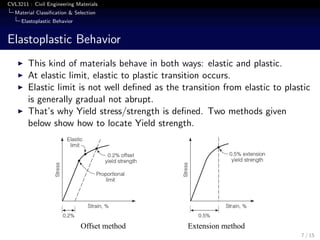
Elastoplastic Behavior
This kind of materials behave in both ways: elastic and plastic.
At elastic limit, elastic to plastic transition occurs.
Elastic limit is not well defined as the transition from elastic to plastic
is generally gradual not abrupt.
That’s why Yield stress/strength is defined. Two methods given
below show how to locate Yield strength.
7 / 15
CVL3211 : Civil Engineering Materials
Material Classification & Selection
Elastoplastic Behavior
If stress is applied beyond elastic limit, after unloading, material
retains a residual (plastic) deformation.
After elastic point/Yield strength, material can follow any of the three
paths:
1. Strain hardening. e.g. Steel (ductile)
2. Perfectly plastic. e.g.
3. Strain softening. e.g. Concrete (brittle)
8 / 15
CVL3211 : Civil Engineering Materials
Material Classification & Selection
Viscoelastic Behavior
This type of material shows:
1. Elastic behavior - Hooke’s law is followed.
2. Viscous behavior - Newton’s law is followed.
It can be seen that stress and strain both are time dependent.
9 / 15
CVL3211 : Civil Engineering Materials
Material Classification & Selection
Viscoelastic Behavior
Viscoelastic materials like Asphalt show creep and relaxation behavior.
A constant load is applied on material
for long time. After unloading, some
residual strain remains.
A constant strain is applied for a long
time. Stress dissipates as the
material relaxes.
10 / 15
CVL3211 : Civil Engineering Materials
Material Classification & Selection
Viscoelastic Behavior
1. Several rheological model have been hypothesized as a combination of
Hooke (Spring) and Newton (Dashpot) model.
2. Best fit model is Burger’s model as shown below. It can be only fitted
for uniaxial behavior of material.
3. Triaxial behavior of viscoelastic material is still a debatable topic.
11 / 15
CVL3211 : Civil Engineering Materials
Material Classification & Selection
Other factors related to stress-strain trend
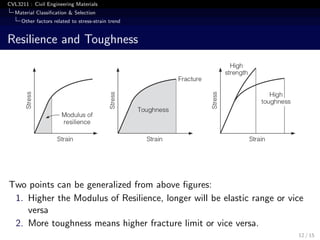
Resilience and Toughness
Two points can be generalized from above figures:
1. Higher the Modulus of Resilience, longer will be elastic range or vice
versa
2. More toughness means higher fracture limit or vice versa.
12 / 15
CVL3211 : Civil Engineering Materials
Material Classification & Selection
Failure and Safety
Modes of failure and Safety
A material may undergo any of the few outlined modes of failure:
Fracture
Brittle materials undergo sudden fracture and fail.
Fatigue
Repeated loading lesser then Yield strength cause fatigue
General yielding
Reaching the Yield strength of a material.
Buckling
Slander members may undergo twisting or buckling.
Excessive deformation
Ductile materials may undergo excessive deformation and fail for
serviceability.
13 / 15
CVL3211 : Civil Engineering Materials
Material Classification & Selection
Failure and Safety
Fatigue
Repetitive loading cause fatigue.
Figure below shows how a material can be withheld a repetitive load for
given number of cycles.
Below Endurance limit, a material is safe for fatigue (loading till infinite
number of cycles).
14 / 15
CVL3211 : Civil Engineering Materials
Material Classification & Selection
Non-mechanical Properties
Density and Unit Weight
unit weight = density × acceleration due to gravity i.e. γ = ρg
Thermal Expansion
Linear expansion: αl δT = δL
Volume expansion: αv δT = δV
For isotropic materials: αv = 3 × αl
Surface Characteristics
Corrosion and Degradation
Abrasion and Wear resistance
Surface texture
15 / 15

Lecture on Basic Material Classification

  • 1.
    CVL3211 : CivilEngineering Materials Department of Civil Engineering Abhipsa Kar Pranjal Mandhaniya Rashmisikha Behera ITER, SoA University August 28, 2016 1 / 15
  • 2.
    CVL3211 : CivilEngineering Materials Material Classification & Selection Material Classification & Selection Outlined factors are used to distinguish materials. Mechanical properties Non-mechanical properties Economic factors Production/Construction considerations Aesthetic properties 2 / 15
  • 3.
    CVL3211 : CivilEngineering Materials Material Classification & Selection Mechanical Properties Mechanical Properties Major Engineering properties of materials are highlighted below: Loading Conditions Stress-Strain Relations 1. Elastic Behavior 2. Elastoplastic Behavior 3. Viscoelastic Behavior Work and Energy: Other factors related to stress-strain trend Failure and Safety Temperature and Time Effects 3 / 15
  • 4.
    CVL3211 : CivilEngineering Materials Material Classification & Selection Mechanical Properties Loading Conditions Loading of materials can be : 1. Static - Stationary load or dead load 2. Dynamic - Moving load or live load Different kind of dynamic loading conditions as shown below, affect materials differently: Machine load Earthquake load, wind load Truck load 4 / 15
  • 5.
    CVL3211 : CivilEngineering Materials Material Classification & Selection Stress-Strain Relations Stress-Strain Relations A material shows deformation if load is applied. This give rise to basic Stress-strain response of material. According to Hooke’s law, Stress ∝ Strain ≡ σ ∝ ≡ σ = E Where E = Young’s modulus, It is defined by various methods from stress-strain response as shown below. 5 / 15
  • 6.
    CVL3211 : CivilEngineering Materials Material Classification & Selection Elastic Behavior Elastic Behavior Material regains its shape after removal of load. Stress-strain path can be linear or non-linear. 6 / 15
  • 7.
    CVL3211 : CivilEngineering Materials Material Classification & Selection Elastoplastic Behavior Elastoplastic Behavior This kind of materials behave in both ways: elastic and plastic. At elastic limit, elastic to plastic transition occurs. Elastic limit is not well defined as the transition from elastic to plastic is generally gradual not abrupt. That’s why Yield stress/strength is defined. Two methods given below show how to locate Yield strength. 7 / 15
  • 8.
    CVL3211 : CivilEngineering Materials Material Classification & Selection Elastoplastic Behavior Elastoplastic Behavior If stress is applied beyond elastic limit, after unloading, material retains a residual (plastic) deformation. After elastic point/Yield strength, material can follow any of the three paths: 1. Strain hardening. e.g. Steel (ductile) 2. Perfectly plastic. e.g. 3. Strain softening. e.g. Concrete (brittle) 8 / 15
  • 9.
    CVL3211 : CivilEngineering Materials Material Classification & Selection Viscoelastic Behavior Viscoelastic Behavior This type of material shows: 1. Elastic behavior - Hooke’s law is followed. 2. Viscous behavior - Newton’s law is followed. It can be seen that stress and strain both are time dependent. 9 / 15
  • 10.
    CVL3211 : CivilEngineering Materials Material Classification & Selection Viscoelastic Behavior Viscoelastic materials like Asphalt show creep and relaxation behavior. A constant load is applied on material for long time. After unloading, some residual strain remains. A constant strain is applied for a long time. Stress dissipates as the material relaxes. 10 / 15
  • 11.
    CVL3211 : CivilEngineering Materials Material Classification & Selection Viscoelastic Behavior 1. Several rheological model have been hypothesized as a combination of Hooke (Spring) and Newton (Dashpot) model. 2. Best fit model is Burger’s model as shown below. It can be only fitted for uniaxial behavior of material. 3. Triaxial behavior of viscoelastic material is still a debatable topic. 11 / 15
  • 12.
    CVL3211 : CivilEngineering Materials Material Classification & Selection Other factors related to stress-strain trend Resilience and Toughness Two points can be generalized from above figures: 1. Higher the Modulus of Resilience, longer will be elastic range or vice versa 2. More toughness means higher fracture limit or vice versa. 12 / 15
  • 13.
    CVL3211 : CivilEngineering Materials Material Classification & Selection Failure and Safety Modes of failure and Safety A material may undergo any of the few outlined modes of failure: Fracture Brittle materials undergo sudden fracture and fail. Fatigue Repeated loading lesser then Yield strength cause fatigue General yielding Reaching the Yield strength of a material. Buckling Slander members may undergo twisting or buckling. Excessive deformation Ductile materials may undergo excessive deformation and fail for serviceability. 13 / 15
  • 14.
    CVL3211 : CivilEngineering Materials Material Classification & Selection Failure and Safety Fatigue Repetitive loading cause fatigue. Figure below shows how a material can be withheld a repetitive load for given number of cycles. Below Endurance limit, a material is safe for fatigue (loading till infinite number of cycles). 14 / 15
  • 15.
    CVL3211 : CivilEngineering Materials Material Classification & Selection Non-mechanical Properties Non-mechanical Properties Density and Unit Weight unit weight = density × acceleration due to gravity i.e. γ = ρg Thermal Expansion Linear expansion: αl δT = δL Volume expansion: αv δT = δV For isotropic materials: αv = 3 × αl Surface Characteristics Corrosion and Degradation Abrasion and Wear resistance Surface texture 15 / 15