Ch 3.5:
Repeated Roots; Reduction of Order
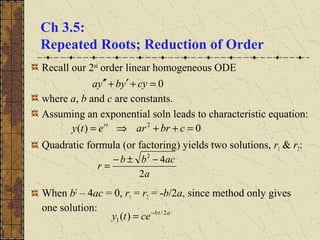
Recall our 2nd
order linear homogeneous ODE
where a, b and c are constants.
Assuming an exponential soln leads to characteristic equation:
Quadratic formula (or factoring) yields two solutions, r1 & r2:
When b2
– 4ac = 0, r1 = r2 = -b/2a, since method only gives
one solution:
0=+′+′′ cyybya
0)( 2
=++⇒= cbrarety rt
a
acbb
r
2
42
−±−
=
atb
cety 2/
1 )( −
=
Second Solution: Multiplying Factor v(t)
We know that
Since y1 and y2 are linearly dependent, we generalize this
approach and multiply by a function v, and determine
conditions for which y2 is a solution:
Then
solutiona)()(solutiona)( 121 tcytyty =⇒
atbatb
etvtyety 2/
2
2/
1 )()(trysolutiona)( −−
=⇒=
atbatbatbatb
atbatb
atb
etv
a
b
etv
a
b
etv
a
b
etvty
etv
a
b
etvty
etvty
2/
2
2
2/2/2/
2
2/2/
2
2/
2
)(
4
)(
2
)(
2
)()(
)(
2
)()(
)()(
−−−−
−−
−
+′−′−′′=′′
−′=′
=
Finding Multiplying Factor v(t)
Substituting derivatives into ODE, we seek a formula for v:
0=+′+′′ cyybya
43
2
222
22
22
2
2
2/
)(0)(
0)(
4
4
)(
0)(
4
4
4
)(0)(
4
4
4
2
4
)(
0)(
24
)(
0)()(
2
)()(
4
)()(
0)()(
2
)()(
4
)()(
ktktvtv
tv
a
acb
tva
tv
a
ac
a
b
tvatv
a
ac
a
b
a
b
tva
tvc
a
b
a
b
tva
tcvtv
a
b
tvbtv
a
b
tvbtva
tcvtv
a
b
tvbtv
a
b
tv
a
b
tvae atb
+=⇒=′′
=




 −
−′′
=





+
−
+′′⇔=





+−+′′
=





+−+′′
=+−′++′−′′
=






+



−′+





+′−′′−
General Solution
To find our general solution, we have:
Thus the general solution for repeated roots is
( )
abtabt
abtabt
abtabt
tecec
ektkek
etvkekty
2/
2
2/
1
2/
43
2/
1
2/
2
2/
1 )()(
−−
−−
−−
+=
++=
+=
abtabt
tececty 2/
2
2/
1)( −−
+=
Wronskian
The general solution is
Thus every solution is a linear combination of
The Wronskian of the two solutions is
Thus y1and y2 form a fundamental solution set for equation.
abtabt
tececty 2/
2
2/
1)( −−
+=
abtabt
tetyety 2/
2
2/
1 )(,)( −−
==
te
a
bt
e
a
bt
e
e
a
bt
e
a
b
tee
tyyW
abt
abtabt
abtabt
abtabt
allfor0
22
1
2
1
2
))(,(
/
//
2/2/
2/2/
21
≠=






+





−=






−−
=
−
−−
−−
−−
Example 1
Consider the initial value problem
Assuming exponential soln leads to characteristic equation:
Thus the general solution is
Using the initial conditions:
Thus
( ) ( ) 10,10,02 =′==+′+′′ yyyyy
10)1(012)( 22
−=⇔=+⇔=++⇒= rrrrety rt
tt
tececty −−
+= 21)(
2,1
1
1
21
21
1
==⇒



=+−
=
cc
cc
c
tt
teety −−
+= 2)(
Example 2
Consider the initial value problem
Assuming exponential soln leads to characteristic equation:
Thus the general solution is
Using the initial conditions:
Thus
( ) ( ) 2/10,20,025.0 =′==+′−′′ yyyyy
2/10)2/1(025.0)( 22
=⇔=−⇔=+−⇒= rrrrety rt
2/
2
2/
1)( tt
tececty +=
2
1
,2
2
1
2
1
2
21
21
1
−==⇒




=+
=
cc
cc
c
2/2/
2
1
2)( tt
teety −=
Example 3
Consider the initial value problem
Assuming exponential soln leads to characteristic equation:
Thus the general solution is
Using the initial conditions:
Thus
( ) ( ) 2/30,20,025.0 =′==+′−′′ yyyyy
2/10)2/1(025.0)( 22
=⇔=−⇔=+−⇒= rrrrety rt
2/
2
2/
1)( tt
tececty +=
2
1
,2
2
3
2
1
2
21
21
1
==⇒




=+
=
cc
cc
c
2/2/
2
1
2)( tt
teety +=
Reduction of Order
The method used so far in this section also works for
equations with nonconstant coefficients:
That is, given that y1 is solution, try y2 = v(t)y1:
Substituting these into ODE and collecting terms,
Since y1 is a solution to the differential equation, this last
equation reduces to a first order equation in v′ :
0)()( =+′+′′ ytqytpy
)()()()(2)()()(
)()()()()(
)()()(
1112
112
12
tytvtytvtytvty
tytvtytvty
tytvty
′′+′′+′′=′′
′+′=′
=
( ) ( ) 02 111111 =+′+′′+′+′+′′ vqyypyvpyyvy
( ) 02 111 =′+′+′′ vpyyvy
Example 4: Reduction of Order (1 of 3)
Given the variable coefficient equation and solution y1,
use reduction of order method to find a second solution:
Substituting these into ODE and collecting terms,
,)(;0,03 1
1
2 −
=>=+′+′′ ttytyytyt
321
2
21
2
1
2
)(2)(2)()(
)()()(
)()(
−−−
−−
−
+′−′′=′′
−′=′
=
ttvttvttvty
ttvttvty
ttvty
( ) ( )
)()(where,0
0
03322
0322
111
1213212
tvtuuut
vvt
vtvtvvtvtv
vtvttvtvttvtvt
′==+′⇔
=′+′′⇔
=+−′++′−′′⇔
=+−′++′−′′
−−−
−−−−−−
Example 4: Finding v(t) (2 of 3)
To solve
for u, we can use the separation of variables method:
Thus
and hence
.0since,
lnln
1
0
11
>=⇔=⇔
+−=⇔−=⇔=+
−−
∫∫
tctuetu
Ctudt
tu
du
u
dt
du
t
C
)()(,0 tvtuuut ′==+′
t
c
v =′
ktctv += ln)(
Example 4: General Solution (3 of 3)
We have
Thus
Recall
and hence we can neglect the second term of y2 to obtain
Hence the general solution to the differential equation is
( ) 111
2 lnln)( −−−
+=+= tktcttktcty
ktctv += ln)(
.ln)( 1
2 ttty −
=
1
1 )( −
= tty
ttctcty ln)( 1
2
1
1
−−
+=

Ch03 5

  • 1.
    Ch 3.5: Repeated Roots;Reduction of Order Recall our 2nd order linear homogeneous ODE where a, b and c are constants. Assuming an exponential soln leads to characteristic equation: Quadratic formula (or factoring) yields two solutions, r1 & r2: When b2 – 4ac = 0, r1 = r2 = -b/2a, since method only gives one solution: 0=+′+′′ cyybya 0)( 2 =++⇒= cbrarety rt a acbb r 2 42 −±− = atb cety 2/ 1 )( − =
  • 2.
    Second Solution: MultiplyingFactor v(t) We know that Since y1 and y2 are linearly dependent, we generalize this approach and multiply by a function v, and determine conditions for which y2 is a solution: Then solutiona)()(solutiona)( 121 tcytyty =⇒ atbatb etvtyety 2/ 2 2/ 1 )()(trysolutiona)( −− =⇒= atbatbatbatb atbatb atb etv a b etv a b etv a b etvty etv a b etvty etvty 2/ 2 2 2/2/2/ 2 2/2/ 2 2/ 2 )( 4 )( 2 )( 2 )()( )( 2 )()( )()( −−−− −− − +′−′−′′=′′ −′=′ =
  • 3.
    Finding Multiplying Factorv(t) Substituting derivatives into ODE, we seek a formula for v: 0=+′+′′ cyybya 43 2 222 22 22 2 2 2/ )(0)( 0)( 4 4 )( 0)( 4 4 4 )(0)( 4 4 4 2 4 )( 0)( 24 )( 0)()( 2 )()( 4 )()( 0)()( 2 )()( 4 )()( ktktvtv tv a acb tva tv a ac a b tvatv a ac a b a b tva tvc a b a b tva tcvtv a b tvbtv a b tvbtva tcvtv a b tvbtv a b tv a b tvae atb +=⇒=′′ =      − −′′ =      + − +′′⇔=      +−+′′ =      +−+′′ =+−′++′−′′ =       +    −′+      +′−′′−
  • 4.
    General Solution To findour general solution, we have: Thus the general solution for repeated roots is ( ) abtabt abtabt abtabt tecec ektkek etvkekty 2/ 2 2/ 1 2/ 43 2/ 1 2/ 2 2/ 1 )()( −− −− −− += ++= += abtabt tececty 2/ 2 2/ 1)( −− +=
  • 5.
    Wronskian The general solutionis Thus every solution is a linear combination of The Wronskian of the two solutions is Thus y1and y2 form a fundamental solution set for equation. abtabt tececty 2/ 2 2/ 1)( −− += abtabt tetyety 2/ 2 2/ 1 )(,)( −− == te a bt e a bt e e a bt e a b tee tyyW abt abtabt abtabt abtabt allfor0 22 1 2 1 2 ))(,( / // 2/2/ 2/2/ 21 ≠=       +      −=       −− = − −− −− −−
  • 6.
    Example 1 Consider theinitial value problem Assuming exponential soln leads to characteristic equation: Thus the general solution is Using the initial conditions: Thus ( ) ( ) 10,10,02 =′==+′+′′ yyyyy 10)1(012)( 22 −=⇔=+⇔=++⇒= rrrrety rt tt tececty −− += 21)( 2,1 1 1 21 21 1 ==⇒    =+− = cc cc c tt teety −− += 2)(
  • 7.
    Example 2 Consider theinitial value problem Assuming exponential soln leads to characteristic equation: Thus the general solution is Using the initial conditions: Thus ( ) ( ) 2/10,20,025.0 =′==+′−′′ yyyyy 2/10)2/1(025.0)( 22 =⇔=−⇔=+−⇒= rrrrety rt 2/ 2 2/ 1)( tt tececty += 2 1 ,2 2 1 2 1 2 21 21 1 −==⇒     =+ = cc cc c 2/2/ 2 1 2)( tt teety −=
  • 8.
    Example 3 Consider theinitial value problem Assuming exponential soln leads to characteristic equation: Thus the general solution is Using the initial conditions: Thus ( ) ( ) 2/30,20,025.0 =′==+′−′′ yyyyy 2/10)2/1(025.0)( 22 =⇔=−⇔=+−⇒= rrrrety rt 2/ 2 2/ 1)( tt tececty += 2 1 ,2 2 3 2 1 2 21 21 1 ==⇒     =+ = cc cc c 2/2/ 2 1 2)( tt teety +=
  • 9.
    Reduction of Order Themethod used so far in this section also works for equations with nonconstant coefficients: That is, given that y1 is solution, try y2 = v(t)y1: Substituting these into ODE and collecting terms, Since y1 is a solution to the differential equation, this last equation reduces to a first order equation in v′ : 0)()( =+′+′′ ytqytpy )()()()(2)()()( )()()()()( )()()( 1112 112 12 tytvtytvtytvty tytvtytvty tytvty ′′+′′+′′=′′ ′+′=′ = ( ) ( ) 02 111111 =+′+′′+′+′+′′ vqyypyvpyyvy ( ) 02 111 =′+′+′′ vpyyvy
  • 10.
    Example 4: Reductionof Order (1 of 3) Given the variable coefficient equation and solution y1, use reduction of order method to find a second solution: Substituting these into ODE and collecting terms, ,)(;0,03 1 1 2 − =>=+′+′′ ttytyytyt 321 2 21 2 1 2 )(2)(2)()( )()()( )()( −−− −− − +′−′′=′′ −′=′ = ttvttvttvty ttvttvty ttvty ( ) ( ) )()(where,0 0 03322 0322 111 1213212 tvtuuut vvt vtvtvvtvtv vtvttvtvttvtvt ′==+′⇔ =′+′′⇔ =+−′++′−′′⇔ =+−′++′−′′ −−− −−−−−−
  • 11.
    Example 4: Findingv(t) (2 of 3) To solve for u, we can use the separation of variables method: Thus and hence .0since, lnln 1 0 11 >=⇔=⇔ +−=⇔−=⇔=+ −− ∫∫ tctuetu Ctudt tu du u dt du t C )()(,0 tvtuuut ′==+′ t c v =′ ktctv += ln)(
  • 12.
    Example 4: GeneralSolution (3 of 3) We have Thus Recall and hence we can neglect the second term of y2 to obtain Hence the general solution to the differential equation is ( ) 111 2 lnln)( −−− +=+= tktcttktcty ktctv += ln)( .ln)( 1 2 ttty − = 1 1 )( − = tty ttctcty ln)( 1 2 1 1 −− +=