Semi-Permeable
    Membrane
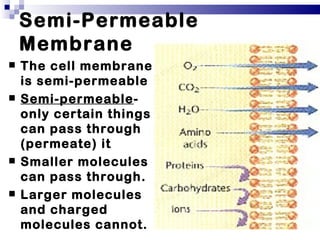
   The cell membrane
    is semi-permeable
   Semi-permeable-
    only certain things
    can pass through
    (permeate) it
   Smaller molecules
    can pass through.
   Larger molecules
    and charged
    molecules cannot.
Passive vs. Active Transport
 PASSIVE= **No energy (ATP) needed for
  movement of certain particles across the
  membrane in/out of cell.
 Particles (molecules and ions) move from
  HIGH to LOW concentration.
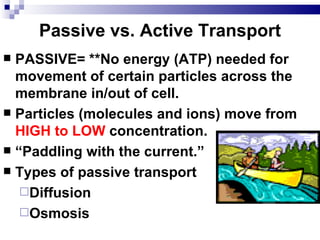
 “Paddling with the current.”
 Types of passive transport
   Diffusion
   Osmosis
Diffusion
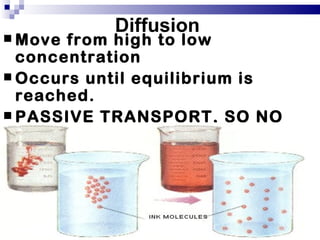
 Move from high to low
  concentration
 Occurs until equilibrium is
  reached.
 PASSIVE TRANSPORT, SO NO
  ENERGY REQUIRED FOR
  PARTICLES TO DIFFUSE!!!
Osmosis
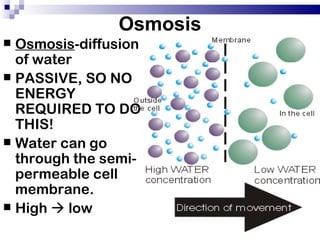
 Osmosis-diffusion
  of water
 PASSIVE, SO NO
  ENERGY
  REQUIRED TO DO
  THIS!
 Water can go
  through the semi-
  permeable cell
  membrane.
 High  low
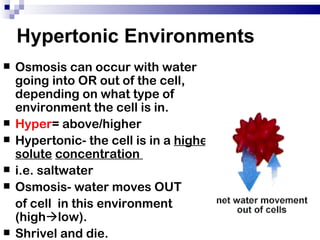
Hypertonic Environments
   Osmosis can occur with water
    going into OR out of the cell,
    depending on what type of
    environment the cell is in.
   Hyper= above/higher
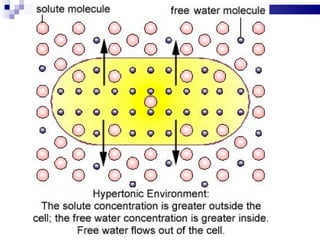
   Hypertonic- the cell is in a higher
    solute concentration
   i.e. saltwater
   Osmosis- water moves OUT
    of cell in this environment
    (highlow).
   Shrivel and die.
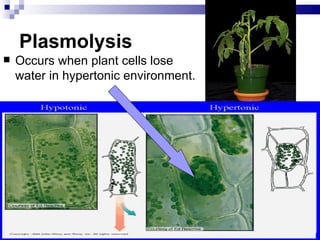
Plasmolysis
   Occurs when plant cells lose
    water in hypertonic environment.
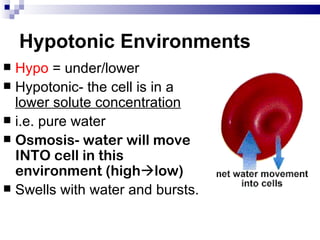
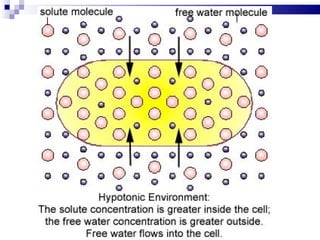
Hypotonic Environments
 Hypo = under/lower
 Hypotonic- the cell is in a
  lower solute concentration
 i.e. pure water
 Osmosis- water will move
  INTO cell in this
  environment (highlow)
 Swells with water and bursts.
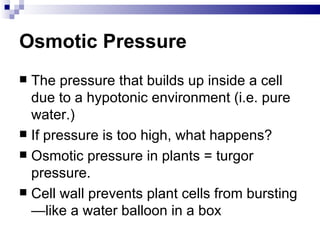
Osmotic Pressure
 The pressure that builds up inside a cell
  due to a hypotonic environment (i.e. pure
  water.)
 If pressure is too high, what happens?
 Osmotic pressure in plants = turgor
  pressure.
 Cell wall prevents plant cells from bursting
  —like a water balloon in a box
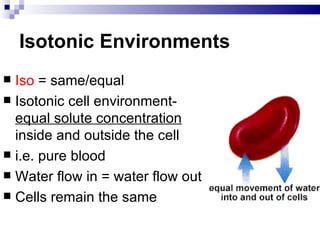
Isotonic Environments
 Iso = same/equal
 Isotonic cell environment-
  equal solute concentration
  inside and outside the cell
 i.e. pure blood
 Water flow in = water flow out
 Cells remain the same
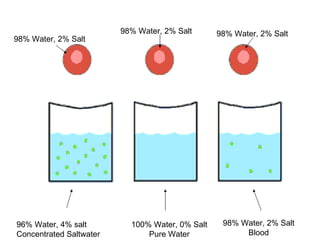
98% Water, 2% Salt      98% Water, 2% Salt
98% Water, 2% Salt


96% Water, 4% salt         100% Water, 0% Salt    98% Water, 2% Salt
Concentrated Saltwater         Pure Water              Blood

Ch 7 cell transport 2011

  • 2.
    Semi-Permeable Membrane  The cell membrane is semi-permeable  Semi-permeable- only certain things can pass through (permeate) it  Smaller molecules can pass through.  Larger molecules and charged molecules cannot.
  • 3.
    Passive vs. ActiveTransport  PASSIVE= **No energy (ATP) needed for movement of certain particles across the membrane in/out of cell.  Particles (molecules and ions) move from HIGH to LOW concentration.  “Paddling with the current.”  Types of passive transport Diffusion Osmosis
  • 4.
    Diffusion  Move fromhigh to low concentration  Occurs until equilibrium is reached.  PASSIVE TRANSPORT, SO NO ENERGY REQUIRED FOR PARTICLES TO DIFFUSE!!!
  • 5.
    Osmosis  Osmosis-diffusion of water  PASSIVE, SO NO ENERGY REQUIRED TO DO THIS!  Water can go through the semi- permeable cell membrane.  High  low
  • 6.
    Hypertonic Environments  Osmosis can occur with water going into OR out of the cell, depending on what type of environment the cell is in.  Hyper= above/higher  Hypertonic- the cell is in a higher solute concentration  i.e. saltwater  Osmosis- water moves OUT of cell in this environment (highlow).  Shrivel and die.
  • 8.
    Plasmolysis  Occurs when plant cells lose water in hypertonic environment.
  • 9.
    Hypotonic Environments  Hypo= under/lower  Hypotonic- the cell is in a lower solute concentration  i.e. pure water  Osmosis- water will move INTO cell in this environment (highlow)  Swells with water and bursts.
  • 11.
    Osmotic Pressure  Thepressure that builds up inside a cell due to a hypotonic environment (i.e. pure water.)  If pressure is too high, what happens?  Osmotic pressure in plants = turgor pressure.  Cell wall prevents plant cells from bursting —like a water balloon in a box
  • 12.
    Isotonic Environments  Iso= same/equal  Isotonic cell environment- equal solute concentration inside and outside the cell  i.e. pure blood  Water flow in = water flow out  Cells remain the same
  • 13.
    98% Water, 2%Salt 98% Water, 2% Salt 98% Water, 2% Salt 96% Water, 4% salt 100% Water, 0% Salt 98% Water, 2% Salt Concentrated Saltwater Pure Water Blood