 We have learnt that Diffusion is:
 The movement of particles/molecules from a region of
their higher concentration to a region of their lower
concentration down the concentration gradient
 Now Osmosis is a special case of diffusion
 It refers to the movement of water molecules
 Across a partially permeable membrane
 Can you define osmosis using this information?
 Where would you find a partially permeable
membrane in a cell?
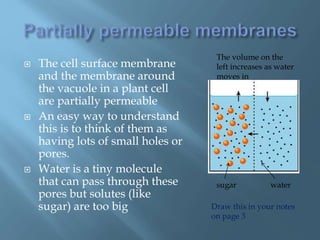
 The cell surface membrane
and the membrane around
the vacuole in a plant cell
are partially permeable
 An easy way to understand
this is to think of them as
having lots of small holes or
pores.
 Water is a tiny molecule
that can pass through these
pores but solutes (like
sugar) are too big
sugar water
The volume on the
left increases as water
moves in
Draw this in your notes
on page 3
 The potential for water to move from one side
of a membrane to another depends on the
amount of dissolved solute in the water.
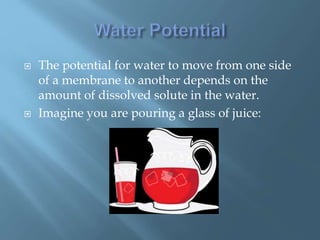
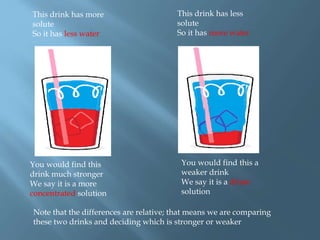
 Imagine you are pouring a glass of juice:
This drink has more
solute
So it has less water
This drink has less
solute
So it has more water
You would find this
drink much stronger
We say it is a more
concentrated solution
You would find this a
weaker drink
We say it is a dilute
solution
Note that the differences are relative; that means we are comparing
these two drinks and deciding which is stronger or weaker
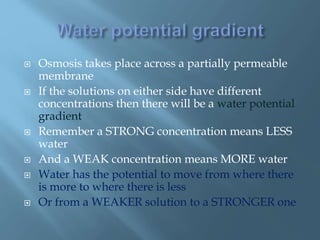
 Osmosis takes place across a partially permeable
membrane
 If the solutions on either side have different
concentrations then there will be a water potential
gradient
 Remember a STRONG concentration means LESS
water
 And a WEAK concentration means MORE water
 Water has the potential to move from where there
is more to where there is less
 Or from a WEAKER solution to a STRONGER one
 Osmosis is the movement of water
molecules from a region of higher water
potential to a region of lower water
potential, down their water potential
gradient, across a partially permeable
membrane
 Highlight this definition in your notes (p3) and
learn it!
 Living cells are surrounded by a partially
permeable membrane
 The concentration of the solution surrounding
a cell will affect the cell
 Remember that plant cells are surrounded by a
rigid cell wall – so they behave differently
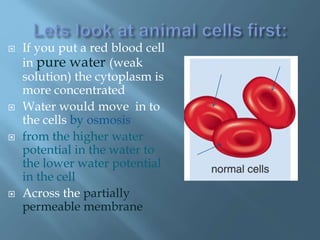
 If you put a red blood cell
in pure water (weak
solution) the cytoplasm is
more concentrated
 Water would move in to
the cells by osmosis
 from the higher water
potential in the water to
the lower water potential
in the cell
 Across the partially
permeable membrane
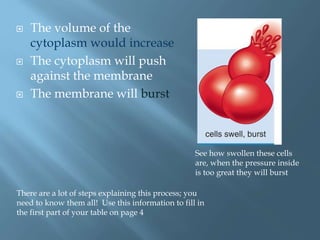
 The volume of the
cytoplasm would increase
 The cytoplasm will push
against the membrane
 The membrane will burst
See how swollen these cells
are, when the pressure inside
is too great they will burst
There are a lot of steps explaining this process; you
need to know them all! Use this information to fill in
the first part of your table on page 4
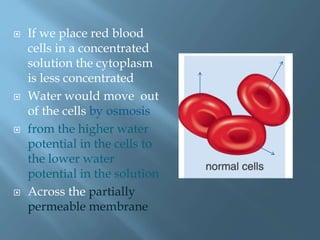
 If we place red blood
cells in a concentrated
solution the cytoplasm
is less concentrated
 Water would move out
of the cells by osmosis
 from the higher water
potential in the cells to
the lower water
potential in the solution
 Across the partially
permeable membrane
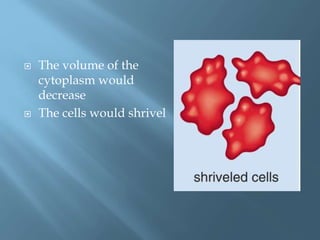
 The volume of the
cytoplasm would
decrease
 The cells would shrivel
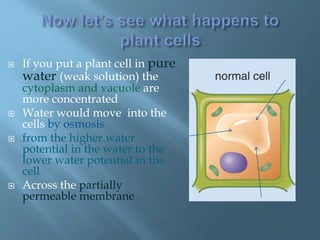
 If you put a plant cell in pure
water (weak solution) the
cytoplasm and vacuole are
more concentrated
 Water would move into the
cells by osmosis
 from the higher water
potential in the water to the
lower water potential in the
cell
 Across the partially
permeable membrane
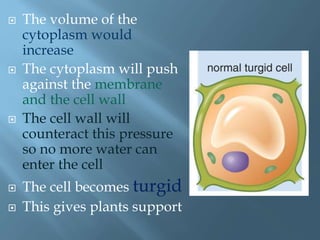
 The volume of the
cytoplasm would
increase
 The cytoplasm will push
against the membrane
and the cell wall
 The cell wall will
counteract this pressure
so no more water can
enter the cell
 The cell becomes turgid
 This gives plants support
 Plant cells don’t burst
because of the wall
 Imagine blowing up a
balloon in a box
 Eventually you
wouldn’t be able to
blow any more air in
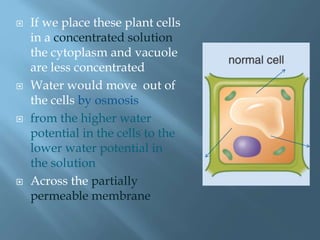
 If we place these plant cells
in a concentrated solution
the cytoplasm and vacuole
are less concentrated
 Water would move out of
the cells by osmosis
 from the higher water
potential in the cells to the
lower water potential in
the solution
 Across the partially
permeable membrane
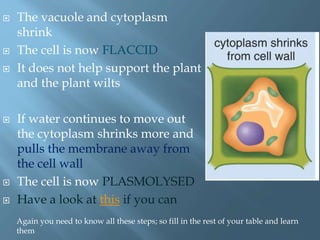
 The vacuole and cytoplasm
shrink
 The cell is now FLACCID
 It does not help support the plant
and the plant wilts
 If water continues to move out
the cytoplasm shrinks more and
pulls the membrane away from
the cell wall
 The cell is now PLASMOLYSED
 Have a look at this if you can
Again you need to know all these steps; so fill in the rest of your table and learn
them

Osmosis

  • 2.
     We havelearnt that Diffusion is:  The movement of particles/molecules from a region of their higher concentration to a region of their lower concentration down the concentration gradient  Now Osmosis is a special case of diffusion  It refers to the movement of water molecules  Across a partially permeable membrane  Can you define osmosis using this information?  Where would you find a partially permeable membrane in a cell?
  • 3.
     The cellsurface membrane and the membrane around the vacuole in a plant cell are partially permeable  An easy way to understand this is to think of them as having lots of small holes or pores.  Water is a tiny molecule that can pass through these pores but solutes (like sugar) are too big sugar water The volume on the left increases as water moves in Draw this in your notes on page 3
  • 4.
     The potentialfor water to move from one side of a membrane to another depends on the amount of dissolved solute in the water.  Imagine you are pouring a glass of juice:
  • 5.
    This drink hasmore solute So it has less water This drink has less solute So it has more water You would find this drink much stronger We say it is a more concentrated solution You would find this a weaker drink We say it is a dilute solution Note that the differences are relative; that means we are comparing these two drinks and deciding which is stronger or weaker
  • 6.
     Osmosis takesplace across a partially permeable membrane  If the solutions on either side have different concentrations then there will be a water potential gradient  Remember a STRONG concentration means LESS water  And a WEAK concentration means MORE water  Water has the potential to move from where there is more to where there is less  Or from a WEAKER solution to a STRONGER one
  • 7.
     Osmosis isthe movement of water molecules from a region of higher water potential to a region of lower water potential, down their water potential gradient, across a partially permeable membrane  Highlight this definition in your notes (p3) and learn it!
  • 8.
     Living cellsare surrounded by a partially permeable membrane  The concentration of the solution surrounding a cell will affect the cell  Remember that plant cells are surrounded by a rigid cell wall – so they behave differently
  • 9.
     If youput a red blood cell in pure water (weak solution) the cytoplasm is more concentrated  Water would move in to the cells by osmosis  from the higher water potential in the water to the lower water potential in the cell  Across the partially permeable membrane
  • 10.
     The volumeof the cytoplasm would increase  The cytoplasm will push against the membrane  The membrane will burst See how swollen these cells are, when the pressure inside is too great they will burst There are a lot of steps explaining this process; you need to know them all! Use this information to fill in the first part of your table on page 4
  • 11.
     If weplace red blood cells in a concentrated solution the cytoplasm is less concentrated  Water would move out of the cells by osmosis  from the higher water potential in the cells to the lower water potential in the solution  Across the partially permeable membrane
  • 12.
     The volumeof the cytoplasm would decrease  The cells would shrivel
  • 13.
     If youput a plant cell in pure water (weak solution) the cytoplasm and vacuole are more concentrated  Water would move into the cells by osmosis  from the higher water potential in the water to the lower water potential in the cell  Across the partially permeable membrane
  • 14.
     The volumeof the cytoplasm would increase  The cytoplasm will push against the membrane and the cell wall  The cell wall will counteract this pressure so no more water can enter the cell  The cell becomes turgid  This gives plants support
  • 15.
     Plant cellsdon’t burst because of the wall  Imagine blowing up a balloon in a box  Eventually you wouldn’t be able to blow any more air in
  • 16.
     If weplace these plant cells in a concentrated solution the cytoplasm and vacuole are less concentrated  Water would move out of the cells by osmosis  from the higher water potential in the cells to the lower water potential in the solution  Across the partially permeable membrane
  • 17.
     The vacuoleand cytoplasm shrink  The cell is now FLACCID  It does not help support the plant and the plant wilts  If water continues to move out the cytoplasm shrinks more and pulls the membrane away from the cell wall  The cell is now PLASMOLYSED  Have a look at this if you can Again you need to know all these steps; so fill in the rest of your table and learn them