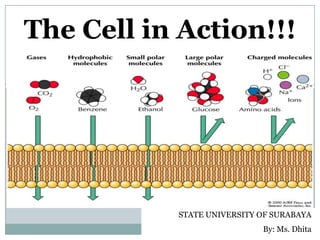
The Cell in Action!!!


           STATE UNIVERSITY OF SURABAYA
                            By: Ms. Dhita
Section 1 Objectives:
•Explain the process of diffusion
•Describe how osmosis occurs
•Compare passive transport with active
transport
•Explain how large particles get into
and out of cells
Exchange with the Environment


 An organism must be able to obtain energy and

 raw materials and get rid of waste.

 Cell division allows organisms to grow and repair

 injuries.

 Exchange of materials between a cell and its

 environment takes place at the cell’s membrane.
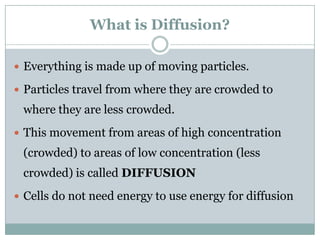
What is Diffusion?

 Everything is made up of moving particles.

 Particles travel from where they are crowded to
 where they are less crowded.
 This movement from areas of high concentration
 (crowded) to areas of low concentration (less
 crowded) is called DIFFUSION
 Cells do not need energy to use energy for diffusion
Example of Diffusion
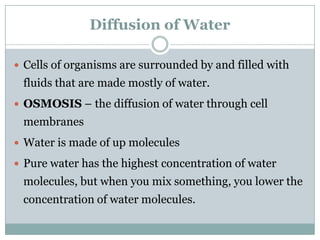
Diffusion of Water

 Cells of organisms are surrounded by and filled with
 fluids that are made mostly of water.
 OSMOSIS – the diffusion of water through cell
 membranes
 Water is made of up molecules

 Pure water has the highest concentration of water
 molecules, but when you mix something, you lower the
 concentration of water molecules.
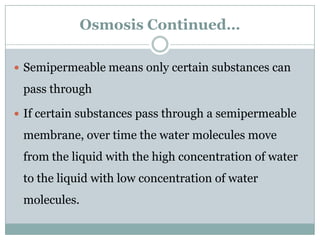
Osmosis Continued…

 Semipermeable means only certain substances can

 pass through

 If certain substances pass through a semipermeable

 membrane, over time the water molecules move
 from the liquid with the high concentration of water
 to the liquid with low concentration of water
 molecules.
Osmosis Example
The Cell and Osmosis

     The Animal Cell                   The Plant Cell

 Plasma (surrounds red        Osmosis occurs in plant

 blood cells) is made up of    cells
 water, salts, and sugars.     When a wilted plant is

 Concentration of these       watered, osmosis makes
 particles is kept in          the plant firm again!
 balance by osmosis.
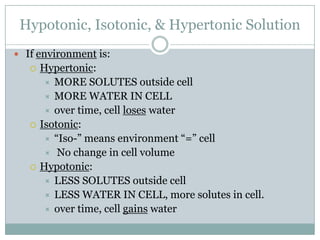
Hypotonic, Isotonic, & Hypertonic Solution
 If environment is:
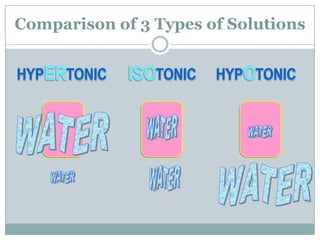
      Hypertonic:
         MORE SOLUTES outside cell
         MORE WATER IN CELL
         over time, cell loses water
      Isotonic:
         “Iso-” means environment “=” cell
         No change in cell volume
      Hypotonic:
         LESS SOLUTES outside cell
         LESS WATER IN CELL, more solutes in cell.
         over time, cell gains water
Comparison of 3 Types of Solutions


HYPERTONIC   ISOTONIC   HYPOTONIC
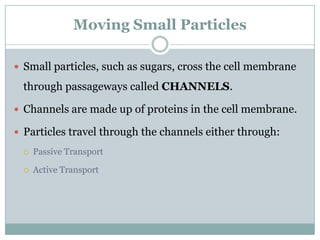
Moving Small Particles

 Small particles, such as sugars, cross the cell membrane

 through passageways called CHANNELS.

 Channels are made up of proteins in the cell membrane.

 Particles travel through the channels either through:

    Passive Transport

    Active Transport
Passive Transport               Active Transport
 Movement of particles across    Process of transporting
  a cell membrane without the
                                  particles that requires
  use of energy by the cell.
                                  the cell to use energy.
 Particles move from an area
                                  Usually involves the
  of high concentration to an
  area of low concentration.      movement of particles
 Diffusion and Osmosis are       from an area of low
  examples of Passive             concentration to an area
  Transport!
                                  of high concentration!
Moving Large Particles

 Large particles move into and out of the cell by

 processes called:
    Endocytosis = “Within the Cell”


    Exocytosis = “Outside the Cell”
Endocytosis

 Active transport process that surrounds a large particle.

 Encloses the particle in a vesicle.

 Brings the particle into the cell.

 2 types of endocytosis:

    Fagocytosis

    Pinocytosis

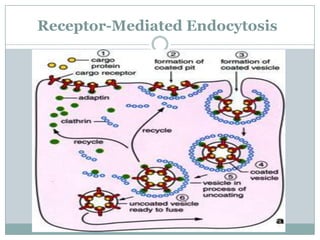
    Receptor-Mediated Endocytosis

 What are Vesicles??
     Sacs formed from pieces of cell membrane
Receptor-Mediated Endocytosis
Exocytosis

 Active transport which moves large particles out of
 the cell.
 A vesicle forms around a large particle within the
 cell.
 Vesicle carries the particle to the cell membrane.

 Vesicle fuses with the cell membrane and releases
 the particle to the outside of the cell.
Quiz . . .

 Describe Diffusion!

 Describe Osmosis!

 What is the difference between active
 transport and passive transport!
 Endocytosis means…?

 Exocytosis means…?

Powerpoint Metabolisme 1

  • 1.
    The Cell inAction!!! STATE UNIVERSITY OF SURABAYA By: Ms. Dhita
  • 2.
    Section 1 Objectives: •Explainthe process of diffusion •Describe how osmosis occurs •Compare passive transport with active transport •Explain how large particles get into and out of cells
  • 3.
    Exchange with theEnvironment  An organism must be able to obtain energy and raw materials and get rid of waste.  Cell division allows organisms to grow and repair injuries.  Exchange of materials between a cell and its environment takes place at the cell’s membrane.
  • 4.
    What is Diffusion? Everything is made up of moving particles.  Particles travel from where they are crowded to where they are less crowded.  This movement from areas of high concentration (crowded) to areas of low concentration (less crowded) is called DIFFUSION  Cells do not need energy to use energy for diffusion
  • 5.
  • 6.
    Diffusion of Water Cells of organisms are surrounded by and filled with fluids that are made mostly of water.  OSMOSIS – the diffusion of water through cell membranes  Water is made of up molecules  Pure water has the highest concentration of water molecules, but when you mix something, you lower the concentration of water molecules.
  • 7.
    Osmosis Continued…  Semipermeablemeans only certain substances can pass through  If certain substances pass through a semipermeable membrane, over time the water molecules move from the liquid with the high concentration of water to the liquid with low concentration of water molecules.
  • 8.
  • 9.
    The Cell andOsmosis The Animal Cell The Plant Cell  Plasma (surrounds red  Osmosis occurs in plant blood cells) is made up of cells water, salts, and sugars.  When a wilted plant is  Concentration of these watered, osmosis makes particles is kept in the plant firm again! balance by osmosis.
  • 10.
    Hypotonic, Isotonic, &Hypertonic Solution  If environment is:  Hypertonic:  MORE SOLUTES outside cell  MORE WATER IN CELL  over time, cell loses water  Isotonic:  “Iso-” means environment “=” cell  No change in cell volume  Hypotonic:  LESS SOLUTES outside cell  LESS WATER IN CELL, more solutes in cell.  over time, cell gains water
  • 11.
    Comparison of 3Types of Solutions HYPERTONIC ISOTONIC HYPOTONIC
  • 12.
    Moving Small Particles Small particles, such as sugars, cross the cell membrane through passageways called CHANNELS.  Channels are made up of proteins in the cell membrane.  Particles travel through the channels either through:  Passive Transport  Active Transport
  • 13.
    Passive Transport Active Transport  Movement of particles across  Process of transporting a cell membrane without the particles that requires use of energy by the cell. the cell to use energy.  Particles move from an area  Usually involves the of high concentration to an area of low concentration. movement of particles  Diffusion and Osmosis are from an area of low examples of Passive concentration to an area Transport! of high concentration!
  • 14.
    Moving Large Particles Large particles move into and out of the cell by processes called:  Endocytosis = “Within the Cell”  Exocytosis = “Outside the Cell”
  • 15.
    Endocytosis  Active transportprocess that surrounds a large particle.  Encloses the particle in a vesicle.  Brings the particle into the cell.  2 types of endocytosis:  Fagocytosis  Pinocytosis  Receptor-Mediated Endocytosis  What are Vesicles??  Sacs formed from pieces of cell membrane
  • 16.
  • 17.
    Exocytosis  Active transportwhich moves large particles out of the cell.  A vesicle forms around a large particle within the cell.  Vesicle carries the particle to the cell membrane.  Vesicle fuses with the cell membrane and releases the particle to the outside of the cell.
  • 18.
    Quiz . ..  Describe Diffusion!  Describe Osmosis!  What is the difference between active transport and passive transport!  Endocytosis means…?  Exocytosis means…?