Industrial Revolution By J. Collins/ D McDowell/ A. Anders
Industrial Revolution The IR is when people stopped making stuff at home and started making products in factories.
Cottage Industry
On the Farm Farm life difficult, but cyclical  Homes built and maintained by farmer and family Intense periods of work during planting and harvesting seasons with slower work schedule in between Daily schedule set by work load, daylight, farmer’s ambition
Agrarian (Agricultural) Revolution Draw two large rectangles divided into nine squares each. Each one of these symbolizes a field of nine different crops.  *In the first rectangle,  *In the second, put an draw crops in each square X in any three of the boxes   Draw crops in the remaining squares Now make a little fence around the entire fields of the rectangle with the Xes. X X X
Agricultural Revolution  – New farming methods invented Lord Townshend in England introduced  crop rotation  – land could now be used year-round; certain crops revitalized soil Enclosure  movement had large land owners buying and then  fencing  public land
Shift AWAY  from Agrarian Movement Smaller farmers pushed off of land to work as wage laborers for various land owners or to  move to the growing cities (urbanization) More food produced = population increase In 1700 there were about 100 million people in Europe, by 1800 the population had grown to 190 million.
Review What was the agrarian or agricultural revolution?
Why did the IR begin in Great Britain? Rise of science Increasing productivity in agriculture Expanding population Merchant tradition- entrepreneurial spirit capitalist philosophy (Adam Smith!) Geography  Coal and iron deposits Navigable rivers Natural harbors Island location Global trading, slave labor, gold & silver of the New World- COLONIES (in America, Africa, India) State-supported economic development Constitutionalism; Locke’s philosophy (property!)
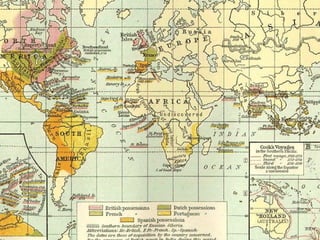
Quest for colonies!- giant map
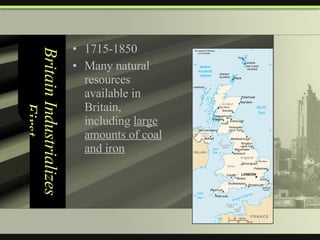
Britain Industrializes First  1715-1850 Many natural resources available in Britain, including  large amounts of coal and iron
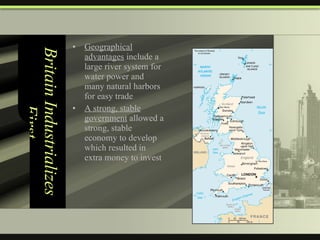
Britain Industrializes First Geographical advantages  include a large river system for water power and many natural harbors for easy trade A strong, stable government  allowed a strong, stable economy to develop which resulted in extra money to invest
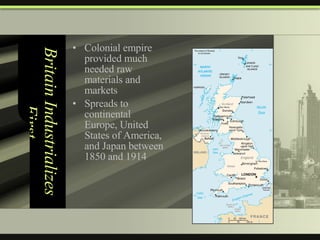
Britain Industrializes First Colonial empire provided much needed raw materials and markets Spreads to continental Europe, United States of America, and Japan between 1850 and 1914
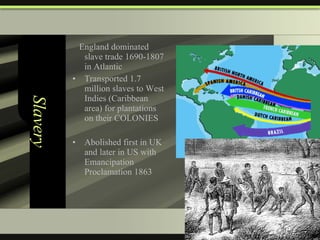
Slavery England dominated slave trade 1690-1807 in Atlantic Transported 1.7 million slaves to West Indies (Caribbean area) for plantations on their COLONIES Abolished first in UK and later in US with Emancipation Proclamation 1863
Urbanization Growth largely unplanned leading to numerous sanitary and social problems Typhoid and cholera epidemics swept through the cities Families lived in tiny, dirty, rat-infested, crime-infested, disease-ridden housing communities
New Cities- Urbanization!
Labor Changes Dramatic changes in work patterns occur in the factories Concept of time introduced to work, people arrive at factory at specific time, work for pre-set number of hours – “Time was money”
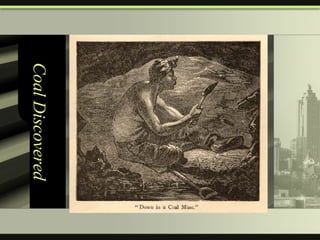
Coal Discovered
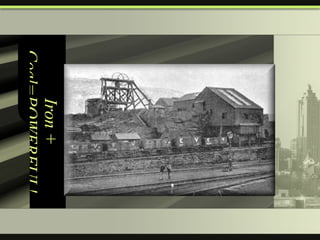
Iron + Coal=POWERFUL!
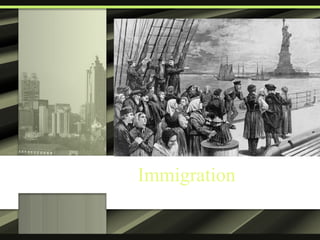
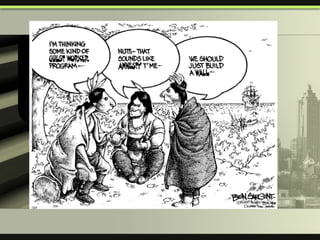
Immigration
 
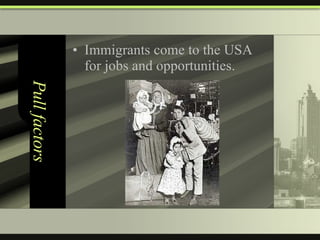
Pull factors Immigrants come to the USA for jobs and opportunities.
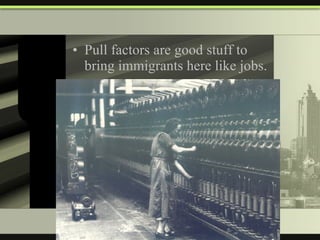
Pull factors are good stuff to bring immigrants here like jobs.
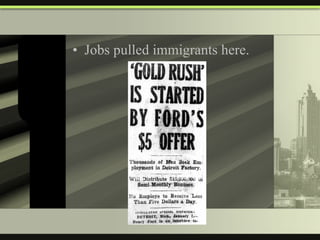
Jobs pulled immigrants here.
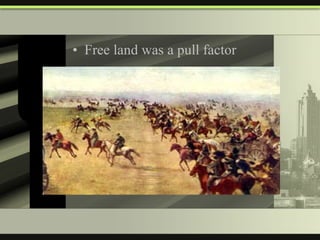
Free land was a pull factor
Push factors Push factors are bad stuff to push immigrants away like war or disease. This is potato famine.
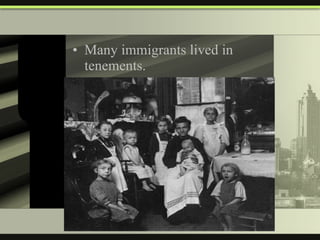
Many immigrants lived in tenements.
Tenement
URBANIZATION These advancements resulted in the movement of work  from the home to the factory Move from  country to city  for opportunities
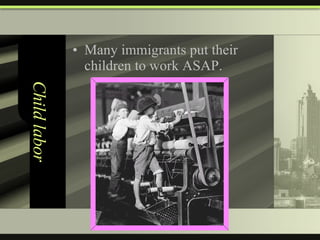
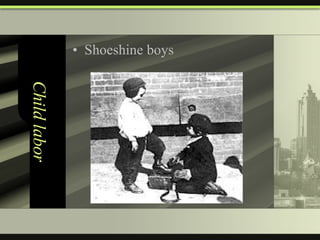
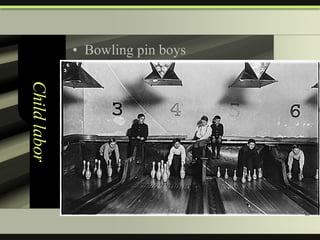
Child labor Many immigrants put their children to work ASAP.
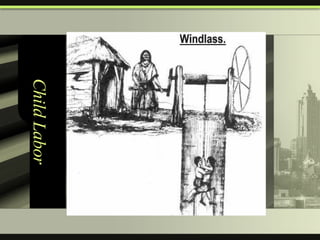
Child Labor
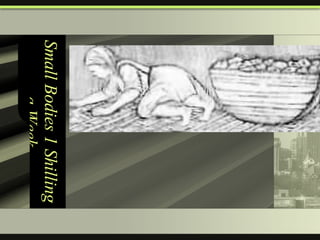
Small Bodies 1 Shilling a Week
Child labor Shoeshine boys
Child labor Bowling pin boys
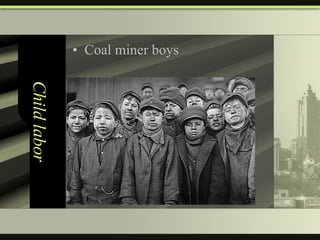
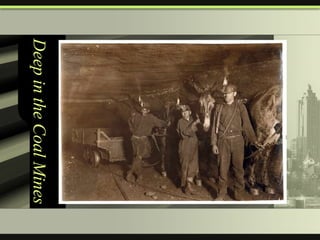
Child labor Coal miner boys
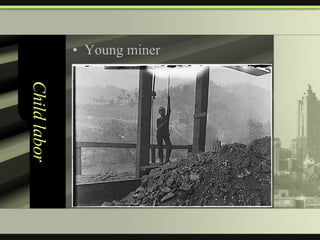
Child labor Young miner
Deep in the Coal Mines
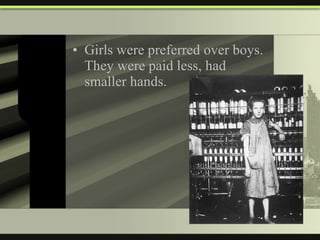
Girls were preferred over boys.  They were paid less, had smaller hands.
Child Labor  Parliament in GB begins to investigate! They hold hearings, calling in witnesses. Primary Document Reading
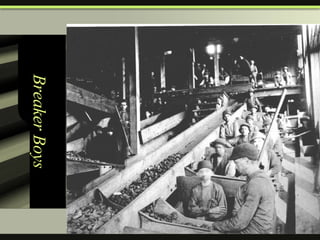
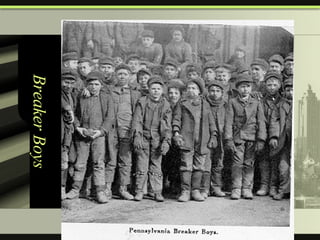
Breaker Boys
Breaker Boys
Charles Dickens Play itunes Dickens
Turn to p. 716 in your textbook. Read the top under “What are Fair Working Conditions?” With your partner, discuss the two questions in the blue box
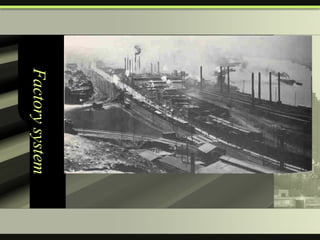
Factory system
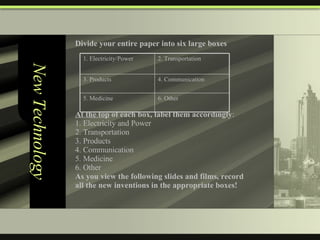
New Technology Divide your entire paper into six large boxes At the top  of each box, label them accordingly : 1. Electricity and Power 2. Transportation 3. Products 4. Communication 5. Medicine 6. Other As you view the following slides and films, record  all the new inventions in the appropriate boxes! 6. Other 5. Medicine 4. Communication 3. Products 2. Transportation 1. Electricity/Power
Into the 20th Century
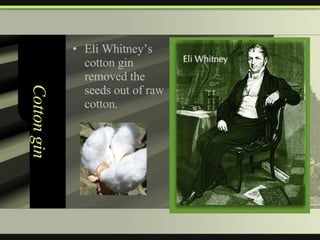
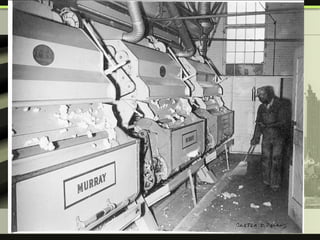
Cotton gin Eli Whitney’s cotton gin removed the seeds out of raw cotton.
 
 
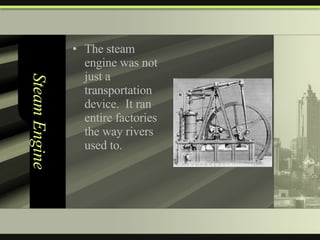
Steam Engine The steam engine was not just a transportation device.  It ran entire factories the way rivers used to.
Improved Transportation
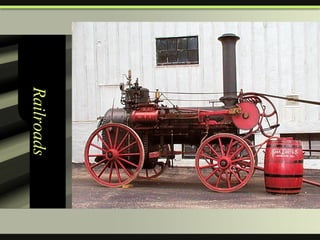
Railroads
 
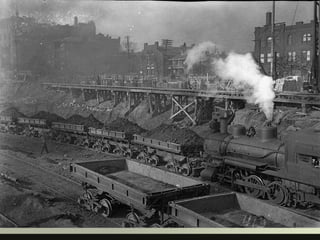
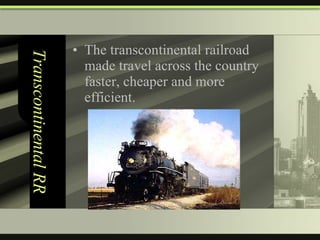
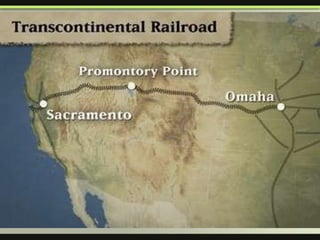
Transcontinental RR The transcontinental railroad made travel across the country faster, cheaper and more efficient.
 
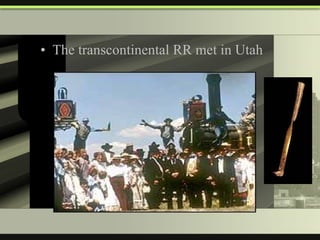
The transcontinental RR met in Utah
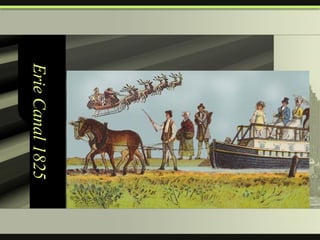
Canals Canals are manmade waterways dug between 2 large bodies of water. The  Erie Canal  was a short cut from the Atlantic Ocean to the Great Lakes.
Erie Canal 1825
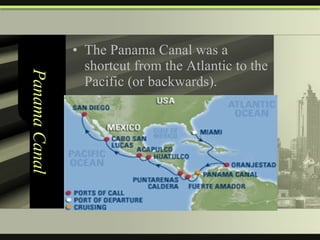
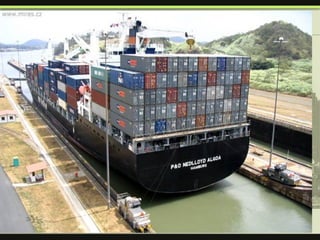
Panama Canal The Panama Canal was a shortcut from the Atlantic to the Pacific (or backwards).
Panama Canal
 
Telegraph Samuel Morse invented the telegraph.  It communicated using a series of beeps (Morse code).
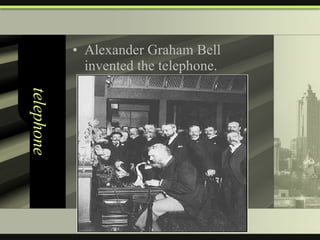
telephone Alexander Graham Bell invented the telephone.
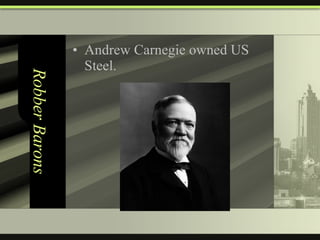
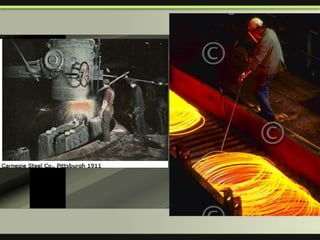
Robber Barons Andrew Carnegie owned US Steel.
 
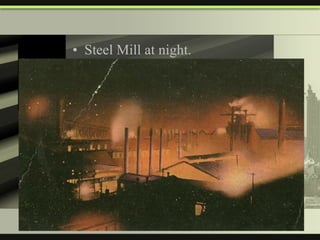
Steel Mill at night.
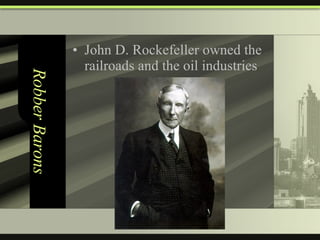
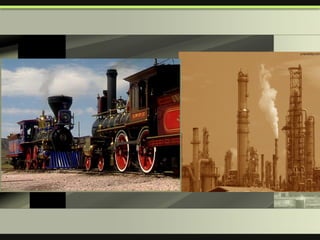
Robber Barons John D. Rockefeller owned the railroads and the oil industries
 
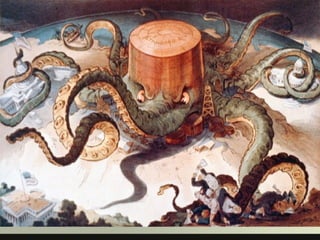
Monopoly Carnegie and Rockefeller ran their competition out of business. A  monopoly  is when one company controls the entire industry.
 
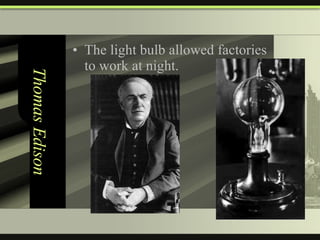
Thomas Edison The light bulb allowed factories to work at night.
Phonograph
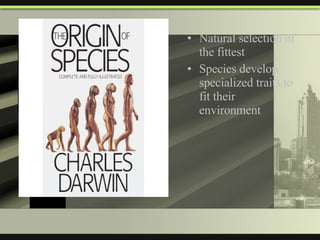
Science 1869-Dmitri Mendeleyev grouped elements according to weight (periodic table) Earth formed over millions of years Charles Darwin (On the Origin of Species)-evolution
Disease Prevention 1870-Louis Pasteur showed link between germs and disease, developed a vaccine for rabies and developed pasteurization 1914- knew yellow fever and malaria were caused by mosquitoes People bathed more 1846-anesthesia  Joseph Lister-insisted surgeons sterilize instruments and wash hands
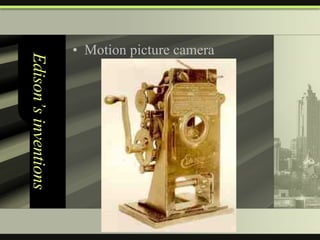
Edison’s inventions Motion picture camera
Efficient industry While some progressives fought industry with labor unions and government regulation, others helped industry by using science in the workplace.
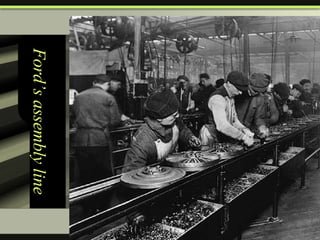
Ford’s assembly line
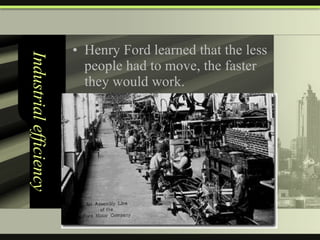
Industrial efficiency Henry Ford learned that the less people had to move, the faster they would work.
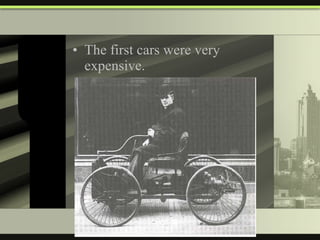
The first cars were very expensive.
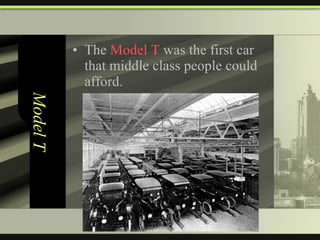
Model T The  Model T  was the first car that middle class people could afford.
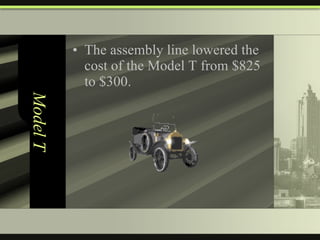
Model T The assembly line lowered the cost of the Model T from $825 to $300.
Philosophical Reactions to Industrialization  Adam Smith Thomas Malthus David Ricardo Charles Darwin Social Darwinism John Stuart Mills Unions Women’s Suffrage Slavery Abolition
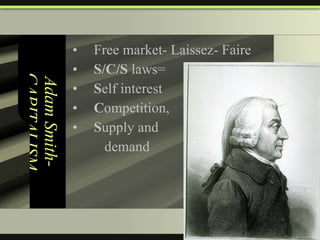
Adam Smith- CAPITALISM Free market- Laissez- Faire S/C/S  laws=  S elf interest C ompetition,  S upply and  demand
Thomas Malthus Population increases faster than the food supply! Malthusian…….. Is this true? When?
“Iron law of wages” David Ricardo  Believed that workers should only be paid enough to survive If they make more, they will only have more children and therefore become poor again or die off from starvation Permanent Underclass (like Malthus)
“Iron law of wages” Workers should be satisfied with their wages because they are maintained at a natural level Leads to the idea that poverty is caused by character flaws in an individual
Natural selection of the fittest Species develop specialized traits to fit their environment
Social Darwinism Separate notion from the biological argument.   Not something Charles Darwin would have likely advocated! Society should allow the weak and less fit to fail and die. Pre-existing prejudices were rationalized by the notion that colonized nations, poor people, or disadvantaged minorities must have deserved their situations because they were “less fit” than those who were better off.  (rationalized colonies and eugenics)
REFORM Brought by the IR Invention of the  steam engine in 1763 by James Watt  shifts labor from humans and animals to machines Inventions continue to make life, manufacturing, and  farming easier  and better Continuous  reinvestment of profits  fuel even greater growth Inventions in one area often led to inventions in others Transportation and communication  systems are greatly enhanced
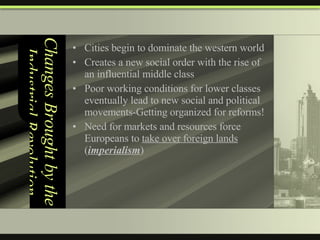
Changes Brought by the Industrial Revolution Cities begin to dominate the western world Creates a new social order with the rise of an influential middle class Poor working conditions for lower classes eventually lead to new social and political movements-Getting organized for reforms! Need for markets and resources force Europeans to  take over foreign lands  ( imperialism )
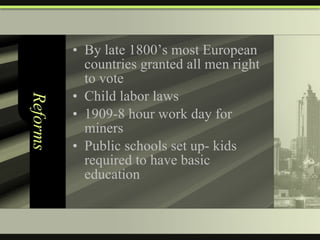
Reforms By late 1800’s most European countries granted all men right to vote Child labor laws 1909-8 hour work day for miners Public schools set up- kids required to have basic education
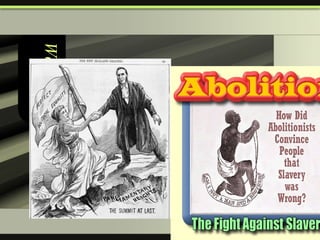
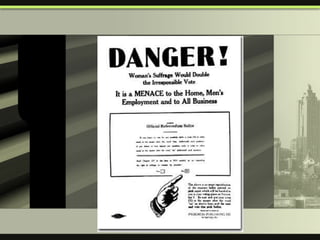
Women’s Suffrage and Slavery Abolition
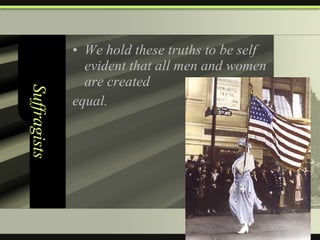
Suffragists We hold these truths to be self evident that all men and women are created  equal.
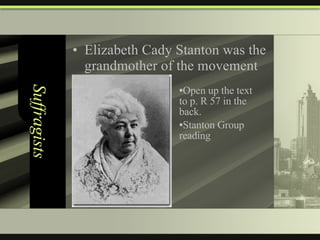
Suffragists Elizabeth Cady Stanton was the grandmother of the movement Open up the text to p. R 57 in the back.  Stanton Group reading
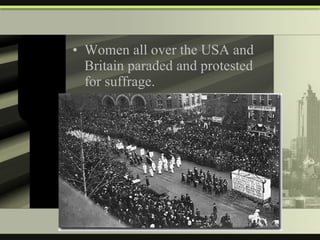
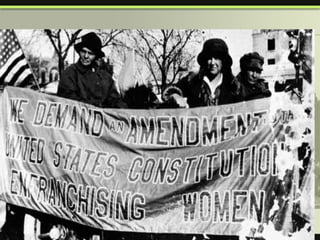
Women all over the USA and Britain paraded and protested for suffrage.
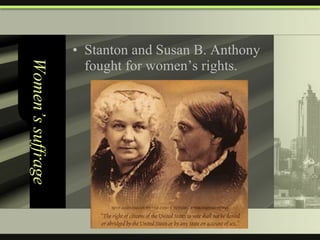
Women’s suffrage Stanton and Susan B. Anthony fought for women’s rights.
 
 
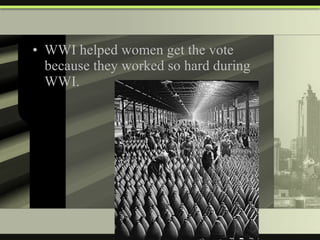
WWI helped women get the vote because they worked so hard during WWI.
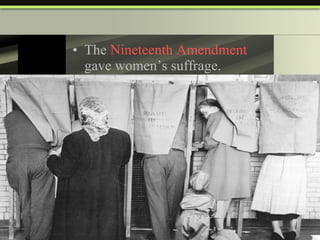
The  Nineteenth Amendment  gave women’s suffrage.
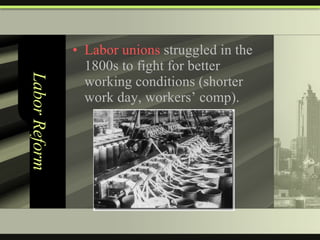
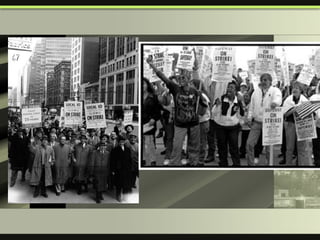
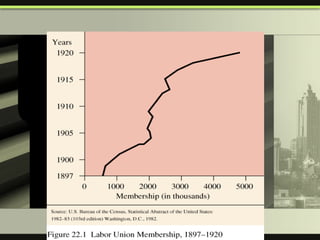
Labor Reform Labor unions  struggled in the 1800s to fight for better working conditions (shorter work day, workers’ comp).
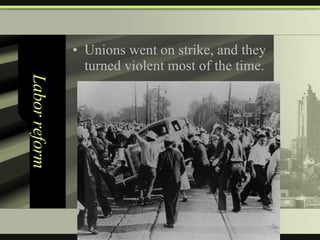
Labor reform Unions went on strike, and they turned violent most of the time.
 
 
Workers Strike
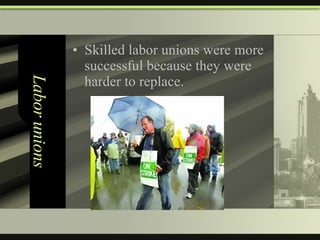
Labor unions Skilled labor unions were more successful because they were harder to replace.
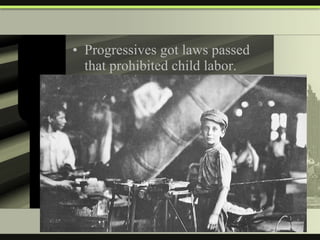
Progressives got laws passed that prohibited child labor.
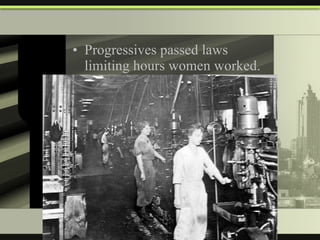
Progressives passed laws limiting hours women worked.
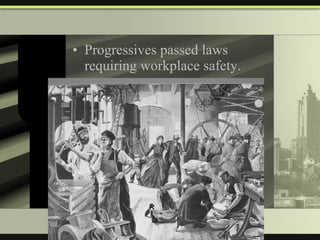
Progressives passed laws requiring workplace safety.
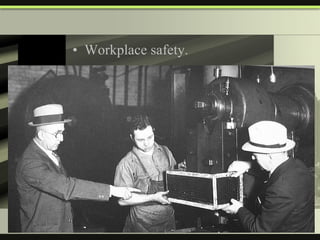
Workplace safety.
Rise of Socialism Critics of the Industrial Revolution began advocating for a  more even distribution of the wealth. Utilitarianism-  government needed only to create greatest good for greatest number of people. John Stuart Mills- Questioned unregulated capitalism More reforms in legal system and education
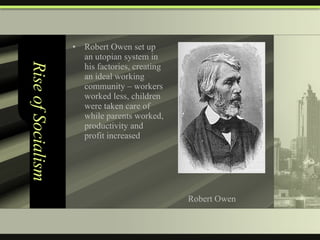
Rise of Socialism Robert Owen set up an utopian system in his factories, creating an ideal working community – workers worked less, children were taken care of while parents worked, productivity and profit increased Robert Owen
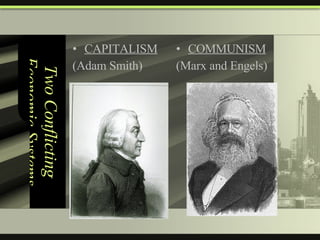
Two Conflicting Economic Systems CAPITALISM (Adam Smith) COMMUNISM (Marx and Engels)
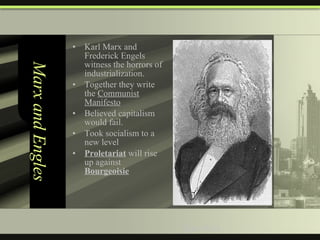
Marx and Engles Karl Marx and Frederick Engels witness the horrors of industrialization. Together they write the  Communist Manifesto Believed capitalism would fail.  Took socialism to a new level Proletariat  will rise up against  Bourgeoisie Karl Marx
Marx and Engels Proletarian cry for justice against the growing bourgeoisie: “  The proletarians have nothing to lose but their chains. They have a world to win. Workingmen of all countries, unite !”
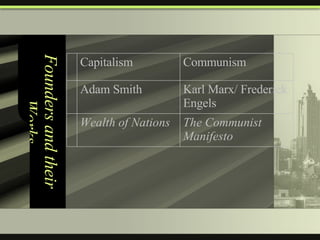
Founders and their Works The Communist Manifesto Wealth of Nations Karl Marx/ Frederick Engels Adam Smith Communism Capitalism
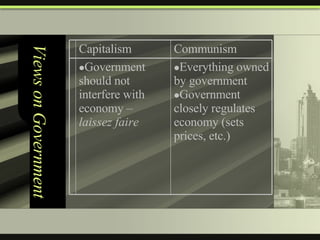
Views on Government Communism Capitalism  Everything owned by government Government closely regulates economy (sets prices, etc.) Government should not interfere with economy –  laissez faire
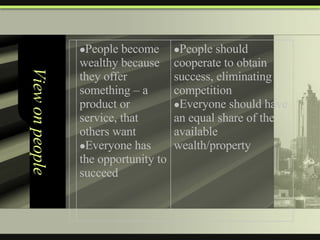
View on people People should cooperate to obtain success, eliminating competition Everyone should have an equal share of the available wealth/property People become wealthy because they offer something – a product or service, that others want Everyone has the opportunity to succeed
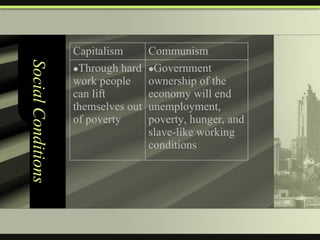
Social Conditions Government ownership of the economy will end unemployment, poverty, hunger, and slave-like working conditions Through hard work people can lift themselves out of poverty Communism Capitalism
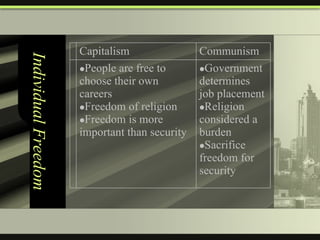
Individual Freedom Government determines job placement Religion considered a burden Sacrifice freedom for security People are free to choose their own careers Freedom of religion Freedom is more important than security Communism Capitalism
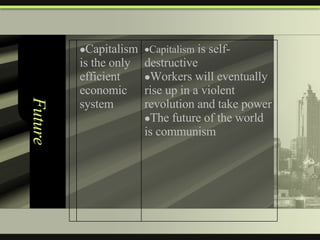
Future Capitalism  is self-destructive Workers will eventually rise up in a violent revolution and take power The future of the world is communism Capitalism is the only efficient economic system

Industrial Revolution

  • 1.
    Industrial Revolution ByJ. Collins/ D McDowell/ A. Anders
  • 2.
    Industrial Revolution TheIR is when people stopped making stuff at home and started making products in factories.
  • 3.
  • 4.
    On the FarmFarm life difficult, but cyclical Homes built and maintained by farmer and family Intense periods of work during planting and harvesting seasons with slower work schedule in between Daily schedule set by work load, daylight, farmer’s ambition
  • 5.
    Agrarian (Agricultural) RevolutionDraw two large rectangles divided into nine squares each. Each one of these symbolizes a field of nine different crops. *In the first rectangle, *In the second, put an draw crops in each square X in any three of the boxes Draw crops in the remaining squares Now make a little fence around the entire fields of the rectangle with the Xes. X X X
  • 6.
    Agricultural Revolution – New farming methods invented Lord Townshend in England introduced crop rotation – land could now be used year-round; certain crops revitalized soil Enclosure movement had large land owners buying and then fencing public land
  • 7.
    Shift AWAY from Agrarian Movement Smaller farmers pushed off of land to work as wage laborers for various land owners or to move to the growing cities (urbanization) More food produced = population increase In 1700 there were about 100 million people in Europe, by 1800 the population had grown to 190 million.
  • 8.
    Review What wasthe agrarian or agricultural revolution?
  • 9.
    Why did theIR begin in Great Britain? Rise of science Increasing productivity in agriculture Expanding population Merchant tradition- entrepreneurial spirit capitalist philosophy (Adam Smith!) Geography Coal and iron deposits Navigable rivers Natural harbors Island location Global trading, slave labor, gold & silver of the New World- COLONIES (in America, Africa, India) State-supported economic development Constitutionalism; Locke’s philosophy (property!)
  • 10.
  • 11.
    Britain Industrializes First 1715-1850 Many natural resources available in Britain, including large amounts of coal and iron
  • 12.
    Britain Industrializes FirstGeographical advantages include a large river system for water power and many natural harbors for easy trade A strong, stable government allowed a strong, stable economy to develop which resulted in extra money to invest
  • 13.
    Britain Industrializes FirstColonial empire provided much needed raw materials and markets Spreads to continental Europe, United States of America, and Japan between 1850 and 1914
  • 14.
    Slavery England dominatedslave trade 1690-1807 in Atlantic Transported 1.7 million slaves to West Indies (Caribbean area) for plantations on their COLONIES Abolished first in UK and later in US with Emancipation Proclamation 1863
  • 15.
    Urbanization Growth largelyunplanned leading to numerous sanitary and social problems Typhoid and cholera epidemics swept through the cities Families lived in tiny, dirty, rat-infested, crime-infested, disease-ridden housing communities
  • 16.
  • 17.
    Labor Changes Dramaticchanges in work patterns occur in the factories Concept of time introduced to work, people arrive at factory at specific time, work for pre-set number of hours – “Time was money”
  • 18.
  • 19.
  • 20.
  • 21.
  • 22.
    Pull factors Immigrantscome to the USA for jobs and opportunities.
  • 23.
    Pull factors aregood stuff to bring immigrants here like jobs.
  • 24.
  • 25.
    Free land wasa pull factor
  • 26.
    Push factors Pushfactors are bad stuff to push immigrants away like war or disease. This is potato famine.
  • 27.
    Many immigrants livedin tenements.
  • 28.
  • 29.
    URBANIZATION These advancementsresulted in the movement of work from the home to the factory Move from country to city for opportunities
  • 30.
    Child labor Manyimmigrants put their children to work ASAP.
  • 31.
  • 32.
    Small Bodies 1Shilling a Week
  • 33.
  • 34.
  • 35.
    Child labor Coalminer boys
  • 36.
  • 37.
    Deep in theCoal Mines
  • 38.
    Girls were preferredover boys. They were paid less, had smaller hands.
  • 39.
    Child Labor Parliament in GB begins to investigate! They hold hearings, calling in witnesses. Primary Document Reading
  • 40.
  • 41.
  • 42.
    Charles Dickens Playitunes Dickens
  • 43.
    Turn to p.716 in your textbook. Read the top under “What are Fair Working Conditions?” With your partner, discuss the two questions in the blue box
  • 44.
  • 45.
    New Technology Divideyour entire paper into six large boxes At the top of each box, label them accordingly : 1. Electricity and Power 2. Transportation 3. Products 4. Communication 5. Medicine 6. Other As you view the following slides and films, record all the new inventions in the appropriate boxes! 6. Other 5. Medicine 4. Communication 3. Products 2. Transportation 1. Electricity/Power
  • 46.
  • 47.
    Cotton gin EliWhitney’s cotton gin removed the seeds out of raw cotton.
  • 48.
  • 49.
  • 50.
    Steam Engine Thesteam engine was not just a transportation device. It ran entire factories the way rivers used to.
  • 51.
  • 52.
  • 53.
  • 54.
    Transcontinental RR Thetranscontinental railroad made travel across the country faster, cheaper and more efficient.
  • 55.
  • 56.
  • 57.
    Canals Canals aremanmade waterways dug between 2 large bodies of water. The Erie Canal was a short cut from the Atlantic Ocean to the Great Lakes.
  • 58.
  • 59.
    Panama Canal ThePanama Canal was a shortcut from the Atlantic to the Pacific (or backwards).
  • 60.
  • 61.
  • 62.
    Telegraph Samuel Morseinvented the telegraph. It communicated using a series of beeps (Morse code).
  • 63.
    telephone Alexander GrahamBell invented the telephone.
  • 64.
    Robber Barons AndrewCarnegie owned US Steel.
  • 65.
  • 66.
  • 67.
    Robber Barons JohnD. Rockefeller owned the railroads and the oil industries
  • 68.
  • 69.
    Monopoly Carnegie andRockefeller ran their competition out of business. A monopoly is when one company controls the entire industry.
  • 70.
  • 71.
    Thomas Edison Thelight bulb allowed factories to work at night.
  • 72.
  • 73.
    Science 1869-Dmitri Mendeleyevgrouped elements according to weight (periodic table) Earth formed over millions of years Charles Darwin (On the Origin of Species)-evolution
  • 74.
    Disease Prevention 1870-LouisPasteur showed link between germs and disease, developed a vaccine for rabies and developed pasteurization 1914- knew yellow fever and malaria were caused by mosquitoes People bathed more 1846-anesthesia Joseph Lister-insisted surgeons sterilize instruments and wash hands
  • 75.
  • 76.
    Efficient industry Whilesome progressives fought industry with labor unions and government regulation, others helped industry by using science in the workplace.
  • 77.
  • 78.
    Industrial efficiency HenryFord learned that the less people had to move, the faster they would work.
  • 79.
    The first carswere very expensive.
  • 80.
    Model T The Model T was the first car that middle class people could afford.
  • 81.
    Model T Theassembly line lowered the cost of the Model T from $825 to $300.
  • 82.
    Philosophical Reactions toIndustrialization Adam Smith Thomas Malthus David Ricardo Charles Darwin Social Darwinism John Stuart Mills Unions Women’s Suffrage Slavery Abolition
  • 83.
    Adam Smith- CAPITALISMFree market- Laissez- Faire S/C/S laws= S elf interest C ompetition, S upply and demand
  • 84.
    Thomas Malthus Populationincreases faster than the food supply! Malthusian…….. Is this true? When?
  • 85.
    “Iron law ofwages” David Ricardo Believed that workers should only be paid enough to survive If they make more, they will only have more children and therefore become poor again or die off from starvation Permanent Underclass (like Malthus)
  • 86.
    “Iron law ofwages” Workers should be satisfied with their wages because they are maintained at a natural level Leads to the idea that poverty is caused by character flaws in an individual
  • 87.
    Natural selection ofthe fittest Species develop specialized traits to fit their environment
  • 88.
    Social Darwinism Separatenotion from the biological argument. Not something Charles Darwin would have likely advocated! Society should allow the weak and less fit to fail and die. Pre-existing prejudices were rationalized by the notion that colonized nations, poor people, or disadvantaged minorities must have deserved their situations because they were “less fit” than those who were better off. (rationalized colonies and eugenics)
  • 89.
    REFORM Brought bythe IR Invention of the steam engine in 1763 by James Watt shifts labor from humans and animals to machines Inventions continue to make life, manufacturing, and farming easier and better Continuous reinvestment of profits fuel even greater growth Inventions in one area often led to inventions in others Transportation and communication systems are greatly enhanced
  • 90.
    Changes Brought bythe Industrial Revolution Cities begin to dominate the western world Creates a new social order with the rise of an influential middle class Poor working conditions for lower classes eventually lead to new social and political movements-Getting organized for reforms! Need for markets and resources force Europeans to take over foreign lands ( imperialism )
  • 91.
    Reforms By late1800’s most European countries granted all men right to vote Child labor laws 1909-8 hour work day for miners Public schools set up- kids required to have basic education
  • 92.
    Women’s Suffrage andSlavery Abolition
  • 93.
    Suffragists We holdthese truths to be self evident that all men and women are created equal.
  • 94.
    Suffragists Elizabeth CadyStanton was the grandmother of the movement Open up the text to p. R 57 in the back. Stanton Group reading
  • 95.
    Women all overthe USA and Britain paraded and protested for suffrage.
  • 96.
    Women’s suffrage Stantonand Susan B. Anthony fought for women’s rights.
  • 97.
  • 98.
  • 99.
    WWI helped womenget the vote because they worked so hard during WWI.
  • 100.
    The NineteenthAmendment gave women’s suffrage.
  • 101.
    Labor Reform Laborunions struggled in the 1800s to fight for better working conditions (shorter work day, workers’ comp).
  • 102.
    Labor reform Unionswent on strike, and they turned violent most of the time.
  • 103.
  • 104.
  • 105.
  • 106.
    Labor unions Skilledlabor unions were more successful because they were harder to replace.
  • 107.
    Progressives got lawspassed that prohibited child labor.
  • 108.
    Progressives passed lawslimiting hours women worked.
  • 109.
    Progressives passed lawsrequiring workplace safety.
  • 110.
  • 111.
    Rise of SocialismCritics of the Industrial Revolution began advocating for a more even distribution of the wealth. Utilitarianism- government needed only to create greatest good for greatest number of people. John Stuart Mills- Questioned unregulated capitalism More reforms in legal system and education
  • 112.
    Rise of SocialismRobert Owen set up an utopian system in his factories, creating an ideal working community – workers worked less, children were taken care of while parents worked, productivity and profit increased Robert Owen
  • 113.
    Two Conflicting EconomicSystems CAPITALISM (Adam Smith) COMMUNISM (Marx and Engels)
  • 114.
    Marx and EnglesKarl Marx and Frederick Engels witness the horrors of industrialization. Together they write the Communist Manifesto Believed capitalism would fail. Took socialism to a new level Proletariat will rise up against Bourgeoisie Karl Marx
  • 115.
    Marx and EngelsProletarian cry for justice against the growing bourgeoisie: “ The proletarians have nothing to lose but their chains. They have a world to win. Workingmen of all countries, unite !”
  • 116.
    Founders and theirWorks The Communist Manifesto Wealth of Nations Karl Marx/ Frederick Engels Adam Smith Communism Capitalism
  • 117.
    Views on GovernmentCommunism Capitalism Everything owned by government Government closely regulates economy (sets prices, etc.) Government should not interfere with economy – laissez faire
  • 118.
    View on peoplePeople should cooperate to obtain success, eliminating competition Everyone should have an equal share of the available wealth/property People become wealthy because they offer something – a product or service, that others want Everyone has the opportunity to succeed
  • 119.
    Social Conditions Governmentownership of the economy will end unemployment, poverty, hunger, and slave-like working conditions Through hard work people can lift themselves out of poverty Communism Capitalism
  • 120.
    Individual Freedom Governmentdetermines job placement Religion considered a burden Sacrifice freedom for security People are free to choose their own careers Freedom of religion Freedom is more important than security Communism Capitalism
  • 121.
    Future Capitalism is self-destructive Workers will eventually rise up in a violent revolution and take power The future of the world is communism Capitalism is the only efficient economic system