THE INDUSTRIAL
REVOLUTION
CHAPTER 23: INDUSTRIALIZATION AND
NATIONALISM
LESSON 1
I. A REVOLUTION IN
AGRICULTURE
THE INDUSTRIAL
REVOLUTION IN GREAT
BRITAIN
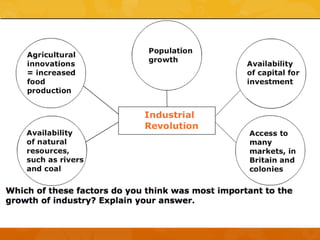
What was the
significance of the
Agricultural Revolution
in Great Britain? Why did
the Industrial Revolution
start in Great Britain?
Enclosure Movement of the 1700s
Enclosure laws allowed landowners to fence off land formerly used as
common pasture. The map on the left shows a British farming area in 1700;
the shaded areas are common pastures. The map on the right shows the
same area in 1800, with the common pastures eliminated by fences.
Enclosure Movement of the 1700s
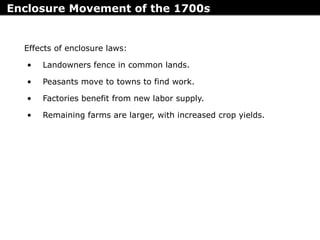
Effects of enclosure laws:
• Landowners fence in common lands.
• Peasants move to towns to find work.
• Factories benefit from new labor supply.
• Remaining farms are larger, with increased crop yields.
• During the Middle Ages and after the Black Death,
most of Europe went through an agricultural
recession.
• There were few innovations in technique, and
production remained constant.
• An open-field system was in place: Large plots of
land had been cleared and divided into long strips
owned by different farmers.
• Often, a farmer's lands were discontinuous and
scattered.
• After the harvest had occurred, the communal fields
were available to all for grazing sheep or other
livestock on a free-range basis.
• The enclosure laws restricted the use of these fields,
allowing the construction of fences or hedgerows
that prevented communal grazing.
• This practice began during the creation of large
estates by the lords of manors.
• Eventually, enclosure led to more efficient and
profitable farming, free of the regulations that
governed the open-field system.
THE AGRICULTURAL REVOLUTION
• ADVANCES IN FARMING
• ENCLOSURE MOVEMENT
HOW WOULD LACK OF ACCESS
TO COMMON LANDS HAVE
CHANGED THE WAY FARMERS
LIVED?
II. CHANGES IN THE
COTTON INDUSTRY
“COTTAGE INDUSTRIES”
• In the Middle Ages, urban guilds controlled small-
scale manufacturing by artisans.
• Entrepreneurs used rural workers, who were supplied
with raw materials and did the work for less pay.
• This allowed rural families to have added income,
marry younger, and have more children.
• The work also provided a source of income to offset
bad harvests, and it prepared workers for the types
of tasks that would be found later in factories.
CHANGES IN THE COTTON
INDUSTRY
• SPINNING JENNYS AND STEM
ENGINES
• THE FIRST FACTORIES
III. COAL AND IRON,
RAILROADS, AND
FACTORIES
Inventions of the Industrial Revolution
• Puddling
o Produced bar iron without hammering
o Faster production and better quality
• Steam engine
o Transformed transportation and
agriculture
o With James Watt’s improvements,
enabled to drive machinery
COAL, IRON, AND RAILROADS
• COAL USED TO POWER
STEAM ENGINES
• IMPROVEMENTS IN IRON
PRODUCTION
• RAILROADS REVOLUTIONIZE
TRANSPORTATION
What connections can you see
among the advances in iron
production and the
development of railroads?
JOURNAL QUESTION #2
Why was an unfailing source
of power one of the keys to the
Industrial Revolution?
THE INDUSTRIAL
REVOLUTION
CHAPTER 23: INDUSTRIALIZATION AND
NATIONALISM
LESSON 1
JOURNAL QUESTION #1
How are the subjects of the
previous day's homework and
the cartoon related?
I. INDUSTRIALIZATION
ELSEWHERE
THE SPREAD OF
INDUSTRIALIZATION
WHAT FACTORS FED THE SPREAD OF
INDUSTRIALIZATION IN EUROPE AND
NORTH AMERICA?
Spread of Industrialization to Europe and North America
• Spread first to countries whose governments
were ready for it: Belgium, France, Germany
• Spread in America once population moved to
cities from farms
• Railway system was key factor in both
Europe and United States
SPREAD OF INDUSTRIALIZATION
• SUPPORT FROM EUROPEAN
GOVERNMENTS
• INDUSTRIALIZATION OF THE U.S.
WHAT TYPE OF ASSISTANCE
COULD A GOVERNMENT PROVIDE
TO ENCOURAGE
INDUSTRIALIZATION?
II. SOCIAL IMPACT
SOCIAL IMPACT OF
INDUSTRIALIZATION
WHAT WAS THE SOCIAL IMPACT OF
INDUSTRIALIZATION IN EUROPE?
Famine and Immigration
• Famine and poverty caused many people in
Europe to move to different countries in search
of a better life.
• A potato famine in Ireland killed a million
people and caused a million more to emigrate
to the United States.
• Other Europeans emigrated to large cities in
other countries, believing that industrialization
brought new economic opportunities.
Early Socialist Utopia
Proposed design for Robert Ower's utopian community
at New Harmony, Indiana
Early Socialist Utopia
Krupp factory in Essen, Germany
Early Socialist Utopia
• Wealth could be distributed evenly if government
controlled factory production.
• Everyone’s basic needs—food, shelter, clothing—
would be met.
• Workers would be fulfilled by using their skills.
What ideals were the early socialists striving for?
Chapter 23 Lesson 1

Chapter 23 Lesson 1

  • 1.
    THE INDUSTRIAL REVOLUTION CHAPTER 23:INDUSTRIALIZATION AND NATIONALISM LESSON 1
  • 3.
    I. A REVOLUTIONIN AGRICULTURE THE INDUSTRIAL REVOLUTION IN GREAT BRITAIN
  • 4.
    What was the significanceof the Agricultural Revolution in Great Britain? Why did the Industrial Revolution start in Great Britain?
  • 5.
    Enclosure Movement ofthe 1700s Enclosure laws allowed landowners to fence off land formerly used as common pasture. The map on the left shows a British farming area in 1700; the shaded areas are common pastures. The map on the right shows the same area in 1800, with the common pastures eliminated by fences.
  • 6.
    Enclosure Movement ofthe 1700s Effects of enclosure laws: • Landowners fence in common lands. • Peasants move to towns to find work. • Factories benefit from new labor supply. • Remaining farms are larger, with increased crop yields.
  • 7.
    • During theMiddle Ages and after the Black Death, most of Europe went through an agricultural recession. • There were few innovations in technique, and production remained constant. • An open-field system was in place: Large plots of land had been cleared and divided into long strips owned by different farmers. • Often, a farmer's lands were discontinuous and scattered. • After the harvest had occurred, the communal fields were available to all for grazing sheep or other livestock on a free-range basis.
  • 8.
    • The enclosurelaws restricted the use of these fields, allowing the construction of fences or hedgerows that prevented communal grazing. • This practice began during the creation of large estates by the lords of manors. • Eventually, enclosure led to more efficient and profitable farming, free of the regulations that governed the open-field system.
  • 9.
    THE AGRICULTURAL REVOLUTION •ADVANCES IN FARMING • ENCLOSURE MOVEMENT HOW WOULD LACK OF ACCESS TO COMMON LANDS HAVE CHANGED THE WAY FARMERS LIVED?
  • 10.
    II. CHANGES INTHE COTTON INDUSTRY
  • 11.
  • 12.
  • 13.
    • In theMiddle Ages, urban guilds controlled small- scale manufacturing by artisans. • Entrepreneurs used rural workers, who were supplied with raw materials and did the work for less pay. • This allowed rural families to have added income, marry younger, and have more children. • The work also provided a source of income to offset bad harvests, and it prepared workers for the types of tasks that would be found later in factories.
  • 14.
    CHANGES IN THECOTTON INDUSTRY • SPINNING JENNYS AND STEM ENGINES • THE FIRST FACTORIES
  • 16.
    III. COAL ANDIRON, RAILROADS, AND FACTORIES
  • 17.
    Inventions of theIndustrial Revolution • Puddling o Produced bar iron without hammering o Faster production and better quality • Steam engine o Transformed transportation and agriculture o With James Watt’s improvements, enabled to drive machinery
  • 18.
    COAL, IRON, ANDRAILROADS • COAL USED TO POWER STEAM ENGINES • IMPROVEMENTS IN IRON PRODUCTION • RAILROADS REVOLUTIONIZE TRANSPORTATION
  • 19.
    What connections canyou see among the advances in iron production and the development of railroads?
  • 20.
    JOURNAL QUESTION #2 Whywas an unfailing source of power one of the keys to the Industrial Revolution?
  • 22.
    THE INDUSTRIAL REVOLUTION CHAPTER 23:INDUSTRIALIZATION AND NATIONALISM LESSON 1
  • 24.
    JOURNAL QUESTION #1 Howare the subjects of the previous day's homework and the cartoon related?
  • 25.
    I. INDUSTRIALIZATION ELSEWHERE THE SPREADOF INDUSTRIALIZATION WHAT FACTORS FED THE SPREAD OF INDUSTRIALIZATION IN EUROPE AND NORTH AMERICA?
  • 26.
    Spread of Industrializationto Europe and North America • Spread first to countries whose governments were ready for it: Belgium, France, Germany • Spread in America once population moved to cities from farms • Railway system was key factor in both Europe and United States
  • 27.
    SPREAD OF INDUSTRIALIZATION •SUPPORT FROM EUROPEAN GOVERNMENTS • INDUSTRIALIZATION OF THE U.S. WHAT TYPE OF ASSISTANCE COULD A GOVERNMENT PROVIDE TO ENCOURAGE INDUSTRIALIZATION?
  • 28.
    II. SOCIAL IMPACT SOCIALIMPACT OF INDUSTRIALIZATION WHAT WAS THE SOCIAL IMPACT OF INDUSTRIALIZATION IN EUROPE?
  • 29.
    Famine and Immigration •Famine and poverty caused many people in Europe to move to different countries in search of a better life. • A potato famine in Ireland killed a million people and caused a million more to emigrate to the United States. • Other Europeans emigrated to large cities in other countries, believing that industrialization brought new economic opportunities.
  • 30.
    Early Socialist Utopia Proposeddesign for Robert Ower's utopian community at New Harmony, Indiana
  • 31.
    Early Socialist Utopia Kruppfactory in Essen, Germany
  • 32.
    Early Socialist Utopia •Wealth could be distributed evenly if government controlled factory production. • Everyone’s basic needs—food, shelter, clothing— would be met. • Workers would be fulfilled by using their skills. What ideals were the early socialists striving for?