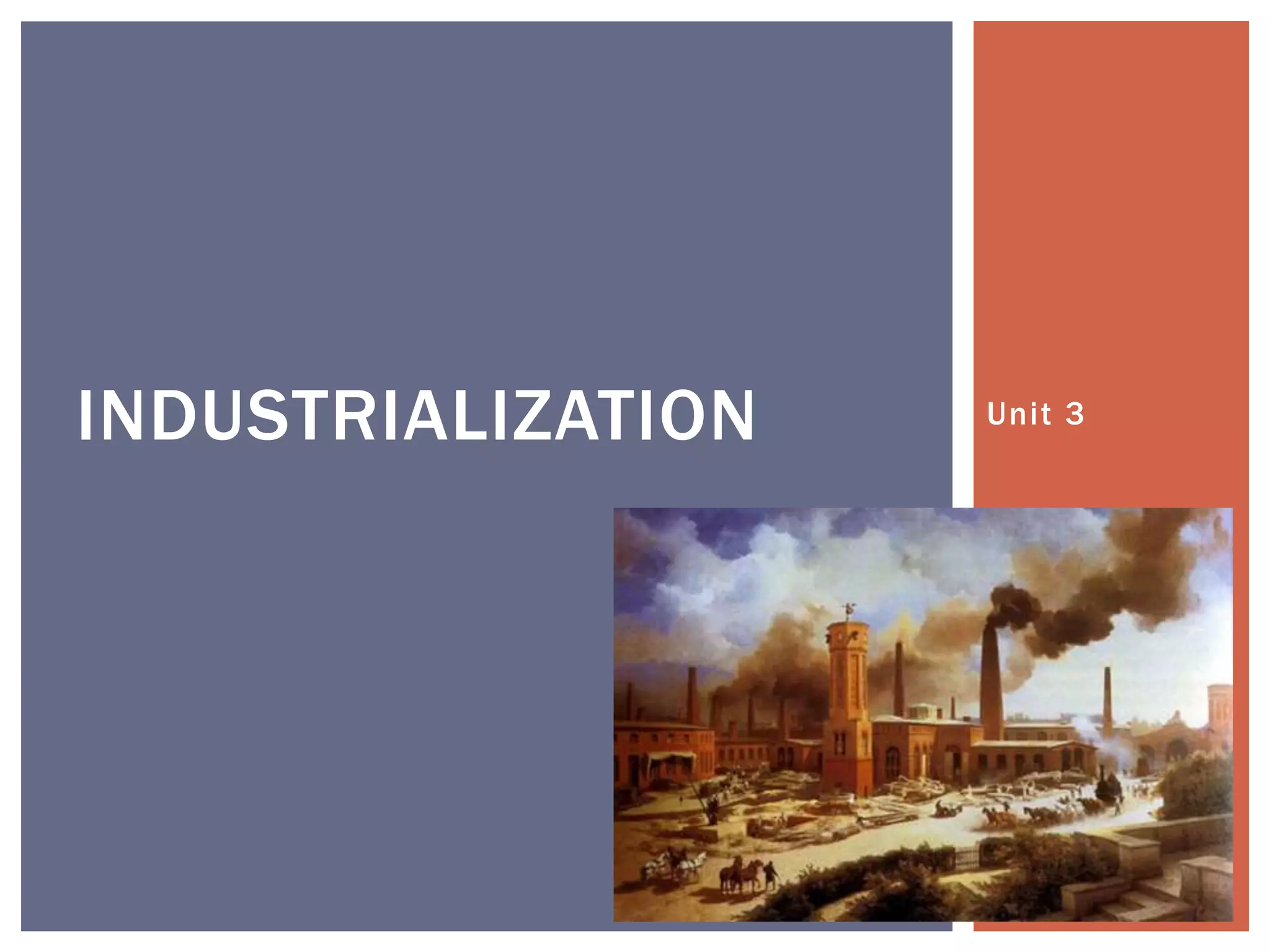
Unit 3INDUSTRIALIZATION
BEGINNINGS OF
INDUSTRIALIZATION
Section 1
Beginnings of Industrialization
• Industrial Revolution transformed how people
worked
• Machines replaced animal and human power to
produce goods
• Began in England and spread to the rest of Europe
and the United States by the middle of the 1800’s
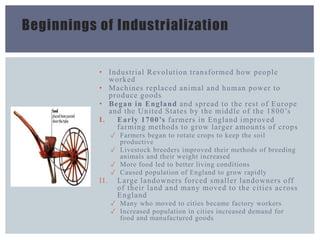
I. Early 1700’s farmers in England improved
farming methods to grow larger amounts of crops
✓ Farmers began to rotate crops to keep the soil
productive
✓ Livestock breeders improved their methods of breeding
animals and their weight increased
✓ More food led to better living conditions
✓ Caused population of England to grow rapidly
II. Large landowners forced smaller landowners off
of their land and many moved to the cities across
England
✓ Many who moved to cities became factory workers
✓ Increased population in cities increased demand for
food and manufactured goods
Beginnings of Industrialization
Why the Industrial Revolution began in England
I. Extensive natural resources
• Coal
• Iron ore
• Rivers for transporting goods
II. Expanding economy
• Developed banking system made it easy to borrow money
to improve industry
III. Over seas colonies and trading partners supported
by the most powerful navy in the world
IV. Parliament passed laws to encourage and protect
businesses
V. Had all of the factors of production (land, labor,
capital or wealth)
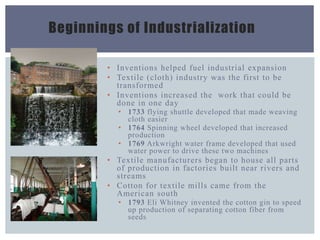
Beginnings of Industrialization
• Inventions helped fuel industrial expansion
• Textile (cloth) industry was the first to be
transformed
• Inventions increased the work that could be
done in one day
• 1733 flying shuttle developed that made weaving
cloth easier
• 1764 Spinning wheel developed that increased
production
• 1769 Arkwright water frame developed that used
water power to drive these two machines
• Textile manufacturers began to house all parts
of production in factories built near rivers and
streams
• Cotton for textile mills came from the
American south
• 1793 Eli Whitney invented the cotton gin to speed
up production of separating cotton fiber from
seeds
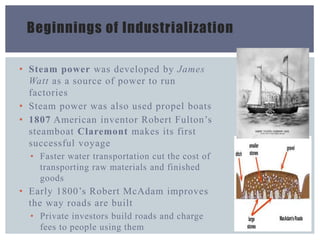
Beginnings of Industrialization
• Steam power was developed by James
Watt as a source of power to run
factories
• Steam power was also used propel boats
• 1807 American inventor Robert Fulton’s
steamboat Claremont makes its first
successful voyage
• Faster water transportation cut the cost of
transporting raw materials and finished
goods
• Early 1800’s Robert McAdam improves
the way roads are built
• Private investors build roads and charge
fees to people using them
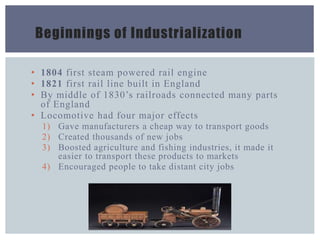
Beginnings of Industrialization
• 1804 first steam powered rail engine
• 1821 first rail line built in England
• By middle of 1830’s railroads connected many parts
of England
• Locomotive had four major effects
1) Gave manufacturers a cheap way to transport goods
2) Created thousands of new jobs
3) Boosted agriculture and fishing industries, it made it
easier to transport these products to markets
4) Encouraged people to take distant city jobs
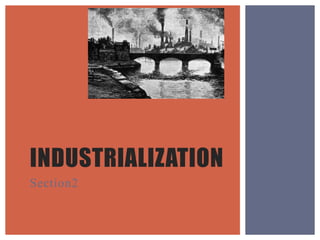
INDUSTRIALIZATION
Section2
Industrialization
• Industrialization led to an increased standard of
living, people had better clothes, better food and
earned higher wages in factories than on farms.
• Change to machine production caused human
suffering when it first began
• Rapid industrialization caused unhealthy living
conditions, child labor abuse and led to class tension
• After 1800 balance of population in Europe was
moving to cities (urbanization)
• 1800-1850 the number of cities with more than 100,000
people went from 22 to 47
• Most urban areas doubled in size
Industrialization
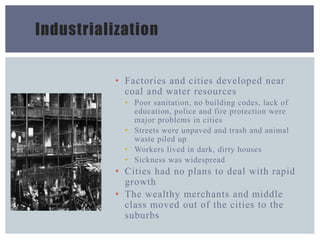
• Factories and cities developed near
coal and water resources
• Poor sanitation, no building codes, lack of
education, police and fire protection were
major problems in cities
• Streets were unpaved and trash and animal
waste piled up
• Workers lived in dark, dirty houses
• Sickness was widespread
• Cities had no plans to deal with rapid
growth
• The wealthy merchants and middle
class moved out of the cities to the
suburbs
Industrialization
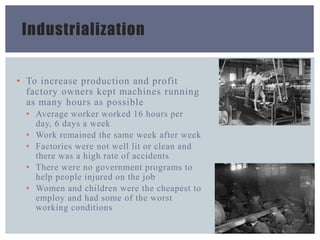
• To increase production and profit
factory owners kept machines running
as many hours as possible
• Average worker worked 16 hours per
day, 6 days a week
• Work remained the same week after week
• Factories were not well lit or clean and
there was a high rate of accidents
• There were no government programs to
help people injured on the job
• Women and children were the cheapest to
employ and had some of the worst
working conditions
Industrialization
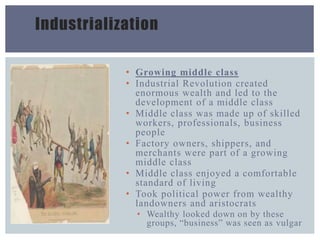
• Growing middle class
• Industrial Revolution created
enormous wealth and led to the
development of a middle class
• Middle class was made up of skilled
workers, professionals, business
people
• Factory owners, shippers, and
merchants were part of a growing
middle class
• Middle class enjoyed a comfortable
standard of living
• Took political power from wealthy
landowners and aristocrats
• Wealthy looked down on by these
groups, “business” was seen as vulgar
Industrialization
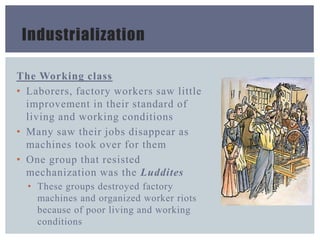
The Working class
• Laborers, factory workers saw little
improvement in their standard of
living and working conditions
• Many saw their jobs disappear as
machines took over for them
• One group that resisted
mechanization was the Luddites
• These groups destroyed factory
machines and organized worker riots
because of poor living and working
conditions
Industrialization
Positive Effects of the Industrial Revolution
A. Created jobs for workers
• Demand for engineers and managers increased
B. Created wealth for the nation
• Created tax revenue that allowed cities and countries to improve
urban areas
C. Allowed for technological progress and invention
D. Raised the standard of living, provided hope for
improvement in peoples lives
• Better food
• Better educational opportunities
• Created cheaper mass produced goods
E. Laborers eventually won better wages and working
conditions after they formed labor unions
INDUSTRIALIZATION
SPREADS
Section 3
Industrialization Spreads
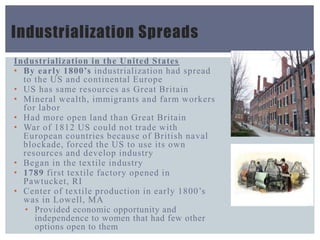
Industrialization in the United States
• By early 1800’s industrialization had spread
to the US and continental Europe
• US has same resources as Great Britain
• Mineral wealth, immigrants and farm workers
for labor
• Had more open land than Great Britain
• War of 1812 US could not trade with
European countries because of British naval
blockade, forced the US to use its own
resources and develop industry
• Began in the textile industry
• 1789 first textile factory opened in
Pawtucket, RI
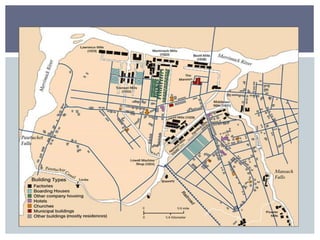
• Center of textile production in early 1800’s
was in Lowell, MA
• Provided economic opportunity and
independence to women that had few other
options open to them
Industrialization Spreads
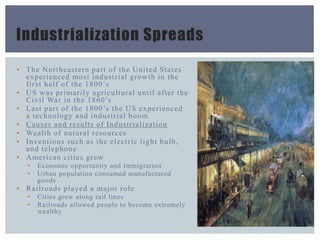
▪ The Northeastern part of the United States
experienced most industrial growth in the
first half of the 1800’s
▪ US was primarily agricultural until after the
Civil War in the 1860’s
▪ Last part of the 1800’s the US experienced
a technology and industrial boom
▪ Causes and results of Industrialization
▪ Wealth of natural resources
▪ Inventions such as the electric light bulb,
and telephone
▪ American cities grew
• Economic opportunity and immigration
• Urban population consumed manufactured
goods
▪ Railroads played a major role
• Cities grew along rail lines
• Railroads allowed people to become extremely
wealthy
Industrialization Spreads
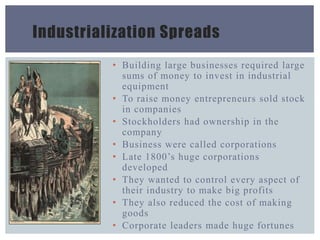
• Building large businesses required large
sums of money to invest in industrial
equipment
• To raise money entrepreneurs sold stock
in companies
• Stockholders had ownership in the
company
• Business were called corporations
• Late 1800’s huge corporations
developed
• They wanted to control every aspect of
their industry to make big profits
• They also reduced the cost of making
goods
• Corporate leaders made huge fortunes
Industrialization Spreads
Continental Europe Industrializes
• Revolution and the Napoleonic Wars in the late
1700’s and early 1800’s halted trade and
communication in many parts of Europe
• While this happened Britain industrialized and grew
wealthy
• Belgium was the first country to adopt new industrial
technology
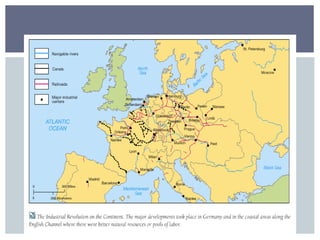
• Country had rich deposits of iron and coal also had good
waterways to transport goods
• By 1800 many factories focused on building industrial
machines like steam engines and locomotives
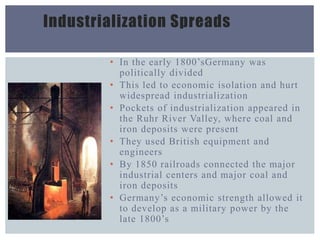
Industrialization Spreads
• In the early 1800’sGermany was
politically divided
• This led to economic isolation and hurt
widespread industrialization
• Pockets of industrialization appeared in
the Ruhr River Valley, where coal and
iron deposits were present
• They used British equipment and
engineers
• By 1850 railroads connected the major
industrial centers and major coal and
iron deposits
• Germany’s economic strength allowed it
to develop as a military power by the
late 1800’s
Industrialization Spreads
The Impact of Industrialization
I. Widened the gap between wealthy and poor nations
II. Led to Imperialism (policy of extending rule over other
countries) by industrial countries
• Industrial countries needed raw materials from other parts of the
world to supply factories policy of extending rule
• Industrial countries needed markets for their products
III. Revolutions in industry, communication and agriculture
changed lives of people in Western Europe and the United
States
• Changed every aspect of society from life expectancy, population,
wealth, and health
• Development of middle class led to greater opportunities for
education and democratic participation
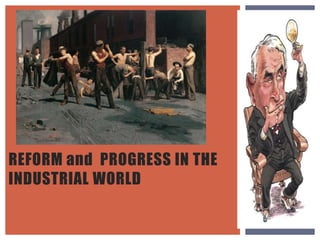
REFORM and PROGRESS IN THE
INDUSTRIAL WORLD
Reforming the Industrial World
Philosophy of Industrialization
• Capitalism is an economic system where all factors of
production are privately owned and where business is
run for a profit
• Many factory and business owners believed in a laissez-
faire economics where the government did not interfere
in business decisions
• They thought that people should work for their own self
interest
• That there would always be a permanent underclass in
society
• Government interference would upset the free market system
Reforming the Industrial World
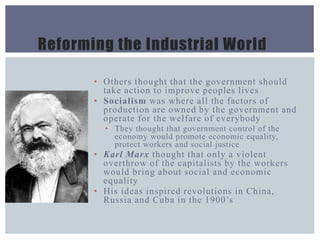
• Others thought that the government should
take action to improve peoples lives
• Socialism was where all the factors of
production are owned by the government and
operate for the welfare of everybody
• They thought that government control of the
economy would promote economic equality,
protect workers and social justice
• Karl Marx thought that only a violent
overthrow of the capitalists by the workers
would bring about social and economic
equality
• His ideas inspired revolutions in China,
Russia and Cuba in the 1900’s
Reforming the Industrial World
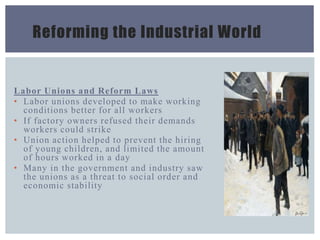
Labor Unions and Reform Laws
• Labor unions developed to make working
conditions better for all workers
• If factory owners refused their demands
workers could strike
• Union action helped to prevent the hiring
of young children, and limited the amount
of hours worked in a day
• Many in the government and industry saw
the unions as a threat to social order and
economic stability
Reforming the Industrial World
The Reform Movement Spreads
• Many began to question what was going on in the modern world,
reform movements began to answer the challenges to these changes
• Abolition of slavery
• Many began to see slavery as morally wrong
• Outlawed in Britain in 1833
• Many saw slavery as an economic threat and supported cheap, free, low
wage labor
• Women’s Rights
• factory work provided economic opportunity for women
• Women earned less than men
• Many women became college educated and began to demand equal rights ,
not rights based on gender
• Education
• Free public education became widely available by the late 1800’s
• Used to train people how to work in an industrial world
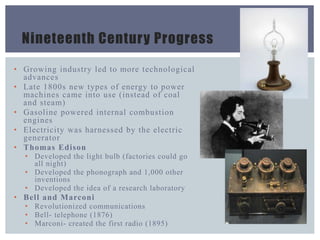
Nineteenth Century Progress
• Growing industry led to more technological
advances
• Late 1800s new types of energy to power
machines came into use (instead of coal
and steam)
• Gasoline powered internal combustion
engines
• Electricity was harnessed by the electric
generator
• Thomas Edison
• Developed the light bulb (factories could go
all night)
• Developed the phonograph and 1,000 other
inventions
• Developed the idea of a research laboratory
• Bell and Marconi
• Revolutionized communications
• Bell- telephone (1876)
• Marconi- created the first radio (1895)
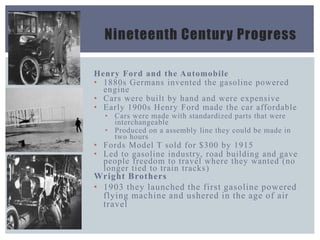
Nineteenth Century Progress
Henry Ford and the Automobile
• 1880s Germans invented the gasoline powered
engine
• Cars were built by hand and were expensive
• Early 1900s Henry Ford made the car affordable
• Cars were made with standardized parts that were
interchangeable
• Produced on a assembly line they could be made in
two hours
• Fords Model T sold for $300 by 1915
• Led to gasoline industry, road building and gave
people freedom to travel where they wanted (no
longer tied to train tracks)
Wright Brothers
• 1903 they launched the first gasoline powered
flying machine and ushered in the age of air
travel
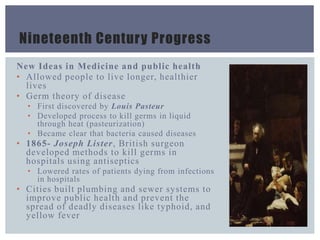
Nineteenth Century Progress
New Ideas in Medicine and public health
• Allowed people to live longer, healthier
lives
• Germ theory of disease
• First discovered by Louis Pasteur
• Developed process to kill germs in liquid
through heat (pasteurization)
• Became clear that bacteria caused diseases
• 1865- Joseph Lister, British surgeon
developed methods to kill germs in
hospitals using antiseptics
• Lowered rates of patients dying from infections
in hospitals
• Cities built plumbing and sewer systems to
improve public health and prevent the
spread of deadly diseases like typhoid, and
yellow fever
Nineteenth Century Progress
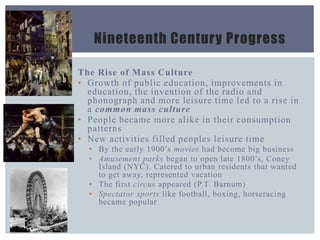
The Rise of Mass Culture
• Growth of public education, improvements in
education, the invention of the radio and
phonograph and more leisure time led to a rise in
a common mass culture
• People became more alike in their consumption
patterns
• New activities filled peoples leisure time
• By the early 1900’s movies had become big business
• Amusement parks began to open late 1800’s, Coney
Island (NYC). Catered to urban residents that wanted
to get away, represented vacation
• The first circus appeared (P.T. Barnum)
• Spectator sports like football, boxing, horseracing
became popular
I. Better sanitation, health care increased life expectancy
II. Factory produced goods, foods, indoor plumbing led to higher
standards of living
III. Rising wages and shorter work weeks led to more leisure time
IV. Rich and poor could purchase same clothes, household items,
etc.
V. Free public education led to higher rates of literacy and a mass
market for magazines and books
RESULTS OF 19TH CENTURY REFORM AND
PROGRESS

Industrialization

  • 1.
  • 2.
  • 3.
    Beginnings of Industrialization •Industrial Revolution transformed how people worked • Machines replaced animal and human power to produce goods • Began in England and spread to the rest of Europe and the United States by the middle of the 1800’s I. Early 1700’s farmers in England improved farming methods to grow larger amounts of crops ✓ Farmers began to rotate crops to keep the soil productive ✓ Livestock breeders improved their methods of breeding animals and their weight increased ✓ More food led to better living conditions ✓ Caused population of England to grow rapidly II. Large landowners forced smaller landowners off of their land and many moved to the cities across England ✓ Many who moved to cities became factory workers ✓ Increased population in cities increased demand for food and manufactured goods
  • 4.
    Beginnings of Industrialization Whythe Industrial Revolution began in England I. Extensive natural resources • Coal • Iron ore • Rivers for transporting goods II. Expanding economy • Developed banking system made it easy to borrow money to improve industry III. Over seas colonies and trading partners supported by the most powerful navy in the world IV. Parliament passed laws to encourage and protect businesses V. Had all of the factors of production (land, labor, capital or wealth)
  • 5.
    Beginnings of Industrialization •Inventions helped fuel industrial expansion • Textile (cloth) industry was the first to be transformed • Inventions increased the work that could be done in one day • 1733 flying shuttle developed that made weaving cloth easier • 1764 Spinning wheel developed that increased production • 1769 Arkwright water frame developed that used water power to drive these two machines • Textile manufacturers began to house all parts of production in factories built near rivers and streams • Cotton for textile mills came from the American south • 1793 Eli Whitney invented the cotton gin to speed up production of separating cotton fiber from seeds
  • 6.
    Beginnings of Industrialization •Steam power was developed by James Watt as a source of power to run factories • Steam power was also used propel boats • 1807 American inventor Robert Fulton’s steamboat Claremont makes its first successful voyage • Faster water transportation cut the cost of transporting raw materials and finished goods • Early 1800’s Robert McAdam improves the way roads are built • Private investors build roads and charge fees to people using them
  • 7.
    Beginnings of Industrialization •1804 first steam powered rail engine • 1821 first rail line built in England • By middle of 1830’s railroads connected many parts of England • Locomotive had four major effects 1) Gave manufacturers a cheap way to transport goods 2) Created thousands of new jobs 3) Boosted agriculture and fishing industries, it made it easier to transport these products to markets 4) Encouraged people to take distant city jobs
  • 8.
  • 9.
    Industrialization • Industrialization ledto an increased standard of living, people had better clothes, better food and earned higher wages in factories than on farms. • Change to machine production caused human suffering when it first began • Rapid industrialization caused unhealthy living conditions, child labor abuse and led to class tension • After 1800 balance of population in Europe was moving to cities (urbanization) • 1800-1850 the number of cities with more than 100,000 people went from 22 to 47 • Most urban areas doubled in size
  • 10.
    Industrialization • Factories andcities developed near coal and water resources • Poor sanitation, no building codes, lack of education, police and fire protection were major problems in cities • Streets were unpaved and trash and animal waste piled up • Workers lived in dark, dirty houses • Sickness was widespread • Cities had no plans to deal with rapid growth • The wealthy merchants and middle class moved out of the cities to the suburbs
  • 11.
    Industrialization • To increaseproduction and profit factory owners kept machines running as many hours as possible • Average worker worked 16 hours per day, 6 days a week • Work remained the same week after week • Factories were not well lit or clean and there was a high rate of accidents • There were no government programs to help people injured on the job • Women and children were the cheapest to employ and had some of the worst working conditions
  • 12.
    Industrialization • Growing middleclass • Industrial Revolution created enormous wealth and led to the development of a middle class • Middle class was made up of skilled workers, professionals, business people • Factory owners, shippers, and merchants were part of a growing middle class • Middle class enjoyed a comfortable standard of living • Took political power from wealthy landowners and aristocrats • Wealthy looked down on by these groups, “business” was seen as vulgar
  • 13.
    Industrialization The Working class •Laborers, factory workers saw little improvement in their standard of living and working conditions • Many saw their jobs disappear as machines took over for them • One group that resisted mechanization was the Luddites • These groups destroyed factory machines and organized worker riots because of poor living and working conditions
  • 14.
    Industrialization Positive Effects ofthe Industrial Revolution A. Created jobs for workers • Demand for engineers and managers increased B. Created wealth for the nation • Created tax revenue that allowed cities and countries to improve urban areas C. Allowed for technological progress and invention D. Raised the standard of living, provided hope for improvement in peoples lives • Better food • Better educational opportunities • Created cheaper mass produced goods E. Laborers eventually won better wages and working conditions after they formed labor unions
  • 15.
  • 16.
    Industrialization Spreads Industrialization inthe United States • By early 1800’s industrialization had spread to the US and continental Europe • US has same resources as Great Britain • Mineral wealth, immigrants and farm workers for labor • Had more open land than Great Britain • War of 1812 US could not trade with European countries because of British naval blockade, forced the US to use its own resources and develop industry • Began in the textile industry • 1789 first textile factory opened in Pawtucket, RI • Center of textile production in early 1800’s was in Lowell, MA • Provided economic opportunity and independence to women that had few other options open to them
  • 18.
    Industrialization Spreads ▪ TheNortheastern part of the United States experienced most industrial growth in the first half of the 1800’s ▪ US was primarily agricultural until after the Civil War in the 1860’s ▪ Last part of the 1800’s the US experienced a technology and industrial boom ▪ Causes and results of Industrialization ▪ Wealth of natural resources ▪ Inventions such as the electric light bulb, and telephone ▪ American cities grew • Economic opportunity and immigration • Urban population consumed manufactured goods ▪ Railroads played a major role • Cities grew along rail lines • Railroads allowed people to become extremely wealthy
  • 19.
    Industrialization Spreads • Buildinglarge businesses required large sums of money to invest in industrial equipment • To raise money entrepreneurs sold stock in companies • Stockholders had ownership in the company • Business were called corporations • Late 1800’s huge corporations developed • They wanted to control every aspect of their industry to make big profits • They also reduced the cost of making goods • Corporate leaders made huge fortunes
  • 20.
    Industrialization Spreads Continental EuropeIndustrializes • Revolution and the Napoleonic Wars in the late 1700’s and early 1800’s halted trade and communication in many parts of Europe • While this happened Britain industrialized and grew wealthy • Belgium was the first country to adopt new industrial technology • Country had rich deposits of iron and coal also had good waterways to transport goods • By 1800 many factories focused on building industrial machines like steam engines and locomotives
  • 21.
    Industrialization Spreads • Inthe early 1800’sGermany was politically divided • This led to economic isolation and hurt widespread industrialization • Pockets of industrialization appeared in the Ruhr River Valley, where coal and iron deposits were present • They used British equipment and engineers • By 1850 railroads connected the major industrial centers and major coal and iron deposits • Germany’s economic strength allowed it to develop as a military power by the late 1800’s
  • 23.
    Industrialization Spreads The Impactof Industrialization I. Widened the gap between wealthy and poor nations II. Led to Imperialism (policy of extending rule over other countries) by industrial countries • Industrial countries needed raw materials from other parts of the world to supply factories policy of extending rule • Industrial countries needed markets for their products III. Revolutions in industry, communication and agriculture changed lives of people in Western Europe and the United States • Changed every aspect of society from life expectancy, population, wealth, and health • Development of middle class led to greater opportunities for education and democratic participation
  • 24.
    REFORM and PROGRESSIN THE INDUSTRIAL WORLD
  • 25.
    Reforming the IndustrialWorld Philosophy of Industrialization • Capitalism is an economic system where all factors of production are privately owned and where business is run for a profit • Many factory and business owners believed in a laissez- faire economics where the government did not interfere in business decisions • They thought that people should work for their own self interest • That there would always be a permanent underclass in society • Government interference would upset the free market system
  • 26.
    Reforming the IndustrialWorld • Others thought that the government should take action to improve peoples lives • Socialism was where all the factors of production are owned by the government and operate for the welfare of everybody • They thought that government control of the economy would promote economic equality, protect workers and social justice • Karl Marx thought that only a violent overthrow of the capitalists by the workers would bring about social and economic equality • His ideas inspired revolutions in China, Russia and Cuba in the 1900’s
  • 27.
    Reforming the IndustrialWorld Labor Unions and Reform Laws • Labor unions developed to make working conditions better for all workers • If factory owners refused their demands workers could strike • Union action helped to prevent the hiring of young children, and limited the amount of hours worked in a day • Many in the government and industry saw the unions as a threat to social order and economic stability
  • 28.
    Reforming the IndustrialWorld The Reform Movement Spreads • Many began to question what was going on in the modern world, reform movements began to answer the challenges to these changes • Abolition of slavery • Many began to see slavery as morally wrong • Outlawed in Britain in 1833 • Many saw slavery as an economic threat and supported cheap, free, low wage labor • Women’s Rights • factory work provided economic opportunity for women • Women earned less than men • Many women became college educated and began to demand equal rights , not rights based on gender • Education • Free public education became widely available by the late 1800’s • Used to train people how to work in an industrial world
  • 29.
    Nineteenth Century Progress •Growing industry led to more technological advances • Late 1800s new types of energy to power machines came into use (instead of coal and steam) • Gasoline powered internal combustion engines • Electricity was harnessed by the electric generator • Thomas Edison • Developed the light bulb (factories could go all night) • Developed the phonograph and 1,000 other inventions • Developed the idea of a research laboratory • Bell and Marconi • Revolutionized communications • Bell- telephone (1876) • Marconi- created the first radio (1895)
  • 30.
    Nineteenth Century Progress HenryFord and the Automobile • 1880s Germans invented the gasoline powered engine • Cars were built by hand and were expensive • Early 1900s Henry Ford made the car affordable • Cars were made with standardized parts that were interchangeable • Produced on a assembly line they could be made in two hours • Fords Model T sold for $300 by 1915 • Led to gasoline industry, road building and gave people freedom to travel where they wanted (no longer tied to train tracks) Wright Brothers • 1903 they launched the first gasoline powered flying machine and ushered in the age of air travel
  • 31.
    Nineteenth Century Progress NewIdeas in Medicine and public health • Allowed people to live longer, healthier lives • Germ theory of disease • First discovered by Louis Pasteur • Developed process to kill germs in liquid through heat (pasteurization) • Became clear that bacteria caused diseases • 1865- Joseph Lister, British surgeon developed methods to kill germs in hospitals using antiseptics • Lowered rates of patients dying from infections in hospitals • Cities built plumbing and sewer systems to improve public health and prevent the spread of deadly diseases like typhoid, and yellow fever
  • 32.
    Nineteenth Century Progress TheRise of Mass Culture • Growth of public education, improvements in education, the invention of the radio and phonograph and more leisure time led to a rise in a common mass culture • People became more alike in their consumption patterns • New activities filled peoples leisure time • By the early 1900’s movies had become big business • Amusement parks began to open late 1800’s, Coney Island (NYC). Catered to urban residents that wanted to get away, represented vacation • The first circus appeared (P.T. Barnum) • Spectator sports like football, boxing, horseracing became popular
  • 33.
    I. Better sanitation,health care increased life expectancy II. Factory produced goods, foods, indoor plumbing led to higher standards of living III. Rising wages and shorter work weeks led to more leisure time IV. Rich and poor could purchase same clothes, household items, etc. V. Free public education led to higher rates of literacy and a mass market for magazines and books RESULTS OF 19TH CENTURY REFORM AND PROGRESS