



The Industrial Revolution

        Chapter 19

          1750-1914
Introduction
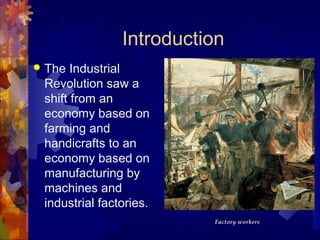
ď‚®   The Industrial
    Revolution saw a
    shift from an
    economy based on
    farming and
    handicrafts to an
    economy based on
    manufacturing by
    machines and
    industrial factories.
The Cottage Industry
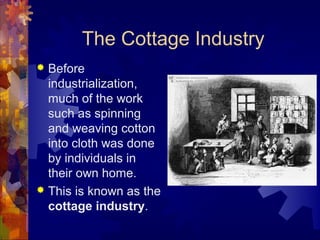
ď‚® Before
  industrialization,
  much of the work
  such as spinning
  and weaving cotton
  into cloth was done
  by individuals in
  their own home.
ď‚® This is known as the
  cottage industry.
Industrial Revolution
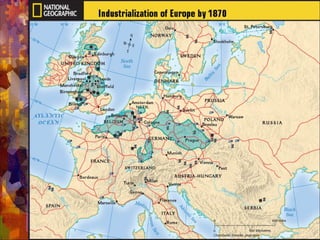
ď‚® The Industrial Revolution first began in Great
  Britain in the 1750s.
ď‚® The Industrial Revolution spread to other
  parts of the world at different speeds.
ď‚® Belgium, France and Germany were quick to
  industrialize.
ď‚® The Industrial Revolution also hit the United
  States and greatly effected the growing
  nation.
Industrial Revolution
ď‚® Industrialization is the move to machine
  production of goods.
 Britain became the world’s greatest industrial
  nation.
ď‚® Improved farming methods increased the
  food supply, which drove food prices down
  and gave families more money for
  manufactured goods.
ď‚® The increased food supply also supported a
  growing population.
Mechanization
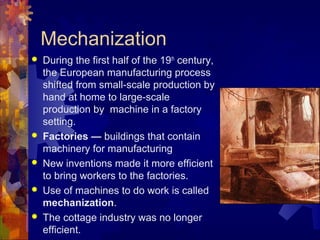
ď‚®   During the first half of the 19th century,
    the European manufacturing process
    shifted from small-scale production by
    hand at home to large-scale
    production by machine in a factory
    setting.
   Factories — buildings that contain
    machinery for manufacturing
ď‚®   New inventions made it more efficient
    to bring workers to the factories.
ď‚®   Use of machines to do work is called
    mechanization.
ď‚®   The cottage industry was no longer
    efficient.
Great Britain in the Industrial Revolution
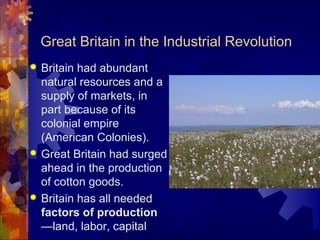
ď‚® Britain had abundant
  natural resources and a
  supply of markets, in
  part because of its
  colonial empire
  (American Colonies).
ď‚® Great Britain had surged
  ahead in the production
  of cotton goods.
ď‚® Britain has all needed
  factors of production
  —land, labor, capital
Textile Industry
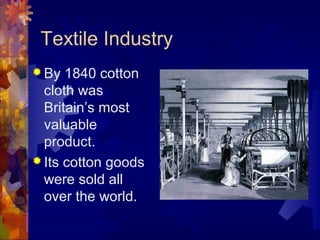
ď‚® By  1840 cotton
  cloth was
  Britain’s most
  valuable
  product.
ď‚® Its cotton goods
  were sold all
  over the world.
Textile Industry
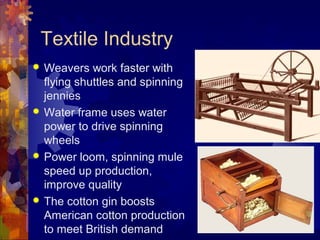
ď‚® Weavers work faster with
  flying shuttles and spinning
  jennies
ď‚® Water frame uses water
  power to drive spinning
  wheels
ď‚® Power loom, spinning mule
  speed up production,
  improve quality
ď‚® The cotton gin boosts
  American cotton production
  to meet British demand
Steam Power
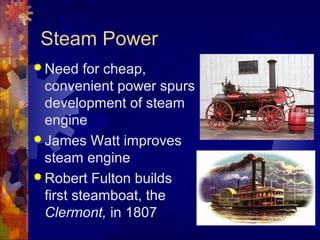
ď‚® Need    for cheap,
  convenient power spurs
  development of steam
  engine
ď‚® James Watt improves
  steam engine
ď‚® Robert Fulton builds
  first steamboat, the
  Clermont, in 1807
The Railway Age
   The steam engine drove Great Britain’s Industrial
    Revolution.
ď‚®   Steam engines were powered by coal.
ď‚®   This led to the coal industry expanding. The coal
    supply seemed unlimited.
ď‚®   Coal also transformed the iron industry.
ď‚®   Iron had been made in England since the Middle
    Ages but due to new inventions and technology, the
    iron industry boomed.
ď‚®   In 1740 Britain produced 17,000 tons of iron. By
    1852, Britain was producing almost 3 million tons of
    iron annually.
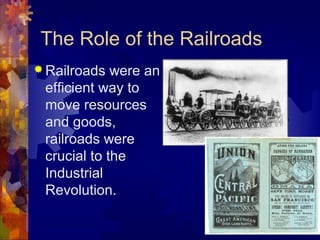
The Role of the Railroads
ď‚® Railroads  were an
 efficient way to
 move resources
 and goods,
 railroads were
 crucial to the
 Industrial
 Revolution.
The Role of the Railroads
ď‚®   The railroads, built during the 1830s and 1840s:
    ď‚®   Building railroads was a new job for farm laborers and
        peasants.
    ď‚®   Enabled people to leave the place of their birth and
        migrate easily to the cities.
    ď‚®   Allowed cheaper and more rapid transport of raw
        materials and finished products.
    ď‚®   Created an increased demand for iron and steel and a
        skilled labor force.
    ď‚®   The less expensive transportation lowered the price of
        goods and made for larger markets.
 Engineering   Empire – The Rocket
Effects of the Industrial Revolution


  ď‚®Industrialization changes the
     way people live and work,
  introducing a variety of benefits
        as well as problems.
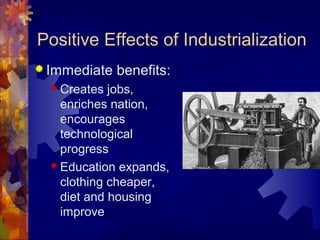
Positive Effects of Industrialization
ď‚® Immediate   benefits:
  ď‚® Creates  jobs,
    enriches nation,
    encourages
    technological
    progress
  ď‚® Education expands,
    clothing cheaper,
    diet and housing
    improve
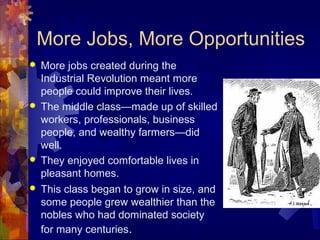
More Jobs, More Opportunities
ď‚®   More jobs created during the
    Industrial Revolution meant more
    people could improve their lives.
   The middle class—made up of skilled
    workers, professionals, business
    people, and wealthy farmers—did
    well.
ď‚®   They enjoyed comfortable lives in
    pleasant homes.
ď‚®   This class began to grow in size, and
    some people grew wealthier than the
    nobles who had dominated society
    for many centuries.
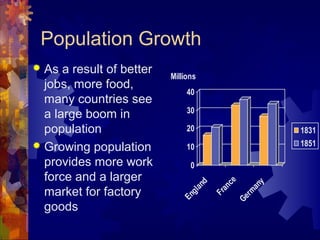
Population Growth
ď‚® As a result of better   Millions
  jobs, more food,
                               40
  many countries see
                               30
  a large boom in
  population                   20                      1831
ď‚® Growing population           10                      1851

  provides more work            0
  force and a larger


                                        ce
                                  d


                                                  ny
  market for factory            an

                                        an


                                               ma
                               gl

                                      Fr
                             En


                                                r
                                             Ge
  goods
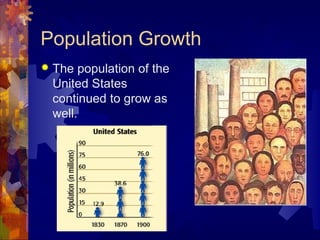
Population Growth
ď‚®   The population of the
    United States
    continued to grow as
    well.
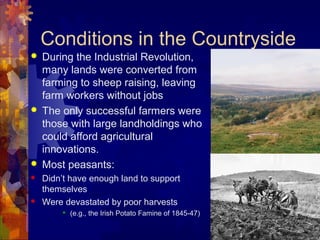
Conditions in the Countryside
ď‚®   During the Industrial Revolution,
    many lands were converted from
    farming to sheep raising, leaving
    farm workers without jobs
ď‚®   The only successful farmers were
    those with large landholdings who
    could afford agricultural
    innovations.
ď‚®   Most peasants:
   Didn’t have enough land to support
    themselves
ď‚®   Were devastated by poor harvests
        ď‚®   (e.g., the Irish Potato Famine of 1845-47)
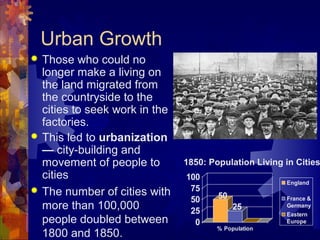
Urban Growth
ď‚® Those who could no
  longer make a living on
  the land migrated from
  the countryside to the
  cities to seek work in the
  factories.
ď‚® This led to urbanization
  — city-building and
  movement of people to        1850: Population Living in Cities
  cities                       100
                                                       England
ď‚® The number of cities with     75
                                50     50              France &
  more than 100,000             25          25         Germany
                                                       Eastern
  people doubled between         0                     Europe
                                       % Population
  1800 and 1850.
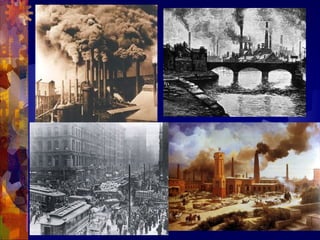
The Plight of the Cities
ď‚®   The sheer number of human beings put pressure on city
    resources:
    ď‚®   Housing, water, sewers, food supplies, and lighting were
        completely inadequate.
    ď‚®   Rapidly growing cities lack sanitary codes, building codes
    ď‚®   Slums grew and disease, especially cholera, sweep
        through and ravaged the population.
    ď‚®   The average life span of a person living in a city was 17
        years—compared to 38 years in the countryside.
    ď‚®   Factory pollution fouls air, poisons river
    ď‚®   Cities also without adequate housing, education, police
        protection
    ď‚®   Crime increased and became a way of life for those who
        could make a living in no other way.
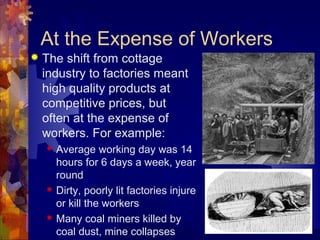
At the Expense of Workers
ď‚®   The shift from cottage
    industry to factories meant
    high quality products at
    competitive prices, but
    often at the expense of
    workers. For example:
    ď‚®   Average working day was 14
        hours for 6 days a week, year
        round
    ď‚®   Dirty, poorly lit factories injure
        or kill the workers
    ď‚®   Many coal miners killed by
        coal dust, mine collapses
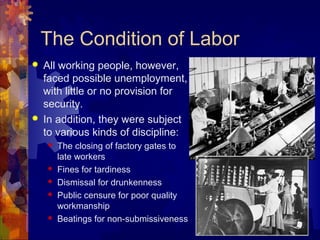
The Condition of Labor
ď‚®   All working people, however,
    faced possible unemployment,
    with little or no provision for
    security.
ď‚®   In addition, they were subject
    to various kinds of discipline:
    ď‚®   The closing of factory gates to
        late workers
    ď‚®   Fines for tardiness
    ď‚®   Dismissal for drunkenness
    ď‚®   Public censure for poor quality
        workmanship
    ď‚®   Beatings for non-submissiveness
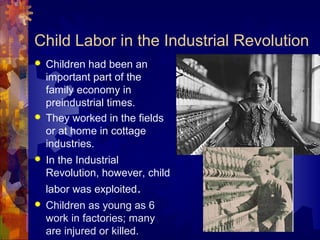
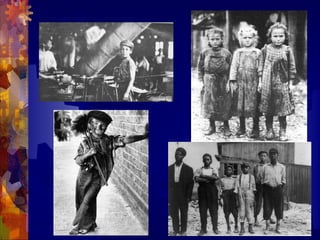
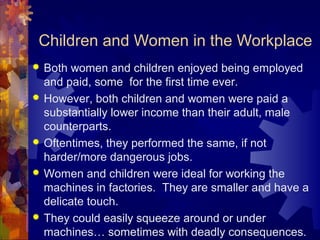
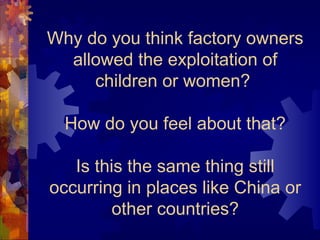
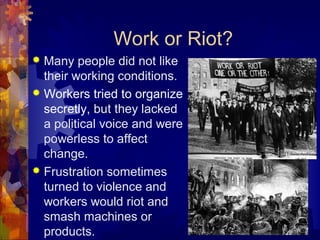
Child Labor in the Industrial Revolution
ď‚®   Children had been an
    important part of the
    family economy in
    preindustrial times.
ď‚®   They worked in the fields
    or at home in cottage
    industries.
ď‚®   In the Industrial
    Revolution, however, child
    labor was exploited.
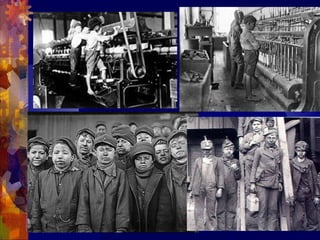
ď‚®   Children as young as 6
    work in factories; many
    are injured or killed.
Children and Women in the Workplace
ď‚®   Both women and children enjoyed being employed
    and paid, some for the first time ever.
ď‚®   However, both children and women were paid a
    substantially lower income than their adult, male
    counterparts.
ď‚®   Oftentimes, they performed the same, if not
    harder/more dangerous jobs.
ď‚®   Women and children were ideal for working the
    machines in factories. They are smaller and have a
    delicate touch.
ď‚®   They could easily squeeze around or under
    machines… sometimes with deadly consequences.
Why do you think factory owners
  allowed the exploitation of
     children or women?

  How do you feel about that?

   Is this the same thing still
occurring in places like China or
         other countries?
Work or Riot?
ď‚® Many people did not like
  their working conditions.
ď‚® Workers tried to organize
  secretly, but they lacked
  a political voice and were
  powerless to affect
  change.
ď‚® Frustration sometimes
  turned to violence and
  workers would riot and
  smash machines or
  products.
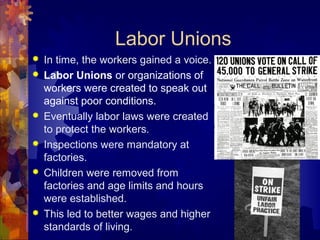
Labor Unions
ď‚®   In time, the workers gained a voice.
ď‚®   Labor Unions or organizations of
    workers were created to speak out
    against poor conditions.
ď‚®   Eventually labor laws were created
    to protect the workers.
ď‚®   Inspections were mandatory at
    factories.
ď‚®   Children were removed from
    factories and age limits and hours
    were established.
ď‚®   This led to better wages and higher
    standards of living.
Can you think of modern day
labor laws that are in place to
     protect workers from
  exploitation like during the
    Industrial Revolution?
Economic and Political Reform

  ď‚®The  Industrial Revolution
  would also lead to economic,
  social, and political reforms.
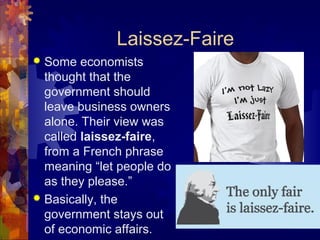
Laissez-Faire
ď‚® Some economists
  thought that the
  government should
  leave business owners
  alone. Their view was
  called laissez-faire,
  from a French phrase
  meaning “let people do
  as they please.”
ď‚® Basically, the
  government stays out
  of economic affairs.
Can you explain positive and
 negative consequences to
       laissez-faire?
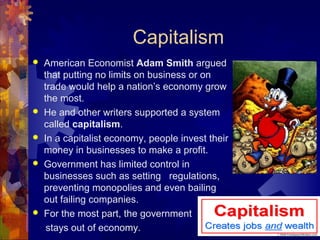
Capitalism
ď‚®   American Economist Adam Smith argued
    that putting no limits on business or on
    trade would help a nation’s economy grow
    the most.
ď‚®   He and other writers supported a system
    called capitalism.
ď‚®   In a capitalist economy, people invest their
    money in businesses to make a profit.
ď‚®   Government has limited control in
    businesses such as setting regulations,
    preventing monopolies and even bailing
    out failing companies.
ď‚®   For the most part, the government
     stays out of economy.
The only difference between
laissez-fair and capitalism is
  government involvement.

Do you think it is necessary to
government to be involved in
 the economy, even if just a
           little bit.
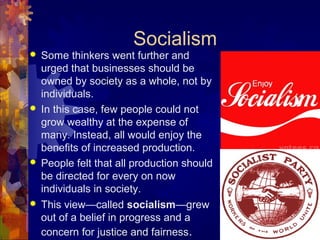
Socialism
ď‚®   Some thinkers went further and
    urged that businesses should be
    owned by society as a whole, not by
    individuals.
ď‚®   In this case, few people could not
    grow wealthy at the expense of
    many. Instead, all would enjoy the
    benefits of increased production.
ď‚®   People felt that all production should
    be directed for every on now
    individuals in society.
   This view—called socialism—grew
    out of a belief in progress and a
    concern for justice and fairness.
Communism
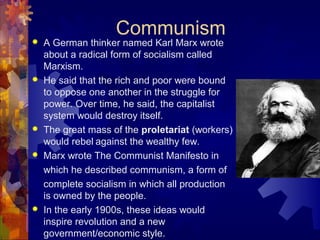
ď‚®   A German thinker named Karl Marx wrote
    about a radical form of socialism called
    Marxism.
ď‚®   He said that the rich and poor were bound
    to oppose one another in the struggle for
    power. Over time, he said, the capitalist
    system would destroy itself.
ď‚®   The great mass of the proletariat (workers)
    would rebel against the wealthy few.
ď‚®   Marx wrote The Communist Manifesto in
    which he described communism, a form of
    complete socialism in which all production
    is owned by the people.
ď‚®   In the early 1900s, these ideas would
    inspire revolution and a new
    government/economic style.
Communism
ď‚®   Communism is a social and political structure in
    which classes are abolished and all property is
    commonly controlled (typically by a strong, central
    government). It advocates and aims to create a
    common society in which everyone is has equal
    share.
    ď‚®   The central government makes ALL major economic
        decisions.
    ď‚®   It controls the wealth: land, mines, factories, banks,
        transportation.
    ď‚®   It decides what products, crops are produced; sets
        prices and divides shares equally.
    ď‚®   Many times, this also means that the government
        controls all aspects of citizens’ lives.
Discuss the positive and
negative aspects to socialism
        communism.

     Could it truly work?
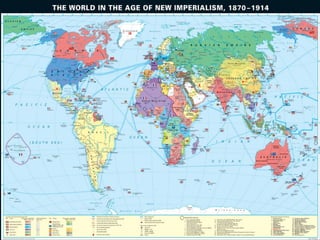
Imperialism

The Industrial Revolution changed the world.
ď‚®
ď‚® Not only for the countries in Europe or the
 U.S., but countries globally would be feeling
    the effects from a practice known as
                 imperialism.
Imperialism
ď‚® Countries that had adopted an industrial economy
  enjoyed more wealth and power than those that
  had not.
ď‚® The countries of Europe, the U.S. and Japan soon
  began to take advantage of lands in Africa and
  Asia.
ď‚® They used these lands as sources of raw materials
  needed for their factories. They saw the people
  only as markets for the goods they made.
ď‚® They took control of these lands, a practice called
  imperialism.
European Power and Influence in China
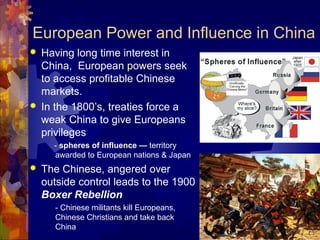
ď‚®   Having long time interest in
    China, European powers seek
    to access profitable Chinese
    markets.
   In the 1800’s, treaties force a
    weak China to give Europeans
    privileges
      - spheres of influence — territory
      awarded to European nations & Japan
ď‚®   The Chinese, angered over
    outside control leads to the 1900
    Boxer Rebellion
       - Chinese militants kill Europeans,
       Chinese Christians and take back
       China
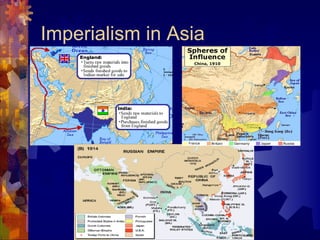
Imperialism in Asia
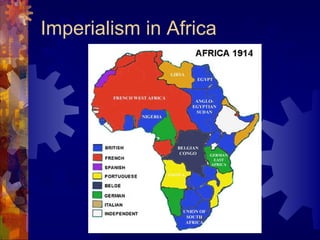
Europeans Exploit Africa
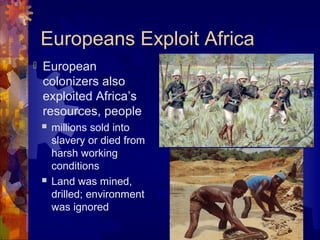
   European
    colonizers also
    exploited Africa’s
    resources, people
       millions sold into
        slavery or died from
        harsh working
        conditions
       Land was mined,
        drilled; environment
        was ignored
Imperialism in Africa
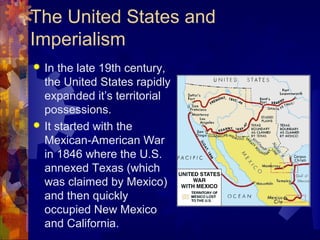
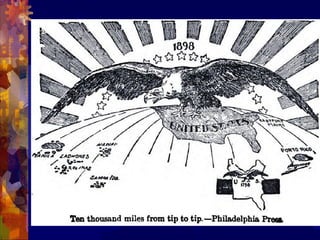
The United States and
Imperialism
ď‚® In the late 19th century,
  the United States rapidly
  expanded it’s territorial
  possessions.
ď‚® It started with the
  Mexican-American War
  in 1846 where the U.S.
  annexed Texas (which
  was claimed by Mexico)
  and then quickly
  occupied New Mexico
  and California.
The United States and Imperialism
ď‚® The war was brief, yet
  bloody and the United
  States came out
  victorious.
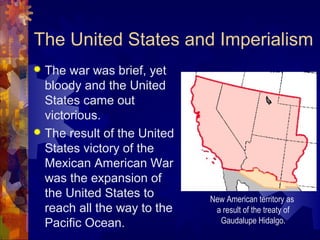
ď‚® The result of the United
  States victory of the
  Mexican American War
  was the expansion of
  the United States to       New American territory as
  reach all the way to the    a result of the treaty of
  Pacific Ocean.               Gaudalupe Hidalgo.
The United States and
Imperialism
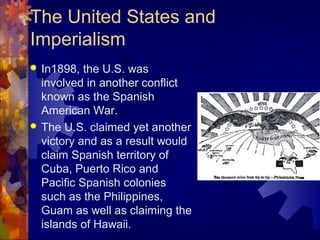
ď‚® In1898, the U.S. was
  involved in another conflict
  known as the Spanish
  American War.
ď‚® The U.S. claimed yet another
  victory and as a result would
  claim Spanish territory of
  Cuba, Puerto Rico and
  Pacific Spanish colonies
  such as the Philippines,
  Guam as well as claiming the
  islands of Hawaii.
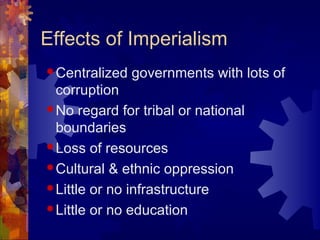
Effects of Imperialism
ď‚® Centralized   governments with lots of
  corruption
ď‚® No regard for tribal or national
  boundaries
ď‚® Loss of resources

ď‚® Cultural & ethnic oppression

ď‚® Little or no infrastructure

ď‚® Little or no education
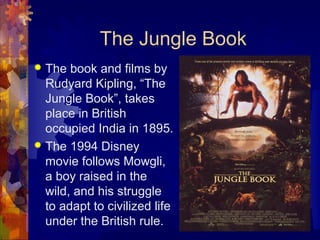
The Jungle Book
ď‚® The book and films by
  Rudyard Kipling, “The
  Jungle Book”, takes
  place in British
  occupied India in 1895.
ď‚® The 1994 Disney
  movie follows Mowgli,
  a boy raised in the
  wild, and his struggle
  to adapt to civilized life
  under the British rule.
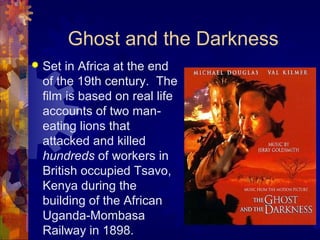
Ghost and the Darkness
ď‚®   Set in Africa at the end
    of the 19th century. The
    film is based on real life
    accounts of two man-
    eating lions that
    attacked and killed
    hundreds of workers in
    British occupied Tsavo,
    Kenya during the
    building of the African
    Uganda-Mombasa
    Railway in 1898.
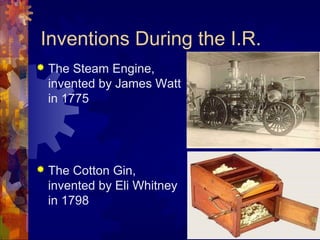
Inventions During the I.R.
ď‚®   The Steam Engine,
    invented by James Watt
    in 1775


ď‚®   The Cotton Gin,
    invented by Eli Whitney
    in 1798
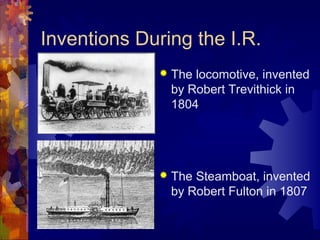
Inventions During the I.R.
             ď‚®   The locomotive, invented
                 by Robert Trevithick in
                 1804


             ď‚®   The Steamboat, invented
                 by Robert Fulton in 1807
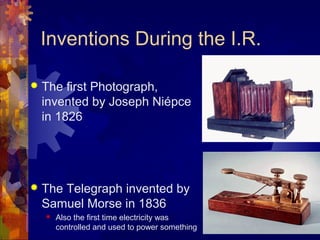
Inventions During the I.R.

ď‚®   The first Photograph,
    invented by Joseph Niépce
    in 1826


ď‚®   The Telegraph invented by
    Samuel Morse in 1836
    ď‚®   Also the first time electricity was
        controlled and used to power something
Inventions During the I.R.

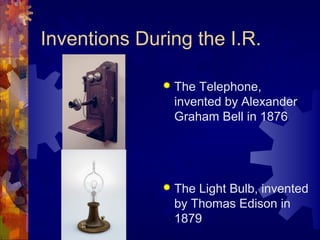
              ď‚®   The Telephone,
                  invented by Alexander
                  Graham Bell in 1876


              ď‚®   The Light Bulb, invented
                  by Thomas Edison in
                  1879
Family guy phone
Inventions During the I.R.

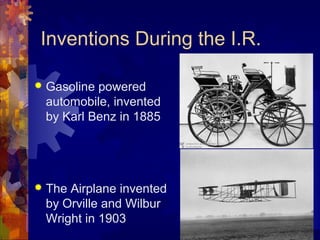
ď‚®   Gasoline powered
    automobile, invented
    by Karl Benz in 1885


ď‚®   The Airplane invented
    by Orville and Wilbur
    Wright in 1903

Industrial revolution2

  • 1.
    The Industrial Revolution Chapter 19 1750-1914
  • 2.
    Introduction ď‚® The Industrial Revolution saw a shift from an economy based on farming and handicrafts to an economy based on manufacturing by machines and industrial factories.
  • 3.
    The Cottage Industry ď‚®Before industrialization, much of the work such as spinning and weaving cotton into cloth was done by individuals in their own home. ď‚® This is known as the cottage industry.
  • 4.
    Industrial Revolution ď‚® TheIndustrial Revolution first began in Great Britain in the 1750s. ď‚® The Industrial Revolution spread to other parts of the world at different speeds. ď‚® Belgium, France and Germany were quick to industrialize. ď‚® The Industrial Revolution also hit the United States and greatly effected the growing nation.
  • 5.
    Industrial Revolution  Industrializationis the move to machine production of goods.  Britain became the world’s greatest industrial nation.  Improved farming methods increased the food supply, which drove food prices down and gave families more money for manufactured goods.  The increased food supply also supported a growing population.
  • 6.
    Mechanization  During the first half of the 19th century, the European manufacturing process shifted from small-scale production by hand at home to large-scale production by machine in a factory setting.  Factories — buildings that contain machinery for manufacturing  New inventions made it more efficient to bring workers to the factories.  Use of machines to do work is called mechanization.  The cottage industry was no longer efficient.
  • 7.
    Great Britain inthe Industrial Revolution  Britain had abundant natural resources and a supply of markets, in part because of its colonial empire (American Colonies).  Great Britain had surged ahead in the production of cotton goods.  Britain has all needed factors of production —land, labor, capital
  • 8.
    Textile Industry  By 1840 cotton cloth was Britain’s most valuable product.  Its cotton goods were sold all over the world.
  • 9.
    Textile Industry ď‚® Weaverswork faster with flying shuttles and spinning jennies ď‚® Water frame uses water power to drive spinning wheels ď‚® Power loom, spinning mule speed up production, improve quality ď‚® The cotton gin boosts American cotton production to meet British demand
  • 10.
    Steam Power ď‚® Need for cheap, convenient power spurs development of steam engine ď‚® James Watt improves steam engine ď‚® Robert Fulton builds first steamboat, the Clermont, in 1807
  • 11.
    The Railway Age  The steam engine drove Great Britain’s Industrial Revolution.  Steam engines were powered by coal.  This led to the coal industry expanding. The coal supply seemed unlimited.  Coal also transformed the iron industry.  Iron had been made in England since the Middle Ages but due to new inventions and technology, the iron industry boomed.  In 1740 Britain produced 17,000 tons of iron. By 1852, Britain was producing almost 3 million tons of iron annually.
  • 12.
    The Role ofthe Railroads ď‚® Railroads were an efficient way to move resources and goods, railroads were crucial to the Industrial Revolution.
  • 13.
    The Role ofthe Railroads ď‚® The railroads, built during the 1830s and 1840s: ď‚® Building railroads was a new job for farm laborers and peasants. ď‚® Enabled people to leave the place of their birth and migrate easily to the cities. ď‚® Allowed cheaper and more rapid transport of raw materials and finished products. ď‚® Created an increased demand for iron and steel and a skilled labor force. ď‚® The less expensive transportation lowered the price of goods and made for larger markets.
  • 14.
     Engineering Empire – The Rocket
  • 15.
    Effects of theIndustrial Revolution ď‚®Industrialization changes the way people live and work, introducing a variety of benefits as well as problems.
  • 16.
    Positive Effects ofIndustrialization ď‚® Immediate benefits: ď‚® Creates jobs, enriches nation, encourages technological progress ď‚® Education expands, clothing cheaper, diet and housing improve
  • 17.
    More Jobs, MoreOpportunities  More jobs created during the Industrial Revolution meant more people could improve their lives.  The middle class—made up of skilled workers, professionals, business people, and wealthy farmers—did well.  They enjoyed comfortable lives in pleasant homes.  This class began to grow in size, and some people grew wealthier than the nobles who had dominated society for many centuries.
  • 18.
    Population Growth ď‚® Asa result of better Millions jobs, more food, 40 many countries see 30 a large boom in population 20 1831 ď‚® Growing population 10 1851 provides more work 0 force and a larger ce d ny market for factory an an ma gl Fr En r Ge goods
  • 19.
    Population Growth ď‚® The population of the United States continued to grow as well.
  • 20.
    Conditions in theCountryside  During the Industrial Revolution, many lands were converted from farming to sheep raising, leaving farm workers without jobs  The only successful farmers were those with large landholdings who could afford agricultural innovations.  Most peasants:  Didn’t have enough land to support themselves  Were devastated by poor harvests  (e.g., the Irish Potato Famine of 1845-47)
  • 21.
    Urban Growth  Thosewho could no longer make a living on the land migrated from the countryside to the cities to seek work in the factories.  This led to urbanization — city-building and movement of people to 1850: Population Living in Cities cities 100 England  The number of cities with 75 50 50 France & more than 100,000 25 25 Germany Eastern people doubled between 0 Europe % Population 1800 and 1850.
  • 22.
    The Plight ofthe Cities  The sheer number of human beings put pressure on city resources:  Housing, water, sewers, food supplies, and lighting were completely inadequate.  Rapidly growing cities lack sanitary codes, building codes  Slums grew and disease, especially cholera, sweep through and ravaged the population.  The average life span of a person living in a city was 17 years—compared to 38 years in the countryside.  Factory pollution fouls air, poisons river  Cities also without adequate housing, education, police protection  Crime increased and became a way of life for those who could make a living in no other way.
  • 24.
    At the Expenseof Workers ď‚® The shift from cottage industry to factories meant high quality products at competitive prices, but often at the expense of workers. For example: ď‚® Average working day was 14 hours for 6 days a week, year round ď‚® Dirty, poorly lit factories injure or kill the workers ď‚® Many coal miners killed by coal dust, mine collapses
  • 25.
    The Condition ofLabor ď‚® All working people, however, faced possible unemployment, with little or no provision for security. ď‚® In addition, they were subject to various kinds of discipline: ď‚® The closing of factory gates to late workers ď‚® Fines for tardiness ď‚® Dismissal for drunkenness ď‚® Public censure for poor quality workmanship ď‚® Beatings for non-submissiveness
  • 26.
    Child Labor inthe Industrial Revolution ď‚® Children had been an important part of the family economy in preindustrial times. ď‚® They worked in the fields or at home in cottage industries. ď‚® In the Industrial Revolution, however, child labor was exploited. ď‚® Children as young as 6 work in factories; many are injured or killed.
  • 29.
    Children and Womenin the Workplace  Both women and children enjoyed being employed and paid, some for the first time ever.  However, both children and women were paid a substantially lower income than their adult, male counterparts.  Oftentimes, they performed the same, if not harder/more dangerous jobs.  Women and children were ideal for working the machines in factories. They are smaller and have a delicate touch.  They could easily squeeze around or under machines… sometimes with deadly consequences.
  • 30.
    Why do youthink factory owners allowed the exploitation of children or women? How do you feel about that? Is this the same thing still occurring in places like China or other countries?
  • 31.
    Work or Riot? ď‚®Many people did not like their working conditions. ď‚® Workers tried to organize secretly, but they lacked a political voice and were powerless to affect change. ď‚® Frustration sometimes turned to violence and workers would riot and smash machines or products.
  • 32.
    Labor Unions ď‚® In time, the workers gained a voice. ď‚® Labor Unions or organizations of workers were created to speak out against poor conditions. ď‚® Eventually labor laws were created to protect the workers. ď‚® Inspections were mandatory at factories. ď‚® Children were removed from factories and age limits and hours were established. ď‚® This led to better wages and higher standards of living.
  • 33.
    Can you thinkof modern day labor laws that are in place to protect workers from exploitation like during the Industrial Revolution?
  • 35.
    Economic and PoliticalReform ď‚®The Industrial Revolution would also lead to economic, social, and political reforms.
  • 36.
    Laissez-Faire  Some economists thought that the government should leave business owners alone. Their view was called laissez-faire, from a French phrase meaning “let people do as they please.”  Basically, the government stays out of economic affairs.
  • 37.
    Can you explainpositive and negative consequences to laissez-faire?
  • 38.
    Capitalism  American Economist Adam Smith argued that putting no limits on business or on trade would help a nation’s economy grow the most.  He and other writers supported a system called capitalism.  In a capitalist economy, people invest their money in businesses to make a profit.  Government has limited control in businesses such as setting regulations, preventing monopolies and even bailing out failing companies.  For the most part, the government stays out of economy.
  • 39.
    The only differencebetween laissez-fair and capitalism is government involvement. Do you think it is necessary to government to be involved in the economy, even if just a little bit.
  • 40.
    Socialism  Some thinkers went further and urged that businesses should be owned by society as a whole, not by individuals.  In this case, few people could not grow wealthy at the expense of many. Instead, all would enjoy the benefits of increased production.  People felt that all production should be directed for every on now individuals in society.  This view—called socialism—grew out of a belief in progress and a concern for justice and fairness.
  • 41.
    Communism ď‚® A German thinker named Karl Marx wrote about a radical form of socialism called Marxism. ď‚® He said that the rich and poor were bound to oppose one another in the struggle for power. Over time, he said, the capitalist system would destroy itself. ď‚® The great mass of the proletariat (workers) would rebel against the wealthy few. ď‚® Marx wrote The Communist Manifesto in which he described communism, a form of complete socialism in which all production is owned by the people. ď‚® In the early 1900s, these ideas would inspire revolution and a new government/economic style.
  • 42.
    Communism  Communism is a social and political structure in which classes are abolished and all property is commonly controlled (typically by a strong, central government). It advocates and aims to create a common society in which everyone is has equal share.  The central government makes ALL major economic decisions.  It controls the wealth: land, mines, factories, banks, transportation.  It decides what products, crops are produced; sets prices and divides shares equally.  Many times, this also means that the government controls all aspects of citizens’ lives.
  • 44.
    Discuss the positiveand negative aspects to socialism communism. Could it truly work?
  • 45.
    Imperialism The Industrial Revolutionchanged the world. ď‚® ď‚® Not only for the countries in Europe or the U.S., but countries globally would be feeling the effects from a practice known as imperialism.
  • 46.
    Imperialism ď‚® Countries thathad adopted an industrial economy enjoyed more wealth and power than those that had not. ď‚® The countries of Europe, the U.S. and Japan soon began to take advantage of lands in Africa and Asia. ď‚® They used these lands as sources of raw materials needed for their factories. They saw the people only as markets for the goods they made. ď‚® They took control of these lands, a practice called imperialism.
  • 47.
    European Power andInfluence in China  Having long time interest in China, European powers seek to access profitable Chinese markets.  In the 1800’s, treaties force a weak China to give Europeans privileges - spheres of influence — territory awarded to European nations & Japan  The Chinese, angered over outside control leads to the 1900 Boxer Rebellion - Chinese militants kill Europeans, Chinese Christians and take back China
  • 48.
  • 49.
    Europeans Exploit Africa  European colonizers also exploited Africa’s resources, people  millions sold into slavery or died from harsh working conditions  Land was mined, drilled; environment was ignored
  • 50.
  • 51.
    The United Statesand Imperialism  In the late 19th century, the United States rapidly expanded it’s territorial possessions.  It started with the Mexican-American War in 1846 where the U.S. annexed Texas (which was claimed by Mexico) and then quickly occupied New Mexico and California.
  • 52.
    The United Statesand Imperialism ď‚® The war was brief, yet bloody and the United States came out victorious. ď‚® The result of the United States victory of the Mexican American War was the expansion of the United States to New American territory as reach all the way to the a result of the treaty of Pacific Ocean. Gaudalupe Hidalgo.
  • 53.
    The United Statesand Imperialism ď‚® In1898, the U.S. was involved in another conflict known as the Spanish American War. ď‚® The U.S. claimed yet another victory and as a result would claim Spanish territory of Cuba, Puerto Rico and Pacific Spanish colonies such as the Philippines, Guam as well as claiming the islands of Hawaii.
  • 55.
    Effects of Imperialism ď‚®Centralized governments with lots of corruption ď‚® No regard for tribal or national boundaries ď‚® Loss of resources ď‚® Cultural & ethnic oppression ď‚® Little or no infrastructure ď‚® Little or no education
  • 57.
    The Jungle Book The book and films by Rudyard Kipling, “The Jungle Book”, takes place in British occupied India in 1895.  The 1994 Disney movie follows Mowgli, a boy raised in the wild, and his struggle to adapt to civilized life under the British rule.
  • 58.
    Ghost and theDarkness ď‚® Set in Africa at the end of the 19th century. The film is based on real life accounts of two man- eating lions that attacked and killed hundreds of workers in British occupied Tsavo, Kenya during the building of the African Uganda-Mombasa Railway in 1898.
  • 60.
    Inventions During theI.R. ď‚® The Steam Engine, invented by James Watt in 1775 ď‚® The Cotton Gin, invented by Eli Whitney in 1798
  • 61.
    Inventions During theI.R. ď‚® The locomotive, invented by Robert Trevithick in 1804 ď‚® The Steamboat, invented by Robert Fulton in 1807
  • 62.
    Inventions During theI.R.  The first Photograph, invented by Joseph Niépce in 1826  The Telegraph invented by Samuel Morse in 1836  Also the first time electricity was controlled and used to power something
  • 63.
    Inventions During theI.R. ď‚® The Telephone, invented by Alexander Graham Bell in 1876 ď‚® The Light Bulb, invented by Thomas Edison in 1879
  • 64.
  • 65.
    Inventions During theI.R. ď‚® Gasoline powered automobile, invented by Karl Benz in 1885 ď‚® The Airplane invented by Orville and Wilbur Wright in 1903