Psychology the human behaviour, body mind relationship, human mind, neuron, connectors, receptors and effectors
1.
Biological basis ofbehaviour
Prepared by Ms.Sameeksha Patial
Assistant professor
Adesh Nursing College
2.
Introduction
Biology ofbehaviour is the study of behavioural functions of the
nervous system, particularly the brain.
Physiological psychology is that branch of psychology, which seeks
to determine how activity in the nervous system is related to both the
behaviour and mind.
Manufacturers affect behaviour of which the most important one, our
brain and genetics, a sick person’s thoughts and emotions are not
visible to the Nurse.
Nurses get a better understanding of these by observing the patients
behaviour during illness.
3.
Body Mind Relationship
Earlier it was a belief that the mind and body are two separate entities.
Today, there is scientific evidence to show that there is a strong relationship
between the mind and the body, both structurally and functionally.
Any internal or external stimulus is perceived and labelled by the mind as
harmful, harmless, pleasant, unpleasant, et cetera. Based on this perception,
the body response to the stimulus, either by flying or fighting. The mind and
the body work in synergy with each other, they cannot be separated and
cannot work as separate entities.
4.
Body Mind Relationship
Mind: mine is retarded as a function of the body and does not exist in isolation from it.
It is the sum total of various mental processes, such as observing, knowing, thinking,
reasoning, feeling, imagining, remembering, judging, etc.
Mind also gross just as the body grows. As an individual grow, the functioning
improves.
However, in older age, the functioning gradually declines, just like there is decline in
body functioning, too.
There can be disturbances in cognitive functions, such as memory, decision, making,
critical thinking, etc.
5.
Body Mind Relationship
Body: body is represented by physical states and body functions. Nervous
system and glands are an important part of our body.
They are also responsible for way of thinking, feeling and doing.
All behaviours have an anal and physiological basis.
Just like the Mind with the increasing age, specially in old age, there is a
disturbance or decline in functioning of various systems, such as skeletal
system, muscular system, cardiovascular system, etc.
This shows how changes that occur with ageing in the body are
accompanied by changes in the mind too.
6.
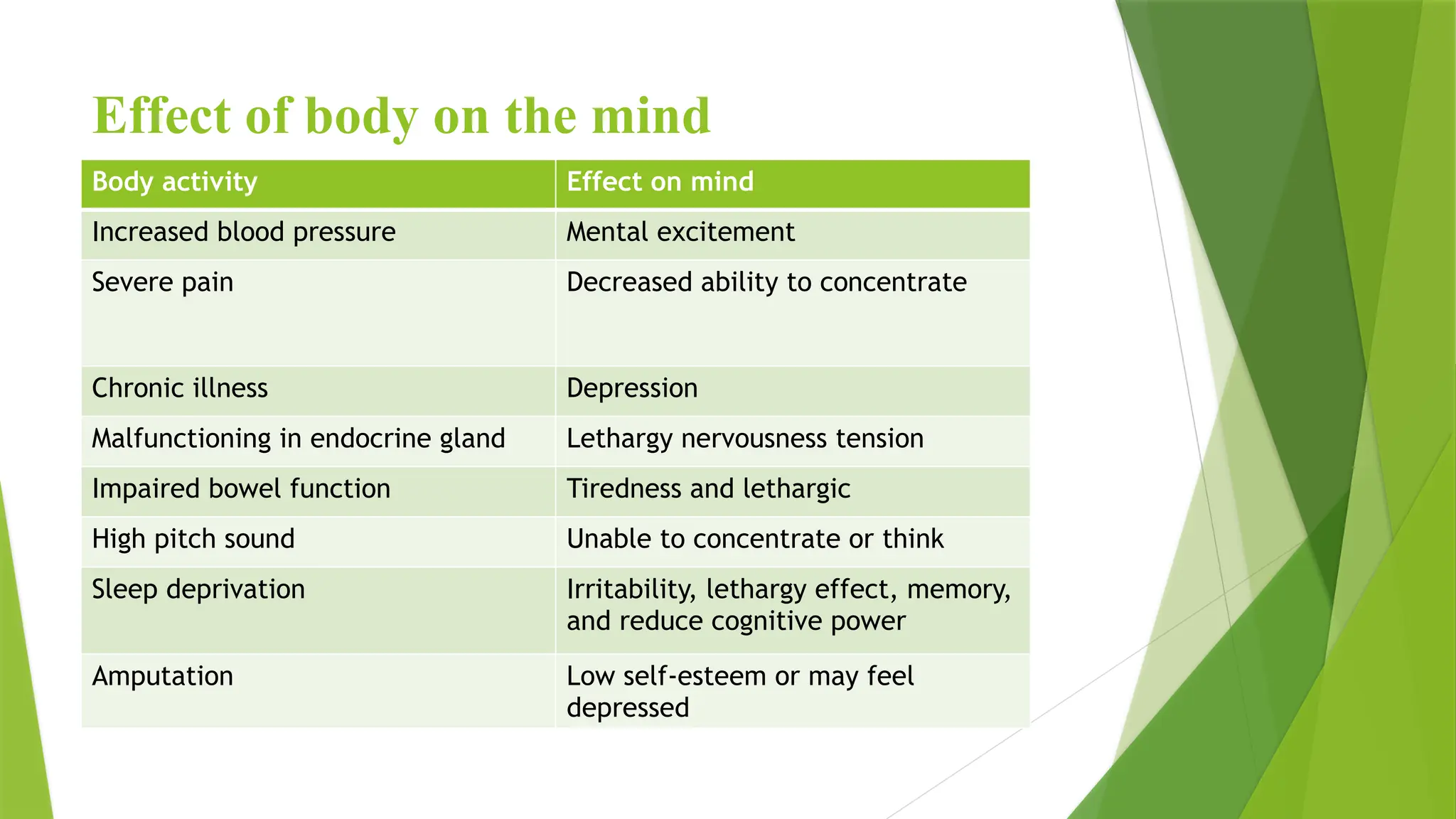
Effect of bodyon the mind
Body activity Effect on mind
Increased blood pressure Mental excitement
Severe pain Decreased ability to concentrate
Chronic illness Depression
Malfunctioning in endocrine gland Lethargy nervousness tension
Impaired bowel function Tiredness and lethargic
High pitch sound Unable to concentrate or think
Sleep deprivation Irritability, lethargy effect, memory,
and reduce cognitive power
Amputation Low self-esteem or may feel
depressed
7.
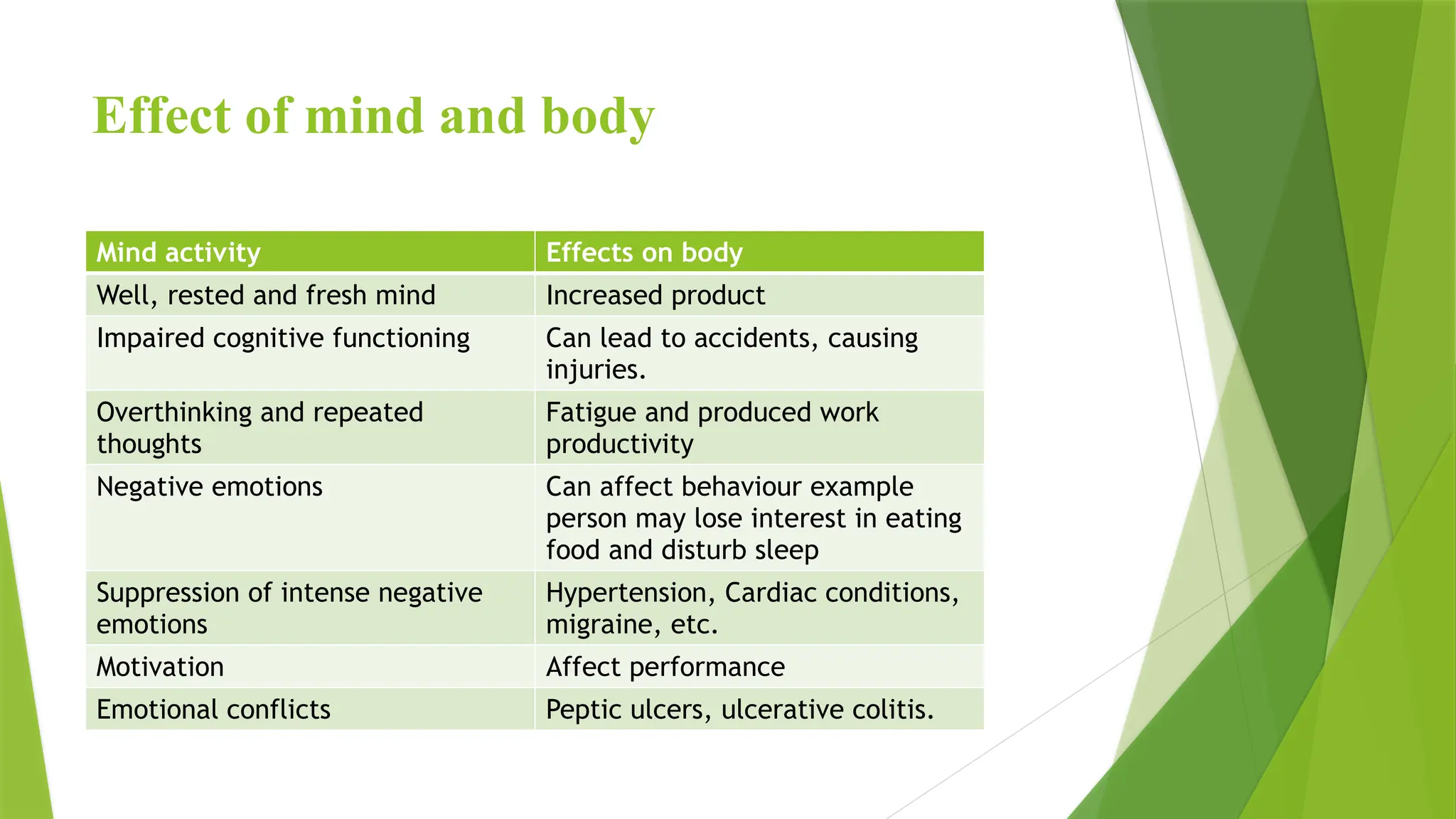
Effect of mindand body
Mind activity Effects on body
Well, rested and fresh mind Increased product
Impaired cognitive functioning Can lead to accidents, causing
injuries.
Overthinking and repeated
thoughts
Fatigue and produced work
productivity
Negative emotions Can affect behaviour example
person may lose interest in eating
food and disturb sleep
Suppression of intense negative
emotions
Hypertension, Cardiac conditions,
migraine, etc.
Motivation Affect performance
Emotional conflicts Peptic ulcers, ulcerative colitis.
8.
Body Mind Relationship
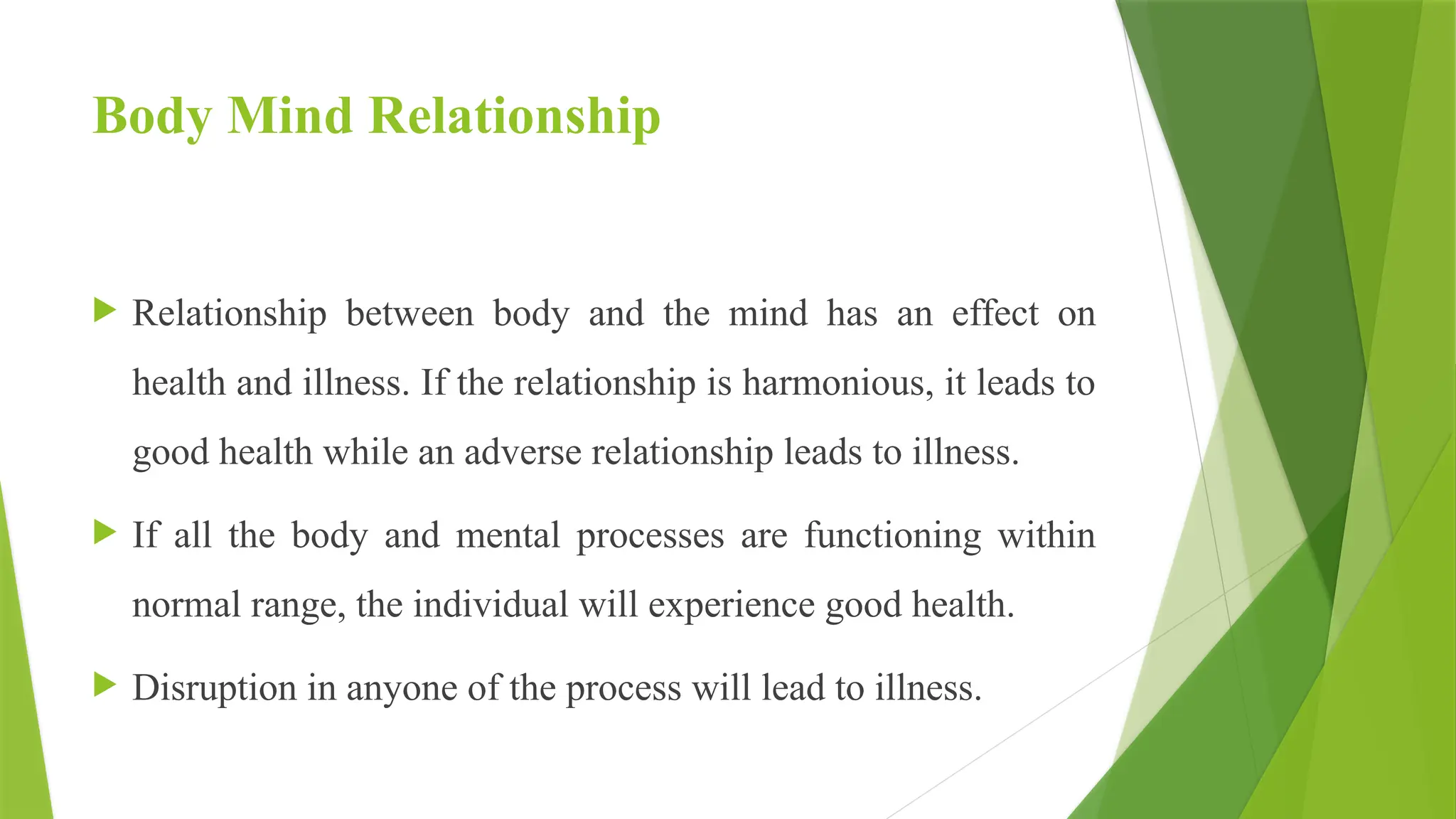
Relationship between body and the mind has an effect on
health and illness. If the relationship is harmonious, it leads to
good health while an adverse relationship leads to illness.
If all the body and mental processes are functioning within
normal range, the individual will experience good health.
Disruption in anyone of the process will lead to illness.
9.
Application of theknowledge of mind,
body relationship
For self-care
Think positively
Keep time for relaxation
Eat, nutritious food and drink plenty of water
Exercise daily
10.
In Nursing practice
Promotion of health and prevention of illness:
Use role-play, puppet shows, stories, etc and inform the community about the body mind
relationship so that health promotion and illness prevention occur.
Secondary prevention: talk to your patients and their family members about the body, mind,
interrelationship and ways to maintain a healthy mind in a healthy body so that there is
smooth and quick recovery from illness.
Tertiary prevention: counsel your patients who are undergoing rehabilitation about the body
mind inter relationship so that the relationship process is facilitated and the individual is able
to return to the pre-morbid level of functioning at the earliest.
11.
Genetics and behaviour
Heredity is the sum total of inborn individual traits.
It is the sum of all biological processes through which
specific characteristics are passed down from parents to
children.
Effect of geneticson Human behaviour
Genetics influences an individual’s intellectual ability,
personality and also risk for developing diseases.
Heredity is the basis for development of human
personality.
It is like the raw material in the hands of artist.
14.
Characteristics influences bygenetic
factors
Physical characteristics:
Height
Weight
Obesity
Tone of voice
Blood pressure (etc)
Environment and Heredity
The influence of environment starts even before one is
born, i.e. In the mother’s womb.
There are 2 ways in which this happen:
Preimplantation
After conception
18.
Preimplantation
The mother’slifestyle – nutrition , substance use,
obesity, or the presence of non communicable disease,
such as diabetes mellitus, influence the development of
the embryo after conception.
19.
After conception
Afterconception 3 types of environment can affect the
growth and development of the embryo:
Intracellular environment
Intrauterine environment
External environment
20.
Intracellular environment
Relatedto embryonic development
Various chemicals factors such as glucose, growth
factor, hormones, metabolic regulators, amino acids and
cytokines contribute to healthy development.
21.
Intrauterine Environment
Itshelters the baby during prenatal life.
The growth of the baby depends on the nourishment
provided by the mother.
The physiological and psychological states of the mother
during pregnancy, her habits & interest etc. All influence
the development of the child.
Influence of heredityand environment
Twin studies
In the absence of parent’s supports a child’s Scores in school
can be influenced.
Not all children born to mentally ill parents have mentally ill
child, environment play its role in the child mental
development.
24.
Application of knowledgeof genetic and
behaviour
Primary prevention
Secondary prevention
Tertiary prevention
25.
Genetic counselling
Preconceptioncounselling
Counsel consanguineously wedded couples
History of chemical, X ray , toxins , drugs exposure.
One child with birth defector genetic disorder.
After Amniocentesis
26.
Role and Responsibilitiesof nurse in
genetic counselling
Good communicator
Non judgmental
Inform the patient & family
Good decision maker
27.
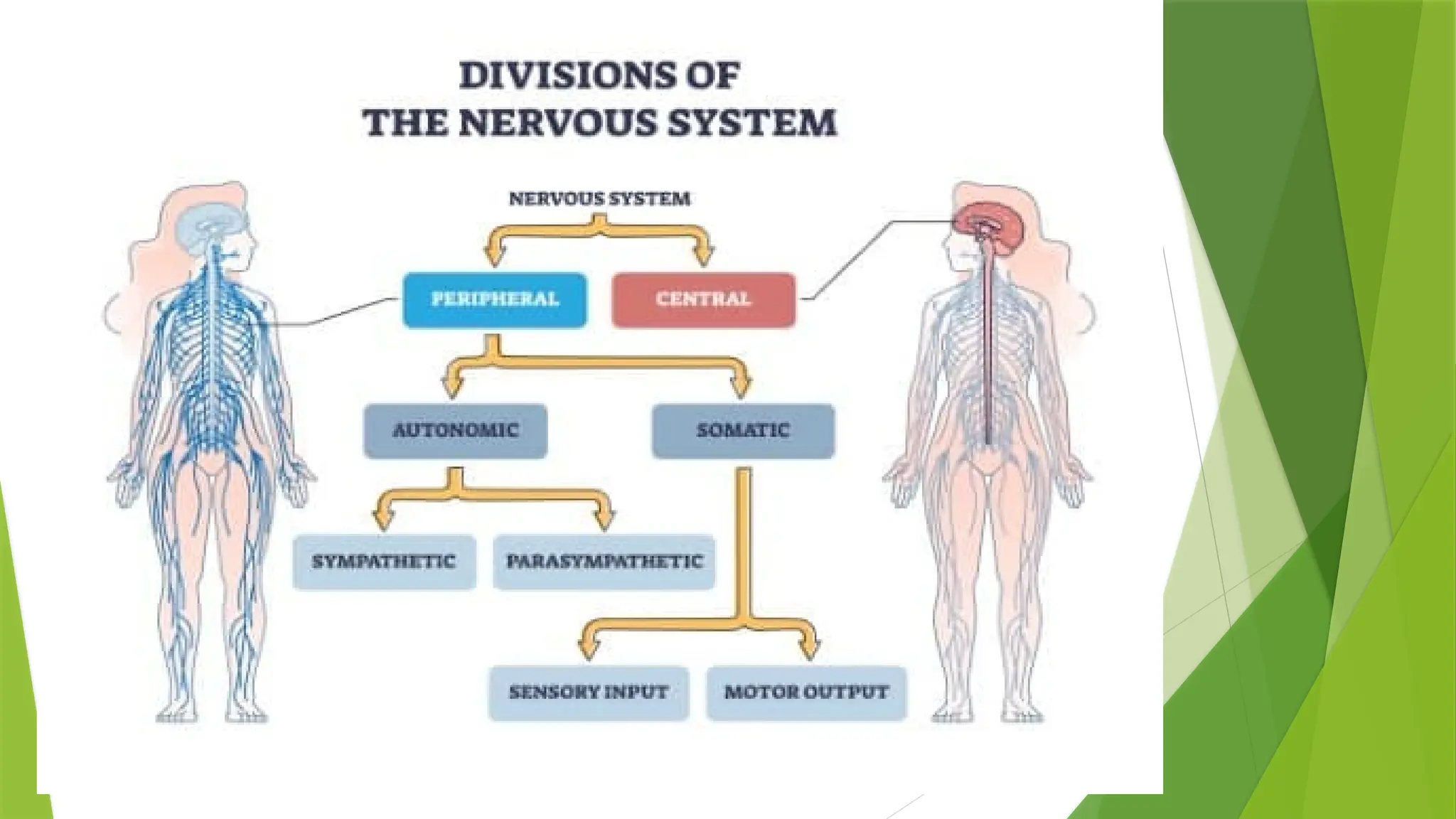
Brain and behaviour
Brain is the core of the nervous system.
The NS is the major controlling & regulatory system.
Human behaviour involves the body-mind interaction of
the various bodily factors.
28.
The biologicalcontrol system
Receptors
Effectors
Connectors
29.
Receptors
The senseorgans called receptors
Stimuli in the form of various sensory experiences are
received by our sensory organs known as receptors.
External receptors
Organswhich help us make contact with the outer world. E.g.
Eyes, Ears, nose, tongue & skin.
The specific receptors cells for receiving the external stimuli lie
within these sensory organs.
When receptors malfunctions they lead to sensory defects or
disorders-visuals , auditory, cutaneous, olfactory, gustatory and
kinaesthetic disorders.
32.
Internal receptors
Associatedwith internal stimuli present in our body.
They are responsible for feelings of pain, hunger or nausea.
They also help us in maintaining equilibrium, balance and
bodily posture.
33.
Effectors
Muscles andendocrine glands called as effectors.
What is received through sensory organs in the form of
sensory input is responded through bodily reactions and
motor activities which are carried out by muscles and
glands.
The hormones secreted by ductless(endocrine) glands are
responsible for most of our behaviour.
34.
Muscles
Muscles helpthe organism to carry out motor activities in
order to respond to various stimuli.
Types of muscles:
Smooth muscles
Cardiac muscles
Skeletal muscles
35.
Smooth
muscles
Cardiac
muscles
Skeletal
muscles
Helps in theprocess
of digestion,
excretion & blood
circulation.
Function smoothly
in a rhythmic
fashion but when
one is emotionally
upset their normal
functioning is
disturbed causing
heart trouble.
Enables the
individual to
perform voluntary
motor activities
ranging from
walking to the fine
psychomotor skill
like typing.
Connectors
Helps inregulating, controlling or coordinating the
activities of receptors & effectors.
It is necessary for the body to provide messages to the
muscles to coordinate.
These messages are passed through specialized cells
called “Neurons”.
38.
Neuron
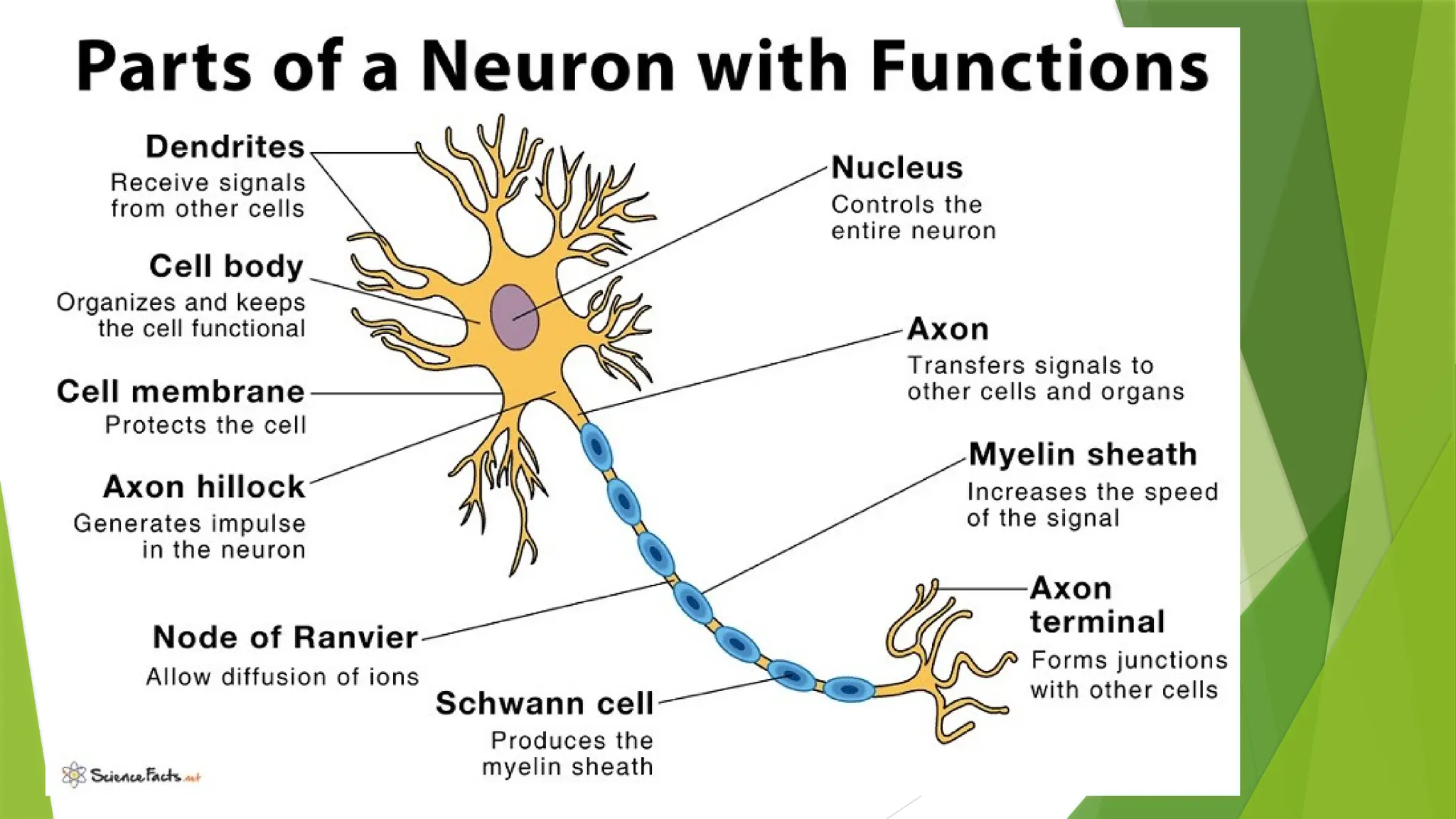
Neurons arethe basic anatomic and functional unit in the
NS.
Size: 5 to 100 micro meter in diameter.
40.
Types of neurons
Sensory neuron
Motor neuron
Interneuron or association neuron